Made By:
Pawan Yadav
WHAT IS ENVIRONMENT EDUCATION
Is a process by which people develop
awareness, concern and knowledge of
the environment and learn to use this
understanding to preserve, conserve and
utilize the environment in a sustainable
manner for the benefit of present and
future generations.
It entails the will to take personal
initiatives and social participation
to achieve sustainability.
It is intended for all types of
learners, students, out-of-school
youth, community leaders,
policy makers and the general
public to develop appropriate
environmental-related skills.
Goals, Objectives and Aims of
Environmental Education
The main goal is to develop concern and
awareness among world population about the
total environment and its associated problems.
The goals of environmental education are:
1. To improve the quality of environment
2. To create awareness among the people on
environmental problems and conversations
3. To create an atmosphere so that people
participate in decision-making and develop
the capabilities to evaluate the
developmental programs.
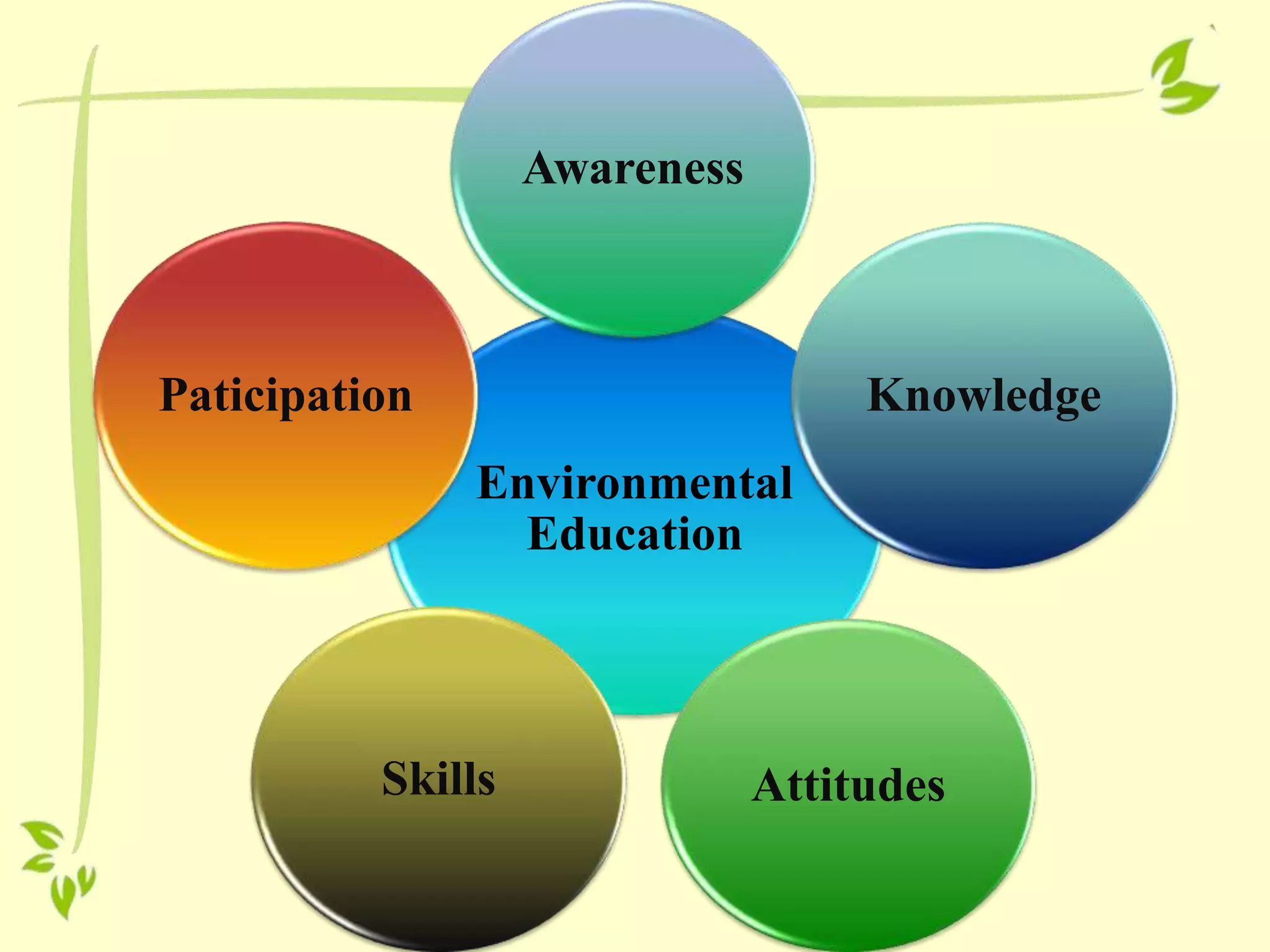
Environmental
Education
Awareness
Knowledge
AttitudesSkills
Paticipation
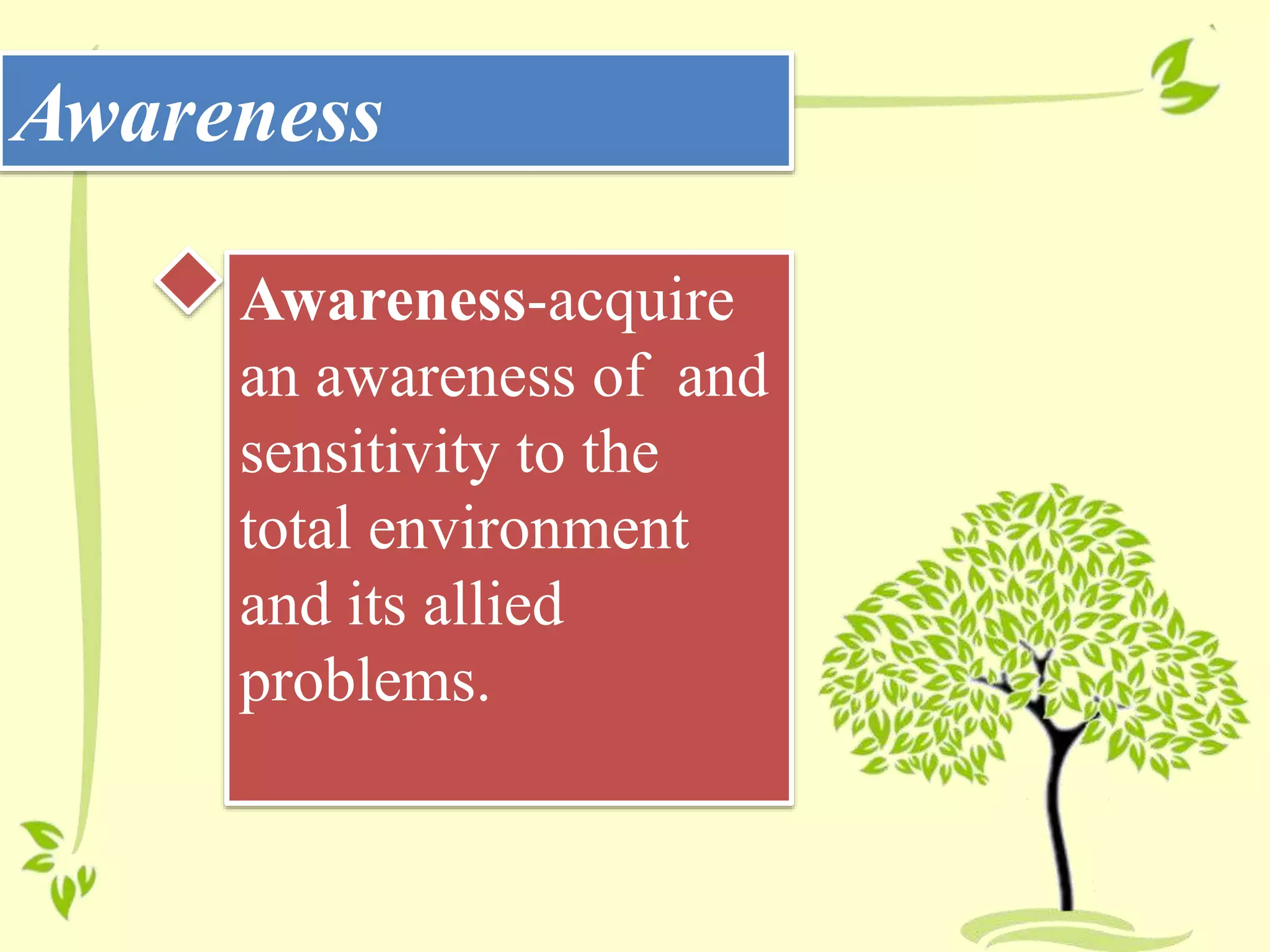
Awareness
Awareness-acquire
an awareness of and
sensitivity to the
total environment
and its allied
problems.
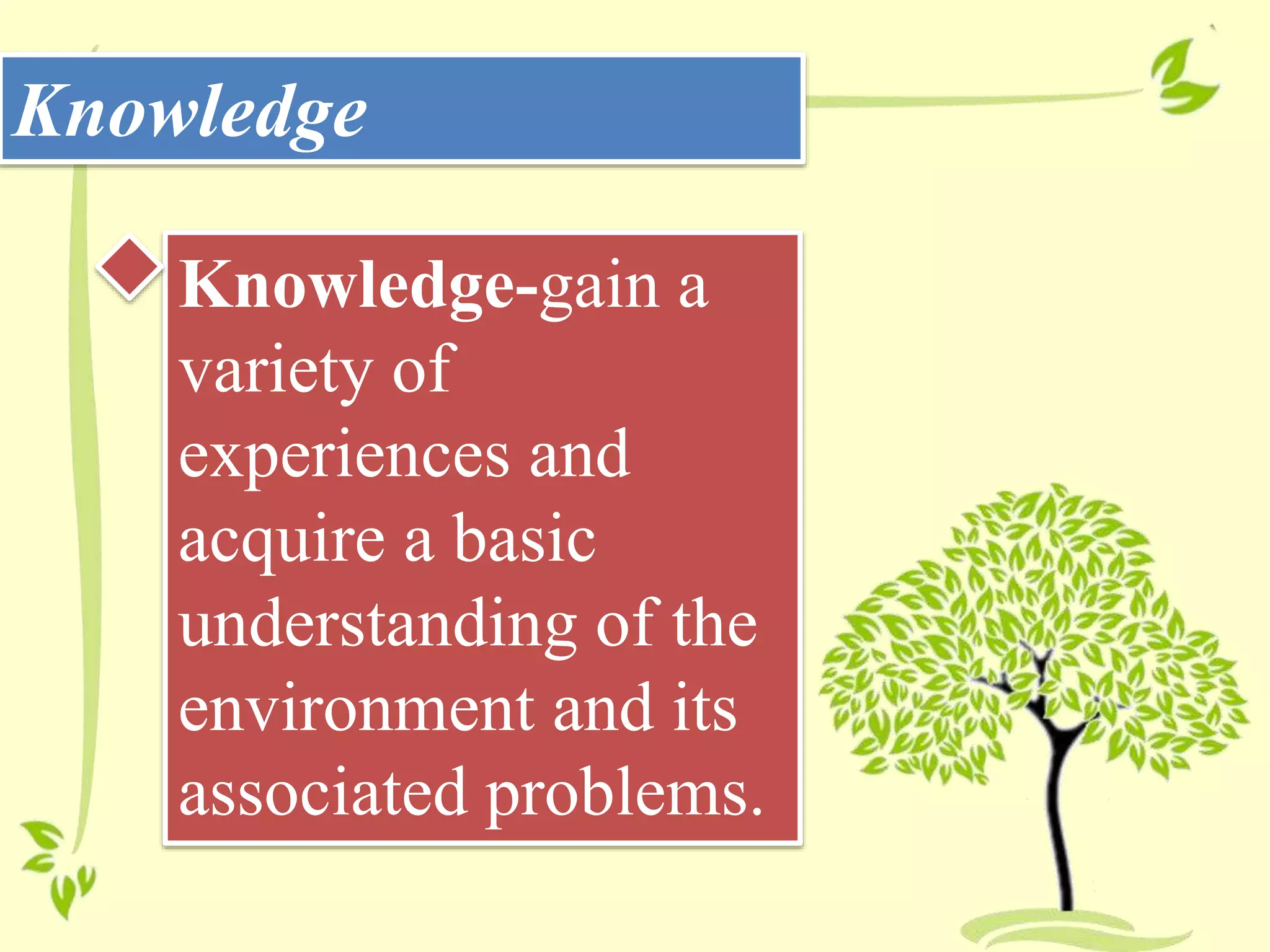
Knowledge
Knowledge-gain a
variety of
experiences and
acquire a basic
understanding of the
environment and its
associated problems.
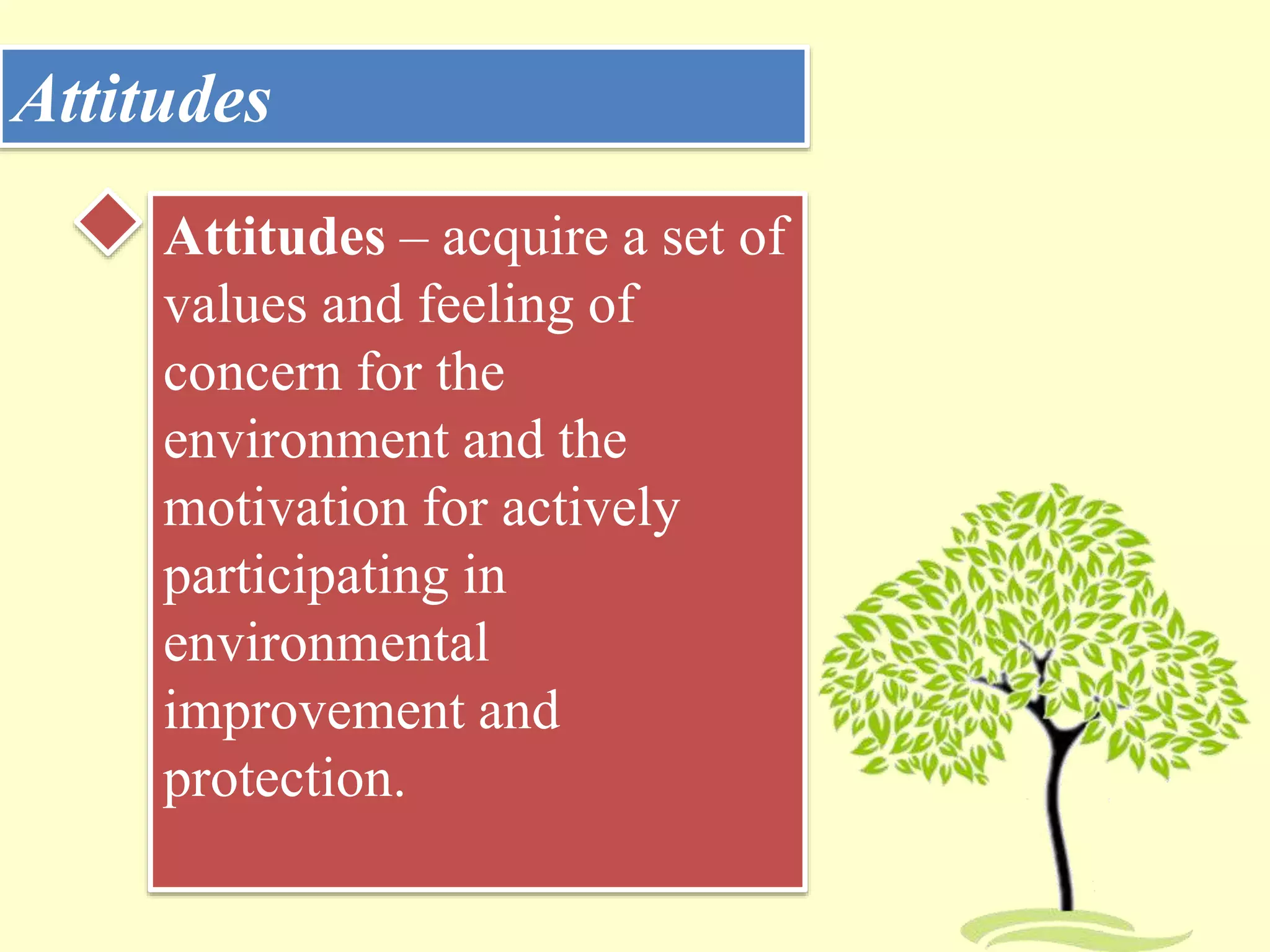
Attitudes
Attitudes – acquire a set of
values and feeling of
concern for the
environment and the
motivation for actively
participating in
environmental
improvement and
protection.
Skills
Skills – acquire
skills for identifying
and solving
environmental
problems.
Participation
Participation - to provide
social groups and
individuals with an
opportunity to be actively
involved at all levels
working towards the
resolution of
environmental problems.
Aims of Environmental
Education
To provide different groups of people as
well as graduates in a variety of
professional fields with the knowledge
needed to develop a sense of
responsibility towards the environment
and the rational utilization of its riches.
To make use of these knowledge and
skills to preserve, conserve and utilize
the environment in a sustainable manner
for the benefit of present and future
generations.
Importance of Environmental
Education
Increases student engagement in
science.
Improves student achievement in
core subject areas.
Provides critical tools for a 21st century
workface
Helps address “nature deficit disorder”
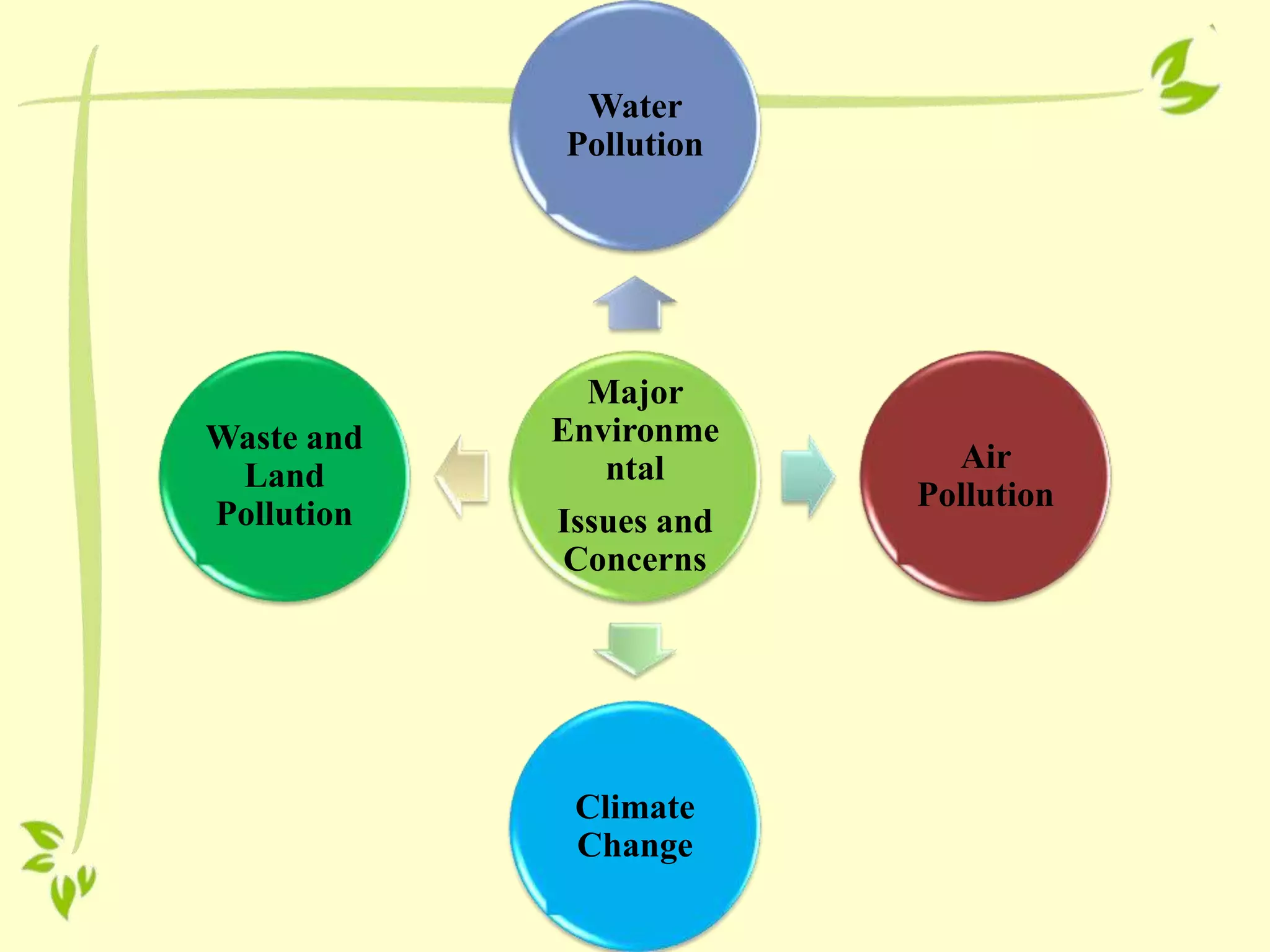
Major
Environme
ntal
Issues and
Concerns
Water
Pollution
Air
Pollution
Climate
Change
Waste and
Land
Pollution
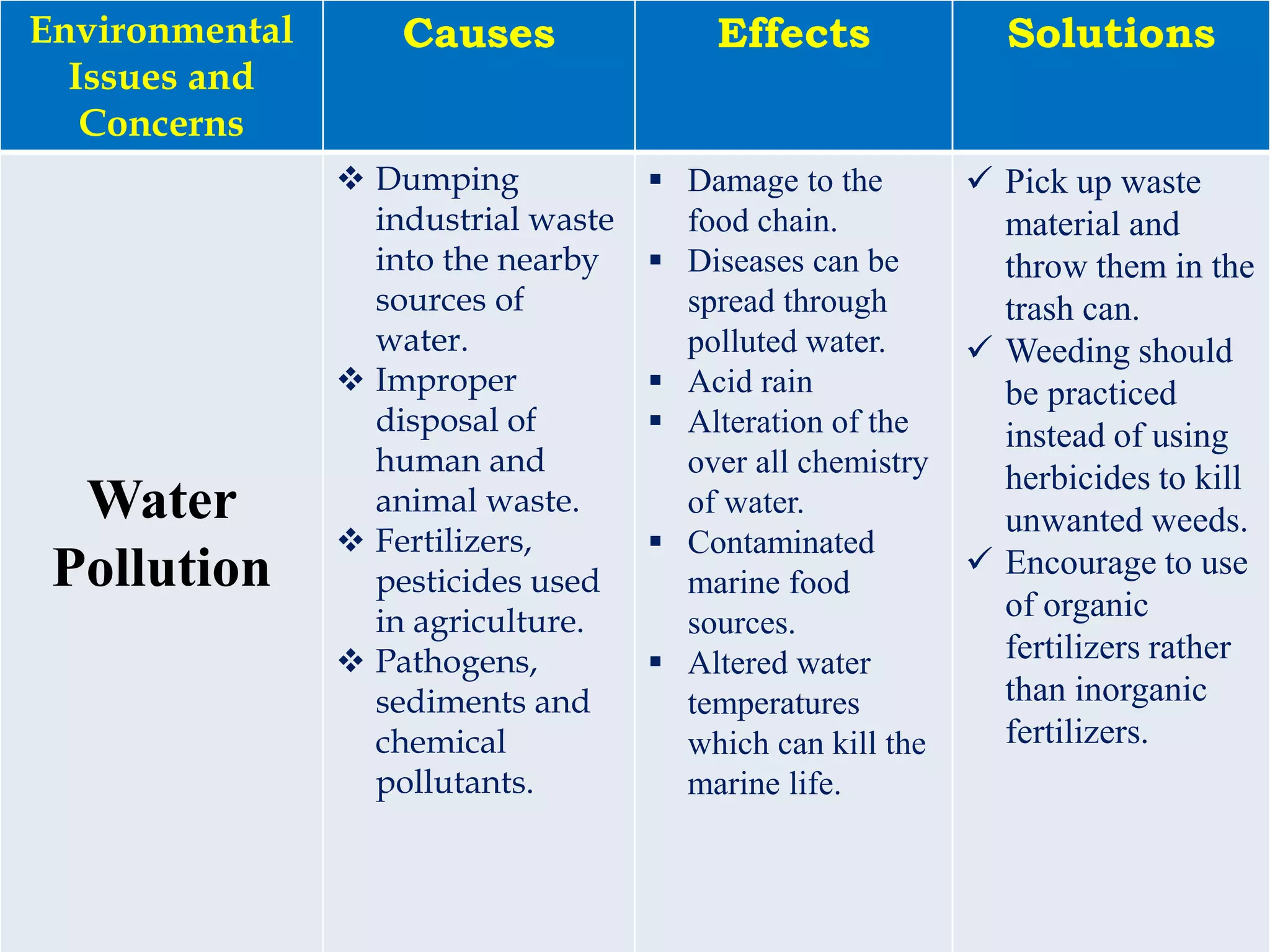
3/26/2017
Environmental
Issues and
Concerns
Causes Effects Solutions
Water
Pollution
 Dumping
industrial waste
into the nearby
sources of
water.
 Improper
disposal of
human and
animal waste.
 Fertilizers,
pesticides used
in agriculture.
 Pathogens,
sediments and
chemical
pollutants.
 Damage to the
food chain.
 Diseases can be
spread through
polluted water.
 Acid rain
 Alteration of the
over all chemistry
of water.
 Contaminated
marine food
sources.
 Altered water
temperatures
which can kill the
marine life.
 Pick up waste
material and
throw them in the
trash can.
 Weeding should
be practiced
instead of using
herbicides to kill
unwanted weeds.
 Encourage to use
of organic
fertilizers rather
than inorganic
fertilizers.
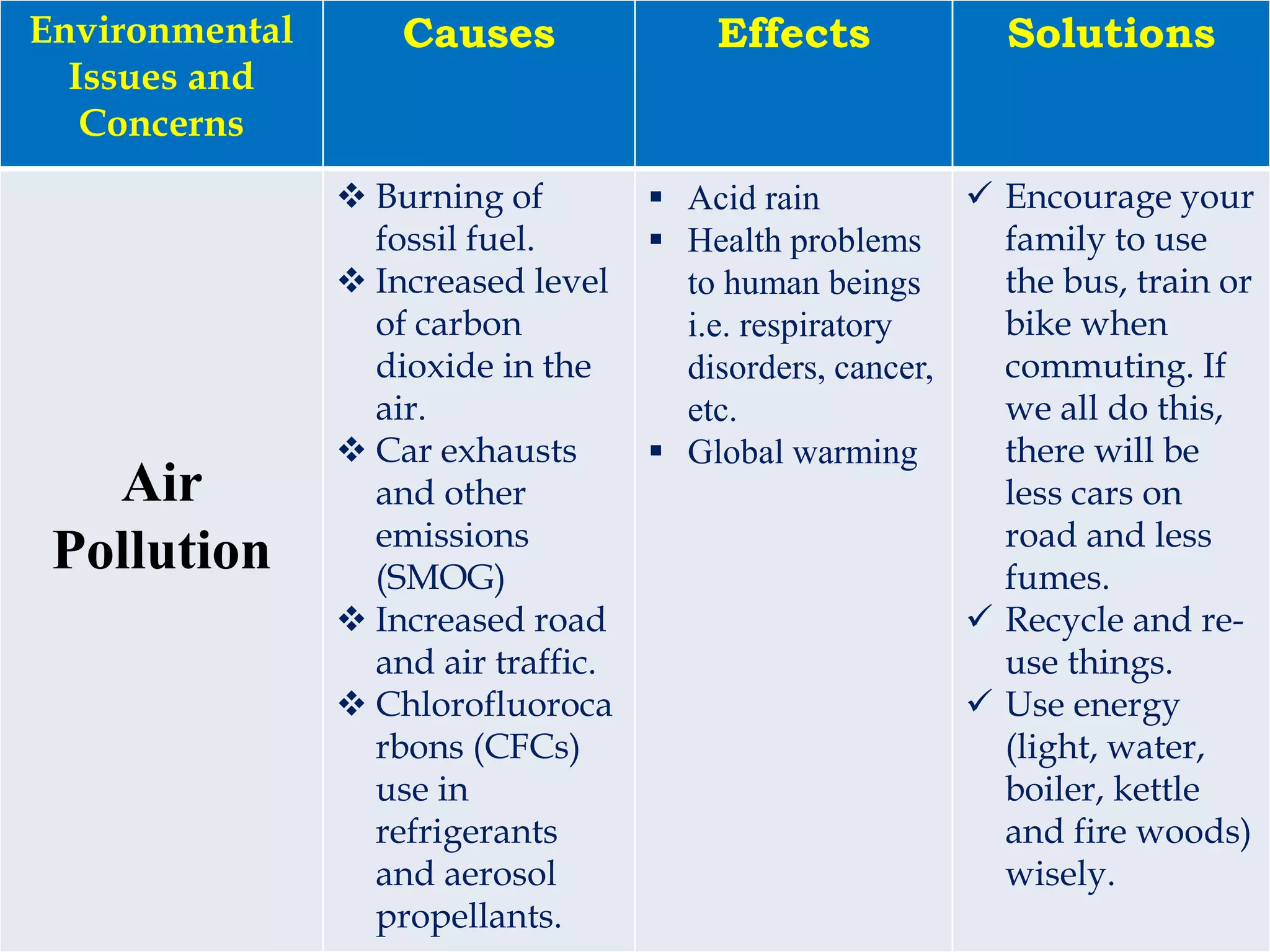
3/26/2017
Environmental
Issues and
Concerns
Causes Effects Solutions
Air
Pollution
 Burning of
fossil fuel.
 Increased level
of carbon
dioxide in the
air.
 Car exhausts
and other
emissions
(SMOG)
 Increased road
and air traffic.
 Chlorofluoroca
rbons (CFCs)
use in
refrigerants
and aerosol
propellants.
 Acid rain
 Health problems
to human beings
i.e. respiratory
disorders, cancer,
etc.
 Global warming
 Encourage your
family to use
the bus, train or
bike when
commuting. If
we all do this,
there will be
less cars on
road and less
fumes.
 Recycle and re-
use things.
 Use energy
(light, water,
boiler, kettle
and fire woods)
wisely.
3/26/2017
Environmental
Issues and
Concerns
Causes Effects Solutions
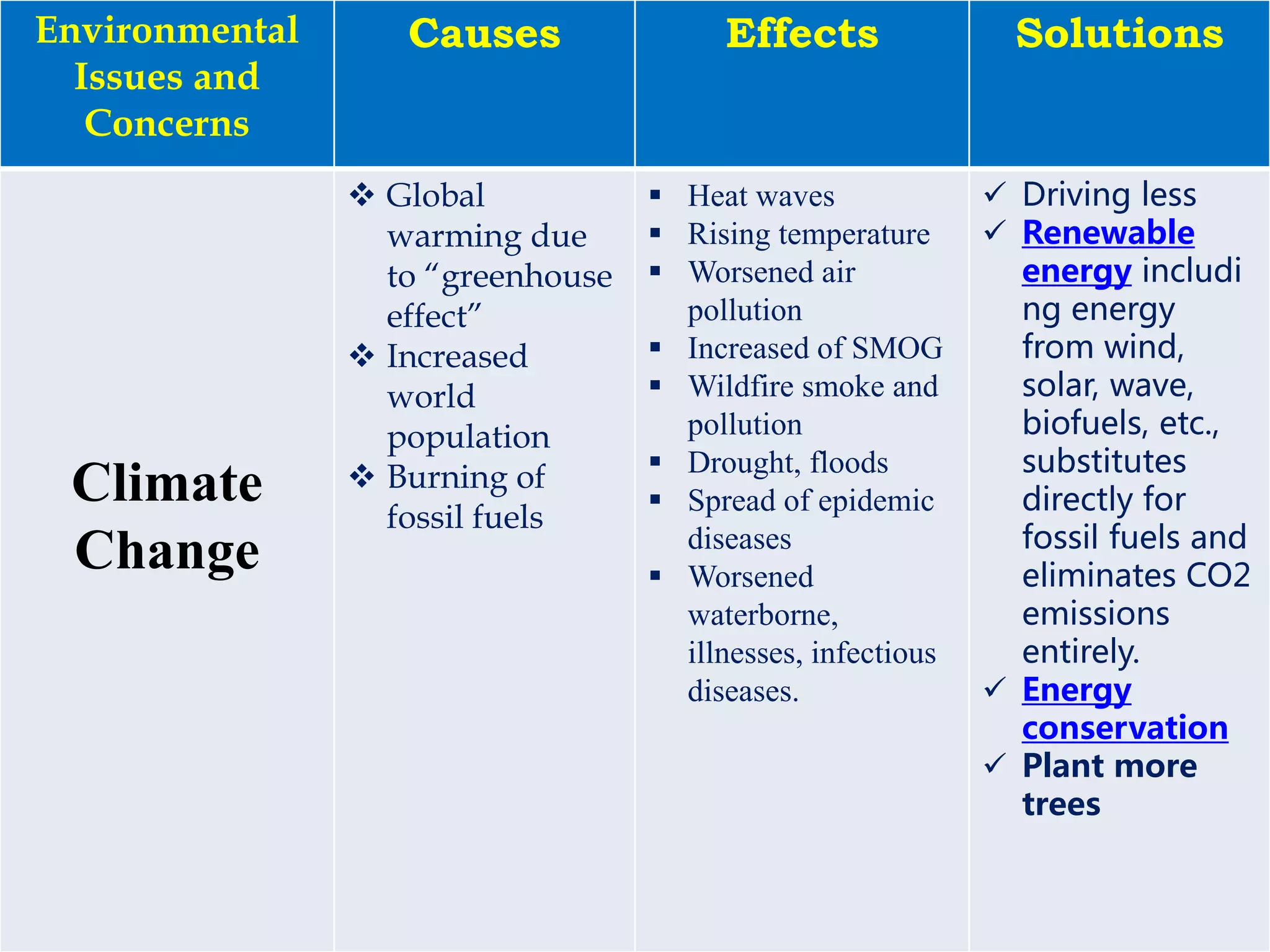
Climate
Change
 Global
warming due
to “greenhouse
effect”
 Increased
world
population
 Burning of
fossil fuels
 Heat waves
 Rising temperature
 Worsened air
pollution
 Increased of SMOG
 Wildfire smoke and
pollution
 Drought, floods
 Spread of epidemic
diseases
 Worsened
waterborne,
illnesses, infectious
diseases.
 Driving less
 Renewable
energy includi
ng energy
from wind,
solar, wave,
biofuels, etc.,
substitutes
directly for
fossil fuels and
eliminates CO2
emissions
entirely.
 Energy
conservation
 Plant more
trees
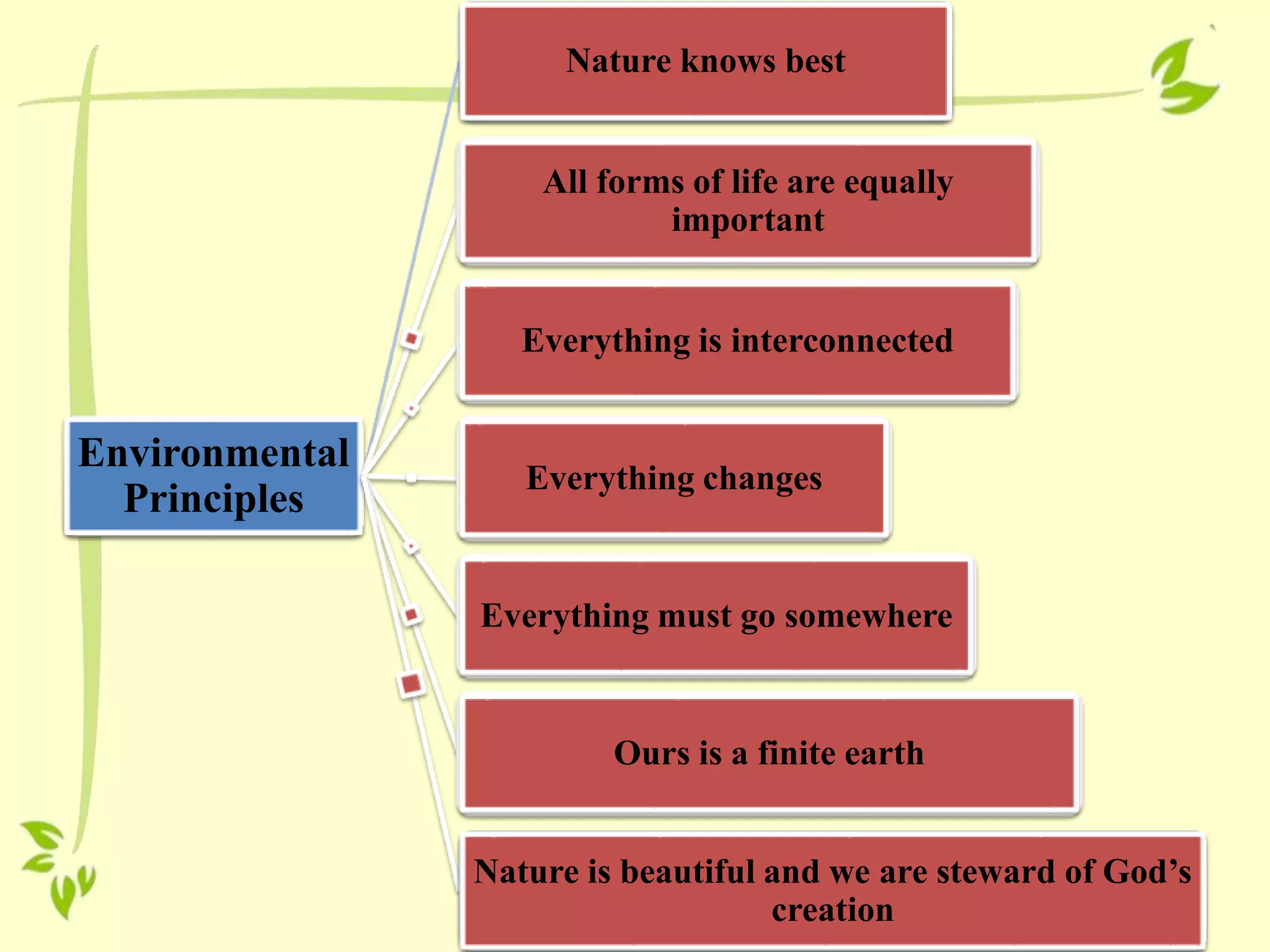
Environmental
Principles
Nature knows best
All forms of life are equally
important
Everything is interconnected
Everything changes
Everything must go somewhere
Ours is a finite earth
Nature is beautiful and we are steward of God’s
creation
TODAY'S EARTH
CONDITION
Thank you
Submited By:
Pawan Yadav

IMPORTANCE OF ENVIRONMENTAL EDUCATION.

  • 1.
  • 2.
    WHAT IS ENVIRONMENTEDUCATION Is a process by which people develop awareness, concern and knowledge of the environment and learn to use this understanding to preserve, conserve and utilize the environment in a sustainable manner for the benefit of present and future generations. It entails the will to take personal initiatives and social participation to achieve sustainability.
  • 3.
    It is intendedfor all types of learners, students, out-of-school youth, community leaders, policy makers and the general public to develop appropriate environmental-related skills.
  • 4.
    Goals, Objectives andAims of Environmental Education The main goal is to develop concern and awareness among world population about the total environment and its associated problems. The goals of environmental education are: 1. To improve the quality of environment 2. To create awareness among the people on environmental problems and conversations 3. To create an atmosphere so that people participate in decision-making and develop the capabilities to evaluate the developmental programs.
  • 5.
  • 6.
    Awareness Awareness-acquire an awareness ofand sensitivity to the total environment and its allied problems.
  • 7.
    Knowledge Knowledge-gain a variety of experiencesand acquire a basic understanding of the environment and its associated problems.
  • 8.
    Attitudes Attitudes – acquirea set of values and feeling of concern for the environment and the motivation for actively participating in environmental improvement and protection.
  • 9.
    Skills Skills – acquire skillsfor identifying and solving environmental problems.
  • 10.
    Participation Participation - toprovide social groups and individuals with an opportunity to be actively involved at all levels working towards the resolution of environmental problems.
  • 11.
    Aims of Environmental Education Toprovide different groups of people as well as graduates in a variety of professional fields with the knowledge needed to develop a sense of responsibility towards the environment and the rational utilization of its riches. To make use of these knowledge and skills to preserve, conserve and utilize the environment in a sustainable manner for the benefit of present and future generations.
  • 12.
    Importance of Environmental Education Increasesstudent engagement in science. Improves student achievement in core subject areas. Provides critical tools for a 21st century workface Helps address “nature deficit disorder”
  • 13.
  • 14.
    3/26/2017 Environmental Issues and Concerns Causes EffectsSolutions Water Pollution  Dumping industrial waste into the nearby sources of water.  Improper disposal of human and animal waste.  Fertilizers, pesticides used in agriculture.  Pathogens, sediments and chemical pollutants.  Damage to the food chain.  Diseases can be spread through polluted water.  Acid rain  Alteration of the over all chemistry of water.  Contaminated marine food sources.  Altered water temperatures which can kill the marine life.  Pick up waste material and throw them in the trash can.  Weeding should be practiced instead of using herbicides to kill unwanted weeds.  Encourage to use of organic fertilizers rather than inorganic fertilizers.
  • 16.
    3/26/2017 Environmental Issues and Concerns Causes EffectsSolutions Air Pollution  Burning of fossil fuel.  Increased level of carbon dioxide in the air.  Car exhausts and other emissions (SMOG)  Increased road and air traffic.  Chlorofluoroca rbons (CFCs) use in refrigerants and aerosol propellants.  Acid rain  Health problems to human beings i.e. respiratory disorders, cancer, etc.  Global warming  Encourage your family to use the bus, train or bike when commuting. If we all do this, there will be less cars on road and less fumes.  Recycle and re- use things.  Use energy (light, water, boiler, kettle and fire woods) wisely.
  • 18.
    3/26/2017 Environmental Issues and Concerns Causes EffectsSolutions Climate Change  Global warming due to “greenhouse effect”  Increased world population  Burning of fossil fuels  Heat waves  Rising temperature  Worsened air pollution  Increased of SMOG  Wildfire smoke and pollution  Drought, floods  Spread of epidemic diseases  Worsened waterborne, illnesses, infectious diseases.  Driving less  Renewable energy includi ng energy from wind, solar, wave, biofuels, etc., substitutes directly for fossil fuels and eliminates CO2 emissions entirely.  Energy conservation  Plant more trees
  • 20.
    Environmental Principles Nature knows best Allforms of life are equally important Everything is interconnected Everything changes Everything must go somewhere Ours is a finite earth Nature is beautiful and we are steward of God’s creation
  • 21.
  • 22.