




MSERA
Pensacola, Florida
November 7, 2013
Susan P. Santoli, Ph.D.
ssantoli@southalabama.edu
Paige Vitulli, Ph.D.
pvitulli@southalabama.edu
University of South Alabama, College of Education
Introduction
 Becoming an effective teacher is a process.

New teachers may have completed quality
teacher education programs, but these
programs alone cannot prepare students
with the knowledge and skills they need to
be successful in their own classrooms (Berry,
2006; Haynes, 2011; Ingersoll, 2012; The
Teaching Council, 2011).
Introduction
 Some of the benefits of quality induction

programs include:
 attracting better candidates
 reduced attrition
 improved job satisfaction
 enhanced professional development
 and improved teaching and learning
 (Howe, 2012, p. 287).
Introduction
 One criticism of many U.S. induction

programs is that they focus on helping
teachers survive the first year of teaching,
but offer little support beyond that (Howe,
2006; American Association of State
Colleges and Universities, 2006;
Wojcikiewicz, 2005)
Introduction
 There is no single way to provide effective

induction to new teachers, nor does any
country or state have a“best” way; however,
there are recurring themes in programs
which have been recognized as effective.
 In this article we focus specifically on the
research-based new teacher induction
program in Ireland.
Ireland’s National Induction
Programme for Teachers
 In 2012, the authors of this article, both teacher

educators in the U.S. visited St. Patrick’s College
Drumcondra, Dublin to discuss teacher education
with the Dean of Education and the Co-ordinators
of the National Induction Programme for
Teachers (NIPT).
 The information and passion that were shared on

Ireland’s continuum of teacher education and the
induction program prompted more research and
resulted in this article.
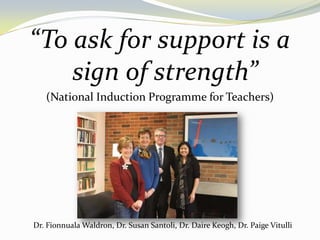
“To ask for support is a
sign of strength”
(National Induction Programme for Teachers)

Dr. Fionnuala Waldron, Dr. Susan Santoli, Dr. Daire Keogh, Dr. Paige Vitulli
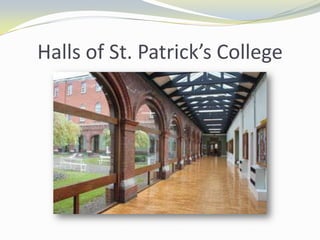
Halls of St. Patrick’s College
Dr. Waldron gives us a tour and accompanies us to the
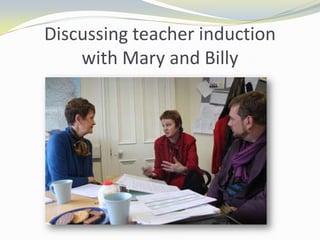
Gate Lodge to meet with Billy Redmond and Mary Burke
Gate Lodge
Big things happen in small buildings!
Discussing teacher induction
with Mary and Billy
Induction in Ireland
 The teaching profession in Ireland is held in great esteem and

the teacher education programs attract students who graduate at
the top of their classes (B. Redmond & M. Burke, personal
communication, October 27, 2012).
 Funding for education is not provided by local governments.
Teacher salaries and the costs of operating the schools and
programs are assumed by the national government through the
Department of Education and Skills. The vast majority of
teachers are unionized (Hyland, 2012).
 In 2011-2012, there were 57,736 primary and post primary
teachers (The Department of Education and Skills, p. 2). Two
thousand seven hundred and fifty students graduated from
primary and post primary teacher preparation programs in 2011
(Hyland, 2012, p. 11).
 In the 1990’s induction for new teachers in Ireland was

characterized as “inconsistent, and in many cases nonexistent” (Killeavy & Murphy, 2006, p. 20).
 By 2002, that was no longer the case as the National Pilot
Project for Teacher Induction was underway.
 Developed in partnership with teacher educators, teacher
unions, education centers and participating schools
(Killeavy, 2006; Politis, 2012), the pilot’s purpose was to
“develop proposals and identify models of induction for an
effective national program” (Killeavy, 2006, p. 172).
 In 2010 the pilot ended and NIPT began (Politis, 2012).
Workshops
 Twelve workshops, whose content “was identified in

research during the pilot phases,” comprise the heart
of the induction process (Politis, 2012, p. 22).
 They focus on immediate teacher needs, such as:
 working as professionals

 preparing and delivering instruction to diverse student






populations
assessment
organizing and managing a classroom
working with parents
areas of specific importance to Irish teachers: Gaelige,
Numeracy and Literacy.
Workshops
 Workshops are led by practicing teachers who have

been trained as facilitators. The workshops actively
involve participants and provide practical, classroombased assistance from facilitators who can share own
classroom experiences (B Redmond & M. Burke,
personal communication October 27, 2012).
 Teachers have three years to complete these workshops
which are offered in the late afternoon or evenings at
regional educational centers throughout the country
(The Teaching Council).
Workshops
 The workshops were originally voluntary, but since July

2, 2012, are required for new teachers applying for
registration.
 Surveys conducted with first term 2011-2012 workshop

participants revealed that all of the workshops
received satisfaction ratings consisting primary of
“very helpful” or “helpful” ratings in large percentages.
In fact, only two workshops received “not helpful
ratings” of over 1 percent (Politis, 2012).
Additional Support
Along with the required workshops, NIPT provides other types of support:
 Direct school based support where practicing teachers are trained to mentor
new teachers and work with school leadership and staff to develop a program
of induction activities.
 New teachers participate in school based activities such as meeting with
mentors for planning, observing other teachers, being observed by their
mentors and receiving feedback on their teaching.
 Schools or teachers needing help in specific areas, beyond what is provided by
workshops, may access Professional Support Group assistance which allows a
small group of teachers to determine the content of and bring their own
classroom situations to a session (B. Redmond & M. Burke, personal
communication, October 27, 2012).
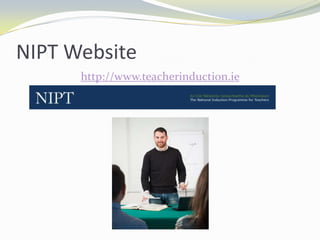
 Teachers also have access to the NIPT website
(http://www.teacherinduction.ie) which provides information and resources
regarding induction.
 Additionally, there is a section entitled, Feature School, which focuses on
schools participating in the mentoring program. For each school, there are
comments from principals, mentors and new teachers along with descriptions
of some induction activities used in that school.
NIPT Website
http://www.teacherinduction.ie
Additional Teacher Education
Revisions
 In addition to strengthening the new teacher induction

phase, initial teacher education programs have been
lengthened.
 Beginning in September 2012, undergraduate primary
programs were increased from three to four years with post
graduate programs scheduled to increase from 18 months
to two years beginning in 2014.
 Post primary programs will increase from 1 to 2 years
beginning in 2014 (The Teaching Council).
 Thus, Ireland continues to examine and revise various parts
of the continuum, truly reflecting the idea that learning
to teach is a process.
Signs of Strength
 Summarizing the findings of a teacher acculturation

study in five countries, Wong, Britton, & Ganser (2005)
concluded there were three major similarities among
those programs deemed as effective:
 highly structured
 focus on professional learning, and
 emphasize collaboration

 Ireland’s induction program certainly exhibits these

research based characteristics.
We left “Pat's” with new friendships and lots of
ideas about improving our own practice and the
practice of our students in the USA College of
Education!

Susan, Billy and Mary

Paige, Billy and Mary
Blog: Vitulli & Santoli: Eyes on Ireland
http://usaeyesonireland.blogspot.com/

Posts specifically on the St. Patrick’s Drumcondra visit:
http://usaeyesonireland.blogspot.com/2012/10/st-patricks-day-at-least-for-us-st.html
http://usaeyesonireland.blogspot.com/2012/10/more-st-patricks-nationalinduction.html


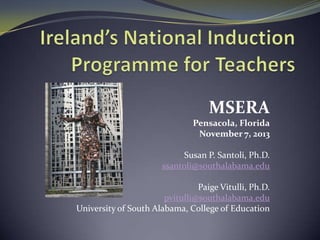
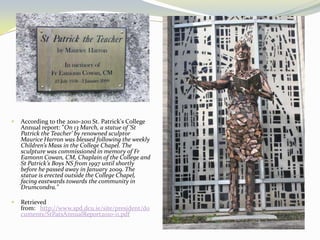
According to the 2010-2011 St. Patrick's College
Annual report: "On 13 March, a statue of ‘St
Patrick the Teacher’ by renowned sculptor
Maurice Harron was blessed following the weekly
Children’s Mass in the College Chapel. The
sculpture was commissioned in memory of Fr
Eamonn Cowan, CM, Chaplain of the College and
St Patrick’s Boys NS from 1997 until shortly
before he passed away in January 2009. The
statue is erected outside the College Chapel,
facing eastwards towards the community in
Drumcondra."



Retrieved
from: http://www.spd.dcu.ie/site/president/do
cuments/StPatsAnnualReport2010-11.pdf
Comments? Questions?

Ireland's National Induction Programme for Teachers

  • 1.
    MSERA Pensacola, Florida November 7,2013 Susan P. Santoli, Ph.D. ssantoli@southalabama.edu Paige Vitulli, Ph.D. pvitulli@southalabama.edu University of South Alabama, College of Education
  • 2.
    Introduction  Becoming aneffective teacher is a process. New teachers may have completed quality teacher education programs, but these programs alone cannot prepare students with the knowledge and skills they need to be successful in their own classrooms (Berry, 2006; Haynes, 2011; Ingersoll, 2012; The Teaching Council, 2011).
  • 3.
    Introduction  Some ofthe benefits of quality induction programs include:  attracting better candidates  reduced attrition  improved job satisfaction  enhanced professional development  and improved teaching and learning  (Howe, 2012, p. 287).
  • 4.
    Introduction  One criticismof many U.S. induction programs is that they focus on helping teachers survive the first year of teaching, but offer little support beyond that (Howe, 2006; American Association of State Colleges and Universities, 2006; Wojcikiewicz, 2005)
  • 5.
    Introduction  There isno single way to provide effective induction to new teachers, nor does any country or state have a“best” way; however, there are recurring themes in programs which have been recognized as effective.  In this article we focus specifically on the research-based new teacher induction program in Ireland.
  • 6.
    Ireland’s National Induction Programmefor Teachers  In 2012, the authors of this article, both teacher educators in the U.S. visited St. Patrick’s College Drumcondra, Dublin to discuss teacher education with the Dean of Education and the Co-ordinators of the National Induction Programme for Teachers (NIPT).  The information and passion that were shared on Ireland’s continuum of teacher education and the induction program prompted more research and resulted in this article.
  • 7.
    “To ask forsupport is a sign of strength” (National Induction Programme for Teachers) Dr. Fionnuala Waldron, Dr. Susan Santoli, Dr. Daire Keogh, Dr. Paige Vitulli
  • 8.
    Halls of St.Patrick’s College
  • 9.
    Dr. Waldron givesus a tour and accompanies us to the Gate Lodge to meet with Billy Redmond and Mary Burke
  • 10.
    Gate Lodge Big thingshappen in small buildings!
  • 11.
  • 12.
    Induction in Ireland The teaching profession in Ireland is held in great esteem and the teacher education programs attract students who graduate at the top of their classes (B. Redmond & M. Burke, personal communication, October 27, 2012).  Funding for education is not provided by local governments. Teacher salaries and the costs of operating the schools and programs are assumed by the national government through the Department of Education and Skills. The vast majority of teachers are unionized (Hyland, 2012).  In 2011-2012, there were 57,736 primary and post primary teachers (The Department of Education and Skills, p. 2). Two thousand seven hundred and fifty students graduated from primary and post primary teacher preparation programs in 2011 (Hyland, 2012, p. 11).
  • 13.
     In the1990’s induction for new teachers in Ireland was characterized as “inconsistent, and in many cases nonexistent” (Killeavy & Murphy, 2006, p. 20).  By 2002, that was no longer the case as the National Pilot Project for Teacher Induction was underway.  Developed in partnership with teacher educators, teacher unions, education centers and participating schools (Killeavy, 2006; Politis, 2012), the pilot’s purpose was to “develop proposals and identify models of induction for an effective national program” (Killeavy, 2006, p. 172).  In 2010 the pilot ended and NIPT began (Politis, 2012).
  • 14.
    Workshops  Twelve workshops,whose content “was identified in research during the pilot phases,” comprise the heart of the induction process (Politis, 2012, p. 22).  They focus on immediate teacher needs, such as:  working as professionals  preparing and delivering instruction to diverse student     populations assessment organizing and managing a classroom working with parents areas of specific importance to Irish teachers: Gaelige, Numeracy and Literacy.
  • 15.
    Workshops  Workshops areled by practicing teachers who have been trained as facilitators. The workshops actively involve participants and provide practical, classroombased assistance from facilitators who can share own classroom experiences (B Redmond & M. Burke, personal communication October 27, 2012).  Teachers have three years to complete these workshops which are offered in the late afternoon or evenings at regional educational centers throughout the country (The Teaching Council).
  • 16.
    Workshops  The workshopswere originally voluntary, but since July 2, 2012, are required for new teachers applying for registration.  Surveys conducted with first term 2011-2012 workshop participants revealed that all of the workshops received satisfaction ratings consisting primary of “very helpful” or “helpful” ratings in large percentages. In fact, only two workshops received “not helpful ratings” of over 1 percent (Politis, 2012).
  • 17.
    Additional Support Along withthe required workshops, NIPT provides other types of support:  Direct school based support where practicing teachers are trained to mentor new teachers and work with school leadership and staff to develop a program of induction activities.  New teachers participate in school based activities such as meeting with mentors for planning, observing other teachers, being observed by their mentors and receiving feedback on their teaching.  Schools or teachers needing help in specific areas, beyond what is provided by workshops, may access Professional Support Group assistance which allows a small group of teachers to determine the content of and bring their own classroom situations to a session (B. Redmond & M. Burke, personal communication, October 27, 2012).  Teachers also have access to the NIPT website (http://www.teacherinduction.ie) which provides information and resources regarding induction.  Additionally, there is a section entitled, Feature School, which focuses on schools participating in the mentoring program. For each school, there are comments from principals, mentors and new teachers along with descriptions of some induction activities used in that school.
  • 18.
  • 19.
    Additional Teacher Education Revisions In addition to strengthening the new teacher induction phase, initial teacher education programs have been lengthened.  Beginning in September 2012, undergraduate primary programs were increased from three to four years with post graduate programs scheduled to increase from 18 months to two years beginning in 2014.  Post primary programs will increase from 1 to 2 years beginning in 2014 (The Teaching Council).  Thus, Ireland continues to examine and revise various parts of the continuum, truly reflecting the idea that learning to teach is a process.
  • 20.
    Signs of Strength Summarizing the findings of a teacher acculturation study in five countries, Wong, Britton, & Ganser (2005) concluded there were three major similarities among those programs deemed as effective:  highly structured  focus on professional learning, and  emphasize collaboration  Ireland’s induction program certainly exhibits these research based characteristics.
  • 21.
    We left “Pat's”with new friendships and lots of ideas about improving our own practice and the practice of our students in the USA College of Education! Susan, Billy and Mary Paige, Billy and Mary
  • 22.
    Blog: Vitulli &Santoli: Eyes on Ireland http://usaeyesonireland.blogspot.com/ Posts specifically on the St. Patrick’s Drumcondra visit: http://usaeyesonireland.blogspot.com/2012/10/st-patricks-day-at-least-for-us-st.html http://usaeyesonireland.blogspot.com/2012/10/more-st-patricks-nationalinduction.html
  • 23.
     According to the2010-2011 St. Patrick's College Annual report: "On 13 March, a statue of ‘St Patrick the Teacher’ by renowned sculptor Maurice Harron was blessed following the weekly Children’s Mass in the College Chapel. The sculpture was commissioned in memory of Fr Eamonn Cowan, CM, Chaplain of the College and St Patrick’s Boys NS from 1997 until shortly before he passed away in January 2009. The statue is erected outside the College Chapel, facing eastwards towards the community in Drumcondra."  Retrieved from: http://www.spd.dcu.ie/site/president/do cuments/StPatsAnnualReport2010-11.pdf
  • 24.