Writing Clear and Concise
Non-conformances (NCs)
Aerospace Auditor Workshop
Quality System Department
Oziel Cardenas Vargas
1
2
Aerospace Auditor Workshop
AGENDA
• Writing Non-conformances (NC)
Analysis.
• Parts of a Non Conformance.
• Making it clear.
• What is the Process Approach?
• Accepting NC Responses.
3
Non-conformance Report Writing
AND THE CLIENT SAYS:
• I DON’T HAVE A CLUE WHAT YOU ARE
SAYING OR WHAT YOU ARE TALKING
ABOUT……???
 WHY IS THIS AN NON CONFORMANCE?
 WHAT REQUIREMENT IS VIOLATED?
4
NC Writing Analysis
From analysis of data collected from witness audits,
office audits aerospace oversight and other feedback,
NC writing has been identified as one of the more
significant concerns.
Identified weaknesses were:
 The NC as written was “incident specific” and did not address
the systematic issue (s).
 The NC as written could not be understood by the organization
after the audit was completed; and not understandable at later
date.
 The NC did not identify the actual requirement being offended.
 The NC did not identify the supporting objective evidence.
 Poor CA and root cause analysis accepted by the auditor.
 No indication corrective actions were verified at NC closure.
NOTE: POORLY WRITTEN NCs SUPPORTS “SOFT
GRADING” CUSTOMER, OEM, AND IAQG AND AAQG
CONCERNS.
5
Writing Process
Non-conformances
• NC’s must be clearly written.
• Should address the process/system
which is deficient.
• Objective evidence gathered should
identify which process is deficient.
• What is the process?
– You must understand the process to
verify conformance or non-
conformance.
• Is the non-conformance identified,
systemic to the process?
6
Process Approach
The process approach emphasizes the
importance of:
• Understanding and meeting requirements.
• Looking at processes in terms of added
value.
• Obtaining results of process performance.
• Continual improvement of processes via
the documenting of NC’s.
7
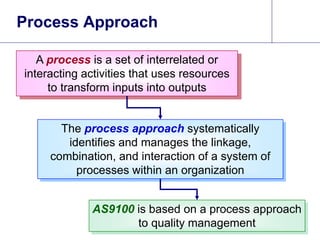
Process Approach
The process approach systematically
identifies and manages the linkage,
combination, and interaction of a system of
processes within an organization
AS9100 is based on a process approach
to quality management
A process is a set of interrelated or
interacting activities that uses resources
to transform inputs into outputs
8
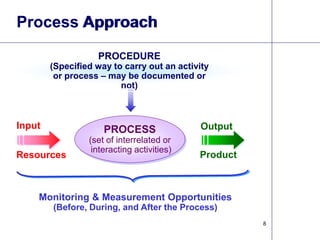
Process Approach
Input Output
Resources Product
Monitoring & Measurement Opportunities
(Before, During, and After the Process)
Process Approach
PROCESS
(set of interrelated or
interacting activities)
PROCEDURE
(Specified way to carry out an activity
or process – may be documented or
not)
9
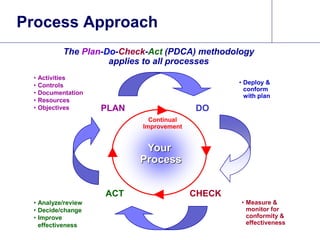
Your
Process
Process Approach
PLAN DO
CHECKACT
• Activities
• Controls
• Documentation
• Resources
• Objectives
• Deploy &
conform
with plan
• Measure &
monitor for
conformity &
effectiveness
• Analyze/review
• Decide/change
• Improve
effectiveness
Continual
Improvement
The Plan-Do-Check-Act (PDCA) methodology
applies to all processes
10
Process Audit Scope
 Specific to the function, area,
requirement, system or process being
audited.
 Processes audited should remain
constant.
 Follow audit trails to the end to obtain
good objective evidence.
 Document objective evidence to support
NC identified.
11
HOW DEEP SHOULD YOU
GO!----INTO THE PROCESS
 Evaluate the process thoroughly.
 Avoid “tunnel vision”.
 Ensure objective evidence supports
conformance or non-conformance of the
process.
 Gather enough objective evidence to
support your final decision.
 Adequate “sampling” of objective evidence.
– Repeatability of objective evidence which
indicates the process is not working.
– indication of consistent process failure.
12
Three Distinct Parts of An NC
An audit NC should have three distinct parts:
 A clear statement of the non-conformance.
 The requirement, or specific reference to the
requirement.
– If you cannot identify a requirement,
then you cannot raise a non-
conformance.
 And finally, objective evidence that supports
the statement of non-conformance; based on
the requirement.
13
Statement of the NC
 Should be self-explanatory and related to the
process.
 Be unambiguous and concise.
 Not be a restatement of the audit evidence.
 Record the requirement against which the
NC was detected.
– If possible, write out the exact text of the
requirement.
 The audit evidence must support the audit
finding.
– The evidence must be specific to the
violated requirement.
– Evidence must be traceable to the NC.
14
Examples of POOR NC Statements
• Example: Two pieces of calibrated
equipment was past due calibration.
“THIS GIVES ONLY A BRIEF INDICATION OF THE
PROBLEM”
AND ALSO
• The statement does not give the auditee any
indication that there is a system/process failure.
• It appears as a single instance.
• It does not identify the actual requirement being
offended-actually, it incorrectly states the
requirement.
• As written, the auditee could easily assume the
NC was a single incident and take action ONLY
related to the two pieces of calibrated equipment.
15
Making it Clear
 Changing the structure and the way the
NC is written can assist in getting the
auditee to address the “root cause” of why
the calibrated equipment is past due
calibration.
 The NC must highlight the issue that
there is a system/process failure vs. a
single incident failure.
 Thus, the corrective action and root
cause should be focused towards
system/process failure, not the observed
incident.
16
NC Statement “TIPS”
TIPS:
 The statement of NC should be as
generic as possible to help direct the
auditee to the system’s issue… instead of
the specific incident.
 Keep the “specific details” in the objective
evidence area, if at all possible.
 The NC statement should include enough
details so that the auditee can respond to
exactly what the auditor found…….even
years later.
17
Examples of Poorly Written NCs
Non-conformance states:
 A required block torque test was not being
performed. (Classified as “Minor” yet a test
not performed would be detrimental to the
integrity of the product.)
Non-conformance states:
 No preventative action records exist. (This
would equate to an absence of a quality
management system element.)
Neither NC statement tells the client what
went wrong...what process is broken?
18
Writing of NC Statements
 Non-conformance: (Clearly define and
document the systemic failure within the non-
conformance. You want ensure the client
understands the exact nature of the non-
conformance. Too many words could mis-
lead the client.)
– The system for the control of the process for
product design failed to ensure authorization
or approval was given prior to proceeding
from Stage 2 to Stage 3 of the product design.
 Objective Evidence: (Quote appropriate
aerospace standard clause, work instruction,
procedure or process requirement)
– The Design/Engineering review record did not
indicate authorization was given to proceed to
Stage 3 of the product design.
19
Writing of NC Statements
 Stated Requirement: (What objective
evidence is/was used to indicate a non-
conformance existed? What record,
document, procedure was used to verify
existence of a non-conformance)
– AS9100, Clause 7.3.4c, at suitable stages,
systematic reviews of design and
development shall be performed in
accordance with planned arrangement;
authorization is required for progression to
the next design stage.
20
Accepting Closure of CAR
Responses
The auditee’s corrective action response should
cover three areas, as a minimum:
 Containment of the current situation and
identified systemic failure.
– Action to control or mitigate a problem;
could includes correction, corrective action.
 Root cause analysis as to why the system
failed.
 Finally, a systemic corrective action to
prevent a recurrence of a failure in the
system/process (could be preventive action
may apply here.)
21
Corrective Action
Acceptance/Closure
• Does CA response address system
process NC?
• Is Root Cause adequate?
• You must know and understand the
process to accept the CA and root
cause.
• Does client’s response ensure no re-
occurrence?
22
Scenario One
-Auditor John Hancock is reviewing control of non-
conforming material at The Great Widget
Company. The Great Widget Company has a
separate locked room where all non-conforming
material is stored until the material is
dispositioned.
-During John’s review of the room he notices that
material dispositioned as scrap is placed in large
metal containers and the containers are then also
stored in the locked room. When John asks what
happens with the containers, he is told that the
local scrap dealer takes them away.
Should John:
• Show that The Great Widget Company is
conforming?
• Ask to see the customer approval of the current
scrap procedure?
• Write an NC?
23
Scenario One
The Correct answer is C: Write an NC.
• John should write an NC because AS9100
Section 8.3 requires that scrap material be
segregated until physically rendered
unusable.
• Currently The Great Widget Company
segregates their scrap but when it leaves
their facility it has not been rendered
unusable.
24
Scenario Two
• During an audit, you read the Management Review
procedure. It states they have defined measurable
objectives for productivity, Customer satisfaction, and
quality. When you ask to see the measures looked at
during a management review meeting, the Plant Manager
hands you a 3 inch pile of papers. As you go through the
information, you notice there are plenty of charts, graphs,
and pivot tables. Seems like this place measures
everything they possible can, but there are no goals listed
or explanations for trends going in the wrong direction.
• The Plant Manager understands each chart and is clearly
involved, but when asked how he uses them to drive
improvement, or how he knows if he is meeting his goals,
he has no answer.
25
Scenario Two
You Should:
A. Do nothing, the thoroughness of the
management review is evidence that it is
acceptable. Improvement, although
desirable, is not required.
B.Write an NCR because there has been
no improvement and therefore the
management review is ineffective.
C. Write an NCR, as there is no evidence
of defined measurable quality objectives
as stated in the procedure.
26
Scenario Two
The Correct answer is C: Write an NC.
• AS9100 Section 5.6.1 states, in part
“that top management shall include
assessing opportunities for improvement
of its effectiveness of it’s QMS.”
• The plant’s procedure stated they will
have defined measurable objectives for
quality and none were found during this
review.
27
Scenario Three
While auditing the purchasing department of Hector
Aircraft Components, you note that the purchasing
procedure, HAC 123, does not address positive recall
per AS9100 section 7.4.3 paragraph two, and the
company’s process does not address periodically
validating test reports for raw material in accordance
with section 7.4.3 paragraph three.
The QM, Hector, immediately corrects the master
purchasing procedure and saves the revised form in the
company’s electronic media. He demonstrates that the
master purchasing document, HAC Admin Form 01 now
shows the requirement to validate test reports, and that
the procedure shows the positive recall requirement.
You should:
A. Write an NC and accept it on site
B. Write an NC and leave it open
C. Do not write an NC because the issue has been resolved
D. Follow up to see if the company actually uses the new
procedure
28
Scenario Three
You should:
A. Write an NC and accept it on site
B. Write an NC and leave it open
C. Do not write an NC because the issue
has been resolved
D. Follow up to see if the company
actually uses the new procedure
29
Scenario Three
The Correct answer is B: Write an NC.
• When a major component of the quality
system is missing, it requires an NC.
• Base on severity of NC, some NCs
cannot be closed on site

Ncr writing and_closure

  • 1.
    Writing Clear andConcise Non-conformances (NCs) Aerospace Auditor Workshop Quality System Department Oziel Cardenas Vargas 1
  • 2.
    2 Aerospace Auditor Workshop AGENDA •Writing Non-conformances (NC) Analysis. • Parts of a Non Conformance. • Making it clear. • What is the Process Approach? • Accepting NC Responses.
  • 3.
    3 Non-conformance Report Writing ANDTHE CLIENT SAYS: • I DON’T HAVE A CLUE WHAT YOU ARE SAYING OR WHAT YOU ARE TALKING ABOUT……???  WHY IS THIS AN NON CONFORMANCE?  WHAT REQUIREMENT IS VIOLATED?
  • 4.
    4 NC Writing Analysis Fromanalysis of data collected from witness audits, office audits aerospace oversight and other feedback, NC writing has been identified as one of the more significant concerns. Identified weaknesses were:  The NC as written was “incident specific” and did not address the systematic issue (s).  The NC as written could not be understood by the organization after the audit was completed; and not understandable at later date.  The NC did not identify the actual requirement being offended.  The NC did not identify the supporting objective evidence.  Poor CA and root cause analysis accepted by the auditor.  No indication corrective actions were verified at NC closure. NOTE: POORLY WRITTEN NCs SUPPORTS “SOFT GRADING” CUSTOMER, OEM, AND IAQG AND AAQG CONCERNS.
  • 5.
    5 Writing Process Non-conformances • NC’smust be clearly written. • Should address the process/system which is deficient. • Objective evidence gathered should identify which process is deficient. • What is the process? – You must understand the process to verify conformance or non- conformance. • Is the non-conformance identified, systemic to the process?
  • 6.
    6 Process Approach The processapproach emphasizes the importance of: • Understanding and meeting requirements. • Looking at processes in terms of added value. • Obtaining results of process performance. • Continual improvement of processes via the documenting of NC’s.
  • 7.
    7 Process Approach The processapproach systematically identifies and manages the linkage, combination, and interaction of a system of processes within an organization AS9100 is based on a process approach to quality management A process is a set of interrelated or interacting activities that uses resources to transform inputs into outputs
  • 8.
    8 Process Approach Input Output ResourcesProduct Monitoring & Measurement Opportunities (Before, During, and After the Process) Process Approach PROCESS (set of interrelated or interacting activities) PROCEDURE (Specified way to carry out an activity or process – may be documented or not)
  • 9.
    9 Your Process Process Approach PLAN DO CHECKACT •Activities • Controls • Documentation • Resources • Objectives • Deploy & conform with plan • Measure & monitor for conformity & effectiveness • Analyze/review • Decide/change • Improve effectiveness Continual Improvement The Plan-Do-Check-Act (PDCA) methodology applies to all processes
  • 10.
    10 Process Audit Scope Specific to the function, area, requirement, system or process being audited.  Processes audited should remain constant.  Follow audit trails to the end to obtain good objective evidence.  Document objective evidence to support NC identified.
  • 11.
    11 HOW DEEP SHOULDYOU GO!----INTO THE PROCESS  Evaluate the process thoroughly.  Avoid “tunnel vision”.  Ensure objective evidence supports conformance or non-conformance of the process.  Gather enough objective evidence to support your final decision.  Adequate “sampling” of objective evidence. – Repeatability of objective evidence which indicates the process is not working. – indication of consistent process failure.
  • 12.
    12 Three Distinct Partsof An NC An audit NC should have three distinct parts:  A clear statement of the non-conformance.  The requirement, or specific reference to the requirement. – If you cannot identify a requirement, then you cannot raise a non- conformance.  And finally, objective evidence that supports the statement of non-conformance; based on the requirement.
  • 13.
    13 Statement of theNC  Should be self-explanatory and related to the process.  Be unambiguous and concise.  Not be a restatement of the audit evidence.  Record the requirement against which the NC was detected. – If possible, write out the exact text of the requirement.  The audit evidence must support the audit finding. – The evidence must be specific to the violated requirement. – Evidence must be traceable to the NC.
  • 14.
    14 Examples of POORNC Statements • Example: Two pieces of calibrated equipment was past due calibration. “THIS GIVES ONLY A BRIEF INDICATION OF THE PROBLEM” AND ALSO • The statement does not give the auditee any indication that there is a system/process failure. • It appears as a single instance. • It does not identify the actual requirement being offended-actually, it incorrectly states the requirement. • As written, the auditee could easily assume the NC was a single incident and take action ONLY related to the two pieces of calibrated equipment.
  • 15.
    15 Making it Clear Changing the structure and the way the NC is written can assist in getting the auditee to address the “root cause” of why the calibrated equipment is past due calibration.  The NC must highlight the issue that there is a system/process failure vs. a single incident failure.  Thus, the corrective action and root cause should be focused towards system/process failure, not the observed incident.
  • 16.
    16 NC Statement “TIPS” TIPS: The statement of NC should be as generic as possible to help direct the auditee to the system’s issue… instead of the specific incident.  Keep the “specific details” in the objective evidence area, if at all possible.  The NC statement should include enough details so that the auditee can respond to exactly what the auditor found…….even years later.
  • 17.
    17 Examples of PoorlyWritten NCs Non-conformance states:  A required block torque test was not being performed. (Classified as “Minor” yet a test not performed would be detrimental to the integrity of the product.) Non-conformance states:  No preventative action records exist. (This would equate to an absence of a quality management system element.) Neither NC statement tells the client what went wrong...what process is broken?
  • 18.
    18 Writing of NCStatements  Non-conformance: (Clearly define and document the systemic failure within the non- conformance. You want ensure the client understands the exact nature of the non- conformance. Too many words could mis- lead the client.) – The system for the control of the process for product design failed to ensure authorization or approval was given prior to proceeding from Stage 2 to Stage 3 of the product design.  Objective Evidence: (Quote appropriate aerospace standard clause, work instruction, procedure or process requirement) – The Design/Engineering review record did not indicate authorization was given to proceed to Stage 3 of the product design.
  • 19.
    19 Writing of NCStatements  Stated Requirement: (What objective evidence is/was used to indicate a non- conformance existed? What record, document, procedure was used to verify existence of a non-conformance) – AS9100, Clause 7.3.4c, at suitable stages, systematic reviews of design and development shall be performed in accordance with planned arrangement; authorization is required for progression to the next design stage.
  • 20.
    20 Accepting Closure ofCAR Responses The auditee’s corrective action response should cover three areas, as a minimum:  Containment of the current situation and identified systemic failure. – Action to control or mitigate a problem; could includes correction, corrective action.  Root cause analysis as to why the system failed.  Finally, a systemic corrective action to prevent a recurrence of a failure in the system/process (could be preventive action may apply here.)
  • 21.
    21 Corrective Action Acceptance/Closure • DoesCA response address system process NC? • Is Root Cause adequate? • You must know and understand the process to accept the CA and root cause. • Does client’s response ensure no re- occurrence?
  • 22.
    22 Scenario One -Auditor JohnHancock is reviewing control of non- conforming material at The Great Widget Company. The Great Widget Company has a separate locked room where all non-conforming material is stored until the material is dispositioned. -During John’s review of the room he notices that material dispositioned as scrap is placed in large metal containers and the containers are then also stored in the locked room. When John asks what happens with the containers, he is told that the local scrap dealer takes them away. Should John: • Show that The Great Widget Company is conforming? • Ask to see the customer approval of the current scrap procedure? • Write an NC?
  • 23.
    23 Scenario One The Correctanswer is C: Write an NC. • John should write an NC because AS9100 Section 8.3 requires that scrap material be segregated until physically rendered unusable. • Currently The Great Widget Company segregates their scrap but when it leaves their facility it has not been rendered unusable.
  • 24.
    24 Scenario Two • Duringan audit, you read the Management Review procedure. It states they have defined measurable objectives for productivity, Customer satisfaction, and quality. When you ask to see the measures looked at during a management review meeting, the Plant Manager hands you a 3 inch pile of papers. As you go through the information, you notice there are plenty of charts, graphs, and pivot tables. Seems like this place measures everything they possible can, but there are no goals listed or explanations for trends going in the wrong direction. • The Plant Manager understands each chart and is clearly involved, but when asked how he uses them to drive improvement, or how he knows if he is meeting his goals, he has no answer.
  • 25.
    25 Scenario Two You Should: A.Do nothing, the thoroughness of the management review is evidence that it is acceptable. Improvement, although desirable, is not required. B.Write an NCR because there has been no improvement and therefore the management review is ineffective. C. Write an NCR, as there is no evidence of defined measurable quality objectives as stated in the procedure.
  • 26.
    26 Scenario Two The Correctanswer is C: Write an NC. • AS9100 Section 5.6.1 states, in part “that top management shall include assessing opportunities for improvement of its effectiveness of it’s QMS.” • The plant’s procedure stated they will have defined measurable objectives for quality and none were found during this review.
  • 27.
    27 Scenario Three While auditingthe purchasing department of Hector Aircraft Components, you note that the purchasing procedure, HAC 123, does not address positive recall per AS9100 section 7.4.3 paragraph two, and the company’s process does not address periodically validating test reports for raw material in accordance with section 7.4.3 paragraph three. The QM, Hector, immediately corrects the master purchasing procedure and saves the revised form in the company’s electronic media. He demonstrates that the master purchasing document, HAC Admin Form 01 now shows the requirement to validate test reports, and that the procedure shows the positive recall requirement. You should: A. Write an NC and accept it on site B. Write an NC and leave it open C. Do not write an NC because the issue has been resolved D. Follow up to see if the company actually uses the new procedure
  • 28.
    28 Scenario Three You should: A.Write an NC and accept it on site B. Write an NC and leave it open C. Do not write an NC because the issue has been resolved D. Follow up to see if the company actually uses the new procedure
  • 29.
    29 Scenario Three The Correctanswer is B: Write an NC. • When a major component of the quality system is missing, it requires an NC. • Base on severity of NC, some NCs cannot be closed on site