

©     opyright     ©     larity
FAIR USE FOR EDUCATORS & STUDENTS

                 Spiro Bolos
              Affiliated Faculty
   Media Education Lab @ Temple University
              boloss@nths.net
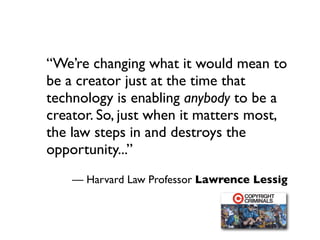
“We’re changing what it would mean to
be a creator just at the time that
technology is enabling anybody to be a
creator. So, just when it matters most,
the law steps in and destroys the
opportunity...”
    — Harvard Law Professor Lawrence Lessig
?
    ?
www.archive.org
©
?
!"#$%%&'()*'*#+'(,'
         -,.&/"0)('
       -,#123",#')$3'
           $//"4*+


!2#+*+'5&'()*'6,)#'78'9'':$()*/"#*';8'<$-=/()2/'!,2#+$(",#
COORDINATORS
! The Media Education Lab
   (Renee Hobbs, Temple University)

! The Program on Information
   Justice and Intellectual Property
   (Peter Jaszi, Washington College of Law:
   American University)

! The Center for Social Media
   (Patricia Aufderheide, School of
   Communication: American University)
SIGNATORIES
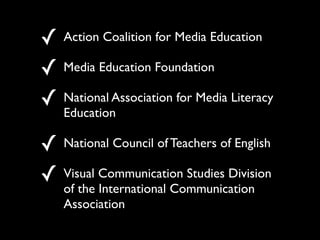
! Action Coalition for Media Education
! Media Education Foundation
! National Association for Media Literacy
    Education

! National Council of Teachers of English
! Visual Communication Studies Division
    of the International Communication
    Association
LEGAL
ADVISORY BOARD
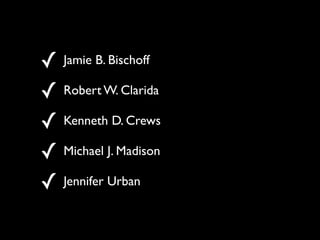
! Jamie B. Bischoff
! Robert W. Clarida
! Kenneth D. Crews
! Michael J. Madison
! Jennifer Urban
FUNDED BY
! The MacArthur Foundation
! The Ford Foundation
What is copyright?
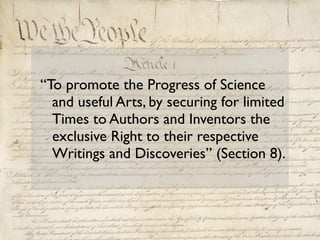
“To promote the Progress of Science
  and useful Arts, by securing for limited
  Times to Authors and Inventors the
  exclusive Right to their respective
  Writings and Discoveries” (Section 8).
What is fair use?
“Fair use is the right to use copyrighted
  material without permission or
  payment under some circumstances
  — especially when the cultural or
  social benefits of the use are
  predominant” (“Code” 1; emphasis added).
“That authors and inventors benefit
  from copyright is a side effect of
  encouraging the dissemination of
  knowledge, and not a direct intent of
  copyright” (Carrie Russell, Complete Copyright).
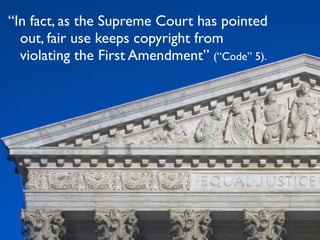
“In fact, as the Supreme Court has pointed
  out, fair use keeps copyright from
  violating the First Amendment” (“Code” 5).
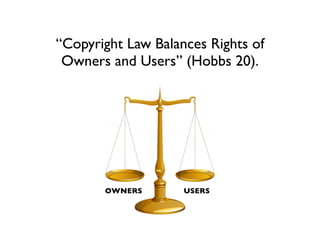
“Copyright Law Balances Rights of
 Owners and Users” (Hobbs 20).


       OWNERS       USERS
The Four Factors
Section 107 of the COPYRIGHT LAW of 1976


1. The Nature of the Use
2. The Nature of the Work Used
3. The Extent of the Use
4. Its Economic Impact (6)
Professor Eric Faden, Bucknell University


“A Fair(y) Use Tale”
COMMON MYTHS
“Fair use is too unclear
and complicated for me;
it’s better left to lawyers
   and administrators.”
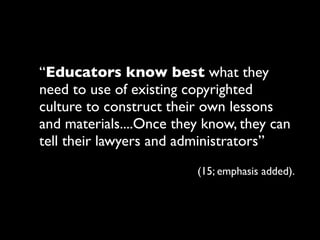
“Educators know best what they
need to use of existing copyrighted
culture to construct their own lessons
and materials....Once they know, they can
tell their lawyers and administrators”
                         (15; emphasis added).
“Educators can rely on
    ‘rules of thumb’
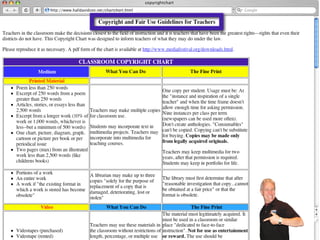
for fair use guidance.”
“The guidelines are negotiated resolutions
of conflicts regarding fair use, and yet they
are often presented as standards to which
one must adhere in order to remain within
the law.”

                                   — Kenneth Crews
  “The Law of Fair Use and the Illusion of Fair-Use Guidelines”
“...in fact the guidelines bear little
relationship, if any, to the law
of fair use” (emphasis added).
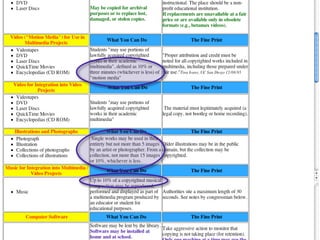
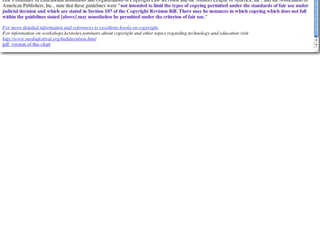
these guidelines were "not intended to limit the
types of copying permitted under the standards
of fair use under judicial decision and which
are stated in Section 107 of the Copyright
Revision Bill. There may be instances in which
copying which does not fall within the
guidelines stated [above] may nonetheless be
permitted under the criterion of fair use."
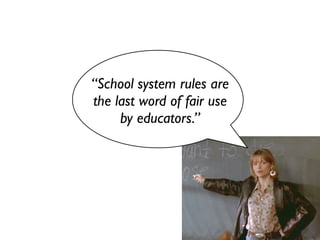
“School system rules are
the last word of fair use
     by educators.”
“Rather than following a specific
  formula, lawyers and judges
  decide whether an unlicensed use of
  copyrighted material is ‘fair’ according
  to the ‘rule of reason’” (6; emphasis added).
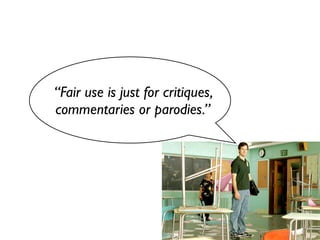
“Fair use is just for critiques,
commentaries or parodies.”
“Transformativeness, a key value
in fair use law, can involve modifying
material or putting material in a new
context, or both” (15; emphasis added).
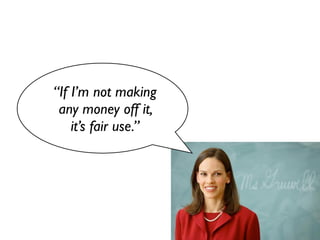
“If I’m not making
 any money off it,
    it’s fair use.”
“...some more public uses may be
unfair even if no money is
exchanged” (16; emphasis added).
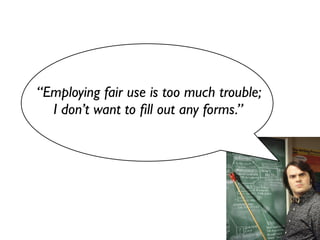
“Employing fair use is too much trouble;
  I don’t want to fill out any forms.”
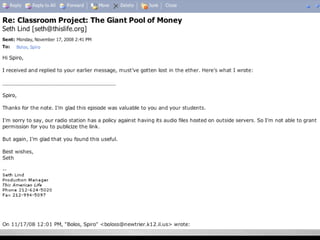
...
“But, if you choose, you may...still claim
fair use if your request is refused or
ignored. In some cases, courts have
found that asking permission and then
being rejected has actually enhanced
fair use claims” (16).
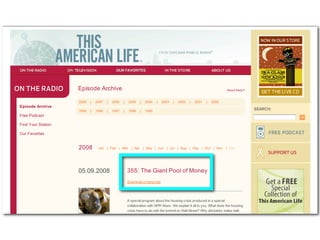
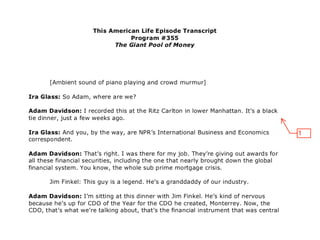
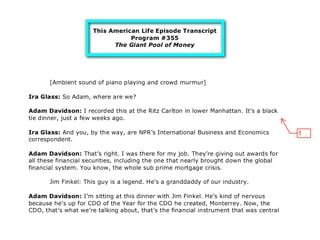
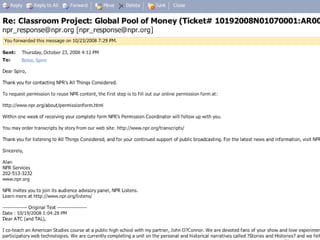
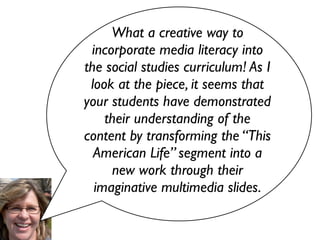
What a creative way to
 incorporate media literacy into
the social studies curriculum! As I
 look at the piece, it seems that
your students have demonstrated
    their understanding of the
content by transforming the “This
  American Life” segment into a
     new work through their
  imaginative multimedia slides.
The educational value of this
 assignment is based, in fact, on
the careful relationship between
   the audio and the images....
     [W]here you have asked
  permission and been refused,
 your decision about distribution
rests completely on your comfort
   level about whether this use
        indeed a fair use....
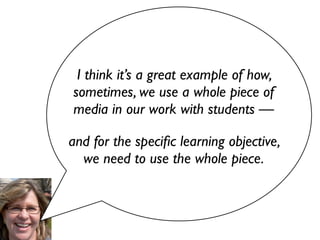
I think it’s a great example of how,
sometimes, we use a whole piece of
media in our work with students —

and for the specific learning objective,
  we need to use the whole piece.
“Fair use could get me sued.”
1. “That’s very, very unlikely” (17)
2. “Cease and Desist” letter
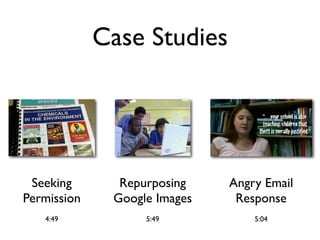
Case Studies


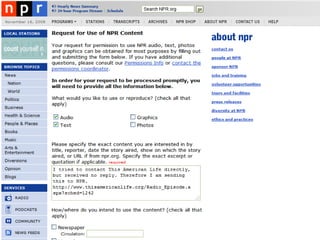
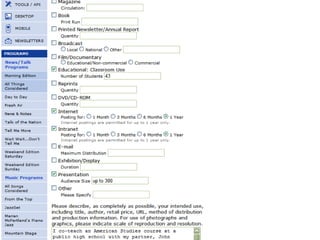
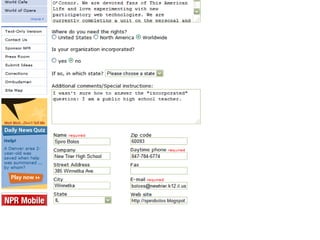
 Seeking       Repurposing    Angry Email
Permission    Google Images    Response
   4:49            5:49           5:04
Best Practices
1. The use of the copyrighted work is
   transformative.
2. The kind and the amount of the copyrighted
   work used is appropriate to accomplish
   the legitimate purpose.
3. The author of the copyrighted work is
   cited, whenever possible.
All forms of media
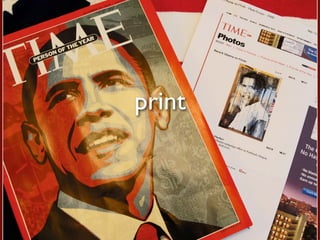
print
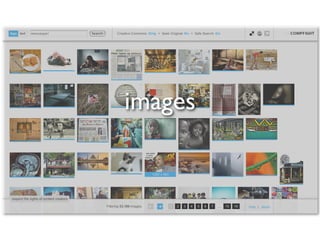
images
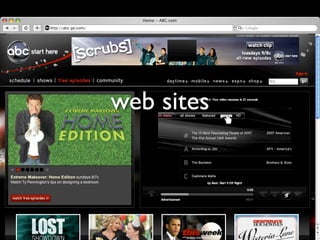
web sites
moving-image media
sound media

   WNYC’s
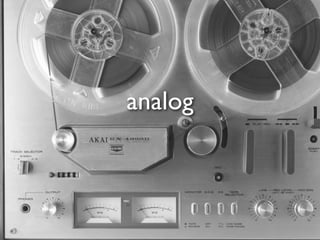
analog
digital
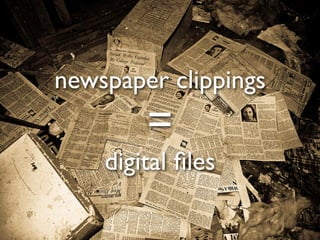
newspaper clippings
        =
    digital files
However...
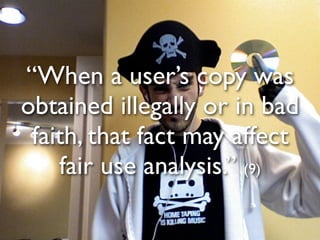
“When a user’s copy was
obtained illegally or in bad
 faith, that fact may affect
    fair use analysis.” (9)
SOURCE = irrelevant
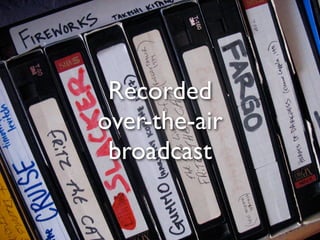
Recorded
over-the-air
 broadcast
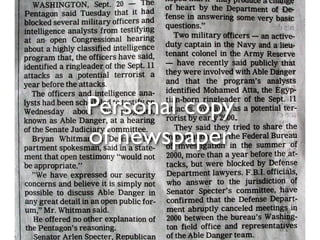
Personal copy
of newspaper
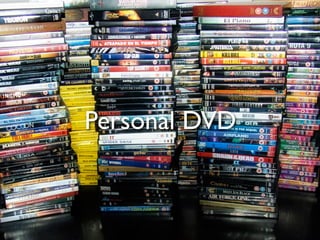
Personal DVD
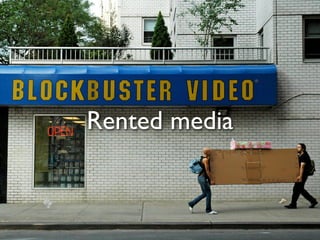
Rented media
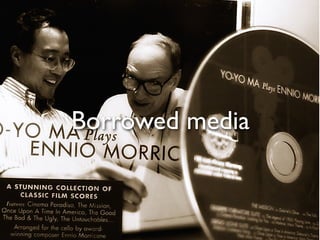
Borrowed media
Labels = irrelevant
eg., “licensed for home [or private or
educational or noncommercial] use only”
Untested Case Study
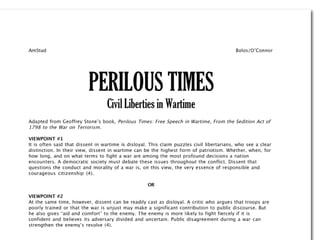
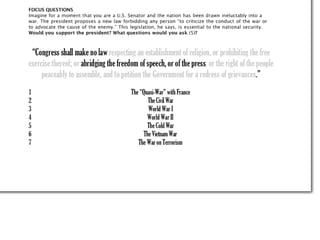
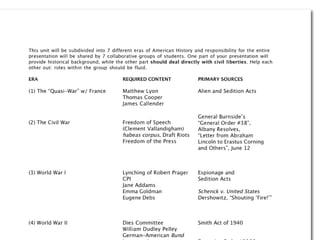
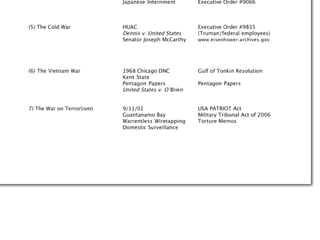
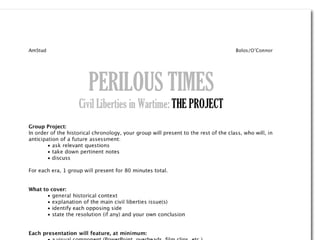
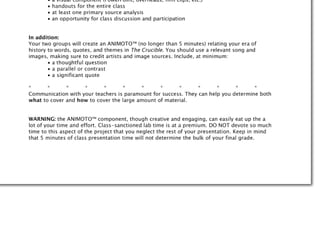
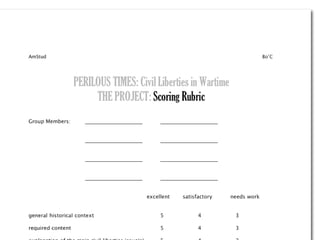
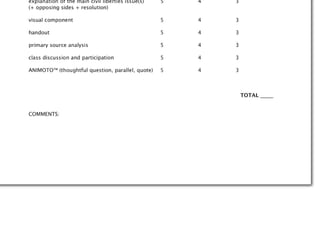
“PERILOUS TIMES: Civil Liberties in Wartime”
      American Studies Group Project
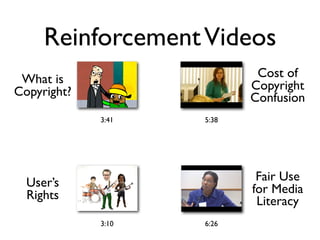
Reinforcement Videos
 What is                    Cost of
Copyright?                 Copyright
                           Confusion
             3:41   5:38


  User’s                    Fair Use
  Rights                   for Media
                            Literacy
             3:10   6:26
• Renee Hobbs: http://api.ning.com/files/
  3xBu0cBSMiiG-qw0tbU3knTMNteLjB8X-
  xqouKhJi40_/ReneeProfessional2009.jpg

• Hobbs, Jaszi, Aufderheide: “How Media
  Literacy Educators Reclaimed Copyright
  and Fair Use”, International Journal of Media
  and Learning, vol. 1, No. 3

• Kutiman, “The Mother of All Funk Chords”:
  http://thru-you.com/
• Copyright Criminals: http://
  www.copyrightcriminals.com

• “Copyright and Fair Use Guidelines for
  Teachers”: http://www.halldavidson.net/
  chartshort.html

• Creative Commons Logos: http://
  www.creativecommons.se/images/
  highquality.jpg

• Balance: http://blog.wineenthusiast.com/wp-
  content/uploads/2008/12/balance.jpg
• Supreme Court: http://www.flickr.com/
  photos/vgm8383/2044910536/

• U.S. Constitution: http://www.archives.gov/
  exhibits/charters/charters_downloads.html

• Courtroom Gavel: http://www.flickr.com/
  photos/63126465@N00/117048243

• Flexibility: http://www.flickr.com/photos/
  khalid-almasoud/474399662/
• Robin Williams: http://images.starpulse.com/
  Photos/Previews/Dead-Poets-Society-04.jpg

• Edward James Olmos: http://
  pantskicker.com/wp-content/uploads/
  2008/01/0standanddeliverbwcrop.jpg

• Michelle Pfeiffer: http://
  images.allmoviephoto.com/
  1995_Dangerous_Minds/
  1995_Dangerous_Minds_036.jpg
• The Wire: http://www.hbo.com/thewire/img/
  episodeguide/season04/ep38_04.jpg

• Hilary Swank: http://
  www.independentcritics.com/images/
  freedom%20writers%20SPLASH.jpg

• Kevin Kline: http://videodetective.com/
  photos/633/026626_27.jpg
• Jack Black: http://fraser.typepad.com/
  a_girl_a_gun/images/
  School_of_Rock_01.jpg

• Kindergarten Cop: http://
  i153.photobucket.com/albums/s229/
  longjohnjohn05/arnold1.jpg

• Crews, Kenneth: “The Law of Fair Use and
  the Illusion of Fair-Use Guidelines,” The
  Ohio State Law Journal 62 (2001): 602–700
• Parthenon Detail Replica: http://
  www.flickr.com/photos/brent_nashville/
  2455550267/

• “in y’own mix”: "pirøbølo", Copyright
  Criminals Contest. http://ccmixter.org/
  copyrightcriminals/people/spirobolos

• “The Next Step”: Trifonic, Copyright
  Criminals Contest. http://ccmixter.org/files/
  trifonic/4163
• Time Magazine (Obama cover): http://
  www.flickr.com/photos/tonythemisfit/
  3142216126/sizes/l/

• Reel-to-reel: http://www.flickr.com/photos/
  dmitry/531285082/

• “HITECH” photo: http://www.flickr.com/
  photos/tsevis/2282944393/in/
  set-72157608680934688
• “Klutz Clippings”: http://www.flickr.com/
  photos/tantrum_dan/2344581860/

• “VHS’sss”: http://www.flickr.com/photos/
  33917831@N00/1018612301/

• Newspaper article: http://www.flickr.com/
  photos/44789431@N00/52308403/

• DVDs: http://www.flickr.com/photos/
  23327787@N08/2348565675/
• Blockbuster Video: http://www.flickr.com/
  photos/40736030@N00/51415142/

• Yo-Yo Ma: http://www.flickr.com/photos/
  21651009@N00/2606693331/

• Apollo 13 DVD: http://www.flickr.com/
  photos/clith/153418933/

• Pirate: http://www.flickr.com/photos/
  83135223@N00/285200741/
www.mediaeducationlab.com
www.centerforsocialmedia.org
        www.spirobolos.com

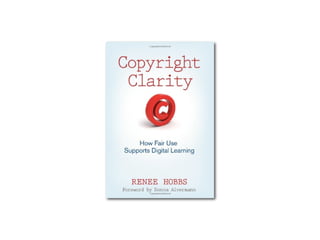
Copyright Clarity

  • 1.
    © opyright © larity FAIR USE FOR EDUCATORS & STUDENTS Spiro Bolos Affiliated Faculty Media Education Lab @ Temple University boloss@nths.net
  • 2.
    “We’re changing whatit would mean to be a creator just at the time that technology is enabling anybody to be a creator. So, just when it matters most, the law steps in and destroys the opportunity...” — Harvard Law Professor Lawrence Lessig
  • 3.
    ? ?
  • 4.
  • 6.
  • 7.
    !"#$%%&'()*'*#+'(,' -,.&/"0)(' -,#123",#')$3' $//"4*+ !2#+*+'5&'()*'6,)#'78'9'':$()*/"#*';8'<$-=/()2/'!,2#+$(",#
  • 8.
  • 9.
    ! The MediaEducation Lab (Renee Hobbs, Temple University) ! The Program on Information Justice and Intellectual Property (Peter Jaszi, Washington College of Law: American University) ! The Center for Social Media (Patricia Aufderheide, School of Communication: American University)
  • 10.
  • 11.
    ! Action Coalitionfor Media Education ! Media Education Foundation ! National Association for Media Literacy Education ! National Council of Teachers of English ! Visual Communication Studies Division of the International Communication Association
  • 12.
  • 13.
    ! Jamie B.Bischoff ! Robert W. Clarida ! Kenneth D. Crews ! Michael J. Madison ! Jennifer Urban
  • 14.
  • 15.
    ! The MacArthurFoundation ! The Ford Foundation
  • 17.
  • 18.
    “To promote theProgress of Science and useful Arts, by securing for limited Times to Authors and Inventors the exclusive Right to their respective Writings and Discoveries” (Section 8).
  • 19.
  • 20.
    “Fair use isthe right to use copyrighted material without permission or payment under some circumstances — especially when the cultural or social benefits of the use are predominant” (“Code” 1; emphasis added).
  • 21.
    “That authors andinventors benefit from copyright is a side effect of encouraging the dissemination of knowledge, and not a direct intent of copyright” (Carrie Russell, Complete Copyright).
  • 22.
    “In fact, asthe Supreme Court has pointed out, fair use keeps copyright from violating the First Amendment” (“Code” 5).
  • 23.
    “Copyright Law BalancesRights of Owners and Users” (Hobbs 20). OWNERS USERS
  • 24.
    The Four Factors Section107 of the COPYRIGHT LAW of 1976 1. The Nature of the Use 2. The Nature of the Work Used 3. The Extent of the Use 4. Its Economic Impact (6)
  • 25.
    Professor Eric Faden,Bucknell University “A Fair(y) Use Tale”
  • 26.
  • 27.
    “Fair use istoo unclear and complicated for me; it’s better left to lawyers and administrators.”
  • 28.
    “Educators know bestwhat they need to use of existing copyrighted culture to construct their own lessons and materials....Once they know, they can tell their lawyers and administrators” (15; emphasis added).
  • 29.
    “Educators can relyon ‘rules of thumb’ for fair use guidance.”
  • 30.
    “The guidelines arenegotiated resolutions of conflicts regarding fair use, and yet they are often presented as standards to which one must adhere in order to remain within the law.” — Kenneth Crews “The Law of Fair Use and the Illusion of Fair-Use Guidelines”
  • 31.
    “...in fact theguidelines bear little relationship, if any, to the law of fair use” (emphasis added).
  • 35.
    these guidelines were"not intended to limit the types of copying permitted under the standards of fair use under judicial decision and which are stated in Section 107 of the Copyright Revision Bill. There may be instances in which copying which does not fall within the guidelines stated [above] may nonetheless be permitted under the criterion of fair use."
  • 36.
    “School system rulesare the last word of fair use by educators.”
  • 37.
    “Rather than followinga specific formula, lawyers and judges decide whether an unlicensed use of copyrighted material is ‘fair’ according to the ‘rule of reason’” (6; emphasis added).
  • 38.
    “Fair use isjust for critiques, commentaries or parodies.”
  • 39.
    “Transformativeness, a keyvalue in fair use law, can involve modifying material or putting material in a new context, or both” (15; emphasis added).
  • 40.
    “If I’m notmaking any money off it, it’s fair use.”
  • 41.
    “...some more publicuses may be unfair even if no money is exchanged” (16; emphasis added).
  • 42.
    “Employing fair useis too much trouble; I don’t want to fill out any forms.”
  • 46.
  • 58.
    “But, if youchoose, you may...still claim fair use if your request is refused or ignored. In some cases, courts have found that asking permission and then being rejected has actually enhanced fair use claims” (16).
  • 59.
    What a creativeway to incorporate media literacy into the social studies curriculum! As I look at the piece, it seems that your students have demonstrated their understanding of the content by transforming the “This American Life” segment into a new work through their imaginative multimedia slides.
  • 60.
    The educational valueof this assignment is based, in fact, on the careful relationship between the audio and the images.... [W]here you have asked permission and been refused, your decision about distribution rests completely on your comfort level about whether this use indeed a fair use....
  • 61.
    I think it’sa great example of how, sometimes, we use a whole piece of media in our work with students — and for the specific learning objective, we need to use the whole piece.
  • 62.
    “Fair use couldget me sued.”
  • 63.
    1. “That’s very,very unlikely” (17) 2. “Cease and Desist” letter
  • 64.
    Case Studies Seeking Repurposing Angry Email Permission Google Images Response 4:49 5:49 5:04
  • 65.
    Best Practices 1. Theuse of the copyrighted work is transformative. 2. The kind and the amount of the copyrighted work used is appropriate to accomplish the legitimate purpose. 3. The author of the copyrighted work is cited, whenever possible.
  • 66.
  • 67.
  • 68.
  • 69.
  • 70.
  • 71.
    sound media WNYC’s
  • 72.
  • 73.
  • 74.
    newspaper clippings = digital files
  • 75.
  • 76.
    “When a user’scopy was obtained illegally or in bad faith, that fact may affect fair use analysis.” (9)
  • 77.
  • 78.
  • 79.
  • 80.
  • 81.
  • 82.
  • 83.
  • 84.
    eg., “licensed forhome [or private or educational or noncommercial] use only”
  • 85.
    Untested Case Study “PERILOUSTIMES: Civil Liberties in Wartime” American Studies Group Project
  • 95.
    Reinforcement Videos Whatis Cost of Copyright? Copyright Confusion 3:41 5:38 User’s Fair Use Rights for Media Literacy 3:10 6:26
  • 96.
    • Renee Hobbs:http://api.ning.com/files/ 3xBu0cBSMiiG-qw0tbU3knTMNteLjB8X- xqouKhJi40_/ReneeProfessional2009.jpg • Hobbs, Jaszi, Aufderheide: “How Media Literacy Educators Reclaimed Copyright and Fair Use”, International Journal of Media and Learning, vol. 1, No. 3 • Kutiman, “The Mother of All Funk Chords”: http://thru-you.com/
  • 97.
    • Copyright Criminals:http:// www.copyrightcriminals.com • “Copyright and Fair Use Guidelines for Teachers”: http://www.halldavidson.net/ chartshort.html • Creative Commons Logos: http:// www.creativecommons.se/images/ highquality.jpg • Balance: http://blog.wineenthusiast.com/wp- content/uploads/2008/12/balance.jpg
  • 98.
    • Supreme Court:http://www.flickr.com/ photos/vgm8383/2044910536/ • U.S. Constitution: http://www.archives.gov/ exhibits/charters/charters_downloads.html • Courtroom Gavel: http://www.flickr.com/ photos/63126465@N00/117048243 • Flexibility: http://www.flickr.com/photos/ khalid-almasoud/474399662/
  • 99.
    • Robin Williams:http://images.starpulse.com/ Photos/Previews/Dead-Poets-Society-04.jpg • Edward James Olmos: http:// pantskicker.com/wp-content/uploads/ 2008/01/0standanddeliverbwcrop.jpg • Michelle Pfeiffer: http:// images.allmoviephoto.com/ 1995_Dangerous_Minds/ 1995_Dangerous_Minds_036.jpg
  • 100.
    • The Wire:http://www.hbo.com/thewire/img/ episodeguide/season04/ep38_04.jpg • Hilary Swank: http:// www.independentcritics.com/images/ freedom%20writers%20SPLASH.jpg • Kevin Kline: http://videodetective.com/ photos/633/026626_27.jpg
  • 101.
    • Jack Black:http://fraser.typepad.com/ a_girl_a_gun/images/ School_of_Rock_01.jpg • Kindergarten Cop: http:// i153.photobucket.com/albums/s229/ longjohnjohn05/arnold1.jpg • Crews, Kenneth: “The Law of Fair Use and the Illusion of Fair-Use Guidelines,” The Ohio State Law Journal 62 (2001): 602–700
  • 102.
    • Parthenon DetailReplica: http:// www.flickr.com/photos/brent_nashville/ 2455550267/ • “in y’own mix”: "pirøbølo", Copyright Criminals Contest. http://ccmixter.org/ copyrightcriminals/people/spirobolos • “The Next Step”: Trifonic, Copyright Criminals Contest. http://ccmixter.org/files/ trifonic/4163
  • 103.
    • Time Magazine(Obama cover): http:// www.flickr.com/photos/tonythemisfit/ 3142216126/sizes/l/ • Reel-to-reel: http://www.flickr.com/photos/ dmitry/531285082/ • “HITECH” photo: http://www.flickr.com/ photos/tsevis/2282944393/in/ set-72157608680934688
  • 104.
    • “Klutz Clippings”:http://www.flickr.com/ photos/tantrum_dan/2344581860/ • “VHS’sss”: http://www.flickr.com/photos/ 33917831@N00/1018612301/ • Newspaper article: http://www.flickr.com/ photos/44789431@N00/52308403/ • DVDs: http://www.flickr.com/photos/ 23327787@N08/2348565675/
  • 105.
    • Blockbuster Video:http://www.flickr.com/ photos/40736030@N00/51415142/ • Yo-Yo Ma: http://www.flickr.com/photos/ 21651009@N00/2606693331/ • Apollo 13 DVD: http://www.flickr.com/ photos/clith/153418933/ • Pirate: http://www.flickr.com/photos/ 83135223@N00/285200741/
  • 106.