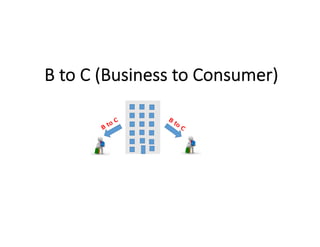
B to C(Business to Consumer)
企業と個人(消費者)間の商取引、あるいは、企業が個人向けに行う事業のこと。一般消費者向けの
製品の製造・販売や、消費者向けサービスの提供(介護、医 療産業、娯楽産業、教育産業、冠婚葬
祭等)、個人と金融機関の取引などがこれに含まれる。消費者向け事業が主体の企業のことをB to C
企業という。
れに対し、企業間の商取引、または、企業が企業向けに行う事業のことを「B to B」(Business to
Business、B2B)、企業と公的機関の商取引、または、企業が公的機関向けに行う事業のことを「B to
G」(Business to Government、B2G)という。
Business to consumer (B to C) is business or transactions conducted directly between a company and
consumers who are the end-users of its products or services. Business to consumer as a business
model differs significantly from the business to business model, which refers to commerce between
two or more businesses.
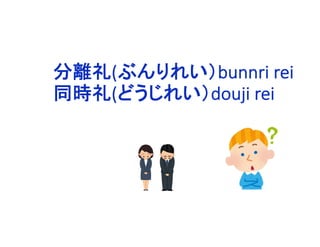
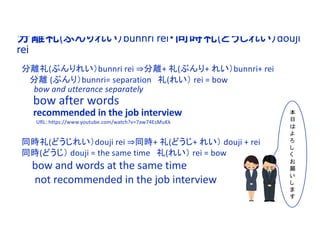
分離礼(ぶんりれい)bunnri rei・同時礼(どうじれい)douji
rei
分離礼(ぶんりれい)bunnri rei⇒分離+ 礼(ぶんり+ れい)bunnri+ rei
分離 (ぶんり)bunnri= separation 礼(れい) rei = bow
bow and utterance separately
bow after words
recommended in the job interview
URL: https://www.youtube.com/watch?v=7aw74EsMuKk
同時礼(どうじれい)douji rei ⇒同時+ 礼(どうじ+ れい) douji + rei
同時(どうじ) douji = the same time 礼(れい) rei = bow
bow and words at the same time
not recommended in the job interview
本
日
は
よ
ろ
し
く
お
願
い
し
ま
す
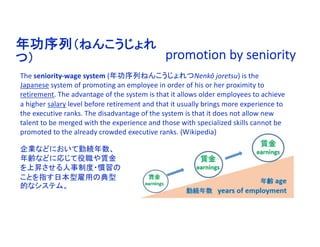
promotion by seniority
年功序列(ねんこうじょれ
つ)
企業などにおいて勤続年数、
年齢などに応じて役職や賃金
を上昇させる人事制度・慣習の
ことを指す日本型雇用の典型
的なシステム。
Theseniority-wage system (年功序列ねんこうじょれつNenkō joretsu) is the
Japanese system of promoting an employee in order of his or her proximity to
retirement. The advantage of the system is that it allows older employees to achieve
a higher salary level before retirement and that it usually brings more experience to
the executive ranks. The disadvantage of the system is that it does not allow new
talent to be merged with the experience and those with specialized skills cannot be
promoted to the already crowded executive ranks. (Wikipedia)
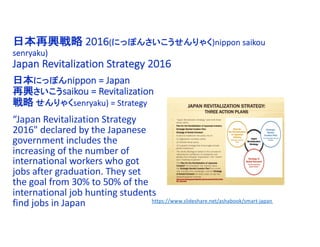
日本再興戦略 2016(にっぽんさいこうせんりゃく)nippon saikou
senryaku)
JapanRevitalization Strategy 2016
“Japan Revitalization Strategy
2016" declared by the Japanese
government includes the
increasing of the number of
international workers who got
jobs after graduation. They set
the goal from 30% to 50% of the
international job hunting students
find jobs in Japan
日本にっぽんnippon = Japan
再興さいこうsaikou = Revitalization
戦略 せんりゃくsenryaku) = Strategy
https://www.slideshare.net/ashabook/smart-japan
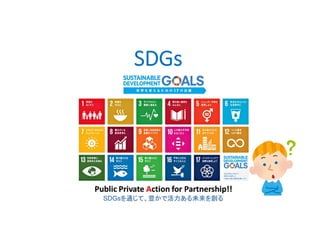
SDGs
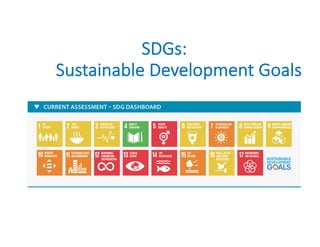
The Sustainable DevelopmentGoals (or SDG's) are a collection of 17 global goals
set by the United Nations General Assembly in 2015 for the year 2030. The SDGs
are part of Resolution 70/1 of the United Nations General Assembly, the 2030
Agenda.[1][2]
The Sustainable Development Goals are: 1) No Poverty, 2) Zero Hunger, 3) Good
Health and Well-being, 4) Quality Education, 5) Gender Equality, 6) Clean Water
and Sanitation, 7) Affordable and Clean Energy, 8) Decent Work and Economic
Growth, 9) Industry, Innovation, and Infrastructure, 10) Reducing Inequality, 11)
Sustainable Cities and Communities, 12) Responsible Consumption and Production,
13) Climate Action, 14) Life Below Water, 15) Life On Land, 16) Peace, Justice, and
Strong Institutions, 17) Partnerships for the Goals.
(Wikipedia)
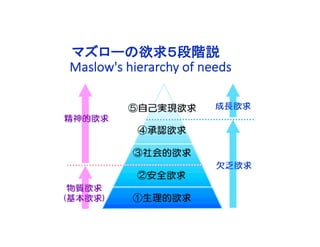
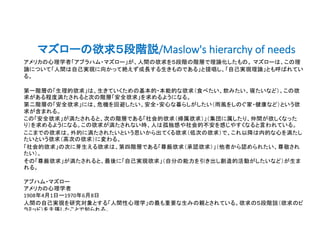
マズローの欲求5段階説/Maslow's hierarchy ofneeds
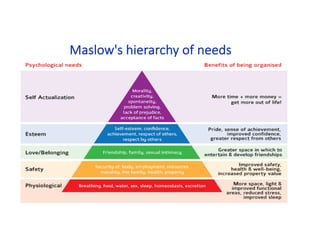
Maslow's hierarchy of needs is a theory in psychology proposed by Abraham
Maslow in his 1943 paper "A Theory of Human Motivation" in Psychological
Review. Maslow subsequently extended the idea to include his observations
of humans' innate curiosity. His theories parallel many other theories of
human developmental psychology, some of which focus on describing the
stages of growth in humans. He then decided to create a classification
system which reflected the universal needs of society as its base and then
proceeding to more acquired emotions. Maslow's hierarchy of needs is used
to study how humans intrinsically partake in behavioral motivation. Maslow
used the terms "physiological", "safety", "belonging and love", "social needs"
or "esteem", and "self-actualization" to describe the pattern through which
human motivations generally move. (Wikipedia)
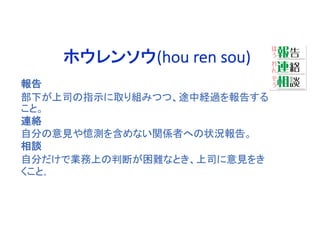
“Hō-Ren-Sō” (報・連・相) isa business
mantra or mnemonic acronym in Japanese
business culture. It is an “abbreviation of
“Hōkoku” (報告, to report), “Renraku" (連絡,
to inform) and “Sōdan” (相談, to consult),
and is more memorable as a homonym of
hōrensō, the Japanese word for "spinach". It
is utilized as a basic business rule in Japan to
conduct smooth business communication.
(Wikipedia)
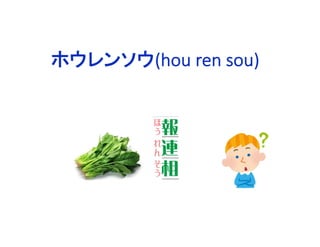
ホウレンソウ(hou ren sou)
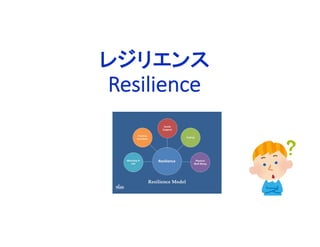
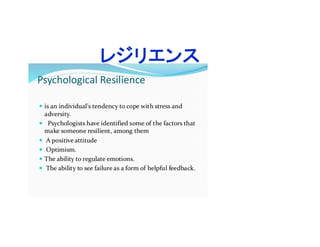
Psychological resilience isthe ability to cope with a
crisis or to return to pre-crisis status quickly. Resilience
exists when the person uses mental processes and
behaviors in promoting personal assets and protecting
self from the potential negative effects of stressors.
(Wiki)
レジリエンス
Resilience
10 Ways toBuild Resilience
The American Psychological Association suggests "10 Ways to Build Resilience",[25] which
are:
1. to maintain good relationships with close family members, friends and others;
2. to avoid seeing crises or stressful events as unbearable problems;
3. to accept circumstances that cannot be changed;
4. to develop realistic goals and move towards them;
5. to take decisive actions in adverse situations;
6. to look for opportunities of self-discovery after a struggle with loss;
7. to develop self-confidence;
8. to keep a long-term perspective and consider the stressful event in a broader context;
9. to maintain a hopeful outlook, expecting good things and visualizing what is wished;
10. to take care of one's mind and body, exercising regularly, paying attention to one's own
needs and feelings.
https://en.wikipedia.org/wiki/Psychological_resilience
https://en.wikipedia.org/wiki/Psychological_resilience
KPI (key performanceindicator )
A performance indicator or key performance
indicator (KPI) is a type of performance
measurement. KPIs evaluate the success of an
organization or of a particular activity (such as
projects, programs, products and other
initiatives) in which it engages. (wikipedia)
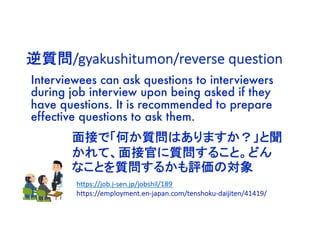
Interviewees can askquestions to interviewers
during job interview upon being asked if they
have questions. It is recommended to prepare
effective questions to ask them.
面接で「何か質問はありますか?」と聞
かれて、面接官に質問すること。どん
なことを質問するかも評価の対象
逆質問/gyakushitumon/reverse question
https://job.j-sen.jp/jobshil/189
https://employment.en-japan.com/tenshoku-daijiten/41419/
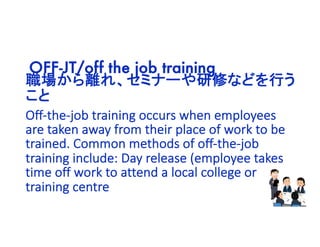
職場から離れ、セミナーや研修などを行う
こと
OFF-JT/off the jobtraining
Off-the-job training occurs when employees
are taken away from their place of work to be
trained. Common methods of off-the-job
training include: Day release (employee takes
time off work to attend a local college or
training centre
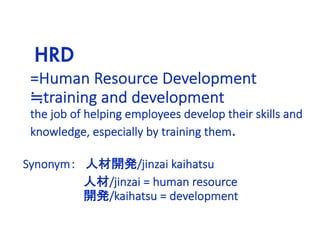
HRD
=Human Resource Development
≒trainingand development
the job of helping employees develop their skills and
knowledge, especially by training them.
Synonym: 人材開発/jinzai kaihatsu
人材/jinzai = human resource
開発/kaihatsu = development
In total, over11.900 companies include the SPI test in
their interviewing process, with over 1.892.000 people
taking the test every year. Especially big companies use
this test, to get an understanding of the candidates’ skills
and personality.
Foreigners are often required to take this test as well. Even
though there is a version for foreigners (available in
English, Korean, and Chinese) it is not widely known and
many companies will ask you to take the Japanese version.
(https://kimi.wiki/jobsearch/spi-test)
SPI(Synthetic Personality Inventory) Test
![SDGs
The Sustainable Development Goals (or SDG's) are a collection of 17 global goals
set by the United Nations General Assembly in 2015 for the year 2030. The SDGs
are part of Resolution 70/1 of the United Nations General Assembly, the 2030
Agenda.[1][2]
The Sustainable Development Goals are: 1) No Poverty, 2) Zero Hunger, 3) Good
Health and Well-being, 4) Quality Education, 5) Gender Equality, 6) Clean Water
and Sanitation, 7) Affordable and Clean Energy, 8) Decent Work and Economic
Growth, 9) Industry, Innovation, and Infrastructure, 10) Reducing Inequality, 11)
Sustainable Cities and Communities, 12) Responsible Consumption and Production,
13) Climate Action, 14) Life Below Water, 15) Life On Land, 16) Peace, Justice, and
Strong Institutions, 17) Partnerships for the Goals.
(Wikipedia)](https://image.slidesharecdn.com/2022-220529233621-c40b523f/85/_2022-2-pdf-14-320.jpg)
![10 Ways to Build Resilience
The American Psychological Association suggests "10 Ways to Build Resilience",[25] which
are:
1. to maintain good relationships with close family members, friends and others;
2. to avoid seeing crises or stressful events as unbearable problems;
3. to accept circumstances that cannot be changed;
4. to develop realistic goals and move towards them;
5. to take decisive actions in adverse situations;
6. to look for opportunities of self-discovery after a struggle with loss;
7. to develop self-confidence;
8. to keep a long-term perspective and consider the stressful event in a broader context;
9. to maintain a hopeful outlook, expecting good things and visualizing what is wished;
10. to take care of one's mind and body, exercising regularly, paying attention to one's own
needs and feelings.
https://en.wikipedia.org/wiki/Psychological_resilience
https://en.wikipedia.org/wiki/Psychological_resilience](https://image.slidesharecdn.com/2022-220529233621-c40b523f/85/_2022-2-pdf-27-320.jpg)