Overview of Documentation
Documentation may mean the following—
• A set of documents provided on paper, or online, or on
digital or analog media, such as audio tape or CDs.
• The process of documenting knowledge, as in scientific
articles.
• The process of providing evidence.
• The writing of product documentation, such as
software documentation.
• A synonym for the term document.
• A synonym for the term bibliography
©Nilotpal Chakraborty 2
Significance of Documentation
• Documents are important for the following reasons—
(a) as an evidence of shipment and title of goods
(b) for obtaining payment
(c) to provide a specific and complete description of the
goods
(d) for assessment of correct Duty for clearance purpose
(e) for obtaining Export Licenses
(f) for obtaining export finance
(g) for completing Pre-shipment Inspection
©Nilotpal Chakraborty 3
Commercial / Regulatory Documents
• Commercial set of documents are mainly used for
Commerce. In other words these are documents
normally exchanged between buyer and seller.
• Regulatory documents are required in dealing
with various regulatory authorities such as
customs, RBI, Excise, Licensing authorities
Inspection and other Export Promotion bodies for
availing incentives etc.
©Nilotpal Chakraborty 4
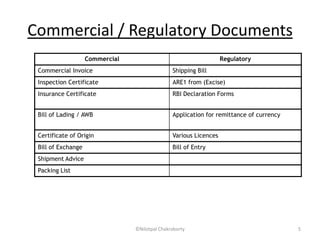
Commercial / Regulatory Documents
Commercial Regulatory
Commercial Invoice Shipping Bill
Inspection Certificate ARE1 from (Excise)
Insurance Certificate RBI Declaration Forms
Bill of Lading / AWB Application for remittance of currency
Certificate of Origin Various Licences
Bill of Exchange Bill of Entry
Shipment Advice
Packing List
©Nilotpal Chakraborty 5
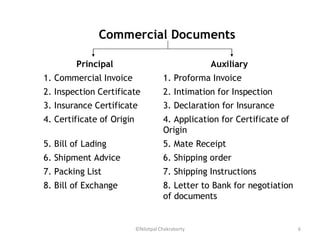
Commercial Documents
8. Letter to Bank for negotiation
of documents
8. Bill of Exchange
7. Shipping Instructions7. Packing List
6. Shipping order6. Shipment Advice
5. Mate Receipt5. Bill of Lading
4. Application for Certificate of
Origin
4. Certificate of Origin
3. Declaration for Insurance3. Insurance Certificate
2. Intimation for Inspection2. Inspection Certificate
1. Proforma Invoice1. Commercial Invoice
AuxiliaryPrincipal
©Nilotpal Chakraborty 6
Import Documents
©Nilotpal Chakraborty 7
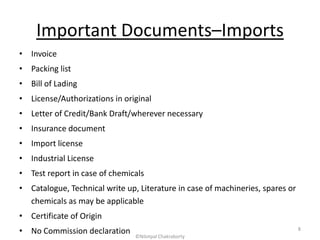
Important Documents–Imports
• Invoice
• Packing list
• Bill of Lading
• License/Authorizations in original
• Letter of Credit/Bank Draft/wherever necessary
• Insurance document
• Import license
• Industrial License
• Test report in case of chemicals
• Catalogue, Technical write up, Literature in case of machineries, spares or
chemicals as may be applicable
• Certificate of Origin
• No Commission declaration
©Nilotpal Chakraborty
8
Invoice
• Invoices are often called bills.
• Various types of invoices used in
International Trade are
• Proforma Invoice
• Commercial Invoice
• Consular Invoice
• Legalized Invoice
• Customs Invoice
©Nilotpal Chakraborty 9
Packing List
• It is a consolidated statement in a prescribed format detailing
how goods are packed, marked and numbered including
weight and dimensions of each package.
• It is useful for customs at the time of examination and
warehouse keeper of buyer to maintain inventory record and
to effect delivery.
• It has many details common from invoice but it does not
indicate unit rate value of goods.
©Nilotpal Chakraborty 10
Packing List
• Customs uses it as a check-list to verify:
– the outgoing cargo (in exporting) and
– the incoming cargo (in importing).
• Basic functions of Packing List are:
– To confirm the contents of a shipment as it left the
exporter’s premises.
– To indicate weights, measures and the piece count (i.e. the
number of cartons or cases) in that shipment.
©Nilotpal Chakraborty 11
Inspection Certificate
• “Certificate of Inspection” is issued by the Inspection Agency concerned
certifying that the consignment has been inspected before shipment as
per the requirements of the Exports (Quality Control and Inspection) Act,
1963.
• It satisfies the conditions relating to quality control and inspection as
applicable to it and is certified export worthy.
• This certificate is required:
– by customs before allowing shipment of goods or
– by a banker to negotiate the documents.
• This certificate bears cross references of invoice or contract number.
©Nilotpal Chakraborty
12
Inspection Certificate
• Inspection can be done by—
– Inspection Agency appointed by the Government of India, i.e. Export
Inspection Agency, Textile Committee, Central Silk Board etc.
– Inspection Agency may also be nominated by importing countries’
Government i.e. SGS and OMIC by some African Countries.
– Sometimes buyer himself appoints an independent private inspector
to inspect the goods.
• If an inspection is a part of transaction, then exporter is required to
arrange for necessary inspection.
• It can be a certificate of quality, weight, analysis, or the like.
©Nilotpal Chakraborty 13
Certificate of Origin [COO]
• It is a certificate indicating the fact that the goods which have
been exported have originated or manufactured in a
particular country. So it is a sort of declaration testifying the
origin of export.
• It is normally required by an importer to clear goods from the
customs.
• For political and social reasons, it is insisted by Customs
Authority of importing country before goods are allowed to
enter in the country.
• It helps the importer to take an advantage in duty concession,
if any. For e.g. goods imported under Free Trade Agreement.
©Nilotpal Chakraborty
14
Certificate of Origin
• These are often required:
– to meet Customs requirements in the importing state
– to comply with Banking requirements
– for other official and commercial reasons.
• There are two categories of Certificate of Origin :
1. Preferential Certificate of Origin and
2. Non-preferential Certificate of Origin
©Nilotpal Chakraborty 15
Bill of Exchange
• Bill of Exchange [BE] is a document drawn and is an order by
the exporter to the buyer to pay the money in specified
exchange.
• It is also known as a draft.
• A bill of exchange is accompanied by commercial documents
which are presented by a bank and released to the buyer
either against payment (at sight) or against a signature for
payment on a specified future date.
• It is an unconditional written order.
©Nilotpal Chakraborty 16
Bill of Exchange
• When a BE is drawn on foreign firm it is termed as a foreign
draft or bill of exchange.
• It is prepared either in an international currency or Indian
rupees depending on the terms of the contract.
• Accordingly, the bill is known by the name of currency in
which it is drawn.
e.g. a bill drawn in US dollars is known as a “Dollar Bill” and
when drawn in Rupees, it is termed as “Rupees Bill”.
©Nilotpal Chakraborty 17
Bill of Exchange
• Features of a Bill of Exchange:
– A bill must be in writing, duly signed by its drawer,
accepted by its drawee and properly stamped.
– It must contain an order to pay. Words like ‘please pay US $
5,000 on demand and oblige’ are not used.
– The order must be unconditional.
– The sum payable mentioned must be certain or capable of
being made certain.
– The parties to a bill must be certain.
©Nilotpal Chakraborty 18
Bill of Lading (B/L)
• Bill of Lading is the transport document associated
with Sea freight.
• It is issued by the Shipping Company or its agent or
master of a ship acknowledging that specified goods
have been received on board as cargo for conveyance
to a named place for delivery to the consignee who is
usually identified.
• It is a document of title to the goods and, as such, is
freely transferable by endorsement and delivery.
©Nilotpal Chakraborty 19
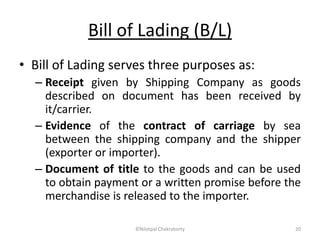
Bill of Lading (B/L)
• Bill of Lading serves three purposes as:
– Receipt given by Shipping Company as goods
described on document has been received by
it/carrier.
– Evidence of the contract of carriage by sea
between the shipping company and the shipper
(exporter or importer).
– Document of title to the goods and can be used
to obtain payment or a written promise before the
merchandise is released to the importer.
©Nilotpal Chakraborty 20
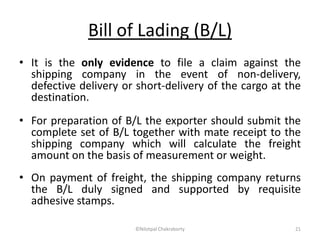
Bill of Lading (B/L)
• It is the only evidence to file a claim against the
shipping company in the event of non-delivery,
defective delivery or short-delivery of the cargo at the
destination.
• For preparation of B/L the exporter should submit the
complete set of B/L together with mate receipt to the
shipping company which will calculate the freight
amount on the basis of measurement or weight.
• On payment of freight, the shipping company returns
the B/L duly signed and supported by requisite
adhesive stamps.
©Nilotpal Chakraborty 21
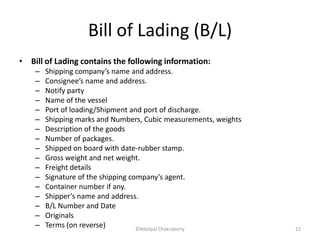
Bill of Lading (B/L)
• Bill of Lading contains the following information:
– Shipping company’s name and address.
– Consignee’s name and address.
– Notify party
– Name of the vessel
– Port of loading/Shipment and port of discharge.
– Shipping marks and Numbers, Cubic measurements, weights
– Description of the goods
– Number of packages.
– Shipped on board with date-rubber stamp.
– Gross weight and net weight.
– Freight details
– Signature of the shipping company’s agent.
– Container number if any.
– Shipper’s name and address.
– B/L Number and Date
– Originals
– Terms (on reverse) ©Nilotpal Chakraborty 22
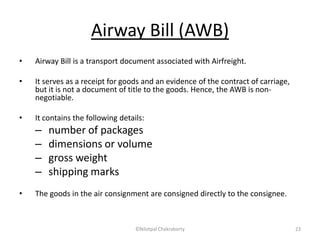
Airway Bill (AWB)
• Airway Bill is a transport document associated with Airfreight.
• It serves as a receipt for goods and an evidence of the contract of carriage,
but it is not a document of title to the goods. Hence, the AWB is non-
negotiable.
• It contains the following details:
– number of packages
– dimensions or volume
– gross weight
– shipping marks
• The goods in the air consignment are consigned directly to the consignee.
©Nilotpal Chakraborty 23
Bill of Entry
• The document on the strength of which clearance of
imported goods can be affected is known as Bill Entry,
the form of which has been standardized by the
Central Board of Excise and Customs.
• Every importer has to submit it under section 46 of
the Customs Act, 1962.
• Under EDI system, Bill of Entry is actually printed on
computer in triplicate only after ‘out of charge’ order
is given. Duplicate copy is given to importer.
©Nilotpal Chakraborty 24
Bill of Entry
• Salient features of a Bill of Entry which is to
be presented for clearance of goods for
home consumption are mentioned below:
– Origin & Vessels Particulars
– Particulars of the Goods
– Value
– Duties Levi able
– Code
– Declaration of Importers/Clearing Agents
©Nilotpal Chakraborty 25
Bill of Entry
• Documents required by customs authorities are required to be
submitted to enable them to (a) check the goods (b) decide
value and classification of goods and (c) to ensure that the
import is legally permitted.
• Documents presented to customs along with the Bill of Entry
generally include:
• Invoice,
• Packing List,
• Bill of Lading or Delivery Order,
• Import License(s) / Customs Clearance Permit,
• Letter of Credit / Bank Draft wherever necessary
• Insurance Policy,
• Certificate of Origin etc.
©Nilotpal Chakraborty 26
Export Documents
©Nilotpal Chakraborty 27
Export Sales Contract
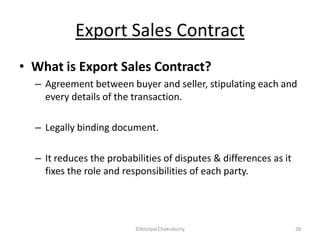
• What is Export Sales Contract?
– Agreement between buyer and seller, stipulating each and
every details of the transaction.
– Legally binding document.
– It reduces the probabilities of disputes & differences as it
fixes the role and responsibilities of each party.
©Nilotpal Chakraborty 28
Export Sales Contract
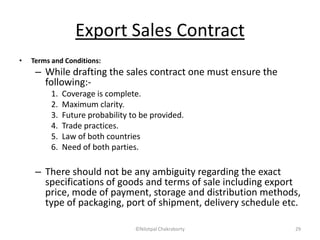
• Terms and Conditions:
– While drafting the sales contract one must ensure the
following:-
1. Coverage is complete.
2. Maximum clarity.
3. Future probability to be provided.
4. Trade practices.
5. Law of both countries
6. Need of both parties.
– There should not be any ambiguity regarding the exact
specifications of goods and terms of sale including export
price, mode of payment, storage and distribution methods,
type of packaging, port of shipment, delivery schedule etc.
©Nilotpal Chakraborty 29
Export Sales Contract
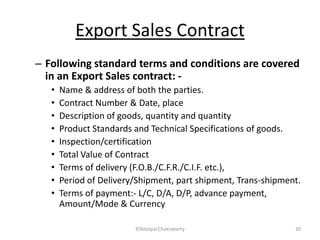
– Following standard terms and conditions are covered
in an Export Sales contract: -
• Name & address of both the parties.
• Contract Number & Date, place
• Description of goods, quantity and quantity
• Product Standards and Technical Specifications of goods.
• Inspection/certification
• Total Value of Contract
• Terms of delivery (F.O.B./C.F.R./C.I.F. etc.),
• Period of Delivery/Shipment, part shipment, Trans-shipment.
• Terms of payment:- L/C, D/A, D/P, advance payment,
Amount/Mode & Currency
©Nilotpal Chakraborty 30
Export Sales Contract
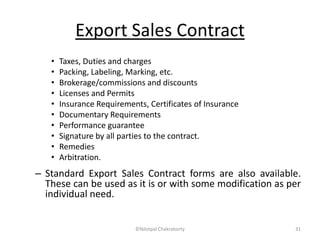
• Taxes, Duties and charges
• Packing, Labeling, Marking, etc.
• Brokerage/commissions and discounts
• Licenses and Permits
• Insurance Requirements, Certificates of Insurance
• Documentary Requirements
• Performance guarantee
• Signature by all parties to the contract.
• Remedies
• Arbitration.
– Standard Export Sales Contract forms are also available.
These can be used as it is or with some modification as per
individual need.
©Nilotpal Chakraborty 31
Pre-shipment Documents
• Documents at pre-shipment stage are those documents,
which are required to be made, till the consignment is
presented to the customs department for clearance.
• The following documents can, therefore, be treated as pre-
shipment documents:-
– Proforma Invoice
– Confirmed order or contract
– Letter of Credit
– Pre-shipment Inspection Certificate
– Packing list
– Shipping Bill
– Export Declaration Forms
– ARE
©Nilotpal Chakraborty 32
Post-shipment Documents
• Documents at Post-shipment stage are naturally those
which are prepared after the shipment.
• These documents include the following:-
– Mate Receipt
– Bill of Lading
– Airway Bill
– Roadway/Railway Bill
– Post Parcel/ Courier Receipt
– Invoices (including consular invoice)
– Certificate of Origin
– Insurance Certificate or Policy
– Bill of Exchange
©Nilotpal Chakraborty 33
Documents for availing various Export Benefits
• Documents are also divided, depending upon,
whether the benefit has to be claimed prior to
exports or after the exports.
• For claiming benefits one has to make
different applications with various
government authorities.
©Nilotpal Chakraborty 34
Conclusion
• Documentation is an essential part of any
business to run efficiently and effectively.
• It helps in avoiding ambiguities and disputes.
• Documents should be prepared carefully and
both the parties (export/import) should study
and refer to it.
©Nilotpal Chakraborty 35
THANK YOU
©Nilotpal Chakraborty 36

Documents for imports and exports

  • 2.
    Overview of Documentation Documentationmay mean the following— • A set of documents provided on paper, or online, or on digital or analog media, such as audio tape or CDs. • The process of documenting knowledge, as in scientific articles. • The process of providing evidence. • The writing of product documentation, such as software documentation. • A synonym for the term document. • A synonym for the term bibliography ©Nilotpal Chakraborty 2
  • 3.
    Significance of Documentation •Documents are important for the following reasons— (a) as an evidence of shipment and title of goods (b) for obtaining payment (c) to provide a specific and complete description of the goods (d) for assessment of correct Duty for clearance purpose (e) for obtaining Export Licenses (f) for obtaining export finance (g) for completing Pre-shipment Inspection ©Nilotpal Chakraborty 3
  • 4.
    Commercial / RegulatoryDocuments • Commercial set of documents are mainly used for Commerce. In other words these are documents normally exchanged between buyer and seller. • Regulatory documents are required in dealing with various regulatory authorities such as customs, RBI, Excise, Licensing authorities Inspection and other Export Promotion bodies for availing incentives etc. ©Nilotpal Chakraborty 4
  • 5.
    Commercial / RegulatoryDocuments Commercial Regulatory Commercial Invoice Shipping Bill Inspection Certificate ARE1 from (Excise) Insurance Certificate RBI Declaration Forms Bill of Lading / AWB Application for remittance of currency Certificate of Origin Various Licences Bill of Exchange Bill of Entry Shipment Advice Packing List ©Nilotpal Chakraborty 5
  • 6.
    Commercial Documents 8. Letterto Bank for negotiation of documents 8. Bill of Exchange 7. Shipping Instructions7. Packing List 6. Shipping order6. Shipment Advice 5. Mate Receipt5. Bill of Lading 4. Application for Certificate of Origin 4. Certificate of Origin 3. Declaration for Insurance3. Insurance Certificate 2. Intimation for Inspection2. Inspection Certificate 1. Proforma Invoice1. Commercial Invoice AuxiliaryPrincipal ©Nilotpal Chakraborty 6
  • 7.
  • 8.
    Important Documents–Imports • Invoice •Packing list • Bill of Lading • License/Authorizations in original • Letter of Credit/Bank Draft/wherever necessary • Insurance document • Import license • Industrial License • Test report in case of chemicals • Catalogue, Technical write up, Literature in case of machineries, spares or chemicals as may be applicable • Certificate of Origin • No Commission declaration ©Nilotpal Chakraborty 8
  • 9.
    Invoice • Invoices areoften called bills. • Various types of invoices used in International Trade are • Proforma Invoice • Commercial Invoice • Consular Invoice • Legalized Invoice • Customs Invoice ©Nilotpal Chakraborty 9
  • 10.
    Packing List • Itis a consolidated statement in a prescribed format detailing how goods are packed, marked and numbered including weight and dimensions of each package. • It is useful for customs at the time of examination and warehouse keeper of buyer to maintain inventory record and to effect delivery. • It has many details common from invoice but it does not indicate unit rate value of goods. ©Nilotpal Chakraborty 10
  • 11.
    Packing List • Customsuses it as a check-list to verify: – the outgoing cargo (in exporting) and – the incoming cargo (in importing). • Basic functions of Packing List are: – To confirm the contents of a shipment as it left the exporter’s premises. – To indicate weights, measures and the piece count (i.e. the number of cartons or cases) in that shipment. ©Nilotpal Chakraborty 11
  • 12.
    Inspection Certificate • “Certificateof Inspection” is issued by the Inspection Agency concerned certifying that the consignment has been inspected before shipment as per the requirements of the Exports (Quality Control and Inspection) Act, 1963. • It satisfies the conditions relating to quality control and inspection as applicable to it and is certified export worthy. • This certificate is required: – by customs before allowing shipment of goods or – by a banker to negotiate the documents. • This certificate bears cross references of invoice or contract number. ©Nilotpal Chakraborty 12
  • 13.
    Inspection Certificate • Inspectioncan be done by— – Inspection Agency appointed by the Government of India, i.e. Export Inspection Agency, Textile Committee, Central Silk Board etc. – Inspection Agency may also be nominated by importing countries’ Government i.e. SGS and OMIC by some African Countries. – Sometimes buyer himself appoints an independent private inspector to inspect the goods. • If an inspection is a part of transaction, then exporter is required to arrange for necessary inspection. • It can be a certificate of quality, weight, analysis, or the like. ©Nilotpal Chakraborty 13
  • 14.
    Certificate of Origin[COO] • It is a certificate indicating the fact that the goods which have been exported have originated or manufactured in a particular country. So it is a sort of declaration testifying the origin of export. • It is normally required by an importer to clear goods from the customs. • For political and social reasons, it is insisted by Customs Authority of importing country before goods are allowed to enter in the country. • It helps the importer to take an advantage in duty concession, if any. For e.g. goods imported under Free Trade Agreement. ©Nilotpal Chakraborty 14
  • 15.
    Certificate of Origin •These are often required: – to meet Customs requirements in the importing state – to comply with Banking requirements – for other official and commercial reasons. • There are two categories of Certificate of Origin : 1. Preferential Certificate of Origin and 2. Non-preferential Certificate of Origin ©Nilotpal Chakraborty 15
  • 16.
    Bill of Exchange •Bill of Exchange [BE] is a document drawn and is an order by the exporter to the buyer to pay the money in specified exchange. • It is also known as a draft. • A bill of exchange is accompanied by commercial documents which are presented by a bank and released to the buyer either against payment (at sight) or against a signature for payment on a specified future date. • It is an unconditional written order. ©Nilotpal Chakraborty 16
  • 17.
    Bill of Exchange •When a BE is drawn on foreign firm it is termed as a foreign draft or bill of exchange. • It is prepared either in an international currency or Indian rupees depending on the terms of the contract. • Accordingly, the bill is known by the name of currency in which it is drawn. e.g. a bill drawn in US dollars is known as a “Dollar Bill” and when drawn in Rupees, it is termed as “Rupees Bill”. ©Nilotpal Chakraborty 17
  • 18.
    Bill of Exchange •Features of a Bill of Exchange: – A bill must be in writing, duly signed by its drawer, accepted by its drawee and properly stamped. – It must contain an order to pay. Words like ‘please pay US $ 5,000 on demand and oblige’ are not used. – The order must be unconditional. – The sum payable mentioned must be certain or capable of being made certain. – The parties to a bill must be certain. ©Nilotpal Chakraborty 18
  • 19.
    Bill of Lading(B/L) • Bill of Lading is the transport document associated with Sea freight. • It is issued by the Shipping Company or its agent or master of a ship acknowledging that specified goods have been received on board as cargo for conveyance to a named place for delivery to the consignee who is usually identified. • It is a document of title to the goods and, as such, is freely transferable by endorsement and delivery. ©Nilotpal Chakraborty 19
  • 20.
    Bill of Lading(B/L) • Bill of Lading serves three purposes as: – Receipt given by Shipping Company as goods described on document has been received by it/carrier. – Evidence of the contract of carriage by sea between the shipping company and the shipper (exporter or importer). – Document of title to the goods and can be used to obtain payment or a written promise before the merchandise is released to the importer. ©Nilotpal Chakraborty 20
  • 21.
    Bill of Lading(B/L) • It is the only evidence to file a claim against the shipping company in the event of non-delivery, defective delivery or short-delivery of the cargo at the destination. • For preparation of B/L the exporter should submit the complete set of B/L together with mate receipt to the shipping company which will calculate the freight amount on the basis of measurement or weight. • On payment of freight, the shipping company returns the B/L duly signed and supported by requisite adhesive stamps. ©Nilotpal Chakraborty 21
  • 22.
    Bill of Lading(B/L) • Bill of Lading contains the following information: – Shipping company’s name and address. – Consignee’s name and address. – Notify party – Name of the vessel – Port of loading/Shipment and port of discharge. – Shipping marks and Numbers, Cubic measurements, weights – Description of the goods – Number of packages. – Shipped on board with date-rubber stamp. – Gross weight and net weight. – Freight details – Signature of the shipping company’s agent. – Container number if any. – Shipper’s name and address. – B/L Number and Date – Originals – Terms (on reverse) ©Nilotpal Chakraborty 22
  • 23.
    Airway Bill (AWB) •Airway Bill is a transport document associated with Airfreight. • It serves as a receipt for goods and an evidence of the contract of carriage, but it is not a document of title to the goods. Hence, the AWB is non- negotiable. • It contains the following details: – number of packages – dimensions or volume – gross weight – shipping marks • The goods in the air consignment are consigned directly to the consignee. ©Nilotpal Chakraborty 23
  • 24.
    Bill of Entry •The document on the strength of which clearance of imported goods can be affected is known as Bill Entry, the form of which has been standardized by the Central Board of Excise and Customs. • Every importer has to submit it under section 46 of the Customs Act, 1962. • Under EDI system, Bill of Entry is actually printed on computer in triplicate only after ‘out of charge’ order is given. Duplicate copy is given to importer. ©Nilotpal Chakraborty 24
  • 25.
    Bill of Entry •Salient features of a Bill of Entry which is to be presented for clearance of goods for home consumption are mentioned below: – Origin & Vessels Particulars – Particulars of the Goods – Value – Duties Levi able – Code – Declaration of Importers/Clearing Agents ©Nilotpal Chakraborty 25
  • 26.
    Bill of Entry •Documents required by customs authorities are required to be submitted to enable them to (a) check the goods (b) decide value and classification of goods and (c) to ensure that the import is legally permitted. • Documents presented to customs along with the Bill of Entry generally include: • Invoice, • Packing List, • Bill of Lading or Delivery Order, • Import License(s) / Customs Clearance Permit, • Letter of Credit / Bank Draft wherever necessary • Insurance Policy, • Certificate of Origin etc. ©Nilotpal Chakraborty 26
  • 27.
  • 28.
    Export Sales Contract •What is Export Sales Contract? – Agreement between buyer and seller, stipulating each and every details of the transaction. – Legally binding document. – It reduces the probabilities of disputes & differences as it fixes the role and responsibilities of each party. ©Nilotpal Chakraborty 28
  • 29.
    Export Sales Contract •Terms and Conditions: – While drafting the sales contract one must ensure the following:- 1. Coverage is complete. 2. Maximum clarity. 3. Future probability to be provided. 4. Trade practices. 5. Law of both countries 6. Need of both parties. – There should not be any ambiguity regarding the exact specifications of goods and terms of sale including export price, mode of payment, storage and distribution methods, type of packaging, port of shipment, delivery schedule etc. ©Nilotpal Chakraborty 29
  • 30.
    Export Sales Contract –Following standard terms and conditions are covered in an Export Sales contract: - • Name & address of both the parties. • Contract Number & Date, place • Description of goods, quantity and quantity • Product Standards and Technical Specifications of goods. • Inspection/certification • Total Value of Contract • Terms of delivery (F.O.B./C.F.R./C.I.F. etc.), • Period of Delivery/Shipment, part shipment, Trans-shipment. • Terms of payment:- L/C, D/A, D/P, advance payment, Amount/Mode & Currency ©Nilotpal Chakraborty 30
  • 31.
    Export Sales Contract •Taxes, Duties and charges • Packing, Labeling, Marking, etc. • Brokerage/commissions and discounts • Licenses and Permits • Insurance Requirements, Certificates of Insurance • Documentary Requirements • Performance guarantee • Signature by all parties to the contract. • Remedies • Arbitration. – Standard Export Sales Contract forms are also available. These can be used as it is or with some modification as per individual need. ©Nilotpal Chakraborty 31
  • 32.
    Pre-shipment Documents • Documentsat pre-shipment stage are those documents, which are required to be made, till the consignment is presented to the customs department for clearance. • The following documents can, therefore, be treated as pre- shipment documents:- – Proforma Invoice – Confirmed order or contract – Letter of Credit – Pre-shipment Inspection Certificate – Packing list – Shipping Bill – Export Declaration Forms – ARE ©Nilotpal Chakraborty 32
  • 33.
    Post-shipment Documents • Documentsat Post-shipment stage are naturally those which are prepared after the shipment. • These documents include the following:- – Mate Receipt – Bill of Lading – Airway Bill – Roadway/Railway Bill – Post Parcel/ Courier Receipt – Invoices (including consular invoice) – Certificate of Origin – Insurance Certificate or Policy – Bill of Exchange ©Nilotpal Chakraborty 33
  • 34.
    Documents for availingvarious Export Benefits • Documents are also divided, depending upon, whether the benefit has to be claimed prior to exports or after the exports. • For claiming benefits one has to make different applications with various government authorities. ©Nilotpal Chakraborty 34
  • 35.
    Conclusion • Documentation isan essential part of any business to run efficiently and effectively. • It helps in avoiding ambiguities and disputes. • Documents should be prepared carefully and both the parties (export/import) should study and refer to it. ©Nilotpal Chakraborty 35
  • 36.