Features of Democracy
In a democracy the final decision making power must rest
with those who elected by the people.
A democracy must be based on a free and fair election
where those currently in power have a fair chance of
losing.
In a democracy, each adult citizen must have one vote
and each vote must have one value.
A democratic government rules within limits sets by
constitutional law and citizen’s right.
The opposition parties are allowed to function freely
before and after the elections.
The democratic governments are based on fundamental
principles of political equality.
Merits of Democracy
 Liberty
 Equality
 Legal form of the Government
Merits of Democracy
 Freedom to choose the Heads
 Quality of decision making
 Deal with differences and conflicts
 No permanent loser/winner
 Enhances the dignity of the citizens
Demerits of Democracy
 Slow
 Success or failure depends on the voter
 Corruption
 Expensive
 Cannot meet emergencies
 Leaders keep changing in a democracy. This leads
to instability.
Dictatorship
 A dictatorship consists of rule by one person or a
group of people.
 A dictatorship is a body of government where total
control and dominance lies with a small group of
people or one person.
 A leader takes control over the gov’t and has total
power
Merits of Dictatorship
 Efficient in war time
 Less Room for Corruption
 "Things Happen" Quickly
Demerits of Dictatorship
 No fundamental rights
 Enemy of international peace
 Dictatorship spreads war and aggression
 Force and violence
Democracy vs Dictatorship
 Stability of the Government
 Rights of the People
 Efficiency
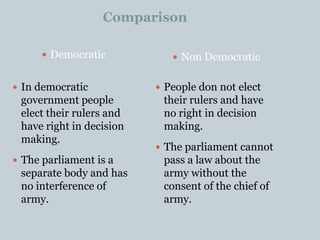
 Democratic  Non Democratic
 In democratic
government people
elect their rulers and
have right in decision
making.
 The parliament is a
separate body and has
no interference of
army.
 People don not elect
their rulers and have
no right in decision
making.
 The parliament cannot
pass a law about the
army without the
consent of the chief of
army.
Comparison
Situation around the World
INDIA : India is said to be the most successful
democratic country.
From its inception , there has not any Military take
over of government.
But it has been facing with the problems of
corruption and rigging in the elections , even the
literacy rate in the urban sector is much higher
than in Pakistan.
Arabian and African Muslim Estates: Many of the Arabian
and African Muslim countries has been controlled by
dictator leadership.
In a past few years , revelotution rose against dictators in
Egypt , Iran and Libiya
These types of riots has been proved extremely
dangerous for the economy.
Due to these , these countries got depend upon the
foreign grants and funds.
Case Study : Pakistan
From the inception of Pakistan , there has been
the conflictions between the military and civil
leadership
For about 30 years in history, we had dictator
leadership.
Pakistan is a democratic country.
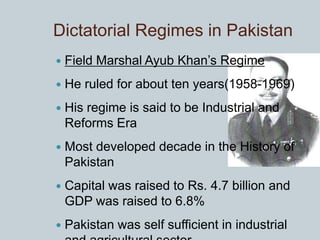
Dictatorial Regimes in Pakistan
 Field Marshal Ayub Khan’s Regime
 He ruled for about ten years(1958-1969)
 His regime is said to be Industrial and
Reforms Era
 Most developed decade in the History of
Pakistan
 Capital was raised to Rs. 4.7 billion and
GDP was raised to 6.8%
 Pakistan was self sufficient in industrial
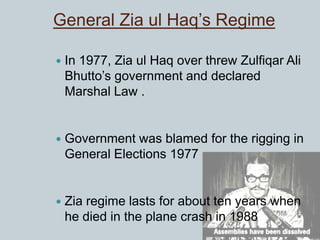
General Zia ul Haq’s Regime
 In 1977, Zia ul Haq over threw Zulfiqar Ali
Bhutto’s government and declared
Marshal Law .
 Government was blamed for the rigging in
General Elections 1977
 Zia regime lasts for about ten years when
he died in the plane crash in 1988
 Like Ayub era , many industrial and
agricultural reforms were introduced.
 Pakistan started its Nuclear Program and
Zia was able to stand against external
pressures.
 Military was made more strong and
efficient.
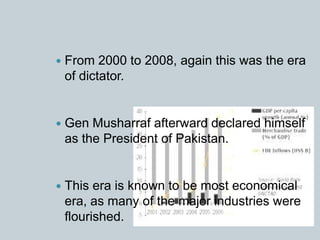
 From 2000 to 2008, again this was the era
of dictator.
 Gen Musharraf afterward declared himself
as the President of Pakistan.
 This era is known to be most economical
era, as many of the major industries were
flourished.
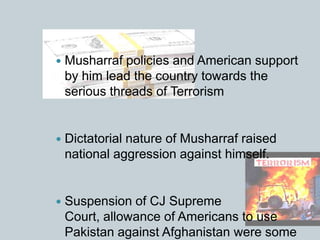
 Musharraf policies and American support
by him lead the country towards the
serious threads of Terrorism
 Dictatorial nature of Musharraf raised
national aggression against himself.
 Suspension of CJ Supreme
Court, allowance of Americans to use
Pakistan against Afghanistan were some
So what should then we do ???
 Democracy is better than other forms of government
because it allows us to correct its own mistakes.
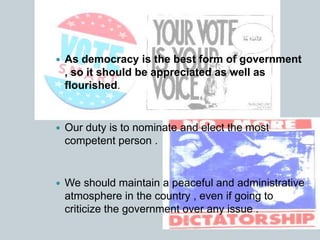
 As democracy is the best form of government
, so it should be appreciated as well as
flourished.
 Our duty is to nominate and elect the most
competent person .
 We should maintain a peaceful and administrative
atmosphere in the country , even if going to
criticize the government over any issue .
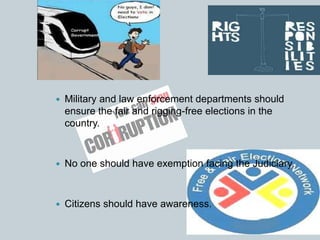
 Military and law enforcement departments should
ensure the fair and rigging-free elections in the
country.
 No one should have exemption facing the Judiciary.
 Citizens should have awareness.

Democracy or dictatorship

  • 3.
    Features of Democracy Ina democracy the final decision making power must rest with those who elected by the people. A democracy must be based on a free and fair election where those currently in power have a fair chance of losing. In a democracy, each adult citizen must have one vote and each vote must have one value. A democratic government rules within limits sets by constitutional law and citizen’s right. The opposition parties are allowed to function freely before and after the elections. The democratic governments are based on fundamental principles of political equality.
  • 4.
    Merits of Democracy Liberty  Equality  Legal form of the Government
  • 5.
    Merits of Democracy Freedom to choose the Heads  Quality of decision making  Deal with differences and conflicts  No permanent loser/winner  Enhances the dignity of the citizens
  • 6.
    Demerits of Democracy Slow  Success or failure depends on the voter  Corruption  Expensive  Cannot meet emergencies  Leaders keep changing in a democracy. This leads to instability.
  • 7.
    Dictatorship  A dictatorshipconsists of rule by one person or a group of people.  A dictatorship is a body of government where total control and dominance lies with a small group of people or one person.  A leader takes control over the gov’t and has total power
  • 8.
    Merits of Dictatorship Efficient in war time  Less Room for Corruption  "Things Happen" Quickly
  • 9.
    Demerits of Dictatorship No fundamental rights  Enemy of international peace  Dictatorship spreads war and aggression  Force and violence
  • 10.
    Democracy vs Dictatorship Stability of the Government  Rights of the People  Efficiency
  • 11.
     Democratic Non Democratic  In democratic government people elect their rulers and have right in decision making.  The parliament is a separate body and has no interference of army.  People don not elect their rulers and have no right in decision making.  The parliament cannot pass a law about the army without the consent of the chief of army. Comparison
  • 12.
    Situation around theWorld INDIA : India is said to be the most successful democratic country. From its inception , there has not any Military take over of government. But it has been facing with the problems of corruption and rigging in the elections , even the literacy rate in the urban sector is much higher than in Pakistan.
  • 13.
    Arabian and AfricanMuslim Estates: Many of the Arabian and African Muslim countries has been controlled by dictator leadership. In a past few years , revelotution rose against dictators in Egypt , Iran and Libiya These types of riots has been proved extremely dangerous for the economy. Due to these , these countries got depend upon the foreign grants and funds.
  • 14.
    Case Study :Pakistan From the inception of Pakistan , there has been the conflictions between the military and civil leadership For about 30 years in history, we had dictator leadership. Pakistan is a democratic country.
  • 15.
    Dictatorial Regimes inPakistan  Field Marshal Ayub Khan’s Regime  He ruled for about ten years(1958-1969)  His regime is said to be Industrial and Reforms Era  Most developed decade in the History of Pakistan  Capital was raised to Rs. 4.7 billion and GDP was raised to 6.8%  Pakistan was self sufficient in industrial
  • 16.
    General Zia ulHaq’s Regime  In 1977, Zia ul Haq over threw Zulfiqar Ali Bhutto’s government and declared Marshal Law .  Government was blamed for the rigging in General Elections 1977  Zia regime lasts for about ten years when he died in the plane crash in 1988
  • 17.
     Like Ayubera , many industrial and agricultural reforms were introduced.  Pakistan started its Nuclear Program and Zia was able to stand against external pressures.  Military was made more strong and efficient.
  • 18.
     From 2000to 2008, again this was the era of dictator.  Gen Musharraf afterward declared himself as the President of Pakistan.  This era is known to be most economical era, as many of the major industries were flourished.
  • 19.
     Musharraf policiesand American support by him lead the country towards the serious threads of Terrorism  Dictatorial nature of Musharraf raised national aggression against himself.  Suspension of CJ Supreme Court, allowance of Americans to use Pakistan against Afghanistan were some
  • 20.
    So what shouldthen we do ???  Democracy is better than other forms of government because it allows us to correct its own mistakes.
  • 21.
     As democracyis the best form of government , so it should be appreciated as well as flourished.  Our duty is to nominate and elect the most competent person .  We should maintain a peaceful and administrative atmosphere in the country , even if going to criticize the government over any issue .
  • 22.
     Military andlaw enforcement departments should ensure the fair and rigging-free elections in the country.  No one should have exemption facing the Judiciary.  Citizens should have awareness.