Democracy
versus
Dictatorship
Table of Contents
 Introduction
 Merits and Demerits
 History
 Some past regimes
 Discussion and Conclusion
 References
What is Democracy ?
 Government of the People , by the people
, for the people (Abraham Lincoln)
 It refers to the type of Government ,
elected by the Local bodies and exercised
by them directly or indirectly.
 It is the most experienced and common
type of Government .
Democracy
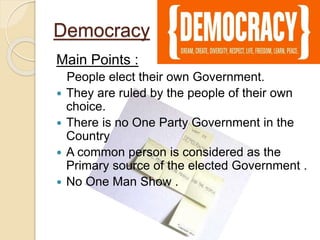
Main Points :
People elect their own Government.
 They are ruled by the people of their own
choice.
 There is no One Party Government in the
Country
 A common person is considered as the
Primary source of the elected Government .
 No One Man Show .
Merits of Democracy
 Local Body government in which
people are free to choose their rulers
 People have liberty of speech .
 Public Questions are decided by the
will of majority.
 People get the chance to change the
governing bodies.
 Legal form of government.
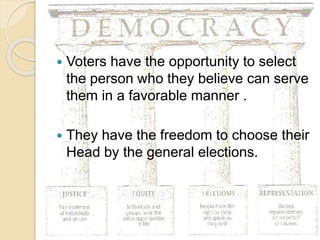
 Voters have the opportunity to select
the person who they believe can serve
them in a favorable manner .
 They have the freedom to choose their
Head by the general elections.
Demerits
 According to Napoleon , “ Nine people
out of ten are fool”
 This cause the election of some
illegible persons
 Corruption and Bribery.
 Ill-litrate people sometimes choose the
people on caste and creed basis.
 Expensive mode of government.
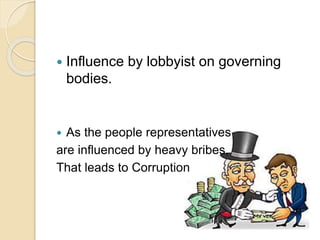
 Influence by lobbyist on governing
bodies.
 As the people representatives
are influenced by heavy bribes,
That leads to Corruption
Dictatorship !!!
 A type of government in which the whole governing
body is controlled by a single individual or a single
group of people.
 Totalitarianism in which a single personality govern
all the authorities .
Dictatorship is an illegal form of
government in which power is used to
overcome the people.
 It has been proved unfriendly.
 One Man Show .
Some Merits of Dictatorship
 More stable government .
 Less room for Corruption.
 More efficient during emergencies.
 Less crime rates.
 Things happening very quickly.
 More stronger economy than
democratic government .
 No politics ever.
Demerits of Dictatorship
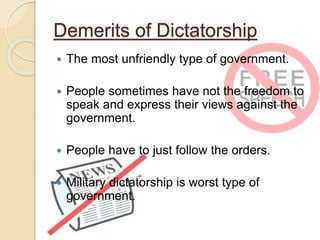
 The most unfriendly type of government.
 People sometimes have not the freedom to
speak and express their views against the
government.
 People have to just follow the orders.
 Military dictatorship is worst type of
government.
In Pakistan, Democracy or the
Dictatorship ???
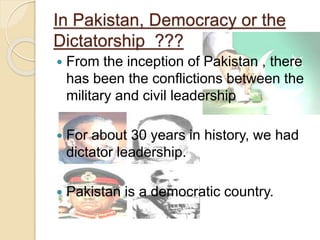
 From the inception of Pakistan , there
has been the conflictions between the
military and civil leadership
 For about 30 years in history, we had
dictator leadership.
 Pakistan is a democratic country.
Dictatorial Regimes in
Pakistan
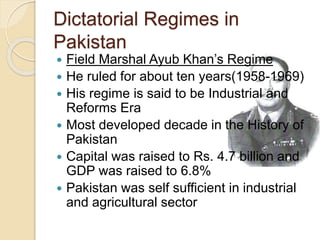
 Field Marshal Ayub Khan’s Regime
 He ruled for about ten years(1958-1969)
 His regime is said to be Industrial and
Reforms Era
 Most developed decade in the History of
Pakistan
 Capital was raised to Rs. 4.7 billion and
GDP was raised to 6.8%
 Pakistan was self sufficient in industrial
and agricultural sector
 Dictatorial behavior of Ayub Khan rose rage of people
against himself
 He tried to overcome it by the use of power, that leads
to the separation of East Pakistan.
 Constitution of 1962 was launched by Ayub Khan in
which all the supreme authorities was owned by him.
 After the resignation, he handed the government to
General Yahya Khan.
 Yahya’s policies against the East Pakistani’s caused
formation of Bangladesh.
General Zia ul Haq’s Regime
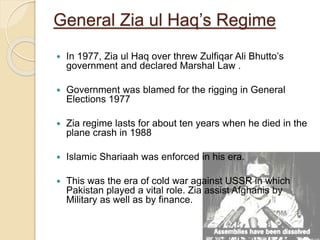
 In 1977, Zia ul Haq over threw Zulfiqar Ali Bhutto’s
government and declared Marshal Law .
 Government was blamed for the rigging in General
Elections 1977
 Zia regime lasts for about ten years when he died in the
plane crash in 1988
 Islamic Shariaah was enforced in his era.
 This was the era of cold war against USSR in which
Pakistan played a vital role. Zia assist Afghanis by
Military as well as by finance.
 Like Ayub era , many industrial and agricultural reforms were
introduced.
 Pakistan started its Nuclear Program and Zia was able to
stand against external pressures.
 Military was made more strong and efficient.
 Many new reforms were introduced that could lend benefits to
the common people.
 Islamization was introduced and all the Non Islamic activities
were strictly prohibited.
 Pakistan had highest GDP rate in the history in Zia era.
General Musharraf’s Regime
 After the Zia ul Haq , general elections were held which
allowed PPP to make government .
 This government could not exist for the long time as they
were acussed of corruption.
 Then came the era of Nawaz Shareef , which too could stand
for a long time
 From 1988 to 1999, no government could stand more than 3
years
 This decade was said to be the failure of democracy in
Pakistan
 At last Gen Pervaiz Mushrraf (COAS) suspended the
constitution and chose designation of Chief Executive of
Pakistan for himself, dissolving the government.
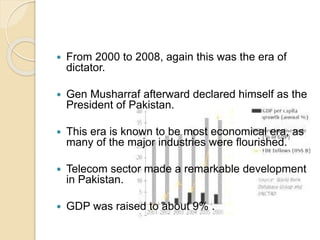
 From 2000 to 2008, again this was the era of
dictator.
 Gen Musharraf afterward declared himself as the
President of Pakistan.
 This era is known to be most economical era, as
many of the major industries were flourished.
 Telecom sector made a remarkable development
in Pakistan.
 GDP was raised to about 9% .
 Musharraf policies and American support by him
lead the country towards the serious threads of
Terrorism
 Dictatorial nature of Musharraf raised national
aggression against himself.
 Suspension of CJ Supreme Court, allowance of
Americans to use Pakistan against Afghanistan
were some of the worst steps taken by him.
 Dictatorial behavior of Musharraf caused the
political opposition against him.
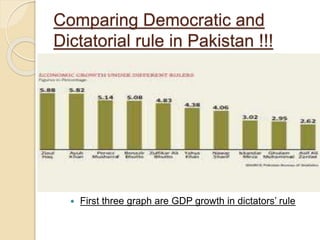
Comparing Democratic and
Dictatorial rule in Pakistan !!!
 First three graph are GDP growth in dictators’ rule
 Ayub Khan and Zia’s Era is known as the Era of
development and peace
 Highest GDP rate was observed.
 Likewise , unfortunately every democratic government
was blamed corrupt , and base of national as well as
international disputes.
 Modification of irrigation system , installments of various
industries , betterment of foreign affairs , strong defense
amendments and Nuclear program etc ,
 All these were introduced and implemented in the
dictatorial era
 Democracy is the legal type of government in which people
elected from the citizens are offered to form the government.
 But a dictator takes over the government when national
disputes and confliction rises.
 In the history dictatorial government has been proved to be
the most economical and most administrative leadership
 The reason is that , by the common person , some of the
incompetent people are elected.
 They do not deserve to have the leadership.
 Foreign aids and funds are highly appreciated.
Situations around the World
 INDIA : India is said to be the most
successful democratic country.
 From its inception , there has not any
Military take over of government.
 But it has been facing with the
problems of corruption and rigging in
the elections , even the literacy rate in
the urban sector is much higher than
in Pakistan.
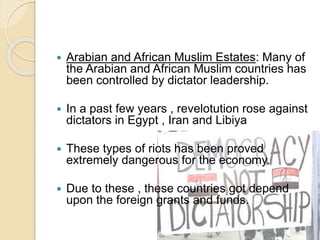
 Arabian and African Muslim Estates: Many of
the Arabian and African Muslim countries has
been controlled by dictator leadership.
 In a past few years , revelotution rose against
dictators in Egypt , Iran and Libiya
 These types of riots has been proved
extremely dangerous for the economy.
 Due to these , these countries got depend
upon the foreign grants and funds.
So what should then we do
???
 As democracy is the best form of government
, so it should be appreciated as well as
flourished.
 Our duty is to nominate and elect the most
competent person .
 We should maintain a peaceful and
administrative atmosphere in the country , even if
going to criticize the government over any issue .
 We should maintain a cooperative atmosphere
with the representatives of government.
 Military and law enforcement departments should
ensure the fair and rigging-free elections in the
country.
 No one should have exemption facing the
Judiciary.
 Citizens should have awareness.
 In these ways we can have a better
democratic and peaceful atmosphere .
Links and References
 society-politics.blurtit.com
 winnerjose.expertscolumn.com/
 buzzle.com
 www.mongabay.com/history/pakistan
 www.drpeeling.com
 www.economist.com/topics/pakistan
 pakistanpoliticsjournal.wordpress.com
Presentation1 140105080840-phpapp01

Presentation1 140105080840-phpapp01

  • 2.
  • 3.
    Table of Contents Introduction  Merits and Demerits  History  Some past regimes  Discussion and Conclusion  References
  • 4.
    What is Democracy?  Government of the People , by the people , for the people (Abraham Lincoln)  It refers to the type of Government , elected by the Local bodies and exercised by them directly or indirectly.  It is the most experienced and common type of Government .
  • 5.
    Democracy Main Points : Peopleelect their own Government.  They are ruled by the people of their own choice.  There is no One Party Government in the Country  A common person is considered as the Primary source of the elected Government .  No One Man Show .
  • 6.
    Merits of Democracy Local Body government in which people are free to choose their rulers  People have liberty of speech .  Public Questions are decided by the will of majority.  People get the chance to change the governing bodies.  Legal form of government.
  • 7.
     Voters havethe opportunity to select the person who they believe can serve them in a favorable manner .  They have the freedom to choose their Head by the general elections.
  • 8.
    Demerits  According toNapoleon , “ Nine people out of ten are fool”  This cause the election of some illegible persons  Corruption and Bribery.  Ill-litrate people sometimes choose the people on caste and creed basis.  Expensive mode of government.
  • 9.
     Influence bylobbyist on governing bodies.  As the people representatives are influenced by heavy bribes, That leads to Corruption
  • 10.
    Dictatorship !!!  Atype of government in which the whole governing body is controlled by a single individual or a single group of people.  Totalitarianism in which a single personality govern all the authorities .
  • 11.
    Dictatorship is anillegal form of government in which power is used to overcome the people.  It has been proved unfriendly.  One Man Show .
  • 12.
    Some Merits ofDictatorship  More stable government .  Less room for Corruption.  More efficient during emergencies.  Less crime rates.  Things happening very quickly.  More stronger economy than democratic government .  No politics ever.
  • 13.
    Demerits of Dictatorship The most unfriendly type of government.  People sometimes have not the freedom to speak and express their views against the government.  People have to just follow the orders.  Military dictatorship is worst type of government.
  • 14.
    In Pakistan, Democracyor the Dictatorship ???  From the inception of Pakistan , there has been the conflictions between the military and civil leadership  For about 30 years in history, we had dictator leadership.  Pakistan is a democratic country.
  • 15.
    Dictatorial Regimes in Pakistan Field Marshal Ayub Khan’s Regime  He ruled for about ten years(1958-1969)  His regime is said to be Industrial and Reforms Era  Most developed decade in the History of Pakistan  Capital was raised to Rs. 4.7 billion and GDP was raised to 6.8%  Pakistan was self sufficient in industrial and agricultural sector
  • 16.
     Dictatorial behaviorof Ayub Khan rose rage of people against himself  He tried to overcome it by the use of power, that leads to the separation of East Pakistan.  Constitution of 1962 was launched by Ayub Khan in which all the supreme authorities was owned by him.  After the resignation, he handed the government to General Yahya Khan.  Yahya’s policies against the East Pakistani’s caused formation of Bangladesh.
  • 17.
    General Zia ulHaq’s Regime  In 1977, Zia ul Haq over threw Zulfiqar Ali Bhutto’s government and declared Marshal Law .  Government was blamed for the rigging in General Elections 1977  Zia regime lasts for about ten years when he died in the plane crash in 1988  Islamic Shariaah was enforced in his era.  This was the era of cold war against USSR in which Pakistan played a vital role. Zia assist Afghanis by Military as well as by finance.
  • 18.
     Like Ayubera , many industrial and agricultural reforms were introduced.  Pakistan started its Nuclear Program and Zia was able to stand against external pressures.  Military was made more strong and efficient.  Many new reforms were introduced that could lend benefits to the common people.  Islamization was introduced and all the Non Islamic activities were strictly prohibited.  Pakistan had highest GDP rate in the history in Zia era.
  • 19.
    General Musharraf’s Regime After the Zia ul Haq , general elections were held which allowed PPP to make government .  This government could not exist for the long time as they were acussed of corruption.  Then came the era of Nawaz Shareef , which too could stand for a long time  From 1988 to 1999, no government could stand more than 3 years  This decade was said to be the failure of democracy in Pakistan  At last Gen Pervaiz Mushrraf (COAS) suspended the constitution and chose designation of Chief Executive of Pakistan for himself, dissolving the government.
  • 20.
     From 2000to 2008, again this was the era of dictator.  Gen Musharraf afterward declared himself as the President of Pakistan.  This era is known to be most economical era, as many of the major industries were flourished.  Telecom sector made a remarkable development in Pakistan.  GDP was raised to about 9% .
  • 21.
     Musharraf policiesand American support by him lead the country towards the serious threads of Terrorism  Dictatorial nature of Musharraf raised national aggression against himself.  Suspension of CJ Supreme Court, allowance of Americans to use Pakistan against Afghanistan were some of the worst steps taken by him.  Dictatorial behavior of Musharraf caused the political opposition against him.
  • 22.
    Comparing Democratic and Dictatorialrule in Pakistan !!!  First three graph are GDP growth in dictators’ rule
  • 23.
     Ayub Khanand Zia’s Era is known as the Era of development and peace  Highest GDP rate was observed.  Likewise , unfortunately every democratic government was blamed corrupt , and base of national as well as international disputes.  Modification of irrigation system , installments of various industries , betterment of foreign affairs , strong defense amendments and Nuclear program etc ,  All these were introduced and implemented in the dictatorial era
  • 24.
     Democracy isthe legal type of government in which people elected from the citizens are offered to form the government.  But a dictator takes over the government when national disputes and confliction rises.  In the history dictatorial government has been proved to be the most economical and most administrative leadership  The reason is that , by the common person , some of the incompetent people are elected.  They do not deserve to have the leadership.  Foreign aids and funds are highly appreciated.
  • 25.
    Situations around theWorld  INDIA : India is said to be the most successful democratic country.  From its inception , there has not any Military take over of government.  But it has been facing with the problems of corruption and rigging in the elections , even the literacy rate in the urban sector is much higher than in Pakistan.
  • 26.
     Arabian andAfrican Muslim Estates: Many of the Arabian and African Muslim countries has been controlled by dictator leadership.  In a past few years , revelotution rose against dictators in Egypt , Iran and Libiya  These types of riots has been proved extremely dangerous for the economy.  Due to these , these countries got depend upon the foreign grants and funds.
  • 27.
    So what shouldthen we do ???  As democracy is the best form of government , so it should be appreciated as well as flourished.  Our duty is to nominate and elect the most competent person .  We should maintain a peaceful and administrative atmosphere in the country , even if going to criticize the government over any issue .  We should maintain a cooperative atmosphere with the representatives of government.
  • 28.
     Military andlaw enforcement departments should ensure the fair and rigging-free elections in the country.  No one should have exemption facing the Judiciary.  Citizens should have awareness.  In these ways we can have a better democratic and peaceful atmosphere .
  • 29.
    Links and References society-politics.blurtit.com  winnerjose.expertscolumn.com/  buzzle.com  www.mongabay.com/history/pakistan  www.drpeeling.com  www.economist.com/topics/pakistan  pakistanpoliticsjournal.wordpress.com