INTRODUCTION TO REAL
TIME SYSTEM
Presented by
D.S.MYDHEESWARAN
REAL TIME SYSTEM
Real time system is a computer
system that must satisfy
bounded response time
constraint or risk severe
consequences including failure.
CHARACTERISTICS OF REAL TIME SYSTEMS
 Time constraints
 Correctness
 Embedded
 Safety
 Concurrency
 Distributed
 Stability
 Fault tolerance
 Determinism
 Real time communication
 Resource Management
TASKS IN REAL TIME SYSTEMS
 Periodic and non Periodic Task
 Critical and Non Critical Task
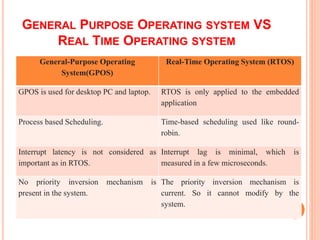
GENERAL PURPOSE OPERATING SYSTEM VS
REAL TIME OPERATING SYSTEM
General-Purpose Operating
System(GPOS)
Real-Time Operating System (RTOS)
GPOS is used for desktop PC and laptop. RTOS is only applied to the embedded
application
Process based Scheduling. Time-based scheduling used like round-
robin.
Interrupt latency is not considered as
important as in RTOS.
Interrupt lag is minimal, which is
measured in a few microseconds.
No priority inversion mechanism is
present in the system.
The priority inversion mechanism is
current. So it cannot modify by the
system.
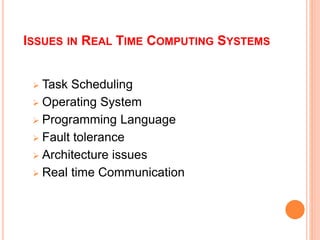
ISSUES IN REAL TIME COMPUTING SYSTEMS
 Task Scheduling
 Operating System
 Programming Language
 Fault tolerance
 Architecture issues
 Real time Communication
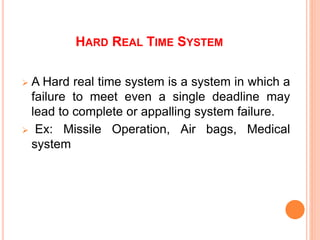
HARD REAL TIME SYSTEM
 A Hard real time system is a system in which a
failure to meet even a single deadline may
lead to complete or appalling system failure.
 Ex: Missile Operation, Air bags, Medical
system
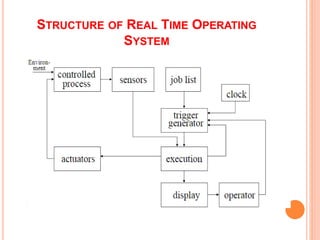
STRUCTURE OF REAL TIME OPERATING
SYSTEM
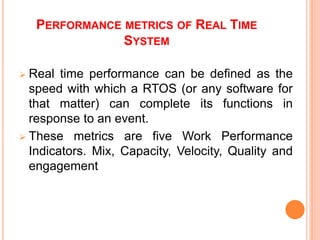
PERFORMANCE METRICS OF REAL TIME
SYSTEM
 Real time performance can be defined as the
speed with which a RTOS (or any software for
that matter) can complete its functions in
response to an event.
 These metrics are five Work Performance
Indicators. Mix, Capacity, Velocity, Quality and
engagement
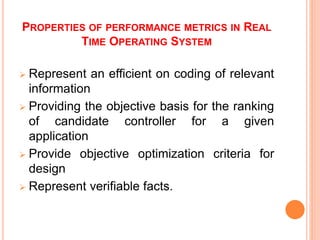
PROPERTIES OF PERFORMANCE METRICS IN REAL
TIME OPERATING SYSTEM
 Represent an efficient on coding of relevant
information
 Providing the objective basis for the ranking
of candidate controller for a given
application
 Provide objective optimization criteria for
design
 Represent verifiable facts.
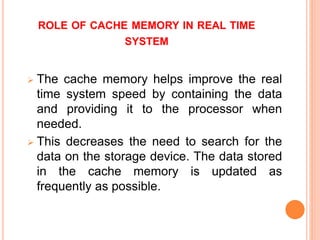
ROLE OF CACHE MEMORY IN REAL TIME
SYSTEM
 The cache memory helps improve the real
time system speed by containing the data
and providing it to the processor when
needed.
 This decreases the need to search for the
data on the storage device. The data stored
in the cache memory is updated as
frequently as possible.

Introduction to Real Time System in computer system

  • 1.
    INTRODUCTION TO REAL TIMESYSTEM Presented by D.S.MYDHEESWARAN
  • 2.
    REAL TIME SYSTEM Realtime system is a computer system that must satisfy bounded response time constraint or risk severe consequences including failure.
  • 3.
    CHARACTERISTICS OF REALTIME SYSTEMS  Time constraints  Correctness  Embedded  Safety  Concurrency  Distributed  Stability  Fault tolerance  Determinism  Real time communication  Resource Management
  • 4.
    TASKS IN REALTIME SYSTEMS  Periodic and non Periodic Task  Critical and Non Critical Task
  • 5.
    GENERAL PURPOSE OPERATINGSYSTEM VS REAL TIME OPERATING SYSTEM General-Purpose Operating System(GPOS) Real-Time Operating System (RTOS) GPOS is used for desktop PC and laptop. RTOS is only applied to the embedded application Process based Scheduling. Time-based scheduling used like round- robin. Interrupt latency is not considered as important as in RTOS. Interrupt lag is minimal, which is measured in a few microseconds. No priority inversion mechanism is present in the system. The priority inversion mechanism is current. So it cannot modify by the system.
  • 6.
    ISSUES IN REALTIME COMPUTING SYSTEMS  Task Scheduling  Operating System  Programming Language  Fault tolerance  Architecture issues  Real time Communication
  • 7.
    HARD REAL TIMESYSTEM  A Hard real time system is a system in which a failure to meet even a single deadline may lead to complete or appalling system failure.  Ex: Missile Operation, Air bags, Medical system
  • 8.
    STRUCTURE OF REALTIME OPERATING SYSTEM
  • 9.
    PERFORMANCE METRICS OFREAL TIME SYSTEM  Real time performance can be defined as the speed with which a RTOS (or any software for that matter) can complete its functions in response to an event.  These metrics are five Work Performance Indicators. Mix, Capacity, Velocity, Quality and engagement
  • 10.
    PROPERTIES OF PERFORMANCEMETRICS IN REAL TIME OPERATING SYSTEM  Represent an efficient on coding of relevant information  Providing the objective basis for the ranking of candidate controller for a given application  Provide objective optimization criteria for design  Represent verifiable facts.
  • 11.
    ROLE OF CACHEMEMORY IN REAL TIME SYSTEM  The cache memory helps improve the real time system speed by containing the data and providing it to the processor when needed.  This decreases the need to search for the data on the storage device. The data stored in the cache memory is updated as frequently as possible.