10/5/2023 Real-Time Systems
Real-Time Systems
Introduction
10/5/2023 Real-Time Systems
Real-time Systems
• A real-time system is a system whose
specification includes both logical and temporal
correctness requirements.
• Logical Correctness: Produces correct outputs.
– Can by checked, for example, by Hoare logic.
• Temporal Correctness: Produces outputs at
the right time.
– In this course, we spend much time on techniques
and technologies for achieving and checking temporal
correctness.
10/5/2023 Real-Time Systems
Embedded Systems
• [www.webopedia.com]:
An embedded system is “a specialized
computer system that is part of a larger system
or machine. Typically, an embedded system is
housed on a single microprocessor board with
the programs stored in ROM. Virtually all
appliances that have digital interfaces (e.g.,
watches, microwaves, VCRs, cars) utilize
embedded systems […]”
• Many embedded systems are real-time systems
10/5/2023 Real-Time Systems
Typical Characteristics of Real-
Time Systems
• Event-driven, reactive.
• High cost of failure.
• Concurrency/multiprogramming.
• Stand-alone/continuous operation.
• Reliability/fault-tolerance requirements.
• Predictable behavior.
10/5/2023 Real-Time Systems
Misconceptions about Real-Time Systems
(Stankovic ‘88)
• There is no science in real-time-system design.
– We shall see…
• Advances in supercomputing hardware will take
care of real-time requirements.
– The old “buy a faster processor” argument…
• Real-time computing is equivalent to fast
computing.
– Only to ad agencies. To us, it means PREDICTABLE
computing.
10/5/2023 Real-Time Systems
Misconceptions (Continued)
• Real-time programming is assembly coding,
– We would like to automate (as much as possible) real-time
system design, instead of relying on clever hand-crafted code.
• “Real time” is performance engineering.
– In real-time computing, timeliness is almost always more
important than raw performance …
• “Real-time problems” have all been solved in other areas
of CS or operations research.
– OR people typically use stochastic queuing models or one-shot
scheduling models to reason about systems.
– In other CS areas, people are usually interested in optimizing
average-case performance.
10/5/2023 Real-Time Systems
Misconceptions (Continued)
• It is not meaningful to talk about
guaranteeing real-time performance when
things can fail.
– Though things may fail, we certainly don’t
want the operating system to be the weakest
link!
• Real-time systems function only in a static
environment.
– Note true. We consider systems in which the
environment may change dynamically.
10/5/2023 Real-Time Systems
Are All Systems Real-Time
Systems?
• Question: Is a payroll processing system a
realtime system?
– It has a time constraint: Print the pay checks every
two weeks.
• Perhaps it is a real-time system in a definitional
sense, but it doesn’t pay us to view it as such.
• We are interested in systems for which it is not a
priori obvious how to meet timing constraints
10/5/2023 Real-Time Systems
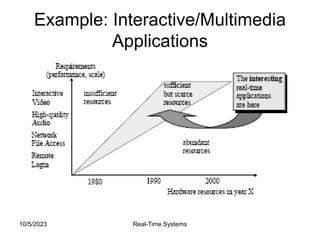
The “Window of Scarcity”
Resources may be categorized as:
• Abundant: Virtually any system design
methodology can be used to realize the timing
requirements of the application.
• Insufficient: The application is ahead of the
technology curve; no design methodology can
be used to realize the timing requirements of the
application.
• Sufficient but scarce: It is possible to realize
the timing requirements of the application, but
careful resource allocation is required.
10/5/2023 Real-Time Systems
Example: Interactive/Multimedia
Applications
10/5/2023 Real-Time Systems
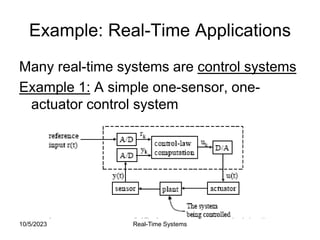
Example: Real-Time Applications
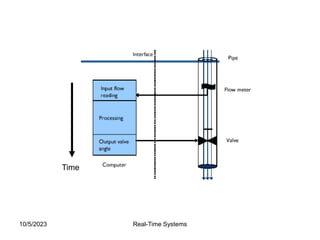
Many real-time systems are control systems
Example 1: A simple one-sensor, one-
actuator control system
10/5/2023 Real-Time Systems
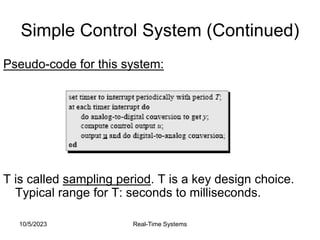
Simple Control System (Continued)
Pseudo-code for this system:
T is called sampling period. T is a key design choice.
Typical range for T: seconds to milliseconds.
10/5/2023 Real-Time Systems
Time
10/5/2023 Real-Time Systems
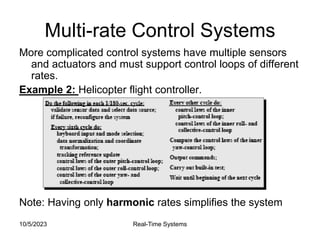
Multi-rate Control Systems
More complicated control systems have multiple sensors
and actuators and must support control loops of different
rates.
Example 2: Helicopter flight controller.
Note: Having only harmonic rates simplifies the system
10/5/2023 Real-Time Systems
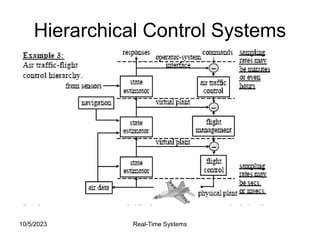
Hierarchical Control Systems
10/5/2023 Real-Time Systems
Air Traffic Control
[Reddaway et al. WMPP’05]
10/5/2023 Real-Time Systems
Signal-Processing System
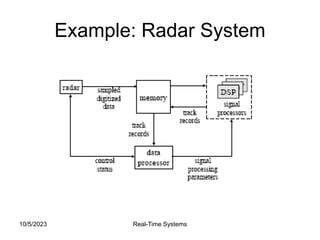
• Signal-processing systems transform
data from one form to another.
• Examples:
– Digital filtering.
– Video and voice compression/decompression.
– Radar signal processing.
• Response times range from a few
milliseconds to a few seconds.
10/5/2023 Real-Time Systems
Example: Radar System
10/5/2023 Real-Time Systems
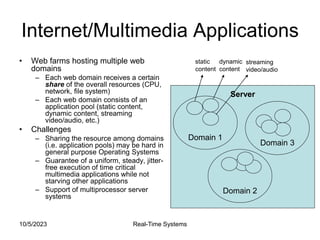
Internet/Multimedia Applications
• Web farms hosting multiple web
domains
– Each web domain receives a certain
share of the overall resources (CPU,
network, file system)
– Each web domain consists of an
application pool (static content,
dynamic content, streaming
video/audio, etc.)
• Challenges
– Sharing the resource among domains
(i.e. application pools) may be hard in
general purpose Operating Systems
– Guarantee of a uniform, steady, jitter-
free execution of time critical
multimedia applications while not
starving other applications
– Support of multiprocessor server
systems
Server
Domain 1
Domain 2
Domain 3
static
content
dynamic
content
streaming
video/audio
10/5/2023 Real-Time Systems
Other Real-Time Applications
• Real-time databases.
– Transactions must complete by deadlines.
– Main dilemma: Transaction scheduling algorithms and real-time
scheduling algorithms often have conflicting goals.
– Data may be subject to absolute and relative temporal
consistency requirements.
– Overall goal: reliable responses
• Multimedia.
• Want to process audio and video frames at steady rates.
– TV video rate is 30 frames/sec. HDTV is 60 frames/sec.
– Telephone audio is 16 Kbits/sec. CD audio is 128 Kbits/sec.
• Other requirements: Lip synchronization, low jitter, low
end-to-end response times (if interactive).
10/5/2023 Real-Time Systems
Hard vs. Soft Real Time
• Task: A sequential piece of code.
• Job: Instance of a task
• Jobs require resources to execute.
– Example resources: CPU, network, disk, critical section.
– We will simply call all hardware resources “processors”.
• Release time of a job: The time instant the job
becomes ready to execute.
• Deadline of a job: The time instant by which the job
must complete execution.
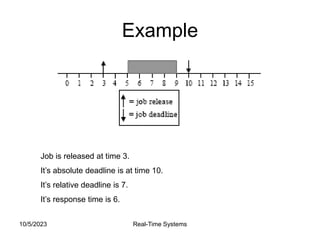
• Relative deadline of a job: “Deadline - Release time”.
• Response time of a job: “Completion time - Release
time”.
10/5/2023 Real-Time Systems
Example
Job is released at time 3.
It’s absolute deadline is at time 10.
It’s relative deadline is 7.
It’s response time is 6.
10/5/2023 Real-Time Systems
Hard Real-Time Systems
• A hard deadline must be met.
– If any hard deadline is ever missed, then the system
is incorrect.
– Requires a means for validating that deadlines are
met.
• Hard real-time system: A real-time system in
• which all deadlines are hard.
– We consider hard and soft real-time systems in this
course.
• Examples: Nuclear power plant control, flight
control.
10/5/2023 Real-Time Systems
Soft Real-Time Systems
• A soft deadline may occasionally be
missed.
– Question: How to define “occasionally”?
• Soft real-time system: A real-time
system in which some deadlines are soft.
• Examples: multimedia applications.
10/5/2023 Real-Time Systems
Performance
• Two particular factors are important
– How fast does a system respond
– When it fails, what happens?
10/5/2023 Real-Time Systems
The Speed of Response
• All required responses are time-critical
– The designer should predict the delivered
performance of the systems with the required
performance
– Unfortunately, it may not be possible to give
100% guarantees
10/5/2023 Real-Time Systems
Periodic vs. Aperiodic Tasks
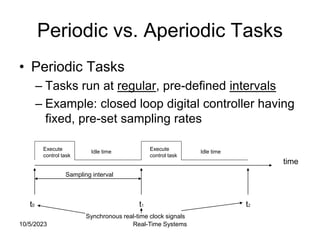
• Periodic Tasks
– Tasks run at regular, pre-defined intervals
– Example: closed loop digital controller having
fixed, pre-set sampling rates
t0 t1 t2
time
Execute
control task
Execute
control task
Idle time Idle time
Sampling interval
Synchronous real-time clock signals
10/5/2023 Real-Time Systems
Periodic vs. Aperiodic Tasks
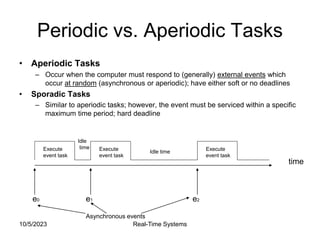
• Aperiodic Tasks
– Occur when the computer must respond to (generally) external events which
occur at random (asynchronous or aperiodic); have either soft or no deadlines
• Sporadic Tasks
– Similar to aperiodic tasks; however, the event must be serviced within a specific
maximum time period; hard deadline
e0
time
Execute
event task
Execute
event task
Idle
time
Idle time
Asynchronous events
e1 e2
Execute
event task
10/5/2023 Real-Time Systems
Mixing Periodic and Aperiodic
Tasks
• We get into trouble in situations which
involve a mix of periodic and
aperiodic(sporadic) events, which are
usual in real-time designs
• Much thought and skill are needed to deal
with the response requirements of periodic
and aperiodic tasks
10/5/2023 Real-Time Systems
Real-Time Operating Systems
(RTOSs)
• RTOS: specialized operating system for RTS
• Main responsibilities:
– Process management
– Resource allocation (processor, memory, network)
• They may not include regular OS facilities such as file
management, virtual memory, user/kernel level
separation, etc.
• Manage at least two priority levels:
– Interrupt level, for processes that need fast response
– Clock level, for periodic processes
• Typical components: real-time clock, interrupt handler,
scheduler, resource manager, dispatcher

Real-Time Systems Intro.pptx

  • 1.
  • 2.
    10/5/2023 Real-Time Systems Real-timeSystems • A real-time system is a system whose specification includes both logical and temporal correctness requirements. • Logical Correctness: Produces correct outputs. – Can by checked, for example, by Hoare logic. • Temporal Correctness: Produces outputs at the right time. – In this course, we spend much time on techniques and technologies for achieving and checking temporal correctness.
  • 3.
    10/5/2023 Real-Time Systems EmbeddedSystems • [www.webopedia.com]: An embedded system is “a specialized computer system that is part of a larger system or machine. Typically, an embedded system is housed on a single microprocessor board with the programs stored in ROM. Virtually all appliances that have digital interfaces (e.g., watches, microwaves, VCRs, cars) utilize embedded systems […]” • Many embedded systems are real-time systems
  • 4.
    10/5/2023 Real-Time Systems TypicalCharacteristics of Real- Time Systems • Event-driven, reactive. • High cost of failure. • Concurrency/multiprogramming. • Stand-alone/continuous operation. • Reliability/fault-tolerance requirements. • Predictable behavior.
  • 5.
    10/5/2023 Real-Time Systems Misconceptionsabout Real-Time Systems (Stankovic ‘88) • There is no science in real-time-system design. – We shall see… • Advances in supercomputing hardware will take care of real-time requirements. – The old “buy a faster processor” argument… • Real-time computing is equivalent to fast computing. – Only to ad agencies. To us, it means PREDICTABLE computing.
  • 6.
    10/5/2023 Real-Time Systems Misconceptions(Continued) • Real-time programming is assembly coding, – We would like to automate (as much as possible) real-time system design, instead of relying on clever hand-crafted code. • “Real time” is performance engineering. – In real-time computing, timeliness is almost always more important than raw performance … • “Real-time problems” have all been solved in other areas of CS or operations research. – OR people typically use stochastic queuing models or one-shot scheduling models to reason about systems. – In other CS areas, people are usually interested in optimizing average-case performance.
  • 7.
    10/5/2023 Real-Time Systems Misconceptions(Continued) • It is not meaningful to talk about guaranteeing real-time performance when things can fail. – Though things may fail, we certainly don’t want the operating system to be the weakest link! • Real-time systems function only in a static environment. – Note true. We consider systems in which the environment may change dynamically.
  • 8.
    10/5/2023 Real-Time Systems AreAll Systems Real-Time Systems? • Question: Is a payroll processing system a realtime system? – It has a time constraint: Print the pay checks every two weeks. • Perhaps it is a real-time system in a definitional sense, but it doesn’t pay us to view it as such. • We are interested in systems for which it is not a priori obvious how to meet timing constraints
  • 9.
    10/5/2023 Real-Time Systems The“Window of Scarcity” Resources may be categorized as: • Abundant: Virtually any system design methodology can be used to realize the timing requirements of the application. • Insufficient: The application is ahead of the technology curve; no design methodology can be used to realize the timing requirements of the application. • Sufficient but scarce: It is possible to realize the timing requirements of the application, but careful resource allocation is required.
  • 10.
    10/5/2023 Real-Time Systems Example:Interactive/Multimedia Applications
  • 11.
    10/5/2023 Real-Time Systems Example:Real-Time Applications Many real-time systems are control systems Example 1: A simple one-sensor, one- actuator control system
  • 12.
    10/5/2023 Real-Time Systems SimpleControl System (Continued) Pseudo-code for this system: T is called sampling period. T is a key design choice. Typical range for T: seconds to milliseconds.
  • 13.
  • 14.
    10/5/2023 Real-Time Systems Multi-rateControl Systems More complicated control systems have multiple sensors and actuators and must support control loops of different rates. Example 2: Helicopter flight controller. Note: Having only harmonic rates simplifies the system
  • 15.
  • 16.
    10/5/2023 Real-Time Systems AirTraffic Control [Reddaway et al. WMPP’05]
  • 17.
    10/5/2023 Real-Time Systems Signal-ProcessingSystem • Signal-processing systems transform data from one form to another. • Examples: – Digital filtering. – Video and voice compression/decompression. – Radar signal processing. • Response times range from a few milliseconds to a few seconds.
  • 18.
  • 19.
    10/5/2023 Real-Time Systems Internet/MultimediaApplications • Web farms hosting multiple web domains – Each web domain receives a certain share of the overall resources (CPU, network, file system) – Each web domain consists of an application pool (static content, dynamic content, streaming video/audio, etc.) • Challenges – Sharing the resource among domains (i.e. application pools) may be hard in general purpose Operating Systems – Guarantee of a uniform, steady, jitter- free execution of time critical multimedia applications while not starving other applications – Support of multiprocessor server systems Server Domain 1 Domain 2 Domain 3 static content dynamic content streaming video/audio
  • 20.
    10/5/2023 Real-Time Systems OtherReal-Time Applications • Real-time databases. – Transactions must complete by deadlines. – Main dilemma: Transaction scheduling algorithms and real-time scheduling algorithms often have conflicting goals. – Data may be subject to absolute and relative temporal consistency requirements. – Overall goal: reliable responses • Multimedia. • Want to process audio and video frames at steady rates. – TV video rate is 30 frames/sec. HDTV is 60 frames/sec. – Telephone audio is 16 Kbits/sec. CD audio is 128 Kbits/sec. • Other requirements: Lip synchronization, low jitter, low end-to-end response times (if interactive).
  • 21.
    10/5/2023 Real-Time Systems Hardvs. Soft Real Time • Task: A sequential piece of code. • Job: Instance of a task • Jobs require resources to execute. – Example resources: CPU, network, disk, critical section. – We will simply call all hardware resources “processors”. • Release time of a job: The time instant the job becomes ready to execute. • Deadline of a job: The time instant by which the job must complete execution. • Relative deadline of a job: “Deadline - Release time”. • Response time of a job: “Completion time - Release time”.
  • 22.
    10/5/2023 Real-Time Systems Example Jobis released at time 3. It’s absolute deadline is at time 10. It’s relative deadline is 7. It’s response time is 6.
  • 23.
    10/5/2023 Real-Time Systems HardReal-Time Systems • A hard deadline must be met. – If any hard deadline is ever missed, then the system is incorrect. – Requires a means for validating that deadlines are met. • Hard real-time system: A real-time system in • which all deadlines are hard. – We consider hard and soft real-time systems in this course. • Examples: Nuclear power plant control, flight control.
  • 24.
    10/5/2023 Real-Time Systems SoftReal-Time Systems • A soft deadline may occasionally be missed. – Question: How to define “occasionally”? • Soft real-time system: A real-time system in which some deadlines are soft. • Examples: multimedia applications.
  • 25.
    10/5/2023 Real-Time Systems Performance •Two particular factors are important – How fast does a system respond – When it fails, what happens?
  • 26.
    10/5/2023 Real-Time Systems TheSpeed of Response • All required responses are time-critical – The designer should predict the delivered performance of the systems with the required performance – Unfortunately, it may not be possible to give 100% guarantees
  • 27.
    10/5/2023 Real-Time Systems Periodicvs. Aperiodic Tasks • Periodic Tasks – Tasks run at regular, pre-defined intervals – Example: closed loop digital controller having fixed, pre-set sampling rates t0 t1 t2 time Execute control task Execute control task Idle time Idle time Sampling interval Synchronous real-time clock signals
  • 28.
    10/5/2023 Real-Time Systems Periodicvs. Aperiodic Tasks • Aperiodic Tasks – Occur when the computer must respond to (generally) external events which occur at random (asynchronous or aperiodic); have either soft or no deadlines • Sporadic Tasks – Similar to aperiodic tasks; however, the event must be serviced within a specific maximum time period; hard deadline e0 time Execute event task Execute event task Idle time Idle time Asynchronous events e1 e2 Execute event task
  • 29.
    10/5/2023 Real-Time Systems MixingPeriodic and Aperiodic Tasks • We get into trouble in situations which involve a mix of periodic and aperiodic(sporadic) events, which are usual in real-time designs • Much thought and skill are needed to deal with the response requirements of periodic and aperiodic tasks
  • 30.
    10/5/2023 Real-Time Systems Real-TimeOperating Systems (RTOSs) • RTOS: specialized operating system for RTS • Main responsibilities: – Process management – Resource allocation (processor, memory, network) • They may not include regular OS facilities such as file management, virtual memory, user/kernel level separation, etc. • Manage at least two priority levels: – Interrupt level, for processes that need fast response – Clock level, for periodic processes • Typical components: real-time clock, interrupt handler, scheduler, resource manager, dispatcher