KENDRIYA VIDYALYA
AFS BIDAR
INVESTIGATORY PROJECT
ON
TRANSFORMER
Certificate
Acknowledgements
• I would like to express my sincere gratitude to
my physics mentor MR. ______________ , for
his vital support, guidance and
encouragement, without which this project
would not have come forth. I would also like
to express my gratitude to the OTHER staff of
the Department of Physics for their support
during the making of this project.
TRANSFORMER
PRINCIPLE
• A Transformer based on the Principle of
mutual induction according to this principle,
the amount of magnetic flux linked with a coil
changing, an e.m.f is induced in the
neighboring coil.
INTRODUCTION
• A transformer consists of a rectangular shaft
iron core made of laminated sheets, well
insulated from one another. Two coils p1 & p2
and s1 & s2 are wound on the same core, but
are well insulated with each other.
CONSTRUCTION
• The transformer is a device used for
converting a low alternating voltage to a high
alternating voltage or a high alternating
voltage into a low alternating voltage.
• Note that the both the coils are insulated from
the core, the source of alternating e.m.f is
connected to p1p2, the primary coil and a load
resistance R is connected to s1 s2, the
secondary coil through an open switch S. thus
there can be no current through the sec. coil
so long as the switch is open.
• For an ideal transformer, we assume that the
resistance of the primary & secondary winding
is negligible. Further, the energy loses due to
magnetic the iron core is also negligible.
INTRODUCTION OF TRANSFORMER
• A transformer is an electrical device which is
used for changing the A.C. voltages. A
transformer is most widely used device in
both low and high current circuit. As such
transformers are built in an amazing strength
of sizes. In electronic, measurement and
control circuits, transformer size may be so
small that it weight only a few tens of grams
where as in high voltage power circuits, it may
weight hundred of tones.
• In a transformer, the electrical energy transfer
from one circuit to another circuit takes place
without the use of moving parts.
• A transformer which increases the voltages is
called a step-up transformer. A transformer
which decreases the A.C. voltages is called a
step-down transformer.
• Transformer is, therefore, an essential piece of
apparatus both for high and low current
circuits.
THEORY AND WORKING OF
TRANSFORMER
• When an altering e.m.f. is supplied to the primary
coil p1p2, an alternating current starts falling in it.
The altering current in the primary produces a
changing magnetic flux, which induces altering
voltage in the primary as well as in the secondary.
In a good-transformer, whole of the magnetic flux
linked with primary is also linked with the
secondary, then the induced e.m.f. induced in
each turn of the secondary is equal to that
induced in each turn of the primary. Thus if Ep
and Es
be the instantaneous values of the e.m.f.’s
induced in the primary and the secondary and
Np and Ns are the no. of turns of the primary
second dфь / dt = rate of change of flux in each
turnoff the coil at this instant, we have
Ep = - Npdфь/dt ----------(1)
Es = -Ns dфь/dt ---------- (2)
• Since the above relations are true at every
instant, so by dividing 2 by 1, we get
Es / Ep = - Ns / Np -----------(3)
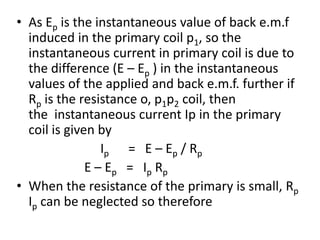
• As Ep is the instantaneous value of back e.m.f
induced in the primary coil p1, so the
instantaneous current in primary coil is due to
the difference (E – Ep ) in the instantaneous
values of the applied and back e.m.f. further if
Rp is the resistance o, p1p2 coil, then
the instantaneous current Ip in the primary
coil is given by
Ip = E – Ep / Rp
E – Ep = Ip Rp
• When the resistance of the primary is small, Rp
Ip can be neglected so therefore
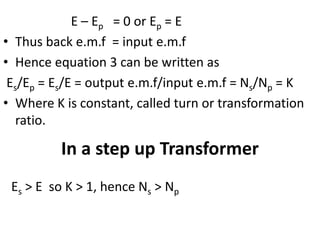
E – Ep = 0 or Ep = E
• Thus back e.m.f = input e.m.f
• Hence equation 3 can be written as
Es/Ep = Es/E = output e.m.f/input e.m.f = Ns/Np = K
• Where K is constant, called turn or transformation
ratio.
In a step up Transformer
Es > E so K > 1, hence Ns > Np
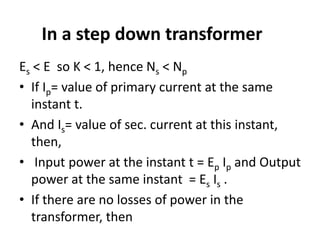
In a step down transformer
Es < E so K < 1, hence Ns < Np
• If Ip= value of primary current at the same
instant t.
• And Is= value of sec. current at this instant,
then,
• Input power at the instant t = Ep Ip and Output
power at the same instant = Es Is .
• If there are no losses of power in the
transformer, then
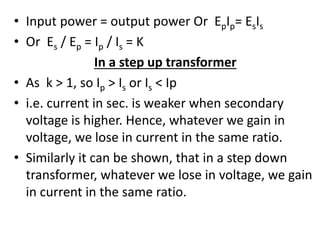
• Input power = output power Or EpIp= EsIs
• Or Es / Ep = Ip / Is = K
In a step up transformer
• As k > 1, so Ip > Is or Is < Ip
• i.e. current in sec. is weaker when secondary
voltage is higher. Hence, whatever we gain in
voltage, we lose in current in the same ratio.
• Similarly it can be shown, that in a step down
transformer, whatever we lose in voltage, we gain
in current in the same ratio.
• Thus a step up transformer in reality steps
down the current & a step down transformer
steps up the current.
Efficiency:-
• Efficiency of a transformer is defined as the
ratio of output power to the input power. i.e.
η = output power / input power = Es Is / Ep Ip
• Thus in an ideal transformer, where there is no
power losses, η = 1. But in actual practice,
there are many power losses, therefore the
efficiency of transformer is less than one.
ENERGY LOSSES:-
• Following are the major sources of energy loss in
a transformer:
• 1. Copper loss is the energy loss in the form of
heat in the copper coils of a transformer. This is
due to joule heating of conducting wires.
• 2. Iron loss is the energy loss in the form of heat
in the iron core of the transformer. This is due to
formation of eddy currents in iron core. It is
minimized by taking laminated cores.
• 3. Leakage of magnetic flux occurs inspite of best
insulations. Therefore, rate of change of magnetic
flux linked with each turn of S1S2 is less than the
rate of change of magnetic flux linked with each
turn of P1P2.
• 4. Hysteretic loss is the loss of energy due to
repeated magnetization and demagnetization of
the iron core when A.C. is fed to it.
• 5. Magneto striation i.e. humming noise of a
transformer.
USES OF TRANSFORMER
A transformer is used in almost all a.c. operations
• In voltage regulator for T.V., refrigerator,
computer, air conditioner etc.
• In the induction furnaces.
• A step down transformer is used for welding
purposes.
• A step down transformer is used for obtaining
large current.
• A step up transformer is used for the
production of X-Rays and NEON
advertisement.
• Transformers are used in voltage regulators
and stabilized power supplies.
• Transformers are used in the transmissions of
a.c. over long distances.
• Small transformers are used in Radio sets,
telephones, loud speakers and electric bells
etc.
BIBLIOGRAPHY
• Physics for class XII by Pradeep.
• www.yahoo.com
• www.google.com
• www.live.com
• www.rediffmail.com

physics 12th class final project

  • 1.
  • 2.
  • 3.
    Acknowledgements • I wouldlike to express my sincere gratitude to my physics mentor MR. ______________ , for his vital support, guidance and encouragement, without which this project would not have come forth. I would also like to express my gratitude to the OTHER staff of the Department of Physics for their support during the making of this project.
  • 4.
    TRANSFORMER PRINCIPLE • A Transformerbased on the Principle of mutual induction according to this principle, the amount of magnetic flux linked with a coil changing, an e.m.f is induced in the neighboring coil.
  • 5.
    INTRODUCTION • A transformerconsists of a rectangular shaft iron core made of laminated sheets, well insulated from one another. Two coils p1 & p2 and s1 & s2 are wound on the same core, but are well insulated with each other. CONSTRUCTION • The transformer is a device used for converting a low alternating voltage to a high alternating voltage or a high alternating voltage into a low alternating voltage.
  • 6.
    • Note thatthe both the coils are insulated from the core, the source of alternating e.m.f is connected to p1p2, the primary coil and a load resistance R is connected to s1 s2, the secondary coil through an open switch S. thus there can be no current through the sec. coil so long as the switch is open. • For an ideal transformer, we assume that the resistance of the primary & secondary winding is negligible. Further, the energy loses due to magnetic the iron core is also negligible.
  • 7.
    INTRODUCTION OF TRANSFORMER •A transformer is an electrical device which is used for changing the A.C. voltages. A transformer is most widely used device in both low and high current circuit. As such transformers are built in an amazing strength of sizes. In electronic, measurement and control circuits, transformer size may be so small that it weight only a few tens of grams where as in high voltage power circuits, it may weight hundred of tones.
  • 8.
    • In atransformer, the electrical energy transfer from one circuit to another circuit takes place without the use of moving parts. • A transformer which increases the voltages is called a step-up transformer. A transformer which decreases the A.C. voltages is called a step-down transformer. • Transformer is, therefore, an essential piece of apparatus both for high and low current circuits.
  • 9.
    THEORY AND WORKINGOF TRANSFORMER • When an altering e.m.f. is supplied to the primary coil p1p2, an alternating current starts falling in it. The altering current in the primary produces a changing magnetic flux, which induces altering voltage in the primary as well as in the secondary. In a good-transformer, whole of the magnetic flux linked with primary is also linked with the secondary, then the induced e.m.f. induced in each turn of the secondary is equal to that induced in each turn of the primary. Thus if Ep and Es
  • 10.
    be the instantaneousvalues of the e.m.f.’s induced in the primary and the secondary and Np and Ns are the no. of turns of the primary second dфь / dt = rate of change of flux in each turnoff the coil at this instant, we have Ep = - Npdфь/dt ----------(1) Es = -Ns dфь/dt ---------- (2) • Since the above relations are true at every instant, so by dividing 2 by 1, we get Es / Ep = - Ns / Np -----------(3)
  • 11.
    • As Epis the instantaneous value of back e.m.f induced in the primary coil p1, so the instantaneous current in primary coil is due to the difference (E – Ep ) in the instantaneous values of the applied and back e.m.f. further if Rp is the resistance o, p1p2 coil, then the instantaneous current Ip in the primary coil is given by Ip = E – Ep / Rp E – Ep = Ip Rp • When the resistance of the primary is small, Rp Ip can be neglected so therefore
  • 12.
    E – Ep= 0 or Ep = E • Thus back e.m.f = input e.m.f • Hence equation 3 can be written as Es/Ep = Es/E = output e.m.f/input e.m.f = Ns/Np = K • Where K is constant, called turn or transformation ratio. In a step up Transformer Es > E so K > 1, hence Ns > Np
  • 13.
    In a stepdown transformer Es < E so K < 1, hence Ns < Np • If Ip= value of primary current at the same instant t. • And Is= value of sec. current at this instant, then, • Input power at the instant t = Ep Ip and Output power at the same instant = Es Is . • If there are no losses of power in the transformer, then
  • 14.
    • Input power= output power Or EpIp= EsIs • Or Es / Ep = Ip / Is = K In a step up transformer • As k > 1, so Ip > Is or Is < Ip • i.e. current in sec. is weaker when secondary voltage is higher. Hence, whatever we gain in voltage, we lose in current in the same ratio. • Similarly it can be shown, that in a step down transformer, whatever we lose in voltage, we gain in current in the same ratio.
  • 15.
    • Thus astep up transformer in reality steps down the current & a step down transformer steps up the current. Efficiency:- • Efficiency of a transformer is defined as the ratio of output power to the input power. i.e. η = output power / input power = Es Is / Ep Ip • Thus in an ideal transformer, where there is no power losses, η = 1. But in actual practice, there are many power losses, therefore the efficiency of transformer is less than one.
  • 16.
    ENERGY LOSSES:- • Followingare the major sources of energy loss in a transformer: • 1. Copper loss is the energy loss in the form of heat in the copper coils of a transformer. This is due to joule heating of conducting wires. • 2. Iron loss is the energy loss in the form of heat in the iron core of the transformer. This is due to formation of eddy currents in iron core. It is minimized by taking laminated cores. • 3. Leakage of magnetic flux occurs inspite of best insulations. Therefore, rate of change of magnetic flux linked with each turn of S1S2 is less than the rate of change of magnetic flux linked with each turn of P1P2.
  • 17.
    • 4. Hystereticloss is the loss of energy due to repeated magnetization and demagnetization of the iron core when A.C. is fed to it. • 5. Magneto striation i.e. humming noise of a transformer. USES OF TRANSFORMER A transformer is used in almost all a.c. operations • In voltage regulator for T.V., refrigerator, computer, air conditioner etc. • In the induction furnaces. • A step down transformer is used for welding purposes. • A step down transformer is used for obtaining large current.
  • 18.
    • A stepup transformer is used for the production of X-Rays and NEON advertisement. • Transformers are used in voltage regulators and stabilized power supplies. • Transformers are used in the transmissions of a.c. over long distances. • Small transformers are used in Radio sets, telephones, loud speakers and electric bells etc.
  • 19.
    BIBLIOGRAPHY • Physics forclass XII by Pradeep. • www.yahoo.com • www.google.com • www.live.com • www.rediffmail.com