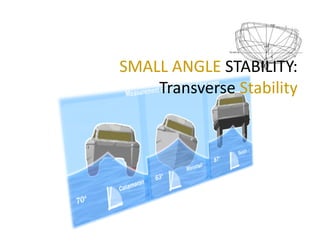
SMALL ANGLE STABILITY: 
Transverse Stability
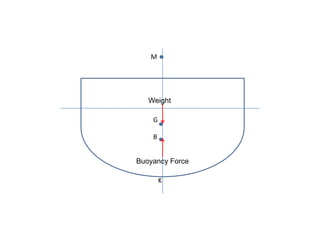
M 
Weight 
G 
B 
Buoyancy Force 
K
Forces Acting on a Floating Body 
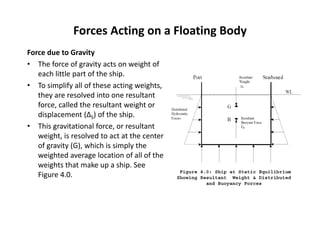
Force due to Gravity 
• The force of gravity acts on weight of 
each little part of the ship. 
• To simplify all of these acting weights, 
they are resolved into one resultant 
force, called the resultant weight or 
displacement (ΔS) of the ship. 
• This gravitational force, or resultant 
weight, is resolved to act at the center 
of gravity (G), which is simply the 
weighted average location of all of the 
weights that make up a ship. See 
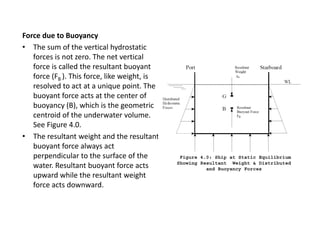
Figure 4.0. Figure 4.0: Ship at Static Equilibrium 
Showing Resultant Weight & Distributed 
and Buoyancy Forces
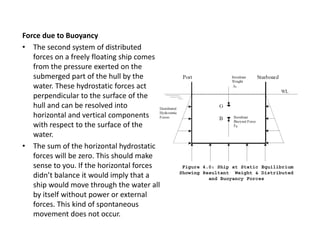
Force due to Buoyancy 
• The second system of distributed 
forces on a freely floating ship comes 
from the pressure exerted on the 
submerged part of the hull by the 
water. These hydrostatic forces act 
perpendicular to the surface of the 
hull and can be resolved into 
horizontal and vertical components 
with respect to the surface of the 
water. 
• The sum of the horizontal hydrostatic 
forces will be zero. This should make 
sense to you. If the horizontal forces Figure 4.0: Ship at Static Equilibrium 
didn’t balance it would imply that a 
ship would move through the water all 
by itself without power or external 
f h k d f 
Showing Resultant Weight & Distributed 
and Buoyancy Forces 
forces. This kind of spontaneous 
movement does not occur.
Force due to Buoyancy 
• The sum of the vertical hydrostatic 
forces is not zero. The net vertical 
force is called the resultant buoyant 
force (FB ). This force, like weight, is 
resolved to act at a unique point. The 
buoyant force acts at the center of 
buoyancy (B), which is the geometric 
centroid of the underwater volume. 
See Figure 4.0. 
• The resultant weight and the resultant 
buoyant force always act 
perpendicular to the surface of the 
water. Resultant buoyant force acts 
Figure 4.0: Ship at Static Equilibrium 
Showing Resultant Weight & Distributed 
and Forces 
upward while the resultant weight 
force acts downward. 
Buoyancy
New States of Static Equilibrium Due to Weight 
Additions, Removals and Shifts on a Floating 
Ship. 
•• Now we want to look at the new static equilibrium condition after 
changing the weight distribution on a ship. 
• An altered weight distribution will cause the Center of Gravity (G) to 
move. 
• To fully identify the location of G before and after its movement, we must 
be able to visualize and sketch the distribution of G points for each weight 
(approximately) . 
• As with the other centroids, the location of G is referenced vertically to 
the keel (KG) or the Vertical Center of Gravity (VCG), transversely to the 
centerline with the Transverse Center of Gravity (TCG) and longitudinally 
to either of the perpendiculars or midships with the Longitudinal Center of 
Gravity (LCG). Recall that the correct sign convention is negative to port of 
the centerline and aft of midships.
• The weight distribution on a ship can change whenever: 
¾ A weight is shifted in any one of three separate directions 
¾ A weight is added or removed from anywhere on a ship 
¾ By some combination of the above. 
• At first, it is manageable if we break it down into a study of three separate 
directions and then further break it down into shifts, additions, and 
removals in each of these directions. 
• This process will be stepped through over the following pages. 
• On a ship the distribution of weight is constantly changing and it would be 
desirable to know the final static equilibrium position of your ship after 
these changes. 
• If these final conditions are undesirable the captain can take actions to 
avoid or minimize the effects.
Qualitative Analysis of Weight Additions, 
Removals and Shifts 
Weight Addition 
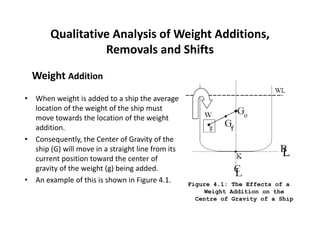
• When weight is added to a ship the average 
location of the weight of the ship must 
move towards the location of the weight 
addition. 
•• Consequently, the Center of Gravity of the 
ship (G) will move in a straight line from its 
current position toward the center of 
gravity of the weight (g) being added. 
• An example of this is shown in Figure 4.1. 
Figure 4.1: The Effects of a 
Weight Addition on the 
Centre of Gravity of a Ship
Qualitative Analysis of Weight Additions, 
Removals and Shifts 
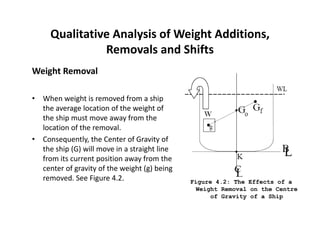
Weight Removal 
• When weight is removed from a ship 
the average location of the weight of 
the ship must move away from the 
location of the removal. 
•• Consequently, the Center of Gravity of 
the ship (G) will move in a straight line 
from its current position away from the 
center of gravity of the weight (g) being 
removed. See Figure 4.2. Figure 4.2: The Effects of a 
Weight Removal on the Centre 
of Gravity of a Ship
Qualitative Analysis of Weight Additions, 
Removals and Shifts 
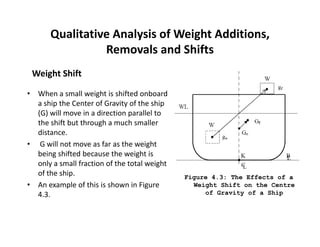
Weight Shift 
• When a small weight is shifted onboard 
a ship the Center of Gravity of the ship 
(G) will move in a direction parallel to 
the shift but through a much smaller 
distance. 
• G will not move as far as the weight 
being shifted because the weight is 
only a small fraction of the total weight 
of the ship. 
• An example of this is shown in Figure 
4.3. 
Figure 4.3: The Effects of a 
Weight Shift on the Centre 
of Gravity of a Ship
Qualitative Analysis of Weight Additions, 
Removals and Shifts 
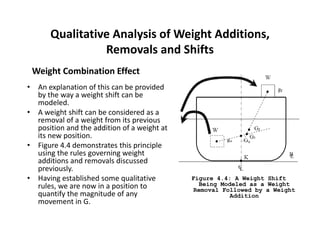
Weight Combination Effect 
• An explanation of this can be provided 
by the way a weight shift can be 
modeled. 
• A weight shift can be considered as a 
removal of a weight from its previous 
position and the addition of a weight at 
its new position. 
• Figure 4.4 demonstrates this principle 
using the rules governing weight 
additions and removals discussed 
previously. 
• Having established some qualitative 
rules, we are now in a position to 
quantify the magnitude of any 
movement G 
Figure 4.4: A Weight Shift 
Being Modeled as a Weight 
Removal Followed by a Weight 
Addition 
in G.
Combining Vertical and Transverse Weight 
Shifts, Weight Additions or Weight Removals 
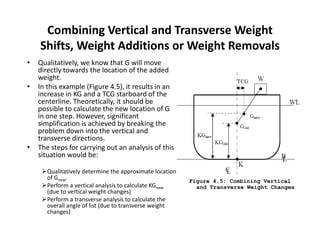
• Qualitatively, we know that G will move 
directly towards the location of the added 
weight. 
• In this example (Figure 4.5), it results in an 
increase in KG and a TCG starboard of the 
centerline. Theoretically, it should be 
possible to calculate the new location of G 
in one step. However, significant 
simplification is achieved by breaking the 
problem down into the vertical and 
transverse directions. 
• The steps for carrying out an analysis of this 
situation would be: 
¾¾Qualitatively determine the approximate location 
of Gnew. 
¾Perform a vertical analysis to calculate KGnew 
(due to vertical weight changes) 
¾Perform a to calculate the 
Figure 4.5: Combining Vertical 
and Transverse Weight Changes 
transverse analysis overall angle of list (due to transverse weight 
changes)
Vertical Changes in the Ship’s Center of Gravity 
Due to Weight Shifts, Weight Additions, and 
Weight Removals. 
• As stated previously, the Center of Gravity of a ship (G) is the point at 
which the all the mass of the ship can be considered to be located. 
• It is the point at which the gravitational forces acting on the ship may be 
resolved to act. G is referenced vertically from the keel of the ship (K). 
•• The distance from K to G is labeled KG with a bar over the letters to 
indicate it is a line segment representing a distance. 
• It is important to keep track of the vertical location of G to predict 
equilibrium conditions, in particular it has a considerable bearing on the 
initial and overall stability of a ship.
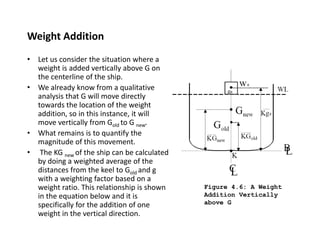
Weight Addition 
• Let us consider the situation where a 
weight is added vertically above G on 
the centerline of the ship. 
• We already know from a qualitative 
analysis that G will move directly 
towards the location of the weight 
addition, so in this instance, it will 
move vertically from Gold to G new. 
• What remains is to quantify the 
magnitude of this movement. 
• The KG new of the ship can be calculated 
by doing a weighted average of the 
distances from the keel to Gold and g 
with a weighting factor based on a 
weight ratio. This relationship is shown 
in the equation below and it is 
Figure 4.6: A Weight 
Addition Vertically 
specifically for the addition of one b weight in the vertical direction. 
above G
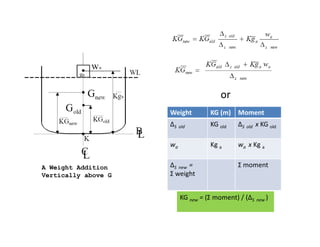
or 
Weight KG (m) Moment 
ΔS old KG old ΔS old x KG old 
wa Kg a wa x Kg a 
A Weight Addition ΔS new = Σ moment 
Σ weight 
KG new = (Σ moment) / (ΔS ) 
g 
Vertically above G 
S new
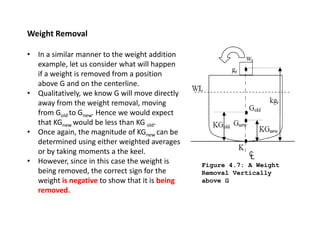
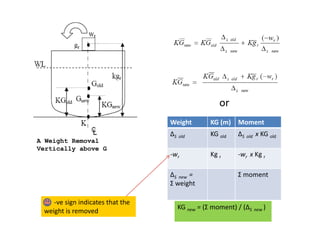
Weight Removal 
• In a similar manner to the weight addition 
example, let us consider what will happen 
if a weight g is removed from a position 
above G and on the centerline. 
• Qualitatively, we know G will move directly 
away from the weight removal, moving 
from Gold to Gnew. Hence we would expect 
that KGnewwould be less than KG old. 
• Once again, the magnitude of KGnew can be 
determined using either weighted averages 
or by taking moments a the keel. 
• However, since in this case the weight is 
being removed the correct sign Figure 4.7: A Weight 
removed, for the 
weight is negative to show that it is being 
removed. 
Removal Vertically 
above G
or 
Weight KG (m) Moment 
ΔS old KG old ΔS old x KG old 
A W i ht R l 
‐wr Kg r ‐wr x Kg r 
Weight Removal 
Vertically above G 
ve sign indicates that the 
ΔS new = 
Σ weight 
Σ moment 
‐weight is removed KG new = (Σ moment) / (ΔS new )
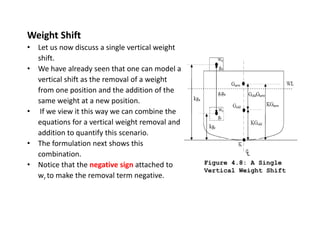
Weight Shift 
• Let us now discuss a single vertical weight 
shift. 
• We have already seen that one can model a 
vertical shift as the removal of a weight 
from one position and the addition of the 
same weight at a new position. 
• If we view it this way we can combine the 
equations for a vertical weight removal and 
addition to quantify this scenario. 
• The formulation next shows this 
combination. 
• Notice that the negative sign attached to Figure 4.8: A Single 
Vertical wr to make the removal term negative. Weight Shift
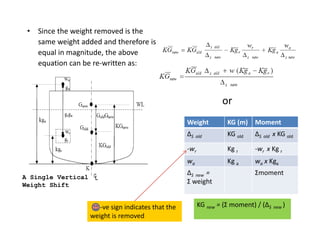
• Since the weight removed is the 
same weight added and therefore is 
equal in magnitude, the above 
equation can be re‐written as: 
or 
Weight KG (m) Moment 
ΔS old KG old ΔS old x KG old 
‐wr Kg r ‐wr x Kg r 
wa Kg a wa x Kga 
ΔS new = 
Σmoment 
Σ weight 
A Single Vertical 
Weight Shift 
‐ve sign indicates that the 
weight is removed 
KG new = (Σ moment) / (ΔS new )
Transverse Changes in the Ship’s Center of 
Gravity Due to Weight Shifts, Weight Additions, 
and Weight Removals. 
• Recall the transverse direction is the “side to side” direction (or the port to 
starboard direction). 
• The centerline of the ship separates the port from the starboard. Recall 
that distances to the port are defined to be negative, and distances to the 
starboard are positive. 
• In general, we use the symbol “y” as the general variable to represent a 
transverse distance from the centerline of the ship. 
• Qualitatively, we know that should a weight be added or removed off 
center (not on the centerline) or a weight is shifted transversely across the 
ship, the ship will assume some angle of inclination. 
• This angle is called an angle of “List”.
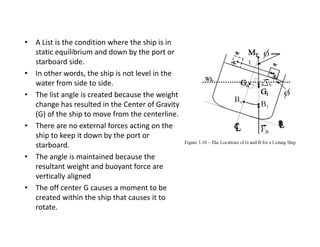
• A List is the condition where the ship is in 
static equilibrium and down by the port or 
starboard side. 
• In other words, the ship is not level in the 
water from side to side. 
• The list angle is created because the weight 
change has resulted in the Center of Gravity 
(G) of the ship to move from the centerline. 
• There are no external forces acting on the 
ship to keep it down by the port or 
starboard. 
• The angle is maintained because the 
resultant weight and buoyant force are 
vertically aligned 
• The off center G causes a moment to be 
created within the ship that causes it to 
rotate.
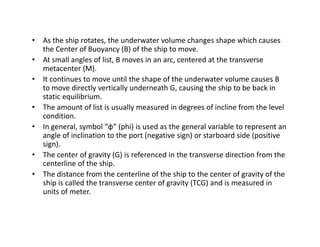
• As the ship rotates, the underwater volume changes shape which causes 
the Center of Buoyancy (B) of the ship to move. 
• At small angles of list, B moves in an arc, centered at the transverse 
metacenter (M). 
• It continues to move until the shape of the underwater volume causes B 
to move directly vertically underneath G, causing the ship to be back in 
static equilibrium. 
•• The amount of list is usually measured in degrees of incline from the level 
condition. 
• In general, symbol “φ” (phi) is used as the general variable to represent an 
angle of inclination to the port (negative sign) or starboard side (positive 
sign). 
• The center of gravity (G) is referenced in the transverse direction from the 
centerline of the ship. 
• The distance from the centerline of the ship to the center of gravity of the 
ship is called the transverse center of gravity (TCG) and is measured in 
units of meter.
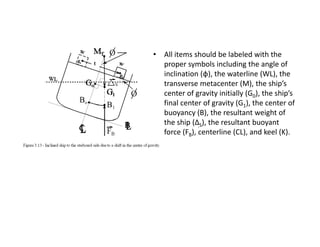
• All items should be labeled with the 
proper symbols including the angle of 
inclination (φφ), the waterline (WL), the 
transverse metacenter (M), the ship’s 
center of gravity initially (G0), the ship’s 
final center of gravity (G1), the center of 
buoyancy (B), the resultant weight of 
the ship (ΔS), the resultant buoyant 
force (FB), centerline (CL), and keel (K).
• We will now move on and examine the listing g ship created by an “off 
center” G in more detail. However firstly, we must understand the 
meaning of the metacenter. 
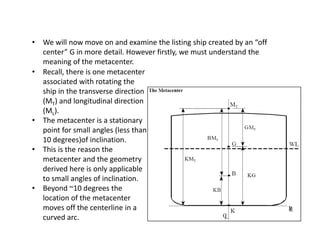
• Recall, there is one metacenter 
associated with rotating the 
ship in the transverse direction 
(MT) and longitudinal direction 
(ML). 
• The metacenter is a stationary 
point for small angles (less than 
10 degrees)of inclination. 
• This is the reason the 
metacenter and the geometry 
derived here is only applicable 
to small angles of inclination. 
• Beyond ~10 degrees the 
location of the metacenter 
moves off the centerline in a 
curved arc.
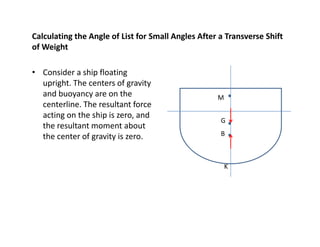
Calculating the Angle of List for Small Angles After a Transverse Shift 
of Weight 
• Consider a ship floating 
upright. The centers of gravity 
and buoyancy are on the 
centerline. The resultant force 
M 
acting on the ship is zero, and 
the resultant moment about 
the center of gravity is zero. 
B 
G 
K
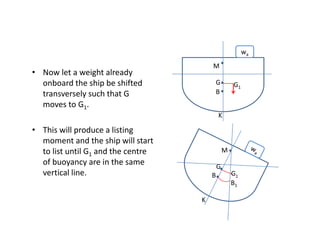
• Now let a weight already 
M 
wa 
onboard the ship be shifted 
transversely such that G 
moves to G1. 
G G1 
B 
1 
• This will produce a listing 
t d th hi ill t t 
K 
moment and the ship will start 
to list until G1 and the centre 
of buoyancy are in the same 
ti l li 
G 
vertical line. B 
K 
B1
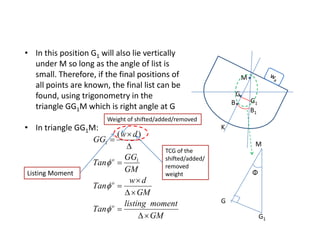
• In this position G1 will also lie vertically 
under M so long as the angle of list is 
small. Therefore, if the final positions of 
all points are known, the final list can be 
found, using trigonometry in the 
triangle GG1M angle at G B 
G 
which is right B 
• In triangle GG1M: K 
GG 
w d 
× 
= 
( ) 
B1 
Weight of shifted/added/removed 
M 
Φ 
1 
Tan GG 
GM 
o = 
Δ 
φ 1 
TCG of the 
shifted/added/ 
removed 
Listing Moment weight 
Tan w d 
GM 
li ti t G 
o 
Δ× 
× 
φ = 
Tan o listing moment 
G1 GM 
Δ× 
φ =
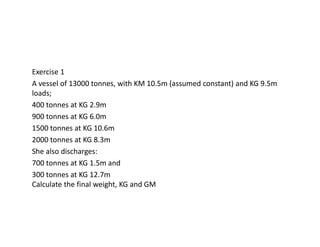
Exercise 1 
A vessel of 13000 tonnes, with KM 10.5m (assumed constant) and KG 9.5m 
loads; 
400 tonnes at KG 2.9m 
900 tonnes at KG 6.0m 
1500 tonnes at KG 10.6m 
2000 tonnes at KG 8.3m 
She also discharges: 
700 tonnes at KG 1.5m and 
300 tonnes at KG 12.7m 
Calculate the final weight, KG and GM
Exercise 2 
A ship has a displacement of 4800 tonnes, KM (constant) = 14.8 and KG = 
11.5m. The TCG is on the centreline. 5 tonnes of water are shifted from a 
location 2.5m above the keel and 11m starboard of centreline to a location 
6m above the keel and 10 m port of centreline. 
Calculate the final KG 
Calculate the final listing angle 
Exercise 3 
A ship has a displacement of 2200 tonnes, and initial transverse centre of 
gravity 2m starboard of the centreline. A 25 tonnes of cargo os moved from a 
position 5m port of the centreline to a position 10m port of the centreline. 
Then 15 tonnes of machinery is added 7m port of the centreline. Determine 
the final location of the ship’s transverse centre of gravity
Exercise 4 
A ship of 8000 tonnes displacement has KM = 8.7m, and KG =7.6m. The 
following weights are then loaded and discharged: 
Load 250 tonnes cargo at KG 6.1m and centre of gravity 7.6m to starboard of 
the centerline 
Load 300 tonnes fuel oil at KG 0.6m and centre of gravity 6.1m to port of the 
centerline 
Discharge 50 tonnes of ballast at KG 1.2m and centre of gravity 4.6m to port 
of the centerline 
Determine the final list

Small angle stability

  • 1.
    SMALL ANGLE STABILITY: Transverse Stability
  • 2.
    M Weight G B Buoyancy Force K
  • 3.
    Forces Acting ona Floating Body Force due to Gravity • The force of gravity acts on weight of each little part of the ship. • To simplify all of these acting weights, they are resolved into one resultant force, called the resultant weight or displacement (ΔS) of the ship. • This gravitational force, or resultant weight, is resolved to act at the center of gravity (G), which is simply the weighted average location of all of the weights that make up a ship. See Figure 4.0. Figure 4.0: Ship at Static Equilibrium Showing Resultant Weight & Distributed and Buoyancy Forces
  • 4.
    Force due toBuoyancy • The second system of distributed forces on a freely floating ship comes from the pressure exerted on the submerged part of the hull by the water. These hydrostatic forces act perpendicular to the surface of the hull and can be resolved into horizontal and vertical components with respect to the surface of the water. • The sum of the horizontal hydrostatic forces will be zero. This should make sense to you. If the horizontal forces Figure 4.0: Ship at Static Equilibrium didn’t balance it would imply that a ship would move through the water all by itself without power or external f h k d f Showing Resultant Weight & Distributed and Buoyancy Forces forces. This kind of spontaneous movement does not occur.
  • 5.
    Force due toBuoyancy • The sum of the vertical hydrostatic forces is not zero. The net vertical force is called the resultant buoyant force (FB ). This force, like weight, is resolved to act at a unique point. The buoyant force acts at the center of buoyancy (B), which is the geometric centroid of the underwater volume. See Figure 4.0. • The resultant weight and the resultant buoyant force always act perpendicular to the surface of the water. Resultant buoyant force acts Figure 4.0: Ship at Static Equilibrium Showing Resultant Weight & Distributed and Forces upward while the resultant weight force acts downward. Buoyancy
  • 6.
    New States ofStatic Equilibrium Due to Weight Additions, Removals and Shifts on a Floating Ship. •• Now we want to look at the new static equilibrium condition after changing the weight distribution on a ship. • An altered weight distribution will cause the Center of Gravity (G) to move. • To fully identify the location of G before and after its movement, we must be able to visualize and sketch the distribution of G points for each weight (approximately) . • As with the other centroids, the location of G is referenced vertically to the keel (KG) or the Vertical Center of Gravity (VCG), transversely to the centerline with the Transverse Center of Gravity (TCG) and longitudinally to either of the perpendiculars or midships with the Longitudinal Center of Gravity (LCG). Recall that the correct sign convention is negative to port of the centerline and aft of midships.
  • 7.
    • The weightdistribution on a ship can change whenever: ¾ A weight is shifted in any one of three separate directions ¾ A weight is added or removed from anywhere on a ship ¾ By some combination of the above. • At first, it is manageable if we break it down into a study of three separate directions and then further break it down into shifts, additions, and removals in each of these directions. • This process will be stepped through over the following pages. • On a ship the distribution of weight is constantly changing and it would be desirable to know the final static equilibrium position of your ship after these changes. • If these final conditions are undesirable the captain can take actions to avoid or minimize the effects.
  • 8.
    Qualitative Analysis ofWeight Additions, Removals and Shifts Weight Addition • When weight is added to a ship the average location of the weight of the ship must move towards the location of the weight addition. •• Consequently, the Center of Gravity of the ship (G) will move in a straight line from its current position toward the center of gravity of the weight (g) being added. • An example of this is shown in Figure 4.1. Figure 4.1: The Effects of a Weight Addition on the Centre of Gravity of a Ship
  • 9.
    Qualitative Analysis ofWeight Additions, Removals and Shifts Weight Removal • When weight is removed from a ship the average location of the weight of the ship must move away from the location of the removal. •• Consequently, the Center of Gravity of the ship (G) will move in a straight line from its current position away from the center of gravity of the weight (g) being removed. See Figure 4.2. Figure 4.2: The Effects of a Weight Removal on the Centre of Gravity of a Ship
  • 10.
    Qualitative Analysis ofWeight Additions, Removals and Shifts Weight Shift • When a small weight is shifted onboard a ship the Center of Gravity of the ship (G) will move in a direction parallel to the shift but through a much smaller distance. • G will not move as far as the weight being shifted because the weight is only a small fraction of the total weight of the ship. • An example of this is shown in Figure 4.3. Figure 4.3: The Effects of a Weight Shift on the Centre of Gravity of a Ship
  • 11.
    Qualitative Analysis ofWeight Additions, Removals and Shifts Weight Combination Effect • An explanation of this can be provided by the way a weight shift can be modeled. • A weight shift can be considered as a removal of a weight from its previous position and the addition of a weight at its new position. • Figure 4.4 demonstrates this principle using the rules governing weight additions and removals discussed previously. • Having established some qualitative rules, we are now in a position to quantify the magnitude of any movement G Figure 4.4: A Weight Shift Being Modeled as a Weight Removal Followed by a Weight Addition in G.
  • 12.
    Combining Vertical andTransverse Weight Shifts, Weight Additions or Weight Removals • Qualitatively, we know that G will move directly towards the location of the added weight. • In this example (Figure 4.5), it results in an increase in KG and a TCG starboard of the centerline. Theoretically, it should be possible to calculate the new location of G in one step. However, significant simplification is achieved by breaking the problem down into the vertical and transverse directions. • The steps for carrying out an analysis of this situation would be: ¾¾Qualitatively determine the approximate location of Gnew. ¾Perform a vertical analysis to calculate KGnew (due to vertical weight changes) ¾Perform a to calculate the Figure 4.5: Combining Vertical and Transverse Weight Changes transverse analysis overall angle of list (due to transverse weight changes)
  • 13.
    Vertical Changes inthe Ship’s Center of Gravity Due to Weight Shifts, Weight Additions, and Weight Removals. • As stated previously, the Center of Gravity of a ship (G) is the point at which the all the mass of the ship can be considered to be located. • It is the point at which the gravitational forces acting on the ship may be resolved to act. G is referenced vertically from the keel of the ship (K). •• The distance from K to G is labeled KG with a bar over the letters to indicate it is a line segment representing a distance. • It is important to keep track of the vertical location of G to predict equilibrium conditions, in particular it has a considerable bearing on the initial and overall stability of a ship.
  • 14.
    Weight Addition •Let us consider the situation where a weight is added vertically above G on the centerline of the ship. • We already know from a qualitative analysis that G will move directly towards the location of the weight addition, so in this instance, it will move vertically from Gold to G new. • What remains is to quantify the magnitude of this movement. • The KG new of the ship can be calculated by doing a weighted average of the distances from the keel to Gold and g with a weighting factor based on a weight ratio. This relationship is shown in the equation below and it is Figure 4.6: A Weight Addition Vertically specifically for the addition of one b weight in the vertical direction. above G
  • 15.
    or Weight KG(m) Moment ΔS old KG old ΔS old x KG old wa Kg a wa x Kg a A Weight Addition ΔS new = Σ moment Σ weight KG new = (Σ moment) / (ΔS ) g Vertically above G S new
  • 16.
    Weight Removal •In a similar manner to the weight addition example, let us consider what will happen if a weight g is removed from a position above G and on the centerline. • Qualitatively, we know G will move directly away from the weight removal, moving from Gold to Gnew. Hence we would expect that KGnewwould be less than KG old. • Once again, the magnitude of KGnew can be determined using either weighted averages or by taking moments a the keel. • However, since in this case the weight is being removed the correct sign Figure 4.7: A Weight removed, for the weight is negative to show that it is being removed. Removal Vertically above G
  • 17.
    or Weight KG(m) Moment ΔS old KG old ΔS old x KG old A W i ht R l ‐wr Kg r ‐wr x Kg r Weight Removal Vertically above G ve sign indicates that the ΔS new = Σ weight Σ moment ‐weight is removed KG new = (Σ moment) / (ΔS new )
  • 18.
    Weight Shift •Let us now discuss a single vertical weight shift. • We have already seen that one can model a vertical shift as the removal of a weight from one position and the addition of the same weight at a new position. • If we view it this way we can combine the equations for a vertical weight removal and addition to quantify this scenario. • The formulation next shows this combination. • Notice that the negative sign attached to Figure 4.8: A Single Vertical wr to make the removal term negative. Weight Shift
  • 19.
    • Since theweight removed is the same weight added and therefore is equal in magnitude, the above equation can be re‐written as: or Weight KG (m) Moment ΔS old KG old ΔS old x KG old ‐wr Kg r ‐wr x Kg r wa Kg a wa x Kga ΔS new = Σmoment Σ weight A Single Vertical Weight Shift ‐ve sign indicates that the weight is removed KG new = (Σ moment) / (ΔS new )
  • 20.
    Transverse Changes inthe Ship’s Center of Gravity Due to Weight Shifts, Weight Additions, and Weight Removals. • Recall the transverse direction is the “side to side” direction (or the port to starboard direction). • The centerline of the ship separates the port from the starboard. Recall that distances to the port are defined to be negative, and distances to the starboard are positive. • In general, we use the symbol “y” as the general variable to represent a transverse distance from the centerline of the ship. • Qualitatively, we know that should a weight be added or removed off center (not on the centerline) or a weight is shifted transversely across the ship, the ship will assume some angle of inclination. • This angle is called an angle of “List”.
  • 21.
    • A Listis the condition where the ship is in static equilibrium and down by the port or starboard side. • In other words, the ship is not level in the water from side to side. • The list angle is created because the weight change has resulted in the Center of Gravity (G) of the ship to move from the centerline. • There are no external forces acting on the ship to keep it down by the port or starboard. • The angle is maintained because the resultant weight and buoyant force are vertically aligned • The off center G causes a moment to be created within the ship that causes it to rotate.
  • 22.
    • As theship rotates, the underwater volume changes shape which causes the Center of Buoyancy (B) of the ship to move. • At small angles of list, B moves in an arc, centered at the transverse metacenter (M). • It continues to move until the shape of the underwater volume causes B to move directly vertically underneath G, causing the ship to be back in static equilibrium. •• The amount of list is usually measured in degrees of incline from the level condition. • In general, symbol “φ” (phi) is used as the general variable to represent an angle of inclination to the port (negative sign) or starboard side (positive sign). • The center of gravity (G) is referenced in the transverse direction from the centerline of the ship. • The distance from the centerline of the ship to the center of gravity of the ship is called the transverse center of gravity (TCG) and is measured in units of meter.
  • 23.
    • All itemsshould be labeled with the proper symbols including the angle of inclination (φφ), the waterline (WL), the transverse metacenter (M), the ship’s center of gravity initially (G0), the ship’s final center of gravity (G1), the center of buoyancy (B), the resultant weight of the ship (ΔS), the resultant buoyant force (FB), centerline (CL), and keel (K).
  • 24.
    • We willnow move on and examine the listing g ship created by an “off center” G in more detail. However firstly, we must understand the meaning of the metacenter. • Recall, there is one metacenter associated with rotating the ship in the transverse direction (MT) and longitudinal direction (ML). • The metacenter is a stationary point for small angles (less than 10 degrees)of inclination. • This is the reason the metacenter and the geometry derived here is only applicable to small angles of inclination. • Beyond ~10 degrees the location of the metacenter moves off the centerline in a curved arc.
  • 25.
    Calculating the Angleof List for Small Angles After a Transverse Shift of Weight • Consider a ship floating upright. The centers of gravity and buoyancy are on the centerline. The resultant force M acting on the ship is zero, and the resultant moment about the center of gravity is zero. B G K
  • 26.
    • Now leta weight already M wa onboard the ship be shifted transversely such that G moves to G1. G G1 B 1 • This will produce a listing t d th hi ill t t K moment and the ship will start to list until G1 and the centre of buoyancy are in the same ti l li G vertical line. B K B1
  • 27.
    • In thisposition G1 will also lie vertically under M so long as the angle of list is small. Therefore, if the final positions of all points are known, the final list can be found, using trigonometry in the triangle GG1M angle at G B G which is right B • In triangle GG1M: K GG w d × = ( ) B1 Weight of shifted/added/removed M Φ 1 Tan GG GM o = Δ φ 1 TCG of the shifted/added/ removed Listing Moment weight Tan w d GM li ti t G o Δ× × φ = Tan o listing moment G1 GM Δ× φ =
  • 28.
    Exercise 1 Avessel of 13000 tonnes, with KM 10.5m (assumed constant) and KG 9.5m loads; 400 tonnes at KG 2.9m 900 tonnes at KG 6.0m 1500 tonnes at KG 10.6m 2000 tonnes at KG 8.3m She also discharges: 700 tonnes at KG 1.5m and 300 tonnes at KG 12.7m Calculate the final weight, KG and GM
  • 29.
    Exercise 2 Aship has a displacement of 4800 tonnes, KM (constant) = 14.8 and KG = 11.5m. The TCG is on the centreline. 5 tonnes of water are shifted from a location 2.5m above the keel and 11m starboard of centreline to a location 6m above the keel and 10 m port of centreline. Calculate the final KG Calculate the final listing angle Exercise 3 A ship has a displacement of 2200 tonnes, and initial transverse centre of gravity 2m starboard of the centreline. A 25 tonnes of cargo os moved from a position 5m port of the centreline to a position 10m port of the centreline. Then 15 tonnes of machinery is added 7m port of the centreline. Determine the final location of the ship’s transverse centre of gravity
  • 30.
    Exercise 4 Aship of 8000 tonnes displacement has KM = 8.7m, and KG =7.6m. The following weights are then loaded and discharged: Load 250 tonnes cargo at KG 6.1m and centre of gravity 7.6m to starboard of the centerline Load 300 tonnes fuel oil at KG 0.6m and centre of gravity 6.1m to port of the centerline Discharge 50 tonnes of ballast at KG 1.2m and centre of gravity 4.6m to port of the centerline Determine the final list