SMALL ANGLE STABILITY: 
Longitudinal Stability
INTRODUCTION 
• In the previous section, we have calculated vertical and 
transverse weight shifts, weight additions, and weight 
removals. In this section we will look at longitudinal weight 
shifts, weight additions, and weight removals. Longitudinal 
problems are done in a different manner because we are 
usually not concerned with the final position of G, but the 
new trim condition of the ship. 
• The consequence of longitudinal shifts, additions, and 
removals of weight is that the ship undergoes a change in 
the forward and after drafts. When the forward and after 
drafts have different magnitudes the ship is said to have 
trim. 
• Trim is defined by the difference between the forward and 
after drafts. 
Trim = Taft - Tfwd
INTRODUCTION Cont. 
• If a ship is "trimmed by the bow," then the forward draft is 
bigger than the after draft. A ship "trimmed by the stern" 
has an after draft bigger than the forward draft. 
•• Recall that the ship rotates about the center of flotation (F) 
which is the centroid of the waterplane area. (It does not 
rotate about midships!) When the centroid of the 
waterplane area is aft of midships the forward draft will 
change by a larger amount than the after draft. This is 
usually the case since a typical ship is wider aft of midships 
than forward of midships.
LONGITUDINAL STABILITY AND TRIM 
• A ship floating at equal draught all along is said to be on an 
even keel, or to have zero trim. If the draughts are not the 
same from bow to stern, the ship is floting with a trim.
LONGITUDINAL STABILITY AND TRIM 
Cont. 
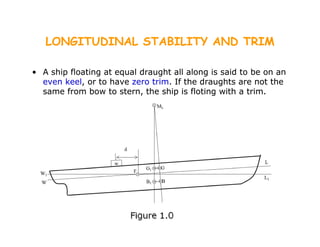
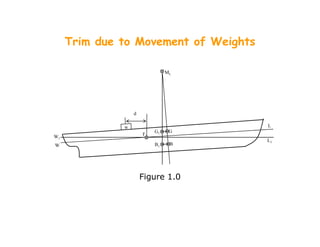
• Two waterlines (or waterplanes) are shown on the ship in 
Figure 1.0; a trimmed waterline (W1L1) and the even keel 
waterline (WL) corresponding to the same displacement. 
They are shown intersecting at the centre of flotation of the 
even keel waterplane. The quantities shown in the figure 
are defined as follows: 
• Centre of Flotation (F): Geometric center of the ship's 
waterline plane. The ship trims about this point. May be 
forward or aft of the midships depending on the ship's hull 
shape at the waterline. 
•• Longitudinal Centre of Flotation (LCF) : Distance from 
the centre of flotation (F) to the midships. Used to 
distribute changes of trim between the fwd and aft 
draughts.
LONGITUDINAL STABILITY AND TRIM 
Cont. 
• Trim (t) : The difference between the forward and after 
draughts 
• Parallel Rise/Sinkage (PR/PS): When weight is 
removed/added from/to a ship at LCF, the forward and aft 
drafts will change by the same amount. Means, no trim 
occur. 
•• Change in Trim (CT): The sum total of the absolute 
values of the change in forward and after drafts. 
• Trimming Arm (d): The distance from the center of 
gravity of the weight to the LCF. If the weight is shifted, (d) 
is the distance shifted.
LONGITUDINAL STABILITY AND TRIM 
Cont. 
• Trimming Moment (TM): Moment about the LCF 
produced by weight additions, removals, or shifts (wd), 
where w is the amount of weight added, removed, or 
shifted. 
• Moment to change Trim One cm (MCTC): The moment 
necessary to produce a change in trim (CT) of one cm. 
Found using the hydrostatic curves. 
• Tons Per cm Immersion (TPC): The number of tons 
added or removed necessary to produce a change in mean 
draft (parallel sinkage) of one cm. Parallel sinkage is when 
the ship changes it’s forward and after drafts by the same 
amount so that no change in trim occurs.
LONGITUDINAL STABILITY AND TRIM 
Cont. 
•TF : Draught forward 
•TA : Draught aft 
•TM : Mean draught at amidships. It is the average of TF and TA. 
••TO : Draught at centre of floation, also called the corresponding 
even keel draught. 
•δTF : Change in draughts forward 
•δTA : Change in draughts after 
• θθ: trim angle 
Figure 2.0 shows more detail on hull geometry and sign conventions adopted in this notes
Figure 2.0
Trim due to Movement of Weights 
ML 
L 
d 
w 
F G1 G W1 L 
B1 B 
1 
W 
L1 
Figure 1.0
Trim due to Movement of Weights 
Cont…… 
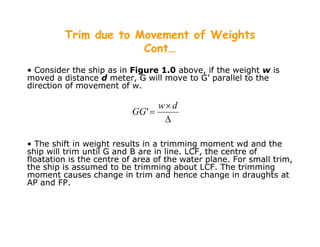
• Consider the ship as in Figure 1.0 above, if the weight w is 
moved a distance d meter, G will move to G’’ parallel to the 
direction of movement of w. 
w× × 
d 
Δ 
GG'= w • The shift in weight results in a trimming moment wd and the 
ship will trim until G and B are in line. LCF, the centre of 
floatation is the centre of area of the water plane. For small trim, 
the ship is assumed to be trimming about LCF. The trimming 
moment causes change in trim and hence change in draughts at 
AP and FP.
Trim due to Movement of Weights 
Cont…… 
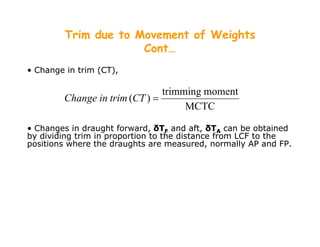
• Change in trim (CT), 
Change in trim(CT ) = trimming moment 
MCTC 
• Changes in draught forward, δTF and aft, δTA can be obtained 
by dividing trim in proportion to the distance from LCF to the 
y g p p 
positions where the draughts are measured, normally AP and FP.
Trim due to Movement of Weights 
Cont…… 
Amidship 
δTA x 
F 
δTF 
T 
Trim 
T 
TA 
TF 
LBP 
Baseline
Trim due to Movement of Weights 
Cont…… 
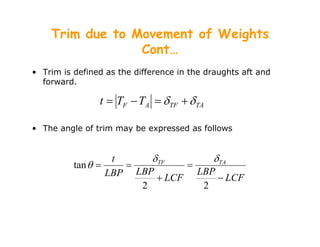
• Trim is defined as the difference in the draughts aft and 
forward. 
F A TF TA t = T −T =δ +δ 
• The angle of trim may be expressed as follows 
δ tan = t = TF δ 
= TA 
LBP LBP LBP 
θ 
+ LCF − LCF 
2 2
Trim due to Movement of Weights 
Cont…… 
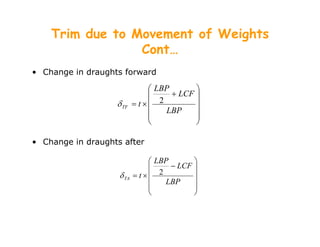
• Change in draughts forward 
⎟ 
⎟ ⎟ ⎞ 
⎜ ⎜ ⎜ ⎛ 
LBP + 
LCF 
δ = × 
2 
LBP 
t TF 
Ch i d ht ft 
⎟ ⎠ 
⎜ 
⎝ 
⎜ 
• Change in draughts after 
⎟ ⎟ ⎞ 
⎜ ⎜ ⎛ 
LBP − LCF 
2 
⎟ ⎟ ⎠ 
⎜ 
⎝ 
⎜ ⎜ 
= × 
LBP 
t TA 
δ
Small Weight Changes 
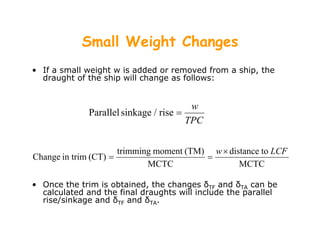
• If a small weight w is added or removed from a ship, the 
draught of the ship will change as follows: 
w 
TPC 
Parallel sinkage / rise = Change in trim (CT) trimming moment (TM) w× distance to 
LCF 
MCTC 
= = 
MCTC 
• Once the trim is obtained, the changes δTF and δTA can be 
calculated and the final draughts will include the parallel 
rise/sinkage and δδTF and δδTA.
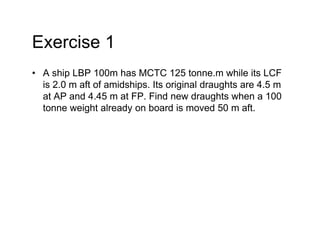
Exercise 1 
• A ship LBP 100m has MCTC 125 tonne.m while its LCF 
is 2.0 m aft of amidships. Its original draughts are 4.5 m 
at AP and 4.45 m at FP. Find new draughts when a 100 
tonne weight already on board is moved 50 m aft.
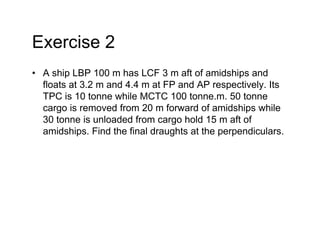
Exercise 2 
• A ship LBP 100 m has LCF 3 m aft of amidships and 
floats at 3.2 m and 4.4 m at FP and AP respectively. Its 
TPC is 10 tonne while MCTC 100 tonne.m. 50 tonne 
cargo is removed from 20 m forward of amidships while 
30 tonne is unloaded from cargo hold 15 m aft of 
amidships. Find the final draughts at the perpendiculars.

Small angle stability longitudinal

  • 1.
    SMALL ANGLE STABILITY: Longitudinal Stability
  • 2.
    INTRODUCTION • Inthe previous section, we have calculated vertical and transverse weight shifts, weight additions, and weight removals. In this section we will look at longitudinal weight shifts, weight additions, and weight removals. Longitudinal problems are done in a different manner because we are usually not concerned with the final position of G, but the new trim condition of the ship. • The consequence of longitudinal shifts, additions, and removals of weight is that the ship undergoes a change in the forward and after drafts. When the forward and after drafts have different magnitudes the ship is said to have trim. • Trim is defined by the difference between the forward and after drafts. Trim = Taft - Tfwd
  • 3.
    INTRODUCTION Cont. •If a ship is "trimmed by the bow," then the forward draft is bigger than the after draft. A ship "trimmed by the stern" has an after draft bigger than the forward draft. •• Recall that the ship rotates about the center of flotation (F) which is the centroid of the waterplane area. (It does not rotate about midships!) When the centroid of the waterplane area is aft of midships the forward draft will change by a larger amount than the after draft. This is usually the case since a typical ship is wider aft of midships than forward of midships.
  • 4.
    LONGITUDINAL STABILITY ANDTRIM • A ship floating at equal draught all along is said to be on an even keel, or to have zero trim. If the draughts are not the same from bow to stern, the ship is floting with a trim.
  • 5.
    LONGITUDINAL STABILITY ANDTRIM Cont. • Two waterlines (or waterplanes) are shown on the ship in Figure 1.0; a trimmed waterline (W1L1) and the even keel waterline (WL) corresponding to the same displacement. They are shown intersecting at the centre of flotation of the even keel waterplane. The quantities shown in the figure are defined as follows: • Centre of Flotation (F): Geometric center of the ship's waterline plane. The ship trims about this point. May be forward or aft of the midships depending on the ship's hull shape at the waterline. •• Longitudinal Centre of Flotation (LCF) : Distance from the centre of flotation (F) to the midships. Used to distribute changes of trim between the fwd and aft draughts.
  • 6.
    LONGITUDINAL STABILITY ANDTRIM Cont. • Trim (t) : The difference between the forward and after draughts • Parallel Rise/Sinkage (PR/PS): When weight is removed/added from/to a ship at LCF, the forward and aft drafts will change by the same amount. Means, no trim occur. •• Change in Trim (CT): The sum total of the absolute values of the change in forward and after drafts. • Trimming Arm (d): The distance from the center of gravity of the weight to the LCF. If the weight is shifted, (d) is the distance shifted.
  • 7.
    LONGITUDINAL STABILITY ANDTRIM Cont. • Trimming Moment (TM): Moment about the LCF produced by weight additions, removals, or shifts (wd), where w is the amount of weight added, removed, or shifted. • Moment to change Trim One cm (MCTC): The moment necessary to produce a change in trim (CT) of one cm. Found using the hydrostatic curves. • Tons Per cm Immersion (TPC): The number of tons added or removed necessary to produce a change in mean draft (parallel sinkage) of one cm. Parallel sinkage is when the ship changes it’s forward and after drafts by the same amount so that no change in trim occurs.
  • 8.
    LONGITUDINAL STABILITY ANDTRIM Cont. •TF : Draught forward •TA : Draught aft •TM : Mean draught at amidships. It is the average of TF and TA. ••TO : Draught at centre of floation, also called the corresponding even keel draught. •δTF : Change in draughts forward •δTA : Change in draughts after • θθ: trim angle Figure 2.0 shows more detail on hull geometry and sign conventions adopted in this notes
  • 9.
  • 10.
    Trim due toMovement of Weights ML L d w F G1 G W1 L B1 B 1 W L1 Figure 1.0
  • 11.
    Trim due toMovement of Weights Cont…… • Consider the ship as in Figure 1.0 above, if the weight w is moved a distance d meter, G will move to G’’ parallel to the direction of movement of w. w× × d Δ GG'= w • The shift in weight results in a trimming moment wd and the ship will trim until G and B are in line. LCF, the centre of floatation is the centre of area of the water plane. For small trim, the ship is assumed to be trimming about LCF. The trimming moment causes change in trim and hence change in draughts at AP and FP.
  • 12.
    Trim due toMovement of Weights Cont…… • Change in trim (CT), Change in trim(CT ) = trimming moment MCTC • Changes in draught forward, δTF and aft, δTA can be obtained by dividing trim in proportion to the distance from LCF to the y g p p positions where the draughts are measured, normally AP and FP.
  • 13.
    Trim due toMovement of Weights Cont…… Amidship δTA x F δTF T Trim T TA TF LBP Baseline
  • 14.
    Trim due toMovement of Weights Cont…… • Trim is defined as the difference in the draughts aft and forward. F A TF TA t = T −T =δ +δ • The angle of trim may be expressed as follows δ tan = t = TF δ = TA LBP LBP LBP θ + LCF − LCF 2 2
  • 15.
    Trim due toMovement of Weights Cont…… • Change in draughts forward ⎟ ⎟ ⎟ ⎞ ⎜ ⎜ ⎜ ⎛ LBP + LCF δ = × 2 LBP t TF Ch i d ht ft ⎟ ⎠ ⎜ ⎝ ⎜ • Change in draughts after ⎟ ⎟ ⎞ ⎜ ⎜ ⎛ LBP − LCF 2 ⎟ ⎟ ⎠ ⎜ ⎝ ⎜ ⎜ = × LBP t TA δ
  • 16.
    Small Weight Changes • If a small weight w is added or removed from a ship, the draught of the ship will change as follows: w TPC Parallel sinkage / rise = Change in trim (CT) trimming moment (TM) w× distance to LCF MCTC = = MCTC • Once the trim is obtained, the changes δTF and δTA can be calculated and the final draughts will include the parallel rise/sinkage and δδTF and δδTA.
  • 17.
    Exercise 1 •A ship LBP 100m has MCTC 125 tonne.m while its LCF is 2.0 m aft of amidships. Its original draughts are 4.5 m at AP and 4.45 m at FP. Find new draughts when a 100 tonne weight already on board is moved 50 m aft.
  • 18.
    Exercise 2 •A ship LBP 100 m has LCF 3 m aft of amidships and floats at 3.2 m and 4.4 m at FP and AP respectively. Its TPC is 10 tonne while MCTC 100 tonne.m. 50 tonne cargo is removed from 20 m forward of amidships while 30 tonne is unloaded from cargo hold 15 m aft of amidships. Find the final draughts at the perpendiculars.