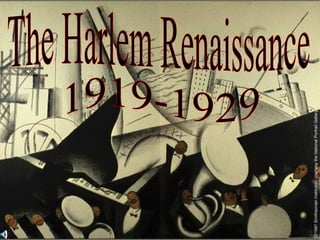
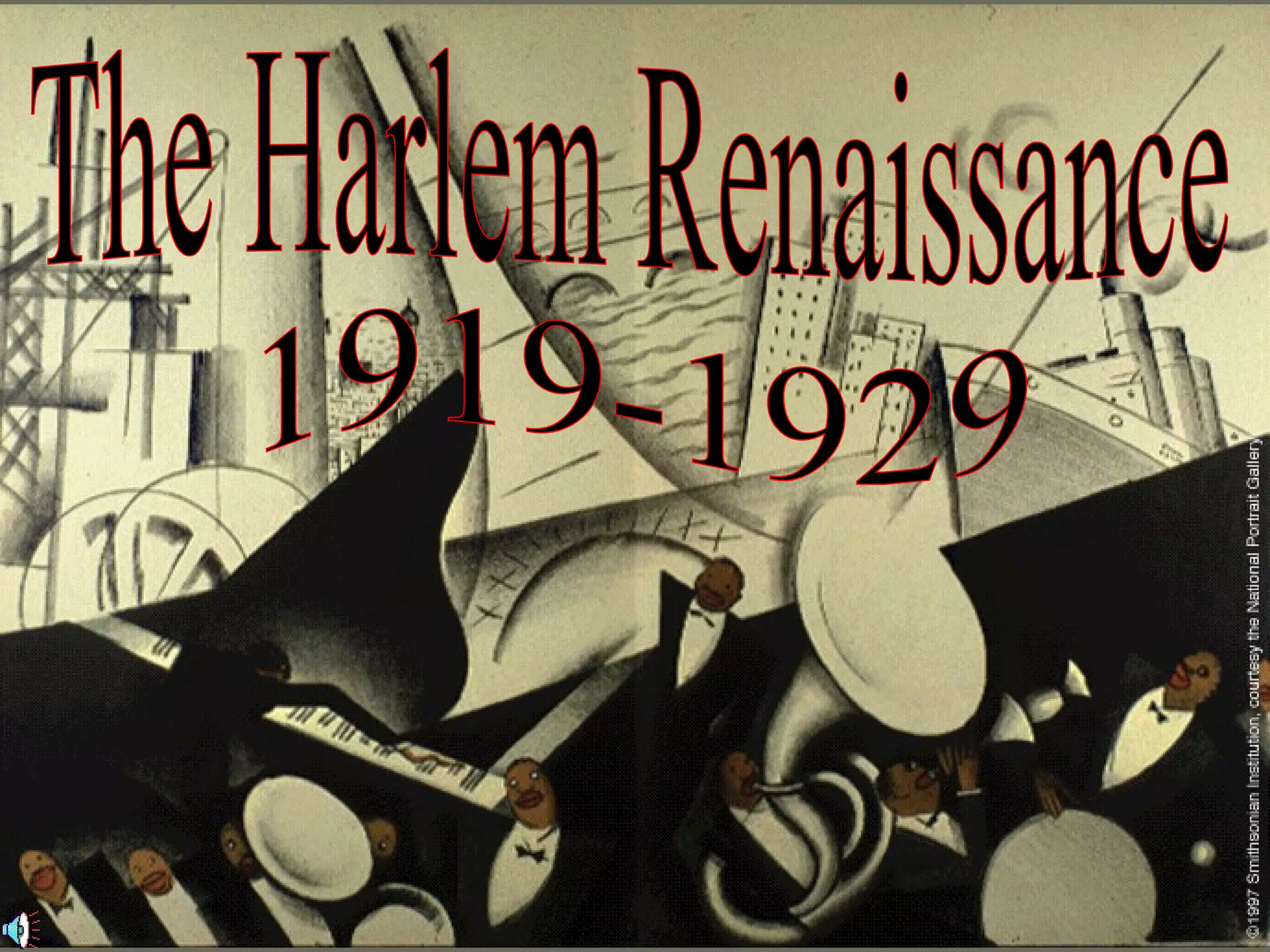
The Harlem Renaissance 1919-1929
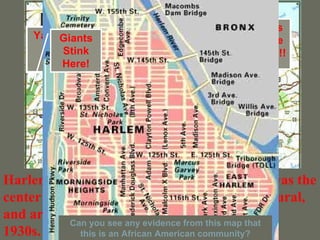
Mets Lose Here!! Yankees Buy Pennant Here!! Can you see any evidence from this map that this is an African American community? Giants Stink Here! Harlem, a neighborhood in New York City, was the center of the African American political, cultural, and artistic movement in the 1920s and early 1930s.
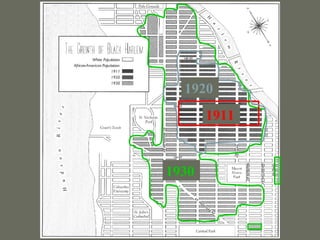
1930 1911 1920
Who made up the Harlem Renaissance? In the early 1920s, African American artists, writers, musicians, and performers were part of a great cultural movement known as the Harlem Renaissance. Doctors, singers, students, musicians, shopkeepers, painters, and writers, congregated, forming a vibrant mecca of cultural affirmation and inspiration.   Why Harlem? The huge migration to the North after World War I, known as “The Great Migration” brought African Americans of all ages and walks of life to the thriving New York City neighborhood called Harlem.
Common themes:  alienation,  marginality,  the use of folk material,  the use of the blues tradition,  the problems of writing for an elite audience. The Harlem Renaissance was more than just a literary movement: it included racial consciousness, "the back to Africa" movement led by Marcus Garvey, racial integration, the explosion of music particularly jazz, spirituals and blues, painting, dramatic revues, and others.
Harlem Renaissance brought the Black  experience clearly within the general American cultural history. The Black migration, from south to north, changed their cultural image from rural to urban, from peasant to sophisticate. Harlem became a crossroads where Blacks interacted with and expanded their contacts internationally.  The Harlem Renaissance profited from a spirit of self-determination which was widespread after W.W.I.
2. The Harlem Renaissance had a huge significance in    American culture at the time.   a. It became a symbol and a point of reference for everyone to recall.  b. The name, more than the place, became synonymous with new vitality and Black urbanity.  c.  It became a racial focal point for Blacks the world over; it remained for a time, a race capital.  d.  It stood for unity; Alain Locke wrote: "The peasant, the student, the businessman, the professional man, artist, poet, musician, adventurer and worker, preacher and criminal, exploiter and social outcast, each group has come with its own special motives ... but their greatest experience has been the finding of one another."
Some Important Historical Figures of The Harlem Renaissance Langston Hughes – Poet Zora Neale Hurston – Writer Marcus Garvey - Activist Duke Ellington – Composer/Musician
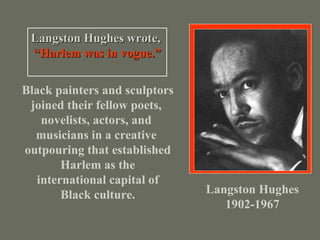
Langston Hughes 1902-1967 Langston Hughes wrote,   “ Harlem was in vogue.” Black painters and sculptors joined their fellow poets,  novelists, actors, and  musicians in a creative  outpouring that established Harlem as the international capital of Black culture.
Langston Hughes Hughes was an American poet, playwright, and writer.  He was one of the earliest innovators of “Jazz Poetry”. Jazz Poetry set his poetry apart from that of other writers, and it allowed him to experiment with a very rhythmic free verse.
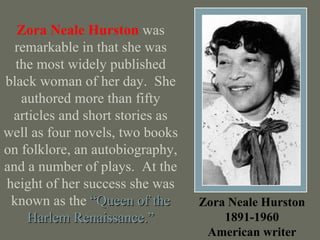
Zora Neale Hurston 1891-1960 American writer Zora Neale Hurston   was remarkable in that she was the most widely published  black woman of her day.  She authored more than fifty articles and short stories as well as four novels, two books on folklore, an autobiography, and a number of plays.  At the height of her success she was known as the   “Queen of the Harlem Renaissance.”
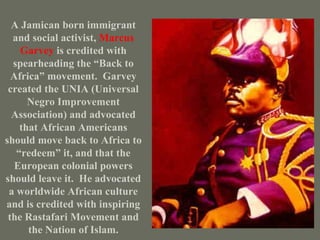
A Jamican born immigrant and social activist,  Marcus Garvey  is credited with spearheading the “Back to Africa” movement.  Garvey created the UNIA (Universal Negro Improvement Association) and advocated that African Americans should move back to Africa to “redeem” it, and that the European colonial powers should leave it.  He advocated a worldwide African culture and is credited with inspiring the Rastafari Movement and the Nation of Islam.
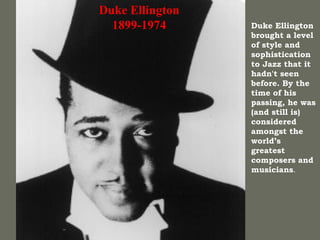
Duke Ellington 1899-1974 Duke Ellington brought a level of style and sophistication to Jazz that it hadn't seen before. By the time of his passing, he was (and still is) considered amongst the world’s greatest composers and musicians .
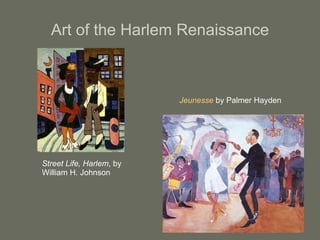
Art of the Harlem Renaissance Street Life, Harlem , by William H. Johnson Jeunesse  by Palmer Hayden
The visual art of the  Harlem Renaissance  was an attempt at developing a new African-American aesthetic in the fine arts.  Thematic content included Africa as a source of inspiration, African-American history, folk idioms,  and social injustice. Believing that their life experiences were valuable sources of material for their art, these artists created an iconography of the  Harlem Renaissance  era.
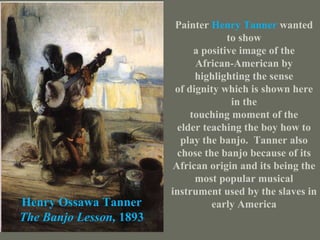
Henry Ossawa Tanner The Banjo Lesson,  1893 Painter  Henry Tanner   wanted to show a positive image of the African-American by highlighting the sense of dignity which is shown here in the touching moment of the elder teaching the boy how to play the banjo.  Tanner also chose the banjo because of its African origin and its being the most popular musical instrument used by the slaves in early America
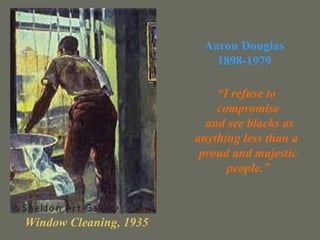
Window Cleaning, 1935 “ I refuse to  compromise and see blacks as anything less than a  proud and majestic people.” Aaron Douglas 1898-1979
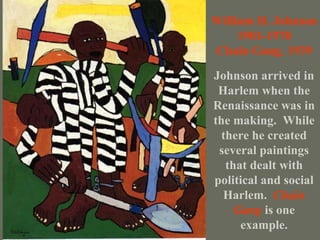
Johnson arrived in Harlem when the Renaissance was in the making.  While there he created several paintings that dealt with political and social Harlem.   Chain Gang   is one example. William H. Johnson 1901-1970 Chain Gang. 1939
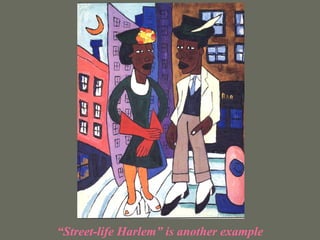
“ Street-life Harlem” is another example
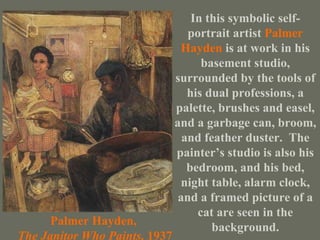
Palmer Hayden, The Janitor Who Paints,  1937 In this symbolic self-portrait artist   Palmer Hayden   is at work in his basement studio, surrounded by the tools of his dual professions, a palette, brushes and easel, and a garbage can, broom, and feather duster.  The painter’s studio is also his bedroom, and his bed, night table, alarm clock, and a framed picture of a cat are seen in the   background.
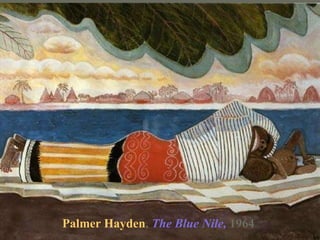
Palmer Hayden ,   The Blue Nile,  1964
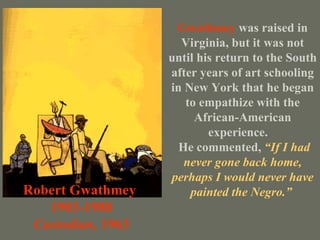
Gwathmey   was raised in Virginia, but it was not until his return to the South after years of art schooling in New York that he began to empathize with the African-American experience.  He commented,   “If I had never gone back home, perhaps I would never have painted the Negro.”  Robert Gwathmey  1903-1988 Custodian,  1963
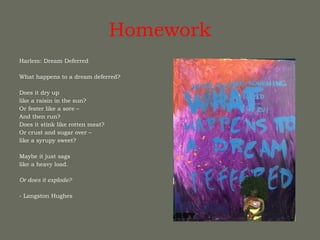
Homework Harlem: Dream Deferred  What happens to a dream deferred?  Does it dry up like a raisin in the sun? Or fester like a sore – And then run? Does it stink like rotten meat? Or crust and sugar over – like a syrupy sweet?  Maybe it just sags like a heavy load.  Or does it explode?   - Langston Hughes
MrHousepian.com Directions:  Please go to mrhousepian.com, reread the poem Harlem: Dream Deferred and click on “Start Discussion” at the bottom of the post.  Please leave a short response that explains what you think this poem is about and why.  Being that it is a poem, there is no right or wrong answer, just your own opinion. Due:  Friday before midnight.

The Harlem Renaissance 97-03

  • 1.
  • 2.
    Mets Lose Here!!Yankees Buy Pennant Here!! Can you see any evidence from this map that this is an African American community? Giants Stink Here! Harlem, a neighborhood in New York City, was the center of the African American political, cultural, and artistic movement in the 1920s and early 1930s.
  • 3.
  • 4.
    Who made upthe Harlem Renaissance? In the early 1920s, African American artists, writers, musicians, and performers were part of a great cultural movement known as the Harlem Renaissance. Doctors, singers, students, musicians, shopkeepers, painters, and writers, congregated, forming a vibrant mecca of cultural affirmation and inspiration. Why Harlem? The huge migration to the North after World War I, known as “The Great Migration” brought African Americans of all ages and walks of life to the thriving New York City neighborhood called Harlem.
  • 5.
    Common themes: alienation, marginality, the use of folk material, the use of the blues tradition, the problems of writing for an elite audience. The Harlem Renaissance was more than just a literary movement: it included racial consciousness, "the back to Africa" movement led by Marcus Garvey, racial integration, the explosion of music particularly jazz, spirituals and blues, painting, dramatic revues, and others.
  • 6.
    Harlem Renaissance broughtthe Black experience clearly within the general American cultural history. The Black migration, from south to north, changed their cultural image from rural to urban, from peasant to sophisticate. Harlem became a crossroads where Blacks interacted with and expanded their contacts internationally. The Harlem Renaissance profited from a spirit of self-determination which was widespread after W.W.I.
  • 7.
    2. The HarlemRenaissance had a huge significance in American culture at the time. a. It became a symbol and a point of reference for everyone to recall. b. The name, more than the place, became synonymous with new vitality and Black urbanity. c. It became a racial focal point for Blacks the world over; it remained for a time, a race capital. d. It stood for unity; Alain Locke wrote: "The peasant, the student, the businessman, the professional man, artist, poet, musician, adventurer and worker, preacher and criminal, exploiter and social outcast, each group has come with its own special motives ... but their greatest experience has been the finding of one another."
  • 8.
    Some Important HistoricalFigures of The Harlem Renaissance Langston Hughes – Poet Zora Neale Hurston – Writer Marcus Garvey - Activist Duke Ellington – Composer/Musician
  • 9.
    Langston Hughes 1902-1967Langston Hughes wrote, “ Harlem was in vogue.” Black painters and sculptors joined their fellow poets, novelists, actors, and musicians in a creative outpouring that established Harlem as the international capital of Black culture.
  • 10.
    Langston Hughes Hugheswas an American poet, playwright, and writer. He was one of the earliest innovators of “Jazz Poetry”. Jazz Poetry set his poetry apart from that of other writers, and it allowed him to experiment with a very rhythmic free verse.
  • 11.
    Zora Neale Hurston1891-1960 American writer Zora Neale Hurston was remarkable in that she was the most widely published black woman of her day. She authored more than fifty articles and short stories as well as four novels, two books on folklore, an autobiography, and a number of plays. At the height of her success she was known as the “Queen of the Harlem Renaissance.”
  • 12.
    A Jamican bornimmigrant and social activist, Marcus Garvey is credited with spearheading the “Back to Africa” movement. Garvey created the UNIA (Universal Negro Improvement Association) and advocated that African Americans should move back to Africa to “redeem” it, and that the European colonial powers should leave it. He advocated a worldwide African culture and is credited with inspiring the Rastafari Movement and the Nation of Islam.
  • 13.
    Duke Ellington 1899-1974Duke Ellington brought a level of style and sophistication to Jazz that it hadn't seen before. By the time of his passing, he was (and still is) considered amongst the world’s greatest composers and musicians .
  • 14.
    Art of theHarlem Renaissance Street Life, Harlem , by William H. Johnson Jeunesse by Palmer Hayden
  • 15.
    The visual artof the Harlem Renaissance was an attempt at developing a new African-American aesthetic in the fine arts. Thematic content included Africa as a source of inspiration, African-American history, folk idioms, and social injustice. Believing that their life experiences were valuable sources of material for their art, these artists created an iconography of the Harlem Renaissance era.
  • 16.
    Henry Ossawa TannerThe Banjo Lesson, 1893 Painter Henry Tanner wanted to show a positive image of the African-American by highlighting the sense of dignity which is shown here in the touching moment of the elder teaching the boy how to play the banjo. Tanner also chose the banjo because of its African origin and its being the most popular musical instrument used by the slaves in early America
  • 17.
    Window Cleaning, 1935“ I refuse to compromise and see blacks as anything less than a proud and majestic people.” Aaron Douglas 1898-1979
  • 18.
    Johnson arrived inHarlem when the Renaissance was in the making. While there he created several paintings that dealt with political and social Harlem. Chain Gang is one example. William H. Johnson 1901-1970 Chain Gang. 1939
  • 19.
    “ Street-life Harlem”is another example
  • 20.
    Palmer Hayden, TheJanitor Who Paints, 1937 In this symbolic self-portrait artist Palmer Hayden is at work in his basement studio, surrounded by the tools of his dual professions, a palette, brushes and easel, and a garbage can, broom, and feather duster. The painter’s studio is also his bedroom, and his bed, night table, alarm clock, and a framed picture of a cat are seen in the background.
  • 21.
    Palmer Hayden , The Blue Nile, 1964
  • 22.
    Gwathmey was raised in Virginia, but it was not until his return to the South after years of art schooling in New York that he began to empathize with the African-American experience. He commented, “If I had never gone back home, perhaps I would never have painted the Negro.” Robert Gwathmey 1903-1988 Custodian, 1963
  • 23.
    Homework Harlem: DreamDeferred What happens to a dream deferred? Does it dry up like a raisin in the sun? Or fester like a sore – And then run? Does it stink like rotten meat? Or crust and sugar over – like a syrupy sweet? Maybe it just sags like a heavy load. Or does it explode? - Langston Hughes
  • 24.
    MrHousepian.com Directions: Please go to mrhousepian.com, reread the poem Harlem: Dream Deferred and click on “Start Discussion” at the bottom of the post. Please leave a short response that explains what you think this poem is about and why.  Being that it is a poem, there is no right or wrong answer, just your own opinion. Due: Friday before midnight.

Editor's Notes

  • #21 The artist is painting a portrait of a young mother seated and holding her well-bundled baby with its curious hypnotic stare. Nothing seems amiss in the painting; the artist wears a shirt, tie, and beret, the attractive mother is clad in a checkered dress, and a cat sleeps peacefully on the floor. When this painting was x-rayed several years ago, however, the under-painting revealed some startling discoveries. The well, dressed, beret-wearing janitor-artist was originally painted as a ludicrous, bald man with a bean-shaped head; the baby was grinning buffoon, and the the mother was depicted as an unflattering servant. Ironically, the cat in the framed picture was painted over a portrait of Abraham Lincoln. The present version, considerably more attractive and flattering, was undoubtedly altered by Hayden in response to widespread criticism of his works by his peers who felt that Hayden was caricaturing blacks for the amusement of whites.