Phonetics for field methods
Understanding consonants and
introducing the IPA
What is a consonant
• Something that is not a vowel
– Vowels relatively obstruction-free path through
the mouth
– Consonants are created through creating some
kind of mouth shape through which the air must
escape.
• We can distinguish consonants from each
other by examining with reference to three
qualities: voicing, manner, place
Voicing
• Many types of consonants can be contrasted in the quality
of their voicing
• Voiceless consonants are produced with the vocal folds
(often referred to as the vocal cords) are apart
• Voiced consonants are produced with the vocal folds held
together. This means air must push between them forcing
them to vibrate.
• You can feel this vibration when saying sounds that you can
hold or draw out such as:
• /zzzzzzzzzzzz/ now say /sssssssssssss/
• You should notice tha tyour mouth stays roughly in the
same shape, but the buzzing switches off for the /s/
sequence
Place
• The flow of air from lungs to outside the body
follows the pathway known as the vocal tract
• Along the tract the air passes over, through
and below various places which can
manipulate the sound qualities.
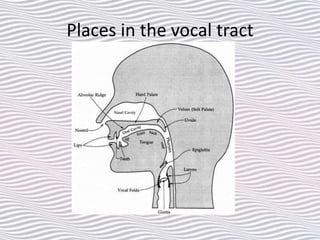
• The different places are represented on the
picture:
Places in the vocal tract
Stops or plosives
Non-continuant sounds
3 phases
blocking the air at point in the mouth
holding the air for ‘a beat’ to build pressure
the release (the audible phase)
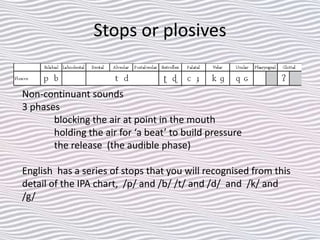
English has a series of stops that you will recognised from this
detail of the IPA chart, /p/ and /b/ /t/ and /d/ and /k/ and
/g/
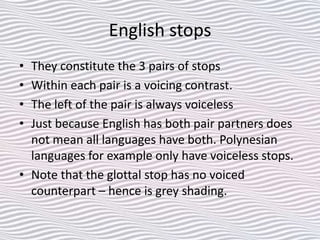
English stops
• They constitute the 3 pairs of stops
• Within each pair is a voicing contrast.
• The left of the pair is always voiceless
• Just because English has both pair partners does
not mean all languages have both. Polynesian
languages for example only have voiceless stops.
• Note that the glottal stop has no voiced
counterpart – hence is grey shading.
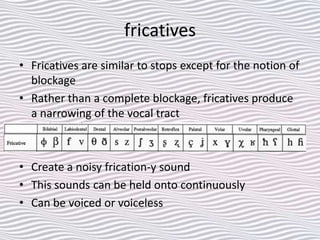
fricatives
• Fricatives are similar to stops except for the notion of
blockage
• Rather than a complete blockage, fricatives produce
a narrowing of the vocal tract
• Create a noisy frication-y sound
• This sounds can be held onto continuously
• Can be voiced or voiceless
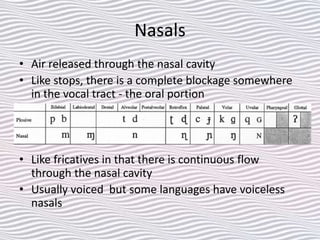
Nasals
• Air released through the nasal cavity
• Like stops, there is a complete blockage somewhere
in the vocal tract - the oral portion
• Like fricatives in that there is continuous flow
through the nasal cavity
• Usually voiced but some languages have voiceless
nasals

Phonetics for field methods

  • 1.
    Phonetics for fieldmethods Understanding consonants and introducing the IPA
  • 2.
    What is aconsonant • Something that is not a vowel – Vowels relatively obstruction-free path through the mouth – Consonants are created through creating some kind of mouth shape through which the air must escape. • We can distinguish consonants from each other by examining with reference to three qualities: voicing, manner, place
  • 3.
    Voicing • Many typesof consonants can be contrasted in the quality of their voicing • Voiceless consonants are produced with the vocal folds (often referred to as the vocal cords) are apart • Voiced consonants are produced with the vocal folds held together. This means air must push between them forcing them to vibrate. • You can feel this vibration when saying sounds that you can hold or draw out such as: • /zzzzzzzzzzzz/ now say /sssssssssssss/ • You should notice tha tyour mouth stays roughly in the same shape, but the buzzing switches off for the /s/ sequence
  • 4.
    Place • The flowof air from lungs to outside the body follows the pathway known as the vocal tract • Along the tract the air passes over, through and below various places which can manipulate the sound qualities. • The different places are represented on the picture:
  • 5.
    Places in thevocal tract
  • 6.
    Stops or plosives Non-continuantsounds 3 phases blocking the air at point in the mouth holding the air for ‘a beat’ to build pressure the release (the audible phase) English has a series of stops that you will recognised from this detail of the IPA chart, /p/ and /b/ /t/ and /d/ and /k/ and /g/
  • 7.
    English stops • Theyconstitute the 3 pairs of stops • Within each pair is a voicing contrast. • The left of the pair is always voiceless • Just because English has both pair partners does not mean all languages have both. Polynesian languages for example only have voiceless stops. • Note that the glottal stop has no voiced counterpart – hence is grey shading.
  • 8.
    fricatives • Fricatives aresimilar to stops except for the notion of blockage • Rather than a complete blockage, fricatives produce a narrowing of the vocal tract • Create a noisy frication-y sound • This sounds can be held onto continuously • Can be voiced or voiceless
  • 9.
    Nasals • Air releasedthrough the nasal cavity • Like stops, there is a complete blockage somewhere in the vocal tract - the oral portion • Like fricatives in that there is continuous flow through the nasal cavity • Usually voiced but some languages have voiceless nasals