supervised by
Dr shimaa taha
MULLIGAN
Techniques
OUR
TEAM
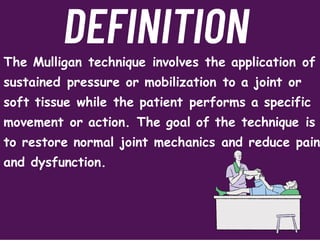
The Mulligan technique involves the application of
sustained pressure or mobilization to a joint or
soft tissue while the patient performs a specific
movement or action. The goal of the technique is
to restore normal joint mechanics and reduce pain
and dysfunction.
DEFINITION
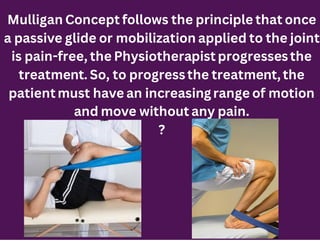
Mulligan Concept follows the principle that once
a passive glide or mobilization applied to the joint
is pain-free, the Physiotherapist progressesthe
treatment. So, to progressthe treatment, the
patient must have an increasing range of motion
and move without any pain.
?
1-A passive accessory joint mobilization
2-This accessory glide must itself be pain free.
3- During assessment the therapist will identify
one or more comparable signs
Examples of this signs
loss of joint movement
pain associated with movement
pain associated with specific functional activities
principles of treatment
The therapist must continuously monitor the patients reaction
to ensure no pain is recreated.
The therapist investigates various combinations of parallel or
perpendicular glides
to find the correct treatment plane and grade of accessory movement.
The previously restricted and/or painful motion or activity is repeated
by the patient while the therapist continues to maintain the
appropriate accessory glide.
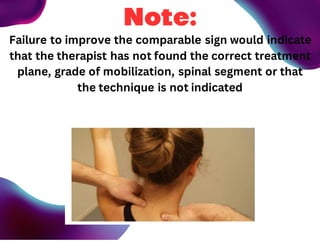
Note:
Failure to improve the comparable sign would indicate
that the therapist has not found the correct treatment
plane, grade of mobilization, spinal segment or that
the technique is not indicated
Techniques
SNAGs
-SNAGs stand for SustainedNatural ApophysealGlides.?can be
applied to all the spinal joints,the rib cage and the sacroiliacjoint
The therapistapplies the appropriateaccessoryzygapophyseal
glide while the patient performsthe symptomaticmovement.
his must resultin full range pain free movement.
SNAGs are most successfulwhen symptomsare provoked by a
movementand are not multilevel.
AlthoughSNAGs are usually performedin weightbearing
positionsthey can be adapted for use in non weightbearing
positions.
Techniques
SPINAL MOBILIZATION WITH LIMB
MOVEMENT (SMWLMS)
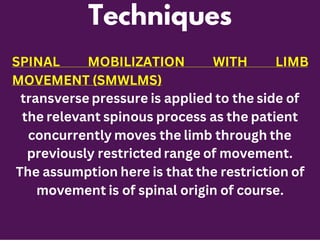
transverse pressure is applied to the side of
the relevant spinous process as the patient
concurrently moves the limb through the
previously restricted range of movement.
The assumption here is that the restriction of
movement is of spinal origin of course.
Techniques
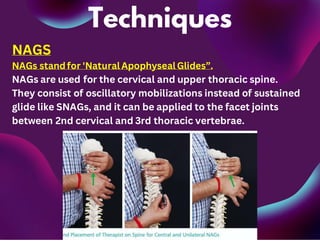
NAGS
NAGs stand for 'Natural Apophyseal Glides”.
NAGs are used for the cervical and upper thoracic spine.
They consist of oscillatory mobilizations instead of sustained
glide like SNAGs, and it can be applied to the facet joints
between 2nd cervical and 3rd thoracic vertebrae.
equipments
mulligan belt
mulligan pads
plinth
tape
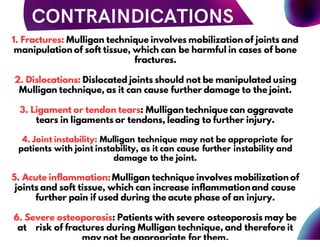
1. Fractures: Mulligan technique involves mobilization of joints and
manipulation of soft tissue, which can be harmful in cases of bone
fractures.
2. Dislocations: Dislocated joints should not be manipulated using
Mulligan technique, as it can cause further damage to the joint.
3. Ligament or tendon tears: Mulligan technique can aggravate
tears in ligaments or tendons, leading to further injury.
4. Joint instability: Mulligan technique may not be appropriate for
patients with joint instability, as it can cause further instability and
damage to the joint.
5. Acute inflammation:Mulligan technique involves mobilization of
joints and soft tissue, which can increase inflammation and cause
further pain if used during the acute phase of an injury.
6. Severe osteoporosis: Patients with severe osteoporosis may be
at risk of fractures during Mulligan technique, and therefore it
may not be appropriate for them.
Corrects abnormal reflexes and organ dysfunction .
Stretches contractedmuscles causing relaxation
Modulates peripheralnociceptors
Activates gating mechanism , neurotransmitters
Associated changes in sympathetic and motor
system .
Mulligan technique physiotherapy........

Mulligan technique physiotherapy........

  • 1.
    supervised by Dr shimaataha MULLIGAN Techniques
  • 2.
  • 4.
    The Mulligan techniqueinvolves the application of sustained pressure or mobilization to a joint or soft tissue while the patient performs a specific movement or action. The goal of the technique is to restore normal joint mechanics and reduce pain and dysfunction. DEFINITION
  • 5.
    Mulligan Concept followsthe principle that once a passive glide or mobilization applied to the joint is pain-free, the Physiotherapist progressesthe treatment. So, to progressthe treatment, the patient must have an increasing range of motion and move without any pain. ?
  • 6.
    1-A passive accessoryjoint mobilization 2-This accessory glide must itself be pain free. 3- During assessment the therapist will identify one or more comparable signs Examples of this signs loss of joint movement pain associated with movement pain associated with specific functional activities principles of treatment
  • 7.
    principles of treatment Thetherapist must continuously monitor the patients reaction to ensure no pain is recreated. The therapist investigates various combinations of parallel or perpendicular glides to find the correct treatment plane and grade of accessory movement. The previously restricted and/or painful motion or activity is repeated by the patient while the therapist continues to maintain the appropriate accessory glide.
  • 8.
    Note: Failure to improvethe comparable sign would indicate that the therapist has not found the correct treatment plane, grade of mobilization, spinal segment or that the technique is not indicated
  • 9.
    Techniques SNAGs -SNAGs stand forSustainedNatural ApophysealGlides.?can be applied to all the spinal joints,the rib cage and the sacroiliacjoint The therapistapplies the appropriateaccessoryzygapophyseal glide while the patient performsthe symptomaticmovement. his must resultin full range pain free movement. SNAGs are most successfulwhen symptomsare provoked by a movementand are not multilevel. AlthoughSNAGs are usually performedin weightbearing positionsthey can be adapted for use in non weightbearing positions.
  • 10.
    Techniques SPINAL MOBILIZATION WITHLIMB MOVEMENT (SMWLMS) transverse pressure is applied to the side of the relevant spinous process as the patient concurrently moves the limb through the previously restricted range of movement. The assumption here is that the restriction of movement is of spinal origin of course.
  • 11.
    Techniques NAGS NAGs stand for'Natural Apophyseal Glides”. NAGs are used for the cervical and upper thoracic spine. They consist of oscillatory mobilizations instead of sustained glide like SNAGs, and it can be applied to the facet joints between 2nd cervical and 3rd thoracic vertebrae.
  • 12.
  • 14.
    1. Fractures: Mulligantechnique involves mobilization of joints and manipulation of soft tissue, which can be harmful in cases of bone fractures. 2. Dislocations: Dislocated joints should not be manipulated using Mulligan technique, as it can cause further damage to the joint. 3. Ligament or tendon tears: Mulligan technique can aggravate tears in ligaments or tendons, leading to further injury. 4. Joint instability: Mulligan technique may not be appropriate for patients with joint instability, as it can cause further instability and damage to the joint. 5. Acute inflammation:Mulligan technique involves mobilization of joints and soft tissue, which can increase inflammation and cause further pain if used during the acute phase of an injury. 6. Severe osteoporosis: Patients with severe osteoporosis may be at risk of fractures during Mulligan technique, and therefore it may not be appropriate for them.
  • 15.
    Corrects abnormal reflexesand organ dysfunction . Stretches contractedmuscles causing relaxation Modulates peripheralnociceptors Activates gating mechanism , neurotransmitters Associated changes in sympathetic and motor system .