© 2017 Continuum Analytics - Confidential & Proprietary© 2018 Quansight - Confidential & Proprietary
Standardizing ND-Arrays (Tensors) in Python
Quansight Labs
travis@quansight.com
@quansightai
@teoliphant
Python Summit, December 2018
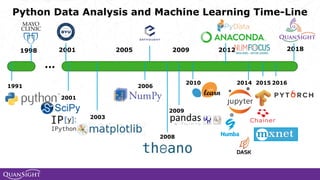
1998 20182001
2015
2009 20122005
…
2001
2006
Python Data Analysis and Machine Learning Time-Line
1991
2003
2014
2008
2010 2016
2009
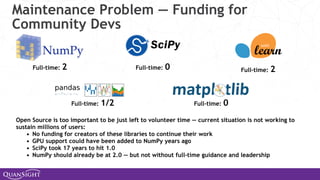
Maintenance Problem — Funding for
Community Devs
Full-time: 2 Full-time: 0
Full-time: 1/2
Open Source is too important to be just left to volunteer time — current situation is not working to
sustain millions of users:
• No funding for creators of these libraries to continue their work
• GPU support could have been added to NumPy years ago
• SciPy took 17 years to hit 1.0
• NumPy should already be at 2.0 — but not without full-time guidance and leadership
Full-time: 2
Full-time: 0
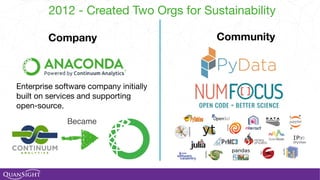
Company
2012 - Created Two Orgs for Sustainability
Community
Enterprise software company initially
built on services and supporting
open-source.
Became
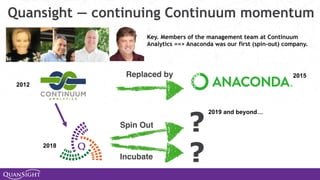
Quansight — continuing Continuum momentum
Replaced by
Spin Out
Incubate
2012
2018
?
?
Key. Members of the management team at Continuum
Analytics ==> Anaconda was our first (spin-out) company.
2015
2019 and beyond…
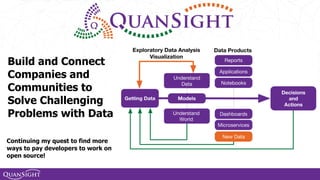
Build and Connect
Companies and
Communities to
Solve Challenging
Problems with Data
Continuing my quest to find more
ways to pay developers to work on
open source!
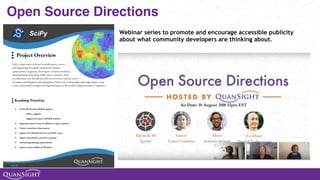
Open Source Directions
Webinar series to promote and encourage accessible publicity
about what community developers are thinking about.
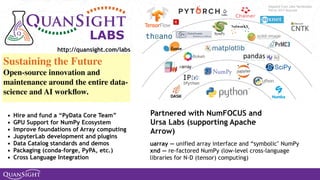
LABS
Sustaining the Future
Open-source innovation and
maintenance around the entire data-
science and AI workflow.
• Hire and fund a “PyData Core Team”
• GPU Support for NumPy Ecosystem
• Improve foundations of Array computing
• JupyterLab development and plugins
• Data Catalog standards and demos
• Packaging (conda-forge, PyPA, etc.)
• Cross Language Integration
uarray — unified array interface and “symbolic" NumPy
xnd — re-factored NumPy (low-level cross-language
libraries for N-D (tensor) computing)
Partnered with NumFOCUS and
Ursa Labs (supporting Apache
Arrow)
Bokeh
Adapted from Jake Vanderplas
PyCon 2017 Keynote
http://quansight.com/labs
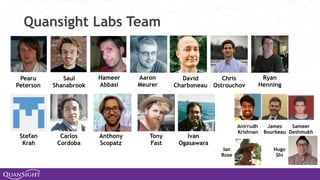
Quansight Labs Team
Pearu
Peterson
Saul
Shanabrook
Hameer
Abbasi
Stefan
Krah
Tony
Fast
Anirrudh
Krishnan
Aaron
Meurer
David
Charboneau
Chris
Ostrouchov
Ryan
Henning
Carlos
Cordoba
Anthony
Scopatz
James
Bourbeau
Sameer
Deshmukh
Ivan
Ogasawara
Ian
Rose
Hugo
Shi
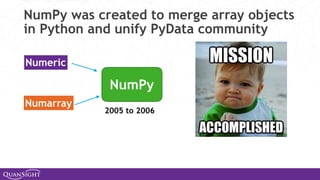
NumPy was created to merge array objects
in Python and unify PyData community
Numeric
Numarray
NumPy
2005 to 2006
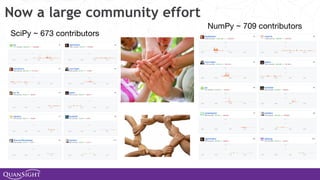
Now a large community effort
SciPy ~ 673 contributors
NumPy ~ 709 contributors
Bokeh
Adapted from Jake Vanderplas
PyCon 2017 Keynote
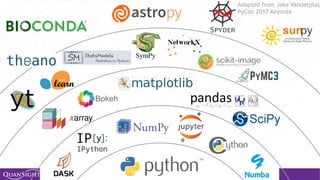
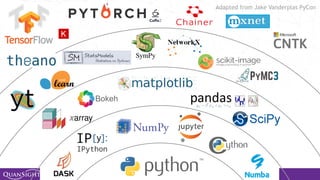
Python’s Scientific Ecosystem
Bokeh
Adapted from Jake Vanderplas PyCon
https://github.com/josephmisiti/awesome-machine-learning#python-general-purpose
http://deeplearning.net/software_links/
http://scikit-learn.org/stable/related_projects.html
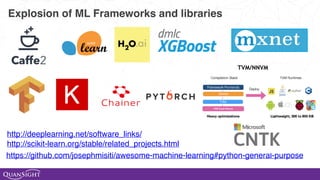
Explosion of ML Frameworks and libraries
TVM/NNVM
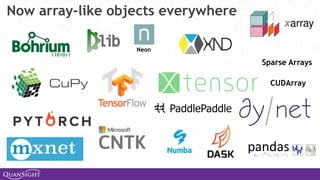
Now array-like objects everywhere
Sparse Arrays
Neon
CUDArray
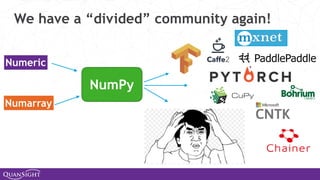
We have a “divided” community again!
Numeric
Numarray
NumPy
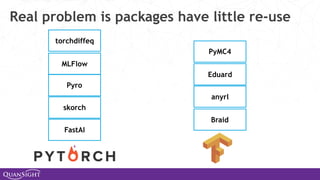
Real problem is packages have little re-use
FastAI
skorch
Pyro
Eduard
anyrl
Braid
PyMC4
MLFlow
torchdiffeq
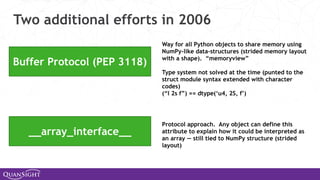
Two additional efforts in 2006
Buffer Protocol (PEP 3118)
__array_interface__
Way for all Python objects to share memory using
NumPy-like data-structures (strided memory layout
with a shape). “memoryview”
Type system not solved at the time (punted to the
struct module syntax extended with character
codes)
(“I 2s f”) == dtype(‘u4, 2S, f’)
Protocol approach. Any object can define this
attribute to explain how it could be interpreted as
an array — still tied to NumPy structure (strided
layout)
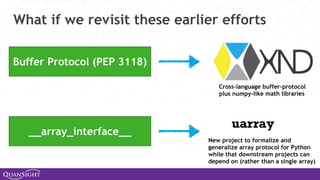
What if we revisit these earlier efforts
Buffer Protocol (PEP 3118)
__array_interface__
Cross-language buffer-protocol
plus numpy-like math libraries
uarray
New project to formalize and
generalize array protocol for Python
while that downstream projects can
depend on (rather than a single array)
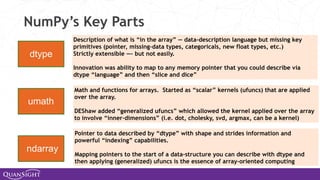
NumPy’s Key Parts
dtype
umath
ndarray
Description of what is “in the array” — data-description language but missing key
primitives (pointer, missing-data types, categoricals, new float types, etc.)
Strictly extensible —- but not easily.
Innovation was ability to map to any memory pointer that you could describe via
dtype “language” and then “slice and dice”
Pointer to data described by “dtype” with shape and strides information and
powerful “indexing” capabilities.
Mapping pointers to the start of a data-structure you can describe with dtype and
then applying (generalized) ufuncs is the essence of array-oriented computing
Math and functions for arrays. Started as “scalar” kernels (ufuncs) that are applied
over the array.
DEShaw added “generalized ufuncs” which allowed the kernel applied over the array
to involve “inner-dimensions” (i.e. dot, cholesky, svd, argmax, can be a kernel)
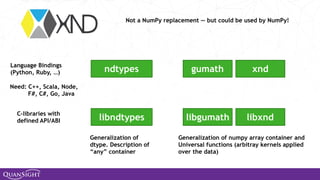
libndtypes libgumath libxnd
C-libraries with
defined API/ABI
Language Bindings
(Python, Ruby, …) ndtypes gumath xnd
Generalization of
dtype. Description of
“any” container
Generalization of numpy array container and
Universal functions (arbitray kernels applied
over the data)
Need: C++, Scala, Node,
F#, C#, Go, Java
Not a NumPy replacement — but could be used by NumPy!
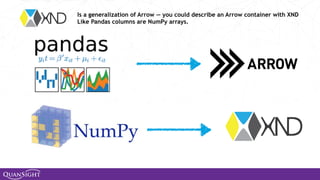
Is a generalization of Arrow — you could describe an Arrow container with XND
Like Pandas columns are NumPy arrays.
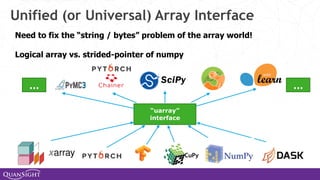
Unified (or Universal) Array Interface
Need to fix the “string / bytes” problem of the array world!
Logical array vs. strided-pointer of numpy
“uarray”
interface
……
CuPy
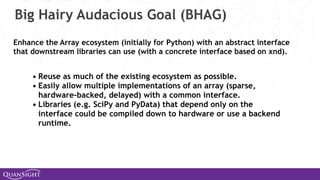
Big Hairy Audacious Goal (BHAG)
Enhance the Array ecosystem (initially for Python) with an abstract interface
that downstream libraries can use (with a concrete interface based on xnd).
• Reuse as much of the existing ecosystem as possible.
• Easily allow multiple implementations of an array (sparse,
hardware-backed, delayed) with a common interface.
• Libraries (e.g. SciPy and PyData) that depend only on the
interface could be compiled down to hardware or use a backend
runtime.
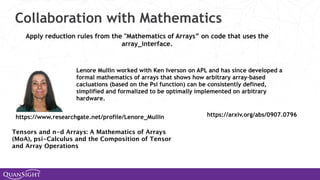
Collaboration with Mathematics
Apply reduction rules from the "Mathematics of Arrays” on code that uses the
array_interface.
Lenore Mullin worked with Ken Iverson on APL and has since developed a
formal mathematics of arrays that shows how arbitrary array-based
cacluations (based on the Psi function) can be consistently defined,
simplified and formalized to be optimally implemented on arbitrary
hardware.
https://www.researchgate.net/profile/Lenore_Mullin https://arxiv.org/abs/0907.0796
Tensors and n-d Arrays: A Mathematics of Arrays
(MoA), psi-Calculus and the Composition of Tensor
and Array Operations
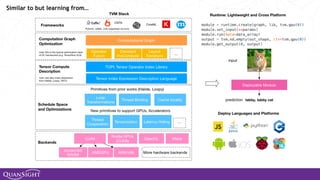
Similar to but learning from…
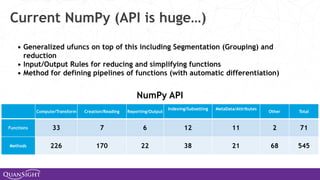
Current NumPy (API is huge…)
• Generalized ufuncs on top of this including Segmentation (Grouping) and
reduction
• Input/Output Rules for reducing and simplifying functions
• Method for defining pipelines of functions (with automatic differentiation)
Compute/Transform Creation/Reading Reporting/Output
Indexing/Subsetting MetaData/Attributes
Other Total
Functions 33 7 6 12 11 2 71
Methods 226 170 22 38 21 68 545
NumPy API
What is an array (or tensor)?
Fundamental concepts:
• shape (a named tuple)
• a function that takes a tuple of indexes and returns another array (Psi function)
• A (“dtype” or “memory-type”) (what are the elements)
• Math that works with arrays.
Other important concepts:
• for each dimension an “index” mapping from index space to 0..N-1 (labels)
• Data pointer (including device ID)
• Slicing, sub-selection, and indexing capability
• conversion from (0-d array) to Python scalar type
• Optional bit-array for masking missing data
• Functions for concatenation
• Functions for creating and filling the array (from a file, from a string, from Python
objects, from ODBC)
Core API that might be necessary
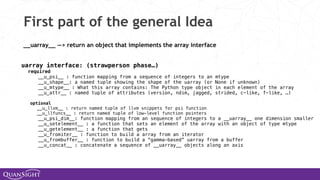
First part of the general Idea
__uarray__ —> return an object that implements the array interface
uarray interface: (strawperson phase…)
required
__u_psi__ : function mapping from a sequence of integers to an mtype
__u_shape__: a named tuple showing the shape of the uarray (or None if unknown)
__u_mtype__ : What this array contains: The Python type object in each element of the array
__u_attr__ : named tuple of attributes (version, ndim, jagged, strided, c-like, f-like, …)
optional
__u_llvm__ : return named tuple of llvm snippets for psi function
__u_llfuncs__ : return named tuple of low-level function pointers
__u_psi_dim__: function mapping from an sequence of integers to a __uarray__ one dimension smaller
__u_setelement__ : a function that sets an element of the array with an object of type mtype
__u_getelement__ : a function that gets
__u_fromiter__ : function to build a array from an iterator
__u_frombuffer__ : function to build a “gamma-based” uarray from a buffer
__u_concat__ : concatenate a sequence of __uarray__ objects along an axis
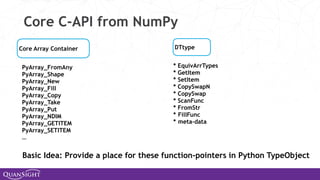
Core C-API from NumPy
PyArray_FromAny
PyArray_Shape
PyArray_New
PyArray_Fill
PyArray_Copy
PyArray_Take
PyArray_Put
PyArray_NDIM
PyArray_GETITEM
PyArray_SETITEM
…
* EquivArrTypes
* GetItem
* SetItem
* CopySwapN
* CopySwap
* ScanFunc
* FromStr
* FillFunc
* meta-data
Core Array Container DTtype
Basic Idea: Provide a place for these function-pointers in Python TypeObject
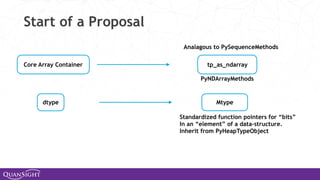
Start of a Proposal
Core Array Container
dtype Mtype
tp_as_ndarray
PyNDArrayMethods
Analagous to PySequenceMethods
Standardized function pointers for “bits”
In an “element” of a data-structure.
Inherit from PyHeapTypeObject

Standardizing arrays -- Microsoft Presentation

  • 1.
    © 2017 ContinuumAnalytics - Confidential & Proprietary© 2018 Quansight - Confidential & Proprietary Standardizing ND-Arrays (Tensors) in Python Quansight Labs travis@quansight.com @quansightai @teoliphant Python Summit, December 2018
  • 2.
    1998 20182001 2015 2009 20122005 … 2001 2006 PythonData Analysis and Machine Learning Time-Line 1991 2003 2014 2008 2010 2016 2009
  • 3.
    Maintenance Problem —Funding for Community Devs Full-time: 2 Full-time: 0 Full-time: 1/2 Open Source is too important to be just left to volunteer time — current situation is not working to sustain millions of users: • No funding for creators of these libraries to continue their work • GPU support could have been added to NumPy years ago • SciPy took 17 years to hit 1.0 • NumPy should already be at 2.0 — but not without full-time guidance and leadership Full-time: 2 Full-time: 0
  • 4.
    Company 2012 - CreatedTwo Orgs for Sustainability Community Enterprise software company initially built on services and supporting open-source. Became
  • 5.
    Quansight — continuingContinuum momentum Replaced by Spin Out Incubate 2012 2018 ? ? Key. Members of the management team at Continuum Analytics ==> Anaconda was our first (spin-out) company. 2015 2019 and beyond…
  • 6.
    Build and Connect Companiesand Communities to Solve Challenging Problems with Data Continuing my quest to find more ways to pay developers to work on open source!
  • 7.
    Open Source Directions Webinarseries to promote and encourage accessible publicity about what community developers are thinking about.
  • 8.
    LABS Sustaining the Future Open-sourceinnovation and maintenance around the entire data- science and AI workflow. • Hire and fund a “PyData Core Team” • GPU Support for NumPy Ecosystem • Improve foundations of Array computing • JupyterLab development and plugins • Data Catalog standards and demos • Packaging (conda-forge, PyPA, etc.) • Cross Language Integration uarray — unified array interface and “symbolic" NumPy xnd — re-factored NumPy (low-level cross-language libraries for N-D (tensor) computing) Partnered with NumFOCUS and Ursa Labs (supporting Apache Arrow) Bokeh Adapted from Jake Vanderplas PyCon 2017 Keynote http://quansight.com/labs
  • 9.
  • 10.
    NumPy was createdto merge array objects in Python and unify PyData community Numeric Numarray NumPy 2005 to 2006
  • 11.
    Now a largecommunity effort SciPy ~ 673 contributors NumPy ~ 709 contributors
  • 12.
    Bokeh Adapted from JakeVanderplas PyCon 2017 Keynote
  • 13.
  • 14.
  • 15.
    Now array-like objectseverywhere Sparse Arrays Neon CUDArray
  • 16.
    We have a“divided” community again! Numeric Numarray NumPy
  • 17.
    Real problem ispackages have little re-use FastAI skorch Pyro Eduard anyrl Braid PyMC4 MLFlow torchdiffeq
  • 18.
    Two additional effortsin 2006 Buffer Protocol (PEP 3118) __array_interface__ Way for all Python objects to share memory using NumPy-like data-structures (strided memory layout with a shape). “memoryview” Type system not solved at the time (punted to the struct module syntax extended with character codes) (“I 2s f”) == dtype(‘u4, 2S, f’) Protocol approach. Any object can define this attribute to explain how it could be interpreted as an array — still tied to NumPy structure (strided layout)
  • 19.
    What if werevisit these earlier efforts Buffer Protocol (PEP 3118) __array_interface__ Cross-language buffer-protocol plus numpy-like math libraries uarray New project to formalize and generalize array protocol for Python while that downstream projects can depend on (rather than a single array)
  • 20.
    NumPy’s Key Parts dtype umath ndarray Descriptionof what is “in the array” — data-description language but missing key primitives (pointer, missing-data types, categoricals, new float types, etc.) Strictly extensible —- but not easily. Innovation was ability to map to any memory pointer that you could describe via dtype “language” and then “slice and dice” Pointer to data described by “dtype” with shape and strides information and powerful “indexing” capabilities. Mapping pointers to the start of a data-structure you can describe with dtype and then applying (generalized) ufuncs is the essence of array-oriented computing Math and functions for arrays. Started as “scalar” kernels (ufuncs) that are applied over the array. DEShaw added “generalized ufuncs” which allowed the kernel applied over the array to involve “inner-dimensions” (i.e. dot, cholesky, svd, argmax, can be a kernel)
  • 21.
    libndtypes libgumath libxnd C-librarieswith defined API/ABI Language Bindings (Python, Ruby, …) ndtypes gumath xnd Generalization of dtype. Description of “any” container Generalization of numpy array container and Universal functions (arbitray kernels applied over the data) Need: C++, Scala, Node, F#, C#, Go, Java Not a NumPy replacement — but could be used by NumPy!
  • 22.
    Is a generalizationof Arrow — you could describe an Arrow container with XND Like Pandas columns are NumPy arrays.
  • 23.
    Unified (or Universal)Array Interface Need to fix the “string / bytes” problem of the array world! Logical array vs. strided-pointer of numpy “uarray” interface …… CuPy
  • 24.
    Big Hairy AudaciousGoal (BHAG) Enhance the Array ecosystem (initially for Python) with an abstract interface that downstream libraries can use (with a concrete interface based on xnd). • Reuse as much of the existing ecosystem as possible. • Easily allow multiple implementations of an array (sparse, hardware-backed, delayed) with a common interface. • Libraries (e.g. SciPy and PyData) that depend only on the interface could be compiled down to hardware or use a backend runtime.
  • 25.
    Collaboration with Mathematics Applyreduction rules from the "Mathematics of Arrays” on code that uses the array_interface. Lenore Mullin worked with Ken Iverson on APL and has since developed a formal mathematics of arrays that shows how arbitrary array-based cacluations (based on the Psi function) can be consistently defined, simplified and formalized to be optimally implemented on arbitrary hardware. https://www.researchgate.net/profile/Lenore_Mullin https://arxiv.org/abs/0907.0796 Tensors and n-d Arrays: A Mathematics of Arrays (MoA), psi-Calculus and the Composition of Tensor and Array Operations
  • 26.
    Similar to butlearning from…
  • 27.
    Current NumPy (APIis huge…) • Generalized ufuncs on top of this including Segmentation (Grouping) and reduction • Input/Output Rules for reducing and simplifying functions • Method for defining pipelines of functions (with automatic differentiation) Compute/Transform Creation/Reading Reporting/Output Indexing/Subsetting MetaData/Attributes Other Total Functions 33 7 6 12 11 2 71 Methods 226 170 22 38 21 68 545 NumPy API
  • 28.
    What is anarray (or tensor)? Fundamental concepts: • shape (a named tuple) • a function that takes a tuple of indexes and returns another array (Psi function) • A (“dtype” or “memory-type”) (what are the elements) • Math that works with arrays. Other important concepts: • for each dimension an “index” mapping from index space to 0..N-1 (labels) • Data pointer (including device ID) • Slicing, sub-selection, and indexing capability • conversion from (0-d array) to Python scalar type • Optional bit-array for masking missing data • Functions for concatenation • Functions for creating and filling the array (from a file, from a string, from Python objects, from ODBC) Core API that might be necessary
  • 29.
    First part ofthe general Idea __uarray__ —> return an object that implements the array interface uarray interface: (strawperson phase…) required __u_psi__ : function mapping from a sequence of integers to an mtype __u_shape__: a named tuple showing the shape of the uarray (or None if unknown) __u_mtype__ : What this array contains: The Python type object in each element of the array __u_attr__ : named tuple of attributes (version, ndim, jagged, strided, c-like, f-like, …) optional __u_llvm__ : return named tuple of llvm snippets for psi function __u_llfuncs__ : return named tuple of low-level function pointers __u_psi_dim__: function mapping from an sequence of integers to a __uarray__ one dimension smaller __u_setelement__ : a function that sets an element of the array with an object of type mtype __u_getelement__ : a function that gets __u_fromiter__ : function to build a array from an iterator __u_frombuffer__ : function to build a “gamma-based” uarray from a buffer __u_concat__ : concatenate a sequence of __uarray__ objects along an axis
  • 30.
    Core C-API fromNumPy PyArray_FromAny PyArray_Shape PyArray_New PyArray_Fill PyArray_Copy PyArray_Take PyArray_Put PyArray_NDIM PyArray_GETITEM PyArray_SETITEM … * EquivArrTypes * GetItem * SetItem * CopySwapN * CopySwap * ScanFunc * FromStr * FillFunc * meta-data Core Array Container DTtype Basic Idea: Provide a place for these function-pointers in Python TypeObject
  • 31.
    Start of aProposal Core Array Container dtype Mtype tp_as_ndarray PyNDArrayMethods Analagous to PySequenceMethods Standardized function pointers for “bits” In an “element” of a data-structure. Inherit from PyHeapTypeObject