Massive Scale USB Device
Driver Fuzz WITHOUT device
HyperChem @ Tencent’s XuanLab
Agenda
•USB Backgroud;
•Windows Driver 010;
•Previous Research;
•My work;
•Result;
USB
• Universal Serial Bus;
• USB 1.0、1.1、2.0、3.0、3.1;
• Four type of Transfers:Control、Isochronous、Interrupt and
Bulk;
• Concept:
• Device
• Configuration
• Interface;
• Endpoint;
• Endpiont is bacic element for Transfers;
USB
• VID=Vendor ID,PID=Product ID;
• Device/InterfaceClass,Define device Class;
• Type of Descriptor:
• Device Descriptor ;
• Configuration Descriptor ;
• Interface Descriptor ;
• Endpoint Descriptor ;
USB
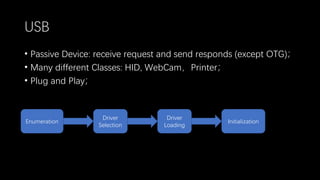
• Passive Device: receive request and send responds (except OTG);
• Many different Classes: HID, WebCam,Printer;
• Plug and Play;
Enumeration
Driver
Selection
Driver
Loading
Initialization
Windows USB
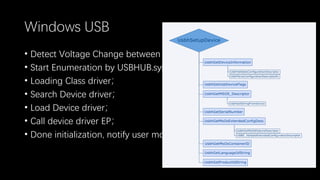
• Detect Voltage Change between D+ and D-;
• Start Enumeration by USBHUB.sys;
• Loading Class driver;
• Search Device driver;
• Load Device driver;
• Call device driver EP;
• Done initialization, notify user mode;
Windows USB
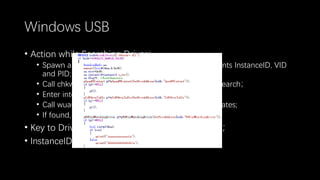
• Action while Searching Driver:
• Spawn a userland process DrvInst.exe,with arguments InstanceID, VID
and PID;
• Call chkwudrv.dll!WUFindMatchingDriver to do the search;
• Enter into Windows Update service via LPC;
• Call wuaueng!CAgentProtocolTalker::SyncServerUpdates;
• If found, WUFindMatchingDriver return True;
• Key to Driver Searching:VID,PID,InstanceID;
• InstanceID is checked locally;
Previous Research
• BadUSB;
• vUSBf;
• USB MITM fuzz;
• USB fuzz via Arduino;
How about massive scale fuzzing on closed-source OS?
The Target
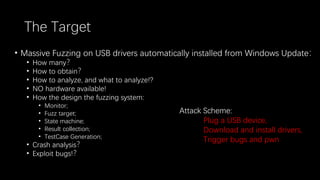
• Massive Fuzzing on USB drivers automatically installed from Windows Update:
• How many?
• How to obtain?
• How to analyze, and what to analyze!?
• NO hardware available!
• How the design the fuzzing system:
• Monitor;
• Fuzz target;
• State machine;
• Result collection;
• TestCase Generation;
• Crash analysis?
• Exploit bugs!?
Attack Scheme:
Plug a USB device,
Download and install drivers,
Trigger bugs and pwn
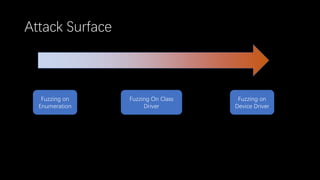
Attack Surface
Fuzzing on
Enumeration
Fuzzing On Class
Driver
Fuzzing on
Device Driver
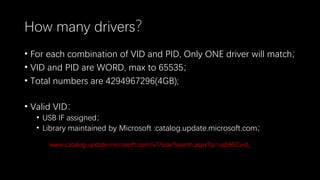
How many drivers?
• For each combination of VID and PID, Only ONE driver will match;
• VID and PID are WORD, max to 65535;
• Total numbers are 4294967296(4GB);
• Valid VID:
• USB IF assigned;
• Library maintained by Microsoft :catalog.update.microsoft.com;
www.catalog.update.microsoft.com/v7/site/Search.aspx?q=usb%5Cvid_
How many drivers?
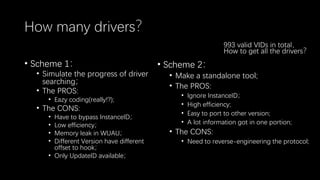
993 valid VIDs in total,
How to get all the drivers?
• Scheme 1:
• Simulate the progress of driver
searching;
• The PROS:
• Eazy coding(really!?);
• The CONS:
• Have to bypass InstanceID;
• Low efficiency;
• Memory leak in WUAU;
• Different Version have different
offset to hook;
• Only UpdateID available;
• Scheme 2:
• Make a standalone tool;
• The PROS:
• Ignore InstanceID;
• High efficiency;
• Easy to port to other version;
• A lot information got in one portion;
• The CONS:
• Need to reverse-engineering the protocol;
How many drivers?
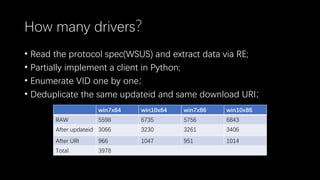
• Read the protocol spec(WSUS) and extract data via RE;
• Partially implement a client in Python;
• Enumerate VID one by one;
• Deduplicate the same updateid and same download URI;
win7x64 win10x64 win7x86 win10x86
RAW 5598 6735 5756 6843
After updateid 3066 3230 3261 3406
After URI 966 1047 951 1014
Total 3978
What to obtain from driver cab?
• Roughly 45K drivers found in catalog website;
• What we need:
• Is sys file exists?
• How many sys files?
• Driver type;
• Device type;
• PIDs Supported;
• Number of INF files;
• Dynamic information while installation;
• Information in binary level;
Obtain information from driver cab
• Auto Cab file analysis System:
• Filter out those with NO sys file;
• Parse INF file;
• Get Supported PIDs;
• Get dynamic behavior of INF file: registry, file copy;
• Driver and device type;
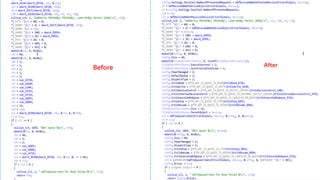
• IDA plugin for binary analysis:
• Determine driver type precisely;
• Identify Callback/ Event handler;
• Sensitive APIs and strings Scanning;
• WDF prototype recovery;
Before After
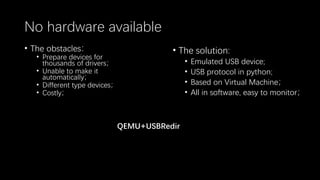
No hardware available
• The obstacles:
• Prepare devices for
thousands of drivers;
• Unable to make it
automatically;
• Different type devices;
• Costly;
• The solution:
• Emulated USB device;
• USB protocol in python;
• Based on Virtual Machine;
• All in software, easy to monitor;
QEMU+USBRedir
Hardware emulation
• USB redir Protocol: redirect physical USB device into virtual machine;
• Has to enable this feature while compiling QEMU;
• The cmd options to use this feature:-device usb-
redir,chardev=usbchardev,debug=0 -chardev
socket,server,id=usbchardev,nowait,path=/tmp/usbr_{CCC}.sock“
• Connect the socket normally, send the protocol packets, then a USB
device shows in VM;
• Keys:
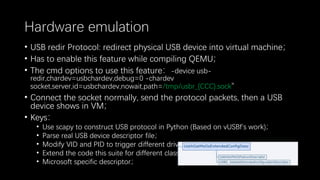
• Use scapy to construct USB protocol in Python (Based on vUSBf’s work);
• Parse real USB device descriptor file;
• Modify VID and PID to trigger different driver loading;
• Extend the code this suite for different classes;
• Microsoft specific descriptor;
Hardware emulation
• Bulk transfer is included in many device driver;
• Customized struct of data often used in Bulk transfer;
• Data sent by USB device;
• Add some code on responsing Bulk transfer requests;
Execute program inside VM
• Some Fuzz progress need to be done inside VM→
Execute program inside VM;
• QGA(Qemu Guest Agent),much like VMTools, but customizable;
• Run as service on Windows,expose Virtual COM device inside VM;
• Exposed as regular socket outside VM;
• Feature:
• Probe VM status;
• Read/Write File;
• Execute Program;
• Etc.
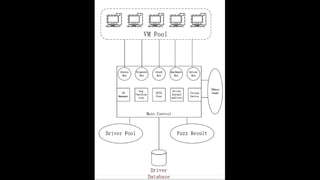
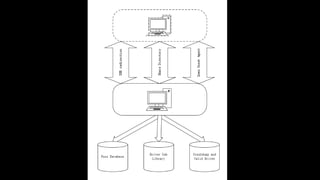
VM Management
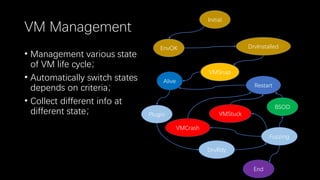
• Management various state
of VM life cycle;
• Automatically switch states
depends on criteria;
• Collect different info at
different state;
Initial
EnvOK DrvInstalled
VMSnap
Alive
Plugin
Fuzzing
End
Restart
VMCrash
BSOD
DrvRdy
VMStuck
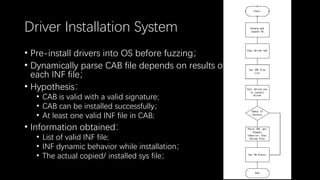
Driver Installation System
• Pre-install drivers into OS before fuzzing;
• Dynamically parse CAB file depends on results of installation for
each INF file;
• Hypothesis:
• CAB is valid with a valid signature;
• CAB can be installed successfully;
• At least one valid INF file in CAB;
• Information obtained:
• List of valid INF file;
• INF dynamic behavior while installation;
• The actual copied/ installed sys file;
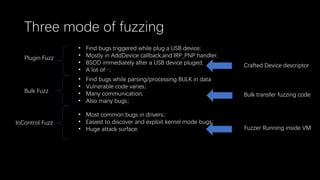
Three mode of fuzzing
Plugin Fuzz
Bulk Fuzz
IoControl Fuzz
• Find bugs triggered while plug a USB device;
• Mostly in AddDevice callback,and IRP_PNP handler;
• BSOD immediately after a USB device pluged;
• A lot of…;
• Find bugs while parsing/processing BULK in data
• Vulnerable code varies;
• Many communication;
• Also many bugs;
• Most common bugs in drivers;
• Easiest to discover and exploit kernel mode bugs;
• Huge attack surface;
Crafted Device descriptor
Bulk transfer fuzzing code
Fuzzer Running inside VM
Design a Fuzzer
• Running inside VM,For fuzzing IoControlCode;
• Dynamically enumerate device interface created by drivers;
• Iterate each IoControlCode by random fuzzing;
• Record random seed and progress before each fuzzing;
• Record any buffer out data for further analysis;
• Support bug verification;
Monitor and Record
• Inside VM:
• Device interfaces;
• Fuzzing Progress;
• Continue to fuzz while BSOD;
• Record the random seed;
• Detect Virtual USB pluged;
• Detect status of driver loading;
• Outside VM:
• VM living;
• BSOD;
• CrashDump and testcase;
• Valid INF and Copied Drivers;
• Fuzz Progress and crash record;
• VM state management;
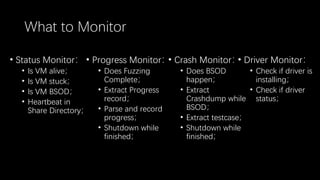
What to Monitor
• Status Monitor:
• Is VM alive;
• Is VM stuck;
• Is VM BSOD;
• Heartbeat in
Share Directory;
• Progress Monitor:
• Does Fuzzing
Complete;
• Extract Progress
record;
• Parse and record
progress;
• Shutdown while
finished;
• Crash Monitor:
• Does BSOD
happen;
• Extract
Crashdump while
BSOD;
• Extract testcase;
• Shutdown while
finished;
• Driver Monitor:
• Check if driver is
installing;
• Check if driver
status;
Bug verification
• Verify bugs from all three fuzzing mode;
• Support Kernel Debugging on Linux;
• One-Click to enable kernel debugging mode;
• Kernel Debugging based on virtual serial com;
• Testcase loading;
• Symbol supported;
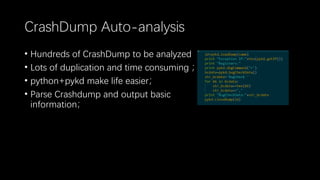
CrashDump Auto-analysis
• Hundreds of CrashDump to be analyzed
• Lots of duplication and time consuming ;
• python+pykd make life easier;
• Parse Crashdump and output basic
information;
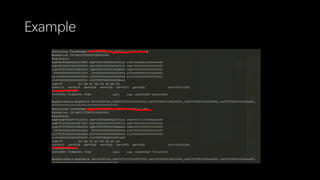
Example
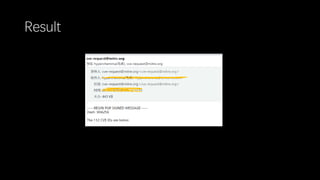
Result
Demo
Summary
• We propose a novel attack surface of Windows;
• We established a fuzzing system to fuzz USB device driver;
• 3rd party driver developer differs in code quality;
• Low quality of device drive may harm to Microsoft ecology;
• Virtual device make driver fuzzing possible, extensible, reliable
and efficient;
Q&A

BlueHat v18 || Massive scale usb device driver fuzz without device

  • 1.
    Massive Scale USBDevice Driver Fuzz WITHOUT device HyperChem @ Tencent’s XuanLab
  • 2.
    Agenda •USB Backgroud; •Windows Driver010; •Previous Research; •My work; •Result;
  • 3.
    USB • Universal SerialBus; • USB 1.0、1.1、2.0、3.0、3.1; • Four type of Transfers:Control、Isochronous、Interrupt and Bulk; • Concept: • Device • Configuration • Interface; • Endpoint; • Endpiont is bacic element for Transfers;
  • 4.
    USB • VID=Vendor ID,PID=ProductID; • Device/InterfaceClass,Define device Class; • Type of Descriptor: • Device Descriptor ; • Configuration Descriptor ; • Interface Descriptor ; • Endpoint Descriptor ;
  • 5.
    USB • Passive Device:receive request and send responds (except OTG); • Many different Classes: HID, WebCam,Printer; • Plug and Play; Enumeration Driver Selection Driver Loading Initialization
  • 6.
    Windows USB • DetectVoltage Change between D+ and D-; • Start Enumeration by USBHUB.sys; • Loading Class driver; • Search Device driver; • Load Device driver; • Call device driver EP; • Done initialization, notify user mode;
  • 7.
    Windows USB • Actionwhile Searching Driver: • Spawn a userland process DrvInst.exe,with arguments InstanceID, VID and PID; • Call chkwudrv.dll!WUFindMatchingDriver to do the search; • Enter into Windows Update service via LPC; • Call wuaueng!CAgentProtocolTalker::SyncServerUpdates; • If found, WUFindMatchingDriver return True; • Key to Driver Searching:VID,PID,InstanceID; • InstanceID is checked locally;
  • 8.
    Previous Research • BadUSB; •vUSBf; • USB MITM fuzz; • USB fuzz via Arduino; How about massive scale fuzzing on closed-source OS?
  • 9.
    The Target • MassiveFuzzing on USB drivers automatically installed from Windows Update: • How many? • How to obtain? • How to analyze, and what to analyze!? • NO hardware available! • How the design the fuzzing system: • Monitor; • Fuzz target; • State machine; • Result collection; • TestCase Generation; • Crash analysis? • Exploit bugs!? Attack Scheme: Plug a USB device, Download and install drivers, Trigger bugs and pwn
  • 10.
    Attack Surface Fuzzing on Enumeration FuzzingOn Class Driver Fuzzing on Device Driver
  • 11.
    How many drivers? •For each combination of VID and PID, Only ONE driver will match; • VID and PID are WORD, max to 65535; • Total numbers are 4294967296(4GB); • Valid VID: • USB IF assigned; • Library maintained by Microsoft :catalog.update.microsoft.com; www.catalog.update.microsoft.com/v7/site/Search.aspx?q=usb%5Cvid_
  • 12.
    How many drivers? 993valid VIDs in total, How to get all the drivers? • Scheme 1: • Simulate the progress of driver searching; • The PROS: • Eazy coding(really!?); • The CONS: • Have to bypass InstanceID; • Low efficiency; • Memory leak in WUAU; • Different Version have different offset to hook; • Only UpdateID available; • Scheme 2: • Make a standalone tool; • The PROS: • Ignore InstanceID; • High efficiency; • Easy to port to other version; • A lot information got in one portion; • The CONS: • Need to reverse-engineering the protocol;
  • 13.
    How many drivers? •Read the protocol spec(WSUS) and extract data via RE; • Partially implement a client in Python; • Enumerate VID one by one; • Deduplicate the same updateid and same download URI; win7x64 win10x64 win7x86 win10x86 RAW 5598 6735 5756 6843 After updateid 3066 3230 3261 3406 After URI 966 1047 951 1014 Total 3978
  • 14.
    What to obtainfrom driver cab? • Roughly 45K drivers found in catalog website; • What we need: • Is sys file exists? • How many sys files? • Driver type; • Device type; • PIDs Supported; • Number of INF files; • Dynamic information while installation; • Information in binary level;
  • 15.
    Obtain information fromdriver cab • Auto Cab file analysis System: • Filter out those with NO sys file; • Parse INF file; • Get Supported PIDs; • Get dynamic behavior of INF file: registry, file copy; • Driver and device type; • IDA plugin for binary analysis: • Determine driver type precisely; • Identify Callback/ Event handler; • Sensitive APIs and strings Scanning; • WDF prototype recovery;
  • 16.
  • 17.
    No hardware available •The obstacles: • Prepare devices for thousands of drivers; • Unable to make it automatically; • Different type devices; • Costly; • The solution: • Emulated USB device; • USB protocol in python; • Based on Virtual Machine; • All in software, easy to monitor; QEMU+USBRedir
  • 19.
    Hardware emulation • USBredir Protocol: redirect physical USB device into virtual machine; • Has to enable this feature while compiling QEMU; • The cmd options to use this feature:-device usb- redir,chardev=usbchardev,debug=0 -chardev socket,server,id=usbchardev,nowait,path=/tmp/usbr_{CCC}.sock“ • Connect the socket normally, send the protocol packets, then a USB device shows in VM; • Keys: • Use scapy to construct USB protocol in Python (Based on vUSBf’s work); • Parse real USB device descriptor file; • Modify VID and PID to trigger different driver loading; • Extend the code this suite for different classes; • Microsoft specific descriptor;
  • 20.
    Hardware emulation • Bulktransfer is included in many device driver; • Customized struct of data often used in Bulk transfer; • Data sent by USB device; • Add some code on responsing Bulk transfer requests;
  • 21.
    Execute program insideVM • Some Fuzz progress need to be done inside VM→ Execute program inside VM; • QGA(Qemu Guest Agent),much like VMTools, but customizable; • Run as service on Windows,expose Virtual COM device inside VM; • Exposed as regular socket outside VM; • Feature: • Probe VM status; • Read/Write File; • Execute Program; • Etc.
  • 22.
    VM Management • Managementvarious state of VM life cycle; • Automatically switch states depends on criteria; • Collect different info at different state; Initial EnvOK DrvInstalled VMSnap Alive Plugin Fuzzing End Restart VMCrash BSOD DrvRdy VMStuck
  • 23.
    Driver Installation System •Pre-install drivers into OS before fuzzing; • Dynamically parse CAB file depends on results of installation for each INF file; • Hypothesis: • CAB is valid with a valid signature; • CAB can be installed successfully; • At least one valid INF file in CAB; • Information obtained: • List of valid INF file; • INF dynamic behavior while installation; • The actual copied/ installed sys file;
  • 24.
    Three mode offuzzing Plugin Fuzz Bulk Fuzz IoControl Fuzz • Find bugs triggered while plug a USB device; • Mostly in AddDevice callback,and IRP_PNP handler; • BSOD immediately after a USB device pluged; • A lot of…; • Find bugs while parsing/processing BULK in data • Vulnerable code varies; • Many communication; • Also many bugs; • Most common bugs in drivers; • Easiest to discover and exploit kernel mode bugs; • Huge attack surface; Crafted Device descriptor Bulk transfer fuzzing code Fuzzer Running inside VM
  • 25.
    Design a Fuzzer •Running inside VM,For fuzzing IoControlCode; • Dynamically enumerate device interface created by drivers; • Iterate each IoControlCode by random fuzzing; • Record random seed and progress before each fuzzing; • Record any buffer out data for further analysis; • Support bug verification;
  • 26.
    Monitor and Record •Inside VM: • Device interfaces; • Fuzzing Progress; • Continue to fuzz while BSOD; • Record the random seed; • Detect Virtual USB pluged; • Detect status of driver loading; • Outside VM: • VM living; • BSOD; • CrashDump and testcase; • Valid INF and Copied Drivers; • Fuzz Progress and crash record; • VM state management;
  • 28.
    What to Monitor •Status Monitor: • Is VM alive; • Is VM stuck; • Is VM BSOD; • Heartbeat in Share Directory; • Progress Monitor: • Does Fuzzing Complete; • Extract Progress record; • Parse and record progress; • Shutdown while finished; • Crash Monitor: • Does BSOD happen; • Extract Crashdump while BSOD; • Extract testcase; • Shutdown while finished; • Driver Monitor: • Check if driver is installing; • Check if driver status;
  • 29.
    Bug verification • Verifybugs from all three fuzzing mode; • Support Kernel Debugging on Linux; • One-Click to enable kernel debugging mode; • Kernel Debugging based on virtual serial com; • Testcase loading; • Symbol supported;
  • 30.
    CrashDump Auto-analysis • Hundredsof CrashDump to be analyzed • Lots of duplication and time consuming ; • python+pykd make life easier; • Parse Crashdump and output basic information;
  • 31.
  • 32.
  • 33.
  • 34.
    Summary • We proposea novel attack surface of Windows; • We established a fuzzing system to fuzz USB device driver; • 3rd party driver developer differs in code quality; • Low quality of device drive may harm to Microsoft ecology; • Virtual device make driver fuzzing possible, extensible, reliable and efficient;
  • 35.