Demystifying the 

Secure Enclave Processor
Tarjei Mandt (@kernelpool)
Mathew Solnik (@msolnik)
David Wang (@planetbeing)
About Us
• Tarjei Mandt
▫ Senior Security Researcher, Azimuth Security
▫ tm@azimuthsecurity.com
• Mathew Solnik
▫ Director, OffCell Research
▫ ms@offcellresearch.com
• David Wang
▫ Senior Security Researcher, Azimuth Security
▫ dw@azimuthsecurity.com
Introduction
• iPhone 5S was a technological milestone
▫ First 64-bit phone
• Introduced several technological advancements
▫ Touch ID
▫ M7 motion coprocessor
▫ Security coprocessor (SEP)
• Enabled sensitive data to be stored securely
▫ Fingerprint data, cryptographic keys, etc.
Secure Enclave Processor
• Security circuit designed to perform secure
services for the rest of the SOC
▫ Prevents main processor from gaining direct access
to sensitive data
• Used to support a number of different services
▫ Most notably Touch ID
• Runs its own operating system (SEPOS)
▫ Includes its own kernel, drivers, services, and
applications
Secure (?) Enclave Processor
• Very little public information exists on the SEP
▫ Only information provided by Apple
• SEP patent only provides a high level overview
▫ Doesn’t describe actual implementation details
• Several open questions remain
▫ What services are exposed by the SEP?
▫ How are these services accessed?
▫ What privileges are needed?
▫ How resilient is SEP against attacks?
Talk Outline
• Part 1: Secure Enclave Processor
▫ Hardware Design
▫ Boot Process
• Part 2: Communication
▫ Mailbox Mechanism
▫ Kernel-to-SEP Interfaces
• Part 3: SEPOS
▫ Architecture / Internals
• Part 4: Security Analysis
▫ Attack Surface and Robustness
Hardware Design
Demystifying the Secure Enclave Processor
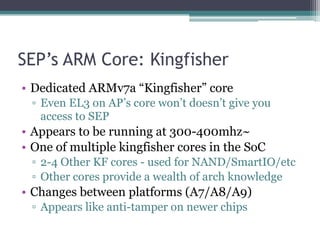
SEP’s ARM Core: Kingfisher
• Dedicated ARMv7a “Kingfisher” core
▫ Even EL3 on AP’s core won’t doesn’t give you
access to SEP
• Appears to be running at 300-400mhz~
• One of multiple kingfisher cores in the SoC
▫ 2-4 Other KF cores - used for NAND/SmartIO/etc
▫ Other cores provide a wealth of arch knowledge
• Changes between platforms (A7/A8/A9)
▫ Appears like anti-tamper on newer chips
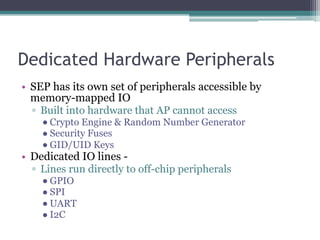
Dedicated Hardware Peripherals
• SEP has its own set of peripherals accessible by
memory-mapped IO
▫ Built into hardware that AP cannot access
● Crypto Engine & Random Number Generator
● Security Fuses
● GID/UID Keys
• Dedicated IO lines -
▫ Lines run directly to off-chip peripherals
● GPIO
● SPI
● UART
● I2C
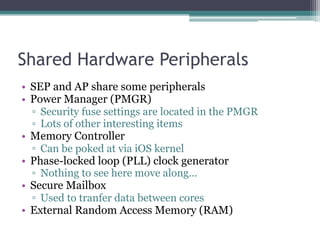
Shared Hardware Peripherals
• SEP and AP share some peripherals
• Power Manager (PMGR)
▫ Security fuse settings are located in the PMGR
▫ Lots of other interesting items
• Memory Controller
▫ Can be poked at via iOS kernel
• Phase-locked loop (PLL) clock generator
▫ Nothing to see here move along…
• Secure Mailbox
▫ Used to tranfer data between cores
• External Random Access Memory (RAM)
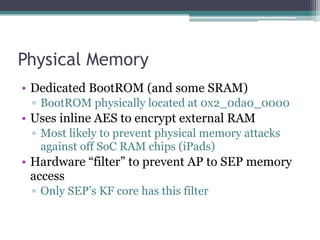
Physical Memory
• Dedicated BootROM (and some SRAM)
▫ BootROM physically located at 0x2_0da0_0000
• Uses inline AES to encrypt external RAM
▫ Most likely to prevent physical memory attacks
against off SoC RAM chips (iPads)
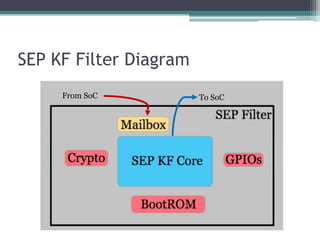
• Hardware “filter” to prevent AP to SEP memory
access
▫ Only SEP’s KF core has this filter
SEP KF Filter Diagram
From SoC To SoC
Boot Process
Demystifying the Secure Enclave Processor
SEP Initialization – First Stage
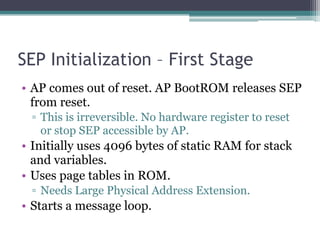
• AP comes out of reset. AP BootROM releases SEP
from reset.
▫ This is irreversible. No hardware register to reset
or stop SEP accessible by AP.
• Initially uses 4096 bytes of static RAM for stack
and variables.
• Uses page tables in ROM.
▫ Needs Large Physical Address Extension.
• Starts a message loop.
SEP Initialization – Second Stage
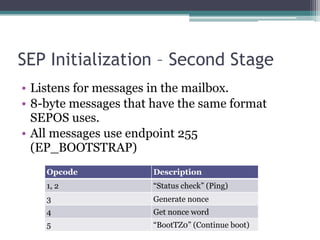
• Listens for messages in the mailbox.
• 8-byte messages that have the same format
SEPOS uses.
• All messages use endpoint 255
(EP_BOOTSTRAP)
Opcode Description
1, 2 “Status check” (Ping)
3 Generate nonce
4 Get nonce word
5 “BootTZ0” (Continue boot)
Memory Protections
• SEP needs more RAM than 4096 bytes of SRAM,
so it needs external RAM.
• RAM used by SEP must be protected against AP
tampering.
• Two regions configurable by AP are setup:
▫ TZ0 is for the SEP.
▫ TZ1 is for the AP’s TrustZone (Kernel Patch
Protection).
• SEP must wait for AP to setup TZ0 to continue
boot.
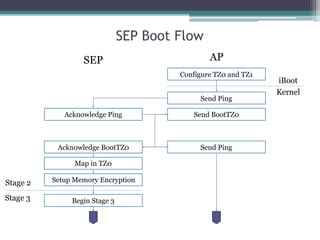
SEP Boot Flow
Configure TZ0 and TZ1
Send Ping
Send BootTZ0
Send Ping
AP
Acknowledge Ping
SEP
Map in TZ0
Setup Memory Encryption
Acknowledge BootTZ0
Begin Stage 3
iBoot
Kernel
Stage 3
Stage 2
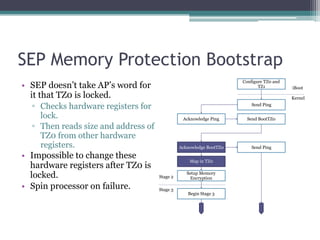
SEP Memory Protection Bootstrap
• SEP doesn’t take AP’s word for
it that TZ0 is locked.
▫ Checks hardware registers for
lock.
▫ Then reads size and address of
TZ0 from other hardware
registers.
• Impossible to change these
hardware registers after TZ0 is
locked.
• Spin processor on failure.
Configure TZ0 and
TZ1
Send Ping
Send BootTZ0
Send Ping
Acknowledge Ping
Map in TZ0
Setup Memory
Encryption
Acknowledge BootTZ0
Begin Stage 3
iBoot
Kernel
Stage 3
Stage 2
Memory Encryption Modes
• Appears to support ECB, CBC, and XEX.
• Capable of AES-128 or AES-256.
• Supports two channels.
▫ BootROM uses channel 1.
▫ SEPOS uses channel 0.
• All access to certain ranges of physical addresses
get encrypted/decrypted transparently.
▫ After boot, SEPOS has all page mappings into the
encrypted range (except for hardware regs and
memory shared with AP).
Key Generation
• Keys are generated by “tangling”:
▫ True Random Number Generator output
▫ Static ”type” value.
• With protected (unreadable) registers:
▫ UID, GID, Seed A, Seed B.
●Seed B tangled with UID == GenID_2B
• Encrypt the following using GenID_2B to
generate key:
▫ [4 byte magic = 0xFF XK1][4 bytes of 0s][192-bits
of randomness]
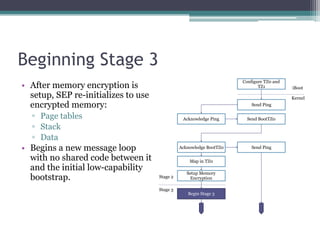
Beginning Stage 3
• After memory encryption is
setup, SEP re-initializes to use
encrypted memory:
▫ Page tables
▫ Stack
▫ Data
• Begins a new message loop
with no shared code between it
and the initial low-capability
bootstrap.
Configure TZ0 and
TZ1
Send Ping
Send BootTZ0
Send Ping
Acknowledge Ping
Map in TZ0
Setup Memory
Encryption
Acknowledge BootTZ0
Begin Stage 3
iBoot
Kernel
Stage 3
Stage 2
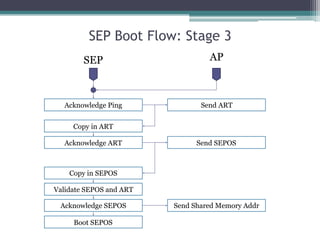
SEP Boot Flow: Stage 3
Send ART
AP
Acknowledge Ping
SEP
Acknowledge ART
Copy in ART
Send Shared Memory Addr
Send SEPOS
Copy in SEPOS
Validate SEPOS and ART
Acknowledge SEPOS
Boot SEPOS
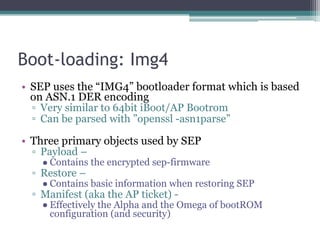
Boot-loading: Img4
• SEP uses the “IMG4” bootloader format which is based
on ASN.1 DER encoding
▫ Very similar to 64bit iBoot/AP Bootrom
▫ Can be parsed with ”openssl -asn1parse”
• Three primary objects used by SEP
▫ Payload –
● Contains the encrypted sep-firmware
▫ Restore –
● Contains basic information when restoring SEP
▫ Manifest (aka the AP ticket) -
● Effectively the Alpha and the Omega of bootROM
configuration (and security)
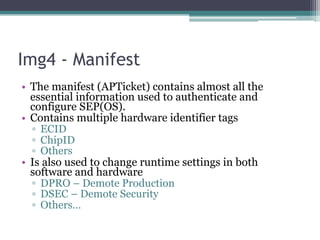
Img4 - Manifest
• The manifest (APTicket) contains almost all the
essential information used to authenticate and
configure SEP(OS).
• Contains multiple hardware identifier tags
▫ ECID
▫ ChipID
▫ Others
• Is also used to change runtime settings in both
software and hardware
▫ DPRO – Demote Production
▫ DSEC – Demote Security
▫ Others…
Reversing SEP’s Img4 Parser: Stage 1
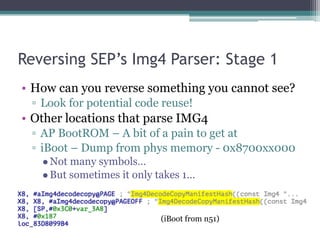
• How can you reverse something you cannot see?
▫ Look for potential code reuse!
• Other locations that parse IMG4
▫ AP BootROM – A bit of a pain to get at
▫ iBoot – Dump from phys memory - 0x8700xx000
●Not many symbols…
●But sometimes it only takes 1…
(iBoot from n51)
Reversing SEP’s Img4 Parser: Stage 2
• Another file also contains the “Img4Decode” symbol
▫ /usr/libexec/seputil
• Userland IMG4 parser with many more symbols
▫ May not be exact – but bindiff shows it is very close
• From symbols found in seputil we can deduce:
▫ The ASN’1 decoder is based on libDER
● Which Apple so kindly releases as OpenSource.
▫ The RSA portion is handled by CoreCrypto
• LibDER + CoreCrypto = SEP’s IMG4 Parsing engine
▫ We now have a great base to work with
Img4 Parsing Flow
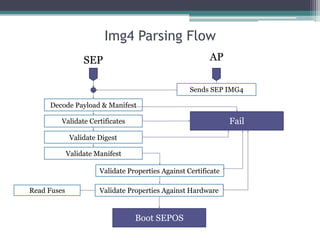
• SEP BootROM copies in the sep-firmware.img4
from AP
• Initializes the DER Decoder
▫ Decodes Payload, Manifest, and Restore Info
• Verifies digests and signing certificates
▫ Root of trust cert is hardcoded at the end of
BootROM
• Verifies all properties in manifest
▫ Checks against current hardware fusing
• If all items pass – load and execute the payload
Img4 Parsing Flow
AP
Decode Payload & Manifest
SEP
Validate Digest
Validate Certificates Fail
Validate Manifest
Validate Properties Against Certificate
Validate Properties Against Hardware
Boot SEPOS
Read Fuses
SEP
Sends SEP IMG4
Communication
Demystifying the Secure Enclave Processor
Secure Mailbox
• The secure mailbox allows the AP to
communicate with the SEP
▫ Features both an inbox (request) and outbox
(reply)
• Implemented using the SEP device I/O registers
▫ Also known as the SEP configuration space
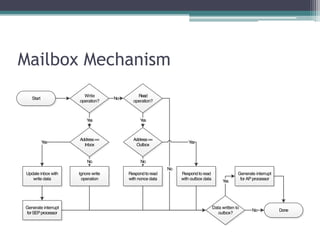
Interrupt-based Message Passing
• When sending a message, the AP writes to the
inbox of the mailbox
• This operation triggers an interrupt in the SEP
▫ Informs the SEP that a message has been received
• When a reply is ready, the SEP writes a message
back to the outbox
▫ Another interrupt is generated in order to let the
AP know a message was received
Mailbox Mechanism
Start
Write
operation?
Read
operation?
No
Yes
Address==
Inbox
Data written to
outbox?
Update inbox with
write data
Generate interrupt
forSEPprocessor
Yes
Ignore write
operation
No
Address==
Outbox
Yes
Respond to read
with nonce data
No
Respond to read
with outbox data
Yes
No
Yes
Done
Generate interrupt
for AP processor
No
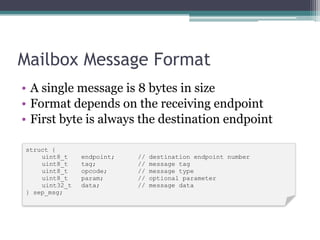
Mailbox Message Format
• A single message is 8 bytes in size
• Format depends on the receiving endpoint
• First byte is always the destination endpoint
struct {
uint8_t endpoint; // destination endpoint number
uint8_t tag; // message tag
uint8_t opcode; // message type
uint8_t param; // optional parameter
uint32_t data; // message data
} sep_msg;
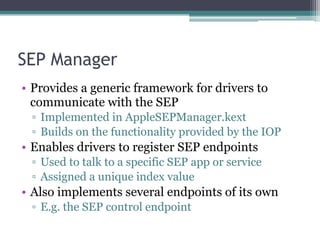
SEP Manager
• Provides a generic framework for drivers to
communicate with the SEP
▫ Implemented in AppleSEPManager.kext
▫ Builds on the functionality provided by the IOP
• Enables drivers to register SEP endpoints
▫ Used to talk to a specific SEP app or service
▫ Assigned a unique index value
• Also implements several endpoints of its own
▫ E.g. the SEP control endpoint
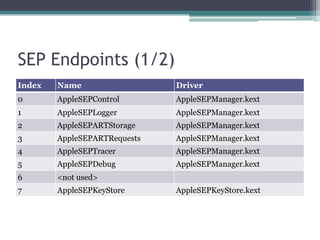
SEP Endpoints (1/2)
Index Name Driver
0 AppleSEPControl AppleSEPManager.kext
1 AppleSEPLogger AppleSEPManager.kext
2 AppleSEPARTStorage AppleSEPManager.kext
3 AppleSEPARTRequests AppleSEPManager.kext
4 AppleSEPTracer AppleSEPManager.kext
5 AppleSEPDebug AppleSEPManager.kext
6 <not used>
7 AppleSEPKeyStore AppleSEPKeyStore.kext
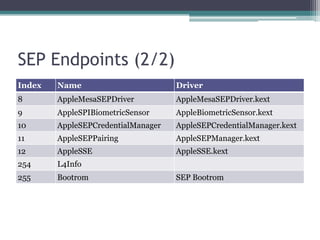
SEP Endpoints (2/2)
Index Name Driver
8 AppleMesaSEPDriver AppleMesaSEPDriver.kext
9 AppleSPIBiometricSensor AppleBiometricSensor.kext
10 AppleSEPCredentialManager AppleSEPCredentialManager.kext
11 AppleSEPPairing AppleSEPManager.kext
12 AppleSSE AppleSSE.kext
254 L4Info
255 Bootrom SEP Bootrom
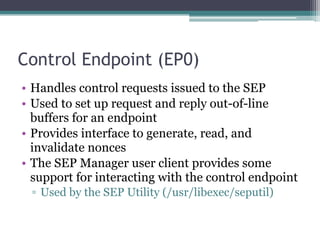
Control Endpoint (EP0)
• Handles control requests issued to the SEP
• Used to set up request and reply out-of-line
buffers for an endpoint
• Provides interface to generate, read, and
invalidate nonces
• The SEP Manager user client provides some
support for interacting with the control endpoint
▫ Used by the SEP Utility (/usr/libexec/seputil)
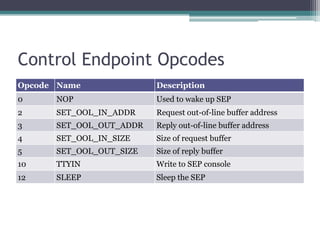
Control Endpoint Opcodes
Opcode Name Description
0 NOP Used to wake up SEP
2 SET_OOL_IN_ADDR Request out-of-line buffer address
3 SET_OOL_OUT_ADDR Reply out-of-line buffer address
4 SET_OOL_IN_SIZE Size of request buffer
5 SET_OOL_OUT_SIZE Size of reply buffer
10 TTYIN Write to SEP console
12 SLEEP Sleep the SEP
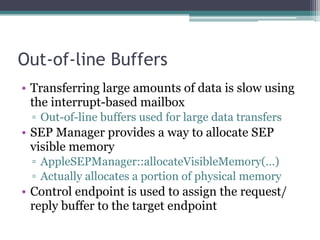
Out-of-line Buffers
• Transferring large amounts of data is slow using
the interrupt-based mailbox
▫ Out-of-line buffers used for large data transfers
• SEP Manager provides a way to allocate SEP
visible memory
▫ AppleSEPManager::allocateVisibleMemory(…)
▫ Actually allocates a portion of physical memory
• Control endpoint is used to assign the request/
reply buffer to the target endpoint
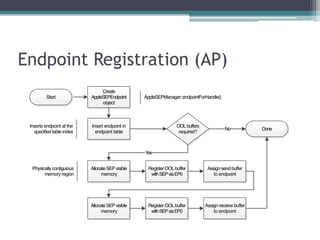
Endpoint Registration (AP)
AllocateSEPvisible
memory
Create
AppleSEPEndpoint
object
Insert endpoint in
endpoint table
OOLbuffers
required?
Yes
Assign send buffer
to endpoint
AllocateSEPvisible
memory
RegisterOOLbuffer
withSEPviaEP0
RegisterOOLbuffer
withSEPviaEP0
Assign receive buffer
to endpoint
DoneNo
Start
Physically contiguious
memory region
AppleSEPManager::endpointForHandle()
Inserts endpoint at the
specified table index
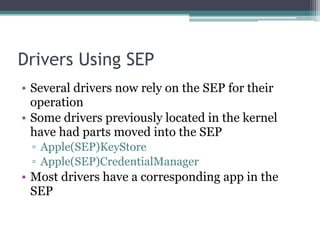
Drivers Using SEP
• Several drivers now rely on the SEP for their
operation
• Some drivers previously located in the kernel
have had parts moved into the SEP
▫ Apple(SEP)KeyStore
▫ Apple(SEP)CredentialManager
• Most drivers have a corresponding app in the
SEP
SEPOS
Demystifying the Secure Enclave Processor
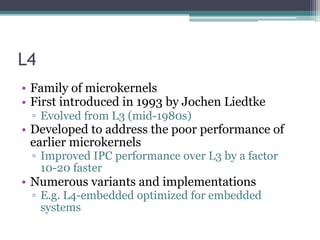
L4
• Family of microkernels
• First introduced in 1993 by Jochen Liedtke
▫ Evolved from L3 (mid-1980s)
• Developed to address the poor performance of
earlier microkernels
▫ Improved IPC performance over L3 by a factor
10-20 faster
• Numerous variants and implementations
▫ E.g. L4-embedded optimized for embedded
systems
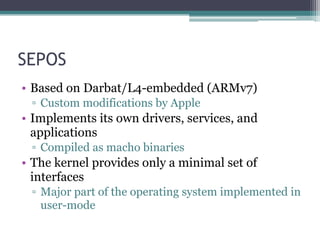
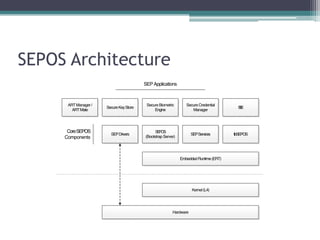
SEPOS
• Based on Darbat/L4-embedded (ARMv7)
▫ Custom modifications by Apple
• Implements its own drivers, services, and
applications
▫ Compiled as macho binaries
• The kernel provides only a minimal set of
interfaces
▫ Major part of the operating system implemented in
user-mode
SEPOS Architecture
SEPDrivers SEPServices
SEPOS
(Bootstrap Server)
SecureKeyStore
SecureCredential
Manager
Secure Biometric
Engine
Hardware
SSE
ARTManager/
ARTMate
EmbeddedRuntime(ERT)
libSEPOS
Kernel(L4)
CoreSEPOS
Components
SEP Applications
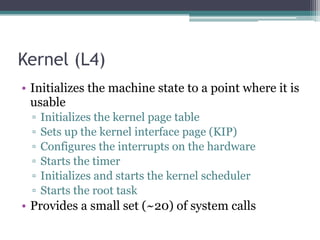
Kernel (L4)
• Initializes the machine state to a point where it is
usable
▫ Initializes the kernel page table
▫ Sets up the kernel interface page (KIP)
▫ Configures the interrupts on the hardware
▫ Starts the timer
▫ Initializes and starts the kernel scheduler
▫ Starts the root task
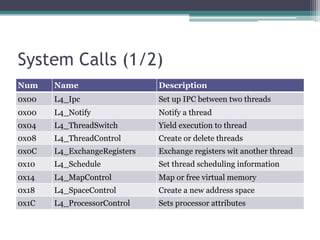
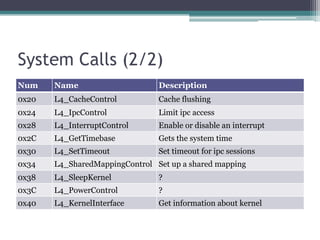
• Provides a small set (~20) of system calls
System Calls (1/2)
Num Name Description
0x00 L4_Ipc Set up IPC between two threads
0x00 L4_Notify Notify a thread
0x04 L4_ThreadSwitch Yield execution to thread
0x08 L4_ThreadControl Create or delete threads
0x0C L4_ExchangeRegisters Exchange registers wit another thread
0x10 L4_Schedule Set thread scheduling information
0x14 L4_MapControl Map or free virtual memory
0x18 L4_SpaceControl Create a new address space
0x1C L4_ProcessorControl Sets processor attributes
System Calls (2/2)
Num Name Description
0x20 L4_CacheControl Cache flushing
0x24 L4_IpcControl Limit ipc access
0x28 L4_InterruptControl Enable or disable an interrupt
0x2C L4_GetTimebase Gets the system time
0x30 L4_SetTimeout Set timeout for ipc sessions
0x34 L4_SharedMappingControl Set up a shared mapping
0x38 L4_SleepKernel ?
0x3C L4_PowerControl ?
0x40 L4_KernelInterface Get information about kernel
Privileged System Calls
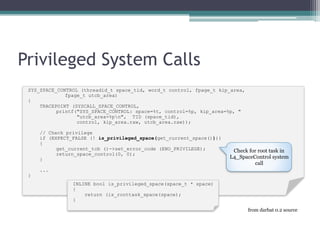
• Some system calls are considered privileged
▫ E.g. memory and thread management calls
• Only root task (SEPOS) may invoke privileged
system calls
▫ Determined by the space address of the caller
• Check performed by each individual system call
where needed
▫ is_privileged_space()
Privileged System Calls
SYS_SPACE_CONTROL (threadid_t space_tid, word_t control, fpage_t kip_area,
fpage_t utcb_area)
{
TRACEPOINT (SYSCALL_SPACE_CONTROL,
printf("SYS_SPACE_CONTROL: space=%t, control=%p, kip_area=%p, "
"utcb_area=%pn", TID (space_tid),
control, kip_area.raw, utcb_area.raw));
// Check privilege
if (EXPECT_FALSE (! is_privileged_space(get_current_space())))
{
get_current_tcb ()->set_error_code (ENO_PRIVILEGE);
return_space_control(0, 0);
}
...
}
INLINE bool is_privileged_space(space_t * space)
{
return (is_roottask_space(space);
}
Check for root task in
L4_SpaceControl system
call
from darbat 0.2 source
SEPOS (INIT)
• Initial process on boot (root task)
▫ Can call any privileged L4 system call
• Initializes and starts all remaining tasks
▫ Processes an application list embedded by the sep-
firmware
• Maintains a context structure for each task
▫ Includes information about the virtual address
space, privilege level, threads, etc.
• Invokes the bootstrap server
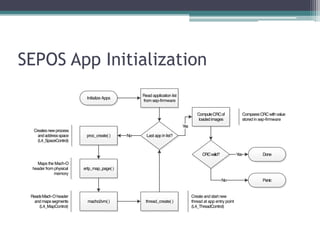
SEPOS App Initialization
Initialize Apps
proc_create( ) No Last app in list?
Done
Yes
macho2vm() thread_create( )
ertp_map_page( )
Read application list
from sep-firmware
ComputeCRCof
loadedimages
CRCvalid?
Panic
Yes
No
Create and start new
thread at app entry point
(L4_ThreadControl)
ReadsMach-Oheader
andmapssegments
(L4_MapControl)
Createsnewprocess
andaddressspace
(L4_SpaceControl)
Maps the Mach-O
header from physical
memory
ComparesCRCwithvalue
stored in sep-firmware
Application List
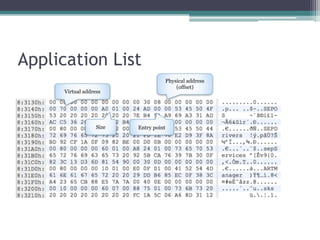
• Includes information about all applications
embedded by the SEP firmware
▫ Physical address (offset)
▫ Virtual base address
▫ Module name and size
▫ Entry point
• Found 0xEC8 bytes prior to the SEPOS binary in
the sep-firmware image
Application List
Size Entry point
Virtual address
Physical address
(offset)
Bootstrap Server
• Implements the core functionality of SEPOS
▫ Exports methods for system, thread and object
(memory) management
• Made available to SEP applications over RPC via
the embedded runtime
▫ ert_rpc_bootstrap_server()
• Enable applications to perform otherwise
privileged operations
▫ E.g. create a new thread
Privileged Methods
• An application must be privileged to invoke
certain bootstrap server methods
▫ Query object/process/acl/mapping information
• Privilege level is determined at process creation
▫ Process name >= ‘A ‘ and <= ‘ZZZZ’
▫ E.g. “SEPD” (SEPDrivers)
• Check is done by each individual method
▫ proc_has_privilege( int pid );
sepos_object_acl_info( )
int sepos_object_acl_info(int *args)
{
int result;
int prot;
int pid;
args[18] = 1;
*((_BYTE *)args + 104) = 1;
result = proc_has_privilege( args[1] );
if ( result == 1 )
{
result = acl_get( args[5], args[6], &pid, &prot);
if ( !result )
{
args[18] = 0;
args[19] = prot;
args[20] = pid;
result = 1;
*((_BYTE *)args + 104) = 1;
}
}
return result;
}
Call to check if sender’s
pid is privileged
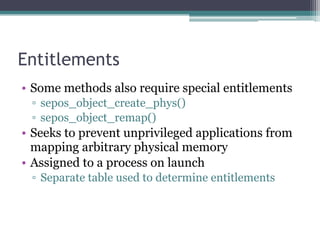
Entitlements
• Some methods also require special entitlements
▫ sepos_object_create_phys()
▫ sepos_object_remap()
• Seeks to prevent unprivileged applications from
mapping arbitrary physical memory
• Assigned to a process on launch
▫ Separate table used to determine entitlements
Entitlement Assignment
int proc_create( int name )
{
int privileged = 0;
...
if ( ( name >= 'A ' ) && ( name <= 'ZZZZ' ) )
privileged = 1;
proctab[ pid ].privileged = privileged;
proctab[ pid ].entitlements = 0;
while ( privileged_tasks[ 2 * i ] != name )
if ( ++i == 3 )
return pid;
proctab[ pid ].entitlements = privileged_tasks[ 2 * i + 1 ];
return pid;
}
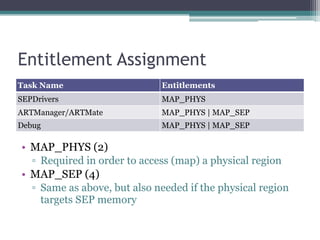
Entitlement Assignment
Task Name Entitlements
SEPDrivers MAP_PHYS
ARTManager/ARTMate MAP_PHYS | MAP_SEP
Debug MAP_PHYS | MAP_SEP
• MAP_PHYS (2)
▫ Required in order to access (map) a physical region
• MAP_SEP (4)
▫ Same as above, but also needed if the physical region
targets SEP memory
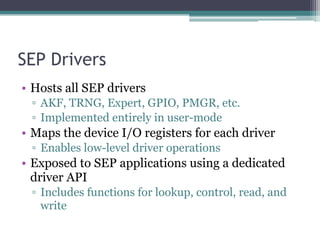
SEP Drivers
• Hosts all SEP drivers
▫ AKF, TRNG, Expert, GPIO, PMGR, etc.
▫ Implemented entirely in user-mode
• Maps the device I/O registers for each driver
▫ Enables low-level driver operations
• Exposed to SEP applications using a dedicated
driver API
▫ Includes functions for lookup, control, read, and
write
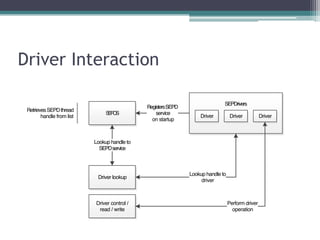
Driver Interaction
SEPOS
SEPDrivers
Lookup handle to
SEPDservice
Driver
Driver lookup
Lookup handle to
driver
Driver control /
read / write
Perform driver
operation
DriverDriver
RegistersSEPD
service
on startup
RetrievesSEPDthread
handle from list
AKF Driver
• Manages AP/SEP endpoints in SEPOS
• Handles control (EP0) requests
▫ E.g. sets up objects for reply and response OOL
buffers
• SEP applications may register new endpoints to
handle specific AP requests
▫ AKF_ENDPOINT_REGISTER (0x412C) control
request
SEP Services
• Hosts various SEP related services
▫ Secure Key Generation Service
▫ Test Service
▫ Anti Replay Service
▫ Entitlement Service
• Usually implemented on top of drivers
• Service API provided to SEP applications
▫ service_lookup(…)
▫ service_call(…)
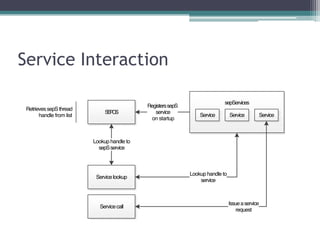
Service Interaction
SEPOS
sepServices
Lookup handle to
sepSservice
Service
Servicelookup
Lookup handle to
service
Servicecall
Issueaservice
request
ServiceService
RegisterssepS
service
on startup
RetrievessepSthread
handle from list
SEP Applications
• Primarily designed to support various drivers
running in the AP
▫ AppleSEPKeyStore ! sks
▫ AppleSEPCredentialManager ! scrd
• Some apps are only found on certain devices
▫ E.g. SSE is only present on iPhone 6 and later
• May also be exclusive to development builds
▫ E.g. Debug application
Attacking SEP
Demystifying the Secure Enclave Processor
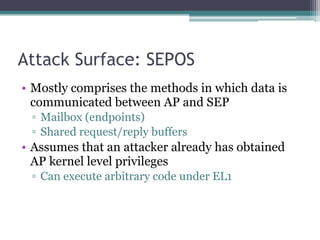
Attack Surface: SEPOS
• Mostly comprises the methods in which data is
communicated between AP and SEP
▫ Mailbox (endpoints)
▫ Shared request/reply buffers
• Assumes that an attacker already has obtained
AP kernel level privileges
▫ Can execute arbitrary code under EL1
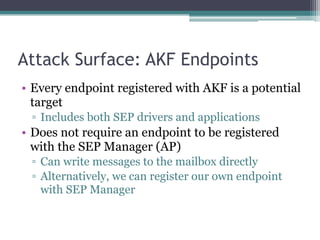
Attack Surface: AKF Endpoints
• Every endpoint registered with AKF is a potential
target
▫ Includes both SEP drivers and applications
• Does not require an endpoint to be registered
with the SEP Manager (AP)
▫ Can write messages to the mailbox directly
▫ Alternatively, we can register our own endpoint
with SEP Manager
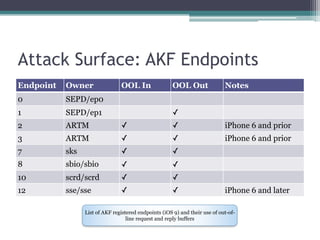
Attack Surface: AKF Endpoints
Endpoint Owner OOL In OOL Out Notes
0 SEPD/ep0
1 SEPD/ep1 ✓
2 ARTM ✓ ✓ iPhone 6 and prior
3 ARTM ✓ ✓ iPhone 6 and prior
7 sks ✓ ✓
8 sbio/sbio ✓ ✓
10 scrd/scrd ✓ ✓
12 sse/sse ✓ ✓ iPhone 6 and later
List of AKF registered endpoints (iOS 9) and their use of out-of-
line request and reply buffers
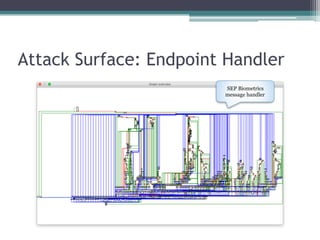
Attack Surface: Endpoint Handler
SEP Biometrics
message handler
Attack Robustness
• How much effort is required to exploit a SEP
vulnerability?
▫ E.g. stack/heap corruption
• Determined by several factors
▫ Address space layout
▫ Allocator (heap) hardening
▫ Exploit mitigations
▫ And more
Address Space Layout
• SEP applications are loaded at their preferred
base address
▫ No image base randomization
▫ Typically based at 0x1000 or 0x8000 (depending
on presence of pagezero segment)
• Segments without a valid memory protection
mask (!= 0) are ignored
▫ E.g. __PAGEZERO is never “mapped”
Stack
TEXT
MainThread
Thread2
Stack
DATA
Mapping
Thread3
Stack
VirtualMemory
Systemstack
(0x1000bytes)
Application
Image
Stack Corruptions
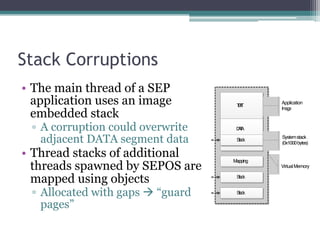
• The main thread of a SEP
application uses an image
embedded stack
▫ A corruption could overwrite
adjacent DATA segment data
• Thread stacks of additional
threads spawned by SEPOS are
mapped using objects
▫ Allocated with gaps ! “guard
pages”
Stack Corruptions
• SEP applications are compiled with stack cookie
protection
▫ Cookie value is fixed to ‘GARD’
▫ Trivial to forge/bypass
• Stack addresses are in most cases known
▫ Main thread stack is at a known address
▫ Addresses of subsequent thread stacks are
predictable
Heap Corruptions: malloc()
• Runtime allocator leveraged by SEP applications
▫ K&R implementation
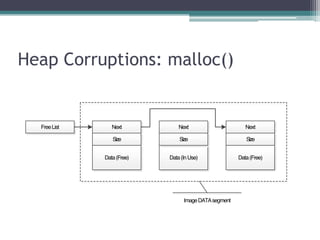
• Singly linked free list (ordered by size) with
header that includes pointer and block size
▫ struct Header { void * ptr, size_t size };
▫ Coalesces adjacent elements on free()
• Size of heap determined on initialization
▫ malloc_init( malloc_base, malloc_top );
▫ Non-expandable
Heap Corruptions: malloc()
Next
Size
Data(Free) Data(InUse)
Next
Size
Data(Free)
FreeList Next
Size
ImageDATAsegment
Heap Corruptions: malloc()
• No protection of heap metadata
▫ Free list pointers can be overwritten
▫ Block size can be corrupted
• Allocation addresses are predictable
▫ Malloc area embedded by __DATA segment in
application image
▫ Allocations made in sequential order
No-Execute Protection
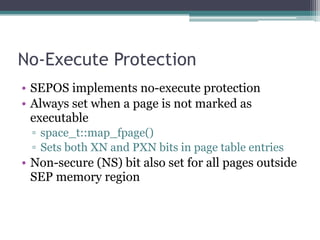
• SEPOS implements no-execute protection
• Always set when a page is not marked as
executable
▫ space_t::map_fpage()
▫ Sets both XN and PXN bits in page table entries
• Non-secure (NS) bit also set for all pages outside
SEP memory region
SEPOS Mitigations Summary
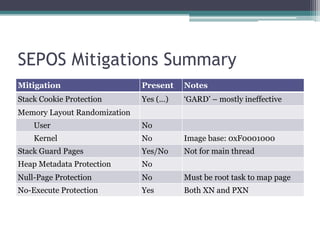
Mitigation Present Notes
Stack Cookie Protection Yes (…) ‘GARD’ – mostly ineffective
Memory Layout Randomization
User No
Kernel No Image base: 0xF0001000
Stack Guard Pages Yes/No Not for main thread
Heap Metadata Protection No
Null-Page Protection No Must be root task to map page
No-Execute Protection Yes Both XN and PXN
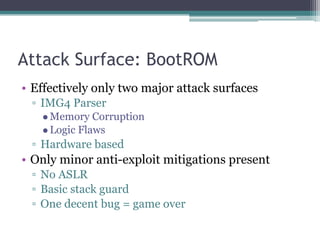
Attack Surface: BootROM
• Effectively only two major attack surfaces
▫ IMG4 Parser
●Memory Corruption
●Logic Flaws
▫ Hardware based
• Only minor anti-exploit mitigations present
▫ No ASLR
▫ Basic stack guard
▫ One decent bug = game over
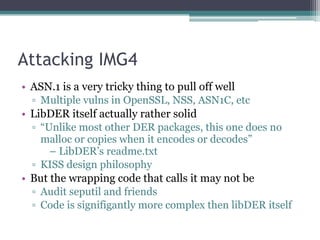
Attacking IMG4
• ASN.1 is a very tricky thing to pull off well
▫ Multiple vulns in OpenSSL, NSS, ASN1C, etc
• LibDER itself actually rather solid
▫ “Unlike most other DER packages, this one does no
malloc or copies when it encodes or decodes”

– LibDER’s readme.txt
▫ KISS design philosophy
• But the wrapping code that calls it may not be
▫ Audit seputil and friends
▫ Code is signifigantly more complex then libDER itself
Attack Surface: Hardware
• Memory corruption attacks again data receivers
on peripheral lines
▫ SPI
▫ I2C
▫ UART
• Side Channel/Differential Power Analysis
▫ Stick to the A7 (newer ones are more resistant)
• Glitching
▫ Standard Clock/Voltage Methods
▫ Others
External RAM
• Encrypted memory has no validation.
▫ Can corrupt bits of SEP memory
• When generating the encryption key the “random
component” is temporarily stored unencrypted in
external RAM.
▫ This may allow an attacker to influence generation
of the final memory encryption key
Attacking the Fuse Array
• Potentially one of the most invasive attack
vectors
▫ Requires a lot of patience
▫ High likelihood of bricking
• Laser could be used
▫ Expensive method - not for us
• Primary targets
▫ Production Mode
▫ Security Mode
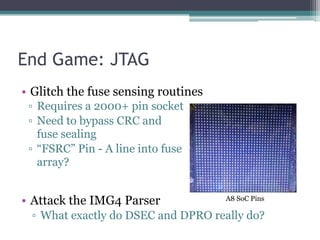
End Game: JTAG
▫ Requires a 2000+ pin socket
▫ Need to bypass CRC and
fuse sealing
▫ “FSRC” Pin - A line into fuse
array?
• Glitch the fuse sensing routines
• Attack the IMG4 Parser
▫ What exactly do DSEC and DPRO really do?
A8 SoC Pins
Conclusion
Demystifying the Secure Enclave Processor
Conclusion
• SEP(OS) was designed with security in mind
▫ Mailbox interface
▫ Privilege separation
• However, SEP(OS) lacks basic exploit protections
▫ E.g. no memory layout randomization
• Some SEP applications expose a significant
attack surface
▫ E.g. SEP biometrics application
Conclusion (Continued)
• Overall hardware design is light years ahead of
competitors
▫ Hardware Filter
▫ Inline Encrypted RAM
▫ Generally small attack surface
• But it does have its weaknesses
▫ Shared PMGR and PLL are open to attacks
▫ Inclusion of the fuse source pin should be re-evaluated
▫ The demotion functionality appears rather dangerous
● Why does JTAG over lightning even exist?
Thanks!
• Ryan Mallon
• Daniel Borca
• Anonymous reviewers
Bonus Slides
Demystifying the Secure Enclave Processor
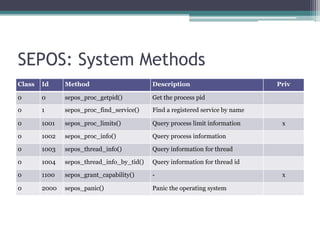
SEPOS: System Methods
Class Id Method Description Priv
0 0 sepos_proc_getpid() Get the process pid
0 1 sepos_proc_find_service() Find a registered service by name
0 1001 sepos_proc_limits() Query process limit information x
0 1002 sepos_proc_info() Query process information
0 1003 sepos_thread_info() Query information for thread
0 1004 sepos_thread_info_by_tid() Query information for thread id
0 1100 sepos_grant_capability() - x
0 2000 sepos_panic() Panic the operating system
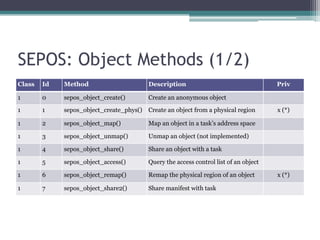
SEPOS: Object Methods (1/2)
Class Id Method Description Priv
1 0 sepos_object_create() Create an anonymous object
1 1 sepos_object_create_phys() Create an object from a physical region x (*)
1 2 sepos_object_map() Map an object in a task’s address space
1 3 sepos_object_unmap() Unmap an object (not implemented)
1 4 sepos_object_share() Share an object with a task
1 5 sepos_object_access() Query the access control list of an object
1 6 sepos_object_remap() Remap the physical region of an object x (*)
1 7 sepos_object_share2() Share manifest with task
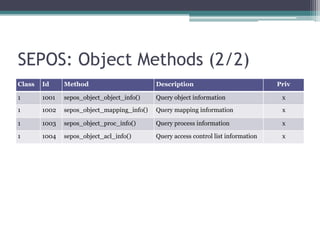
SEPOS: Object Methods (2/2)
Class Id Method Description Priv
1 1001 sepos_object_object_info() Query object information x
1 1002 sepos_object_mapping_info() Query mapping information x
1 1003 sepos_object_proc_info() Query process information x
1 1004 sepos_object_acl_info() Query access control list information x
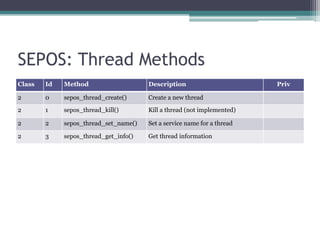
SEPOS: Thread Methods
Class Id Method Description Priv
2 0 sepos_thread_create() Create a new thread
2 1 sepos_thread_kill() Kill a thread (not implemented)
2 2 sepos_thread_set_name() Set a service name for a thread
2 3 sepos_thread_get_info() Get thread information

Solnik secure enclaveprocessor-pacsec

  • 1.
    Demystifying the 
 SecureEnclave Processor Tarjei Mandt (@kernelpool) Mathew Solnik (@msolnik) David Wang (@planetbeing)
  • 2.
    About Us • TarjeiMandt ▫ Senior Security Researcher, Azimuth Security ▫ tm@azimuthsecurity.com • Mathew Solnik ▫ Director, OffCell Research ▫ ms@offcellresearch.com • David Wang ▫ Senior Security Researcher, Azimuth Security ▫ dw@azimuthsecurity.com
  • 3.
    Introduction • iPhone 5Swas a technological milestone ▫ First 64-bit phone • Introduced several technological advancements ▫ Touch ID ▫ M7 motion coprocessor ▫ Security coprocessor (SEP) • Enabled sensitive data to be stored securely ▫ Fingerprint data, cryptographic keys, etc.
  • 4.
    Secure Enclave Processor •Security circuit designed to perform secure services for the rest of the SOC ▫ Prevents main processor from gaining direct access to sensitive data • Used to support a number of different services ▫ Most notably Touch ID • Runs its own operating system (SEPOS) ▫ Includes its own kernel, drivers, services, and applications
  • 5.
    Secure (?) EnclaveProcessor • Very little public information exists on the SEP ▫ Only information provided by Apple • SEP patent only provides a high level overview ▫ Doesn’t describe actual implementation details • Several open questions remain ▫ What services are exposed by the SEP? ▫ How are these services accessed? ▫ What privileges are needed? ▫ How resilient is SEP against attacks?
  • 6.
    Talk Outline • Part1: Secure Enclave Processor ▫ Hardware Design ▫ Boot Process • Part 2: Communication ▫ Mailbox Mechanism ▫ Kernel-to-SEP Interfaces • Part 3: SEPOS ▫ Architecture / Internals • Part 4: Security Analysis ▫ Attack Surface and Robustness
  • 7.
    Hardware Design Demystifying theSecure Enclave Processor
  • 8.
    SEP’s ARM Core:Kingfisher • Dedicated ARMv7a “Kingfisher” core ▫ Even EL3 on AP’s core won’t doesn’t give you access to SEP • Appears to be running at 300-400mhz~ • One of multiple kingfisher cores in the SoC ▫ 2-4 Other KF cores - used for NAND/SmartIO/etc ▫ Other cores provide a wealth of arch knowledge • Changes between platforms (A7/A8/A9) ▫ Appears like anti-tamper on newer chips
  • 9.
    Dedicated Hardware Peripherals •SEP has its own set of peripherals accessible by memory-mapped IO ▫ Built into hardware that AP cannot access ● Crypto Engine & Random Number Generator ● Security Fuses ● GID/UID Keys • Dedicated IO lines - ▫ Lines run directly to off-chip peripherals ● GPIO ● SPI ● UART ● I2C
  • 10.
    Shared Hardware Peripherals •SEP and AP share some peripherals • Power Manager (PMGR) ▫ Security fuse settings are located in the PMGR ▫ Lots of other interesting items • Memory Controller ▫ Can be poked at via iOS kernel • Phase-locked loop (PLL) clock generator ▫ Nothing to see here move along… • Secure Mailbox ▫ Used to tranfer data between cores • External Random Access Memory (RAM)
  • 11.
    Physical Memory • DedicatedBootROM (and some SRAM) ▫ BootROM physically located at 0x2_0da0_0000 • Uses inline AES to encrypt external RAM ▫ Most likely to prevent physical memory attacks against off SoC RAM chips (iPads) • Hardware “filter” to prevent AP to SEP memory access ▫ Only SEP’s KF core has this filter
  • 12.
    SEP KF FilterDiagram From SoC To SoC
  • 13.
    Boot Process Demystifying theSecure Enclave Processor
  • 14.
    SEP Initialization –First Stage • AP comes out of reset. AP BootROM releases SEP from reset. ▫ This is irreversible. No hardware register to reset or stop SEP accessible by AP. • Initially uses 4096 bytes of static RAM for stack and variables. • Uses page tables in ROM. ▫ Needs Large Physical Address Extension. • Starts a message loop.
  • 15.
    SEP Initialization –Second Stage • Listens for messages in the mailbox. • 8-byte messages that have the same format SEPOS uses. • All messages use endpoint 255 (EP_BOOTSTRAP) Opcode Description 1, 2 “Status check” (Ping) 3 Generate nonce 4 Get nonce word 5 “BootTZ0” (Continue boot)
  • 16.
    Memory Protections • SEPneeds more RAM than 4096 bytes of SRAM, so it needs external RAM. • RAM used by SEP must be protected against AP tampering. • Two regions configurable by AP are setup: ▫ TZ0 is for the SEP. ▫ TZ1 is for the AP’s TrustZone (Kernel Patch Protection). • SEP must wait for AP to setup TZ0 to continue boot.
  • 17.
    SEP Boot Flow ConfigureTZ0 and TZ1 Send Ping Send BootTZ0 Send Ping AP Acknowledge Ping SEP Map in TZ0 Setup Memory Encryption Acknowledge BootTZ0 Begin Stage 3 iBoot Kernel Stage 3 Stage 2
  • 18.
    SEP Memory ProtectionBootstrap • SEP doesn’t take AP’s word for it that TZ0 is locked. ▫ Checks hardware registers for lock. ▫ Then reads size and address of TZ0 from other hardware registers. • Impossible to change these hardware registers after TZ0 is locked. • Spin processor on failure. Configure TZ0 and TZ1 Send Ping Send BootTZ0 Send Ping Acknowledge Ping Map in TZ0 Setup Memory Encryption Acknowledge BootTZ0 Begin Stage 3 iBoot Kernel Stage 3 Stage 2
  • 19.
    Memory Encryption Modes •Appears to support ECB, CBC, and XEX. • Capable of AES-128 or AES-256. • Supports two channels. ▫ BootROM uses channel 1. ▫ SEPOS uses channel 0. • All access to certain ranges of physical addresses get encrypted/decrypted transparently. ▫ After boot, SEPOS has all page mappings into the encrypted range (except for hardware regs and memory shared with AP).
  • 20.
    Key Generation • Keysare generated by “tangling”: ▫ True Random Number Generator output ▫ Static ”type” value. • With protected (unreadable) registers: ▫ UID, GID, Seed A, Seed B. ●Seed B tangled with UID == GenID_2B • Encrypt the following using GenID_2B to generate key: ▫ [4 byte magic = 0xFF XK1][4 bytes of 0s][192-bits of randomness]
  • 21.
    Beginning Stage 3 •After memory encryption is setup, SEP re-initializes to use encrypted memory: ▫ Page tables ▫ Stack ▫ Data • Begins a new message loop with no shared code between it and the initial low-capability bootstrap. Configure TZ0 and TZ1 Send Ping Send BootTZ0 Send Ping Acknowledge Ping Map in TZ0 Setup Memory Encryption Acknowledge BootTZ0 Begin Stage 3 iBoot Kernel Stage 3 Stage 2
  • 22.
    SEP Boot Flow:Stage 3 Send ART AP Acknowledge Ping SEP Acknowledge ART Copy in ART Send Shared Memory Addr Send SEPOS Copy in SEPOS Validate SEPOS and ART Acknowledge SEPOS Boot SEPOS
  • 23.
    Boot-loading: Img4 • SEPuses the “IMG4” bootloader format which is based on ASN.1 DER encoding ▫ Very similar to 64bit iBoot/AP Bootrom ▫ Can be parsed with ”openssl -asn1parse” • Three primary objects used by SEP ▫ Payload – ● Contains the encrypted sep-firmware ▫ Restore – ● Contains basic information when restoring SEP ▫ Manifest (aka the AP ticket) - ● Effectively the Alpha and the Omega of bootROM configuration (and security)
  • 24.
    Img4 - Manifest •The manifest (APTicket) contains almost all the essential information used to authenticate and configure SEP(OS). • Contains multiple hardware identifier tags ▫ ECID ▫ ChipID ▫ Others • Is also used to change runtime settings in both software and hardware ▫ DPRO – Demote Production ▫ DSEC – Demote Security ▫ Others…
  • 25.
    Reversing SEP’s Img4Parser: Stage 1 • How can you reverse something you cannot see? ▫ Look for potential code reuse! • Other locations that parse IMG4 ▫ AP BootROM – A bit of a pain to get at ▫ iBoot – Dump from phys memory - 0x8700xx000 ●Not many symbols… ●But sometimes it only takes 1… (iBoot from n51)
  • 26.
    Reversing SEP’s Img4Parser: Stage 2 • Another file also contains the “Img4Decode” symbol ▫ /usr/libexec/seputil • Userland IMG4 parser with many more symbols ▫ May not be exact – but bindiff shows it is very close • From symbols found in seputil we can deduce: ▫ The ASN’1 decoder is based on libDER ● Which Apple so kindly releases as OpenSource. ▫ The RSA portion is handled by CoreCrypto • LibDER + CoreCrypto = SEP’s IMG4 Parsing engine ▫ We now have a great base to work with
  • 27.
    Img4 Parsing Flow •SEP BootROM copies in the sep-firmware.img4 from AP • Initializes the DER Decoder ▫ Decodes Payload, Manifest, and Restore Info • Verifies digests and signing certificates ▫ Root of trust cert is hardcoded at the end of BootROM • Verifies all properties in manifest ▫ Checks against current hardware fusing • If all items pass – load and execute the payload
  • 28.
    Img4 Parsing Flow AP DecodePayload & Manifest SEP Validate Digest Validate Certificates Fail Validate Manifest Validate Properties Against Certificate Validate Properties Against Hardware Boot SEPOS Read Fuses SEP Sends SEP IMG4
  • 29.
  • 30.
    Secure Mailbox • Thesecure mailbox allows the AP to communicate with the SEP ▫ Features both an inbox (request) and outbox (reply) • Implemented using the SEP device I/O registers ▫ Also known as the SEP configuration space
  • 31.
    Interrupt-based Message Passing •When sending a message, the AP writes to the inbox of the mailbox • This operation triggers an interrupt in the SEP ▫ Informs the SEP that a message has been received • When a reply is ready, the SEP writes a message back to the outbox ▫ Another interrupt is generated in order to let the AP know a message was received
  • 32.
    Mailbox Mechanism Start Write operation? Read operation? No Yes Address== Inbox Data writtento outbox? Update inbox with write data Generate interrupt forSEPprocessor Yes Ignore write operation No Address== Outbox Yes Respond to read with nonce data No Respond to read with outbox data Yes No Yes Done Generate interrupt for AP processor No
  • 33.
    Mailbox Message Format •A single message is 8 bytes in size • Format depends on the receiving endpoint • First byte is always the destination endpoint struct { uint8_t endpoint; // destination endpoint number uint8_t tag; // message tag uint8_t opcode; // message type uint8_t param; // optional parameter uint32_t data; // message data } sep_msg;
  • 34.
    SEP Manager • Providesa generic framework for drivers to communicate with the SEP ▫ Implemented in AppleSEPManager.kext ▫ Builds on the functionality provided by the IOP • Enables drivers to register SEP endpoints ▫ Used to talk to a specific SEP app or service ▫ Assigned a unique index value • Also implements several endpoints of its own ▫ E.g. the SEP control endpoint
  • 35.
    SEP Endpoints (1/2) IndexName Driver 0 AppleSEPControl AppleSEPManager.kext 1 AppleSEPLogger AppleSEPManager.kext 2 AppleSEPARTStorage AppleSEPManager.kext 3 AppleSEPARTRequests AppleSEPManager.kext 4 AppleSEPTracer AppleSEPManager.kext 5 AppleSEPDebug AppleSEPManager.kext 6 <not used> 7 AppleSEPKeyStore AppleSEPKeyStore.kext
  • 36.
    SEP Endpoints (2/2) IndexName Driver 8 AppleMesaSEPDriver AppleMesaSEPDriver.kext 9 AppleSPIBiometricSensor AppleBiometricSensor.kext 10 AppleSEPCredentialManager AppleSEPCredentialManager.kext 11 AppleSEPPairing AppleSEPManager.kext 12 AppleSSE AppleSSE.kext 254 L4Info 255 Bootrom SEP Bootrom
  • 37.
    Control Endpoint (EP0) •Handles control requests issued to the SEP • Used to set up request and reply out-of-line buffers for an endpoint • Provides interface to generate, read, and invalidate nonces • The SEP Manager user client provides some support for interacting with the control endpoint ▫ Used by the SEP Utility (/usr/libexec/seputil)
  • 38.
    Control Endpoint Opcodes OpcodeName Description 0 NOP Used to wake up SEP 2 SET_OOL_IN_ADDR Request out-of-line buffer address 3 SET_OOL_OUT_ADDR Reply out-of-line buffer address 4 SET_OOL_IN_SIZE Size of request buffer 5 SET_OOL_OUT_SIZE Size of reply buffer 10 TTYIN Write to SEP console 12 SLEEP Sleep the SEP
  • 39.
    Out-of-line Buffers • Transferringlarge amounts of data is slow using the interrupt-based mailbox ▫ Out-of-line buffers used for large data transfers • SEP Manager provides a way to allocate SEP visible memory ▫ AppleSEPManager::allocateVisibleMemory(…) ▫ Actually allocates a portion of physical memory • Control endpoint is used to assign the request/ reply buffer to the target endpoint
  • 40.
    Endpoint Registration (AP) AllocateSEPvisible memory Create AppleSEPEndpoint object Insertendpoint in endpoint table OOLbuffers required? Yes Assign send buffer to endpoint AllocateSEPvisible memory RegisterOOLbuffer withSEPviaEP0 RegisterOOLbuffer withSEPviaEP0 Assign receive buffer to endpoint DoneNo Start Physically contiguious memory region AppleSEPManager::endpointForHandle() Inserts endpoint at the specified table index
  • 41.
    Drivers Using SEP •Several drivers now rely on the SEP for their operation • Some drivers previously located in the kernel have had parts moved into the SEP ▫ Apple(SEP)KeyStore ▫ Apple(SEP)CredentialManager • Most drivers have a corresponding app in the SEP
  • 42.
  • 43.
    L4 • Family ofmicrokernels • First introduced in 1993 by Jochen Liedtke ▫ Evolved from L3 (mid-1980s) • Developed to address the poor performance of earlier microkernels ▫ Improved IPC performance over L3 by a factor 10-20 faster • Numerous variants and implementations ▫ E.g. L4-embedded optimized for embedded systems
  • 44.
    SEPOS • Based onDarbat/L4-embedded (ARMv7) ▫ Custom modifications by Apple • Implements its own drivers, services, and applications ▫ Compiled as macho binaries • The kernel provides only a minimal set of interfaces ▫ Major part of the operating system implemented in user-mode
  • 45.
    SEPOS Architecture SEPDrivers SEPServices SEPOS (BootstrapServer) SecureKeyStore SecureCredential Manager Secure Biometric Engine Hardware SSE ARTManager/ ARTMate EmbeddedRuntime(ERT) libSEPOS Kernel(L4) CoreSEPOS Components SEP Applications
  • 46.
    Kernel (L4) • Initializesthe machine state to a point where it is usable ▫ Initializes the kernel page table ▫ Sets up the kernel interface page (KIP) ▫ Configures the interrupts on the hardware ▫ Starts the timer ▫ Initializes and starts the kernel scheduler ▫ Starts the root task • Provides a small set (~20) of system calls
  • 47.
    System Calls (1/2) NumName Description 0x00 L4_Ipc Set up IPC between two threads 0x00 L4_Notify Notify a thread 0x04 L4_ThreadSwitch Yield execution to thread 0x08 L4_ThreadControl Create or delete threads 0x0C L4_ExchangeRegisters Exchange registers wit another thread 0x10 L4_Schedule Set thread scheduling information 0x14 L4_MapControl Map or free virtual memory 0x18 L4_SpaceControl Create a new address space 0x1C L4_ProcessorControl Sets processor attributes
  • 48.
    System Calls (2/2) NumName Description 0x20 L4_CacheControl Cache flushing 0x24 L4_IpcControl Limit ipc access 0x28 L4_InterruptControl Enable or disable an interrupt 0x2C L4_GetTimebase Gets the system time 0x30 L4_SetTimeout Set timeout for ipc sessions 0x34 L4_SharedMappingControl Set up a shared mapping 0x38 L4_SleepKernel ? 0x3C L4_PowerControl ? 0x40 L4_KernelInterface Get information about kernel
  • 49.
    Privileged System Calls •Some system calls are considered privileged ▫ E.g. memory and thread management calls • Only root task (SEPOS) may invoke privileged system calls ▫ Determined by the space address of the caller • Check performed by each individual system call where needed ▫ is_privileged_space()
  • 50.
    Privileged System Calls SYS_SPACE_CONTROL(threadid_t space_tid, word_t control, fpage_t kip_area, fpage_t utcb_area) { TRACEPOINT (SYSCALL_SPACE_CONTROL, printf("SYS_SPACE_CONTROL: space=%t, control=%p, kip_area=%p, " "utcb_area=%pn", TID (space_tid), control, kip_area.raw, utcb_area.raw)); // Check privilege if (EXPECT_FALSE (! is_privileged_space(get_current_space()))) { get_current_tcb ()->set_error_code (ENO_PRIVILEGE); return_space_control(0, 0); } ... } INLINE bool is_privileged_space(space_t * space) { return (is_roottask_space(space); } Check for root task in L4_SpaceControl system call from darbat 0.2 source
  • 51.
    SEPOS (INIT) • Initialprocess on boot (root task) ▫ Can call any privileged L4 system call • Initializes and starts all remaining tasks ▫ Processes an application list embedded by the sep- firmware • Maintains a context structure for each task ▫ Includes information about the virtual address space, privilege level, threads, etc. • Invokes the bootstrap server
  • 52.
    SEPOS App Initialization InitializeApps proc_create( ) No Last app in list? Done Yes macho2vm() thread_create( ) ertp_map_page( ) Read application list from sep-firmware ComputeCRCof loadedimages CRCvalid? Panic Yes No Create and start new thread at app entry point (L4_ThreadControl) ReadsMach-Oheader andmapssegments (L4_MapControl) Createsnewprocess andaddressspace (L4_SpaceControl) Maps the Mach-O header from physical memory ComparesCRCwithvalue stored in sep-firmware
  • 53.
    Application List • Includesinformation about all applications embedded by the SEP firmware ▫ Physical address (offset) ▫ Virtual base address ▫ Module name and size ▫ Entry point • Found 0xEC8 bytes prior to the SEPOS binary in the sep-firmware image
  • 54.
    Application List Size Entrypoint Virtual address Physical address (offset)
  • 55.
    Bootstrap Server • Implementsthe core functionality of SEPOS ▫ Exports methods for system, thread and object (memory) management • Made available to SEP applications over RPC via the embedded runtime ▫ ert_rpc_bootstrap_server() • Enable applications to perform otherwise privileged operations ▫ E.g. create a new thread
  • 56.
    Privileged Methods • Anapplication must be privileged to invoke certain bootstrap server methods ▫ Query object/process/acl/mapping information • Privilege level is determined at process creation ▫ Process name >= ‘A ‘ and <= ‘ZZZZ’ ▫ E.g. “SEPD” (SEPDrivers) • Check is done by each individual method ▫ proc_has_privilege( int pid );
  • 57.
    sepos_object_acl_info( ) int sepos_object_acl_info(int*args) { int result; int prot; int pid; args[18] = 1; *((_BYTE *)args + 104) = 1; result = proc_has_privilege( args[1] ); if ( result == 1 ) { result = acl_get( args[5], args[6], &pid, &prot); if ( !result ) { args[18] = 0; args[19] = prot; args[20] = pid; result = 1; *((_BYTE *)args + 104) = 1; } } return result; } Call to check if sender’s pid is privileged
  • 58.
    Entitlements • Some methodsalso require special entitlements ▫ sepos_object_create_phys() ▫ sepos_object_remap() • Seeks to prevent unprivileged applications from mapping arbitrary physical memory • Assigned to a process on launch ▫ Separate table used to determine entitlements
  • 59.
    Entitlement Assignment int proc_create(int name ) { int privileged = 0; ... if ( ( name >= 'A ' ) && ( name <= 'ZZZZ' ) ) privileged = 1; proctab[ pid ].privileged = privileged; proctab[ pid ].entitlements = 0; while ( privileged_tasks[ 2 * i ] != name ) if ( ++i == 3 ) return pid; proctab[ pid ].entitlements = privileged_tasks[ 2 * i + 1 ]; return pid; }
  • 60.
    Entitlement Assignment Task NameEntitlements SEPDrivers MAP_PHYS ARTManager/ARTMate MAP_PHYS | MAP_SEP Debug MAP_PHYS | MAP_SEP • MAP_PHYS (2) ▫ Required in order to access (map) a physical region • MAP_SEP (4) ▫ Same as above, but also needed if the physical region targets SEP memory
  • 61.
    SEP Drivers • Hostsall SEP drivers ▫ AKF, TRNG, Expert, GPIO, PMGR, etc. ▫ Implemented entirely in user-mode • Maps the device I/O registers for each driver ▫ Enables low-level driver operations • Exposed to SEP applications using a dedicated driver API ▫ Includes functions for lookup, control, read, and write
  • 62.
    Driver Interaction SEPOS SEPDrivers Lookup handleto SEPDservice Driver Driver lookup Lookup handle to driver Driver control / read / write Perform driver operation DriverDriver RegistersSEPD service on startup RetrievesSEPDthread handle from list
  • 63.
    AKF Driver • ManagesAP/SEP endpoints in SEPOS • Handles control (EP0) requests ▫ E.g. sets up objects for reply and response OOL buffers • SEP applications may register new endpoints to handle specific AP requests ▫ AKF_ENDPOINT_REGISTER (0x412C) control request
  • 64.
    SEP Services • Hostsvarious SEP related services ▫ Secure Key Generation Service ▫ Test Service ▫ Anti Replay Service ▫ Entitlement Service • Usually implemented on top of drivers • Service API provided to SEP applications ▫ service_lookup(…) ▫ service_call(…)
  • 65.
    Service Interaction SEPOS sepServices Lookup handleto sepSservice Service Servicelookup Lookup handle to service Servicecall Issueaservice request ServiceService RegisterssepS service on startup RetrievessepSthread handle from list
  • 66.
    SEP Applications • Primarilydesigned to support various drivers running in the AP ▫ AppleSEPKeyStore ! sks ▫ AppleSEPCredentialManager ! scrd • Some apps are only found on certain devices ▫ E.g. SSE is only present on iPhone 6 and later • May also be exclusive to development builds ▫ E.g. Debug application
  • 67.
    Attacking SEP Demystifying theSecure Enclave Processor
  • 68.
    Attack Surface: SEPOS •Mostly comprises the methods in which data is communicated between AP and SEP ▫ Mailbox (endpoints) ▫ Shared request/reply buffers • Assumes that an attacker already has obtained AP kernel level privileges ▫ Can execute arbitrary code under EL1
  • 69.
    Attack Surface: AKFEndpoints • Every endpoint registered with AKF is a potential target ▫ Includes both SEP drivers and applications • Does not require an endpoint to be registered with the SEP Manager (AP) ▫ Can write messages to the mailbox directly ▫ Alternatively, we can register our own endpoint with SEP Manager
  • 70.
    Attack Surface: AKFEndpoints Endpoint Owner OOL In OOL Out Notes 0 SEPD/ep0 1 SEPD/ep1 ✓ 2 ARTM ✓ ✓ iPhone 6 and prior 3 ARTM ✓ ✓ iPhone 6 and prior 7 sks ✓ ✓ 8 sbio/sbio ✓ ✓ 10 scrd/scrd ✓ ✓ 12 sse/sse ✓ ✓ iPhone 6 and later List of AKF registered endpoints (iOS 9) and their use of out-of- line request and reply buffers
  • 71.
    Attack Surface: EndpointHandler SEP Biometrics message handler
  • 72.
    Attack Robustness • Howmuch effort is required to exploit a SEP vulnerability? ▫ E.g. stack/heap corruption • Determined by several factors ▫ Address space layout ▫ Allocator (heap) hardening ▫ Exploit mitigations ▫ And more
  • 73.
    Address Space Layout •SEP applications are loaded at their preferred base address ▫ No image base randomization ▫ Typically based at 0x1000 or 0x8000 (depending on presence of pagezero segment) • Segments without a valid memory protection mask (!= 0) are ignored ▫ E.g. __PAGEZERO is never “mapped”
  • 74.
    Stack TEXT MainThread Thread2 Stack DATA Mapping Thread3 Stack VirtualMemory Systemstack (0x1000bytes) Application Image Stack Corruptions • Themain thread of a SEP application uses an image embedded stack ▫ A corruption could overwrite adjacent DATA segment data • Thread stacks of additional threads spawned by SEPOS are mapped using objects ▫ Allocated with gaps ! “guard pages”
  • 75.
    Stack Corruptions • SEPapplications are compiled with stack cookie protection ▫ Cookie value is fixed to ‘GARD’ ▫ Trivial to forge/bypass • Stack addresses are in most cases known ▫ Main thread stack is at a known address ▫ Addresses of subsequent thread stacks are predictable
  • 76.
    Heap Corruptions: malloc() •Runtime allocator leveraged by SEP applications ▫ K&R implementation • Singly linked free list (ordered by size) with header that includes pointer and block size ▫ struct Header { void * ptr, size_t size }; ▫ Coalesces adjacent elements on free() • Size of heap determined on initialization ▫ malloc_init( malloc_base, malloc_top ); ▫ Non-expandable
  • 77.
    Heap Corruptions: malloc() Next Size Data(Free)Data(InUse) Next Size Data(Free) FreeList Next Size ImageDATAsegment
  • 78.
    Heap Corruptions: malloc() •No protection of heap metadata ▫ Free list pointers can be overwritten ▫ Block size can be corrupted • Allocation addresses are predictable ▫ Malloc area embedded by __DATA segment in application image ▫ Allocations made in sequential order
  • 79.
    No-Execute Protection • SEPOSimplements no-execute protection • Always set when a page is not marked as executable ▫ space_t::map_fpage() ▫ Sets both XN and PXN bits in page table entries • Non-secure (NS) bit also set for all pages outside SEP memory region
  • 80.
    SEPOS Mitigations Summary MitigationPresent Notes Stack Cookie Protection Yes (…) ‘GARD’ – mostly ineffective Memory Layout Randomization User No Kernel No Image base: 0xF0001000 Stack Guard Pages Yes/No Not for main thread Heap Metadata Protection No Null-Page Protection No Must be root task to map page No-Execute Protection Yes Both XN and PXN
  • 81.
    Attack Surface: BootROM •Effectively only two major attack surfaces ▫ IMG4 Parser ●Memory Corruption ●Logic Flaws ▫ Hardware based • Only minor anti-exploit mitigations present ▫ No ASLR ▫ Basic stack guard ▫ One decent bug = game over
  • 82.
    Attacking IMG4 • ASN.1is a very tricky thing to pull off well ▫ Multiple vulns in OpenSSL, NSS, ASN1C, etc • LibDER itself actually rather solid ▫ “Unlike most other DER packages, this one does no malloc or copies when it encodes or decodes”
 – LibDER’s readme.txt ▫ KISS design philosophy • But the wrapping code that calls it may not be ▫ Audit seputil and friends ▫ Code is signifigantly more complex then libDER itself
  • 83.
    Attack Surface: Hardware •Memory corruption attacks again data receivers on peripheral lines ▫ SPI ▫ I2C ▫ UART • Side Channel/Differential Power Analysis ▫ Stick to the A7 (newer ones are more resistant) • Glitching ▫ Standard Clock/Voltage Methods ▫ Others
  • 84.
    External RAM • Encryptedmemory has no validation. ▫ Can corrupt bits of SEP memory • When generating the encryption key the “random component” is temporarily stored unencrypted in external RAM. ▫ This may allow an attacker to influence generation of the final memory encryption key
  • 85.
    Attacking the FuseArray • Potentially one of the most invasive attack vectors ▫ Requires a lot of patience ▫ High likelihood of bricking • Laser could be used ▫ Expensive method - not for us • Primary targets ▫ Production Mode ▫ Security Mode
  • 86.
    End Game: JTAG ▫Requires a 2000+ pin socket ▫ Need to bypass CRC and fuse sealing ▫ “FSRC” Pin - A line into fuse array? • Glitch the fuse sensing routines • Attack the IMG4 Parser ▫ What exactly do DSEC and DPRO really do? A8 SoC Pins
  • 87.
  • 88.
    Conclusion • SEP(OS) wasdesigned with security in mind ▫ Mailbox interface ▫ Privilege separation • However, SEP(OS) lacks basic exploit protections ▫ E.g. no memory layout randomization • Some SEP applications expose a significant attack surface ▫ E.g. SEP biometrics application
  • 89.
    Conclusion (Continued) • Overallhardware design is light years ahead of competitors ▫ Hardware Filter ▫ Inline Encrypted RAM ▫ Generally small attack surface • But it does have its weaknesses ▫ Shared PMGR and PLL are open to attacks ▫ Inclusion of the fuse source pin should be re-evaluated ▫ The demotion functionality appears rather dangerous ● Why does JTAG over lightning even exist?
  • 90.
    Thanks! • Ryan Mallon •Daniel Borca • Anonymous reviewers
  • 91.
    Bonus Slides Demystifying theSecure Enclave Processor
  • 92.
    SEPOS: System Methods ClassId Method Description Priv 0 0 sepos_proc_getpid() Get the process pid 0 1 sepos_proc_find_service() Find a registered service by name 0 1001 sepos_proc_limits() Query process limit information x 0 1002 sepos_proc_info() Query process information 0 1003 sepos_thread_info() Query information for thread 0 1004 sepos_thread_info_by_tid() Query information for thread id 0 1100 sepos_grant_capability() - x 0 2000 sepos_panic() Panic the operating system
  • 93.
    SEPOS: Object Methods(1/2) Class Id Method Description Priv 1 0 sepos_object_create() Create an anonymous object 1 1 sepos_object_create_phys() Create an object from a physical region x (*) 1 2 sepos_object_map() Map an object in a task’s address space 1 3 sepos_object_unmap() Unmap an object (not implemented) 1 4 sepos_object_share() Share an object with a task 1 5 sepos_object_access() Query the access control list of an object 1 6 sepos_object_remap() Remap the physical region of an object x (*) 1 7 sepos_object_share2() Share manifest with task
  • 94.
    SEPOS: Object Methods(2/2) Class Id Method Description Priv 1 1001 sepos_object_object_info() Query object information x 1 1002 sepos_object_mapping_info() Query mapping information x 1 1003 sepos_object_proc_info() Query process information x 1 1004 sepos_object_acl_info() Query access control list information x
  • 95.
    SEPOS: Thread Methods ClassId Method Description Priv 2 0 sepos_thread_create() Create a new thread 2 1 sepos_thread_kill() Kill a thread (not implemented) 2 2 sepos_thread_set_name() Set a service name for a thread 2 3 sepos_thread_get_info() Get thread information