What are ‘Media Texts’?
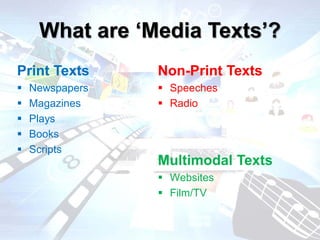
Print Texts
 Newspapers
 Magazines
 Plays
 Books
 Scripts
Non-Print Texts
 Speeches
 Radio
Multimodal Texts
 Websites
 Film/TV
What are ‘Media Texts’?
Print Texts
 Newspapers
 Magazines
 Plays
 Books
 Scripts
Non-Print Texts
 Speeches
 Radio
Multimodal Texts
 Websites
 Film/TV
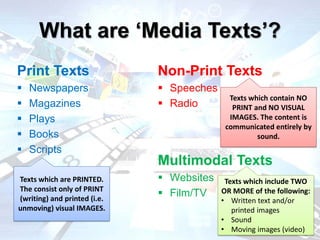
Texts which are PRINTED.
The consist only of PRINT
(writing) and printed (i.e.
unmoving) visual IMAGES.
Texts which include TWO
OR MORE of the following:
• Written text and/or
printed images
• Sound
• Moving images (video)
Texts which contain NO
PRINT and NO VISUAL
IMAGES. The content is
communicated entirely by
sound.
What do we look for in the
media?
Information?
Truth?
Reliability?
Perspective/Viewpoint?
Opinion?
Bias?
How is the text positioned?
 Context?
 Purpose?
 Audience?
 Language?
 Form?
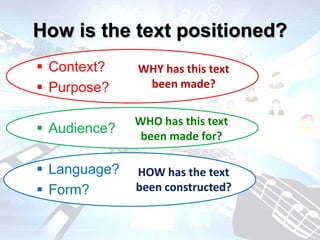
How is the text positioned?
 Context?
 Purpose?
 Audience?
 Language?
 Form?
WHY has this text
been made?
WHO has this text
been made for?
HOW has the text
been constructed?
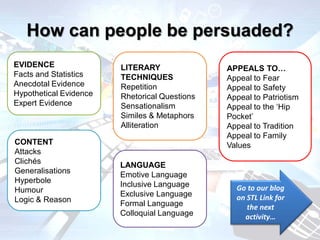
How can people be persuaded?
EVIDENCE
Facts and Statistics
Anecdotal Evidence
Hypothetical Evidence
Expert Evidence
CONTENT
Attacks
Clichés
Generalisations
Hyperbole
Humour
Logic & Reason
LITERARY
TECHNIQUES
Repetition
Rhetorical Questions
Sensationalism
Similes & Metaphors
Alliteration
LANGUAGE
Emotive Language
Inclusive Language
Exclusive Language
Formal Language
Colloquial Language
APPEALS TO…
Appeal to Fear
Appeal to Safety
Appeal to Patriotism
Appeal to the ‘Hip
Pocket’
Appeal to Tradition
Appeal to Family
Values
Go to our blog
on STL Link for
the next
activity…
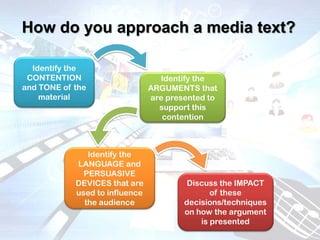
How do you approach a media text?
Identify the
CONTENTION
and TONE of the
material
Identify the
ARGUMENTS that
are presented to
support this
contention
Identify the
LANGUAGE and
PERSUASIVE
DEVICES that are
used to influence
the audience
Discuss the IMPACT
of these
decisions/techniques
on how the argument
is presented
Introduction: Using language to persuade (Media Texts)

Introduction: Using language to persuade (Media Texts)

  • 2.
    What are ‘MediaTexts’? Print Texts  Newspapers  Magazines  Plays  Books  Scripts Non-Print Texts  Speeches  Radio Multimodal Texts  Websites  Film/TV
  • 3.
    What are ‘MediaTexts’? Print Texts  Newspapers  Magazines  Plays  Books  Scripts Non-Print Texts  Speeches  Radio Multimodal Texts  Websites  Film/TV Texts which are PRINTED. The consist only of PRINT (writing) and printed (i.e. unmoving) visual IMAGES. Texts which include TWO OR MORE of the following: • Written text and/or printed images • Sound • Moving images (video) Texts which contain NO PRINT and NO VISUAL IMAGES. The content is communicated entirely by sound.
  • 4.
    What do welook for in the media? Information? Truth? Reliability? Perspective/Viewpoint? Opinion? Bias?
  • 5.
    How is thetext positioned?  Context?  Purpose?  Audience?  Language?  Form?
  • 6.
    How is thetext positioned?  Context?  Purpose?  Audience?  Language?  Form? WHY has this text been made? WHO has this text been made for? HOW has the text been constructed?
  • 7.
    How can peoplebe persuaded? EVIDENCE Facts and Statistics Anecdotal Evidence Hypothetical Evidence Expert Evidence CONTENT Attacks Clichés Generalisations Hyperbole Humour Logic & Reason LITERARY TECHNIQUES Repetition Rhetorical Questions Sensationalism Similes & Metaphors Alliteration LANGUAGE Emotive Language Inclusive Language Exclusive Language Formal Language Colloquial Language APPEALS TO… Appeal to Fear Appeal to Safety Appeal to Patriotism Appeal to the ‘Hip Pocket’ Appeal to Tradition Appeal to Family Values Go to our blog on STL Link for the next activity…
  • 8.
    How do youapproach a media text? Identify the CONTENTION and TONE of the material Identify the ARGUMENTS that are presented to support this contention Identify the LANGUAGE and PERSUASIVE DEVICES that are used to influence the audience Discuss the IMPACT of these decisions/techniques on how the argument is presented