Prepared By :
Aslesha Basnet (69007)
Jasmina Joshi (69015)
Manika Bajracharya (69018)
Rubina Maskey (69033)
L E E
D
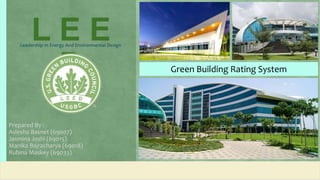
Leadership In Energy And Environmental Design
Green Building Rating System
What is Green building?
A green building:
 Operates energy
efficiently
 Conserves water
 Comfortable, safe and
healthy
 Durable and
maintainable with
minimal environment
impact
Reduced
operating
cost
Energy saving
20-30%
Water saving
40-60%
Reduced
impact on the
environment
Enhanced occupant
comfort, safety and
health
Improved
productivity of
occupants
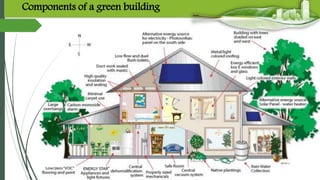
Components of a green building
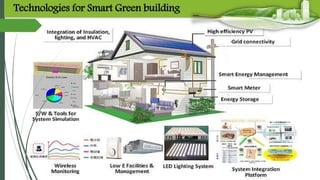
Technologies for Smart Green building
Benefits comparison
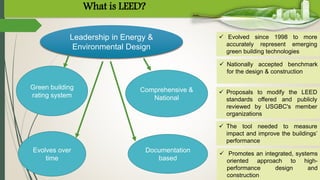
What is LEED?
Leadership in Energy &
Environmental Design
Green building
rating system
Documentation
based
Evolves over
time
Comprehensive &
National
 Nationally accepted benchmark
for the design & construction
 The tool needed to measure
impact and improve the buildings’
performance
 Promotes an integrated, systems
oriented approach to high-
performance design and
construction
 Evolved since 1998 to more
accurately represent emerging
green building technologies
 Proposals to modify the LEED
standards offered and publicly
reviewed by USGBC's member
organizations
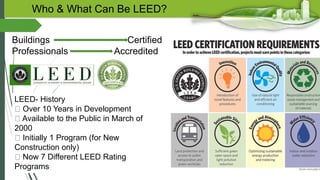
Who & What Can Be LEED?
Buildings Certified
Professionals Accredited
LEED- History
Over 10 Years in Development
Available to the Public in March of
2000
Initially 1 Program (for New
Construction only)
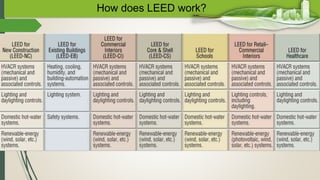
Now 7 Different LEED Rating
Programs
LEED Rating system
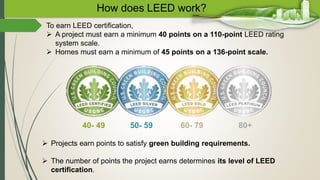
How does LEED work?
 Projects earn points to satisfy green building requirements.
 The number of points the project earns determines its level of LEED
certification.
To earn LEED certification,
 A project must earn a minimum 40 points on a 110-point LEED rating
system scale.
 Homes must earn a minimum of 45 points on a 136-point scale.
40- 49 50- 59 60- 79 80+
How does LEED work?
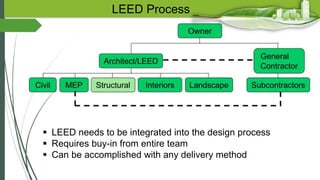
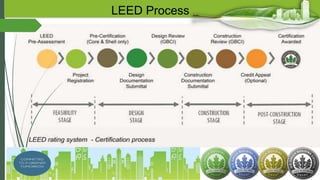
LEED Process
 LEED needs to be integrated into the design process
 Requires buy-in from entire team
 Can be accomplished with any delivery method
LEED Process
Top 10 countries outside USA
2002:
More than
80 million
square feet.
2003:
More than
141 million
square feet.
2004:
More than
180 million
square feet.
2005:
500 million
square feet.
2006:
642 million
square feet.
Increase in LEED projects
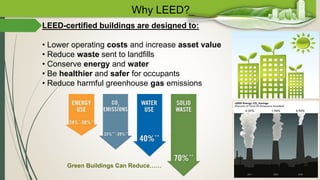
Why LEED?
LEED-certified buildings are designed to:
• Lower operating costs and increase asset value
• Reduce waste sent to landfills
• Conserve energy and water
• Be healthier and safer for occupants
• Reduce harmful greenhouse gas emissions
Green Buildings Can Reduce……
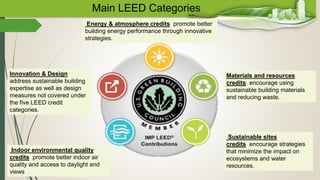
Main LEED Categories
Energy & atmosphere credits promote better
building energy performance through innovative
strategies.
Materials and resources
credits encourage using
sustainable building materials
and reducing waste.
Sustainable sites
credits encourage strategies
that minimize the impact on
ecosystems and water
resources.
Indoor environmental quality
credits promote better indoor air
quality and access to daylight and
views
Innovation & Design
address sustainable building
expertise as well as design
measures not covered under
the five LEED credit
categories.
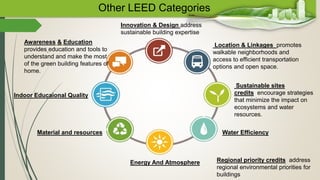
Innovation & Design address
sustainable building expertise
Location & Linkages promotes
walkable neighborhoods and
access to efficient transportation
options and open space.
Sustainable sites
credits encourage strategies
that minimize the impact on
ecosystems and water
resources.
Other LEED Categories
Water Efficiency
Energy And Atmosphere
Awareness & Education
provides education and tools to
understand and make the most
of the green building features of
home.
Indoor Educaional Quality
Material and resources
Regional priority credits address
regional environmental priorities for
buildings
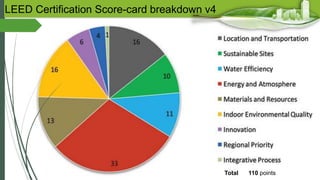
LEED Certification Score-card breakdown v4
Total 110 points
Rating system scale for LEED platinum:
SUSTAINABLE SITES
15-21
WATER EFFICIENCY
8-11
ENERGY &
ATMOSPHERE 23-37
MATERIALS & RESOURCES
3-14
INDOOR ENV. QUALITY
9-17
INNOVATION IN
OPERATION +4
BONUS
0-10
Categories of LEED:
1. CHOOSE
2.
REGISTER
3. SUBMIT
4. REVIEW
5. CERTIFY
HOW TO REGISTER A PROJECT
Determine which
rating system you will
use
Registration fee- $900
for USGBC (United
State Green Building
Council)
$1200 for non-
members
Submit your
certification
application
Receive the certification
decision
Await the application
review
Examples of LEED buildings
CII –Godrej GBC
,Hyderabad
ITC Green Center,
Gurgaon
Suzlon Energy
Limited
Wipro
Technologies
, Gurgaon
Examples of LEED buildings
Anna Centenary
Library
Building,
Chennai
American Embassy
School, Delhi
NEG Micon,
Chennai
IGP Office,
Gulbarga
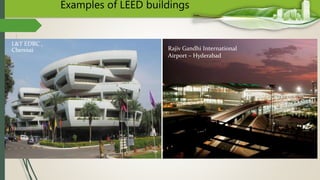
Examples of LEED buildings
L&T EDRC ,
Chennai Rajiv Gandhi International
Airport – Hyderabad
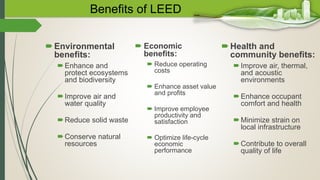
Environmental
benefits:
Enhance and
protect ecosystems
and biodiversity
Improve air and
water quality
Reduce solid waste
Conserve natural
resources
 Economic
benefits:
 Reduce operating
costs
 Enhance asset value
and profits
 Improve employee
productivity and
satisfaction
 Optimize life-cycle
economic
performance
Health and
community benefits:
Improve air, thermal,
and acoustic
environments
Enhance occupant
comfort and health
Minimize strain on
local infrastructure
Contribute to overall
quality of life
Benefits of LEED
1. LEED is difficult and expensive for individual homeowners and
smaller non commercial projects.
2. LEED ignores context and performance.
3. The closer LEED gets to becoming a mandate, the more blindly it will
be followed
Limitations Of LEED
Categories LEED BREEAM GRIHA CASBEE
Launch Date 1998 1990 2007 2004
Origin USA UK India Japan
Assessment USGBC Trained Assessors Team from
ADaRSH
Design/Managem
ent team
Ratings Certified, Silver,
Gold, Platinum
Pass, Good, Very
Good, Excellent
and Outstanding
1, 2, 3,
4, 5
C, B-, B+, A, S
Focus Globally Globally Locally in India Globally but
specially in Japan
Comparison
C
A
S
E
S
T
U
D
Y
CASE STUDY
USGBC Headquarter
PROJECT: USGBC Headquarters
LOCATION: Washington, D.C.
CLIENT: U.S. Green Building Council
SIZE: 75,000 sq.ft
LEED CERTIFICATION: Platinum certified in 2009,
LEED v3
LEED platinum for commercial
interiors status, renovated
AWARDS- AIA DC Presidential Citation for Sustainable
Design
AGC of DC Award of Excellence
Best Sustainable Interior Project
ENR Mid-Atlantic Best Project of the Year
Interior Design/Tenant Improvement
Exterior of building
www.usgbc.org
MATERIAL
MATERIALS:
 Sawn Bamboo
 Cool Carpet
 Veneer Douglas Fir Stripe
 Linoleum
 Cork Flooring
 Eco spec
 Metal Works
 Reclaimed Douglas Fir Wood
Timbers
 Day lighting Ballast
Front lobby featuring reclaimed wood, a water feature,
and the new stair penetration
Optimize Energy Performance
Lighting Power: 35.7% Lower lighting power
Reduced potable water by 40.75%
Lighting Controls: Daylight response controls
HVAC : Zoning Controls
Thermafusers
Pre-fab
Insulated Ductwork
Open office environment
MATERIAL
Tenant Space
• 10 Year Lease Commitment
Resource Reuse
• 7.93% Building Materials
Reused
• 30% Furniture Reused
Recycled Content
• 21% Building Materials used
• Recycled Content
Storage & Collection of Recyclables
Sustainable Education
• 100% Green Power
Water Use Reduction
• Reduced Potable Water use
By 40.75%
Ergonomic Excellence
LEED Accredited Professional
Platinum
LEED for Commercial Interiors
45 of 57 Points
RATINGS BASIS
Platinum LEED for Commercial Interiors 45
of 57 Points
Outside Air Delivery
Monitoring
• Aircuity Sensors
Increased Ventilation
• 39.3% Increased Air
Construction IAQ Management
• During Construction
Low-Emitting Materials
• Adhesives, Sealants
• Paints & Coatings
• Carpet
• Systems Furniture & Seating
Minimum IAQ Performance Tobacco Smoke Control
SCOREBOARD
GOALS AND SUCCESSES
• To make the new office sophisticated and
advanced green building design and
technology
• Set an example for their membership and the
public, but also to demonstrate what is
possible
Increased productivity due to day lighting, good air
quality, design innovation, integrated design
process, waste reduction and avoidance
• Greatest success - day lighting
Remarkable day lighting, high-performance lighting
system achieves lighting power densities among the
best in the industry
Indoor office environment
www.usgbc.org
STRATEGIES
•An electronic window shade system operates to maximize good daylight
and minimize glare.
•Walls, ceilings and workstation panels are colored white to reflect as much
light as possible.
•Eco-corridor features a lighter perimeter carpeting along the window line
which acts as a light shelf, reflecting natural light back into the space
STRATEGIES
•With lighting controls set to 80% maximum output,
lighting power density is 54% below the ASHRAE
standard. With so much daylight streaming in, use
of overhead lights reduced
•Biophilic strategies, those connecting staff to
nature, was to provide views of the outdoors from a
seated position, and 97% of all regularly occupied
spaces have a direct sightline to the outdoors.
•Energy use in space is monitored, including
energy used for lighting, to ensure we leverage
design efficiencies and systems are operating in
sync.
Overhead lighting
PROCESS
• Space layout, windows, HVAC, lighting, and
furniture selection and finishes
•Interior as transparent as possible - low partition
heights and interior glass features
•Reduced the amount of air conditioning load in the
summer
• Innovative linear diffusers that would automatically
deliver the supply air downward in the heating mode in
the winter months and pivot the air horizontally while in
cooling mode. This new technology significantly removes
the thermal downdraft
•Water wall which provides cooling and dehumidification
•8’ between the glass and the first workstation on the south face – eco-
corridor
•Daylight-responsive sensors dim light fixtures if adequate natural
light is available; spaces are only illuminated if they need to be.
•Occupancy sensors to control light fixtures – turns off light
automatically when not in use
•Thermostats used to maintain precise temperature control - regain
proper temperature quickly
BIBLIOGRAPHY
• http://www.usgbc.org/projects/usgbc-headquarters?view=stories
•http://www.architectmagazine.com/design/buildings/us-green-building-council-corporate-
headquarters_o
•https://segd.org/us-green-building-council-headquarters
•http://www.vsbn.org/docs/20070320_USGBC_Headquarters.pdf
•http://www.txap.com/assets/file/bulletins/titus-usgbc_new.pdf
Thank

LEED

  • 1.
    Prepared By : AsleshaBasnet (69007) Jasmina Joshi (69015) Manika Bajracharya (69018) Rubina Maskey (69033) L E E D Leadership In Energy And Environmental Design Green Building Rating System
  • 2.
    What is Greenbuilding? A green building:  Operates energy efficiently  Conserves water  Comfortable, safe and healthy  Durable and maintainable with minimal environment impact Reduced operating cost Energy saving 20-30% Water saving 40-60% Reduced impact on the environment Enhanced occupant comfort, safety and health Improved productivity of occupants
  • 3.
    Components of agreen building
  • 4.
    Technologies for SmartGreen building
  • 5.
  • 6.
    What is LEED? Leadershipin Energy & Environmental Design Green building rating system Documentation based Evolves over time Comprehensive & National  Nationally accepted benchmark for the design & construction  The tool needed to measure impact and improve the buildings’ performance  Promotes an integrated, systems oriented approach to high- performance design and construction  Evolved since 1998 to more accurately represent emerging green building technologies  Proposals to modify the LEED standards offered and publicly reviewed by USGBC's member organizations
  • 7.
    Who & WhatCan Be LEED? Buildings Certified Professionals Accredited LEED- History Over 10 Years in Development Available to the Public in March of 2000 Initially 1 Program (for New Construction only) Now 7 Different LEED Rating Programs
  • 8.
  • 9.
    How does LEEDwork?  Projects earn points to satisfy green building requirements.  The number of points the project earns determines its level of LEED certification. To earn LEED certification,  A project must earn a minimum 40 points on a 110-point LEED rating system scale.  Homes must earn a minimum of 45 points on a 136-point scale. 40- 49 50- 59 60- 79 80+
  • 10.
  • 11.
    LEED Process  LEEDneeds to be integrated into the design process  Requires buy-in from entire team  Can be accomplished with any delivery method
  • 12.
  • 13.
    Top 10 countriesoutside USA
  • 14.
    2002: More than 80 million squarefeet. 2003: More than 141 million square feet. 2004: More than 180 million square feet. 2005: 500 million square feet. 2006: 642 million square feet. Increase in LEED projects
  • 15.
    Why LEED? LEED-certified buildingsare designed to: • Lower operating costs and increase asset value • Reduce waste sent to landfills • Conserve energy and water • Be healthier and safer for occupants • Reduce harmful greenhouse gas emissions Green Buildings Can Reduce……
  • 16.
    Main LEED Categories Energy& atmosphere credits promote better building energy performance through innovative strategies. Materials and resources credits encourage using sustainable building materials and reducing waste. Sustainable sites credits encourage strategies that minimize the impact on ecosystems and water resources. Indoor environmental quality credits promote better indoor air quality and access to daylight and views Innovation & Design address sustainable building expertise as well as design measures not covered under the five LEED credit categories.
  • 17.
    Innovation & Designaddress sustainable building expertise Location & Linkages promotes walkable neighborhoods and access to efficient transportation options and open space. Sustainable sites credits encourage strategies that minimize the impact on ecosystems and water resources. Other LEED Categories Water Efficiency Energy And Atmosphere Awareness & Education provides education and tools to understand and make the most of the green building features of home. Indoor Educaional Quality Material and resources Regional priority credits address regional environmental priorities for buildings
  • 18.
    LEED Certification Score-cardbreakdown v4 Total 110 points
  • 19.
    Rating system scalefor LEED platinum: SUSTAINABLE SITES 15-21 WATER EFFICIENCY 8-11 ENERGY & ATMOSPHERE 23-37 MATERIALS & RESOURCES 3-14 INDOOR ENV. QUALITY 9-17 INNOVATION IN OPERATION +4 BONUS 0-10
  • 20.
    Categories of LEED: 1.CHOOSE 2. REGISTER 3. SUBMIT 4. REVIEW 5. CERTIFY HOW TO REGISTER A PROJECT Determine which rating system you will use Registration fee- $900 for USGBC (United State Green Building Council) $1200 for non- members Submit your certification application Receive the certification decision Await the application review
  • 21.
    Examples of LEEDbuildings CII –Godrej GBC ,Hyderabad ITC Green Center, Gurgaon Suzlon Energy Limited Wipro Technologies , Gurgaon
  • 22.
    Examples of LEEDbuildings Anna Centenary Library Building, Chennai American Embassy School, Delhi NEG Micon, Chennai IGP Office, Gulbarga
  • 23.
    Examples of LEEDbuildings L&T EDRC , Chennai Rajiv Gandhi International Airport – Hyderabad
  • 24.
    Environmental benefits: Enhance and protect ecosystems andbiodiversity Improve air and water quality Reduce solid waste Conserve natural resources  Economic benefits:  Reduce operating costs  Enhance asset value and profits  Improve employee productivity and satisfaction  Optimize life-cycle economic performance Health and community benefits: Improve air, thermal, and acoustic environments Enhance occupant comfort and health Minimize strain on local infrastructure Contribute to overall quality of life Benefits of LEED
  • 25.
    1. LEED isdifficult and expensive for individual homeowners and smaller non commercial projects. 2. LEED ignores context and performance. 3. The closer LEED gets to becoming a mandate, the more blindly it will be followed Limitations Of LEED
  • 26.
    Categories LEED BREEAMGRIHA CASBEE Launch Date 1998 1990 2007 2004 Origin USA UK India Japan Assessment USGBC Trained Assessors Team from ADaRSH Design/Managem ent team Ratings Certified, Silver, Gold, Platinum Pass, Good, Very Good, Excellent and Outstanding 1, 2, 3, 4, 5 C, B-, B+, A, S Focus Globally Globally Locally in India Globally but specially in Japan Comparison
  • 27.
  • 28.
    CASE STUDY USGBC Headquarter PROJECT:USGBC Headquarters LOCATION: Washington, D.C. CLIENT: U.S. Green Building Council SIZE: 75,000 sq.ft LEED CERTIFICATION: Platinum certified in 2009, LEED v3 LEED platinum for commercial interiors status, renovated AWARDS- AIA DC Presidential Citation for Sustainable Design AGC of DC Award of Excellence Best Sustainable Interior Project ENR Mid-Atlantic Best Project of the Year Interior Design/Tenant Improvement Exterior of building www.usgbc.org
  • 29.
    MATERIAL MATERIALS:  Sawn Bamboo Cool Carpet  Veneer Douglas Fir Stripe  Linoleum  Cork Flooring  Eco spec  Metal Works  Reclaimed Douglas Fir Wood Timbers  Day lighting Ballast Front lobby featuring reclaimed wood, a water feature, and the new stair penetration
  • 30.
    Optimize Energy Performance LightingPower: 35.7% Lower lighting power Reduced potable water by 40.75% Lighting Controls: Daylight response controls HVAC : Zoning Controls Thermafusers Pre-fab Insulated Ductwork Open office environment MATERIAL
  • 31.
    Tenant Space • 10Year Lease Commitment Resource Reuse • 7.93% Building Materials Reused • 30% Furniture Reused Recycled Content • 21% Building Materials used • Recycled Content Storage & Collection of Recyclables
  • 32.
    Sustainable Education • 100%Green Power Water Use Reduction • Reduced Potable Water use By 40.75% Ergonomic Excellence LEED Accredited Professional Platinum LEED for Commercial Interiors 45 of 57 Points RATINGS BASIS Platinum LEED for Commercial Interiors 45 of 57 Points
  • 33.
    Outside Air Delivery Monitoring •Aircuity Sensors Increased Ventilation • 39.3% Increased Air Construction IAQ Management • During Construction Low-Emitting Materials • Adhesives, Sealants • Paints & Coatings • Carpet • Systems Furniture & Seating Minimum IAQ Performance Tobacco Smoke Control
  • 34.
  • 35.
    GOALS AND SUCCESSES •To make the new office sophisticated and advanced green building design and technology • Set an example for their membership and the public, but also to demonstrate what is possible Increased productivity due to day lighting, good air quality, design innovation, integrated design process, waste reduction and avoidance • Greatest success - day lighting Remarkable day lighting, high-performance lighting system achieves lighting power densities among the best in the industry Indoor office environment www.usgbc.org
  • 36.
    STRATEGIES •An electronic windowshade system operates to maximize good daylight and minimize glare. •Walls, ceilings and workstation panels are colored white to reflect as much light as possible. •Eco-corridor features a lighter perimeter carpeting along the window line which acts as a light shelf, reflecting natural light back into the space
  • 37.
    STRATEGIES •With lighting controlsset to 80% maximum output, lighting power density is 54% below the ASHRAE standard. With so much daylight streaming in, use of overhead lights reduced •Biophilic strategies, those connecting staff to nature, was to provide views of the outdoors from a seated position, and 97% of all regularly occupied spaces have a direct sightline to the outdoors. •Energy use in space is monitored, including energy used for lighting, to ensure we leverage design efficiencies and systems are operating in sync. Overhead lighting
  • 38.
    PROCESS • Space layout,windows, HVAC, lighting, and furniture selection and finishes •Interior as transparent as possible - low partition heights and interior glass features •Reduced the amount of air conditioning load in the summer • Innovative linear diffusers that would automatically deliver the supply air downward in the heating mode in the winter months and pivot the air horizontally while in cooling mode. This new technology significantly removes the thermal downdraft •Water wall which provides cooling and dehumidification
  • 39.
    •8’ between theglass and the first workstation on the south face – eco- corridor •Daylight-responsive sensors dim light fixtures if adequate natural light is available; spaces are only illuminated if they need to be. •Occupancy sensors to control light fixtures – turns off light automatically when not in use •Thermostats used to maintain precise temperature control - regain proper temperature quickly
  • 40.
  • 41.