REPUBLIC OF SOUTH SUDAN
MINISTRY OF PETROLEUM AND MINING
RSS/JUBA
GEOLOGY AND MINERAL
INVESTMENT OPPORTUNITIES
IN SOUTH SUDAN
DR. ANDU EZBON ADDE
MAY 2013
PRESENTATION OUTLINES
1. Introduction.
2. Geology.
3. Minerals: occurrences & work done.
4. Investment opportunities in minerals and
geological materials.
5. Positive investment factors in minerals.
6. Challenges of investments in minerals.
7. Conclusions.
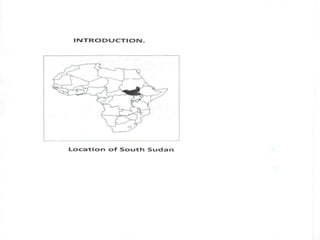
1. INTRODUCTION
• Rock types and structures optimum for metallic
mineralization
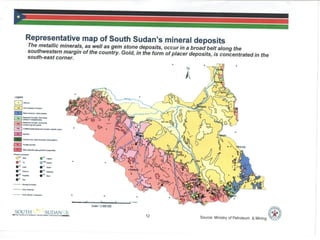
• Precious and base metals occur in several places
• Industrial minerals/building materials are
widespread.
• Insignificant exploration work done; no existing mine.
• Many investment opportunities in mineral sector.
• Government tailors mining laws to attract investors.
2. GEOLOGY
• Precambrian gneisses, meta-sediments, basic
volcanics and recent sediments at the lowlands.
• Crystalline rocks cover about 40 % of the surface
area.
• Granitic intrusions of various ages.
• Metamorphism: high, medium and insignificant
low.
• Multi-phase deformation: folding and faulting.
• Metallic mineralization in Precambrian and
Tertiary orogenies.
3. MINERAL OCCURRENCES AND EXPLORATION
WORK DONE IN SOUTH SUDAN.
• There are a vast number of metallic minerals spread
all over the South Sudan: gold, copper, zinc, lead,
manganese, iron, silver, tin, etc.
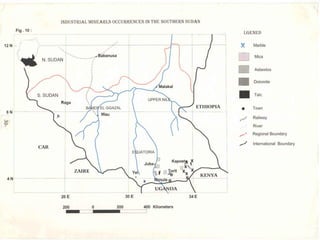
• Also industrial minerals exist: marble, limestone,
dolomite, kaolin, clay, asbestos, etc.
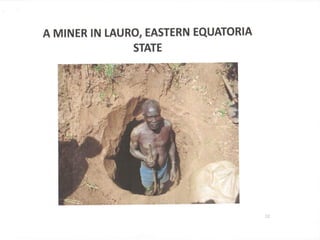
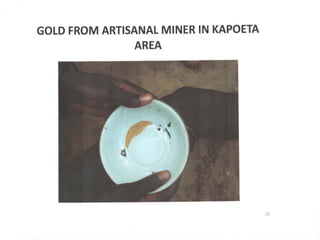
• Apart from gold at Kapoeta and Luri; copper at Hofrat
Ennahas, bauxite/iron ore at Wau area and marble at
Kapoeta no other mineral has been prospected to an
appreciable level.
• A lot of work needs to be done on the minerals to
develop them exploitation subsequently
development stage.
INVESTMENT OPPORTUNITIES IN MINERALS
AND GEOLOGICAL MATERIALS.
4.1. Investment opportunities in gold.
• Areas of gold occurrences in S.Sudan
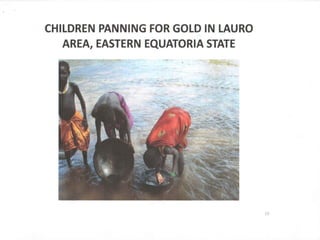
• Eastern Equatoria State: All Kapoeta Counties +
Nimule.
• Central Equatoria State: Luri, Lobonok, Yei.
• Western Equatoria State: Mundri-Amadi.
• Western Bahr El Ghazal State: Khor Ghana, Wau
County.
• Upper Nile State: Sobat County.
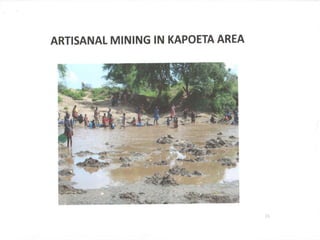
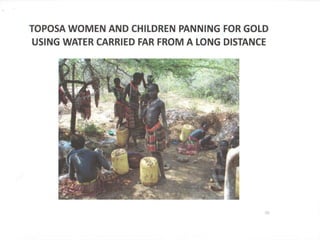
• Some prospecting/exploration work was done on
gold in the Kapoeta Counties and Luri in Juba County;
other areas are still untouched.
Fineness of South Sudan gold Neutron
activation analytical results
Variable Composite gold Samples Av
C1 C2 C3 C4
Au % 89.1 84.4 90.5 76.0 85.0
Ag % 6.3 10.9 3.9 4.4 6.4
Fe, % 4.2 4.1 5.3 5.9 4.9
T ppm 3395 5840 3470 -- 3179
Sb ppm 180 294 153 -- 156
Hg, ppm 77 75 39 114 76
Au Fineness [a] 891 844 904 881 880
Au Fineness[b] 934 886 959 945 930
Au/Ag ratio 14.1 7.7 23.2 17.3 13.3
[a] = 1000 Au [Au+Ag+Fe+Te+Sb+Hg]-1
[b] = 1000 Au[Au+Ag]-1
[Source; Adde, 1990]
Pure gold is 24 carat or 1000 Fine; so South Sudan gold is of a very high purity it is
worth investing in.
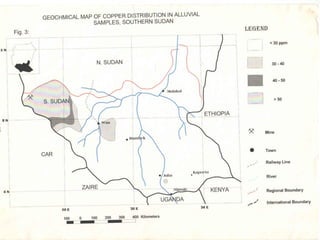
• The main copper-gold ore occurrence is at Hofrat Ennahas,
Western Bahr El Ghazal State.
• Prospected and explored by several companies, including
Billington of South Africa.
• Ore is strata bound with minor later basic intrusions.
• Associated with radioactive minerals.
• Assays commonly 1 – 5 % Cu and up to 3 g Au/t.
• Ore resources 40 – 60 m tons.
• Mineralisation open at depth and laterally to CAR boarder.
4.2. Investment opportunities in copper and gold.
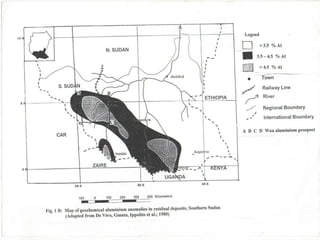
• Three main areas of bauxite prospects: West of Wau City, North
and east of Juba City and West of Yambio town.
• Wau bauxite area 30 km by 30 km prospected by grid drilling.
• Bauxite layer 4 – 20 m thick, usually underlies laterite.
• Samples assay 20 - 30 % Al203, occasionally > 40 % Al203
• Bauxite ore resources estimated at about 3 b tons.
• Occurrence open to the west and north.
4.3. Investment opportunities in bauxite.
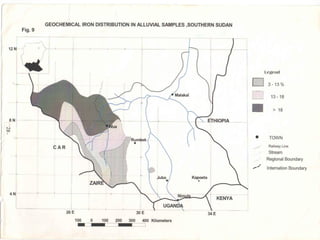
• Extensive iron ore occurrence north and west of Wau City to
borders with Sudan and CAR respectively.
• Represented by iron caps as discontinuous bodies.
• Generally overlies bauxitic layer.
• Chip and percussion samples assay 30 – 70 % Fe203, occasionally
> 80 % Fe203.
• Variable ore zone thickness: 10 – 30 m.
• Possible tonnage in 900 km2 drilled area about 10 b.
• Ore occurrence thickens to the north.
• Unlimited investment opportunity.
4.4. Investment opportunities in iron ore.
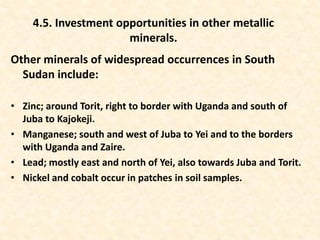
Other minerals of widespread occurrences in South
Sudan include:
• Zinc; around Torit, right to border with Uganda and south of
Juba to Kajokeji.
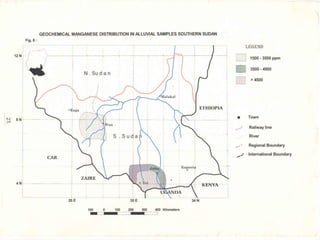
• Manganese; south and west of Juba to Yei and to the borders
with Uganda and Zaire.
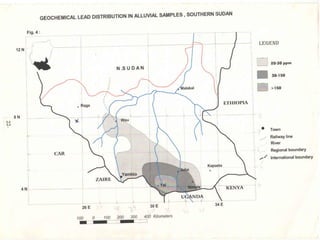
• Lead; mostly east and north of Yei, also towards Juba and Torit.
• Nickel and cobalt occur in patches in soil samples.
4.5. Investment opportunities in other metallic
minerals.
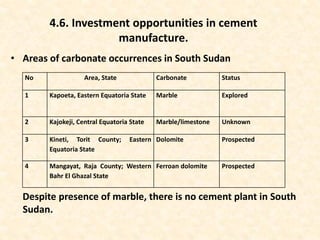
• Areas of carbonate occurrences in South Sudan
Despite presence of marble, there is no cement plant in South
Sudan.
4.6. Investment opportunities in cement
manufacture.
No Area, State Carbonate Status
1 Kapoeta, Eastern Equatoria State Marble Explored
2 Kajokeji, Central Equatoria State Marble/limestone Unknown
3 Kineti, Torit County; Eastern
Equatoria State
Dolomite Prospected
4 Mangayat, Raja County; Western
Bahr El Ghazal State
Ferroan dolomite Prospected
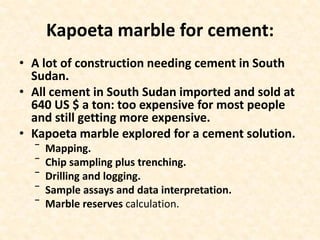
Kapoeta marble for cement:
• A lot of construction needing cement in South
Sudan.
• All cement in South Sudan imported and sold at
640 US $ a ton: too expensive for most people
and still getting more expensive.
• Kapoeta marble explored for a cement solution.
‾ Mapping.
‾ Chip sampling plus trenching.
‾ Drilling and logging.
‾ Sample assays and data interpretation.
‾ Marble reserves calculation.
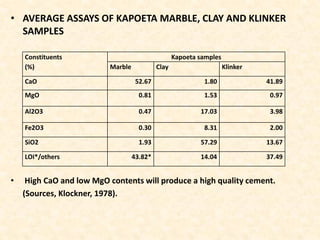
• AVERAGE ASSAYS OF KAPOETA MARBLE, CLAY AND KLINKER
SAMPLES
• High CaO and low MgO contents will produce a high quality cement.
(Sources, Klockner, 1978).
Constituents
(%)
Kapoeta samples
Marble Clay Klinker
CaO 52.67 1.80 41.89
MgO 0.81 1.53 0.97
Al2O3 0.47 17.03 3.98
Fe2O3 0.30 8.31 2.00
SiO2 1.93 57.29 13.67
LOI*/others 43.82* 14.04 37.49
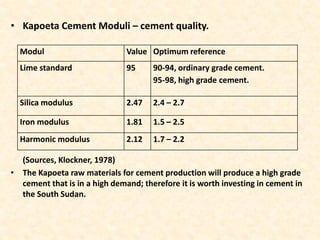
• Kapoeta Cement Moduli – cement quality.
(Sources, Klockner, 1978)
• The Kapoeta raw materials for cement production will produce a high grade
cement that is in a high demand; therefore it is worth investing in cement in
the South Sudan.
Modul Value Optimum reference
Lime standard 95 90-94, ordinary grade cement.
95-98, high grade cement.
Silica modulus 2.47 2.4 – 2.7
Iron modulus 1.81 1.5 – 2.5
Harmonic modulus 2.12 1.7 – 2.2
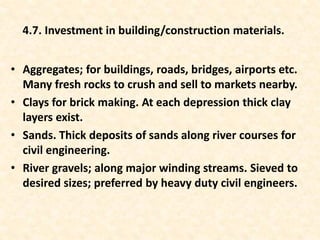
• Aggregates; for buildings, roads, bridges, airports etc.
Many fresh rocks to crush and sell to markets nearby.
• Clays for brick making. At each depression thick clay
layers exist.
• Sands. Thick deposits of sands along river courses for
civil engineering.
• River gravels; along major winding streams. Sieved to
desired sizes; preferred by heavy duty civil engineers.
4.7. Investment in building/construction materials.
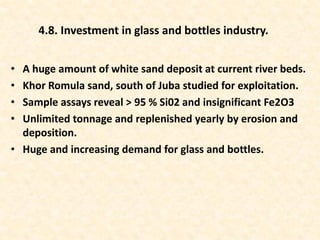
• A huge amount of white sand deposit at current river beds.
• Khor Romula sand, south of Juba studied for exploitation.
• Sample assays reveal > 95 % Si02 and insignificant Fe2O3
• Unlimited tonnage and replenished yearly by erosion and
deposition.
• Huge and increasing demand for glass and bottles.
4.8. Investment in glass and bottles industry.
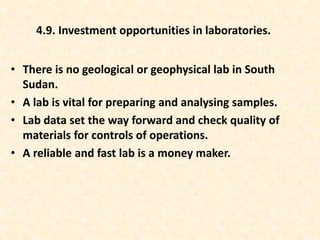
• There is no geological or geophysical lab in South
Sudan.
• A lab is vital for preparing and analysing samples.
• Lab data set the way forward and check quality of
materials for controls of operations.
• A reliable and fast lab is a money maker.
4.9. Investment opportunities in laboratories.
Types of Labs to invest in.
• A preparatory lab – for bringing samples to analysis
stage: crushing, grinding, pelletization, thin
sectioning, separation, dissolution, standardisation.
• Chemistry Lab – for analysis of samples: soil, rock,
ore, water etc for desired elements.
• Physical Lab – XRD, hardness strength, conductivity,
resistivity, radioactivity, etc tests.
• Heavy mineral Lab – Separation, identification, etc.
• Petrographic Lab – Thin sectioning, mineralogy,
alterations, etc.
• Efficiency in work reflects the measure taken in
training/teaching the employee to do the work.
• Nations, families, groups are prepared to pay highly
for a high quality training.
• Apart from general and university education South
Sudan lacks professional training institutes in the
mineral and related sector.
• South Sudanese are sent abroad for short trainings; it
is found insufficient and unreliable.
• Home based training will cost less but train more
people.
4.10. Investment opportunities in study/training
institutions.
Where to invest in Training.
• Investment in practical geology, geochemistry and
geophysical training on home soil and materials.
• Investment in Lab technology to cater for exploration
and hospitals.
• Investment in metallurgy for extraction of metals
from home ores.
• Investment in drilling industry for supplying the many
oil and water drilling companies with competent
South Sudanese drillers.
• Investment in hydrogeology and hydrochemistry for
monitoring water availability and suitability for
consumption.
• Geological factors convenient for vast mineralizations
• Vast minerals to choose from.
• Some background information available for a smooth
start.
• Mining Laws designed to encourage investors.
• High demand for building materials in local market
• Local personnel eager for work in the mineral sector.
5. Positive factors for investment in minerals and
related things in S. Sudan.
• Land-locked Country – transport of heavy equipment a
problem.
• Poor road infrastructure – access to sites rather hard.
• Most minerals occur in remote areas – haul and
accommodate manpower at work place at a cost.
• Training of local staff – to level of proficiency at a cost.
• After-shocks of a long war ebbing slowly – long time to
adjust to civil life.
6. Challenging investment factors in minerals.
CONCLUSIONS
• About 40 % of the South Sudan area is covered
by crystalline rocks.
• These rocks are folded and fractured to provide
dilation zones.
• Several minerals are found in the South Sudan at
commercial potentials.
• The Government is all out to lure investors.
• Many investment opportunities exist in the
mineral sector.
THANK YOU
FOR YOUR ATTENTION

Geology and Mineral Investment Opportunities in South Sudan

  • 1.
    REPUBLIC OF SOUTHSUDAN MINISTRY OF PETROLEUM AND MINING RSS/JUBA GEOLOGY AND MINERAL INVESTMENT OPPORTUNITIES IN SOUTH SUDAN DR. ANDU EZBON ADDE MAY 2013
  • 2.
    PRESENTATION OUTLINES 1. Introduction. 2.Geology. 3. Minerals: occurrences & work done. 4. Investment opportunities in minerals and geological materials. 5. Positive investment factors in minerals. 6. Challenges of investments in minerals. 7. Conclusions.
  • 4.
    1. INTRODUCTION • Rocktypes and structures optimum for metallic mineralization • Precious and base metals occur in several places • Industrial minerals/building materials are widespread. • Insignificant exploration work done; no existing mine. • Many investment opportunities in mineral sector. • Government tailors mining laws to attract investors.
  • 5.
    2. GEOLOGY • Precambriangneisses, meta-sediments, basic volcanics and recent sediments at the lowlands. • Crystalline rocks cover about 40 % of the surface area. • Granitic intrusions of various ages. • Metamorphism: high, medium and insignificant low. • Multi-phase deformation: folding and faulting. • Metallic mineralization in Precambrian and Tertiary orogenies.
  • 7.
    3. MINERAL OCCURRENCESAND EXPLORATION WORK DONE IN SOUTH SUDAN. • There are a vast number of metallic minerals spread all over the South Sudan: gold, copper, zinc, lead, manganese, iron, silver, tin, etc. • Also industrial minerals exist: marble, limestone, dolomite, kaolin, clay, asbestos, etc. • Apart from gold at Kapoeta and Luri; copper at Hofrat Ennahas, bauxite/iron ore at Wau area and marble at Kapoeta no other mineral has been prospected to an appreciable level. • A lot of work needs to be done on the minerals to develop them exploitation subsequently development stage.
  • 14.
    INVESTMENT OPPORTUNITIES INMINERALS AND GEOLOGICAL MATERIALS. 4.1. Investment opportunities in gold. • Areas of gold occurrences in S.Sudan • Eastern Equatoria State: All Kapoeta Counties + Nimule. • Central Equatoria State: Luri, Lobonok, Yei. • Western Equatoria State: Mundri-Amadi. • Western Bahr El Ghazal State: Khor Ghana, Wau County. • Upper Nile State: Sobat County. • Some prospecting/exploration work was done on gold in the Kapoeta Counties and Luri in Juba County; other areas are still untouched.
  • 21.
    Fineness of SouthSudan gold Neutron activation analytical results Variable Composite gold Samples Av C1 C2 C3 C4 Au % 89.1 84.4 90.5 76.0 85.0 Ag % 6.3 10.9 3.9 4.4 6.4 Fe, % 4.2 4.1 5.3 5.9 4.9 T ppm 3395 5840 3470 -- 3179 Sb ppm 180 294 153 -- 156 Hg, ppm 77 75 39 114 76 Au Fineness [a] 891 844 904 881 880 Au Fineness[b] 934 886 959 945 930 Au/Ag ratio 14.1 7.7 23.2 17.3 13.3 [a] = 1000 Au [Au+Ag+Fe+Te+Sb+Hg]-1 [b] = 1000 Au[Au+Ag]-1 [Source; Adde, 1990] Pure gold is 24 carat or 1000 Fine; so South Sudan gold is of a very high purity it is worth investing in.
  • 22.
    • The maincopper-gold ore occurrence is at Hofrat Ennahas, Western Bahr El Ghazal State. • Prospected and explored by several companies, including Billington of South Africa. • Ore is strata bound with minor later basic intrusions. • Associated with radioactive minerals. • Assays commonly 1 – 5 % Cu and up to 3 g Au/t. • Ore resources 40 – 60 m tons. • Mineralisation open at depth and laterally to CAR boarder. 4.2. Investment opportunities in copper and gold.
  • 23.
    • Three mainareas of bauxite prospects: West of Wau City, North and east of Juba City and West of Yambio town. • Wau bauxite area 30 km by 30 km prospected by grid drilling. • Bauxite layer 4 – 20 m thick, usually underlies laterite. • Samples assay 20 - 30 % Al203, occasionally > 40 % Al203 • Bauxite ore resources estimated at about 3 b tons. • Occurrence open to the west and north. 4.3. Investment opportunities in bauxite.
  • 24.
    • Extensive ironore occurrence north and west of Wau City to borders with Sudan and CAR respectively. • Represented by iron caps as discontinuous bodies. • Generally overlies bauxitic layer. • Chip and percussion samples assay 30 – 70 % Fe203, occasionally > 80 % Fe203. • Variable ore zone thickness: 10 – 30 m. • Possible tonnage in 900 km2 drilled area about 10 b. • Ore occurrence thickens to the north. • Unlimited investment opportunity. 4.4. Investment opportunities in iron ore.
  • 25.
    Other minerals ofwidespread occurrences in South Sudan include: • Zinc; around Torit, right to border with Uganda and south of Juba to Kajokeji. • Manganese; south and west of Juba to Yei and to the borders with Uganda and Zaire. • Lead; mostly east and north of Yei, also towards Juba and Torit. • Nickel and cobalt occur in patches in soil samples. 4.5. Investment opportunities in other metallic minerals.
  • 26.
    • Areas ofcarbonate occurrences in South Sudan Despite presence of marble, there is no cement plant in South Sudan. 4.6. Investment opportunities in cement manufacture. No Area, State Carbonate Status 1 Kapoeta, Eastern Equatoria State Marble Explored 2 Kajokeji, Central Equatoria State Marble/limestone Unknown 3 Kineti, Torit County; Eastern Equatoria State Dolomite Prospected 4 Mangayat, Raja County; Western Bahr El Ghazal State Ferroan dolomite Prospected
  • 27.
    Kapoeta marble forcement: • A lot of construction needing cement in South Sudan. • All cement in South Sudan imported and sold at 640 US $ a ton: too expensive for most people and still getting more expensive. • Kapoeta marble explored for a cement solution. ‾ Mapping. ‾ Chip sampling plus trenching. ‾ Drilling and logging. ‾ Sample assays and data interpretation. ‾ Marble reserves calculation.
  • 28.
    • AVERAGE ASSAYSOF KAPOETA MARBLE, CLAY AND KLINKER SAMPLES • High CaO and low MgO contents will produce a high quality cement. (Sources, Klockner, 1978). Constituents (%) Kapoeta samples Marble Clay Klinker CaO 52.67 1.80 41.89 MgO 0.81 1.53 0.97 Al2O3 0.47 17.03 3.98 Fe2O3 0.30 8.31 2.00 SiO2 1.93 57.29 13.67 LOI*/others 43.82* 14.04 37.49
  • 29.
    • Kapoeta CementModuli – cement quality. (Sources, Klockner, 1978) • The Kapoeta raw materials for cement production will produce a high grade cement that is in a high demand; therefore it is worth investing in cement in the South Sudan. Modul Value Optimum reference Lime standard 95 90-94, ordinary grade cement. 95-98, high grade cement. Silica modulus 2.47 2.4 – 2.7 Iron modulus 1.81 1.5 – 2.5 Harmonic modulus 2.12 1.7 – 2.2
  • 30.
    • Aggregates; forbuildings, roads, bridges, airports etc. Many fresh rocks to crush and sell to markets nearby. • Clays for brick making. At each depression thick clay layers exist. • Sands. Thick deposits of sands along river courses for civil engineering. • River gravels; along major winding streams. Sieved to desired sizes; preferred by heavy duty civil engineers. 4.7. Investment in building/construction materials.
  • 31.
    • A hugeamount of white sand deposit at current river beds. • Khor Romula sand, south of Juba studied for exploitation. • Sample assays reveal > 95 % Si02 and insignificant Fe2O3 • Unlimited tonnage and replenished yearly by erosion and deposition. • Huge and increasing demand for glass and bottles. 4.8. Investment in glass and bottles industry.
  • 32.
    • There isno geological or geophysical lab in South Sudan. • A lab is vital for preparing and analysing samples. • Lab data set the way forward and check quality of materials for controls of operations. • A reliable and fast lab is a money maker. 4.9. Investment opportunities in laboratories.
  • 33.
    Types of Labsto invest in. • A preparatory lab – for bringing samples to analysis stage: crushing, grinding, pelletization, thin sectioning, separation, dissolution, standardisation. • Chemistry Lab – for analysis of samples: soil, rock, ore, water etc for desired elements. • Physical Lab – XRD, hardness strength, conductivity, resistivity, radioactivity, etc tests. • Heavy mineral Lab – Separation, identification, etc. • Petrographic Lab – Thin sectioning, mineralogy, alterations, etc.
  • 34.
    • Efficiency inwork reflects the measure taken in training/teaching the employee to do the work. • Nations, families, groups are prepared to pay highly for a high quality training. • Apart from general and university education South Sudan lacks professional training institutes in the mineral and related sector. • South Sudanese are sent abroad for short trainings; it is found insufficient and unreliable. • Home based training will cost less but train more people. 4.10. Investment opportunities in study/training institutions.
  • 35.
    Where to investin Training. • Investment in practical geology, geochemistry and geophysical training on home soil and materials. • Investment in Lab technology to cater for exploration and hospitals. • Investment in metallurgy for extraction of metals from home ores. • Investment in drilling industry for supplying the many oil and water drilling companies with competent South Sudanese drillers. • Investment in hydrogeology and hydrochemistry for monitoring water availability and suitability for consumption.
  • 36.
    • Geological factorsconvenient for vast mineralizations • Vast minerals to choose from. • Some background information available for a smooth start. • Mining Laws designed to encourage investors. • High demand for building materials in local market • Local personnel eager for work in the mineral sector. 5. Positive factors for investment in minerals and related things in S. Sudan.
  • 37.
    • Land-locked Country– transport of heavy equipment a problem. • Poor road infrastructure – access to sites rather hard. • Most minerals occur in remote areas – haul and accommodate manpower at work place at a cost. • Training of local staff – to level of proficiency at a cost. • After-shocks of a long war ebbing slowly – long time to adjust to civil life. 6. Challenging investment factors in minerals.
  • 38.
    CONCLUSIONS • About 40% of the South Sudan area is covered by crystalline rocks. • These rocks are folded and fractured to provide dilation zones. • Several minerals are found in the South Sudan at commercial potentials. • The Government is all out to lure investors. • Many investment opportunities exist in the mineral sector.
  • 39.