Republic of
C A M E R O O N MINISTRY OF
INDUSTRY, MINES
&
TECHNOLOGICAL
DEVELOPMENT
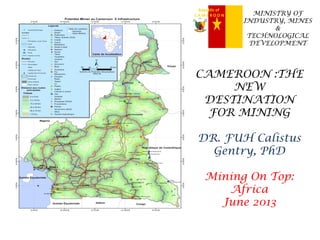
CAMEROON :THE
NEW
DESTINATION
FOR MINING
DR. FUH Calistus
Gentry, PhD
Mining On Top:
Africa
June 2013
Lies midway between West and Central Africa;
Stretches from the Gulf of Guinea in the South-
West to Lake Chad in the North;
Lies between 2° - 13° of latitude North and 08° - 16°
of longitude East;
Bounded to the:
South-West and West by the Gulf of Guinea
(the Atlantic Ocean) and the Federal Republic
of Nigeria respectively;
North by Lake Chad;
 North-East and East by the Republics of
Chad and Central Africa respectively;
South by the Republics of Congo, Gabon
and Equatorial Guinea;
Population: January 2010 estimation gives 19.4
million inhabitants.
LOCATIONLOCATION
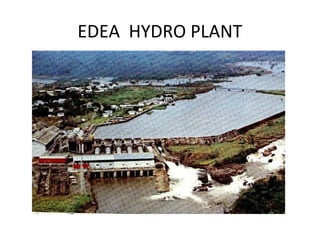
EDEA HYDRO PLANT
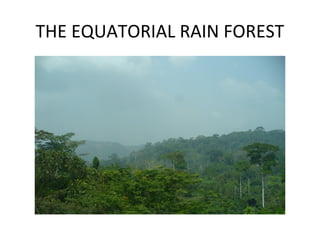
THE EQUATORIAL RAIN FOREST
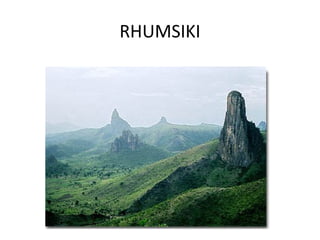
RHUMSIKI
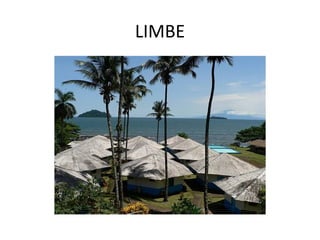
LIMBE
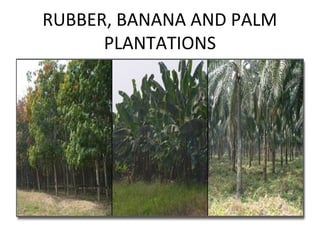
RUBBER, BANANA AND PALM
PLANTATIONS
NDU TEA ESTATE
WAZA NATIONAL PARK
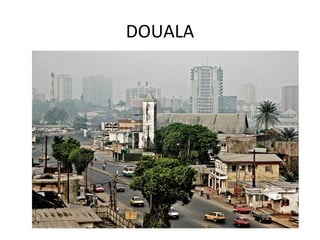
DOUALA
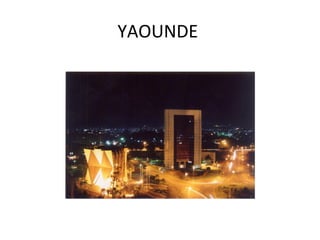
YAOUNDE
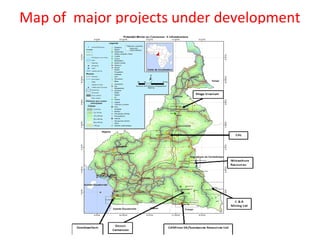
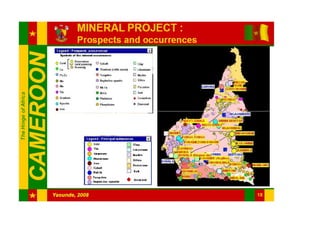
Map of major projects under development
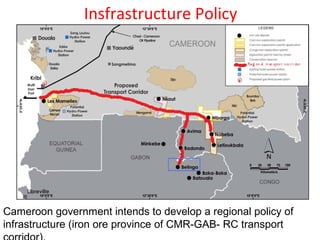
Insfrastructure Policy
Cameroon government intends to develop a regional policy of
infrastructure (iron ore province of CMR-GAB- RC transport
Infrastructure(ctd)
• Hydroelectric dams of Edea, Song-Loulou, Lagdo for a
total of 1200 MW;
• Nyassa in Douala thermic central of gas has been
launched for energy capacity enhancing;
• Construction of Lom-Panger and Memvele started in 2011;
• Mekin and Menchum hydroelectric dams starts 2014;
• Kribi gas thermal plant (150 MW) will be operational 2013;
• 5000 km of asphalted roads, 45000 km of maintained
laterite roads;
• Three International ( Douala, Yaounde-Nsimalen &
Garoua), and three national airports;
Infrastructure (ctd)
• Railway linking Douala – Yaounde – Ngaoundere &
western railway (1009 km);
• Kribi deep sea port under construction since 2010;
• Limbe deep sea port preliminary studies have
started;
• Opportunities for BOT negotiations with the
government on rail reoptimization/built;
• Work on the Yaounde-Douala high-way ongoing.
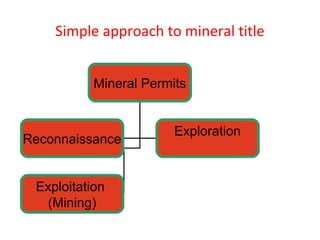
Simple approach to mineral title
Mineral Permits
Reconnaissance
Exploration
Exploitation
(Mining)
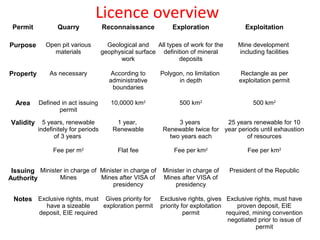
Licence overview
Permit Quarry Reconnaissance Exploration Exploitation
Purpose Open pit various
materials
Geological and
geophysical surface
work
All types of work for the
definition of mineral
deposits
Mine development
including facilities
Property As necessary According to
administrative
boundaries
Polygon, no limitation
in depth
Rectangle as per
exploitation permit
Area Defined in act issuing
permit
10,0000 km2
500 km2
500 km2
Validity 5 years, renewable
indefinitely for periods
of 3 years
Fee per m2
1 year,
Renewable
Flat fee
3 years
Renewable twice for
two years each
Fee per km2
25 years renewable for 10
year periods until exhaustion
of resources
Fee per km2
Issuing
Authority
Minister in charge of
Mines
Minister in charge of
Mines after VISA of
presidency
Minister in charge of
Mines after VISA of
presidency
President of the Republic
Notes Exclusive rights, must
have a sizeable
deposit, EIE required
Gives priority for
exploration permit
Exclusive rights, gives
priority for exploitation
permit
Exclusive rights, must have
proven deposit, EIE
required, mining convention
negotiated prior to issue of
permit
Duration for processing of applicationsDuration for processing of applications
• Applications for grant of reconnaissance licence and mining titles shall
be processed within the following time-frames: reconnaissance or
prospecting licence: within 30 (thirty) days of registration of the
application; exploration permit: within 45 (forty-five) days of registration
of the application; mining permit: within 90 (ninety) days of registration of
the application.
• Where the application for mining title is not processed within the time-
frame prescribed above, the title shall be considered as granted, unless
the service in charge of mines duly informs the applicant, of the
extension of the time-limit for examining the application. Such time-limit
may not be longer than the initial time-frame.
• Where an application for renewal of a mining title is not processed
before the expiry date, such title shall continue to be in force for the land
for which the renewal is requested until notification of the renewal or
rejection.
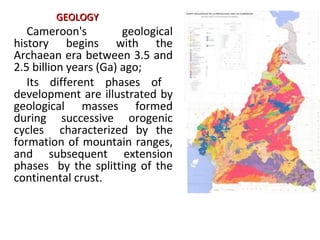
Cameroon's geological
history begins with the
Archaean era between 3.5 and
2.5 billion years (Ga) ago;
Its different phases of
development are illustrated by
geological masses formed
during successive orogenic
cycles characterized by the
formation of mountain ranges,
and subsequent extension
phases by the splitting of the
continental crust.
GEOLOGYGEOLOGY
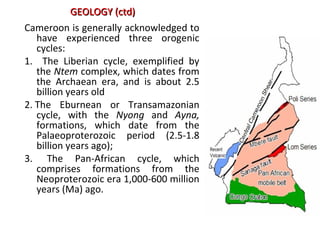
Cameroon is generally acknowledged to
have experienced three orogenic
cycles:
1. The Liberian cycle, exemplified by
the Ntem complex, which dates from
the Archaean era, and is about 2.5
billion years old
2. The Eburnean or Transamazonian
cycle, with the Nyong and Ayna,
formations, which date from the
Palaeoproterozoic period (2.5-1.8
billion years ago);
3. The Pan-African cycle, which
comprises formations from the
Neoproterozoic era 1,000-600 million
years (Ma) ago.
GEOLOGY (ctd)GEOLOGY (ctd)
Geology & Mineral potentialGeology & Mineral potential
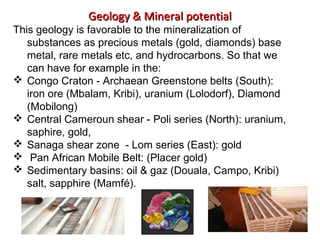
This geology is favorable to the mineralization of
substances as precious metals (gold, diamonds) base
metal, rare metals etc, and hydrocarbons. So that we
can have for example in the:
 Congo Craton - Archaean Greenstone belts (South):
iron ore (Mbalam, Kribi), uranium (Lolodorf), Diamond
(Mobilong)
 Central Cameroun shear - Poli series (North): uranium,
saphire, gold,
 Sanaga shear zone - Lom series (East): gold
 Pan African Mobile Belt: (Placer gold)
 Sedimentary basins: oil & gaz (Douala, Campo, Kribi)
salt, sapphire (Mamfé).
SUMARY OF THE EXPLORATION ISSUES
From 1960 to1990, some of these indices discovered through the
exploration carried out since the beginning of the last century,
were investigated with the bilateral cooperation agreements
between Cameroon and international bodies like BRGM, UNDP,
BGR and others. This resulted in the iron in Mbalam & Kribi,
bauxite in Ngaoundal and Minim Martap and Fongo Tongo,
Nickel-Cobalt in Lomie, titanium in Akonolinga, Tin in Mayo Darle,
Uranium in Poli & Lolodorf, Gold in the East region, Diamond in
the south east region. These projects form the current axis of the
mineral exploration & exploitation activities in Cameroon.
Actually :
 87 research permits have been granted to some companies;
one mining permit in Ni-Co and 3 for limestone and marble
have been issued.
The present review has focused its attention to some basic metal
and precious substances projects which are going on in
Cameroon territory.
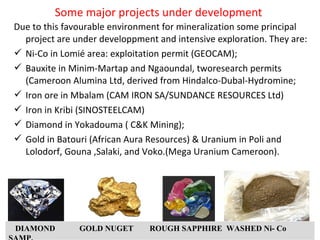
Some major projects under development
DIAMOND GOLD NUGET ROUGH SAPPHIRE WASHED Ni- Co
Due to this favourable environment for mineralization some principal
project are under developpment and intensive exploration. They are:
 Ni-Co in Lomié area: exploitation permit (GEOCAM);
 Bauxite in Minim-Martap and Ngaoundal, tworesearch permits
(Cameroon Alumina Ltd, derived from Hindalco-Dubal-Hydromine;
 Iron ore in Mbalam (CAM IRON SA/SUNDANCE RESOURCES Ltd)
 Iron in Kribi (SINOSTEELCAM)
 Diamond in Yokadouma ( C&K Mining);
 Gold in Batouri (African Aura Resources) & Uranium in Poli and
Lolodorf, Gouna ,Salaki, and Voko.(Mega Uranium Cameroon).
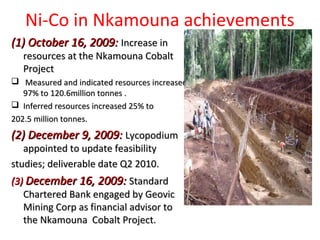
Ni-Co in Nkamouna achievements
(1) October 16, 2009:(1) October 16, 2009: Increase inIncrease in
resources at the Nkamouna Cobaltresources at the Nkamouna Cobalt
ProjectProject
 Measured and indicated resources increasedMeasured and indicated resources increased
97% to 120.6million tonnes .97% to 120.6million tonnes .
 Inferred resources increased 25% toInferred resources increased 25% to
202.5 million tonnes.202.5 million tonnes.
(2) December 9, 2009:(2) December 9, 2009: LycopodiumLycopodium
appointed to update feasibilityappointed to update feasibility
studies; deliverable date Q2 2010.studies; deliverable date Q2 2010.
(3)(3) December 16, 2009:December 16, 2009: StandardStandard
Chartered Bank engaged by GeovicChartered Bank engaged by Geovic
Mining Corp as financial advisor toMining Corp as financial advisor to
the Nkamouna Cobalt Project.the Nkamouna Cobalt Project.
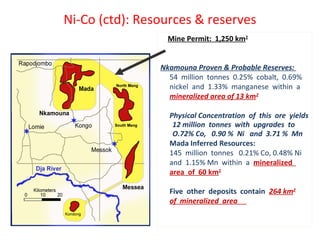
Ni-Co (ctd): Resources & reserves
Mine Permit: 1,250 km2
Nkamouna Proven & Probable Reserves:
54 million tonnes 0.25% cobalt, 0.69%
nickel and 1.33% manganese within a
mineralized area of 13 km2
Physical Concentration of this ore yields
12 million tonnes with upgrades to
O.72% Co, 0.90 % Ni and 3.71 % Mn
Mada Inferred Resources:
145 million tonnes 0.21% Co, 0.48% Ni
and 1.15% Mn within a mineralized
area of 60 km2
Five other deposits contain 264 km2
of mineralized area
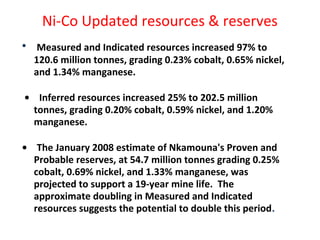
Ni-Co Updated resources & reserves
• Measured and Indicated resources increased 97% to
120.6 million tonnes, grading 0.23% cobalt, 0.65% nickel,
and 1.34% manganese.
• Inferred resources increased 25% to 202.5 million
tonnes, grading 0.20% cobalt, 0.59% nickel, and 1.20%
manganese.
• The January 2008 estimate of Nkamouna's Proven and
Probable reserves, at 54.7 million tonnes grading 0.25%
cobalt, 0.69% nickel, and 1.33% manganese, was
projected to support a 19-year mine life. The
approximate doubling in Measured and Indicated
resources suggests the potential to double this period.
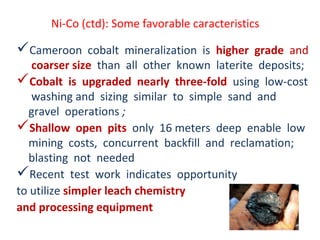
Ni-Co (ctd): Some favorable caracteristics
Cameroon cobalt mineralization is higher grade and
coarser size than all other known laterite deposits;
Cobalt is upgraded nearly three-fold using low-cost
washing and sizing similar to simple sand and
gravel operations ;
Shallow open pits only 16 meters deep enable low
mining costs, concurrent backfill and reclamation;
blasting not needed
Recent test work indicates opportunity
to utilize simpler leach chemistry
and processing equipment
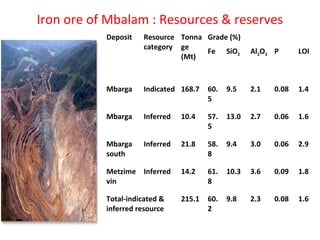
Iron ore of Mbalam : Resources & reserves
Deposit Resource
category
Tonna
ge
(Mt)
Grade (%)
Fe SiO2 Al2O3 P LOI
Mbarga Indicated 168.7 60.
5
9.5 2.1 0.08 1.4
Mbarga Inferred 10.4 57.
5
13.0 2.7 0.06 1.6
Mbarga
south
Inferred 21.8 58.
8
9.4 3.0 0.06 2.9
Metzime
vin
Inferred 14.2 61.
8
10.3 3.6 0.09 1.8
Total-indicated &
inferred resource
215.1 60.
2
9.8 2.3 0.08 1.6
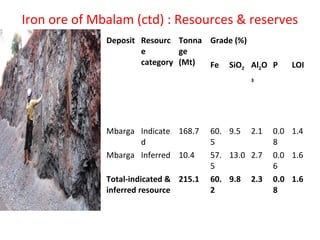
Iron ore of Mbalam (ctd) : Resources & reserves
Deposit Resourc
e
category
Tonna
ge
(Mt)
Grade (%)
Fe SiO2 Al2O
3
P LOI
Mbarga Indicate
d
168.7 60.
5
9.5 2.1 0.0
8
1.4
Mbarga Inferred 10.4 57.
5
13.0 2.7 0.0
6
1.6
Total-indicated &
inferred resource
215.1 60.
2
9.8 2.3 0.0
8
1.6
Mbalam Iron Ore: Recents achievements
• The indicated resource of itabirite hematite is
sufficient to provide beneficiation feed required for
the proposed production of high quality Direct
Reduction grade and blast furnace grade iron
concentrate during the first 20 years of project
operation.
• To enhance the high grade hematite, another RP
(N°143) has been granted to CAM IRON SA/
SUNDANCES RESOURCES Ltd for further exploration
activities.
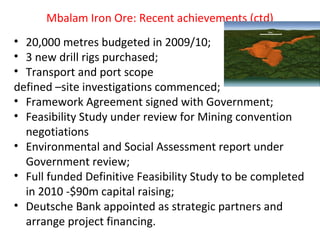
Mbalam Iron Ore: Recent achievements (ctd)
• 20,000 metres budgeted in 2009/10;
• 3 new drill rigs purchased;
• Transport and port scope
defined –site investigations commenced;
• Framework Agreement signed with Government;
• Feasibility Study under review for Mining convention
negotiations
• Environmental and Social Assessment report under
Government review;
• Full funded Definitive Feasibility Study to be completed
in 2010 -$90m capital raising;
• Deutsche Bank appointed as strategic partners and
arrange project financing.
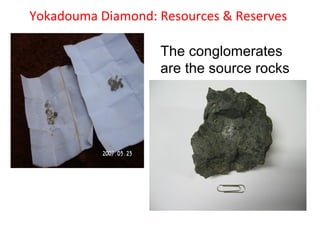
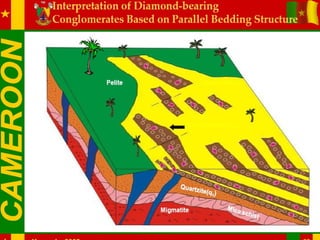
Yokadouma Diamond: Resources & Reserves
The conglomerates
are the source rocks
Yokadouma Diamond: Resources & Reserves
(ctd)
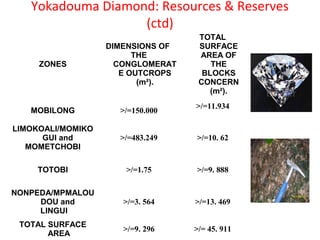
ZONES
DIMENSIONS OF
THE
CONGLOMERAT
E OUTCROPS
(m²).
TOTAL
SURFACE
AREA OF
THE
BLOCKS
CONCERN
(m²).
MOBILONG >/=150.000
>/=11.934
LIMOKOALI/MOMIKO
GUI and
MOMETCHOBI
>/=483.249 >/=10. 62
TOTOBI >/=1.75 >/=9. 888
NONPEDA/MPMALOU
DOU and
LINGUI
>/=3. 564 >/=13. 469
TOTAL SURFACE
AREA
>/=9. 296 >/= 45. 911
Yokadouma Diamond(ctd): Open pit
mining
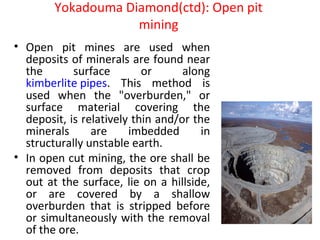
• Open pit mines are used when
deposits of minerals are found near
the surface or along
kimberlite pipes. This method is
used when the "overburden," or
surface material covering the
deposit, is relatively thin and/or the
minerals are imbedded in
structurally unstable earth.
• In open cut mining, the ore shall be
removed from deposits that crop
out at the surface, lie on a hillside,
or are covered by a shallow
overburden that is stripped before
or simultaneously with the removal
of the ore.
Yokadouma Diamond (ctd):Environmental
issues
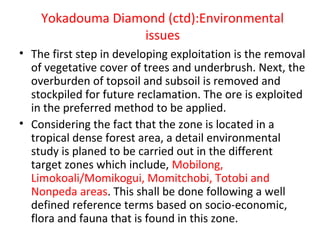
• The first step in developing exploitation is the removal
of vegetative cover of trees and underbrush. Next, the
overburden of topsoil and subsoil is removed and
stockpiled for future reclamation. The ore is exploited
in the preferred method to be applied.
• Considering the fact that the zone is located in a
tropical dense forest area, a detail environmental
study is planed to be carried out in the different
target zones which include, Mobilong,
Limokoali/Momikogui, Momitchobi, Totobi and
Nonpeda areas. This shall be done following a well
defined reference terms based on socio-economic,
flora and fauna that is found in this zone.
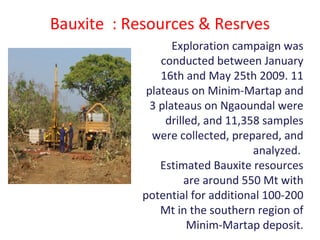
Bauxite : Resources & Resrves
Exploration campaign was
conducted between January
16th and May 25th 2009. 11
plateaus on Minim-Martap and
3 plateaus on Ngaoundal were
drilled, and 11,358 samples
were collected, prepared, and
analyzed.
Estimated Bauxite resources
are around 550 Mt with
potential for additional 100-200
Mt in the southern region of
Minim-Martap deposit.
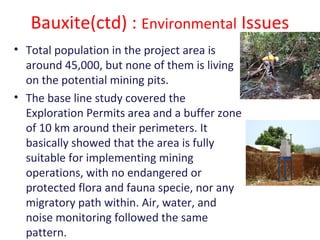
Bauxite(ctd) : Environmental Issues
• Total population in the project area is
around 45,000, but none of them is living
on the potential mining pits.
• The base line study covered the
Exploration Permits area and a buffer zone
of 10 km around their perimeters. It
basically showed that the area is fully
suitable for implementing mining
operations, with no endangered or
protected flora and fauna specie, nor any
migratory path within. Air, water, and
noise monitoring followed the same
pattern.
Bauxite (ctd): Alumina refinery
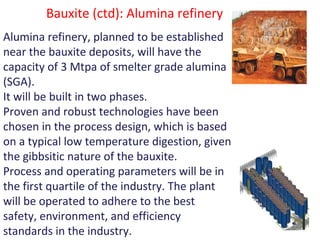
Alumina refinery, planned to be established
near the bauxite deposits, will have the
capacity of 3 Mtpa of smelter grade alumina
(SGA).
It will be built in two phases.
Proven and robust technologies have been
chosen in the process design, which is based
on a typical low temperature digestion, given
the gibbsitic nature of the bauxite.
Process and operating parameters will be in
the first quartile of the industry. The plant
will be operated to adhere to the best
safety, environment, and efficiency
standards in the industry.
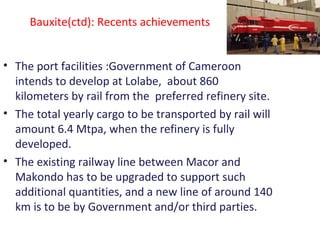
Bauxite(ctd): Recents achievements
• The port facilities :Government of Cameroon
intends to develop at Lolabe, about 860
kilometers by rail from the preferred refinery site.
• The total yearly cargo to be transported by rail will
amount 6.4 Mtpa, when the refinery is fully
developed.
• The existing railway line between Macor and
Makondo has to be upgraded to support such
additional quantities, and a new line of around 140
km is to be by Government and/or third parties.
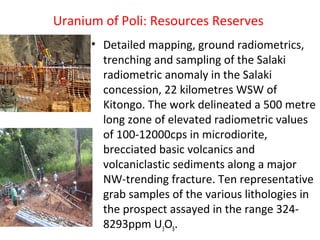
Uranium of Poli: Resources Reserves
• Detailed mapping, ground radiometrics,
trenching and sampling of the Salaki
radiometric anomaly in the Salaki
concession, 22 kilometres WSW of
Kitongo. The work delineated a 500 metre
long zone of elevated radiometric values
of 100-12000cps in microdiorite,
brecciated basic volcanics and
volcaniclastic sediments along a major
NW-trending fracture. Ten representative
grab samples of the various lithologies in
the prospect assayed in the range 324-
8293ppm U3O8.
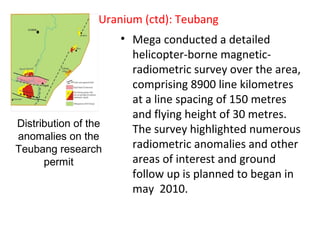
Uranium (ctd): Teubang
• Mega conducted a detailed
helicopter-borne magnetic-
radiometric survey over the area,
comprising 8900 line kilometres
at a line spacing of 150 metres
and flying height of 30 metres.
The survey highlighted numerous
radiometric anomalies and other
areas of interest and ground
follow up is planned to began in
may 2010.
Distribution of the
anomalies on the
Teubang research
permit
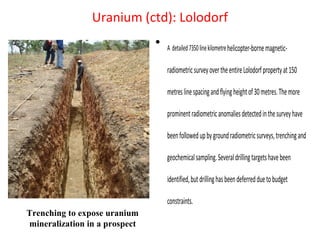
Uranium (ctd): Lolodorf
• A detailed7350linekilometrehelicopter-bornemagnetic-
radiometricsurveyovertheentireLolodorfpropertyat150
metreslinespacingandflyingheightof30metres.Themore
prominentradiometricanomaliesdetectedinthesurveyhave
beenfollowedupbygroundradiometricsurveys,trenchingand
geochemicalsampling.Severaldrillingtargetshavebeen
identified,butdrillinghasbeendeferredduetobudget
constraints.
Trenching to expose uranium
mineralization in a prospect
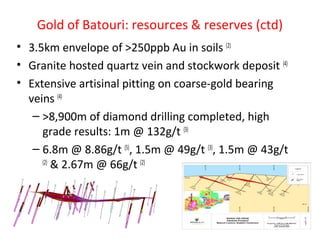
Gold of Batouri: resources & reserves (ctd)
• 3.5km envelope of >250ppb Au in soils (2)
• Granite hosted quartz vein and stockwork deposit (4)
• Extensive artisinal pitting on coarse-gold bearing
veins (4)
– >8,900m of diamond drilling completed, high
grade results: 1m @ 132g/t (3)
– 6.8m @ 8.86g/t (5)
, 1.5m @ 49g/t (3)
, 1.5m @ 43g/t
(2)
& 2.67m @ 66g/t (2)
Business Opportunities in the Sector
• Participation in a new mining inventory;
• Priority in the research permits
attribution to companies which have
participated to the new mining
inventory;
• Negotiations of JVs with the juniors
holding research permits are encouraged
by the government trough the mining
law.
THANK YOUTHANK YOU
FOR YOUR KINDFOR YOUR KIND
ATTENTIONATTENTION

Cameroon: The New Destination for Mining

  • 1.
    Republic of C AM E R O O N MINISTRY OF INDUSTRY, MINES & TECHNOLOGICAL DEVELOPMENT CAMEROON :THE NEW DESTINATION FOR MINING DR. FUH Calistus Gentry, PhD Mining On Top: Africa June 2013
  • 2.
    Lies midway betweenWest and Central Africa; Stretches from the Gulf of Guinea in the South- West to Lake Chad in the North; Lies between 2° - 13° of latitude North and 08° - 16° of longitude East; Bounded to the: South-West and West by the Gulf of Guinea (the Atlantic Ocean) and the Federal Republic of Nigeria respectively; North by Lake Chad;  North-East and East by the Republics of Chad and Central Africa respectively; South by the Republics of Congo, Gabon and Equatorial Guinea; Population: January 2010 estimation gives 19.4 million inhabitants. LOCATIONLOCATION
  • 3.
  • 4.
  • 5.
  • 6.
  • 7.
    RUBBER, BANANA ANDPALM PLANTATIONS
  • 8.
  • 9.
  • 10.
  • 11.
  • 12.
    Map of majorprojects under development
  • 13.
    Insfrastructure Policy Cameroon governmentintends to develop a regional policy of infrastructure (iron ore province of CMR-GAB- RC transport
  • 14.
    Infrastructure(ctd) • Hydroelectric damsof Edea, Song-Loulou, Lagdo for a total of 1200 MW; • Nyassa in Douala thermic central of gas has been launched for energy capacity enhancing; • Construction of Lom-Panger and Memvele started in 2011; • Mekin and Menchum hydroelectric dams starts 2014; • Kribi gas thermal plant (150 MW) will be operational 2013; • 5000 km of asphalted roads, 45000 km of maintained laterite roads; • Three International ( Douala, Yaounde-Nsimalen & Garoua), and three national airports;
  • 15.
    Infrastructure (ctd) • Railwaylinking Douala – Yaounde – Ngaoundere & western railway (1009 km); • Kribi deep sea port under construction since 2010; • Limbe deep sea port preliminary studies have started; • Opportunities for BOT negotiations with the government on rail reoptimization/built; • Work on the Yaounde-Douala high-way ongoing.
  • 16.
    Simple approach tomineral title Mineral Permits Reconnaissance Exploration Exploitation (Mining)
  • 17.
    Licence overview Permit QuarryReconnaissance Exploration Exploitation Purpose Open pit various materials Geological and geophysical surface work All types of work for the definition of mineral deposits Mine development including facilities Property As necessary According to administrative boundaries Polygon, no limitation in depth Rectangle as per exploitation permit Area Defined in act issuing permit 10,0000 km2 500 km2 500 km2 Validity 5 years, renewable indefinitely for periods of 3 years Fee per m2 1 year, Renewable Flat fee 3 years Renewable twice for two years each Fee per km2 25 years renewable for 10 year periods until exhaustion of resources Fee per km2 Issuing Authority Minister in charge of Mines Minister in charge of Mines after VISA of presidency Minister in charge of Mines after VISA of presidency President of the Republic Notes Exclusive rights, must have a sizeable deposit, EIE required Gives priority for exploration permit Exclusive rights, gives priority for exploitation permit Exclusive rights, must have proven deposit, EIE required, mining convention negotiated prior to issue of permit
  • 18.
    Duration for processingof applicationsDuration for processing of applications • Applications for grant of reconnaissance licence and mining titles shall be processed within the following time-frames: reconnaissance or prospecting licence: within 30 (thirty) days of registration of the application; exploration permit: within 45 (forty-five) days of registration of the application; mining permit: within 90 (ninety) days of registration of the application. • Where the application for mining title is not processed within the time- frame prescribed above, the title shall be considered as granted, unless the service in charge of mines duly informs the applicant, of the extension of the time-limit for examining the application. Such time-limit may not be longer than the initial time-frame. • Where an application for renewal of a mining title is not processed before the expiry date, such title shall continue to be in force for the land for which the renewal is requested until notification of the renewal or rejection.
  • 19.
    Cameroon's geological history beginswith the Archaean era between 3.5 and 2.5 billion years (Ga) ago; Its different phases of development are illustrated by geological masses formed during successive orogenic cycles characterized by the formation of mountain ranges, and subsequent extension phases by the splitting of the continental crust. GEOLOGYGEOLOGY
  • 20.
    Cameroon is generallyacknowledged to have experienced three orogenic cycles: 1. The Liberian cycle, exemplified by the Ntem complex, which dates from the Archaean era, and is about 2.5 billion years old 2. The Eburnean or Transamazonian cycle, with the Nyong and Ayna, formations, which date from the Palaeoproterozoic period (2.5-1.8 billion years ago); 3. The Pan-African cycle, which comprises formations from the Neoproterozoic era 1,000-600 million years (Ma) ago. GEOLOGY (ctd)GEOLOGY (ctd)
  • 21.
    Geology & MineralpotentialGeology & Mineral potential This geology is favorable to the mineralization of substances as precious metals (gold, diamonds) base metal, rare metals etc, and hydrocarbons. So that we can have for example in the:  Congo Craton - Archaean Greenstone belts (South): iron ore (Mbalam, Kribi), uranium (Lolodorf), Diamond (Mobilong)  Central Cameroun shear - Poli series (North): uranium, saphire, gold,  Sanaga shear zone - Lom series (East): gold  Pan African Mobile Belt: (Placer gold)  Sedimentary basins: oil & gaz (Douala, Campo, Kribi) salt, sapphire (Mamfé).
  • 22.
    SUMARY OF THEEXPLORATION ISSUES From 1960 to1990, some of these indices discovered through the exploration carried out since the beginning of the last century, were investigated with the bilateral cooperation agreements between Cameroon and international bodies like BRGM, UNDP, BGR and others. This resulted in the iron in Mbalam & Kribi, bauxite in Ngaoundal and Minim Martap and Fongo Tongo, Nickel-Cobalt in Lomie, titanium in Akonolinga, Tin in Mayo Darle, Uranium in Poli & Lolodorf, Gold in the East region, Diamond in the south east region. These projects form the current axis of the mineral exploration & exploitation activities in Cameroon. Actually :  87 research permits have been granted to some companies; one mining permit in Ni-Co and 3 for limestone and marble have been issued. The present review has focused its attention to some basic metal and precious substances projects which are going on in Cameroon territory.
  • 24.
    Some major projectsunder development DIAMOND GOLD NUGET ROUGH SAPPHIRE WASHED Ni- Co Due to this favourable environment for mineralization some principal project are under developpment and intensive exploration. They are:  Ni-Co in Lomié area: exploitation permit (GEOCAM);  Bauxite in Minim-Martap and Ngaoundal, tworesearch permits (Cameroon Alumina Ltd, derived from Hindalco-Dubal-Hydromine;  Iron ore in Mbalam (CAM IRON SA/SUNDANCE RESOURCES Ltd)  Iron in Kribi (SINOSTEELCAM)  Diamond in Yokadouma ( C&K Mining);  Gold in Batouri (African Aura Resources) & Uranium in Poli and Lolodorf, Gouna ,Salaki, and Voko.(Mega Uranium Cameroon).
  • 25.
    Ni-Co in Nkamounaachievements (1) October 16, 2009:(1) October 16, 2009: Increase inIncrease in resources at the Nkamouna Cobaltresources at the Nkamouna Cobalt ProjectProject  Measured and indicated resources increasedMeasured and indicated resources increased 97% to 120.6million tonnes .97% to 120.6million tonnes .  Inferred resources increased 25% toInferred resources increased 25% to 202.5 million tonnes.202.5 million tonnes. (2) December 9, 2009:(2) December 9, 2009: LycopodiumLycopodium appointed to update feasibilityappointed to update feasibility studies; deliverable date Q2 2010.studies; deliverable date Q2 2010. (3)(3) December 16, 2009:December 16, 2009: StandardStandard Chartered Bank engaged by GeovicChartered Bank engaged by Geovic Mining Corp as financial advisor toMining Corp as financial advisor to the Nkamouna Cobalt Project.the Nkamouna Cobalt Project.
  • 26.
    Ni-Co (ctd): Resources& reserves Mine Permit: 1,250 km2 Nkamouna Proven & Probable Reserves: 54 million tonnes 0.25% cobalt, 0.69% nickel and 1.33% manganese within a mineralized area of 13 km2 Physical Concentration of this ore yields 12 million tonnes with upgrades to O.72% Co, 0.90 % Ni and 3.71 % Mn Mada Inferred Resources: 145 million tonnes 0.21% Co, 0.48% Ni and 1.15% Mn within a mineralized area of 60 km2 Five other deposits contain 264 km2 of mineralized area
  • 27.
    Ni-Co Updated resources& reserves • Measured and Indicated resources increased 97% to 120.6 million tonnes, grading 0.23% cobalt, 0.65% nickel, and 1.34% manganese. • Inferred resources increased 25% to 202.5 million tonnes, grading 0.20% cobalt, 0.59% nickel, and 1.20% manganese. • The January 2008 estimate of Nkamouna's Proven and Probable reserves, at 54.7 million tonnes grading 0.25% cobalt, 0.69% nickel, and 1.33% manganese, was projected to support a 19-year mine life. The approximate doubling in Measured and Indicated resources suggests the potential to double this period.
  • 28.
    Ni-Co (ctd): Somefavorable caracteristics Cameroon cobalt mineralization is higher grade and coarser size than all other known laterite deposits; Cobalt is upgraded nearly three-fold using low-cost washing and sizing similar to simple sand and gravel operations ; Shallow open pits only 16 meters deep enable low mining costs, concurrent backfill and reclamation; blasting not needed Recent test work indicates opportunity to utilize simpler leach chemistry and processing equipment
  • 29.
    Iron ore ofMbalam : Resources & reserves Deposit Resource category Tonna ge (Mt) Grade (%) Fe SiO2 Al2O3 P LOI Mbarga Indicated 168.7 60. 5 9.5 2.1 0.08 1.4 Mbarga Inferred 10.4 57. 5 13.0 2.7 0.06 1.6 Mbarga south Inferred 21.8 58. 8 9.4 3.0 0.06 2.9 Metzime vin Inferred 14.2 61. 8 10.3 3.6 0.09 1.8 Total-indicated & inferred resource 215.1 60. 2 9.8 2.3 0.08 1.6
  • 30.
    Iron ore ofMbalam (ctd) : Resources & reserves Deposit Resourc e category Tonna ge (Mt) Grade (%) Fe SiO2 Al2O 3 P LOI Mbarga Indicate d 168.7 60. 5 9.5 2.1 0.0 8 1.4 Mbarga Inferred 10.4 57. 5 13.0 2.7 0.0 6 1.6 Total-indicated & inferred resource 215.1 60. 2 9.8 2.3 0.0 8 1.6
  • 31.
    Mbalam Iron Ore:Recents achievements • The indicated resource of itabirite hematite is sufficient to provide beneficiation feed required for the proposed production of high quality Direct Reduction grade and blast furnace grade iron concentrate during the first 20 years of project operation. • To enhance the high grade hematite, another RP (N°143) has been granted to CAM IRON SA/ SUNDANCES RESOURCES Ltd for further exploration activities.
  • 32.
    Mbalam Iron Ore:Recent achievements (ctd) • 20,000 metres budgeted in 2009/10; • 3 new drill rigs purchased; • Transport and port scope defined –site investigations commenced; • Framework Agreement signed with Government; • Feasibility Study under review for Mining convention negotiations • Environmental and Social Assessment report under Government review; • Full funded Definitive Feasibility Study to be completed in 2010 -$90m capital raising; • Deutsche Bank appointed as strategic partners and arrange project financing.
  • 33.
    Yokadouma Diamond: Resources& Reserves The conglomerates are the source rocks
  • 35.
    Yokadouma Diamond: Resources& Reserves (ctd) ZONES DIMENSIONS OF THE CONGLOMERAT E OUTCROPS (m²). TOTAL SURFACE AREA OF THE BLOCKS CONCERN (m²). MOBILONG >/=150.000 >/=11.934 LIMOKOALI/MOMIKO GUI and MOMETCHOBI >/=483.249 >/=10. 62 TOTOBI >/=1.75 >/=9. 888 NONPEDA/MPMALOU DOU and LINGUI >/=3. 564 >/=13. 469 TOTAL SURFACE AREA >/=9. 296 >/= 45. 911
  • 36.
    Yokadouma Diamond(ctd): Openpit mining • Open pit mines are used when deposits of minerals are found near the surface or along kimberlite pipes. This method is used when the "overburden," or surface material covering the deposit, is relatively thin and/or the minerals are imbedded in structurally unstable earth. • In open cut mining, the ore shall be removed from deposits that crop out at the surface, lie on a hillside, or are covered by a shallow overburden that is stripped before or simultaneously with the removal of the ore.
  • 37.
    Yokadouma Diamond (ctd):Environmental issues •The first step in developing exploitation is the removal of vegetative cover of trees and underbrush. Next, the overburden of topsoil and subsoil is removed and stockpiled for future reclamation. The ore is exploited in the preferred method to be applied. • Considering the fact that the zone is located in a tropical dense forest area, a detail environmental study is planed to be carried out in the different target zones which include, Mobilong, Limokoali/Momikogui, Momitchobi, Totobi and Nonpeda areas. This shall be done following a well defined reference terms based on socio-economic, flora and fauna that is found in this zone.
  • 38.
    Bauxite : Resources& Resrves Exploration campaign was conducted between January 16th and May 25th 2009. 11 plateaus on Minim-Martap and 3 plateaus on Ngaoundal were drilled, and 11,358 samples were collected, prepared, and analyzed. Estimated Bauxite resources are around 550 Mt with potential for additional 100-200 Mt in the southern region of Minim-Martap deposit.
  • 39.
    Bauxite(ctd) : EnvironmentalIssues • Total population in the project area is around 45,000, but none of them is living on the potential mining pits. • The base line study covered the Exploration Permits area and a buffer zone of 10 km around their perimeters. It basically showed that the area is fully suitable for implementing mining operations, with no endangered or protected flora and fauna specie, nor any migratory path within. Air, water, and noise monitoring followed the same pattern.
  • 40.
    Bauxite (ctd): Aluminarefinery Alumina refinery, planned to be established near the bauxite deposits, will have the capacity of 3 Mtpa of smelter grade alumina (SGA). It will be built in two phases. Proven and robust technologies have been chosen in the process design, which is based on a typical low temperature digestion, given the gibbsitic nature of the bauxite. Process and operating parameters will be in the first quartile of the industry. The plant will be operated to adhere to the best safety, environment, and efficiency standards in the industry.
  • 41.
    Bauxite(ctd): Recents achievements •The port facilities :Government of Cameroon intends to develop at Lolabe, about 860 kilometers by rail from the preferred refinery site. • The total yearly cargo to be transported by rail will amount 6.4 Mtpa, when the refinery is fully developed. • The existing railway line between Macor and Makondo has to be upgraded to support such additional quantities, and a new line of around 140 km is to be by Government and/or third parties.
  • 42.
    Uranium of Poli:Resources Reserves • Detailed mapping, ground radiometrics, trenching and sampling of the Salaki radiometric anomaly in the Salaki concession, 22 kilometres WSW of Kitongo. The work delineated a 500 metre long zone of elevated radiometric values of 100-12000cps in microdiorite, brecciated basic volcanics and volcaniclastic sediments along a major NW-trending fracture. Ten representative grab samples of the various lithologies in the prospect assayed in the range 324- 8293ppm U3O8.
  • 43.
    Uranium (ctd): Teubang •Mega conducted a detailed helicopter-borne magnetic- radiometric survey over the area, comprising 8900 line kilometres at a line spacing of 150 metres and flying height of 30 metres. The survey highlighted numerous radiometric anomalies and other areas of interest and ground follow up is planned to began in may 2010. Distribution of the anomalies on the Teubang research permit
  • 44.
    Uranium (ctd): Lolodorf •A detailed7350linekilometrehelicopter-bornemagnetic- radiometricsurveyovertheentireLolodorfpropertyat150 metreslinespacingandflyingheightof30metres.Themore prominentradiometricanomaliesdetectedinthesurveyhave beenfollowedupbygroundradiometricsurveys,trenchingand geochemicalsampling.Severaldrillingtargetshavebeen identified,butdrillinghasbeendeferredduetobudget constraints. Trenching to expose uranium mineralization in a prospect
  • 45.
    Gold of Batouri:resources & reserves (ctd) • 3.5km envelope of >250ppb Au in soils (2) • Granite hosted quartz vein and stockwork deposit (4) • Extensive artisinal pitting on coarse-gold bearing veins (4) – >8,900m of diamond drilling completed, high grade results: 1m @ 132g/t (3) – 6.8m @ 8.86g/t (5) , 1.5m @ 49g/t (3) , 1.5m @ 43g/t (2) & 2.67m @ 66g/t (2)
  • 46.
    Business Opportunities inthe Sector • Participation in a new mining inventory; • Priority in the research permits attribution to companies which have participated to the new mining inventory; • Negotiations of JVs with the juniors holding research permits are encouraged by the government trough the mining law.
  • 48.
    THANK YOUTHANK YOU FORYOUR KINDFOR YOUR KIND ATTENTIONATTENTION