Cold Laser Therapy And Applications
  in Canine Rehabilitation Therapy
   Presented by Deanna Clark
 DVM, CCRT of 4 Paws Swim and
            Fitness
          10/26/2011
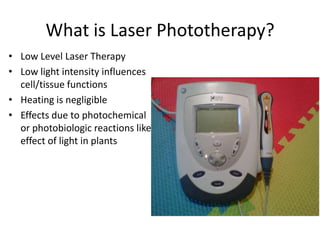
What is Laser Phototherapy?
• Low Level Laser Therapy
• Low light intensity influences
  cell/tissue functions
• Heating is negligible
• Effects due to photochemical
  or photobiologic reactions like
  effect of light in plants
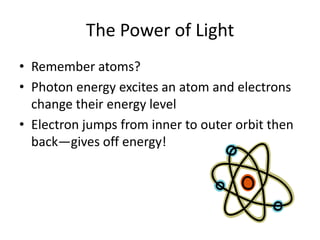
The Power of Light
• Remember atoms?
• Photon energy excites an atom and electrons
  change their energy level
• Electron jumps from inner to outer orbit then
  back—gives off energy!
Physiological Effects
•   Visible red light absorbed in mitochondria
•   Infra red light absorbed at cellular membranes
•   Increases ATP
•   DNA production
•   Opens Ca channels
•   Increases cellular proliferation
•   Increase in release of growth factor
•   Increased myofibroblast activity
•   Alters pain threshold
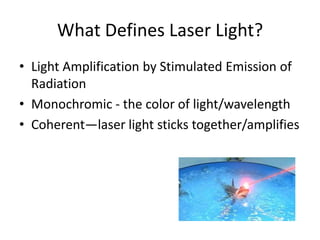
What Defines Laser Light?
• Light Amplification by Stimulated Emission of
  Radiation
• Monochromic - the color of light/wavelength
• Coherent—laser light sticks together/amplifies
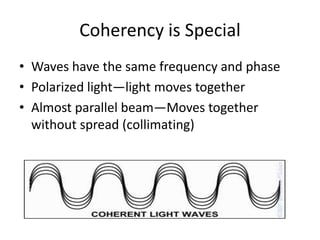
Coherency is Special
• Waves have the same frequency and phase
• Polarized light—light moves together
• Almost parallel beam—Moves together
  without spread (collimating)
Laser Light
•   Visible: Helium Neon (HeNe) 400-700 nm
•   Invisible: Infrared 750nm-950nm
•   600-1000 nm is therapeutic window
•   < 600 nm Bactericidal
•   600 nm Skin repair and acupoint stim
•   600-1000 nm tissue repair
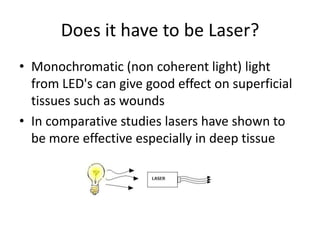
Does it have to be Laser?
• Monochromatic (non coherent light) light
  from LED's can give good effect on superficial
  tissues such as wounds
• In comparative studies lasers have shown to
  be more effective especially in deep tissue
How Deep can Laser Penetrate?
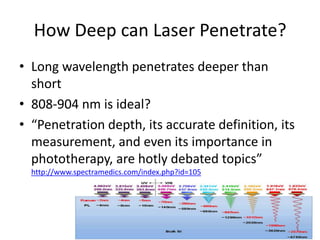
• Long wavelength penetrates deeper than
  short
• 808-904 nm is ideal?
• “Penetration depth, its accurate definition, its
  measurement, and even its importance in
  phototherapy, are hotly debated topics”
  http://www.spectramedics.com/index.php?id=105
Power of Penetration
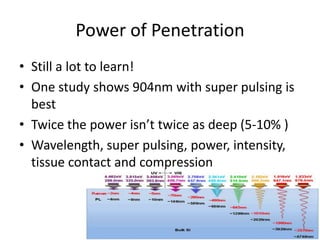
• Still a lot to learn!
• One study shows 904nm with super pulsing is
  best
• Twice the power isn’t twice as deep (5-10% )
• Wavelength, super pulsing, power, intensity,
  tissue contact and compression
What about Absorption?
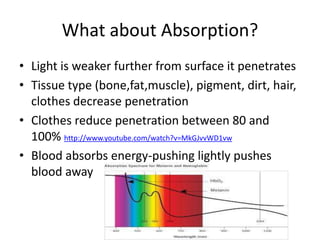
• Light is weaker further from surface it penetrates
• Tissue type (bone,fat,muscle), pigment, dirt, hair,
  clothes decrease penetration
• Clothes reduce penetration between 80 and
  100% http://www.youtube.com/watch?v=MkGJvvWD1vw
• Blood absorbs energy-pushing lightly pushes
  blood away
What does this Imply?
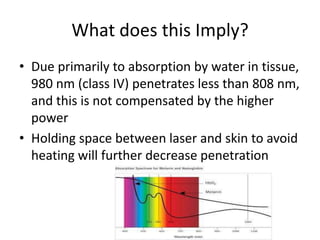
• Due primarily to absorption by water in tissue,
  980 nm (class IV) penetrates less than 808 nm,
  and this is not compensated by the higher
  power
• Holding space between laser and skin to avoid
  heating will further decrease penetration
Does LLLT Cause Heating of Tissue?
• Yes - all light causes heating if absorbed
• GaAlAs (3B) lasers in 300-500 mW range cause
  noticeable heat sensation, particularly hairy
  areas, tattoo
• Melanin important factor; dark skin > fair skin
• Increased circulation causes increase
  0.5-1 °C local
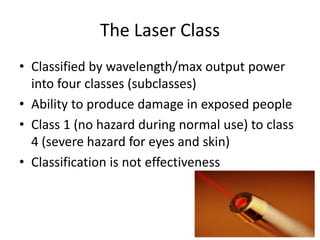
The Laser Class
• Classified by wavelength/max output power
  into four classes (subclasses)
• Ability to produce damage in exposed people
• Class 1 (no hazard during normal use) to class
  4 (severe hazard for eyes and skin)
• Classification is not effectiveness
Laser Classes

• Class I 0.4 mW
• Class II 0.5-1.0 mW blink
  adequate
• Class IIIa 1-5 mW eye caution
• Class IIIb 5-500 mW eye danger
• Class IV >500 mW fire
  hazard, Danger
Class 1 (less than 0.5 mW)
•   Visible and non visible
•   No eye or skin danger
•   Laser printers, car entry, CD players
•   No heating/no healing
•   Safe in all uses unless focused through
    magnifier
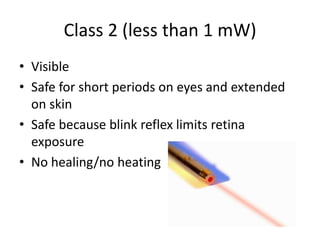
Class 2 (less than 1 mW)
• Visible
• Safe for short periods on eyes and extended
  on skin
• Safe because blink reflex limits retina
  exposure
• No healing/no heating
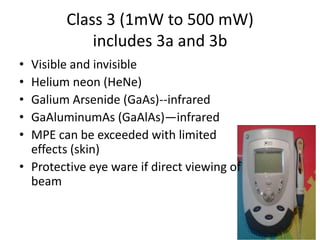
Class 3 (1mW to 500 mW)
            includes 3a and 3b
• Visible and invisible
• Helium neon (HeNe)
• Galium Arsenide (GaAs)--infrared
• GaAluminumAs (GaAlAs)—infrared
• MPE can be exceeded with limited
  effects (skin)
• Protective eye ware if direct viewing of
  beam
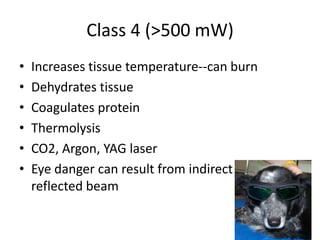
Class 4 (>500 mW)
•   Increases tissue temperature--can burn
•   Dehydrates tissue
•   Coagulates protein
•   Thermolysis
•   CO2, Argon, YAG laser
•   Eye danger can result from indirect or
    reflected beam
The Calculations
• Energy is power over time
• Energy (Joules) = Watt (W) x second
• Lasers come in mW and 1000 mW= 1 watt
• 1 joule from 5 mW laser requires 200 seconds
  of time (3.3 minutes)
• 50 mW laser requires 20 seconds
• 500 mW laser requires 2 seconds
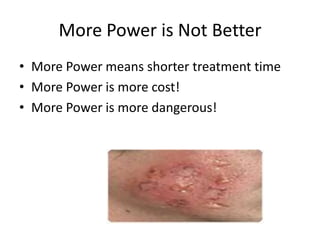
More Power is Not Better
• More Power means shorter treatment time
• More Power is more cost!
• More Power is more dangerous!
It Comes Down to Dose
• Class 3 and 4 can deliver same dose
• http://www.laser.nu/lllt/pdf/theimpossibledose.pdf
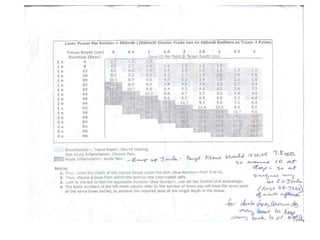
Dosage
•   Doses—Respond 904 nM, 500 mW, IIIb
•   1-3 j/cm(2) circulation
•   1-6 j/cm(2) acute pain
•   2-4 j/cm(2) muscle pain
•   4-6 j/cm(2) neurological indications
•   4-8 j/cm(2) joint pain
•   5-6 j/cm(2) wounds
•   8-12 j/cm(2) chronic pain and OA
•   Acu-points @ 60 mW = 33 sec = 2J
•   Laurie Edge-Hughes
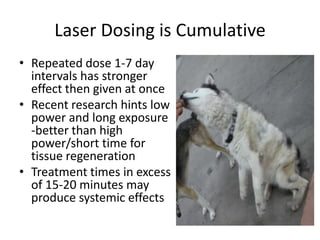
Laser Dosing is Cumulative
• Repeated dose 1-7 day
  intervals has stronger
  effect then given at once
• Recent research hints low
  power and long exposure
  -better than high
  power/short time for
  tissue regeneration
• Treatment times in excess
  of 15-20 minutes may
  produce systemic effects
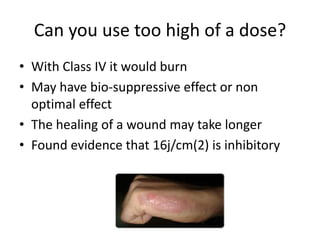
Can you use too high of a dose?
• With Class IV it would burn
• May have bio-suppressive effect or non
  optimal effect
• The healing of a wound may take longer
• Found evidence that 16j/cm(2) is inhibitory
Can Laser Light Cause Cancer?
• No mutational effects with wavelengths in red or
  infra-red range
• No mutational effects with doses used within LLLT
• Cancer cells in vitro have shown stimulation
• Rat studies shown small tumors can recede or
  completely disappear
• Rat studies shown no effect on tumors over a
  certain size
• Probably local immune system is stimulated more
  than the tumor
What about Bacteria
• The situation is the same for bacteria and
  virus in culture--stimulated by laser light in
  certain doses
• Bacterial or viral infection is cured much
  quicker after treatment with LLLT
• Study on MRSA-one positive and other refuted
  http://www.stanford.edu/~kendric/PDF/B57.pdf
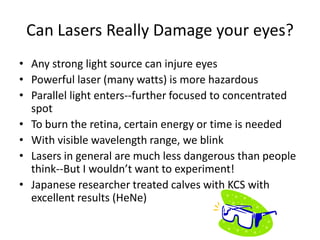
Can Lasers Really Damage your eyes?
• Any strong light source can injure eyes
• Powerful laser (many watts) is more hazardous
• Parallel light enters--further focused to concentrated
  spot
• To burn the retina, certain energy or time is needed
• With visible wavelength range, we blink
• Lasers in general are much less dangerous than people
  think--But I wouldn’t want to experiment!
• Japanese researcher treated calves with KCS with
  excellent results (HeNe)
Is Laser Therapy Proven?
• Mostly yes
• More than 130 double-blind
  positive studies confirming clinical
  effect of LLLT
• About 250 papers annually
  published in peer reviewed
  scientific papers
• www.pubmed.com
• www.laser.nu
And the Flip Side
• Many studies prove it doesn’t work
• Closer look reveals serious study flaws
• Don’t clearly indicate dose or are
  under-dosed
• LLLT will not work on everything
• Matter of dosage, diagnosis, treatment
  technique, individual reaction for any
  modality
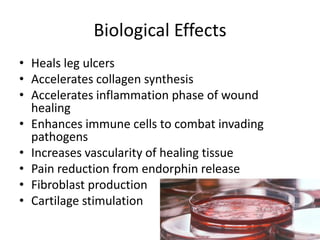
Biological Effects
• Heals leg ulcers
• Accelerates collagen synthesis
• Accelerates inflammation phase of wound
  healing
• Enhances immune cells to combat invading
  pathogens
• Increases vascularity of healing tissue
• Pain reduction from endorphin release
• Fibroblast production
• Cartilage stimulation
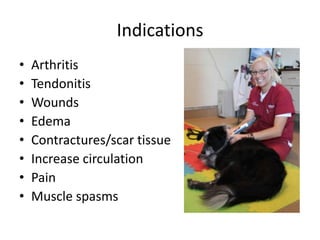
Indications
•   Arthritis
•   Tendonitis
•   Wounds
•   Edema
•   Contractures/scar tissue
•   Increase circulation
•   Pain
•   Muscle spasms
Contraindications
• Dr. Laurie Edge-Hughes says….
• Eye
• On cancerous lesions
• Pregnant abdomen (no testing)
• Unclosed fontanels
• Over Vagus nerve
• Over sympathetic ganglia
• Cardiac region of heart patients
• Areas of hemorrhage
• Over thyroid/endocrine glands
• Areas treated with recent cortisone injection (wait 1 week as may
  flare site)
• Stem cell therapy—wait 6-8 weeks
Contraindications?
• www.lasernu.com says….
• None medical
• In most countries-legal, i.e. you should not treat
  cancer or some other serious diseases
• Pregnancy is not-if treatment done with common
  sense
• Pacemakers are electronic -not influenced by light
• Most valid contraindication is possible lack of
  adequate medical treatment
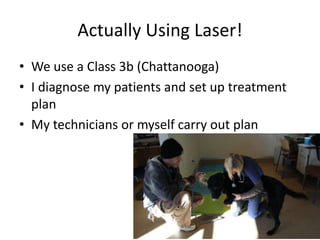
Actually Using Laser!
• We use a Class 3b (Chattanooga)
• I diagnose my patients and set up treatment
  plan
• My technicians or myself carry out plan
What Dose Do We Use?
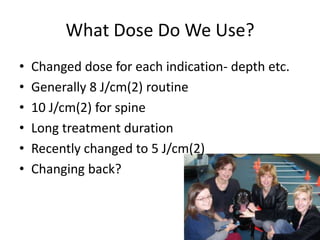
•   Changed dose for each indication- depth etc.
•   Generally 8 J/cm(2) routine
•   10 J/cm(2) for spine
•   Long treatment duration
•   Recently changed to 5 J/cm(2)
•   Changing back?
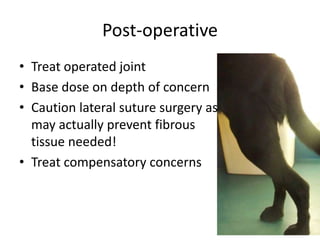
Post-operative
• Treat operated joint
• Base dose on depth of concern
• Caution lateral suture surgery as
  may actually prevent fibrous
  tissue needed!
• Treat compensatory concerns
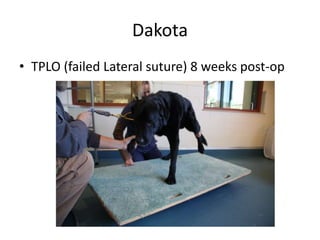
Dakota
• TPLO (failed Lateral suture) 8 weeks post-op
Osteoarthritis
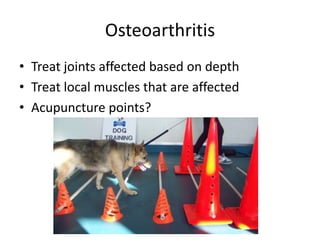
• Treat joints affected based on depth
• Treat local muscles that are affected
• Acupuncture points?
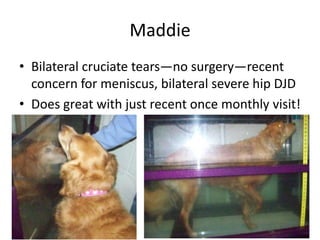
Maddie
• Bilateral cruciate tears—no surgery—recent
  concern for meniscus, bilateral severe hip DJD
• Does great with just recent once monthly visit!
Muscle injuries
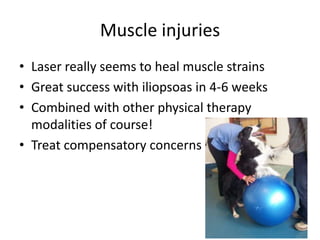
• Laser really seems to heal muscle strains
• Great success with iliopsoas in 4-6 weeks
• Combined with other physical therapy
  modalities of course!
• Treat compensatory concerns
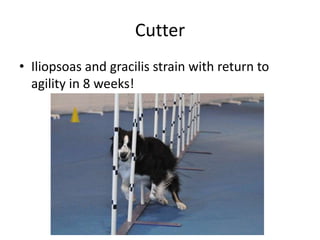
Cutter
• Iliopsoas and gracilis strain with return to
  agility in 8 weeks!
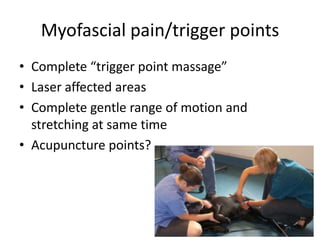
Myofascial pain/trigger points
• Complete “trigger point massage”
• Laser affected areas
• Complete gentle range of motion and
  stretching at same time
• Acupuncture points?
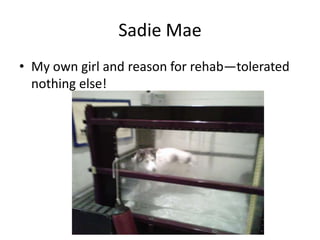
Sadie Mae
• My own girl and reason for rehab—tolerated
  nothing else!
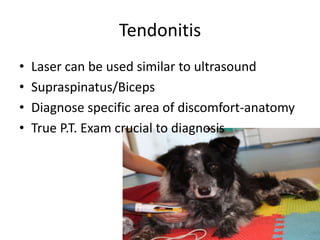
Tendonitis
•   Laser can be used similar to ultrasound
•   Supraspinatus/Biceps
•   Diagnose specific area of discomfort-anatomy
•   True P.T. Exam crucial to diagnosis
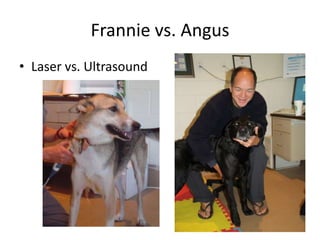
Frannie vs. Angus
• Laser vs. Ultrasound
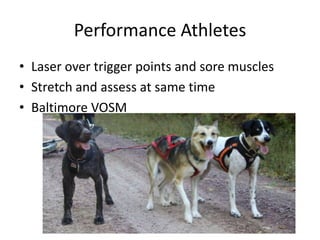
Performance Athletes
• Laser over trigger points and sore muscles
• Stretch and assess at same time
• Baltimore VOSM
Helmet
• Does one time laser session work?
• Study suggests endurance training
  program combined with LLLT lead
  to greater reduction in fatigue
 http://www.ncbi.nlm.nih.gov/pubmed/21870127
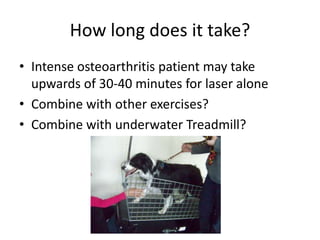
How long does it take?
• Intense osteoarthritis patient may take
  upwards of 30-40 minutes for laser alone
• Combine with other exercises?
• Combine with underwater Treadmill?
How to charge?
• Some charge per time
• Some charge per modality
• At 4 Paws we designate Level which is
  basically time and includes more modalities
References
• http://www.laser.nu/lllt/pdf/Confounders.pdf
• http://www.laser.nu/lllt/pdf/Penetration.pdf
• Laurie McCauley, DVM TOPS Veterinary
  rehabilitation
• www.laser.nu
• Dr. Laurie Edge-Hughes
• CRI—likes Spectra-Vet laser
• Swedish Laser-Medical Society
Questions?

Laser therapy presentation dr. clark

  • 1.
    Cold Laser TherapyAnd Applications in Canine Rehabilitation Therapy Presented by Deanna Clark DVM, CCRT of 4 Paws Swim and Fitness 10/26/2011
  • 2.
    What is LaserPhototherapy? • Low Level Laser Therapy • Low light intensity influences cell/tissue functions • Heating is negligible • Effects due to photochemical or photobiologic reactions like effect of light in plants
  • 3.
    The Power ofLight • Remember atoms? • Photon energy excites an atom and electrons change their energy level • Electron jumps from inner to outer orbit then back—gives off energy!
  • 4.
    Physiological Effects • Visible red light absorbed in mitochondria • Infra red light absorbed at cellular membranes • Increases ATP • DNA production • Opens Ca channels • Increases cellular proliferation • Increase in release of growth factor • Increased myofibroblast activity • Alters pain threshold
  • 5.
    What Defines LaserLight? • Light Amplification by Stimulated Emission of Radiation • Monochromic - the color of light/wavelength • Coherent—laser light sticks together/amplifies
  • 6.
    Coherency is Special •Waves have the same frequency and phase • Polarized light—light moves together • Almost parallel beam—Moves together without spread (collimating)
  • 7.
    Laser Light • Visible: Helium Neon (HeNe) 400-700 nm • Invisible: Infrared 750nm-950nm • 600-1000 nm is therapeutic window • < 600 nm Bactericidal • 600 nm Skin repair and acupoint stim • 600-1000 nm tissue repair
  • 8.
    Does it haveto be Laser? • Monochromatic (non coherent light) light from LED's can give good effect on superficial tissues such as wounds • In comparative studies lasers have shown to be more effective especially in deep tissue
  • 9.
    How Deep canLaser Penetrate? • Long wavelength penetrates deeper than short • 808-904 nm is ideal? • “Penetration depth, its accurate definition, its measurement, and even its importance in phototherapy, are hotly debated topics” http://www.spectramedics.com/index.php?id=105
  • 10.
    Power of Penetration •Still a lot to learn! • One study shows 904nm with super pulsing is best • Twice the power isn’t twice as deep (5-10% ) • Wavelength, super pulsing, power, intensity, tissue contact and compression
  • 11.
    What about Absorption? •Light is weaker further from surface it penetrates • Tissue type (bone,fat,muscle), pigment, dirt, hair, clothes decrease penetration • Clothes reduce penetration between 80 and 100% http://www.youtube.com/watch?v=MkGJvvWD1vw • Blood absorbs energy-pushing lightly pushes blood away
  • 12.
    What does thisImply? • Due primarily to absorption by water in tissue, 980 nm (class IV) penetrates less than 808 nm, and this is not compensated by the higher power • Holding space between laser and skin to avoid heating will further decrease penetration
  • 13.
    Does LLLT CauseHeating of Tissue? • Yes - all light causes heating if absorbed • GaAlAs (3B) lasers in 300-500 mW range cause noticeable heat sensation, particularly hairy areas, tattoo • Melanin important factor; dark skin > fair skin • Increased circulation causes increase 0.5-1 °C local
  • 14.
    The Laser Class •Classified by wavelength/max output power into four classes (subclasses) • Ability to produce damage in exposed people • Class 1 (no hazard during normal use) to class 4 (severe hazard for eyes and skin) • Classification is not effectiveness
  • 15.
    Laser Classes • ClassI 0.4 mW • Class II 0.5-1.0 mW blink adequate • Class IIIa 1-5 mW eye caution • Class IIIb 5-500 mW eye danger • Class IV >500 mW fire hazard, Danger
  • 16.
    Class 1 (lessthan 0.5 mW) • Visible and non visible • No eye or skin danger • Laser printers, car entry, CD players • No heating/no healing • Safe in all uses unless focused through magnifier
  • 17.
    Class 2 (lessthan 1 mW) • Visible • Safe for short periods on eyes and extended on skin • Safe because blink reflex limits retina exposure • No healing/no heating
  • 18.
    Class 3 (1mWto 500 mW) includes 3a and 3b • Visible and invisible • Helium neon (HeNe) • Galium Arsenide (GaAs)--infrared • GaAluminumAs (GaAlAs)—infrared • MPE can be exceeded with limited effects (skin) • Protective eye ware if direct viewing of beam
  • 19.
    Class 4 (>500mW) • Increases tissue temperature--can burn • Dehydrates tissue • Coagulates protein • Thermolysis • CO2, Argon, YAG laser • Eye danger can result from indirect or reflected beam
  • 20.
    The Calculations • Energyis power over time • Energy (Joules) = Watt (W) x second • Lasers come in mW and 1000 mW= 1 watt • 1 joule from 5 mW laser requires 200 seconds of time (3.3 minutes) • 50 mW laser requires 20 seconds • 500 mW laser requires 2 seconds
  • 21.
    More Power isNot Better • More Power means shorter treatment time • More Power is more cost! • More Power is more dangerous!
  • 22.
    It Comes Downto Dose • Class 3 and 4 can deliver same dose • http://www.laser.nu/lllt/pdf/theimpossibledose.pdf
  • 23.
    Dosage • Doses—Respond 904 nM, 500 mW, IIIb • 1-3 j/cm(2) circulation • 1-6 j/cm(2) acute pain • 2-4 j/cm(2) muscle pain • 4-6 j/cm(2) neurological indications • 4-8 j/cm(2) joint pain • 5-6 j/cm(2) wounds • 8-12 j/cm(2) chronic pain and OA • Acu-points @ 60 mW = 33 sec = 2J • Laurie Edge-Hughes
  • 25.
    Laser Dosing isCumulative • Repeated dose 1-7 day intervals has stronger effect then given at once • Recent research hints low power and long exposure -better than high power/short time for tissue regeneration • Treatment times in excess of 15-20 minutes may produce systemic effects
  • 26.
    Can you usetoo high of a dose? • With Class IV it would burn • May have bio-suppressive effect or non optimal effect • The healing of a wound may take longer • Found evidence that 16j/cm(2) is inhibitory
  • 27.
    Can Laser LightCause Cancer? • No mutational effects with wavelengths in red or infra-red range • No mutational effects with doses used within LLLT • Cancer cells in vitro have shown stimulation • Rat studies shown small tumors can recede or completely disappear • Rat studies shown no effect on tumors over a certain size • Probably local immune system is stimulated more than the tumor
  • 28.
    What about Bacteria •The situation is the same for bacteria and virus in culture--stimulated by laser light in certain doses • Bacterial or viral infection is cured much quicker after treatment with LLLT • Study on MRSA-one positive and other refuted http://www.stanford.edu/~kendric/PDF/B57.pdf
  • 29.
    Can Lasers ReallyDamage your eyes? • Any strong light source can injure eyes • Powerful laser (many watts) is more hazardous • Parallel light enters--further focused to concentrated spot • To burn the retina, certain energy or time is needed • With visible wavelength range, we blink • Lasers in general are much less dangerous than people think--But I wouldn’t want to experiment! • Japanese researcher treated calves with KCS with excellent results (HeNe)
  • 30.
    Is Laser TherapyProven? • Mostly yes • More than 130 double-blind positive studies confirming clinical effect of LLLT • About 250 papers annually published in peer reviewed scientific papers • www.pubmed.com • www.laser.nu
  • 31.
    And the FlipSide • Many studies prove it doesn’t work • Closer look reveals serious study flaws • Don’t clearly indicate dose or are under-dosed • LLLT will not work on everything • Matter of dosage, diagnosis, treatment technique, individual reaction for any modality
  • 32.
    Biological Effects • Healsleg ulcers • Accelerates collagen synthesis • Accelerates inflammation phase of wound healing • Enhances immune cells to combat invading pathogens • Increases vascularity of healing tissue • Pain reduction from endorphin release • Fibroblast production • Cartilage stimulation
  • 33.
    Indications • Arthritis • Tendonitis • Wounds • Edema • Contractures/scar tissue • Increase circulation • Pain • Muscle spasms
  • 34.
    Contraindications • Dr. LaurieEdge-Hughes says…. • Eye • On cancerous lesions • Pregnant abdomen (no testing) • Unclosed fontanels • Over Vagus nerve • Over sympathetic ganglia • Cardiac region of heart patients • Areas of hemorrhage • Over thyroid/endocrine glands • Areas treated with recent cortisone injection (wait 1 week as may flare site) • Stem cell therapy—wait 6-8 weeks
  • 35.
    Contraindications? • www.lasernu.com says…. •None medical • In most countries-legal, i.e. you should not treat cancer or some other serious diseases • Pregnancy is not-if treatment done with common sense • Pacemakers are electronic -not influenced by light • Most valid contraindication is possible lack of adequate medical treatment
  • 36.
    Actually Using Laser! •We use a Class 3b (Chattanooga) • I diagnose my patients and set up treatment plan • My technicians or myself carry out plan
  • 37.
    What Dose DoWe Use? • Changed dose for each indication- depth etc. • Generally 8 J/cm(2) routine • 10 J/cm(2) for spine • Long treatment duration • Recently changed to 5 J/cm(2) • Changing back?
  • 38.
    Post-operative • Treat operatedjoint • Base dose on depth of concern • Caution lateral suture surgery as may actually prevent fibrous tissue needed! • Treat compensatory concerns
  • 39.
    Dakota • TPLO (failedLateral suture) 8 weeks post-op
  • 40.
    Osteoarthritis • Treat jointsaffected based on depth • Treat local muscles that are affected • Acupuncture points?
  • 41.
    Maddie • Bilateral cruciatetears—no surgery—recent concern for meniscus, bilateral severe hip DJD • Does great with just recent once monthly visit!
  • 42.
    Muscle injuries • Laserreally seems to heal muscle strains • Great success with iliopsoas in 4-6 weeks • Combined with other physical therapy modalities of course! • Treat compensatory concerns
  • 43.
    Cutter • Iliopsoas andgracilis strain with return to agility in 8 weeks!
  • 44.
    Myofascial pain/trigger points •Complete “trigger point massage” • Laser affected areas • Complete gentle range of motion and stretching at same time • Acupuncture points?
  • 45.
    Sadie Mae • Myown girl and reason for rehab—tolerated nothing else!
  • 46.
    Tendonitis • Laser can be used similar to ultrasound • Supraspinatus/Biceps • Diagnose specific area of discomfort-anatomy • True P.T. Exam crucial to diagnosis
  • 47.
    Frannie vs. Angus •Laser vs. Ultrasound
  • 48.
    Performance Athletes • Laserover trigger points and sore muscles • Stretch and assess at same time • Baltimore VOSM
  • 49.
    Helmet • Does onetime laser session work? • Study suggests endurance training program combined with LLLT lead to greater reduction in fatigue http://www.ncbi.nlm.nih.gov/pubmed/21870127
  • 50.
    How long doesit take? • Intense osteoarthritis patient may take upwards of 30-40 minutes for laser alone • Combine with other exercises? • Combine with underwater Treadmill?
  • 51.
    How to charge? •Some charge per time • Some charge per modality • At 4 Paws we designate Level which is basically time and includes more modalities
  • 52.
    References • http://www.laser.nu/lllt/pdf/Confounders.pdf • http://www.laser.nu/lllt/pdf/Penetration.pdf •Laurie McCauley, DVM TOPS Veterinary rehabilitation • www.laser.nu • Dr. Laurie Edge-Hughes • CRI—likes Spectra-Vet laser • Swedish Laser-Medical Society
  • 53.

Editor's Notes

  • #2 Introduction and certification….. My name is Dr. Deanna Clark I graduated from UW vet school in 2004 as a large animal practitioner. My journey evolved to a mixed animal and now small animal only practitioner. I became interested in Canine Rehab about 2 ½ years ago due to my own interest in Canine sports medicine. I then began the journey through CRI to become certified in March. I have been working at 4 Paws with somewhat limited hours for the last 1 ½ years
  • #3 Cold laser therapy
  • #6 Lots of debate on what coherence is!! Like an onion—source comes from center and moves out where as other light is similar—but comes from multiple atoms and is like looking through a frosted pain of glass—image becomes distorted
  • #10 A laser designed for the treatment of humans is rarely suitable for treating animals with fur. There are, in fact, lasers specially made for this purpose. The special design feature here is that the laser diode(s) obtrude from the treatment probe rather like the teeth on a comb. By delving between the animal&apos;s hair, the laser diode&apos;s glass surface comes in contact with the skin and all the light from the laser is &quot;forced&quot; into the tissue. increasing power only increases the depth of penetration marginally. With the higher superficial absorbance of the 980 nm laser there will be considerable heating, and, while heat is finefor many conditions, it is not of what photomedicine
  • #11 The most surprising part of this is that the GaAs differs so much from the other. What is so special with that wavelength – 904 nm? It is not the wavelength, it is the extreme pulsing (super pulsing). Today it is possible to find GaAlAs-lasers with the 904 nm wavelength and then the energy loss due to the skin barrier is about 80%. Bjordal states further: “In vivo trials with 904 nm pulse lasers, have demonstrated that these lasers achieve similar effects on collagen production with far lower doses on the animal´s skin than lasers with continuous output (Enwemeka 1991a; van der Veen and Lievens 2000).This effect can be attributed to the photobleaching phenomenon, where the first strong pulse bleaches the opaque barrier of tissue, letting the second pulse pass through the tissue barrier with less loss of energy (Kusnetzow et al. 2001), (Fig. 7).”This has further been studied by Jon Joensen and presented by himself at the WALT meeting, September, 2010in Bergen, Norway. Figure 3 and 4. Surprisingly, the penetration of the super pulsed laser light is markedlyincreasing by the time, while the 810nm laser light transmission remained constant. The very high power peaksof the GaAs laser “bleaches” the collagen and thus gradually creates a more transparent tissue. This gradually increasing transmission supports the theory of bleaching
  • #12 limit at which intensity is so low no biological effect
  • #15 Classification has nothing to do with effectiveness
  • #19 MPE is maximal permissibleexposure
  • #20 yttrium aluminum garnet
  • #21 Energy is measurement of power over time
  • #22 Remember that Class 3 is 1mW-500 mW and Class 4 is &gt;500 mW
  • #28 Use in our patients?
  • #30 Obvious that a powerful laser is more hazardous to stare into than a weak laserEnergy is power multiplied by time, so exposure time is important.
  • #44 String cheese and Deli meat!!