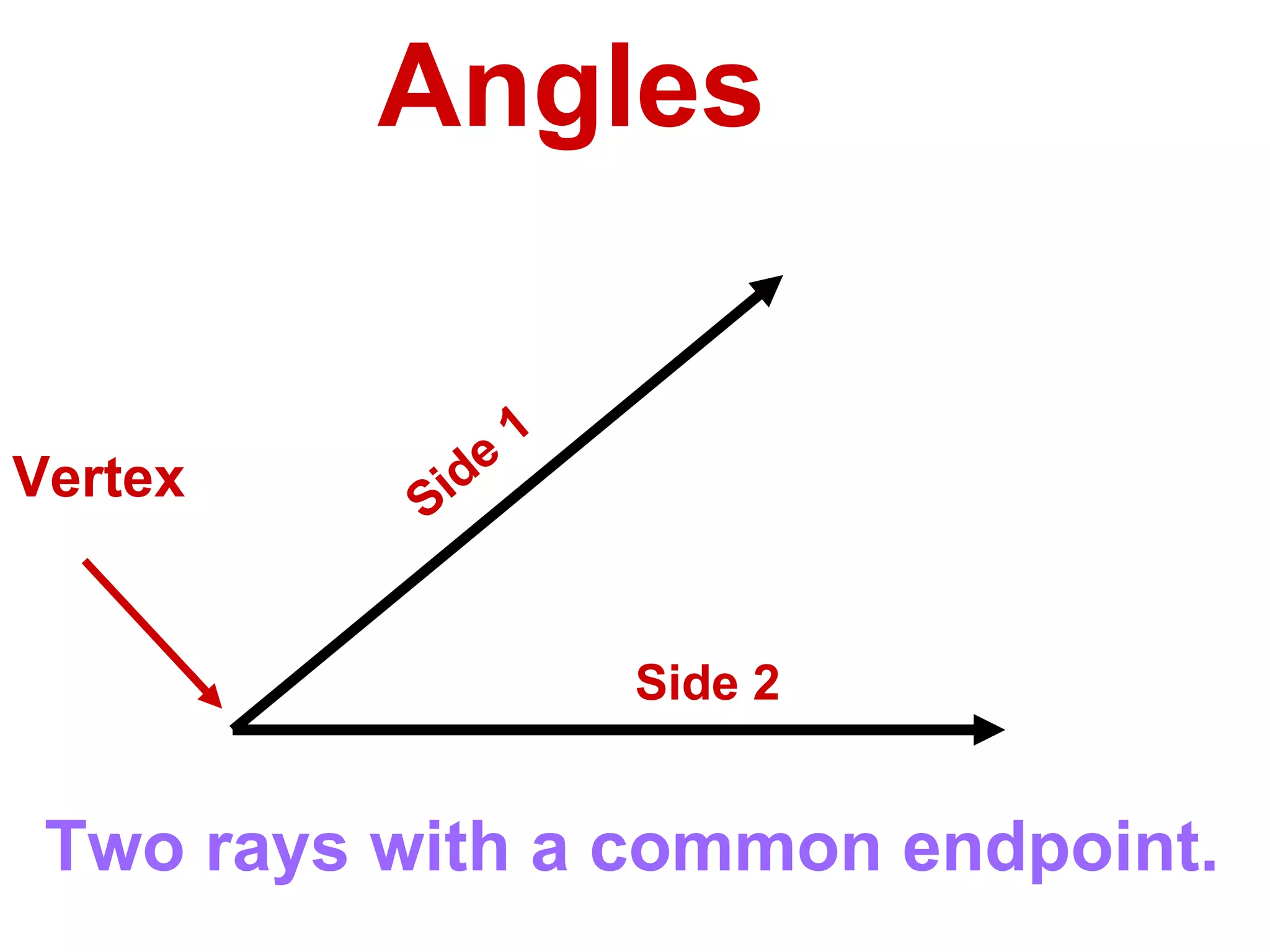
Angles Two rays with a common endpoint. Vertex Side 1 Side 2
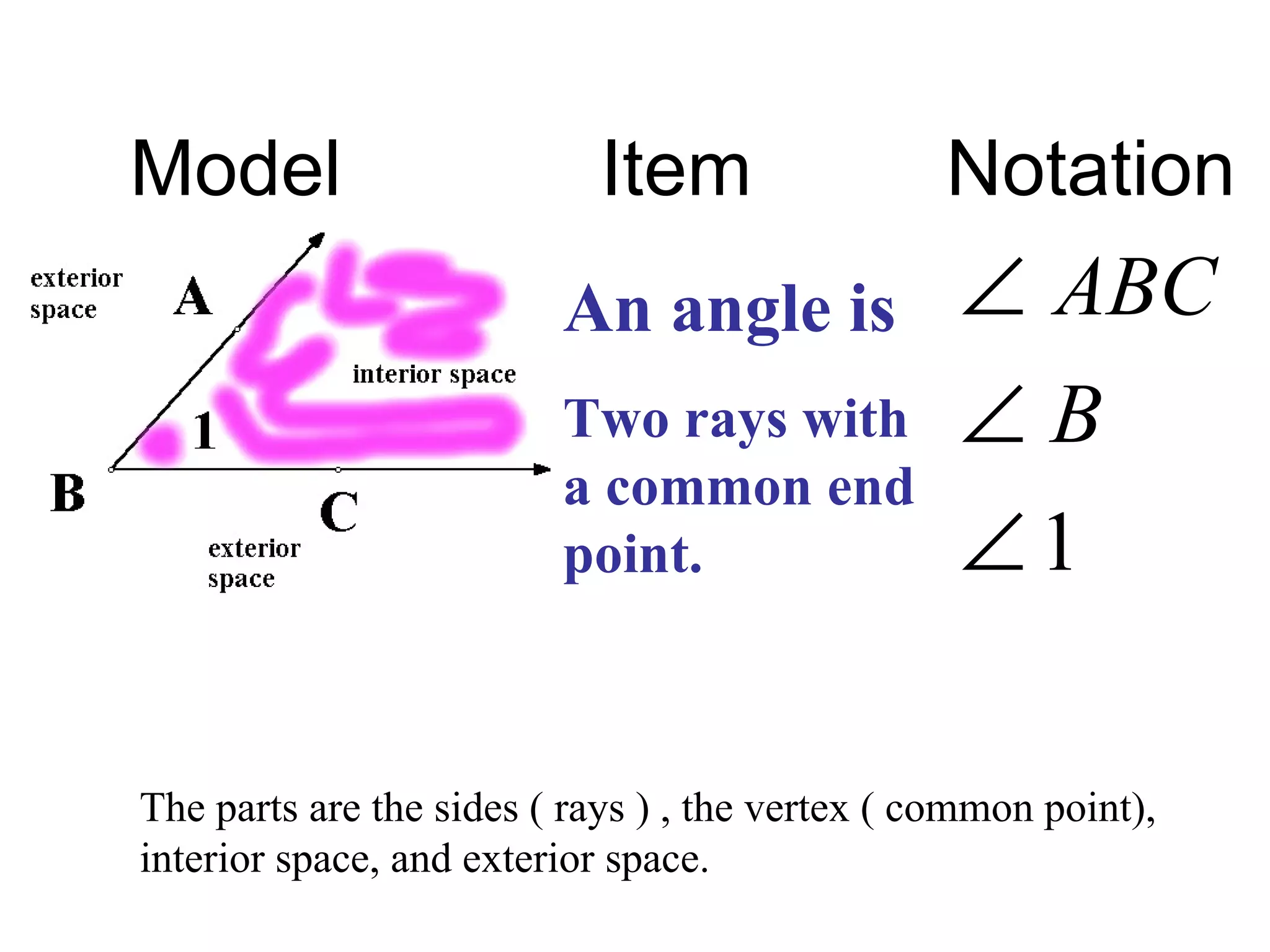
Model  Item  Notation An angle is Two rays with a common end point. The parts are the sides ( rays ) , the vertex ( common point), interior space, and exterior space.
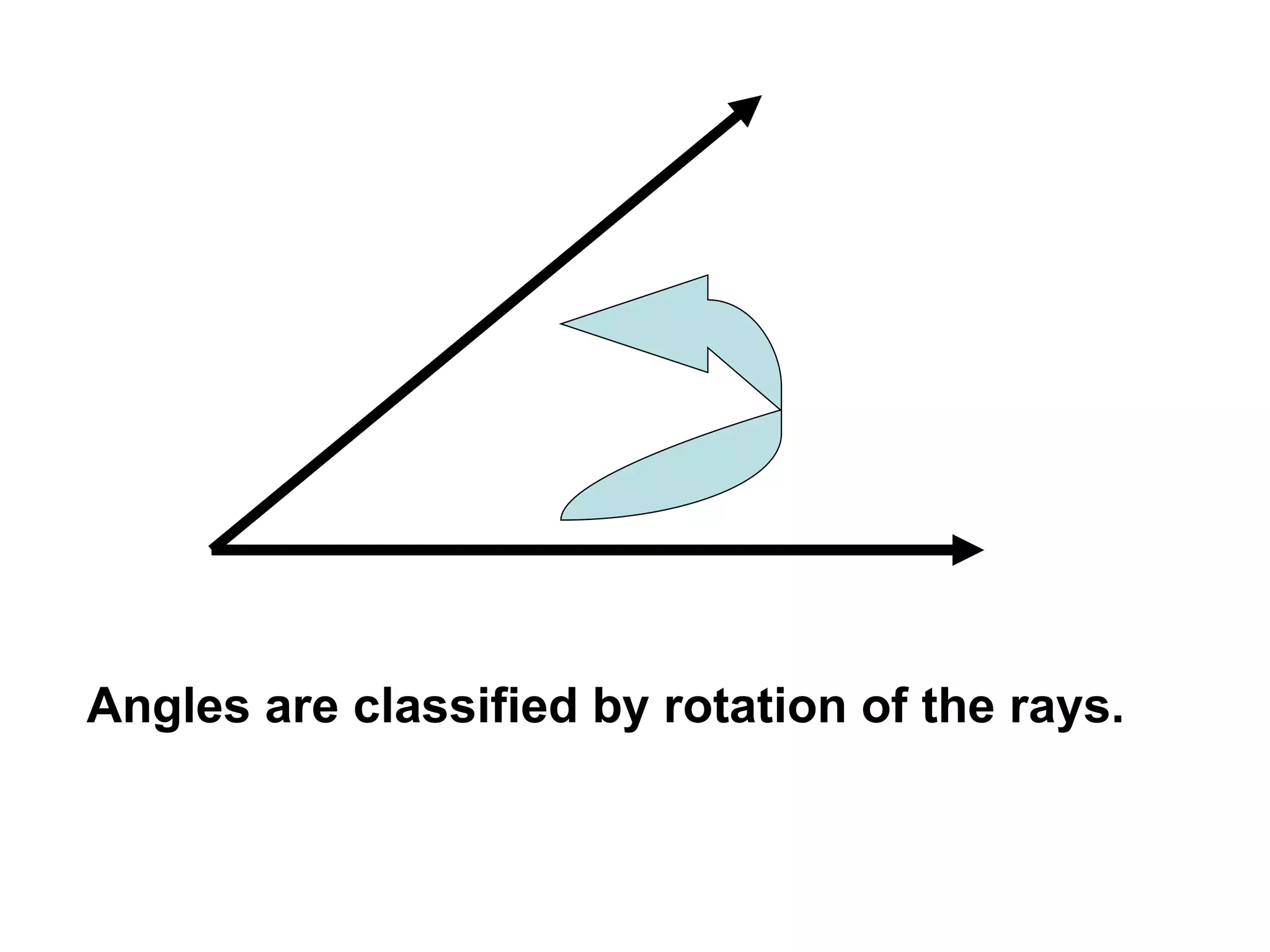
Angles are classified by rotation of the rays.
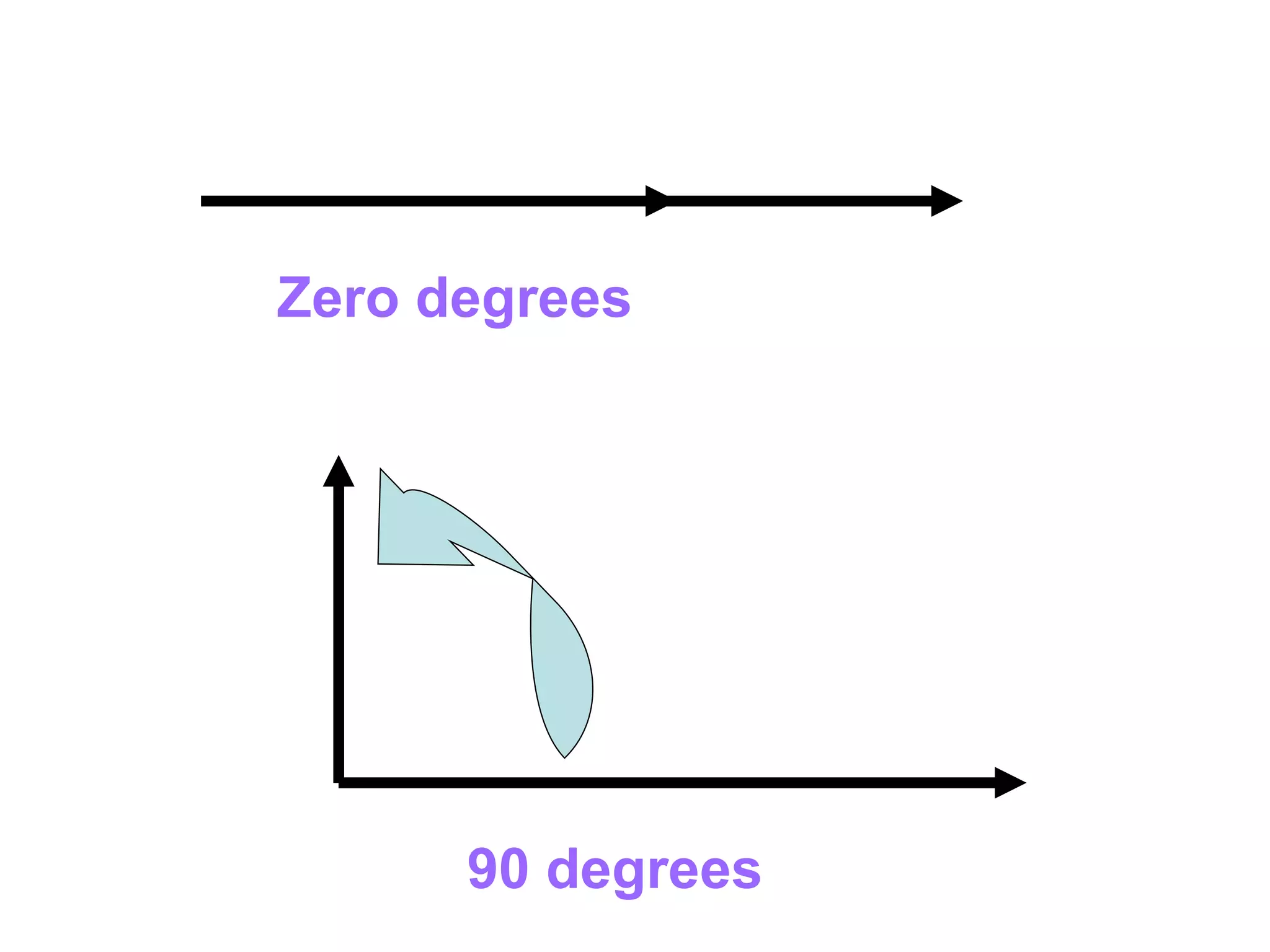
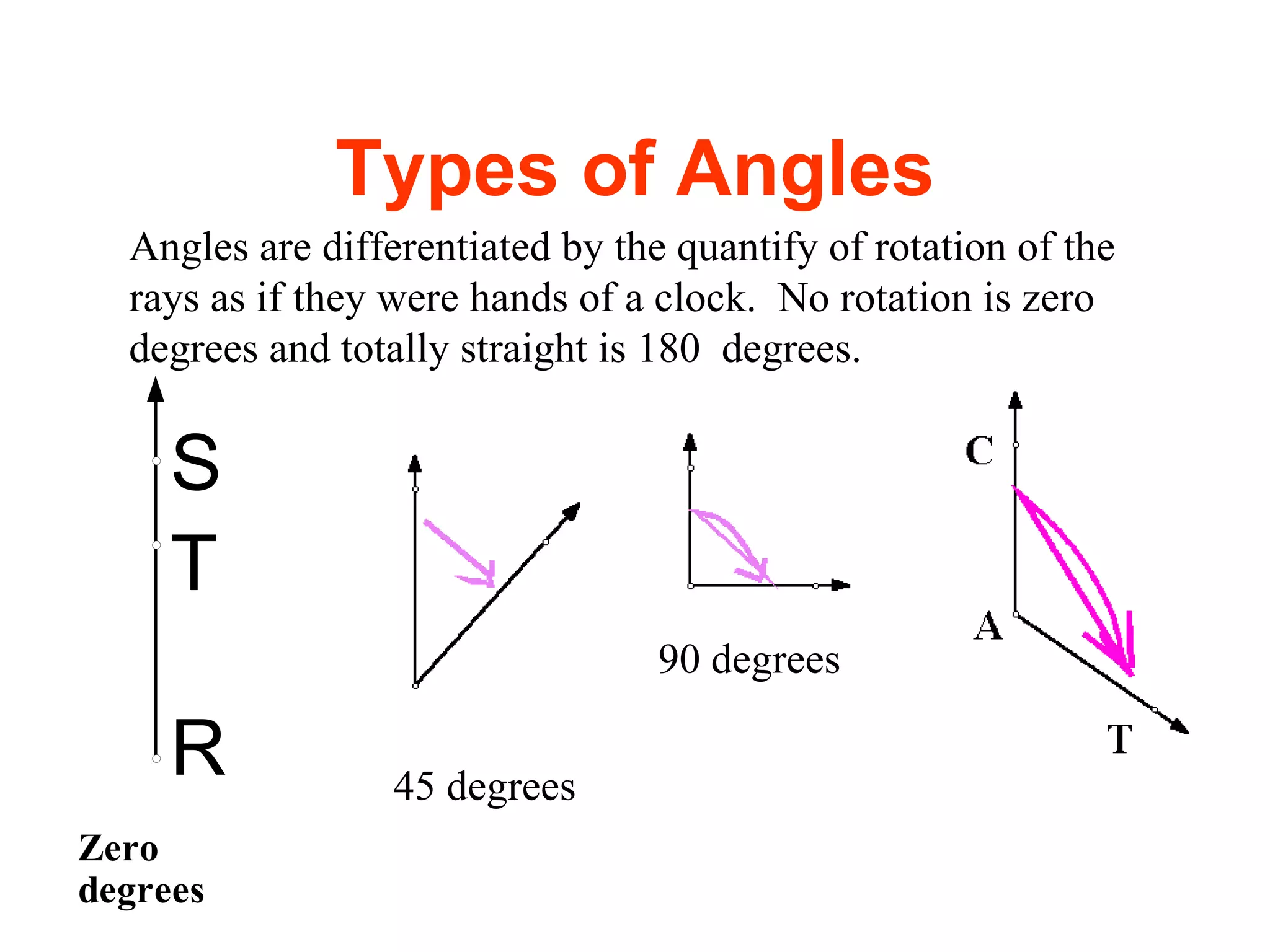
Zero degrees 90 degrees
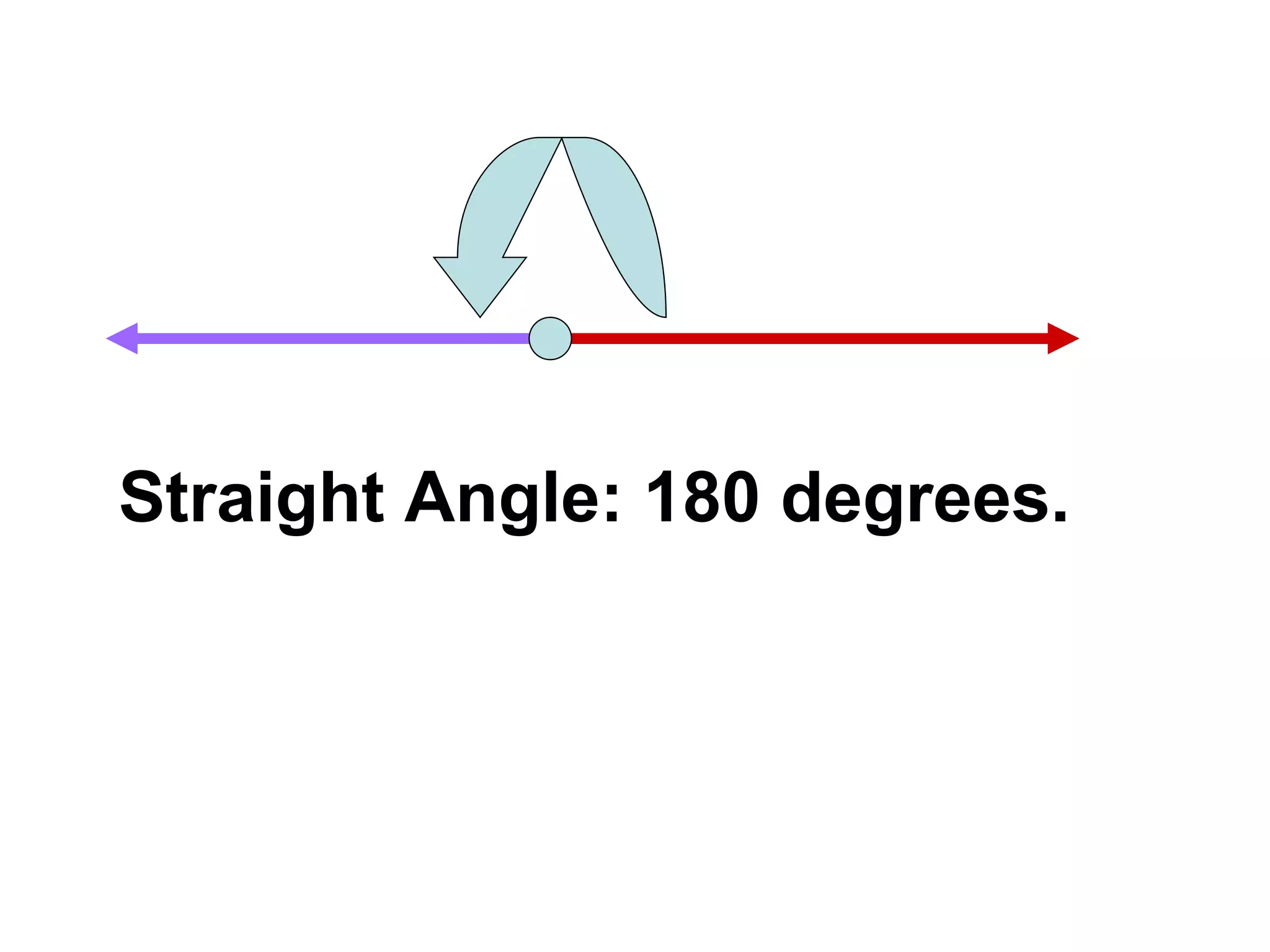
Straight Angle: 180 degrees.
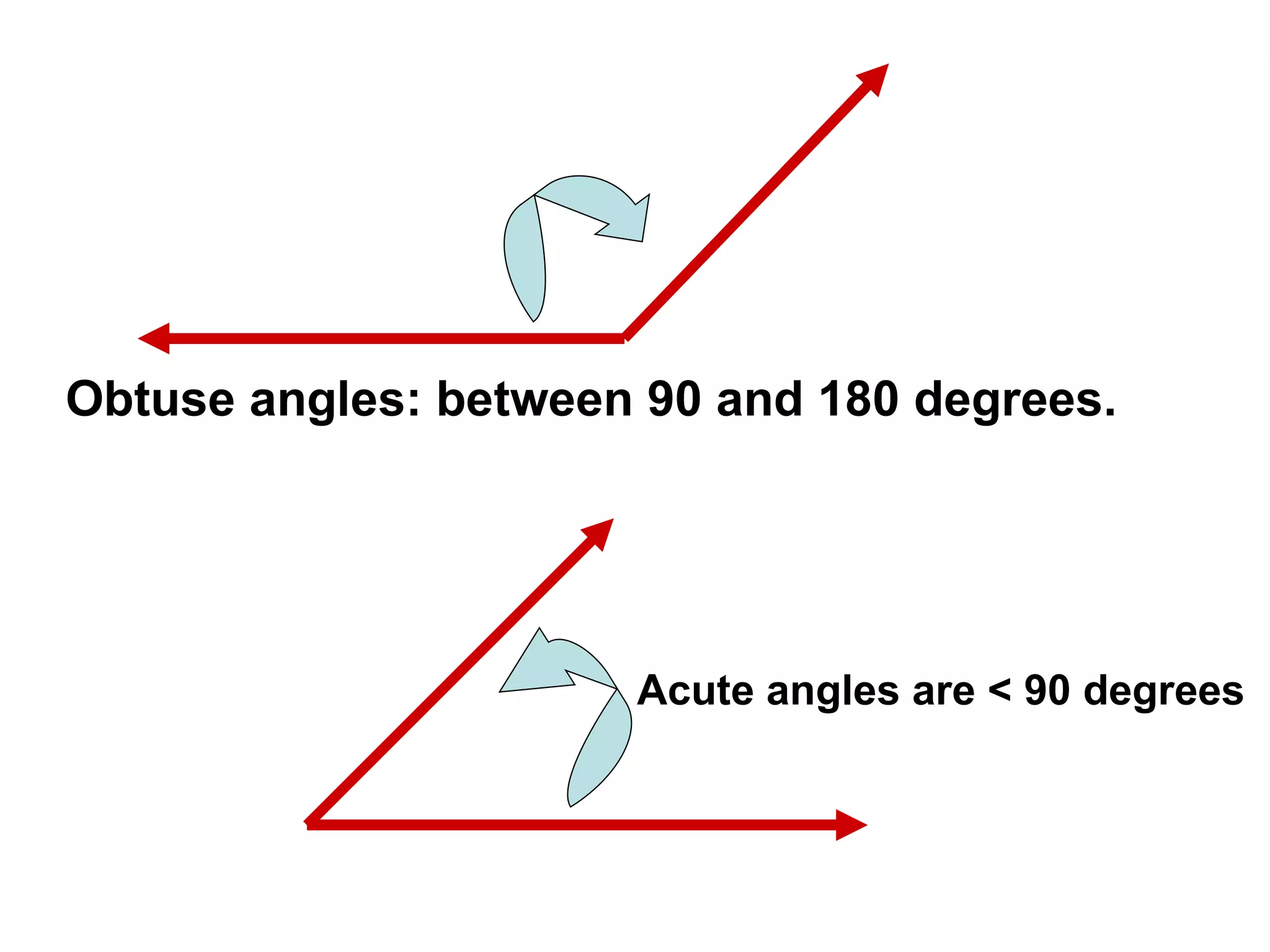
Obtuse angles: between 90 and 180 degrees. Acute angles are < 90 degrees
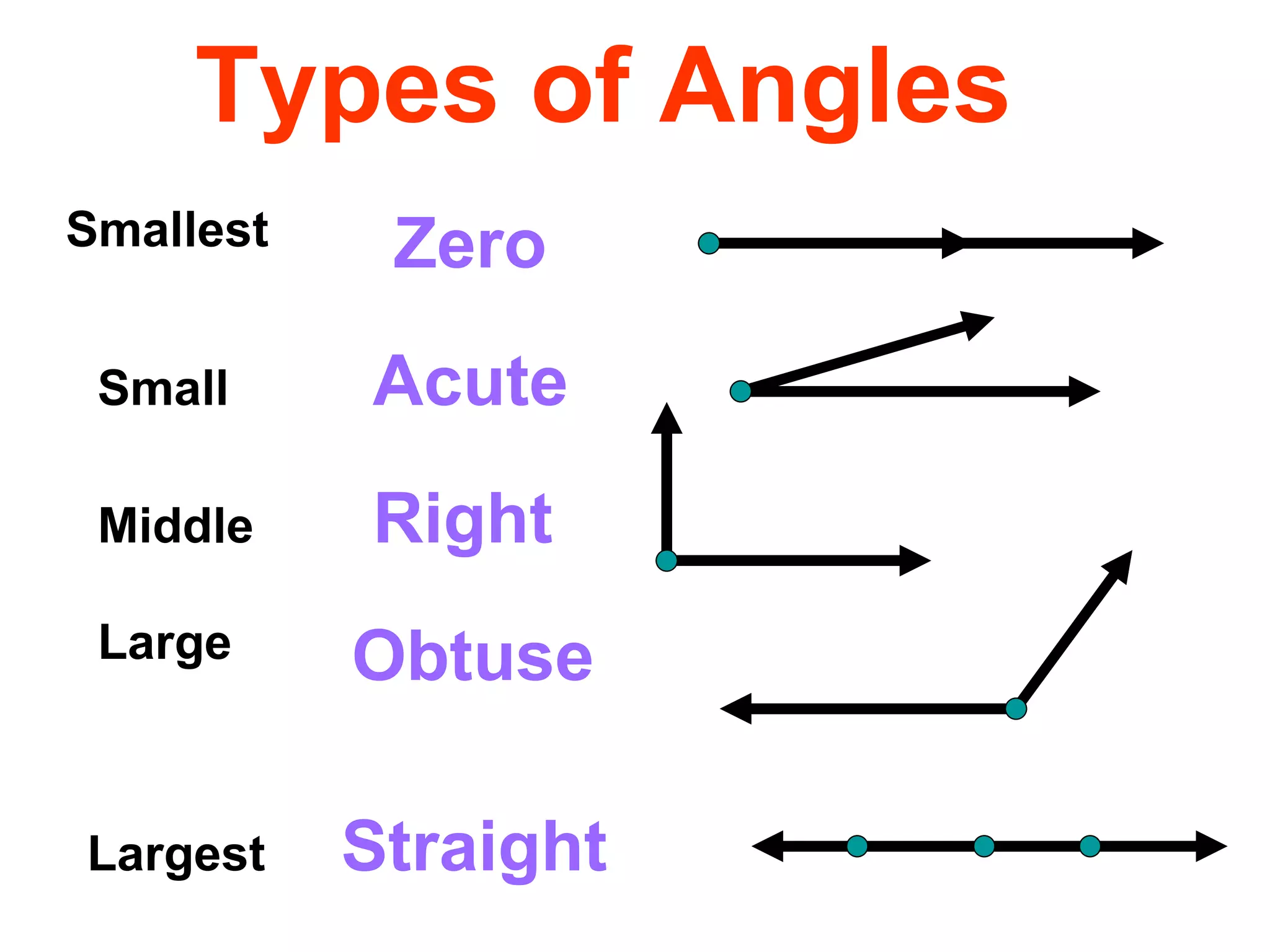
Types of Angles Acute angles are less than 90 degrees Right angles are equal to 90 degrees .  [  Looks like letter L  ] Obtuse angles are greater than 90 degrees but less than 180 degrees. Straight angles look like lines and are equal to 180 degrees.
Types of Angles Angles are differentiated by the quantify of rotation of the rays as if they were hands of a clock.  No rotation is zero degrees and totally straight is 180  degrees. 45 degrees 90 degrees
Types of Angles Smallest Largest Large Middle Small Zero Acute Right Obtuse Straight
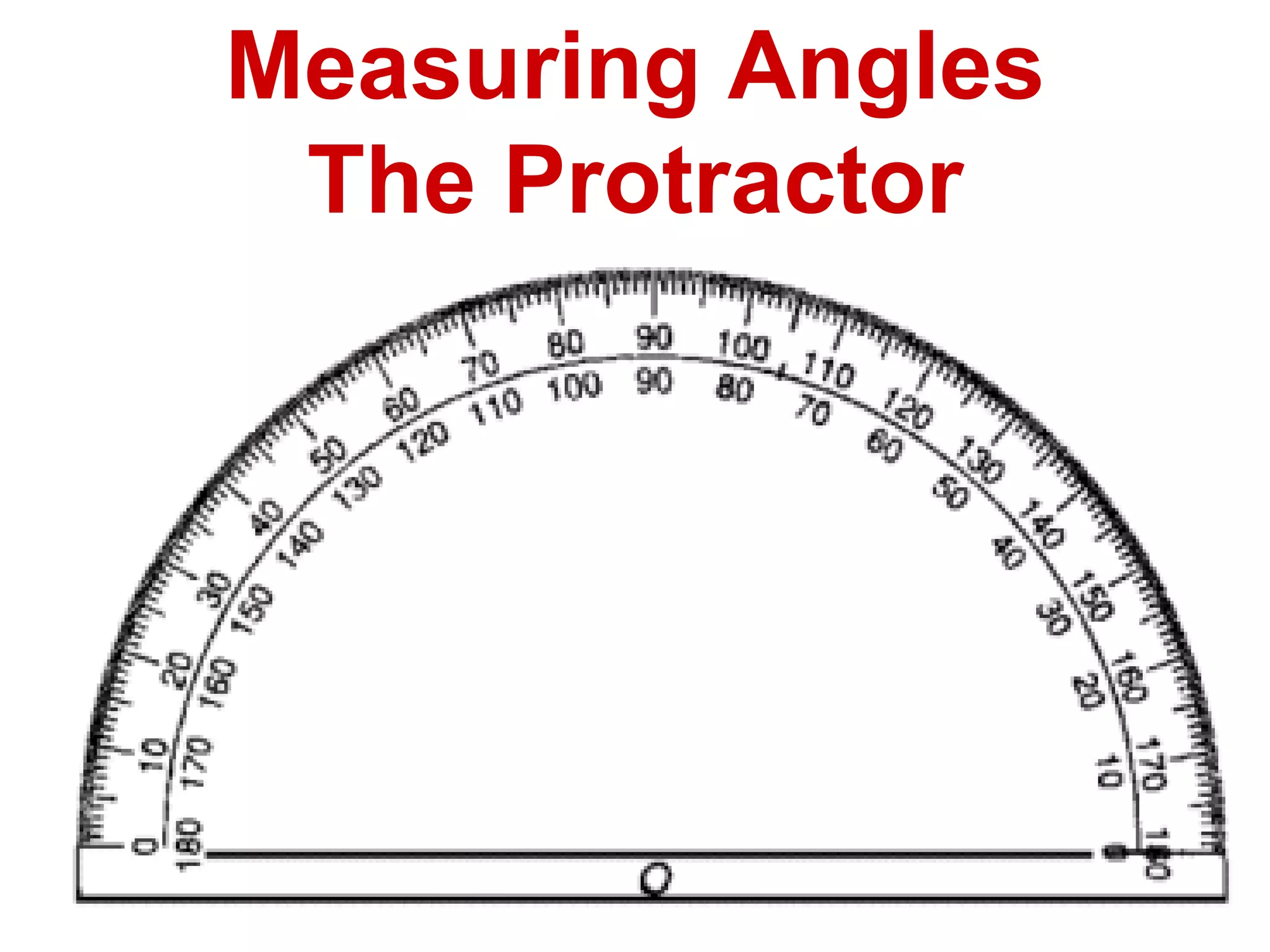
Measuring Angles The Protractor
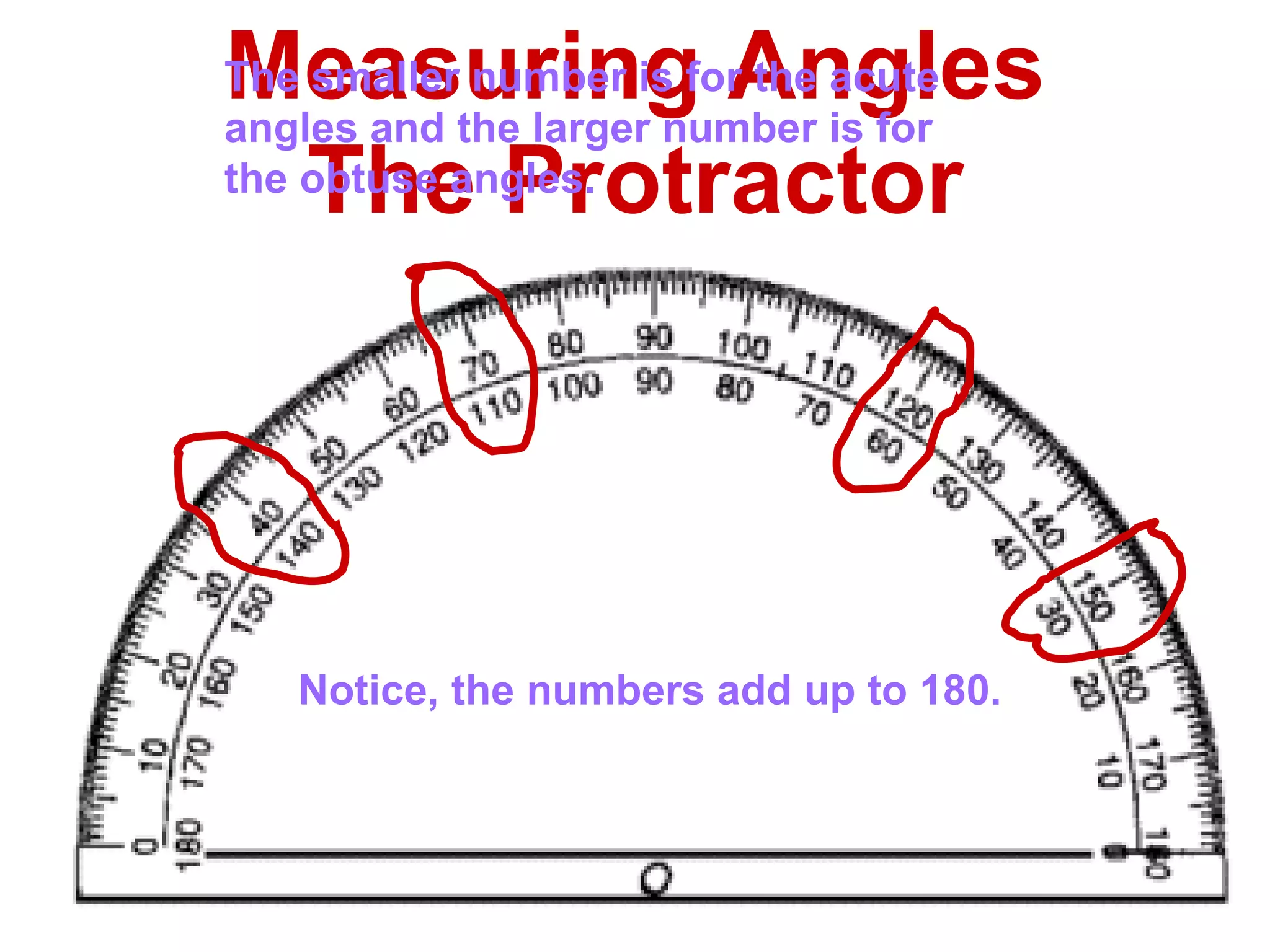
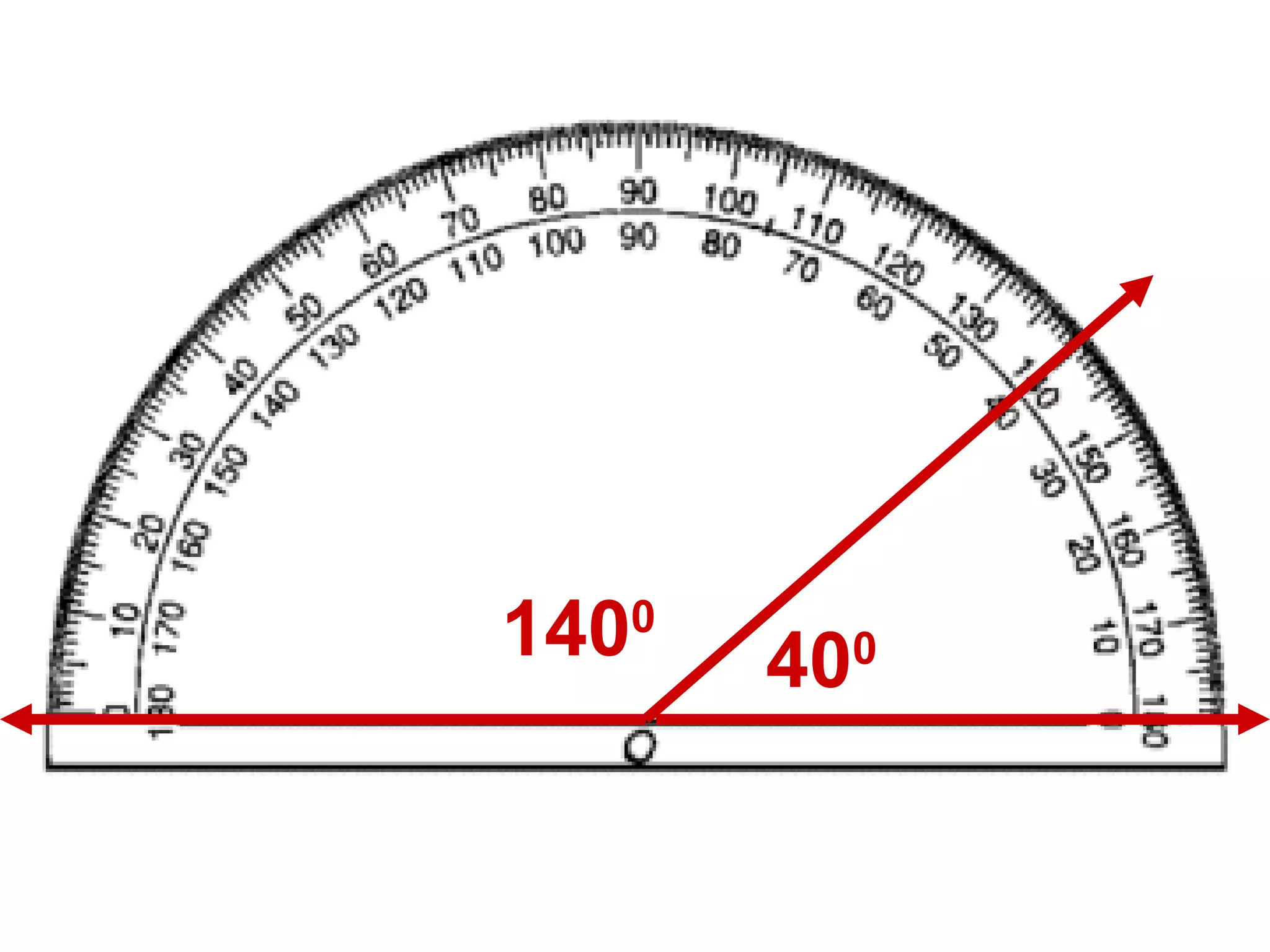
Measuring Angles The Protractor Notice, the numbers add up to 180. The smaller number is for the acute angles and the larger number is for the obtuse angles.
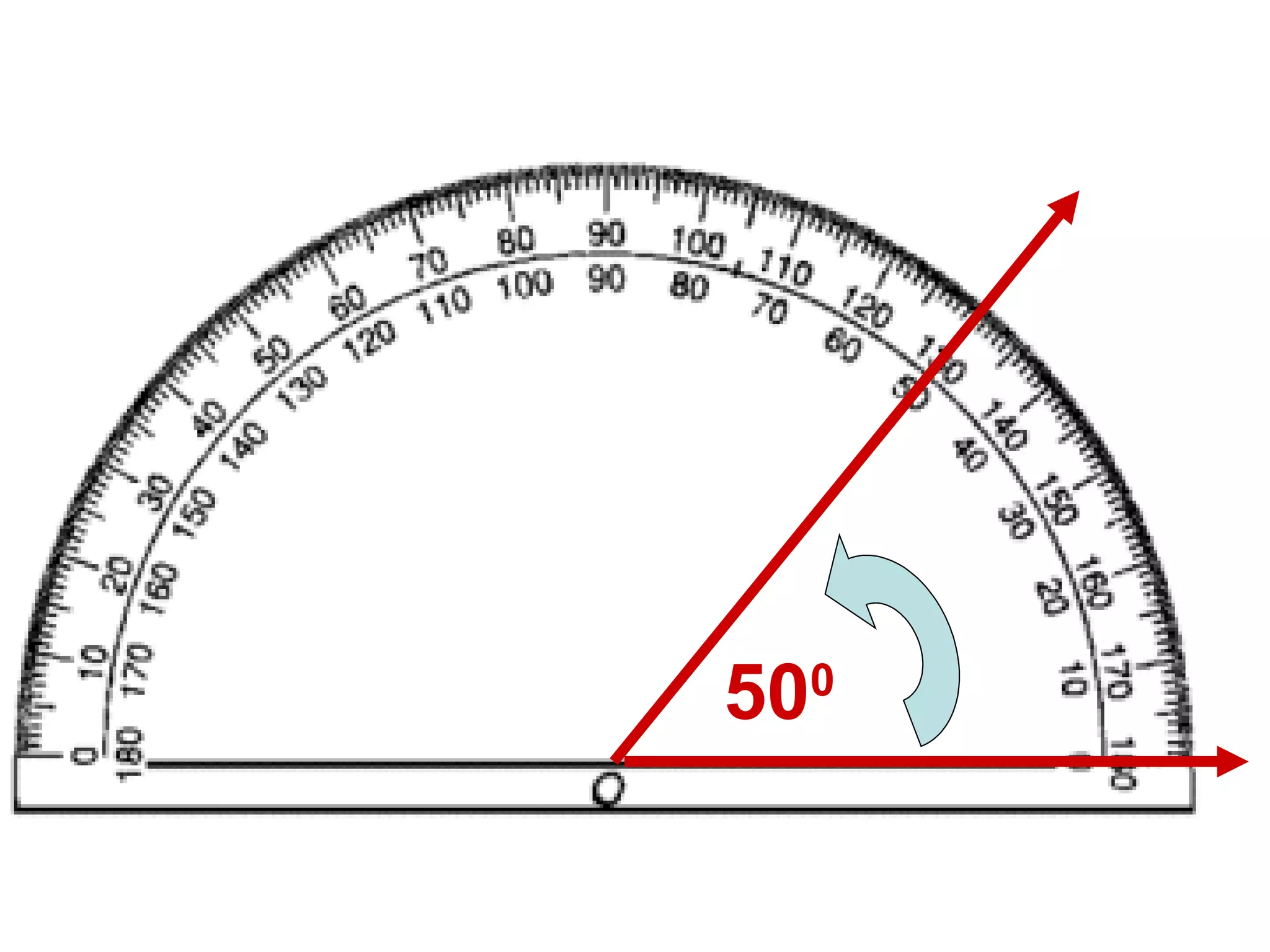
50 0
140 0 40 0
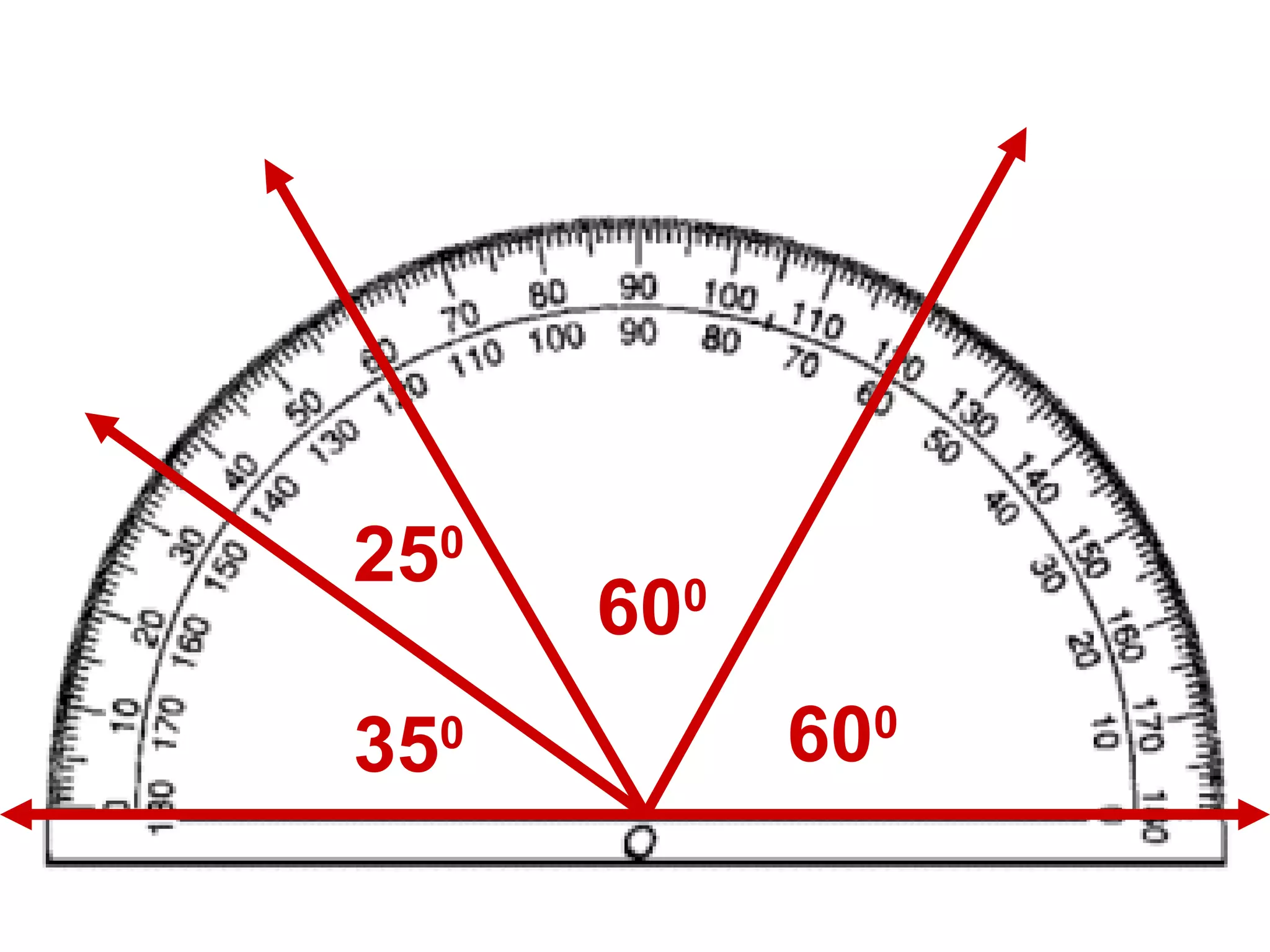
35 0 25 0 60 0 60 0
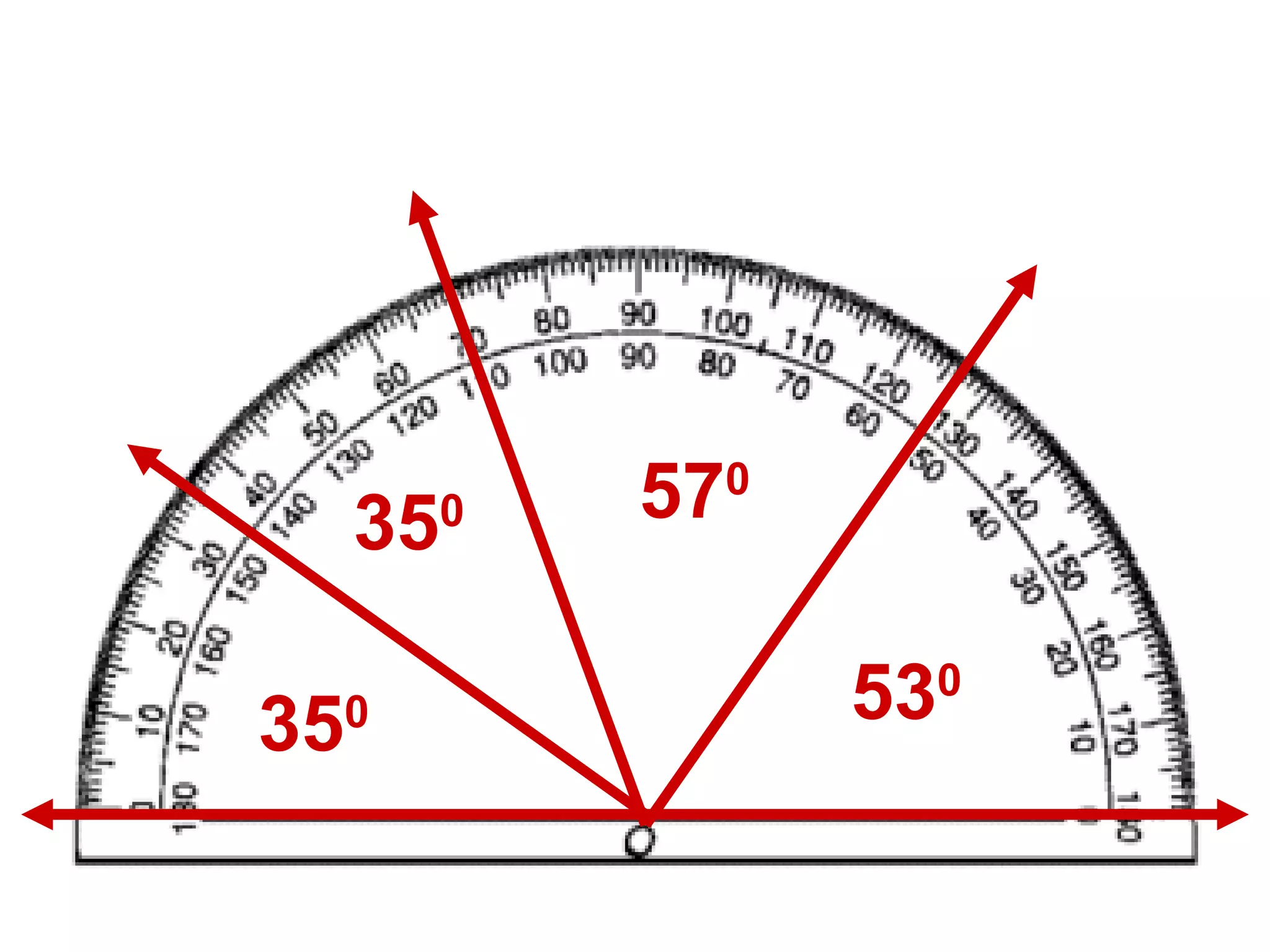
35 0 35 0 57 0 53 0
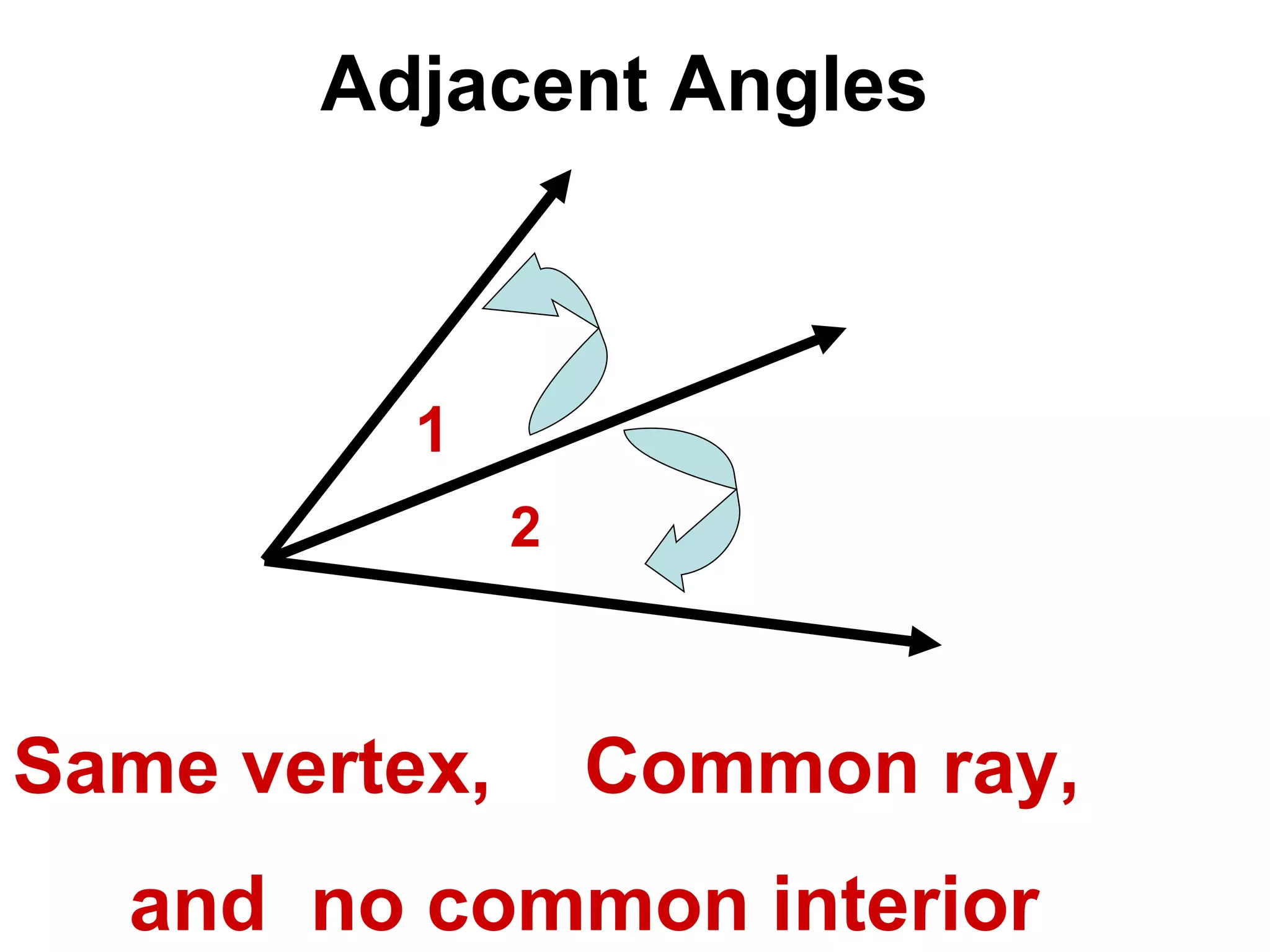
Adjacent Angles 1 2 Same vertex,  Common ray,  and  no common interior
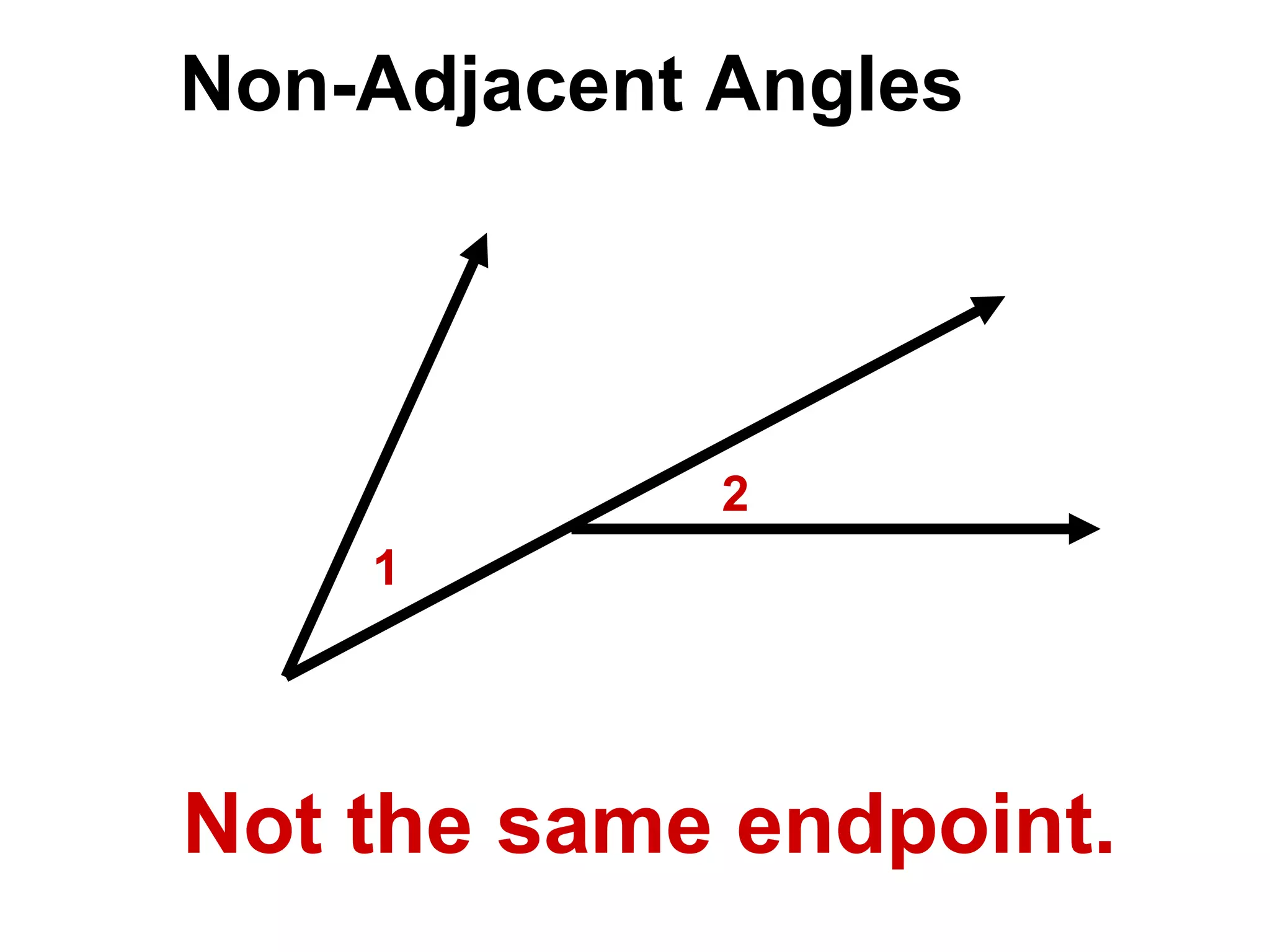
Non-Adjacent Angles 1 2 Not the same endpoint.
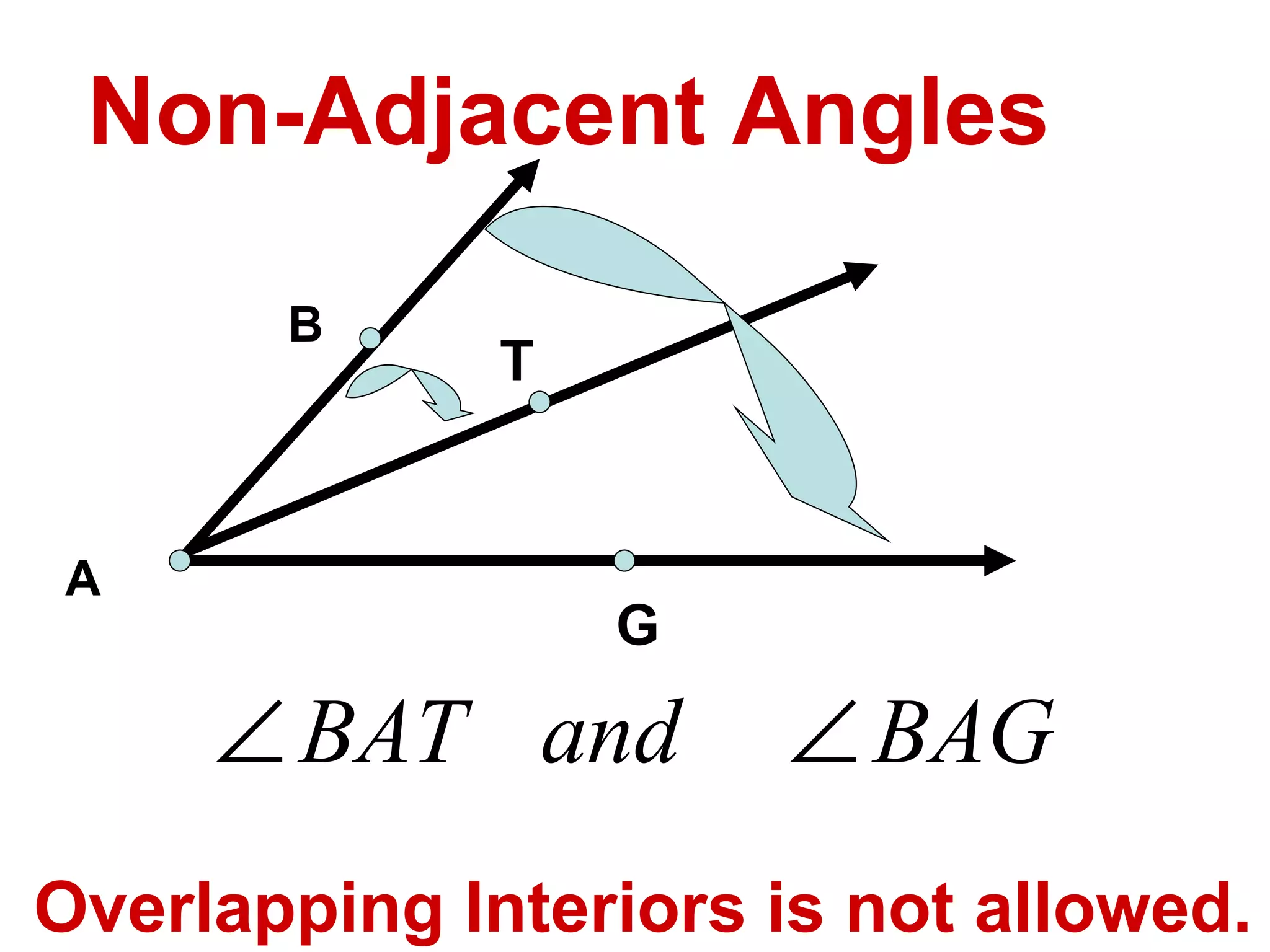
A B T G Non-Adjacent Angles Overlapping Interiors is not allowed.
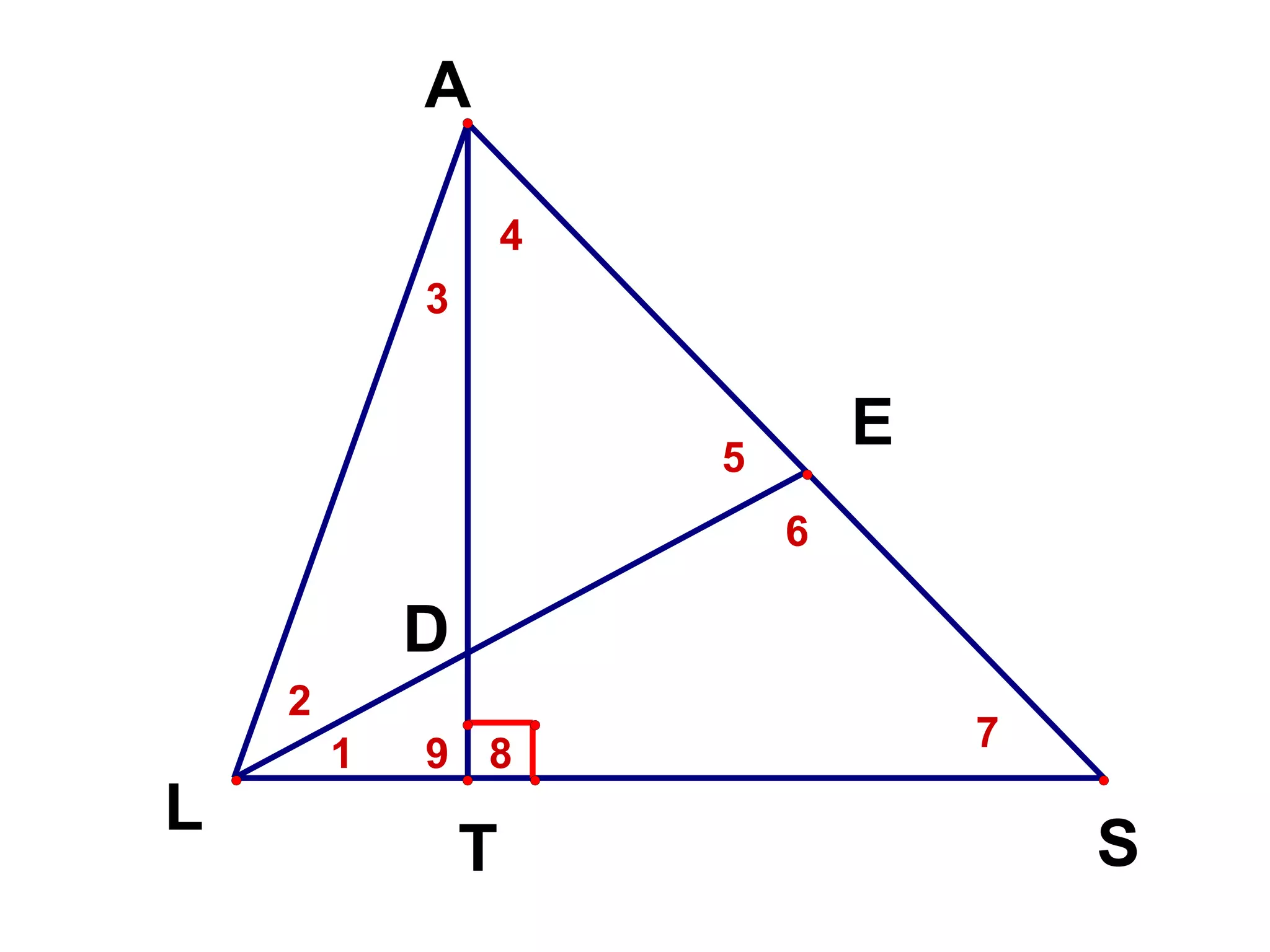
1 2 3 4 5 6 7 8 9
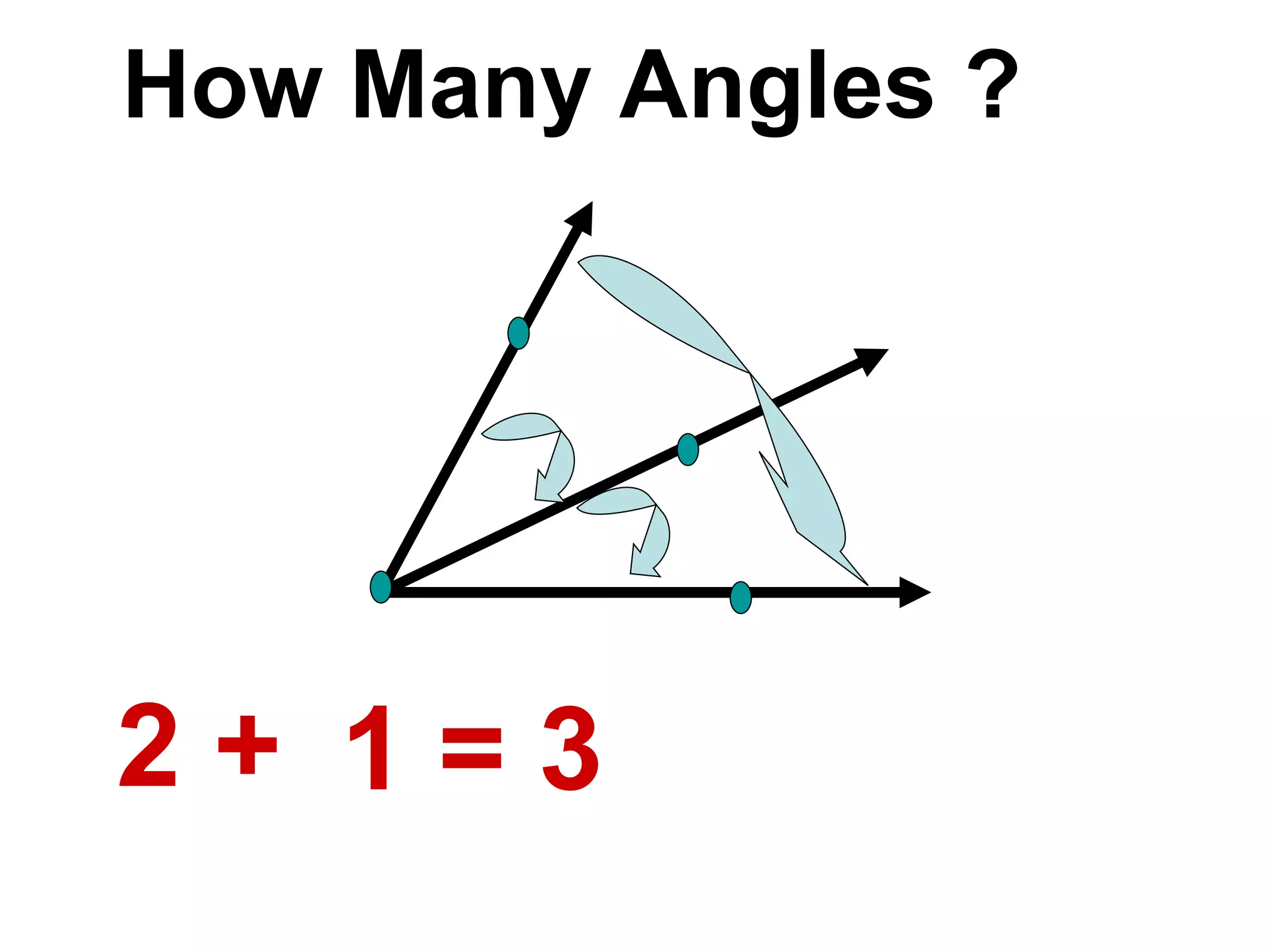
How Many Angles ? 2 + 1 = 3
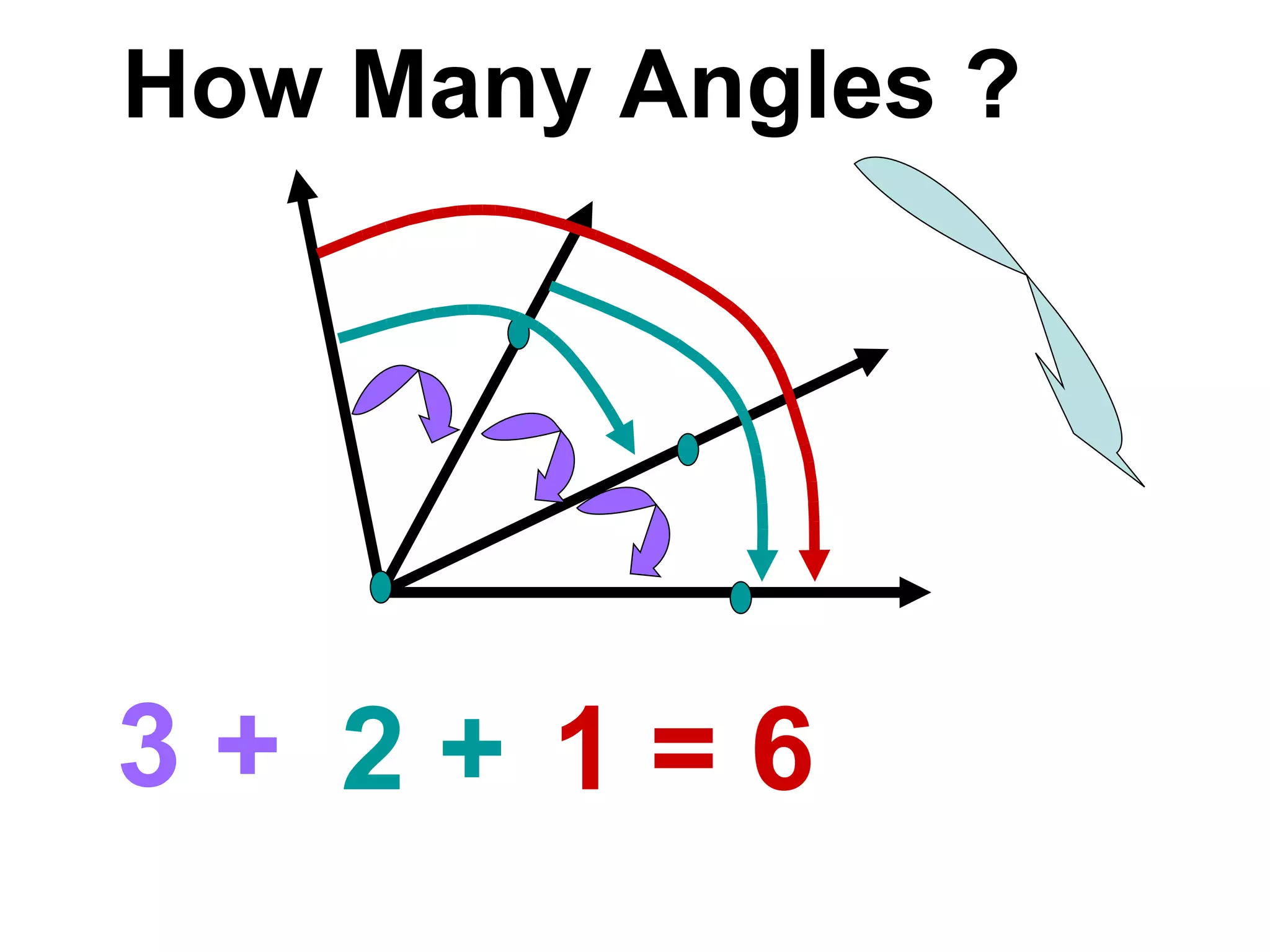
How Many Angles ? 3 + 2 + 1 = 6
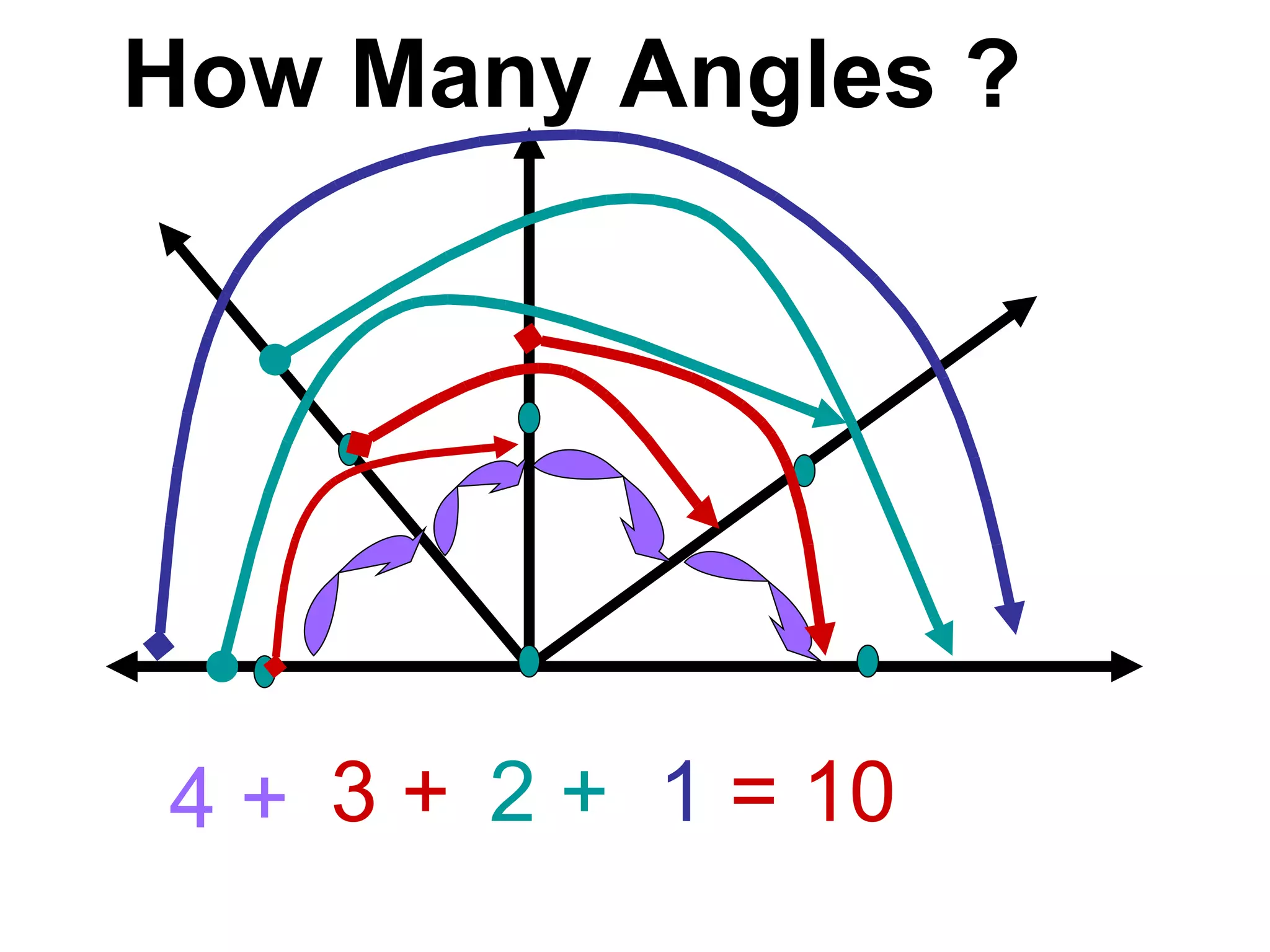
How Many Angles ? 4 + 3 + 2 + 1  = 10
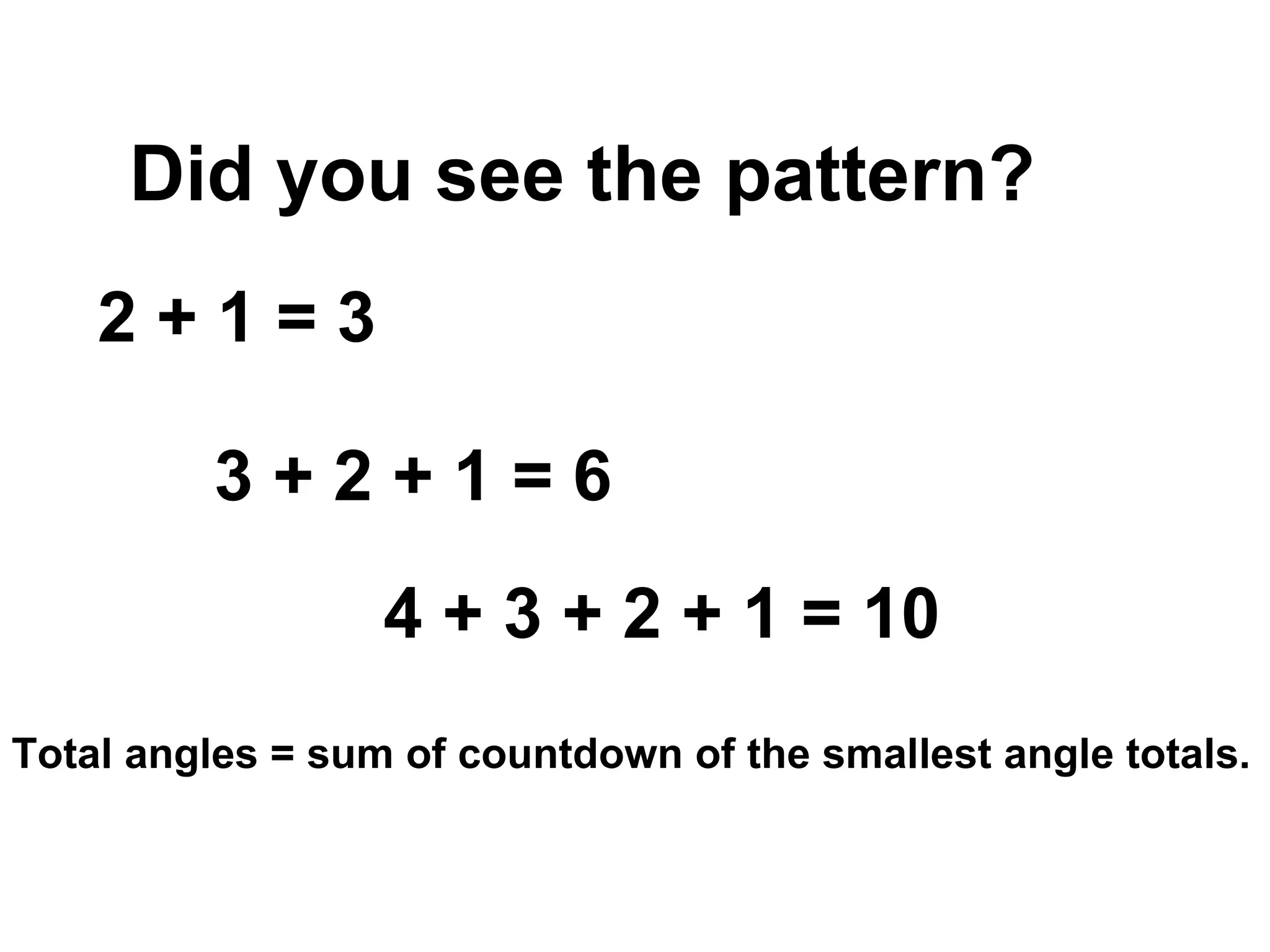
Did you see the pattern? Total angles = sum of countdown of the smallest angle totals. 2 + 1 = 3 3 + 2 + 1 = 6 4 + 3 + 2 + 1 = 10
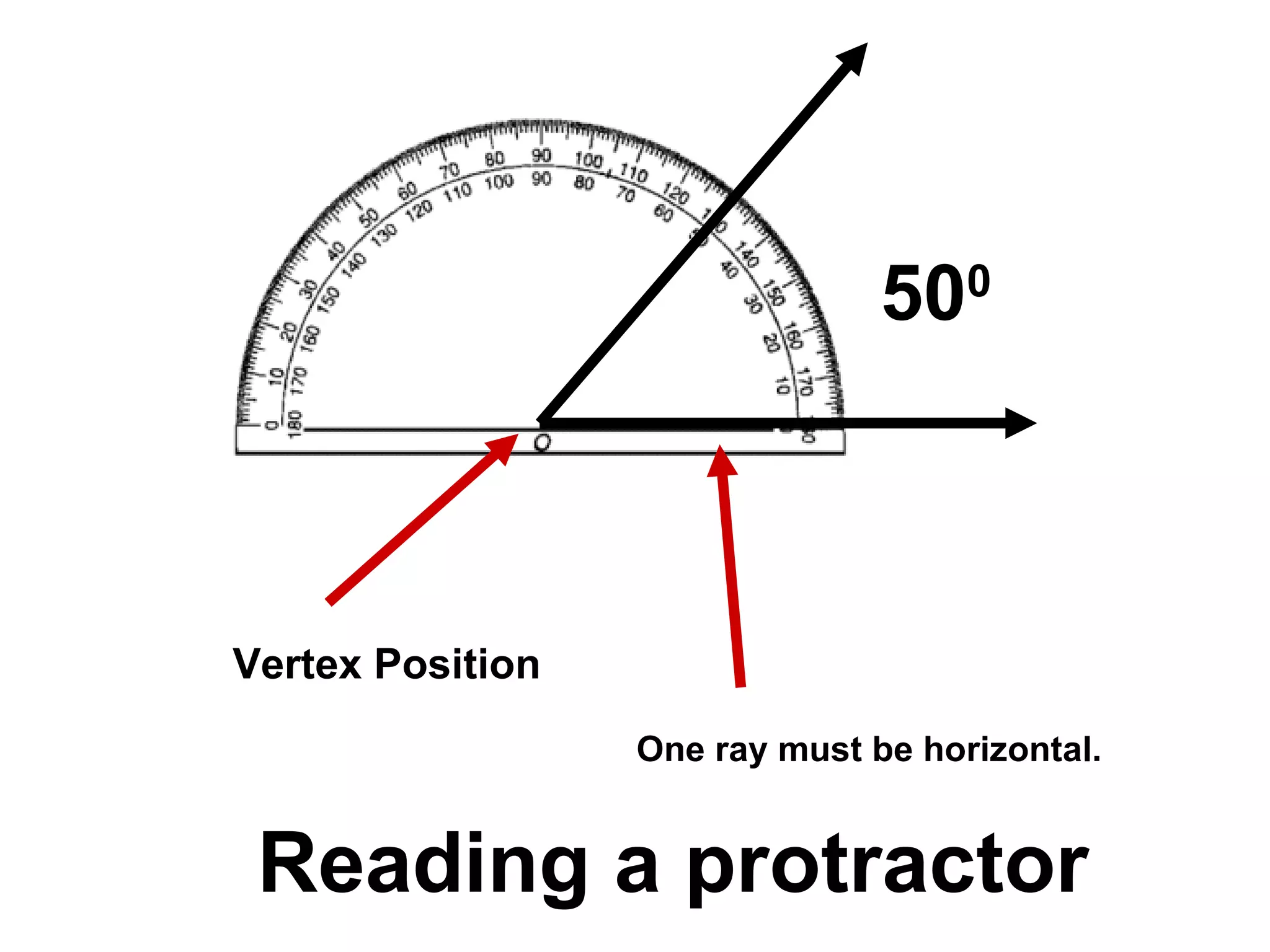
50 0 Vertex Position One ray must be horizontal. Reading a protractor
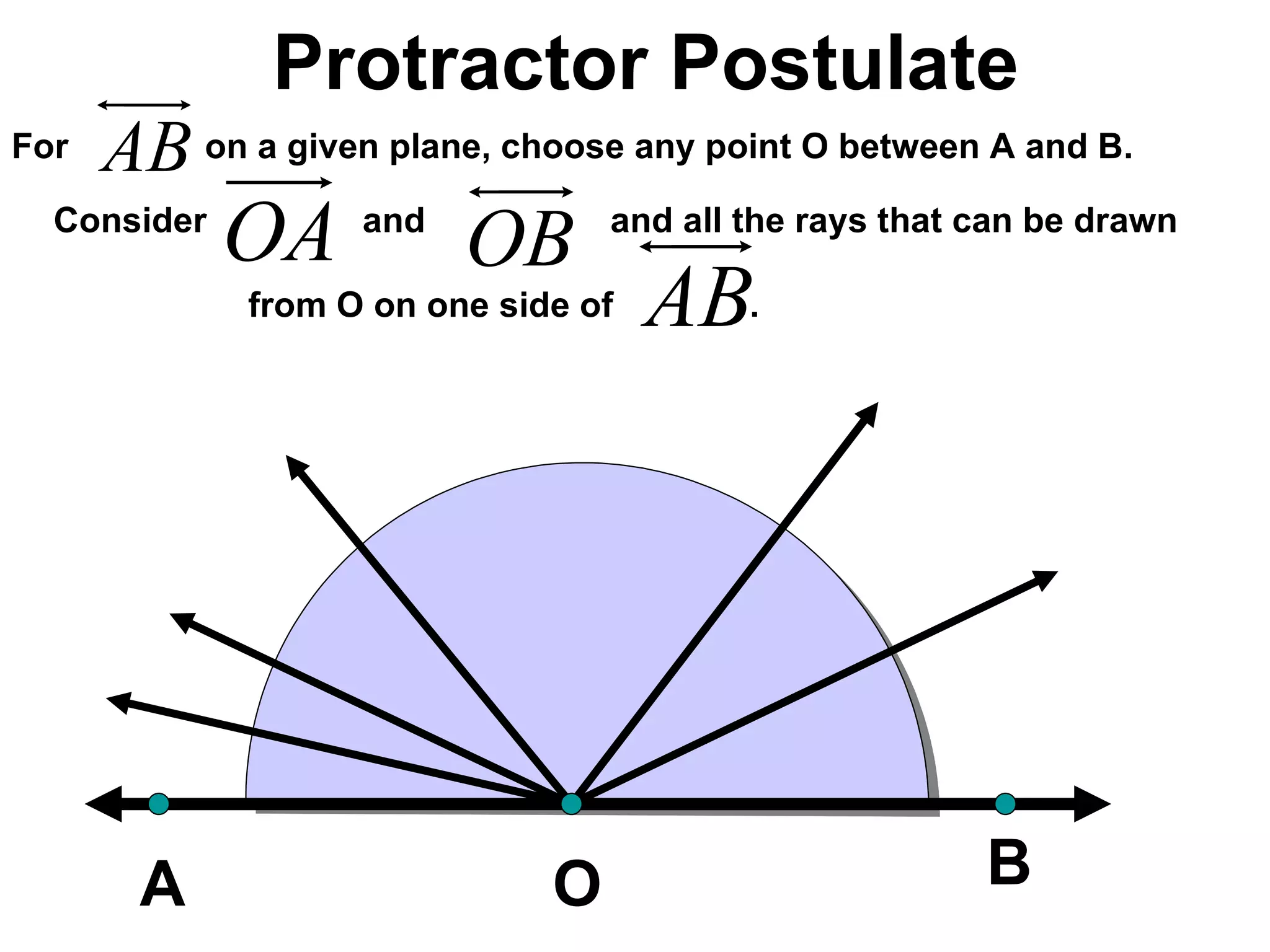
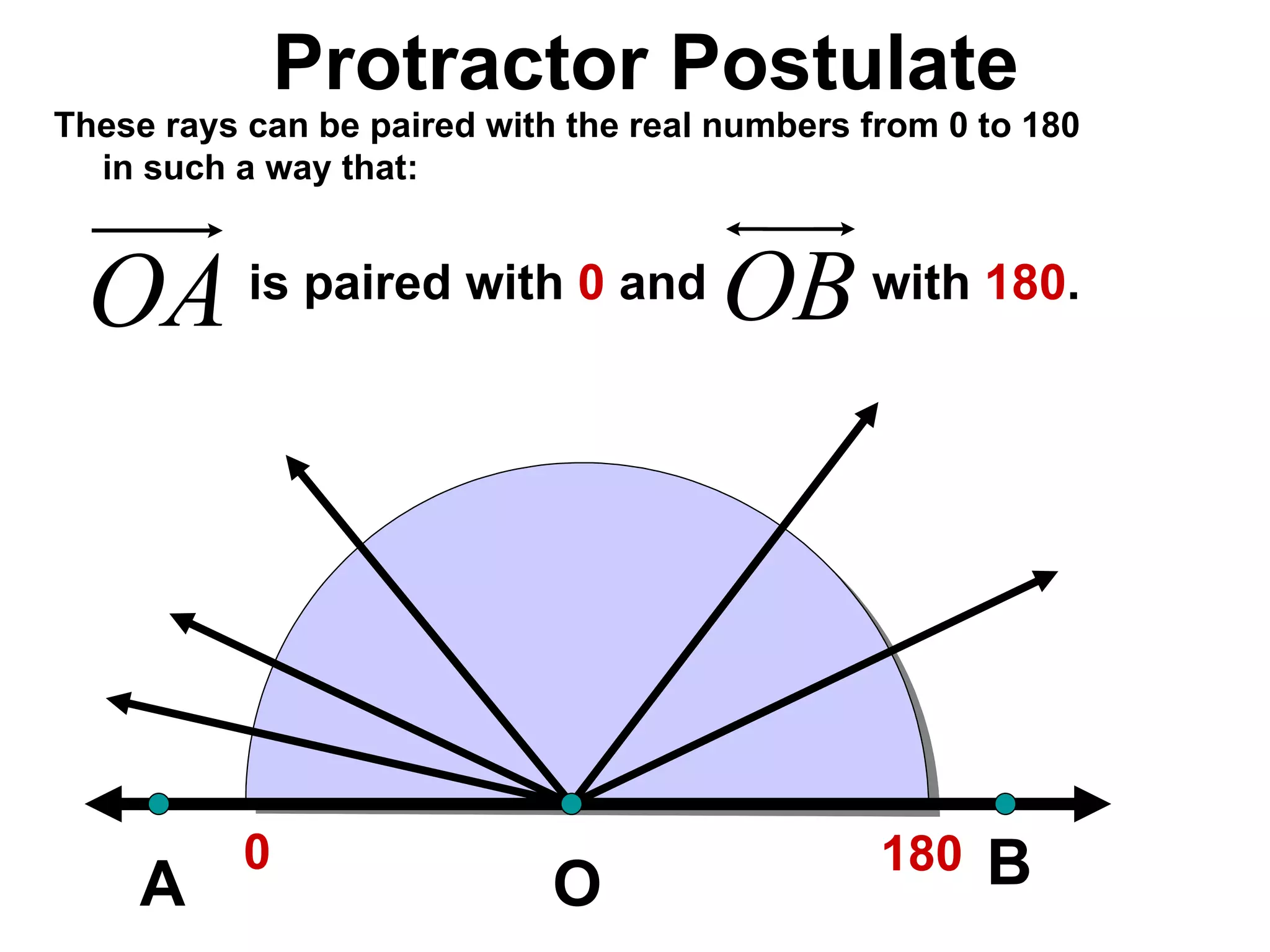
Protractor Postulate For  on a given plane, choose any point O between A and B.  Consider  and  and all the rays that can be drawn  from O on one side of  . A O B
Protractor Postulate These rays can be paired with the real numbers from 0 to 180  in such a way that: A O B is paired with  0  and  with  180 . 0 180
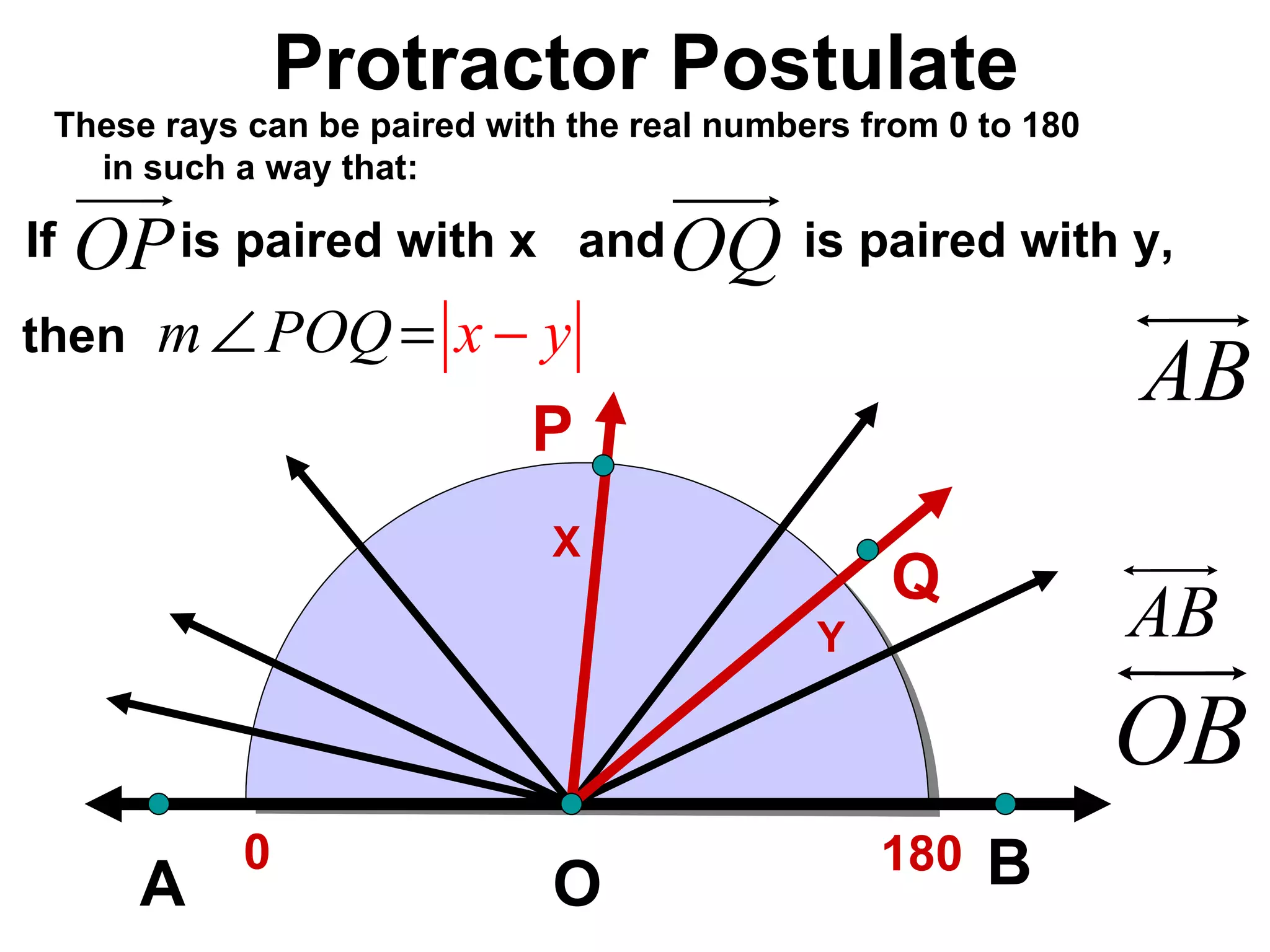
Protractor Postulate If  is paired with x  and  is paired with y, These rays can be paired with the real numbers from 0 to 180  in such a way that: A O B 0 180 X Y P Q then
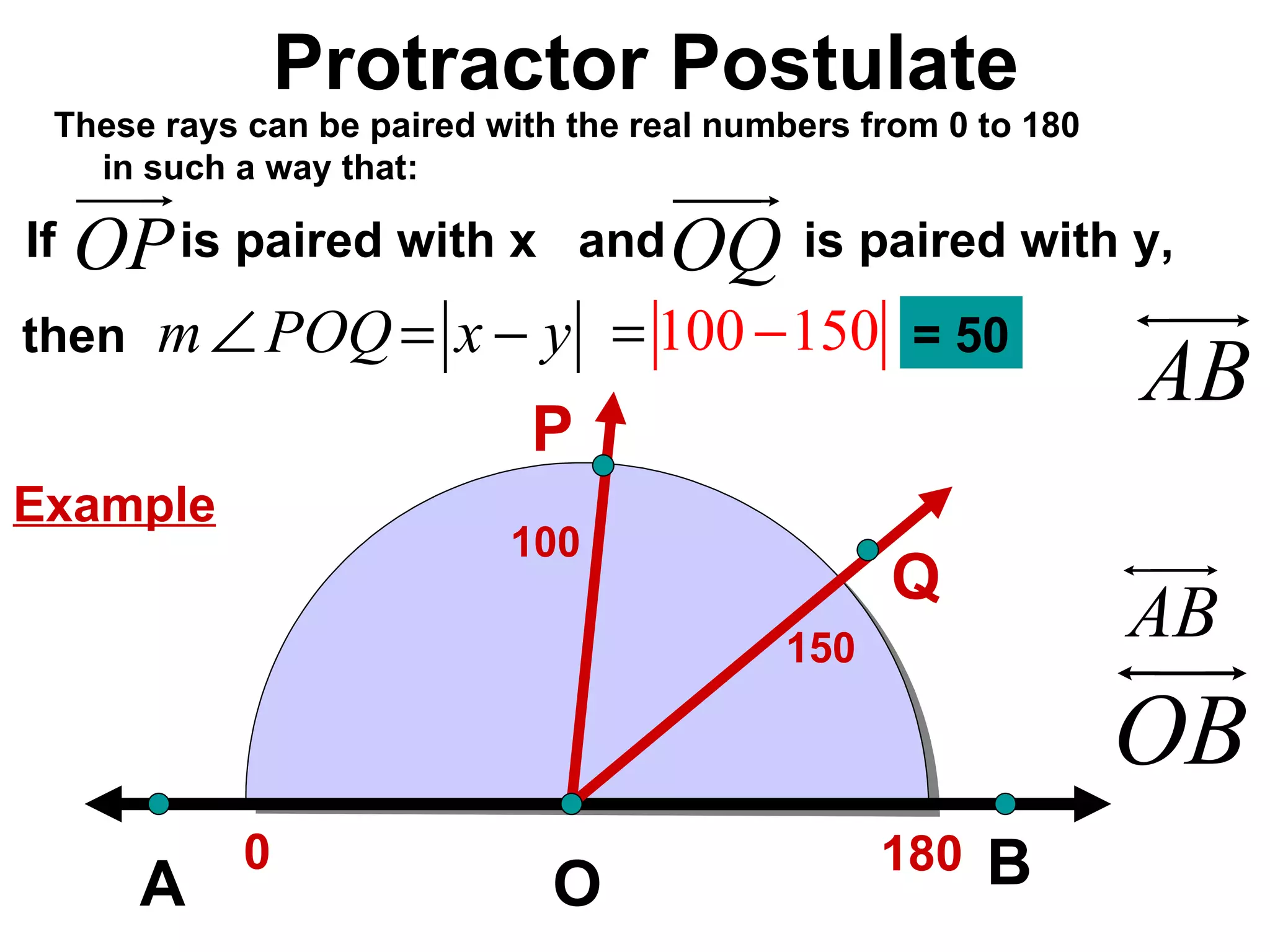
Protractor Postulate If  is paired with x  and  is paired with y, These rays can be paired with the real numbers from 0 to 180  in such a way that: A O B 0 180 100 150 P Q then  Example = 50
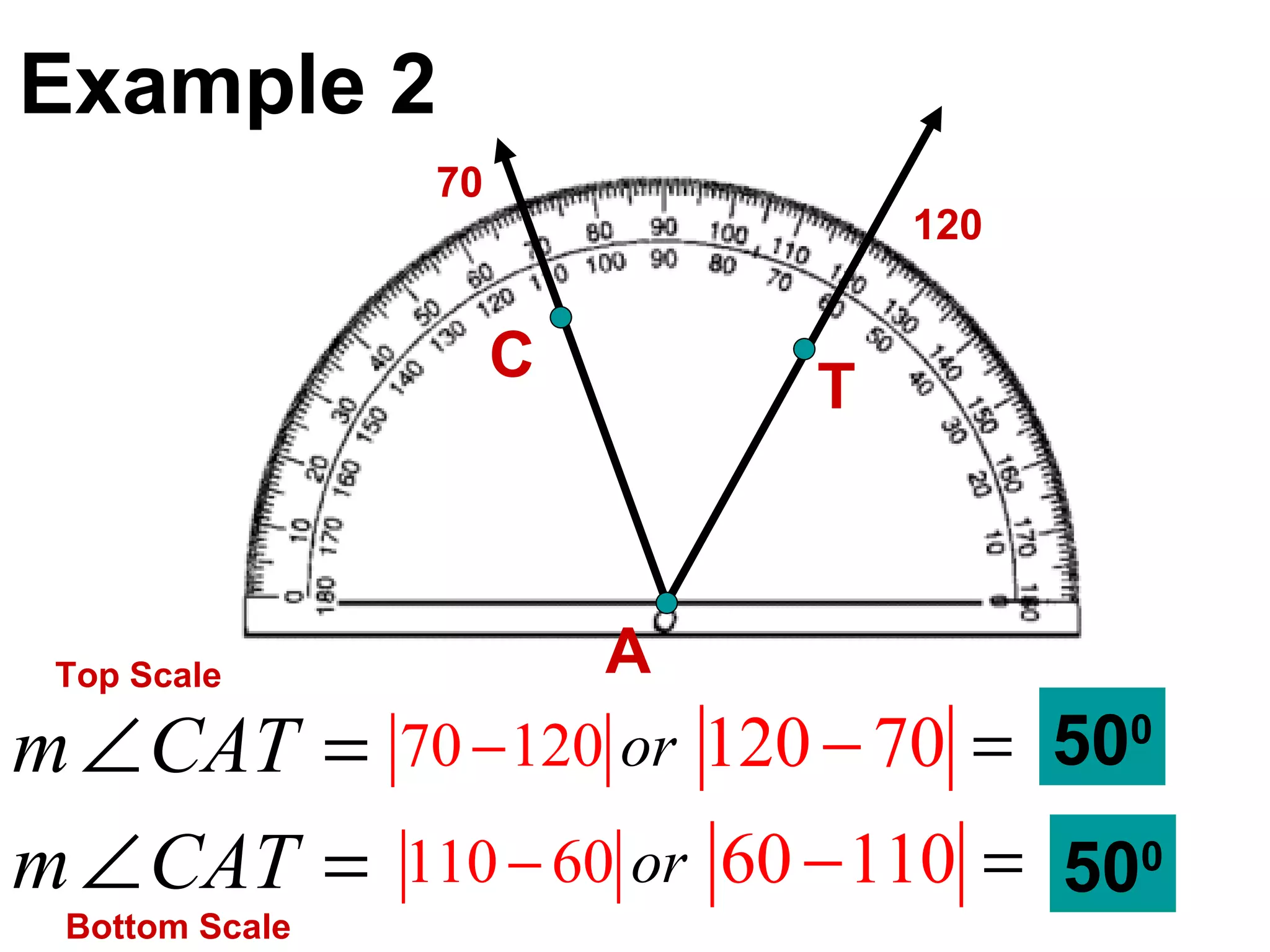
Example 2 70 120 A C T 50 0 50 0 Top Scale Bottom Scale
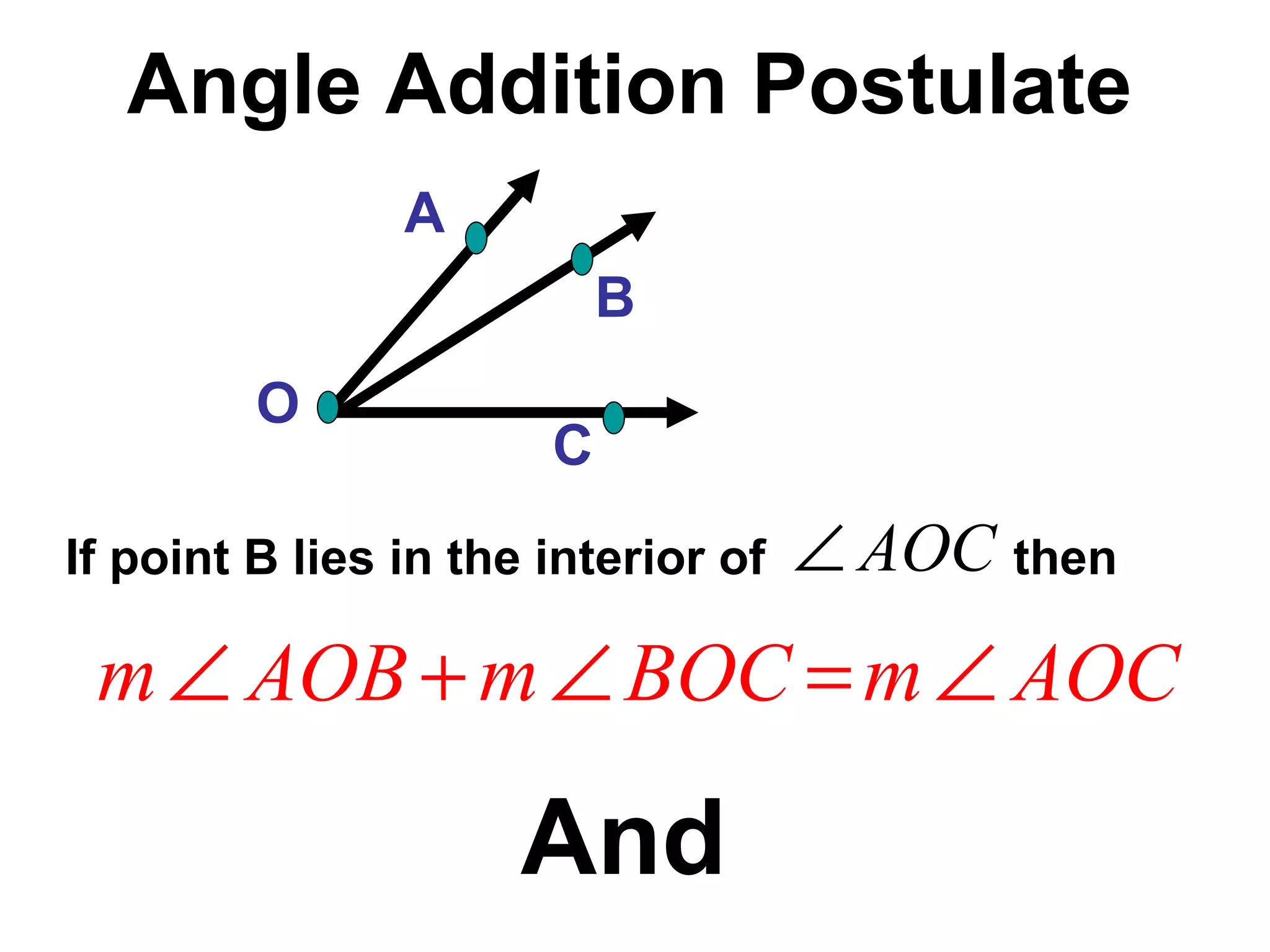
Angle Addition Postulate If point B lies in the interior of  then O C B A And
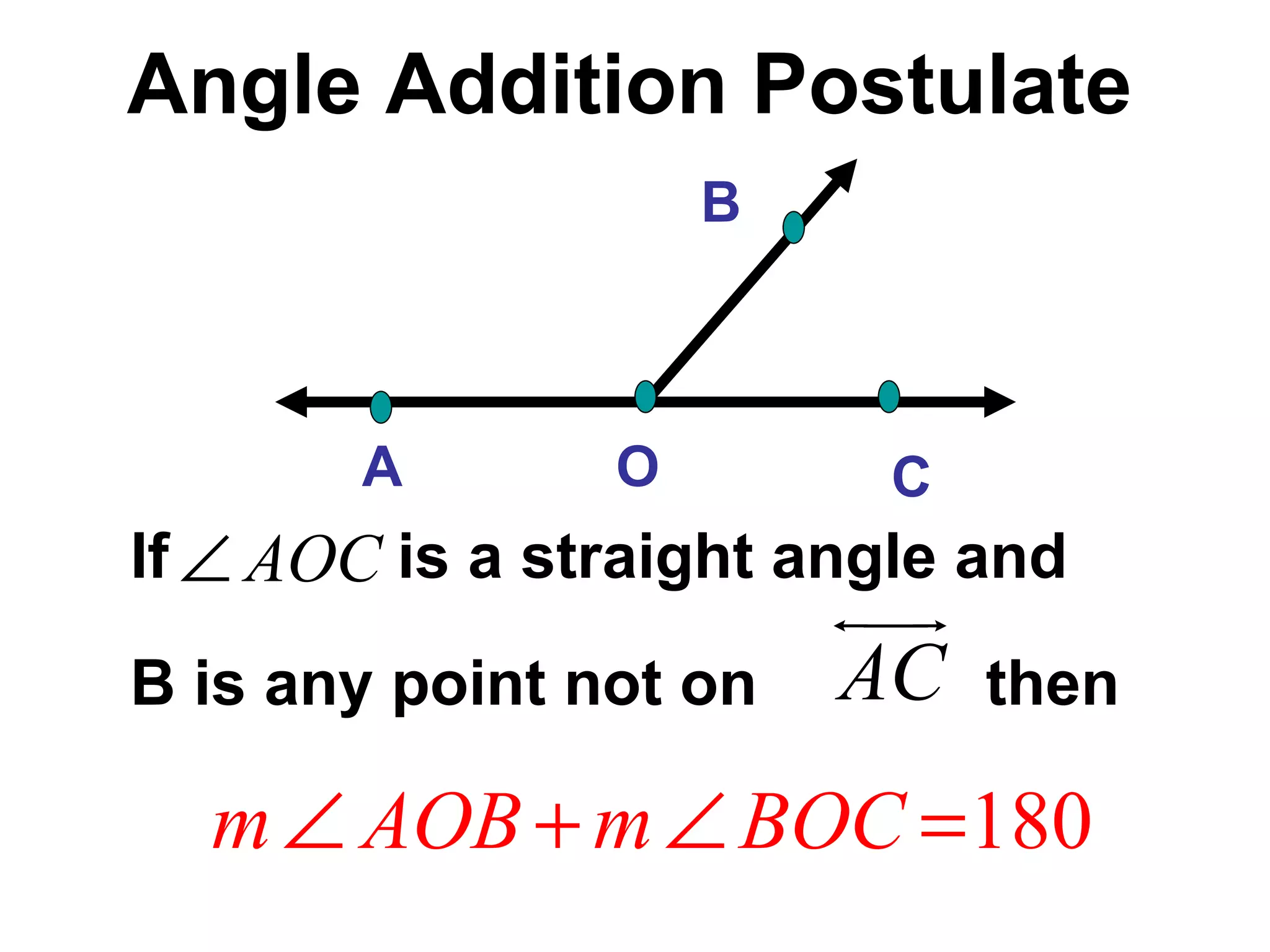
Angle Addition Postulate If  is a straight angle and  B is any point not on  then   O C B A
Note: The angle addition postulate is just like  the segment addition postulate. When the two angles form a straight line  then they are called  linear pairs . Euclid referred to this concept as … “ The sum of the parts equals the whole.”
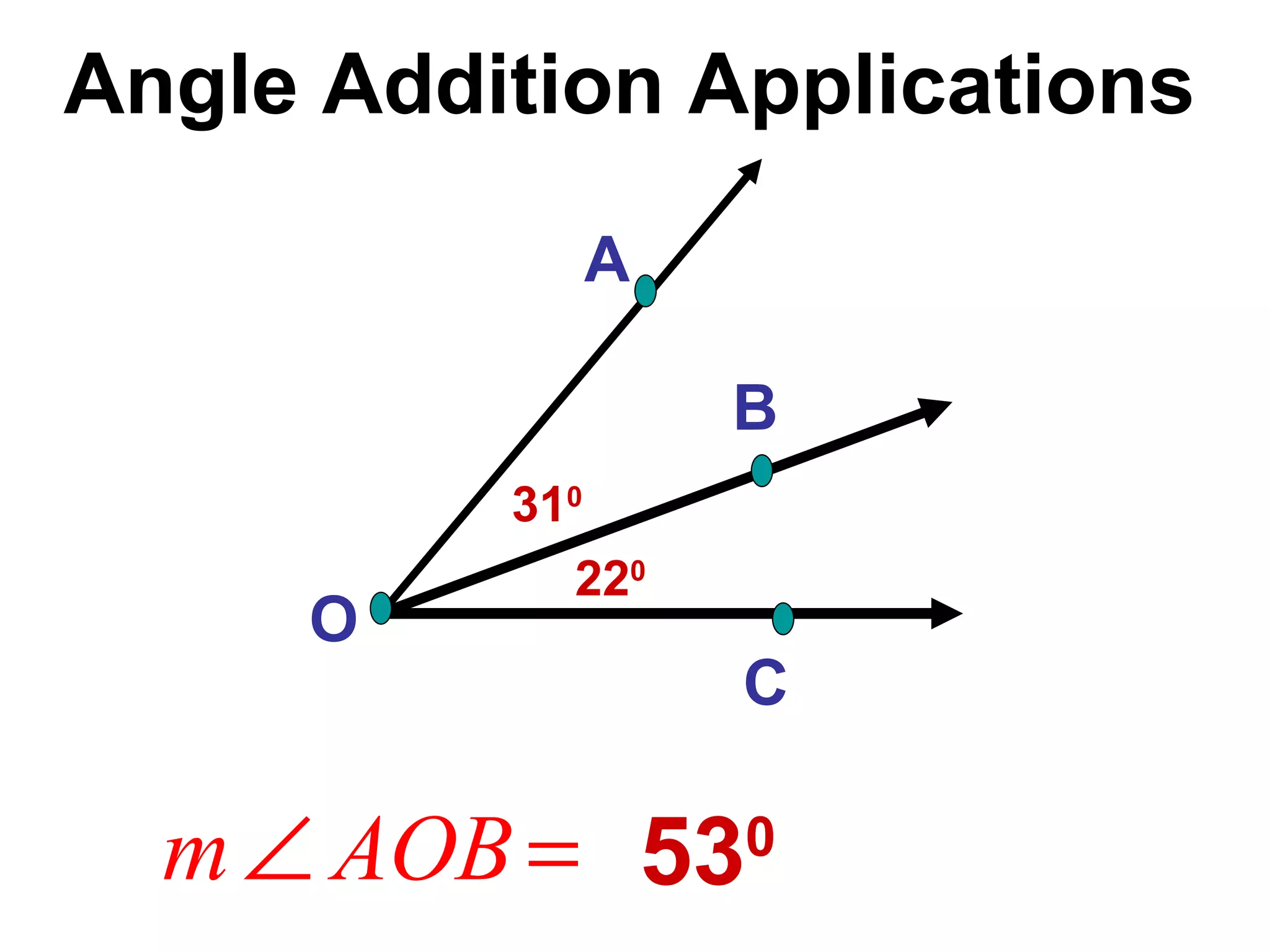
Angle Addition Applications A B C O 31 0 22 0 53 0
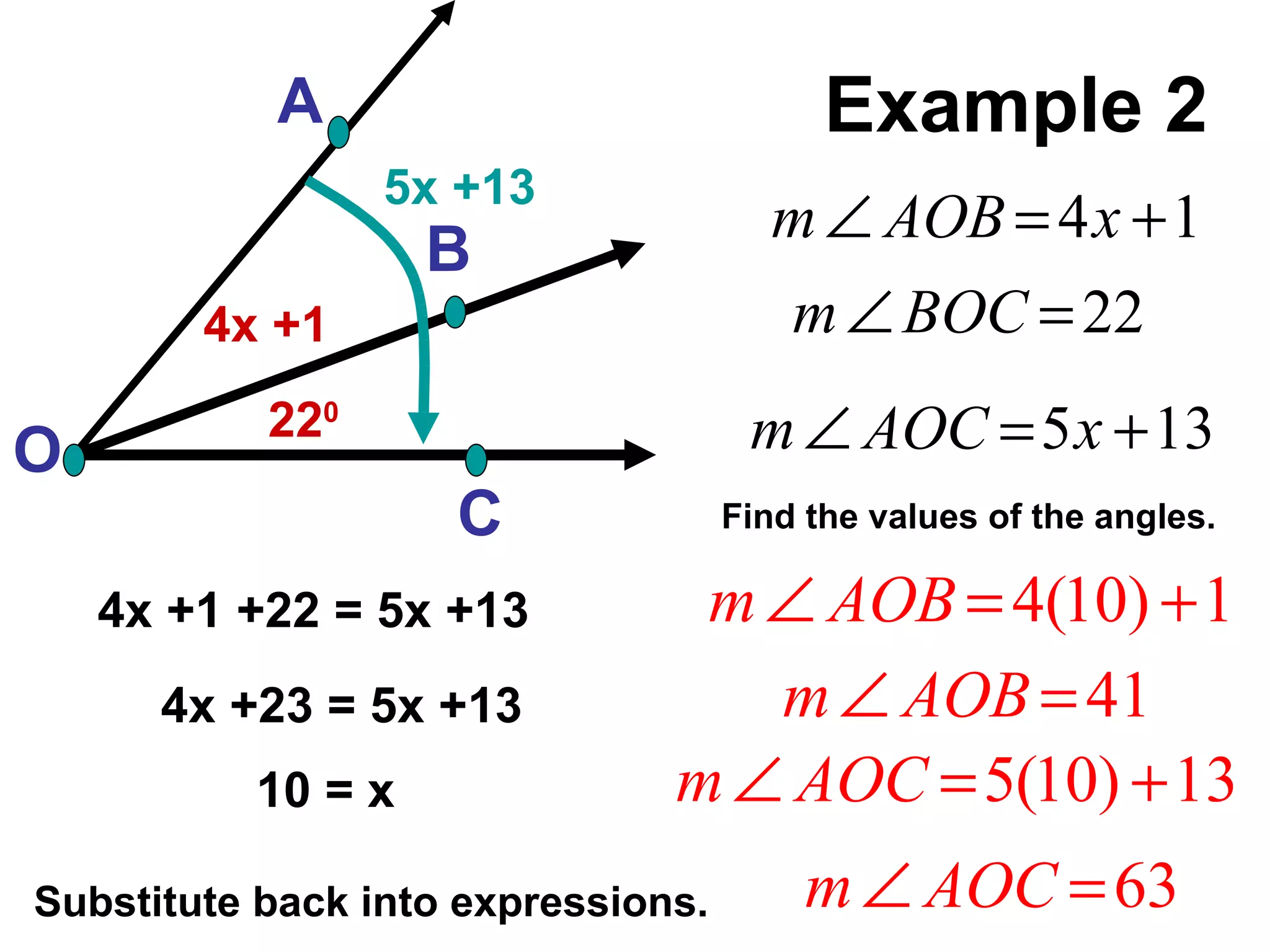
Example 2 A B C O 4x +1 22 0 Find the values of the angles. 5x +13 4x +1 +22 = 5x +13 4x +23 = 5x +13 10 = x  Substitute back into expressions.
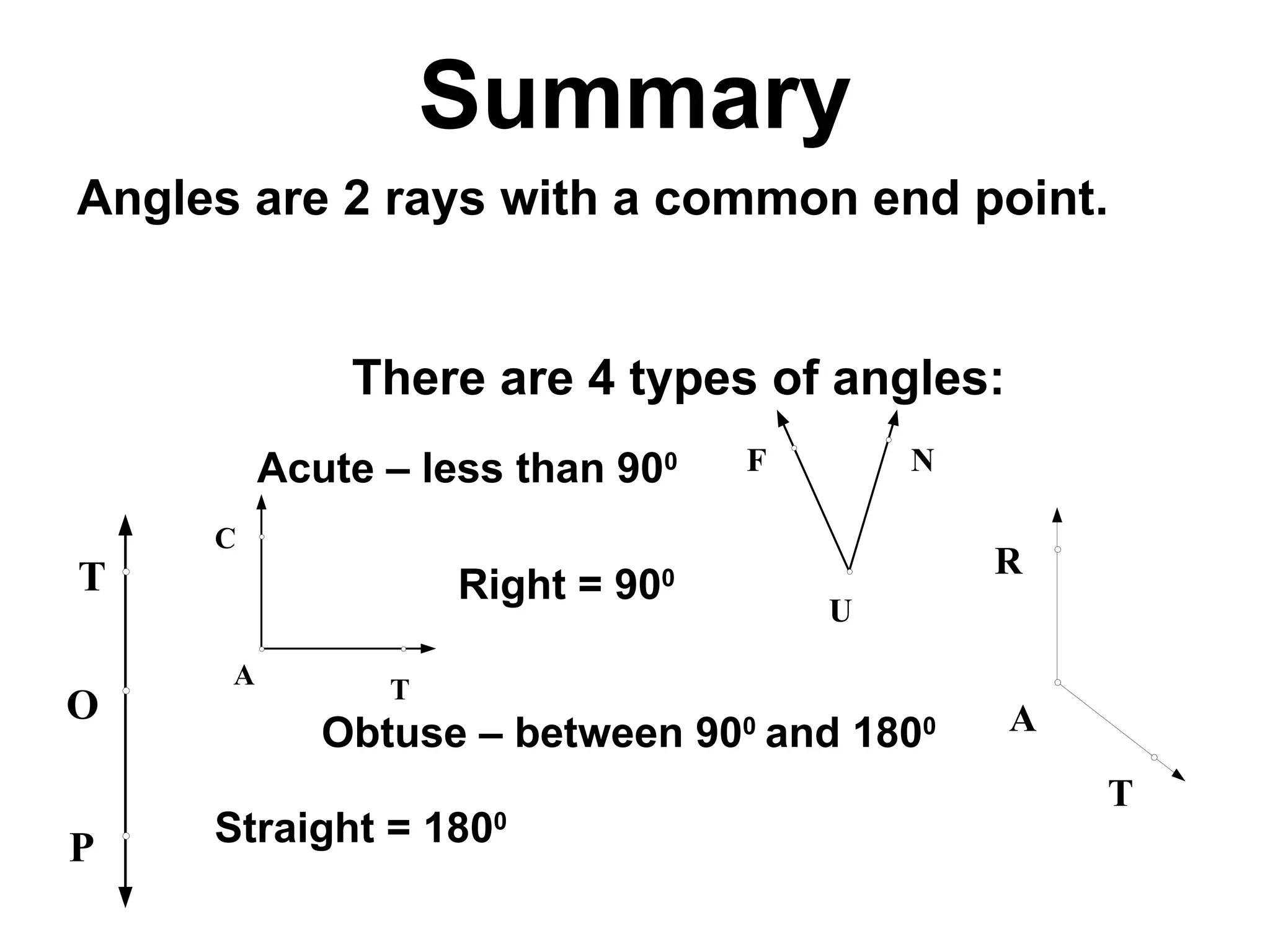
Summary There are 4 types of angles: Angles are 2 rays with a common end point. Acute – less than 90 0 Right = 90 0 Obtuse – between 90 0   and 180 0 Straight = 180 0
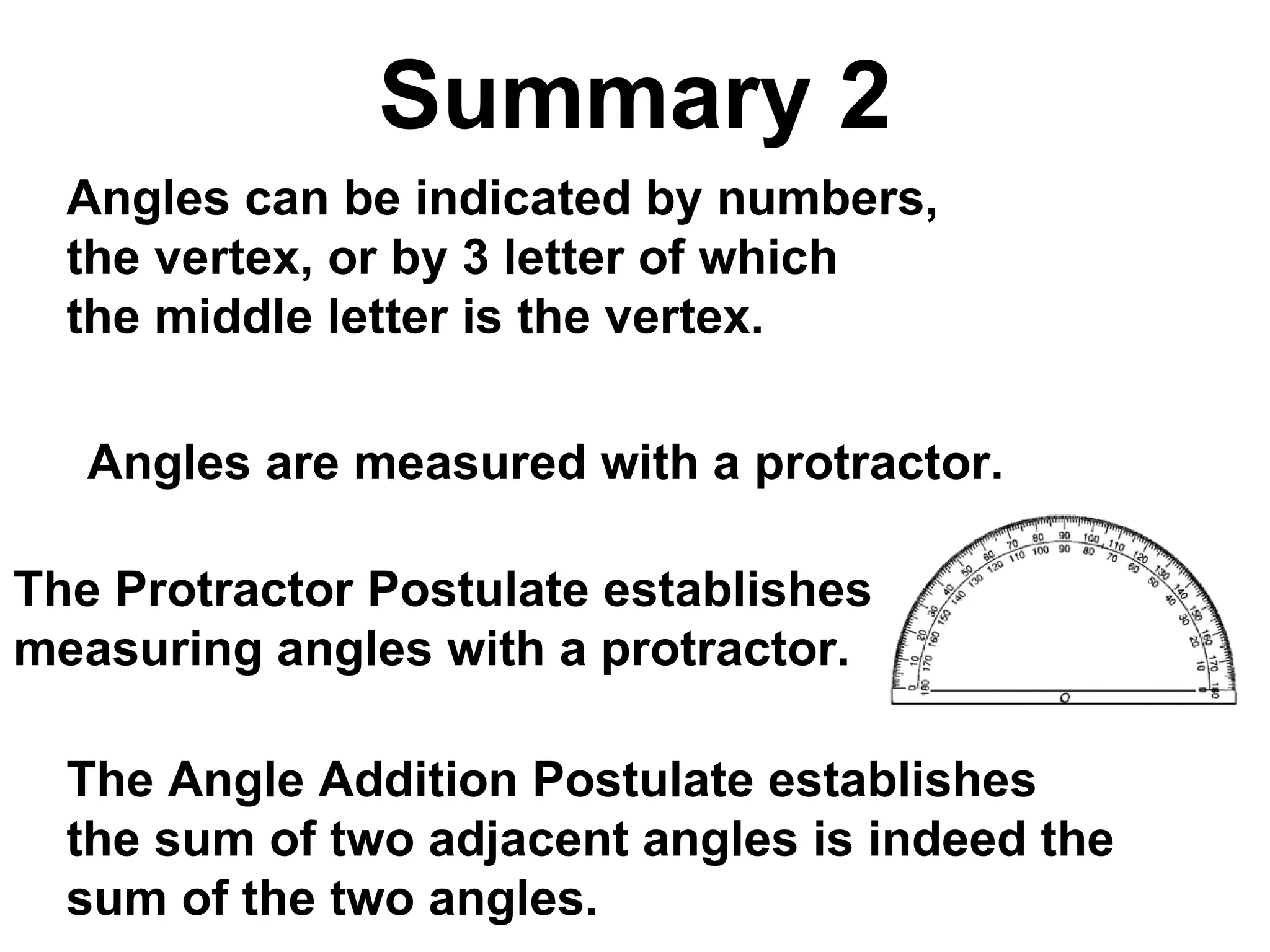
Summary 2 Angles are measured with a protractor. Angles can be indicated by numbers,  the vertex, or by 3 letter of which  the middle letter is the vertex. The Protractor Postulate establishes  measuring angles with a protractor. The Angle Addition Postulate establishes  the sum of two adjacent angles is indeed the  sum of the two angles.
C’est fini. Good day and good luck.

Ac1.4aAngles

  • 1.
    Angles Two rayswith a common endpoint. Vertex Side 1 Side 2
  • 2.
    Model Item Notation An angle is Two rays with a common end point. The parts are the sides ( rays ) , the vertex ( common point), interior space, and exterior space.
  • 3.
    Angles are classifiedby rotation of the rays.
  • 4.
  • 5.
  • 6.
    Obtuse angles: between90 and 180 degrees. Acute angles are < 90 degrees
  • 7.
    Types of AnglesAcute angles are less than 90 degrees Right angles are equal to 90 degrees . [ Looks like letter L ] Obtuse angles are greater than 90 degrees but less than 180 degrees. Straight angles look like lines and are equal to 180 degrees.
  • 8.
    Types of AnglesAngles are differentiated by the quantify of rotation of the rays as if they were hands of a clock. No rotation is zero degrees and totally straight is 180 degrees. 45 degrees 90 degrees
  • 9.
    Types of AnglesSmallest Largest Large Middle Small Zero Acute Right Obtuse Straight
  • 10.
  • 11.
    Measuring Angles TheProtractor Notice, the numbers add up to 180. The smaller number is for the acute angles and the larger number is for the obtuse angles.
  • 12.
  • 13.
  • 14.
    35 0 250 60 0 60 0
  • 15.
    35 0 350 57 0 53 0
  • 16.
    Adjacent Angles 12 Same vertex, Common ray, and no common interior
  • 17.
    Non-Adjacent Angles 12 Not the same endpoint.
  • 18.
    A B TG Non-Adjacent Angles Overlapping Interiors is not allowed.
  • 19.
    1 2 34 5 6 7 8 9
  • 20.
    How Many Angles? 2 + 1 = 3
  • 21.
    How Many Angles? 3 + 2 + 1 = 6
  • 22.
    How Many Angles? 4 + 3 + 2 + 1 = 10
  • 23.
    Did you seethe pattern? Total angles = sum of countdown of the smallest angle totals. 2 + 1 = 3 3 + 2 + 1 = 6 4 + 3 + 2 + 1 = 10
  • 24.
    50 0 VertexPosition One ray must be horizontal. Reading a protractor
  • 25.
    Protractor Postulate For on a given plane, choose any point O between A and B. Consider and and all the rays that can be drawn from O on one side of . A O B
  • 26.
    Protractor Postulate Theserays can be paired with the real numbers from 0 to 180 in such a way that: A O B is paired with 0 and with 180 . 0 180
  • 27.
    Protractor Postulate If is paired with x and is paired with y, These rays can be paired with the real numbers from 0 to 180 in such a way that: A O B 0 180 X Y P Q then
  • 28.
    Protractor Postulate If is paired with x and is paired with y, These rays can be paired with the real numbers from 0 to 180 in such a way that: A O B 0 180 100 150 P Q then Example = 50
  • 29.
    Example 2 70120 A C T 50 0 50 0 Top Scale Bottom Scale
  • 30.
    Angle Addition PostulateIf point B lies in the interior of then O C B A And
  • 31.
    Angle Addition PostulateIf is a straight angle and B is any point not on then O C B A
  • 32.
    Note: The angleaddition postulate is just like the segment addition postulate. When the two angles form a straight line then they are called linear pairs . Euclid referred to this concept as … “ The sum of the parts equals the whole.”
  • 33.
    Angle Addition ApplicationsA B C O 31 0 22 0 53 0
  • 34.
    Example 2 AB C O 4x +1 22 0 Find the values of the angles. 5x +13 4x +1 +22 = 5x +13 4x +23 = 5x +13 10 = x Substitute back into expressions.
  • 35.
    Summary There are4 types of angles: Angles are 2 rays with a common end point. Acute – less than 90 0 Right = 90 0 Obtuse – between 90 0 and 180 0 Straight = 180 0
  • 36.
    Summary 2 Anglesare measured with a protractor. Angles can be indicated by numbers, the vertex, or by 3 letter of which the middle letter is the vertex. The Protractor Postulate establishes measuring angles with a protractor. The Angle Addition Postulate establishes the sum of two adjacent angles is indeed the sum of the two angles.
  • 37.
    C’est fini. Goodday and good luck.