














Thinking Differently.
Enabling Innovation.

#BFLOInnov8
www.create-learning.com - Michael Cardus
What’s in it for me?
Having fun & learning
Understand what causes “stuckness” in
thinking
Learn & apply tools to get people “unstuck”
Understand the 5 levels of Inventive
Problems
Learn & apply Innovation Tools
Ways to best use these Innovation tools with
teams, individuals and stakeholders
 Contact me, I want to help
www.create-learning.com - Michael Cardus
http://www.gapingvoidart.com/

www.create-learning.com - Michael Cardus
“If you have been trained to think in
a certain way and are a member of
a group that thinks the same way,
how can you imagine changing to a
new way of thinking?”
- Edgar Schein

www.create-learning.com - Michael Cardus
http://www.gapingvoidart.com/

www.create-learning.com - Michael Cardus
What is Innovation?
o3 Minutes: Generate a Pool of
Concepts
o12 Minutes: Develop Concepts
o3 Minutes: Make Presentation
www.create-learning.com - Michael Cardus
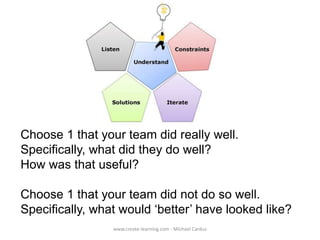
Choose 1 that your team did really well.
Specifically, what did they do well?
How was that useful?
Choose 1 that your team did not do so well.
Specifically, what would ‘better’ have looked like?
www.create-learning.com - Michael Cardus
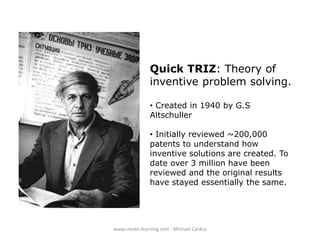
Quick TRIZ: Theory of
inventive problem solving.
‱ Created in 1940 by G.S
Altschuller

‱ Initially reviewed ~200,000
patents to understand how
inventive solutions are created. To
date over 3 million have been
reviewed and the original results
have stayed essentially the same.

www.create-learning.com - Michael Cardus
5 Levels of Inventiveness:
Altschuller determined 5 levels with level
1 being basic and level 5 being highly
innovative patents that required new
technology. Levels only indicate how
difficult a problem is to solve, higher
levels requiring more knowledge from
outside sources; truly outside-the-box.
Trials = estimation of the number of
trials it may take to obtain a solution
using trail and error.
www.create-learning.com - Michael Cardus
Level 1 = 32% of patents; Less than 10 trials.

o Example: Narrow hull the ship is unstable. Solution: use a wider hull.
Level 1 does not change the system substantially.

Level 2 = 45% of patents; up to 100 trials.

o Not well known within the industry or technology. No need for
knowledge outside of the industry and requires creative thinking for the
solution.

Level 3 = 18% of patents; up to 1000 trials.

o Significant improvements are made to an existing system. The solution
requires using engineering knowledge from other industries and
technology.

Level 4 = 4% of patents; up to 10,000 trials.

o Solution uses science that is new to that industry or technology. Usually
involves a radical new principle of operation.

Level 5 = Less than 1%; over 10 million trials.

o Solutions involve discoveries of new scientific phenomena or a new
scientific discovery.
www.create-learning.com - Michael Cardus
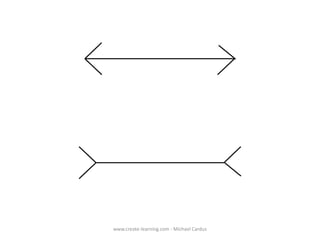
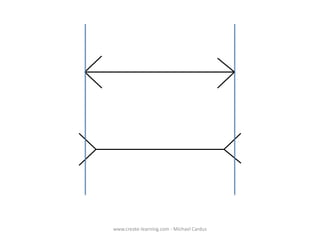
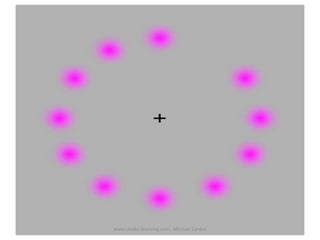
Many problems can
be solved by
changing – widening
our perception.

www.create-learning.com - Michael Cardus
www.create-learning.com
Image http://www.flickr.com/photos/speednutdave/2839923659/

- Michael Cardus
www.create-learning.com - Michael Cardus
TRIZ tools can work to release
Psychological Inertia
AKA Mental / Organizational Stuckness

www.create-learning.com - Michael Cardus
PSYCHOLOGICAL INERTIA.
The psychological meaning of the word
"inertia" implies an indisposition to
change – a certain "stuckness" due to
human programming. It represents the
inevitability of behaving in a certain way
– the way that has been indelibly
inscribed somewhere in the brain. It
also represents the impossibility – as
long as a person is guided by his habits
– of ever behaving in a better way.
– Kowalick

www.create-learning.com - Michael Cardus
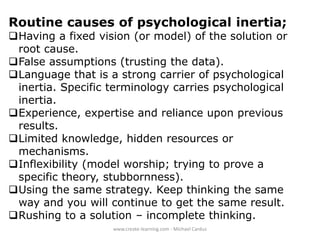
Routine causes of psychological inertia;

Having a fixed vision (or model) of the solution or
root cause.
False assumptions (trusting the data).
Language that is a strong carrier of psychological
inertia. Specific terminology carries psychological
inertia.
Experience, expertise and reliance upon previous
results.
Limited knowledge, hidden resources or
mechanisms.
Inflexibility (model worship; trying to prove a
specific theory, stubbornness).
Using the same strategy. Keep thinking the same
way and you will continue to get the same result.
Rushing to a solution – incomplete thinking.
www.create-learning.com - Michael Cardus
Tools to
Release
Innovation

www.create-learning.com - Michael Cardus
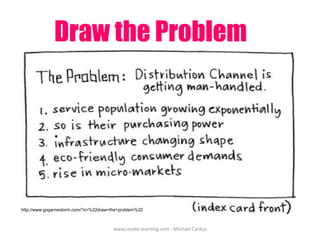
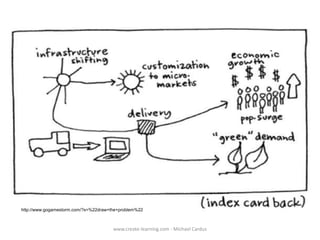
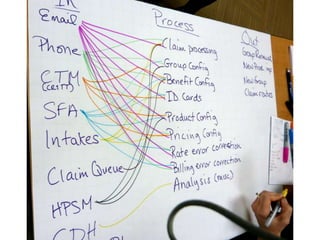
Draw the Problem

http://www.gogamestorm.com/?s=%22draw+the+problem%22

www.create-learning.com - Michael Cardus
http://www.gogamestorm.com/?s=%22draw+the+problem%22

www.create-learning.com - Michael Cardus
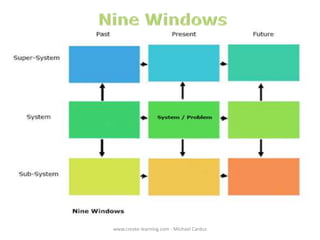
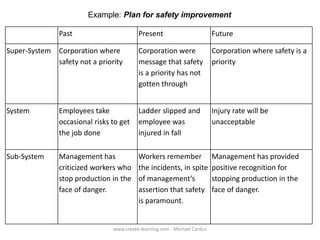
Example: Plan for safety improvement
Past

Present

Future

Super-System

Corporation where
safety not a priority

Corporation were
message that safety
is a priority has not
gotten through

Corporation where safety is a
priority

System

Employees take
occasional risks to get
the job done

Ladder slipped and
employee was
injured in fall

Injury rate will be
unacceptable

Sub-System

Management has
criticized workers who
stop production in the
face of danger.

Workers remember
the incidents, in spite
of management’s
assertion that safety
is paramount.

Management has provided
positive recognition for
stopping production in the
face of danger.

www.create-learning.com - Michael Cardus
Plan for an increase in customer satisfaction based upon meeting with client support.

Past
Smaller company, Less
need for product, Only
phones No Internet, SoldDirectly to Customer

Present
Organization, Phone
System, Internet,
Transportation, Buyers,
Wholesalers, Suppliers

Future
Larger organization, More
product offerings, More
staff, More customers,
Outsourcing much of
sales, Global Market

System

Customer phoned or
physically came to the
location.

Meetings are scheduled
according to incoming
phone calls, emails, online contacts for support.

Meeting happen
“virtually”, more product
sold = more incoming calls
and contact for support,
increased dependence
upon “magnet & virtual”
staff and locations.

Sub-System

phones, typewriters + file Phones, Each persons
cabinets (physical tangible computer, Personal
records), Only spoke
Relationships, Multiple
English, Only US currency Languages, Locations

Super-System

www.create-learning.com - Michael Cardus

Increased storage of
records on computers,
People who speak
multiple languages,
Translators, Done on
computers
www.create-learning.com - Michael Cardus
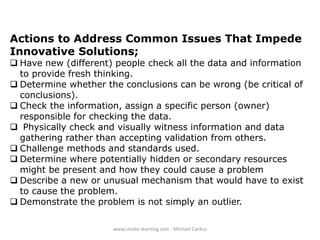
Actions to Address Common Issues That Impede
Innovative Solutions;

 Have new (different) people check all the data and information
to provide fresh thinking.
 Determine whether the conclusions can be wrong (be critical of
conclusions).
 Check the information, assign a specific person (owner)
responsible for checking the data.
 Physically check and visually witness information and data
gathering rather than accepting validation from others.
 Challenge methods and standards used.
 Determine where potentially hidden or secondary resources
might be present and how they could cause a problem
 Describe a new or unusual mechanism that would have to exist
to cause the problem.
 Demonstrate the problem is not simply an outlier.
www.create-learning.com - Michael Cardus
The DTC Operator Algorithm
 Define the problem: Name the
system or the part of the system of
interest.
 Consider ideas created by DTC
extremes:

www.create-learning.com - Michael Cardus
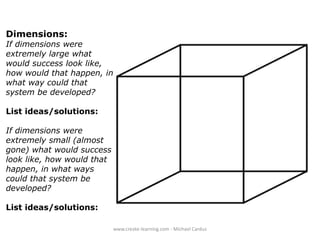
Dimensions:

If dimensions were
extremely large what
would success look like,
how would that happen, in
what way could that
system be developed?
List ideas/solutions:

If dimensions were
extremely small (almost
gone) what would success
look like, how would that
happen, in what ways
could that system be
developed?
List ideas/solutions:
www.create-learning.com - Michael Cardus
Time:

If time were extremely long what would success look like, how
would that happen, in what ways could that system be
developed? (i.e. Days, Years, Decades instead of seconds or
minutes) OR If speed were extremely slow what would success
look like, how would that happen, in what ways could that
system be developed?
List ideas/solutions:
If time were extremely small what would success look like, how
would that happen, in what ways could that system be
developed? (i.e. nanoseconds instead of seconds) OR If speed
were extremely fast what would success look like, how would
that happen, in what ways could that system be developed?
List ideas/solutions:

www.create-learning.com - Michael Cardus
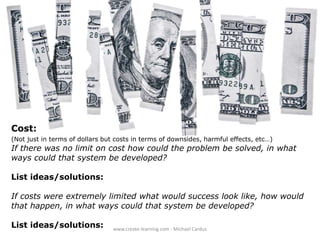
Cost:
(Not just in terms of dollars but costs in terms of downsides, harmful effects, etc
)

If there was no limit on cost how could the problem be solved, in what
ways could that system be developed?
List ideas/solutions:
If costs were extremely limited what would success look like, how would
that happen, in what ways could that system be developed?
List ideas/solutions:

www.create-learning.com - Michael Cardus
The DTC Operator Algorithm
 Define the problem: Name the
system or the part of the system of
interest.
 Consider ideas created by DTC
extremes:

www.create-learning.com - Michael Cardus
Photo attribution
http://www.flickr.com/photos/pasukaru76/4307189567/
http://www.flickr.com/photos/pasukaru76/3992935923/
http://www.flickr.com/photos/wingtorn/7225734766/
http://www.flickr.com/photos/antonnovoselov/4712010305/
http://www.flickr.com/photos/33263856@N02/5157196328/in/photostream/
http://www.flickr.com/photos/aidanmorgan/4763085590/
http://www.flickr.com/photos/calliope/5902712709/
http://www.flickr.com/photos/pasukaru76/5018455914/
http://www.flickr.com/photos/kurtbudiarto/7150324143/
http://www.flickr.com/photos/derekgavey/5069358550/
http://www.flickr.com/photos/a_siegel/8133716733/
http://en.wikipedia.org/wiki/File:Necker_cube.svg
http://www.flickr.com/photos/dhilung/3311130707/
http://www.flickr.com/photos/76657755@N04/7408506410/
http://www.flickr.com/photos/jdhancock/3948724485/

www.create-learning.com - Michael Cardus

Thinking Differently. Enabling Innovation - Buffalo Business First Event