Albert Bandura 
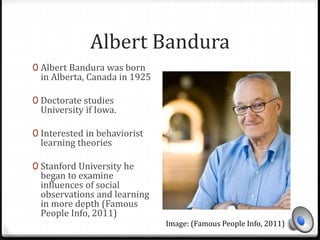
0 Albert Bandura was born 
in Alberta, Canada in 1925 
0 Doctorate studies 
University if Iowa. 
0 Interested in behaviorist 
learning theories 
0 Stanford University he 
began to examine 
influences of social 
observations and learning 
in more depth (Famous 
People Info, 2011) 
Image: (Famous People Info, 2011)
Social Cognitive Theory 
Bobo doll experiment: 
 Adults were recorded being aggressive to bobo dolls 
Children were shown the video and then allow to play 
in a room full of toys 
Children were aggressive to the bobo doll just as the 
adults were in the video (Cherry, 2014).
Social Cognitive Theory 
0 Through his research, 
Bandura observed that 
components of learning 
occur though observation 
and modeling behaviors 
0 This concept led to the 
theoretical framework of 
the social cognitive 
learning theory (Famous 
People Info, 2011).
Assumptions Of Social 
Cognitive Theory 
0 Learning occurs by observing others and modeling 
0 Internal processes and cognition of observed behavior may 
or may not lead to a learned behavior ( learning 
performance distinction). 
0 Behavior is goal directed- goals are set and behavior is 
directed to accomplishing the goal (motivation driven) 
0 Behavior is eventually self-regulated 
0 Punishment and reinforcement have indirect effects on the 
learning process (Hurst, 2014).
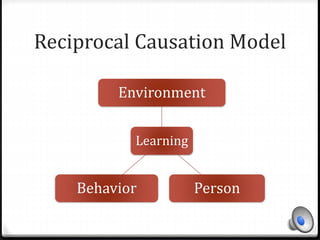
Reciprocal Causation Model 
Environment 
Learning 
Behavior Person
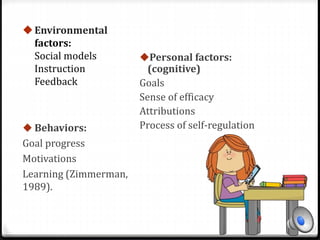
Environmental 
factors: 
Social models 
Instruction 
Feedback 
Personal factors: 
(cognitive) 
Goals 
Sense of efficacy 
Attributions 
Behaviors: Process of self-regulation 
Goal progress 
Motivations 
Learning (Zimmerman, 
1989).
Types of Learning: 
0 Enactive Learning- learning by 
doing and is reinforced by the 
consequences of 
actions/outcomes 
0 Vicarious Learning- learning 
through observation not 
performance (Hurst, 2014).
The Learning Process 
Requires: 
0 Attention 
0 Retention 
0 Reproduction 
0 Motivation
Social Cognitive Theory: 
Modeling 
0 Models can be real 
people (teachers, 
coaches etc.) 
0 Models can also come 
from media: books, TV, 
Magazines (symbolic) 
0 Models can influence 
behavior: positively or 
negatively (Schunk, 
2012).
Characteristics of Models 
Models, both real and 
symbolic, have: 
0 Have prestige and power 
0 Models are competent 
0 Perform tasks well that 
others would like to be 
able to do (Hurst, 2014).
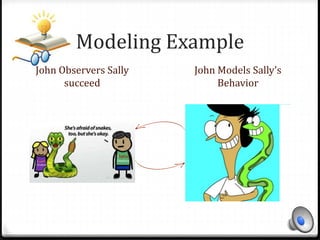
Modeling Example 
John Observers Sally 
succeed 
John Models Sally’s 
Behavior
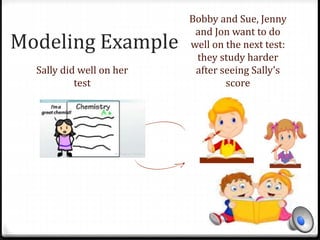
Modeling Example 
Sally did well on her 
test 
Bobby and Sue, Jenny 
and Jon want to do 
well on the next test: 
they study harder 
after seeing Sally’s 
score
Evaluation of Learning and 
Behavior 
0 Perceived self-efficacy 
0 Outcome expectations 
0 Goal Setting 
0 Self-evaluation 
0 Goal Progress 
0 Cognitive modeling 
0 Self-instruction 
(Schunk, 2012).
Summary Points 
Learning/behavior occurs through: 
Models/modeling 
Efficacy 
Reinforcement 
Self-regulation
Strengths of Theory 
0 A great deal of learning 
occurs from watching 
others 
0 Strong research to support 
theory 
0 People have considerable 
control over behaviors 
learning (motivation) 
(Hurst, 2014)
Weaknesses of Theory 
0 The theory is loosely 
structured 
0 Doesn’t take emotional 
responses into account 
0 Ignores biological differences 
between individuals –genetic 
factors 
0 Assumes that all behavior is a 
result of modeling, not 
genetics, illness, or other 
influences (Flamand, 2014).
Applications Of The Theory 
Think-Pare-Share: 
 By modeling the process prior to the exercise, expectations and the goal of the exercise 
can be set by the instructor. By interacting with peers, students can model behavior of 
those they feel are self-assured and this in turn increases self-efficacy 
 The process goes something like this: a professor gives a lecture and then asks 
questions about the material. Students are pared off in sets and allowed to discuss the 
material. Later the students voice a conclusion/answer following the collaborative 
discussions (Karge, Phillips, Dodson, & McCabe, 2011). 
 Benefits: Allows for students to participate in collaborative learning and peer 
interaction allows for discussion. Students are more likely to model those who they 
feel are like them and competent in the area of studies (McLeod, 2011).
Application Of The Theory 
Scenario-based learning: 
This is the process of dividing students into small groups 
and then providing a situational learning environment 
(example CPR). 
The instructor demonstrates the procedure of providing 
CPR and then students emulate the behavior. Feedback is 
provided and students are able to self-correct. Students 
gain increased self-efficacy as they progress in the activity 
( Johnson, Dana, Jordan, Draeger, Schmitt-Olabisi, Reich, 
2012).
Application Of The Theory 
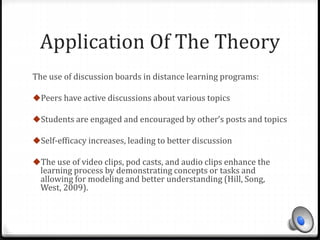
The use of discussion boards in distance learning programs: 
Peers have active discussions about various topics 
Students are engaged and encouraged by other’s posts and topics 
Self-efficacy increases, leading to better discussion 
The use of video clips, pod casts, and audio clips enhance the 
learning process by demonstrating concepts or tasks and 
allowing for modeling and better understanding (Hill, Song, 
West, 2009).
References 
0 Cherry, K. (2014). Social Learning Theory: How People 
Learn By Observation. About Education Retrieved from 
http://psychology.about.com/od/developmentalpsycholog 
y/a/sociallearning.htm 
0 Famous People Info. (2011). Albert Bandura: Theory Dollar 
and Miller. Retrieved from 
http://famouspeopleinfo.com/albert-bandura-theory-dollar- 
and-miller/ 
0 Flamand, L. (2014). Limitations of Social Cognitive Theory. 
Ehow. Retrieved from 
http://www.ehow.com/about_5421206_limitations-social-cognitive- 
theory.html
References 
Hurst, M. (2014). Social-Cognitive Learning Theory: Definition and 
Examples. Education Portal retrieved from http://education-portal. 
com/academy/lesson/social-cognitive-learning-theory-definition-and- 
examples.html#lesson 
Hill, J.R, Song, L., West, R. E. (2009). Social Learning Theory and Web-Based 
Learning Environments: A Review of Research and Discussion of 
Implications. The American Journal of Distance Education, 23:1-16 
Johnson, K. A., Dana, G., Jordan, N.R., Draeger, K.J., Kapuscinski, A., Schmitt- 
Olabisi, L.K., Reich, P.B. Using Participatory Scenarios to Simulate Social 
Learning for Collaborative Sustainable Development. Ecology and Society, 
17(2).
References 
Karge, B.D., Phillips, K.M., Dodson, T.J. & McCabe, M. (2011). 
Effective Strategies for Engaging the Adult Learner. Journal of 
College Teaching & Learning, vol. 8 (12), p. 53-57. 
McLeod, S.A. (2011). Social Learning Theory. Retrieved from 
http://www.simplypsychology.org/bandura.html 
Schunk, D.H. (2012). Learning Theories: An Educational 
Perspective 6th ed, Allyn & Bacon Publishing, Boston, MA. 
Zimmerman, B. J. (1989). A Cognitive View of Self-Regulated 
Academic Learning. Journal of Educational Psychology, 81(3) 
329-39

Social Cognitive Theory

  • 2.
    Albert Bandura 0Albert Bandura was born in Alberta, Canada in 1925 0 Doctorate studies University if Iowa. 0 Interested in behaviorist learning theories 0 Stanford University he began to examine influences of social observations and learning in more depth (Famous People Info, 2011) Image: (Famous People Info, 2011)
  • 3.
    Social Cognitive Theory Bobo doll experiment:  Adults were recorded being aggressive to bobo dolls Children were shown the video and then allow to play in a room full of toys Children were aggressive to the bobo doll just as the adults were in the video (Cherry, 2014).
  • 4.
    Social Cognitive Theory 0 Through his research, Bandura observed that components of learning occur though observation and modeling behaviors 0 This concept led to the theoretical framework of the social cognitive learning theory (Famous People Info, 2011).
  • 5.
    Assumptions Of Social Cognitive Theory 0 Learning occurs by observing others and modeling 0 Internal processes and cognition of observed behavior may or may not lead to a learned behavior ( learning performance distinction). 0 Behavior is goal directed- goals are set and behavior is directed to accomplishing the goal (motivation driven) 0 Behavior is eventually self-regulated 0 Punishment and reinforcement have indirect effects on the learning process (Hurst, 2014).
  • 6.
    Reciprocal Causation Model Environment Learning Behavior Person
  • 7.
    Environmental factors: Socialmodels Instruction Feedback Personal factors: (cognitive) Goals Sense of efficacy Attributions Behaviors: Process of self-regulation Goal progress Motivations Learning (Zimmerman, 1989).
  • 8.
    Types of Learning: 0 Enactive Learning- learning by doing and is reinforced by the consequences of actions/outcomes 0 Vicarious Learning- learning through observation not performance (Hurst, 2014).
  • 9.
    The Learning Process Requires: 0 Attention 0 Retention 0 Reproduction 0 Motivation
  • 10.
    Social Cognitive Theory: Modeling 0 Models can be real people (teachers, coaches etc.) 0 Models can also come from media: books, TV, Magazines (symbolic) 0 Models can influence behavior: positively or negatively (Schunk, 2012).
  • 11.
    Characteristics of Models Models, both real and symbolic, have: 0 Have prestige and power 0 Models are competent 0 Perform tasks well that others would like to be able to do (Hurst, 2014).
  • 12.
    Modeling Example JohnObservers Sally succeed John Models Sally’s Behavior
  • 13.
    Modeling Example Sallydid well on her test Bobby and Sue, Jenny and Jon want to do well on the next test: they study harder after seeing Sally’s score
  • 14.
    Evaluation of Learningand Behavior 0 Perceived self-efficacy 0 Outcome expectations 0 Goal Setting 0 Self-evaluation 0 Goal Progress 0 Cognitive modeling 0 Self-instruction (Schunk, 2012).
  • 15.
    Summary Points Learning/behavioroccurs through: Models/modeling Efficacy Reinforcement Self-regulation
  • 16.
    Strengths of Theory 0 A great deal of learning occurs from watching others 0 Strong research to support theory 0 People have considerable control over behaviors learning (motivation) (Hurst, 2014)
  • 17.
    Weaknesses of Theory 0 The theory is loosely structured 0 Doesn’t take emotional responses into account 0 Ignores biological differences between individuals –genetic factors 0 Assumes that all behavior is a result of modeling, not genetics, illness, or other influences (Flamand, 2014).
  • 18.
    Applications Of TheTheory Think-Pare-Share:  By modeling the process prior to the exercise, expectations and the goal of the exercise can be set by the instructor. By interacting with peers, students can model behavior of those they feel are self-assured and this in turn increases self-efficacy  The process goes something like this: a professor gives a lecture and then asks questions about the material. Students are pared off in sets and allowed to discuss the material. Later the students voice a conclusion/answer following the collaborative discussions (Karge, Phillips, Dodson, & McCabe, 2011).  Benefits: Allows for students to participate in collaborative learning and peer interaction allows for discussion. Students are more likely to model those who they feel are like them and competent in the area of studies (McLeod, 2011).
  • 19.
    Application Of TheTheory Scenario-based learning: This is the process of dividing students into small groups and then providing a situational learning environment (example CPR). The instructor demonstrates the procedure of providing CPR and then students emulate the behavior. Feedback is provided and students are able to self-correct. Students gain increased self-efficacy as they progress in the activity ( Johnson, Dana, Jordan, Draeger, Schmitt-Olabisi, Reich, 2012).
  • 20.
    Application Of TheTheory The use of discussion boards in distance learning programs: Peers have active discussions about various topics Students are engaged and encouraged by other’s posts and topics Self-efficacy increases, leading to better discussion The use of video clips, pod casts, and audio clips enhance the learning process by demonstrating concepts or tasks and allowing for modeling and better understanding (Hill, Song, West, 2009).
  • 21.
    References 0 Cherry,K. (2014). Social Learning Theory: How People Learn By Observation. About Education Retrieved from http://psychology.about.com/od/developmentalpsycholog y/a/sociallearning.htm 0 Famous People Info. (2011). Albert Bandura: Theory Dollar and Miller. Retrieved from http://famouspeopleinfo.com/albert-bandura-theory-dollar- and-miller/ 0 Flamand, L. (2014). Limitations of Social Cognitive Theory. Ehow. Retrieved from http://www.ehow.com/about_5421206_limitations-social-cognitive- theory.html
  • 22.
    References Hurst, M.(2014). Social-Cognitive Learning Theory: Definition and Examples. Education Portal retrieved from http://education-portal. com/academy/lesson/social-cognitive-learning-theory-definition-and- examples.html#lesson Hill, J.R, Song, L., West, R. E. (2009). Social Learning Theory and Web-Based Learning Environments: A Review of Research and Discussion of Implications. The American Journal of Distance Education, 23:1-16 Johnson, K. A., Dana, G., Jordan, N.R., Draeger, K.J., Kapuscinski, A., Schmitt- Olabisi, L.K., Reich, P.B. Using Participatory Scenarios to Simulate Social Learning for Collaborative Sustainable Development. Ecology and Society, 17(2).
  • 23.
    References Karge, B.D.,Phillips, K.M., Dodson, T.J. & McCabe, M. (2011). Effective Strategies for Engaging the Adult Learner. Journal of College Teaching & Learning, vol. 8 (12), p. 53-57. McLeod, S.A. (2011). Social Learning Theory. Retrieved from http://www.simplypsychology.org/bandura.html Schunk, D.H. (2012). Learning Theories: An Educational Perspective 6th ed, Allyn & Bacon Publishing, Boston, MA. Zimmerman, B. J. (1989). A Cognitive View of Self-Regulated Academic Learning. Journal of Educational Psychology, 81(3) 329-39