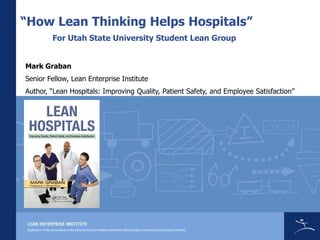
“How Lean Thinking Helps Hospitals”
        For Utah State University Student Lean Group


Mark Graban
Senior Fellow, Lean Enterprise Institute
Author, “Lean Hospitals: Improving Quality, Patient Safety, and Employee Satisfaction”
Agenda

• Lean in Healthcare
   – The need for Lean in Healthcare
   – Principles that apply in Healthcare
   – Examples
• Career Lessons Learned
   – As an Industrial Engineer
   – As a Lean Implementer
• Q&A
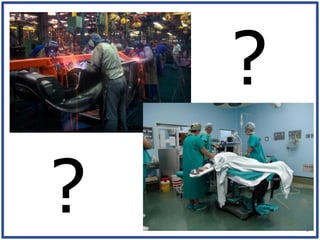
?
?       3
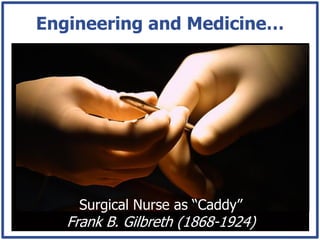
Engineering and Medicine…


    Surgical Nurse as “Caddy”
   Frank B. Gilbreth (1868-1924)
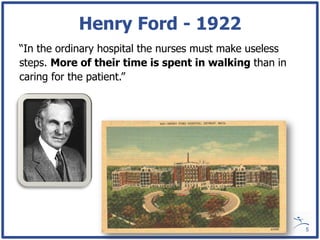
Henry Ford - 1922
“In the ordinary hospital the nurses must make useless
steps. More of their time is spent in walking than in
caring for the patient.”


                                                         5
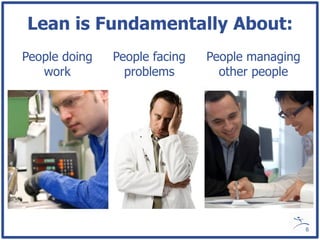
Lean is Fundamentally About:
People doing   People facing   People managing
   work          problems        other people


                                                 6
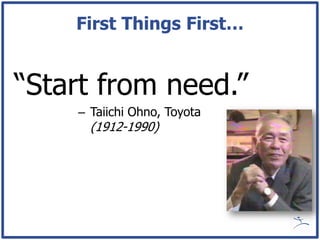
First Things First…


“Start from need.”
    – Taiichi Ohno, Toyota
      (1912-1990)
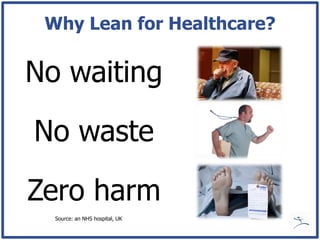
Why Lean for Healthcare?

No waiting

No waste

Zero harm
  Source: an NHS hospital, UK
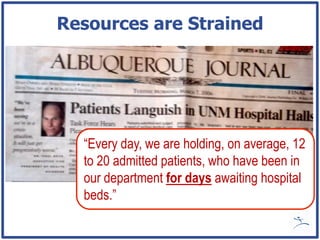
Resources are Strained


  “Every day, we are holding, on average, 12
  to 20 admitted patients, who have been in
  our department for days awaiting hospital
  beds.”
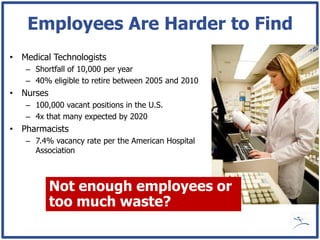
Employees Are Harder to Find
• Medical Technologists
   – Shortfall of 10,000 per year
   – 40% eligible to retire between 2005 and 2010
• Nurses
   – 100,000 vacant positions in the U.S.
   – 4x that many expected by 2020
• Pharmacists
   – 7.4% vacancy rate per the American Hospital
     Association


           Not enough employees or
           too much waste?
Too Many Errors Occur

• Adverse events in 3.7% of hospitalizations(1)
   – 13.6% of those led to death(1)
   – 53-58% are preventable(2)


• Death resulting from preventable error occurs in 1 of 400
  hospitalizations


      •   (1): Brennan, Leape, et al, New England Journal of Medicine
      •   (2): To Err is Human, Institute of Medicine


 One per week in a typical hospital
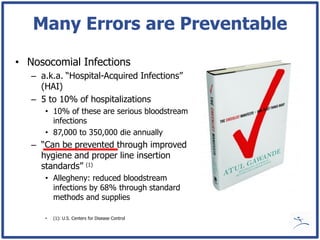
Many Errors are Preventable

• Nosocomial Infections
   – a.k.a. “Hospital-Acquired Infections”
     (HAI)
   – 5 to 10% of hospitalizations
      • 10% of these are serious bloodstream
        infections
      • 87,000 to 350,000 die annually
   – “Can be prevented through improved
     hygiene and proper line insertion
     standards” (1)
      • Allegheny: reduced bloodstream
        infections by 68% through standard
        methods and supplies

      •   (1): U.S. Centers for Disease Control
Remember This:


 The problem
is the process
(or lack thereof)…
not the people
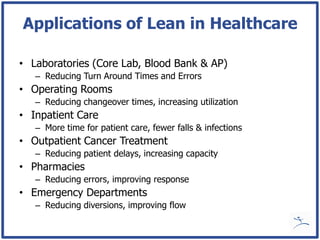
Applications of Lean in Healthcare

• Laboratories (Core Lab, Blood Bank & AP)
   – Reducing Turn Around Times and Errors
• Operating Rooms
   – Reducing changeover times, increasing utilization
• Inpatient Care
   – More time for patient care, fewer falls & infections
• Outpatient Cancer Treatment
   – Reducing patient delays, increasing capacity
• Pharmacies
   – Reducing errors, improving response
• Emergency Departments
   – Reducing diversions, improving flow
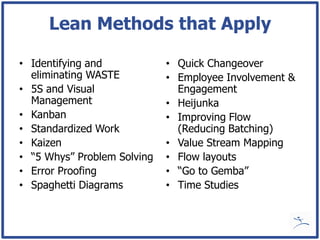
Lean Methods that Apply

• Identifying and            • Quick Changeover
  eliminating WASTE          • Employee Involvement &
• 5S and Visual                Engagement
  Management                 • Heijunka
• Kanban                     • Improving Flow
• Standardized Work            (Reducing Batching)
• Kaizen                     • Value Stream Mapping
• “5 Whys” Problem Solving   • Flow layouts
• Error Proofing             • “Go to Gemba”
• Spaghetti Diagrams         • Time Studies
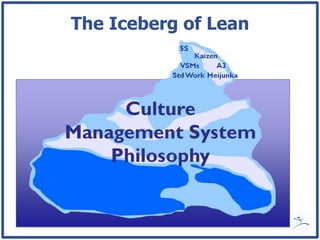
The Iceberg of Lean
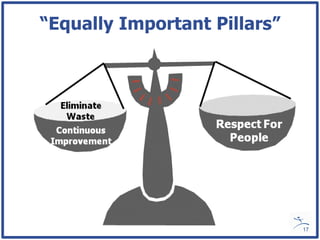
“Equally Important Pillars”


                              17
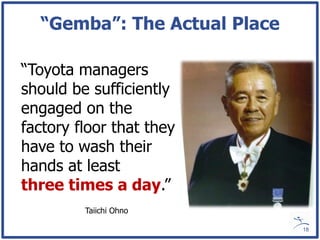
“Gemba”: The Actual Place

“Toyota managers
should be sufficiently
engaged on the
factory floor that they
have to wash their
hands at least
three times a day.”
         Taiichi Ohno

                              18
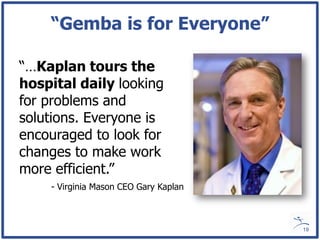
“Gemba is for Everyone”

“…Kaplan tours the
hospital daily looking
for problems and
solutions. Everyone is
encouraged to look for
changes to make work
more efficient.”
    - Virginia Mason CEO Gary Kaplan


                                       19
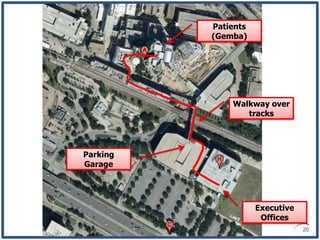
Patients
          (Gemba)


              Walkway over
                 tracks


Parking
Garage


                     Executive
                      Offices
                                 20
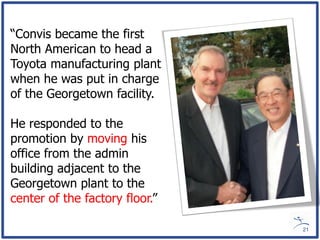
“Convis became the first
North American to head a
Toyota manufacturing plant
when he was put in charge
of the Georgetown facility.

He responded to the
promotion by moving his
office from the admin
building adjacent to the
Georgetown plant to the
center of the factory floor.”

                                21
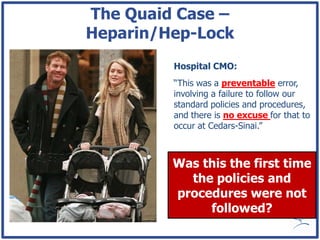
The Quaid Case –
Heparin/Hep-Lock
         Hospital CMO:
         “This was a preventable error,
         involving a failure to follow our
         standard policies and procedures,
         and there is no excuse for that to
         occur at Cedars-Sinai.”


         Was this the first time
           the policies and
         procedures were not
              followed?
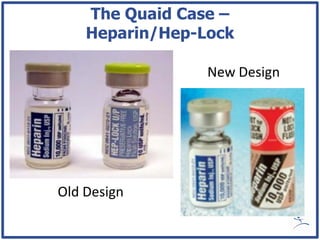
The Quaid Case –
    Heparin/Hep-Lock

                 New Design


Old Design
Case Example

• Virginia Mason Medical Center (2004)
   – Mary McClinton died after cleaning solution was injected (not
     dye)
   – Identical looking clear syringes together on tray
       • “Mistakes will happen,” he said, sadly. “We are exceptionally
         human.”
   – Knew about same color syringes 2 YEARS before fatal error
     occurred
       • Had switched from brown cleaning solution to clear
   – Radiology tech MENTIONED the problem to a supervisor 2
     MONTHS before the fatality
• Why does this happen? How can we prevent this?
The Need for Lean Problem
         Solving
By Adopting the Lean Approach

 • Asked Key Questions:
    – Whose responsibility is it to stock supplies?
        • Add standardized work
        • Establish kanban system
    – How do we make it obvious something is missing?
        • Visual management
    – How do we manage the system and hold people
      accountable to the standardized work?
        • Lean management system
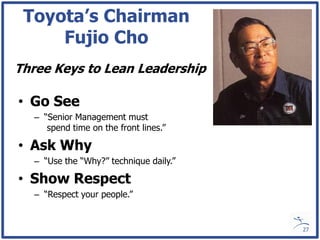
Toyota’s Chairman
     Fujio Cho
Three Keys to Lean Leadership

• Go See
  – “Senior Management must
     spend time on the front lines.”

• Ask Why
  – “Use the “Why?” technique daily.”

• Show Respect
  – “Respect your people.”


                                        27
It’s The System
“You respect people, you         “Human error is
 listen to them, you              inevitable. We can
 work together. You               never eliminate it.” We
 don’t blame them.                can eliminate problems
 Maybe the process was            in the system that make
 not set up well, so it           it more likely to
 was easy to make a               happen.”
 mistake.”
 – Gary Convis, President TMMK    – Liam Donaldson, WHO World
                                    Health Alliance for Patient
                                    safety

                                                                  28
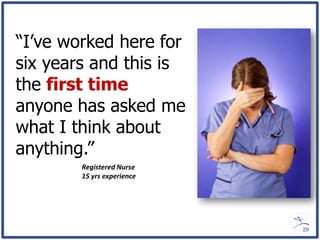
“I’ve worked here for
six years and this is
the first time
anyone has asked me
what I think about
anything.”
        Registered Nurse
        15 yrs experience


                            29
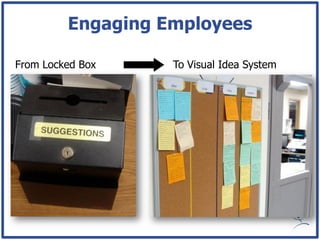
Engaging Employees

From Locked Box    To Visual Idea System
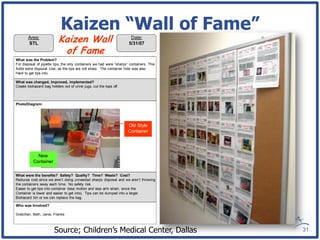
Kaizen “Wall of Fame”
       Area:
       STL
                           Kaizen Wall                                 Date:
                                                                      5/31/07
                            of Fame
What was the Problem?
For disposal of pipette tips, the only containers we had were “sharps” containers. This
Adds extra disposal cost, as the tips are not sharp. The container hole was also
Hard to get tips into.

What was changed, improved, implemented?
Create biohazard bag holders out of urine jugs, cut the tops off.


Photo/Diagram:


                                                                      Old Style
                                                                      Container


             New
           Container

What were the benefits? Safety? Quality? Time? Waste? Cost?
Reduces cost since we aren’t doing unneeded sharps disposal and we aren’t throwing
the containers away each time. No safety risk.
Easier to get tips into container (less motion and less arm strain, since the
Container is lower and easier to get into). Tips can be dumped into a larger
Biohazard bin or we can replace the bag.

Who was Involved?

Gretchen, Beth, Janie, Franke


                        Source; Children’s Medical Center, Dallas                         31
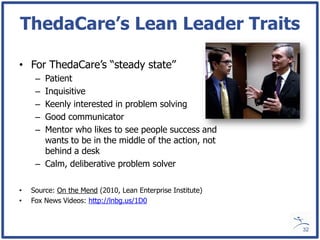
ThedaCare’s Lean Leader Traits

• For ThedaCare’s “steady state”
     – Patient
     – Inquisitive
     – Keenly interested in problem solving
     – Good communicator
     – Mentor who likes to see people success and
       wants to be in the middle of the action, not
       behind a desk
     – Calm, deliberative problem solver

•   Source: On the Mend (2010, Lean Enterprise Institute)
•   Fox News Videos: http://lnbg.us/1D0


                                                            32
Lack of Lean Leadership

“This [lean] is not the
  standard model executive
  being produced by U.S
  business schools, much
  less American medical
  schools.”
  – Toussaint and Gerard, On the Mend


                                        33
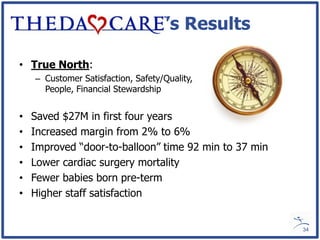
ThedaCare’s Results

• True North:
    – Customer Satisfaction, Safety/Quality,
      People, Financial Stewardship


•   Saved $27M in first four years
•   Increased margin from 2% to 6%
•   Improved “door-to-balloon” time 92 min to 37 min
•   Lower cardiac surgery mortality
•   Fewer babies born pre-term
•   Higher staff satisfaction


                                                       34
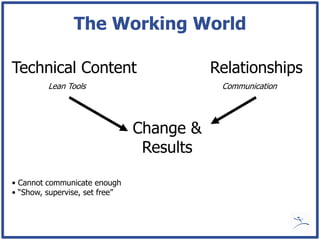
The Working World

Technical Content                          Relationships
         Lean Tools                         Communication


                                Change &
                                 Results

• Cannot communicate enough
• “Show, supervise, set free”
Mark’s Lessons Learned (1)
• Don’t be the lone “Expert,” get everyone involved
• Great ideas don’t matter if people can’t agree
• Understand an organization’s capacity for change
   – “Have the right amount of impatience”
• Observe first, then propose solutions
• Solving problems rather than “doing stuff”
   – Choose the right problem and define it properly
   – Numbers and results for your resume
Mark’s Lessons Learned (2)
• Lean is a management system and philosophy, not just
  “tools”
• Does your employer really want to “be Lean”??
• Don’t rely just on “events”
• Get direct supervision experience early (but not first)
Why Work in Healthcare?

•   Less likely to be “offshored”
•   As a “Lean” person, you can make a difference
•   Incredibly interesting, rewarding work
•   Impact people’s lives
    – Patients
    – Hospital Staff
    – Medical Professionals
• Help solve a high-priority societal issue
Q&A

•    Email:
    – mgraban@lean.org
•    Lean Enterprise Institute:
    – www.lean.org
•    Healthcare Value Leaders:
    – www.healthcarevalueleaders.org
•    Blog:
    – www.leanblog.org
•    Twitter:
    – www.twitter.com/LeanBlog


                                  39
About LEI

• Lean Enterprise Institute, Inc. (LEI) is a nonprofit
  education, publishing, conference, and research
  organization founded by James Womack, Ph.D. in 1997
  to promote and advance the principles of lean thinking in
  every aspect of business and across a wide range of
  industries.
• Through its publications, summits, conferences,
  workshops, webinars, online forums, and website
  resources, LEI helps organizations transform themselves
  into lean enterprises, based on the principles of the
  Toyota Business System.


                                                              40

Mark Graban "How Lean Thinking Helps Hospitals"

  • 1.
    “How Lean ThinkingHelps Hospitals” For Utah State University Student Lean Group Mark Graban Senior Fellow, Lean Enterprise Institute Author, “Lean Hospitals: Improving Quality, Patient Safety, and Employee Satisfaction”
  • 2.
    Agenda • Lean inHealthcare – The need for Lean in Healthcare – Principles that apply in Healthcare – Examples • Career Lessons Learned – As an Industrial Engineer – As a Lean Implementer • Q&A
  • 3.
  • 4.
    Engineering and Medicine… Surgical Nurse as “Caddy” Frank B. Gilbreth (1868-1924)
  • 5.
    Henry Ford -1922 “In the ordinary hospital the nurses must make useless steps. More of their time is spent in walking than in caring for the patient.” 5
  • 6.
    Lean is FundamentallyAbout: People doing People facing People managing work problems other people 6
  • 7.
    First Things First… “Startfrom need.” – Taiichi Ohno, Toyota (1912-1990)
  • 8.
    Why Lean forHealthcare? No waiting No waste Zero harm Source: an NHS hospital, UK
  • 9.
    Resources are Strained “Every day, we are holding, on average, 12 to 20 admitted patients, who have been in our department for days awaiting hospital beds.”
  • 10.
    Employees Are Harderto Find • Medical Technologists – Shortfall of 10,000 per year – 40% eligible to retire between 2005 and 2010 • Nurses – 100,000 vacant positions in the U.S. – 4x that many expected by 2020 • Pharmacists – 7.4% vacancy rate per the American Hospital Association Not enough employees or too much waste?
  • 11.
    Too Many ErrorsOccur • Adverse events in 3.7% of hospitalizations(1) – 13.6% of those led to death(1) – 53-58% are preventable(2) • Death resulting from preventable error occurs in 1 of 400 hospitalizations • (1): Brennan, Leape, et al, New England Journal of Medicine • (2): To Err is Human, Institute of Medicine One per week in a typical hospital
  • 12.
    Many Errors arePreventable • Nosocomial Infections – a.k.a. “Hospital-Acquired Infections” (HAI) – 5 to 10% of hospitalizations • 10% of these are serious bloodstream infections • 87,000 to 350,000 die annually – “Can be prevented through improved hygiene and proper line insertion standards” (1) • Allegheny: reduced bloodstream infections by 68% through standard methods and supplies • (1): U.S. Centers for Disease Control
  • 13.
    Remember This: Theproblem is the process (or lack thereof)… not the people
  • 14.
    Applications of Leanin Healthcare • Laboratories (Core Lab, Blood Bank & AP) – Reducing Turn Around Times and Errors • Operating Rooms – Reducing changeover times, increasing utilization • Inpatient Care – More time for patient care, fewer falls & infections • Outpatient Cancer Treatment – Reducing patient delays, increasing capacity • Pharmacies – Reducing errors, improving response • Emergency Departments – Reducing diversions, improving flow
  • 15.
    Lean Methods thatApply • Identifying and • Quick Changeover eliminating WASTE • Employee Involvement & • 5S and Visual Engagement Management • Heijunka • Kanban • Improving Flow • Standardized Work (Reducing Batching) • Kaizen • Value Stream Mapping • “5 Whys” Problem Solving • Flow layouts • Error Proofing • “Go to Gemba” • Spaghetti Diagrams • Time Studies
  • 16.
  • 17.
  • 18.
    “Gemba”: The ActualPlace “Toyota managers should be sufficiently engaged on the factory floor that they have to wash their hands at least three times a day.” Taiichi Ohno 18
  • 19.
    “Gemba is forEveryone” “…Kaplan tours the hospital daily looking for problems and solutions. Everyone is encouraged to look for changes to make work more efficient.” - Virginia Mason CEO Gary Kaplan 19
  • 20.
    Patients (Gemba) Walkway over tracks Parking Garage Executive Offices 20
  • 21.
    “Convis became thefirst North American to head a Toyota manufacturing plant when he was put in charge of the Georgetown facility. He responded to the promotion by moving his office from the admin building adjacent to the Georgetown plant to the center of the factory floor.” 21
  • 22.
    The Quaid Case– Heparin/Hep-Lock Hospital CMO: “This was a preventable error, involving a failure to follow our standard policies and procedures, and there is no excuse for that to occur at Cedars-Sinai.” Was this the first time the policies and procedures were not followed?
  • 23.
    The Quaid Case– Heparin/Hep-Lock New Design Old Design
  • 24.
    Case Example • VirginiaMason Medical Center (2004) – Mary McClinton died after cleaning solution was injected (not dye) – Identical looking clear syringes together on tray • “Mistakes will happen,” he said, sadly. “We are exceptionally human.” – Knew about same color syringes 2 YEARS before fatal error occurred • Had switched from brown cleaning solution to clear – Radiology tech MENTIONED the problem to a supervisor 2 MONTHS before the fatality • Why does this happen? How can we prevent this?
  • 25.
    The Need forLean Problem Solving
  • 26.
    By Adopting theLean Approach • Asked Key Questions: – Whose responsibility is it to stock supplies? • Add standardized work • Establish kanban system – How do we make it obvious something is missing? • Visual management – How do we manage the system and hold people accountable to the standardized work? • Lean management system
  • 27.
    Toyota’s Chairman Fujio Cho Three Keys to Lean Leadership • Go See – “Senior Management must spend time on the front lines.” • Ask Why – “Use the “Why?” technique daily.” • Show Respect – “Respect your people.” 27
  • 28.
    It’s The System “Yourespect people, you “Human error is listen to them, you inevitable. We can work together. You never eliminate it.” We don’t blame them. can eliminate problems Maybe the process was in the system that make not set up well, so it it more likely to was easy to make a happen.” mistake.” – Gary Convis, President TMMK – Liam Donaldson, WHO World Health Alliance for Patient safety 28
  • 29.
    “I’ve worked herefor six years and this is the first time anyone has asked me what I think about anything.” Registered Nurse 15 yrs experience 29
  • 30.
    Engaging Employees From LockedBox To Visual Idea System
  • 31.
    Kaizen “Wall ofFame” Area: STL Kaizen Wall Date: 5/31/07 of Fame What was the Problem? For disposal of pipette tips, the only containers we had were “sharps” containers. This Adds extra disposal cost, as the tips are not sharp. The container hole was also Hard to get tips into. What was changed, improved, implemented? Create biohazard bag holders out of urine jugs, cut the tops off. Photo/Diagram: Old Style Container New Container What were the benefits? Safety? Quality? Time? Waste? Cost? Reduces cost since we aren’t doing unneeded sharps disposal and we aren’t throwing the containers away each time. No safety risk. Easier to get tips into container (less motion and less arm strain, since the Container is lower and easier to get into). Tips can be dumped into a larger Biohazard bin or we can replace the bag. Who was Involved? Gretchen, Beth, Janie, Franke Source; Children’s Medical Center, Dallas 31
  • 32.
    ThedaCare’s Lean LeaderTraits • For ThedaCare’s “steady state” – Patient – Inquisitive – Keenly interested in problem solving – Good communicator – Mentor who likes to see people success and wants to be in the middle of the action, not behind a desk – Calm, deliberative problem solver • Source: On the Mend (2010, Lean Enterprise Institute) • Fox News Videos: http://lnbg.us/1D0 32
  • 33.
    Lack of LeanLeadership “This [lean] is not the standard model executive being produced by U.S business schools, much less American medical schools.” – Toussaint and Gerard, On the Mend 33
  • 34.
    ThedaCare’s Results • TrueNorth: – Customer Satisfaction, Safety/Quality, People, Financial Stewardship • Saved $27M in first four years • Increased margin from 2% to 6% • Improved “door-to-balloon” time 92 min to 37 min • Lower cardiac surgery mortality • Fewer babies born pre-term • Higher staff satisfaction 34
  • 35.
    The Working World TechnicalContent Relationships Lean Tools Communication Change & Results • Cannot communicate enough • “Show, supervise, set free”
  • 36.
    Mark’s Lessons Learned(1) • Don’t be the lone “Expert,” get everyone involved • Great ideas don’t matter if people can’t agree • Understand an organization’s capacity for change – “Have the right amount of impatience” • Observe first, then propose solutions • Solving problems rather than “doing stuff” – Choose the right problem and define it properly – Numbers and results for your resume
  • 37.
    Mark’s Lessons Learned(2) • Lean is a management system and philosophy, not just “tools” • Does your employer really want to “be Lean”?? • Don’t rely just on “events” • Get direct supervision experience early (but not first)
  • 38.
    Why Work inHealthcare? • Less likely to be “offshored” • As a “Lean” person, you can make a difference • Incredibly interesting, rewarding work • Impact people’s lives – Patients – Hospital Staff – Medical Professionals • Help solve a high-priority societal issue
  • 39.
    Q&A • Email: – mgraban@lean.org • Lean Enterprise Institute: – www.lean.org • Healthcare Value Leaders: – www.healthcarevalueleaders.org • Blog: – www.leanblog.org • Twitter: – www.twitter.com/LeanBlog 39
  • 40.
    About LEI • LeanEnterprise Institute, Inc. (LEI) is a nonprofit education, publishing, conference, and research organization founded by James Womack, Ph.D. in 1997 to promote and advance the principles of lean thinking in every aspect of business and across a wide range of industries. • Through its publications, summits, conferences, workshops, webinars, online forums, and website resources, LEI helps organizations transform themselves into lean enterprises, based on the principles of the Toyota Business System. 40