1/21/2016 © Clinical Skills Resource Centre, University of Liverpool, UK 1
Basic Life Support
2010 Guidelines
1/21/2016 © Clinical Skills Resource Centre, University of Liverpool, UK 2
Signs of life =
 A – Check airway for signs or risk of any
airway obstruction
 B – Check for normal breathing pattern, rate
>8 AND <30.
 C – Check pulse, assess general colour, and
perfusion
 D – Monitor for changes in conscious level
 E – Can you see any obvious major injuries
that require prompt treatment
1/21/2016 © Clinical Skills Resource Centre, University of Liverpool, UK 3
DR SCAB PACED
1/21/2016 © Clinical Skills Resource Centre, University of Liverpool, UK 4
Danger
Ensure
safety of both
victim AND
rescuer
1/21/2016 © Clinical Skills Resource Centre, University of Liverpool, UK 5
Response
Shake gently, stabilising
the head, to see if the
person responds
Shout “Are you alright”
1/21/2016 © Clinical Skills Resource Centre, University of Liverpool, UK 6
Shout
Shout for help
1/21/2016 © Clinical Skills Resource Centre, University of Liverpool, UK 7
Clear airway
 Remove any visible
obstruction or loose
fitting dentures
 Leave well fitting
dentures
 Do not under any
circumstances do a
blind finger sweep
(only remove visible
objects)
1/21/2016 © Clinical Skills Resource Centre, University of Liverpool, UK 8
Open Airway
 Open airway with head
tilt - chin lift
 Try to avoid head tilt if
neck injury suspected
1/21/2016 © Clinical Skills Resource Centre, University of Liverpool, UK 9
Are They Breathing Normally
 Maintain head tilt chin lift and
 Look, Listen, Feel
 For no more than 10
seconds
 If in any doubt breathing is
normal, act as if patient is not
breathing
 If (s)he is breathing
normally
 place in recovery position
 check for continued
breathing
 send for or go for help
1/21/2016 © Clinical Skills Resource Centre, University of Liverpool, UK 10
Carotid Pulse
 Look for any movement
(signs of life)
 Check for the carotid
pulse FOR NO MORE
THAN 10 SECONDS
1/21/2016 © Clinical Skills Resource Centre, University of Liverpool, UK 11
If no pulse call Arrest team
 Send someone for help or if alone go
yourself If available ask them to bring the
Automated External Defibrillator (AED)
with them
 At this point you need qualified help,
 pre hospital this would be a paramedic,
call 999 or the Pan European number
112 America is 911.
 In hospital the cardiac arrest team is
usually on 2222.
1/21/2016 © Clinical Skills Resource Centre, University of Liverpool, UK 12
Apply Compressions x 30
 Kneel/stand beside the casualty
 Place the heel of one hand in the
centre of the victim’s chest
 Place the heel of your other hand on
top of the first hand
 Interlock the fingers of your hands
and ensure that pressure is not
applied over the victim’s ribs.
 Keeping arms straight aim to
depress sternum to a depth of 5 cm
(no more than 6 cm)
 Release pressure and repeat 30
times
1/21/2016 © Clinical Skills Resource Centre, University of Liverpool, UK 13
Minute rate
Compressions should be
applied at a rate of
between 100 to 120 per
minute
Compression and release
should take an equal
amount of time
Avoid applying pressure over the
upper abdomen or the bottom
end of the sternum
1/21/2016 © Clinical Skills Resource Centre, University of Liverpool, UK 14
Two ventilations
 Re-establish head tilt –
chin lift
 Pinch soft part of nose with
thumb and forefinger
 Open mouth a little
 Take a good breath and
place lips round mouth
 Give two effective
ventilations
1/21/2016 © Clinical Skills Resource Centre, University of Liverpool, UK 15
Effective ventilation
 Blow steadily over 1 second
 Watch for chest to rise
 Maintain head tilt - chin lift
 Avoid inhaling patient’s
expired breath
 Watch chest fall
 Repeat
 Continue at ratio of 30
compressions to 2
ventilations
1/21/2016 © Clinical Skills Resource Centre, University of Liverpool, UK 16
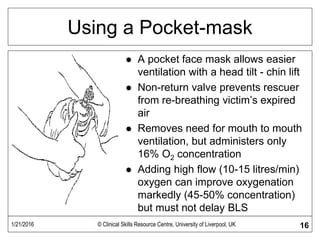
Using a Pocket-mask
 A pocket face mask allows easier
ventilation with a head tilt - chin lift
 Non-return valve prevents rescuer
from re-breathing victim’s expired
air
 Removes need for mouth to mouth
ventilation, but administers only
16% O2 concentration
 Adding high flow (10-15 litres/min)
oxygen can improve oxygenation
markedly (45-50% concentration)
but must not delay BLS
Setting up a pocket Mask
1. Remove the mask and valve from the case
2. Push out the soft dome with your fingers
3. Ensure that the one way valve is in place
1/21/2016 © Clinical Skills Resource Centre, University of Liverpool, UK 17
1 2 3
Your position
 A pocket mask is best
managed if you
position yourself in
line with the top of the
patient’s head
1/21/2016 © Clinical Skills Resource Centre, University of Liverpool, UK 18
1/21/2016 © Clinical Skills Resource Centre, University of Liverpool, UK 19
Technique of using pocket-mask
 Place the mask over the patients
mouth and nose
 Use the rim of the mask to retract
the lower lip so that the patient’s
mouth remains open under the
mask
 Use thumbs to hold the mask and
your fingers to grasp the lower
jaw in front of the earlobes
 Pull upward to open the airway
and seal the mask.
 Blow slowly into the air valve and
watch as the patients chest rises
1/21/2016 © Clinical Skills Resource Centre, University of Liverpool, UK 20
DON’T STOP UNLESS
 Shows signs of life
 (if so, reassess patient)
 Help arrives
 You are overcome by
exhaustion
 If patient begins to show
signs of recovery place in
the recovery position and
monitor A,B,C,D and E
 Be prepared to
recommence resuscitation
DO NOT STOP
 Once basic life support has commenced do
not stop unless the victim shows signs of
regaining consciousness:
 Coughing
 Opening eyes
 Speaking
 Moving purposefully
 Starts breathing
1/21/2016 © Clinical Skills Resource Centre, University of Liverpool, UK 21
1/21/2016 © Clinical Skills Resource Centre, University of Liverpool, UK 22
Problems with respirations
 If ventilations are not
effective – then continue on
to 30 compressions.
 Before you give your next
breaths
- Check victim’s mouth and remove
any visible obstruction
- Recheck you have adequate head
tilt chin lift
- Do not attempt more than
two breaths before
returning to
compressions
 If you are unable to do
mouth to mouth ventilation
(e.g. massive facial
trauma) then continuous
compressions are advised
at a rate of 100 a minute
 Mouth to nose or mouth to
tracheostomy ventilations
may also be effective
1/21/2016 © Clinical Skills Resource Centre, University of Liverpool, UK 23
Respiratory arrest
 Respiratory arrest is when there is a pulse present
but no breathing
 Commence ventilating the patient at a rate of 10-12
breaths per minute, at the end of the minute reassess
breathing and circulation (see slide 13 & 14)
 If circulation ceases then seek help and commence
full basic life support at 30 compressions to 2
ventilations.
1/21/2016 © Clinical Skills Resource Centre, University of Liverpool, UK 24
DR SCAB PACED
 D – DANGER
 R – RESPONSE
 S – SHOUT FOR HELP
 C – CLEAR AIRWAY
 A – OPEN AIRWAY
 B – BREATHING ASSESSMENT
 P – PULSE CHECK
 A – ARREST TEAM (CALL 999 OR 112) HOSPITAL 2222
 C – COMPRESSIONS X 30
 E – EFFECTIVE VENTILATION X 2
 D – DON’T STOP

BLS and Pocket Mask

  • 1.
    1/21/2016 © ClinicalSkills Resource Centre, University of Liverpool, UK 1 Basic Life Support 2010 Guidelines
  • 2.
    1/21/2016 © ClinicalSkills Resource Centre, University of Liverpool, UK 2 Signs of life =  A – Check airway for signs or risk of any airway obstruction  B – Check for normal breathing pattern, rate >8 AND <30.  C – Check pulse, assess general colour, and perfusion  D – Monitor for changes in conscious level  E – Can you see any obvious major injuries that require prompt treatment
  • 3.
    1/21/2016 © ClinicalSkills Resource Centre, University of Liverpool, UK 3 DR SCAB PACED
  • 4.
    1/21/2016 © ClinicalSkills Resource Centre, University of Liverpool, UK 4 Danger Ensure safety of both victim AND rescuer
  • 5.
    1/21/2016 © ClinicalSkills Resource Centre, University of Liverpool, UK 5 Response Shake gently, stabilising the head, to see if the person responds Shout “Are you alright”
  • 6.
    1/21/2016 © ClinicalSkills Resource Centre, University of Liverpool, UK 6 Shout Shout for help
  • 7.
    1/21/2016 © ClinicalSkills Resource Centre, University of Liverpool, UK 7 Clear airway  Remove any visible obstruction or loose fitting dentures  Leave well fitting dentures  Do not under any circumstances do a blind finger sweep (only remove visible objects)
  • 8.
    1/21/2016 © ClinicalSkills Resource Centre, University of Liverpool, UK 8 Open Airway  Open airway with head tilt - chin lift  Try to avoid head tilt if neck injury suspected
  • 9.
    1/21/2016 © ClinicalSkills Resource Centre, University of Liverpool, UK 9 Are They Breathing Normally  Maintain head tilt chin lift and  Look, Listen, Feel  For no more than 10 seconds  If in any doubt breathing is normal, act as if patient is not breathing  If (s)he is breathing normally  place in recovery position  check for continued breathing  send for or go for help
  • 10.
    1/21/2016 © ClinicalSkills Resource Centre, University of Liverpool, UK 10 Carotid Pulse  Look for any movement (signs of life)  Check for the carotid pulse FOR NO MORE THAN 10 SECONDS
  • 11.
    1/21/2016 © ClinicalSkills Resource Centre, University of Liverpool, UK 11 If no pulse call Arrest team  Send someone for help or if alone go yourself If available ask them to bring the Automated External Defibrillator (AED) with them  At this point you need qualified help,  pre hospital this would be a paramedic, call 999 or the Pan European number 112 America is 911.  In hospital the cardiac arrest team is usually on 2222.
  • 12.
    1/21/2016 © ClinicalSkills Resource Centre, University of Liverpool, UK 12 Apply Compressions x 30  Kneel/stand beside the casualty  Place the heel of one hand in the centre of the victim’s chest  Place the heel of your other hand on top of the first hand  Interlock the fingers of your hands and ensure that pressure is not applied over the victim’s ribs.  Keeping arms straight aim to depress sternum to a depth of 5 cm (no more than 6 cm)  Release pressure and repeat 30 times
  • 13.
    1/21/2016 © ClinicalSkills Resource Centre, University of Liverpool, UK 13 Minute rate Compressions should be applied at a rate of between 100 to 120 per minute Compression and release should take an equal amount of time Avoid applying pressure over the upper abdomen or the bottom end of the sternum
  • 14.
    1/21/2016 © ClinicalSkills Resource Centre, University of Liverpool, UK 14 Two ventilations  Re-establish head tilt – chin lift  Pinch soft part of nose with thumb and forefinger  Open mouth a little  Take a good breath and place lips round mouth  Give two effective ventilations
  • 15.
    1/21/2016 © ClinicalSkills Resource Centre, University of Liverpool, UK 15 Effective ventilation  Blow steadily over 1 second  Watch for chest to rise  Maintain head tilt - chin lift  Avoid inhaling patient’s expired breath  Watch chest fall  Repeat  Continue at ratio of 30 compressions to 2 ventilations
  • 16.
    1/21/2016 © ClinicalSkills Resource Centre, University of Liverpool, UK 16 Using a Pocket-mask  A pocket face mask allows easier ventilation with a head tilt - chin lift  Non-return valve prevents rescuer from re-breathing victim’s expired air  Removes need for mouth to mouth ventilation, but administers only 16% O2 concentration  Adding high flow (10-15 litres/min) oxygen can improve oxygenation markedly (45-50% concentration) but must not delay BLS
  • 17.
    Setting up apocket Mask 1. Remove the mask and valve from the case 2. Push out the soft dome with your fingers 3. Ensure that the one way valve is in place 1/21/2016 © Clinical Skills Resource Centre, University of Liverpool, UK 17 1 2 3
  • 18.
    Your position  Apocket mask is best managed if you position yourself in line with the top of the patient’s head 1/21/2016 © Clinical Skills Resource Centre, University of Liverpool, UK 18
  • 19.
    1/21/2016 © ClinicalSkills Resource Centre, University of Liverpool, UK 19 Technique of using pocket-mask  Place the mask over the patients mouth and nose  Use the rim of the mask to retract the lower lip so that the patient’s mouth remains open under the mask  Use thumbs to hold the mask and your fingers to grasp the lower jaw in front of the earlobes  Pull upward to open the airway and seal the mask.  Blow slowly into the air valve and watch as the patients chest rises
  • 20.
    1/21/2016 © ClinicalSkills Resource Centre, University of Liverpool, UK 20 DON’T STOP UNLESS  Shows signs of life  (if so, reassess patient)  Help arrives  You are overcome by exhaustion  If patient begins to show signs of recovery place in the recovery position and monitor A,B,C,D and E  Be prepared to recommence resuscitation
  • 21.
    DO NOT STOP Once basic life support has commenced do not stop unless the victim shows signs of regaining consciousness:  Coughing  Opening eyes  Speaking  Moving purposefully  Starts breathing 1/21/2016 © Clinical Skills Resource Centre, University of Liverpool, UK 21
  • 22.
    1/21/2016 © ClinicalSkills Resource Centre, University of Liverpool, UK 22 Problems with respirations  If ventilations are not effective – then continue on to 30 compressions.  Before you give your next breaths - Check victim’s mouth and remove any visible obstruction - Recheck you have adequate head tilt chin lift - Do not attempt more than two breaths before returning to compressions  If you are unable to do mouth to mouth ventilation (e.g. massive facial trauma) then continuous compressions are advised at a rate of 100 a minute  Mouth to nose or mouth to tracheostomy ventilations may also be effective
  • 23.
    1/21/2016 © ClinicalSkills Resource Centre, University of Liverpool, UK 23 Respiratory arrest  Respiratory arrest is when there is a pulse present but no breathing  Commence ventilating the patient at a rate of 10-12 breaths per minute, at the end of the minute reassess breathing and circulation (see slide 13 & 14)  If circulation ceases then seek help and commence full basic life support at 30 compressions to 2 ventilations.
  • 24.
    1/21/2016 © ClinicalSkills Resource Centre, University of Liverpool, UK 24 DR SCAB PACED  D – DANGER  R – RESPONSE  S – SHOUT FOR HELP  C – CLEAR AIRWAY  A – OPEN AIRWAY  B – BREATHING ASSESSMENT  P – PULSE CHECK  A – ARREST TEAM (CALL 999 OR 112) HOSPITAL 2222  C – COMPRESSIONS X 30  E – EFFECTIVE VENTILATION X 2  D – DON’T STOP