Practitioner Integration in
Computational Thinking
Education.
Big Picture
How can outside expertise best be integrated into
formal Computational Thinking education?
What lessons can be improved upon
by a small scale experimental setting?
What is Computational Thinking?
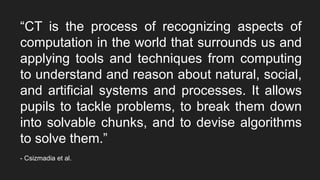
“CT is the process of recognizing aspects of
computation in the world that surrounds us and
applying tools and techniques from computing
to understand and reason about natural, social,
and artificial systems and processes. It allows
pupils to tackle problems, to break them down
into solvable chunks, and to devise algorithms
to solve them.”
- Csizmadia et al.
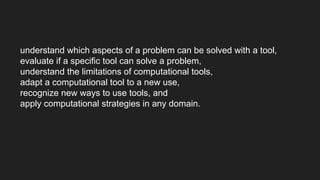
understand which aspects of a problem can be solved with a tool,
evaluate if a specific tool can solve a problem,
understand the limitations of computational tools,
adapt a computational tool to a new use,
recognize new ways to use tools, and
apply computational strategies in any domain.
Waidhofen an der Thaya
Research Design
Idea and Framework
Outcomes and lessons learned
Conclusions and Future Work
Balance between freedom and structure
is the key to creative learning.
- Mitchel Resnick
Sources
Map of Europe from Wikimedia:Maix
Logo of HAK Waidhofen from Facebook
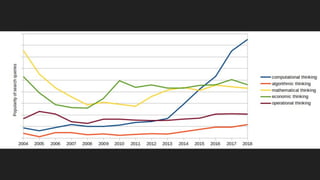
Google Trends analysis
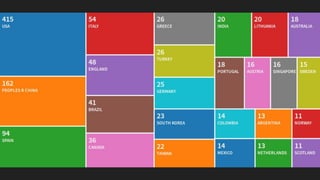
Research papers published by country as
generated on Web of Science
The Missing Link to Computational Thinking
(german) Praktikerinnen und Praktiker im
Computational Thinking Unterricht.
Blue Marble Picture from NASA
Fake TED talk
Margaret Hamilton’s Foto from NASA
CT - A guide for teachers
This talk was given during the EdMedia +
Innovate Learning conference 2020.

Practitioner Integration in Computational Thinking Education

  • 1.
  • 2.
  • 3.
    How can outsideexpertise best be integrated into formal Computational Thinking education? What lessons can be improved upon by a small scale experimental setting?
  • 4.
  • 7.
    “CT is theprocess of recognizing aspects of computation in the world that surrounds us and applying tools and techniques from computing to understand and reason about natural, social, and artificial systems and processes. It allows pupils to tackle problems, to break them down into solvable chunks, and to devise algorithms to solve them.” - Csizmadia et al.
  • 8.
    understand which aspectsof a problem can be solved with a tool, evaluate if a specific tool can solve a problem, understand the limitations of computational tools, adapt a computational tool to a new use, recognize new ways to use tools, and apply computational strategies in any domain.
  • 9.
  • 11.
  • 13.
  • 16.
  • 19.
  • 21.
    Balance between freedomand structure is the key to creative learning. - Mitchel Resnick
  • 23.
    Sources Map of Europefrom Wikimedia:Maix Logo of HAK Waidhofen from Facebook Google Trends analysis Research papers published by country as generated on Web of Science The Missing Link to Computational Thinking (german) Praktikerinnen und Praktiker im Computational Thinking Unterricht. Blue Marble Picture from NASA Fake TED talk Margaret Hamilton’s Foto from NASA CT - A guide for teachers
  • 24.
    This talk wasgiven during the EdMedia + Innovate Learning conference 2020.