An Introduction to Referencing
Harvard Referencing Style
Criminology
Susan McGlamery
Susan.Mcglamery@uwl.ac.uk
1
What is referencing and
why should I do it?
2
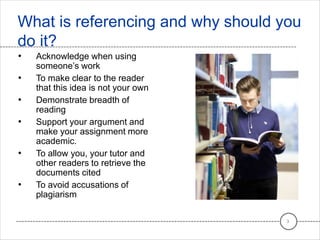
• Acknowledge when using
someone’s work
• To make clear to the reader
that this idea is not your own
• Demonstrate breadth of
reading
• Support your argument and
make your assignment more
academic.
• To allow you, your tutor and
other readers to retrieve the
documents cited
• To avoid accusations of
plagiarism
What is referencing and why should you
do it?
3
What is plagiarism?
4
Plagiarism
5
“Plagiarism is presenting someone else’s work or ideas as
your own, with or without their consent, by incorporating it
into your work without full acknowledgement.”
(University of Oxford, 2015)
Plagiarism
6
• Using someone’s work
without clear
acknowledgement
• Paying someone to write
your essay
• Collusion
• Poor paraphrasing and
summarising
• Self Plagiarism
Paraphrasing thoughts
7
Your work flows better if you learn to put different authors’
ideas in your own words
You can use some key words and phrases but the key is
understanding meaning and significance
Be careful not to change the odd word here or there. Direct quote
if you can not paraphrase
Always use a reference
Summarising thoughts
8
A brief statement of the main points of an article, web page,
chapter or book, known as a summary
Only lists the main topics or headings
Most of the detailed information is left out
Always use a reference
How to avoid plagiarism?
9
• Take effective notes
• Don’t leave it to the last
minute
• Keep a note of the
sources used
• Paraphrase and
summarise properly
• Reference accurately
Avoid Plagiarism
10
Harvard Referencing
11
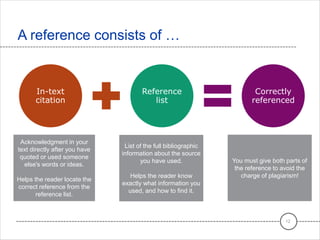
In-text
citation
Reference
list
Correctly
referenced
A reference consists of …
12
Acknowledgment in your
text directly after you have
quoted or used someone
else's words or ideas.
Helps the reader locate the
correct reference from the
reference list.
List of the full bibliographic
information about the source
you have used.
Helps the reader know
exactly what information you
used, and how to find it.
You must give both parts of
the reference to avoid the
charge of plagiarism!
In Text Citations
Direct Quoting
“Academics in their own writing cite the work of others to respect the original
thinking and consequent ownership of that work” (McMillan and Weyers,
2013, p.16)
Paraphrasing
• It its important to cite the work of other academics in your assignment in
order to acknowledge their ownership and respect the original work.
(McMillan and Weyers, 2013, p.16)
• McMillan and Weyers (2013, p.16) state that it is important to cite the
work of other academics in your assignment in order to acknowledge
their ownership and respect the original work.
Harvard Referencing
13
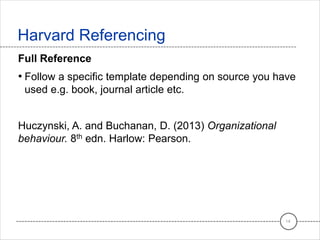
Full Reference
• Follow a specific template depending on source you have
used e.g. book, journal article etc.
Huczynski, A. and Buchanan, D. (2013) Organizational
behaviour. 8th edn. Harlow: Pearson.
Harvard Referencing
14
When to cite?
15
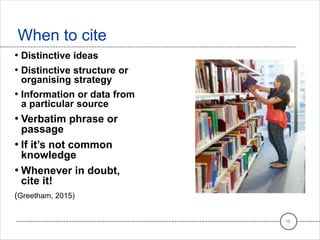
• Distinctive ideas
• Distinctive structure or
organising strategy
• Information or data from
a particular source
• Verbatim phrase or
passage
• If it’s not common
knowledge
• Whenever in doubt,
cite it!
(Greetham, 2015)
When to cite
16
• If you make a legal proposition always give the authority
on which that proposition is based.
- This will normally be a primary source (a reported
case or legislation).
• Commentary about the law can be found in a secondary
source (textbooks or articles)
• When making a primary legal proposition do not cite a
student textbook as authority.
For legal materials
17
Cite Them Right
18
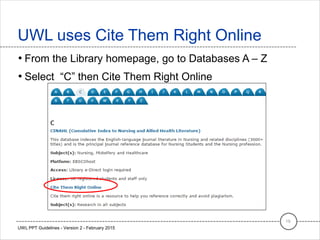
• From the Library homepage, go to Databases A – Z
• Select “C” then Cite Them Right Online
UWL uses Cite Them Right Online
19
UWL PPT Guidelines - Version 2 - February 2015
Book
20
Use cite them right to make the:
-In text citation
-Full reference
Book
21
In text Citation
(Cottrell, 2013)
Full reference list
Cottrell, S. (2013) The study skills handbook. 4th edn.
Basingstoke: Palgrave Macmillan.
Book
22
Journal Article
23
Use cite them right to make the:
-In text citation
-Full reference
Journal Article
24
In text Citation
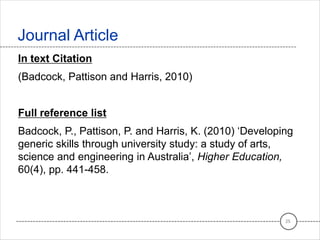
(Badcock, Pattison and Harris, 2010)
Full reference list
Badcock, P., Pattison, P. and Harris, K. (2010) ‘Developing
generic skills through university study: a study of arts,
science and engineering in Australia’, Higher Education,
60(4), pp. 441-458.
Journal Article
25
Website
26
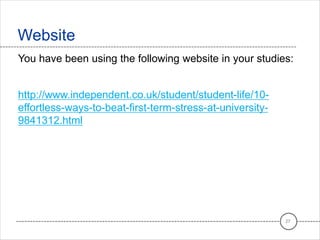
You have been using the following website in your studies:
http://www.independent.co.uk/student/student-life/10-
effortless-ways-to-beat-first-term-stress-at-university-
9841312.html
Website
27
In text Citation
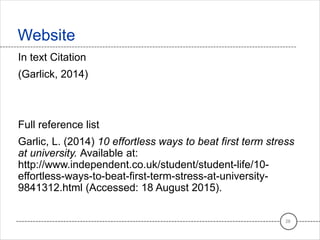
(Garlick, 2014)
Full reference list
Garlic, L. (2014) 10 effortless ways to beat first term stress
at university. Available at:
http://www.independent.co.uk/student/student-life/10-
effortless-ways-to-beat-first-term-stress-at-university-
9841312.html (Accessed: 18 August 2015).
Website
28
Legal materials: UK Legislation
29
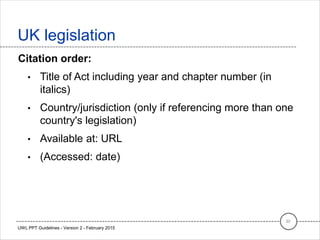
Citation order:
• Title of Act including year and chapter number (in
italics)
• Country/jurisdiction (only if referencing more than one
country's legislation)
• Available at: URL
• (Accessed: date)
UK legislation
30
UWL PPT Guidelines - Version 2 - February 2015
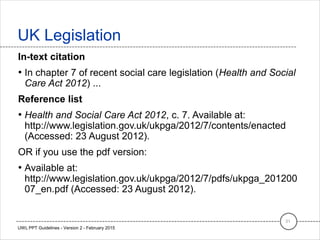
In-text citation
• In chapter 7 of recent social care legislation (Health and Social
Care Act 2012) ...
Reference list
• Health and Social Care Act 2012, c. 7. Available at:
http://www.legislation.gov.uk/ukpga/2012/7/contents/enacted
(Accessed: 23 August 2012).
OR if you use the pdf version:
• Available at:
http://www.legislation.gov.uk/ukpga/2012/7/pdfs/ukpga_201200
07_en.pdf (Accessed: 23 August 2012).
UK Legislation
31
UWL PPT Guidelines - Version 2 - February 2015
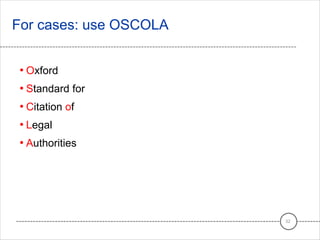
• Oxford
• Standard for
• Citation of
• Legal
• Authorities
For cases: use OSCOLA
32
Corr v IBC Vehicles Ltd [2008] UKHL 13, [2008] 1 AC 884
Corr v IBC Vehicles Ltd
[2008] UKHL 13
[2008] 1 AC 884
Pre-2001 case, with no neutral citation:
R v Leeds County Court, ex p Morris [1990] 1 QB 523 (QB)
Pinpointing a specific page:
R v Leeds County Court, ex p Morris [1990] 1 QB 523 (QB) 530-31
Citing cases
33
Party Names
Neutral citation
(for cases after 11/01/2001
Law reports citation
• All judgments in the High Court and above are now
assigned a unique “neutral citation” by the court which
helps identify cases which have been published on the
Internet even when they have not been reported in a law
report series
Neutral Citations
34
UWL PPT Guidelines - Version 2 - February 2015
• Corr v IBC Vehicles Ltd [2008] UKHL 13, [2008] 1 AC 884
UKHL = UK House of Lords (neutral citation)
AC = Law Reports, Appeal Cases
Guides to legal abbreviations:
• Index to legal citations and abbreviations, Raistrick
• Cardiff online guide: http://www.legalabbrevs.cardiff.ac.uk/
Tip: legal abbreviations
35
• Law Reports (AC, QB, Ch, Fam)
• Weekly Law Reports (WLR)
• All England Law Reports (All ER)
• Specialist law reports (Lloyd’s Law Reports, Industrial
Cases Reports, Criminal Appeal Reports)
• Unreported cases: use the neutral citation, if available
Law reports: order of authority
36
UWL PPT Guidelines - Version 2 - February 2015
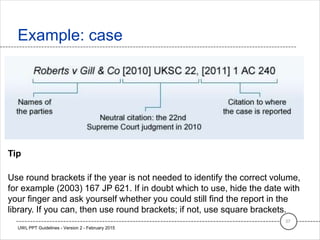
Example: case
37
UWL PPT Guidelines - Version 2 - February 2015
Tip
Use round brackets if the year is not needed to identify the correct volume,
for example (2003) 167 JP 621. If in doubt which to use, hide the date with
your finger and ask yourself whether you could still find the report in the
library. If you can, then use round brackets; if not, use square brackets.
In-text citation:
The case of Campbell v MGN Ltd [2004] concerns an
invasion of privacy lawsuit brought by supermodel Naomi
Campbell against the publisher of the ‘Mirror’.
Reference list:
Campbell v MGN Ltd [2004] UKHL 22; [2004] 2 A.C. 457
Example: Campbell v MGN Ltd
38
UWL PPT Guidelines - Version 2 - February 2015
Reference List
39
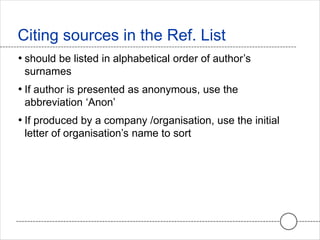
• should be listed in alphabetical order of author’s
surnames
• If author is presented as anonymous, use the
abbreviation ‘Anon’
• If produced by a company /organisation, use the initial
letter of organisation’s name to sort
Citing sources in the Ref. List
Any Questions?
41
Contact Susan McGlamery
susan.mcglamery@uwl.ac.uk
Greetham, B. (2015) Referencing and avoiding plagiarism.
Available at: http://www.palgrave.com/studentstudyskills/page/
referencing-and-avoiding-plagiarism/ (Accessed: 18 August
2015).
Oxford University (2015) Plagiarism. Available at:
http://www.ox.ac.uk/students/academic/guidance/skills/plagiar
ism (Accessed: 18 August 2015).
References
42

Harvard Referencing for Criminology

  • 1.
    An Introduction toReferencing Harvard Referencing Style Criminology Susan McGlamery Susan.Mcglamery@uwl.ac.uk 1
  • 2.
    What is referencingand why should I do it? 2
  • 3.
    • Acknowledge whenusing someone’s work • To make clear to the reader that this idea is not your own • Demonstrate breadth of reading • Support your argument and make your assignment more academic. • To allow you, your tutor and other readers to retrieve the documents cited • To avoid accusations of plagiarism What is referencing and why should you do it? 3
  • 4.
  • 5.
    Plagiarism 5 “Plagiarism is presentingsomeone else’s work or ideas as your own, with or without their consent, by incorporating it into your work without full acknowledgement.” (University of Oxford, 2015)
  • 6.
    Plagiarism 6 • Using someone’swork without clear acknowledgement • Paying someone to write your essay • Collusion • Poor paraphrasing and summarising • Self Plagiarism
  • 7.
    Paraphrasing thoughts 7 Your workflows better if you learn to put different authors’ ideas in your own words You can use some key words and phrases but the key is understanding meaning and significance Be careful not to change the odd word here or there. Direct quote if you can not paraphrase Always use a reference
  • 8.
    Summarising thoughts 8 A briefstatement of the main points of an article, web page, chapter or book, known as a summary Only lists the main topics or headings Most of the detailed information is left out Always use a reference
  • 9.
    How to avoidplagiarism? 9
  • 10.
    • Take effectivenotes • Don’t leave it to the last minute • Keep a note of the sources used • Paraphrase and summarise properly • Reference accurately Avoid Plagiarism 10
  • 11.
  • 12.
    In-text citation Reference list Correctly referenced A reference consistsof … 12 Acknowledgment in your text directly after you have quoted or used someone else's words or ideas. Helps the reader locate the correct reference from the reference list. List of the full bibliographic information about the source you have used. Helps the reader know exactly what information you used, and how to find it. You must give both parts of the reference to avoid the charge of plagiarism!
  • 13.
    In Text Citations DirectQuoting “Academics in their own writing cite the work of others to respect the original thinking and consequent ownership of that work” (McMillan and Weyers, 2013, p.16) Paraphrasing • It its important to cite the work of other academics in your assignment in order to acknowledge their ownership and respect the original work. (McMillan and Weyers, 2013, p.16) • McMillan and Weyers (2013, p.16) state that it is important to cite the work of other academics in your assignment in order to acknowledge their ownership and respect the original work. Harvard Referencing 13
  • 14.
    Full Reference • Followa specific template depending on source you have used e.g. book, journal article etc. Huczynski, A. and Buchanan, D. (2013) Organizational behaviour. 8th edn. Harlow: Pearson. Harvard Referencing 14
  • 15.
  • 16.
    • Distinctive ideas •Distinctive structure or organising strategy • Information or data from a particular source • Verbatim phrase or passage • If it’s not common knowledge • Whenever in doubt, cite it! (Greetham, 2015) When to cite 16
  • 17.
    • If youmake a legal proposition always give the authority on which that proposition is based. - This will normally be a primary source (a reported case or legislation). • Commentary about the law can be found in a secondary source (textbooks or articles) • When making a primary legal proposition do not cite a student textbook as authority. For legal materials 17
  • 18.
  • 19.
    • From theLibrary homepage, go to Databases A – Z • Select “C” then Cite Them Right Online UWL uses Cite Them Right Online 19 UWL PPT Guidelines - Version 2 - February 2015
  • 20.
  • 21.
    Use cite themright to make the: -In text citation -Full reference Book 21
  • 22.
    In text Citation (Cottrell,2013) Full reference list Cottrell, S. (2013) The study skills handbook. 4th edn. Basingstoke: Palgrave Macmillan. Book 22
  • 23.
  • 24.
    Use cite themright to make the: -In text citation -Full reference Journal Article 24
  • 25.
    In text Citation (Badcock,Pattison and Harris, 2010) Full reference list Badcock, P., Pattison, P. and Harris, K. (2010) ‘Developing generic skills through university study: a study of arts, science and engineering in Australia’, Higher Education, 60(4), pp. 441-458. Journal Article 25
  • 26.
  • 27.
    You have beenusing the following website in your studies: http://www.independent.co.uk/student/student-life/10- effortless-ways-to-beat-first-term-stress-at-university- 9841312.html Website 27
  • 28.
    In text Citation (Garlick,2014) Full reference list Garlic, L. (2014) 10 effortless ways to beat first term stress at university. Available at: http://www.independent.co.uk/student/student-life/10- effortless-ways-to-beat-first-term-stress-at-university- 9841312.html (Accessed: 18 August 2015). Website 28
  • 29.
    Legal materials: UKLegislation 29
  • 30.
    Citation order: • Titleof Act including year and chapter number (in italics) • Country/jurisdiction (only if referencing more than one country's legislation) • Available at: URL • (Accessed: date) UK legislation 30 UWL PPT Guidelines - Version 2 - February 2015
  • 31.
    In-text citation • Inchapter 7 of recent social care legislation (Health and Social Care Act 2012) ... Reference list • Health and Social Care Act 2012, c. 7. Available at: http://www.legislation.gov.uk/ukpga/2012/7/contents/enacted (Accessed: 23 August 2012). OR if you use the pdf version: • Available at: http://www.legislation.gov.uk/ukpga/2012/7/pdfs/ukpga_201200 07_en.pdf (Accessed: 23 August 2012). UK Legislation 31 UWL PPT Guidelines - Version 2 - February 2015
  • 32.
    • Oxford • Standardfor • Citation of • Legal • Authorities For cases: use OSCOLA 32
  • 33.
    Corr v IBCVehicles Ltd [2008] UKHL 13, [2008] 1 AC 884 Corr v IBC Vehicles Ltd [2008] UKHL 13 [2008] 1 AC 884 Pre-2001 case, with no neutral citation: R v Leeds County Court, ex p Morris [1990] 1 QB 523 (QB) Pinpointing a specific page: R v Leeds County Court, ex p Morris [1990] 1 QB 523 (QB) 530-31 Citing cases 33 Party Names Neutral citation (for cases after 11/01/2001 Law reports citation
  • 34.
    • All judgmentsin the High Court and above are now assigned a unique “neutral citation” by the court which helps identify cases which have been published on the Internet even when they have not been reported in a law report series Neutral Citations 34 UWL PPT Guidelines - Version 2 - February 2015
  • 35.
    • Corr vIBC Vehicles Ltd [2008] UKHL 13, [2008] 1 AC 884 UKHL = UK House of Lords (neutral citation) AC = Law Reports, Appeal Cases Guides to legal abbreviations: • Index to legal citations and abbreviations, Raistrick • Cardiff online guide: http://www.legalabbrevs.cardiff.ac.uk/ Tip: legal abbreviations 35
  • 36.
    • Law Reports(AC, QB, Ch, Fam) • Weekly Law Reports (WLR) • All England Law Reports (All ER) • Specialist law reports (Lloyd’s Law Reports, Industrial Cases Reports, Criminal Appeal Reports) • Unreported cases: use the neutral citation, if available Law reports: order of authority 36 UWL PPT Guidelines - Version 2 - February 2015
  • 37.
    Example: case 37 UWL PPTGuidelines - Version 2 - February 2015 Tip Use round brackets if the year is not needed to identify the correct volume, for example (2003) 167 JP 621. If in doubt which to use, hide the date with your finger and ask yourself whether you could still find the report in the library. If you can, then use round brackets; if not, use square brackets.
  • 38.
    In-text citation: The caseof Campbell v MGN Ltd [2004] concerns an invasion of privacy lawsuit brought by supermodel Naomi Campbell against the publisher of the ‘Mirror’. Reference list: Campbell v MGN Ltd [2004] UKHL 22; [2004] 2 A.C. 457 Example: Campbell v MGN Ltd 38 UWL PPT Guidelines - Version 2 - February 2015
  • 39.
  • 40.
    • should belisted in alphabetical order of author’s surnames • If author is presented as anonymous, use the abbreviation ‘Anon’ • If produced by a company /organisation, use the initial letter of organisation’s name to sort Citing sources in the Ref. List
  • 41.
    Any Questions? 41 Contact SusanMcGlamery susan.mcglamery@uwl.ac.uk
  • 42.
    Greetham, B. (2015)Referencing and avoiding plagiarism. Available at: http://www.palgrave.com/studentstudyskills/page/ referencing-and-avoiding-plagiarism/ (Accessed: 18 August 2015). Oxford University (2015) Plagiarism. Available at: http://www.ox.ac.uk/students/academic/guidance/skills/plagiar ism (Accessed: 18 August 2015). References 42

Editor's Notes

  • #4 Demonstrate breadth of reading = shows your tutor your research process and highlights all of the different sources you have used e.g. journal articles, books, reports, websites etc….as it is good to use a range of sources in your assignments. To avoid accusations of plagiarism = mention the use of Turnitin and tribunals/disciplinary
  • #7 Using someone else work without acknowledgment = here we need to emphasise how important it is to reference accurately. Paying someone to write your essay = blatant cheating and fraudulent Collusion = working on an essay that is meant to be individual but you work as a group/pair without acknowledging that. Agreeing to let someone use/copy your work Poor paraphrasing = not enough just to change certain words or sentence structure, still need to reference Self Plagiarism = submitting the same assignment twice or using a large chunk of one essay in another.
  • #8 Writing out evidence in your own words You still need to put a reference Author’s surname, date of publication are required Its meaning is not changed
  • #11 - Reference accurately = Must reference when using another person’s work. This includes In text citation and a full reference at the end of the assignment….we will discuss next
  • #15 Explain that referencing is following a template. You need to identify what the source is that you are using e.g. book, article, report….then find the appropriate template to use to create the reference. We use the online referencing guide Cite them right has all of these templates and we will show them that in a second.
  • #17 Distinctive ideas Whenever the ideas or opinions are distinctive to one particular source. Distinctive structure or organising strategy If the author has adopted a particular method of approaching a problem, or there is a distinctive intellectual structure to what’s written. Information or data from a particular source If you’ve gathered information from a source in the form of facts, statistics, tables and diagrams. Verbatim phrase or passage Even a single word, if it is distinctive to your author’s argument. You must use quotation marks. If it’s not common knowledge Whenever you mention some aspect of another person’s work, unless the information or opinion is widely known. Whenever in doubt, cite it! It will do no harm, as long as you’re not citing just to impress the examiner.
  • #19 Navigate to Cite them right and explain how you can access it, what it is and briefly how to search it e.g. search box or browsing. Show the help and support features under the tab Basics., use this guide when using Harvard referencing in your assignments We are now going to show you how to build a reference using our guide Cite them right for a Book Journal article Website
  • #22 On cite them right they need to search for books and then go to printed book. Probably easier to click on tab “books” and the select “Printed books”
  • #23 On cite them right they need to search for books and then go to printed book. Probably easier to click on tab “books” and the select “Printed books”
  • #25 On cite them right they need to search for journal articles and then scroll to journal articles. Probably easier to click on tab “journals” and the select “journal articles” http://www.citethemrightonline.com/Basics/setting-out-citations – this explains what to do with more than 1 author, Might be good to point this out as this can be confusing
  • #26 On cite them right they need to search for journal articles and then scroll to journal articles. Probably easier to click on tab “journals” and the select “journal articles” http://www.citethemrightonline.com/Basics/setting-out-citations – this explains what to do with more than 1 author. Might be good to point this out as this can be confusing