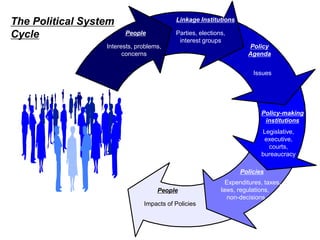
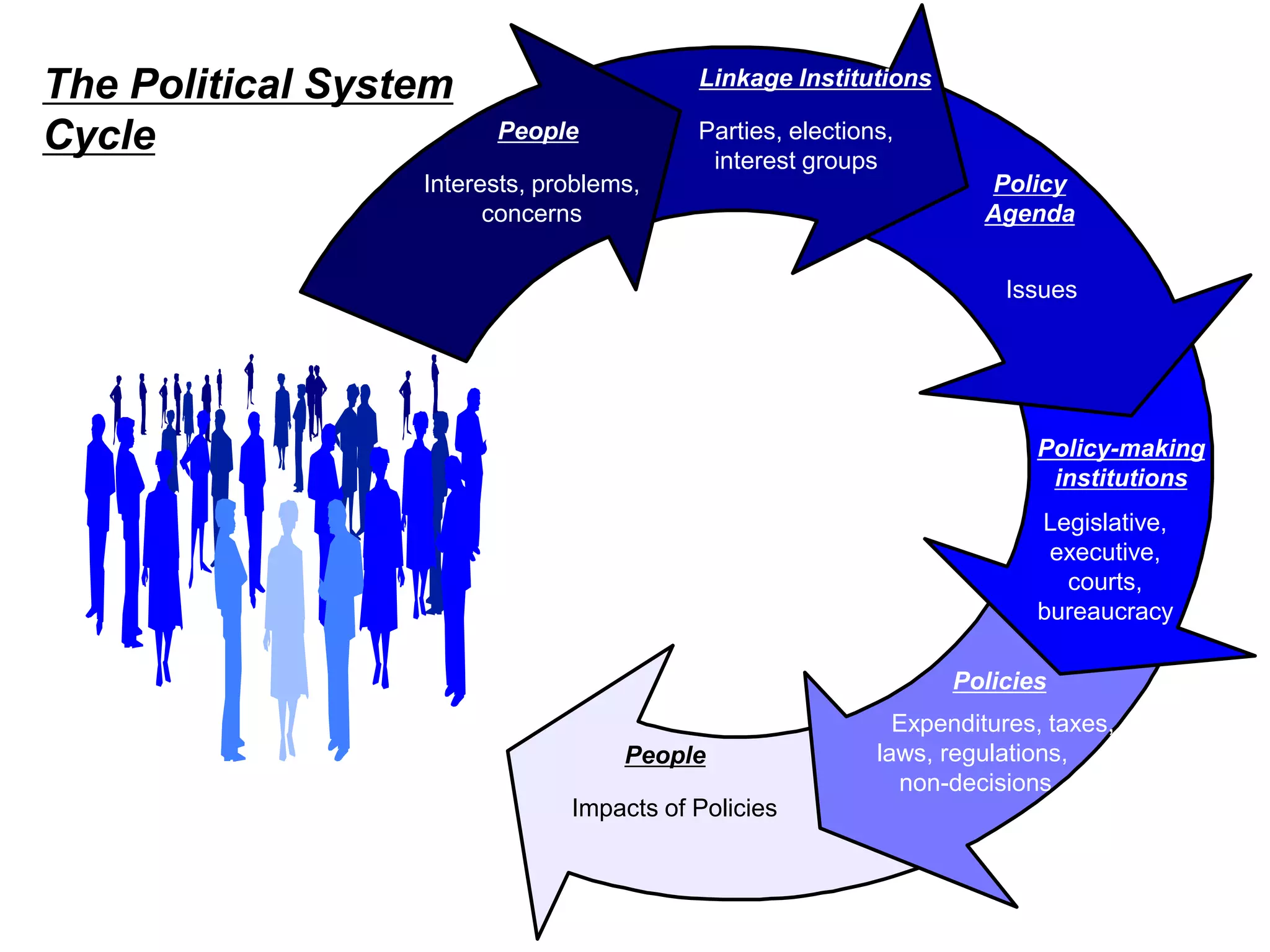
People
Impacts of Policies
The Political System
Cycle
Policies
Expenditures, taxes,
laws, regulations,
non-decisions
Policy-making
institutions
Legislative,
executive,
courts,
bureaucracy
Policy
Agenda
Issues
Linkage Institutions
Parties, elections,
interest groups
People
Interests, problems,
concerns
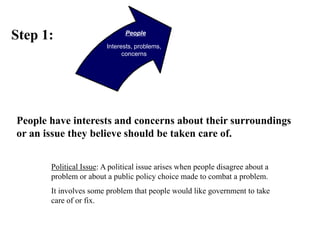
People
Interests, problems,
concerns
Step 1:
People have interests and concerns about their surroundings
or an issue they believe should be taken care of.
Political Issue: A political issue arises when people disagree about a
problem or about a public policy choice made to combat a problem.
It involves some problem that people would like government to take
care of or fix.
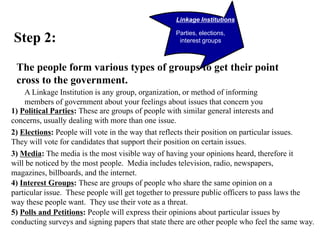
Linkage Institutions
Parties, elections,
interest groupsStep 2:
The people form various types of groups to get their point
cross to the government.
A Linkage Institution is any group, organization, or method of informing
members of government about your feelings about issues that concern you
1) Political Parties: These are groups of people with similar general interests and
concerns, usually dealing with more than one issue.
2) Elections: People will vote in the way that reflects their position on particular issues.
They will vote for candidates that support their position on certain issues.
3) Media: The media is the most visible way of having your opinions heard, therefore it
will be noticed by the most people. Media includes television, radio, newspapers,
magazines, billboards, and the internet.
4) Interest Groups: These are groups of people who share the same opinion on a
particular issue. These people will get together to pressure public officers to pass laws the
way these people want. They use their vote as a threat.
5) Polls and Petitions: People will express their opinions about particular issues by
conducting surveys and signing papers that state there are other people who feel the same way.
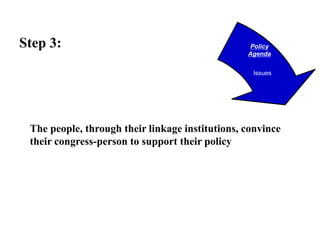
Policy
Agenda
Issues
Step 3:
The people, through their linkage institutions, convince
their congress-person to support their policy
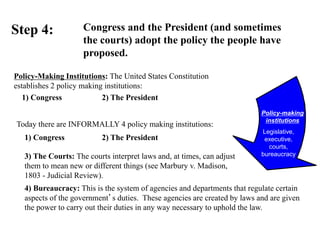
Policy-making
institutions
Legislative,
executive,
courts,
bureaucracy
Step 4: Congress and the President (and sometimes
the courts) adopt the policy the people have
proposed.
Policy-Making Institutions: The United States Constitution
establishes 2 policy making institutions:
1) Congress 2) The President
Today there are INFORMALLY 4 policy making institutions:
1) Congress 2) The President
3) The Courts: The courts interpret laws and, at times, can adjust
them to mean new or different things (see Marbury v. Madison,
1803 - Judicial Review).
4) Bureaucracy: This is the system of agencies and departments that regulate certain
aspects of the government’s duties. These agencies are created by laws and are given
the power to carry out their duties in any way necessary to uphold the law.
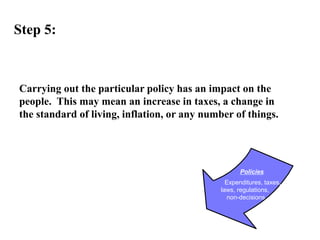
Policies
Expenditures, taxes,
laws, regulations,
non-decisions
Step 5:
Carrying out the particular policy has an impact on the
people. This may mean an increase in taxes, a change in
the standard of living, inflation, or any number of things.
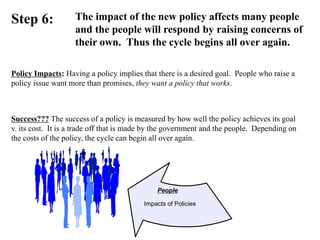
People
Impacts of Policies
Step 6: The impact of the new policy affects many people
and the people will respond by raising concerns of
their own. Thus the cycle begins all over again.
Policy Impacts: Having a policy implies that there is a desired goal. People who raise a
policy issue want more than promises, they want a policy that works.
Success??? The success of a policy is measured by how well the policy achieves its goal
v. its cost. It is a trade off that is made by the government and the people. Depending on
the costs of the policy, the cycle can begin all over again.

Political System Cycle

  • 1.
    People Impacts of Policies ThePolitical System Cycle Policies Expenditures, taxes, laws, regulations, non-decisions Policy-making institutions Legislative, executive, courts, bureaucracy Policy Agenda Issues Linkage Institutions Parties, elections, interest groups People Interests, problems, concerns
  • 2.
    People Interests, problems, concerns Step 1: Peoplehave interests and concerns about their surroundings or an issue they believe should be taken care of. Political Issue: A political issue arises when people disagree about a problem or about a public policy choice made to combat a problem. It involves some problem that people would like government to take care of or fix.
  • 3.
    Linkage Institutions Parties, elections, interestgroupsStep 2: The people form various types of groups to get their point cross to the government. A Linkage Institution is any group, organization, or method of informing members of government about your feelings about issues that concern you 1) Political Parties: These are groups of people with similar general interests and concerns, usually dealing with more than one issue. 2) Elections: People will vote in the way that reflects their position on particular issues. They will vote for candidates that support their position on certain issues. 3) Media: The media is the most visible way of having your opinions heard, therefore it will be noticed by the most people. Media includes television, radio, newspapers, magazines, billboards, and the internet. 4) Interest Groups: These are groups of people who share the same opinion on a particular issue. These people will get together to pressure public officers to pass laws the way these people want. They use their vote as a threat. 5) Polls and Petitions: People will express their opinions about particular issues by conducting surveys and signing papers that state there are other people who feel the same way.
  • 4.
    Policy Agenda Issues Step 3: The people,through their linkage institutions, convince their congress-person to support their policy
  • 5.
    Policy-making institutions Legislative, executive, courts, bureaucracy Step 4: Congressand the President (and sometimes the courts) adopt the policy the people have proposed. Policy-Making Institutions: The United States Constitution establishes 2 policy making institutions: 1) Congress 2) The President Today there are INFORMALLY 4 policy making institutions: 1) Congress 2) The President 3) The Courts: The courts interpret laws and, at times, can adjust them to mean new or different things (see Marbury v. Madison, 1803 - Judicial Review). 4) Bureaucracy: This is the system of agencies and departments that regulate certain aspects of the government’s duties. These agencies are created by laws and are given the power to carry out their duties in any way necessary to uphold the law.
  • 6.
    Policies Expenditures, taxes, laws, regulations, non-decisions Step5: Carrying out the particular policy has an impact on the people. This may mean an increase in taxes, a change in the standard of living, inflation, or any number of things.
  • 7.
    People Impacts of Policies Step6: The impact of the new policy affects many people and the people will respond by raising concerns of their own. Thus the cycle begins all over again. Policy Impacts: Having a policy implies that there is a desired goal. People who raise a policy issue want more than promises, they want a policy that works. Success??? The success of a policy is measured by how well the policy achieves its goal v. its cost. It is a trade off that is made by the government and the people. Depending on the costs of the policy, the cycle can begin all over again.