
Developing New Generation Leaders:
The EMPOWER Leadership Development Programme
Professor Mark Brown,
George Ubachs & Fred de Vries
Paris, France
24th May 2017
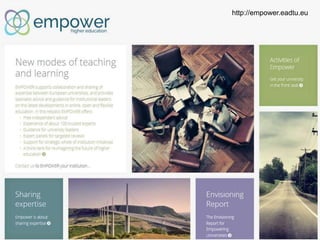
http://empower.eadtu.eu
Developing New Generation Leaders:
The EMPOWER Leadership Development Programme
Professor Mark Brown,
George Ubachs & Fred de Vries
Paris, France
24th May 2017
Three assumptions…
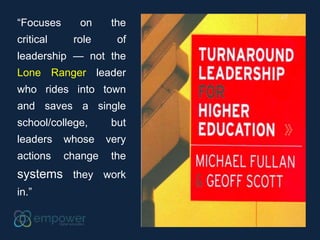
“Focuses on the
critical role of
leadership — not the
Lone Ranger leader
who rides into town
and saves a single
school/college, but
leaders whose very
actions change the
systems they work
in.”
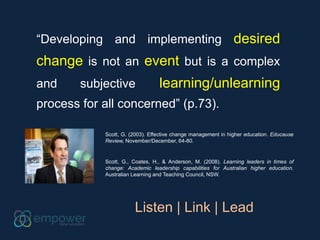
“Developing and implementing desired
change is not an event but is a complex
and subjective learning/unlearning
process for all concerned” (p.73).
Scott, G., Coates, H., & Anderson, M. (2008). Learning leaders in times of
change: Academic leadership capabilities for Australian higher education.
Australian Learning and Teaching Council, NSW.
Scott, G. (2003). Effective change management in higher education. Educause
Review, November/December, 64-80.
Listen | Link | Lead
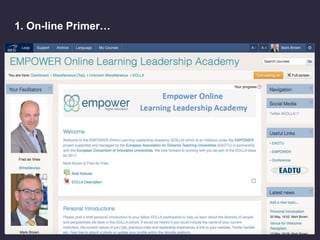
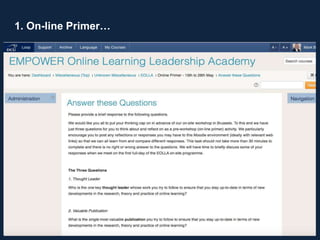
1. On-line Primer…
1. On-line Primer…
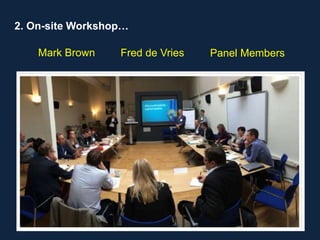
Mark Brown Fred de Vries Panel Members
2. On-site Workshop…
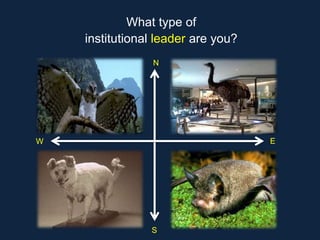
What type of
institutional leader are you?
N
S
W E
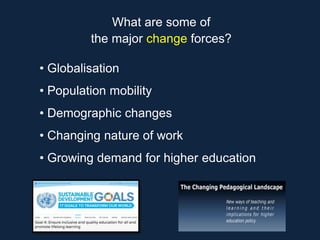
What are some of
the major change forces?
• Globalisation
• Population mobility
• Demographic changes
• Changing nature of work
• Growing demand for higher education
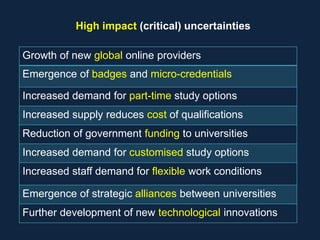
High impact (critical) uncertainties
Growth of new global online providers
Emergence of badges and micro-credentials
Increased demand for part-time study options
Increased supply reduces cost of qualifications
Reduction of government funding to universities
Increased demand for customised study options
Increased staff demand for flexible work conditions
Emergence of strategic alliances between universities
Further development of new technological innovations
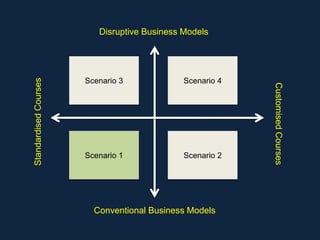
Disruptive Business Models
Conventional Business Models
StandardisedCourses
CustomisedCourses
Scenario 3 Scenario 4
Scenario 1 Scenario 2
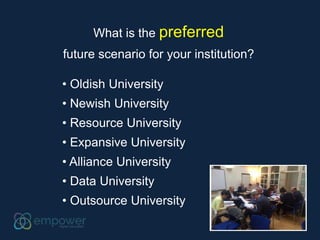
What is the preferred
future scenario for your institution?
• Oldish University
• Newish University
• Resource University
• Expansive University
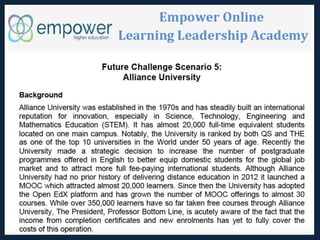
• Alliance University
• Data University
• Outsource University
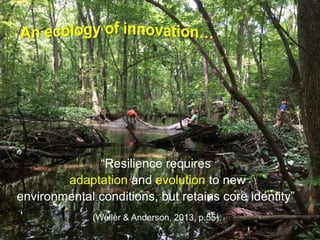
“Resilience requires
adaptation and evolution to new
environmental conditions, but retains core identity”
(Weller & Anderson, 2013, p.55).
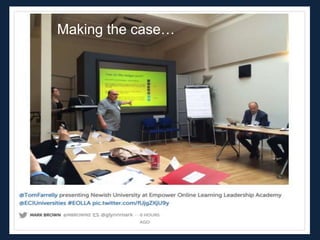
Making the case…
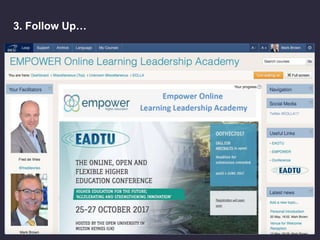
3. Follow Up…
Conclusion…
• What transfer?
• What personal impact?
• What institutional impact?
Professor Mark Brown
Director, National Institute for Digital Learning
www.dcu.ie/nidlmark.brown@dcu.ie
@mbrownz www.slideshare.net/mbrownz

Developing New Generation Leaders: The EMPOWER Leadership Development Programme

  • 1.
    Developing New GenerationLeaders: The EMPOWER Leadership Development Programme Professor Mark Brown, George Ubachs & Fred de Vries Paris, France 24th May 2017
  • 2.
  • 5.
    Developing New GenerationLeaders: The EMPOWER Leadership Development Programme Professor Mark Brown, George Ubachs & Fred de Vries Paris, France 24th May 2017
  • 6.
  • 8.
    “Focuses on the criticalrole of leadership — not the Lone Ranger leader who rides into town and saves a single school/college, but leaders whose very actions change the systems they work in.”
  • 9.
    “Developing and implementingdesired change is not an event but is a complex and subjective learning/unlearning process for all concerned” (p.73). Scott, G., Coates, H., & Anderson, M. (2008). Learning leaders in times of change: Academic leadership capabilities for Australian higher education. Australian Learning and Teaching Council, NSW. Scott, G. (2003). Effective change management in higher education. Educause Review, November/December, 64-80. Listen | Link | Lead
  • 12.
  • 13.
  • 14.
    Mark Brown Fredde Vries Panel Members 2. On-site Workshop…
  • 15.
    What type of institutionalleader are you? N S W E
  • 16.
    What are someof the major change forces? • Globalisation • Population mobility • Demographic changes • Changing nature of work • Growing demand for higher education
  • 17.
    High impact (critical)uncertainties Growth of new global online providers Emergence of badges and micro-credentials Increased demand for part-time study options Increased supply reduces cost of qualifications Reduction of government funding to universities Increased demand for customised study options Increased staff demand for flexible work conditions Emergence of strategic alliances between universities Further development of new technological innovations
  • 18.
    Disruptive Business Models ConventionalBusiness Models StandardisedCourses CustomisedCourses Scenario 3 Scenario 4 Scenario 1 Scenario 2
  • 19.
    What is thepreferred future scenario for your institution? • Oldish University • Newish University • Resource University • Expansive University • Alliance University • Data University • Outsource University
  • 22.
    “Resilience requires adaptation andevolution to new environmental conditions, but retains core identity” (Weller & Anderson, 2013, p.55).
  • 23.
  • 25.
  • 26.
    Conclusion… • What transfer? •What personal impact? • What institutional impact?
  • 28.
    Professor Mark Brown Director,National Institute for Digital Learning www.dcu.ie/nidlmark.brown@dcu.ie @mbrownz www.slideshare.net/mbrownz

Editor's Notes

  • #3 EMPOWER was launched in December 2014