Professor Mark Brown
and Dr Mairéad Nic Giolla Mhichíl
Dublin City University
Reykjavik, Iceland
8th June 2017
The Digital Literacy Movement:
Utopian or Dystopian Development?
DystopianUtopian
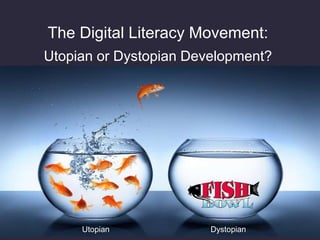
The Digital Literacy Movement:
Utopian or Dystopian Development?
@mbrownz
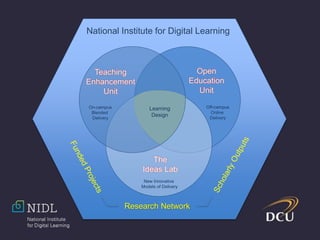
National Institute for Digital Learning
@1MNGM
Open
Education
Unit
The
Ideas Lab
Off-campus
Online
Delivery
Teaching
Enhancement
Unit
On-campus
Blended
Delivery
Learning
Design
National Institute for Digital Learning
New Innovative
Models of Delivery
Research Network
https://oeb-insights.com
https://www.slideshare.net/mbrownz
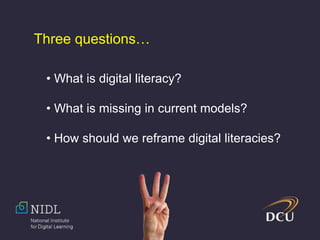
Three questions…
• What is digital literacy?
• What is missing in current models?
• How should we reframe digital literacies?
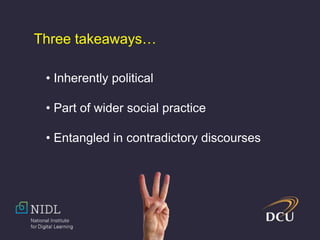
• Inherently political
• Part of wider social practice
• Entangled in contradictory discourses
Three takeaways…
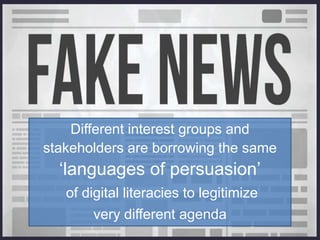
Different interest groups and
stakeholders are borrowing the same
‘languages of persuasion’
of digital literacies to legitimize
very different agenda
1. What is digital literacy?
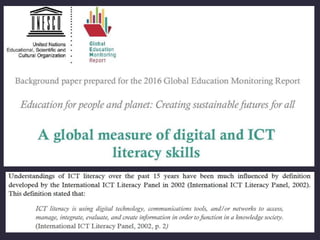
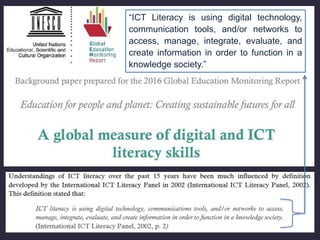
“ICT Literacy is using digital technology,
communication tools, and/or networks to
access, manage, integrate, evaluate, and
create information in order to function in a
knowledge society.”
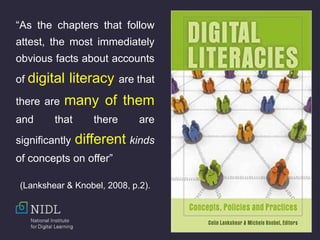
“As the chapters that follow
attest, the most immediately
obvious facts about accounts
of digital literacy are that
there are many of them
and that there are
significantly different kinds
of concepts on offer”
(Lankshear & Knobel, 2008, p.2).
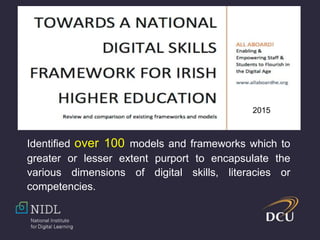
2015
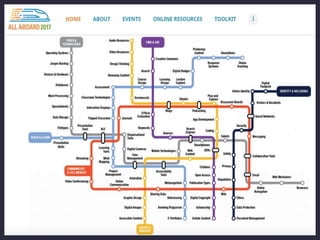
Identified over 100 models and frameworks which to
greater or lesser extent purport to encapsulate the
various dimensions of digital skills, literacies or
competencies.
‘There is no single universal
definition of digital literacy’
(Hoechsmann & DeWaard, 2015, p.4).
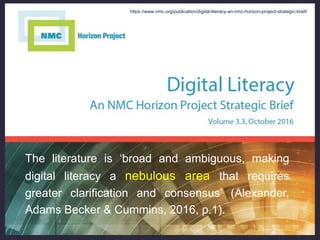
The literature is ‘broad and ambiguous, making
digital literacy a nebulous area that requires
greater clarification and consensus’ (Alexander,
Adams Becker & Cummins, 2016, p.1).
https://www.nmc.org/publication/digital-literacy-an-nmc-horizon-project-strategic-brief/
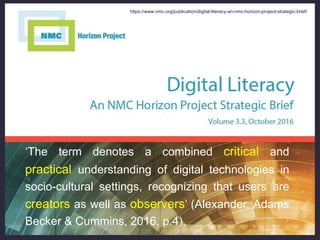
‘The term denotes a combined critical and
practical understanding of digital technologies in
socio-cultural settings, recognizing that users are
creators as well as observers’ (Alexander, Adams
Becker & Cummins, 2016, p.4).
https://www.nmc.org/publication/digital-literacy-an-nmc-horizon-project-strategic-brief/
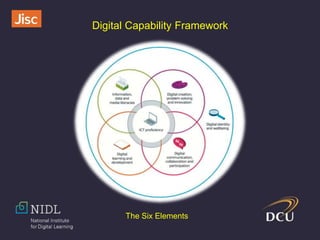
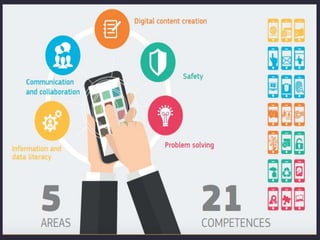
Digital Capability Framework
The Six Elements
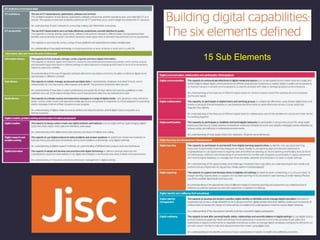
15 Sub Elements
2017
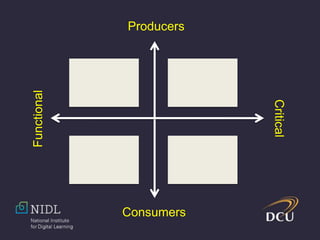
Functional
Producers
Consumers
Critical
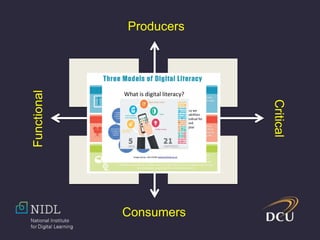
Functional
Producers
Consumers
Critical
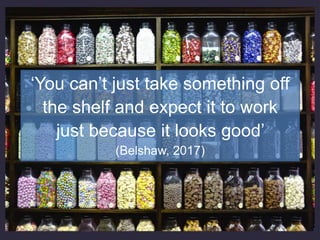
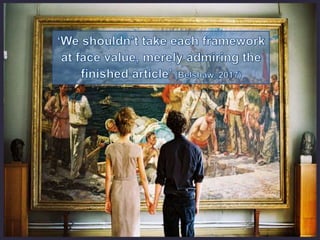
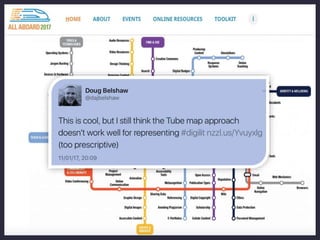
‘You can’t just take something off
the shelf and expect it to work
just because it looks good’
(Belshaw, 2017)
2. What is missing in current models?
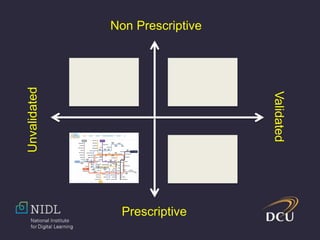
Non Prescriptive
Prescriptive
Unvalidated
Validated
New Literacy Studies
Any attempt to define
[digital] literacies
needs to be ‘…located
as part of social
practices and occur
within culturally
constructed instances
or literacy events’
(Bhatt, 2017, p.1).
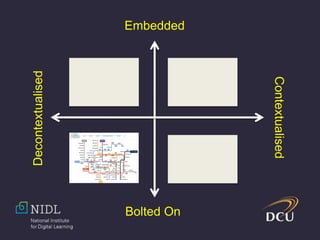
Embedded
Bolted On
Decontextualised
Contextualised
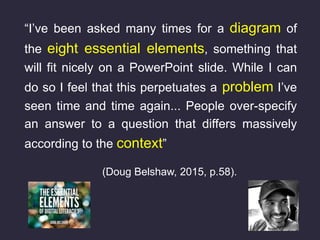
“I’ve been asked many times for a diagram of
the eight essential elements, something that
will fit nicely on a PowerPoint slide. While I can
do so I feel that this perpetuates a problem I’ve
seen time and time again... People over-specify
an answer to a question that differs massively
according to the context”
(Doug Belshaw, 2015, p.58).
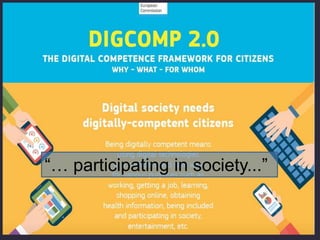
For the purpose of this report we can define digital skills, literacies or
competencies as ....
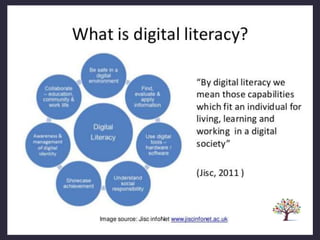
“the capabilities which fit someone for living, learning
and working in a digital society, with the knowledge
that a digital society is ever evolving” (p.18).
“… participating in society...”
3. How should we reframe digital literacies?
Digital litercies are
about the struggle for
POWER
and
control
Who? Why?
Digital literacies are about
changing mindsets rather than
developing narrow skill-sets
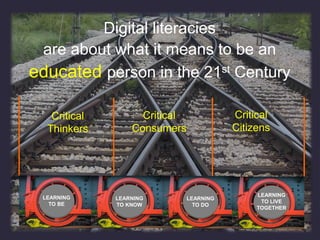
Critical
Consumers
Critical
Citizens
LEARNING
TO BE
LEARNING
TO KNOW
LEARNING
TO DO
LEARNING
TO LIVE
TOGETHER
Critical
Thinkers
Digital literacies
are about what it means to be an
educated person in the 21st Century
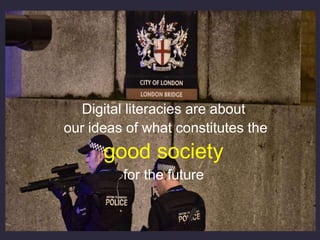
Digital literacies are about
our ideas of what constitutes the
good society
for the future
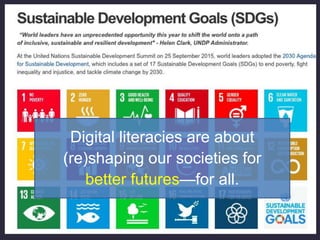
Digital literacies are about
(re)shaping our societies for
better futures—for all.
Conclusion…
Conclusion…
• No single framework
• Not on independent trajectory
• Active citizenry for shaping better futures
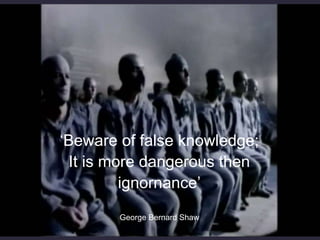
‘Beware of false knowledge;
It is more dangerous then
ignornance’
George Bernard Shaw
Go raibh
maith
agaibh!
Digital Literacies
@mbrownz @1MNGM
https://www.slideshare.net/mbrownz

The Digital Literacy Movement: Utopian or Dystopian Development?

Editor's Notes

  • #2 Title slide only ----- Meeting Notes (5/03/17 10:33) -----
  • #3 DB: Hello my name is Deirdre Butler and… MB: Hello my name is Mark Brown and... MB: The intention of this fishbowl session is to put the spotlight on the importance of learning transformation.
  • #14 MB: The concept of digital literacy was first introduced back in 1997 and as this seminal book illustrates there are many and varied interpretations of this concept.
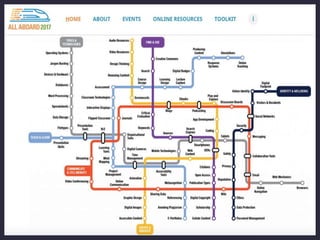
  • #15 MB: This is a point reiterated in the review of existing models and framework undertaken at the start of the All Aboard project, which identified over 100 of them (All Aboard, 2015). For example…
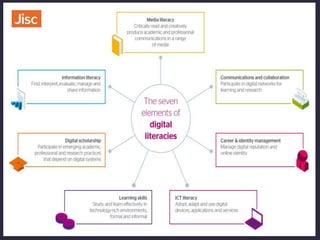
  • #20 MB: In the UK JISC has published a number of models and frameworks for the HE sector which continue to evolve.
  • #26 MB: This version of the quadrant analysis illustrates that very few of the models and frameworks combine critical literacies within an authentic embedded approach. The concept of critical literacy here extends to understanding the impact technology has on wider society and deeper questions of sustainability.
  • #27 MB: This version of the quadrant analysis illustrates that very few of the models and frameworks combine critical literacies within an authentic embedded approach. The concept of critical literacy here extends to understanding the impact technology has on wider society and deeper questions of sustainability.
  • #34 Every organization’s context is different. You’re painting with different brushes with a different pallet.
  • #35 MB: In this case it would be fair to locate TPACK in the upper right quadrant as it is one of the most researched frameworks and embeds new digital technology in an existing and well established framework for teacher knowledge. More recent adaptations have incorporated TPACK in a wider ecological context.
  • #39 MB: In this case it would be fair to locate TPACK in the upper right quadrant as it is one of the most researched frameworks and embeds new digital technology in an existing and well established framework for teacher knowledge. More recent adaptations have incorporated TPACK in a wider ecological context.
  • #40 MB: As this quote shows he has also resisted requests to try to present the eight essential elements in a simple diagram as the instructional and institutional context is crucial.
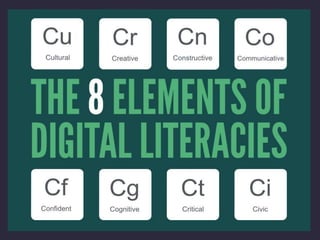
  • #41 MB: The 8 elements of digital literacies arise out of Doug Belshaw’s doctoral research and notably he places a particular emphasis on critical and civic literacies which incorporate a socio-political perspective.
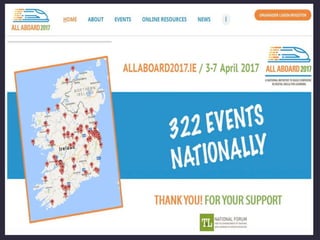
  • #42 MB: As this slide shows many third level institutions have signed up to participate in the week. For various reasons DCU chose not to participate in this initiative.
  • #44 MB: As this slide shows many third level institutions have signed up to participate in the week. For various reasons DCU chose not to participate in this initiative.
  • #45 DB
  • #51 DB: It’s also notable that very few of the other frameworks are anchored in the Sustainable Development Goals which are currently our best effort at attempting to articulate a transformative agenda with a moral purpose.
  • #56 DB: Hello my name is Deirdre Butler and… MB: Hello my name is Mark Brown and... MB: The intention of this fishbowl session is to put the spotlight on the importance of learning transformation.