Creating
            a
Positive Work Environment


                  By Michelle Bernardo
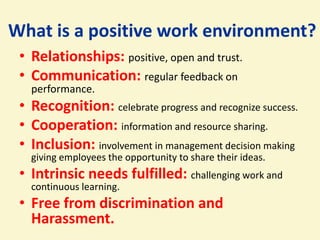
What is a positive work environment?
 • Relationships: positive, open and trust.
 • Communication: regular feedback on
   performance.
 • Recognition: celebrate progress and recognize success.
 • Cooperation: information and resource sharing.
 • Inclusion: involvement in management decision making
   giving employees the opportunity to share their ideas.
 • Intrinsic needs fulfilled: challenging work and
   continuous learning.
 • Free from discrimination and
   Harassment.
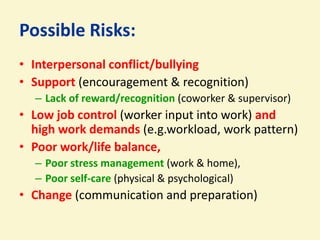
Possible Risks:
• Interpersonal conflict/bullying
• Support (encouragement & recognition)
  – Lack of reward/recognition (coworker & supervisor)
• Low job control (worker input into work) and
  high work demands (e.g.workload, work pattern)
• Poor work/life balance,
  – Poor stress management (work & home),
  – Poor self-care (physical & psychological)
• Change (communication and preparation)
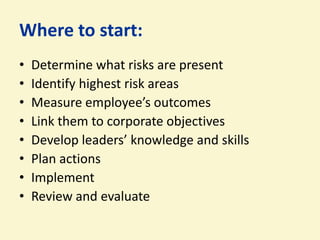
Where to start:
•   Determine what risks are present
•   Identify highest risk areas
•   Measure employee’s outcomes
•   Link them to corporate objectives
•   Develop leaders’ knowledge and skills
•   Plan actions
•   Implement
•   Review and evaluate
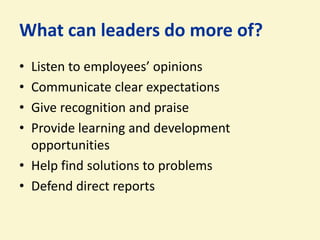
What can leaders do more of?
• Listen to employees’ opinions
• Communicate clear expectations
• Give recognition and praise
• Provide learning and development
  opportunities
• Help find solutions to problems
• Defend direct reports

Creating A Positive Work Environment

  • 1.
    Creating a Positive Work Environment By Michelle Bernardo
  • 2.
    What is apositive work environment? • Relationships: positive, open and trust. • Communication: regular feedback on performance. • Recognition: celebrate progress and recognize success. • Cooperation: information and resource sharing. • Inclusion: involvement in management decision making giving employees the opportunity to share their ideas. • Intrinsic needs fulfilled: challenging work and continuous learning. • Free from discrimination and Harassment.
  • 3.
    Possible Risks: • Interpersonalconflict/bullying • Support (encouragement & recognition) – Lack of reward/recognition (coworker & supervisor) • Low job control (worker input into work) and high work demands (e.g.workload, work pattern) • Poor work/life balance, – Poor stress management (work & home), – Poor self-care (physical & psychological) • Change (communication and preparation)
  • 4.
    Where to start: • Determine what risks are present • Identify highest risk areas • Measure employee’s outcomes • Link them to corporate objectives • Develop leaders’ knowledge and skills • Plan actions • Implement • Review and evaluate
  • 5.
    What can leadersdo more of? • Listen to employees’ opinions • Communicate clear expectations • Give recognition and praise • Provide learning and development opportunities • Help find solutions to problems • Defend direct reports