presented by –
Abhishek Goyal
Ritu Mittal
Sakshi Kankar
Simran Gupta
NARASIMHAM COMMITTEE FINANCIAL
SECTOR REFORM
ABOUT THE COMMITTEE
The 1st Narasimham Committee was set up by
Manmohan Singh as India’s Finance Minister on 14th
August 1991
A nine member committee was set up under the
chairmanship of M. Narasimham, a former Governor of
Reserve Bank of India
The Committee submitted its
Report to the Finance Minister
in November 1991
Problems Identified By The
Narasimham Committee
• Interest Rate Structure : The
committee found that the interest
rate structure and rate of interest
in India are highly regulated and
controlled by the government.
• Additional Suggestions :
Committee also suggested that the
determination of interest rate
should be on grounds of market
forces.
conti…
• Directed Credit Programme : Since
nationalization the government has
encouraged the lending to
agriculture and small-scale
industries at a confessional rate of
interest.
• Directed Investment Programme :
The committee objected to the
system of maintaining high liquid
assets by commercial banks in the
form of cash, gold and government
securities.
Narasimham Committee Report I -
1991
• Reduction in the SLR and CRR : The committee
recommended the reduction of the higher
proportion of the Statutory Liquidity Ratio 'SLR' and
the Cash Reserve Ratio 'CRR'. Both of these ratios
were very high at that time.
• Phasing out Directed Credit Programme : In India,
since nationalization, directed credit programmes
were adopted by the government. The committee
recommended phasing out of this programme.
Conti…• Interest rate determination :
The committee felt that the
interest rates in India are
regulated and controlled by
the authorities. The
Committee observed that
the prevailing structure of
administered rates was
highly complex and rigid and
called for deregulating.
• Structural Reorganizations of
the Banking sector : The
committee recommended
that the actual numbers of
public sector banks need to
be reduced. Three to four
big banks including SBI
should be developed as
Conti…
• Establishment of the ARF
Tribunal : The proportion of bad
debts and Non-performing asset
(NPA) of the public sector Banks
and Development Financial
Institute was very alarming in
those days.
• Removal of Dual control : Those
days banks were under the dual
control of the Reserve Bank of
India (RBI) and the Banking
Division of the Ministry of
Finance
• Banking Autonomy : The committee
recommended that the public sector banks
should be free and autonomous. In order to
pursue competitiveness and efficiency, banks
must enjoy autonomy so that they can reform
the work culture and banking technology
upgradation will thus be easy.
Narasimham Committee Report II -
1998
• The 2nd Narasimham Committee was set up
by P.Chidambaram as Finance Minister of India
in December 1997
• It is also known as the Committee on Banking
Sector Reforms
• The Committee submitted the report to the
Finance Minister Yashwant Sinha in April 1998
Conti …
• Strengthening Banks in India :
The committee considered the
stronger banking system in the
context of the Current Account
Convertibility 'CAC'.
• Narrow Banking : Those days
many public sector banks were
facing a problem of the Non-
performing assets (NPAs).
Some of them had NPAs were
as high as 20 percent of their
assets.
Conti …
Capital Adequacy Ratio : In order to
improve the inherent strength
of the Indian banking system the
committee recommended that the
Government should raise the
prescribed capital adequacy norms.
Bank ownership : As it had
earlier mentioned the
freedom for banks in its
working and bank
autonomy, it felt that
the government control
over the banks
• Review of banking laws : The committee
considered that there was an urgent need for
reviewing and amending main laws
governing Indian Banking Industry like RBI
Act, Banking Regulation Act, State Bank of
India Act, Bank Nationalisation Act, etc. This
upgradation will bring them in line with the
present needs of the banking sector in India.
• Apart from these major recommendations,
the committee has also recommended faster
computerization, technology upgradation,
training of staff, depoliticizing of banks,
professionalism in banking, reviewing bank
recruitment, etc.
Conclusion
• During the 2008 economic crisis, performance
of Indian banking sector was far better than
their international counterparts
• RBI raised Capital Adequacy Ratio by 1%
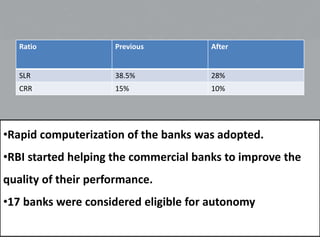
Ratio Previous After
SLR 38.5% 28%
CRR 15% 10%
•Rapid computerization of the banks was adopted.
•RBI started helping the commercial banks to improve the
quality of their performance.
•17 banks were considered eligible for autonomy
Narasimham Committee

Narasimham Committee

  • 1.
    presented by – AbhishekGoyal Ritu Mittal Sakshi Kankar Simran Gupta NARASIMHAM COMMITTEE FINANCIAL SECTOR REFORM
  • 2.
    ABOUT THE COMMITTEE The1st Narasimham Committee was set up by Manmohan Singh as India’s Finance Minister on 14th August 1991 A nine member committee was set up under the chairmanship of M. Narasimham, a former Governor of Reserve Bank of India The Committee submitted its Report to the Finance Minister in November 1991
  • 4.
    Problems Identified ByThe Narasimham Committee • Interest Rate Structure : The committee found that the interest rate structure and rate of interest in India are highly regulated and controlled by the government. • Additional Suggestions : Committee also suggested that the determination of interest rate should be on grounds of market forces.
  • 5.
    conti… • Directed CreditProgramme : Since nationalization the government has encouraged the lending to agriculture and small-scale industries at a confessional rate of interest. • Directed Investment Programme : The committee objected to the system of maintaining high liquid assets by commercial banks in the form of cash, gold and government securities.
  • 6.
  • 7.
    • Reduction inthe SLR and CRR : The committee recommended the reduction of the higher proportion of the Statutory Liquidity Ratio 'SLR' and the Cash Reserve Ratio 'CRR'. Both of these ratios were very high at that time. • Phasing out Directed Credit Programme : In India, since nationalization, directed credit programmes were adopted by the government. The committee recommended phasing out of this programme.
  • 8.
    Conti…• Interest ratedetermination : The committee felt that the interest rates in India are regulated and controlled by the authorities. The Committee observed that the prevailing structure of administered rates was highly complex and rigid and called for deregulating. • Structural Reorganizations of the Banking sector : The committee recommended that the actual numbers of public sector banks need to be reduced. Three to four big banks including SBI should be developed as
  • 9.
    Conti… • Establishment ofthe ARF Tribunal : The proportion of bad debts and Non-performing asset (NPA) of the public sector Banks and Development Financial Institute was very alarming in those days. • Removal of Dual control : Those days banks were under the dual control of the Reserve Bank of India (RBI) and the Banking Division of the Ministry of Finance
  • 10.
    • Banking Autonomy: The committee recommended that the public sector banks should be free and autonomous. In order to pursue competitiveness and efficiency, banks must enjoy autonomy so that they can reform the work culture and banking technology upgradation will thus be easy.
  • 11.
  • 12.
    • The 2ndNarasimham Committee was set up by P.Chidambaram as Finance Minister of India in December 1997 • It is also known as the Committee on Banking Sector Reforms • The Committee submitted the report to the Finance Minister Yashwant Sinha in April 1998
  • 13.
    Conti … • StrengtheningBanks in India : The committee considered the stronger banking system in the context of the Current Account Convertibility 'CAC'. • Narrow Banking : Those days many public sector banks were facing a problem of the Non- performing assets (NPAs). Some of them had NPAs were as high as 20 percent of their assets.
  • 14.
    Conti … Capital AdequacyRatio : In order to improve the inherent strength of the Indian banking system the committee recommended that the Government should raise the prescribed capital adequacy norms. Bank ownership : As it had earlier mentioned the freedom for banks in its working and bank autonomy, it felt that the government control over the banks
  • 15.
    • Review ofbanking laws : The committee considered that there was an urgent need for reviewing and amending main laws governing Indian Banking Industry like RBI Act, Banking Regulation Act, State Bank of India Act, Bank Nationalisation Act, etc. This upgradation will bring them in line with the present needs of the banking sector in India.
  • 16.
    • Apart fromthese major recommendations, the committee has also recommended faster computerization, technology upgradation, training of staff, depoliticizing of banks, professionalism in banking, reviewing bank recruitment, etc.
  • 17.
    Conclusion • During the2008 economic crisis, performance of Indian banking sector was far better than their international counterparts • RBI raised Capital Adequacy Ratio by 1%
  • 18.
    Ratio Previous After SLR38.5% 28% CRR 15% 10% •Rapid computerization of the banks was adopted. •RBI started helping the commercial banks to improve the quality of their performance. •17 banks were considered eligible for autonomy

Editor's Notes

  • #3 The Narasimham Committee laid the foundation for the reformation of the Indian banking sector
  • #6 Directed Investment Programme : The committee objected to the system of maintaining high liquid assets by commercial banks in the form of cash, gold and unencumbered government securities. It is also known as the statutory liquidity Ratio (SLR). In those days, in India, the SLR was as high as 38.5 percent. According to the M. Narasimham's Committee it was one of the reasons for the poor profitability of banks. Similarly, the Cash Reserve Ratio- (CRR) was as high as 15 percent. Taken together, banks needed to maintain 53.5 percent of their resources idle with the RBI. Directed Credit Programme : Since nationalization the government has encouraged the lending to agriculture and small-scale industries at a confessional rate of interest. It is known as the directed credit programme. The committee opined that these sectors have matured and thus do not need such financial support. This directed credit programme was successful from the government's point of view but it affected commercial banks in a bad manner. Basically it deteriorated the quality of loan, resulted in a shift from the security oriented loan to purpose oriented. Banks were given a huge target of priority sector lending, etc. ultimately leading to profit erosion of banks
  • #8 1.    Lowering SLR And CRR The SLR should be gradually reduced from the present 38.5 per cent to 25 percent over the next five years The CRR should be progressively reduced from the present high level of 15 per cent to 3 to 5 per cent. 2.    Prudential Norms :-                            Prudential norms have been started by RBI in order to impart professionalism in commercial banks. The purpose of prudential norms include proper disclosure of income, classification of assets and provision for Bad debts so as to ensure hat the books of commercial banks reflect the accurate and correct picture of financial position. Prudential norms required banks to make 100% provision for all Non-performing Assets (NPAs). Funding for this purpose was placed at Rs. 10,000 crores phased over 2 years. This programme compelled banks to earmark then financial resources for the needy and poor sectors at confessional rates of interest. It was reducing the profitability of banks and thus the committee recommended the stopping of this programme.
  • #9 Interest Rate Determination : The committee felt that the interest rates in India are regulated and controlled by the authorities. The Committee observed that the prevailing structure of administered rates was highly complex and rigid and called for deregulating it so that it reflects the emerging market conditions However, it warned against instant deregulation and suggested that the rates be brought in line with the market rates gradually over a period of time The Committee also recommended phasing out Concessional Interest rates Structural Reorganizations of the Banking sector : The committee recommended that the actual numbers of public sector banks need to be reduced. Three to four big banks including SBI should be developed as international banks. Eight to Ten Banks having nationwide presence should concentrate on the national and universal banking services. Local banks should concentrate on region specific banking. Regarding the RRBs (Regional Rural Banks), it recommended that they should focus on agriculture and rural financing. They recommended that the government should assure that henceforth there won't be any nationalization and private and foreign banks should be allowed liberal entry in India
  • #10 Establishment of the ARF Tribunal : The proportion of bad debts and Non-performing asset (NPA) of the public sector Banks and Development Financial Institute was very alarming in those days. The committee recommended the establishment of an Asset Reconstruction Fund (ARF). This fund will take over the proportion of the bad and doubtful debts from the banks and financial institutes. It would help banks to get rid of bad debts. Removal of Dual control : Those days banks were under the dual control of the Reserve Bank of India (RBI) and the Banking Division of the Ministry of Finance (Government of India). The committee recommended the stepping of this system. It considered and recommended that the RBI should be the only main agency to regulate banking in India
  • #15 Capital Adequacy Ratio : In order to improve the inherent strength of the Indian banking system the committee recommended that the Government should raise the prescribed capital adequacy norms. This will further improve their absorption capacity also. Currently the capital adequacy ration for Indian banks is at 9 percent. Bank ownership : As it had earlier mentioned the freedom for banks in its working and bank autonomy, it felt that the government control over the banks in the form of management and ownership and bank autonomy does not go hand in hand and thus it recommended a review of functions of boards and enabled them to adopt professional corporate strategy
  • #18 Actions on recommendations of First Narasimham Committee Many of the recommendations of the committee were acceded to by the government. The SLR , which was around 38.5% in 1991-1992 was brought down to some 28% in five years. The CRR was also brought down from 14% to 10% by 1997. The RBI introduced the CRAR or Capital to Risk Weighted Asset ratio in 1992 for the soundness of the banking industry. RBI also included new prudential reforms for classification of assets and provisioning of the non-performing assets. Some strong banks (such as SBI) were allowed to seek access to capital markets. The banks which were relatively weaker, were recapitalized by the government via budgetary support. More private banks were allowed. More freedom was given to banks to open branches. The RBI’s supervision system was strengthened. Rapid computerization of the banks was adopted. RBI started helping the commercial banks to improve the quality of their performance. The government also enacted Recovery of Debts Due to Banks and Financial Institutions (RDDBFI) Act, 1993 Debt Recovery Tribunals with an Appellate Tribunal at Mumbai for quicker recovery of bad debts. In 1995, Banking Ombudsman scheme was launched with an objective to provide quicker solutions to customers’ complaints.