Insert to 7132/3
A-level
Business
7132/3
Paper 3 Business 3
Insert
Please turn the page over
to see the source.
Source 1 J SAINSBURY PLC
• Source 1: J Sainsbury PLC
2
Justin King became Chief Executive of J Sainsbury plc, a UK retailer, in March
2004. At that time the company's sales and market share were falling.
Analysts reported significant inventory shortages in its stores, particularly in
fresh foods. Product quality was inconsistent and staff morale was low.
King acted decisively taking into account findings from marketing research. He
reassured customers of Sainsbury’s commitment to “even better quality at
good prices” Deciding on a strategy of recovery through sales growth, he
implemented a series of price cuts, some organisational restructuring and
bonuses for staff based on the achievement of higher store standards. Unlike
Tesco, Sainsbury’s avoided overseas expansion which was regarded as too
risky and was not seen as the priority; instead King focused on the company’s
UK strategy including opening more local convenience stores, as research
showed this market segment was growing fast.
The changes introduced by King included increased efforts to involve the
company’s 157 000 employees (called ‘colleagues’) and to communicate and
share his vision more effectively with them. One initiative, called ‘Tell Justin’,
encouraged colleagues to send suggestions about where the company could
make improvements for customers and employees. The company used a
range of methods to communicate regularly internally including listening groups
and employee councils called ‘Great Place to Work’ groups, where senior
managers discussed issues with junior colleagues. A typical Sainsbury’s
supermarket has around 250 jobs, ranging from deputy managers to team
leaders, online managers and customer services managers. King focused on
greater employee engagement, believing there was a clear correlation between
the stores that involved their colleagues effectively and those that offered great
service and achieved positive financial performance.
Following King’s changes greater customer satisfaction helped monthly sales
for the company increase for 36 consecutive months from 2010 to 2013 and
increased Sainsbury’s market share.
Sainsbury’s objectives
Sainsbury's has a number of financial objectives including sales growth, higher
profits and sound cash flow. It also has a broad range of corporate social
responsibility (CSR) objectives. These fit into five broad categories:
• best for food and health
• sourcing with integrity
• respect for our environment
• making a difference to our community
• a great place to work.
Supply chain management
Over time Sainsbury’s has modernised its IT system to provide a more
scientific assessment of the company's inventory needs to ensure that its
stores stock the right goods. Supply chain management is a complex process
for the company as it is influenced by many external variables, such as the
economy and the weather, and involves many different products. To maximise
customer availability and minimise waste, Sainsbury's liaise with the
Meteorological Office to provide accurate and timely weather information so
5
10
15
20
25
30
35
40
45
50
3
that the business can make informed decisions when forecasting sales and
ordering seasonal items, both nationally and for individual stores.
Sainsbury’s CSR objectives have also been helped by its supply chain
improvements, as there is much greater control over quality, labelling and
sourcing. In early 2013 some supermarkets’ reputations were damaged by the
presence of horsemeat in ‘beef’ products. With all its fresh beef sourced from
the British Isles and DNA testing carried out on its products, Sainsbury’s was
able to show that its beef products contained no horsemeat.
Understanding customers
Sainsbury's researches customer needs regularly and was the first
supermarket in Europe to install self-service checkouts in all of its
supermarkets. Sainsbury's ‘Brand Match’ scheme provides a price comparison
with rival supermarkets and a refund voucher if Sainsbury's proves to be more
expensive. This also helps to reassure customers that Sainsbury's prices are
competitive. Meanwhile the Nectar loyalty card scheme provides rewards for
customers whilst giving Sainsbury’s valuable data on individual consumer
purchases that it can link to other information such as their home address.
Future strategy
Sainsbury’s managed to increase sales despite difficult market conditions such
as slow economic growth, low consumer confidence and fierce competition.
Even though interest rates were very low, consumers were more price
conscious and retailers offered numerous promotional offers to win sales.
As the economy now recovers, Sainsbury's is focusing its future strategy on:
• promoting ‘high-quality, affordable’ own-brand products
• non-food products, such as clothing, as these sales are growing at
twice the rate of food sales
• ‘click and collect’ sales, allowing shoppers to pick up completed orders
in store
• online grocery sales, which increased by 15% in 2013 and now account
for over £1 billion of annual revenue.
King stands down
In 2014 Justin King announced he was standing down as Chief Executive. Not
long after, Sainsbury’s announced its sales had fallen for the first time in 9
years. This was due in part to the continued fierce competition in the market
including the growth of discount retailers such as Aldi and Lidl. Sainsbury’s
said it was still confident it was in a strong position to achieve long-term
growth.
55
60
65
70
75
80
85
90
4
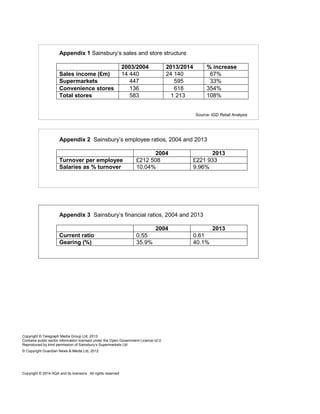
Appendix 1 Sainsbury’s sales and store structure
2003/2004 2013/2014 % increase
Sales income (£m) 14 440 24 140 67%
Supermarkets 447 595 33%
Convenience stores 136 618 354%
Total stores 583 1 213 108%
Source: IGD Retail Analysis
Appendix 2 Sainsbury’s employee ratios, 2004 and 2013
2004 2013
Turnover per employee £212 508 £221 933
Salaries as % turnover 10.04% 9.96%
Appendix 3 Sainsbury’s financial ratios, 2004 and 2013
2004 2013
Current ratio 0.55 0.61
Gearing (%) 35.9% 40.1%
Copyright © Telegraph Media Group Ltd, 2013
Contains public sector information licensed under the Open Government Licence v2.0
Reproduced by kind permission of Sainsbury’s Supermarkets Ltd
© Copyright Guardian News & Media Ltd, 2012
Copyright © 2014 AQA and its licensors. All rights reserved

Specimen paper insert

  • 1.
    Insert to 7132/3 A-level Business 7132/3 Paper3 Business 3 Insert Please turn the page over to see the source. Source 1 J SAINSBURY PLC • Source 1: J Sainsbury PLC
  • 2.
    2 Justin King becameChief Executive of J Sainsbury plc, a UK retailer, in March 2004. At that time the company's sales and market share were falling. Analysts reported significant inventory shortages in its stores, particularly in fresh foods. Product quality was inconsistent and staff morale was low. King acted decisively taking into account findings from marketing research. He reassured customers of Sainsbury’s commitment to “even better quality at good prices” Deciding on a strategy of recovery through sales growth, he implemented a series of price cuts, some organisational restructuring and bonuses for staff based on the achievement of higher store standards. Unlike Tesco, Sainsbury’s avoided overseas expansion which was regarded as too risky and was not seen as the priority; instead King focused on the company’s UK strategy including opening more local convenience stores, as research showed this market segment was growing fast. The changes introduced by King included increased efforts to involve the company’s 157 000 employees (called ‘colleagues’) and to communicate and share his vision more effectively with them. One initiative, called ‘Tell Justin’, encouraged colleagues to send suggestions about where the company could make improvements for customers and employees. The company used a range of methods to communicate regularly internally including listening groups and employee councils called ‘Great Place to Work’ groups, where senior managers discussed issues with junior colleagues. A typical Sainsbury’s supermarket has around 250 jobs, ranging from deputy managers to team leaders, online managers and customer services managers. King focused on greater employee engagement, believing there was a clear correlation between the stores that involved their colleagues effectively and those that offered great service and achieved positive financial performance. Following King’s changes greater customer satisfaction helped monthly sales for the company increase for 36 consecutive months from 2010 to 2013 and increased Sainsbury’s market share. Sainsbury’s objectives Sainsbury's has a number of financial objectives including sales growth, higher profits and sound cash flow. It also has a broad range of corporate social responsibility (CSR) objectives. These fit into five broad categories: • best for food and health • sourcing with integrity • respect for our environment • making a difference to our community • a great place to work. Supply chain management Over time Sainsbury’s has modernised its IT system to provide a more scientific assessment of the company's inventory needs to ensure that its stores stock the right goods. Supply chain management is a complex process for the company as it is influenced by many external variables, such as the economy and the weather, and involves many different products. To maximise customer availability and minimise waste, Sainsbury's liaise with the Meteorological Office to provide accurate and timely weather information so 5 10 15 20 25 30 35 40 45 50
  • 3.
    3 that the businesscan make informed decisions when forecasting sales and ordering seasonal items, both nationally and for individual stores. Sainsbury’s CSR objectives have also been helped by its supply chain improvements, as there is much greater control over quality, labelling and sourcing. In early 2013 some supermarkets’ reputations were damaged by the presence of horsemeat in ‘beef’ products. With all its fresh beef sourced from the British Isles and DNA testing carried out on its products, Sainsbury’s was able to show that its beef products contained no horsemeat. Understanding customers Sainsbury's researches customer needs regularly and was the first supermarket in Europe to install self-service checkouts in all of its supermarkets. Sainsbury's ‘Brand Match’ scheme provides a price comparison with rival supermarkets and a refund voucher if Sainsbury's proves to be more expensive. This also helps to reassure customers that Sainsbury's prices are competitive. Meanwhile the Nectar loyalty card scheme provides rewards for customers whilst giving Sainsbury’s valuable data on individual consumer purchases that it can link to other information such as their home address. Future strategy Sainsbury’s managed to increase sales despite difficult market conditions such as slow economic growth, low consumer confidence and fierce competition. Even though interest rates were very low, consumers were more price conscious and retailers offered numerous promotional offers to win sales. As the economy now recovers, Sainsbury's is focusing its future strategy on: • promoting ‘high-quality, affordable’ own-brand products • non-food products, such as clothing, as these sales are growing at twice the rate of food sales • ‘click and collect’ sales, allowing shoppers to pick up completed orders in store • online grocery sales, which increased by 15% in 2013 and now account for over £1 billion of annual revenue. King stands down In 2014 Justin King announced he was standing down as Chief Executive. Not long after, Sainsbury’s announced its sales had fallen for the first time in 9 years. This was due in part to the continued fierce competition in the market including the growth of discount retailers such as Aldi and Lidl. Sainsbury’s said it was still confident it was in a strong position to achieve long-term growth. 55 60 65 70 75 80 85 90
  • 4.
    4 Appendix 1 Sainsbury’ssales and store structure 2003/2004 2013/2014 % increase Sales income (£m) 14 440 24 140 67% Supermarkets 447 595 33% Convenience stores 136 618 354% Total stores 583 1 213 108% Source: IGD Retail Analysis Appendix 2 Sainsbury’s employee ratios, 2004 and 2013 2004 2013 Turnover per employee £212 508 £221 933 Salaries as % turnover 10.04% 9.96% Appendix 3 Sainsbury’s financial ratios, 2004 and 2013 2004 2013 Current ratio 0.55 0.61 Gearing (%) 35.9% 40.1% Copyright © Telegraph Media Group Ltd, 2013 Contains public sector information licensed under the Open Government Licence v2.0 Reproduced by kind permission of Sainsbury’s Supermarkets Ltd © Copyright Guardian News & Media Ltd, 2012 Copyright © 2014 AQA and its licensors. All rights reserved