Conflict
management
Web quest in Class11

http://www.zunal.com/webquest.ph
 p?w=106108
What You Will Learn to Do
 Determine causes of conflict
Linked Core Abilities
• Do your share as a good citizen in your school,
community, country, and the world
Skills and Knowledge You Will Gain Along the
Way
 Recognize the impact of conflict on
   relationships.
 Describe the four basic causes of conflict.
 Analyze five different types of conflicts
 Use "I" statements to facilitate effective
   communication
Conflict is a natural part of life. It can be
positive or negative depending on how you
choose to manage it. By recognizing potential
conflicts and their warning signs, and
using conflict management strategies to help
you make appropriate decisions, you will
have confidence and be better prepared to deal
with conflict in the future.
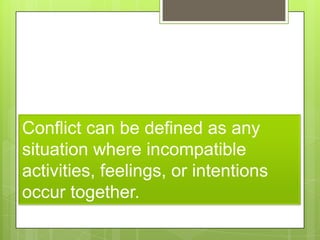
Conflict can be defined as any
situation where incompatible
activities, feelings, or intentions
occur together.
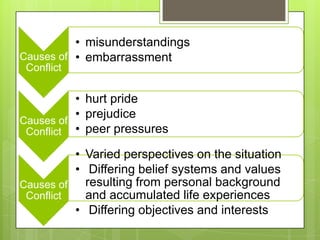
• misunderstandings
Causes of • embarrassment
 Conflict

          • hurt pride
          • prejudice
Causes of
 Conflict • peer pressures

          • Varied perspectives on the situation
          • Differing belief systems and values
Causes of   resulting from personal background
 Conflict   and accumulated life experiences
          • Differing objectives and interests
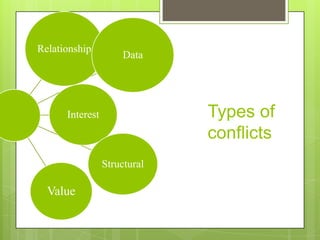
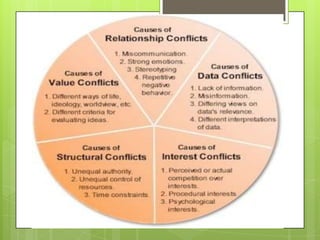
Relationship
                     Data


      Interest                Types of
                              conflicts
                 Structural

  Value
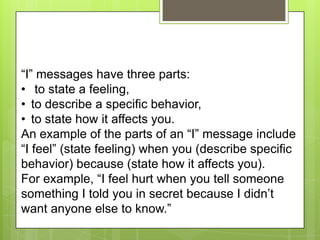
“I” messages have three parts:
• to state a feeling,
• to describe a specific behavior,
• to state how it affects you.
An example of the parts of an “I” message include
“I feel” (state feeling) when you (describe specific
behavior) because (state how it affects you).
For example, “I feel hurt when you tell someone
something I told you in secret because I didn’t
want anyone else to know.”
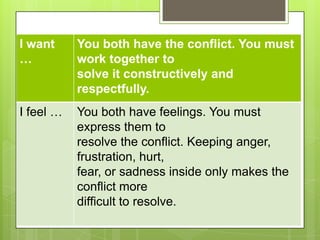
I want     You both have the conflict. You must
…          work together to
           solve it constructively and
           respectfully.
I feel …   You both have feelings. You must
           express them to
           resolve the conflict. Keeping anger,
           frustration, hurt,
           fear, or sadness inside only makes the
           conflict more
           difficult to resolve.
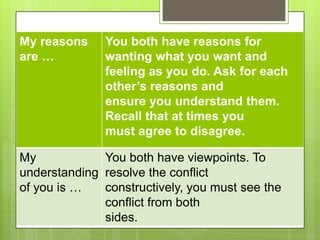
My reasons     You both have reasons for
are …          wanting what you want and
               feeling as you do. Ask for each
               other’s reasons and
               ensure you understand them.
               Recall that at times you
               must agree to disagree.

My            You both have viewpoints. To
understanding resolve the conflict
of you is …   constructively, you must see the
              conflict from both
              sides.
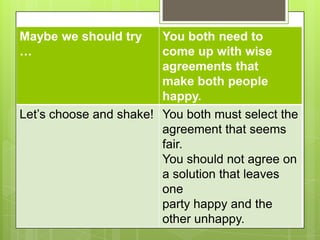
Maybe we should try     You both need to
…                       come up with wise
                        agreements that
                        make both people
                        happy.
Let’s choose and shake! You both must select the
                        agreement that seems
                        fair.
                        You should not agree on
                        a solution that leaves
                        one
                        party happy and the
                        other unhappy.
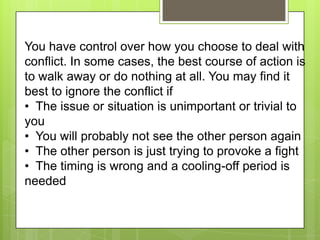
You have control over how you choose to deal with
conflict. In some cases, the best course of action is
to walk away or do nothing at all. You may find it
best to ignore the conflict if
• The issue or situation is unimportant or trivial to
you
• You will probably not see the other person again
• The other person is just trying to provoke a fight
• The timing is wrong and a cooling-off period is
needed
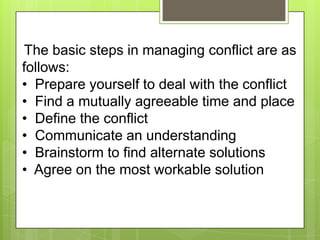
The basic steps in managing conflict are as
follows:
• Prepare yourself to deal with the conflict
• Find a mutually agreeable time and place
• Define the conflict
• Communicate an understanding
• Brainstorm to find alternate solutions
• Agree on the most workable solution
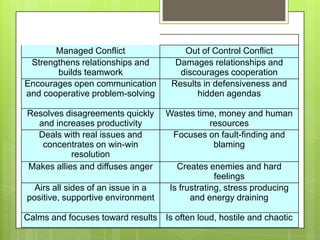
Managed Conflict                 Out of Control Conflict
 Strengthens relationships and        Damages relationships and
       builds teamwork                 discourages cooperation
Encourages open communication        Results in defensiveness and
and cooperative problem-solving            hidden agendas

Resolves disagreements quickly      Wastes time, money and human
  and increases productivity                  resources
  Deals with real issues and         Focuses on fault-finding and
   concentrates on win-win                     blaming
           resolution
Makes allies and diffuses anger       Creates enemies and hard
                                                 feelings
  Airs all sides of an issue in a   Is frustrating, stress producing
positive, supportive environment          and energy draining

Calms and focuses toward results Is often loud, hostile and chaotic
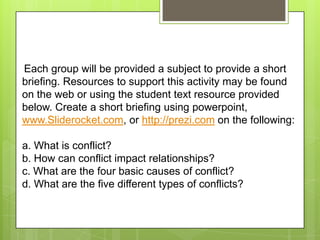
Each group will be provided a subject to provide a short
briefing. Resources to support this activity may be found
on the web or using the student text resource provided
below. Create a short briefing using powerpoint,
www.Sliderocket.com, or http://prezi.com on the following:

a. What is conflict?
b. How can conflict impact relationships?
c. What are the four basic causes of conflict?
d. What are the five different types of conflicts?
Resources
 http://www.helpguide.org/mental/eq8_conflict_resolution.htm
 http://cmhc.utexas.edu/booklets/fighting/fighting.html
 http://www.zunal.com/zunal_uploads/files/20110703100926en
  eLe.pdf
 http://www.westbrookstevens.com/conflict_Resolution.htm
Resources
http://www.helpguide.org/mental/eq8_conflict_r
 esolution.htm
http://cmhc.utexas.edu/booklets/fighting/fighting
 .html
http://newresolutionmediation.blogspot.com/20
 08/02/getting-creative-in-mediation-2how-
 one.html
http://www.westbrookstevens.com/conflict_Res
 olution.htm

Conflict management

  • 1.
  • 2.
    Web quest inClass11 http://www.zunal.com/webquest.ph p?w=106108
  • 3.
    What You WillLearn to Do  Determine causes of conflict Linked Core Abilities • Do your share as a good citizen in your school, community, country, and the world Skills and Knowledge You Will Gain Along the Way  Recognize the impact of conflict on relationships.  Describe the four basic causes of conflict.  Analyze five different types of conflicts  Use "I" statements to facilitate effective communication
  • 4.
    Conflict is anatural part of life. It can be positive or negative depending on how you choose to manage it. By recognizing potential conflicts and their warning signs, and using conflict management strategies to help you make appropriate decisions, you will have confidence and be better prepared to deal with conflict in the future.
  • 5.
    Conflict can bedefined as any situation where incompatible activities, feelings, or intentions occur together.
  • 6.
    • misunderstandings Causes of• embarrassment Conflict • hurt pride • prejudice Causes of Conflict • peer pressures • Varied perspectives on the situation • Differing belief systems and values Causes of resulting from personal background Conflict and accumulated life experiences • Differing objectives and interests
  • 7.
    Relationship Data Interest Types of conflicts Structural Value
  • 8.
    “I” messages havethree parts: • to state a feeling, • to describe a specific behavior, • to state how it affects you. An example of the parts of an “I” message include “I feel” (state feeling) when you (describe specific behavior) because (state how it affects you). For example, “I feel hurt when you tell someone something I told you in secret because I didn’t want anyone else to know.”
  • 9.
    I want You both have the conflict. You must … work together to solve it constructively and respectfully. I feel … You both have feelings. You must express them to resolve the conflict. Keeping anger, frustration, hurt, fear, or sadness inside only makes the conflict more difficult to resolve.
  • 10.
    My reasons You both have reasons for are … wanting what you want and feeling as you do. Ask for each other’s reasons and ensure you understand them. Recall that at times you must agree to disagree. My You both have viewpoints. To understanding resolve the conflict of you is … constructively, you must see the conflict from both sides.
  • 11.
    Maybe we shouldtry You both need to … come up with wise agreements that make both people happy. Let’s choose and shake! You both must select the agreement that seems fair. You should not agree on a solution that leaves one party happy and the other unhappy.
  • 12.
    You have controlover how you choose to deal with conflict. In some cases, the best course of action is to walk away or do nothing at all. You may find it best to ignore the conflict if • The issue or situation is unimportant or trivial to you • You will probably not see the other person again • The other person is just trying to provoke a fight • The timing is wrong and a cooling-off period is needed
  • 13.
    The basic stepsin managing conflict are as follows: • Prepare yourself to deal with the conflict • Find a mutually agreeable time and place • Define the conflict • Communicate an understanding • Brainstorm to find alternate solutions • Agree on the most workable solution
  • 14.
    Managed Conflict Out of Control Conflict Strengthens relationships and Damages relationships and builds teamwork discourages cooperation Encourages open communication Results in defensiveness and and cooperative problem-solving hidden agendas Resolves disagreements quickly Wastes time, money and human and increases productivity resources Deals with real issues and Focuses on fault-finding and concentrates on win-win blaming resolution Makes allies and diffuses anger Creates enemies and hard feelings Airs all sides of an issue in a Is frustrating, stress producing positive, supportive environment and energy draining Calms and focuses toward results Is often loud, hostile and chaotic
  • 17.
    Each group willbe provided a subject to provide a short briefing. Resources to support this activity may be found on the web or using the student text resource provided below. Create a short briefing using powerpoint, www.Sliderocket.com, or http://prezi.com on the following: a. What is conflict? b. How can conflict impact relationships? c. What are the four basic causes of conflict? d. What are the five different types of conflicts?
  • 18.
    Resources  http://www.helpguide.org/mental/eq8_conflict_resolution.htm  http://cmhc.utexas.edu/booklets/fighting/fighting.html http://www.zunal.com/zunal_uploads/files/20110703100926en eLe.pdf  http://www.westbrookstevens.com/conflict_Resolution.htm
  • 19.