EWMA Document:
Debridement
An updated overview and clarifi cation 
of the principle role of debridement
A EWMA Document
S2 JOURNAL OF WOUND CARE    Vol 22. No 1. EWMA Docu men t 2013
© EWMA 2013
All rights reserved. No reproduction, transmission or copying of this publication is allowed without written
permission. No part of this publication may be reproduced, stored in a retrieval system, or transmitted in any form or
by any means, mechanical, electronic, photocopying, recording, or otherwise, without the prior written permission
of the European Wound Management Association (EWMA) or in accordance with the relevant copyright legislation.
Although the editor, MA Healthcare Ltd. and EWMA have taken great care to ensure accuracy, neither MA
Healthcare Ltd. nor EWMA will be liable for any errors of omission or inaccuracies in this publication.
Published on behalf of EWMA by MA Healthcare Ltd.
Publisher: Anthony Kerr 
Editor: Daniel Shanahan 
Designer: Alison Cutler 
Published by: MA Healthcare Ltd, St Jude’s Church, Dulwich Road, London, SE24 0PB, UK
Tel: +44 (0)20 7738 5454 Email: anthony.kerr@markallengroup.com Web: www.markallengroup.com
R. Strohal (Editor);1
J. Dissemond;2
J. Jordan O’Brien;3
A. Piaggesi;4
R. Rimdeika;5,6
T. Young;7
J. Apelqvist (Co-editor);8
1 Department of Dermatology and Venerology, Federal University Teaching Hospital Feldkirch, Feldkirch, Austria;
2 Clinic of Dermatology, Venerology and Allercology, Essen University Hospital, Germany;
3 Centre of Education,Beaumont Hospital,Beaumont Road, Dublin, Ireland;
4 Department of Endocrinology and Metabolism, University of Pisa, Pisa, Italy;
5 Kaunas University Hospital, Department of Plastic and Reconstructive Surgery, Lithuania;
6 Lithuanian University of Health Sciences , Faculty of Medicine, Lithuania;
7 Bangor University, North Wales, United Kingdom;
8 Department of Endocrinology, University Hospital of Malmö, Sweden.
Editorial support and coordination: Julie Bjerregaard, EWMA Secretariat
Email: robert.strohal@lkhf.at  Web: www.ewma.org
The document is supported by an unrestricted grant from Ferris Healthcare, FlenPharma, Lohmann  Rauscher,  
Sorbion and Söring.
This article has not undergone double-blind peer review;
This article should be referenced as: Strohal, R., Apelqvist, J., Dissemond, J. et al. EWMA Document: Debridement.
J Wound Care. 2013; 22 (Suppl. 1): S1–S52.
JOURNAL OF WOUND CARE  Vol 22. No 1. EWMA Documen t 2013  S 3
Contents
Introduction 4
Method 6
Patient consent for debridement 8
Mechanical debridement 10
Wet-to-dry debridement 10
Paraffin tulle 10
Gauze 11
Monofilament fibre pad 12
Conclusions 12
Autolytic dressings, enzymatic dressings, absorptive dressings and honey 13
Autolytic dressings 13
Enzymatic dressings 17
Absorptive dressings 20
Honey 20
Larvae debridement therapy 22
Technical solutions 26
Direct debridement technologies 26
Jet lavage/hydro surgery 26
Ultrasound 27
Indirect debridement technologies 28
Negative pressure 28
Low-frequency ultrasound 29
Conclusions 30
Surgical and sharp debridement 31
Health economics:Wound management and debridement 35
Health economics and factors related to healing of non-healing wounds 35
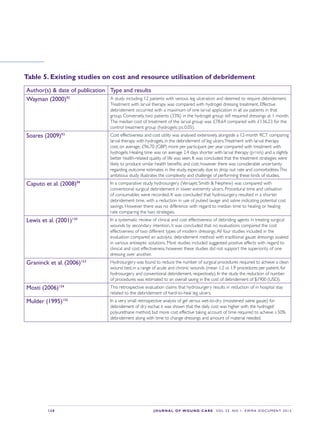
Cost of wound management: Existing evidence 36
The health economy of debridement 37
Need for studies on the cost-effectiveness of debridement 37
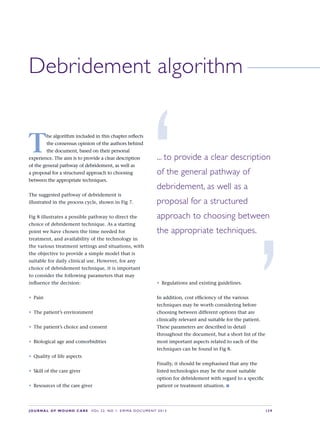
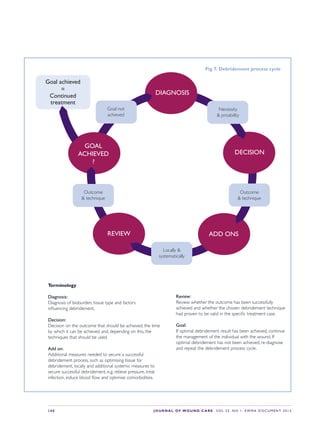
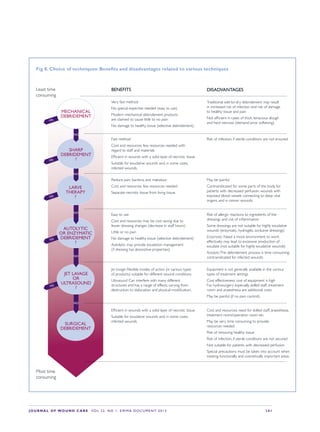
Debridement algorithm 39
References 42
Appendices 46
S4 JOURNALOFWOUNDCARE Vol 22. No 1. EWMA DocuMENt 2013
R
outine care of non-healing acute and 
chronic wounds often comprises either 
cleaning or debridement. Consequently, 
debridement is a basic necessity to induce the 
functional process of tissue repair, which makes it a 
central medical intervention in the management of 
acute and chronic, non-healing wounds.
The last years many different new debridement 
techniques have been introduced; primarily 
applying physical principles and forces to promote 
the development from acute infl ammatory phase to 
the reparative condition.1
However, despite the central role of debridement 
in the fi eld of wound healing, there is still no 
document that gathers this information. With this 
document, the European Wound Management 
Association (EWMA) aims to provide an overview 
of the various options, including a clarifi cation of 
the principal role of debridement (why and when to 
debride, evidence for debridement), the defi nition 
of possibilities and limitations for standard and new 
debridement options with specifi c potentials in 
their practical use, health-economic aspects and an 
algorithm for the clinical routine.
Definitionofdebridement
The word debridement derives from the French 
débridement, which means to remove a constraint. 
In clinical medicine this term was fi rst used by 
Henri Le Dran (1685–1770), in the context of 
an incision to promote drainage and relieve of 
tension.2
 Today, debridement refers to deeply 
removing adherent, dead or contaminated tissue 
from a wound and must be clearly separated from 
the act of cleansing, defi ned as the removal of 
dirt (loose metabolic waste or foreign material).3
 
Furthermore, debridement does not encompass 
revision of a wound, resection of functional tissue 
or amputation. Thus, we defi ne debridement as 
the act of removing necrotic material, eschar, 
devitalised tissue, serocrusts, infected tissue, 
hyperkeratosis, slough, pus, haematomas, foreign 
bodies, debris, bone fragments or any other type 
of bioburden from a wound with the objective to 
promote wound healing. 
Debridement is sometimes referred to as a form of 
wound bed preparation;4
 however, from a global 
perspective it becomes clear that not only the 
wound bed but also the wound edges and the 
peri-wound skin are important for the successful 
healing of a wound. This supports a defi nition 
of debridement that does not only refer to the 
removal of bioburden from the wound bed, but 
also the liberation of wound edges as well as of 
peri-wound skin. This document will show that 
this broader view on debridement opens new 
possibilities and perspectives within the fi eld of 
wound healing.
When adapting a global approach to wound 
healing, debridement must be understood as 
a process, possibly used in conjunction with 
other treatment approaches, with the aim to 
create a benefi cial situation supporting various 
clinical goals related to wound management. 
We believe that this approach increases the 
Introduction
JOURNALOFWOUNDCAREVol 22. No 1. EWMA DocuMENt 2013 S 5
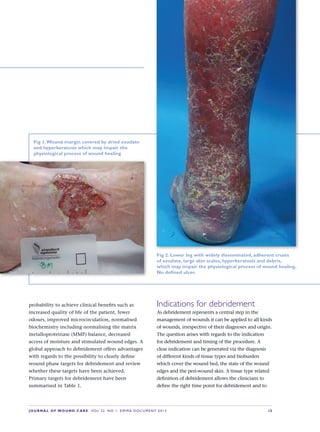
Fig 1.Woundmargincoveredbydriedexudate
andhyperkeratosiswhichmayimpairthe
physiologicalprocessofwoundhealing
Fig 2.Lowerlegwithwidelydisseminated,adherentcrusts
ofexudate,largeskinscales,hyperkeratosisanddebris,
whichmayimpairthephysiologicalprocessofwoundhealing.
Nodefinedulcer.
probability to achieve clinical benefi ts such as 
increased quality of life of the patient, fewer 
odours, improved microcirculation, normalised 
biochemistry including normalising the matrix 
metalloproteinase (MMP) balance, decreased 
access of moisture and stimulated wound edges. A 
global approach to debridement offers advantages 
with regards to the possibility to clearly defi ne 
wound phase targets for debridement and review 
whether these targets have been achieved. 
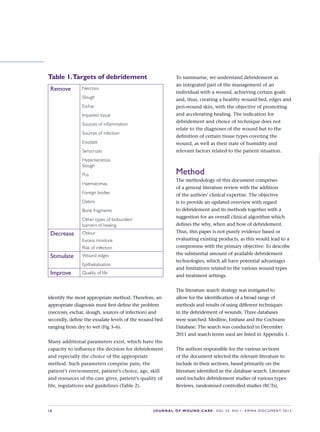
Primary targets for debridement have been 
summarised in Table 1.
Indicationsfordebridement
As debridement represents a central step in the 
management of wounds it can be applied to all kinds 
of wounds, irrespective of their diagnoses and origin. 
The question arises with regards to the indication 
for debridement and timing of the procedure. A 
clear indication can be generated via the diagnosis 
of different kinds of tissue types and bioburden 
which cover the wound bed, the state of the wound 
edges and the peri-wound skin. A tissue type related 
defi nition of debridement allows the clinicians to 
defi ne the right time point for debridement and to 
S6 JOURNALOFWOUNDCARE Vol 22. No 1. EWMA DocuMENt 2013
identify the most appropriate method. Therefore, an 
appropriate diagnosis must fi rst defi ne the problem 
(necrosis, eschar, slough, sources of infection) and 
secondly, defi ne the exudate levels of the wound bed 
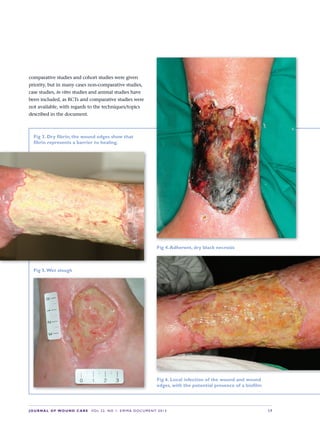
ranging from dry to wet (Fig 3–6).
Many additional parameters exist, which have the 
capacity to infl uence the decision for debridement 
and especially the choice of the appropriate 
method. Such parameters comprise pain, the 
patient’s environment, patient’s choice, age, skill 
and resources of the care giver, patient’s quality of 
life, regulations and guidelines (Table 2).
Remove Necrosis
Slough
Eschar
Impairedtissue
Sourcesofinflammation
Sourcesofinfection
Exudate
Serocrusts
Hyperkeratosis
Slough
Pus
Haematomas
Foreignbodies
Debris
Bonefragments
Othertypesofbioburden/
barriersofhealing
Decrease Odour
Excessmoisture
Riskofinfection
Stimulate Woundedges
Epithelialisation
Improve Qualityoflife
Table1.Targetsofdebridement To summarise, we understand debridement as 
an integrated part of the management of an 
individual with a wound, achieving certain goals 
and, thus, creating a healthy wound bed, edges and 
peri-wound skin, with the objective of promoting 
and accelerating healing. The indication for 
debridement and choice of technique does not 
relate to the diagnoses of the wound but to the 
defi nition of certain tissue types covering the 
wound, as well as their state of humidity and 
relevant factors related to the patient situation.
Method
The methodology of this document comprises 
of a general literature review with the addition 
of the authors’ clinical expertise. The objective 
is to provide an updated overview with regard 
to debridement and its methods together with a 
suggestion for an overall clinical algorithm which 
defi nes the why, when and how of debridement. 
Thus, this paper is not purely evidence based or 
evaluating existing products, as this would lead to a 
compromise with the primary objective: To describe 
the substantial amount of available debridement 
technologies, which all have potential advantages 
and limitations related to the various wound types 
and treatment settings.
The literature search strategy was instigated to 
allow for the identifi cation of a broad range of 
methods and results of using different techniques 
in the debridement of wounds. Three databases 
were searched: Medline, Embase and the Cochrane 
Database. The search was conducted in December 
2011 and search terms used are listed in Appendix 1. 
The authors responsible for the various sections 
of the document selected the relevant literature to 
include in their sections, based primarily on the 
literature identifi ed in the database search. Literature 
used includes debridement studies of various types: 
Reviews, randomised controlled studies (RCTs), 
JOURNALOFWOUNDCAREVol 22. No 1. EWMA DocuMENt 2013 S 7
Fig 3.Dryfibrin;thewoundedgesshowthat
fibrinrepresentsabarriertohealing.
Fig 4.Adherent,dryblacknecrosis
Fig 5.Wetslough
Fig 6.Localinfectionofthewoundandwound
edges,withthepotentialpresenceofabiofilm
comparative studies and cohort studies were given 
priority, but in many cases non-comparative studies, 
case studies, in vitro studies and animal studies have 
been included, as RCTs and comparative studies were 
not available, with regards to the techniques/topics 
described in the document.
S8 JOURNAL OF WOUND CARE    Vol 22. No 1. EWMA Docu men t 2013
A list of references, including information on
the study and document type, can be found at
www.ewma.org (Appendix 2).
As a general conclusion with regards to the
literature search we acknowledge that more  
high-level evidence is needed to further support
the content of this document. However, until this
has been provided, we have to rely on existing
information and experience to define existing
methods of debridement.
Patient consent for debridement
A comprehensive and holistic patient assessment
is a necessary pre-requisite to evaluate the most
appropriate method of debridement. Patient
involvement in the assessment and planning of
treatment will optimise success, as the patient will
be more informed and more likely to accept and
comply with treatment resulting in greater success
in removing necrotic tissue.5
Informed consent must be obtained before
commencing any treatment or investigation, or
in providing personal care.6
For consent to be
valid, the person giving consent must be capable
of making the decision or deemed competent.
The consent should be given voluntarily, without
coercion and the person should be provided with
adequate information to make that decision.
Information should be available regarding the
type of debridement treatment, including benefits
and risks, implications of having treatment and
alternatives that maybe available.7
It should be noted that a parent or guardian
can initiate consent if the person receiving the
debridement treatment is too young ( 16 years
old) or is incapable of making the decision for
themselves (due to physical or mental illness).8
It is important that parents and their children
are informed about the proposed treatment and
that children are listened to so that they can be
involved in the decision making. Ensuring consent
is legally and ethically obtained will reduce risk of
litigation and improve patient satisfaction.9
Informed consent maybe expressed or implied.
Implied consent may be inferred by the patient’s
actions, for example voluntary attendance to the
clinic for larval therapy dressings.10
Expressed
consent can be either written or verbal.11
In the
USA and UK, for example, it is common practice
for patients to sign a consent form, indicating
that they have been given information and that
they are consciously giving their permission to
receive care, for example, sharp debridement of a
necrotic diabetic foot ulcer.
Documentation of consent provides evidence that
processes involved in obtaining consent have
Decision parameters
Pain Skill of the care giver
Patients environment Resources of the care giver
Patients choice and consent Regulations
Biological age and comorbidities Guidelines
Quality of life
Table 2.Additional parameters influencing the decision for debridement 
and the choice of technique
JOURNAL OF WOUND CARE  Vol 22. No 1. EWMA Documen t 2013  S 9
been adhered to. It can also provide evidence of
information given to patients and clarification of
treatment, for example, amputation of lower limb
in theatre under general anaesthetic. However,
patients do have a right to withdraw their consent
at any stage before, or during the course of the
debridement technique.12
Regardless of debridement technique it is essential
that patients are given adequate information in
order to reach an informed decision and consent
to treatment. Focus should be on all methods
of debridement and not just surgical and sharp
debridement. Consent is not just a signature on a
piece of paper,13
it is an active participation of the
patient in the decisions about their own health care.
An example of a debridement consent form can
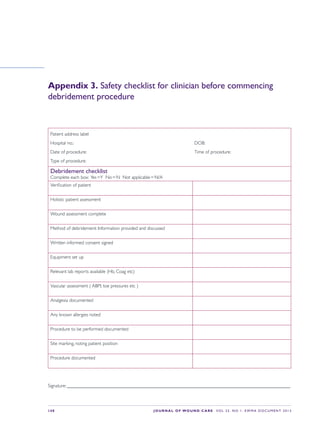
be found in Appendix 3.
‘The objective is to provide an updated
overview with regard to debridement
and its methods, together with a
suggestion for an overall clinical
algorithm which defines the why, 
when and how of debridement
’
S10 JOURNAL OF WOUND CARE    Vol 22. No 1. EWMA Docu men t 2013
M
echanical wound debridement involves
the use of dry gauze dressings, wet
to dry gauze dressings, impregnated
gauze/tulle dressings or a monofilament fibre pad
to remove non-viable tissue from the wound bed.
Following a review of the literature, a large
proportion of the articles were excluded, as they
did not contain specific information on the ability
to debride non-viable tissue (Edsrtom et al., 1979;
Xakellis and Chrischilles, 1992; Brown, 2000; Piaggesi
et al., 2000; Caravaggio et al., 2003; Eginton et al.,
2003; Wanner et al., 2003; Allie et al., 2004; Cohn et
al., 2004; Mouës, 2004; Brigido et al., 2006; Huang et
al., 2006; Yao et al., 2006; Mouës et al., 2007; Koller et
al., 2008; Wang and Teng, 2008; El-Nahas et al., 2009;
Saba et al., 2009; Martin et al., 2010; Perez et al.,
2010; Solway et al., 2010; Brenes et al., 2011; Uccioli
et al., 2011; Warriner et al., 2011; Zhen et al., 2011.
Full references can be found in Appendix 4).
Wet-to-dry debridement
Background
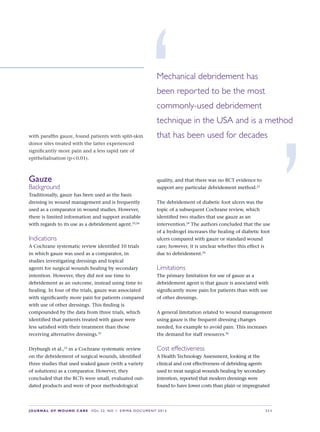
Mechanical debridement has been reported to be
the most commonly used debridement technique
in the USA14
and is a method that has been used
for decades.15,16
A wet-to-dry method of wound
cleansing has also been decribed,17
but should
not be confused with the traditional wet-to-dry
method of debridement.
Action
One technique used to achieve mechanical
debridement is the wet-to-dry method. A moist
Mechanical debridement
gauze pad is applied to the wound. As the
devitalised tissue dries, it re-hardens and becomes
attached to the gauze; when the dressing is
removed, the adhered material is pulled free.
Indications
Wet to dry dressings are recommended only as a
short-term therapy for infected necrotic wounds.15,18
One case study reports using wet-to-dry as a
debridement method in a patient with a category III
pressure ulcer.19
In addition, there is one case
reporting success in using wet-to-dry gauze as one
component of a debridement regimen.20
Limitations
The wet-to-dry debridement method often
results in a lack of procedural concordance, with
an increased risk of infection; also, the gauze
remnants can potentially act as foreign bodies
within the wound bed. The disadvantages of this
method are described as injury to normal tissue
and pain, along with the necessity for frequent
dressing changes.15
In addition, while cost of
the gauze is low, application is said to be time
consuming and costly.15,18
Paraffin tulle
Donati and Vigano21
provide anecdotal reports of
paraffin tulle dressings causing pain and damage
to new tissue, bleeding at the wound bed on
removal, as well as an increased risk of infection
and a delay in re-epithelialisation.21
Barnea et
al.,22
in a study comparing a Hydrofiber dressing
JOURNAL OF WOUND CARE  Vol 22. No 1. EWMA Documen t 2013  S 11
with paraffin gauze, found patients with split-skin
donor sites treated with the latter experienced
significantly more pain and a less rapid rate of
epithelialisation (p  0.01).
Gauze
Background
Traditionally, gauze has been used as the basis
dressing in wound management and is frequently
used as a comparator in wound studies. However,
there is limited information and support available
with regards to its use as a debridement agent.23,24
Indications
A Cochrane systematic review identified 10 trials
in which gauze was used as a comparator, in
studies investigating dressings and topical
agents for surgical wounds healing by secondary
intention. However, they did not use time to
debridement as an outcome, instead using time to
healing. In four of the trials, gauze was associated
with significantly more pain for patients compared
with use of other dressings. This finding is
compounded by the data from three trials, which
identified that patients treated with gauze were
less satisfied with their treatment than those
receiving alternative dressings.25
Dryburgh et al.,23
in a Cochrane systematic review
on the debridement of surgical wounds, identified
three studies that used soaked gauze (with a variety
of solutions) as a comparator. However, they
concluded that the RCTs were small, evaluated out-
dated products and were of poor methodological
quality, and that there was no RCT evidence to
support any particular debridement method.23
The debridement of diabetic foot ulcers was the
topic of a subsequent Cochrane review, which
identified two studies that use gauze as an
intervention.24
The authors concluded that the use
of a hydrogel increases the healing of diabetic foot
ulcers compared with gauze or standard wound
care; however, it is unclear whether this effect is
due to debridement.24
Limitations
The primary limitation for use of gauze as a
debridement agent is that gauze is associated with
significantly more pain for patients than with use
of other dressings.
A general limitation related to wound management
using gauze is the frequent dressing changes
needed, for example to avoid pain. This increases
the demand for staff resources.26
Cost effectiveness
A Health Technology Assessment, looking at the
clinical and cost effectiveness of debriding agents
used to treat surgical wounds healing by secondary
intention, reported that modern dressings were
found to have lower costs than plain or impregnated
‘Mechanical debridement has
been reported to be the most
commonly-used debridement
technique in the USA and is a method
that has been used for decades
’
S12 JOURNAL OF WOUND CARE    Vol 22. No 1. EWMA Docu men t 2013
gauze. However, the quality of the cost-effectiveness
analyses in the studies was found to be poor.27
However, several studies show that the need for staff
resources, in relation to a high number of dressing
changes, decreases the cost effectiveness of gauze.26
Monofilament fibre pad
Background
The monofilament fibre product has recently been
introduced as a modern, wound-debriding product,
designed to mechanically remove slough and
devitalised cells from the wound bed.28
Case studies
suggest that slough, hyperceratotic debris and
crusts of desiccated exudate are bound in the fibre
composite and thereby removed from the wound
and surrounding skin.29
Action
The wound-contact side is fleecy in appearance
and, once wetted, is gently wiped over the surface
of the wound for 2–4 minutes.30
Indications
The monofilament fibre pad has been used
in debriding a variety of wound types,
including venous leg ulcers, diabetic foot ulcers
(neuropathic and neuro-ischaemic), arterial ulcers,
mixed aetiology ulcers, pressure ulcers  
and traumatic wounds.29,31
A number of smaller, prospective, pilot, non-
comparative studies and case studies29
suggest
good debridement results after one use on a variety
of tissue types, such as slough and necrotic, and
effective removal of hyperkeratosis. It is also claimed
that the monofilament fibre pad leads to removal
of debris, leaving healthy granulation tissue intact,
including small epithelialised islands of vital tissue.29
In the case of thick, tenacious slough and hard
necrosis it is recommended that the tissue is
softened prior to using the pad.28
A larger study
of 60 patients with chronic wounds, of which
57 (95%) were included in the analysis, the
monofilament fibre pad was effective in 93.4%
(n=142) of the debridement episodes.32
Benefits
The debridement process using a monofilament
pad is found to be quick (range 2–12 minutes).32,33
In addition, the monofilament pad is claimed to be
easy to use, causing little-to-no pain.31
Side effects
Some pain responses following the debridement
procedure have been reported.32
Conclusions
The use of wet-to-dry, plain gauze and paraffin
tulle as debriding agents has little to support their
use. The limitations should preclude their use in
clinical practice; however, the monofilament fibre
pad shows the potential to advance mechanical
debridement as a viable technique, by providing
a rapid, safe and easy-to-use method with limited
pain for the patient. However, further research,
including clinical use on a variety of acute and
chronic wound types, is needed.
JOURNAL OF WOUND CARE  Vol 22. No 1. EWMA Documen t 2013  S 13
T
his chapter describes various debridement
techniques with autolytic, enzymatic and/
or absorptive properties. Many different
products are currently available on the market,
offering different combinations of components
and suitable for different wound characteristics and
stages. We will provide an overview of the various
product types, defined in four overall categories:
autolytic dressings, enzymatic dressings, absorptive
dressings and honey.
Autolytic dressings
Background
The term ‘autolytic debridement’ describes a
natural process in all kinds of wounds, which
can be supported by a moist wound-mangament
strategy. Autolytic debridement products can
be found in many different varieties, including
different properties, benefits and limitations. They
can be defined in the following groups:
a Hydrogels, or hydrogel-based dressings, are
three-dimensional, cross-linked homopolymers
Autolytic dressings,
enzymatic dressings,
absorbtive dressings 
and honey
or copolymers, saturated with water. The
proportion of water in hydrogel dressings can
vary from 30% to 90%. Different gel-forming
agents, such as carboxymethylcellulose, are
incorporated into most hydrogels.34
b Hydrocolloids are composed of carbomethyl­
cellulose, gelatin, pectin, elastomers and
adhesives that turn in to a gel when exudate  
is absorbed.35
c Highly absorptive dressings with autolytic
and occlusive properties, such as dressings
with a multifunctional polymeric membrane
formulation and hydrations techniques
(e.g. hydration response technology [HRT]).
These dressings are designed for exudation
management, aiming to create a moist and
physiological environment for autolytic
debridement.36
Some dressings comprise a hydrophilic polymer-
modified starch in its three-dimensional network
with physically-bound iodine.
S14 JOURNAL OF WOUND CARE    Vol 22. No 1. EWMA Docu men t 2013
d Hydrofibers, including carboxymethylcellulose
fibres, which turn into a gel when they come
into contact with wound fluid, thereby aiding
the removal of nonviable tissue. Hydrofiber
dressings are highly absorbent and those with
silver content and other antimicrobials are
available on the market.37
e Multi-component dressings. Some dressings
combine autolytic, absorptive and antimicrobial
features in the debridement process. These
include enzyme alginogels, comprising hydrated
alginate polymers in a polyethylene glycol (PEG)/
water matrix, embedded with an antimicrobial
oxidase/peroxidase enzymatic complex.38
Indications
Autolytic dressings are indicated for different kinds
of acute and chronic wounds with necrotic tissue
or fibrin coatings, to rehydrate, soften and liquefy
hard eschar and slough.33
For example, hydrogels
should only be used in wounds with moderate
or no exudate, while absorptive dressings with
autolytic properties, Hydrofibers and combination
dressings can be used for the treatment of
exudative (low, medium or high) wounds with
yellow sloughy surfaces.39
Different products are
available for varying levels of exudate.
Autolytic debridement can be used for  
infected wounds, only if the infection is under
control/treatment.
Action
Autolytic debridement products have a dual
mode of activity in wound therapies. They can
donate water to dry wounds, or absorb fluids
from moderately exudating wounds. The idea
behind an autolytic debridement is a selective
debridement by release of the patients’ endogenous
proteolytic enzymes, such as collagenase, elastase,
myeloperoxidase, acid hydroxylase or lysozymes,
and the activation of phagocytes. These enzymes
will soften, break down and dissolve necrotic
or sloughy tissue in wounds, enabling it to be
digested by macrophages. Most of these enzymes
are produced by leucocytes. Another aspect of
autolytic debridement is mediated by the high
water content in, for example, hydrogels and the
moisturising effect of absorptive dressings, which
leads to swelling of necrotic tissue and fibrin
coatings, facilitating their de-attachment.
For an autolytic debridement, wound conditions
must be created that are optimised for leucocytes
and macrophages activity. This is achieved by
creating a moist wound milieu using, for example,
hydrogels or polymers/sugars, which absorb and
physically bind the dissolved material, to maintain
a moist environment in the wound.
c	 Highly-absorptive dressings absorb and bind
wound exudate, which could delay wound
healing, and are often combined with moisturisers,
which keep dressings from adhering to the wound
‘Autolytic debridement 
is a selective debridement
by release of the patients’
endogenous proteolytic
enzymes, and the 
activation of phagocytes.
’
JOURNAL OF WOUND CARE  Vol 22. No 1. EWMA Documen t 2013  S 15
and are claimed to support wound healing in
some types of wounds (see Contraindications for
types and areas to be avoided).
Devices based on HRT combine a glueless  
mixture of mechanically-treated cellulose fibres
and gelling agents. Comparative in vitro tests have
shown antibacterial and antifungal properties
of the dressing, implying that their application
could aid treatment of wound infections through
entrapment of microorganisms, while wound
exudate is being absorbed.40
Dressings containing cadexomer-iodine liquid
particles, with a hydrophilic polymer-modified
starch, can accommodate up to seven times
their dry weight in exudate, and then generate
a hydrogel. Even if the gel supports autolytic
debridement, its primary indication in wound
therapy is the antimicrobial treatment of  
infected wounds.41,42
e	Some multi-component dressings include an
enzyme alginogel, which is claimed to create a
protective film, protecting the wound borders
from maceration.38
Administration
For correct use of an autolytic debridement, the
dressing is directly applied to the wound surface.
As the administration of the available dressings
varies according to the properties of the dressings,
specific administration guidance apply to different
types of products.
For autolytic dressings without absorptive properties,
it should in general be mentioned that these may
be combined with an exudate-absorbing secondary
dressing to allow already-detached, non-viable tissue
to be absorbed. For autolytic debridement, it is most
common to change dressings once daily. Remains
of the gels can be removed with tap water or sterile
irrigation solutions.34,43
In addition, it should be mentioned that:
a	For hydrogels, a coating with a thickness of
at least 5mm is necessary; smaller or deeper
wounds may be completely filled with the gel.
Hydrogel sheets should be applied so that they
overlap 2cm around the wound edges.
c	 Dressings with highly absorptive properties
should be applied at a thickness of a least 3mm.
The dressing should be replaced after 1–3 days,
depending on the level of exudate.
For cadexomer iodine, it is recommended that
the total dose should not exceed 150g/week and
the overall treatment should not be longer than
3 months, for a single course of treatment.44
Benefits
Products for autolytic debridement are fairly
well documented as easy to use and causing
little-to-no pain. They do not damage healthy
tissues (selective debridement) and are claimed to
promote the formation of granulation tissue and
epithelialisation.22,37
Most of these products are
likely to require few dressing changes.45
With regard to specific groups of products, it
should be mentioned that:
a	A further benefit of hydrogel sheets is that they
are mostly transparent, thus allowing wound
inspection without having to remove the
dressing. As well as the debridement effects,
certain hydrogel sheets are claimed to provide
a cooling effect, which may lead to pain relief,
especially for patients with burns. However, for
other patients, for example patients with arterial
disease, this cooling effect may be unpleasant.34
c	 Benefits of the absorptive dressings with
autolytic properties include removal of
slough, provision of moisture, absorption and
S16 JOURNAL OF WOUND CARE    Vol 22. No 1. EWMA Docu men t 2013
protection.36
These dressings are designed to
be used in highly exudative wounds and thus
support the exudate management.
Polymeric membrane dressings are claimed to soften
tissue and absorb exudate, with the objective to
promote healing by combining glycerin and starch.45,46
e	By generating reactive oxygen species, the
oxidase/peroxidase enzymatic complex included
in multi-component products should be effective
as an antimicrobial agent. Some multi-component
dressings include alginate polymers with a strong
absorption capacity and polyethylene glycol/
water. These multi-component dressings are
claimed to absorb microorganisms into the gel,
leading to an oxidative antimicrobial effect.38
Contraindications
General contraindications are known contact
sensitisation to ingredients of the dressings. For
example, propylene glycol is used as a preserving
agent in many autolytic dressings and it is well
known that contact sensitisation to propylene
glycol exists in up to 14% of patients with chronic
venous leg ulcers.47
Other product-group specific contraindications are:
a	Hydrogels and hydrogel dressings should not
be used in bleeding wounds, fistulae or body
cavities. Moreover, they should not be used
when wounds are highly exudative. In addition,
these products are contraindicated in infected
wounds (this may vary between countries in
Europe, depending on the available products)
and in those with a high potential for anaerobic
infections. It should also not be used in patients
with necrotic or ischaemic feet.33
b	Hydrocolloids should be used with special
precautions in patients with diabetes or  
infected wounds.
c and e: Use of dressings with occlusive properties
for highly exudative wounds and/or high
temperatures may lead to risk of infection by
Pseudomonas aeruginosa.48
Dressings with an absorptive effect should not be
used near the eyes, mucous membranes, in deep
wounds with narrow openings, or wounds in body
cavities, due to the risk of drying and adhesion.
Dressings using hydration technology should also
be avoided for dry or drying wound areas, or other
areas requiring little or no fluids.
Dressings supporting a moist wound healing
environment should not be used in, for example,
necrotic digits, because of ischaemia and/or
neuropathy. These wounds should be kept dry due
to the risk of infection.
Cadexomer iodine is contraindicated in patients
with iodine sensitivity, Hashimoto´s disease,
thyroiditis and nontoxic goiter. Some cases of
hyperthyroidism following cadexomer iodine have
also been reported and cadexomer iodine may  
lead to toxicosis, due to a tissue reaction in the
peri-wound area when hyperkeratosis is present.44
Side effects
Possible side effects related to the various groups of
products are:
a	For hydrogels, excessive use, or use in a highly
exudative wound, may lead to maceration  
of the peri-wound skin. Maceration potentially
weakens the skin barrier function and may
impede the wound-healing process. Moreover,
maceration can be a portal of entry for
infections caused by microorganisms,  
such as bacteria or fungi.
c	 Pain related to cadexomer iodine dressings,
such as a burning sensation during application,
has been reported.44
JOURNAL OF WOUND CARE  Vol 22. No 1. EWMA Documen t 2013  S 17
Moreover, certain topical, antimicrobial agents have
been associated with cytotoxicity, delayed healing,
emergence of bacterial strains resistant to common
antimicrobial agents and contact dermatitis.49,50
Cost effectiveness
Only a few studies have thoroughly evaluated the
cost effectiveness of autolytic debridement methods.
A cost efficacy analysis of cadexomer-iodine
dressings, compared with hydrocolloid dressings
and paraffin gauze dressings, indicate that while
material costs were higher in the cadexomer-
iodine group, the total weekly costs were similar
for all treatments, due to the need for less frequent
changes with cadexomer iodine. Primary costs were
related to cost of staff resources and transportation,
in relation to dressing changes.41,44,51
A randomised clinical study by Caruso,37
including
a cost-effectiveness analysis, suggests potential
cost benefits related to fewer dressing changes,
less nursing time and fewer procedural and opiate
medications during dressing changes.
Some general comments with regards to possible
cost indicators are:
•	 Autolytic debridement can be considered one
of the easiest and safest methods of debriding
wounds. Therefore, it may be appropriate to use
in long-term care facilities and in the home-care
setting, thereby possibly saving costs.
•	 However, achieving cost effectiveness may  
be difficult, as a prolonged period of time  
may be needed to achieve complete removal
of nonviable tissue. Therefore, costs associated
with dressings and repeated visits need to 
be considered.
•	 Another problem may occur as the hygienic
specification for hydrogels are usually
determined for single use. Thus, the tube should
be discarded after a single use, regardless of the
remaining stock.
Enzymatic dressings
Background
For a few hundreds of years, patients with
chronic wounds have been treated topically with
proteolytic enzymes, for example in the form of
fruit juices. Since 1960, the first scientific records
exist on the effective use of proteolytic enzymes
in the treatment of patients with chronic wounds
(Table 3). Enzymatic debridement is a specific
wound-debridement option using proteolytic
enzymes in gels or ointments, which should work
synergistically with endogenous enzymes.36
Indications
Enzymatic debridement can be useful in patients
with wounds where mechanical debridement
options are not available or are contraindicated; for
example, in patients with bleeding problems.
Mechanism of action
During debridement, proteolytic enzymes are
used to hydrolyse peptide bonds, in order to
facilitate the removal of non-viable tissue from
a wound. These enzymes can be divided in exo-
and endopeptidases. Exopeptidases hydrolyse
the amino or carboxy terminal protein, whereas
endopeptidases degrade peptide bonds within the
protein molecules.34
Matrix metalloproteases (MMPs) are
zinc-dependent endopeptidases, with a sub-
group of metalloenzymes called collagenases.
Humans generate endogenous collagenases to
facilitate the physiological balance between
the assembly and degradation of collagen.
Collagenases are the only endoproteases that
can degrade human triple helical collagen, but
do not attack keratin, fat, fibrin or haemoglobin.
S18 JOURNAL OF WOUND CARE    Vol 22. No 1. EWMA Docu men t 2013
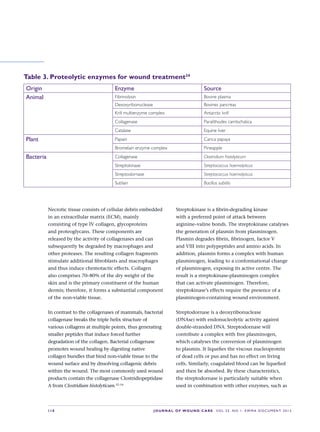
Origin Enzyme Source
Animal Fibrinolysin Bovine plasma
Desoxyribonuclease Bovines pancreas
Krill multienzyme complex Antarctic krill
Collagenase Paralithodes camtschatica
Catalase Equine liver
Plant Papain Carica papaya
Bromelain enzyme complex Pineapple
Bacteria Collagenase Clostridium histolyticum
Streptokinase Streptococcus haemolyticus
Streptodornase Streptococcus haemolyticus
Sutilain Bacillus subtilis
Table 3. Proteolytic enzymes for wound treatment34
Necrotic tissue consists of cellular debris embedded
in an extracellular matrix (ECM), mainly
consisting of type IV collagen, glycoproteins
and proteoglycans. These components are
released by the activity of collagenases and can
subsequently be degraded by macrophages and
other proteases. The resulting collagen fragments
stimulate additional fibroblasts and macrophages
and thus induce chemotactic effects. Collagen
also comprises 70–80% of the dry weight of the
skin and is the primary constituent of the human
dermis; therefore, it forms a substantial component
of the non-viable tissue.
In contrast to the collagenases of mammals, bacterial
collagenase breaks the triple helix structure of
various collagens at multiple points, thus generating
smaller peptides that induce forced further
degradation of the collagen. Bacterial collagenase
promotes wound healing by digesting native
collagen bundles that bind non-viable tissue to the
wound surface and by dissolving collagenic debris
within the wound. The most commonly used wound
products contain the collagenase Clostridiopeptidase
A from Clostridium histolyticum.52–54
Streptokinase is a fibrin-degrading kinase
with a preferred point of attack between
arginine–valine bonds. The streptokinase catalyses
the generation of plasmin from plasminogen.
Plasmin degrades fibrin, fibrinogen, factor V
and VIII into polypeptides and amino acids. In
addition, plasmin forms a complex with human
plasminogen, leading to a conformational change
of plasminogen, exposing its active centre. The
result is a streptokinase-plasminogen complex
that can activate plasminogen. Therefore,
streptokinase’s effects require the presence of a
plasminogen-containing wound environment.
Streptodornase is a deoxyribonuclease
(DNAse) with endonucleolytic activity against
double-stranded DNA. Streptodornase will
contribute a complex with free plasminogen,
which catalyses the conversion of plasminogen
to plasmin. It liquefies the viscous nucleoprotein
of dead cells or pus and has no effect on living
cells. Similarly, coagulated blood can be liquefied
and then be absorbed. By these characteristics,
the streptodornase is particularly suitable when
used in combination with other enzymes, such as
JOURNAL OF WOUND CARE  Vol 22. No 1. EWMA Documen t 2013  S 19
streptokinase. A combination of streptokinase and
streptodornase is commercially available.
Papain digests necrotic tissue by liquefying
fibrinous debris across a wide range of pH, from 3
to 12.52
For its full activity, it requires the presence
of sulphydryl groups, such as cysteine. Usually,
urea is combined with papain. Urea also denatures
proteins, making them more susceptible to
proteolysis by papain and exposes the necessary
activators for papain in necrotic tissue.55
It should
be noted that papain is not commercially available
in all parts of the world.
Krill enzymes (euphauserase) are a complex mixture
of endo- and exopeptidases, which are isolated from
the gastrointestinal tract of Antarctic krill (Euphausia
superba). The acidic endopeptidases have a structural
relationship to trypsin and chymotrypsin, whereas
the exopeptidases are mainly carboxypeptidases A
and B. A high molecular similarity to crab
collagenase could be found for the serin
endopetidase euphauserase. Krill enzymes assure a
nearly-complete breakdown of proteinous substrates
to soluble free amino acids.56,57
Administration
To ensure the full effectiveness during the therapy
with proteolytic enzymes, the wounds must always
have sufficient moisture in the environment.
Application of the enzymatic ointment should be
performed in a coating of thickness about 2–3mm
on the non-viable tissue areas, once or twice daily.
Benefits
The main advantages of the use of proteolytic
enzymes in the debridement of patients with
chronic wounds are their easy and safe handling.
Therapies are bloodless and generally considered
rather painless.58
Because of the highly-selective
mode of action, this type of debridement can be
appropriate to use in long-term care facilities and
in home-care settings.
Contraindications
It is important to respect the fact that
enzymes need a moist environment to be
effective. Therefore, dry wounds are a relative
contraindication for the use of proteolytic enzymes.
The additional use of, for example, antiseptics or
soaps should be avoided, as some of the enzymes
become ineffective in the presence of these
solutions. A contraindication for streptokinase is
the acute wound, because the cleavage of fibrin
leads to an increased risk of bleeding.
Side effects
Products with proteolytic enzymes can lead to
irritation of the peri-wound skin, with clinical signs
of inflammation or discomfort. This, in particular, is
most important when using papain, as considerable
pain induced by inflammatory response has
been commonly described.59
In an attempt to
reduce the occurrence of pain induced by papain,
chlorophyllin has been added to these preparations.
Therapy with streptodornase can cause fever,
chills, and leucocytosis, due to the absorption of
split purines and pyrimidines. Streptokinase and
streptodornase are effective as antigens and thus
the formation of antibodies may result. In some
cases, clinically-relevant contact sensitisation, with
allergic contact dermatitis, has been reported.
Cost effectiveness
Proteolytic debridement is an easy-to-handle and
safe option for conservative debridement; however,
additional costs may occur due to the prolonged
period of time needed to achieve complete
removal of necrotic tissue, and due to the relatively
expensive ointments.
Absorptive dressings
Background
Dextranomer is a hydrophilic, dextran polymer,
which is supplied as anhydrous, porous, spherical
S20 JOURNAL OF WOUND CARE    Vol 22. No 1. EWMA Docu men t 2013
beads measuring 0.1–0.3mm in diameter, or as
a paste with polyethylene glycol. The product
consists of unbranched dextran-polymer chains
which are interconnected by gycerol bridges into a
three-dimensional network.
Indication
Absorptive dressings are recommended for the
treatment of exudative wounds (low, medium or
high), with yellow sloughy surfaces.39
Mechanism of action
Absorptive dressings are highly hydrophilic and
rapidly absorb exudate from the necrotic, sloughy
mass. One gramme of dextranomer can absorb up
to 4g of fluid. Prostaglandins, hormones and other
small molecules enter the matrix of the absorptive
dressings, while larger particles, such as bacteria
and wound debris, become concentrated at the
surface of the dressing layer. When the dressings are
changed, or the beads are washed out, the absorbed
and trapped necrotic material is removed.60
Administration
Dextranomer should be applied in a thickness of a
least 3mm on to wounds that have previously been
cleaned with solutions. When the wound is dressed,
there must be some room for expansion, as the
dressing absorbs a lot of fluid. The absorbent dressing
should be replaced after 1–3 days, depending on the
extent of exudation. When it assumes a grey–yellow
colour, it is saturated and should be removed.
Benefits
Absorptive dressings are easy-to-handle products
that can be used even with highly exudative
wounds and thus support the exudate management.
Contraindications
As with absorptive dressings with autolytic
properties, absorptive dressings should not be
used near the eyes, in deep wounds with narrow
openings, or wounds in body cavities. Other
contraindications are known contact sensitisation
to ingredients of the dressings.
Side effects
Beside some reports of erythema, slightly blistered
skin or dehydration of the wound bed,61
the most
important adverse effect is pain on removal of the
saturated dressing from the wounds. This effect is
the result of the adherence effects.
Honey
Background
The first records of the use of honey in
wound management are already more than
4000 years old.62
Honey can be characterised
as a combination products but is, as a purely
natural substance, placed in a separate chapter.
It is a viscous, supersaturated, sugar solution,
containing approximately 30% glucose, 40%
fructose, 5% sucrose and 20% water, as well as
many other substances, such as amino acids,
vitamins, minerals and enzymes. As well as honey
preparations in tubes for wound treatments,
dressing pads pre-impregnated with honey are
also commercially available.
Indications
Honey has been used to treat a wide range of
wound types with necrotic tissue or slough. Other
indications are wound infections, even when they
are caused by, for example, Pseudomonas aeruginosa
or meticillin-resistant Staphylococcus aureus (MRSA).63
Action
Honey osmotically draws fluid from the
surrounding tissue. This reduce wound oedema
and, along with the increased exudate, results in
autolytic debridement. The claimed antimicrobial
effectiveness of honey may be partly explained by
an osmotic dehydration, a low pH-value of 3.0–4.5
and the release of small amounts of hydrogen
peroxide or methylglyoxal.64
Since honey is a
JOURNAL OF WOUND CARE  Vol 22. No 1. EWMA Documen t 2013  S 21
natural product, effectiveness, depending on the
origin of the honey, varies greatly.65
It is claimed that honey has anti-inflammatory
properties and also stimulates immune responses.
Although the exact mode of action remains
unclear, it has been observed that reactive oxygen
species production is decreased and TNF-α release
is enhanced by honey.66
Administration
The amount of honey used depends on the
amount of exudate from the wound. We suggest
that, in typical cases, 20ml of honey should
be used on a 10cm2
dressing. The frequency of
dressing changes depends on how rapidly the
honey is being diluted by the exudate. Honey is
water-soluble and easily rinsed out, even if it is
inserted to cavities and sinuses. For moderately-
to-heavily exuding wounds, a secondary dressing
may be needed to contain seepage of diluted
honey from the primary dressing.
Benefits
In addition to the suggested autolytic debridement
effects of honey, it is also used because of the
claimed antibacterial activities and ability to
deodorise wounds.
Contraindications
Relative contraindications are dry, necrotic
wounds, as honey may cause further drying.
Honey products should not be used in patients
with known contact sensitisation to ingredients  
or patients who are sensitive to bee venom.
Side effects
Side effects of honey as a natural product may
result from its lack of standardisation and the
possibility of contamination with pesticides,
antibiotics or viable spores, including clostridia.
Allergic reactions to honey are rare but have been
attributed, in some cases, to a reaction to specific
pollen in the honey.67
Pain associated with the use
of honey may result due to the acidity and/or the
organic chemicals in it. In some instances, the pain
or discomfort has been transitory.
‘Absorptive dressings are 
highly hydrophilic and rapidly
absorb exudate from the
necrotic, sloughy mass. 
One gramme of dextranomer
can absorb up to 4g of fluid.
’
S22 JOURNAL OF WOUND CARE    Vol 22. No 1. EWMA Docu men t 2013
Larvae debridement
therapy
T
he removal of devitalised tissue is an
essential component of wound care.
Larval therapy, also known as maggot
debridement therapy (MDT) or biosurgery, is a
form of mechanical debridement whereby live
maggots, raised in sterile conditions, usually Lucilia
sericata (common green bottle fly), are placed
on necrotic/sloughy wounds. Maggot secretions
contain antibacterial substances that reduce
bacterial load by exerting a bacteriostatic effect,
and proteolytic enzymes cause eschar degradation
by disrupting the tissue collagen matrix. These
actions promote wound healing and amplify
human fibroblast and chondrocyte growth.68
Larval therapy has been around for the last 400 years
and has been primarily used for debridement of
wounds when traditional methods of debridement
(autolytic, mechanical or surgical) are unsuccessful.14
During the First World War, Baer successfully used
sterile larval therapy in the treatment of leg ulcers
and osteomyelitis.69
With the development of
antibiotics and advanced surgical technique, the use
of larval therapy decreased and it was only used in
chronic wounds as a last resort.70
However, in recent
years, the treatment is re-emerging, due to the rise
in chronic wounds and the emergence of antibiotic-
resistant strains of bacteria, such as MRSA.71
Action
The actions of the larvae are threefold:
•	 Debridement
•	 Antimicrobial
•	 Stimulation of healing.
The larvae feed on necrotic tissue and exudate
within the wound, thereby debriding it of
devitalised tissue. The digestive juices secreted
by larvae contain proteolytic enzymes,
including trypsin-like and collagenase, and
these selectively debride necrotic tissue, leaving
viable tissue unharmed.72
The movement of
the larvae stimulates exudate production, thus
increasing irrigation of the wound and assisting
in the removal of bacteria;73
the larvae ingest
the liquefied tissue, neutralising the bacteria in
their gut.74
Additionally, bacteria that are not
destroyed in the acidic alimentary canal are
contained within a tubular structure, known
as the peritrophic membrane, thus preventing
contamination.74
Larvae also inhibit bacterial
activity by producing inhibiting secretions.
Steenvoorde and Jukema75
argue that adequate
numbers of larvae are necessary to eradicate some
Gram-negative species such as Escherichia coli;
however, Van de Plas76
contends that the larvae are
antibacterial and useful in the eradication of biofilms.
The larvae secretions contain alkaline components,
thereby altering the PH of the wound and enabling
JOURNAL OF WOUND CARE  Vol 22. No 1. EWMA Documen t 2013  S 23
the growth factors increasing oxygenation and
promoting wound healing.77
In studies by Gilead
et al.78
and Sherman,71
larvae were associated with
increased measurements of granulation tissue.
Horobin et al.68
suggest that this is due to a wider
distribution of fibroblasts within the wound bed, a
major cellular component of granulation tissue.
The utility of larvae debridement therapy is well
documented in the literature.71,73,77–88
Markevich
et al.86
conducted an RCT of 140 patients with
diabetic foot ulcers. Participants were randomised
into hydrogel or larval therapy groups (each n=70)
and 36 (51%) demonstrated a reduction in necrosis
compared with 19 (27%) in the hydrogel group.
Dumville et al.,82
in an RCT of venous leg ulcers
of 267 patients randomised into loose, bagged or
hydrogel groups, found that the larvae resulted in
speedy removal of necrotic tissue.
There is a re-emergence of the use of larval
therapy, particularly for patients who have
chronic intractable wounds, who may not
be suitable for surgery due to the presence of
comorbidities. Larval therapy is selective and
rapid, it can be performed easily and quickly,
eradicating the discomfort of infection, malodour
and necrosis, in a safe and effective way.89
However, larval therapy is not suitable for all
wound debridement and patients need to be
holistically assessed before treatment is initiated.
Administration
Larval therapy can be administered by directly
applying loose ‘free range’ maggots to the wound,
or using a biobag (maggots contained in a mesh
polyvinylalcohol net dressing). On arrival, the
larvae or the biobag should be inspected for
activity and if there is none it should be reported
to the manufacturer and a replacement sought.
Information and specialist training is available  
to ensure practitioners are competent and  
proficient in the administration of larval therapy.
Patient-advice leaflets are also available to assist
patients with any queries they may have regarding
their therapy.33
The rate of exudation is relevant for use of larval
therapy, as a sufficient amount of fluids is needed
for this therapy to be efficient.
Loose larvae
The recommended dose is 10–15/cm2
of loose
larvae placed directly on to the wound bed. Sterile
maggots approximately 24–48 hours old are
applied approximately twice a week and left in
place for 24–72 hours. The peri-wound is protected
with hydrocolloid strips and a sterile net dressing
is placed over the wound. This net is secured with
tape to prevent escape of larvae. It also allows
drainage of liquefied necrotic tissue to be removed
on a secondary dressing and gaseous exchange to
occur for the larvae.78
S24 JOURNAL OF WOUND CARE    Vol 22. No 1. EWMA Docu men t 2013
Biobag
Alternatively, the net bag is available, called a
‘biobag’, which contains the larvae, prevents
escape and reduces the ‘yuk factor’ for nurses/
patients who sometimes are hesitant in using
them. Depending on the size of the wound,
one biobag, containing live, sterile maggots and
foam beads in a net bag, is placed directly on the
wound bed. The biobag is placed directly onto
the sloughy/necrotic tissue. The peri-wound skin
is protected with zinc paste, or a hydrocollid
dressing, to reduce irritation to skin.90
There is little difference in outcomes between
loose or bagged larvae, although for wounds
around toes or crevices, loose larvae may be
more beneficial.75,91
However, Dumville et al.82
reported that, although time for debridement
was quicker in the loose group, overall time to
healing did not differ between loose or bagged
groups. Patients demonstrated no preference over
loose or bagged larvae,75,84
with patients reporting
that ulcer healing, and reducing pain, odour and
exudate were of greater priority than the choice of
larvae. Spilsbury et al.84
reported that a minority
of females over 70 years old (8/35 women, 23%)
had a negative view of larval therapy and would
refuse to consider it as a treatment option.
However, they argue that information given prior
to therapy is of importance and can influence
patient acceptance of therapy.
Benefits
Larval therapy is a cost-effective debriding
treatment,80,92
which can reduce pain, bacteria
and malodour, while promoting wound healing
with little or no side effects.80
One of the major
advantages of larval therapy is that the maggots
separate the necrotic tissue from live tissue,
allowing for an easier surgical debridement.78
The
therapy can be easily applied in any environment
(inpatient/outpatient) and can be left in place
for 48–72 hours.78
Newer biobags, where larvae
are contained in a net bag, may make it easier to
contain larvae and may also be more aesthetically
pleasing to both staff and patients.33
Contraindications
Larvae are contraindicated for use near eyes, upper
gastrointestinal tract and upper respiratory tract,
and patients with reported allergy to fly larvae,
brewer’s yeast or soy-bean protein.93
In addition,
larval therapy is not suitable for wounds with
exposed blood vessels potentially connecting
to deep vital organs,94
patients with decreased
perfusion, or in malignant (cancer) wounds.
Caution must be taken that wounds are never
allowed to close over larvae, intentionally or
otherwise. Care should be taken if the patient has
a known risk, or a bleeding disorder, and it may be
necessary to use antibiotics in conjunction with
the therapy, particularly if P. aeruginosa is present.84
Larval therapy should not be utilised in areas of
the body subject to pressure, as larvae may become
squashed and suffocate.33
There is the potential to
drown the larvae in the presence of heavy exudate.
‘In recent years, larval therapy
is re-emerging, due to the rise
in chronic wounds and the
emergence of antibiotic-resistant
strains of bacteria, such as MRSA
’
JOURNAL OF WOUND CARE  Vol 22. No 1. EWMA Documen t 2013  S 25
Side effects
The most common side effect reported is
pain.71,73,77–86,88
This may be due to agitation of
larvae in the wound bed, or changes in the pH, but
as yet is not fully understood.
Cost effectiveness
Larvae are expensive (UK 2011 price is £58 loose
and £98.79 bagged, but prices vary between
countries), but they are effective in rapid
debridement of chronic wounds.95
Wayman92
found that larvae were more cost effective than
hydrogel (n=12) for treatment of leg ulcers, but
the economic analysis was limited. Sherman71
reports that larvae have traditionally only
been used as a last resort and recommends that
they should be used as a first or second line of
treatment, to save costs.
Larval therapy can quickly debride wounds
requiring grafting and the separation of the necrotic
tissue from live tissue allows for an easier surgical
debridement.71,78
Gilead et al.78
argue that costs
should be evaluated, not only by the cost unit of
dressings, but also by costs associated to reduced
length of stay in hospital, decreased amputation
rates and reduced complications. However, in their
RCT, Dumville et al.83
documented little difference
in costs between hydrogel and larvae, indicating a
cost of £96.70 on average more per participant with
larvae compared with treatment with hydrogel,
but patients’ quality of life showed an incremental
cost effectiveness of approximately £8826 per QALY
gained, £40 per ulcer-free day (QALY 0.011; 95%CI
–0.067; 0.071). This was slightly better for the larvae
group and healing was slightly faster, on average
2.42 days faster than the hydrogel group.82
Conclusions
There is a re-emergence in the use of larval therapy.
Patient interest is growing due to the potential
benefits and health professionals are becoming more
familiar with this treatment method.96
The decision
to use larval therapy is influenced by knowledge of
their efficiency in debridement, disinfection and
stimulation of healing in chronic wounds. Once
staff are adequately informed, larval therapy can
be performed easily and quickly, eradicating the
discomfort of infection, malodour and necrosis, in
a safe and cost-effective way.92
However, the choice
for debridement by larvae therapy requires active
participation, where possible, of the patient in the
decisions about their own health care.
S26 JOURNAL OF WOUND CARE    Vol 22. No 1. EWMA Docu men t 2013
Technical solutions
T
his section will describe and discuss some
of the most widely-used technologies
among the different available options,
such as hydrosurgery, negative pressure wound
therapy (NPWT) and ultrasound.
Among these, some options, such as hydrosurgery
and ultrasound, act via a direct debriding action
on the wound and may be defined as direct
debridement technologies (DDT). Others, such as
low-frequency ultrasound and NPWT, act indirectly,
activating elements and conditions in the wound
that subsequently promote debridement. These may
be defined indirect debridement technologies (IDT).
Direct debridement
technologies
Jet lavage/hydrosurgery
Background
The principle of jet lavage debridement
(hydrosurgery) is basically an evolution of the lavage
of wounds, used since the ancient times in acute
wounds and, more recently, in chronic wounds.
Mechanism of action
It is related to water irrigation, which can
physically remove foreign bodies, debris and  
any other kind of loose material from the wound.
The more intense and fast the irrigation, the  
more intense are the energies transferred to  
the tissues and consequently the more extensive
the debridement.
Many different technologies have been developed
in this area, and many different devices have been
produced. Some are gentle, while others are so
aggressive that they may be considered similar to
certain surgical tools.97
The gentler options can be used for removal of
necrotic debris, slough and biofilms and all other
types of material with a loose structure that have
a weak consistence and may be removed easily.
The more powerful options, especially those using
the so-called Venturi effect, have the capacity to
precisely debride dense fibrotic tissues and materials,
and may in some cases be used on bone structures,
depending on the velocity and intensity of the jet
stream passing through the instrument tip.98
The precision and the versatility of this kind of
device are so flexible that they can be applied in
many different conditions and clinical models,
from venous leg ulcers to post-surgical diabetic foot
ulcers, depending on their settings.99
Another interesting aspect of this technology is the
possibility to combine it with antiseptic solutions.
This may maximise the antimicrobial activity, which
is an important part of the debridement procedure.
When used with the new classes of antiseptics, such
as super-oxidised solutions or solutions containing
polyhexanide (PHMB; these both have a neutral
pH, are not harmful, per se, on the tissue and are
active against all kinds of infectious material); in
particular, the hydro surgical devices may act as a
physical and biological debrider.100
JOURNAL OF WOUND CARE  Vol 22. No 1. EWMA Documen t 2013  S 27
Limitations
The principal limitation of this technology is that
it may be painful for some patients and for this
reason it should only be used when an adequate
pain control can be achieved, such as by use of
local anesthesia.101
Another issue is that jet lavage has been suspected to
disseminate bacteria in the environment because of
the formation of an aerosol during the application.
This may contribute to the contamination of the
setting in which the procedure is carried out.102
Although questionable, this objection emphasises
the importance of an adequate education of the
staff. The clinicians responsible should not only
be trained by experienced staff members, but also
supported by a system that includes periodical
control of the incidence of nosocomial infections.
Air contamination can be prevented by using
adequate cuffs or protection that may effectively
stop, or a least reduce, the diffusion of the aerosol
in the environment.103
Cost effectiveness
Costs of jet lavage equipment vary according to the
different technologies adopted, but are generally
higher than other solutions, depending mainly on
the costs of the consumables. On the other hand, the
advantage of a fast, precise and effective technique
make jet lavage interesting and widely indicated for
use in the operation-room setting for complex and
vast lesions, which can be effectively debrided in
a single session, with local anaesthesia. Therefore,
indications are the primary issue with regards to cost
effectiveness; when used for the correct indications
jet lavage is claimed to be cost effective, due to a
reduction in cost of management in the hospital and
shortened hospital stay in some cases.
Ultrasound
Background
The most renowned application of ultrasound (US)
in medicine is related to the diagnostic-imaging
field, in which they reached a level of sophistication
considered the golden standard in many areas of
medicine and surgery. However, on the therapeutic
side, many applications of ultrasound in the range of
the megahertz (MHz) have recently been developed.
These include surgical cutting and coagulation
in laparoscopy or, to the specific interest of this
document, in the debridement of chronic lesions.
Mechanism of action
US can, depending on the frequency and intensity
of the mechanical energy transmitted, interfere
with many different structures, from inert protein
material to cellular bodies, exerting a range of effects
that may vary from destruction to dislocation and
physical modification.
This characteristic makes this technology suitable for
application in different conditions and in different
clinical settings; primarily for debriding purposes, but
eventually also as an adjunct to the reparative phase.
The application of US in the debriding phase
of the management of various types of chronic
ulcerations has been difficult until relatively
S28 JOURNAL OF WOUND CARE    Vol 22. No 1. EWMA Docu men t 2013
recent times. Technical limitations related to the
difficulties with producing reliable and affordable
devices that can safely be applied to the patients
have been the primary challenge.104
Due to impressive technological upgrading,
ultrasound equipment now populate the clinical
environment with a variety of instruments that
have been applied to almost all the clinical models
of chronic ulceration with satisfying results.105
A positive feature of the US approach is that this
technology may be used for many different types
of tissue, from loose connective tissue to tendon
and even bones, with a high level of effectiveness.
Limitations
Similar to hydrosurgery, US technology can
modulate the debriding activity and can be strictly
controlled by the clinician, whose expertise and
confidence with the technique is essential to
guarantee the effectiveness of the procedure and
avoid the possible complications, such as bleeding
and disruption of heathy structures.
This is a positive aspect as well as a limitation;
the indications for the use of US vary according
to skills of the clinician and may range from
very simple to complex procedures, based on the
frequency of usage, the power of the instrument
available and the type of patients treated.
Another aspect that is relevant for some
US devices, as well as hydrosurgery, is the
nebulisation of material from the wound bed. If
not properly managed, this can be substantial
and, due to this aspect, the setting in which the
procedures are carried out is of crucial importance
for the safety of patients and clinicians.
Barriers and cuffs are indicated, as for jet lavage
systems, to counteract this negative feature of US,
which limits use in outpatient settings.
Cost effectiveness
Based on our experience, the total costs related
to the use of US devices are higher than the
direct costs related to purchase of the instrument,
but lower when one consider that most of the
devices use sterilisable probes and not disposable
consumables. This may be interpreted as a saving,
but also as a limitation, since only a limited
number of patients can be treated in each session,
depending on the number of probes available.
Indirect debridement
technologies
Negative pressure
Background
In wound management, negative pressure wound
therapy (NPWT) is probably the most important
technological achievement of the last 20 years. It
arose as the result of the scientific development
of an empiric observation made, in this case, by
plastic surgeons, who noted how negative pressure
dramatically improved the course of both acute
and chronic wounds.106
NPWT has also been claimed to have certain indirect
debridement properties.
Mechanism of action
Negative pressure interacts with the wound
environment on a number of different levels. It acts
on the macro-structure as well as on the micro-
structure of the lesion, integrating all these effects  
in a complex activity that promotes wound healing
in all the phases of the wound development.
On a macro level, NPWT removes secretion and
fluids from the lesion, reduces peri-wound oedema,
increases local blood flow and reduces the dimension
of the ulcer, as well as the risk of contamination of
the wound from external sources.107
JOURNAL OF WOUND CARE  Vol 22. No 1. EWMA Documen t 2013  S 29
On a micro-level, the stimulation that negative
pressure exerts on the cell surfaces and on many of
the cellular elements present in the lesion (paralleled
by a change in nuclear transcription activity)
induces positive modifications in both the shape and
function of the cells. It has been demonstrated that
NPWT promotes angiogenesis, fibrogenesis and the
activity of macrophages and leucocytes.108
A number of studies on NPWT have been carried
out on virtually all clinical conditions related to
wounds and the management of wounds; acute as
well as chronic, from cardiosurgery to the diabetic
foot, and from venous leg ulcers to pressure
ulceration. Its activity has been confirmed for most
of the conditions in which it has been tested.109–112
An interesting option with NPWT is that it can be
integrated with antiseptic application. This is the
case if the antiseptics are instilled in the system,
with the objective to rinse the areas of the wound
periodically (as has been done with osteomyelitis),
or if they are absorbed on the material used to
fill the lesion (such as with PHMB on the gauzes
used, as is done with many of the devices currently
on the market). This adds an antimicrobial effect
to the indirect debridement of NPWT, as the
new antiseptics have a better profile in terms of
effectiveness and safety, and have been successfully
tested in a number of conditions.113
Limitations
A primary contraindication for the use of NPWT
in relation to debridement is the fact that this
technology cannot be used in an uncontrolled
infection, or when necrotic tissue is present in  
the wound.
In addition, NPWT should not be applied when
local ischaemia is present, when there is active
bleeding, or when deep structures, such as vessels,
tendons, muscles, joints or bones are exposed in
the lesion.
However, in cases where one or more of the contra-
indications to NPWT are present, it is possible to
remove these by additional treatment efforts and
then proceed to apply NPWT.114
When applying NPWT on a poorly debrided
wound, the dressing changes must be altered
accordingly, so that they are more frequent, as the
foam or gauze will be more saturated with slough
and the NPWT-machine will malfunction, causing
problems when the patient is at home.
Cost effectiveness
Many different, and sometimes portable or
even disposable, NPWT devices are available. A
potential cost saving is related to the possibility of
discharging the patient with a portable device until
debridement is complete, and then prescribing
a disposable NPWT device in case further
debridement is needed.115
However, when using a
portable system at home, the health professional
needs to make sure that the patient can manage
the treatment and machine by themselves.
Otherwise there complications may occur, in the
form of negative impact on the patients quality of
life and a non-successful treatment result.
The possibility of shortening the hospital stay and
prolonging debridement activity in an outpatient
setting supports an improved cost-effectiveness
profile for NPWT.116
Low-frequency ultrasound
Background
Low-frequency ultrasound is claimed to provide a
debridement alternative to, for example, surgical
debridement.105
However, it is more commonly
used for therapeutic purposes.
Ultrasonic waves are also claimed to lead
to destruction of bacteria and disruption of
biofilms.117,118
S30 JOURNAL OF WOUND CARE    Vol 22. No 1. EWMA Docu men t 2013
Mechanisms of action
While high-frequency ultrasound operates in the
1–3MHz range and transmits the mechanical energy
directly to the structures to which they are applied,
low-frequency ultrasound (LFUS) works in the
kilohertz (kHz) range and does not necessarily need
direct contact with the tissue to exert its actions.119
The known mechanisms of action of LFUS
vary according to the physical and biological
modification that they induce at the cellular level,
and occur more frequently in the kHz rather than
in the MHz frequency range.120
Cavitation is the result of the formation of micro-
bubbles, which concentrate the acoustic energy
and produce a shearing of cellular structures.121
This should act selectively, for example leading to
removal of necrotic tissue, while healthy tissue is
not influenced to the same degree. Microstreaming
may be a consequence of cavitation, as it consists
of a linear movement of macromolecules and ions
around the stationary structure of the cells. The
combination of cavitation and microstereaming
can interfere with the cellular activity.122
A possible alternative mechanism of action, called
frequency resonance, is related to the modification in
the structure of proteins and the activation of signal
transduction at nuclear level. This can lead to a range
of effects at cellular level that impact wound healing,
such as leucocyte adhesion, increased angiogenesis
and increase of nitric oxide (NO) production.123
As in the case of NPWT, all these effects may
indirectly promote the debridement of chronic
lesions, shifting them towards the healing phase.
The actions of LFUS are mediated by a medium
of saline, which is vaporised by the US probe and
transmits the mechanical energy to the wound bed.
Clinical studies have demonstrated an
improvement in the healing process and positive
effects on the microcirculation in many different
models for treatment of chronic wounds.124
Limitations
Vaporisation of saline solution is probably the
most relevant limitation of this technology.
However, it can be managed by applying the
same protection suggested for high-frequency
ultrasound equipment. Another limitation is the
great expertise necessary to effectively manage
this technology. It is dependent on the user and
requires the staff member using the equipment has
specific technical knowledge about the device.125
Cost effectiveness
There is no clear information available about
cost effectiveness of LFUS; however, it has been
suggested that the office-based application of
this technology may reduce costs related to
hospitalisation of patients, as well as the number
of surgical procedures required for debridement.
Conclusions
The possibility of using new technologies in the
debridement phase of wound healing is now a
reality, with a complex structure and an ever-
increasing range of possible solutions relevant for
any kind of acute and chronic wound typology.
The role of the clinician is to choose the best possible
option for each case, taking into consideration the
indications and technical characteristics, as well as
the cost–benefit profile of the chosen option.
The limitations of this approach are primarily
related to the relatively recent development of the
technologies. This means that solid evidence has
not yet been produced. This commits the scientists
and clinicians working in wound healing and tissue
repair to design and carry out studies challenging
each technology within the indications for which
they are suggested by manufacturers.
JOURNAL OF WOUND CARE  Vol 22. No 1. EWMA Documen t 2013  S 31
Surgical and sharp
debridement
S
urgical and sharp debridement are rapid
methods of debridement and have
been in use for many years. We define
‘sharp debridement’ as a minor surgical bedside
procedure, involving cutting away tissue with
a scalpel or scissors. ‘Surgical debridement’ is
defined as a procedure performed under general
anaesthesia, using various surgical instruments.
Despite the major role of surgical debridement
in current wound management, there is little
evidence available to document the benefits.24,126
Indications
In general, surgical debridement should be
considered only if other techniques are ineffective
or the condition of the patient requires rapid,
major intervention.
Indications for sharp and surgical debridement
include a solid layer of necrotic tissue, when
excision and immediate grafting are considered
superior to other methods of reconstruction, and
when there is a clear demarcation line between
viable and non-viable tissue.127
However, there
are some exceptions, which will be described  
under contraindications.
Presumed involvement of the deep structures and
complications are relative indications for surgical
debridement; damage of the vessels results in
bleeding, and this may be significant and require a
surgical approach to arrest it. Damage of the nerves
and tendons result in loss of function and may also
require reconstruction. Even minor debridement
in distant parts of fingers, approximate to the nail
bed and matrix, may result in impaired nail growth
that may also require correction in the future.
Surgical debridement may also be a relevant
method in severe cases of wound infection.128
Action
Sharp debridement is an action that may be
performed by any kind of medical specialist,
including nurses, family doctors, dermatologists,
podiatrists and other personnel without surgical
background. Local treatment protocols and
regulatory guidelines regarding the permitted
functions of different groups of professionals vary
from country to country and, naturally, must be
followed. Usually, sharp debridement is performed
by the patient bed or in the clinic; however,
specific facilities, such as a treatment room, may  
be an advantage.
Surgical debridement is considered a more
invasive action, usually performed by surgeons
(vascular, general, trauma, plastic etc) in a
facility dedicated to surgical interventions,
such as an operating theatre or treatment room.
Due to the invasive aspects of this procedure,
S32 JOURNAL OF WOUND CARE    Vol 22. No 1. EWMA Docu men t 2013
special education, qualifications, experience
and equipment are required before any kind
of surgical debridement can be performed. The
surgical debridement procedure may be performed
as a single procedure, or as the initial phase of
a reconstructive surgery, where debridement
is followed by immediate or delayed tissue
reconstruction, using skin substitute, skin graft  
or composite micro-vascular flap grafting. Surgical
debridement may be limited to dead tissue
removal, or excision may be extended to viable
tissue level to obtain a vital tissue bed. This is
essential for grafting if immediate reconstruction
is performed.
Whenever invasive debridement is planned
(minor sharp debridement or more extended
surgical debridement), the patient’s general status
and the anaesthesia requirements should be
considered. Necessary laboratory tests, such as
general clinical and blood coagulation, should be
evaluated before the procedure is initiated. These
steps are relevant, even if the initial plan for the
procedure is a minimal invasion one. Biochemical
blood test and ECG should be performed if an
extension of procedure is expected; in this case it
should be followed by general anaesthesia. Ideally
microbiological investigation of the removed
tissue should follow the debridement, whenever
this is possible and affordable.
Sharp and surgical debridement should be
performed under sterile conditions, regardless of
the extent of the invasion. The invaded area s 
hould be prepared using antiseptic medication for
wound and peri-wound skin antisepsis, covered
with sterile drapes or textiles, and the tissue
removed or excised using sterile instruments
(scalpel blade, scissors, forceps) and gloves. Usually
an antiseptic solution is used to clean the wound
after the procedure and a sterile dressing containing
antiseptic is applied.129
It is recommended that part
of the removed non-viable tissue, including some
healthy tissue from the wound margin (biopsy),
is harvested for microbiological examination,
in case there are clinical signs of wound critical
contamination of infection.
Spread of infection may occur when debridement
is performed. This is often caused by not
maintaining sterility, an unprepared site, or use
of an improper drape or non-sterile instruments.
Although these situations are rare, they do occur,
especially in institutions with no protocols for this
type of clinical procedure.
Disposable sterile instruments and drapes should
be used whenever possible, as the majority of the
debrided wounds contain a substantial number
of microbes. Special procedure sets, including
drapes, gauze and disposable instruments, have
been designed for sharp excision or surgical
debridement, and are widely available on the
market, supplied by various producers.
Administration
Pain is a very important issue in the treatment
of wounds, as such possible pain increase during
the procedures should be monitored closely.
Appropriate anaesthesia is essential in all types
of debridement. Some wounds are painless
(for example diabetic foot ulcers {neuropathy},
frostbite and some pressure ulcers); in these
situations sharp debridement may be performed
without significant anaesthesia, but the need for
oral or systemic pain-killers must be considered
before the procedure.
Patient fear is also an issue. Any procedure should
be thoroughly explained to the patient, obtaining
a written and signed consent form, if needed and
possible.130
The patient should be forewarned
about any manipulations (injection, tracking of
tissue, application of the tourniquet). Children
and patients with a low pain threshold should be
sedated if anaesthesia is contraindicated.
JOURNAL OF WOUND CARE  Vol 22. No 1. EWMA Documen t 2013  S 33
Local anaesthesia should be used with caution, as
the application of anaesthetics (ointments, creams)
may be insufficient and infiltrate local anaesthesia.
In particular, vasoconstrictive agents (epinephrine)
may lead to suppression of local immune protection
and thus enhance bacterial load and infection.
Benefits
The primary benefit of sharp and surgical
debridement is the speed of removal of dead
tissue. These procedures allow fast and effective
removal, allowing the healing process to start
immediately. A further benefit of sharp excision
is the low cost of treatment compared with, for
example, surgical debridement.
Among the benefits of surgical debridement is that
it is possible to remove dead tissue when other
alternative methods are ineffective. This method is
quick and essential when the presence of devitalised
tissue becomes life threatening for the patient.
Another benefit is the possibility to close the wound
when immediate reconstruction is performed.
There is some documentation available on the
benefits of surgical debridement with regard to
increased healing rates, improved status of the
wound and a reduction in pain related to the
wound status after the procedure.105,131–133
Contraindications
Surgical and sharp debridement are non-selective
methods, bringing the risk of over-excision into
consideration.52,134
Over-excised wounds might heal
with scarring, lead to a significant delay in healing
(when debridement is brutal/not gentle), or cause
damage to the deeper structures may occur. However,
this is rarely the case for sharp debridement, as this
method is usually performed with the intention to
remove small amounts of visible non-viable tissue.
Considerations and precautions should be taken
in specific areas, such as temporal areas, neck,
axilla, groin and other areas where neurovascular
bundles pass superficially and damage to the vitally
and functionally important structures (major
blood vessels, nerves and tendons) may occur. In
these situations, whenever removal of necrotic
tissue is indicated, surgical debridement must be
performed by an experienced specialist. Usually
these procedures take place in a dedicated facility
(operating theatre or procedural room) and with
use of appropriate anaesthesia.
Although the risk is small, a potential enlargement
of the wound in the deeper layers must be
considered and pre-procedural planning and
proper evaluation must be performed. Pocketing of
the wound, involving the deep structures (blood
vessels, nerves, tendons or even bones), may
require an major procedure, involving removal and
replacement of the affected structures.
As sharp and surgical debridement may be very
invasive procedures, special precautions must be
taken into account when treating functionally
and cosmetically important areas, such as the face,
hands, perineum and feet. Excessive damage of the
tissue should be avoided and alternative techniques
should be considered for treatment of these areas.
Contraindications for sharp and surgical
debridement are few. The most important are
a poor general state of the patient and the
disturbance of the blood coagulation. Usually
these contraindications are relative, as sharp
debridement is a small intervention that drastically
improves the patient state in the majority of  
cases, leading to the release of cytokines and
mediators of the inflammation. Debridement will,
in all cases, improve the wound healing if over-
debridement is avoided.
However, an absolute contraindication for any
sharp debridement is refusal from the patient and
choice of alternative treatment method should be
S34 JOURNAL OF WOUND CARE    Vol 22. No 1. EWMA Docu men t 2013
considered. Therefore, the consent of the patient
should be obtained whenever possible.
Cost effectiveness
There is little evidence available on these methods
with regard to clinical efficacy and economic
effectiveness in comparison to other methods
of debridement. However, the resources needed
to perform these procedures may provide an
approximate indication of the level of cost.
Sharp debridement is relatively cheap with regard
to staff resources and materials. It can be performed
by a single staff member. Materials required
include a scalpel or scissors, forceps, curette and
sterile materials, such as drapes, gauzes, gloves,
and containers for tissue biopsy and swabs. In
addition, antiseptic medications for pre-procedure
site preparation, wound cleansing following the
procedure and proper dressings are required. Special
procedure packs, containing drapes, gauzes and
disposable instruments, are available on the market.
In comparison, costs related to surgical
debridement are high. They include, but are
not limited to, the cost of the surgical team
(surgeon, nurse, anaesthesiologist, anaesthesia
nurse etc), labour, and cost of the operating
theatre, anaesthesia and materials for surgery.
Surgical debridement also requires a set of surgical
instruments, usually including various sizes of
scissors, scalpels, curettes, saws, drills, osteotomes,
forceps, needle holders and others. The need to
stop bleeding often occurs and an electrocautery
machine is, therefore, an important part of the
equipment. Surgery also requires sterile materials
(surgical coats and gloves, drapes, gauzes),
antiseptic medications and dressings.
Conclusions
Surgical and sharp debridement are rapid
methods of dead tissue removal from the wound,
including devitalised, necrotic tissue or fibrin
from the wound and peri-wound skin. These
methods can be used for all types of wounds.
Although clinically effective, both sharp and
surgical methods should be used with some
precautions, due to the risk of over-excision
and wound damage, which might delay later
wound healing. Alternative methods to sharp
and surgical debridement should be considered,
if non-viable tissue demarcation does not extend
deeper than the deep-dermal layer, or the
wound bed is covered by fibrin or slough. These
situations usually require more gentle methods of
debridement, to avoid excess wound-bed damage
during the procedure.
‘Despite the major role of
surgical debridement in 
current wound management,
there is little evidence available
to document the benefits.
’
JOURNAL OF WOUND CARE  Vol 22. No 1. EWMA Documen t 2013  S 35
Health economics: 
Wound management 
and debridement
T
he distinctive feature of an economic
approach to the evaluation of health-
care interventions is that it involves
explicit consideration of both the costs and the
outcomes, or consequences, of an intervention.
When resources are scarce, it is not appropriate
to make choices on the basis of patient outcomes
alone, since maximising benefits for one group
of patients may mean fewer benefits for others.
With a fixed budget, spending money on an
expensive treatment that heals wounds faster
may simply mean that it is possible to treat fewer
patients in total. Economic evaluation takes
account of the benefits as well as the costs of an
intervention, measured in terms of the value of
other opportunities forgone.
During recent years, positive examples have
illustrated the possibilities to reduce both resource
utilisation and costs, alongside important
improvements in health-related quality of life
for affected patients. Successful projects are often
associated with a broader perspective including,
not only the costs of dressings and other material,
but also costs of staff resources, frequency of
dressing changes, total time to healing and
quality of life. Several cases have also focused  
on education of physicians and nurses, together
with more effective management of ulcers as
fruitful actions.
From the resource utilisation point of view it is
essential to analyse debridement as an integrated
part of wound management to achieve a specific
end point, such as healing. Currently these
aspects of the various debridement techniques
have not been thoroughly examined.
Thus, this introduction to the health economy
of debridement will not go in to detail regarding
the cost effectiveness of various techniques,
but instead focus on the overall structures of
costs, with a reference to existing literature on
debridement and non-healing wounds.
Health economics and
factors related to healing
of non-healing wounds
In patients with hard-to-heal diabetic foot ulcers
(those with deep foot infections), the dominating
factors related to high cost have been identified
as the number of surgical procedures, length
S36 JOURNAL OF WOUND CARE    Vol 22. No 1. EWMA Docu men t 2013
of hospital stay and time to healing.135
In a
prospective study following diabetic patients
with foot ulcers until healing, with or without
amputation,136,137
the highest costs were for
inpatient care and topical treatment of wounds.
The costs for antimicrobial drugs, outpatient visits
and orthopaedic appliances were low in relation to
the total costs in both categories of patients. In the
same study, the total cost for healing a foot ulcer
was strongly related to the severity of the lesion
and comorbidities.137
When assessing use of resources, it is important not
to focus on individual items, such as dressings or
procedures, but to adopt a broader view of the total
resource use.138,139
Table 4 provides an overview of
the resource consumption related to debridement.
Additional costs may be related to rehabilitation,
transportation, home care and social services, loss
of productivity and reimbursement, depending on
whether you apply a societal or a private payer’s
perspective.
Cost of wound management:
Existing evidence
As a very limited amount of data exist for the cost
effectiveness of debridement, the results from
studies of the costs of non-healing wounds may
inform cost structures related to debridement.
Total cost of interventions
Product costs are often considered to be
synonymous with the cost of care;140
however,
the purchase price of, for example, dressings,
rarely forms a significant portion of the actual
cost of care.141,142
These dressing costs are often
negligible in comparison with other factors, such
as costs associated with frequency of dressing
changes, physician (surgeon) and nursing time,
effectiveness in relation to time-to-heal, quality
of healing (avoidance of ulcer recurrence), ability
to return to paid employment and the cost of the
care setting.141,142
Cost-cutting exercises that focus
on the use of less costly dressings could in fact
result in higher overall costs, if dressing-change
frequency is increased (necessitating increased
nursing time) and time-to-heal is extended.
A number of reports have demonstrated the
cost-effectiveness of different technologies and
dressings used for the treatment of hard-to-heal
wounds. Although many of these products are
more expensive than the comparison treatment,
the use of them may be cost-effective, if they
result in less frequent dressing changes and/ 
or in more effective or faster healing.136,143,144
It
is important to be aware that a treatment could  
be cost-effective in one group of patients or for
one type of wound, but not in another type.  
An intervention could also be cost-effective  
when used in one setting or country but not  
in another.138,139,145
Surgical procedures (theatre time, clinician time, disposables) Frequency of dressing changes and by whom (staff, patient, family)
Debridement (material, number of procedures, time, category of staff) Dressings, drugs, and other disposables and appliances
Inpatient stay (bed-days, clinic) Antibiotics and other drugs (duration , dosage)
Diagnostic and laboratory tests Complications and adverse reactions
Facility time and visits (clinic or outpatient setting, category of staff) Outcome: time to heal, healing rate, time to clean ulcer etc.
Table 4. Resource utilisation and debridement
JOURNAL OF WOUND CARE  Vol 22. No 1. EWMA Documen t 2013  S 37
Time to healing
A key theme in most studies are high costs
associated with extended time to healing for  
hard-to-heal wounds. Most commonly, the
size and duration of ulcer have been related
to outcome146,147
and increased resource
utilisation.148,149
A study by Tennvall et al.148
confirmed that leg ulcers with an area of ≥ 10cm2
and of longer duration (≥ 6 months) are the  
most expensive. The cost, for example, of
treatment for a venous leg ulcer of less then
6 months in Sweden was estimated as €1827
(EUR) compared with €2585 for an ulcer of  
greater then 6 months’ duration.148
Additional costs related to hospital and
home care setting
Many health-economic studies in non-healing
wounds have focused on reduction in hospital stay
and treatment at hospital based specialist clinics.
However, a substantial number of resources are used
in outpatient facilities in primary care/home care.
When analysed according to care setting, home
health care accounted for the largest proportion
(48%) of the total cost of treating venous leg
ulcers in the USA.141
A study in the UK calculated
that, in 2000, the mean annual cost per patient
for treatment at a leg ulcer clinic was €1205 and
by community nurses was €2135.150
The finding
that home health care accounts for a significant
proportion of the total medical costs suggests that
promotion of high-quality care based in outpatient
clinics appears likely to improve cost efficiency. This
can be illustrated by a Swedish study in primary
care, where a system for early diagnosis of lower
leg ulcers and a strategy to reduce frequency of
dressings changes resulted in a substantial reduction
in resources used and economic cost.148,151
These studies suggest the importance of organisation
in wound care, as well as coordination of treatment
strategies, to achieve an optimal care, both with
regard to outcome and cost.
The health economy
of debridement
Debridement is considered an essential part of
wound management, but the evidence supporting
debridement as a primary treatment regimen to
improve healing is sparse. The evidence primarily
consists of self reporting from treating physicians
and post hoc analysis of RCTs. As a consequence,
the health economic data specifically related to
debridement techniques are limited.
The literature listed in Table 5 covers the
identified studies including a cost-effectiveness
analysis of selected debridement techniques.
Need for studies on the cost-
effectiveness of debridement
Evidence, including health economic data, will
become increasingly important in a situation
where the impact of non-healing wounds on
society, as well as on the individual, is clarified and
the resources of the health-care system are scarce.
For approval of new treatment strategies these data
may become mandatory in many countries.
However, differences in reimbursement
procedures, health-care organisation, salaries
of staff members and facilities available in the
various European countries, make it difficult to
define clear-cut recommendations with regard to
health economics. Furthermore, methodological
difficulties, which are seen in the existing studies,
demonstrate a need to increase the knowledge
about economic evaluation with wound
management in general. An overview of the
methods of economic evaluation is included in
the EWMA Document Outcomes in controlled and
comparative studies on non-healing wounds.149
For a
more complete discussion of economic evaluation
in health care see Drummond et al.152
S38 JOURNAL OF WOUND CARE    Vol 22. No 1. EWMA Docu men t 2013
Author(s)  date of publication Type and results
Wayman (2000)92 A study including 12 patients with venous leg ulceration and deemed to require debridement.
Treatment with larval therapy was compared with hydrogel dressing treatment. Effective
debridement occurred with a maximum of one larval application in all six patients in that
group. Conversely, two patients (33%) in the hydrogel group still required dressings at 1 month.
The median cost of treatment of the larval group was £78.64 compared with £136.23 for the
control treatment group (hydrogels; p≤ 0.05).
Soares (2009)93 Cost effectiveness and cost utility was analysed extensively, alongside a 12-month RCT comparing
larval therapy with hydrogels, in the debridement of leg ulcers.Treatment with larval therapy
cost, on average, £96.70 (GBP) more per participant per year compared with treatment with
hydrogels. Healing time was on average 2.4 days shorter with larval therapy (p=n/s) and a slightly
better health-related quality of life was seen. It was concluded that the treatment strategies were
likely to produce similar health benefits and cost; however there was considerable uncertainty
regarding outcome estimates in the study, especially due to drop out rate and comorbidities.This
ambitious study illustrates the complexity and challenge of performing these kinds of studies.
Caputo et al. (2008)99 In a comparative study hydrosurgery (Versajet; Smith  Nephew) was compared with
conventional surgical debridement in lower extremity ulcers. Procedural time and utilisation
of consumables were recorded. It was concluded that hydrosurgery resulted in a shorter
debridement time, with a reduction in use of pulsed lavage and saline indicating potential cost
savings. However there was no difference with regard to median time to healing or healing
rate comparing the two strategies.
Lewis et al. (2001)134 In a systematic review of clinical and cost effectiveness of debriding agents in treating surgical
wounds by secondary intention, it was concluded that no evaluations compared the cost
effectiveness of two different types of modern dressings.All four studies included in the
evaluation compared an autolytic debridement method with traditional gauze dressings soaked
in various antiseptic solutions. Most studies included suggested positive effects with regard to
clinical and cost effectiveness; however, these studies did not support the superiority of one
dressing over another.
Graninck et al. (2006)153 Hydrosurgery was found to reduce the number of surgical procedures required to achieve a clean
wound bed, in a range of acute and chronic wounds (mean 1.2 vs 1.9 procedures per patient, for
hydrosurgery and conventional debridement, respectively). In the study the reduction of number
of procedures was estimated to an overall saving in the cost of debridement of $1900 (USD).
Mosti (2006)154 This retrospective evaluation claims that hydrosurgery results in reduction of in hospital stay
related to the debridement of hard-to-heal leg ulcers.
Mulder (1995)155 In a very small retrospective analysis of gel versus wet-to-dry (moistened saline gauze) for
debridement of dry eschar, it was shown that the daily cost was higher with the hydrogel/
polyurethane method, but more cost effective taking account of time required to achieve ≥ 50%
debridement along with time to change dressings and amount of material needed.
Table 5. Existing studies on cost and resource utilisation of debridement
JOURNAL OF WOUND CARE  Vol 22. No 1. EWMA Documen t 2013  S 39
Debridement algorithm
T
he algorithm included in this chapter reflects
the consensus opinion of the authors behind
the document, based on their personal
experience. The aim is to provide a clear description
of the general pathway of debridement, as well as
a proposal for a structured approach to choosing
between the appropriate techniques.
The suggested pathway of debridement is
illustrated in the process cycle, shown in Fig 7.
Fig 8 illustrates a possible pathway to direct the
choice of debridement technique. As a starting
point we have chosen the time needed for
treatment, and availability of the technology in
the various treatment settings and situations, with
the objective to provide a simple model that is
suitable for daily clinical use. However, for any
choice of debridement technique, it is important
to consider the following parameters that may
influence the decision:
•	 Pain
•	 The patient’s environment
•	 The patient’s choice and consent
•	 Biological age and comorbidities
•	 Quality of life aspects
•	 Skill of the care giver
•	 Resources of the care giver
•	 Regulations and existing guidelines.
In addition, cost efficiency of the various
techniques may be worth considering before
choosing between different options that are
clinically relevant and suitable for the patient.
These parameters are described in detail
throughout the document, but a short list of the
most important aspects related to each of the
techniques can be found in Fig 8.
Finally, it should be emphasised that any the  
listed technologies may be the most suitable
option for debridement with regard to a specific
patient or treatment situation. n
... to provide a clear description
of the general pathway of
debridement, as well as a
proposal for a structured
approach to choosing between
the appropriate techniques.
’
‘
S40 JOURNAL OF WOUND CARE    Vol 22. No 1. EWMA Docu men t 2013
DIAGNOSIS
DECISION
ADD ONSREVIEW
GOAL
ACHIEVED
?
Goal achieved
=
Continued
treatment
Necessity
 proability
Goal not
achieved
Outcome
 technique
Locally 
systematically
Outcome
 technique
Fig 7. Debridement process cycle
Terminology
Diagnosis:
Diagnosis of bioburden, tissue type and factors 
influencing debridement.
Decision:
Decision on the outcome that should be achieved, the time
by which it can be achieved and, depending on this, the
techniques that should be used.
Add on:
Additional measures needed to secure a successful
debridement process, such as optimising tissue for
debridement, locally and additional systemic measures to
secure successful debridement, e.g. relieve pressure, treat
infection, induce blood flow and optimise comorbidities.
Review:
Review whether the outcome has been successfully
achieved and whether the chosen debridement technique
had proven to be valid in the specific treatment case.
Goal:
If optimal debridement result has been achieved, continue
the management of the individual with the wound. If
optimal debridement has not been achieved, re-diagnose
and repeat the debridement process cycle.
JOURNALOFWOUNDCAREVol 22. No 1. EWMA DocuMENt 2013 S 41
Fig 8.Choiceoftechniques:Benefitsanddisadvantagesrelatedtovarioustechniques
MECHANICAL
DEBRIDEMENT
SHARP
DEBRIDEMENT
?
LARVE
THERAPY
?
AUTOLYTIC
OR ENZYMATIC
DEBRIDEMENT
?
JET LAVAGE
OR
ULTRASOUND
?
SURGICAL
DEBRIDEMENT
NO
NO
NO
NO
NO
YES
YES
YES
YES
YES
Leasttime
consuming
BENEFItS
Veryfastmethod
Nospecialexpertiseneeded(easytouse)
Modernmechanicaldebridementproducts
areclaimedtocauselittletonopain
Nodamagetohealthytissue(selectivedebridement).
DISADVANtAGES
Traditionalwet-to-drydebridementmayresult
inincreasedriskofinfectionandriskofdamage
tohealthytissueandpain
Notefficientincasesofthick,tenaciousslough
andhardnecrosis(demandpriorsoftening).
Fastmethod
Costandresources:fewresourcesneededwith
regardtostaffandmaterials
Efficientinwoundswithasolidlayerofnecrotictissue
Suitableforexudativewoundsand,insomecases,
infectedwounds.
Riskofinfection,ifsterileconditionsarenotensured.
Reducepain,bacteriaandmalodour
Costandresources:fewresourcesneeded
Separatenecrotictissuefromlivingtissue.
Maybepainful
Contraindicatedforsomepartsofthebody,for
patientswithdecreasedperfusion,woundswith
exposedbloodvesselsconnectingtodeepvital
organs,andincancerwounds.
Easytouse
Costandresources:maybecostsavingdueto
fewerdressingchanges(decreaseinstaffhours)
Littleornopain
Nodamagetohealthytissue(selectivedebridement)
Autolytic:mayprovideexudationmanagement
(ifdressinghasabsorptiveproperties).
Riskofallergicreactionstoingredientsofthe
dressingsandriskofinflammation
Somedressingsarenotsuitableforhighlyexudative
wounds(enzymatic,hydrogels,occlusivedressings)
Enzymatic:Needamoistenvironmenttowork
effectively;mayleadtoexcessiveproductionof
exudate(notsuitableforhighlyexudativewounds)
Autolytic:Thedebridementprocessistimeconsuming;
contraindicatedforinfectedwounds.
Jet lavage:Flexiblemodesofaction(invarioustypes
ofproducts)suitablefordifferentwoundconditions
Ultrasound:Caninterferewithmanydifferent
structuresandhasarangeofeffects,varyingfrom
destructiontodislocationandphysicalmodification.
Equipmentisnotgenerallyavailableinthevarious
typesoftreatmentsettings
Costeffectiveness:costofequipmentishigh
Forhydrosurgeryespecially,skilledstaff,treatment
roomandanaesthesiaareadditionalcosts
Maybepainful(ifnopaincontrol).
Efficientinwoundswithasolidlayerofnecrotictissue
Suitableforexudativewoundsand,insomecases,
infectedwounds.
Costandresources:needforskilledstaff,anaesthesia,
treatmentroom/operationroometc
Maybeverytimeconsumingtoprovide
resourcesneeded
Riskofremovinghealthytissue
Riskofinfection,ifsterileconditionsarenotsecured
Notsuitableforpatientswithdecreasedperfusion
Specialprecautionsmustbetakenintoaccountwhen
treatingfunctionallyandcosmeticallyimportantareas.
Mosttime
consuming
S42 JOURNAL OF WOUND CARE    Vol 22. No 1. EWMA Docu men t 2013
References
1 Hinchliffe, R.J.,Valk, G.D.,Apelqvist,
J. et al.A systematic review of the
effectiveness of interventions to
enhance the healing of chronic
ulcers of the foot in diabetes.
Diabetes Metab Res Rev. 2008; 24
(Suppl. 1): 119–144.
2 O’Brien, M. Exploring methods of
wound debridement. Br J Comm
Nurs. 2002; 7: 10–18.
3 Oxford English Dictionary.
Available from: http://
oxforddictionaries.com/
4 Gethin, G., Cowman, S., Kolbach,
D.N. Debridement for venous leg
ulcers. Cochrane Database Sys Rev.
2010; 7: CD008599.
5 Vowden, K.R.,Vowden, P.Wound
debridement. Part 2: sharp
techniques. J Wound Care. 1999; 8:
291–294.
6 Department of Health (DH).
Reference guide to consent for
examination or treatment. DH, 2001.
7 Fisher-Jeffes, L.F., Barton, C., Finlay,
F. Clinicians’ knowledge of informed
consent. J Med Ethics. 2007; 33:
181–184.
8 Department of Health (DH).
Seeking consent: working with
children. DH, 2001.
9 Pape ,T. Legal and ethical
considerations of informed consent.
AORN J. 1997; 65: 122–127.
10 Kanerva,A., Suominen,T., Leino-
Kilpi, H. Informed consent for short
stay surgery. Nurs Ethics. 1999; 6:
483–493.
11 Fisher, F., McDonald, N.J.,Weston,
R. Medical EthicsToday: Its practice
and Philosophy. LatimerTrend, 1995.
12 Victorian Healthcare Association
(VHA). Informed Consent for
Treatment/InterventionVHA
Clinical Governance in Community
Health Discussion Paper, 2009.
13 Leclercq,W.K., Keulers, B.J.,
Scheltinga, M.R. et al.A review of
surgical informed consent: past,
present, and future.A quest to help
patients make better decisions.
World J Surg. 2010; 34: 1406–1415.
14 Rodeheaver, G.T. Pressure
ulcer debridement and cleansing:
a review of current literature.
Ostomy Wound Manage. 1999; 45
(Suppl. 1A): 80S–85S.
15 Eneroth, M., van Houtum,W.H.
The value of debridement and
vacuum-assisted closure (V.A.C.)
therapy in diabetic foot ulcers.
Diabetes Metab Res Rev. 2008; 24
(Suppl. 1): S76–80.
16 Armstrong, M., Price, P.Wet-to-
dry gauze dressings: fact and fiction
Wounds. 2004; 16: 56–62.
17 Kammerlander, G.,Andriessen,
A.,Asmussen, P. et al. Role of the
wet-to-dry phase of cleansing in
preparing the chronic wound bed
for dressing application. J Wound
Care. 2005; 14: 349–353.
18 Ovington, L.G. Hanging wet-
to-dry dressings out to dry. Home
Healthc Nurse. 2001; 19: 477–484.
19 Spoelhof, G.D., Ide, K. Pressure
ulcers in nursing home patients.
Am Fam Physician. 1993;Vol 47:
1207–1215.
20 Nash, M.S., Nash, L.H., Garcia,
R.G., Neimark, P. Nonselective
debridement and antimicrobial
cleansing of a venting ductal breast
carcinoma.Arch Phys Med Rehabil.
1999; 80: 118–121.
21 Donati, L.,Vigano, M. Use of the
hydrocolloidal dressing Duoderm
for skin donor sites for burns. Int J
Tissue React. 1988; 4: 267–272.
22 Barnea,Y.,Amir,A., Leshem, D.
et al. Clinical comparative study of
Aquacel and paraffin gauze dressing
for split-skin donor site treatment,
Ann Plast Surg. 2004; 53: 132–136.
23 Dryburgh ,N., Smith, F., Donaldson,
J., Mitchell, M. Debridement for
surgical wounds. Cochrane Database
Syst Rev. 2008; 3, CD006214.
24 Edwards, J., Stapley, S.
Debridement of diabetic foot
ulcers. Cochrane Database Syst
Rev. 2010; 1, CD003556.
25 Vermeulen, H., Ubbink, D.T.,
Goossens,A.et al. Dressings and
topical agents for surgical wounds
healing by secondary intention.
Cochrane Database Syst Rev. 2004;
1, CD003554.
26 RagnarsonTennvall, G.,Apelqvist,
J. Cost-effective management
of diabetic foot ulcers: a review.
Pharmacoeconomics. 1997; 12:
42–53.
27 Lewis, R.,Whiting, P., ter Riet, G.,
et al.A rapid and systematic review
of the clinical effectiveness and cost
effectiveness of debriding agents in
treating surgical wounds healing by
secondary intention. HealthTechnol
Assess. 2001; 5: 1–141.
28 Benbow, M. Using debrisoft for
wound debridement. J Comm Nurs.
2001; 25: 5, 17–18.
29 Haemmerle, G., Duelli, H.,
Abel, M., Strohal, R.The wound
debrider: a new monofilament fibre
technology. Br J Nurs. 2011; 20: 6
(Suppl.), S35–42.
30 Dam,W.,Winther, C.,
Rasmussen, G.S. Methods for
cleaning and debridement of
wounds — experiences with
Debrisoft. SAR. 2011; 19: 182–184.
31 Vowden, K.,Vowden, P. Debrisoft:
Revolutionising debridement. Br J
Nurs. 2011; 20: 20 (Suppl.), S1–S16.
32 Bahr, S., Mustafi, N., Hättig, P.
et al. Clinical efficacy of a new
monofilament fibre-containing
wound debridement product. J
Wound Care. 2011; 20: 242–248.
33 Gray, D.,Acton, C., Chadwick, P.
et al. Consensus guidance for the
use of debridement techniques in
the UK.Wounds UK. 2011; 7: 77–84.
34 Dissemond, J. Modern wound
dressings for the therapy of chronic
wounds [in German]. Hautarzt.
2006; 10: 881–887.
35 Bouza, C., Munoz,A.,Amate, J.M.
Efficacy of modern dressings in the
treatment of leg ulcers: a systematic
review.Wound Repair Regen. 2005;
13: 218–229.
36 König, M.,Vanscheidt,W.,Augustin,
M., Kapp, H. Enzymatic versus
autolytic debridement of chronic leg
ulcers:A prospective randomised trial.
JWound Care. 2005; 14: 320–323.
37 Caruso, D.M., Foster, K.N., Blome-
Eberwein, S.A. et al. Randomized
clinical study of Hydrofiber dressing
with silver or silver sulfadiazine in
the management of partial-thickness
burns. J Burn Care Res. 2006; 27:
298–309.
38 Vandenbulcke, K., Horvat, L.I.,
De Mil, M. et al. Evaluation of the
antibacterial activity and toxicity of 2
new hydrogels: a pilot study. Int J Low
ExtremWounds. 2006; 5: 109–114.
39 Jull,A.B., Rodgers,A.,Walker, N.
Honey as a topical treatment for
wounds. Cochrane Database Syst
Rev. 2008; 4, CD005083.
40 Wiegand, C.,Abel, M., Ruth,
P., Hipler, U.C. Comparison of
the antimicrobial effect of two
superabsorbent polymer-containing
wound dressings in vitro. 4th
International Workshop on Wound
Technology (IWWT), Paris, 2012.
41 Apelqvist, J., RagnarsonTennvall,
G. Cavity foot ulcers in diabetic
patients: a comparative study of
cadexomer iodine ointment and
standard treatment.An economic
analysis alongside a clinical trial.Acta
DermVenereol. 1996; 76: 231–235.
JOURNAL OF WOUND CARE  Vol 22. No 1. EWMA Documen t 2013  S 43
42 Moss, C.,Taylor,A.E., Shuster, S.
Comparison of cadexomer iodine
and dextranomer for chronic
venous ulcers. Clin Exp Dermatol.
1987; 12: 413–418.
43 SIGN (Scottish Intercollegiate
Guidelines Network), Part of NHS
Quality Improvement Scotland.
Management of ChronicVenous
Leg Ulcers — A National Clinical
Guideline. SIGN, 2010.
44 Hansson, C., Persson, L.M.,
Stenquist, B. et al.The effects of
Cadexomer iodine paste in the
treatment of veneous leg ulcers
compared with hydrocollid dressing
and paraffin gauze dressing. Int
Dermatol. 1998; 37: 390–396.
45 National Pressure Ulcer
Advisory Panel (NPUAP) and
European Pressure Ulcer Advisory
Panel (EPUAP). Prevention and
Treatment of Pressure Ulcers:
Clinical Practice Guideline. NPUAP/
EPUAP, 2009.
46 Yastrub, D.J. Relationship
between type of treatment and
degree of wound healing among
institutionalized geriatric patients
with stage II pressure ulcers. Care
Manage J. 2004; 5: 213–218.
47 Freise, J., Kohaus, S., Körber,A. et
al. Contact sensitization in patients
with chronic wounds: Results of
a prospective investigation. J Eur
Acad DermatolVenereol. 2008; 22:
1203–1207.
48 Bowler, P.G., Jones, S.A., Davies,
B.J., Coyle, E. Infection control
properties of some wound
dressings. J Wound Care. 1999; 8:
499–502.
49 de la Brassinne, M.,Thirion, L.,
Horvat, L.I.A novel method of
comparing the healing properties of
two hydrogels in chronic leg ulcers.
J Eur Acad DermatolVenereol.
2006; 20: 131–135.
50 Best Practice Statement:The Use
ofTopical Antiseptic/Antimicrobial
Agents in Wound Management (2nd
edn).Wounds UK, 2011.
51 Sundberg, J., Meller, R.A
retrospective review of the use of
cadexomer iodine in the treatment
of chronic wounds.Wounds. 1997;
9: 68–86.
52 Falabella,A.F. Debridement and
wound bed preparation. Dermatol
Ther. 2006; 19: 317–325.
53 Pullen, R., Popp, R.,Volkers, P.,
Fusgen, I. Prospective randomized
double-blind study of the wound-
debriding effects of collagenase and
fibrinolysin/deoxyribonuclease in
pressure ulcers.Age Ageing. 2002;
31: 126–130.
54 Ramundo, J., Gray, M. Collagenase
for enzymatic debridement: a
systematic review. J Wound Ostomy
Continence Nurs. 2009; 36: 4–11.
55 Shapira, E., Giladi,A., Neiman, Z.
Use of water insoluble papain for
debridement of burn eschar and
necrotic tissue. Plast Reconstr Surg.
2005; 52: 279.
56 Hellgren, L., Mohr,V.,Vincent,
J. Proteases of Antarctic krill — a
new system for effective enzymatic
debridement of necrotic ulcerations.
Experientia. 1986; 42: 403–404.
57 Mekkes,J.R., Le Poole,I.C.,Das,P.K.
et al.Efficient debridement of necrotic
wounds using proteolytic enzymes
derived from Antarctic krill:a double-
blind, placebo-controlled study in a
standardized animal wound model.
Wound Repair Regen. 1998;6: 50–57.
58 Dissemond, J., Goos, M.
Conditioning of chronic wounds with
proteolytic enzymes [in German].
Hautarzt. 2003; 54: 1073–1079
59 Smith, R.G. Enzymatic debriding
agents: an evaluation of the medical
literature. Ostomy Wound Manage.
2008; 54: 8, 16–34.
60 Goode,A.W., Glazer, G., Ellis,
B.W.The cost effectiveness of
Dextranomer and Eusol in the
treatment of infected surgical
wounds. Br J Clin Pract. 1979; 33:
325–328.
61 Heel, R.C., Marton, P., Brogden,
R.N. et al. Dextranomer: a review of
its general properties and therapeutic
efficacy. Drugs. 1979; 18: 89–102.
62 Dissemond, J., Goos, M. Options
for debridement in the therapy
of chronic wounds [in German].
J Dtsch Dermatol Ges. 2004; 2:
743–751.
63 Greenwood, D. Honey for
superficial wounds and ulcers.
Lancet. 1993; 341: 8837, 90–91.
64 Schneider, L.A., Körber,A.,
Grabbe, S., Dissemond, J. Influence
of pH on wound healing: a new
perspective for wound therapy?
Arch Dermatol Res. 2007; 298:
418–420.
65 Gethin, G., Cowman, S.
Manuka honey vs. hydrogel — a
prospective, open label, multicentre,
randomised controlled trial to
compare desloughing efficacy and
healing outcomes in venous ulcers. J
Clin Nurs. 2009; 18: 466–474.
66 Tartibian, B., Maleki, B.H.The
effects of honey supplementation
on seminal plasma cytokines,
oxiditive stress biomarkers and
antioxidants during 8 weeks of
intensive cyclying training. J Androl.
2012; 33: 449–461.
67 Bauer, L., Kohlich,A.,
Hirschwehr, R. et al. Food allergy
to honey: pollen or bee products?
Characterization of allergenic
proteins in honey by means of
immunoblotting. J Allergy Clin
Immunol. 1996; 97 (1 Pt 1): 65–73.
68 Horobin,A., Shakeesheff, K.,
Pritchard, D. Maggots and wound
healing: an investigation of the
effects of secretions from Lucilla
sericata larvae upon the migration
of human dermal fibroblasts over a
fibronectin-coated surface.Wound
Repair Regen. 2005; 13: 422–433.
69 Baer,W.S.The treatment of
chronic osteomyelitis with the
maggot (larvae or blowfly) J Bone
Joint Surg. 1931; 13: 428–475
70 Margolin, L., Gialanella, P.
Assessment of the antimicrobial
properties of maggots. Int Wound J.
2010; 7: 202–204.
71 Sherman, R.A., Shimoda, K.J.
Presurgical maggot debridement
of soft tissue wounds is associated
with decreased rates of
postoperative infection. Clin Infect
Dis. 2004; 39: 1067–1070.
72 Chambers, L.,Woodrow, S.,
Brown A.P. et al. Degradation of
extracellular matrix components
by defined proteinases from the
greenbottle larva Lucilia ssericata
used for clinical debridement of
non healing wounds. Br J Dermatol.
2003; 148: 14–23.
73 Sherman, R.A. Maggot versus
conservative debridement therapy
for the treatment of pressure
ulcers.Wound Repair Regen. 2002;
10: 208–214.
74 Mumcuoglu, KY., Miller, J.,
Mumcuoglu, M. et al. Destruction
of bacteria in the digestive tract of
the maggot of Lucilia sericata. J Med
Entomol. 2001; 38: 161–166.
75 Steenvoorde, P., Jukema, G.N.
The antimicrobial activity of
maggots in vivo results. JTissue
Viability. 2004; 14: 97–101.
76 Van der Plas, M.J.A., Jukema, G.N.,
Wai, S.W. et al. Maggot excretions/
secretions are differentially effective
against biofilms of Staphylococcus
aureus and Pseudomonas aeruginosa.
J Antimicrob Chemother. 2008; 61:
377–379.
S44 JOURNAL OF WOUND CARE    Vol 22. No 1. EWMA Docu men t 2013
77 Wollina, U., Liebold, K., Schmidt,
W. et al. Biosurgery supports
granulation and debridement
in chronic wounds- clinical data
and remittance spectroscopy
measurement. Int Soc Dermatol.
2002; 41: 635–639.
78 Gilead, L., Mumcuoglu, K.Y., Ingher,
A.The use of maggot debridement
therapy in the treatment of
chronic wounds in hospitalised and
ambulatory patients. J Wound Care.
2012; 21: 78–85.
79 Cullen,A. Spinal cord injury:
using maggots to ease the pressure.
Wounds UK. 2009; 5: 82–85.
80 Paul, l.A.G.,Ahmad, N.W., Lee,
H.L. et al. Maggot debridement
therapy with Lucile cuprina: a
comparison with conventional
debridement in diabetic foot ulcers.
Int Wound J. 2009; 6: 39–46.
81 Rodgers,A. Maggots for the
management of purpura fulminans
in a paediatric patient.Wounds UK.
2009; 5: 141–145.
82 Dumville, J.,Worthy, G., Bland, J.M.
et al. Larval therapy for leg ulcers
(VenUS 11): randomised controlled
trial. BMJ. 2009; 338: b773.
83 Sherman, R.A. Maggot therapy
for treating diabetic foot ulcers
unresposive to conventional therapy.
Diabetes Care. 2003; 26: 446–451.
84 Spilsbury, K., Cullum, N.,
Dumville, J. et al. Exploring patient
perceptions of larval therapy as a
potential treatment for venous leg
ulceration. Health Expect. 2008; 11:
148–159.
85 Courtenay, M., Church, J.C.,
Ryan,T.J. Larva therapy in wound
management. J R Soc Med. 2000;
93: 72–74.
86 Markevich,Y.O., McLeod-Roberts,
J., Mousley, M., Molloy, E. Maggot
therapy for diabetic neuropathy
foot wounds. Diabetologia. 2000; 43
(Suppl. 1):A15.
87 Bradley, M., Cullum, N., Sheldon,
T.The debridement of chronic
wounds: a systematic review. Health
Technol Assess. 1999; 3: 17, 1–78.
88 Mumcuoglu, K.Y., Ingber,A.,
Gilead. L. et al. Maggot therapy for
the treatment of intractable wounds.
Int J Dermatol. 1999; 38: 623–627.
89 Waymen,J.,Walker,A.,Sowinski,A.
et al.Larval debridement therapy:a
cost-effective alternative to hydrogel in
necrotic venous ulcers:a randomized
trial.Br J Surg.2000;87:507.
90 Evans, H. Larvae therapy and
venous leg ulcers: reducing the ‘Yuk
factor’. J Wound Care. 2002; 11:
407–408.
91 Blake, F.A.S.,Abromeit, N.,
Bubenheim, M.The biosurgical
wound debridement: experimental
investigation of efficiency and
practicability.Wound Repair Regen.
2007; 15: 756–761.
92 Wayman, J.,Anne,W., Sowinski,A.,
Walker, M.A.The cost effectiveness
of larval therapy in venous ulcers. J
TissueViability. 2000; 10: 91–94.
93 Drisdelle, R. Maggot
debridement therapy: a living cure.
Nursing. 2003; 33: 17.
94 Richardson, M.The benefit of
larval therapy in wound care. Nurs
Stand. 2004; 19: 7, 70–74.
95 Soares, M.O., Iglesias, C.P., Bland,
M. et al. Cost effectiveness analysis
of larval therapy for leg ulcers. BMJ.
2009; 338: b825.
96 Margolin, L., Gialanella, P.
Assessment of the antimicrobial
properties of maggots. Int Wound J.
2010; 7: 202–204.
97 Brown, L.L., Shelton, H.T.,
Bornside, G.H., Cohn, I., Jnr. Evaluation
of wound irrigation by pulsatile jet
and conventional methods.Ann Surg.
1978; 187: 170–173.
98 Granick, M.S.,Tenenhaus, M.,
Knox, K.R., Ulm, J.P. Comparison
of wound irrigation and tangential
hydrodissection in bacterial
clearance of contaminated wounds:
results of a randomized, controlled
clinical study. Ostomy Wound
Manage. 2007; 53: 4, 64–70.
99 Caputo,W.J., Beggs, D.J., DeFede,
J.L. et al.A prospective randomised
controlled clinical trial comparing
hydrosurgery debridement with
conventional surgical debridement in
lower extremity ulcers. Int Wound J.
2008; 5: 288–294.
100 Draeger, R.W., Dahners. L.E.
Traumatic wound debridement: a
comparison of irrigation methods. J
OrthopTrauma. 2006; 20: 83–88.
101 Gravante, G., Delogu, D.,
Esposito, G., Montone,A.Versajet
hydrosurgery versus classic
escharectomy for burn débridment:
a prospective randomized trial. J
Burn Care Res. 2007; 28: 720–724.
102 Bowling, F.L., Stickings,
D.S., Edwards-Jones,V. et al.
Hydro debridement of wounds:
effectiveness in reducing
wound bacterial contamination
and potential for air bacterial
contamination. J Foot Ankle Res.
2009; 8: 13.
103 Daeschlein, G., Lehnert,W.,
Arnold,A. et al. Hygienic safety
of a new hydrodynamic wound
debridement system. Dermatol
Surg. 2010; 36: 1426–1438.
104 Nussbaum, E.L., Biemann,
I., Mustard, B. Comparison of
ultrasound/ultraviolet-C and laser
for treatment of pressure ulcers in
patients with spinal cord injury. Phys
Ther. 1994; 74: 812–825.
105 Herberger, K., Franzke, N., Blome,
C. et al. Efficacy, tolerability and
patient benefit of ultrasound-assisted
wound treatment versus surgical
debridement: a randomized clinical
study. Dermatol. 2011; 222: 244–249.
106 Morykwas, M.J.,Argenta, L.C.,
Shelton-Brown, E.I., McGuirt,W.
Vacuum-assisted closure: a new
method for wound control and
treatment.Animal studies and basic
foundation. Plast Surg. 1997; 38:
553–562.
107 Lorée, S., Dompmartin,A.,
Penven, K. et al. Is vacuum-assisted
closure a valid technique for
debriding chronic leg ulcers? J
Wound Care. 2004; 13: 249–252.
108 Saxena,V., Hwang, C.W., Huang,
S. et al.Vacuum-assisted closure:
microdeformations of wounds and
cell proliferation. Plast Reconstr Surg.
2004; 114: 1086–1096.
109 Armstrong, D.G., Lavery, L.A.,
Diabetic Foot Study Consortium.
Negative pressure wound
therapy after partial diabetic
foot amputation: a multicentre,
randomised controlled trial. Lancet.
2005; 366: 9498, 1704–1710.
110 Blume, P.A.,Walters, J., Payne,
W. et al. Comparison of negative
pressure wound therapy using
vacuum-assisted closure with
advanced moist wound therapy
in the treatment of diabetic foot
ulcers: a multicenter randomized
controlled trial. Diabetes Care.
2008; 31: 631–636.
111 Mouës, C.M., van den
Bemd, G.J., Heule, F., Hovius, S.E.
Comparing conventional gauze
therapy to vacuum-assisted closure
wound therapy: a prospective
randomised trial. J Plast Reconstr
Aesthet Surg. 2007; 60: 672–681.
112 Wanner, M.B., Schwarzl, F.,
Strub, B. et al.Vacuum-assisted
wound closure for cheaper and
more comfortable healing of
pressure sores: a prospective study.
Scand J Plast Reconstr Surg Hand
Surg. 2003; 37: 28–33.
113 Timmers, M.S., Graafland, N.,
Bernards,A.T. et al. Negative pressure
wound treatment with polyvinyl
alcohol foam and polyhexanide
antiseptic solution instillation in
posttraumatic osteomyelitis.Wound
Repair Regen. 2009; 17: 278–286.
114 Stannard,J.P.,Volgas,D.A.,Stewart,
R.et al.Negative pressure wound
therapy after severe open fractures:
a prospective randomized study.J
OrthopTrauma.2009;23:552–557.
115 Braakenburg,A., Obdeijn, M.C.,
Feitz, R. et al.The clinical efficacy
and cost effectiveness of the
vacuum-assisted closure technique
in the management of acute and
chronic wounds: a randomized
controlled trial. J Plast Reconstr
Surg. 2006; 118: 390–397
116 Wu, S.C.,Armstrong, D.G.
Clinical outcome of diabetic foot
ulcers treated with negative pressure
wound therapy and the transition
from acute care to home care. Int
Wound J. 2008; 5 (Suppl. 2): 10–16.
117 Ensing, G.T., Roeder, B.L.,
Nelson, J.L. et al. Effect of pulsed
ultrasound in combination with
gentamicin on bacterial viability in
biofilms on bone cements in vivo. J
Appl Microbiol. 2005; 99: 443–448.
118 Ensing, G.T., Neut, D., van
Horn, J.R. et al.The combination of
ultrasound with antibiotics released
from bone cement decreases
the viability of planktonic and
biofilm bacteria, an in vitro study
with clinical strains. J Antimicrob
Chemother. 2006; 58: 1287–1290.
JOURNAL OF WOUND CARE  Vol 22. No 1. EWMA Documen t 2013  S 45
119 Voigt, J.,Wendelken, M., Driver,
V.,Alvarez, O.M. Low-frequency
ultrasound (20–40kHz) as an
adjunctive therapy for chronic
wound healing: a systematic review
of the literature and meta-analysis
of eight randomized controlled
trials. Int J Low Extrem Wounds.
2011; 10: 190–199.
120 Tan, J.,Abisi, S., Smith,A.,
Burnand, K.G.A painless method of
ultrasonically assisted debridement
of chronic leg ulcers: a pilot study.
Eur JVasc Endovasc Surg. 2007; 33:
234–238.
121 Webster, D.F., Pond, J.B.,
Byson, M., Harvey,W.The role
of cavitation in the in vitro
stimulation of protein synthesis in
human fibroblasts by ultrasound.
Ultrasound Med Biol. 1978; 4:
343–351.
122 Nyborg,W.L. Ultrasonic
microstreaming and related
phenomena. Br J Cancer. 1982; 45:
156–160.
123 Johns, L.D. Nonthermal effects
of herapeutic ultrasound the
frequency resonance hypothesis. J
AthlTrain. 2002; 37: 293–299.
124 Ennis,W.J.,Valdes,W., Gainer,
M., Meneses, P. Evaluation of clinical
effectiveness of MIST ultrasound
therapy for the healing of chronic
wounds.Adv Skin Wound Care.
2006; 19: 437–446.
125 Ramundo, J., Gray, M. Is
ultrasonic mist therapy effective for
debriding chronic wounds? J Wound
Ostomy Continence Nurs. 2008;
35: 579–583.
126 Lebrun, E.,Tomic-Canic, M.,
Kirsner, R.S.The role of surgical
debridement in healing of diabetic
foot ulcers.Wound Repair Regen.
2010; 18: 433–438.
127 Brigido, S.A.The use of an
cellular dermal regenerative tissue
matrix in the treatment of lower
extremity wounds: a prospective
16-week pilot study. Int Wound J.
2006; 3: 181–187.
128 Zeitani, J., Bertoldo, F.,
Bassano, C. et al. Superficial wound
dehiscence after median sternotomy:
surgical treatment versus secondary
wound healing.AnnThoracic Surg.
2004; 77: 672–675.
129 Al-Arabi,Y.B., Nader, M.,
Hamidian-Jahromi,A.R.,Woods, D.A.
The effect of the timing of antibiotics
and surgical treatment on infection
rates in open long-bone fractures:
A 9-year prospective study from a
district general hospital. Injury. 2007;
38: 900–905.
130 Haycocks, S., Chadwick, P.  
Sharp debridement of diabetic
foot ulcers and the importance
of meaningful informed consent.
Wounds UK. 2008; 4: 51–56.
131 Cardinal, M., Eisenbud, D.E.,
Armstrong, D.G. et al. Serial surgical
debridement:A retrospective study
on clinical outcomes in chronic
lower extremity wounds.Wound
Repair Regen. 2009; 17: 306–311.
132 Williams, D., Enoch, S., Miller, D.
et al. Effect of sharp debridement
using curette on recalcitrant
nonhealing venous leg ulcers:A
concurrently controlled, prospective
cohort study.Wound Repair Regen.
2005; 13: 131–137.
133 Steed, D.L.,Attinger, C., Brem, H.
et al. Guidelines for the prevention
of diabetic ulcers.Wound Repair
Regen. 1996; 16: 169–174.
134 Lewis, R.,Whiting, P., ter Riet, G.
et al.A rapid and systematic review
of the clinical effectiveness and cost-
effectiveness of debriding agents in
treating surgical wounds healing by
secondary intention. HealthTechnol
Assess. 2001; 5: 14, 1–131.
135 RagnarsonTennvall, G.,Apelqvist,
J., Eneroth, M. Costs of deep foot
infections in patients with diabetes
mellitus. Pharmacoeconomics. 2000;
18: 225–238.
136 RagnarsonTennvall, G.,Apelqvist,
J. Health-economic consequences of
diabetic foot lesions. Clin Infect Dis.
2004; 39 (Suppl. 2): S132–139.
137 Apelqvist, J., Ragnarson
Tennvall, G., Persson, U. et al.
Diabetic foot ulcers in a multi-
disciplinary setting.An economic
analysis of primary healing and
healing with amputation. J Int Med.
1994; 235: 463–471.
138 Prompers, L., Huijberts, M.,
Apelqvist, J. et al. High prevalence
of ischaemia, infection and serious
comorbidity in patients with diabetic
foot disease in Europe. Baseline
results from the EURODIALE study.
Diabetologia. 2007; 50: 18–25.
139 Prompers, L., Huijberts, M.S.P.,
Schaper, N.C. et al. Resource
utilisation and costs associated
with the treatment of diabetic foot
ulcers. Prospective data from the
Eurodiale Study, Diabetologia. 2008;
51: 1826–1834.
140 Ballard-Krishnan, S., van Rijswijk,
L., Polansky, M. Pressure ulcers in
extended care facilities: report
of a survey. J Wound Ostomy
Continence Nurs. 1994; 21: 4–11.
141 Olin, J.W., Beusterien, K.M.,
Childs, M.B. et al. Medical costs
of treating venous stasis ulcers:
evidence from a retrospective
cohort study.Vasc Med. 1999; 4: 1–7.
142 Kerstein, M.D., Gemmen, E.,
van Rijswijk, L. et al. Cost and cost
effectiveness of venous and pressure
ulcer protocols of care. Dis Manage
Health Outcomes. 2005; 9: 651–663.
143 Posnett, J., Gottrup, F.,
Lundgren, H., Saal, G.The resource
impact of wounds on health-care
providers in Europe. J Wound Care.
2009; 18: 154–161.
144 Boulton,A.J.M.,Vileikyte,L.,
RagnarsonTennvall,G.,Apelqvist,J.
The global burden of the diabetic foot
disease.Lancet.2005;336:1719–1724.
145 Persson, U.,Willis, M., Ödegaard,
K.,Apelqvist, J.The cost-effectiveness
of treating diabetic lower extremity
ulcers with becaplermin (Regranex).
A care model with an application
using Swedish cost data.Value
Health. 2000; 3 (Suppl. 1): 39–46.
146 Margolis, D.J., Gross, E.A.,Wood,
C.R., Lazarus, G.S. Planimetric rate of
healing in venous ulcers of the leg
treated with pressure bandage and
hydrocolloid dressing. J Am Acad
Dermatol. 1993; 28: 418–421.
147 Falanga,V., Saap, L.J., Ozonoff,A.
Wound bed score and its correlation
with healing of chronic wounds.
DermatolTher. 2006; 19: 383–390.
148 RagnarsonTennvall, G.,
Hjelmgren, J.Annual costs of
treatment for venous leg ulcers in
Sweden and the United Kingdom.
Wound Repair Regen. 2005; 13:
13–18.
149 Gottrup, F.,Appelqvist, J., Price,
P. Outcomes in controlled and
comparative studies on non-healing
wounds: Recommendations to
improve the quality of evidence
in wound management. J Wound
Care. 2010; 19: 237–268.
150 Posnett, J., Franks, P.J.The costs
of skin breakdown and ulceration
in the UK. In: Pownall, M. (ed). Skin
Breakdown —The Silent Epidemic.
Smith  Nephew Foundation, 2010.
151 Oien, R.F., RagnarsonTennvall,
G.Accurate diagnosis and effective
treatment of leg ulcers reduce
prevalence, care time and costs. J
Wound Care. 2006; 15: 259–262.
152 Drummond, M.F., Schulpher,
M.J.,Torrance, G.W. et al. Methods
for the economic evaluation of
health care programmes (3rd edn).
Oxford University Press, 2005.
153 Granick, M., Boykin, J., Gamelli,
R. et al.Toward a common language:
surgical wound bed preparation
and debridement.Wound Repair
Regen. 2005; 14 (Suppl. 1): 1–10.
154 Mosti, G., Iabichella, M.L., Picerni,
P. et al.The debridement of hard to
heal leg ulcers by means of a new
device based on Fluidjet technology.
Int Wound J. 2005; 2: 307–314.
155 Mulder, G.D. Cost-effective
managed care: gel versus wet-
to-dry for debridement. Ostomy
Wound Manage. 1995; 41: 2, 68–74.
S46 JOURNAL OF WOUND CARE    Vol 22. No 1. EWMA Docu men t 2013
Appendices
Appendix 1. Literature review of debridement methods
This literature was undertaken as a prelude to a Position paper on debridement to be published by the
European Wound Management Association (EWMA). In order to achieve this, three databases were
interrogated: Medline, Embase and Cochrane Database.
A search strategy was instigated to allow for the identification of a broad range of methods and results of
using different techniques in the debridement of wounds
The search terms used were as follows
1	 Debridement
2	 Gauze or Wet-to-Dry
3	 Dressings or alginate or hydrofiber or hydrofibre or hydrocolloid or Granuflex or Tegasorb or Aquacel or
Combiderm or Duoderm
4	 Hydrogel or Intrasite or Sterigel or Granugel or Nugel or Purilon or Vigilon
5	 Zinc oxide
6	 Hypochlorite or Hydrogen peroxide
7	 Malic acid or benzoic acid or salicylic acid or propylene glycol
8	 Iodoflex or Iodosorb
9	 Dextranomer or Cadexomer or Xerogel or Eusol or Debrisan
10	 Dakin
11	 Collagenase or fibrinolytic or proteolytic or Trypsin or streptokinase or Varidase
12	 Papain
13	 Honey
14	 Maggot or larva
15	 Jet lavage (Versajet or fluidjet)
16	 Ultrasound
17	 Negative pressure or vacuum assisted closure
18	 Laser
19	 Electrical stimulation
20	 Surgical or sharp
21	 Pain
22	 Granulation
23	 Cost
Each search term (2–23) was combined with search term 1 and outputs were identified from the databases.
Where there were a large number of outputs ( 500) these were restricted to clinical trials.
JOURNAL OF WOUND CARE  Vol 22. No 1. EWMA Documen t 2013  S 47
Method of paper selection
Following the identification of papers in each category as define in the search strategy, the papers were
scrutinised to ensure that they were appropriate for the review taking place. A first sift was undertaken to
exclude papers that did not fulfil the remit of the literature review. In addition, duplicate citations were
deleted. This led to the following numbers of citations. Note that these citations are not mutually exclusive.
Some citations may appear in more than one category.
No. Search term Citations
2 ‘Gauze’ OR ‘wet-to-dry’ 64
3 ‘Dressings’ OR ‘alginate’ OR ‘Hydrofiber’ OR ‘hydrofibre’ OR ‘hydrocolloid’ OR ‘Granuflex’ OR 204
4 ‘Hydrogel’ OR ‘Intrasite’ OR ‘Sterigel’ OR ‘Granugel’ OR ‘Nugel’ OR ‘Purilon’ OR ‘Vigilon’ 130
5 ‘Zinc oxide’ 14
6 ‘Hypochlorite’ OR ‘hydrogen peroxide’ 107
7 ‘Malic acid’ OR ‘benzoic acid’ OR ‘salicylic acid’ OR ‘propylene glycol’ 25
8 ‘Iodoflex’ OR ‘Iodosorb’ 21
9 ‘Dextranomer’ OR ‘cadexomer’ OR ‘Xerogel’ OR ‘Eusol’ OR ‘Debrisan’ 81
10 ‘Dakin’ 10
11 ‘Collagenase’ OR ‘fibrinolytic’ OR ‘proteolytic’ OR ‘trypsin’ OR ‘streptokinase’ OR ‘Varidase’ 231
12 ‘Papain’ 52
13 ‘Honey’ 57
14 ‘Maggot’ OR ‘larva’ 38
15 ‘Versajet’ OR ‘fluidjet’ 5
16 ‘Ultrasound’ 25
17 ‘Negative pressure’ OR ‘vacuum-assisted closure’ 61
18 ‘Laser’ 27
19 ‘Electrical stimulation’ 15
20 ‘Surgical’ OR ‘sharp’ 68
21 ‘Pain’ 106
22 ‘Granulation’ 62
23 ‘Cost’ 86
S48 JOURNAL OF WOUND CARE    Vol 22. No 1. EWMA Docu men t 2013
Appendix 3. Safety checklist for clinician before commencing
debridement procedure
Patient address label
Hospital no.:	 DOB:
Date of procedure:	 Time of procedure:
Type of procedure:
Debridement checklist
Complete each box:  Yes = Y  No = N  Not applicable = N/A
Verification of patient
Holistic patient assessment
Wound assessment complete
Method of debridement: Information provided and discussed
Written informed consent signed
Equipment set up
Relevant lab reports available (Hb, Coag etc)
Vascular assessment ( ABPI, toe pressures etc )
Analgesia documented
Any known allergies noted
Procedure to be performed documented
Site marking, noting patient position
Procedure documented
Signature: _____________________________________________________________________________________________
JOURNAL OF WOUND CARE  Vol 22. No 1. EWMA Documen t 2013  S 49
Appendix 4. Mechanical debridement, excluded articles
1 Edstrom, L.E., Robson, M.C., Macchiaverna, J.R., Scala,A.D. Prospective
randomized treatments for burned hands: nonoperative vs operative.
Preliminary report. Scand J Plast Reconstr Surg. 1979; 13: 131–135.
2 Xakellis, G.C., Chrischilles, E.A. Hydrocolloid versus saline-gauze
dressings in treating pressure ulcers: a cost-effectiveness analysis.Arch Phys
Med Rehabil. 1992; 73: 463–469.
3 Brown, G.S. Reporting outcomes for stage IV pressure ulcer healing: a
proposal.Adv Skin Wound Care. 2000; 13: 277–283.
4 Piaggesi,A., Baccetti, F., Rizzo, L. et al. Sodium carboxyl-methyl-cellulose
dressings in the management of deep ulcerations of diabetic foot. Diabet
Med. 2001; 18: 320–324.
5 Caravaggi, C., De Giglio, R., Pritelli, C. et al. HYAFF 11-based autologous
dermal and epidermal grafts in the treatment of noninfected diabetic
plantar and dorsal foot ulcers: a prospective, multicenter, controlled,
randomized clinical trial. Diabetes Care. 2003; 26: 2853–2859.
6 Eginton, M.T., Brown, K.R., Seabrook, G.R. et al.A prospective
randomized evaluation of negative-pressure wound dressings for diabetic
foot wounds.AnnVasc Surg. 2003; 17: 645–649.
7 Wanner, M.B., Schwarzl, F., Strub, B. et al.Vacuum-assisted wound
closure for cheaper and more comfortable healing of pressure sores: a
prospective study. Scand J Plast Reconstr Surg Hand Surg. 2003; 37: 28–33.
8 Allie, D.E., Hebert, C.J., Lirtzman, M.D. et al. Novel treatment strategy for
leg and sternal wound complications after coronary artery bypass graft
surgery: bioengineered Apligraf.AnnThorac Surg. 2004; 78: 673–678.
9 Cohn, S.M., Lopez, P.P., Brown, M. et al. Open surgical wounds: how does
Aquacel compare with wet-to-dry gauze? J Wound Care. 2004; 13: 10–12.
10 Mouës, C.M.,Vos, M.C., van den Bemd, G.J. et al. Bacterial load in
relation to vacuum-assisted closure wound therapy: a prospective
randomized trial.Wound Repair Regen. 2004; 12: 11–17.
11 Brigido, S.A.The use of an acellular dermal regenerative tissue matrix
in the treatment of lower extremity wounds: a prospective 16-week pilot
study. Int Wound J. 2006; 3: 181–187.
12 Huang,W.S., Hsieh, S.C., Hsieh, C.S. et al. Use of vacuum-assisted
wound closure to manage limb wounds in patients suffering from acute
necrotizing fasciitis.Asian J Surg. 2006; 29: 135–139.
13 Yao, C.,Yao, P.,Wu, H., Zha, Z.Acceleration of wound healing in
traumatic ulcers by absorbable collagen sponge containing recombinant
basic fibroblast growth factor. Biomed Mater. 2006; 1: 33–37.
14 Mouës, C.M., van den Bemd, G.J., Heule, F., Hovius, S.E. Comparing
conventional gauze therapy to vacuum-assisted closure wound therapy: a
prospective randomised trial. J Plast Reconstr Aesthet Surg. 2007; 60: 672–681
15 Koller, J., Bukovcan, P., Orság, M. et al. Enzymatic necrolysis of acute
deep burns—report of preliminary results with 22 patients.Acta Chir
Plast. 2008; 50: 4, 109–114.
16 Wang, J.W.,Teng,Y.J. Efficacy of ionic silver dressing and gel in local
treatment of dog bite wounds: a randomised control study [in Chinese]. J
Clin RehabilTissue Eng Res. 2008; 12: 2659–2662.
17 El-Nahas, M., Gawish, H.,Tarshoby, M., State, O.The impact of topical
phenytoin on recalcitrant neuropathic diabetic foot ulceration. J Wound
Care. 2009; 18: 33–37.
18 Saba, S.C.,Tsai, R., Glat, P. Clinical evaluation comparing the efficacy of
aquacel ag hydrofiber dressing versus petrolatum gauze with antibiotic
ointment in partial-thickness burns in a pediatric burn center. J Burn Care
Res. 2009; 30: 380–385.
19 Martin, F.T., O’Sullivan, J.B., Regan, P.J. et al. Hydrocolloid dressing in
pediatric burns may decrease operative intervention rates. J Pediatr Surg.
2010; 45: 600–605.
20 Perez, D., Bramkamp, M., Exe, C. et al. Modern wound care for the
poor: a randomized clinical trial comparing the vacuum system with
conventional saline-soaked gauze dressings.Am J Surg. 2010; 199: 14–20.
21 Solway, D.R., Clark,W.A., Levinson, D.J.A parallel open-label trial to
evaluate microbial cellulose wound dressing in the treatment of diabetic
foot ulcers. Int Wound J. 2011; 8: 69–73.
22 Brenes, R.A., Sobotka, L.,Ajemian, M.S. et al. Hyaluronate-iodine
complex: a new adjunct for the management of complex sternal wounds
after a cardiac operation.Arch Surg. 2011; 146: 1323–1325.
23 Uccioli, L., Giurato, L., Ruotolo,V. et al.Two-step autologous grafting
using HYAFF scaffolds in treating difficult diabetic foot ulcers: results of a
multicenter, randomized controlled clinical trial with long-term follow-up.
Int J Low Extrem Wounds. 2011; 10: 80–85.
24 Warriner, R.A. 3rd, Cardinal, M.,TIDE Investigators. Human fibroblast-
derived dermal substitute: results from a treatment investigational device
exemption (TIDE) study in diabetic foot ulcers.Adv Skin Wound Care.
2011; 24: 306–311.
25 Zhen, Z.J., Lai, E.C., Lee, Q.H. et al. Conventional wound management
versus a closed suction irrigation method for infected laparotomy wound-
-a comparative study. Int J Surg. 2011; 9: 378–381.
Journal of Wound Care (JWC) is the defi nitive wound-care journal and the leading 
source of tissue viability research and clinical information. Launched in 1992, it is 
designed to meet the needs of the multidisciplinary team. The journal is essential 
reading for all wound-care specialists – nurses, doctors and researchers – who are 
keen to keep up-to-date with all developments in wound management and tissue 
viability, but also appeals to generalists wishing to enhance their practice.
JWC is internationally renowned for its cutting edge and state-of the-art research 
and practice articles. The journal also covers management, education and novel 
therapies. Articles are rigorously peer-reviewed by a panel of international experts.
For information on how to subscribe, call 0800 137 201 or visit our 
website www.journalofwoundcare.com Here you can also search and 
access all articles published in the journal since 1999.
journal of wound care
? ?
CW
C
? ? ?v o l u m e 2 1 . n u m b e r 1 1 . n o v e m b e r 2 0 1 2
Effect of continuous pressure monitoring
on strategic shifting of medical inpatients
Odyssey RCT: Efficacy of two compression systems in the management ofVLUs
Yakult:A role in combating multi-drug resistant Pseudomonas aeruginosa?
Psychosocial impact of chronic wounds on patients with epidermolysis bullosa
Red flags and alarm bells:An atypical lesion masquerading as a diabetic foot ulcer
RCT to evaluate a hyaluronic acid-impregnated gauze pad in leg ulcers
Clinical case-series evaluation of a superabsorbent dressing on exuding wounds
JWC_21_11_cover.indd 1
26/10/2012 12:38
CWv o l u m e 2 1 . n u m b e r 1 1 . n o v e m b e r 2 0 1 2
Effect of continuous pressure monitoring
on strategic shifting of medical inpatients
Odyssey RCT: Efficacy of two compression systems in the management ofVLUs
Pseudomonas aeruginosa?
Psychosocial impact of chronic wounds on patients with epidermolysis bullosa
Red flags and alarm bells:An atypical lesion masquerading as a diabetic foot ulcer
RCT to evaluate a hyaluronic acid-impregnated gauze pad in leg ulcers
Clinical case-series evaluation of a superabsorbent dressing on exuding wounds
journal of wound care
? ?
CW
C
? ? ?
v o l u m e 2 2 . n u m b e r 1 . j a n u a r y 2 0 1 3
Stem cells in burn care and reconstructionTreatment of hypergranulation at gastrostomy sites with table salt
Benefits of active surgical re-closure for disrupted abdominal laparotomy wounds
Economic analysis of soft-heel casting for diabetic foot ulcers
A novel surgical approach to calcinosis cutis using a collagen-elastin matrix
More effective cell-based therapy through biofilm suppression
Patients’ experiences of negative pressure wound therapy:A review
JWC_22_1_cover.indd 1
18/12/2012 14:23
“JWC publishes independent, accessible, high-quality, evidence-based 
articles that fulfi l the needs of the multidisciplinary team, and provides 
a forum for the worldwide wound-care community.”
JOURNAL OF WOUND CARE  Vol 22. No 1. EWMA Documen t 2013  S 51
To subscribe, call 0800 137201
or visit www.journalofwoundcare.com
Quote promotion code EWMA2010 to receive a 10% discount
Essential reading for
all wound care
professionals
Benefits of subscription:
• Cutting edge research articles
from leading specialists
• Guidance in applying new clinical
developments to your day-to-
day practice
• Advice on managing
tissue viability services
• Coverage of the latest
developments in tissue
viability education
• Regular supplements,
including: venous leg ulcers,
pressure ulcers, the diabetic
foot, wound infection
“Journal of Wound Care is an
extremely valuable resource that
contains a wealth of peer-reviewed
papers detailing the latest advances
in wound care research.A must read
for clinicians, academics and researchers
who want to advance their own
knowledge/ practice and keep
abreast of the wound care literature.”
Caroline McIntosh, Head of Podiatry,
National University of Ireland
Journal of Wound Care is the
definitive wound care journal
and the leading source of
tissue viability research and
clinical information.
A EWMA Document

Ewma debridement document_jw_cfinal

  • 1.
  • 2.
    S2 JOURNAL OFWOUND CARE Vol 22. No 1. EWMA Docu men t 2013 © EWMA 2013 All rights reserved. No reproduction, transmission or copying of this publication is allowed without written permission. No part of this publication may be reproduced, stored in a retrieval system, or transmitted in any form or by any means, mechanical, electronic, photocopying, recording, or otherwise, without the prior written permission of the European Wound Management Association (EWMA) or in accordance with the relevant copyright legislation. Although the editor, MA Healthcare Ltd. and EWMA have taken great care to ensure accuracy, neither MA Healthcare Ltd. nor EWMA will be liable for any errors of omission or inaccuracies in this publication. Published on behalf of EWMA by MA Healthcare Ltd. Publisher: Anthony Kerr  Editor: Daniel Shanahan  Designer: Alison Cutler  Published by: MA Healthcare Ltd, St Jude’s Church, Dulwich Road, London, SE24 0PB, UK Tel: +44 (0)20 7738 5454 Email: anthony.kerr@markallengroup.com Web: www.markallengroup.com R. Strohal (Editor);1 J. Dissemond;2 J. Jordan O’Brien;3 A. Piaggesi;4 R. Rimdeika;5,6 T. Young;7 J. Apelqvist (Co-editor);8 1 Department of Dermatology and Venerology, Federal University Teaching Hospital Feldkirch, Feldkirch, Austria; 2 Clinic of Dermatology, Venerology and Allercology, Essen University Hospital, Germany; 3 Centre of Education,Beaumont Hospital,Beaumont Road, Dublin, Ireland; 4 Department of Endocrinology and Metabolism, University of Pisa, Pisa, Italy; 5 Kaunas University Hospital, Department of Plastic and Reconstructive Surgery, Lithuania; 6 Lithuanian University of Health Sciences , Faculty of Medicine, Lithuania; 7 Bangor University, North Wales, United Kingdom; 8 Department of Endocrinology, University Hospital of Malmö, Sweden. Editorial support and coordination: Julie Bjerregaard, EWMA Secretariat Email: robert.strohal@lkhf.at Web: www.ewma.org The document is supported by an unrestricted grant from Ferris Healthcare, FlenPharma, Lohmann Rauscher,   Sorbion and Söring. This article has not undergone double-blind peer review; This article should be referenced as: Strohal, R., Apelqvist, J., Dissemond, J. et al. EWMA Document: Debridement. J Wound Care. 2013; 22 (Suppl. 1): S1–S52.
  • 3.
    JOURNAL OF WOUNDCARE Vol 22. No 1. EWMA Documen t 2013 S 3 Contents Introduction 4 Method 6 Patient consent for debridement 8 Mechanical debridement 10 Wet-to-dry debridement 10 Paraffin tulle 10 Gauze 11 Monofilament fibre pad 12 Conclusions 12 Autolytic dressings, enzymatic dressings, absorptive dressings and honey 13 Autolytic dressings 13 Enzymatic dressings 17 Absorptive dressings 20 Honey 20 Larvae debridement therapy 22 Technical solutions 26 Direct debridement technologies 26 Jet lavage/hydro surgery 26 Ultrasound 27 Indirect debridement technologies 28 Negative pressure 28 Low-frequency ultrasound 29 Conclusions 30 Surgical and sharp debridement 31 Health economics:Wound management and debridement 35 Health economics and factors related to healing of non-healing wounds 35 Cost of wound management: Existing evidence 36 The health economy of debridement 37 Need for studies on the cost-effectiveness of debridement 37 Debridement algorithm 39 References 42 Appendices 46
  • 4.
    S4 JOURNALOFWOUNDCARE Vol22. No 1. EWMA DocuMENt 2013 R outine care of non-healing acute and  chronic wounds often comprises either  cleaning or debridement. Consequently,  debridement is a basic necessity to induce the  functional process of tissue repair, which makes it a  central medical intervention in the management of  acute and chronic, non-healing wounds. The last years many different new debridement  techniques have been introduced; primarily  applying physical principles and forces to promote  the development from acute infl ammatory phase to  the reparative condition.1 However, despite the central role of debridement  in the fi eld of wound healing, there is still no  document that gathers this information. With this  document, the European Wound Management  Association (EWMA) aims to provide an overview  of the various options, including a clarifi cation of  the principal role of debridement (why and when to  debride, evidence for debridement), the defi nition  of possibilities and limitations for standard and new  debridement options with specifi c potentials in  their practical use, health-economic aspects and an  algorithm for the clinical routine. Definitionofdebridement The word debridement derives from the French  débridement, which means to remove a constraint.  In clinical medicine this term was fi rst used by  Henri Le Dran (1685–1770), in the context of  an incision to promote drainage and relieve of  tension.2  Today, debridement refers to deeply  removing adherent, dead or contaminated tissue  from a wound and must be clearly separated from  the act of cleansing, defi ned as the removal of  dirt (loose metabolic waste or foreign material).3   Furthermore, debridement does not encompass  revision of a wound, resection of functional tissue  or amputation. Thus, we defi ne debridement as  the act of removing necrotic material, eschar,  devitalised tissue, serocrusts, infected tissue,  hyperkeratosis, slough, pus, haematomas, foreign  bodies, debris, bone fragments or any other type  of bioburden from a wound with the objective to  promote wound healing.  Debridement is sometimes referred to as a form of  wound bed preparation;4  however, from a global  perspective it becomes clear that not only the  wound bed but also the wound edges and the  peri-wound skin are important for the successful  healing of a wound. This supports a defi nition  of debridement that does not only refer to the  removal of bioburden from the wound bed, but  also the liberation of wound edges as well as of  peri-wound skin. This document will show that  this broader view on debridement opens new  possibilities and perspectives within the fi eld of  wound healing. When adapting a global approach to wound  healing, debridement must be understood as  a process, possibly used in conjunction with  other treatment approaches, with the aim to  create a benefi cial situation supporting various  clinical goals related to wound management.  We believe that this approach increases the  Introduction
  • 5.
    JOURNALOFWOUNDCAREVol 22. No1. EWMA DocuMENt 2013 S 5 Fig 1.Woundmargincoveredbydriedexudate andhyperkeratosiswhichmayimpairthe physiologicalprocessofwoundhealing Fig 2.Lowerlegwithwidelydisseminated,adherentcrusts ofexudate,largeskinscales,hyperkeratosisanddebris, whichmayimpairthephysiologicalprocessofwoundhealing. Nodefinedulcer. probability to achieve clinical benefi ts such as  increased quality of life of the patient, fewer  odours, improved microcirculation, normalised  biochemistry including normalising the matrix  metalloproteinase (MMP) balance, decreased  access of moisture and stimulated wound edges. A  global approach to debridement offers advantages  with regards to the possibility to clearly defi ne  wound phase targets for debridement and review  whether these targets have been achieved.  Primary targets for debridement have been  summarised in Table 1. Indicationsfordebridement As debridement represents a central step in the  management of wounds it can be applied to all kinds  of wounds, irrespective of their diagnoses and origin.  The question arises with regards to the indication  for debridement and timing of the procedure. A  clear indication can be generated via the diagnosis  of different kinds of tissue types and bioburden  which cover the wound bed, the state of the wound  edges and the peri-wound skin. A tissue type related  defi nition of debridement allows the clinicians to  defi ne the right time point for debridement and to 
  • 6.
    S6 JOURNALOFWOUNDCARE Vol22. No 1. EWMA DocuMENt 2013 identify the most appropriate method. Therefore, an  appropriate diagnosis must fi rst defi ne the problem  (necrosis, eschar, slough, sources of infection) and  secondly, defi ne the exudate levels of the wound bed  ranging from dry to wet (Fig 3–6). Many additional parameters exist, which have the  capacity to infl uence the decision for debridement  and especially the choice of the appropriate  method. Such parameters comprise pain, the  patient’s environment, patient’s choice, age, skill  and resources of the care giver, patient’s quality of  life, regulations and guidelines (Table 2). Remove Necrosis Slough Eschar Impairedtissue Sourcesofinflammation Sourcesofinfection Exudate Serocrusts Hyperkeratosis Slough Pus Haematomas Foreignbodies Debris Bonefragments Othertypesofbioburden/ barriersofhealing Decrease Odour Excessmoisture Riskofinfection Stimulate Woundedges Epithelialisation Improve Qualityoflife Table1.Targetsofdebridement To summarise, we understand debridement as  an integrated part of the management of an  individual with a wound, achieving certain goals  and, thus, creating a healthy wound bed, edges and  peri-wound skin, with the objective of promoting  and accelerating healing. The indication for  debridement and choice of technique does not  relate to the diagnoses of the wound but to the  defi nition of certain tissue types covering the  wound, as well as their state of humidity and  relevant factors related to the patient situation. Method The methodology of this document comprises  of a general literature review with the addition  of the authors’ clinical expertise. The objective  is to provide an updated overview with regard  to debridement and its methods together with a  suggestion for an overall clinical algorithm which  defi nes the why, when and how of debridement.  Thus, this paper is not purely evidence based or  evaluating existing products, as this would lead to a  compromise with the primary objective: To describe  the substantial amount of available debridement  technologies, which all have potential advantages  and limitations related to the various wound types  and treatment settings. The literature search strategy was instigated to  allow for the identifi cation of a broad range of  methods and results of using different techniques  in the debridement of wounds. Three databases  were searched: Medline, Embase and the Cochrane  Database. The search was conducted in December  2011 and search terms used are listed in Appendix 1.  The authors responsible for the various sections  of the document selected the relevant literature to  include in their sections, based primarily on the  literature identifi ed in the database search. Literature  used includes debridement studies of various types:  Reviews, randomised controlled studies (RCTs), 
  • 7.
    JOURNALOFWOUNDCAREVol 22. No1. EWMA DocuMENt 2013 S 7 Fig 3.Dryfibrin;thewoundedgesshowthat fibrinrepresentsabarriertohealing. Fig 4.Adherent,dryblacknecrosis Fig 5.Wetslough Fig 6.Localinfectionofthewoundandwound edges,withthepotentialpresenceofabiofilm comparative studies and cohort studies were given  priority, but in many cases non-comparative studies,  case studies, in vitro studies and animal studies have  been included, as RCTs and comparative studies were  not available, with regards to the techniques/topics  described in the document.
  • 8.
    S8 JOURNAL OFWOUND CARE Vol 22. No 1. EWMA Docu men t 2013 A list of references, including information on the study and document type, can be found at www.ewma.org (Appendix 2). As a general conclusion with regards to the literature search we acknowledge that more   high-level evidence is needed to further support the content of this document. However, until this has been provided, we have to rely on existing information and experience to define existing methods of debridement. Patient consent for debridement A comprehensive and holistic patient assessment is a necessary pre-requisite to evaluate the most appropriate method of debridement. Patient involvement in the assessment and planning of treatment will optimise success, as the patient will be more informed and more likely to accept and comply with treatment resulting in greater success in removing necrotic tissue.5 Informed consent must be obtained before commencing any treatment or investigation, or in providing personal care.6 For consent to be valid, the person giving consent must be capable of making the decision or deemed competent. The consent should be given voluntarily, without coercion and the person should be provided with adequate information to make that decision. Information should be available regarding the type of debridement treatment, including benefits and risks, implications of having treatment and alternatives that maybe available.7 It should be noted that a parent or guardian can initiate consent if the person receiving the debridement treatment is too young ( 16 years old) or is incapable of making the decision for themselves (due to physical or mental illness).8 It is important that parents and their children are informed about the proposed treatment and that children are listened to so that they can be involved in the decision making. Ensuring consent is legally and ethically obtained will reduce risk of litigation and improve patient satisfaction.9 Informed consent maybe expressed or implied. Implied consent may be inferred by the patient’s actions, for example voluntary attendance to the clinic for larval therapy dressings.10 Expressed consent can be either written or verbal.11 In the USA and UK, for example, it is common practice for patients to sign a consent form, indicating that they have been given information and that they are consciously giving their permission to receive care, for example, sharp debridement of a necrotic diabetic foot ulcer. Documentation of consent provides evidence that processes involved in obtaining consent have Decision parameters Pain Skill of the care giver Patients environment Resources of the care giver Patients choice and consent Regulations Biological age and comorbidities Guidelines Quality of life Table 2.Additional parameters influencing the decision for debridement and the choice of technique
  • 9.
    JOURNAL OF WOUNDCARE Vol 22. No 1. EWMA Documen t 2013 S 9 been adhered to. It can also provide evidence of information given to patients and clarification of treatment, for example, amputation of lower limb in theatre under general anaesthetic. However, patients do have a right to withdraw their consent at any stage before, or during the course of the debridement technique.12 Regardless of debridement technique it is essential that patients are given adequate information in order to reach an informed decision and consent to treatment. Focus should be on all methods of debridement and not just surgical and sharp debridement. Consent is not just a signature on a piece of paper,13 it is an active participation of the patient in the decisions about their own health care. An example of a debridement consent form can be found in Appendix 3. ‘The objective is to provide an updated overview with regard to debridement and its methods, together with a suggestion for an overall clinical algorithm which defines the why, when and how of debridement ’
  • 10.
    S10 JOURNAL OFWOUND CARE Vol 22. No 1. EWMA Docu men t 2013 M echanical wound debridement involves the use of dry gauze dressings, wet to dry gauze dressings, impregnated gauze/tulle dressings or a monofilament fibre pad to remove non-viable tissue from the wound bed. Following a review of the literature, a large proportion of the articles were excluded, as they did not contain specific information on the ability to debride non-viable tissue (Edsrtom et al., 1979; Xakellis and Chrischilles, 1992; Brown, 2000; Piaggesi et al., 2000; Caravaggio et al., 2003; Eginton et al., 2003; Wanner et al., 2003; Allie et al., 2004; Cohn et al., 2004; Mouës, 2004; Brigido et al., 2006; Huang et al., 2006; Yao et al., 2006; Mouës et al., 2007; Koller et al., 2008; Wang and Teng, 2008; El-Nahas et al., 2009; Saba et al., 2009; Martin et al., 2010; Perez et al., 2010; Solway et al., 2010; Brenes et al., 2011; Uccioli et al., 2011; Warriner et al., 2011; Zhen et al., 2011. Full references can be found in Appendix 4). Wet-to-dry debridement Background Mechanical debridement has been reported to be the most commonly used debridement technique in the USA14 and is a method that has been used for decades.15,16 A wet-to-dry method of wound cleansing has also been decribed,17 but should not be confused with the traditional wet-to-dry method of debridement. Action One technique used to achieve mechanical debridement is the wet-to-dry method. A moist Mechanical debridement gauze pad is applied to the wound. As the devitalised tissue dries, it re-hardens and becomes attached to the gauze; when the dressing is removed, the adhered material is pulled free. Indications Wet to dry dressings are recommended only as a short-term therapy for infected necrotic wounds.15,18 One case study reports using wet-to-dry as a debridement method in a patient with a category III pressure ulcer.19 In addition, there is one case reporting success in using wet-to-dry gauze as one component of a debridement regimen.20 Limitations The wet-to-dry debridement method often results in a lack of procedural concordance, with an increased risk of infection; also, the gauze remnants can potentially act as foreign bodies within the wound bed. The disadvantages of this method are described as injury to normal tissue and pain, along with the necessity for frequent dressing changes.15 In addition, while cost of the gauze is low, application is said to be time consuming and costly.15,18 Paraffin tulle Donati and Vigano21 provide anecdotal reports of paraffin tulle dressings causing pain and damage to new tissue, bleeding at the wound bed on removal, as well as an increased risk of infection and a delay in re-epithelialisation.21 Barnea et al.,22 in a study comparing a Hydrofiber dressing
  • 11.
    JOURNAL OF WOUNDCARE Vol 22. No 1. EWMA Documen t 2013 S 11 with paraffin gauze, found patients with split-skin donor sites treated with the latter experienced significantly more pain and a less rapid rate of epithelialisation (p  0.01). Gauze Background Traditionally, gauze has been used as the basis dressing in wound management and is frequently used as a comparator in wound studies. However, there is limited information and support available with regards to its use as a debridement agent.23,24 Indications A Cochrane systematic review identified 10 trials in which gauze was used as a comparator, in studies investigating dressings and topical agents for surgical wounds healing by secondary intention. However, they did not use time to debridement as an outcome, instead using time to healing. In four of the trials, gauze was associated with significantly more pain for patients compared with use of other dressings. This finding is compounded by the data from three trials, which identified that patients treated with gauze were less satisfied with their treatment than those receiving alternative dressings.25 Dryburgh et al.,23 in a Cochrane systematic review on the debridement of surgical wounds, identified three studies that used soaked gauze (with a variety of solutions) as a comparator. However, they concluded that the RCTs were small, evaluated out- dated products and were of poor methodological quality, and that there was no RCT evidence to support any particular debridement method.23 The debridement of diabetic foot ulcers was the topic of a subsequent Cochrane review, which identified two studies that use gauze as an intervention.24 The authors concluded that the use of a hydrogel increases the healing of diabetic foot ulcers compared with gauze or standard wound care; however, it is unclear whether this effect is due to debridement.24 Limitations The primary limitation for use of gauze as a debridement agent is that gauze is associated with significantly more pain for patients than with use of other dressings. A general limitation related to wound management using gauze is the frequent dressing changes needed, for example to avoid pain. This increases the demand for staff resources.26 Cost effectiveness A Health Technology Assessment, looking at the clinical and cost effectiveness of debriding agents used to treat surgical wounds healing by secondary intention, reported that modern dressings were found to have lower costs than plain or impregnated ‘Mechanical debridement has been reported to be the most commonly-used debridement technique in the USA and is a method that has been used for decades ’
  • 12.
    S12 JOURNAL OFWOUND CARE Vol 22. No 1. EWMA Docu men t 2013 gauze. However, the quality of the cost-effectiveness analyses in the studies was found to be poor.27 However, several studies show that the need for staff resources, in relation to a high number of dressing changes, decreases the cost effectiveness of gauze.26 Monofilament fibre pad Background The monofilament fibre product has recently been introduced as a modern, wound-debriding product, designed to mechanically remove slough and devitalised cells from the wound bed.28 Case studies suggest that slough, hyperceratotic debris and crusts of desiccated exudate are bound in the fibre composite and thereby removed from the wound and surrounding skin.29 Action The wound-contact side is fleecy in appearance and, once wetted, is gently wiped over the surface of the wound for 2–4 minutes.30 Indications The monofilament fibre pad has been used in debriding a variety of wound types, including venous leg ulcers, diabetic foot ulcers (neuropathic and neuro-ischaemic), arterial ulcers, mixed aetiology ulcers, pressure ulcers   and traumatic wounds.29,31 A number of smaller, prospective, pilot, non- comparative studies and case studies29 suggest good debridement results after one use on a variety of tissue types, such as slough and necrotic, and effective removal of hyperkeratosis. It is also claimed that the monofilament fibre pad leads to removal of debris, leaving healthy granulation tissue intact, including small epithelialised islands of vital tissue.29 In the case of thick, tenacious slough and hard necrosis it is recommended that the tissue is softened prior to using the pad.28 A larger study of 60 patients with chronic wounds, of which 57 (95%) were included in the analysis, the monofilament fibre pad was effective in 93.4% (n=142) of the debridement episodes.32 Benefits The debridement process using a monofilament pad is found to be quick (range 2–12 minutes).32,33 In addition, the monofilament pad is claimed to be easy to use, causing little-to-no pain.31 Side effects Some pain responses following the debridement procedure have been reported.32 Conclusions The use of wet-to-dry, plain gauze and paraffin tulle as debriding agents has little to support their use. The limitations should preclude their use in clinical practice; however, the monofilament fibre pad shows the potential to advance mechanical debridement as a viable technique, by providing a rapid, safe and easy-to-use method with limited pain for the patient. However, further research, including clinical use on a variety of acute and chronic wound types, is needed.
  • 13.
    JOURNAL OF WOUNDCARE Vol 22. No 1. EWMA Documen t 2013 S 13 T his chapter describes various debridement techniques with autolytic, enzymatic and/ or absorptive properties. Many different products are currently available on the market, offering different combinations of components and suitable for different wound characteristics and stages. We will provide an overview of the various product types, defined in four overall categories: autolytic dressings, enzymatic dressings, absorptive dressings and honey. Autolytic dressings Background The term ‘autolytic debridement’ describes a natural process in all kinds of wounds, which can be supported by a moist wound-mangament strategy. Autolytic debridement products can be found in many different varieties, including different properties, benefits and limitations. They can be defined in the following groups: a Hydrogels, or hydrogel-based dressings, are three-dimensional, cross-linked homopolymers Autolytic dressings, enzymatic dressings, absorbtive dressings and honey or copolymers, saturated with water. The proportion of water in hydrogel dressings can vary from 30% to 90%. Different gel-forming agents, such as carboxymethylcellulose, are incorporated into most hydrogels.34 b Hydrocolloids are composed of carbomethyl­ cellulose, gelatin, pectin, elastomers and adhesives that turn in to a gel when exudate   is absorbed.35 c Highly absorptive dressings with autolytic and occlusive properties, such as dressings with a multifunctional polymeric membrane formulation and hydrations techniques (e.g. hydration response technology [HRT]). These dressings are designed for exudation management, aiming to create a moist and physiological environment for autolytic debridement.36 Some dressings comprise a hydrophilic polymer- modified starch in its three-dimensional network with physically-bound iodine.
  • 14.
    S14 JOURNAL OFWOUND CARE Vol 22. No 1. EWMA Docu men t 2013 d Hydrofibers, including carboxymethylcellulose fibres, which turn into a gel when they come into contact with wound fluid, thereby aiding the removal of nonviable tissue. Hydrofiber dressings are highly absorbent and those with silver content and other antimicrobials are available on the market.37 e Multi-component dressings. Some dressings combine autolytic, absorptive and antimicrobial features in the debridement process. These include enzyme alginogels, comprising hydrated alginate polymers in a polyethylene glycol (PEG)/ water matrix, embedded with an antimicrobial oxidase/peroxidase enzymatic complex.38 Indications Autolytic dressings are indicated for different kinds of acute and chronic wounds with necrotic tissue or fibrin coatings, to rehydrate, soften and liquefy hard eschar and slough.33 For example, hydrogels should only be used in wounds with moderate or no exudate, while absorptive dressings with autolytic properties, Hydrofibers and combination dressings can be used for the treatment of exudative (low, medium or high) wounds with yellow sloughy surfaces.39 Different products are available for varying levels of exudate. Autolytic debridement can be used for   infected wounds, only if the infection is under control/treatment. Action Autolytic debridement products have a dual mode of activity in wound therapies. They can donate water to dry wounds, or absorb fluids from moderately exudating wounds. The idea behind an autolytic debridement is a selective debridement by release of the patients’ endogenous proteolytic enzymes, such as collagenase, elastase, myeloperoxidase, acid hydroxylase or lysozymes, and the activation of phagocytes. These enzymes will soften, break down and dissolve necrotic or sloughy tissue in wounds, enabling it to be digested by macrophages. Most of these enzymes are produced by leucocytes. Another aspect of autolytic debridement is mediated by the high water content in, for example, hydrogels and the moisturising effect of absorptive dressings, which leads to swelling of necrotic tissue and fibrin coatings, facilitating their de-attachment. For an autolytic debridement, wound conditions must be created that are optimised for leucocytes and macrophages activity. This is achieved by creating a moist wound milieu using, for example, hydrogels or polymers/sugars, which absorb and physically bind the dissolved material, to maintain a moist environment in the wound. c Highly-absorptive dressings absorb and bind wound exudate, which could delay wound healing, and are often combined with moisturisers, which keep dressings from adhering to the wound ‘Autolytic debridement is a selective debridement by release of the patients’ endogenous proteolytic enzymes, and the activation of phagocytes. ’
  • 15.
    JOURNAL OF WOUNDCARE Vol 22. No 1. EWMA Documen t 2013 S 15 and are claimed to support wound healing in some types of wounds (see Contraindications for types and areas to be avoided). Devices based on HRT combine a glueless   mixture of mechanically-treated cellulose fibres and gelling agents. Comparative in vitro tests have shown antibacterial and antifungal properties of the dressing, implying that their application could aid treatment of wound infections through entrapment of microorganisms, while wound exudate is being absorbed.40 Dressings containing cadexomer-iodine liquid particles, with a hydrophilic polymer-modified starch, can accommodate up to seven times their dry weight in exudate, and then generate a hydrogel. Even if the gel supports autolytic debridement, its primary indication in wound therapy is the antimicrobial treatment of   infected wounds.41,42 e Some multi-component dressings include an enzyme alginogel, which is claimed to create a protective film, protecting the wound borders from maceration.38 Administration For correct use of an autolytic debridement, the dressing is directly applied to the wound surface. As the administration of the available dressings varies according to the properties of the dressings, specific administration guidance apply to different types of products. For autolytic dressings without absorptive properties, it should in general be mentioned that these may be combined with an exudate-absorbing secondary dressing to allow already-detached, non-viable tissue to be absorbed. For autolytic debridement, it is most common to change dressings once daily. Remains of the gels can be removed with tap water or sterile irrigation solutions.34,43 In addition, it should be mentioned that: a For hydrogels, a coating with a thickness of at least 5mm is necessary; smaller or deeper wounds may be completely filled with the gel. Hydrogel sheets should be applied so that they overlap 2cm around the wound edges. c Dressings with highly absorptive properties should be applied at a thickness of a least 3mm. The dressing should be replaced after 1–3 days, depending on the level of exudate. For cadexomer iodine, it is recommended that the total dose should not exceed 150g/week and the overall treatment should not be longer than 3 months, for a single course of treatment.44 Benefits Products for autolytic debridement are fairly well documented as easy to use and causing little-to-no pain. They do not damage healthy tissues (selective debridement) and are claimed to promote the formation of granulation tissue and epithelialisation.22,37 Most of these products are likely to require few dressing changes.45 With regard to specific groups of products, it should be mentioned that: a A further benefit of hydrogel sheets is that they are mostly transparent, thus allowing wound inspection without having to remove the dressing. As well as the debridement effects, certain hydrogel sheets are claimed to provide a cooling effect, which may lead to pain relief, especially for patients with burns. However, for other patients, for example patients with arterial disease, this cooling effect may be unpleasant.34 c Benefits of the absorptive dressings with autolytic properties include removal of slough, provision of moisture, absorption and
  • 16.
    S16 JOURNAL OFWOUND CARE Vol 22. No 1. EWMA Docu men t 2013 protection.36 These dressings are designed to be used in highly exudative wounds and thus support the exudate management. Polymeric membrane dressings are claimed to soften tissue and absorb exudate, with the objective to promote healing by combining glycerin and starch.45,46 e By generating reactive oxygen species, the oxidase/peroxidase enzymatic complex included in multi-component products should be effective as an antimicrobial agent. Some multi-component dressings include alginate polymers with a strong absorption capacity and polyethylene glycol/ water. These multi-component dressings are claimed to absorb microorganisms into the gel, leading to an oxidative antimicrobial effect.38 Contraindications General contraindications are known contact sensitisation to ingredients of the dressings. For example, propylene glycol is used as a preserving agent in many autolytic dressings and it is well known that contact sensitisation to propylene glycol exists in up to 14% of patients with chronic venous leg ulcers.47 Other product-group specific contraindications are: a Hydrogels and hydrogel dressings should not be used in bleeding wounds, fistulae or body cavities. Moreover, they should not be used when wounds are highly exudative. In addition, these products are contraindicated in infected wounds (this may vary between countries in Europe, depending on the available products) and in those with a high potential for anaerobic infections. It should also not be used in patients with necrotic or ischaemic feet.33 b Hydrocolloids should be used with special precautions in patients with diabetes or   infected wounds. c and e: Use of dressings with occlusive properties for highly exudative wounds and/or high temperatures may lead to risk of infection by Pseudomonas aeruginosa.48 Dressings with an absorptive effect should not be used near the eyes, mucous membranes, in deep wounds with narrow openings, or wounds in body cavities, due to the risk of drying and adhesion. Dressings using hydration technology should also be avoided for dry or drying wound areas, or other areas requiring little or no fluids. Dressings supporting a moist wound healing environment should not be used in, for example, necrotic digits, because of ischaemia and/or neuropathy. These wounds should be kept dry due to the risk of infection. Cadexomer iodine is contraindicated in patients with iodine sensitivity, Hashimoto´s disease, thyroiditis and nontoxic goiter. Some cases of hyperthyroidism following cadexomer iodine have also been reported and cadexomer iodine may   lead to toxicosis, due to a tissue reaction in the peri-wound area when hyperkeratosis is present.44 Side effects Possible side effects related to the various groups of products are: a For hydrogels, excessive use, or use in a highly exudative wound, may lead to maceration   of the peri-wound skin. Maceration potentially weakens the skin barrier function and may impede the wound-healing process. Moreover, maceration can be a portal of entry for infections caused by microorganisms,   such as bacteria or fungi. c Pain related to cadexomer iodine dressings, such as a burning sensation during application, has been reported.44
  • 17.
    JOURNAL OF WOUNDCARE Vol 22. No 1. EWMA Documen t 2013 S 17 Moreover, certain topical, antimicrobial agents have been associated with cytotoxicity, delayed healing, emergence of bacterial strains resistant to common antimicrobial agents and contact dermatitis.49,50 Cost effectiveness Only a few studies have thoroughly evaluated the cost effectiveness of autolytic debridement methods. A cost efficacy analysis of cadexomer-iodine dressings, compared with hydrocolloid dressings and paraffin gauze dressings, indicate that while material costs were higher in the cadexomer- iodine group, the total weekly costs were similar for all treatments, due to the need for less frequent changes with cadexomer iodine. Primary costs were related to cost of staff resources and transportation, in relation to dressing changes.41,44,51 A randomised clinical study by Caruso,37 including a cost-effectiveness analysis, suggests potential cost benefits related to fewer dressing changes, less nursing time and fewer procedural and opiate medications during dressing changes. Some general comments with regards to possible cost indicators are: • Autolytic debridement can be considered one of the easiest and safest methods of debriding wounds. Therefore, it may be appropriate to use in long-term care facilities and in the home-care setting, thereby possibly saving costs. • However, achieving cost effectiveness may   be difficult, as a prolonged period of time   may be needed to achieve complete removal of nonviable tissue. Therefore, costs associated with dressings and repeated visits need to  be considered. • Another problem may occur as the hygienic specification for hydrogels are usually determined for single use. Thus, the tube should be discarded after a single use, regardless of the remaining stock. Enzymatic dressings Background For a few hundreds of years, patients with chronic wounds have been treated topically with proteolytic enzymes, for example in the form of fruit juices. Since 1960, the first scientific records exist on the effective use of proteolytic enzymes in the treatment of patients with chronic wounds (Table 3). Enzymatic debridement is a specific wound-debridement option using proteolytic enzymes in gels or ointments, which should work synergistically with endogenous enzymes.36 Indications Enzymatic debridement can be useful in patients with wounds where mechanical debridement options are not available or are contraindicated; for example, in patients with bleeding problems. Mechanism of action During debridement, proteolytic enzymes are used to hydrolyse peptide bonds, in order to facilitate the removal of non-viable tissue from a wound. These enzymes can be divided in exo- and endopeptidases. Exopeptidases hydrolyse the amino or carboxy terminal protein, whereas endopeptidases degrade peptide bonds within the protein molecules.34 Matrix metalloproteases (MMPs) are zinc-dependent endopeptidases, with a sub- group of metalloenzymes called collagenases. Humans generate endogenous collagenases to facilitate the physiological balance between the assembly and degradation of collagen. Collagenases are the only endoproteases that can degrade human triple helical collagen, but do not attack keratin, fat, fibrin or haemoglobin.
  • 18.
    S18 JOURNAL OFWOUND CARE Vol 22. No 1. EWMA Docu men t 2013 Origin Enzyme Source Animal Fibrinolysin Bovine plasma Desoxyribonuclease Bovines pancreas Krill multienzyme complex Antarctic krill Collagenase Paralithodes camtschatica Catalase Equine liver Plant Papain Carica papaya Bromelain enzyme complex Pineapple Bacteria Collagenase Clostridium histolyticum Streptokinase Streptococcus haemolyticus Streptodornase Streptococcus haemolyticus Sutilain Bacillus subtilis Table 3. Proteolytic enzymes for wound treatment34 Necrotic tissue consists of cellular debris embedded in an extracellular matrix (ECM), mainly consisting of type IV collagen, glycoproteins and proteoglycans. These components are released by the activity of collagenases and can subsequently be degraded by macrophages and other proteases. The resulting collagen fragments stimulate additional fibroblasts and macrophages and thus induce chemotactic effects. Collagen also comprises 70–80% of the dry weight of the skin and is the primary constituent of the human dermis; therefore, it forms a substantial component of the non-viable tissue. In contrast to the collagenases of mammals, bacterial collagenase breaks the triple helix structure of various collagens at multiple points, thus generating smaller peptides that induce forced further degradation of the collagen. Bacterial collagenase promotes wound healing by digesting native collagen bundles that bind non-viable tissue to the wound surface and by dissolving collagenic debris within the wound. The most commonly used wound products contain the collagenase Clostridiopeptidase A from Clostridium histolyticum.52–54 Streptokinase is a fibrin-degrading kinase with a preferred point of attack between arginine–valine bonds. The streptokinase catalyses the generation of plasmin from plasminogen. Plasmin degrades fibrin, fibrinogen, factor V and VIII into polypeptides and amino acids. In addition, plasmin forms a complex with human plasminogen, leading to a conformational change of plasminogen, exposing its active centre. The result is a streptokinase-plasminogen complex that can activate plasminogen. Therefore, streptokinase’s effects require the presence of a plasminogen-containing wound environment. Streptodornase is a deoxyribonuclease (DNAse) with endonucleolytic activity against double-stranded DNA. Streptodornase will contribute a complex with free plasminogen, which catalyses the conversion of plasminogen to plasmin. It liquefies the viscous nucleoprotein of dead cells or pus and has no effect on living cells. Similarly, coagulated blood can be liquefied and then be absorbed. By these characteristics, the streptodornase is particularly suitable when used in combination with other enzymes, such as
  • 19.
    JOURNAL OF WOUNDCARE Vol 22. No 1. EWMA Documen t 2013 S 19 streptokinase. A combination of streptokinase and streptodornase is commercially available. Papain digests necrotic tissue by liquefying fibrinous debris across a wide range of pH, from 3 to 12.52 For its full activity, it requires the presence of sulphydryl groups, such as cysteine. Usually, urea is combined with papain. Urea also denatures proteins, making them more susceptible to proteolysis by papain and exposes the necessary activators for papain in necrotic tissue.55 It should be noted that papain is not commercially available in all parts of the world. Krill enzymes (euphauserase) are a complex mixture of endo- and exopeptidases, which are isolated from the gastrointestinal tract of Antarctic krill (Euphausia superba). The acidic endopeptidases have a structural relationship to trypsin and chymotrypsin, whereas the exopeptidases are mainly carboxypeptidases A and B. A high molecular similarity to crab collagenase could be found for the serin endopetidase euphauserase. Krill enzymes assure a nearly-complete breakdown of proteinous substrates to soluble free amino acids.56,57 Administration To ensure the full effectiveness during the therapy with proteolytic enzymes, the wounds must always have sufficient moisture in the environment. Application of the enzymatic ointment should be performed in a coating of thickness about 2–3mm on the non-viable tissue areas, once or twice daily. Benefits The main advantages of the use of proteolytic enzymes in the debridement of patients with chronic wounds are their easy and safe handling. Therapies are bloodless and generally considered rather painless.58 Because of the highly-selective mode of action, this type of debridement can be appropriate to use in long-term care facilities and in home-care settings. Contraindications It is important to respect the fact that enzymes need a moist environment to be effective. Therefore, dry wounds are a relative contraindication for the use of proteolytic enzymes. The additional use of, for example, antiseptics or soaps should be avoided, as some of the enzymes become ineffective in the presence of these solutions. A contraindication for streptokinase is the acute wound, because the cleavage of fibrin leads to an increased risk of bleeding. Side effects Products with proteolytic enzymes can lead to irritation of the peri-wound skin, with clinical signs of inflammation or discomfort. This, in particular, is most important when using papain, as considerable pain induced by inflammatory response has been commonly described.59 In an attempt to reduce the occurrence of pain induced by papain, chlorophyllin has been added to these preparations. Therapy with streptodornase can cause fever, chills, and leucocytosis, due to the absorption of split purines and pyrimidines. Streptokinase and streptodornase are effective as antigens and thus the formation of antibodies may result. In some cases, clinically-relevant contact sensitisation, with allergic contact dermatitis, has been reported. Cost effectiveness Proteolytic debridement is an easy-to-handle and safe option for conservative debridement; however, additional costs may occur due to the prolonged period of time needed to achieve complete removal of necrotic tissue, and due to the relatively expensive ointments. Absorptive dressings Background Dextranomer is a hydrophilic, dextran polymer, which is supplied as anhydrous, porous, spherical
  • 20.
    S20 JOURNAL OFWOUND CARE Vol 22. No 1. EWMA Docu men t 2013 beads measuring 0.1–0.3mm in diameter, or as a paste with polyethylene glycol. The product consists of unbranched dextran-polymer chains which are interconnected by gycerol bridges into a three-dimensional network. Indication Absorptive dressings are recommended for the treatment of exudative wounds (low, medium or high), with yellow sloughy surfaces.39 Mechanism of action Absorptive dressings are highly hydrophilic and rapidly absorb exudate from the necrotic, sloughy mass. One gramme of dextranomer can absorb up to 4g of fluid. Prostaglandins, hormones and other small molecules enter the matrix of the absorptive dressings, while larger particles, such as bacteria and wound debris, become concentrated at the surface of the dressing layer. When the dressings are changed, or the beads are washed out, the absorbed and trapped necrotic material is removed.60 Administration Dextranomer should be applied in a thickness of a least 3mm on to wounds that have previously been cleaned with solutions. When the wound is dressed, there must be some room for expansion, as the dressing absorbs a lot of fluid. The absorbent dressing should be replaced after 1–3 days, depending on the extent of exudation. When it assumes a grey–yellow colour, it is saturated and should be removed. Benefits Absorptive dressings are easy-to-handle products that can be used even with highly exudative wounds and thus support the exudate management. Contraindications As with absorptive dressings with autolytic properties, absorptive dressings should not be used near the eyes, in deep wounds with narrow openings, or wounds in body cavities. Other contraindications are known contact sensitisation to ingredients of the dressings. Side effects Beside some reports of erythema, slightly blistered skin or dehydration of the wound bed,61 the most important adverse effect is pain on removal of the saturated dressing from the wounds. This effect is the result of the adherence effects. Honey Background The first records of the use of honey in wound management are already more than 4000 years old.62 Honey can be characterised as a combination products but is, as a purely natural substance, placed in a separate chapter. It is a viscous, supersaturated, sugar solution, containing approximately 30% glucose, 40% fructose, 5% sucrose and 20% water, as well as many other substances, such as amino acids, vitamins, minerals and enzymes. As well as honey preparations in tubes for wound treatments, dressing pads pre-impregnated with honey are also commercially available. Indications Honey has been used to treat a wide range of wound types with necrotic tissue or slough. Other indications are wound infections, even when they are caused by, for example, Pseudomonas aeruginosa or meticillin-resistant Staphylococcus aureus (MRSA).63 Action Honey osmotically draws fluid from the surrounding tissue. This reduce wound oedema and, along with the increased exudate, results in autolytic debridement. The claimed antimicrobial effectiveness of honey may be partly explained by an osmotic dehydration, a low pH-value of 3.0–4.5 and the release of small amounts of hydrogen peroxide or methylglyoxal.64 Since honey is a
  • 21.
    JOURNAL OF WOUNDCARE Vol 22. No 1. EWMA Documen t 2013 S 21 natural product, effectiveness, depending on the origin of the honey, varies greatly.65 It is claimed that honey has anti-inflammatory properties and also stimulates immune responses. Although the exact mode of action remains unclear, it has been observed that reactive oxygen species production is decreased and TNF-α release is enhanced by honey.66 Administration The amount of honey used depends on the amount of exudate from the wound. We suggest that, in typical cases, 20ml of honey should be used on a 10cm2 dressing. The frequency of dressing changes depends on how rapidly the honey is being diluted by the exudate. Honey is water-soluble and easily rinsed out, even if it is inserted to cavities and sinuses. For moderately- to-heavily exuding wounds, a secondary dressing may be needed to contain seepage of diluted honey from the primary dressing. Benefits In addition to the suggested autolytic debridement effects of honey, it is also used because of the claimed antibacterial activities and ability to deodorise wounds. Contraindications Relative contraindications are dry, necrotic wounds, as honey may cause further drying. Honey products should not be used in patients with known contact sensitisation to ingredients   or patients who are sensitive to bee venom. Side effects Side effects of honey as a natural product may result from its lack of standardisation and the possibility of contamination with pesticides, antibiotics or viable spores, including clostridia. Allergic reactions to honey are rare but have been attributed, in some cases, to a reaction to specific pollen in the honey.67 Pain associated with the use of honey may result due to the acidity and/or the organic chemicals in it. In some instances, the pain or discomfort has been transitory. ‘Absorptive dressings are highly hydrophilic and rapidly absorb exudate from the necrotic, sloughy mass. One gramme of dextranomer can absorb up to 4g of fluid. ’
  • 22.
    S22 JOURNAL OFWOUND CARE Vol 22. No 1. EWMA Docu men t 2013 Larvae debridement therapy T he removal of devitalised tissue is an essential component of wound care. Larval therapy, also known as maggot debridement therapy (MDT) or biosurgery, is a form of mechanical debridement whereby live maggots, raised in sterile conditions, usually Lucilia sericata (common green bottle fly), are placed on necrotic/sloughy wounds. Maggot secretions contain antibacterial substances that reduce bacterial load by exerting a bacteriostatic effect, and proteolytic enzymes cause eschar degradation by disrupting the tissue collagen matrix. These actions promote wound healing and amplify human fibroblast and chondrocyte growth.68 Larval therapy has been around for the last 400 years and has been primarily used for debridement of wounds when traditional methods of debridement (autolytic, mechanical or surgical) are unsuccessful.14 During the First World War, Baer successfully used sterile larval therapy in the treatment of leg ulcers and osteomyelitis.69 With the development of antibiotics and advanced surgical technique, the use of larval therapy decreased and it was only used in chronic wounds as a last resort.70 However, in recent years, the treatment is re-emerging, due to the rise in chronic wounds and the emergence of antibiotic- resistant strains of bacteria, such as MRSA.71 Action The actions of the larvae are threefold: • Debridement • Antimicrobial • Stimulation of healing. The larvae feed on necrotic tissue and exudate within the wound, thereby debriding it of devitalised tissue. The digestive juices secreted by larvae contain proteolytic enzymes, including trypsin-like and collagenase, and these selectively debride necrotic tissue, leaving viable tissue unharmed.72 The movement of the larvae stimulates exudate production, thus increasing irrigation of the wound and assisting in the removal of bacteria;73 the larvae ingest the liquefied tissue, neutralising the bacteria in their gut.74 Additionally, bacteria that are not destroyed in the acidic alimentary canal are contained within a tubular structure, known as the peritrophic membrane, thus preventing contamination.74 Larvae also inhibit bacterial activity by producing inhibiting secretions. Steenvoorde and Jukema75 argue that adequate numbers of larvae are necessary to eradicate some Gram-negative species such as Escherichia coli; however, Van de Plas76 contends that the larvae are antibacterial and useful in the eradication of biofilms. The larvae secretions contain alkaline components, thereby altering the PH of the wound and enabling
  • 23.
    JOURNAL OF WOUNDCARE Vol 22. No 1. EWMA Documen t 2013 S 23 the growth factors increasing oxygenation and promoting wound healing.77 In studies by Gilead et al.78 and Sherman,71 larvae were associated with increased measurements of granulation tissue. Horobin et al.68 suggest that this is due to a wider distribution of fibroblasts within the wound bed, a major cellular component of granulation tissue. The utility of larvae debridement therapy is well documented in the literature.71,73,77–88 Markevich et al.86 conducted an RCT of 140 patients with diabetic foot ulcers. Participants were randomised into hydrogel or larval therapy groups (each n=70) and 36 (51%) demonstrated a reduction in necrosis compared with 19 (27%) in the hydrogel group. Dumville et al.,82 in an RCT of venous leg ulcers of 267 patients randomised into loose, bagged or hydrogel groups, found that the larvae resulted in speedy removal of necrotic tissue. There is a re-emergence of the use of larval therapy, particularly for patients who have chronic intractable wounds, who may not be suitable for surgery due to the presence of comorbidities. Larval therapy is selective and rapid, it can be performed easily and quickly, eradicating the discomfort of infection, malodour and necrosis, in a safe and effective way.89 However, larval therapy is not suitable for all wound debridement and patients need to be holistically assessed before treatment is initiated. Administration Larval therapy can be administered by directly applying loose ‘free range’ maggots to the wound, or using a biobag (maggots contained in a mesh polyvinylalcohol net dressing). On arrival, the larvae or the biobag should be inspected for activity and if there is none it should be reported to the manufacturer and a replacement sought. Information and specialist training is available   to ensure practitioners are competent and   proficient in the administration of larval therapy. Patient-advice leaflets are also available to assist patients with any queries they may have regarding their therapy.33 The rate of exudation is relevant for use of larval therapy, as a sufficient amount of fluids is needed for this therapy to be efficient. Loose larvae The recommended dose is 10–15/cm2 of loose larvae placed directly on to the wound bed. Sterile maggots approximately 24–48 hours old are applied approximately twice a week and left in place for 24–72 hours. The peri-wound is protected with hydrocolloid strips and a sterile net dressing is placed over the wound. This net is secured with tape to prevent escape of larvae. It also allows drainage of liquefied necrotic tissue to be removed on a secondary dressing and gaseous exchange to occur for the larvae.78
  • 24.
    S24 JOURNAL OFWOUND CARE Vol 22. No 1. EWMA Docu men t 2013 Biobag Alternatively, the net bag is available, called a ‘biobag’, which contains the larvae, prevents escape and reduces the ‘yuk factor’ for nurses/ patients who sometimes are hesitant in using them. Depending on the size of the wound, one biobag, containing live, sterile maggots and foam beads in a net bag, is placed directly on the wound bed. The biobag is placed directly onto the sloughy/necrotic tissue. The peri-wound skin is protected with zinc paste, or a hydrocollid dressing, to reduce irritation to skin.90 There is little difference in outcomes between loose or bagged larvae, although for wounds around toes or crevices, loose larvae may be more beneficial.75,91 However, Dumville et al.82 reported that, although time for debridement was quicker in the loose group, overall time to healing did not differ between loose or bagged groups. Patients demonstrated no preference over loose or bagged larvae,75,84 with patients reporting that ulcer healing, and reducing pain, odour and exudate were of greater priority than the choice of larvae. Spilsbury et al.84 reported that a minority of females over 70 years old (8/35 women, 23%) had a negative view of larval therapy and would refuse to consider it as a treatment option. However, they argue that information given prior to therapy is of importance and can influence patient acceptance of therapy. Benefits Larval therapy is a cost-effective debriding treatment,80,92 which can reduce pain, bacteria and malodour, while promoting wound healing with little or no side effects.80 One of the major advantages of larval therapy is that the maggots separate the necrotic tissue from live tissue, allowing for an easier surgical debridement.78 The therapy can be easily applied in any environment (inpatient/outpatient) and can be left in place for 48–72 hours.78 Newer biobags, where larvae are contained in a net bag, may make it easier to contain larvae and may also be more aesthetically pleasing to both staff and patients.33 Contraindications Larvae are contraindicated for use near eyes, upper gastrointestinal tract and upper respiratory tract, and patients with reported allergy to fly larvae, brewer’s yeast or soy-bean protein.93 In addition, larval therapy is not suitable for wounds with exposed blood vessels potentially connecting to deep vital organs,94 patients with decreased perfusion, or in malignant (cancer) wounds. Caution must be taken that wounds are never allowed to close over larvae, intentionally or otherwise. Care should be taken if the patient has a known risk, or a bleeding disorder, and it may be necessary to use antibiotics in conjunction with the therapy, particularly if P. aeruginosa is present.84 Larval therapy should not be utilised in areas of the body subject to pressure, as larvae may become squashed and suffocate.33 There is the potential to drown the larvae in the presence of heavy exudate. ‘In recent years, larval therapy is re-emerging, due to the rise in chronic wounds and the emergence of antibiotic-resistant strains of bacteria, such as MRSA ’
  • 25.
    JOURNAL OF WOUNDCARE Vol 22. No 1. EWMA Documen t 2013 S 25 Side effects The most common side effect reported is pain.71,73,77–86,88 This may be due to agitation of larvae in the wound bed, or changes in the pH, but as yet is not fully understood. Cost effectiveness Larvae are expensive (UK 2011 price is £58 loose and £98.79 bagged, but prices vary between countries), but they are effective in rapid debridement of chronic wounds.95 Wayman92 found that larvae were more cost effective than hydrogel (n=12) for treatment of leg ulcers, but the economic analysis was limited. Sherman71 reports that larvae have traditionally only been used as a last resort and recommends that they should be used as a first or second line of treatment, to save costs. Larval therapy can quickly debride wounds requiring grafting and the separation of the necrotic tissue from live tissue allows for an easier surgical debridement.71,78 Gilead et al.78 argue that costs should be evaluated, not only by the cost unit of dressings, but also by costs associated to reduced length of stay in hospital, decreased amputation rates and reduced complications. However, in their RCT, Dumville et al.83 documented little difference in costs between hydrogel and larvae, indicating a cost of £96.70 on average more per participant with larvae compared with treatment with hydrogel, but patients’ quality of life showed an incremental cost effectiveness of approximately £8826 per QALY gained, £40 per ulcer-free day (QALY 0.011; 95%CI –0.067; 0.071). This was slightly better for the larvae group and healing was slightly faster, on average 2.42 days faster than the hydrogel group.82 Conclusions There is a re-emergence in the use of larval therapy. Patient interest is growing due to the potential benefits and health professionals are becoming more familiar with this treatment method.96 The decision to use larval therapy is influenced by knowledge of their efficiency in debridement, disinfection and stimulation of healing in chronic wounds. Once staff are adequately informed, larval therapy can be performed easily and quickly, eradicating the discomfort of infection, malodour and necrosis, in a safe and cost-effective way.92 However, the choice for debridement by larvae therapy requires active participation, where possible, of the patient in the decisions about their own health care.
  • 26.
    S26 JOURNAL OFWOUND CARE Vol 22. No 1. EWMA Docu men t 2013 Technical solutions T his section will describe and discuss some of the most widely-used technologies among the different available options, such as hydrosurgery, negative pressure wound therapy (NPWT) and ultrasound. Among these, some options, such as hydrosurgery and ultrasound, act via a direct debriding action on the wound and may be defined as direct debridement technologies (DDT). Others, such as low-frequency ultrasound and NPWT, act indirectly, activating elements and conditions in the wound that subsequently promote debridement. These may be defined indirect debridement technologies (IDT). Direct debridement technologies Jet lavage/hydrosurgery Background The principle of jet lavage debridement (hydrosurgery) is basically an evolution of the lavage of wounds, used since the ancient times in acute wounds and, more recently, in chronic wounds. Mechanism of action It is related to water irrigation, which can physically remove foreign bodies, debris and   any other kind of loose material from the wound. The more intense and fast the irrigation, the   more intense are the energies transferred to   the tissues and consequently the more extensive the debridement. Many different technologies have been developed in this area, and many different devices have been produced. Some are gentle, while others are so aggressive that they may be considered similar to certain surgical tools.97 The gentler options can be used for removal of necrotic debris, slough and biofilms and all other types of material with a loose structure that have a weak consistence and may be removed easily. The more powerful options, especially those using the so-called Venturi effect, have the capacity to precisely debride dense fibrotic tissues and materials, and may in some cases be used on bone structures, depending on the velocity and intensity of the jet stream passing through the instrument tip.98 The precision and the versatility of this kind of device are so flexible that they can be applied in many different conditions and clinical models, from venous leg ulcers to post-surgical diabetic foot ulcers, depending on their settings.99 Another interesting aspect of this technology is the possibility to combine it with antiseptic solutions. This may maximise the antimicrobial activity, which is an important part of the debridement procedure. When used with the new classes of antiseptics, such as super-oxidised solutions or solutions containing polyhexanide (PHMB; these both have a neutral pH, are not harmful, per se, on the tissue and are active against all kinds of infectious material); in particular, the hydro surgical devices may act as a physical and biological debrider.100
  • 27.
    JOURNAL OF WOUNDCARE Vol 22. No 1. EWMA Documen t 2013 S 27 Limitations The principal limitation of this technology is that it may be painful for some patients and for this reason it should only be used when an adequate pain control can be achieved, such as by use of local anesthesia.101 Another issue is that jet lavage has been suspected to disseminate bacteria in the environment because of the formation of an aerosol during the application. This may contribute to the contamination of the setting in which the procedure is carried out.102 Although questionable, this objection emphasises the importance of an adequate education of the staff. The clinicians responsible should not only be trained by experienced staff members, but also supported by a system that includes periodical control of the incidence of nosocomial infections. Air contamination can be prevented by using adequate cuffs or protection that may effectively stop, or a least reduce, the diffusion of the aerosol in the environment.103 Cost effectiveness Costs of jet lavage equipment vary according to the different technologies adopted, but are generally higher than other solutions, depending mainly on the costs of the consumables. On the other hand, the advantage of a fast, precise and effective technique make jet lavage interesting and widely indicated for use in the operation-room setting for complex and vast lesions, which can be effectively debrided in a single session, with local anaesthesia. Therefore, indications are the primary issue with regards to cost effectiveness; when used for the correct indications jet lavage is claimed to be cost effective, due to a reduction in cost of management in the hospital and shortened hospital stay in some cases. Ultrasound Background The most renowned application of ultrasound (US) in medicine is related to the diagnostic-imaging field, in which they reached a level of sophistication considered the golden standard in many areas of medicine and surgery. However, on the therapeutic side, many applications of ultrasound in the range of the megahertz (MHz) have recently been developed. These include surgical cutting and coagulation in laparoscopy or, to the specific interest of this document, in the debridement of chronic lesions. Mechanism of action US can, depending on the frequency and intensity of the mechanical energy transmitted, interfere with many different structures, from inert protein material to cellular bodies, exerting a range of effects that may vary from destruction to dislocation and physical modification. This characteristic makes this technology suitable for application in different conditions and in different clinical settings; primarily for debriding purposes, but eventually also as an adjunct to the reparative phase. The application of US in the debriding phase of the management of various types of chronic ulcerations has been difficult until relatively
  • 28.
    S28 JOURNAL OFWOUND CARE Vol 22. No 1. EWMA Docu men t 2013 recent times. Technical limitations related to the difficulties with producing reliable and affordable devices that can safely be applied to the patients have been the primary challenge.104 Due to impressive technological upgrading, ultrasound equipment now populate the clinical environment with a variety of instruments that have been applied to almost all the clinical models of chronic ulceration with satisfying results.105 A positive feature of the US approach is that this technology may be used for many different types of tissue, from loose connective tissue to tendon and even bones, with a high level of effectiveness. Limitations Similar to hydrosurgery, US technology can modulate the debriding activity and can be strictly controlled by the clinician, whose expertise and confidence with the technique is essential to guarantee the effectiveness of the procedure and avoid the possible complications, such as bleeding and disruption of heathy structures. This is a positive aspect as well as a limitation; the indications for the use of US vary according to skills of the clinician and may range from very simple to complex procedures, based on the frequency of usage, the power of the instrument available and the type of patients treated. Another aspect that is relevant for some US devices, as well as hydrosurgery, is the nebulisation of material from the wound bed. If not properly managed, this can be substantial and, due to this aspect, the setting in which the procedures are carried out is of crucial importance for the safety of patients and clinicians. Barriers and cuffs are indicated, as for jet lavage systems, to counteract this negative feature of US, which limits use in outpatient settings. Cost effectiveness Based on our experience, the total costs related to the use of US devices are higher than the direct costs related to purchase of the instrument, but lower when one consider that most of the devices use sterilisable probes and not disposable consumables. This may be interpreted as a saving, but also as a limitation, since only a limited number of patients can be treated in each session, depending on the number of probes available. Indirect debridement technologies Negative pressure Background In wound management, negative pressure wound therapy (NPWT) is probably the most important technological achievement of the last 20 years. It arose as the result of the scientific development of an empiric observation made, in this case, by plastic surgeons, who noted how negative pressure dramatically improved the course of both acute and chronic wounds.106 NPWT has also been claimed to have certain indirect debridement properties. Mechanism of action Negative pressure interacts with the wound environment on a number of different levels. It acts on the macro-structure as well as on the micro- structure of the lesion, integrating all these effects   in a complex activity that promotes wound healing in all the phases of the wound development. On a macro level, NPWT removes secretion and fluids from the lesion, reduces peri-wound oedema, increases local blood flow and reduces the dimension of the ulcer, as well as the risk of contamination of the wound from external sources.107
  • 29.
    JOURNAL OF WOUNDCARE Vol 22. No 1. EWMA Documen t 2013 S 29 On a micro-level, the stimulation that negative pressure exerts on the cell surfaces and on many of the cellular elements present in the lesion (paralleled by a change in nuclear transcription activity) induces positive modifications in both the shape and function of the cells. It has been demonstrated that NPWT promotes angiogenesis, fibrogenesis and the activity of macrophages and leucocytes.108 A number of studies on NPWT have been carried out on virtually all clinical conditions related to wounds and the management of wounds; acute as well as chronic, from cardiosurgery to the diabetic foot, and from venous leg ulcers to pressure ulceration. Its activity has been confirmed for most of the conditions in which it has been tested.109–112 An interesting option with NPWT is that it can be integrated with antiseptic application. This is the case if the antiseptics are instilled in the system, with the objective to rinse the areas of the wound periodically (as has been done with osteomyelitis), or if they are absorbed on the material used to fill the lesion (such as with PHMB on the gauzes used, as is done with many of the devices currently on the market). This adds an antimicrobial effect to the indirect debridement of NPWT, as the new antiseptics have a better profile in terms of effectiveness and safety, and have been successfully tested in a number of conditions.113 Limitations A primary contraindication for the use of NPWT in relation to debridement is the fact that this technology cannot be used in an uncontrolled infection, or when necrotic tissue is present in   the wound. In addition, NPWT should not be applied when local ischaemia is present, when there is active bleeding, or when deep structures, such as vessels, tendons, muscles, joints or bones are exposed in the lesion. However, in cases where one or more of the contra- indications to NPWT are present, it is possible to remove these by additional treatment efforts and then proceed to apply NPWT.114 When applying NPWT on a poorly debrided wound, the dressing changes must be altered accordingly, so that they are more frequent, as the foam or gauze will be more saturated with slough and the NPWT-machine will malfunction, causing problems when the patient is at home. Cost effectiveness Many different, and sometimes portable or even disposable, NPWT devices are available. A potential cost saving is related to the possibility of discharging the patient with a portable device until debridement is complete, and then prescribing a disposable NPWT device in case further debridement is needed.115 However, when using a portable system at home, the health professional needs to make sure that the patient can manage the treatment and machine by themselves. Otherwise there complications may occur, in the form of negative impact on the patients quality of life and a non-successful treatment result. The possibility of shortening the hospital stay and prolonging debridement activity in an outpatient setting supports an improved cost-effectiveness profile for NPWT.116 Low-frequency ultrasound Background Low-frequency ultrasound is claimed to provide a debridement alternative to, for example, surgical debridement.105 However, it is more commonly used for therapeutic purposes. Ultrasonic waves are also claimed to lead to destruction of bacteria and disruption of biofilms.117,118
  • 30.
    S30 JOURNAL OFWOUND CARE Vol 22. No 1. EWMA Docu men t 2013 Mechanisms of action While high-frequency ultrasound operates in the 1–3MHz range and transmits the mechanical energy directly to the structures to which they are applied, low-frequency ultrasound (LFUS) works in the kilohertz (kHz) range and does not necessarily need direct contact with the tissue to exert its actions.119 The known mechanisms of action of LFUS vary according to the physical and biological modification that they induce at the cellular level, and occur more frequently in the kHz rather than in the MHz frequency range.120 Cavitation is the result of the formation of micro- bubbles, which concentrate the acoustic energy and produce a shearing of cellular structures.121 This should act selectively, for example leading to removal of necrotic tissue, while healthy tissue is not influenced to the same degree. Microstreaming may be a consequence of cavitation, as it consists of a linear movement of macromolecules and ions around the stationary structure of the cells. The combination of cavitation and microstereaming can interfere with the cellular activity.122 A possible alternative mechanism of action, called frequency resonance, is related to the modification in the structure of proteins and the activation of signal transduction at nuclear level. This can lead to a range of effects at cellular level that impact wound healing, such as leucocyte adhesion, increased angiogenesis and increase of nitric oxide (NO) production.123 As in the case of NPWT, all these effects may indirectly promote the debridement of chronic lesions, shifting them towards the healing phase. The actions of LFUS are mediated by a medium of saline, which is vaporised by the US probe and transmits the mechanical energy to the wound bed. Clinical studies have demonstrated an improvement in the healing process and positive effects on the microcirculation in many different models for treatment of chronic wounds.124 Limitations Vaporisation of saline solution is probably the most relevant limitation of this technology. However, it can be managed by applying the same protection suggested for high-frequency ultrasound equipment. Another limitation is the great expertise necessary to effectively manage this technology. It is dependent on the user and requires the staff member using the equipment has specific technical knowledge about the device.125 Cost effectiveness There is no clear information available about cost effectiveness of LFUS; however, it has been suggested that the office-based application of this technology may reduce costs related to hospitalisation of patients, as well as the number of surgical procedures required for debridement. Conclusions The possibility of using new technologies in the debridement phase of wound healing is now a reality, with a complex structure and an ever- increasing range of possible solutions relevant for any kind of acute and chronic wound typology. The role of the clinician is to choose the best possible option for each case, taking into consideration the indications and technical characteristics, as well as the cost–benefit profile of the chosen option. The limitations of this approach are primarily related to the relatively recent development of the technologies. This means that solid evidence has not yet been produced. This commits the scientists and clinicians working in wound healing and tissue repair to design and carry out studies challenging each technology within the indications for which they are suggested by manufacturers.
  • 31.
    JOURNAL OF WOUNDCARE Vol 22. No 1. EWMA Documen t 2013 S 31 Surgical and sharp debridement S urgical and sharp debridement are rapid methods of debridement and have been in use for many years. We define ‘sharp debridement’ as a minor surgical bedside procedure, involving cutting away tissue with a scalpel or scissors. ‘Surgical debridement’ is defined as a procedure performed under general anaesthesia, using various surgical instruments. Despite the major role of surgical debridement in current wound management, there is little evidence available to document the benefits.24,126 Indications In general, surgical debridement should be considered only if other techniques are ineffective or the condition of the patient requires rapid, major intervention. Indications for sharp and surgical debridement include a solid layer of necrotic tissue, when excision and immediate grafting are considered superior to other methods of reconstruction, and when there is a clear demarcation line between viable and non-viable tissue.127 However, there are some exceptions, which will be described   under contraindications. Presumed involvement of the deep structures and complications are relative indications for surgical debridement; damage of the vessels results in bleeding, and this may be significant and require a surgical approach to arrest it. Damage of the nerves and tendons result in loss of function and may also require reconstruction. Even minor debridement in distant parts of fingers, approximate to the nail bed and matrix, may result in impaired nail growth that may also require correction in the future. Surgical debridement may also be a relevant method in severe cases of wound infection.128 Action Sharp debridement is an action that may be performed by any kind of medical specialist, including nurses, family doctors, dermatologists, podiatrists and other personnel without surgical background. Local treatment protocols and regulatory guidelines regarding the permitted functions of different groups of professionals vary from country to country and, naturally, must be followed. Usually, sharp debridement is performed by the patient bed or in the clinic; however, specific facilities, such as a treatment room, may   be an advantage. Surgical debridement is considered a more invasive action, usually performed by surgeons (vascular, general, trauma, plastic etc) in a facility dedicated to surgical interventions, such as an operating theatre or treatment room. Due to the invasive aspects of this procedure,
  • 32.
    S32 JOURNAL OFWOUND CARE Vol 22. No 1. EWMA Docu men t 2013 special education, qualifications, experience and equipment are required before any kind of surgical debridement can be performed. The surgical debridement procedure may be performed as a single procedure, or as the initial phase of a reconstructive surgery, where debridement is followed by immediate or delayed tissue reconstruction, using skin substitute, skin graft   or composite micro-vascular flap grafting. Surgical debridement may be limited to dead tissue removal, or excision may be extended to viable tissue level to obtain a vital tissue bed. This is essential for grafting if immediate reconstruction is performed. Whenever invasive debridement is planned (minor sharp debridement or more extended surgical debridement), the patient’s general status and the anaesthesia requirements should be considered. Necessary laboratory tests, such as general clinical and blood coagulation, should be evaluated before the procedure is initiated. These steps are relevant, even if the initial plan for the procedure is a minimal invasion one. Biochemical blood test and ECG should be performed if an extension of procedure is expected; in this case it should be followed by general anaesthesia. Ideally microbiological investigation of the removed tissue should follow the debridement, whenever this is possible and affordable. Sharp and surgical debridement should be performed under sterile conditions, regardless of the extent of the invasion. The invaded area s  hould be prepared using antiseptic medication for wound and peri-wound skin antisepsis, covered with sterile drapes or textiles, and the tissue removed or excised using sterile instruments (scalpel blade, scissors, forceps) and gloves. Usually an antiseptic solution is used to clean the wound after the procedure and a sterile dressing containing antiseptic is applied.129 It is recommended that part of the removed non-viable tissue, including some healthy tissue from the wound margin (biopsy), is harvested for microbiological examination, in case there are clinical signs of wound critical contamination of infection. Spread of infection may occur when debridement is performed. This is often caused by not maintaining sterility, an unprepared site, or use of an improper drape or non-sterile instruments. Although these situations are rare, they do occur, especially in institutions with no protocols for this type of clinical procedure. Disposable sterile instruments and drapes should be used whenever possible, as the majority of the debrided wounds contain a substantial number of microbes. Special procedure sets, including drapes, gauze and disposable instruments, have been designed for sharp excision or surgical debridement, and are widely available on the market, supplied by various producers. Administration Pain is a very important issue in the treatment of wounds, as such possible pain increase during the procedures should be monitored closely. Appropriate anaesthesia is essential in all types of debridement. Some wounds are painless (for example diabetic foot ulcers {neuropathy}, frostbite and some pressure ulcers); in these situations sharp debridement may be performed without significant anaesthesia, but the need for oral or systemic pain-killers must be considered before the procedure. Patient fear is also an issue. Any procedure should be thoroughly explained to the patient, obtaining a written and signed consent form, if needed and possible.130 The patient should be forewarned about any manipulations (injection, tracking of tissue, application of the tourniquet). Children and patients with a low pain threshold should be sedated if anaesthesia is contraindicated.
  • 33.
    JOURNAL OF WOUNDCARE Vol 22. No 1. EWMA Documen t 2013 S 33 Local anaesthesia should be used with caution, as the application of anaesthetics (ointments, creams) may be insufficient and infiltrate local anaesthesia. In particular, vasoconstrictive agents (epinephrine) may lead to suppression of local immune protection and thus enhance bacterial load and infection. Benefits The primary benefit of sharp and surgical debridement is the speed of removal of dead tissue. These procedures allow fast and effective removal, allowing the healing process to start immediately. A further benefit of sharp excision is the low cost of treatment compared with, for example, surgical debridement. Among the benefits of surgical debridement is that it is possible to remove dead tissue when other alternative methods are ineffective. This method is quick and essential when the presence of devitalised tissue becomes life threatening for the patient. Another benefit is the possibility to close the wound when immediate reconstruction is performed. There is some documentation available on the benefits of surgical debridement with regard to increased healing rates, improved status of the wound and a reduction in pain related to the wound status after the procedure.105,131–133 Contraindications Surgical and sharp debridement are non-selective methods, bringing the risk of over-excision into consideration.52,134 Over-excised wounds might heal with scarring, lead to a significant delay in healing (when debridement is brutal/not gentle), or cause damage to the deeper structures may occur. However, this is rarely the case for sharp debridement, as this method is usually performed with the intention to remove small amounts of visible non-viable tissue. Considerations and precautions should be taken in specific areas, such as temporal areas, neck, axilla, groin and other areas where neurovascular bundles pass superficially and damage to the vitally and functionally important structures (major blood vessels, nerves and tendons) may occur. In these situations, whenever removal of necrotic tissue is indicated, surgical debridement must be performed by an experienced specialist. Usually these procedures take place in a dedicated facility (operating theatre or procedural room) and with use of appropriate anaesthesia. Although the risk is small, a potential enlargement of the wound in the deeper layers must be considered and pre-procedural planning and proper evaluation must be performed. Pocketing of the wound, involving the deep structures (blood vessels, nerves, tendons or even bones), may require an major procedure, involving removal and replacement of the affected structures. As sharp and surgical debridement may be very invasive procedures, special precautions must be taken into account when treating functionally and cosmetically important areas, such as the face, hands, perineum and feet. Excessive damage of the tissue should be avoided and alternative techniques should be considered for treatment of these areas. Contraindications for sharp and surgical debridement are few. The most important are a poor general state of the patient and the disturbance of the blood coagulation. Usually these contraindications are relative, as sharp debridement is a small intervention that drastically improves the patient state in the majority of   cases, leading to the release of cytokines and mediators of the inflammation. Debridement will, in all cases, improve the wound healing if over- debridement is avoided. However, an absolute contraindication for any sharp debridement is refusal from the patient and choice of alternative treatment method should be
  • 34.
    S34 JOURNAL OFWOUND CARE Vol 22. No 1. EWMA Docu men t 2013 considered. Therefore, the consent of the patient should be obtained whenever possible. Cost effectiveness There is little evidence available on these methods with regard to clinical efficacy and economic effectiveness in comparison to other methods of debridement. However, the resources needed to perform these procedures may provide an approximate indication of the level of cost. Sharp debridement is relatively cheap with regard to staff resources and materials. It can be performed by a single staff member. Materials required include a scalpel or scissors, forceps, curette and sterile materials, such as drapes, gauzes, gloves, and containers for tissue biopsy and swabs. In addition, antiseptic medications for pre-procedure site preparation, wound cleansing following the procedure and proper dressings are required. Special procedure packs, containing drapes, gauzes and disposable instruments, are available on the market. In comparison, costs related to surgical debridement are high. They include, but are not limited to, the cost of the surgical team (surgeon, nurse, anaesthesiologist, anaesthesia nurse etc), labour, and cost of the operating theatre, anaesthesia and materials for surgery. Surgical debridement also requires a set of surgical instruments, usually including various sizes of scissors, scalpels, curettes, saws, drills, osteotomes, forceps, needle holders and others. The need to stop bleeding often occurs and an electrocautery machine is, therefore, an important part of the equipment. Surgery also requires sterile materials (surgical coats and gloves, drapes, gauzes), antiseptic medications and dressings. Conclusions Surgical and sharp debridement are rapid methods of dead tissue removal from the wound, including devitalised, necrotic tissue or fibrin from the wound and peri-wound skin. These methods can be used for all types of wounds. Although clinically effective, both sharp and surgical methods should be used with some precautions, due to the risk of over-excision and wound damage, which might delay later wound healing. Alternative methods to sharp and surgical debridement should be considered, if non-viable tissue demarcation does not extend deeper than the deep-dermal layer, or the wound bed is covered by fibrin or slough. These situations usually require more gentle methods of debridement, to avoid excess wound-bed damage during the procedure. ‘Despite the major role of surgical debridement in current wound management, there is little evidence available to document the benefits. ’
  • 35.
    JOURNAL OF WOUNDCARE Vol 22. No 1. EWMA Documen t 2013 S 35 Health economics: Wound management and debridement T he distinctive feature of an economic approach to the evaluation of health- care interventions is that it involves explicit consideration of both the costs and the outcomes, or consequences, of an intervention. When resources are scarce, it is not appropriate to make choices on the basis of patient outcomes alone, since maximising benefits for one group of patients may mean fewer benefits for others. With a fixed budget, spending money on an expensive treatment that heals wounds faster may simply mean that it is possible to treat fewer patients in total. Economic evaluation takes account of the benefits as well as the costs of an intervention, measured in terms of the value of other opportunities forgone. During recent years, positive examples have illustrated the possibilities to reduce both resource utilisation and costs, alongside important improvements in health-related quality of life for affected patients. Successful projects are often associated with a broader perspective including, not only the costs of dressings and other material, but also costs of staff resources, frequency of dressing changes, total time to healing and quality of life. Several cases have also focused   on education of physicians and nurses, together with more effective management of ulcers as fruitful actions. From the resource utilisation point of view it is essential to analyse debridement as an integrated part of wound management to achieve a specific end point, such as healing. Currently these aspects of the various debridement techniques have not been thoroughly examined. Thus, this introduction to the health economy of debridement will not go in to detail regarding the cost effectiveness of various techniques, but instead focus on the overall structures of costs, with a reference to existing literature on debridement and non-healing wounds. Health economics and factors related to healing of non-healing wounds In patients with hard-to-heal diabetic foot ulcers (those with deep foot infections), the dominating factors related to high cost have been identified as the number of surgical procedures, length
  • 36.
    S36 JOURNAL OFWOUND CARE Vol 22. No 1. EWMA Docu men t 2013 of hospital stay and time to healing.135 In a prospective study following diabetic patients with foot ulcers until healing, with or without amputation,136,137 the highest costs were for inpatient care and topical treatment of wounds. The costs for antimicrobial drugs, outpatient visits and orthopaedic appliances were low in relation to the total costs in both categories of patients. In the same study, the total cost for healing a foot ulcer was strongly related to the severity of the lesion and comorbidities.137 When assessing use of resources, it is important not to focus on individual items, such as dressings or procedures, but to adopt a broader view of the total resource use.138,139 Table 4 provides an overview of the resource consumption related to debridement. Additional costs may be related to rehabilitation, transportation, home care and social services, loss of productivity and reimbursement, depending on whether you apply a societal or a private payer’s perspective. Cost of wound management: Existing evidence As a very limited amount of data exist for the cost effectiveness of debridement, the results from studies of the costs of non-healing wounds may inform cost structures related to debridement. Total cost of interventions Product costs are often considered to be synonymous with the cost of care;140 however, the purchase price of, for example, dressings, rarely forms a significant portion of the actual cost of care.141,142 These dressing costs are often negligible in comparison with other factors, such as costs associated with frequency of dressing changes, physician (surgeon) and nursing time, effectiveness in relation to time-to-heal, quality of healing (avoidance of ulcer recurrence), ability to return to paid employment and the cost of the care setting.141,142 Cost-cutting exercises that focus on the use of less costly dressings could in fact result in higher overall costs, if dressing-change frequency is increased (necessitating increased nursing time) and time-to-heal is extended. A number of reports have demonstrated the cost-effectiveness of different technologies and dressings used for the treatment of hard-to-heal wounds. Although many of these products are more expensive than the comparison treatment, the use of them may be cost-effective, if they result in less frequent dressing changes and/  or in more effective or faster healing.136,143,144 It is important to be aware that a treatment could   be cost-effective in one group of patients or for one type of wound, but not in another type.   An intervention could also be cost-effective   when used in one setting or country but not   in another.138,139,145 Surgical procedures (theatre time, clinician time, disposables) Frequency of dressing changes and by whom (staff, patient, family) Debridement (material, number of procedures, time, category of staff) Dressings, drugs, and other disposables and appliances Inpatient stay (bed-days, clinic) Antibiotics and other drugs (duration , dosage) Diagnostic and laboratory tests Complications and adverse reactions Facility time and visits (clinic or outpatient setting, category of staff) Outcome: time to heal, healing rate, time to clean ulcer etc. Table 4. Resource utilisation and debridement
  • 37.
    JOURNAL OF WOUNDCARE Vol 22. No 1. EWMA Documen t 2013 S 37 Time to healing A key theme in most studies are high costs associated with extended time to healing for   hard-to-heal wounds. Most commonly, the size and duration of ulcer have been related to outcome146,147 and increased resource utilisation.148,149 A study by Tennvall et al.148 confirmed that leg ulcers with an area of ≥ 10cm2 and of longer duration (≥ 6 months) are the   most expensive. The cost, for example, of treatment for a venous leg ulcer of less then 6 months in Sweden was estimated as €1827 (EUR) compared with €2585 for an ulcer of   greater then 6 months’ duration.148 Additional costs related to hospital and home care setting Many health-economic studies in non-healing wounds have focused on reduction in hospital stay and treatment at hospital based specialist clinics. However, a substantial number of resources are used in outpatient facilities in primary care/home care. When analysed according to care setting, home health care accounted for the largest proportion (48%) of the total cost of treating venous leg ulcers in the USA.141 A study in the UK calculated that, in 2000, the mean annual cost per patient for treatment at a leg ulcer clinic was €1205 and by community nurses was €2135.150 The finding that home health care accounts for a significant proportion of the total medical costs suggests that promotion of high-quality care based in outpatient clinics appears likely to improve cost efficiency. This can be illustrated by a Swedish study in primary care, where a system for early diagnosis of lower leg ulcers and a strategy to reduce frequency of dressings changes resulted in a substantial reduction in resources used and economic cost.148,151 These studies suggest the importance of organisation in wound care, as well as coordination of treatment strategies, to achieve an optimal care, both with regard to outcome and cost. The health economy of debridement Debridement is considered an essential part of wound management, but the evidence supporting debridement as a primary treatment regimen to improve healing is sparse. The evidence primarily consists of self reporting from treating physicians and post hoc analysis of RCTs. As a consequence, the health economic data specifically related to debridement techniques are limited. The literature listed in Table 5 covers the identified studies including a cost-effectiveness analysis of selected debridement techniques. Need for studies on the cost- effectiveness of debridement Evidence, including health economic data, will become increasingly important in a situation where the impact of non-healing wounds on society, as well as on the individual, is clarified and the resources of the health-care system are scarce. For approval of new treatment strategies these data may become mandatory in many countries. However, differences in reimbursement procedures, health-care organisation, salaries of staff members and facilities available in the various European countries, make it difficult to define clear-cut recommendations with regard to health economics. Furthermore, methodological difficulties, which are seen in the existing studies, demonstrate a need to increase the knowledge about economic evaluation with wound management in general. An overview of the methods of economic evaluation is included in the EWMA Document Outcomes in controlled and comparative studies on non-healing wounds.149 For a more complete discussion of economic evaluation in health care see Drummond et al.152
  • 38.
    S38 JOURNAL OFWOUND CARE Vol 22. No 1. EWMA Docu men t 2013 Author(s) date of publication Type and results Wayman (2000)92 A study including 12 patients with venous leg ulceration and deemed to require debridement. Treatment with larval therapy was compared with hydrogel dressing treatment. Effective debridement occurred with a maximum of one larval application in all six patients in that group. Conversely, two patients (33%) in the hydrogel group still required dressings at 1 month. The median cost of treatment of the larval group was £78.64 compared with £136.23 for the control treatment group (hydrogels; p≤ 0.05). Soares (2009)93 Cost effectiveness and cost utility was analysed extensively, alongside a 12-month RCT comparing larval therapy with hydrogels, in the debridement of leg ulcers.Treatment with larval therapy cost, on average, £96.70 (GBP) more per participant per year compared with treatment with hydrogels. Healing time was on average 2.4 days shorter with larval therapy (p=n/s) and a slightly better health-related quality of life was seen. It was concluded that the treatment strategies were likely to produce similar health benefits and cost; however there was considerable uncertainty regarding outcome estimates in the study, especially due to drop out rate and comorbidities.This ambitious study illustrates the complexity and challenge of performing these kinds of studies. Caputo et al. (2008)99 In a comparative study hydrosurgery (Versajet; Smith Nephew) was compared with conventional surgical debridement in lower extremity ulcers. Procedural time and utilisation of consumables were recorded. It was concluded that hydrosurgery resulted in a shorter debridement time, with a reduction in use of pulsed lavage and saline indicating potential cost savings. However there was no difference with regard to median time to healing or healing rate comparing the two strategies. Lewis et al. (2001)134 In a systematic review of clinical and cost effectiveness of debriding agents in treating surgical wounds by secondary intention, it was concluded that no evaluations compared the cost effectiveness of two different types of modern dressings.All four studies included in the evaluation compared an autolytic debridement method with traditional gauze dressings soaked in various antiseptic solutions. Most studies included suggested positive effects with regard to clinical and cost effectiveness; however, these studies did not support the superiority of one dressing over another. Graninck et al. (2006)153 Hydrosurgery was found to reduce the number of surgical procedures required to achieve a clean wound bed, in a range of acute and chronic wounds (mean 1.2 vs 1.9 procedures per patient, for hydrosurgery and conventional debridement, respectively). In the study the reduction of number of procedures was estimated to an overall saving in the cost of debridement of $1900 (USD). Mosti (2006)154 This retrospective evaluation claims that hydrosurgery results in reduction of in hospital stay related to the debridement of hard-to-heal leg ulcers. Mulder (1995)155 In a very small retrospective analysis of gel versus wet-to-dry (moistened saline gauze) for debridement of dry eschar, it was shown that the daily cost was higher with the hydrogel/ polyurethane method, but more cost effective taking account of time required to achieve ≥ 50% debridement along with time to change dressings and amount of material needed. Table 5. Existing studies on cost and resource utilisation of debridement
  • 39.
    JOURNAL OF WOUNDCARE Vol 22. No 1. EWMA Documen t 2013 S 39 Debridement algorithm T he algorithm included in this chapter reflects the consensus opinion of the authors behind the document, based on their personal experience. The aim is to provide a clear description of the general pathway of debridement, as well as a proposal for a structured approach to choosing between the appropriate techniques. The suggested pathway of debridement is illustrated in the process cycle, shown in Fig 7. Fig 8 illustrates a possible pathway to direct the choice of debridement technique. As a starting point we have chosen the time needed for treatment, and availability of the technology in the various treatment settings and situations, with the objective to provide a simple model that is suitable for daily clinical use. However, for any choice of debridement technique, it is important to consider the following parameters that may influence the decision: • Pain • The patient’s environment • The patient’s choice and consent • Biological age and comorbidities • Quality of life aspects • Skill of the care giver • Resources of the care giver • Regulations and existing guidelines. In addition, cost efficiency of the various techniques may be worth considering before choosing between different options that are clinically relevant and suitable for the patient. These parameters are described in detail throughout the document, but a short list of the most important aspects related to each of the techniques can be found in Fig 8. Finally, it should be emphasised that any the   listed technologies may be the most suitable option for debridement with regard to a specific patient or treatment situation. n ... to provide a clear description of the general pathway of debridement, as well as a proposal for a structured approach to choosing between the appropriate techniques. ’ ‘
  • 40.
    S40 JOURNAL OFWOUND CARE Vol 22. No 1. EWMA Docu men t 2013 DIAGNOSIS DECISION ADD ONSREVIEW GOAL ACHIEVED ? Goal achieved = Continued treatment Necessity proability Goal not achieved Outcome technique Locally systematically Outcome technique Fig 7. Debridement process cycle Terminology Diagnosis: Diagnosis of bioburden, tissue type and factors influencing debridement. Decision: Decision on the outcome that should be achieved, the time by which it can be achieved and, depending on this, the techniques that should be used. Add on: Additional measures needed to secure a successful debridement process, such as optimising tissue for debridement, locally and additional systemic measures to secure successful debridement, e.g. relieve pressure, treat infection, induce blood flow and optimise comorbidities. Review: Review whether the outcome has been successfully achieved and whether the chosen debridement technique had proven to be valid in the specific treatment case. Goal: If optimal debridement result has been achieved, continue the management of the individual with the wound. If optimal debridement has not been achieved, re-diagnose and repeat the debridement process cycle.
  • 41.
    JOURNALOFWOUNDCAREVol 22. No1. EWMA DocuMENt 2013 S 41 Fig 8.Choiceoftechniques:Benefitsanddisadvantagesrelatedtovarioustechniques MECHANICAL DEBRIDEMENT SHARP DEBRIDEMENT ? LARVE THERAPY ? AUTOLYTIC OR ENZYMATIC DEBRIDEMENT ? JET LAVAGE OR ULTRASOUND ? SURGICAL DEBRIDEMENT NO NO NO NO NO YES YES YES YES YES Leasttime consuming BENEFItS Veryfastmethod Nospecialexpertiseneeded(easytouse) Modernmechanicaldebridementproducts areclaimedtocauselittletonopain Nodamagetohealthytissue(selectivedebridement). DISADVANtAGES Traditionalwet-to-drydebridementmayresult inincreasedriskofinfectionandriskofdamage tohealthytissueandpain Notefficientincasesofthick,tenaciousslough andhardnecrosis(demandpriorsoftening). Fastmethod Costandresources:fewresourcesneededwith regardtostaffandmaterials Efficientinwoundswithasolidlayerofnecrotictissue Suitableforexudativewoundsand,insomecases, infectedwounds. Riskofinfection,ifsterileconditionsarenotensured. Reducepain,bacteriaandmalodour Costandresources:fewresourcesneeded Separatenecrotictissuefromlivingtissue. Maybepainful Contraindicatedforsomepartsofthebody,for patientswithdecreasedperfusion,woundswith exposedbloodvesselsconnectingtodeepvital organs,andincancerwounds. Easytouse Costandresources:maybecostsavingdueto fewerdressingchanges(decreaseinstaffhours) Littleornopain Nodamagetohealthytissue(selectivedebridement) Autolytic:mayprovideexudationmanagement (ifdressinghasabsorptiveproperties). Riskofallergicreactionstoingredientsofthe dressingsandriskofinflammation Somedressingsarenotsuitableforhighlyexudative wounds(enzymatic,hydrogels,occlusivedressings) Enzymatic:Needamoistenvironmenttowork effectively;mayleadtoexcessiveproductionof exudate(notsuitableforhighlyexudativewounds) Autolytic:Thedebridementprocessistimeconsuming; contraindicatedforinfectedwounds. Jet lavage:Flexiblemodesofaction(invarioustypes ofproducts)suitablefordifferentwoundconditions Ultrasound:Caninterferewithmanydifferent structuresandhasarangeofeffects,varyingfrom destructiontodislocationandphysicalmodification. Equipmentisnotgenerallyavailableinthevarious typesoftreatmentsettings Costeffectiveness:costofequipmentishigh Forhydrosurgeryespecially,skilledstaff,treatment roomandanaesthesiaareadditionalcosts Maybepainful(ifnopaincontrol). Efficientinwoundswithasolidlayerofnecrotictissue Suitableforexudativewoundsand,insomecases, infectedwounds. Costandresources:needforskilledstaff,anaesthesia, treatmentroom/operationroometc Maybeverytimeconsumingtoprovide resourcesneeded Riskofremovinghealthytissue Riskofinfection,ifsterileconditionsarenotsecured Notsuitableforpatientswithdecreasedperfusion Specialprecautionsmustbetakenintoaccountwhen treatingfunctionallyandcosmeticallyimportantareas. Mosttime consuming
  • 42.
    S42 JOURNAL OFWOUND CARE Vol 22. No 1. EWMA Docu men t 2013 References 1 Hinchliffe, R.J.,Valk, G.D.,Apelqvist, J. et al.A systematic review of the effectiveness of interventions to enhance the healing of chronic ulcers of the foot in diabetes. Diabetes Metab Res Rev. 2008; 24 (Suppl. 1): 119–144. 2 O’Brien, M. Exploring methods of wound debridement. Br J Comm Nurs. 2002; 7: 10–18. 3 Oxford English Dictionary. Available from: http:// oxforddictionaries.com/ 4 Gethin, G., Cowman, S., Kolbach, D.N. Debridement for venous leg ulcers. Cochrane Database Sys Rev. 2010; 7: CD008599. 5 Vowden, K.R.,Vowden, P.Wound debridement. Part 2: sharp techniques. J Wound Care. 1999; 8: 291–294. 6 Department of Health (DH). Reference guide to consent for examination or treatment. DH, 2001. 7 Fisher-Jeffes, L.F., Barton, C., Finlay, F. Clinicians’ knowledge of informed consent. J Med Ethics. 2007; 33: 181–184. 8 Department of Health (DH). Seeking consent: working with children. DH, 2001. 9 Pape ,T. Legal and ethical considerations of informed consent. AORN J. 1997; 65: 122–127. 10 Kanerva,A., Suominen,T., Leino- Kilpi, H. Informed consent for short stay surgery. Nurs Ethics. 1999; 6: 483–493. 11 Fisher, F., McDonald, N.J.,Weston, R. Medical EthicsToday: Its practice and Philosophy. LatimerTrend, 1995. 12 Victorian Healthcare Association (VHA). Informed Consent for Treatment/InterventionVHA Clinical Governance in Community Health Discussion Paper, 2009. 13 Leclercq,W.K., Keulers, B.J., Scheltinga, M.R. et al.A review of surgical informed consent: past, present, and future.A quest to help patients make better decisions. World J Surg. 2010; 34: 1406–1415. 14 Rodeheaver, G.T. Pressure ulcer debridement and cleansing: a review of current literature. Ostomy Wound Manage. 1999; 45 (Suppl. 1A): 80S–85S. 15 Eneroth, M., van Houtum,W.H. The value of debridement and vacuum-assisted closure (V.A.C.) therapy in diabetic foot ulcers. Diabetes Metab Res Rev. 2008; 24 (Suppl. 1): S76–80. 16 Armstrong, M., Price, P.Wet-to- dry gauze dressings: fact and fiction Wounds. 2004; 16: 56–62. 17 Kammerlander, G.,Andriessen, A.,Asmussen, P. et al. Role of the wet-to-dry phase of cleansing in preparing the chronic wound bed for dressing application. J Wound Care. 2005; 14: 349–353. 18 Ovington, L.G. Hanging wet- to-dry dressings out to dry. Home Healthc Nurse. 2001; 19: 477–484. 19 Spoelhof, G.D., Ide, K. Pressure ulcers in nursing home patients. Am Fam Physician. 1993;Vol 47: 1207–1215. 20 Nash, M.S., Nash, L.H., Garcia, R.G., Neimark, P. Nonselective debridement and antimicrobial cleansing of a venting ductal breast carcinoma.Arch Phys Med Rehabil. 1999; 80: 118–121. 21 Donati, L.,Vigano, M. Use of the hydrocolloidal dressing Duoderm for skin donor sites for burns. Int J Tissue React. 1988; 4: 267–272. 22 Barnea,Y.,Amir,A., Leshem, D. et al. Clinical comparative study of Aquacel and paraffin gauze dressing for split-skin donor site treatment, Ann Plast Surg. 2004; 53: 132–136. 23 Dryburgh ,N., Smith, F., Donaldson, J., Mitchell, M. Debridement for surgical wounds. Cochrane Database Syst Rev. 2008; 3, CD006214. 24 Edwards, J., Stapley, S. Debridement of diabetic foot ulcers. Cochrane Database Syst Rev. 2010; 1, CD003556. 25 Vermeulen, H., Ubbink, D.T., Goossens,A.et al. Dressings and topical agents for surgical wounds healing by secondary intention. Cochrane Database Syst Rev. 2004; 1, CD003554. 26 RagnarsonTennvall, G.,Apelqvist, J. Cost-effective management of diabetic foot ulcers: a review. Pharmacoeconomics. 1997; 12: 42–53. 27 Lewis, R.,Whiting, P., ter Riet, G., et al.A rapid and systematic review of the clinical effectiveness and cost effectiveness of debriding agents in treating surgical wounds healing by secondary intention. HealthTechnol Assess. 2001; 5: 1–141. 28 Benbow, M. Using debrisoft for wound debridement. J Comm Nurs. 2001; 25: 5, 17–18. 29 Haemmerle, G., Duelli, H., Abel, M., Strohal, R.The wound debrider: a new monofilament fibre technology. Br J Nurs. 2011; 20: 6 (Suppl.), S35–42. 30 Dam,W.,Winther, C., Rasmussen, G.S. Methods for cleaning and debridement of wounds — experiences with Debrisoft. SAR. 2011; 19: 182–184. 31 Vowden, K.,Vowden, P. Debrisoft: Revolutionising debridement. Br J Nurs. 2011; 20: 20 (Suppl.), S1–S16. 32 Bahr, S., Mustafi, N., Hättig, P. et al. Clinical efficacy of a new monofilament fibre-containing wound debridement product. J Wound Care. 2011; 20: 242–248. 33 Gray, D.,Acton, C., Chadwick, P. et al. Consensus guidance for the use of debridement techniques in the UK.Wounds UK. 2011; 7: 77–84. 34 Dissemond, J. Modern wound dressings for the therapy of chronic wounds [in German]. Hautarzt. 2006; 10: 881–887. 35 Bouza, C., Munoz,A.,Amate, J.M. Efficacy of modern dressings in the treatment of leg ulcers: a systematic review.Wound Repair Regen. 2005; 13: 218–229. 36 König, M.,Vanscheidt,W.,Augustin, M., Kapp, H. Enzymatic versus autolytic debridement of chronic leg ulcers:A prospective randomised trial. JWound Care. 2005; 14: 320–323. 37 Caruso, D.M., Foster, K.N., Blome- Eberwein, S.A. et al. Randomized clinical study of Hydrofiber dressing with silver or silver sulfadiazine in the management of partial-thickness burns. J Burn Care Res. 2006; 27: 298–309. 38 Vandenbulcke, K., Horvat, L.I., De Mil, M. et al. Evaluation of the antibacterial activity and toxicity of 2 new hydrogels: a pilot study. Int J Low ExtremWounds. 2006; 5: 109–114. 39 Jull,A.B., Rodgers,A.,Walker, N. Honey as a topical treatment for wounds. Cochrane Database Syst Rev. 2008; 4, CD005083. 40 Wiegand, C.,Abel, M., Ruth, P., Hipler, U.C. Comparison of the antimicrobial effect of two superabsorbent polymer-containing wound dressings in vitro. 4th International Workshop on Wound Technology (IWWT), Paris, 2012. 41 Apelqvist, J., RagnarsonTennvall, G. Cavity foot ulcers in diabetic patients: a comparative study of cadexomer iodine ointment and standard treatment.An economic analysis alongside a clinical trial.Acta DermVenereol. 1996; 76: 231–235.
  • 43.
    JOURNAL OF WOUNDCARE Vol 22. No 1. EWMA Documen t 2013 S 43 42 Moss, C.,Taylor,A.E., Shuster, S. Comparison of cadexomer iodine and dextranomer for chronic venous ulcers. Clin Exp Dermatol. 1987; 12: 413–418. 43 SIGN (Scottish Intercollegiate Guidelines Network), Part of NHS Quality Improvement Scotland. Management of ChronicVenous Leg Ulcers — A National Clinical Guideline. SIGN, 2010. 44 Hansson, C., Persson, L.M., Stenquist, B. et al.The effects of Cadexomer iodine paste in the treatment of veneous leg ulcers compared with hydrocollid dressing and paraffin gauze dressing. Int Dermatol. 1998; 37: 390–396. 45 National Pressure Ulcer Advisory Panel (NPUAP) and European Pressure Ulcer Advisory Panel (EPUAP). Prevention and Treatment of Pressure Ulcers: Clinical Practice Guideline. NPUAP/ EPUAP, 2009. 46 Yastrub, D.J. Relationship between type of treatment and degree of wound healing among institutionalized geriatric patients with stage II pressure ulcers. Care Manage J. 2004; 5: 213–218. 47 Freise, J., Kohaus, S., Körber,A. et al. Contact sensitization in patients with chronic wounds: Results of a prospective investigation. J Eur Acad DermatolVenereol. 2008; 22: 1203–1207. 48 Bowler, P.G., Jones, S.A., Davies, B.J., Coyle, E. Infection control properties of some wound dressings. J Wound Care. 1999; 8: 499–502. 49 de la Brassinne, M.,Thirion, L., Horvat, L.I.A novel method of comparing the healing properties of two hydrogels in chronic leg ulcers. J Eur Acad DermatolVenereol. 2006; 20: 131–135. 50 Best Practice Statement:The Use ofTopical Antiseptic/Antimicrobial Agents in Wound Management (2nd edn).Wounds UK, 2011. 51 Sundberg, J., Meller, R.A retrospective review of the use of cadexomer iodine in the treatment of chronic wounds.Wounds. 1997; 9: 68–86. 52 Falabella,A.F. Debridement and wound bed preparation. Dermatol Ther. 2006; 19: 317–325. 53 Pullen, R., Popp, R.,Volkers, P., Fusgen, I. Prospective randomized double-blind study of the wound- debriding effects of collagenase and fibrinolysin/deoxyribonuclease in pressure ulcers.Age Ageing. 2002; 31: 126–130. 54 Ramundo, J., Gray, M. Collagenase for enzymatic debridement: a systematic review. J Wound Ostomy Continence Nurs. 2009; 36: 4–11. 55 Shapira, E., Giladi,A., Neiman, Z. Use of water insoluble papain for debridement of burn eschar and necrotic tissue. Plast Reconstr Surg. 2005; 52: 279. 56 Hellgren, L., Mohr,V.,Vincent, J. Proteases of Antarctic krill — a new system for effective enzymatic debridement of necrotic ulcerations. Experientia. 1986; 42: 403–404. 57 Mekkes,J.R., Le Poole,I.C.,Das,P.K. et al.Efficient debridement of necrotic wounds using proteolytic enzymes derived from Antarctic krill:a double- blind, placebo-controlled study in a standardized animal wound model. Wound Repair Regen. 1998;6: 50–57. 58 Dissemond, J., Goos, M. Conditioning of chronic wounds with proteolytic enzymes [in German]. Hautarzt. 2003; 54: 1073–1079 59 Smith, R.G. Enzymatic debriding agents: an evaluation of the medical literature. Ostomy Wound Manage. 2008; 54: 8, 16–34. 60 Goode,A.W., Glazer, G., Ellis, B.W.The cost effectiveness of Dextranomer and Eusol in the treatment of infected surgical wounds. Br J Clin Pract. 1979; 33: 325–328. 61 Heel, R.C., Marton, P., Brogden, R.N. et al. Dextranomer: a review of its general properties and therapeutic efficacy. Drugs. 1979; 18: 89–102. 62 Dissemond, J., Goos, M. Options for debridement in the therapy of chronic wounds [in German]. J Dtsch Dermatol Ges. 2004; 2: 743–751. 63 Greenwood, D. Honey for superficial wounds and ulcers. Lancet. 1993; 341: 8837, 90–91. 64 Schneider, L.A., Körber,A., Grabbe, S., Dissemond, J. Influence of pH on wound healing: a new perspective for wound therapy? Arch Dermatol Res. 2007; 298: 418–420. 65 Gethin, G., Cowman, S. Manuka honey vs. hydrogel — a prospective, open label, multicentre, randomised controlled trial to compare desloughing efficacy and healing outcomes in venous ulcers. J Clin Nurs. 2009; 18: 466–474. 66 Tartibian, B., Maleki, B.H.The effects of honey supplementation on seminal plasma cytokines, oxiditive stress biomarkers and antioxidants during 8 weeks of intensive cyclying training. J Androl. 2012; 33: 449–461. 67 Bauer, L., Kohlich,A., Hirschwehr, R. et al. Food allergy to honey: pollen or bee products? Characterization of allergenic proteins in honey by means of immunoblotting. J Allergy Clin Immunol. 1996; 97 (1 Pt 1): 65–73. 68 Horobin,A., Shakeesheff, K., Pritchard, D. Maggots and wound healing: an investigation of the effects of secretions from Lucilla sericata larvae upon the migration of human dermal fibroblasts over a fibronectin-coated surface.Wound Repair Regen. 2005; 13: 422–433. 69 Baer,W.S.The treatment of chronic osteomyelitis with the maggot (larvae or blowfly) J Bone Joint Surg. 1931; 13: 428–475 70 Margolin, L., Gialanella, P. Assessment of the antimicrobial properties of maggots. Int Wound J. 2010; 7: 202–204. 71 Sherman, R.A., Shimoda, K.J. Presurgical maggot debridement of soft tissue wounds is associated with decreased rates of postoperative infection. Clin Infect Dis. 2004; 39: 1067–1070. 72 Chambers, L.,Woodrow, S., Brown A.P. et al. Degradation of extracellular matrix components by defined proteinases from the greenbottle larva Lucilia ssericata used for clinical debridement of non healing wounds. Br J Dermatol. 2003; 148: 14–23. 73 Sherman, R.A. Maggot versus conservative debridement therapy for the treatment of pressure ulcers.Wound Repair Regen. 2002; 10: 208–214. 74 Mumcuoglu, KY., Miller, J., Mumcuoglu, M. et al. Destruction of bacteria in the digestive tract of the maggot of Lucilia sericata. J Med Entomol. 2001; 38: 161–166. 75 Steenvoorde, P., Jukema, G.N. The antimicrobial activity of maggots in vivo results. JTissue Viability. 2004; 14: 97–101. 76 Van der Plas, M.J.A., Jukema, G.N., Wai, S.W. et al. Maggot excretions/ secretions are differentially effective against biofilms of Staphylococcus aureus and Pseudomonas aeruginosa. J Antimicrob Chemother. 2008; 61: 377–379.
  • 44.
    S44 JOURNAL OFWOUND CARE Vol 22. No 1. EWMA Docu men t 2013 77 Wollina, U., Liebold, K., Schmidt, W. et al. Biosurgery supports granulation and debridement in chronic wounds- clinical data and remittance spectroscopy measurement. Int Soc Dermatol. 2002; 41: 635–639. 78 Gilead, L., Mumcuoglu, K.Y., Ingher, A.The use of maggot debridement therapy in the treatment of chronic wounds in hospitalised and ambulatory patients. J Wound Care. 2012; 21: 78–85. 79 Cullen,A. Spinal cord injury: using maggots to ease the pressure. Wounds UK. 2009; 5: 82–85. 80 Paul, l.A.G.,Ahmad, N.W., Lee, H.L. et al. Maggot debridement therapy with Lucile cuprina: a comparison with conventional debridement in diabetic foot ulcers. Int Wound J. 2009; 6: 39–46. 81 Rodgers,A. Maggots for the management of purpura fulminans in a paediatric patient.Wounds UK. 2009; 5: 141–145. 82 Dumville, J.,Worthy, G., Bland, J.M. et al. Larval therapy for leg ulcers (VenUS 11): randomised controlled trial. BMJ. 2009; 338: b773. 83 Sherman, R.A. Maggot therapy for treating diabetic foot ulcers unresposive to conventional therapy. Diabetes Care. 2003; 26: 446–451. 84 Spilsbury, K., Cullum, N., Dumville, J. et al. Exploring patient perceptions of larval therapy as a potential treatment for venous leg ulceration. Health Expect. 2008; 11: 148–159. 85 Courtenay, M., Church, J.C., Ryan,T.J. Larva therapy in wound management. J R Soc Med. 2000; 93: 72–74. 86 Markevich,Y.O., McLeod-Roberts, J., Mousley, M., Molloy, E. Maggot therapy for diabetic neuropathy foot wounds. Diabetologia. 2000; 43 (Suppl. 1):A15. 87 Bradley, M., Cullum, N., Sheldon, T.The debridement of chronic wounds: a systematic review. Health Technol Assess. 1999; 3: 17, 1–78. 88 Mumcuoglu, K.Y., Ingber,A., Gilead. L. et al. Maggot therapy for the treatment of intractable wounds. Int J Dermatol. 1999; 38: 623–627. 89 Waymen,J.,Walker,A.,Sowinski,A. et al.Larval debridement therapy:a cost-effective alternative to hydrogel in necrotic venous ulcers:a randomized trial.Br J Surg.2000;87:507. 90 Evans, H. Larvae therapy and venous leg ulcers: reducing the ‘Yuk factor’. J Wound Care. 2002; 11: 407–408. 91 Blake, F.A.S.,Abromeit, N., Bubenheim, M.The biosurgical wound debridement: experimental investigation of efficiency and practicability.Wound Repair Regen. 2007; 15: 756–761. 92 Wayman, J.,Anne,W., Sowinski,A., Walker, M.A.The cost effectiveness of larval therapy in venous ulcers. J TissueViability. 2000; 10: 91–94. 93 Drisdelle, R. Maggot debridement therapy: a living cure. Nursing. 2003; 33: 17. 94 Richardson, M.The benefit of larval therapy in wound care. Nurs Stand. 2004; 19: 7, 70–74. 95 Soares, M.O., Iglesias, C.P., Bland, M. et al. Cost effectiveness analysis of larval therapy for leg ulcers. BMJ. 2009; 338: b825. 96 Margolin, L., Gialanella, P. Assessment of the antimicrobial properties of maggots. Int Wound J. 2010; 7: 202–204. 97 Brown, L.L., Shelton, H.T., Bornside, G.H., Cohn, I., Jnr. Evaluation of wound irrigation by pulsatile jet and conventional methods.Ann Surg. 1978; 187: 170–173. 98 Granick, M.S.,Tenenhaus, M., Knox, K.R., Ulm, J.P. Comparison of wound irrigation and tangential hydrodissection in bacterial clearance of contaminated wounds: results of a randomized, controlled clinical study. Ostomy Wound Manage. 2007; 53: 4, 64–70. 99 Caputo,W.J., Beggs, D.J., DeFede, J.L. et al.A prospective randomised controlled clinical trial comparing hydrosurgery debridement with conventional surgical debridement in lower extremity ulcers. Int Wound J. 2008; 5: 288–294. 100 Draeger, R.W., Dahners. L.E. Traumatic wound debridement: a comparison of irrigation methods. J OrthopTrauma. 2006; 20: 83–88. 101 Gravante, G., Delogu, D., Esposito, G., Montone,A.Versajet hydrosurgery versus classic escharectomy for burn débridment: a prospective randomized trial. J Burn Care Res. 2007; 28: 720–724. 102 Bowling, F.L., Stickings, D.S., Edwards-Jones,V. et al. Hydro debridement of wounds: effectiveness in reducing wound bacterial contamination and potential for air bacterial contamination. J Foot Ankle Res. 2009; 8: 13. 103 Daeschlein, G., Lehnert,W., Arnold,A. et al. Hygienic safety of a new hydrodynamic wound debridement system. Dermatol Surg. 2010; 36: 1426–1438. 104 Nussbaum, E.L., Biemann, I., Mustard, B. Comparison of ultrasound/ultraviolet-C and laser for treatment of pressure ulcers in patients with spinal cord injury. Phys Ther. 1994; 74: 812–825. 105 Herberger, K., Franzke, N., Blome, C. et al. Efficacy, tolerability and patient benefit of ultrasound-assisted wound treatment versus surgical debridement: a randomized clinical study. Dermatol. 2011; 222: 244–249. 106 Morykwas, M.J.,Argenta, L.C., Shelton-Brown, E.I., McGuirt,W. Vacuum-assisted closure: a new method for wound control and treatment.Animal studies and basic foundation. Plast Surg. 1997; 38: 553–562. 107 Lorée, S., Dompmartin,A., Penven, K. et al. Is vacuum-assisted closure a valid technique for debriding chronic leg ulcers? J Wound Care. 2004; 13: 249–252. 108 Saxena,V., Hwang, C.W., Huang, S. et al.Vacuum-assisted closure: microdeformations of wounds and cell proliferation. Plast Reconstr Surg. 2004; 114: 1086–1096. 109 Armstrong, D.G., Lavery, L.A., Diabetic Foot Study Consortium. Negative pressure wound therapy after partial diabetic foot amputation: a multicentre, randomised controlled trial. Lancet. 2005; 366: 9498, 1704–1710. 110 Blume, P.A.,Walters, J., Payne, W. et al. Comparison of negative pressure wound therapy using vacuum-assisted closure with advanced moist wound therapy in the treatment of diabetic foot ulcers: a multicenter randomized controlled trial. Diabetes Care. 2008; 31: 631–636. 111 Mouës, C.M., van den Bemd, G.J., Heule, F., Hovius, S.E. Comparing conventional gauze therapy to vacuum-assisted closure wound therapy: a prospective randomised trial. J Plast Reconstr Aesthet Surg. 2007; 60: 672–681. 112 Wanner, M.B., Schwarzl, F., Strub, B. et al.Vacuum-assisted wound closure for cheaper and more comfortable healing of pressure sores: a prospective study. Scand J Plast Reconstr Surg Hand Surg. 2003; 37: 28–33. 113 Timmers, M.S., Graafland, N., Bernards,A.T. et al. Negative pressure wound treatment with polyvinyl alcohol foam and polyhexanide antiseptic solution instillation in posttraumatic osteomyelitis.Wound Repair Regen. 2009; 17: 278–286. 114 Stannard,J.P.,Volgas,D.A.,Stewart, R.et al.Negative pressure wound therapy after severe open fractures: a prospective randomized study.J OrthopTrauma.2009;23:552–557. 115 Braakenburg,A., Obdeijn, M.C., Feitz, R. et al.The clinical efficacy and cost effectiveness of the vacuum-assisted closure technique in the management of acute and chronic wounds: a randomized controlled trial. J Plast Reconstr Surg. 2006; 118: 390–397 116 Wu, S.C.,Armstrong, D.G. Clinical outcome of diabetic foot ulcers treated with negative pressure wound therapy and the transition from acute care to home care. Int Wound J. 2008; 5 (Suppl. 2): 10–16. 117 Ensing, G.T., Roeder, B.L., Nelson, J.L. et al. Effect of pulsed ultrasound in combination with gentamicin on bacterial viability in biofilms on bone cements in vivo. J Appl Microbiol. 2005; 99: 443–448. 118 Ensing, G.T., Neut, D., van Horn, J.R. et al.The combination of ultrasound with antibiotics released from bone cement decreases the viability of planktonic and biofilm bacteria, an in vitro study with clinical strains. J Antimicrob Chemother. 2006; 58: 1287–1290.
  • 45.
    JOURNAL OF WOUNDCARE Vol 22. No 1. EWMA Documen t 2013 S 45 119 Voigt, J.,Wendelken, M., Driver, V.,Alvarez, O.M. Low-frequency ultrasound (20–40kHz) as an adjunctive therapy for chronic wound healing: a systematic review of the literature and meta-analysis of eight randomized controlled trials. Int J Low Extrem Wounds. 2011; 10: 190–199. 120 Tan, J.,Abisi, S., Smith,A., Burnand, K.G.A painless method of ultrasonically assisted debridement of chronic leg ulcers: a pilot study. Eur JVasc Endovasc Surg. 2007; 33: 234–238. 121 Webster, D.F., Pond, J.B., Byson, M., Harvey,W.The role of cavitation in the in vitro stimulation of protein synthesis in human fibroblasts by ultrasound. Ultrasound Med Biol. 1978; 4: 343–351. 122 Nyborg,W.L. Ultrasonic microstreaming and related phenomena. Br J Cancer. 1982; 45: 156–160. 123 Johns, L.D. Nonthermal effects of herapeutic ultrasound the frequency resonance hypothesis. J AthlTrain. 2002; 37: 293–299. 124 Ennis,W.J.,Valdes,W., Gainer, M., Meneses, P. Evaluation of clinical effectiveness of MIST ultrasound therapy for the healing of chronic wounds.Adv Skin Wound Care. 2006; 19: 437–446. 125 Ramundo, J., Gray, M. Is ultrasonic mist therapy effective for debriding chronic wounds? J Wound Ostomy Continence Nurs. 2008; 35: 579–583. 126 Lebrun, E.,Tomic-Canic, M., Kirsner, R.S.The role of surgical debridement in healing of diabetic foot ulcers.Wound Repair Regen. 2010; 18: 433–438. 127 Brigido, S.A.The use of an cellular dermal regenerative tissue matrix in the treatment of lower extremity wounds: a prospective 16-week pilot study. Int Wound J. 2006; 3: 181–187. 128 Zeitani, J., Bertoldo, F., Bassano, C. et al. Superficial wound dehiscence after median sternotomy: surgical treatment versus secondary wound healing.AnnThoracic Surg. 2004; 77: 672–675. 129 Al-Arabi,Y.B., Nader, M., Hamidian-Jahromi,A.R.,Woods, D.A. The effect of the timing of antibiotics and surgical treatment on infection rates in open long-bone fractures: A 9-year prospective study from a district general hospital. Injury. 2007; 38: 900–905. 130 Haycocks, S., Chadwick, P. Sharp debridement of diabetic foot ulcers and the importance of meaningful informed consent. Wounds UK. 2008; 4: 51–56. 131 Cardinal, M., Eisenbud, D.E., Armstrong, D.G. et al. Serial surgical debridement:A retrospective study on clinical outcomes in chronic lower extremity wounds.Wound Repair Regen. 2009; 17: 306–311. 132 Williams, D., Enoch, S., Miller, D. et al. Effect of sharp debridement using curette on recalcitrant nonhealing venous leg ulcers:A concurrently controlled, prospective cohort study.Wound Repair Regen. 2005; 13: 131–137. 133 Steed, D.L.,Attinger, C., Brem, H. et al. Guidelines for the prevention of diabetic ulcers.Wound Repair Regen. 1996; 16: 169–174. 134 Lewis, R.,Whiting, P., ter Riet, G. et al.A rapid and systematic review of the clinical effectiveness and cost- effectiveness of debriding agents in treating surgical wounds healing by secondary intention. HealthTechnol Assess. 2001; 5: 14, 1–131. 135 RagnarsonTennvall, G.,Apelqvist, J., Eneroth, M. Costs of deep foot infections in patients with diabetes mellitus. Pharmacoeconomics. 2000; 18: 225–238. 136 RagnarsonTennvall, G.,Apelqvist, J. Health-economic consequences of diabetic foot lesions. Clin Infect Dis. 2004; 39 (Suppl. 2): S132–139. 137 Apelqvist, J., Ragnarson Tennvall, G., Persson, U. et al. Diabetic foot ulcers in a multi- disciplinary setting.An economic analysis of primary healing and healing with amputation. J Int Med. 1994; 235: 463–471. 138 Prompers, L., Huijberts, M., Apelqvist, J. et al. High prevalence of ischaemia, infection and serious comorbidity in patients with diabetic foot disease in Europe. Baseline results from the EURODIALE study. Diabetologia. 2007; 50: 18–25. 139 Prompers, L., Huijberts, M.S.P., Schaper, N.C. et al. Resource utilisation and costs associated with the treatment of diabetic foot ulcers. Prospective data from the Eurodiale Study, Diabetologia. 2008; 51: 1826–1834. 140 Ballard-Krishnan, S., van Rijswijk, L., Polansky, M. Pressure ulcers in extended care facilities: report of a survey. J Wound Ostomy Continence Nurs. 1994; 21: 4–11. 141 Olin, J.W., Beusterien, K.M., Childs, M.B. et al. Medical costs of treating venous stasis ulcers: evidence from a retrospective cohort study.Vasc Med. 1999; 4: 1–7. 142 Kerstein, M.D., Gemmen, E., van Rijswijk, L. et al. Cost and cost effectiveness of venous and pressure ulcer protocols of care. Dis Manage Health Outcomes. 2005; 9: 651–663. 143 Posnett, J., Gottrup, F., Lundgren, H., Saal, G.The resource impact of wounds on health-care providers in Europe. J Wound Care. 2009; 18: 154–161. 144 Boulton,A.J.M.,Vileikyte,L., RagnarsonTennvall,G.,Apelqvist,J. The global burden of the diabetic foot disease.Lancet.2005;336:1719–1724. 145 Persson, U.,Willis, M., Ödegaard, K.,Apelqvist, J.The cost-effectiveness of treating diabetic lower extremity ulcers with becaplermin (Regranex). A care model with an application using Swedish cost data.Value Health. 2000; 3 (Suppl. 1): 39–46. 146 Margolis, D.J., Gross, E.A.,Wood, C.R., Lazarus, G.S. Planimetric rate of healing in venous ulcers of the leg treated with pressure bandage and hydrocolloid dressing. J Am Acad Dermatol. 1993; 28: 418–421. 147 Falanga,V., Saap, L.J., Ozonoff,A. Wound bed score and its correlation with healing of chronic wounds. DermatolTher. 2006; 19: 383–390. 148 RagnarsonTennvall, G., Hjelmgren, J.Annual costs of treatment for venous leg ulcers in Sweden and the United Kingdom. Wound Repair Regen. 2005; 13: 13–18. 149 Gottrup, F.,Appelqvist, J., Price, P. Outcomes in controlled and comparative studies on non-healing wounds: Recommendations to improve the quality of evidence in wound management. J Wound Care. 2010; 19: 237–268. 150 Posnett, J., Franks, P.J.The costs of skin breakdown and ulceration in the UK. In: Pownall, M. (ed). Skin Breakdown —The Silent Epidemic. Smith Nephew Foundation, 2010. 151 Oien, R.F., RagnarsonTennvall, G.Accurate diagnosis and effective treatment of leg ulcers reduce prevalence, care time and costs. J Wound Care. 2006; 15: 259–262. 152 Drummond, M.F., Schulpher, M.J.,Torrance, G.W. et al. Methods for the economic evaluation of health care programmes (3rd edn). Oxford University Press, 2005. 153 Granick, M., Boykin, J., Gamelli, R. et al.Toward a common language: surgical wound bed preparation and debridement.Wound Repair Regen. 2005; 14 (Suppl. 1): 1–10. 154 Mosti, G., Iabichella, M.L., Picerni, P. et al.The debridement of hard to heal leg ulcers by means of a new device based on Fluidjet technology. Int Wound J. 2005; 2: 307–314. 155 Mulder, G.D. Cost-effective managed care: gel versus wet- to-dry for debridement. Ostomy Wound Manage. 1995; 41: 2, 68–74.
  • 46.
    S46 JOURNAL OFWOUND CARE Vol 22. No 1. EWMA Docu men t 2013 Appendices Appendix 1. Literature review of debridement methods This literature was undertaken as a prelude to a Position paper on debridement to be published by the European Wound Management Association (EWMA). In order to achieve this, three databases were interrogated: Medline, Embase and Cochrane Database. A search strategy was instigated to allow for the identification of a broad range of methods and results of using different techniques in the debridement of wounds The search terms used were as follows 1 Debridement 2 Gauze or Wet-to-Dry 3 Dressings or alginate or hydrofiber or hydrofibre or hydrocolloid or Granuflex or Tegasorb or Aquacel or Combiderm or Duoderm 4 Hydrogel or Intrasite or Sterigel or Granugel or Nugel or Purilon or Vigilon 5 Zinc oxide 6 Hypochlorite or Hydrogen peroxide 7 Malic acid or benzoic acid or salicylic acid or propylene glycol 8 Iodoflex or Iodosorb 9 Dextranomer or Cadexomer or Xerogel or Eusol or Debrisan 10 Dakin 11 Collagenase or fibrinolytic or proteolytic or Trypsin or streptokinase or Varidase 12 Papain 13 Honey 14 Maggot or larva 15 Jet lavage (Versajet or fluidjet) 16 Ultrasound 17 Negative pressure or vacuum assisted closure 18 Laser 19 Electrical stimulation 20 Surgical or sharp 21 Pain 22 Granulation 23 Cost Each search term (2–23) was combined with search term 1 and outputs were identified from the databases. Where there were a large number of outputs ( 500) these were restricted to clinical trials.
  • 47.
    JOURNAL OF WOUNDCARE Vol 22. No 1. EWMA Documen t 2013 S 47 Method of paper selection Following the identification of papers in each category as define in the search strategy, the papers were scrutinised to ensure that they were appropriate for the review taking place. A first sift was undertaken to exclude papers that did not fulfil the remit of the literature review. In addition, duplicate citations were deleted. This led to the following numbers of citations. Note that these citations are not mutually exclusive. Some citations may appear in more than one category. No. Search term Citations 2 ‘Gauze’ OR ‘wet-to-dry’ 64 3 ‘Dressings’ OR ‘alginate’ OR ‘Hydrofiber’ OR ‘hydrofibre’ OR ‘hydrocolloid’ OR ‘Granuflex’ OR 204 4 ‘Hydrogel’ OR ‘Intrasite’ OR ‘Sterigel’ OR ‘Granugel’ OR ‘Nugel’ OR ‘Purilon’ OR ‘Vigilon’ 130 5 ‘Zinc oxide’ 14 6 ‘Hypochlorite’ OR ‘hydrogen peroxide’ 107 7 ‘Malic acid’ OR ‘benzoic acid’ OR ‘salicylic acid’ OR ‘propylene glycol’ 25 8 ‘Iodoflex’ OR ‘Iodosorb’ 21 9 ‘Dextranomer’ OR ‘cadexomer’ OR ‘Xerogel’ OR ‘Eusol’ OR ‘Debrisan’ 81 10 ‘Dakin’ 10 11 ‘Collagenase’ OR ‘fibrinolytic’ OR ‘proteolytic’ OR ‘trypsin’ OR ‘streptokinase’ OR ‘Varidase’ 231 12 ‘Papain’ 52 13 ‘Honey’ 57 14 ‘Maggot’ OR ‘larva’ 38 15 ‘Versajet’ OR ‘fluidjet’ 5 16 ‘Ultrasound’ 25 17 ‘Negative pressure’ OR ‘vacuum-assisted closure’ 61 18 ‘Laser’ 27 19 ‘Electrical stimulation’ 15 20 ‘Surgical’ OR ‘sharp’ 68 21 ‘Pain’ 106 22 ‘Granulation’ 62 23 ‘Cost’ 86
  • 48.
    S48 JOURNAL OFWOUND CARE Vol 22. No 1. EWMA Docu men t 2013 Appendix 3. Safety checklist for clinician before commencing debridement procedure Patient address label Hospital no.: DOB: Date of procedure: Time of procedure: Type of procedure: Debridement checklist Complete each box: Yes = Y No = N Not applicable = N/A Verification of patient Holistic patient assessment Wound assessment complete Method of debridement: Information provided and discussed Written informed consent signed Equipment set up Relevant lab reports available (Hb, Coag etc) Vascular assessment ( ABPI, toe pressures etc ) Analgesia documented Any known allergies noted Procedure to be performed documented Site marking, noting patient position Procedure documented Signature: _____________________________________________________________________________________________
  • 49.
    JOURNAL OF WOUNDCARE Vol 22. No 1. EWMA Documen t 2013 S 49 Appendix 4. Mechanical debridement, excluded articles 1 Edstrom, L.E., Robson, M.C., Macchiaverna, J.R., Scala,A.D. Prospective randomized treatments for burned hands: nonoperative vs operative. Preliminary report. Scand J Plast Reconstr Surg. 1979; 13: 131–135. 2 Xakellis, G.C., Chrischilles, E.A. Hydrocolloid versus saline-gauze dressings in treating pressure ulcers: a cost-effectiveness analysis.Arch Phys Med Rehabil. 1992; 73: 463–469. 3 Brown, G.S. Reporting outcomes for stage IV pressure ulcer healing: a proposal.Adv Skin Wound Care. 2000; 13: 277–283. 4 Piaggesi,A., Baccetti, F., Rizzo, L. et al. Sodium carboxyl-methyl-cellulose dressings in the management of deep ulcerations of diabetic foot. Diabet Med. 2001; 18: 320–324. 5 Caravaggi, C., De Giglio, R., Pritelli, C. et al. HYAFF 11-based autologous dermal and epidermal grafts in the treatment of noninfected diabetic plantar and dorsal foot ulcers: a prospective, multicenter, controlled, randomized clinical trial. Diabetes Care. 2003; 26: 2853–2859. 6 Eginton, M.T., Brown, K.R., Seabrook, G.R. et al.A prospective randomized evaluation of negative-pressure wound dressings for diabetic foot wounds.AnnVasc Surg. 2003; 17: 645–649. 7 Wanner, M.B., Schwarzl, F., Strub, B. et al.Vacuum-assisted wound closure for cheaper and more comfortable healing of pressure sores: a prospective study. Scand J Plast Reconstr Surg Hand Surg. 2003; 37: 28–33. 8 Allie, D.E., Hebert, C.J., Lirtzman, M.D. et al. Novel treatment strategy for leg and sternal wound complications after coronary artery bypass graft surgery: bioengineered Apligraf.AnnThorac Surg. 2004; 78: 673–678. 9 Cohn, S.M., Lopez, P.P., Brown, M. et al. Open surgical wounds: how does Aquacel compare with wet-to-dry gauze? J Wound Care. 2004; 13: 10–12. 10 Mouës, C.M.,Vos, M.C., van den Bemd, G.J. et al. Bacterial load in relation to vacuum-assisted closure wound therapy: a prospective randomized trial.Wound Repair Regen. 2004; 12: 11–17. 11 Brigido, S.A.The use of an acellular dermal regenerative tissue matrix in the treatment of lower extremity wounds: a prospective 16-week pilot study. Int Wound J. 2006; 3: 181–187. 12 Huang,W.S., Hsieh, S.C., Hsieh, C.S. et al. Use of vacuum-assisted wound closure to manage limb wounds in patients suffering from acute necrotizing fasciitis.Asian J Surg. 2006; 29: 135–139. 13 Yao, C.,Yao, P.,Wu, H., Zha, Z.Acceleration of wound healing in traumatic ulcers by absorbable collagen sponge containing recombinant basic fibroblast growth factor. Biomed Mater. 2006; 1: 33–37. 14 Mouës, C.M., van den Bemd, G.J., Heule, F., Hovius, S.E. Comparing conventional gauze therapy to vacuum-assisted closure wound therapy: a prospective randomised trial. J Plast Reconstr Aesthet Surg. 2007; 60: 672–681 15 Koller, J., Bukovcan, P., Orság, M. et al. Enzymatic necrolysis of acute deep burns—report of preliminary results with 22 patients.Acta Chir Plast. 2008; 50: 4, 109–114. 16 Wang, J.W.,Teng,Y.J. Efficacy of ionic silver dressing and gel in local treatment of dog bite wounds: a randomised control study [in Chinese]. J Clin RehabilTissue Eng Res. 2008; 12: 2659–2662. 17 El-Nahas, M., Gawish, H.,Tarshoby, M., State, O.The impact of topical phenytoin on recalcitrant neuropathic diabetic foot ulceration. J Wound Care. 2009; 18: 33–37. 18 Saba, S.C.,Tsai, R., Glat, P. Clinical evaluation comparing the efficacy of aquacel ag hydrofiber dressing versus petrolatum gauze with antibiotic ointment in partial-thickness burns in a pediatric burn center. J Burn Care Res. 2009; 30: 380–385. 19 Martin, F.T., O’Sullivan, J.B., Regan, P.J. et al. Hydrocolloid dressing in pediatric burns may decrease operative intervention rates. J Pediatr Surg. 2010; 45: 600–605. 20 Perez, D., Bramkamp, M., Exe, C. et al. Modern wound care for the poor: a randomized clinical trial comparing the vacuum system with conventional saline-soaked gauze dressings.Am J Surg. 2010; 199: 14–20. 21 Solway, D.R., Clark,W.A., Levinson, D.J.A parallel open-label trial to evaluate microbial cellulose wound dressing in the treatment of diabetic foot ulcers. Int Wound J. 2011; 8: 69–73. 22 Brenes, R.A., Sobotka, L.,Ajemian, M.S. et al. Hyaluronate-iodine complex: a new adjunct for the management of complex sternal wounds after a cardiac operation.Arch Surg. 2011; 146: 1323–1325. 23 Uccioli, L., Giurato, L., Ruotolo,V. et al.Two-step autologous grafting using HYAFF scaffolds in treating difficult diabetic foot ulcers: results of a multicenter, randomized controlled clinical trial with long-term follow-up. Int J Low Extrem Wounds. 2011; 10: 80–85. 24 Warriner, R.A. 3rd, Cardinal, M.,TIDE Investigators. Human fibroblast- derived dermal substitute: results from a treatment investigational device exemption (TIDE) study in diabetic foot ulcers.Adv Skin Wound Care. 2011; 24: 306–311. 25 Zhen, Z.J., Lai, E.C., Lee, Q.H. et al. Conventional wound management versus a closed suction irrigation method for infected laparotomy wound- -a comparative study. Int J Surg. 2011; 9: 378–381.
  • 50.
    Journal of WoundCare (JWC) is the defi nitive wound-care journal and the leading  source of tissue viability research and clinical information. Launched in 1992, it is  designed to meet the needs of the multidisciplinary team. The journal is essential  reading for all wound-care specialists – nurses, doctors and researchers – who are  keen to keep up-to-date with all developments in wound management and tissue  viability, but also appeals to generalists wishing to enhance their practice. JWC is internationally renowned for its cutting edge and state-of the-art research  and practice articles. The journal also covers management, education and novel  therapies. Articles are rigorously peer-reviewed by a panel of international experts. For information on how to subscribe, call 0800 137 201 or visit our  website www.journalofwoundcare.com Here you can also search and  access all articles published in the journal since 1999. journal of wound care ? ? CW C ? ? ?v o l u m e 2 1 . n u m b e r 1 1 . n o v e m b e r 2 0 1 2 Effect of continuous pressure monitoring on strategic shifting of medical inpatients Odyssey RCT: Efficacy of two compression systems in the management ofVLUs Yakult:A role in combating multi-drug resistant Pseudomonas aeruginosa? Psychosocial impact of chronic wounds on patients with epidermolysis bullosa Red flags and alarm bells:An atypical lesion masquerading as a diabetic foot ulcer RCT to evaluate a hyaluronic acid-impregnated gauze pad in leg ulcers Clinical case-series evaluation of a superabsorbent dressing on exuding wounds JWC_21_11_cover.indd 1 26/10/2012 12:38 CWv o l u m e 2 1 . n u m b e r 1 1 . n o v e m b e r 2 0 1 2 Effect of continuous pressure monitoring on strategic shifting of medical inpatients Odyssey RCT: Efficacy of two compression systems in the management ofVLUs Pseudomonas aeruginosa? Psychosocial impact of chronic wounds on patients with epidermolysis bullosa Red flags and alarm bells:An atypical lesion masquerading as a diabetic foot ulcer RCT to evaluate a hyaluronic acid-impregnated gauze pad in leg ulcers Clinical case-series evaluation of a superabsorbent dressing on exuding wounds journal of wound care ? ? CW C ? ? ? v o l u m e 2 2 . n u m b e r 1 . j a n u a r y 2 0 1 3 Stem cells in burn care and reconstructionTreatment of hypergranulation at gastrostomy sites with table salt Benefits of active surgical re-closure for disrupted abdominal laparotomy wounds Economic analysis of soft-heel casting for diabetic foot ulcers A novel surgical approach to calcinosis cutis using a collagen-elastin matrix More effective cell-based therapy through biofilm suppression Patients’ experiences of negative pressure wound therapy:A review JWC_22_1_cover.indd 1 18/12/2012 14:23 “JWC publishes independent, accessible, high-quality, evidence-based  articles that fulfi l the needs of the multidisciplinary team, and provides  a forum for the worldwide wound-care community.”
  • 51.
    JOURNAL OF WOUNDCARE Vol 22. No 1. EWMA Documen t 2013 S 51 To subscribe, call 0800 137201 or visit www.journalofwoundcare.com Quote promotion code EWMA2010 to receive a 10% discount Essential reading for all wound care professionals Benefits of subscription: • Cutting edge research articles from leading specialists • Guidance in applying new clinical developments to your day-to- day practice • Advice on managing tissue viability services • Coverage of the latest developments in tissue viability education • Regular supplements, including: venous leg ulcers, pressure ulcers, the diabetic foot, wound infection “Journal of Wound Care is an extremely valuable resource that contains a wealth of peer-reviewed papers detailing the latest advances in wound care research.A must read for clinicians, academics and researchers who want to advance their own knowledge/ practice and keep abreast of the wound care literature.” Caroline McIntosh, Head of Podiatry, National University of Ireland Journal of Wound Care is the definitive wound care journal and the leading source of tissue viability research and clinical information.
  • 52.