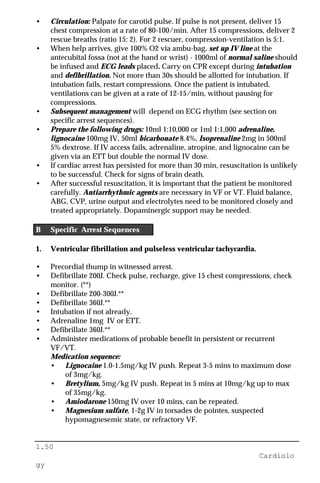
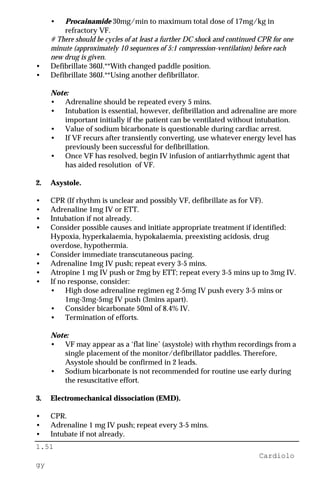
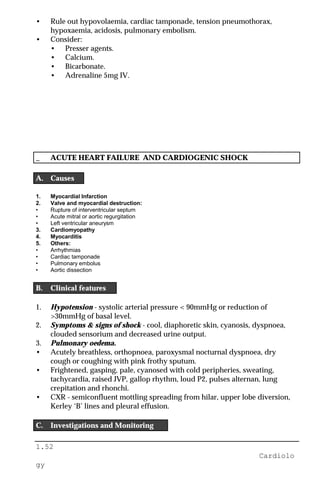
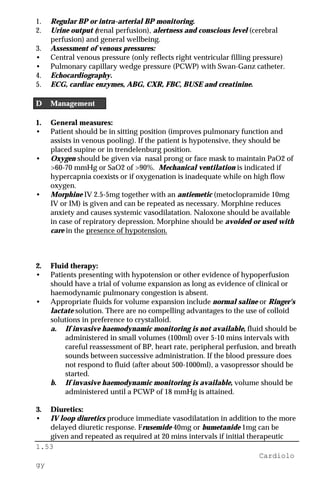
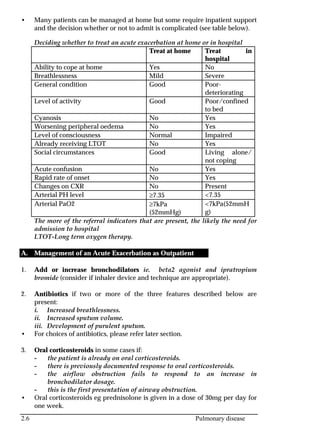
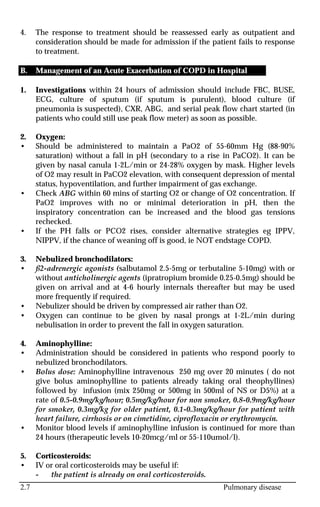
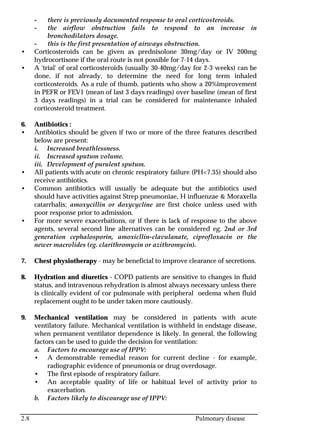
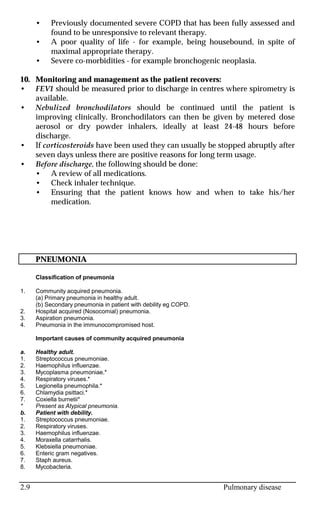
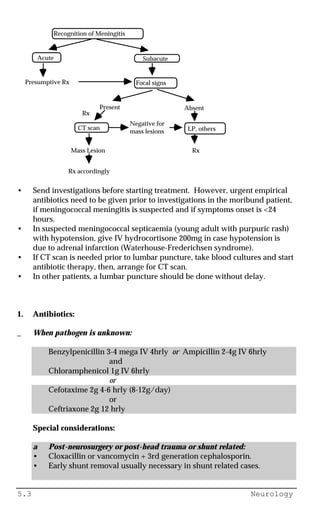
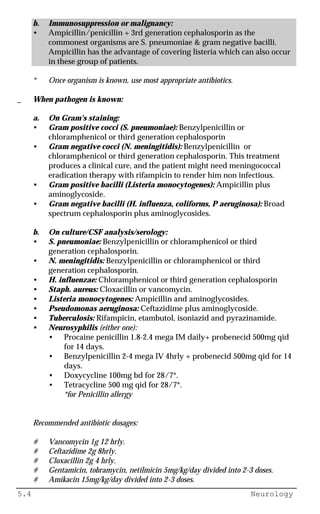
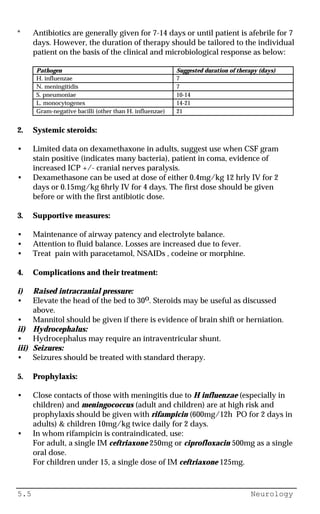
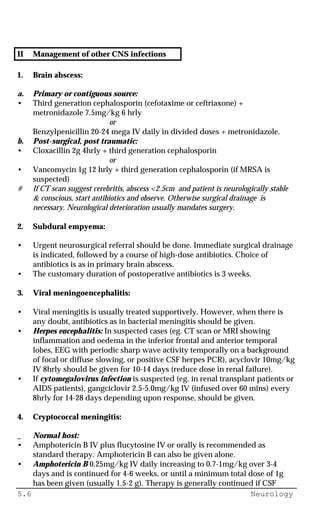
Handbook of Medical EmergenciesHandbook of Medical EmergenciesHandbook of Medical EmergenciesHandbook of Medical Emergencies
Department of Medicine, Sarawak General HospitalDepartment of Medicine, Sarawak General HospitalDepartment of Medicine, Sarawak General HospitalDepartment of Medicine, Sarawak General Hospital
Dr Soo Hua Huat
MBBS (Malaya), MRCP (UK)
Clinical Specialist,
Department of Medicine,
Sarawak General Hospital,
Kuching, Sarawak.
Dr Chew Peng Hong,
AM, MBBS (Malaya), FCCP, FRCP
Senior Consultant & State Physician,
Head, Department of Medicine,
Sarawak General Hospital,
Kuching, Sarawak.
Dr Lau Lee Gong,
MBBS (Malaya), MRCP (UK)
Clinical Specialist,
Department of Medicine,
Sarawak General Hospital,
Kuching, Sarawak.
This Publications is sponsored by Servier
Although every effort has been made to ensure that information and drug
doses in this booklet are correct and accurate, the responsibility rests
ultimately with the prescribing doctor. The authors cannot be held
responsible for errors or any undesirable consequences arising from the use
of the information contained herein.
LIST OF CONTRIBUTORS
Dr Soo Hua Huat,
Clinical Specialist,
Department of Medicine,
Sarawak General Hospital,
Kuching.
Dr Chew Peng Hong,
Senior Consultant & State Physician
Head, Department of Medicine,
Sarawak General Hospital,
Kuching.
Dr Lau Lee Gong,
Clinical Specialist,
Department of Medicine,
Sarawak General Hospital,
Kuching.
A. Prof (Dr) Chan Siew Pheng
Lecturer & Consultant
Endocrinologist,
University Hospital,
University of Malaya,
Kuala Lumpur.
Dr Ong Tiong Kiam
Cardiologist,
National Heart Centre,
Kuala Lumpur.
Dr Ronnie Chong,
Consultant Respiratory Physician,
National Respiratory Centre,
Kuala Lumpur.
Dr Clare Tan,
Nephrologist,
Nephrology Unit,
Kuala Lumpur Hospital,
Kuala Lumpur.
Dr Visalachy Purushothaman,
Consultant Haematologist,
Haematology Unit,
Kuala Lumpur Hospital,
Kuala Lumpur.
Prof (Dr) Tan Chong Tin,
Lecturer & Consultant Neurologist,
University Hospital ,
University of Malaya,
Kuala Lumpur.
Dr Goh Khean Jin
Lecturer & Consultant Neurologist,
University Hospital ,
University of Malaya,
Kuala Lumpur.
Dr Chew Nee Kong,
Lecturer,
Division of Neurology,
University Hospital,
University of Malaya,
Kuala Lumpur.
Dr Tan Kay Sin,
Lecturer,
Division of Neurology,
University Hospital,
University of Malaya,
Kuala Lumpur.
Mr Ching Hin San
Consultant Neurosurgeon,
Normal Medical Specialist Centre,
Kuching.
FORWARD
I wish to congratulate the authors for the splendid effort in compiling this
Handbook of Medical Emergencies. The topics covered in this handbook are
Very comprehensive. This handbook will be an invaluable reference book for
Doctors working in emergency unit and wards of hospitals and in health clinics
And polyclinics. With the availability of this handbook, it is hoped that the
Quality of patient care in hospitals, health clinics and polyclinics will be
Further enhanced.
Thank you.
Dr. Yao Sik Chi,
State Director of Health,
Sarawak
19th October, 1999
PREFACE
The idea of writing a little handbook on guidelines on the treatment of medical
emergencies came while I was working as a medical officer in a small district
hospital where I was expected to be an 'all rounder'. The spectrum of cases
encountered in the district hospital (or in any hospital for that matter) is rather
diverse and it would be such an invaluable help to have a reliable and yet
simple handbook to refer to.
I started collecting useful management guidelines and information during my
tenure at the district hospital, and began to compile these into a little handbook.
Over the years, I have revised it 3 times (the last time being before this
publication together with my colleagues) and have given several copies to junior
doctors to use to assess the usefulness and relevance of the information therein.
The feedback from them was rather encouraging. I then decided to make this
handbook into a management guide for the Department of Medicine, Sarawak
General Hospital as well as all other hospitals in Sarawak (with the blessing
from the head of the Department of Medicine, Sarawak General Hospital and
the state director of health of Sarawak). Dr Chew Peng Hong ( head of the
Department of Medicine) has helped me tremendously to restructure and edit
this handbook. I would like to sincerely thank him for this.
This handbook is essentially a management guide for the use of junior staff like
the house officers and medical officers during busy medical calls. Trainees in
the field of internal medicine may also find this handbook useful. This
handbook aims to provide users with more practical information rather than
theoretical knowledge. As such, little attention is paid to the clinical features or
the pathological basis of diseases. The stress here is on management, for
example, the approach to a clinical condition, the drugs to give for treatment,
the type of monitoring accorded, subsequent approach should tne initial
treatment fail, etc. It includes not only the common emergency medical
conditions but also many not-so-common conditions that can be potentially
life-threatening.
This handbook was done by extensive research reading of numerous textbooks,
reference books, subspecialty books, journals and review articles as I progressed
through my brief medical career from a medical officer to a medical registrar
and later, a general physician. Information was also obtained and verified from
colleagues, some of whom were eminent figures in certain subspecialties.
Opinions as well as criticisms were also gathered from the junior staff to make
sure that, as end-users, they could make use of this handbook to the fullest.
It is our sincere and fervent wish as the authors, that our efforts have not
resulted in just another handbook of medical emergencies to be displayed on the
shelf in the medical library, but a book that is informative, handy and above all,
helpful, in the management of various medical emergencies in the hospital. We
hope that all house officers as well as medical officers would find this book an
asset during the course of their duties.
Dr Soo Hua Huat
9.9.99
ACKNOWLEDGEMENTS
The editors would like to thank Dr Lim Kok Ban, Dr Yeoh Peng Hui, Dr Brian
Chiou, Dr Kong Kok Ooi, Dr Ng Heng Joo, Dr Frederick de Rozario, Dr Tee
Chik Kiong, Dr Yeoh Lee Ying, Dr Chan Wei Ling, Dr Florence Tan, Dr Teh
Cheng Lay, Dr Lorita Ngu, Dr Louis Ling, and Dr Chong from the Sarawak
General Hospital, Kuching for their valuable opinions, and help rendered, to
make the publication of this book a success.
We would also like to thank representatives from Servier Malaysia, particularly
Mr Sim Chi Tie, Ms Geraldine Chai and Ms Carol Sim, for helping and
sponsoring the printing of this handbook.
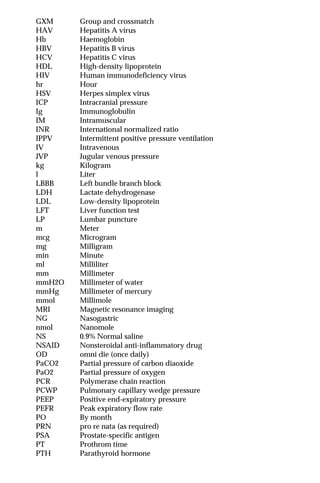
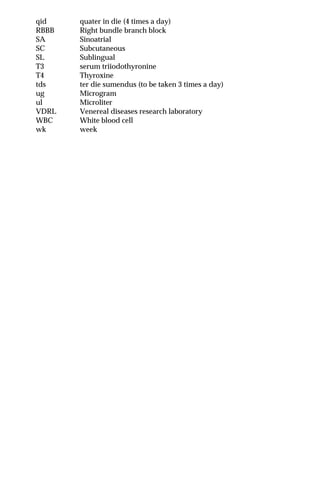
ABBREVIATIONS
ABG Arterial blood gas
ACE Angiotensin converting enzyme
ADH Antidiuretic hormone
AFB Acid-fast bacillus
AIDS Acquired immunodeficiency syndrome
ALT Alanine transaminase
ANA Antinuclear antibody
ANCA Anti-neutrophil cytoplasmic antibody
aPTT Partial thromboplastin time
AST Aspartate transaminase
AV atrioventricular
bd bis die (twice a day)
BP Blood pressure
BUSE Blood urea and electrolytes
BW Body weight
CEA Carcinoembryonic antigen
cm Centimeter
CMV Cytomegalovirus
COPD Chronic obstructive pulmonary disease
CPAP Continuous positive airways pressure
CPK/CK Creatininephosphokinase
CPR Cardio-pulmonary resuscitation
Creat Creatinine
CSF Cerebrospinal fluid
CT Computed tomography
CVP Central venous pressure
CXR Chest x-ray
D5% Dextrose 5% solution
DIVC Disseminated intravascular coagulation
DKA Diabetes ketoacidosis
dl Deciliter
DS Dextrose saline
DVT Deep vein thrombosis
EBV Epstein-Barr virus
ECG Electrocardiogram
ECHO Echocardiography
EEG Electroencephalogram
EMG Electromyography
ESR Erythrocyte sedimentation rate
FBC Full blood counts
FEV1 Forced expiratory volume in 1 second
FIO2 Inspired fraction of oxygen
FVC Forced vital capacity
g Gram
G6PD Glucose 6-phosphate dehydrogenase
GXM Group and crossmatch
HAV Hepatitis A virus
Hb Haemoglobin
HBV Hepatitis B virus
HCV Hepatitis C virus
HDL High-density lipoprotein
HIV Human immunodeficiency virus
hr Hour
HSV Herpes simplex virus
ICP Intracranial pressure
Ig Immunoglobulin
IM Intramuscular
INR International normalized ratio
IPPV Intermittent positive pressure ventilation
IV Intravenous
JVP Jugular venous pressure
kg Kilogram
l Liter
LBBB Left bundle branch block
LDH Lactate dehydrogenase
LDL Low-density lipoprotein
LFT Liver function test
LP Lumbar puncture
m Meter
mcg Microgram
mg Milligram
min Minute
ml Milliliter
mm Millimeter
mmH2O Millimeter of water
mmHg Millimeter of mercury
mmol Millimole
MRI Magnetic resonance imaging
NG Nasogastric
nmol Nanomole
NS 0.9% Normal saline
NSAID Nonsteroidal anti-inflammatory drug
OD omni die (once daily)
PaCO2 Partial pressure of carbon diaoxide
PaO2 Partial pressure of oxygen
PCR Polymerase chain reaction
PCWP Pulmonary capillary wedge pressure
PEEP Positive end-expiratory pressure
PEFR Peak expiratory flow rate
PO By month
PRN pro re nata (as required)
PSA Prostate-specific antigen
PT Prothrom time
PTH Parathyroid hormone
qid quater in die (4 times a day)
RBBB Right bundle branch block
SA Sinoatrial
SC Subcutaneous
SL Sublingual
T3 serum triiodothyronine
T4 Thyroxine
tds ter die sumendus (to be taken 3 times a day)
ug Microgram
ul Microliter
VDRL Venereal diseases research laboratory
WBC White blood cell
wk week
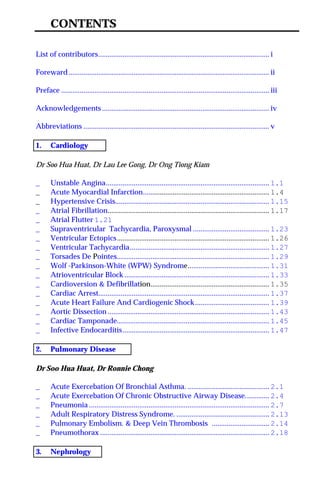
CONTENTS
List of contributors............................................................................................ i
Foreward............................................................................................................ ii
Preface ................................................................................................................ iii
Acknowledgements .......................................................................................... iv
Abbreviations .................................................................................................... v
1. Cardiology
Dr Soo Hua Huat, Dr Lau Lee Gong, Dr Ong Tiong Kiam
_ Unstable Angina........................................................................................ 1.1
_ Acute Myocardial Infarction.................................................................... 1.4
_ Hypertensive Crisis................................................................................... 1.15
_ Atrial Fibrillation....................................................................................... 1.17
_ Atrial Flutter 1.21
_ Supraventricular Tachycardia, Paroxysmal ......................................... 1.23
_ Ventricular Ectopics.................................................................................. 1.26
_ Ventricular Tachycardia........................................................................... 1.27
_ Torsades De Pointes.................................................................................. 1.29
_ Wolf -Parkinson-White (WPW) Syndrome............................................ 1.31
_ Atrioventricular Block .............................................................................. 1.33
_ Cardioversion & Defibrillation................................................................ 1.35
_ Cardiac Arrest............................................................................................ 1.37
_ Acute Heart Failure And Cardiogenic Shock........................................ 1.39
_ Aortic Dissection ....................................................................................... 1.43
_ Cardiac Tamponade.................................................................................. 1.45
_ Infective Endocarditis............................................................................... 1.47
2. Pulmonary Disease
Dr Soo Hua Huat, Dr Ronnie Chong
_ Acute Exercebation Of Bronchial Asthma. ............................................ 2.1
_ Acute Exercebation Of Chronic Obstructive Airway Disease............. 2.4
_ Pneumonia ................................................................................................. 2.7
_ Adult Respiratory Distress Syndrome. .................................................. 2.13
_ Pulmonary Embolism. & Deep Vein Thrombosis ............................... 2.14
_ Pneumothorax ........................................................................................... 2.18
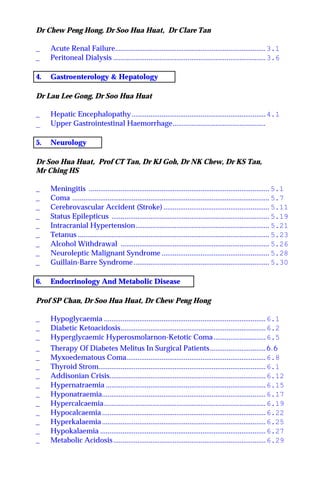
3. Nephrology
Dr Chew Peng Hong, Dr Soo Hua Huat, Dr Clare Tan
_ Acute Renal Failure.................................................................................3.1
_ Peritoneal Dialysis ..................................................................................3.6
4. Gastroenterology & Hepatology
Dr Lau Lee Gong, Dr Soo Hua Huat
_ Hepatic Encephalopathy ........................................................................4.1
_ Upper Gastrointestinal Haemorrhage..................................................
5. Neurology
Dr Soo Hua Huat, Prof CT Tan, Dr KJ Goh, Dr NK Chew, Dr KS Tan,
Mr Ching HS
_ Meningitis ................................................................................................. 5.1
_ Coma .......................................................................................................... 5.7
_ Cerebrovascular Accident (Stroke) ......................................................... 5.11
_ Status Epilepticus ..................................................................................... 5.19
_ Intracranial Hypertension........................................................................ 5.21
_ Tetanus ....................................................................................................... 5.23
_ Alcohol Withdrawal ................................................................................ 5.26
_ Neuroleptic Malignant Syndrome .......................................................... 5.28
_ Guillain-Barre Syndrome......................................................................... 5.30
6. Endocrinology And Metabolic Disease
Prof SP Chan, Dr Soo Hua Huat, Dr Chew Peng Hong
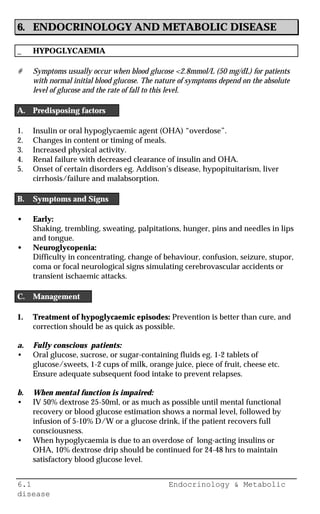
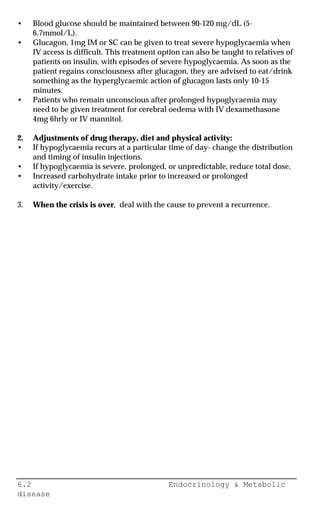
_ Hypoglycaemia .......................................................................................6.1
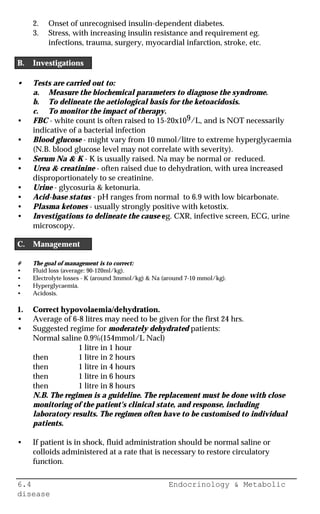
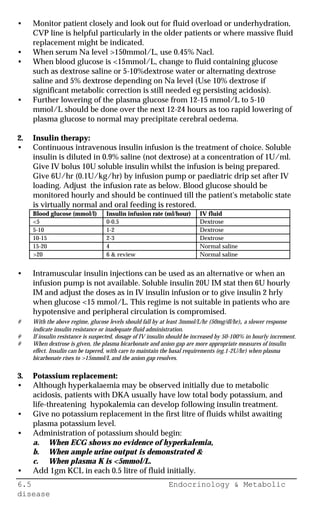
_ Diabetic Ketoacidosis..............................................................................6.2
_ Hyperglycaemic Hyperosmolarnon-Ketotic Coma............................6.5
_ Therapy Of Diabetes Melitus In Surgical Patients..............................6.6
_ Myxoedematous Coma...........................................................................6.8
_ Thyroid Strom..........................................................................................6.1
_ Addisonian Crisis....................................................................................6.12
_ Hypernatraemia ......................................................................................6.15
_ Hyponatraemia........................................................................................6.17
_ Hypercalcaemia.......................................................................................6.19
_ Hypocalcaemia ........................................................................................6.22
_ Hyperkalaemia ........................................................................................6.25
_ Hypokalaemia .........................................................................................6.27
_ Metabolic Acidosis..................................................................................6.29
7. Haematology
Dr Soo Hua Huat, Dr Lau Lee Gong
_ Immune Thrombocytopaenic Purpura.................................................7.1
_ Haemophilia ...........................................................................................7.4
_ Anticoagulationtherapy .........................................................................7.7
_ Transfusion Medicine.............................................................................7.11
_ Disseminated Intravascular Coagulation.............................................7.16
8. Poisoning
Dr Soo Hua Huat
_ General Principles..................................................................................... 8.1
_ Digoxin ....................................................................................................... 8.3
_ Paraquat...................................................................................................... 8.4
_ Organophosphates.................................................................................... 8.5
_ Paracetamol................................................................................................ 8.7
_ Salicylates................................................................................................... 8.8
_ Ethanol And Other Alcohols ................................................................... 8.10
_ Opioids ....................................................................................................... 8.12
_ Acids And Alkali....................................................................................... 8.13
_ Benzodiazepines........................................................................................ 8.15
_ Barbiturates 8.16
_ Tricyclic Antidepressants & Related Drugs........................................... 8.17
_ Phenothiazines .......................................................................................... 8.18
_ Theophylline8.19
9. Miscellaneous
Dr Soo Hua Huat, Dr Chew Peng Hong
_ Snake Bite................................................................................................... 9.1
_ Electrical Injuries....................................................................................... 9.5
_ Near Drowning ......................................................................................... 9.7
_ Anaphylaxis 9.8
_ Sepsis And Septic Shock........................................................................... 9.10
_ Malaria........................................................................................................ 9.13
10 Reference Intervals
_ Normal Values.........................................................................................10.1
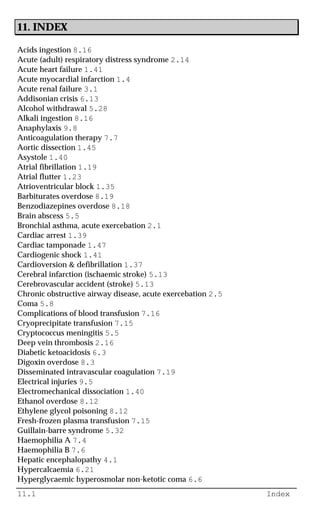
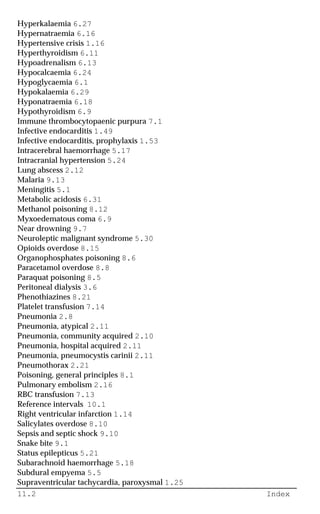
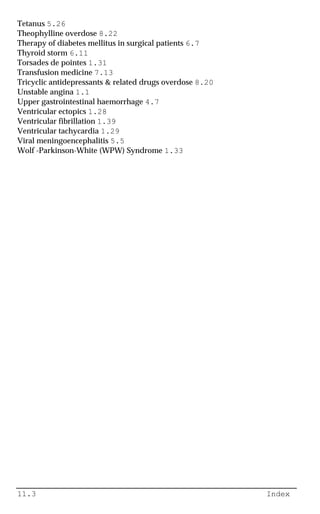
11. Index
1.1
Cardiolo
gy
1. CARDIOLOGY
_ UNSTABLE ANGINA
โ€ข The development of unstable symptoms carries a 10-20% risk of
progression to acute MI.
โ€ข When ECG evidence of transient myocardial ishcaemia (ST-segment
changes and /or T-wave inversions during episodes of chest pain) is
present, it is almost always associated with critical stenoses in one or more
major epicardial coronary arteries.
A. Definition
โ€ข The following groups of patient may be said to have unstable angina
pectoris:
1. Patients with new onset (<2months) angina that is severe and/or
frequent (>3episodes/day);
2. Patients with accelerating angina, ie. those with chronic stable angina
who develop angina that is distinctly more frequent, severe,
prolonged, or precipitated by less exertion than previously;
3. Those with angina at rest.
B. Management
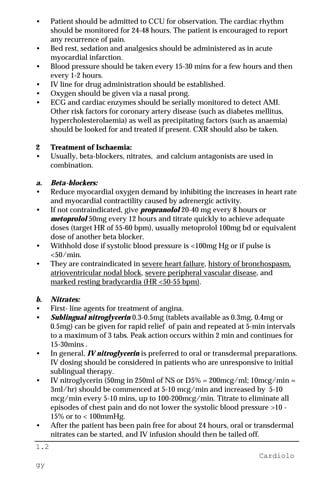
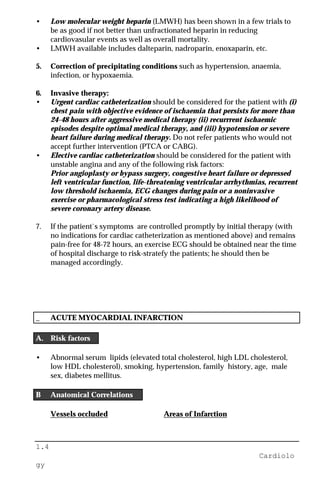
# Algorithm for the management of unstable angina
Beta-blocker contraindicated?
Diltiazem + IV nitrate +
Aspirin + Heparin
Beta-blocker at adequate
dose + IV nitrate + aspirin
+ heparin +/- calcium
antagonist
Control in 24 hours
Consider coronary
angiography
Exercise Stress
ECG
No Yes
Medical therapy
Yes No
Risk factors +
+
-
1. General measures:
1.2
Cardiolo
gy
โ€ข Patient should be admitted to CCU for observation. The cardiac rhythm
should be monitored for 24-48 hours. The patient is encouraged to report
any recurrence of pain.
โ€ข Bed rest, sedation and analgesics should be administered as in acute
myocardial infarction.
โ€ข Blood pressure should be taken every 15-30 mins for a few hours and then
every 1-2 hours.
โ€ข IV line for drug administration should be established.
โ€ข Oxygen should be given via a nasal prong.
โ€ข ECG and cardiac enzymes should be serially monitored to detect AMI.
Other risk factors for coronary artery disease (such as diabetes mellitus,
hypercholesterolaemia) as well as precipitating factors (such as anaemia)
should be looked for and treated if present. CXR should also be taken.
2 Treatment of Ischaemia:
โ€ข Usually, beta-blockers, nitrates, and calcium antagonists are used in
combination.
a. Beta-blockers:
โ€ข Reduce myocardial oxygen demand by inhibiting the increases in heart rate
and myocardial contractility caused by adrenergic activity.
โ€ข If not contraindicated, give propranolol 20-40 mg every 8 hours or
metoprolol 50mg every 12 hours and titrate quickly to achieve adequate
doses (target HR of 55-60 bpm), usually metoprolol 100mg bd or equivalent
dose of another beta blocker.
โ€ข Withhold dose if systolic blood pressure is <100mg Hg or if pulse is
<50/min.
โ€ข They are contraindicated in severe heart failure, history of bronchospasm,
atrioventricular nodal block, severe peripheral vascular disease, and
marked resting bradycardia (HR <50-55 bpm).
b. Nitrates:
โ€ข First- line agents for treatment of angina.
โ€ข Sublingual nitroglycerin 0.3-0.5mg (tablets available as 0.3mg, 0.4mg or
0.5mg) can be given for rapid relief of pain and repeated at 5-min intervals
to a maximum of 3 tabs. Peak action occurs within 2 min and continues for
15-30mins .
โ€ข In general, IV nitroglycerin is preferred to oral or transdermal preparations.
IV dosing should be considered in patients who are unresponsive to initial
sublingual therapy.
โ€ข IV nitroglycerin (50mg in 250ml of NS or D5% = 200mcg/ml; 10mcg/min =
3ml/hr) should be commenced at 5-10 mcg/min and increased by 5-10
mcg/min every 5-10 mins, up to 100-200mcg/min. Titrate to eliminate all
episodes of chest pain and do not lower the systolic blood pressure >10 -
15% or to < 100mmHg.
โ€ข After the patient has been pain free for about 24 hours, oral or transdermal
nitrates can be started, and IV infusion should then be tailed off.
1.3
Cardiolo
gy
Transdermal nitrates dosing can also be given to patients who respond well
to initial oral therapy.
โ€ข Preparation Dose
Isosorbide dinitrate 5-40mg tds
2% nitroglycerin ointment 0.5 - 2.0 in. 4-6hrly
Sustained-release GTN patches 5-15mg OD
Isosorbide mononitrates 20-120 mg daily in divided doses
c. Calcium channel blockers:
โ€ข These agents are not recommended as first or second line but as third line
agents. They are added if the blood pressure allows this addition to be
safely made. If used, nondihydrophyridines group eg. diltiazem or
verapamil is preferred.
โ€ข Calcium channel blockers do not decrease mortality in patients with
unstable angina.
โ€ข They cause a variable degree of coronary and peripheral artery
vasodilation and have negative inotropic effects. They decrease cardiac
afterload hence, preserve or increase cardiac output despite the negative
inotropic effects.
โ€ข Short-acting dihydrophyridine calcium antagonists eg. nifedipine should be
avoided as they tend to cause reflex tachycardia unless they can be used in
combination with beta-adrenergic blockers.
โ€ข Verapamil or diltiazem should not be given if sinus node disease,
bradycardia, AV block, heart failure, or left ventricular dysfunction is
present. Verapamil is contraindicated in acute infarction.
โ€ข Doses of selected calcium channel antagonists:
Verapamil 40-120 mg tds
Diltiazem 30-90 mg tds
Nifedipine R 20-40mg bd
Amlodipine 2.5-10 mg od
Felodipine 5-10 mg od to bd
3. Antiplatelet agents.
โ€ข Aspirin 300mg chewed and swallowed for a rapid effect and then 150mg
daily. Aspirin (given concomitantly with anticoagulants) has been proven
effective in clinical trials to prevent fatal and nonfatal infarction in patients
with unstable angina.
โ€ข Ticlopidine 250mg bd may be useful in patients with aspirin
hypersensitivity or intolerance.
4. Anticoagulants:
โ€ข Intravenous unfractionated heparin appears to decrease the incidence of MI
in patients with unstable angina. It should be given as a bolus dose of 5000
U followed by an infusion of 1000 U per hour. The infusion dose is adjusted
by regular monitoring of aPTT, keeping it between 1.5 to 2.5X control. This
should be maintained for 2-5 days.
1.4
Cardiolo
gy
โ€ข Low molecular weight heparin (LMWH) has been shown in a few trials to
be as good if not better than unfractionated heparin in reducing
cardiovasular events as well as overall mortality.
โ€ข LMWH available includes dalteparin, nadroparin, enoxaparin, etc.
5. Correction of precipitating conditions such as hypertension, anaemia,
infection, or hypoxaemia.
6. Invasive therapy:
โ€ข Urgent cardiac catheterization should be considered for the patient with (i)
chest pain with objective evidence of ischaemia that persists for more than
24-48 hours after aggressive medical therapy (ii) recurrrent ischaemic
episodes despite optimal medical therapy, and (iii) hypotension or severe
heart failure during medical therapy. Do not refer patients who would not
accept further intervention (PTCA or CABG).
โ€ข Elective cardiac catheterization should be considered for the patient with
unstable angina and any of the following risk factors:
Prior angioplasty or bypass surgery, congestive heart failure or depressed
left ventricular function, life-threatening ventricular arrhythmias, recurrent
low threshold ischaemia, ECG changes during pain or a noninvasive
exercise or pharmacological stress test indicating a high likelihood of
severe coronary artery disease.
7. If the patient`s symptoms are controlled promptly by initial therapy (with
no indications for cardiac catheterization as mentioned above) and remains
pain-free for 48-72 hours, an exercise ECG should be obtained near the time
of hospital discharge to risk-stratefy the patients; he should then be
managed accordingly.
_ ACUTE MYOCARDIAL INFARCTION
A. Risk factors
โ€ข Abnormal serum lipids (elevated total cholesterol, high LDL cholesterol,
low HDL cholesterol), smoking, hypertension, family history, age, male
sex, diabetes mellitus.
B Anatomical Correlations
Vessels occluded Areas of Infarction
1.5
Cardiolo
gy
Anterior descending artery Anterior wall of the left ventricle (LV),
anterior part of the septum (affect
intraventricular conduction)
Circumflex artery Lateral or inferior walls of the LV &
posterior wall of LV
Right coronary artery Posterior and inferior surface of the LV,
posterior part of septum, right ventricle
(RV). A-V node in 90% & SA node in
60% of cases (thus inferior and posterior
infaction may be associated with A-V
conduction disturbances)
C. Clinical Features
โ€ข Pain - characteristically retrosternal, > 20 minutes, radiation to the arms,
neck or jaw. Severe and crushing in nature, not relieved by rest or GTN.
May be epigastric, radiating to the back.
โ€ข Symptoms frequently associated with sweating, nausea, vomiting,
dyspnoea, weakness, apprehension, restlessness and anxiety.
โ€ข Rarely painless, masquarading as acute left ventricular failure, syncope,
CVA or unexplained shock
โ€ข 25% are asymptomatic and detected on routine ECG.
โ€ข Non-specific physical signs - pallor, sweating, irregular pulse, hypotension,
and 4th heart sound may be present.
D. Investigations
1. Electrocardiogram (ECG):
โ€ข ECG provides valuable information on the size, extent, age of the MI and
some anatomical correlations of vessels occluded.
a. Q wave infarction:
ECG changes Onset Duration
ST elevation within minutes days or weeks
or hours
T inversion immediate or hours several months
Q wave hours or days remain indefinitely
(Q wave - _1mm wide[0.04s] and/or _2mm deep [0.2mV] or >25% of the
amplitude of the R wave)
b. Non-Q wave infarction:
โ€ข Changes are prolonged ST depression and T inversion.
1.6
Cardiolo
gy
โ€ข Non-Q wave infarction generally results from incomplete occlusion or
spontaneous lysis of the thrombus and it is associated with a higher
incidence of reinfarction and recurrent ischaemia.
โ€ข Localization of infarction area:
Infarct site Leads showing main changes
Anterior
Small V3-V4
Extensive V2-V5
Anteroseptal V1-V3
Anterolateral V4-V6, I, AVL
Lateral I, II, AVL
Inferior II, III, AVF
Posterior V1, V2 (reciprocal)
Subendocardial (non-Q) Any lead
2. Cardiac enzymes:
โ€ข Necrotic cardiac tissue releases cellular enzymes:
Enzyme Earliest Peak, h Norma-Non-cardiac
Rise, h lize, sources of
days Enzyme
CK-MB 3-6 12-24 1-2
CK 6-8 24-30 3-4 Intramuscular injections,
defibrillation, convulsions,
vigorous exertion, cerebral
infarction, etc
AST 8-12 36-48 3-5 Alcoholism, hepatitis,
biliary obstruction,
cardiac arrest
LDH 12-24 48-96 7-10 Haemolytic anaemia,
pulmonary infarction,
neoplastic disease.
HBD 12 72 10-14
CK - creatine kinase
AST - aspartate aminotransferase
LDH - lactic dehydrogenase
HBD - hydroxybutyrate dehydrogenase (a measure of LDH1 and LDH2
concentration can be obtained by measuring serum HBD activity)
โ€ข Enzymes are usually estimated for the first 3 days following a suspected
myocardial infarction.
โ€ข Troponin T:
* A cardiac specific protein (a cardiac muscle specific protein that binds the
troponin complex to the tropomysin strain and neighbouring tropomysin
molecules).
1.7
Cardiolo
gy
* It is not detectable in healthy individuals.
* Troponin T appaers in the circulation as early as 2.5 hours after onset of
chest pain (cf. 3 hours for CK-MB) and remains elevated for more than 7
days post-infarction.
* Can be measured using a rapid kit.
3. Other diagnostic techniques:
a. Radionuclide studies:
โ€ข Pyrophosphate scan โ€“ useful when the ECG is unhelpful due to
preexisting abnormalities (eg. LBBB) or when patient presents late and
cardiac enzymes are no longer elevated or are unreliable (limitations:
test is only optimal 2-7 days after AMI, insensitive for small infarction).
However, this test is only available in specialised centres.
b. Echocardiography โ€“ images the cardiac structures, pericardium and
aorta, allowing identification of regional wall motion abnormalities,
valvular abnormalities as well as global, left and right ventricular
function.
c. Coronary angiography is performed where interventional treatment is
indicated. In the peri-infarction period, thrombus is known to appear
and vanish, with reperfusion spontaneously.
4. General investigations:
โ€ข FBC, BUSE, blood sugar, cholesterol (within 24 hrs or after 3 mons of MI),
portable CXR, se creat.
E. Management of Acute MI
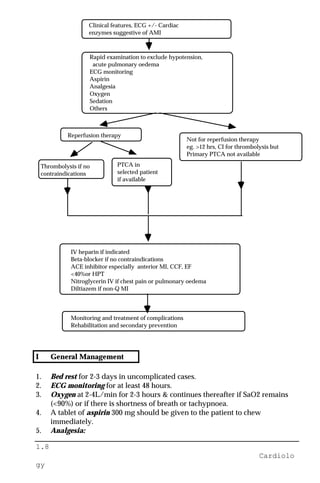
# Algorithm for the treatment of AMI:
1.8
Cardiolo
gy
Clinical features, ECG +/- Cardiac
enzymes suggestive of AMI
Rapid examination to exclude hypotension,
acute pulmonary oedema
ECG monitoring
Aspirin
Analgesia
Oxygen
Sedation
Others
Reperfusion therapy
Not for reperfusion therapy
eg. >12 hrs, CI for thrombolysis but
Primary PTCA not available
Thrombolysis if no
contraindications
PTCA in
selected patient
if available
IV heparin if indicated
Beta-blocker if no contraindications
ACE inhibitor especially anterior MI, CCF, EF
<40%or HPT
Nitroglycerin IV if chest pain or pulmonary oedema
Diltiazem if non-Q MI
Monitoring and treatment of complications
Rehabilitation and secondary prevention
I General Management
1. Bed rest for 2-3 days in uncomplicated cases.
2. ECG monitoring for at least 48 hours.
3. Oxygen at 2-4L/min for 2-3 hours & continues thereafter if SaO2 remains
(<90%) or if there is shortness of breath or tachypnoea.
4. A tablet of aspirin 300 mg should be given to the patient to chew
immediately.
5. Analgesia:
1.9
Cardiolo
gy
โ€ข Sublingual nitroglycerin (0.3-0.5mg) - should be given to patient in the
absence of hypotension repeated every 5 minutes till 3-4 doses have been
given.
โ€ข Morphine 5-10mg IV slow bolus with antiemetic.
โ€ข Patients who have recurrence of symptoms after given SL GTN and
morphine should be started on IV GTN.
5. Regular leg exercises and low dose heparin (eg. subcutaneous 5,000 units
bd) to prevent deep vein thrombosis.
6. Sedation with small oral doses of diazepam or lorazepam.
7. Diet and bowel care - for the first day after MI, diet should be liquid or soft,
stool softeners or mild laxatives are routinely given.
8. Potassium levels should be maintained at 4-5 mmol/l.
II Specific management to reduce infart size and to improve mortality
1. Thrombolytic therapy:
โ€ข Administration of fibrinolytic agents can achieve early reperfusion in 50-
70% of patients (compared with a spontaneous reperfusion rate of < 30%)
and has been shown to reduce the extent of ventricular damage, and
mortality rates associated with myocardial infarction.
_ All patients fulfilling the following criteria without contraindication
should be given thrombolytic therapy.
a. Clinical:
โ€ข Chest pain or chest-pain-equivalent syndrome consistent with acute
myocardial infarction _ 12 hours from symptom onset with:
b. ECG (either one):
โ€ข _ 1 mm ST elevation in _ 2 contiguous limb leads.
โ€ข _ 2 mm ST elevation in _ 2 contiguous precordial leads.
โ€ข New left bundle branch block.
โ€ข True posterior MI (Tall R wave in V1 with ST depression; exclude other
causes of tall R wave [eg. RBBB, RVH, WPW syndrome]; right
ventricular infarction[ST elevation V4R]).
# Cardiogenic shock: emergency catheterization and revascularization if
possible; consider thrombolysis if catheterization not immediately available.
# Age is not a limiting factor - can be given up to 80 yo or older if benefit-to-risk
ratio seems favourable.
# Should be avoided in patient with ST segment depression without
concomitant ST segment elevation or with normal ECG.
1.10
Cardiolo
gy
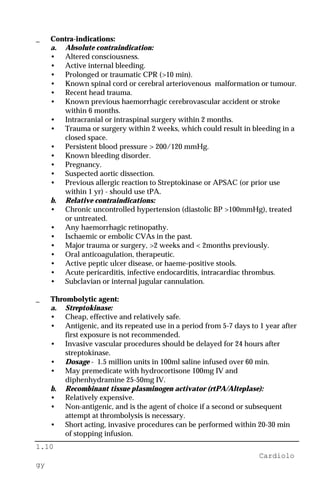
_ Contra-indications:
a. Absolute contraindication:
โ€ข Altered consciousness.
โ€ข Active internal bleeding.
โ€ข Prolonged or traumatic CPR (>10 min).
โ€ข Known spinal cord or cerebral arteriovenous malformation or tumour.
โ€ข Recent head trauma.
โ€ข Known previous haemorrhagic cerebrovascular accident or stroke
within 6 months.
โ€ข Intracranial or intraspinal surgery within 2 months.
โ€ข Trauma or surgery within 2 weeks, which could result in bleeding in a
closed space.
โ€ข Persistent blood pressure > 200/120 mmHg.
โ€ข Known bleeding disorder.
โ€ข Pregnancy.
โ€ข Suspected aortic dissection.
โ€ข Previous allergic reaction to Streptokinase or APSAC (or prior use
within 1 yr) - should use tPA.
b. Relative contraindications:
โ€ข Chronic uncontrolled hypertension (diastolic BP >100mmHg), treated
or untreated.
โ€ข Any haemorrhagic retinopathy.
โ€ข Ischaemic or embolic CVAs in the past.
โ€ข Major trauma or surgery, >2 weeks and < 2months previously.
โ€ข Oral anticoagulation, therapeutic.
โ€ข Active peptic ulcer disease, or haeme-positive stools.
โ€ข Acute pericarditis, infective endocarditis, intracardiac thrombus.
โ€ข Subclavian or internal jugular cannulation.
_ Thrombolytic agent:
a. Streptokinase:
โ€ข Cheap, effective and relatively safe.
โ€ข Antigenic, and its repeated use in a period from 5-7 days to 1 year after
first exposure is not recommended.
โ€ข Invasive vascular procedures should be delayed for 24 hours after
streptokinase.
โ€ข Dosage - 1.5 million units in 100ml saline infused over 60 min.
โ€ข May premedicate with hydrocortisone 100mg IV and
diphenhydramine 25-50mg IV.
b. Recombinant tissue plasminogen activator (rtPA/Alteplase):
โ€ข Relatively expensive.
โ€ข Non-antigenic, and is the agent of choice if a second or subsequent
attempt at thrombolysis is necessary.
โ€ข Short acting, invasive procedures can be performed within 20-30 min
of stopping infusion.
1.11
Cardiolo
gy
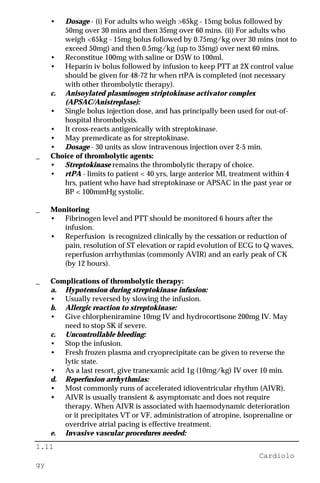
โ€ข Dosage - (i) For adults who weigh >65kg - 15mg bolus followed by
50mg over 30 mins and then 35mg over 60 mins. (ii) For adults who
weigh <65kg - 15mg bolus followed by 0.75mg/kg over 30 mins (not to
exceed 50mg) and then 0.5mg/kg (up to 35mg) over next 60 mins.
โ€ข Reconstitue 100mg with saline or D5W to 100ml.
โ€ข Heparin iv bolus followed by infusion to keep PTT at 2X control value
should be given for 48-72 hr when rtPA is completed (not necessary
with other thrombolytic therapy).
c. Anisoylated plasminogen striptokinase activator complex
(APSAC/Anistreplase):
โ€ข Single bolus injection dose, and has principally been used for out-of-
hospital thrombolysis.
โ€ข It cross-reacts antigenically with streptokinase.
โ€ข May premedicate as for streptokinase.
โ€ข Dosage - 30 units as slow intravenous injection over 2-5 min.
_ Choice of thrombolytic agents:
โ€ข Streptokinase remains the thrombolytic therapy of choice.
โ€ข rtPA - limits to patient < 40 yrs, large anterior MI, treatment within 4
hrs, patient who have had streptokinase or APSAC in the past year or
BP < 100mmHg systolic.
_ Monitoring
โ€ข Fibrinogen level and PTT should be monitored 6 hours after the
infusion.
โ€ข Reperfusion is recognized clinically by the cessation or reduction of
pain, resolution of ST elevation or rapid evolution of ECG to Q waves,
reperfusion arrhythmias (commonly AVIR) and an early peak of CK
(by 12 hours).
_ Complications of thrombolytic therapy:
a. Hypotension during streptokinase infusion:
โ€ข Usually reversed by slowing the infusion.
b. Allergic reaction to streptokinase:
โ€ข Give chlorpheniramine 10mg IV and hydrocortisone 200mg IV. May
need to stop SK if severe.
c. Uncontrollable bleeding:
โ€ข Stop the infusion.
โ€ข Fresh frozen plasma and cryoprecipitate can be given to reverse the
lytic state.
โ€ข As a last resort, give tranexamic acid 1g (10mg/kg) IV over 10 min.
d. Reperfusion arrhythmias:
โ€ข Most commonly runs of accelerated idioventricular rhythm (AIVR).
โ€ข AIVR is usually transient & asymptomatc and does not require
therapy. When AIVR is associated with haemodynamic deterioration
or it precipitates VT or VF, administration of atropine, isoprenaline or
overdrive atrial pacing is effective treatment.
e. Invasive vascular procedures needed:
1.12
Cardiolo
gy
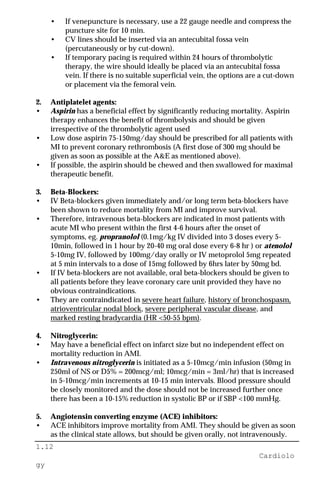
โ€ข If venepuncture is necessary, use a 22 gauge needle and compress the
puncture site for 10 min.
โ€ข CV lines should be inserted via an antecubital fossa vein
(percutaneously or by cut-down).
โ€ข If temporary pacing is required within 24 hours of thrombolytic
therapy, the wire should ideally be placed via an antecubital fossa
vein. If there is no suitable superficial vein, the options are a cut-down
or placement via the femoral vein.
2. Antiplatelet agents:
โ€ข Aspirin has a beneficial effect by significantly reducing mortality. Aspirin
therapy enhances the benefit of thrombolysis and should be given
irrespective of the thrombolytic agent used
โ€ข Low dose aspirin 75-150mg/day should be prescribed for all patients with
MI to prevent coronary rethrombosis (A first dose of 300 mg should be
given as soon as possible at the A&E as mentioned above).
โ€ข If possible, the aspirin should be chewed and then swallowed for maximal
therapeutic benefit.
3. Beta-Blockers:
โ€ข IV Beta-blockers given immediately and/or long term beta-blockers have
been shown to reduce mortality from MI and improve survival.
โ€ข Therefore, intravenous beta-blockers are indicated in most patients with
acute MI who present within the first 4-6 hours after the onset of
symptoms, eg. propranolol (0.1mg/kg IV divided into 3 doses every 5-
10min, followed in 1 hour by 20-40 mg oral dose every 6-8 hr ) or atenolol
5-10mg IV, followed by 100mg/day orally or IV metoprolol 5mg repeated
at 5 min intervals to a dose of 15mg followed by 6hrs later by 50mg bd.
โ€ข If IV beta-blockers are not available, oral beta-blockers should be given to
all patients before they leave coronary care unit provided they have no
obvious contraindications.
โ€ข They are contraindicated in severe heart failure, history of bronchospasm,
atrioventricular nodal block, severe peripheral vascular disease, and
marked resting bradycardia (HR <50-55 bpm).
4. Nitroglycerin:
โ€ข May have a beneficial effect on infarct size but no independent effect on
mortality reduction in AMI.
โ€ข Intravenous nitroglycerin is initiated as a 5-10mcg/min infusion (50mg in
250ml of NS or D5% = 200mcg/ml; 10mcg/min = 3ml/hr) that is increased
in 5-10mcg/min increments at 10-15 min intervals. Blood pressure should
be closely monitored and the dose should not be increased further once
there has been a 10-15% reduction in systolic BP or if SBP <100 mmHg.
5. Angiotensin converting enzyme (ACE) inhibitors:
โ€ข ACE inhibitors improve mortality from AMI. They should be given as soon
as the clinical state allows, but should be given orally, not intravenously.
1.13
Cardiolo
gy
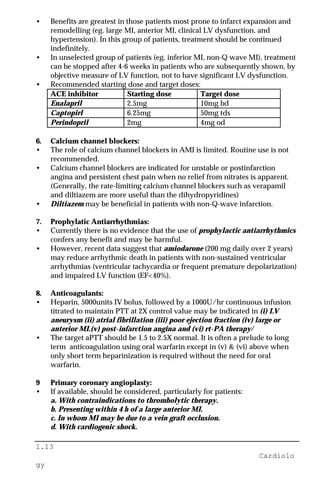
โ€ข Benefits are greatest in those patients most prone to infarct expansion and
remodelling (eg. large MI, anterior MI, clinical LV dysfunction, and
hypertension). In this group of patients, treatment should be continued
indefinitely.
โ€ข In unselected group of patients (eg. inferior MI, non-Q wave MI), treatment
can be stopped after 4-6 weeks in patients who are subsequently shown, by
objective measure of LV function, not to have significant LV dysfunction.
โ€ข Recommended starting dose and target doses:
ACE inhibitor Starting dose Target dose
Enalapril 2.5mg 10mg bd
Captopirl 6.25mg 50mg tds
Perindopril 2mg 4mg od
6. Calcium channel blockers:
โ€ข The role of calcium channel blockers in AMI is limited. Routine use is not
recommended.
โ€ข Calcium channel blockers are indicated for unstable or postinfarction
angina and persistent chest pain when no relief from nitrates is apparent.
(Generally, the rate-limiting calcium channel blockers such as verapamil
and diltiazem are more useful than the dihydropyridines)
โ€ข Diltiazem may be beneficial in patients with non-Q-wave infarction.
7. Prophylatic Antiarrhythmias:
โ€ข Currently there is no evidence that the use of prophylactic antiarrhythmics
confers any benefit and may be harmful.
โ€ข However, recent data suggest that amiodarone (200 mg daily over 2 years)
may reduce arrhythmic death in patients with non-sustained ventricular
arrhythmias (ventricular tachycardia or frequent premature depolarization)
and impaired LV function (EF<40%).
8. Anticoagulants:
โ€ข Heparin, 5000units IV bolus, followed by a 1000U/hr continuous infusion
titrated to maintain PTT at 2X control value may be indicated in (i) LV
aneurysm (ii) atrial fibrillation (iii) poor ejection fraction (iv) large or
anterior MI.(v) post-infarction angina and (vi) rt-PA therapy/
โ€ข The target aPTT should be 1.5 to 2.5X normal. It is often a prelude to long
term anticoagulation using oral warfarin except in (v) & (vi) above when
only short term heparinization is required without the need for oral
warfarin.
9 Primary coronary angioplasty:
โ€ข If available, should be considered, particularly for patients:
a. With contraindications to thrombolytic therapy.
b. Presenting within 4 h of a large anterior MI.
c. In whom MI may be due to a vein graft occlusion.
d. With cardiogenic shock.
1.14
Cardiolo
gy
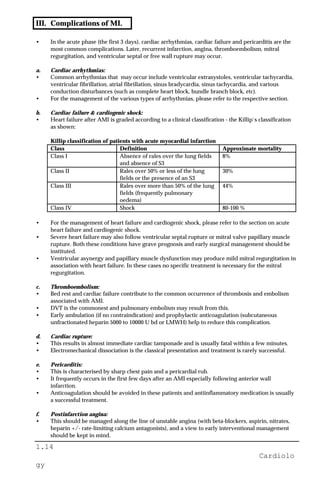
III. Complications of MI.
โ€ข In the acute phase (the first 3 days), cardiac arrhythmias, cardiac failure and pericarditis are the
most common complications. Later, recurrent infarction, angina, thromboembolism, mitral
regurgitation, and ventricular septal or free wall rupture may occur.
a. Cardiac arrhythmias:
โ€ข Common arrhythmias that may occur include ventricular extrasystoles, ventricular tachycardia,
ventricular fibrillation, atrial fibrillation, sinus bradycardia, sinus tachycardia, and various
conduction disturbances (such as complete heart block, bundle branch block, etc).
โ€ข For the management of the various types of arrhythmias, please refer to the respective section.
b. Cardiac failure & cardiogenic shock:
โ€ข Heart failure after AMI is graded according to a clinical classification - the Killip`s classification
as shown:
Killip classification of patients with acute myocardial infarction
Class Definition Approximate mortality
Class I Absence of rales over the lung fields
and absence of S3
8%
Class II Rales over 50% or less of the lung
fields or the presence of an S3
30%
Class III Rales over more than 50% of the lung
fields (frequently pulmonary
oedema)
44%
Class IV Shock 80-100 %
โ€ข For the management of heart failure and cardiogenic shock, please refer to the section on acute
heart failure and cardiogenic shock.
โ€ข Severe heart failure may also follow ventricular septal rupture or mitral valve papillary muscle
rupture. Both these conditions have grave prognosis and early surgical management should be
instituted.
โ€ข Ventricular asynergy and papillary muscle dysfunction may produce mild mitral regurgitation in
association with heart failure. In these cases no specific treatment is necessary for the mitral
regurgitation.
c. Thromboembolism:
โ€ข Bed rest and cardiac failure contribute to the common occurrence of thrombosis and embolism
associated with AMI.
โ€ข DVT is the commonest and pulmonary embolism may result from this.
โ€ข Early ambulation (if no contraindication) and prophylactic anticoagulation (subcutaneous
unfractionated heparin 5000 to 10000 U bd or LMWH) help to reduce this complication.
d. Cardiac rupture:
โ€ข This results in almost immediate cardiac tamponade and is usually fatal within a few minutes.
โ€ข Electromechanical dissociation is the classical presentation and treatment is rarely successful.
e. Pericarditis:
โ€ข This is characterised by sharp chest pain and a pericardial rub.
โ€ข It frequently occurs in the first few days after an AMI especially following anterior wall
infarction.
โ€ข Anticoagulation should be avoided in these patients and antiinflammatory medication is usually
a successful treatment.
f. Postinfarction angina:
โ€ข This should be managed along the line of unstable angina (with beta-blockers, aspirin, nitrates,
heparin +/- rate-limiting calcium antagonists), and a view to early interventional management
should be kept in mind.
1.15
Cardiolo
gy
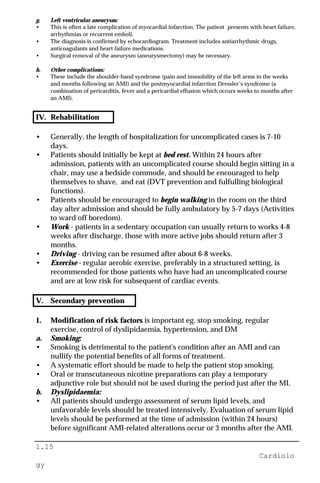
g. Left ventricular aneurysm:
โ€ข This is often a late complication of myocardial infarction. The patient presents with heart failure,
arrhythmias or recurrent emboli.
โ€ข The diagnosis is confirmed by echocardiogram. Treatment includes antiarrhythmic drugs,
anticoagulants and heart failure medications.
โ€ข Surgical removal of the aneurysm (aneurysmectomy) may be necessary.
h. Other complications:
โ€ข These include the shoulder-hand syndrome (pain and immobility of the left arms in the weeks
and months following an AMI) and the postmyocardial infarction Dressler`s syndrome (a
combination of pericarditis, fever and a pericardial effusion which occurs weeks to months after
an AMI).
IV. Rehabilitation
โ€ข Generally, the length of hospitalization for uncomplicated cases is 7-10
days.
โ€ข Patients should initially be kept at bed rest. Within 24 hours after
admission, patients with an uncomplicated course should begin sitting in a
chair, may use a bedside commode, and should be encouraged to help
themselves to shave, and eat (DVT prevention and fulfulling biological
functions).
โ€ข Patients should be encouraged to begin walking in the room on the third
day after admission and should be fully ambulatory by 5-7 days (Activities
to ward off boredom).
โ€ข Work - patients in a sedentary occupation can usually return to works 4-8
weeks after discharge, those with more active jobs should return after 3
months.
โ€ข Driving - driving can be resumed after about 6-8 weeks.
โ€ข Exercise - regular aerobic exercise, preferably in a structured setting, is
recommended for those patients who have had an uncomplicated course
and are at low risk for subsequent of cardiac events.
V. Secondary prevention
1. Modification of risk factors is important eg. stop smoking, regular
exercise, control of dyslipidaemia, hypertension, and DM
a. Smoking:
โ€ข Smoking is detrimental to the patient's condition after an AMI and can
nullify the potential benefits of all forms of treatment.
โ€ข A systematic effort should be made to help the patient stop smoking.
โ€ข Oral or transcutaneous nicotine preparations can play a temporary
adjunctive role but should not be used during the period just after the MI.
b. Dyslipidaemia:
โ€ข All patients should undergo assessment of serum lipid levels, and
unfavorable levels should be treated intensively. Evaluation of serum lipid
levels should be performed at the time of admission (within 24 hours)
before significant AMI-related alterations occur or 3 months after the AMI.
1.16
Cardiolo
gy
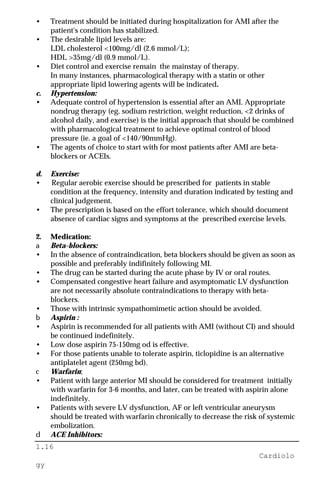
โ€ข Treatment should be initiated during hospitalization for AMI after the
patient's condition has stabilized.
โ€ข The desirable lipid levels are:
LDL cholesterol <100mg/dl (2.6 mmol/L);
HDL >35mg/dl (0.9 mmol/L).
โ€ข Diet control and exercise remain the mainstay of therapy.
In many instances, pharmacological therapy with a statin or other
appropriate lipid lowering agents will be indicated.
c. Hypertension:
โ€ข Adequate control of hypertension is essential after an AMI. Appropriate
nondrug therapy (eg. sodium restriction, weight reduction, <2 drinks of
alcohol daily, and exercise) is the initial approach that should be combined
with pharmacological treatment to achieve optimal control of blood
pressure (ie. a goal of <140/90mmHg).
โ€ข The agents of choice to start with for most patients after AMI are beta-
blockers or ACEIs.
d. Exercise:
โ€ข Regular aerobic exercise should be prescribed for patients in stable
condition at the frequency, intensity and duration indicated by testing and
clinical judgement.
โ€ข The prescription is based on the effort tolerance, which should document
absence of cardiac signs and symptoms at the prescribed exercise levels.
2. Medication:
a Beta-blockers:
โ€ข In the absence of contraindication, beta blockers should be given as soon as
possible and preferably indifinitely following MI.
โ€ข The drug can be started during the acute phase by IV or oral routes.
โ€ข Compensated congestive heart failure and asymptomatic LV dysfunction
are not necessarily absolute contraindications to therapy with beta-
blockers.
โ€ข Those with intrinsic sympathomimetic action should be avoided.
b Aspirin :
โ€ข Aspirin is recommended for all patients with AMI (without CI) and should
be continued indefinitely.
โ€ข Low dose aspirin 75-150mg od is effective.
โ€ข For those patients unable to tolerate aspirin, ticlopidine is an alternative
antiplatelet agent (250mg bd).
c Warfarin;
โ€ข Patient with large anterior MI should be considered for treatment initially
with warfarin for 3-6 months, and later, can be treated with aspirin alone
indefinitely.
โ€ข Patients with severe LV dysfunction, AF or left ventricular aneurysm
should be treated with warfarin chronically to decrease the risk of systemic
embolization.
d ACE Inhibitors:
1.17
Cardiolo
gy
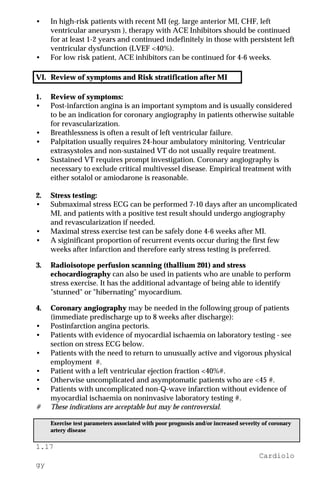
โ€ข In high-risk patients with recent MI (eg. large anterior MI, CHF, left
ventricular aneurysm ), therapy with ACE Inhibitors should be continued
for at least 1-2 years and continued indefinitely in those with persistent left
ventricular dysfunction (LVEF <40%).
โ€ข For low risk patient, ACE inhibitors can be continued for 4-6 weeks.
VI. Review of symptoms and Risk stratification after MI
1. Review of symptoms:
โ€ข Post-infarction angina is an important symptom and is usually considered
to be an indication for coronary angiography in patients otherwise suitable
for revascularization.
โ€ข Breathlessness is often a result of left ventricular failure.
โ€ข Palpitation usually requires 24-hour ambulatory minitoring. Ventricular
extrasystoles and non-sustained VT do not usually require treatment.
โ€ข Sustained VT requires prompt investigation. Coronary angiography is
necessary to exclude critical multivessel disease. Empirical treatment with
either sotalol or amiodarone is reasonable.
2. Stress testing:
โ€ข Submaximal stress ECG can be performed 7-10 days after an uncomplicated
MI, and patients with a positive test result should undergo angiography
and revascularization if needed.
โ€ข Maximal stress exercise test can be safely done 4-6 weeks after MI.
โ€ข A siginificant proportion of recurrent events occur during the first few
weeks after infarction and therefore early stress testing is preferred.
3. Radioisotope perfusion scanning (thallium 201) and stress
echocardiography can also be used in patients who are unable to perform
stress exercise. It has the additional advantage of being able to identify
"stunned" or "hibernating" myocardium.
4. Coronary angiography may be needed in the following group of patients
(immediate predischarge up to 8 weeks after discharge):
โ€ข Postinfarction angina pectoris.
โ€ข Patients with evidence of myocardial ischaemia on laboratory testing - see
section on stress ECG below.
โ€ข Patients with the need to return to unusually active and vigorous physical
employment #.
โ€ข Patient with a left ventricular ejection fraction <40%#.
โ€ข Otherwise uncomplicated and asymptomatic patients who are <45 #.
โ€ข Patients with uncomplicated non-Q-wave infarction without evidence of
myocardial ischaemia on noninvasive laboratory testing #.
# These indications are acceptable but may be controversial.
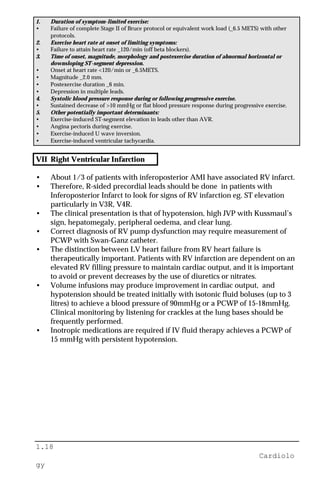
Exercise test parameters associated with poor prognosis and/or increased severity of coronary
artery disease
1.18
Cardiolo
gy
1. Duration of symptom-limited exercise:
โ€ข Failure of complete Stage II of Bruce protocol or equivalent work load (_6.5 METS) with other
protocols.
2. Exercise heart rate at onset of limiting symptoms:
โ€ข Failure to attain heart rate _120/min (off beta blockers).
3. Time of onset, magnitude, morphology and postexercise duration of abnormal horizontal or
downsloping ST-segment depression.
โ€ข Onset at heart rate <120/min or _6.5METS.
โ€ข Magnitude _2.0 mm.
โ€ข Postexercise duration _6 min.
โ€ข Depression in multiple leads.
4. Systolic blood pressure response during or following progressive exercise.
โ€ข Sustained decrease of >10 mmHg or flat blood pressure response during progressive exercise.
5. Other potentially important determinants:
โ€ข Exercise-induced ST-segment elevation in leads other than AVR.
โ€ข Angina pectoris during exercise.
โ€ข Exercise-induced U wave inversion.
โ€ข Exercise-induced ventricular tachycardia.
VII Right Ventricular Infarction
โ€ข About 1/3 of patients with inferoposterior AMI have associated RV infarct.
โ€ข Therefore, R-sided precordial leads should be done in patients with
Inferoposterior Infarct to look for signs of RV infarction eg. ST elevation
particularly in V3R, V4R.
โ€ข The clinical presentation is that of hypotension, high JVP with Kussmaulโ€™s
sign, hepatomegaly, peripheral oedema, and clear lung.
โ€ข Correct diagnosis of RV pump dysfunction may require measurement of
PCWP with Swan-Ganz catheter.
โ€ข The distinction between LV heart failure from RV heart failure is
therapeutically important. Patients with RV infarction are dependent on an
elevated RV filling pressure to maintain cardiac output, and it is important
to avoid or prevent decreases by the use of diuretics or nitrates.
โ€ข Volume infusions may produce improvement in cardiac output, and
hypotension should be treated initially with isotonic fluid boluses (up to 3
litres) to achieve a blood pressure of 90mmHg or a PCWP of 15-18mmHg.
Clinical monitoring by listening for crackles at the lung bases should be
frequently performed.
โ€ข Inotropic medications are required if IV fluid therapy achieves a PCWP of
15 mmHg with persistent hypotension.
1.19
Cardiolo
gy
_ HYPERTENSIVE CRISIS
1.20
Cardiolo
gy
โ€ข Hypertensive crisis is defined as a substantial acute increase in blood
pressure, usually with diastolic blood pressure over 120 mmHg with or
without end-organ damage.
โ€ข It can be further classified into:
(i) Hypertensive emergencies - increased blood pressure with evidence of
end-organ damage or dysfunction.
โ€ข End-organ manifestations include [1] retinal eg. papilloedema [2]
cardiac eg. pulmonary oedema, myocardial ischaemia such as unstable
angina or infarction [3] neurological eg. severe headache, mental
status changes, seizure, coma and [4] renal eg. acute renal failure.
(ii) Hypertensive urgencies - elevation of blood pressure to a level which
may be potentially harmful, but without signs, symptoms or other
evidence of end-organ dysfunction.
A. Management
1. General principles:
โ€ข In hypertensive emergencies, blood pressure control should be
accomplished within a few hours to reduce the risk of permanent damage
or death (diastolic of 100-110 mmHg may be adequate for the first 24
hours). IV antihypertensive agents should be used.
โ€ข In hypertensive urgencies, blood pressure control can be accomplished
more slowly with oral antihypertensive agents within 24-48 hrs to a
diastolic level of 100-110 mmHg initially. Excessive or rapid decreases in BP
should be avoided to minimize the risk of cerebral hypoperfusion or
coronary insufficiency.
โ€ข BUSE, creatinine, urinalysis, CXR and ECG should be performed urgently.
โ€ข Drugs of choice for management:
a. Coronary artery disease and heart failure: IV nitroprusside or
nitroglycerin
b. Pheochromocytoma: IV phentolamine or alpha-blocker eg. prazosin
c. Aortic dissection: IV beta-blockers or labetalol +/- nitroprusside
d. Pulmonary oedema: IV frusemide, IV nitroprusside, ACE inhibitors
e. Hypertension in pregnancy: Hydralazine, labetalol and magnesium
sulphate
f. Stroke: Beta-blockers, diuretics or ACE inhibitors.
โ€ข Sublingual nifedipine SHOULD BE AVOIDED.
โ€ข IV diazoxide should be discouraged.
2. Oral antihypertensive agents:
โ€ข Can be used in patients with hypertensive crisis when urgent but not
immediate reduction of BP is indicated. Combination therapy is necessary
for most cases when diastolic blood pressure is > 110 mmHg.
โ€ข Beta-blockers eg. atenolol 100mg with or without diuretics, or oral
captopril 12.5mg with or without diuretics may be all that is required. If
1.21
Cardiolo
gy
nifedipine is contemplated, it should be used with careful monitoring of
blood pressure to avoid precipitous drop.
3. Parenteral antihypertensive agents:
โ€ข Indicated in hypertensive emergencies or individuals with hypertensive
urgencies who are in need of emergency surgery.
a. Sodium nitroprusside:
โ€ข A direct-acting arterial and venous vasodilator, is the treatment of
choice for virtually all hypertensive crises.
โ€ข It reduces BP rapidly, is easily titratable, and its action is short-lived
when discontinued.
โ€ข Dosage - (mix 50mg in 250ml of D5%= 200mcg/ml; 10mcg/min = 3
ml/hr), start at 0.5mcg/kg/min and titrate until the desired blood
pressure has been achievedor maximal dose is reached, which ever
comes first. Average effective dose is 3mcg/kg/min (range from 0.5-
8mcg/kg/min). Stop if marked response not obtained with max. dose
in 10 minutes.
โ€ข Contraindications are severe coronary disease, advanced hepatic or
renal insufficiency.
โ€ข Therapy for more than 24 hours, in high doses, or in the presence of
renal and hepatic insufficiency may cause thiocyanate toxicity as
manifested by tinnitus, blurred vision, seizures, or delirium.
โ€ข Side effects include headache, dizziness, nausea, abdominal pain and
renal impairment
b. Nitroglycerin:
โ€ข Drug of choice for moderate hypertension complicating unstable
angina or myocardial infarction or when sodium nitroprusside is
contraindicated.
โ€ข Dosage - (50mg in 250ml of NS or D5% = 200mcg/ml; 10mcg/ml =
3ml/hr) start at 5-10mcg/min and titrate until the desired BP is
achieved or up to 200mcg/min.
c. Labetalol:
โ€ข Alpha-1 and beta blocker with beta-alpha ratio of 7:1.
โ€ข Can be given by slow boluses or continuous infusion.
โ€ข The usual precautions for beta blockers should be observed.
โ€ข (i) Bolus - IV 50 mg over 1-5 min and can be repeated every 5-10min
till maximum doses of 200-300mg or until desired BP is achieved.
Maximum response occur in 5-10 min and may last for up to 6 hours.
Oral dosing can then be started at eg. 200mg 12hourly (max
2400mg/day).
(ii) Infusion - Mix 200mg in 200ml of D5% and run at 1-2mg/min (1-
2ml/min). When goal blood pressure is achieved, the infusion should
be stopped and oral medication can be started.
1.22
Cardiolo
gy
โ€ข Excessive bradycardia can be countered with IV atropine 0.5-2mg in
divided doses of 0.5mg.
d. Hydralazine:
โ€ข A direct arteriolar dilator, with an onset of action within 10 min after
an IV dose and a duration of action of 3-8 hours.
โ€ข 5-20mg IV may be given, repeated if necessary at about 15-30min
intervals, to a maximum of 50mg. Alternately it can be given as
infusion (eg. 50mg of hydralazine in 500 ml of normal saline =
100mcg/ml; 50mcg/min = 30ml/hr) start with 50 mcg/min and titrate
to reduce the BP gradually (usually 50-150mcg/min).
โ€ข This drug is best avoided in the presence of coronary arterial disease
because of reflex tachycardia.
e. Esmolol:
โ€ข This is a relatively cardioselective beta blocker with a very short
duration of action, used intravenously for the short term treatment,
particularly in the perioperative period.
โ€ข Dilute 2.5g in 250ml of normal saline or 5% dextrose solution to a
concentration of 10 mg/ml.
โ€ข A loading dose of 500mcg/kg/min for 1 min should be given followed
by maintenance dose starting at a dose of 50mcg/kg/min and titrate
within a range of infusion of 50-200 mcg/kg/min.
โ€ข Usual precautions for beta blockers should be observed.
4. Subsequent therapy:
โ€ข Investigate for possible underlying causes.
โ€ข If parenteral agents are used initially, oral medications should be
administered often in combination shortly thereafter to facilitate weaning
from parenteral therapy (over 1-2 days).
1.23
Cardiolo
gy
_ ATRIAL FIBRILLATION
A. Causes
1. Common - Ischaemic heart disease, mitral valve disease (commoner in
stenosis), thyrotoxicosis, hypertension.
1.24
Cardiolo
gy
2. Less common - cardiomyopathy, pericarditis, sick sinus syndrome, atrial
myxoma, endocarditis, chronic lung disease, atrial septal defect, acute
alcohol intoxication, WPW syndrome, digoxin toxicity and lone AF.
B. Clinical Features
โ€ข May be either chronic or paroxysmal.
โ€ข Irregularly irregular pulse, S1 of variable intensity, pulse deficit (rate at
apex is greater than at radial artery).
โ€ข ECG: chaotic baseline with no P waves, irregularly irregular but normally
shaped QRS complex (unless concomitant BBB or preexcitation syndrome)
at a rate of 160-200/min. AF with regular ventricular response may suggest
digoxin toxicity.
โ€ข Complications of atrial fibrillation are hypotension, cardiac failure,
systemic embolism and troublesome palpitations.
C. Investigations
โ€ข BUSE, ECG, CXR, cardiac enzymes, thyroid function, calcium and Echo.
D. Treatment
_ Aims of therapy:
โ€ข Control of the ventricular rate using AV node blocking drugs (digitalis, beta
blockers, calcium channel blockers and occasionally amiodarone).
โ€ข Reversion to sinus rhythm using membrance stabilizing agents [(class 1a -
quinidine, procainamide, disopyramide), class 1c (propafenone, flecanide)
and class III (sotalol, amiodarone)] or cardioversion.
โ€ข Prophylatic therapy to prevent recurrence.
โ€ข Anticoagulation to prevent embolization.
1. Emergency synchronised cardioversion is required in patients with rapid
ventricular response (VR >200/min) and acute haemodynamic
deterioration (eg. patients with angina, hypotension, dyspnoea, or heart
failure).
โ€ข If initial cardioversion is unsuccessful, procainamide or amiodarone can be
given to facilitate further cardioversion attempts.
โ€ข Do not attempt to cardiovert patients with known chronic AF & a known
progressive cause (eg. MS), in which case, rapid rate control with drugs
should be achieved.
โ€ข Patients undergoing emergency cardioversion should receive anticoagulant
therapy for 2-3 weeks after conversion unless there is a contraindication
(anticoagulation may not be necessary if AF is <24-48 hr duration).
2. Haemodynamically stable acute AF and Chronic AF:
1.25
Cardiolo
gy
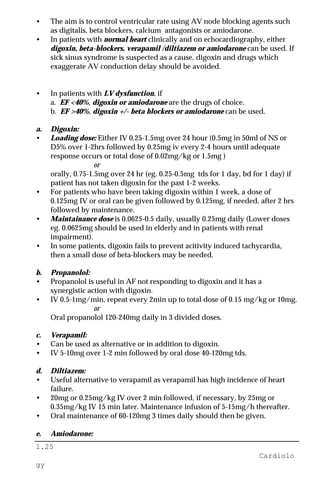
โ€ข The aim is to control ventricular rate using AV node blocking agents such
as digitalis, beta blockers, calcium antagonists or amiodarone.
โ€ข In patients with normal heart clinically and on echocardiography, either
digoxin, beta-blockers, verapamil /diltiazem or amiodarone can be used. If
sick sinus syndrome is suspected as a cause, digoxin and drugs which
exaggerate AV conduction delay should be avoided.
โ€ข In patients with LV dysfunction, if
a. EF <40%, digoxin or amiodarone are the drugs of choice.
b. EF >40%, digoxin +/- beta blockers or amiodarone can be used.
a. Digoxin:
โ€ข Loading dose: Either IV 0.25-1.5mg over 24 hour (0.5mg in 50ml of NS or
D5% over 1-2hrs followed by 0.25mg iv every 2-4 hours until adequate
response occurs or total dose of 0.02mg/kg or 1.5mg )
or
orally, 0.75-1.5mg over 24 hr (eg. 0.25-0.5mg tds for 1 day, bd for 1 day) if
patient has not taken digoxin for the past 1-2 weeks.
โ€ข For patients who have been taking digoxin within 1 week, a dose of
0.125mg IV or oral can be given followed by 0.125mg, if needed, after 2 hrs
followed by maintenance.
โ€ข Maintainance dose is 0.0625-0.5 daily, usually 0.25mg daily (Lower doses
eg. 0.0625mg should be used in elderly and in patients with renal
impairment).
โ€ข In some patients, digoxin fails to prevent acitivity induced tachycardia,
then a small dose of beta-blockers may be needed.
b. Propanolol:
โ€ข Propanolol is useful in AF not responding to digoxin and it has a
synergistic action with digoxin.
โ€ข IV 0.5-1mg/min, repeat every 2min up to total dose of 0.15 mg/kg or 10mg.
or
Oral propanolol 120-240mg daily in 3 divided doses.
c. Verapamil:
โ€ข Can be used as alternative or in addition to digoxin.
โ€ข IV 5-10mg over 1-2 min followed by oral dose 40-120mg tds.
d. Diltiazem:
โ€ข Useful alternative to verapamil as verapamil has high incidence of heart
failure.
โ€ข 20mg or 0.25mg/kg IV over 2 min followed, if necessary, by 25mg or
0.35mg/kg IV 15 min later. Maintenance infusion of 5-15mg/h thereafter.
โ€ข Oral maintenance of 60-120mg 3 times daily should then be given.
e. Amiodarone:
1.26
Cardiolo
gy
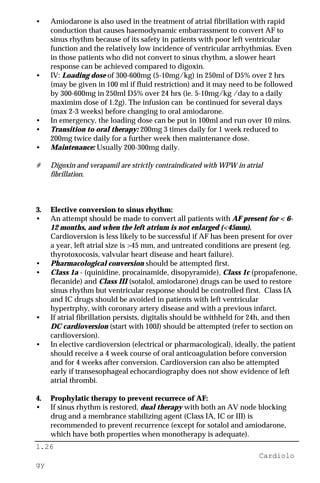
โ€ข Amiodarone is also used in the treatment of atrial fibrillation with rapid
conduction that causes haemodynamic embarrassment to convert AF to
sinus rhythm because of its safety in patients with poor left ventricular
function and the relatively low incidence of ventricular arrhythmias. Even
in those patients who did not convert to sinus rhythm, a slower heart
response can be achieved compared to digoxin.
โ€ข IV: Loading dose of 300-600mg (5-10mg/kg) in 250ml of D5% over 2 hrs
(may be given in 100 ml if fluid restriction) and it may need to be followed
by 300-600mg in 250ml D5% over 24 hrs (ie. 5-10mg/kg /day to a daily
maximim dose of 1.2g). The infusion can be continued for several days
(max 2-3 weeks) before changing to oral amiodarone.
โ€ข In emergency, the loading dose can be put in 100ml and run over 10 mins.
โ€ข Transition to oral therapy: 200mg 3 times daily for 1 week reduced to
200mg twice daily for a further week then maintenance dose.
โ€ข Maintenance: Usually 200-300mg daily.
# Digoxin and verapamil are strictly contraindicated with WPW in atrial
fibrillation.
3. Elective conversion to sinus rhythm:
โ€ข An attempt should be made to convert all patients with AF present for < 6-
12 months, and when the left atrium is not enlarged (<45mm).
Cardioversion is less likely to be successful if AF has been present for over
a year, left atrial size is >45 mm, and untreated conditions are present (eg.
thyrotoxocosis, valvular heart disease and heart failure).
โ€ข Pharmacological conversion should be attempted first.
โ€ข Class 1a - (quinidine, procainamide, disopyramide), Class 1c (propafenone,
flecanide) and Class III (sotalol, amiodarone) drugs can be used to restore
sinus rhythm but ventricular response should be controlled first. Class IA
and IC drugs should be avoided in patients with left ventricular
hypertrphy, with coronary artery disease and with a previous infarct.
โ€ข If atrial fibrillation persists, digitalis should be withheld for 24h, and then
DC cardioversion (start with 100J) should be attempted (refer to section on
cardioversion).
โ€ข In elective cardioversion (electrical or pharmacological), ideally, the patient
should receive a 4 week course of oral anticoagulation before conversion
and for 4 weeks after conversion. Cardioversion can also be attempted
early if transesophageal echocardiography does not show evidence of left
atrial thrombi.
4. Prophylatic therapy to prevent recurrece of AF:
โ€ข If sinus rhythm is restored, dual therapy with both an AV node blocking
drug and a membrance stabilizing agent (Class IA, IC or III) is
recommended to prevent recurrence (except for sotalol and amiodarone,
which have both properties when monotherapy is adequate).
1.27
Cardiolo
gy
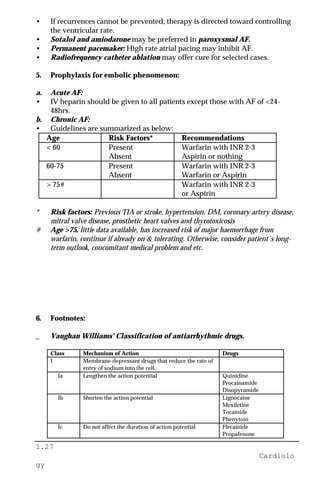
โ€ข If recurrences cannot be prevented, therapy is directed toward controlling
the ventricular rate.
โ€ข Sotalol and amiodarone may be preferred in paroxysmal AF.
โ€ข Permanent pacemaker: High rate atrial pacing may inhibit AF.
โ€ข Radiofrequency catheter ablation may offer cure for selected cases.
5. Prophylaxis for embolic phenomenon:
a. Acute AF:
โ€ข IV heparin should be given to all patients except those with AF of <24-
48hrs.
b. Chronic AF:
โ€ข Guidelines are summarized as below:
Age Risk Factors* Recommendations
< 60 Present
Absent
Warfarin with INR 2-3
Aspirin or nothing
60-75 Present
Absent
Warfarin with INR 2-3
Warfarin or Aspirin
> 75# Warfarin with INR 2-3
or Aspirin
* Risk factors: Previous TIA or stroke, hypertension, DM, coronary artery disease,
mitral valve disease, prosthetic heart valves and thyrotoxicosis
# Age >75, little data available, has increased risk of major haemorrhage from
warfarin, continue if already on & tolerating. Otherwise, consider patient's long-
term outlook, concomitant medical problem and etc.
6. Footnotes:
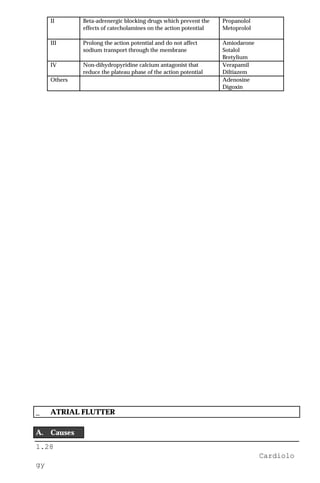
_ Vaughan Williams' Classification of antiarrhythmic drugs.
Class Mechanism of Action Drugs
I Membrane-depressant drugs that reduce the rate of
entry of sodium into the cell.
Ia Lengthen the action potential Quinidine
Procainamide
Disopyramide
Ib Shorten the action potential Lignocaine
Mexiletine
Tocainide
Phenytoin
Ic Do not affect the duration of action potential Flecainide
Propafenone
1.28
Cardiolo
gy
II Beta-adrenergic blocking drugs which prevent the
effects of catecholamines on the action potential
Propanolol
Metoprolol
III Prolong the action potential and do not affect
sodium transport through the membrane
Amiodarone
Sotalol
Bretylium
IV Non-dihydropyridine calcium antagonist that
reduce the plateau phase of the action potential
Verapamil
Diltiazem
Others Adenosine
Digoxin
_ ATRIAL FLUTTER
A. Causes
1.29
Cardiolo
gy
โ€ข Atrial flutter rarely occurs without heart disease eg. rheumatic and
ischaemic heart disease, cardiomyopathy, thyrtoxicosis, valvular disease,
septal defect and digoxin toxicity.
B. Clinical Features
โ€ข Atrial flutter is a rhythm that originates from a small area within the atria.
โ€ข ECG: P waves are replaced by flutter waves resulting in โ€˜saw-toothโ€™,or
โ€˜corrugatedโ€™ pattern. Flutter may sometimes be obscured by the T wave.
Carotid sinus massage will usually slow the ventricular rate and flutter
waves may then be more obvious. Ventricular rate is often regular but may
vary depending on the degree of A-V block present and is a fraction of
atrial rate 1:2, 1:3, etc. Rarely, 1:1 conduction occurs. Atrial rate is usually
between 250-350/min.
# When ventricular rate is 150/min, suspect atrial flutter with 2:1 block until
proven otherwise.
C. Managment
1. DC cardioversion in haemodynamically unstable patients, patients with
symptoms and signs of ischaemia, VR >200/min, known or suspected to
have WPW syndrome. Synchronized DC shock of 25-50J is usually
adequate.
2. Control of the ventricular rate using AV node blocking drugs (digitalis,
beta blockers,calcium antagonists or amiodarone):
โ€ข Digoxin often converts atrial flutter to AF and slows the ventricular
response.
โ€ข Beta-blockers (eg. IV propranolol or esmolol, oral propranolol or
metoprolol) slows the ventricular response rate by causing AV blockade.
โ€ข IV verapamil or diltiazem may reduce the ventricular response but
conversion to sinus rhythm rarely occurs.
โ€ข IV amiodarone has also been shown to slow the ventricular rate as
effectively as digoxin.
โ€ข Adenosine produces transient AV block and can be used to reveal flutter
waves if the diagnosis of the arrhythmias is in doubt but it generally will
not terminate the atrial flutter and can provoke atrial fibrillation.
# Verapamil and digoxin are contraindicated in patients with WPW syndrome
presenting with atrial flutter or AF.
3. Reversion to sinus rhythm using membrance stabilizing agents [(class 1a -
quinidine, procainamide, disopyramide), class 1c (propafenone, flecanide)
and class III (sotalol, amiodarone)] or DC cardioversion:
1.30
Cardiolo
gy
โ€ข Class I or III drugs should not be used unless the ventricular rate during
atrial flutter has been slowed with digitalis, calcium antagonist or beta
blockers.
โ€ข Class I and III drugs should be discontinued if flutter remains.
โ€ข Class IA and IC drugs should be avoided in patients with left ventricular
hypertrophy, with coronary artery disease and with a previous infarct.
โ€ข DC cardioversion is very effective for atrial flutter with as little as 25-50J of
energy.
4. Prophylatic therapy to prevent recurrence of flutter:
โ€ข Dual therapy with both an AV node blocking drug and a membrance
stabilizing agent is recommended except for sotalol and amiodarone, which
have both properties.
โ€ข If recurrences cannot be prevented, therapy is directed toward controlling
the ventricular rate when the flutter does recur, with digitalis alone or in
combination with beta blockers or calcium antagonists.
5. Anticoagulation:
โ€ข There is currently no clear evidence of increased risk of systemic embolism
in acute atrial flutter, and anticoagulation is not generally recommended.
โ€ข In chronic atrial flutter, anticoagulation is recommended since transient
runs of atrial fibrillation are common in these patients.
6. Catheter ablation of flutter circuit:
โ€ข This technique should be considered in patients refractory to drug therapy.
1.31
Cardiolo
gy
_ SUPRAVENTRICULAR TACHYCARDIA, PAROXYSMAL
โ€ข A condition in which the heart rate suddenly increases to 100-250
beats/min and 1:1 A-V conduction is maintained.
โ€ข SVT is most often due to reentry, generally within the AV node or
involving an accessory pathway, although sinus node reentry, intra-atrial
reentry, and SVT due to enhanced automaticity can also occur.
โ€ข SVT often occurs in patients with a healthy heart, but may occur in patients
with organic heart disease and with WPW syndrome.
โ€ข The arrhythmias is of sudden onset, and may be associated with sensation
of rapid palpitations in the chest or throat, dyspnoea, light headedness, or
chest pain. Cardiac failure may develop. Termination of the arrhythmia,
whether spontaneous or with treatment, is sudden.
A. Type and ECG diagnosis of SVT
Type Incidence ECG manifestations
1. AV node reentry 60% Retrograde P wave most
frequently buried in QRS or with
1.32
Cardiolo
gy
short RP (RP <50% RR interval),
Negative P wave in II, III, AVF.
2. SVT with acce- 25% Retrograde P wave with short
ssory pathway RP (RP<50% RR interval),
(i) Concealed* negative P wave lead I.
(ii) Manifest*
3. Intra-atrial re- 5% Positive P wave in II, III, AVF
entry (indicating antegrade atrial
activation), RP>50% RR interval.
4. Sinus node re- rare P wave morphology indentical
entry to sinus rhythm (RP>50% RR).
5. Automatic atrial 5% Positive or negative P wave in
tachycardia II, III, AVF depends on the
location (RP>50% RR interval).
* Manifest accessory pathway (AP) conducts anterogradely during sinus rhythm, and
characteristic delta waves and short (<0.12s) PR intervals are observed in the ECG, reflecting
ventricular preexcitation.
Concealed AP only conducts retrogradely, and ventricular preexcitation is not present during
sinus rhythm.
B. Management
I. Acute therapy
1. Immediate cardioversion (50J) is required in patients with acute
haemodynamic deterioration (eg. patients with angina, hypotension,
dyspnoea, or heart failure)
2. Vagal stimulation may terminate some SVT (AV node dependent
tachycardia) by increasing parasympathetic tone while inhibiting
sympathetic outflow.
โ€ข Carotid sinus massage: The patient should be supine with an IV line in
place and the ECG monitored. Before massage, the carotid vessels should
be auscultated for bruits, and carotid massage is rarely so essential that it
needs to be done even if bruits are heard. The right carotid sinus should be
massaged first, for no more than 10 seconds. If this is ineffective, the left
carotid should be massaged. The left and right carotids should never be
massaged simultaneously.
โ€ข Valsalva maneuver may also be helpful.
3. Drugs:
โ€ข In patients with normal heart, if no response is obtained from vagal
maneuvers, IV verapamil or adenosine is indicated. Verapamil can cause
hypotension and is contraindicated if systolic BP is <90mmHg. Adenosine
has the advantage of not causing hypotension.
โ€ข In patients with heart failure or left ventricular dysfunction, digoxin is the
drug of choice. Adenosine can also be used.
1.33
Cardiolo
gy
โ€ข In patients with AMI, IV beta-blockers especially short-acting is advisable if
there is no contraindication.
a. Adenosine:
โ€ข Causes inhibition of sinus node automaticity, depression of AV node
conduction, and prolongation of AV nodal refractoriness.
โ€ข Contraindicated in second or third degree AV block, sinus node
disease, known hypersensitivity to adenosine, asthma, COPD with
theophylline usage.
โ€ข Rapid IV bolus 6 mg. Onset of action is 15-30 secs and the duration of
action only 1-2 minutes. A second bolus injection of 12 mg is repeated
2-5 minutes after the first if the arrhythmia persists or recurs. Another
12mg dose may be given in 2-5 mins, if required.
b. Verapamil:
โ€ข 5 mg IV over 2-3 mins with monitoring of cardiac rhythm and BP (Use
2.5mg if LV function is believed to be slightly impaired). If arrhythmia
persisted, additional 2.5-5mg dose can be given 10 minutes after the
first dose.
โ€ข Pretreatment with calcium chloride or calcium gluconate (10ml of
a10%solution over 5-10 mins) before verapamil bolus may prevent
many of the hypotensive effects of verapamil without antagonizing the
negative dromotropic effects.
โ€ข If sinus arrest or AV block occurs, give calcium chloride or gluconate
and atropine (0.5-1mg IV repeated, to a total dose of 2mg, if required).
โ€ข Should be used with caution in the elderly and is contraindicated in
those with hypotension (<90mmHg) , high-degree AV block, heart
failure of all grades, LV dysfunction (particularly with cardiomegaly or
EF <40%), sick sinus syndrome, suspected digoxin toxicity, beta
blockade, concomitant use of disopyramide or amiodarone, wide QRS
tachycardia (unless identical complexes of intraventricular conduction
delay seen on previous ECG while in sinus rhythm), and atrial flutter
or fibrillation complicating WPW syndrome
c. Diltiazem:
โ€ข Useful alternative to verapamil as verapamil has high incidence of
heart failure.
โ€ข 20mg or 0.25mg/kg IV over 2 min followed, if necessary, by 25mg or
0.35mg/kg IV 15 min later. Maintenance infusion of 5-15mg/h
thereafter.
d. Propanolol:
โ€ข IV 0.5-1mg/min, repeat every 2min, until rhythm converts or up to
total dose of 0.15 mg/kg.
e. Digoxin:
1.34
Cardiolo
gy
โ€ข Digoxin 0.5mg IV with repeat doses of 0.25mg in 1-2hrs until a
response occurs or total dose of 0.02mg/kg or 1.5mg has been
achieved.
f. Quinidine, procainamide and flecanide may also be considered.
4. Elective cardioversion or rapid atrial pacing may be required if the
preceding techniques prove unsuccessful.
II. Prophylaxis against recurrence
โ€ข Decisions regarding prophylactic therapy should be based on the SVT
mechanism, frequency of episodes, underlying heart disease, and
symptoms.
โ€ข Prophylactic therapy is generally needed only in patients with bothersome
episodes (eg. occurring several times annually).
โ€ข This can be done by the use of drugs that act primarily on the antegrade
slow pathway (eg. digoxin, B-blockers, calcium channel antagonists) or on
the fast pathway (eg. quinidine-like agents, flecainide, propafenone, and
amiodarone). Generally, the former group is preferred because the risk-
benefit ratio is more favourable.
โ€ข During acute attacks outside the hospital, if vagal maneuvers fail, (if WPW
and structural heart disease are excluded) one tablet 80mg verapamil may
be taken. An additional 80mg tablet may be taken 1 hour later if the
arrhythmia persists. If this is not effective, the patient is advised to go to the
emergency room.
โ€ข Electrophysiologic study and Radiofrequency ablation offer a chance of
cure for SVT.
1.35
Cardiolo
gy
_ VENTRICULAR ECTOPIC (PVC)
โ€ข Occurs in normal subjects and patients with heart disease.They are due to
intraventricular reentry or disturbances in automaticity.
โ€ข They are exacerbated by electrolyte imbalance, hypoxia, acid-base
imbalance, endocrine disorders such as thyrotoxicosis, and a variety of
medications eg. digitalis, phenothiazines, tricyclic antidepressants, and
antiarrhythmias. Tobacco smoking and beverages such as tea, coffee and
alcohol can also induce or exacerbate PVCs.
โ€ข In patients without heart disease, PVCs have not been shown to be
associated with any increased incidence in mortality or morbidity.
โ€ข ECG changes: Wide and bizarre premature QRS(>0.12s). T wave is usually
large and opposite in direction to the major deflection of the QRS. QRS is
usually not preceded by a premature P wave.
โ€ข The following patterns of PVCs in the setting of AMI may precede
ventricular tachycardia or fibrillation, and require urgent treatment
particularly in the first 24 hours (the Lown`s classification).
(i) Multifocal (ii) Frequent, >5/min (iii) occur in runs of 2 or more
(iv) R-on-T.
A. Management
1. Indications for treatment of PVCs
1.36
Cardiolo
gy
โ€ข In the setting of AMI, most physicians would treat PVCs especially if the
risk of VT or VF is high, ie. >5 PVCs/min, multifocal PVCs, coupled PVCs,
runs of VT or R-on-T phenomenon.
โ€ข In patients with chronic ectopics, the following factors should be
considered in deciding whether a patient needs to be treated:
(i) the underlying heart disease (ii) the nature of the ectopic (iii) the
presence or absence of symptoms (iv) the potential side effects of oral
antiarrhythmic therapy.
โ€ข In the absence of cardiac disease, isolated asymptomatic PVCs, regardless
of configuration and frequency, need no treatment. The underlying cause
of the PVCs and the precipitating factors should be identified and treated.
2. Therapy:
a. Acute suppression of PVCs can be achieved with IV lignocaine,
procainamide, amiodarone, disopyramide, bretylium or beta-blockers.
โ€ข Please refer to treatment of VT for dosages.
b. Chronic suppression of PVCs may be achieved by using class I agents,
amiodarone or beta-blockers.
โ€ข Generally, a trial of beta-blockers (eg. metoprolol 50-100 mg bd or
propranolol 10-40 mg tds/qid) should be given; if symptoms persist
substitution with or addition of mexiletine (200 mg tds/qid) may be
advisable. Amiodarone (200 mg tds for 1week, then 200 mg for another
week followed by a maintenance of 200 mg daily) or sotalol (80 mg in 1-2
divided doses increased gradually at intervals of 2-3 days to usual dose of
160-320 mg daily in 2 divided doses) should be considered if symptoms
persist despite beta-blocker and mexiletine.
_ VENTRICULAR TACHYCARDIA
โ€ข A regular ventricular rhythm with 3 or more broad QRS complexes and at a
rate between 100-200 beats/min.
A. Causes
โ€ข Ischaemic heart disease, AMI, cardiomyopathy, prolonged QT syndrome,
mitral valve prolapse, drug toxicity eg. digoxin, and metabolic disorders. It
may occur in normal individuals.
1.37
Cardiolo
gy
B. Clinical features
1. Haemodynamic instabilities eg. hypotension, cardiogenic shock, and
pulmonary oedema. A small percentage of patients may be asymptomatic.
2. ECG characteristics:
(i) three or more wide QRS complexes (ii) rate greater than 100 (iii) rhythm
usually regular with occasional beat-to-beat variation (iv) QRS axis usually
constant (v) ST and T wave changes in a direction opposite to the major
QRS deflection.
โ€ข Classified as nonsustained or sustained:
Sustained VT is defined as lasting longer than 30 s or associated with
immediate haemodynamic collapse.
โ€ข It is important to distinguish SVT with aberration or intraventricular
conduction from VT because tha clinical implications and management of
these arrhythmias are different.
Features favouring VT include the following:
a. QRS duration _0.14 s.
b. Sinus capture beats with narrow QRS morphology.
c. AV dissociation.
d. Fusion beats.
e. Concordance of the QRS pattern in all precordial leads (ie. all positive or all negative deflections -
a totally negative precordial concordance is always VT).
f. Predominantly negative QRS complexes V4-V6 or in one or more of V2 to V6.
g. Morphology in V6: QS or rS.
h. Morphology in V1: if positive, 'left rabbit ear' taller than the right.
# IF IN DOUBT, VT SHOULD BE DIAGNOSED.
C. Management
1. Acute therapy:
_ In haemodynamically unstable patients, immediate cardioversion is
indicated. IV lignocaine (or procainamide or bretylium when appropriate)
should be administered concomitantly.
_ In stable patients, the following antiarrhythmias should be given.
Generally, no more than 2 drugs should be used. If patients deteriorate,
immediate electical cardioversion is indicated.
a. Lignocaine: Drug of choice.
โ€ข IV bolus 50-100mg (1mg/kg), repeats as necessary at 0.5mg/kg at
intervals of 10 min to a total dose of 3mg/kg and followed by infusion
of 4mg/min for 1hr, 3mg/min for 1 hr, and 1-2mg/min for
maintainance (eg. mix 2g in 500ml of NS or D5%= 4mg/ml; 1mg/min
= 15ml/hr).
1.38
Cardiolo
gy
โ€ข Decrease the dose by 50% in the presence of AMI, acute pulmonary
oedema or shock & in those patients over 70 years due to reduced
volume of distribution.
โ€ข Features of toxicity:
CNS: circumoral paraesthesias, transient auditory disturbances,
drowsiness, delirium, muscle twitching, and seizures.
Cardiac: sinus bradycardia, AV block, depression of myocardial
contractility.
b. Procainamide: can be given if lignocaine is ineffective.
โ€ข The loading dose is given as 100mg at 25-50mg/min q5min until
arrhythmia terminates or a maximum of 15mg/kg (or 1g) has been
achieved or when adverse effects develop (hypotension or QRS
duration increases by 50% of the original width). Maintenance of 1-
4mg/min is then given (mix 2g in 500ml of D5% or NS = 4mg/ml;
1mg/min = 15ml/hr).
โ€ข ECG and BP monitoring are essential.
โ€ข Toxicity: sinus arrest, AV block, ventricular arrhythmia and
hypotension. Prolongation of QT interval and QRS widening are ECG
signs of toxicity.
c. Amiodarone:
โ€ข May be used as alternative to procainamide.
โ€ข IV: Loading dose of 300-600mg (5-10mg/kg) in 250ml of D5% over 2
hrs (may be given in 100 ml if fluid restriction) and it may need to be
followed by 300-600mg in 250ml D5% over 24 hrs (ie. 5-10mg/kg /day
to a daily maximim dose of 1.2g). The infusion can be continued for
several days (max 2-3 weeks) before change to oral amiodarone.
โ€ข In emergency, the loading dose can be put in 100ml and run over 10
mins.
# These agents can be continued for several days if necessary.
# If the above measures fail and VT persists, synchronised DC shock is
preferred to further antiarrhythmics.
# Urgent BUSE, Se Calcium, Se magnesium, ABG should be sent. Any
electrolyte abnormality should be corrected. Severe acidosis (PH <7.2)
should also be corrected.
# Consider magnesium sulphate (1-2g in 50ml over 15 min) if
hypomagnesaemia is suspected especially if patient is on diuretics or if
there is history of alcohol intake.
2. Chronic therapy:
โ€ข Once VT has been terminated, further episodes can be prevented by
continued use of suppressive drug, eg. class I agents, รŸ-blocker and
amiodarone in a subgroup of patients without obvious precipitating factors.
1.39
Cardiolo
gy
โ€ข Electrophysiologic study would be helpful. The patient can be given
antiarrhythmic drug therapy, after which electrophysiologic study can be
repeated to assess drug efficacy.
โ€ข If drug therapy suppresses VT, it is continued indefinitely. However, if
drug therapy is unsuccessful, the patient should be considered for
implantation of a defibrillator.
โ€ข Radiofrequency ablation is also possible for some forms of VT.
_ TORSADES DE POINTES
โ€ข Torsades depointes arises when ventricular repolarization is greatly
prolonged (long QT interval; often > 0.60 s).
A. Causes
1 Congenital syndromes:
Jervell-Lange-Nielsen (AR)
Romano-Ward (AD)
2 Electrolyte abnormalities:
Hypokalaemia
Hypomagnesaemia
Hypocalcaemia
3 Drugs:
Quinidine (and other class Ia antiarrhythmics)
Amiodarone (and other class III )
Amitriptyline (and other tricyclic antidepressants)
Chlorpromazine (and other phenothiazines)
Terfenadine and astemizole
Terodiline
Erythromycin
4 Poisons
Organophosphate insecticides
5 Miscellaneous
Bradycardia
Mitral valve prolapse
AMI
Prolong fasting and liquid protein diets
CNS diseases
B. Clinical Features
1.40
Cardiolo
gy
โ€ข This arrhythmia is usually short in duration and spontaneously reverts to
sinus rhythm. It may give rise to presyncope or syncope and occasionally
convert to ventricular fibrillation and cause sudden death.
โ€ข Characterized on the ECG by rapid, irregular, sharp complexes that
continuously change from an upright to an inverted position. ECG shows a
prolonged QT interval between spells.
โ€ข Normal QTc = QT = 0.38-0.46s.
_RR interval
โ€ข Eyeballing of QT - If the QT interval is longer than half its corresponding R-
R interval, then suspect the QT is prolonged.
C. Management
1. Acquired prolonged-QT:
โ€ข Any precipitating factor should be identified and removed.
โ€ข Any electrolyte disturbance is corrected eg. K and Mg deficiency.
โ€ข Causative drugs are stopped.
โ€ข Sustained arrhythmia in the presence of haemodynamic compromise
should be treated with DC cardioversion. In stable patient, cardioversion
should be a last resort because the rhythm will likely recur or degenerate to
VF.
โ€ข Magnesium sulfate, is highly effective in the treatment and prevention of
drug-induced torsades de pointes. Initial dose of 1-2g IV bolus over 5-10
mins, followed by an infusion of 1g/hour for 4 hour, if successful, is
currently considered first-line drug therapy (MgSO4 1 g = 4 mmol of
elemental Mg). Use cautiously in patient with impaired renal function.
โ€ข Temporary transvenous pacing is the safest and most effective method of
management because the heart rate can be quickly and easily controlled for
long periods. It should be attempted if magnesium is unsuccessful. Either
atrial or ventricular pacing can be used.
โ€ข Intravenous isoprenaline (to shorten QT interval by increasing HR), is
sometimes used if pacing is not readily available. An infusion rate of 2-
20mcg/min can be used (2 mg is added to 500ml D5% or NS = 4mcg/ml)
and infusion should be titrated to maintain HR between 100-120 bpm
(Isoprenaline is CI for congenital Long QT syndrome).
โ€ข Isoprenaline is contraindicated in AMI, angina, or severe hypertension.
2. Congenital prolonged-QT:
โ€ข For patients who have the idiopathic long Q-T syndrome but do not have
syncope, complex ventricular arrhythmias, or a family history of sudden
cardiac death, no therapy is recommended.
โ€ข Patients with congenital QT prolongation are best managed with beta-
blockers +/- Class IB agents. Class IB agents, eg. phenytoin, mexilitine have
1.41
Cardiolo
gy
a role if beta blockers are contraindicated (Isoprenaline is CI for congenital
Long QT syndrome).
โ€ข Resistant cases are managed with permanent pacing plus beta-blockers or
left stellate ganglionectomy.
โ€ข An implantable cardioverter defibrillator should be considered if the above
measures failed.
โ€ข Remember Class IA and Class III (and possibly Class IC) aggravate
torsades de pointes.
_ WOLFF-PARKINSON-WHITE (WPW) SYNDROME
1.42
Cardiolo
gy
โ€ข Most common form of ventricular preexcitation and is due to an accessory
pathway (Kent bundle) connecting the atria and ventricles.Two types are
seen:
(a) Type A with the bypass situated on the left of A-V ring. ECG shows
upright QRS in right precordial leads (tall R waves in V1-V2).
(b) Type B with the bypass situated on the right of the A-V ring (negative
QRS in V1 and V2 on ECG).
โ€ข Majority of patients have normal hearts but WPW has been associated with
Ebsteinโ€™s anomaly, hypertrophic cardiomyopathy, and others.
โ€ข WPW syndrome as a term is to be used only when there is demonstrated
supraventricular tachycardia occuring with the accelerated conduction
abnormality.
Type of conduction in WPW syndrome ECG changes
1. Sinus rhythm - anterograde conduction A short PR interval (<0.12s)
occurs over both AV node and with widened QRS. Upslope
accessory pathway(AP) of R wave is slurred and
designated a delta wave.
2. Orthodromic SVT- AV node conducts Retrograde P wave with short
antegradely and AP retrogradely. RP and negative P wave
(95%) lead I. Narrow QRS complexe.
No delta wave is seen.
3. Antidromic SVT - AV node conducts Widened QRS complex with
retrogradely and AP antegradely.(5%) pronounced delta wave.
4. Atrial flutter or AF Ventricular responses may be
unusually rapid and may cause
VF since the AP does not have
the same decremental
conducting (prolonged AV conduction
with increased HR) properties as
the AV node.
A. Management
I. Acute therapy
1 Narrow complex WPW tachycardia or orthodromic SVT:
โ€ข Can be treated like other cases of reentrant SVT as described before.
โ€ข After vagal maneuvers, adenosine (6-12mg), IV verapamil (5-10mg) or
diltiazem (15-20mg) is the initial treatment of choice. Procainamide is
another pharmacologic option that is usually effective. Digoxin should be
1.43
Cardiolo
gy
avoided and beta-blockers are usually ineffective. Atrial fibrillation can
occur after drug administration, particularly adenosine, with a rapid
ventricular response. Therefore, an cardioverter-defibrillator should be
available.
2 Wide-complex WPW tachycardia (antidromic, atrial flutter or
fibrillation):
โ€ข Those haemodynamically unstable represents a medical emergency and
should be treated by immediate cardioversion.
โ€ข Those stable haemodynamically can be treated acutely with IV
procainamide (10-15mg/kg given as 50mg/min).
โ€ข IV amiodarone in the usual recommended doses is also effective but may
precipitate VF.
โ€ข DIGOXIN AND VERAPAMIL ARE STRICTLY CONTRAINDICATED IN
THIS SETTING. Beta blockers are usually ineffective.
B. Chronic therapy
1. Asymptomatic patients:
โ€ข Generally do not require empiric therapy.
โ€ข EPS (Electrophysiologic study) may be indicated when i) there is family
history of WPW, with or without sudden death ii) he or she has a high-risk
occupation (eg. an airline pilot).
2. Symptomatic patients:
โ€ข Most symptomatic patients would probably require electrophysiologic
testing to assess antegrade pathway conduction.
a. Medical therapy:
โ€ข Class Ia or Ic agents, amiodarone or sotalol may be effective for chronic
therapy in both narrow complex and wide-complex tachycardia.
โ€ข Chronic therapy with nodal blocking agents in narrow complex
tachycardia in WPW carries a small risk of promoting a rapid ventricular
response to AF and susequently VF.
b. Ablation of accessory pathways by either radiofrequency or surgical means
provide an alternative to medical therapy.
โ€ข Indications: patients with frequent symptomatic arrhythmias that are not
fully controlled by drugs, in patients who are drug intolerant, in those who
do not wish to take drugs, or WPW syndrome who is found to have life-
threatening conduction capability via the accesory pathway.
โ€ข Treatment of choice if easily available.
1.44
Cardiolo
gy
_ ATRIOVENTRICULAR (AV) BLOCK
A Clinical classification
1. First-degree AV block: Delay in AV conduction.
2. Second-degree AV block: Intermittent AV conduction - some atrial
impulses reach the ventricles and others are blocked.
3. Third-degree AV block: Complete interruption in AV conduction.
โ€ข AV blocks can be further divided into nodal and infranodal blocks. Nodal
blocks are usually due to reversible depression of conduction, generally do
not have a serious prognosis. Infranodal blocks are usually due to organic
disease of the His bundle or bundle branches, they generally have a slow
and unstable ventricular escape rhythm pacing the ventricles, and they may
have a serious prognosis.
B. First-Degree AV Block
โ€ข Causes: Increased vagal tone, digitalis toxicity, acute inferior MI,
myocarditis and occasionally in normal hearts.
โ€ข Clinical: Asymptomatic.
โ€ข ECG: PR interval of >0.20s.
1.45
Cardiolo
gy
โ€ข Management: None is required.
C. Second-Degree Mobitz I (Wenckebach) AV Block
โ€ข This type of block almost always occurs at the level of the AV node and is
often due to reversible depression of AV nodal conduction. It is often
transient.
โ€ข Causes: Acute Inferior MI, digitalis toxicity, myocarditis and occasionally
normal individual.
โ€ข ECG: Progressive PR interval prolongation prior to block of an atrial
impulse. PR interval of the first conducted impulse is shorter than the last
conducted atrial impulse prior to the blocked P Wave (When R waves
appear in groupings of twos or threes, suspect second degree AV block).
โ€ข Management: Specific treatment is not necessary unless slow ventricular
rates produce signs of hypoperfusion. Then 0.5mg of atropine IV is given,
repeated every 5 min as necessary until the total dose of 2mg.
D Second-Degree Mobitz II AV block & High-grade block
โ€ข Type II blocks & high-grade blocks imply structural damage to the
infranodal conducting system, are usually permanent, and may progress
suddenly to complete heart block.
โ€ข Causes: Similar to first degree heart block.
โ€ข ECG: Conduction fails suddenly and unexpectedly without a preceding
change in PR intervals, and often associated with a prolonged QRS
duration. May have a constant AV block ratio (high grade block), eg. 2:1,
3:1 etc, where P waves are 2 and 3 times more frequent than QRS
complexes.
โ€ข Management: In the presence of symptoms of hypoperfusion, atropine or
isoprenaline can be used. However, isoprenaline is potentially hazardous
in the setting of AMI or digitalis toxicity. Most cases will require permanent
transvenous cardiac pacing.
E. Third-Degree (Complete) AV Block
โ€ข There is no AV conduction. The ventricles are paced by an escape
pacemaker at a rate slower than the atrial rate. Can occur either at nodal or
infranodal level.
โ€ข Causes:
(i) Nodal- Inferior MI, congenital block.
(ii) Infranodal - Acute anterior MI, idiopathic fibrosis.
1.46
Cardiolo
gy
โ€ข ECG: Regular P waves, completely dissociated from QRS complexes, PR
interval varies. QRS may be normal or widened.
(i) Nodal - Narrow QRS complexes with a ventricular rate of 40-60.
(ii) Infranodal - Widened QRS complexes with a ventricular rate of <40.
โ€ข Management:
(i) Nodal third-degree AV Block - as for second degree Mobitz I AV block.
(ii) Infranodal third-degree AV Block - Usually requires pacemaker.
Isoprenaline can be used temporarily to accelerate the ventricular
escape rhythm.
1.47
Cardiolo
gy
_ CARDIOVERSION AND DEFIBRILLATION
โ€ข Definition: Cardioversion refers to the use of electrical energy to revert
cardiac arrhythmias other than VF. The electrical energy is delivered
synchronized to the R wave of the surface ECG. This minimizes
precipitation of VF. Defibrillation refers to the application of sufficient
electrical energy to the heart in VF.
A Indications for Cardioversion
โ€ข In the presence of haemodynamic compromise, when medical cardioversion
has failed or as initial form of therapy, in:
1. Atrial flutter.
2. Atrial fibrillation when present for <6-12mon.
3. Supraventricular tachycardia.
4. Ventricular tachycardia.
B Relative contraindications
1. Atrial fibrillation of > 6 months duration, associated with thyrotoxicosis,
sick sinus syndrome, uncorrected precipitating cause (cardiomyopathy,
myocarditis/pericarditis, markedly enlarged left atrium), and a slow
ventricular rate in the abscence of drugs.
2. Digoxin toxicity - Cardioversion has been shown to be hazardous in the
presence of digoxin toxicity, but is safe in the patient with digoxin levels
within the therapeutic range.
3. Severe conduction system disease eg. heart block.
4. Repeated short-lived tachycardias.
5. Electrolyte and acid-base disturbance.
C Procedures of cardioversion
a. Consent - Informed consent should be taken.
b. Anticoagulation - should be administered for up to 4 weeks before the
procedure (elective cardioversion) in atrial fibrillation and may need to be
continued after cardioversion.
c. Facilities for Resuscitation - should be available. Patient should be supine
on a hard surface that can support the chest, should CPR become necessary.
1.48
Cardiolo
gy
IV access and ECG monitoring should be available. Where the procedure is
electively performed, ensure the presence of ananaesthetic colleague.
d. Fasting - To minimize the risk of aspiration, patient should be fasted for at
least 6 hrs.
e. Sedation - Patient should be sedated with diazepam 5-20mg IV or
midazolam 2.5-10mg IV.
f. Paddle placement - One paddle is placed to the right of the sternum below
the clavicle, and the other to the left of the nipple with the centre over the
mid axillary line. Conductive gel or gel pads should be used.
g. Suggested energy sequences-
VF and unstable VT 200, 200-300, 360J
Stable VT 50-100, 200, 300, 360J
AF 100, 200, 300, 360J
Atrial flutter 25-50, 100, 200, 300, 360J
SVT 50, 100, 200, 300, 360J
h. Synchronization and cardioversion- Before the defibrillator is activated,
make sure the defibrillation is in synchronized mode (except in VF and
pulseless VT) and the patient is not in direct contact with any person or
metal object.
i. It is important after successful restoration of SR, to consider the need for
antiarrhythmic therapy in order to prevent arrhythmia recurrences.
D Potential complications of cardioversion/defibrillation
1. Skin burns.
2. Aspiration pneumonia.
3. Bradycardia.
4. Asystole.
5. Ventricular fibrillation.
6. Transient hypotension.
7. Thromboembolism.
8. Pulmonary oedema.
1.49
Cardiolo
gy
_ CARDIAC ARREST
โ€ข There are three mechanisms for cardiac arrest:
i) Ventricular fibrillation. ii) Asystole. iii) Electromechanical dissociation.
A Initial management of Cardiac arrest
โ€ข Confirm the diagnosis (unconscious, absent carotid or femoral pulse), check
the time, start CPR and call for help.
โ€ข Airway: Extend the neck by head tilt and chin lift. Clear the airway.
โ€ข Breathing: Assess for the presence of respiration. If no spontaneous
breathing, give 2-breaths of mouth-to-mouth.
1.50
Cardiolo
gy
โ€ข Circulation: Palpate for carotid pulse. If pulse is not present, deliver 15
chest compression at a rate of 80-100/min. After 15 compressions, deliver 2
rescue breaths (ratio 15: 2). For 2 rescuer, compression-ventilation is 5:1.
โ€ข When help arrives, give 100% O2 via ambu-bag, set up IV line at the
antecubital fossa (not at the hand or wrist) - 1000ml of normal saline should
be infused and ECG leads placed. Carry on CPR except during intubation
and defibrillation. Not more than 30s should be allotted for intubation. If
intubation fails, restart compressions. Once the patient is intubated,
ventilations can be given at a rate of 12-15/min, without pausing for
compressions.
โ€ข Subsequent management will depend on ECG rhythm (see section on
specific arrest sequences).
โ€ข Prepare the following drugs: 10ml 1:10,000 or 1ml 1:1,000 adrenaline,
lignocaine 100mg IV, 50ml bicarbonate 8.4%, Isoprenaline 2mg in 500ml
5% dextrose. If IV access fails, adrenaline, atropine, and lignocaine can be
given via an ETT but double the normal IV dose.
โ€ข If cardiac arrest has persisted for more than 30 min, resuscitation is unlikely
to be successful. Check for signs of brain death.
โ€ข After successful resuscitation, it is important that the patient be monitored
carefully. Antiarrhythmic agents are necessary in VF or VT. Fluid balance,
ABG, CVP, urine output and electrolytes need to be monitored closely and
treated appropriately. Dopaminergic support may be needed.
B Specific Arrest Sequences
1. Ventricular fibrillation and pulseless ventricular tachycardia.
โ€ข Precordial thump in witnessed arrest.
โ€ข Defibrillate 200J. Check pulse, recharge, give 15 chest compressions, check
monitor. (**)
โ€ข Defibrillate 200-300J.**
โ€ข Defibrillate 360J.**
โ€ข Intubation if not already.
โ€ข Adrenaline 1mg IV or ETT.
โ€ข Defibrillate 360J.**
โ€ข Administer medications of probable benefit in persistent or recurrent
VF/VT.
Medication sequence:
โ€ข Lignocaine 1.0-1.5mg/kg IV push. Repeat 3-5 mins to maximum dose
of 3mg/kg.
โ€ข Bretylium, 5mg/kg IV push. Repeat in 5 mins at 10mg/kg up to max
of 35mg/kg.
โ€ข Amiodarone 150mg IV over 10 mins, can be repeated.
โ€ข Magnesium sulfate, 1-2g IV in torsades de pointes, suspected
hypomagnesemic state, or refractory VF.
1.51
Cardiolo
gy
โ€ข Procainamide 30mg/min to maximum total dose of 17mg/kg in
refractory VF.
# There should be cycles of at least a further DC shock and continued CPR for one
minute (approximately 10 sequences of 5:1 compression-ventilation) before each
new drug is given.
โ€ข Defibrillate 360J.**With changed paddle position.
โ€ข Defibrillate 360J.**Using another defibrillator.
Note:
โ€ข Adrenaline should be repeated every 5 mins.
โ€ข Intubation is essential, however, defibrillation and adrenaline are more
important initially if the patient can be ventilated without intubation.
โ€ข Value of sodium bicarbonate is questionable during cardiac arrest.
โ€ข If VF recurs after transiently converting, use whatever energy level has
previously been successful for defibrillation.
โ€ข Once VF has resolved, begin IV infusion of antiarrhythmic agent that
has aided resolution of VF.
2. Asystole.
โ€ข CPR (If rhythm is unclear and possibly VF, defibrillate as for VF).
โ€ข Adrenaline 1mg IV or ETT.
โ€ข Intubation if not already.
โ€ข Consider possible causes and initiate appropriate treatment if identified:
Hypoxia, hyperkalaemia, hypokalaemia, preexisting acidosis, drug
overdose, hypothermia.
โ€ข Consider immediate transcutaneous pacing.
โ€ข Adrenaline 1mg IV push; repeat every 3-5 mins.
โ€ข Atropine 1 mg IV push or 2mg by ETT; repeat every 3-5 mins up to 3mg IV.
โ€ข If no response, consider:
โ€ข High dose adrenaline regimen eg 2-5mg IV push every 3-5 mins or
1mg-3mg-5mg IV push (3mins apart).
โ€ข Consider bicarbonate 50ml of 8.4% IV.
โ€ข Termination of efforts.
Note:
โ€ข VF may appear as a โ€˜flat lineโ€™ (asystole) with rhythm recordings from a
single placement of the monitor/defibrillator paddles. Therefore,
Asystole should be confirmed in 2 leads.
โ€ข Sodium bicarbonate is not recommended for routine use early during
the resuscitative effort.
3. Electromechanical dissociation (EMD).
โ€ข CPR.
โ€ข Adrenaline 1 mg IV push; repeat every 3-5 mins.
โ€ข Intubate if not already.
1.52
Cardiolo
gy
โ€ข Rule out hypovolaemia, cardiac tamponade, tension pneumothorax,
hypoxaemia, acidosis, pulmonary embolism.
โ€ข Consider:
โ€ข Presser agents.
โ€ข Calcium.
โ€ข Bicarbonate.
โ€ข Adrenaline 5mg IV.
_ ACUTE HEART FAILURE AND CARDIOGENIC SHOCK
A. Causes
1. Myocardial Infarction
2. Valve and myocardial destruction:
โ€ข Rupture of interventricular septum
โ€ข Acute mitral or aortic regurgitation
โ€ข Left ventricular aneurysm
3. Cardiomyopathy
4. Myocarditis
5. Others:
โ€ข Arrhythmias
โ€ข Cardiac tamponade
โ€ข Pulmonary embolus
โ€ข Aortic dissection
B. Clinical features
1. Hypotension - systolic arterial pressure < 90mmHg or reduction of
>30mmHg of basal level.
2. Symptoms & signs of shock - cool, diaphoretic skin, cyanosis, dyspnoea,
clouded sensorium and decreased urine output.
3. Pulmonary oedema.
โ€ข Acutely breathless, orthopnoea, paroxysmal nocturnal dyspnoea, dry
cough or coughing with pink frothy sputum.
โ€ข Frightened, gasping, pale, cyanosed with cold peripheries, sweating,
tachycardia, raised JVP, gallop rhythm, loud P2, pulses alternan, lung
crepitation and rhonchi.
โ€ข CXR - semiconfluent mottling spreading from hilar, upper lobe diversion,
Kerley โ€˜Bโ€™ lines and pleural effusion.
C. Investigations and Monitoring
1.53
Cardiolo
gy
1. Regular BP or intra-arterial BP monitoring.
2. Urine output (renal perfusion), alertness and conscious level (cerebral
perfusion) and general wellbeing.
3. Assessment of venous pressures:
โ€ข Central venous pressure (only reflects right ventricular filling pressure)
โ€ข Pulmonary capillary wedge pressure (PCWP) with Swan-Ganz catheter.
4. Echocardiography.
5. ECG, cardiac enzymes, ABG, CXR, FBC, BUSE and creatinine.
D Management
1. General measures:
โ€ข Patient should be in sitting position (improves pulmonary function and
assists in venous pooling). If the patient is hypotensive, they should be
placed supine or in trendelenburg position.
โ€ข Oxygen should be given via nasal prong or face mask to maintain PaO2 of
>60-70 mmHg or SaO2 of >90%. Mechanical ventilation is indicated if
hypercapnia coexists or if oxygenation is inadequate while on high flow
oxygen.
โ€ข Morphine IV 2.5-5mg together with an antiemetic (metoclopramide 10mg
IV or IM) is given and can be repeated as necessary. Morphine reduces
anxiety and causes systemic vasodilatation. Naloxone should be available
in case of repiratory depression. Morphine should be avoided or used with
care in the presence of hypotension.
2. Fluid therapy:
โ€ข Patients presenting with hypotension or other evidence of hypoperfusion
should have a trial of volume expansion as long as evidence of clinical or
haemodynamic pulmonary congestion is absent.
โ€ข Appropriate fluids for volume expansion include normal saline or Ringer's
lactate solution. There are no compelling advantages to the use of colloid
solutions in preference to crystalloid.
a. If invasive haemodynamic monitoring is not available, fluid should be
administered in small volumes (100ml) over 5-10 mins intervals with
careful reassessment of BP, heart rate, peripheral perfusion, and breath
sounds between successive administration. If the blood pressure does
not respond to fluid (after about 500-1000ml), a vasopressor should be
started.
b. If invasive haemodynamic monitoring is available, volume should be
administered until a PCWP of 18 mmHg is attained.
3. Diuretics:
โ€ข IV loop diuretics produce immediate vasodilatation in addition to the more
delayed diuretic response. Frusemide 40mg or bumetanide 1mg can be
given and repeated as required at 20 mins intervals if initial therapeutic
1.54
Cardiolo
gy
response is inadequate. In patients with chronic renal insufficiency, initial
doses of 80-160mg of frusemide may be required for the production of
significant diuresis. Bumetanide can be given to maximal dose of 10mg.
โ€ข Although extremely useful for the treatment of pulmonary congestion, loop
diuretics should be used with caution in patients with significant
hypotension.
4. Vasodilators:
a. Venodilators eg. nitroglycerin IVor SL reduces preload, and hence left
ventricular end-diastolic pressure.
โ€ข Contraindicated in hypotension (eg. BP <90 mmHg systolic).
โ€ข Nitroglycerin is the drug of choice for acute ischaemic pulmonary
congestion.
โ€ข Nitroglycerin may be administered in sublingual, topical and IV
formulations. Sublingual and topical GTN are useful primarily as a
bridge until IV therapy can be started.
โ€ข Sublingual nitroglycerin 0.3-0.5mg can be given for rapid relief and
repeated at 5-min intervals to maximum of 3 tabs. Peak action occurs
within 2 min and continues for 15-30mins .
โ€ข Topical application can be applied as half to 2 inches of 2%ointment or
as sustained release patches 5-15mg. The onset of effects is delayed
approximately 30 mins and can persist from 3-6 hours
โ€ข IV nitroglycerin should be commenced at 5-10 mcg/min and increased
by 5-10 mcg/min every 5-10 mins, if needed to 100-200mcg/min
(50mg in 250ml of NS or D5% = 200mcg/ml; 10mcg/ml = 3ml/hr).
โ€ข End points for titration with GTN are a 10-15% decline in systolic BP
without lowering systolic BP below 100 mmHg, increase in heart rate
not exceeding 20bpm, or a decrease of 30% in PCWP.
b. Arteriolar and venodilatation eg. sodium nitroprusside:
โ€ข Dosage - (mix 50mg in 250ml of D5%= 200mcg/ml; 10mcg/min = 3
ml/hr), start at 0.5mcg/kg/min and titrate until the desired effect or
blood pressure has been achieved (eg. drop of 10-20 mmHg or SBP of
about 100 mmHg). Average effective dose is 3mcg/kg/min (range
from 0.5-8 mcg/kg/min).
5. Inotropic agents :
a. Dopamine: beta1-adrenergic action stimulates heart rate and
contractility (5-20mcg/kg/min); dopaminergic action causes
vasodilation of renal, splanchnic, and coronary vasculatures at low
doses (0.5-5mcg/kg/min); alfa-adrenergic action increases mean
1.55
Cardiolo
gy
arterial pressure, systemic vascular resistance and PCWP by about
one-third at high doses (>10-20mcg/kg/min).
โ€ข Advantages - prompt elevation of blood pressure, preservation of renal
and mesenteric blood flow.
โ€ข Disadvantages - reflex tachycardia which increases myocardial oxygen
consumption, arrhythmogenic potential.
โ€ข Dosage - 5-10mcg/kg/min, rarely exceeding 20mcg/kg/min (mix
800mg in 500ml of NS or D5% = 1600mcg/ml).
b. Dobutamine: acts mainly on beta-1-adrenergic receptors and weakly
on beta-2-receptors.
โ€ข Advantages - mild vasodilatation (decreased afterload) & hence reduce
PCWP in addition to increased cardiac contractility, no alpha-
adrenergic acitvity, little effect on heart rate in lower doses.
โ€ข Disadvantages - arrhythmogenic, positive chronotropic and peripheral
vasodilatory effects limit use at higher doses. Can cause hypotension
when administered at dosages of 20 mcg/kg/min.
โ€ข Dosage - up to 15-20mcg/kg/min. Desired effects are commonly
obtained at dosages from 7.5-15 mcg/kg/min (mix 250mg in 250ml of
NS or D5% = 1000mcg/ml).
# When there is peripheral hypoperfusion and significant hypotension,
dopamine is preferred for its ability to increase mean arterial pressure and
restore adequate coronary, cerebral, and renal perfusion.
# In the patient with significant pulmonary congestion and only mild
hypotension, dobutamine is preferred.
# Combination of both agents at the modest infusion rate of 7.5ug/kg/min in
patients with hypoperfusion, hypotension, and pulmonary congestion
minimizes the disadvantages effects of the individual drugs while taking the
beneficial effects of both.
c. Noradrenaline/Adrenaline:
โ€ข Noradrenaline is a beta-1 & alpha adrenergic agonist. It increases
contractility but also causes peripheral vasoconstriction.
โ€ข It is often used when dopamine at a dose of >20mcg/kg/min fails to
maintain adequate BP & perfusion.
โ€ข Noradrenaline is initiated at an infusion rate of 8-12mcg/min (mix
2mg in 500ml of D5%) & then adjusted upward or downward as
indicated by clinical response(usual maintenance dose 2-4mcg/min).
โ€ข Adrenaline is often used as alternative (at similar dose) when
noradrenaline is not available.
d.. Phosphodiesterase-III inhibitors:
โ€ข Amrinone or milrinone IV is indicated for cardiogenic shock associated
with severe pulmonary congestion, PCWP >24 mmHg if dobutamine
and dopamine used alone or in combination are ineffective, and
interventional therapy is not appropriate.
1.56
Cardiolo
gy
โ€ข These agent have both inotropic and vasodilating effects and may
cause hypotension and is usually less effective than dobutamine.
โ€ข Dosages: Amrinone IV bolus 0.75mg/kg over 2-5 mins and then an
infusion of 5-10ug/kg/min. An added bolus dose may be given 30
mins later. Milrinone IV over 10 min, 50 ug/kg then IV infusion 375-
750 nanograms/kg/min.
6. Others:
โ€ข Aminophylline - loading dose of 250-500mg or 5mg/kg infused over 10 min
followed by an infusion at 0.3-0.5mg/kg per hour causes bronchodilatation,
vasodilatation and increased cardiac contractility. The dose may need
modifying in old or very ill patients. The usage of this agent in the
treatment of heart failure, however, should be discussed with the
physician.
โ€ข Mechanical circulatory support eg. intraaortic balloon counterpulsation.
โ€ข Investigation and treatment of the cause or precipitating factors eg.
anaemia, arrhythmias, hypertension, myocardial infarction, valvular lesion,
etc.
โ€ข Correction of severe acid-base or electrolyte disturbances.
โ€ข Dialysis - in patients who have renal failure & anuria, dialysis will be
required.
โ€ข Venesection - in patients who are fluid overloaded (with Hb >10g/dl),
venesection (500cc of blood) may be necessary.
E. Pharmacotherapy by Forrester subset
Forrester Correlative classification of clinical and haemodynamic function after acute myocardial
infarction.
Subset
I No pulmonary congestion or peripheral hypoperfusion
II Isolated pulmonary congestion
III Isolated peripheral hypoperfusion
IV Both pulmonary congestion and hypoperfusion
A. Subset II: Isolated pulmonary congestion.
โ€ข Assuming normal blood pressure and cardiac output, therapy for pulmonary congestion in the
setting of ongoing ischaemia should be initiated with GTN.
โ€ข Simultaneous adminstration of diuretics would be helpful.
โ€ข Severely hypertensive patients may benefit from initial vasodilator therapy with sodium
nitroprusside.
B. Subset III: Isolated hypoperfusion.
โ€ข Volume replacement should be instituted as explained earlier.
โ€ข The majority of patients in this group will be hypotensive, and will require support with
inotropes and pressors in addition to volume expansion.
โ€ข Both dopamine and dobutamine are capable of augmenting CO in patients with isolated
hypoperfusion. When BP is adequate, dobutamine is the preferred agent. However, when MAP is
less than 70 mmHg, the pressor effects of dopamine are required to maintain adequate coronary
perfusion pressure.
1.57
Cardiolo
gy
C. Subset IV: Hypoperfusion with pulmonary congestion.
โ€ข In the patient with frank hypotension, therapy is best initiated by inotrope therapy with
dopamine at 5 mcg/kg/min and titirate to 20mcg/kg/min if required. Noradrenaline or
adrenaline should be used in replacement of dopamine if doses of >20mcg/kg/min failed to
restored BP and perfusion. Failure to promptly restore adequate arterial pressure while
maintaining peripheral perfusion with noradrenaline requires the initiation of mechanical
circulatory support.
โ€ข Should dopamine succed in elevating MAP to adequate levels, dobutamine may be added to
augment cardiac output and allow weaning of dopamine to levels that do not produce
unacceptable side effects.
โ€ข GTN or nitroprusside might also be added to dopamine to augment SV and reduce filling
pressures once systolic BP has been stabilized at >90 mmHg.
โ€ข Patients with borderline blood pressure or subclinical hypoperfusion eg. BP of 90-100 mmHg may
require support of cardiac output with inotropes. Administration of dobutamine in this setting
can augment CO and increase systolic blood pressure to an extent that permits the initiation of
vasodilator therapy with GTN. Dopamine is less effective than dobutamine in this setting due to
its potential for causing alpha-mediated increases in afterload and increased PCWP. Should MAP
fall, dopamine may be added.
โ€ข The treatment of pulmonary congestion necessarily takes a back seat to the correction of
inadequate perfusion pressure in the majority of patients with cardiogenic shock. Once arterial
pressure is stabilized, measures to reduce filling pressure with nitrates and diuretics can be
attempted.
_ AORTIC DISSECTION
A. Causes / Predisposing factors
โ€ข Atherosclerosis
โ€ข Marfan syndrome
โ€ข Pregnancy
โ€ข Ehlers-Danlos syndrome
โ€ข Trauma
โ€ข Hypertension
โ€ข Advanced age
โ€ข Coarctation of the aorta
โ€ข Arteritis - Giant cells
B. Clincal features
1. Symptoms:
โ€ข Severe pain at chest, back, abdomen, or the legs, depending upon the origin
of the aneurysm (pain may mimick MI except for rapid onset).
2. Signs:
โ€ข Heart failure or hypotension. Exclude pseudohypotension by feeling for
peripheral pulse & look for unequal BP in the arms.
โ€ข Signs of ischaemia in the :
โ€ขMyocardium.
โ€ขLimbs-pallor, cold and peripheral pulses are absent (a difference of
20mmHg between the systolic arterial pressures of opposite limbs or
different limbs indicates arterial obstruction in the limb with lower
pressure).
โ€ขBrain- hemi or quadriplegia.
โ€ขSpinal cord- paraplegia.
1.58
Cardiolo
gy
โ€ขKidneys- anuria (if both kidneys are involved).
โ€ขGut ischaemia.
โ€ข Aortic regurgitation.
โ€ข Haemopericardium or left pleural effusion.
C Investigations
1. Chest X-ray - possible findings:
a. Mediastinal widening.
b. Change of configuration of the thoracic aorta as compared with old
films.
c. Extension of aortic shadow beyond a calcified aortic wall.
d. Pleural effusion, most commonly on the left.
e. Blood around the apex of the lung (โ€˜cappingโ€™).
f. May be normal.
2. Echocardiography (TEE is the better choice).
- widening of the aorta.
- double lumen of aorta.
3. ECG.
4. CT scan.
5. Aortography -largely superceded by CT & TEE.
Stanford Classification:
Type A: Includes all proximal dissections and distal dissections that extend proximally to nvolve the
arch and ascending aorta.
Type B: All other distal dissections without proximal extension.
D Management:
1. Supportive care:
โ€ข Airway, breathing and circulation should be secured as rapidly as possible.
โ€ข Pain control with IV morphine.
โ€ข All patients should be admitted to ICU.
โ€ข CVP line monitoring would be required.
โ€ข Intraarterial BP monitoring.
โ€ข Send blood for FBC, BUSE, se creat, ABG & GXM (6-8 units).
2. Blood pressure control:
โ€ข The blood pressure should be kept in the range of 100-120 mmHg systolic
and the heart rate should be kept in the range of 60-80 bpm.
โ€ข This is usually accomplished with beta-blockers combined with sodium
nitroprusside or other vasodilators. Vasodilators in the absence of beta-
blockade theoretically may promote extension of the dissection.
โ€ข Beta-blockers:
1.59
Cardiolo
gy
IV propanolol 0.5-1mg q5min until the heart rate is between 60-80 bpm or
maximal dose of 0.15mg/kg followed later by oral medication.
or
Labetolol either as IV infusion or bolus
[Infusion - Mix 200mg in 200 ml of D5% and run at 1-2mg/min (1-
2ml/min). When goal blood pressure is achieved and BP is stable (usually
after 50-200mg total amount infused), the infusion can be stopped and oral
labetolol be started at a dose of 100-200mg 12hrly.
Bolus - IV 50mg over 1-5 min and can be repeated every 5-10min till
maximum dose of 300mg or until desired BP is achieved. Maximum
response occur in 5-10 min and may last for up to 6 hours. BP should be
checked 5-10 mins after each IV boluses. Oral labetolol can then be started.]
or
IV metoprolol 5-10mg q6h.
โ€ข Sodium nitroprusside: (mix 50mg in 250ml of D5%= 200mcg/ml;
10mcg/min = 3 ml/hr) start at 0.5mcg/kg/min and titrate until the
desirable blood pressure has been achieved. Average effective dose is
3mcg/kg/min (range from 0.5-10mcg/kg/min).
# If sodium nitroprusside is not available, IV or oral hydralazine, IV GTN or oral
nifedepine can be used instead.
โ€ข Hypotension may be due to haemorrhage or cardiac tamponade. When
hypotension occurs, stop all antihypertensive agents & resuscitate patient
with IV fluid.
3. Definitive therapy:
a. Type A: Emergency surgery is indicated.
b. Type B: Medical therapy for stable patients, with surgery reserved for those
with any of the following:
โ€ข Appearance of aortic regurgitation.
โ€ข Pericardial tamponade.
โ€ข Leakage of the aneurysm โ€“ rupture or impending rupture.
โ€ข Occlusion of a major systemic artery โ€“ major organ or limb ischaemia.
โ€ข Persistence of severe pain or hypertension.
โ€ข Progressive enlargement of the aneurysm.
โ€ข Saccular aneurysm formation.
โ€ข Dissecting aneurysm in Marfan`s syndrome.
4. Chronic therapy:
โ€ข In patients who are treated medically or surgically, chronic therapy with a
beta-blocker is indicated. Those being treated medically require chronic
vasodilator therapy as well. Systolic BP should be aim at 130-140 mmHg.
โ€ข Patient will require CT performed once or twice/year.
_ CARDIAC TAMPONADE.
โ€ข Cardiac tamponade occurs when a pericardial effusion causes
haemodynamically significant cardiac compression.
1.60
Cardiolo
gy
A. Causes
1. Infections:
Viral eg. coxsackie, influenza
Bacterial: Pyogenic, TB
Fungal
2. Metabolic:
Uraemia
Hypothyroidism
3. Neoplastic:
Ca bronchus
Lymphomas
4. Myocardial Infarction
5. Radiotherapy
6. Autoimmune:
Collagen disease: RA, SLE
Post-pericardiotomy & post infarction
Serum sickness & drug reactions
Rheumatic fever
Idiopathic relapsing pericarditis
7. Haemopericardium:
Cardiac rupture
Aortic dissection
Trauma & surgery
Post cardiac pacing or catheterization.
B. Clinical Features
1. May be a preceding history of precordial pain followed by increasing
dyspnoea.
2. Decreased cardiac output:
Tachycardia, hypotensive, small pulse pressure, peripheries are poorly
perfused, pulsus paradoxus is usually present (May be demonstrated by
measuring the systolic arterial pressure in expiration and inspiration. If
there is a fall of >10mmHg on inspiration, then pulsus paradoxus is
present).
3. Increased pressure in the systemic and pulmonary veins:
JVP is raised, โ€™yโ€™ descent is rapid, Kussmaulโ€™s sign (high JVP which
paradoxically rises with inspiration), tachypnoea, orthopnea, wheezing and
crepitation.
4. Effusion itself:
Increased area of dullness around the pericordium, apex beat is impalpable
and heart sounds are muffled. Third heart sound may be heard.
* Beckโ€™s triad: rising JVP, falling BP, small quiet heart.
C Investigations
1. CXR - Large globular heart. May be normal in acute tamponade.
2. ECG - Sinus tachycardia with low voltage complexes. Alternating QRS
morphologies (electrical alternans).
1.61
Cardiolo
gy
3. Echocardiography - Usually shows large effusion. Echocardiographic
features of tamponade include the presence of diastolic collapse of the RA
& RV.
4. Investigate for causes.
D. Management
1. Volume expansion may be helpful; increasing the preload by maximizing
venous pressure with isotonic fluid administration is imperative prior to
parenteral inotropic support . Inotropic agents may be used as a temporary
measure while more definitive treatments are being instituted.
2. Decompress the heart:
โ€ข Indications: when the effusion collects rapidly
when the circulation is embarrassed
when malignant, TB or purulent effusion is suspected
# Pericardiocentesis is most likely to be successful and uncomplicated when
performed in patients with an anterior clear space of 10mm or more measured by
echocardiography.
โ€ข If trauma is the cause, treatment is urgent thoracotomy. Pericardiocentesis
is to buy time, and should not delay surgery.
โ€ข If the cause is non trauma:
a. If patient is in extremis, insert a wide-bore needle in the fourth or fifth
left intercostal space 1 to 2 cm medial to the left border of cardiac
dullness with the needle directed inward and slightly medially until
fluid is obtained.
b. Otherwise the site of choice is the xiphisternal approach. Sit the patient
up at 45o, insert the needle (14-18 gauge) at left xiphocostal angle
advance toward left shoulder at an angle of approximately 30 degrees,
aspirating during advancement until fluid is obtained.
โ€ข If effusion is haemorrhagic, place a few millilitres of the fluid in a
glass tube, intracardiac blood will clot, haemorrhagic effusion will not.
Alternatively, if using echo guidance, inject 5-10ml saline into the
needle looking for 'microbubble contrast' in the cavity containing the
needle tip.
โ€ข To minimise the chances of entering a cardiac chamber, it is helpful to
attach the aspiration needle to the โ€˜Vโ€™ lead terminal on the ECG cable.
โ€ข Aspirate to dryness and then leave a pericardial drain in situ on free
drainage.
โ€ข Send fluid for biochemistry, gram stain, culture, cytology.
โ€ข Romove the drain after 24 hrs or when the drainage stops.
1.62
Cardiolo
gy
3. Diuretics, nitrates or any other preload-reducing agents are
contraindicated.
4. Treat the cause.
_ INFECTIVE ENDOCARDITIS
A Classifications
1. Clinical classification:
โ€ข Native valve endocarditis.
โ€ข Prosthetic valve endocarditis.
a. Early PVE: Occurs within 2 months of replacement.
b. Late PVE: Occurs after 2 months of replacement.
โ€ข Intravenous drug-use-associated endocarditis (IVDU).
2. Acute and subacute classification:
โ€ข Divided into acute or subacute forms depending on whether untreated
patients could be expected to survive for more than or less than 8 weeks.
3. Classification by aetiological agents.
B Risk factors and common organisms
1. Predisposing factors/Groups at risk of endocarditis:
a. The elderly (>60years).
b. Patients with intrinsic cardiovascular disease:
โ€ข Patients with valve prostheses, tissue grafts and other intracardiac foreign material.
โ€ข Ventricular septal defect.
โ€ข Aortic regurgitation.
โ€ข Mitral regurgitation.
1.63
Cardiolo
gy
โ€ข Aortic stenosis.
โ€ข Patent ductus arteriosus.
โ€ข Coarctation of the aorta.
โ€ข Cynotic congenital hearty lesions.
โ€ข MVP with regurgitation.
โ€ข Hypertrophic obstructive cardiomyopathy.
c. Main-lining drug addicts - right sided valvular endocarditis occurs relatively commonly in
this group.
d. Immunosuppressed patients.
2. Organisms causing endocarditis:
a. Native valve endocarditis (NVE):
โ€ข Streptococcus viridans
โ€ข S. bovis
โ€ข Enterococcus fecalis
โ€ข Staphylococci
โ€ข Gram-negative organisms
โ€ข Fungi
b. Right-sided endocarditis (RSE):
โ€ข Staphylococci
โ€ข Streptococci
โ€ข Pseudomonas
โ€ข Gram-negative organisms
โ€ข Fungi
โ€ข Diphtheroids
c. Prosthetic valve endocarditis (PVE-early and late):
โ€ข Staphylococci aureus
โ€ข Coagulase-negative staphylococci
โ€ข Streptococci
โ€ข Gram-negative organisms
โ€ข Fungi eg. candida
โ€ข Diphtheroids
d. Culture-negative endocaridtis:
โ€ข HACEK group
โ€ข Fungi
โ€ข Chlamydia
โ€ข Rickettsiae
โ€ข Acid fast bacilli
HACEK= Haemophilus, Actinobacillus, Cardiobacterium, Eikenella, Kingella
C. Clinical features
1. General:
โ€ข Malaise
โ€ข Clubbing
โ€ข Fever
โ€ข Chills
2. Cardiac:
โ€ข Murmurs
โ€ข Heart failure
3. Skin lesions:
โ€ข Osler's nodes
1.64
Cardiolo
gy
โ€ข Splinter haemorrhages
โ€ข Janeway lesions
โ€ข Petechiae
4. Eye:
โ€ข Roth spots
โ€ข Conjunctival splinter haemorrhages
5. Neurological:
โ€ข Cerebral emboli
โ€ข Mycotic aneurysm
6. Renal:
โ€ข Haematuria
โ€ข Glomerulonephritis
7. Splenomegaly
D. Investigations
โ€ข Blood cultures (3 times) - 10mls, prior to antibiotic Rx, taken at any time
(whether febrile or not).
โ€ข FBC, BUSE & ESR.
โ€ข Urinalysis (presence of RBC or red cell casts).
โ€ข Chest x-ray.
โ€ข Serum creatinine.
โ€ข Liver functions.
โ€ข ECG.
โ€ข Echocardiography.
E. Management
1. General principles:
โ€ข The patient suspected of having endocarditis should have at least 3
separate samples of blood cultured before antibiotic are begun.
โ€ข If a stable patient has recently been treated with antibiotics, it is reasonable
to obtain several additional cultures in an effort to isolate the causative
organism before beginning therapy.
โ€ข In acute cases or if risk of death or complication from untreated
endocarditis is a significant possibility, empirical therapy should be started
as soon as cultures have been taken.
โ€ข In subacute infective endocarditis, there should be no rush to starting
antibiotics; time should be well spent to obtain an infective proof so as to
lend confidence to the choice of antibiotic and the initiation of a very
protracted course of treatment.
โ€ข If an organism is isolated, antibiotic therapy may need to be modified when
sensitivities are known.
1.65
Cardiolo
gy
2. Empirical Antibiotics:
A. Non-drug addict:
โ€ข Benzylpenicillin 10-20 mega units (2-3mega 4-6 hourly) IV for 4-6
weeks and gentamicin 1mg/kg IV 8hrly for 2 weeks (after 4 weeks of
IV penicillin, replacement with oral penicillin 500mg 6hrly with
probenecid 500mg 6hrly may be considered).
or
โ€ข If penicillin-allergy: vancomycin 30mg/kg/day in divided doses eg.
500mg 6hrly (2g/day maximum) for 4 weeks and gentamicin 1mg/kg
(80mg maximum) 8hrly for 2 weeks.
# For acute native valve endocarditis, empirical therapy should include
antibiotics that are bactericidal against streptococci, staphylococci &
enterococci eg. combination of penicillin + cloxacillin + gentamicin can be
used.
B. Prosthetic valve endocarditis (or post surgical) or IV drug abusers:
โ€ข Cloxacillin 2g 4hrly IV for 6 weeks and gentamicin 1mg/kg 8hrly IV
for 2 weeks.
or
โ€ข If penicillin allergy or if MRSA is suspected: vancomycin 30mg/kg
/day in divided doses IV (maximum 2g/day) for 4-6 weeks and
gentamicin 1mg/kg 8hrly for 1-2 weeks +/- rifampicin 300mg 12hrly
orally for 6 weeks (if MRSA is suspected).
3. Definitive therapy for bacterial endocarditis:
Organism Regimen
Penicillin-susceptible
viridans streptococci
(MIC _0.1ug/ml)
Penicillin 2-3 mega units IV 4hrly for 4 wks
or
Cetriaxone 2g IV daily for 4 wks
or
Penicillin 2-3 mega units IV 4 hrly for 4wks, plus
Gentamicin 1mg/kg IV 8hrly for 2 wks
or
Vancomycin 1g IV 12hrly for 4 wks (for penicillin allergy)
Relatively Penicillin
resistant streptococci
(0.1ug/ml < MIC
_0.5ug/ml)
Penicillin 3 mega units IV 4 hrly for 4wks, plus
Gentamicin 1mg/kg IV 8hrly for 2 wks
or
Vancomycin 1g IV 12hrly for 4 wks (for penicillin allergy; to avoid
gentamicin)
1.66
Cardiolo
gy
Enterocci, Penicillin-
resistant Streptococci
(MIC >0.5ug/ml)
Penicillin 3-5 mega units IV 4 hrly for 4-6 wks/Ampicillin 2g 4hrly is
preferred in enterococci, plus
Gentamicin 1mg/kg IV 8hrly for 4-6 wks (6 wks for enterococci
endocarditis; 6 wks for prosthetic valve infection)
or
Vancomycin 1g IV 12hrly for 4-6 wks, plus
Gentamicin 1mg/kg IV 8hrly for 4-6 wks
Staphylococcus aureus Cloxacillin 2g 4hrly for 4 wks, plus
Gentamicin 1mg/kg IV 8hrly for 2 wks (omit gentamicin for significant
renal insuffiency, cloxacillin for 6 wks in prosthetic valve endocarditis)
or
Vancomycin 1g IV 12hrly for 4 wks (For MRSA use vancomycin +
gentamicin +/- rifampicin)
Coagulase-negative
Staphylococci, Prosthetic
valve infection
Cloxacillin 2g IV 4hrly for 6 wks, plus
Gentamicin 1mg/kg IV 8hrly for 2 wks +/-
Rifampicin 300mg bd for 6 wks
(Use vancomycin for 6 wks instead of cloxacillin for MRSA)
HACEK strains Ampicillin 2g IV 4hrly for 4 wks, plus
Gentamicin 1 mg/kg IV 8 hrly for 4 weks
or
Ceftriaxone 2g once daily for 4 wks
4. Indications for surgery in infective endocarditis:
Absolute
Indications
Refractory heart failure or shock caused by valvular dysfunction.
Myocardial or perivalvular abscess
Myocardial spread of infection- complete heart block
Ineffective medical therapy (persistent pyrexia, persistently positive blood
cultures, new murmurs, development of cardiac failure).
Valve obstruction
Prosthesis especially unstable or obstructed (especially early infection).
Fungal endocarditis
Repeated relapses
Large vegetations
Relative indications Myocardial spread of infection - VSD
Rupture of mitral valve chordae or papillary muscle.
Periprosthetic leak
Multiple embolic episodes
5. Monitoring:
โ€ข Patient should be examined regularly for persistent pyrexia, changes in
cardiac murmurs, signs of cardiac failure and new embolic phenomena.
Persistent fever may be due to drug resistance, concomitant infections or
drug allergy.
โ€ข Echocardiography should be repeated (every 1-2 weeks initially) to detect
valve dysfunction, development of intracardiac abscesses or vegetations.
โ€ข ECG should be repeated looking for AV block or conduction abnormalities
suggesting intracardiac extension of the infection.
1.67
Cardiolo
gy
โ€ข Blood culture should be repeated if there are symptoms or signs to suggest
persistent infection.
6. Endocarditis prophylaxis:
a. Cardiac lesions for which bacterial endocarditis prophylaxis is or is not recommended.
Endocarditis prophylaxis recommended
A. High risk category
Prosthetic cardiac valves, including bioprosthetic and homograft valves
Previous bacterial endocarditis, even in the absence of heart disease
Complex cyanotic congenital heart disease (eg. single ventricle states, transposition of the great
arteries, tetralogy of fallot)
Surgically constructed systemic pulmonary shunts or conduits
B. Moderate-risk category
Rheumatic and other acquired valvular dysfunction, even after valvular surgery
Hypertrophic cardiomyopathy
Mitral valve prolapse with valvular regurgitation and murmur
Most other congenital cardiac malformations (other than above and below)
Endocarditis prophylaxis not recommended
Isolated secundum ASD
Surgical repair without residua beyond 6 months of secundum ASD, VSD or PDA
Previous coronary artery bypass graft surgery
Mitral valve prolapse without valvular regurgitation or murmur
Physiologic, functional, or innocent heart murmurs
Previous Kawasaki disease without valvular dysfunction
Cardiac pacemakers and implanted defibrillators
Previous rheumatic fever without valvular dysfunction
b. Procedures for which bacterial endocarditis prophylaxis is or is not recommended.
Endocarditis prophylaxis recommended
Dental procedures known to induce gingival or mucosal bleeding, including professional cleaning
1.68
Cardiolo
gy
Tonsillectomy or adenoidectomy
Surgical operations that may interrupt intestinal or respiratory mucosa
Rigid bronchoscopy
Sclerotherapy for oesophageal varices
Esophageal dilatation
Gallbladder surgery
Cystoscopy
Urethral dilatation
Urethral catheterization if urinary tract infection is present
Urinary tract surgery if urinary tract infection is present
Prostatic surgery
Incision and drainage of infected tissue
Vaginal delivery in the presence of infection
Endocarditis prophylaxis not recommended
Dental procedures not likely to induce gingival bleeding, such as simple adjustment of orthodontic
appliances or fillings above the gum line
Injection of local intraoral anaesthetic (except intraligamentary injections)
Shedding of primary teeth
Tympanostomy tube insertion
Endotracheal intubation
Fiberoptic bronchoscopy with or without biopsy #
Cardiac catheterization including balloon angioplasty
Transeosophageal echocardiography #
Implanted cardiac pacemakers, implanted defibrillators, and coronary stents
Endoscopy with or without gastrointestinal biopsy #
Vaginal hysterectomy #
Cesarean section
Vaginal delivery #
In the absence of infection: urethral catheterization , D & C, therapeutic abortion, sterilisation
procedures, or insertion or removal of IUCD
Incision or biopsy of surgically scrubbed skin
Circumcision
# Prophylaxis is optional for high-risk patients
c. Prophylactic Regimens for Dental, Oral, Respiratory Tract, or Esophageal Procedures ; AHA
recommendations 1997
Situation Regimen
Standard general
prophylaxis
Amoxicillin 2 g 1 h orally before procedure
Unable to take oral
medications
Ampicillin 2 g IM or IV within 30 min before procedure
Allergic to penicillin Clindamycin 600mg 1 hr before procedure
or
Cephalexin or cefadroxil 2 g 1 hr before procedure
or
Azithromycin or clarithromycin 500mg 1 hr before procedure
Allergic to penicillin and
unable to take oral
medications
Clindamycin 600mg IV within 30 min before procedure
or
Cefazolin 1 g IM or IV within 30 min before procedure
d. Prophylatic Regimens for Genitourinary, Gastrointestinal (Excluding oesophageal) procedures;
AHA recommendations 1997
Situation Regimen
High risk patients Ampicillin 2 g IM or IV plus gentamicin 1.5mg/kg (not to exceed
120mg) within 30 min of starting the procedure; 6 hrs later,
ampicillin 1 g IM/IV or amoxicillin 1 g PO
1.69
Cardiolo
gy
High-risk patients allergic
to ampicillin/ amoxicillin
Vancomycin 1 g IV over 1-2 hr plus gentamicin 1.5mg/kg IV or IM
(not to exceed 120mg); complete injection/infusion within 30 min of
starting the procedure
Moderate-risk patients Amoxicillin 2 g PO 1 h before procedure or ampicillin 2 g IM/IV
within 30 min of starting the procedure
Moderate-risk patients
allergic to ampicillin/
amoxicillin
Vancomycin 1 g IV over 1-2 h; complete infusion wihin 30 min of
starting the procedure
2.1 Pulmonary disease
2. PULMONARY DISEASE
ACUTE EXERCEBATION OF BRONCHIAL ASTHMA
โ€ข Due to the potentially life-threatening nature of severe exacerbation of
asthma, treatment should be started as soon as the exacerbation is
recognized and a quick assessment is made. More detailed assessment,
including laboratory studies, should be delayed until after initial therapy
has been completed.
A. Assessment
History .
Clinical Examination.
Peak Flow Measurement ( PEFR ).
Arterial Blood Gases - in patient who has any of the severe or life
threatening features.
1. Features of severe asthma:
โ€ข Cannot complete sentence in one breath.
โ€ข Respiration (per minute): 25 or more.
โ€ข Pulse (per minute): 120 or more.
โ€ข PEFR usually 33-50 % of predicted (refer to nomogram) or best.
2. Features of life threatening asthma:
โ€ข Silent chest, cyanosis, feeble respiratory effort.
โ€ข Bradycardia.
โ€ข Hypotension.
โ€ข Exhaustion, confusion or coma.
โ€ข PEFR usually less than 33 % of predicted or best (or a single reading of
<150L/min or patients who are not able to blow).
โ€ข ABG markers of very severe, life threatening atttack include:
- a normal (5-6kPa, or 36-45mmHg) or high PaCO2
- severe hypoxaemia (PaO2 <8kPa or 60mmHg) irrespective of treatment
with oxygen
- a low PH.
B. Mangement of Acute Asthma in Accident and Emergency
Department
1. Mild attack of asthma (PEFR more than 75 %, no features of severe / life
threatening symptoms):
โ€ข Give usual inhaled bronchodilator or nebulised with beta2 agonist.
โ€ข Observe for 60 minutes .
โ€ข If stable and PEFR remains more than 75 %, allow home with adequate
supply of medication (at least 1000mcg inhaled beclomethasone or
equavalent per day). Ensure that inhaler technique is correct and a follow
up review is arranged.
2.2 Pulmonary disease
โ€ข Advise patient to return immediately if asthma worsens.
โ€ข Patients should be considered for admission if social situations such as
staying alone, lack of transport for emergency visit to hospital etc are
present. Consider admission also for patients with history of brittle asthma
or previous attacks requiring mechanincal ventilation.
2. Moderate attack of asthma (PEFR 50-75%, no symptoms of severe / life
threatening asthma):
โ€ข Immediately give nebulised salbutamol 5 mg or terbutaline 10 mg with
OXYGEN as driving gas and oral prednisolone 30-60mg daily.
Alternatively, beta2 agonist may be given by multiple actuations of a
pressurised aerosol inhaler into a large spacer device (2-5mg ie 20-50 puffs,
five puffs at a time).
โ€ข Reassess in 30 minutes:
a) If condition remains unchanged, repeat nebulised beta agonist .
b) If condition worsens or PEFR less than 50 %, arrange admission.
โ€ข Reassess in 30 minutes:
a) If PEFR is more than 75% and condition stable, patient can be allowed
home with prednisolone 30-60mg daily for 5-10 days, regular inhaled
corticosteroids (at least 1000mcg inhaled beclomethasone or equivalent per
day) and beta agonist as necessary. Advise patient to return if asthma
worsens. Arrange for early review in clinic.
b) If condition worsens or PEFR less than 75%, arrange admission.
3. Severe or life threatening attack of asthma (PEFR <50 % and /or features
of severe or life threatening asthma):
โ€ข Immediately give nebulised salbutamol 5 mg or terbutaline 10 mg with
OXYGEN as driving gas. Add Ipratropium 0.5 mg to nebulised beta
agonist.
โ€ข Give oxygen 40-60 %.
โ€ข Intravenous hydrocortisone 200 mg or oral prednisolone 30-60mg. There
are no clinical effects for the first 4-6 hours. Therefore it is important to
begin steroids early and to use intensive bronchodilator treatment while
waiting for them to take effect.
โ€ข If life threatening features are present, give intravenous aminophylline 250
mg over 20 minutes (do not give bolus aminophylline to patients already
taking oral theophyllines) or salbutamol 250 mcg over 10 minutes or
terbutaline 250 mcg over 10 minutes.
โ€ข Chest radiography to exclude pneumothorax or lung collapse.
โ€ข Arrange admission, accompanied by doctor or nurse.
โ€ข Antibiotic are usually not indicated.
โ€ข Anxiolytic and hypnotic drugs SHOULD NOT BE GIVEN because of their
respiratory depressant effects.
C. Subsequent Management in the Ward or ICU
1. If patient is improving, continue:
โ€ข Oxygen at 40%.
2.3 Pulmonary disease
โ€ข IV hydrocortisone 200mg 6 hourly or prednisolone 30-60mg daily. In
patients who are given IV hydrocortisone, after 24 hrs, if there has been a
substantial improvement, oral prednisolone at 30-60mg/day (or 0.5-1mg
/kg) should be substituted. Oral prednosolone should be continued for 7-
14 days. The dose may then be tailed off slowly or, after short courses (eg.
<7days), stopped abruptly.
โ€ข Nebulized beta2 agonist regularly eg. 2-4 hourly; this can subsequently be
reduced when patients improve and changed to metered dose inhaler.
2. If patient is not improving after 15-30 mins:
โ€ข Continue oxygen and steroids.
โ€ข Give nebulised beta agonist more frequently, up to every 15-30 mins.
โ€ข Add ipratropium 0.5mg to nebuliser and repeat 6 hourly until patient is
improving.
โ€ข Consider IV aminophylline infusion (mix 250mg or 500mg in 500ml of NS
or D5%) at a rate of 0.5-0.9mg/kg/hour; 0.5mg/kg/hour for non smoker, 0.8-
0.9mg/kg/hour for smoker, 0.3mg/kg for older patient, 0.1-0.3mg/kg/hour for
patient with heart failure, cirrhosis or on cimetidine, ciprofloxacin or
erythromycin; monitor blood levels if aminophylline infusion is continued
for more than 24 hours (therapeutic levels 10-20mcg/ml or 55-110umol/l).
โ€ข Salbutamol (or terbutaline) infusion as an alternative to aminophylline,
salbutamol infusion (mix 5mg of salbutamol and 2.5mg of terbutaline in
500ml of NS or D5%) can be given at 3-20mcg/min (Terbutaline 1.5-
5mcg/min) after an initial IV bolus dose of 250mcg over 10 mins. They can
also be given as SC/IM at a dose of 500mcg repeated every 4 hourly as
necessary.
โ€ข Intubation and mechanical ventilation are required in patients with severe
respiratory distress, worsening hypoxaemia, mental status changes,
obvious exhaustion, or CO2 retention.
3. Monitoring the effects of treatment:
โ€ข Repeat measurement of PEFR 15-30 mins after starting treatment.
โ€ข Maintain arterial oxygen saturation above 92%.
โ€ข Repeat arterial blood gas measurement if initial results are abnormal or if
patient deteriorates.
โ€ข Chart PEFR before and 15 mins after giving nebulised or inhaled beta2
agonist at least 4 times daily throughout the hospital stay.
โ€ข Monitor serum electrolytes (hypokalaemia is a recognised complication of
treatment with beta2 agonist and corticosteroids).
4. Before discharge, the patient should be:
โ€ข Started on inhaled steroids for at least 48 hours in addition to a short course
of oral prednisolone and bronchodilators.
โ€ข Stable on the medication he is going to take outside the hospital for at least
24 hours.
โ€ข Having PEFR of >75% of predicted or best value and PEF diurnal
variability of < 20%.
โ€ข Taught and checked on the correct inhaler technique and if necessary,
alternative inhaler devices should be prescribed.
2.4 Pulmonary disease
โ€ข Educated on the discharge medication, home peak flow monitoring and self
management plan, and the importance of regular follow-up.
D. Summary of Emergency Room Management of Acute Asthma
Assess asthma severity clinically and PEFR
PEFR >75% predicted/best PEFR <75% predicted/best
Give usual inhaled bronchodilator
or nebulised with beta2 antagonist
Observe for 60 min, if PEFR
>75% and stable, discharge
patient
Give multiple puffs or MDI via a
large spacer or nebulised beta2 agonist
with oxygen
Features of severe or life threatening asthma
โ€ข Give oral prednisolone 30-60mg or IV
hydrocortisone 200mg stat
โ€ข Consider giving IV aminophylline 250m
slowly over 20 min or IV terbutaline/
salbutamol 250mcg over 10 min
โ€ข Arrange admission as soon as possible
Reassess
response
Incomplete response PEFR
50-75%
Repeat nebulised beta2
agonist
Observe for 60 min
Good response
PEFR >75%
Observe for 60 min
If PEFR >75%
discharge patient
Poor response
PEFR <50% or unable
to blow
Admit patient
PEFR >75%
Discharge patient
PEFR <75%
Admit patient
YES
NO
Normogram:
2.5 Pulmonary disease
ACUTE EXACERBATION OF CHRONIC OBSTRUCTIVE PULMONARY
DISEASES (COPD)
โ€ข Acute exacerbation of COPD presents as a worsening of the previous stable
situation. Important symptoms include:
- Increased sputum purulence, increased sputum volume, increased
dyspnoea, increased wheeze, chest tightness and fluid retention.
โ€ข Most instance are precipitated by respiratory tract infections, both upper
and lower.
2.6 Pulmonary disease
โ€ข Many patients can be managed at home but some require inpatient support
and the decision whether or not to admit is complicated (see table below).
Deciding whether to treat an acute exacerbation at home or in hospital
Treat at home Treat in
hospital
Ability to cope at home Yes No
Breathlessness Mild Severe
General condition Good Poor-
deteriorating
Level of activity Good Poor/confined
to bed
Cyanosis No Yes
Worsening peripheral oedema No Yes
Level of consciousness Normal Impaired
Already receiving LTOT No Yes
Social circumstances Good Living alone/
not coping
Acute confusion No Yes
Rapid rate of onset No Yes
Changes on CXR No Present
Arterial PH level โ‰ฅ7.35 <7.35
Arterial PaO2 โ‰ฅ7kPa
(52mmHg)
<7kPa(52mmH
g)
The more of the referral indicators that are present, the likely the need for
admission to hospital
LTOT-Long term oxygen therapy.
A. Management of an Acute Exacerbation as Outpatient
1. Add or increase bronchodilators ie. beta2 agonist and ipratropium
bromide (consider if inhaler device and technique are appropriate).
2. Antibiotics if two or more of the three features described below are
present:
i. Increased breathlessness.
ii. Increased sputum volume.
iii. Development of purulent sputum.
โ€ข For choices of antibiotics, please refer later section.
3. Oral corticosteroids in some cases if:
- the patient is already on oral corticosteroids.
- there is previously documented response to oral corticosteroids.
- the airflow obstruction fails to respond to an increase in
bronchodilator dosage.
- this is the first presentation of airway obstruction.
โ€ข Oral corticosteroids eg prednisolone is given in a dose of 30mg per day for
one week.
2.7 Pulmonary disease
4. The response to treatment should be reassessed early as outpatient and
consideration should be made for admission if the patient fails to response
to treatment.
B. Management of an Acute Exacerbation of COPD in Hospital
1. Investigations within 24 hours of admission should include FBC, BUSE,
ECG, culture of sputum (if sputum is purulent), blood culture (if
pneumonia is suspected), CXR, ABG, and serial peak flow chart started (in
patients who could still use peak flow meter) as soon as possible.
2. Oxygen:
โ€ข Should be administered to maintain a PaO2 of 55-60mm Hg (88-90%
saturation) without a fall in pH (secondary to a rise in PaCO2). It can be
given by nasal canula 1-2L/min or 24-28% oxygen by mask. Higher levels
of O2 may result in PaCO2 elevation, with consequent depression of mental
status, hypoventilation, and further impairment of gas exchange.
โ€ข Check ABG within 60 mins of starting O2 or change of O2 concentration. If
PaO2 improves with no or minimal deterioration in pH, then the
inspiratory concentration can be increased and the blood gas tensions
rechecked.
โ€ข If the PH falls or PCO2 rises, consider alternative strategies eg IPPV,
NIPPV, if the chance of weaning off is good, ie NOT endstage COPD.
3. Nebulized bronchodilators:
โ€ข รŸ2-adrenergic agonists (salbutamol 2.5-5mg or terbutaline 5-10mg) with or
without anticholinergic agents (ipratropium bromide 0.25-0.5mg) should be
given on arrival and at 4-6 hourly internals thereafter but may be used
more frequently if required.
โ€ข Nebulizer should be driven by compressed air rather than O2.
โ€ข Oxygen can continue to be given by nasal prongs at 1-2L/min during
nebulisation in order to prevent the fall in oxygen saturation.
4. Aminophylline:
โ€ข Administration should be considered in patients who respond poorly to
nebulized bronchodilators.
โ€ข Bolus dose: Aminophylline intravenous 250 mg over 20 minutes ( do not
give bolus aminophylline to patients already taking oral theophyllines)
followed by infusion (mix 250mg or 500mg in 500ml of NS or D5%) at a
rate of 0.5-0.9mg/kg/hour; 0.5mg/kg/hour for non smoker, 0.8-0.9mg/kg/hour
for smoker, 0.3mg/kg for older patient, 0.1-0.3mg/kg/hour for patient with
heart failure, cirrhosis or on cimetidine, ciprofloxacin or erythromycin.
โ€ข Monitor blood levels if aminophylline infusion is continued for more than
24 hours (therapeutic levels 10-20mcg/ml or 55-110umol/l).
5. Corticosteroids:
โ€ข IV or oral corticosteroids may be useful if:
- the patient is already on oral corticosteroids.
2.8 Pulmonary disease
- there is previously documented response to oral corticosteroids.
- the airflow obstruction fails to respond to an increase in
bronchodilators dosage.
- this is the first presentation of airways obstruction.
โ€ข Corticosteroids can be given as prednisolone 30mg/day or IV 200mg
hydrocortisone if the oral route is not possible for 7-14 days.
โ€ข A 'trial' of oral corticosteroids (usually 30-40mg/day for 2-3 weeks) can be
done, if not already, to determine the need for long term inhaled
corticosteroids. As a rule of thumb, patients who show a 20%improvement
in PEFR or FEV1 (mean of last 3 days readings) over baseline (mean of first
3 days readings) in a trial can be considered for maintenance inhaled
corticosteroid treatment.
6. Antibiotics :
โ€ข Antibiotics should be given if two or more of the three features described
below are present:
i. Increased breathlessness.
ii. Increased sputum volume.
iii. Development of purulent sputum.
โ€ข All patients with acute on chronic respiratory failure (PH<7.35) should also
receive antibiotics.
โ€ข Common antibiotics will usually be adequate but the antibiotics used
should have activities against Strep pneumoniae, H influenzae & Moraxella
catarrhalis; amoxycillin or doxycycline are first choice unless used with
poor response prior to admission.
โ€ข For more severe exacerbations, or if there is lack of response to the above
agents, several second line alternatives can be considered eg. 2nd or 3rd
generation cephalosporin, amoxicllin-clavulanate, ciprofloxacin or the
newer macrolides (eg. clarithromycin or azithromycin).
7. Chest physiotherapy - may be beneficial to improve clearance of secretions.
8. Hydration and diuretics - COPD patients are sensitive to changes in fluid
status, and intravenous rehydration is almost always necessary unless there
is clinically evident of cor pulmonale with peripheral oedema when fluid
replacement ought to be under taken more cautiously.
9. Mechanical ventilation may be considered in patients with acute
ventilatory failure. Mechanical ventilation is withheld in endstage disease,
when permanent ventilator dependence is likely. In general, the following
factors can be used to guide the decision for ventilation:
a. Factors to encourage use of IPPV:
โ€ข A demonstrable remedial reason for current decline - for example,
radiographic evidence of pneumonia or drug overdosage.
โ€ข The first episode of respiratory failure.
โ€ข An acceptable quality of life or habitual level of activity prior to
exacerbation.
b. Factors likely to discourage use of IPPV:
2.9 Pulmonary disease
โ€ข Previously documented severe COPD that has been fully assessed and
found to be unresponsive to relevant therapy.
โ€ข A poor quality of life - for example, being housebound, in spite of
maximal appropriate therapy.
โ€ข Severe co-morbidities - for example bronchogenic neoplasia.
10. Monitoring and management as the patient recovers:
โ€ข FEV1 should be measured prior to discharge in centres where spirometry is
available.
โ€ข Nebulized bronchodilators should be continued until the patient is
improving clinically. Bronchodilators can then be given by metered dose
aerosol or dry powder inhalers, ideally at least 24-48 hours before
discharge.
โ€ข If corticosteroids have been used they can usually be stopped abruptly after
seven days unless there are positive reasons for long term usage.
โ€ข Before discharge, the following should be done:
โ€ข A review of all medications.
โ€ข Check inhaler technique.
โ€ข Ensuring that the patient knows how and when to take his/her
medication.
PNEUMONIA
Classification of pneumonia
1. Community acquired pneumonia.
(a) Primary pneumonia in healthy adult.
(b) Secondary pneumonia in patient with debility eg COPD.
2. Hospital acquired (Nosocomial) pneumonia.
3. Aspiration pneumonia.
4. Pneumonia in the immunocompromised host.
Important causes of community acquired pneumonia
a. Healthy adult.
1. Streptococcus pneumoniae.
2. Haemophilus influenzae.
3. Mycoplasma pneumoniae.*
4. Respiratory viruses.*
5. Legionella pneumophila.*
6. Chlamydia psittaci.*
7. Coxiella burnetii*
* Present as Atypical pneumonia.
b. Patient with debility.
1. Streptococcus pneumoniae.
2. Respiratory viruses.
3. Haemophilus influenzae.
4. Moraxella catarrhalis.
5. Klebsiella pneumoniae.
6. Enteric gram negatives.
7. Staph aureus.
8. Mycobacteria.
2.10 Pulmonary disease
Important causes of hospital acquired pneumonia
1. Gram negative bacteria (esp. Klebsiella sp & Pseudomonas aeruginosa, Enterobacter sp, E coli,
Proteus, Serratia).
2. Staphylococcus aureus.
3. Anaerobes.
4. Streptococcus pneumoniae.
5. H. influenza.
Important causes of pneumonia in the immunocompromised host
1. Pneumocystis carinii.
2. Mycobacteria.
3. Viruses (eg.Cytomegalovirus, Herpes simplex).
4. Fungi (Candida, Aspergillus, Cryptococcus).
5. Strongyloides stercoralis.
6. Enteric gram negatives.
7. Enteric anaerobes.
A Clinical Features
โ€ข Traditionally divided into 2 clinical patterns:
a. โ€Typicalโ€ pneumonia - characterized by a sudden onset of illness with high
fever, sweats, rigors, pleuritic chest pain, cough, sputum production,
haemoptysis, dyspnoea, tachypnoea, tachycardia, pleural rub, rhonchi and
signs of consolidation and a โ€˜toxicโ€™ appearance. Chest X-ray shows a lobar
or lobular opacity. White cell count is usually markedly elevated.
b. โ€Atypicalโ€ pneumonia- characterized by a gradual onset of non-productive
cough, dyspnoea, constitutional symptoms and low grade fever. Clinical
findings are often minimal. White cell count is often not elevated. Chest X-
ray characteristically show a diffuse bilateral pulmonary infiltrate which
appears worse than accounted for by the clinical signs.
B. Investigations
1. General: FBC, BUSE, CXR, LFT, se creatinine, ABG, cold agglutinins (if
mycoplasma suspected), etc.
2. Microbiology diagnosis:
โ€ข Sputum culture and microscopy.
โ€ข Blood culture.
โ€ข Acid fast bacilli.
โ€ข Pleural aspiration for analysis and cultures if effusion is present.
โ€ข Bronchoscopy should be considered in solitary lung abscess.
โ€ข Serology (or serum antibody titres) for mycoplasma, chlamydia, legionella
or viruses when atypical pneumonia is suspected. A rising titre over a 2
week interval may provide a retrospective diagnosis. Persistently high
antibody titre can also be suggestive.
โ€ข Immunofluorescence or Giemsa stain for pneumocystis carinii from
induced sputum or bronchial lavage specimens.
2.11 Pulmonary disease
โ€ข If the patient is very ill or has not responded to conventional treatment, the
correctness of the diagnosis or the aetiological agent and the possibility of
an occult underlying bronchogenic malignancy must be suspected. In such
a case the following tests may be done:
i) Bronchoalveolar lavage.
ii) Percutaneous lung aspiration.
iii) Lung biopsy (transbronchial/open lung biopsy).
Indications for hospitalization for community acquired pneumonia
โ€ข Age >60.
โ€ข Coexisting illnesses eg alcoholism, DM, COPD, LVF.
โ€ข Alteration in vital signs eg hypotension.
โ€ข Leukopenia or marked leukocytosis.
โ€ข Any evidence of respiratory failure.
โ€ข Alteration in mental status eg. confusion
โ€ข CXR shows multilobar involvement
โ€ข Urea > 7 mmol/L
โ€ข Septic appearance.
โ€ข Absence of supportive care at home.
C. Management
1. Antibiotics:
โ€ข Empirical antibiotic therapy is started before the actual microbiological
diagnosis is established. Such antibiotic therapy is based primarily on host
status, clinical pattern (eg.typical or atypical), CXR appearance, gram stain
findings, etc.
โ€ข Antibiotics can be given orally unless there is vomiting, fever >38oC or
significant hypoxia (PaO2<8kPa, or <60mmHg) when they should be given
intravenously.
a. Community acquired pneumonia:
(i) Mild (healthy adult, ageโ‰ค60):
Erythromycin stearate 500mg orally 6hrly (or erythromycin
ethylsuccinate 800mg bd) for 7-14 days
2.12 Pulmonary disease
or
Doxycycline 100mg for 7-14 days
or
Second generation cephalosporin (eg. cefuroxime axetil 500mg bd) for
7-14 days
or
Beta-lactam - beta-lactamase inhibitors (eg. augmentin 375mg tds) for
7-14 days
or
Azithromycin 500mg od for 3 days
or
Clarithromycin 250mg bd for 7-14 days
(ii) Moderate to severe or with coexisting conditions # or age>60 yr:
Second generation cephalosporin (eg. cefuroxime axetil 500mg bd or IV
cefuroxime 750-1500mg 8hrly)
or
Third generation cephalosporin (eg. IV ceftriaxone 1-2g 12-24 hrly, up
to 4g/d)
or
A beta-lactam-beta-lactamase inhibitor (eg. augmentin PO 375-750mg
tds or IV 1.2g 8hrly)
with or without
Erythromicin or another macrolide
# Comorbid illnesses include COPD, DM, renal insufficiency, CCF,
hospitalization within past year, post-splenectomy state, chronic alcohol abuse,
malnutrition, altered mental status & suspected aspiration.
(iii) Severely ill patient:
(defined as respiratory rate >30/min, PaO2/FIO2 ratio <250mmHg,
requirement for mechanical ventilation, CXR showing bilateral or multiple
lobar involvement, SBP < 90mmHg or DBP <60mmHg, requirement for
vasopressors >4 hrs or renal failure).
Erythromycin 500-1000mg (50mg/kg/day) IV 6 hrly 10-14 days
Plus
Third-generation cephalosporin with antipseudomonal activity (eg. IV
ceftazidime 2g 8hrly, cefoperazone 2g 12hrly etc)
or
Other antipseudomonal agent eg. imipenem (250-500mg IV every 6-8
hrly) or ciprofloxacin (IV 200-400mg 12hrly) for 10-14 days if
pseudomonas is suspected
Plus
Aminoglycosides eg. Gentamicin 1-1.5mg/kg IV 8hrly for 7-10 days
+/-
2.13 Pulmonary disease
IV cloxacillin 500-1000mg 6 hourly if staphylococcus pneumonia is
probable ie a) if there is recent influenza b) cavitation on CXR c) Gram-stain
of sputum shows cluster of gram positive cocci.
(iv) Atypical pneumonias:
Erythromycin stearate 500-1000mg orally 6hrly (or erythromycin
ethysuccinate 800mg bd)
or
Azithromycin 500mg od (total dose of 1.5g)
or
Clarithromycin 250mg bd
or
Doxycycline 100mg orally 12hrly (if patient cannot tolerate macrolide).
#Legionella, mycoplasma and chlamydia pneumonia should be treated
for a total duration of 14-21 days.
b. Hospital acquired pneumonia (Defined as pneumonia occuring 48 hrs or
longer after admission and not incubating at the time of hospitalization):
(i) Mild to moderate outside ICU:
Second or non-antipseudomonal third generation cephalosporin or
beta-lactam-beta lactamase inhibitors
plus
Aminoglycosides eg. gentamicin for 10-14 days (or quinolones eg IV
ciprofloxacin 200mg 12hrly)
(ii) Severe or ICU or ventilator associated:
Antipseudomonal third generation cephalosporin or antipseudomonal
penicillin (Piperacillin 3-4g 6 hrly) or imipenem-cilastatin
plus
Gentamicin or another aminoglycoside (or Quinolones)
+/-
Cloxacillin 1g IV 6hrly or vancomycin for 10-14 days
+/-
Erythromycin if Legionella pneumonia is suspected.
c. Immunocompromised patients:
Treat as in severe or ICU or ventilator associated pneumonia
plus
Consider cotrimoxazole/pentamidine, anti-TB, amphotericin,
metronidazole, depending on clinical picture.
2.14 Pulmonary disease
Treatment regime for Pneumocystis carinii pneumonia
โ€ข TMP/SMX 15mg TMP/kg daily divided QID PO or IV
or
Pentamidine 4mg/kg OD IV
or
Dapsone 100mg OD (check G6PD) plus TMP 15-20mg/kg daily divided QID
or
Clindamycin 450mg QID plus primaquine 30mg OD
โ€ข Treatment should be continued for 14-21 days.
โ€ข Prednisolone should be added to the initial treatment in patients with moderate to severe
respiratory distress defined by an arterial oxygen pressure of <75mmHg on room air. Even
patients with milder PCP are likely to benefit - prednisolone should be given at a dose of
40mg bd for 1 week, followed by 40mg od for 1 week and then followed by 20mg daily for 1
week.
d. Lung abscess:
Benzylpenicillin 1-2 mega U IV 6 hrly (or Penicillin V 0.5-1g 6hrly may
be used after improvement with IV penicillin) for 4-6 weeks
plus
Gentamicin 1-1.5mg/kg IV or another aminoglycoside for 14 days
plus
Metronidazole 500mg IV 8 hrly or PO 400mg tds for 14 days
Note:
*Prolonged treatment of up to 4 months may be necessary in some cases
in order to achieve cure without relapse.
*Substitute cloxacillin for benzylpenicillin where staphylococcus aureus is
a likely aetiological agent.
*Surgical resection or percutaneous drainage of a lung abscess is only
rarely required for a nonresolving abscess with persistent fevers and
leukocytosis despite appropriate medical therapy, the development of
a bronchopleural fistula, empyema, persistent haemoptysis, evidence
of an enlarging cavity or mechanical ventilation dependence.
# Once organismโ€™s sensitivities have been determined, therapy should be
revised to the most appropriate antibiotics.
# In case of treatment failure, to consider:
- Incorrect diagnosis, eg. pulmonary infarct
- Resistant organisms, eg. ampicillin-resistant H. influenzae
- Resistant infection, eg. tuberculosis, an immunocompromised host
- Development of complications, eg. empyema, lung abscess
- Preexisting underlying lung disease, eg. lung tumour,
bronchiectasis
2. Bed rest with patient sitting up.
3. Oxygen - In the absence of hypoxia, look at the PaCO2: a low PaCO2
indicates the need for oxygen in a patient working hard to maintain a
normal PaO2.
2.15 Pulmonary disease
4. Fluids - Dehydration should be corrected. Patients with severe pneumonia
should receive IV fluids to meet the increased fluid demands (a minimum
of 3 litres is usually indicated) with a daily check of urea & electrolytes.
5. Physiotherapy - chest physiotherapy is an important adjunct to clearing
secretions.
6. Inotropic drugs and mechanical ventilation may be required.
D Footnotes
Characteristics and treatment of selected pneumonias
Organism Clinical setting CXR findings & gram-
stain smears of
sputum
Antimicrobial therapy
Streptococcus
pneumoniae
(pneumococcus)
Chronic
cardiopulmonary
disease; follows upper
resp tract infection
Lobar consolidation
Gram positive
diplococci
P: Penicillin G or V
A: Erythromicin,
cephalosporin
Haemophilus
influenzae
Chronic
cardiopulmonary
disease; follows URTI
Lobar consolidation
Pleomorphic gram-
negative coccobacilli
P: Cefotaxime or
Ceftriaxone
A: Cefuroxime
Staphylococcus
aureus
Influenza epidemics;
nosocomial
Patchy infiltrates
Gram pos cocci in
clumps
P: Penicillinase-resistant
penicillin eg Cloxacillin
A: Cephalosporin,
Vancomycin
MRSA: Vancomycin
Klebsiella
pneumoniae
Alcohol abuse, DM,
nosocomial
Lobar consolidation
Gram-neg
encapsulated rods
P: Cefotaxime,
Ceftriaxone, or
Ceftazidime (+
aminoglycoside if severe
infection).
A: Ampicillin-sulbactam,
imipenem, amoxycillin-
clavulanic acid
Escherichia coli Nosocomial; rarely
community- acquired
Patchy infiltrates,
pleural effusion
Gram-neg rod
Same as for Klebsiella
Pseudomonas
aeruginosa
Nosocomial; cystic
fibrosis
Patchy infiltrate,
cavitation
Gram-neg rods
P: A broad spectrum beta-
lactam (antipseudomonal
penicillin, 3rd G anti
pseudomonal ceph,
ciprofloxacin, imipenem)
plus an aminoglycoside
Anaerobes Aspiration,
periodontitis
Patchy infiltrates in
dependent lung zones
Mixed flora
P: Penicillin G.
A: Clindamycin,
chloramphenicol,
metronidazole,
ampicillin-sulbactam,
amoxycillin-clavulanic
acid, imipenem
2.16 Pulmonary disease
Mycoplasma
pneumoniae
Young adults Extensive patchy
infiltrates
PMNs and monocytes;
no pathogens
P: Erythromycin
A: Tetracycline,
doxycycline,
clarithromycin or
azithromycin
Legionella sp Exposure to
contaminated
construction site, water
source, air conditioner;
community-acquired
or nosocomial
Patchy or lobar
consolidation
Few PMNs; no bacteria
P: Erythromycin
A: TMP-SMX,
azithromycin,
clarithromycin or
ciprofloxacin
Chlamydia
pneumoniae
Mild pneumonia in
teenagers and young
adults
Subsegmental
infiltrate.
Non-specific
P: Tetracycline
A: Erythromicin,
clarithromycin or
azithromycin
Moraxella
catarrhalis
Preexisting lung
disease; elderly;
corticosteroid or
immunosuppressive
therapy
Patchy infiltrates;
occasionally lobar
consolidation
P: TMP-SMX
A: Amoxicillin-clavulanic
acid, erythromyin,
tetracycline, cefuroxime
or cefotaxime
Pneumocystis
carinii
AIDS,
immunosuppresion or
cytotoxic therapy,
cancer
Difuse interstitial and
alveolar infiltrates;
apical or upper lobe
infiltrates in patients
on aerosolized
pentamidine
Not helpful in
diagnosis
P: TMP-SMX,
pentamidine IV plus
prednisolone
A: Dapsone &
trimethoprim,
clindamycin and
primaquine
P: Preferred A: Alternative
ACUTE RESPIRATORY DISTRESS SYNDROME.
โ€ข Formerly called adult respiratory distress syndrome.
โ€ข The term is used to describe a pulmonary condition usually follows a major
systemic insult, characterised by progressive hypoxaemia, chest X-ray
infiltrates and reduced lung compliance in the presence of a normal left
atrial pressure. It is due to diffuse damage to the pulmonary capillary
endothelium, which results in increased leakage of plasma and red blood
cells into the interstitial space causing interstitial oedema.
A. Causes
โ€ข Septicaemia, major trauma, haemorrhagic shock, DIVC, massive
transfusion, major pulmonary infection, aspiration, oxygen toxicity, irritant
gas inhalation, fat or amniotic fluid embolism, drug overdose, metabolic
disorders, intracerebral bleed or oedema, pancreatitis, etc.
B. Diagnosis
2.17 Pulmonary disease
1. The syndrome usually develops insidiously 12-72 hrs following the
precipitating event.
2. Usual features are dyspnoea, tachypnoea (>20/min), laboured breathing,
cyanosis and fine crepitations in both lung fields.
3. ABG reveals severe hypoxaemia (refractory to treatment with supplemental
oxygen indicating shunting), ratio of partial pressure of oxygen in arterial
blood (PaO2) to fractional concentration of inspired oxygen (FIO2) <200
mmHg. CXR shows widespread, diffuse opacification (cardiomegaly or
pulmonary vascular redistribution are absent), normal left heart pressures
(PCWP < 18 mmHg).
4. Chronic pulmonary disease and left heart abnormalities need to be
excluded.
C. Management
1. Oxygenation - The mainstay of treatment is mechanical ventilatory
support. Continuous mechanical ventilation (CMV) using intermittent
positive pressure ventilation (IPPV) may be used. If oxygenation cannot be
maintained at an adequate level with FiO2 of 60%, then positive end
expiratory pressure (PEEP) should be used at a range of 5-15cm H2O (0.5-
1.5kPa). However, it may decrease cardiac output and increase risk of
barotrauma.
2. Fluid management - Fluid administration must be carefully controlled to
allow improvement of systemic and pulmonary perfusion without
aggravating the pulmonary oedema. CVP measurement is not adequate. A
Swan-Ganz catheter measuring pulmonary capillary wedge pressure
(PCWP) may be needed and PCWP should be kept at 8-12 cm H2O. Other
parameters like blood pressure, peripheral perfusion, and urine output
should also be assessed. Fluid can be given as colloid, crystalloid or salt
free albumin. IV frusemide should be used in patient with fluid overload.
3. Cardiac Support - Optimal preload is achieved with fluid administration
according to the PCWP. Inotropic agents such as dopamine (low dose 2-
5mcg/kg/min) or dobutamine (2.5-10mcg/kg/min) are necessary in some
patients if cardiac output cannot be maintained and urine output is poor
despite adequate hydration.
4. Specific therapy for ARDS is not yet available. Early corticosteroid therapy
does not prevent the development of ARDS or alter its outcome.
Corticosteroids during the fibroproliferative phase of ARDS may hasten
recovery, but its use has not been rigorously studied. Present evidence
indicates an increased incidence of infection following steroid usage. The
use of inhaled nitric oxide is still experimental.
5. Treatment of underlying causes and other supportive measures eg.
nutrition, physiotherapy, antibiotics, etc.
2.18 Pulmonary disease
2.19 Pulmonary disease
PULMONARY EMBOLISM & DEEP VEIN THROMBOSIS
A. Aetiology
1. Majority of Pulmonary emboli arise from DVT in the iliofemoral system,
others arise in the pelvic venous plexus as postsurgical or gynaecological
complications.
2. Predisposing factors:
a. General factors:
โ€ข Age >40.
โ€ข Obesity.
โ€ข Varicose veins.
โ€ข Previous DVT.
โ€ข OCP, pregnancy, puerperium.
โ€ข Dehydration.
โ€ข Immobility.
โ€ข Surgery esp if > 30 min , abdominal or pelvic, orthopaedic to lower limb.
b. Medical conditions:
โ€ข MI or heart failure.
โ€ข Inflammatory bowel disease.
โ€ข Malignancy.
โ€ข Nephrotic syndrome.
โ€ข Behcetโ€™s syndrome.
โ€ข Homocystinuria.
c. Haematological disorders:
โ€ข PRV.
โ€ข Essential thrombocythaemia.
โ€ข Myelofibrosis.
โ€ข Paroxysmal nocturnal haemoglobinuria.
d. Deficiency of anticoagulants:
โ€ข Antithrombin III.
โ€ข Protein C or S.
โ€ข Factor V Leiden mutation.
e. Antiphospholipid syndrome.
B. Clinical Features
1. Pulmonary embolism:
a. Symptoms:
โ€ข Dyspnoea of sudden onset, chest pain of substernal or pleuritic type, cough
or haemoptysis, and apprehension (Pleuritic chest pain and haemoptysis
suggest pulmonary infarction). Massive PE may present as cardiac arrest.
b. Signs - usually non-specific:
โ€ข Tachypnoea with shallow breaths, cyanosis, pleural rub, tachycardia,
splitting of 2nd heart sound, right ventricular heave, S3, S4, high JVP,
prominent โ€˜aโ€™ waves, hypotension and shock in massive embolization.
โ€ข Clinical evidence of DVT present in 30% of patients with PE.
2. Deep vein thrombosis:
a. Symptoms:
โ€ข Most patients are asymptomatic or with minor leg discomfort or swelling
only.
b. Signs:
โ€ข Signs include erythema & swelling of the leg, dilated superficial veins and
calf discomfort on dorsiflexion of foot (Homan's sign).
2.20 Pulmonary disease
C. Investigations
1. Diagnosis of DVT:
โ€ข In most instances, the diagnosis is based on good clinical history and
classical signs.
โ€ข Doppler Ultrasonography- detects flow changes in veins, but is notoriously
unreliable in detecting iliac vein and calf vein thrombi in asymptomatic
patients. A negative test does not exclude a DVT.
โ€ข Contrast Venography-most accurate diagnostic technique.
โ€ข Impedance Plethysmography- a non invasive technique sensitive for
proximal, but not distal DVT.
โ€ข MRI.
2. Diagnosis of pulmonary embolism:
โ€ข ECG - S wave in lead I, large Q wave in lead III, inverted T wave in lead III
(SIQIIITIII) are not frequently seen. Other changes include non-specific ST
depression and T wave inversion in anterior leads. P pulmonale, RBBB, and
atrial arrhythmias may be seen. Most of these are ECG changes indicating
right ventricular strain.
โ€ข CXR - Frequently normal. Focal pulmonary oligaemia (Westermark sign),
localized infiltrates, Hampton's hump (a homogeneous wedge-shaped
density based on pleura and pointing toward the hilum) consolidation,
raised diaphragms, pleural effusion may be seen.
โ€ข ABG - Hypoxaemia, and hypocarbia due to tachypnoea.
โ€ข Echocardiography - May show dilated RV and hypokinesia. TR and PR
may be seen. Rarely thrombus in the pulmonary artery may be visible.
โ€ข Ventilation/Perfusion Lung Scans - Should be performed in all clinically
stable patients with suspected pulmonary emboli. It may shows ventilation
-perfusion mismatch.
โ€ข Pulmonary Angiography- should be performed whenever clinical data and
noninvasive tests are equivocal or contradictory.
โ€ข CT scan (spiral) - May demonstrate thrombus within the proximal
pulmonary arteries and may be a useful alternative in patients who are too
unstable for pulmonary angiography.
# Locally, many of the tests mentioned above are not available and the diagnosis of
PE is often made clinically together with some supportive lab tests available.
3. Investigations for an underlying cause, when appropriate:
โ€ข Coagulation screen.
โ€ข Protein C, S, antithrombin III levels, lupus anticoagulant, false positive
VDRL, anticardiolipin antibody, Ham 's test etc.
โ€ข Screen for malignancy - CXR, LFT, PSA, CEA etc.
2.21 Pulmonary disease
D. Management of Pulmonary Embolism
Investigation and management of suspected pulmonary embolism
2.22 Pulmonary disease
Suspected PE
Investigation
Heparin bolus & infusion
Features of acute major PE
V/Q scan
V/Q result
Continue
heparin and
warfarinize
Consider
alternative
diagnosis
Supportive measures
Echocardiography
Clinically definite
PE
Haemodynamically
stable
Contraindication for
Thrombolytic therapy
Consider embolectomy
Consider
Thrombolytic therapy
Normal or
low
probability
High
proba-
bility
Equivocal or uninterpretable
Venous ultrasound
or venography
PositiveNegative
Consider pulmonary
angiography
Continue
Anticoagulation
Yes No
Yes
No
No
Yes
Haemodynamically
unstable or with RV
dysfunction
1. General measures:
โ€ข Bed rest with elevation of foot.
โ€ข Oxygen.
โ€ข Fluid infusion and inotropic agents for hypotension.
2. Definitive therapy for PE.
a. Anticoagulation:
โ€ข Heparin therapy should be started when the diagnosis of pulmonary
emboli is suspected rather than delaying therapy until the diagnosis is
certain.
โ€ข IV heparin should be given for the first 7-10 days. Oral warfarin should be
initiated at the same time with an overlap of 3-7 days before heparin is
discontinued. A standard beginning regimen consists of IV heparin 5000 U
heparin bolus followed by 1000 U/hr. However, heparin delivered on a per
weight basis could result in a shorter time to full anticoagulation, hence
decreases the risk of recurrence. For heparin on a per weight basis, a bolus
of heparin at a dose of 80u/kg can be given followed by an infusion of
18unit/kg/hour titrated individually to an aPTT of 1.5-2.5 times normal.
2.23 Pulmonary disease
The first aPTT is obtained 4-6 hours after the start of treatment and then
every 6 hours until the target range is reached.
โ€ข The starting dose of warfarin is 10mg/d, with subsequent doses adjusted
based on the INR (refer to section on anticoagulation).
โ€ข Oral warfarin therapy should be continued for 3-6 months for PE, and
indefinitely if 2 or more episodes of PE has occured. If unresolvable risk
factors are present eg cancer, ATIII deficiency, protein C & S deficiency,
antiphospholipid antibodies, warfarin should be continued for life.
โ€ข Low-molecular weight heparins (LMWHs) may provide effective
alternative treatment for PE and is as effective and safe as traditional IV
heparin. Dosage is as in treatment of DVT.
b. Systemic thrombolytic therapy with streptokinase, urokinase or tissue
plasminogen activator hastens the resolution of thrombi.
โ€ข May be indicated in patients with massive embolism and persistent
systemic hypotension despite appropriate supportive measures. In extreme
circumstances, when there is a high suspicion of PE in a critically ill patient,
thrombolysis may be given empirically.
โ€ข Streptokinase can be given as IV infusion 250,000-500,000U over 30 min,
followed by streptokinase infusion 100,000U IV hourly for 24 hrs.
Concomitant heparin therapy is not recommended and if started
previously, the heparin should be stopped and resumed after thrombolytic
administration without a bolus.
โ€ข rtPA can be given at a dose of 100mg infused over 2 hours.
โ€ข No tests of coagulation are needed during infusion of any of the
thrombolytic agents.
c. Inferior vena cava (IVC) filter:
โ€ข May be considered in (i) Recurrent PE despite adequate anticoagulation (ii)
Inability to tolerate anticoagulation (iii) Immediately following
pulmonary embolectomy.
d. Pulmonary embolectomy:
โ€ข May be considered only in rare patient with angiographically proven PE
(i) who remains in shock despite thrombolytic therapy and supportive care
(ii) in whom thrombolytic therapy would be appropriate but is
contraindicated.
3. Management of shock or cardiac arrest due to pulmonary embolus:
โ€ข The most logical approach for patients in cardiopulmonary shock or arrest,
assuming that thrombosis has been documented either in the lungs by
angiography/perfusion scan or in the lower extremities by venography or
noninvasive studies, is to start thrombolytic therapy as soon as possible and
to provide appropriate circulatory support with fluids and pressors.
โ€ข If available, cardiopulmonary bypass and embolectomy should also be
considered.
2.24 Pulmonary disease
E. Management of Deep Vein Thrombosis
1. Bed rest with elevation of the leg for 24-48 hours.
2. Analgesia with an NSAID if needed.
3. Anticoagulation:
โ€ข Heparinized patient as in pulmonary embolism.
โ€ข In DVT heparin therapy can be started when clinical suspicion of DVT is
high and this may be discontinued if subsequent investigations are
negative.
โ€ข Warfarin should be started during heparin therapy as in pulmonary
embolism and overlap for 3-7 days. Keep INR between 2.0-3.0. Heparin can
then be stopped provided INR is >2.
โ€ข Warfarin is usually given for 3 months after a first DVT (INR 2.0-3.0), and 1
year for those with history of previous DVT. Indefinite treatment may be
indicated after recurrent (>2 episodes) thromboembolism (INR 3.0-4.5). If
unresolvable risk factors are present eg cancer, ATIII deficiency, protein C
& S deficiency, antiphospholipid antibodies, warfarin should be continued
for life.
โ€ข The use of SC heparin in treatment of DVT is as safe as continuous heparin.
SC heparin can be given 15000U 12hrly and aPTT taken 6 hrs after SC
injection should be kept at 1.5-2.5 times the control level.
โ€ข Low-molecular weight heparins (LMWHs) produce predictable response
when given in fixed doses based on patients' body weight. Labarotory
monitoring is not necessary. They are more effective than adjusted-dose
unfractionated heparin. LMWHs are gradually replacing heparin in the
initial treatment of DVT.
โ€ข Nadroparin Ca can be given at a dose of 0.1ml/10 kg (0.1ml = 2,500 AXa
Units) body wt SC bd ( min 0.5ml for those with BW <50kg, max 1ml for
those with BW >90kg ) given SC in the abdominal wall for 10 days.
Warfarin should be instituted as in unfractionated heparin.
โ€ข Enoxaparin Na can be given at a dose of 1mg/kg SC twice daily.
4. Thrombolytic therapy:
2.25 Pulmonary disease
โ€ข May be indicated in patients with extensive, large-vein DVT (eg.
iliofemoral). Dose as in PE.
5 Inferior vena cava (IVC) filter:
โ€ข May be considered in the present of large, free-floating thrombus in the
ileo-femoral veins.
6. Look for the cause of the DVT.
PNEUMOTHORAX
A. Causes
a. Traumatic:
โ€ข Penetrating chest wounds.
โ€ข Iatrogenic (chest aspiration, intercostal nerve block, subclavian cannulation, transbronchial biopsy,
needle aspiration lung biopsy, positive pressure ventilation).
โ€ข Chest compression injury (including external cardiac massage).
b. Spontaneous:
1. Primary (most common causes).
2. Secondary:
โ€ข COPD.
โ€ข Asthma.
โ€ข Congenital cysts and bullae.
โ€ข Pleural malignancy.
โ€ข Rheumatoid lung disease.
โ€ข Bacterial pneumonia.
โ€ข Tuberculosis.
โ€ข Whooping cough.
โ€ข Cystic fibrosis.
โ€ข Histiocytosis X.
โ€ข Tuberous sclerosis.
โ€ข Marfanโ€™s syndrome.
โ€ข Sarcoidosis.
โ€ข Oesophageal rupture.
โ€ข Pneumocystis carinii pneumonia.
B. Clinical Features
2.26 Pulmonary disease
โ€ข Most commonly chest pain on the side of the pneumothorax and dyspnoea.
Chest pain is sharp and pleuritic.
โ€ข Dypnoea, tachycardia and tachypnoea in large pneumothorax.
โ€ข Physical examination shows decreased breath sounds and hyper-resonance
of the affected side. Other findings may include subcutaneous emphysema
of the neck and chest wall.
โ€ข In tension pneumothorax - tracheal deviation, cyanosis and jugular veneous
distension.
C. Diagnosis
โ€ข In the stable patient a CXR confirms the diagnosis. The expiratory chest film
is most sensitive.
โ€ข If tension pneumothorax is suspected, immediate treatment with needle
thoracostomy is indicated before any diagnostic studies.
D. Management
1. Algorithm for treatment of spontaneous pneumothorax:
2.27 Pulmonary disease
Spontaneous pneumothorax
Tension pneumothoraxNo tension pneumothorax
Urgent pleural space
decompression with large-
bore needle
Patient
symptomatic
Patient
asymptomatic
Small
(15-20%)
Follow with
repeat films
Large or
Lung collapse
โ€ขChest tube thoracostomy
โ€ขNeedle aspiration can be
done for small
pneumothoraces
Improvement
No improvement, or
recurrence
Consider:
โ€ขThoracotomy
โ€ขSurgical obliteration of pleural
space, video-assisted surgery or
chemical pleurodesis
Work-up for possible aetiology
2. Tension pneumothorax:
โ€ข If tension pneumothorax is present, insert the largest cannula to hand into
the second intercostal space in the midclavicular line on the side with
absent or reduced breath sounds; if air rushes out, leave the cannula in
place until a chest drain is inserted.
โ€ข Insert an intercostal drain immediately.
3. Small asymptomatic or mildly symptomatic pneumothoraces (<15-20%)
can be treated with cough suppression and analgesics.
โ€ข These patients may be followed as outpatients with frequent chest films
(repeat CXR 1-2 days later), although some centres admit these patients for
observation.
โ€ข The patient can resume normal activity but avoid strenous exercise.
โ€ข Air will be reabsorbed at a rate of 1.25% of the total radiographic volume of
the hemithorax per day.
2.28 Pulmonary disease
4. Symptomatic patients or asymptomatic patients with large
pneumothoraces:
โ€ข Needle aspiration of pneumothoraces speeds the removal of pleural air in
symptomatic patients or asymptomatic with large pneumothoraces without
evidence of continued air leaks.
โ€ข Simple aspiration entails placement of a small catheter (often an IV
catheter) between the fourth and fifth intercostal space over the superior rib
margin in the mid axillary line after appropriate sterile preparation and
anaesthesia. A three-way stopcock and a large syringe are used to aspirate
intrathoracic air with full lung expansion heralded by the inability to
aspirate further air or by sudden cough. The catheter is then removed.
โ€ข Alternatively, chest tube thoracostomy can be done.
5. Significantly symptomatic patients with large pneumothoraces:
โ€ข Admit and treat with chest tube thoracostomy patients who have
significant symptoms and large pneumothoraces.
โ€ข A small-bore catheter (up to 18F) can be safely used as the initial therapy in
all patients with an spontaneous pneumothoraces, provided the patient is
not at significant risk for a large air leak (receiving mechanical ventilation
or likely to be given mechanical ventilation) or catheter occlusion (presence
of pleural effusion).
โ€ข A larger-bore tubes, โ‰ฅ22F should be used in a patient at risk for mechanical
ventilation or with accompanying pleural fluid.
โ€ข For thoracotomy, the best approach is usually the third or fourth space in
the midaxillary line. This is less alarming for the patient and there is less
muscle to be crossed than with the second space in the midclavicular line.
โ€ข Place chest tubes under water seal drainage.
โ€ข Apply suction (start with 5kPa & titrate as tolerated) in patients with active
air leaks and/or significant lung collapse, and administer nasal oxygen to
enhance the resorption of pleural air.
โ€ข Pulmonary oedema is a rare complication of re-expanded lung, occuring
primarily in lungs collapsed for more than 3 days.
6. Continued air leaks:
โ€ข Place additional chest tubes or/and continuous suction in patients with
continued air leaks.
โ€ข Consider thoracotomy in patients in whom this treatment fails after 7-10
days.
7. Recurrent spontaneous pneumothoraces:
โ€ข Consider patients with recurrent spontaneous pneumothoraces (2 or 3
recurrences) for chemical pleurodesis (using tetracycline, bleomycin or
talc), video-assisted thoracoscopy or surgical obliteration of the pleural
space.
8. Removal of chest tube:
โ€ข The chest tube can be left in place for 24 h after the air leak subsides and the
lung reexpands. Then the tube may be clamped for an additional 24 h and
removed if recurrence does not occur.
2.29 Pulmonary disease
โ€ข However, clamping times as short as 4 h have been used with success.
9. Surgical intervention should be considered if:
โ€ข The lung fails to reexpand on chest tube drainage.
โ€ข There is history of two or more previous pneumothoraces on the same side
as the current episode.
โ€ข Any occurrence of bilateral pneumothorax.
10. For all patients with a first episode of pneumothorax, there should be a
diagnostic investigation into the aetiology.
3.1
Nephrolog
y
3. NEPHROLOGY
_ ACUTE RENAL FAILURE
A. Causes
a. Prerenal causes:
i) Volume depletion:
โ€ข Blood loss or fluid loss (N.B. Beware โ€œnon visibleโ€ third space loss as occurs in septic
shock).
ii) Reduced cardiac output:
โ€ข Cardiac failure, cardiac tamponade, etc.
iii) Vascular obstruction:
โ€ข Bilateral renal artery occlusion eg. thrombosis, dissecting aneurysm.
b. Intrarenal causes:
i) Glomerulonephritis.
ii) Vasculitis:
โ€ข eg. SLE.
iii) Vasocontrictive diseases:
โ€ข eg. Malignant hypertension.
โ€ข Haemolytic-uraemic syndrome.
iv) Acute interstitial nephritis:
โ€ข Drug related.
โ€ข Systemic infections eg. leptospirosis.
v) Intratubular obstruction:
โ€ข eg. uric acids, oxalates crystals.
vi) Acute tubular necrosis (ATN):
โ€ข Nephrotoxins:
Drugs: Amphotericin B, aminoglycosides, radiocontrast, etc.
Poisons: Ethylene glycol, methanol, heavy metals.
Ischaemia: Any cause of hypotension.
c. Postrenal causes:
i) Surgical obstruction at pelvic, ureteric or bladder neck.
B. Investigations in acute renal failure
_ Tests are done to :
a. confirm the the functional diagnosis of acute renal failure
b. define immediate life threatening or potentially life threatening events
c. delineate the possible aetiologic basis and
d. monitor the progress of the functional derangements, with treatment.
a. Functional diagnosis:
โ€ข Full blood count and film.
โ€ข Blood urea, creatinine.
โ€ข Urinalysis and urine output determination.
b. Defining life threatening events:
โ€ข Chest X ray for pulmonary oedema.
โ€ข Serum electrolytes and ECG for dangerous hyperkalaemia.
โ€ข Blood gas for life threatening acidosis.
c. Delineate the possible aetiology:
โ€ข Ultrasound for renal sizes, hydronephrosis, stones, etc.
โ€ข Collagen screen eg. ANF, LE cells to exclude SLE.
3.2
Nephrolog
y
โ€ข Urinary oxalate crystals for ethylene glycol poisoning.
โ€ข Occasionally renal biopsy to exclude rapidly progressive
glomerulonephritis.
d. Monitor progress of disease:
โ€ข Repeat urea, serum potassium, arterial blood gases, CXR, ECG, etc.
Urinary Profiles in Pre-renal and intrinsic renal failure
Index Prerenal Intrinsic renal
โ€ข Sediment Normal Tubular cells, cell cast,
granular casts
โ€ข Specific gravity High 1.020 Fixed at 1.010-1.012
โ€ข Sodium Low < 20mmol/l High > 40mmol/l
โ€ข Fractional excretion < 1% > 1%
of sodium
โ€ข U:P urea ratio > 20 < 10
โ€ข U:P creatinine ratio > 40 < 20
โ€ข U:P osmolality ratio > 1.2 < 1.2
โ€ข Osmolality > 500 < 400
C. Management of acute renal failure
I. Strategy
1. Identify the functional derangement. This requires a high index of
suspicion. (N.B. Beware of non-oliguric acute renal failure)
2. Define and neutralise immediate life threatening or potentially life
threatening events eg. Pulmonary oedema, hyperkalaemia, severe acidosis
3. Delineate the cause. Remember to exclude a surgical obstruction
4. Plan long term management such as preventing future identical insults, etc
II. Conservative medical management
1. Fluid management:
โ€ข One of the hallmarks of acute renal failure is a marked reduction in urine
production ( <400 mls/24 hours). However, non-oliguric renal failure can
also occur.
โ€ข In established renal failure, the strategy is fluid restriction. However, in the
pre-renal phase, fluid replacement and correction of intravascular volume
contraction is important.
โ€ข Accurate clinical judgement of intravascular volume is required.
Assessment of intravascular volume can be achieved by:
3.3
Nephrolog
y
i. Estimating from history the quantum of loss.
ii. Determining loss in body weight.
iii. Assessing clinically the percentage of dehydration eg. skin tugor, etc.
iv. Measuring the pulse volume and blood pressure.
v. Putting in a central line to measure central venous pressure (CVP).
โ€ข Hypovolaemia should be corrected . Any hypotension must be quickly
corrected with fluid challenge, or if there is no volume deficit, the use of an
appropriate inotrope is advocated.
โ€ข Patient with volume deficit:
I. IN HYPOTENSIVE PATIENTS:
โ€ข Fluid challenge with 250 ml of normal saline over 15 mins may be
given. If CVP measurement does not increase by 2 cm repeat fluid
challenge (up to 500-1000ml of NS may be required). Stop if CVP
measurement increase to satisfactory level ie 5-10cm H2O (NB:-Patient
in severe shock may have an initial high CVP due to central venous spasm).
โ€ข If a good blood pressure is obtained, and good urine flow is
established (>40 mls/hour), continue with a slower fluid replacement
regimen.
โ€ข If volume is restored, and blood pressure is still low, use an
appropriate inotrope (eg dopamine titrated to less than 10
mcg/kg/min).
โ€ข If volume is restored, with good blood pressure, but urine outflow is
poor (less than 40 mls/hour), start IV frusemide as described below.
โ€ข IV frusemide can be given either by slow bolus of 40-120mg repeated
as necessary or infusion (dilute in NS) at a rate of 10-60mg/hr with
maximal daily dose of 2g. Large doses of IV frusemide for prolonged
period may cause hearing loss.
โ€ข If volume is restored, with good blood pressure, and the use of both
frusemide and inotrope do not induce adequate urine output, restrict
fluid to 500 mls/24 hours plus measured losses. Avoid potassium and
food rich in potassium. Keep a strict intake and output chart.
II. IN NORMOTENSIVE PATIENTS:
โ€ข Fluid challenge should also be given to correct fluid deficit. If good
urine flow is established (>40ml/hr), continue with slower fluid
replacement regimen. If volume is restored but urine outflow is poor
(<40ml/hr), start IV frusemide as described above.
โ€ข Patient without volume deficit:
Start IV frusemide and if necessary with an inotrope as above. If urine flow
cannot be induced, restrict fluid.
2. Dietary modification:
โ€ข Protein - 0.5gm/kg/day (normal to high protein intake if dialysis is in
place).
โ€ข NaCl - 2-4g/day.
3.4
Nephrolog
y
โ€ข Calaric intake - 35-50 kcal/kg/day.
โ€ข Potassium - 40mmol/day (if dialysed).
N.B. Nutrition is a vital area of management and should be given a high priority.
3. Blood pressure:
โ€ข Hypotension should be corrected with volume expansion or vasopressors,
depending on the patientโ€™s intravascular volume status.
โ€ข Hypertension should be treated appropriately, with the blood pressure
controlled at a rate depending on the clinical situations.
4. Hyperkalaemia should be treated promptly (see section on
hyperkalaemia). Successful diuresis or dialysis are the only definite
methods of removing potassium from the body; all other methods shift
potassium between body fluid compartments.
5. Metabolic Acidosis:
โ€ข Metabolic acidosis of pH <7.2 or with HCO3 <10mmol/l should be treated
with NaHCO3. A rough estimation of the amount required can be
calculated from the following formula:
0.5 X Body weight (kg) X Base deficit
# 1ml of 8.4% NaHCO3 provides 1 mmol/l of NaHCO3.
# Base deficit = 24 - Actual HCO3.
โ€ข In practice the treatment is usually โ€˜titratedโ€™ slowly by infusing bicarbonate
(eg. 1ml of 8.4% NaHCO3 per kg BW over 30 min) and regularly checking
the plasma pH & HCO3. It is safer to under correct the deficit.
6. Drug dosages:
โ€ข Dosages of agents excreted by kidney must be adjusted for the level of
renal function. Refer to drug information documents for accurate dosing.
7. Infection:
โ€ข Appropriate antibiotics should be given. Irrespective of the degree of renal
impairment or the route of drug metabolism, a โ€œloadingโ€ dose is
mandatory, followed by appropriate adjustment in dosage/frequency of
dosing, to maintain a therapeutically efficacious and safe level.
8. Gastrointestinal haemorrhage should be treated appropriately.
Prophylaxis with H2 antagonist or similar drugs may be given.
9. Anaemia: Packed cells are transfused when anaemia is symptomatic. Aim
for slow correction to a โ€œfunctionally accepted levelโ€ rather than a normal
level.
10. Hyperalimentation:
3.5
Nephrolog
y
โ€ข In hypercatabolic patient, hyperalimentation should be started when the
patient is more stable.
โ€ข If instituted in oliguric patients, it will necessitate more frequent dialysis or
some of the continuous dialysis hemofiltration methods.
โ€ข The best and safest feeding route is oral; tubes placed in the intestinal tract
are less desirable; IV feeding is the most dangerous.
11. Other measures:
โ€ข Abdominal ultrasound should be done to measure renal size and exclude
obstructive uropathy.
โ€ข A renal biopsy may be indicated to establish a treatable renal cause, if pre-
and post-renal causes and abdominal infection have been excluded.
III. Dialysis
โ€ข Dialysis is best started early (eg when BU is around 35 mmol/l and
creatinine around 600 umol/l).
โ€ข Dialysis is most often prescribed every other day or as frequently as
necessary.
โ€ข In severely catabolic patients (crush injury, burns), daily dialysis (usually
haemodialysis) may be required.
โ€ข It is generally accepted that in patient with ARF, dialysis therapy should be
used as often as necessary to maintain BU of <30mmol/l.
1. Indications for initiating dialysis are:
โ€ข BU >35mmol/l.
โ€ข Severe hyperkalaemia (>6.5mmol/l).
โ€ข Severe metabolic acidosis (pH <7.2).
โ€ข Volume overload +/- pulmonary oedema not responsive to diuretics.
โ€ข The development of uraemic symptoms eg. CNS (asterixis,
neuromuscular irritability, somnolence, coma, seizures), GI (nausea
and vomiting, haemorrhage) symptoms.
โ€ข Oliguria (urinary output <5ml/kg per day) or anuria (no urinary
output for 12 hr).
N.B. Do not wait for the โ€œcritical numberโ€ to appear before initiating dialysis
if the renal function is deemed to deteriorate. Early dialysis results in
lessmorbidity and mortality.
2. Type of dialysis:
โ€ข The type of dialysis therapy for a particular patient - haemodialysis vs
peritoneal dialysis - depends on the clinical situation.
โ€ข Patients with severe tissue breakdown (eg. rhabdomyolysis, trauma,
burns, sepsis, postoperative) have enhanced urea production and
usually require haemodialysis.
โ€ข In other types of ARF in which the catabolic component is less
prominent, peritoneal dialysis may be adequate.
3.6
Nephrolog
y
IV. Treatment of specific conditions
1. Acute intersitital nephritis.
โ€ข The suspected causative agent(s) should be stopped.
โ€ข When renal impairment is minor, recovery is the rule, and dialysis is
usually not indicated.
โ€ข In more severe cases, high dose, short term prednisolone therapy
(60mg/day for 1-2 weeks) may speed recovery of renal function.
โ€ข Renal function replacement therapy may occassionally be necessary
2. Primary renal disease, systemic diseases and vascular diseases.
Disease Therapy
Acute poststreptococcal
glomerulonephritis
No specific therapy unless very severe.
Penicillin therapy indicated for 10 days
Goodpasture's
syndrome/anti GBM GN
Plasmapheresis + Pulse IV
methylprednisolone 1g daily for 3 days
followed by prednisolone 1g/kg/day and
cyclophosphamide 2 mg/kg/day
Pauci-immune rapidly
progressive GN (ANCA
associated microvasculitis)
IV pulse methylprednisolone followed by
oral prednisolone 1 mg/kg/day and
cyclophosphamide 2 mg/kg/day
SLE Prednisolone 1-2mg/kg/day with or
without initial IV methylprednisolone 1g
od for 3 days +/- cyclophosphamide 2
mg/kg/day or azathioprine 2-
3mg/kg/day
Subacute bacterial
endocarditis
Antibiotics (note use of possible
nephrotoxic antibiotics)
Henoch-schonlein purpura No specific therapy
Malignant hypertension Antihypertensives. Control blood pressure
to a safe but NOT normal level within a
twenty four hour period.
Dialysis, if required
D. Footnotes
1. D Cockcroft formula:
Creatinine clearance (ml/min)
= (140-age in years) x (wt in kg) *
72 x serum creatinine in mg/dl
3.7
Nephrolog
y
* For women multiply by 0.85
2. Fractional excretion of sodium (FENa) is the per cent of the filtered
sodium which is eventually excreted.
FENa (%) = Urine Na x Plasma creatinine x 100
Plasma Na Urine creatinine
In normal subject FENa is <1%.
_ PERITONEAL DIALYSIS
โ€ข Peritoneal dialysis is approximately one-eighth as efficient as
haemodialysis in altering blood solute composition and about one-fourth as
efficient in terms of fluid removal. However, measured over a longer
period, the efficacy of haemodialysis in effecting changes in solute and
fluid status is not markedly different from that of peritoneal dialysis.
A Indications
a) Acute Renal Failure.
b) Removal of toxic substance/poison, predominantly excreted via the
kidneys
c) Fluid overload eg. in CCF if use of diurectics produce unsatisfactory results
because of underlying renal impairment.
B. Contraindications
a) Absolute: Ileus , presence of obvious intra-abdominal adhesions.
b) Relative: Recent โ€œdirtyโ€ abdominal surgery, presence of an intraabdominal
vascular graft.
C. Peritoneal Dialysis Catheter Insertion
1. Consent must be obtained and peritoneal dialysate and tubing ready prior
to insertion of peritoneal catheter. Choose appropriate gauge.
2 Position of patient:
โ€ข Supine with empty bladder unless very orthopnoeic.
3.8
Nephrolog
y
3. Technique:
a) Shave, prep and drape.
b) Infiltrate Local Anaesthetic.
โ€ข Infiltrate 2 inches below umbilicus in midline from skin to peritoneum
(Whole length of a 21 G needle).
โ€ข Alternative sites to avoid abdominal scar: supra umbilical, midline or
right/left lower quadrant lateral to rectus sheath on a line joining the
umbilicus to the anterior superior iliac spine.
c) Make incision with blade (Bard-Parker 10) - about 5 mm wide and
through the whole skin thickness.
d) Position PD catheter with stylette in incision. Keep catheter in midline,
perpendicular to abdominal wall.
e) Ensure that stylette protrude 1/8 inches from tip of catheter.
f) Instruct patient to lift head to tense abdominal wall (If necessary, staff
to raise patientโ€™s shoulders).
g) Insert PD catheter into peritoneal cavity. Use both hands, one to
provide force and the other to prevent excessive penetration. (In some
patients, A14G cannula is inserted through the anaesthetized area into
the peritoneal cavity and 1-2 litres of dialysate rapidly infused through
this to distend the abdominal cavity so that its contents will float out of
the way when the PD catheter is inserted The cannula is then removed
and a small incision is made at the puncture site which should be large
enough to just admit the PD catheter).
h) Upon entering the peritoneal cavity ( a โ€œgiveโ€ is felt), withdraw
stylette slightly so that its tip is flushed with the end of the catheter.
Redirect catheter towards right or left iliac fossa .Gently advance
catheter until a resistance is met. Withdraw the catheter about half to
one inch. Remove stylette. A free flow back of peritoneal fluid into the
catheter, and a unimpeded โ€œswingโ€ with respiration indicate the
catheter is intraperitoneally placed.
j) Trim catheter to allow only 2 inches to protrude from abdominal
cavity.
k) Fix catheter position
โ€ข Slide fixation clamp (correct side up) to abdominal wall - secure with
skin suture.
l) Apply dressing: sterile gauze dressing around catheter and then apply
elastoplast to cover dressing.
m) Secure dialysis tubing and begin dialysis.
D Peritoneal Dialysis Regime
1. Use either 0.5 litre (smaller patients, patients with pulmonary disease,
patients with hernia) or 1 litre (average-sized adult) isotonic (1.5%) or
hypertonic (4.24%) solution per cycle per hour.
3.9
Nephrolog
y
โ€ข The greater the volume used, the higher will be the clearance and the
ultrafiltration rate.
โ€ข 1.5% Dextrose is used as a 'standard' prescription. This amount of dextrose
will exert an osmotic force sufficient to result in the removal of 50-150ml
fluid/hour when using a 1-liter exchange and a 60-minute cycle time ie
1200-3600 ml/day.
โ€ข Higher concentrations of dextrose is used when a higher rate of fluid
removal is required eg. alternating 4.25% dextrose with 1.5% dextrose.
โ€ข When very rapid fluid removal is required eg. in pulmonary oedema. 2-3
in-out (zero dwell time) 1-litre exchanges of 4.25% can be used. Each
exchange will remove approximately 300 ml of fluid, so that almost 1000ml
can be removed over 1 hour period.
2. In the first 3 cycles, PD fluid is to be infused in and allowed to run out fast
without any indwelling time. A quick inflow and outflow indicate good
patency and good intraperitoneal catheter placement.
3. Following this dialysis is commenced with each cylce over an hour:
โ€ข 10 minutes for infusing in (inflow time), 20 minutes for the fluid to stay
inside the peritoneum (dwell time), and 30 minutes for infusing out
(outflow time).
โ€ข Shorter dwell period for high-efficiency dialysis can be used for the short
term in patients who are extremely hypercatabolic, when rapid fluid
removal is required and for patients with peritonitis or damaged peritoneal
membrane eg. Inflow 10 mins, Outflow 10 mins, and Dwell 10 mins.
4. 500 units heparin/ litre dialysate is to be added for the first 4 cycles and
into every 4th cycle. If the returning dialysate is blood stained or cloudy
because of fibrin, hourly heparin is indicated.
5. Appropriate measures need to be taken if:
a) The fluid infused out is heavily blood stained.
b) The fluid infused out is turbid.
c) The fluid infused out is less than 500 mls.
6. In most cases the dialysis should be continued for 48-72 cycles.
7. Routinely, the 1st, 20th and 40th cycle of peritoneal dialysate infused out,
and, at termination of dialysis, the catheter tip, should be sent for culture.
8. The BUSE should be checked at least twice a day.
9. If the serum potassium is less than 4 mmol/L, 0.3 g of potassium chloride is
to be added to each litre of dialysate fluid.
E Other aspects of Nursing Care.
3.10
Nephrolog
y
1. 2-4 hourly vital signs i.e. Blood Pressure, pulse, respiratory rate and
temperature. Observe for any discomfort and pain (More frequent if active
bleeding suspected).
2. Check for any leakage from the peritoneal catheter site.
3. Check for good constant inflow and outflow.
4. Record the inflow and outflow of every cycle on a chart on a cumulative
basis. Note the nature and colour of the fluid infused out. Monitor also the
total fluid exchange, urine output, intake, etc
5. The peritoneal catheter site should be redressed aseptically daily or when
soaked. Look for signs of infection and tenderness.
6. Inform the doctor immediately if there are any abnormalities.
F Troubleshooting for problems with acute peritoneal dialysis
Problem Probable cause Action plan
Exit site leak 1 Long skin incision 1 Tighten pursestring
Poor inflow or
outflow
1 Catheter problem
2 Clot in catheter
3 Omental
wrapping
1 Exclude kinking of catheter or lines
Alter position of patient eg lie on one side
Treat constipation
Reposition catheter tip
2 Flush and add heparin to dialysate
3 Flush and reposition. Replace catheter if necessary.
Pelvic pain 1 Pressure from
catheter tip
1 Treat constipation
2 Replace catheter
Abdominal
pain
1 Stretching of
peritoneum
1 Exclude peritonitis
2 Dialysed on a smaller volume
Faeculent
effluent
1 Viscus perforated
by catheter
1 Off PD. Rest abdomen for _ 2 wks before resuming PD.
Start systemic antibiotics.
Laparotomy if fails to resolve. Alternate dialysis
procedure might be indicated.
Bloody effluent 1 Blood vessels
damaged by
catheter
1 Tighten pursestring. Consider cryoprecipitate/FFP or
DDAVP. Continue rapid cycle with heparin till clear.
Off PD if fails to resolve and consider laparotomy.
Unilateral
pleural effusion
1 Pleuro-peritoneal
fistula
1 Confirm diagnosis (high sugar content of pleural
aspirate) and switch to haemodialysis.
Poor metabolic
control
1 Hypercata-bolism 1 Switch to haemodialysis treatment
Hyperglycaemi
a in diabetic
patients
1 High dextrose
solution
1 Add regular insulin to dialysate
โ€ข 4-5 units in each liter of 1.5% Dextrose
โ€ข 7-10 units in each liter of 4.25% Dextrose
to keep blood sugar below 12 mmol/litre
or
2 Subcutaneous insulin
3.11
Nephrolog
y
Peritonitis 1 Bacterial infection
2 Rarely fungal,
viral or chemical
1 Send the first cloudy dialysate sample for Gram stain,
culture and cell count (with EDTA bottle)*
2 Lavage peritoneum with rapid exchanges with heparin
added to dialysate for 4 bags
3 Resume hourly exchanges & add intraperitoneal
antibiotics every cycle #
โ€ข Gentamicin1 8mg/l + cloxacillin 2100mg/l
4 Heparin 500u/l every cycle till effluent clear
5 May need to change antibiotics according to C & S
6 Off PD & change to HD if peritonitis persisted or
worsened with continue PD.
7 Change to systemic antibiotics for at least 1 wk after
stopping PD.
* The percentage of neutrophils does not normally
exceed 15% of non erythrocyte cell count. A neutrophil
% of >50% strongly suggests peritonitis.
# In patients who appear very ill, administer a dose of IV
loading antibiotics prior to IP antibiotics.
1 Alternative antibiotic:
Amikacin 6-8mg/l
2 Alternative antibiotics:
Cefoperazone 250mg/l
Ceftazidime 125mg/l
Cefuroxime 250mg/l
Cefotaxime 250mg/l
Vancomycin 25mg/l
3.12
Nephrolog
y
4.1 Gastroenterology &
Hepatology
4. GASTROENTEROLOGY AND HEPATOLOGY
_ HEPATIC ENCEPHALOPATHY
โ€ข The syndrome of altered consciousness and neuropsychiatric disturbances
seen in patients with severe liver failure.
โ€ข It may be acute, as in acute/fulminant liver failure, or chronic and
recurrent, as in liver cirrhosis; cerebral oedema is more important in the
encephalopathy of acute/fulminant liver failure, while portosystemic
shunting and hepatocellular dysfunction are implicated in the
portosystemic encephalopathy of cirrhosis.
โ€ข It is critical to distinguish portosystemic encephalopathy (PSE) from
acute/fulminant liver failure since there are a number of effective
therapeutic interventions in the treatment of PSE, whereas the management
goal in fulminant liver failure is to support the patient until hepatic
regeneration occurs or transplantion is performed.
A. Factors in hepatic encephalopathy
________________________________________________________________
Type of encephalopathy Aetiological factor
Acute liver failure Drug reaction and overdose eg. para-
cetamol, halothane, antituberculous drugs
Viral hepatitis
Pregnancy
Sepsis
Alcoholic hepatitis
Reye`s syndrome
Portal-systemic Diuresis, dehydration, paracentesis,
encephalopathy surgery, haemorrhage, sedatives, infection,
hypokalaemia, high-protein diet,
constipation
B. Symptoms and Signs
1 Acute fulminant liver failure:
โ€ข The diagnosis of acute fulminant liver failure depends on the recognition of
hepatic encephalopathy within 8 weeks after the onset of an acute liver
illness and in the absence of any feature of chronic liver disease.
โ€ข Features: Malaise, nausea, vomiting, fever, headache, abdominal pain,
jaundice, fetor hepaticus, changes in personality eg. antisocial behaviour
and character disturbance, delirium, fits, clouding of consciousness,
asterixis, increased muscle tone and brisk reflexes.
4.2 Gastroenterology &
Hepatology
โ€ข Later, decerebrate spasticity, dysconjugate eye movements, skew positions
of the eyes, respiratory and circulatory failure with hypotension, cardiac
arrhythmias and respiratory arrest.
โ€ข Ascites develops late and splenomegaly is unusual.
2. Portal systemic encephalopathy (PSE):
โ€ข In mild PSE, the symptoms and signs are so subtle as to be overlooked by
patient and family members and consist of slight postprandial confusion or
somnolence. Recognition of this condition requires careful observation and
neuropsychological testing.
โ€ข Features are:
โ€ข Disturbed consciousness - hypersomnia, reversal of normal sleep
pattern, fixed stare, apathy, slowness and brevity of response, coma,
and delirium.
โ€ข Personality changes - childishness, irritability, and euphoria.
โ€ข Intellectual deterioration โ€“ slight impairment of mental function to
gross confusion, constructional apraxia, and astereognosis.
โ€ข Speech โ€“ slow, slurred, monotonous speech, and dysphasia.
โ€ข Others โ€“ jaundice, fetor hepaticus, asterixis, spider naevi, palmar
erythema, clubbing, gynaecomastia, testicular atrophy, splenomegaly,
bruises, hypertonia, muscle twitching, ankle clonus, extensor plantar
in deep coma, hyperventilation, hyperthermia, grasping and sucking
reflexes.
โ€ข The clinical course fluctuates and frequent observation is necessary.
โ€ข Diagnosis is clinical and routine liver biochemistry merely confirms the
presence of the underlying liver disease.
West Haven criteria for grading of hepatic encephalopathy
Grade I Confusion, altered mood and behaviour
Grade II Drowsy, inappropriate behaviour
Grade III Stuporose but obeys simple commands; slurred speech, marked confusion
Grade IV Unarousable coma
C Investigations
1. In acute liver failure: Consider FBC, PT, BUSE, ABG, creatinine, liver
function test, blood sugar, virology (HAV IgM, HBsAg, EBV, CMV, HSV),
toxicology (eg. paracetamol level), autoantibodies (eg. ANA, SMA, AMA,
LKM antibodies), septic workup, serum caeruloplasmin & urine copper if
<50 years, ECG, chest X-ray, ultrasound abdomen, and CT Brain.
2. In chronic liver disease: FBC, PT, BUSE, ABG, creatinine, liver function test,
blood sugar, ECG, CXR, CSF examination if suspected meningitis,
electroencephalogram, CT brain & psychometric testing.
4.3 Gastroenterology &
Hepatology
D Differential diagnosis
โ€ข Mainly for hepatic encephalopathy in chronic liver disease - this includes:
Delirium tremens
Wernicke`s encephalopathy
Alcoholic intoxication
Subdural haematoma
Functional psychosis
Metabolic encephalopathies - hypoglycaemia, ketoacidosis, uraemia,
hyponatraemia, hypoxia/anoxia, hypercapnoea
E. Management
I. Acute liver failure
1. General measures:
โ€ข Accurate assessment of the aetiology and complications of fulminant liver
failure is central to the general management of these patients.
โ€ข Prevention and early detection and treatment of the numerous
complications is of paramount importance.
โ€ข These patients should be managed in an intensive care unit.
โ€ข A central venous line, an arterial line, an indwelling urinary catheter and a
nasogastric tube should be inserted.
โ€ข Oxygen supplementation may be required; intubation and ventilation if
grades III or IV encephalopathy.
โ€ข Hb, BUSE, creatinine, PT, blood sugar and ABG should be monitored
regularly.
โ€ข The patient's vital signs and cardiac rhythm should be monitored closely.
โ€ข Avoidance of sedative drugs and narcotics. However, in patients with
delirium or convulsions, IV diazepam may be used cautiously.
โ€ข Normovolaemia should be maintained. Fluid overload may precipitate or
worsen cerebral oedema, and hypovolaemia may result in hypotension
with disastrous effects on the liver, and other organs.
โ€ข Omeprazole 40mg od or Sucralfate 1g qid should be given to prevent stress
ulcer.
2. Specific management:
โ€ข This includes early treatment of paracetamol overdose with N-
acetylcysteine infusion (see section on paracetamol poisoning), mushroom
poisoning with forced diuresis and activated charcoal, herpesvirus
infection with acyclovir and acute hepatic vein occlusion with surgery or
transjugular intrahepatic portosystemic shunt.
โ€ข Liver transplant improves survival of patients with acute liver failure to
between 65% and 90% at 1 year.
4.4 Gastroenterology &
Hepatology
โ€ข Medically, uncontrolled intracranial hypertension, severe sepsis and adult
respiratory distress syndrome are considered contraindications.
3. Management of complications:
a. Cerebral complications:
โ€ข Both encephalopathy and cerebral oedema occur in patients with
fulminant liver failure.
โ€ข Signs of increased intracranial pressure should be monitored (An
extradural sensor is helpful if available).
โ€ข In advanced liver failure with increased ICP, provided renal function is
adequate, treatment with mannitol (0.25-0.5 g/kg), repeated until a plasma
osmolality of 320 mosm is reached, should be instituted.
โ€ข It is important to note that mannitol therapy will require haemofiltration
or haemodialysis in the setting of renal failure, with the removal of 2 - 3
times the volume infused.
โ€ข Other measures include hyperventilation to keep PCO2 25-30mmHg,
thiopentone induced barbiturate coma and etc.
b. Cardiovascular system:
โ€ข Patients have an elevated cardiac output and a lowered systemic as well as
pulmonary vascular resistance; this is similar to the pattern seen in patients
with sepsis and burns which leads to systemic hypotension.
โ€ข Swan Ganz catheter as well as intraarterial line monitoring may be
appropriate in severe cases; the PCWP should be maintained at 8-12 mmHg
with colloid infusions.
โ€ข Hypotension may require treatment with vasoconstrictors, such as
noradrenaline and dopamine.
c. Renal complications:
โ€ข Oliguric renal failure occurs in up to 50% of cases irrespective of aetiology
and is associated with a worse prognosis.
โ€ข Management of renal dysfunction requires adequate volume replacement
(balanced against the risk of aggravating cerebral oedema) and avoidance
of nephrotoxic agents and arterial hypotension.
โ€ข Low dose dopamine (2 - 5 mcg/kg/min) is often used.
โ€ข Renal replacement therapy may still be indicated and the indications for
haemofiltration are fairly standard: fluid overload, hyperkalaemia,
acidosis, rising creatinine and following mannitol infusion if oliguric.
โ€ข Continuous haemofiltration is the preferred method of renal replacement as
intermittent treatment is associated with an abrupt increase in ICP.
d. Respiratory complications:
โ€ข Most patients who develop grade III & IV encephalopathy and those who
are extremely agitated need to be ventilated to allow adequate
management.
โ€ข Respiratry tract infection is common in acute liver failure.
4.5 Gastroenterology &
Hepatology
โ€ข Hypoxaemia can also result from intrapulmonary haemorrhage or adult
respiratory distress syndrome; these should be managed expectantly and
often require mechanical ventilation and positive end-expiratory pressure.
e. Sepsis:
โ€ข Many patients with acute liver failure succumb to sepsis .
โ€ข Frequent cultures, frequent chest X-ray and close attention to line sites are
required.
โ€ข Infections are often bacterial and both gram-positive as well as gram
negative organisms are important.
โ€ข Selective intestinal decontamination (oral neomycin, matronidazole or
lactulose) reduces the risk of infection with gram-negative bacilli.
โ€ข Prophylactic antibiotics are not routinely used but any slightest indication
of sepsis should be treated with broad spectrum antibiotics.
โ€ข Aminoglycosides should be avoided.
f. Coagulopathy:
โ€ข Patients with acute liver failure may develop haemorrhagic complications
because of severe coagulation disorders caused by the lack of coagulation
factors of hepatic origin.
โ€ข Prothrombin time is a very useful indicator of prognosis and therefore
should not be corrected with fresh frozen plasma unless there is bleeding or
before an invasive procedure; moreover, cerebral oedema may worsen with
the unnecessary transfusion of blood products.
โ€ข Abnormal or low platelet concentrations are often found and consumptive
coagulopathy (DIVC) is also seen.
โ€ข Acid suppresants (eg. omeprazole 40 mg od) or sucralfate (1 g qid) are
given for prophylaxis against gastrointestinal bleeding
g. Electrolyte and metabolic abnormalities:
โ€ข Hyponatraemia is common.
โ€ข Hypokalaemia associated with respiratory alkalosis may be profound and
requires urgent correction.
โ€ข Hypophosphataemia can occur but correction should be cautious as levels
rise rapidly if renal failure develops.
โ€ข Hypoglycaemia is a hallmark of fulminant liver failure; thus blood glucose
should be monitored regularly(4 โ€“ 6-hourly) and administration of 10%
glucose is necessary.
โ€ข Hyperlactataemia and metabolic acidosis are found in 30% of cases and
have a very poor prognosis (10% survival); correction with sodium
bicarbonate infusion needs to be done carefully and dialysis may be
necessary.
โ€ข Hypocalcaemia may occur (especially if acute pancreatitis occurs); 10 ml of
10% calcium gluconate daily are added to the IV infusion and another 10
ml for every unit of citrated blood transfused.
h. Nutrition:
4.6 Gastroenterology &
Hepatology
โ€ข The catabolic rate in acute liver failure may be increased as much as four
fold; thus adequate calories should be administered.
โ€ข It is accepted practice to feed enterally or parenterally patients who have
grade III - IV encephalopathy after 72 hours.
II. Portal systemic encephalopathy (PSE)
โ€ข Treatment of the portal systemic encephalopathy of chronic liver disease
depends on the removal of precipitating factors and on measures to
alleviate the syndrome itself.
โ€ข This is aimed primarily at reducing the absorption of potentially neurotoxic
material from the gastrointestinal tract, and is achieved by dietary
alterations and by the use of agents that alter the nature and metabolism of
the intestinal flora.
1. General measures:
โ€ข Please refer to measures instituted for acute liver failure.
2. Elimination of precipitating factors and exclusion of other causes:
โ€ข Recognition and elimination of precipitating factors is of utmost
importance. Section A above lists some of the more common precipitants.
โ€ข Acute patients should have a careful history taken for medications, alcohol
usage, constipation, diarrhoea, vomiting and recent protein intake.
โ€ข Actively look out for UGIH, electrolytes imbalances and sepsis.
โ€ข Evaluation of potential causes of encephalopathy other than, or in addition
to , hepatic encephalopathy depends on clinical suspicion (refer to
differential diagnosis).
โ€ข If benzodiazepine overdose is suspected, flumazenil should be
administered.
โ€ข Thiamine (100mg IV) should be given routinely prior to glucose-containing
solutions.
โ€ข CT scan and lumbar puncture should be done if intracranial lesion and
meningitis are suspected respectively.
3. Specific management and management of complications:
_ Amelioration of ammonia production and absorption in the
intestine:
a Purgatives and enemas to empty the bowels of nitrogenous substances.
โ€ข Lactulose is an osmotic purgative that produces an osmotic diarrhoea
and alters intestinal flora, resulting in the production of acidic
diarrhoea.
โ€ข Oral lactulose can be given in doses of 30ml 3 hourly until diarrhoea
begins then reduce to10-30 ml 2-3 times daily to produce 2-3 soft stools
4.7 Gastroenterology &
Hepatology
per day (Not diarrhoea). Excess usage can lead to dehydration and
hypernatraemia.
โ€ข Lactulose enemas, prepared with 300 ml of lactulose added to 700ml of
water, can be administered 2-4 times daily.
b Antibiotics:
โ€ข Neomycin given PO or by NG tube, 1g 4-6hrly or by retention enema,
as a 1% solution (1-2g in 100-200ml of normal saline) 2-4 times daily for
not more than 5 days to suppress the acitivty of bacterial flora in the
intestinal tract thereby decreasing intestinal ammonia formation.
โ€ข Metronidazole orally (200-400mg 8hrly) can be given when neomycin
is not available.
_ Protein-free diet with adequate calories (1600-2000kcal IV or via NG
tube) in patients with grade III and IV encephalopathy. Example IV
20% dextrose (4 pints in 24 hours) should be given through a wide-
bore cannula. Once clinical improvement occurs, protein diet than can
slowly be introduced. A low-protein diet (20g/day) can be given to
patients with Grade I or II encephalopathy and this amount can be
increased by 10g every 3-4 days until a total protein intake of 40-
60g/day is achieved. If deterioration occurs, intake is reduced to the
previously tolerated level. Patients with chronic liver disease need
protein and in the long term adequate nutrition needs a protein intake
of at least 40g per day
โ€ข TPN solutions rich in branched-chain amino acids can be used in some
patients.
_ Correct bleeding with vitamin K (IV 10-30mg daily) or FFP if
bleeding tendency is present.
4. Long-term prevention strategies:
โ€ข Lactulose can be used to produce 2-3 soft (but not diarrhoeal) movements
per day.
โ€ข Patients should get at least 2,000 calories per day to prevent wasting, with
high fiber, while protein is limited to 20-50 g daily depending on clinical
response.
โ€ข Vitamin supplementation should include thiamine (50mg per day), folate
(5mg per day) and vitamin K (10mg per day).
4.8 Gastroenterology &
Hepatology
_ UPPER GASTROINTESTINAL HAEMORRHAGE
A. Aetiology
โ€ข Peptic ulceration (duodenal and gastric ulcers) 50%
โ€ข Acute gastric erosions/ gastroduodenitis 20%
โ€ข Oesophageal varices 5 โ€“ 10%
โ€ข Mallory-Weiss syndrome 5 โ€“ 10%
โ€ข Reflux oesophagitis 5%
โ€ข Others (gastric carcinoma, blood dyscrasias, Dieulafoy
anomaly, hereditary telangiectasia)
B. Poor prognostic factors in UGIH
โ€ข Age โ€“ below the age of 60 years mortality is low; above 80 years mortality is
greater than 20%.
โ€ข High rate of bleeding โ€“ continuous haematemesis or nasogastric aspirate of
blood and clots.
โ€ข The presence of hypotension (SBP < 100 mmHg) and postural hypotension
on admission.
4.9 Gastroenterology &
Hepatology
โ€ข Patient whose admission haemoglobin is below 8 g%.
โ€ข The need for more than 4 units of blood to achieve circulatory stability
within the first 24 hours during the initial resuscitation.
โ€ข If bleeding continues and subsequent transfusion requirements exceed 1
unit every 8 hours.
โ€ข Bleeding from gastric ulcer as compared to bleeding from duodenal ulcer;
variceal bleeding also carries a poorer prognosis due to the underlying liver
disease.
โ€ข Rebleeding within 2 days.
โ€ข Underlying comorbid conditions eg. heart disease, liver disease.
โ€ข Endoscopic finding of a visible vessel in the ulcer or ulcer > 2 cm. Patient
with these characteristics are more likely to require surgical management.
C. Management
1. All cases with a recent (within 48 hours) significant gastrointestinal bleed
should be admitted to hospital. Management of UGIH should be a
multidisciplinary approach. Approximately 85% of patients stop bleeding
spontaneously within 48 hours; the rest includes those who will require
surgery, experience complications, or die.
2. Initial assessment:
โ€ข A brief history should be obtained from the patient or the relatives - the
general conditions of the patient should be assessed quickly looking in
particular for pallor, thready pulse, tachycardia (PR > 100/min),
hypotension (systolic < 100 mmHg), stigmata of chronic liver disease,
features of portosystemic encephalopathy, tell-tale signs of coagulopathy,
evidence of alcoholic intoxication or features of alcohol withdrawal.
โ€ข 2 large bore IV cannulae (14 or 16G) should be inserted.
โ€ข A nasogastric tube should be inserted and aspiration should be done; the
tube is then left behind for periodic re-aspiration to monitor any ongoing
bleed.
โ€ข Keep the patient nil by mouth for endoscopy.
โ€ข Blood samples should be sent urgently for cross-matching, FBC, PT/PTT,
blood sugar, urea, electrolytes, creatinine, liver function test; normally up
to 4 to 6 units of whole blood need to be requested depending on the
assessment of the severity of bleeding. ABG in ill patients.
3. Acute resuscitation:
โ€ข In hypovolaemic patients, the blood volume should be restored with saline
or colloid, initially, and later whole blood.
โ€ข The adequacy of volume replacement should be monitored closely with
pulse rate, blood pressure, urine output (via a urinary catheter if deemed
necessary), general condition of the patient and any ongoing blood loss
(NG aspirate).
4.10 Gastroenterology &
Hepatology
โ€ข CVP line insertion should be considered especially in the elderly and
hypotensive patient who needs large volume transfusion.
โ€ข Anaemia (haemoglobin level) is a poor indicator of the need to transfusion
as it does not develop immediately as haemodilution has not taken place.
โ€ข Coagulopathy needs to be suspected in patients with chronic liver disease
and this has to be corrected with fresh frozen plasma and IV vitamin K.
Platelet counts of <50,000/ul require platelets transfusion (4-8 U).
4. Diagnosis and definitive treatment:
โ€ข Urgent endoscopy (within 24 hours) should be performed to confirm the
site of bleeding (which is possible in 80% of the cases).
โ€ข A bleeding peptic ulcer should be injected with adrenalin solution (or
ethanol) or the vessel should be coagulated with a heater probe,
electrocautery or laser therapy; if this fails to arrest the haemorrhage,
surgical management needs to be instituted.
โ€ข Mallory-Weiss tear usually stops bleeding spontaneously (90%); however,
endoscopic therapies as mentioned above may be useful in a still bleeding
lesion. If bleeding persists, surgical repair is indicated.
โ€ข Varices can be injected with a sclerosant or banded with the endoscope
(these are the treatments of choice and the success rate is over 80%)
5. Other forms of treatment for bleeding oesophageal varices:
โ€ข There are several forms of medical therapy as emergency control of
bleeding whilst awaiting for endoscopy or, if the sclerotherapy fails.
a. Octreotide:
โ€ข This is a synthetic somatostatin analogue.
โ€ข It causes selective splanchnic vasoconstriction and thereby lowering
the portal pressure.
โ€ข It is given as IV 50mcg bolus in the first hour followed by 25-50mcg/hr
as continuous infusion for 48 hours (mix 500mcg in 50ml of NS or
D5%).
b. Vasopressin:
โ€ข This is a vasoconstrictor and hence reduces portal pressure.
โ€ข It is given as 20 U slow IV bolus in 20 min followed by 0.3-0.6U/min as
constant infusion for 12 hours (mix 120U in 250ml of D5%).
โ€ข It should be stopped if the patient has chest pain or abdominal colic.
โ€ข Nitrates (sublingual, transdermal or IV) should be used to reduce the
complication rates and enhances its efficacy.
โ€ข It should be administered with cardiac monitoring and the success rate
is 80%.
โ€ข Its complications include angina, myocardial infarction, ventricular
arrhythmias, cardiac arrest, mesenteric ischaemia and infarct.
c. Balloon tamponade:
4.11 Gastroenterology &
Hepatology
โ€ข This is used if sclerotherapy failed or is unavailable, or if
vasoconstrictor therapy failed or is contraindicated eg. Sengstaken-
Blakemore tube, Minnesota tube.
โ€ข It should be left in place for up to 12 hours and the success rate is up to
90%
โ€ข Complications include aspiration pneumonia, oesophageal rupture,
mucosal ulceration and necrosis.
6. Additional therapies:
โ€ข Pulse rate, blood pressure, urine output, signs of rebleeding, patient`s
clinical conditions, electrolytes, PT, haemoglobin and renal function need to
be monitored closely.
โ€ข Patient should be managed in the ICU and good nursing care should be
provided.
โ€ข Prophylactic management to prevent hepatic encephalopathy should be
instituted in patient with chronic liver disease (refer to section on hepatic
encephalopathy).
โ€ข Sucralfate (1g qid) should be given to reduce oesophageal ulceration
following therapy with sclerosant.
โ€ข H2-antagonist (IV ranitidine 50 mg tds or IV cimetidine 200mg 6hrly) or
proton pump inhibitor (omeprazole 40 mg daily) can be given to treat the
underlying peptic ulcer as well as to prevent stress ulceration
7. Immediate recurrent bleeding (within 2 days):
โ€ข Repeat endoscopy to acertain the site of a rebleed and repeat the above
therapeutic procedures for the specific conditions if required.
โ€ข Fluid resuscitation and blood transfusion may be required as judged by the
clinical conditions of the patient.
โ€ข For peptic ulceration, recurrent bleeding often requires surgical
management of the underlying ulcer.
โ€ข For recurrent variceal bleed, the following procedures may be done:
โ€ข oesophageal transection and ligation of the feeding vessels to the
bleeding varices (Sugiura procedure).
โ€ข acute portosystemic shunt, either portocaval shunt or distal
splenorenal shunt (Warren`s shunt).
โ€ข transjugular intrahepatic portocaval shunt (TIPS).
โ€ข The underlying liver disease remains the major factor determining survival
in patient with variceal haemorrhage.
8. Prevention of future recurrent haemorrhages:
โ€ข Definitive treatment of the underlying condition should be instituted.
โ€ข Malignancy should be ruled out with biopsy of any gastric ulcer.
โ€ข If test for Helicobactor pylori infection is positive in a patient with gastric or
duedenal ulcer, eradication therapy should be given and acid suppresant
therapy should be administered for 6 to 8 weeks to let the ulcer heal up
completely.
4.12 Gastroenterology &
Hepatology
โ€ข Repeat endoscopy should be performed in 8 weeks in the case of gastric
ulcer to confirm healing.
โ€ข Risk factors of peptic ulceration and acute gastric erosion such as smoking,
and NSAID abuse should be eliminated.
โ€ข Risk of recurrent variceal bleed is 60 to 80% over 2 years.
โ€ข Long term injection sclerotherapy or banding leads to obliteration of the
varices by fibrous tissue (complications include ulceration, stricture,
perforation, mediastinitis, etc).
โ€ข Beta-blocker with or without nitrates should be used to reduce the resting
pulse rate by 25% decreases cardiac output and causes splanchnic
vasoconstriction, and reduces incidence of variceal bleeding eg. propranolol
40-80mg tds.
โ€ข Surgical procedures for long term management of oesophageal varices:
โ€ข portosystemic shunting (eg. Warren`s shunt).
โ€ข liver transplant.
5.1 Neurology
5. NEUROLOGY
_ MENINGITIS & OTHER CNS INFECTIONS
I. Meningitis
A. Causes
1. Bacteria
โ€ข Neisseria meningitidis*
โ€ข Haemophilus influenzae*
โ€ข Streptococcus pneumoniae*
โ€ข Staphylococcus aureus
โ€ข Listeria monocytogenes
โ€ข Gram-negative bacilli
โ€ข Mycobacterium tuberculosis
โ€ข Treponema pallidum
2. Viruses
โ€ข Enteroviruses
Echo
Coxsackie
Polio
โ€ข Mumps
โ€ข Herpes Simplex
โ€ข HIV
โ€ข Epstein-Barr virus
3. Fungi
โ€ข Cryptococcus neoformans
*Most common
B. Clinical Features
โ€ข Fever, malaise, rigors, severe headache, photophobia, nausea & vomiting.
Seizures & mild changes in mental status may be present.
โ€ข Neck stiffness, Kernigโ€™s sign.
โ€ข Brudzinski โ€˜s sign - bending the head forward produces flexion movements
of the lower extremity.
โ€ข Focal neurological deficits may be present as a result of complications of
meningitis.
โ€ข The very old, very young & immunocompromised may have minimal
symptoms and signs or have very fulminant presentations.
โ€ข Most cases of tuberculous or cryptococcal meningitis have a subacute
presentation, where headache and an often ignored low grade fever
predominate.
C. Investigations
โ€ข Lumbar puncture: Measure opening pressure. Send for gram stain, culture,
indian ink, acid fast bacilli, cell counts, protein, glucose, virus studies, latex
agglutination and antigen study as indicated.
5.2 Neurology
โ€ข CT scan or MRI prior to LP if i) Diagnosis is in doubt, ii) Increased ICP
iii) Presence of focal neurological signs. Some neurologists prefer to have a
CT scan prior to LP in all patients.
โ€ข Blood culture, FBC, BUSE, plasma glucose, urine culture, nose swab, VDRL.
CSF Findings:
Cells Cell Type Glucose Protein (mg/dl)
Normal 0-5 Lymphocytes 1/2-2/3 serum 10-40
Meningitis
-Bacterial 10-100,000 PMN Low Increased
-Viral 10-2,000 PMN (early) Normal Normal to increased
Lymph (late)
-TB & Fungi 10-1,000 Lymphocytes Low Increased
Brain Abscess 10-500 PMN (early) Normal Early: Increased
Lymph (late) Late: Normal
Encephalitis 10-2,000 PMN (early) Normal Normal to increased
Lymph (late)
PMN - Polymorphonuclear cells.
Lymh - lymphocytes
# CSF may be normal in early bacterial meningitis, do not hesitate to repeat LP if signs persisted
# Very high cell counts eg.>50,000 suggests a ruptured brain abscess
# Antibiotic therapy substantially changes the CSF pictures in pyogenic bacterial meningitis,
leading to a fall in cell count, increased proportion of lymphocytes and fall in protein level.
However, the low CSF glucose level usually persists.
D. Management
An algorithm for the initial strategy of management of patients with
suspected bacterial meningitis:
5.3 Neurology
Recognition of Meningitis
Acute Subacute
Presumptive Rx Focal signs
Present Absent
CT scan
Mass Lesion
Rx accordingly
Negative for
mass lesions LP, others
Rx
Rx
โ€ข Send investigations before starting treatment. However, urgent empirical
antibiotics need to be given prior to investigations in the moribund patient,
if meningococcal meningitis is suspected and if symptoms onset is <24
hours.
โ€ข In suspected meningococcal septicaemia (young adult with purpuric rash)
with hypotension, give IV hydrocortisone 200mg in case hypotension is
due to adrenal infarction (Waterhouse-Frederichsen syndrome).
โ€ข If CT scan is needed prior to lumbar puncture, take blood cultures and start
antibiotic therapy, then, arrange for CT scan.
โ€ข In other patients, a lumbar puncture should be done without delay.
1. Antibiotics:
_ When pathogen is unknown:
Benzylpenicillin 3-4 mega IV 4hrly or Ampicillin 2-4g IV 6hrly
and
Chloramphenicol 1g IV 6hrly
or
Cefotaxime 2g 4-6 hrly (8-12g/day)
or
Ceftriaxone 2g 12 hrly
Special considerations:
a Post-neurosurgery or post-head trauma or shunt related:
โ€ข Cloxacillin or vancomycin + 3rd generation cephalosporin.
โ€ข Early shunt removal usually necessary in shunt related cases.
5.4 Neurology
b. Immunosuppression or malignancy:
โ€ข Ampicillin/penicillin + 3rd generation cephalosporin as the
commonest organisms are S. pneumoniae & gram negative bacilli.
Ampicillin has the advantage of covering listeria which can also occur
in these group of patients.
* Once organism is known, use most appropriate antibiotics.
_ When pathogen is known:
a. On Gram's staining:
โ€ข Gram positive cocci (S. pneumoniae): Benzylpenicillin or
chloramphenicol or third generation cephalosporin
โ€ข Gram negative cocci (N. meningitidis): Benzylpenicillin or
chloramphenicol or third generation cephalosporin. This treatment
produces a clinical cure, and the patient might need meningococcal
eradication therapy with rifampicin to render him non infectious.
โ€ข Gram positive bacilli (Listeria monocytogenes): Ampicillin plus
aminoglycoside.
โ€ข Gram negative bacilli (H. influenza, coliforms, P aeruginosa): Broad
spectrum cephalosporin plus aminoglycosides.
b. On culture/CSF analysis/serology:
โ€ข S. pneumoniae: Benzylpenicillin or chloramphenicol or third
generation cephalosporin.
โ€ข N. meningitidis: Benzylpenicillin or chloramphenicol or third
generation cephalosporin.
โ€ข H. influenzae: Chloramphenicol or third generation cephalosporin
โ€ข Staph. aureus: Cloxacillin or vancomycin.
โ€ข Listeria monocytogenes: Ampicillin and aminoglycosides.
โ€ข Pseudomonas aeruginosa: Ceftazidime plus aminoglycoside.
โ€ข Tuberculosis: Rifampicin, etambutol, isoniazid and pyrazinamide.
โ€ข Neurosyphilis (either one):
โ€ข Procaine penicillin 1.8-2.4 mega IM daily+ probenecid 500mg qid
for 14 days.
โ€ข Benzylpenicillin 2-4 mega IV 4hrly + probenecid 500mg qid for 14
days.
โ€ข Doxycycline 100mg bd for 28/7*.
โ€ข Tetracycline 500 mg qid for 28/7*.
*for Penicillin allergy
Recommended antibiotic dosages:
# Vancomycin 1g 12 hrly.
# Ceftazidime 2g 8hrly.
# Cloxacillin 2g 4 hrly.
# Gentamicin, tobramycin, netilmicin 5mg/kg/day divided into 2-3 doses.
# Amikacin 15mg/kg/day divided into 2-3 doses.
5.5 Neurology
* Antibiotics are generally given for 7-14 days or until patient is afebrile for 7
days. However, the duration of therapy should be tailored to the individual
patient on the basis of the clinical and microbiological response as below:
Pathogen Suggested duration of therapy (days)
H. influenzae 7
N. meningitidis 7
S. pneumoniae 10-14
L. monocytogenes 14-21
Gram-negative bacilli (other than H. influenzae) 21
2. Systemic steroids:
โ€ข Limited data on dexamethaxone in adults, suggest use when CSF gram
stain positive (indicates many bacteria), patient in coma, evidence of
increased ICP +/- cranial nerves paralysis.
โ€ข Dexamethasone can be used at dose of either 0.4mg/kg 12 hrly IV for 2
days or 0.15mg/kg 6hrly IV for 4 days. The first dose should be given
before or with the first antibiotic dose.
3. Supportive measures:
โ€ข Maintenance of airway patency and electrolyte balance.
โ€ข Attention to fluid balance. Losses are increased due to fever.
โ€ข Treat pain with paracetamol, NSAIDs , codeine or morphine.
4. Complications and their treatment:
i) Raised intracranial pressure:
โ€ข Elevate the head of the bed to 30o. Steroids may be useful as discussed
above.
โ€ข Mannitol should be given if there is evidence of brain shift or herniation.
ii) Hydrocephalus:
โ€ข Hydrocephalus may require an intraventricular shunt.
iii) Seizures:
โ€ข Seizures should be treated with standard therapy.
5. Prophylaxis:
โ€ข Close contacts of those with meningitis due to H influenzae (especially in
children) and meningococcus (adult and children) are at high risk and
prophylaxis should be given with rifampicin (600mg/12h PO for 2 days in
adults) & children 10mg/kg twice daily for 2 days.
โ€ข In whom rifampicin is contraindicated, use:
For adult, a single IM ceftriaxone 250mg or ciprofloxacin 500mg as a single
oral dose.
For children under 15, a single dose of IM ceftriaxone 125mg.
5.6 Neurology
II Management of other CNS infections
1. Brain abscess:
a. Primary or contiguous source:
โ€ข Third generation cephalosporin (cefotaxime or ceftriaxone) +
metronidazole 7.5mg/kg 6 hrly
or
Benzylpenicillin 20-24 mega IV daily in divided doses + metronidazole.
b. Post-surgical, post traumatic:
โ€ข Cloxacillin 2g 4hrly + third generation cephalosporin
or
โ€ข Vancomycin 1g 12 hrly + third generation cephalosporin (if MRSA is
suspected)
# If CT scan suggest cerebritis, abscess <2.5cm and patient is neurologically stable
& conscious, start antibiotics and observe. Otherwise surgical drainage is
necessary. Neurological deterioration usually mandates surgery.
2. Subdural empyema:
โ€ข Urgent neurosurgical referral should be done. Immediate surgical drainage
is indicated, followed by a course of high-dose antibiotics. Choice of
antibiotics is as in primary brain abscess.
โ€ข The customary duration of postoperative antibiotics is 3 weeks.
3. Viral meningoencephalitis:
โ€ข Viral meningitis is usually treated supportively. However, when there is
any doubt, antibiotics as in bacterial meningitis should be given.
โ€ข Herpes encephalitis: In suspected cases (eg. CT scan or MRI showing
inflammation and oedema in the inferior frontal and anterior temporal
lobes, EEG with periodic sharp wave activity temporally on a background
of focal or diffuse slowing, or positive CSF herpes PCR), acyclovir 10mg/kg
IV 8hrly should be given for 10-14 days (reduce dose in renal failure).
โ€ข If cytomegalovirus infection is suspected (eg. in renal transplant patients or
AIDS patients), gangciclovir 2.5-5.0mg/kg IV (infused over 60 mins) every
8hrly for 14-28 days depending upon response, should be given.
4. Cryptococcal meningitis:
_ Normal host:
โ€ข Amphotericin B IV plus flucytosine IV or orally is recommended as
standard therapy. Amphotericin B can also be given alone.
โ€ข Amphotericin B 0.25mg/kg IV daily increasing to 0.7-1mg/kg over 3-4
days and is continued for 4-6 weeks, or until a minimum total dose of 1g
has been given (usually 1.5-2 g). Therapy is generally continued if CSF
5.7 Neurology
sugar is low. When flucytosine is used together, amphotericin B at a dose of
0.3mg/kg/d is as effective as higher doses of amphotericin B alone.
โ€ข Flucytosine if used should be given at a dose of 100-150mg/kg/day at 4
divided doses.
โ€ข Fluconazole 400mg od for 8-10 weeks can be used as an alternative for less
severely ill patient.
โ€ข Some advocate amphotericin B 0.7mg/kg IV daily with flucytosine until
there is marked improvement (usually 2-3 weeks), and then complete a 10
week course with fluconazole 400mg PO daily.
_ AIDS and other immunocompromised hosts:
a. Abnormal mental state :
โ€ข Amphotericin B 0.7-1.0mg/kg IV daily with or without flucytosine 100-
150mg/kg/day until there is marked improvement (usually 2-3
weeks), and then complete a 10 week course with fluconazole 400mg
PO daily.
โ€ข Alternatively: IV amphotericin 0.7-1mg/kg/day for 6-10 weeks, or
until a minimum total dose of 1g and normal CSF sugar.
b. Normal mental state:
โ€ข Fluconazole: In this group of patients, fluconazole 400mg/day for 10
weeks has efficacy comparable to that of amphotericin B, (successful
outcomes were lower but fluconazole was much better tolerated and
with fewer adverse effects).
โ€ข Combination of fluconazole and flucytosine may be more efficacious
than monotherapy.
โ€ข Itraconazole at a dose of 200mg bd may be used as in fluconazole.
Efficacy is probably lower.
_ Maintenance treatment:
โ€ข The risk of recurrence in patients with AIDS following treatment of
cryptococcal meningitis is high (>50%) without long term suppresive
therapy. Therefore, maintenance treatment should be given after treatment
of an acute episode in HIV-related cases.
โ€ข Fluconazole 200mg daily is the treatment of choice.
โ€ข Itraconazole 200-400mg daily may be a useful alternative.
_ Monitoring:
โ€ข Patients should be monitored for FBC, BUSE, renal function at least twice
weekly.
โ€ข If initial lumbar puncture indicates elevated opening pressure or clinical
course suggests development of raised ICP, repeated lumbar punctures
may be required (+/- shunting) with repeated CT scans of the brain.
5.8 Neurology
_ Guides for the use of Amphotericin B
5.9 Neurology
General principles:
โ€ข Parenterally.
โ€ข Test dose required (1mg in 20ml of
D5%administered over 20-30 mins).
โ€ข Diluting amphotericin B in D5% to 0.1mg/ml
(precipitates in saline).
โ€ข Concentrations up to 1.4mg/ml in D5% are stable
in vitro and may be useful for volume-overloaded
patients (this conc must be given via a central
line).
โ€ข Infuse over 2-6 hrs daily.
โ€ข To determine minimum tolerated infusion
duration, reduce duration of infusion by 30 mins
daily (to a minimum of 2 hours) until intolerance
demonstrated (fever, chills, hypotension, nausea
and vomiting), then increase by 30 mins and
administered further doses over this period.
โ€ข Therapy is usually initiated after test dose with a
daily dose of 0.25-0.3mg/kg of body wt (in those
with impaired cardio-renal function or a severe
reaction to the test dose, start with smaller dose
eg. 5-10mg), doses may gradually be increased by
5-10mg per day to final daily dosage of 0.5-
0.7mg/kg.
โ€ข A daily doses of 1.0mg/kg/day can be given given
for severe infections (as tolerated by patient).
โ€ข Doses up to 1.5mg/kg have been used for
uncommon resistant infections (max).
โ€ข Since amphotericin has a serum elimination (half-
life) of about 24 hours, a dosing interval of every
two days is probably adequate for the treatment of
less severe infections, could be used if the patient
is past the acute phase of the infection.
Dosage adjustment for renal
dysfunction:
โ€ข Normal dosing interval Q24 H.
โ€ข Creat Cl >60ml/min: no adjustment
needed.
โ€ข Creat Cl 30-60ml/min: extend interval
to Q2 days.
โ€ข Creat Cl <30ml/min: avoid drug if
possible.
Side effects:
โ€ข Hypotension.
โ€ข Fever and rigors.
โ€ข Anorexia, nausea, and vomiting.
โ€ข Anaemia.
โ€ข Hypokalaemia.
โ€ข Nephrotoxicity.
โ€ข Phlebitis.
โ€ข Pulmonary reactions (acute dyspnoea,
hypoxaemia, interstitial infiltrates).
Monitoring:
โ€ข Monitor BP prior to and at 5 mins, 15
mins, and 30 mins during infusion on
days 1, 2, 3 and continue during
subsequent infusions until no changes
in blood pressures are observed with
the infusion.
โ€ข Monitor K conc, Hb, serum creatinine
at least twice weekly.
5.10 Neurology
_ COMA
A. Causes
a. Trauma
b. Post-ictal
c. Drugs & alcohol- eg. morphine, hypnotics, alcohol, organophosphates, paraquat
d. Vascular:
โ€ข Cerebral haemorrhage
โ€ข Subarachnoid haemorrhage
โ€ข Cerebral infarction
โ€ข Extradural & subdural haematoma
โ€ข Hypertensive encephalopathy
e. Cerebral tumours
f. Cerebral Infections:
โ€ข Meningitis
โ€ข Encephalitis
โ€ข Abscess
โ€ข Cerebral malaria
g. Global anoxia-ischaemia (fat emboli, cardiopulmonary arrest, strangulation, exsanguination).
h. Metabolic causes:
โ€ข Uraemia
โ€ข Diabetic emergencies:
Hypoglycaemia
Hyperglycaemic non-ketotic coma
Ketoacidosis
โ€ข Endocrine:
Myxoedema
Acute hypocortisolism
โ€ข Respiratory failure (Hypercapnia)
โ€ข Hypothermia/Hyperthermia
โ€ข Hyponatraemia/Hypernatraemia
โ€ข Hepatic encephalopathy
โ€ข Metabolic acidosis
โ€ข Hypercalcaemia/Hypocalcaemia
โ€ข Thiamine deficiency (Wernicke's encephalopathy).
i. Psychogenic coma.
B. Assessment
โ€ข Coma requires prompt institution of basic critical care to prevent ongoing
neurological injury.
โ€ข Rapid recognition & treatment of remediable causes of coma can restore
neurological function.
โ€ข Measures to stabilize patients should be started as soon as possible after
initial assessment & take precedence over more detailed physical
examination and investigations.
5.11 Neurology
โ€ข Algorithm for the approach to a comatose patient:
Comatose patient
Airway
Breathing
Circulation
Take blood for: FBC, BUSE, LFT
se creat, ABG, glucose, calcium, phosphate,
toxicology screening
Administer: Dextrose 50%
Thiamine
Naloxone if narcotic overdose is suspected
Flumazenil if suspected benzodiazepine overdose
More thorough history & PE
Focal signs
External evidence
of trauma
Signs of increased ICP
Urgent CT scan
Urgent measures to
reduced ICP
No focal signs
Meningism
Consider:
Antibiotics
LP (if No CI)
CT scan
Awaiting Ix
result prior to
further Ix eg.
CT scan
(possible toxic,
metabolic aetiologies)
YesNo
I. History
โ€ข A history should be obtained from accompanying relatives, friends,
ambulance drivers or the police. Find out whether they have diabetes
5.12 Neurology
mellitus, epilepsy, hypoadrenalism, history of injury, taking corticosteroids,
etc.
II. Examination
1. Examination should commence with assessment of the cardiac and
respiratory status. Only once the airway and cardiac output are satisfactory
should further physical and neurological examination commence.
a. Airway.
b. Breathing, look for:
โ€ข Cheyne-stoke breathing (Bilateral cerebral dysfunction, acute heart
failure, uraemia, CO2 retention).
โ€ข Kussmaul breathing (diabetic ketoacidosis, uraemia).
โ€ข Ataxic respiration (medullary respiratory centre damaged).
c. Circulation:
โ€ข BP, Pulse.
d. Temperature (Hypothermia or hyperthermia should be looked for).
2. Level of consciousness (Glasgow coma scale):
a. Best motor response
6 Obeys commands
5 Localizes pain
4 Withdraws to pain
3 Abnormal flexion
2 Abnormal extension
1 No movement
b. Best verbal response
5 Orientated and appropriate
4 Confused conversation/Disorientated
3 Inappropriate words
2 Incomprehensible sounds
1 No sounds
c. Eye-opening
4 Spontaneous
3 To speech
2 To pain
1 No eye opening
# To assess the motor response, ask the patient to move the limb. If there is no
response, apply firm pressure to the nailbed. Test and record for each of the
limbs. Test for a localizing response by pressure on the supra-orbital notch or
sternal rub. For the purpose of assessment of conscious level, the best motor
response is taken.
# The GCS is a valuable tool in predicting likely outcome from coma, but it has
limitations and should not be the only factor used to assess prognosis. The
cause of coma is also an important predictor. Patients with GCS 3-8 generally
have far worse prognosis than those with >8.
5.13 Neurology
3. Head and face, look for:
โ€ข Injuries.
โ€ข Facial asymmetry (7th nerve palsy).
4. Eyes:
a. Pupils, look for:
โ€ข Pin point pupils (pontine lesion, narcotic poisoning, organophosphate
poisoning).
โ€ข Midposition fixed pupils (4-6mm) (midbrain lesion).
โ€ข Unilateral fixed dilated pupil (uncul herniation with 3rd nerve
compression).
โ€ข Bilateral fixed dilated pupils (brain death, deep coma of any cause).
โ€ข Skew deviation (brain stem lesion).
b. Eye position:
โ€ข Absence of Doll's eye reflex (brain stem lesions, deep coma).
โ€ข Sustained conjugate lateral gaze towards one side (destructive
hemisphere lesion of the same side, pontine brain stem lesion of
opposite side, irritative frontal lesion of opposite side).
โ€ข Dysconjugate gaze (3rd or 6th nerves palsy).
c. Corneal reflex.
d. Fundus:
โ€ข Papilloedema (increased ICP).
โ€ข Retinal haemorrhage (subarachnoid haemorrhage).
5. Ears & nostrils:
โ€ข Look for bleeding, middle ear discharge or drum perforation or CSF
leak.
6. Tongue and mouth:
a. Localized injury.
b. Breath:
โ€ข Alcohol (alcohol intoxication).
โ€ข Ketone (Diabetic ketoacidosis).
โ€ข Uraemic (Uraemic encephalopathy).
โ€ข Hepatic (Hepatic encephalopathy).
c. Gag reflex.
7. Neck & meningism:
a. Neck stiffness (subarachnoid haemorrhage, meningitis, tonsillar
herniation).
b. Kernig's sign.
8. Upper and lower limbs:
a. Posture:
โ€ข Decerebrate posture.
โ€ข Decorticate posture.
5.14 Neurology
b. Involuntary movement.
c. Tone.
d. Reflexes.
e. Power.
f. Sensation.
9. Body:
a. Signs of trauma.
b. Heart for murmur or arrhythmia especially AF.
c. Lung for possible aspiration or collapse.
d. Abdomen for stigmata of liver disease, gastroparesis.
C. Investigations
โ€ข FBC, BUSE, glucose, Ca, LFT, blood C&S, se T4, se cortisol, BFMP, urine
ketone, plasma osmolality, CXR, ECG, ABG, toxicology, lumbar puncture
(if meningitis is suspected and if no sign of increased ICP) and CT
scan/MRI. Gastric lavage if poisoning is suspected.
D. Management
1. Ensure adequate ventilation, circulation, and body temperature.
2. If alcohol intoxication is suspected, give thiamine, 100mg IV or IM (before
giving dextrose), followed by 100mg IM or orally for 3 days.
3. If narcotic overdose is suspected (eg when pupils are pinpoint, respiratory
rate is <10/min), naloxone hydrochloride, 0.4-1.2 mg IV should be given.
The dose can be repeated several times until the respiratory rate is around
15/min (max 10mg). With opiate intoxication, response should be seen
within minutes. If there is a response, start IV infusion: add 2mg to 500ml
dextrose 5% or saline (4ug/ml), start at 100ml/hr and titrate against the
respiratory rate and conscious level.
4. When blood glucose is low (eg. < 50 mg/dL) or when level is not
obtainable, 50ml of 50% Dextrose IV should be given.
5. If coma is a complication of the therapeutic use of benzodiazepine in
hospital, flumazenil (a selective benzodiazepine antagonist) may be given
(200mcg IV over 15s; if needed, further doses of 100mcg can be given at 1
min interval up to a total dose of 1-2 mg). Flumazenil should not be given
to other patients because of the risk of precipitating fits if there is mixed
poisoning with benzodiazepines and tricyclics.
6. Treat increased intracranial pressure.
โ€ข The comatose patient should be intubated to protect the airway & maintain
hyperventilation when elevated ICP is suspected.
โ€ข For further measures refer to section on intracranial hypertension.
5.15 Neurology
7. Control seizures (see section on seizures).
8. Treat the underlying problem eg. antibiotics for meningitis.
9. General care of comatose patient:
โ€ข Hydration and nutrition - maintained with IV fluids or by NG feeding.
N.B. Presence of gag reflex is no gurantee against aspiration in a patient
with changes in sensorium
โ€ข Cutaneous pressure sores - 2hourly turning of patient.
โ€ข Joint mobility- maintained with passive exercise.
โ€ข Corneal abrasions - can be prevented by taping the eyelids closed after
applying methylcellulose drops (1 drop every 4 hourly).
โ€ข Indwelling urinary catheters or condom catheters in man.
โ€ข Prevention of gastric stress ulceration with sucralfate, H2 antagonists or
proton pump inhibitors.
โ€ข Heparin SC 5000U 12hourly, should be given to prevent DVT.
5.16 Neurology
_ CEREBROVASCULAR ACCIDENT (STROKE)
Stroke Manifestations:
1. Cerebral Infarction
a. Thrombosis
b. Embolism
2. Spontaneous intracranial haemorrhage
a. Intracerebral haemorrhage
b. Subarachnoid haemorrhage
I. Cerebral Infarction (Ischaemic stroke)
โ€ข Refers to occlusion of a cerebral blood vessel in association with an
inadequate collateral circulation. Can be due to cerebral thrombosis or
cerebral embolism.
โ€ข Aetiology:
(a) Cerebral thrombosis: Atherosclerosis, hypertension, arteritis, arterial
dissection, aortic arch syndromes, syphilis, angiography, infection, and
haematological disorders.
(b) Cerebral embolism: Left atrial thrombus associated with mitral stenosis
or AF, a mural thrombosis following MI, or bacterial endocarditis.
โ€ข Risk factors:
Hypertension, DM, obesity, heart disease, family history, cigarette smoking,
hyperlipidaemia, OCP, alcohol and age.
A. Clinical Presentation
1. Cerebral Thrombosis
Commonly preceded by TIA. Generally no headache. Neurological deficit
may come on suddenly or gradually progresses to its full extent over a
matter of hours. The symptoms and signs are dependent on the size of the
lesion and the artery that is affected.
2. Cerebral Embolism
Characterized by its sudden onset and the rapid development of complete
neurological deficit. The neurological deficit is dependent on the artery
involved.
B. Investigations
5.17 Neurology
โ€ข FBC, ESR, BUSE, RBS, UFEME, se cholesterol, triglycerides, VDRL,
coagulation profile, ECG, & CXR should be done in all patients. ABG
should be done if hypoxia is suspected.
โ€ข CT scan should be done for most patients. When to scan is controversial,
but it is reasonable to perform scanning at 1-2 days as infarction may not be
seen on a non-contrast CT within the first 24 hours.
โ€ข Urgent CT scanning should be performed if:
- diagnosis is unclear.
- signs of raised ICP and/or brain shift are present.
- intracerebral haemorrhage or subarachnoid haemorrhage is suspected.
- a cerebellar stroke is likely.
- anticoagulation or thrombolytic therapy is contemplated.
โ€ข CSF examination - may be indicated if a subarachnoid haemorrhage is to be
excluded and CT scan is not available or when infection, multiple sclerosis
or neurosyphilis are suspected.
โ€ข ANF, anticardiolipin antibody, lupus anticoagulant, PT, aPTT, protein C,
S, antithrombin III, homocystine level or other specific tests may be
required in young patients without common risk factors.
โ€ข Echocardiography should be done if cardiac embolism is suspected.
โ€ข Carotid doppler studies should be performed in patients who would be
suitable for carotid endarterectomy (patients with minor ischaemic stroke &
patients with a more substantial stroke who have a good recovery who are
otherwise medically fit) in anterior circulation infarct.
C. Management
ยฅ Acute therapy
1. General measures:
a. Coma nursing, physiotherapy, maintainence of electrolytes and
glucose within normal ranges, maintenance of fluid balance, treatment
of associated illnesses, etc.
โ€ข Hyperglycaemia and increased body temperature have both been
convincingly associated with a bad stroke outcome and both require
adequate therapeutic measures.
โ€ข Avoid flat supine position; elevate head of bed 15-30 degrees.
โ€ข Dehydration may increase morbidity and mortality in patients
recovering from acute stroke and elevated serum osmolarities should
be avoided.
โ€ข The use of hypotonic saline should be avoided when rehydrating
stroke patients, as the added free water in hypotonic IV solutions may
produce a relative plasma hypoosmolarity that can cause a subsequent
shift of fluid into the brain. Use normal saline.
โ€ข The use of hyperglycaemic solutions in patients with acute stroke
should be avoided.
โ€ข Most patients require 2,000 to 2,500ml fluid per 24 hours.
โ€ข Patient who are unconscious and not able to sit upright should be kept
nil by mouth. Otherwise, the swallowing ability can be assessed by
5.18 Neurology
giving one teaspoon of water increasing to second teaspoon of water
and then half a glass of water if tolerating. Patients who cannot tolerate
fluid (eg. no attempt to swallow, water leaks straight out, coughing,
choking, wet/gurgly voice after drinking) should be kept nil by mouth
or feeding by NG tube and reassess again later.
b. Oxygen:
โ€ข Supplemental oxygen is important to prevent hypoxaemia.
c. Blood pressure control:
โ€ข Lowering of blood pressure should be avoided in the first 10 days
unless it is critically high.
โ€ข Severe hypertension (>200/>120mmHg) should be treated; but it is
important to reduce the blood pressure slowly (to about 100-110mmHg
diastolic & 160-180 mmHg systolic) in order to prevent the
development of further cerebral ischaemia due to hypotension. Further
reduction to more normotensive levels can be achieved more slowly
during the ensuing 2-3 days.
โ€ข Antihypertensive agents can be given orally or intravenously. Beta
blockers or labetolol are drugs of choice for BP control.
โ€ข If hypotension is present, it should be corrected.
d. Treatment of cerebral oedema:
โ€ข Maximum in 24-72 hours.
โ€ข Steroids are not effective in strokes. Mannitol and frusemide may be
helpful. Other measures include 30o head tilt, hyperventilation (target
PCO2 25-30 mmHg). In younger patients with large, space occupying,
right-sided MCA territory or cerebellar infarctions, craniectomy can be
done when conservative therapy fails (see section on intracranial
hypertension).
2. Antiplatelets:
โ€ข When initiated early in hospitalized patients, aspirin therapy produces
a small but significant benefit within weeks of onset of stroke.
โ€ข Unless there are clear contraindications (eg. aspirin hypersentivity,
active peptic ulcer disease, recent GI bleeding or if the patient is
already taking an anticoagulant), immediate use of aspirin (with an
initial dose of about 150-300mg daily, though a lower maintenance
dose might suffice) should be considered in all patients with acute
ischaemic stroke, especially if a CT has excluded intracerebral
haemorrhage.
3 Anticoagulation:
โ€ข Unfractionated heparin and low molecular weight (LMW) heparin
have little overall effect in preventing early recurrent stroke; any
reduction in ischaemic stroke is offset by an increase in haemorrhagic
stroke.
โ€ข Anticoagulation with unfractionated heparin may be indicated for :
(i) Progressing strokes.
(ii) Cardiogenic emboli eg AF - delay of several days may be required
(see below).
5.19 Neurology
(iii) TIAs particularly recent or crescendo TIAs and/or tight stenoses of
the carotid or vertebrobasilar systems.
โ€ข Intracranial-haemorrhage and non-ischaemic causes of stroke must be
excluded before anticoagulation is started.
โ€ข If a cardiac source for emboli is identified, full anticoagulation should
be delayed for a few days (2-3 days) after a small or moderate
ischaemic stroke and for one to two weeks if there is a large infarction.
โ€ข In patients who are on warfarin and with CVA, warfarin should be
discontinued; if there is no evidence of intracerebral haemorrhage or
haemorrhagic infarction, it can be resumed 72 hours later.
4. Thrombolytic therapy:
โ€ข rtPA may be safe and effective within 3 hrs but not after 4 hours of
symptom onset.
โ€ข Risk of bleeding is high, so careful evaluation of imaging study is
required.
โ€ข The FDA has approved the use of IV rtPA to treat acute stroke within 3
hours of symptom onset.
โ€ข Close attention to issues of patient eligibility and acute medical
management are critical because of the potential for serious
complications in otherwise unselected cases.
Special considerations:
1. Stroke in evolution:
โ€ข Rule out hemorrhage with CT Scan.
โ€ข Acute anticoagulation therapy or thrombolysis should be considered.
2. Cerebellar Involvement:
โ€ข May present with ataxia, loss of coordination, increased drowsiness.
โ€ข In patients with change in mental status, consider increased oedema or cerebral
haemorrhage.
โ€ข Compression on 4th ventricle leads to CSF Outflow Obstruction and elevated ICP.
โ€ข May progress rapidly to death (urgent CT scan essential), surgical decompression of
posterior fossa may be needed.
ยฅ Stroke (Primary and secondary) prevention
1. Routine interventions:
โ€ข Blood pressure normalization.
โ€ข Stop smoking.
โ€ข Obesity - weight reduction will improve cardiovascular status and
glucose tolerance.
โ€ข Diabetes Mellitus - good control is essential.
5.20 Neurology
โ€ข Cholesterol - Use of stastin to reduce cholesterol level has been shown
to reduce incidence of stroke.
โ€ข Improvement in physical activity.
โ€ข Hormone Replacement Therapy (HRT) may reduce risk slightly.
2. Antiplatelet agents:
โ€ข Antiplatelet therapy causes significant risk reduction for stroke,
myocardial infarction or vascular death in the whole population at risk
and in patients with cerebrovascular diseases.
โ€ข For all patients having experienced a prior TIA/stroke, Aspirin is the
agent of choice because of its antiplatelet activity, low cost, and
efficacy. Dosage: 75-300mg/day.
โ€ข Ticlopidine 250mg bd is an alternative to aspirin in patients who
cannot tolerate or who have failed on aspirin therapy. Although
ticlopidine was shown to be slightly more effective than aspirin,
ticlopidine has a higher incidence of adverse effects (diarrhea, rash,
and severe neutropenia). FBC should be monitored in 2 weeks and 1
month.
โ€ข The combination of antiplatelet agents with different mechanisms of
action may have additive effects in preventing stroke recurrence eg.
aspirin 75-300mg daily + dipyridamole 75mg tds or SR 400mg daily.
โ€ข If TIAs/stroke continue to occur on aspirin, options (after extensive
search for treatable risk factors) are:
- Consider other antiplatelet therapies eg. ticlopidine, clopidrogrel.
- Add dipyridamole or combination of aspirin with other
antipletelet agents.
- Consider anticoagulation.
3. Anticoagulation:
a. Atrial fibrillation:
โ€ข Anticoagulation is recommended for all patients with chronic or
paroxysmal atrial fibrillation if cardiac disease such as hypertension,
rheumatic heart disease, coronary artery disease, CCF, or
thyrotoxicosis is present (in the absence of contraindication eg.
coagulation disorder, GI bleeding, liver disease, frequent falling). Lone
AF in patients age > 65 can be treated with either aspirin or
anticoagulation (refer to section on AF for details).
โ€ข Short-term anticoagulation prior to attempting to convert (electrically
or pharmacologically) to sinus rhythm should be considered for
patients who have been in AF or flutter for longer than 2 days.
b. Heart valves:
โ€ข All patients with mechanical prosthetic cardiac valves should receive
anticoagulant.
c. Others:
โ€ข Warfarin can also be used if a patient has had several TIAs that were
not controlled by aspirin.
โ€ข If TIAs /stroke continue to occur on anticoagulation, options (after
extensive search for treatable risk factors) are:
- Increase the INR range.
5.21 Neurology
- Add antiplatelet agents.
4. Carotid Endarterectomy
โ€ข All patients with transient ischaemic attacks or recent minor strokes
without an obvious cardiac cause, who are otherwise fit for surgery,
should be screened with noninvasive ultrasonographic techniques.
โ€ข Those with minimal narrowing or none should be treated with what is
currently the best medical care.
โ€ข Those with moderate or severe narrowing should be seriously
considered for arteriography.
โ€ข Patients with high-grade stenosis (70-99%) from arteriography should
be considered for carotid endarterectomy.
โ€ข Perioperative risks are increased in female pateints, patients with
peripheral vascular disease and systolic hypertension (>180 mmHg).
II. Intracerebral Haemorrhage
A. Causes
โ€ข Hypertension, arteriovenous malformations, cerebral tumours,
haematological disease, berry aneurysms, mycotic aneurysms and etc.
B. Clinical Features
โ€ข Often indistinguishable from cerebral infarction.
โ€ข Severe headache, vomiting and impairment of consciousness are more
common with haemorrhage. Neurological deficit is of sudden onset.
C. Investigations
โ€ข CT scan is required to determine the exact site and size of the haematoma
and exclude other pathologies.
D. Management
โ€ข General measures, blood pressure control, treatment of cerebral oedema as
in cerebral infarction.
โ€ข Anticoagulation is contraindicated.
โ€ข Correction of any coagulation disorders.
โ€ข Surgical evacuation of haematoma may be indicated in cerebellar
haematomas and surgically accessible cerebral haematomas causing
significant mass effect.
โ€ข In non-hypertensive ICH, patients should be investigated for the
underlying cause (eg cerebral angiography).
5.22 Neurology
III. Subarachnoid Haemorrhage
โ€ข Refers to bleeding which occurs principally within the subarachnoid space.
โ€ข Causes are rupture of an intracranial (usually Berry) aneurysm (75%),
bleeding from an arteriovenous malformation (AVM) (5%), and unknown
(20%).
โ€ข Rare associations with SAH:
Bleeding disorders, mycotic aneurysms, bacterial meningitis, brain tumour,
arteritis, Marfanโ€™s syndrome, Ehlers-Danlos syndrome, coarctation of aorta,
polycystic kidney.
A. Clinical Features
โ€ข Sudden onset of severe headache, loss of consciousness, meningism ie. neck
stiffness, Kernigโ€™s sign, photophobia, vomiting, retinal haemorrhage
(subhyaloid haemorrhages), seizures, ECG abnormalities (eg.T wave
inversion, ST segment changes, U waves and QT prolongation).
โ€ข Neurological deficits, related to the site of the aneurysm and size of the
haemorrhage.
โ€ข Complications of SAH include rebleeding (20% at 2 weeks), vasospasm
with ischaemia (day 4-14), hydrocephalus, seizures, and SIADH.
Clinical Grading system:
1. Hunt and Hess:
Grade I Awake, with no symptoms, or mild headache and /or nuchal rigidity.
Grade II Awake, with moderate to severe headache, and with nuchal rigidity.
Grade III Drowsy or confused, with or without focal deficits.
Grade IV Stuporous, with moderate to severe hemiparesis, and signs of increased intracranial
pressure.
Grade V Comatose with signs of severe increased intracranial pressure.
2. World Federation of Neurologic Surgeons (WFNS):
5.23 Neurology
GCS Focal deficit
Grade I 15 Absent
Grade II 14-13 Absent
Grade III 14-13 Present
Grade IV 12-7 Present or absent
Grade V 6-3 Present or absent
# Grade I or II patients have the best prognosis and should undergo early cerebral angiography and
definitive intervention, particularly if evaluation is within the first 48 hours of onset.
# Grade III patients may undergo angiography early, but then should be managed conservatively
until their grade improves and surgical risk decreases.
# Grade IV and V patients have a poor prognosis and require medical management until their state
improves. Angiography may be performed later in such cases if they improve sufficiently to
warrant more definitive care.
B. Investigations
โ€ข General investigations as in cerebral infarction.
โ€ข CT scan/MRI.
โ€ข Lumbar puncture - should be performed when the clinical impression of
SAH is not confirmed by CT. It is important to exclude a traumatic spinal
tap (when haemorrhagic CSF is obtained, the following measures may
differentiate between SAH and traumatic tap: (i) Immediate centrifugation
which shows Xanthochromatic supernatant indicates SAH (ii) Comparison
of the first and last specimens of CSF will show significant decline in RBC
count when the blood is from traumatic tap).
โ€ข Angiography is needed if surgery is comtemplated.
C. Management
1. Initial management:
a. General care:
โ€ข Bed rest with room darkened and noise minimized.
โ€ข Sedation with phenobarbitone or diazepam is instituted to prevent
excitement and elevation of BP.
โ€ข Oxygen, prevention of gastric erosions, maintenance of fluid and electrolyte
balance.
โ€ข Nausea and vomiting should be treated promptly.
โ€ข Stool softeners should be given.
b. Blood pressure control:
โ€ข With the exception of patients with cerebral vasospasm, severe
hypertension (diastolic >120mmHg) should be controlled with sedation,
analgesias and antihypertensives. Hypotension should be avoided.
โ€ข Calcium channel blockers may have potential advantages with reference to
vasospasm.
c. Prevention of vasospasm:
5.24 Neurology
โ€ข Nimodipine has been shown to reduce morbidity & mortality following
SAH. Nimodipine (usually given once the diagnosis is established) can be
given at a dose of 30-60mg PO 4 hrly for 3 weeks initiated within 4 days of
presentations. If the patient cannot take the medication by mouth, it is
administered by NG tube or intravenously.
โ€ข If IV nimodipine is available, it should be given as infusion solution for 5-14
days followed by oral nimodipine for additional 7 days. Nimodipine
infusion should be started at a dose of 1mg/hr for 2 hrs. If this is well
tolerated and no marked reduction in blood pressure, the dose is increased
after 2 hrs to 2mg/hr. Patients whose body weight is appreciably <70 kg or
who have labile blood pressure should be started with a dose of 0.5mg/hr.
Nimodipine infusion solution should be administered as a continuous IV
infusion via a 3-way stopcock together with about 40ml/hr of D5%or NS
through (not to be added toinfusion container) a central catheter using an
infusion pump.
2. Definitive treatment:
a. Surgery:
โ€ข Patients who undergo surgery for ruptured aneurysms generally fare better
than those who are treated medically because of the reduction in the
incidence of rebleeding with surgery.
โ€ข Contraindications - surgery is not usually performed on patients in coma
or with severe neurological deficits (Class IV or V) because of the high
mortality and low potential for recovery.
โ€ข Procedures - Various procedures have been used and the most common of
which is clipping the neck of the aneurysm.
โ€ข Timing - Early aneurysm surgery in the first 24-48 hours for patients not
neurologically severely impaired is generally preferred.
b. Endovascular occlusive procedures:
โ€ข Embolization with platinum coils has been shown to be effective in patients
in whom aneurysm surgery is contraindicated or with surgically
unclippable aneurysms.
3. Treatment of complications of SAH:
a. Vasospasm:
โ€ข Vasospasm may be responsible for drowsiness or focal neurological signs,
but these signs usually do not occur until 2-3 days after the initial
haemorrhage and peak in occurrence at about 7 days.
โ€ข Transcranial doppler or cerebral angiogram may be useful to confirm
cerebral vasospasm.
โ€ข Discontinue nimodipine, and antihypertensive therapy.
โ€ข Most consistently effective treatment for vasospasm remains hypervolaemia
and/or induced arterial hypertension. Hypervolaemic volume expansion is
accomplished by administering 5% albumin or artificial colloids. The
5.25 Neurology
therapy is monitored via a central venous catheter, adjusting the central
venous pressure to 8-12 cm H2O or the pulmonary capillary wedge
pressure to 12-16 cm H2O. If spasm is still a problem even after
hypervolemia, the BP can be raised with hypertensive agents such as IV
dopamine, dobutamine etc (to keep at mean arterial pressure of 110mm
Hg).
b. Rebleeding:
โ€ข Rebleeding may be immediately fatal or lead to deteriorating conscious
level with apnoea.
โ€ข Ventilatory supports should be provided for the latter. If these patients
improve, emergency aneurysm clipping should be considered as they are at
high risk of further bleed.
c. Hydrocephalus:
โ€ข Hydrocephalus of acute onset, associated with a clinical deterioration or in
severe cases warrants a ventriculostomy.
d. Cerebral oedema:
โ€ข See section on intracranial hypertension.
5.26 Neurology
_ STATUS EPILEPTICUS
โ€ข Defined as repeated seizures without recovery between attacks or one
single prolonged seizure lasting more than 20-30min. However, it is
important to note that therapy for status epilepticus needs to begin well
before 20 mins have elapsed.
โ€ข May occur with any pathology though more common in patient with space
occupying lesion (esp frontal lobe), encephalitis, following head injury,
when drug therapy is changed (esp. abrupt withdrawal of anticonvulsant).
โ€ข Prompt treatment is needed to reduce cerebral damage and metabolic
complications (hypoglycaemia, lactic acidosis and hyperpyrexia) and
prevent mortality.
A Management
Algorithm for the treatment of status epilepticus:
Patient with STATUS EPILEPTICUS
0-10 mins Assess cardiorespiratory function
Monitor ECG, BP and ABG
Give oxygen, IV line with normal saline
Draw blood for glucose, calcium, Mg,
BUSE, LFT, se creat, toxicology
screening, serum antiepileptic-drug
concentrations
Thiamine 100mg IV
Dextrose (50ml of 50%) if hypoglycaemia
or glucose determination unavailable
Take relevent history and examine patient
10-20 mins
Give loading dose of IV phenytoin 15- 20mg/kg at <50mg/min20-40 mins
Additional dose of 5-10mg/kg of phenytoin if seizures continue40-60 mins
Phenobarbitone IV loading
15-20mg/kg at 50-100mg/min
if seizures have continued for >60-90 mins
if patient has severe systemic
disturbances eg. extreme hyperthermia
>60 mins
Additional dose of
5-10mg/kg of
phenobarbitone IV
if seizures continue
Anaethesia with
Midazolam 0.15-0.20 mg/kg loading
followed by 0.06-1.1 mg/kg/h or
Propofol 1-2mg/kg then 3-10mg/kg/h or
Thiopentone 3-5mg/kg loading followed by
50mg/h
EEG monitoring - to maintain burst suppression
Seizures
stop
Further workup to define cause eg. CT scan,
and LP for suspected meningitis
Additional emergency drug
therapy may not be required
if seizures stop
Give IV diazepam 0.2mg/kg at 5mg/min or
lorazepam 4 mg at 2mg/min & repeat if
seizures do not stop after 5 min
5.27 Neurology
1. General measures:
โ€ข Maintain airway with oropharyngeal airway. Put patients on their side in a
semiprone position.
โ€ข Give oxygen.
โ€ข Monitor vital signs and temperature and institute appropriate measures.
โ€ข IV infusion eg. normal saline as appropriate.
โ€ข Monitor electrolytes and acid base balance and treat cerebral oedema as
appropriate. Dextrose should be given if hypoglycaemia is suspected.
Thiamine should also be given if alcoholism appears likely.
โ€ข Patient should be transferred to ICU if fits persisted despite initial
treatment with diazepam and phenytoin.
โ€ข Attempt should be made to identify aetiology.
2. Specific measures:
a. Diazepam - IV 0.2mg/kg at 5mg/min (usually 5-10mg), repeated after
5mins as necessary up to 20mg bolus or when seizures stop or when
significant respiratory depression occurs. Following then, if seizures recur,
5-10mg IV can be given every 20-30 mins. Maximum dose is 3mg/kg/day.
Diazepam can also be given rectally if IV access is not readily available. Do
not give IM diazepam.
โ€ข Alternatively, lorazepam , 2-4mg IV every 5-10 mins, up to a total dose of
10mg can be given (Advantage: lower risk of hypotension and respiratory
arrest, longer action, rate of injection not critical. Disadvantage: risk of
acute tolerance, no effect if repeated use).
b. Phenytoin IV:
โ€ข 2nd line drug if seizures persisted after 20-30 mins.
โ€ข Drug of choice due to its high efficacy, long duration of action, and low
incidence of serious complications.
โ€ข Recommended initial loading dose: IV 15-20mg/kg at a rate of <
50mg/min. Phenytoin should be administered manually close to the vein
via a large-bore IV infusing glucose-free saline to prevent precipitation in
the line. Additional IV phenytoin loading of 5-10mg/kg may need to be
given in some patients (max 30mg/kg).
โ€ข Daily maintenance dose - 5mg/kg/day orally or IV 12-24 hours after
loading dose.
โ€ข Continuous ECG monitoring is required. Phenytoin is contraindicated in
heart block.
โ€ข Plasma phenytoin level monitoring may be required (draw blood 2-4 hours
after loading dose).
c. Phenobarbitone:
5.28 Neurology
โ€ข An alternative for phenytoin or when seizures recur despite a full loading
dose of phenytoin (Advantages over phenytoin: Quicker injection time,
prolonged action, single IV line, potential cerebro-protective action).
โ€ข Usual loading dose - IV 15-20 mg/kg at a rate of 50-100 mg/min. An
additional loading dose of 5-10mg/kg may need to be given in some
patients.
โ€ข Daily maintenance dose - 5mg/kg/day given orally or IV 12-24 hours after
loading dose.
โ€ข ECG and BP monitoring is required.
d. Other anticonvulsants which may be used include IM paraldehyde, IV
lignocaine and IV sodium vaproate if facilities for immediate ventilation are
not available after the above measures have been taken.
โ€ข Sodium valproate IV appears to stop some types of status epilepticus. It can
be given at a loading dose of IV 15mg/kg followed by maintenance
1mg/kg/hr given 30 mins after bolus & maintained for 5-6 hrs.
โ€ข Paraldehyde (5-10ml IM) requires glass syringes as it corrodes rubber &
plastic.
โ€ข Lignocaine can be given at a loading dose of 100mg (1.5-2mg/kg) IV
followed by continuous infusion at 1-2mg/min.
e. In resistant cases, paralysis and I.P.P.V. may be required. Midazolam,
propofol or thiopentone can be given for 24-48 hours to achieve EEG burst
suppression if seizures continue to occur.
5.29 Neurology
_ INTRACRANIAL HYPERTENSION
A. Symptoms and Signs
1. General features:
โ€ข Headache, vomiting, papilloedema, change of conscious level.
โ€ข Hypertension, bradycardia (Cushingโ€™s reflex).
2. Herniation:
a. Diencephalic herniation (Central tentorial herniation)
โ€ข Cause by a midline lesion or diffuse swelling of the cerebral hemispheres
results in a vertical displacement of the midbrain and diencephalon
through the tentorial hiatus.
โ€ข (i) deterioration of conscious level (ii) small pupils and subsequently
become dilated (iii) upward gaze palsy (iv) Cheyne-stokes respiration.
b. Uncal herniation (Lateral tentorial herniation)
โ€ข Caused by a unilateral expanding mass causing tentorial (uncul) herniation
as the medial edge of the temporal lobe herniates through the tentorial
hiatus.
5.30 Neurology
โ€ข (i) deterioration of conscious level (ii) dilated, unreactive pupil ipsilateral to
the mass [3rd nerve palsy] (iii) hemiparesis on either side [false localising
sign- produce weakness on the same side].
c. Tonsillar herniation.
โ€ข Caused by a subtentorial expanding mass causing herniation of the
cerebellar tonsils through the foramen magnum.
โ€ข (i) depression of conscious level (ii) repiratory irregularities or apnoea (iii)
neck stiffness and head tilt.
B. Management
โ€ข Neurosurgical intervention is the definitive treatment for some focal causes
and medical treatment is helpful for increased ICP following ischaemic,
anoxic or metabolic brain necrosis.
1. General measures:
โ€ข Patient should be placed in bed with the head elevated 30 degrees and in
the midline. Stimulation by family and staff (eg turning the head,
suctioning) should be kept to a minimum.
โ€ข Avoid hypotonic IV solutions or fluids that contain large amounts of free
water (eg 5%D/W ).
โ€ข Restrict fluid to 1000ml of normal saline/m2 body surface per day and
monitor BP, serum osmolality and urine output.
2. Osmotic agents:
โ€ข This can be initiated with mannitol, glycerol or other agents.
โ€ข Mannitol given in 0.5-1.0 g/kg (eg. 100-200ml of 20% over 15-30 min) every
6 hourly for 24-72 hours.
โ€ข It draws water from the brain tissue compartment into the systemic
vascular compartment. The effect starts within minutes and lasts for several
hours.
โ€ข The effect on both urine output and ICP is extended with a loop diuretic. IV
frusemide 40-80 mg 6hourly may be given.
โ€ข Indwelling bladder catheter is necessary. Monitor vital signs, electrolytes,
BU and osmolality (aim at 300-320mOsm/liter) frequently.
โ€ข Usually used in anticipation of more definitive treatment.
โ€ข If the ICP is stabilized with continuous hyperosmolar therapy, this
treatment is best withdrawn slowly and with close neurological
observation.
โ€ข Complications included (i) rebound increase in ICP (ii) acute intravascular
volume expansion with pulmonary oedema or congestive cardiac failure
(iii) dehydration and hypernatraemia.
3. Hyperventilation:
โ€ข Produces a fall in arterial PCO2 thereby reducing cerebral blood flow.
โ€ข Hyperventilation is an excellent acute treatment, but the effect on ICP is not
well-sustained.
โ€ข Patient should be sedated, paralysed and ventilated.
โ€ข Maintained PaCO2 at 25-30mm Hg.
5.31 Neurology
โ€ข After ICP has been controlled, a stabilizing treatment and a long-term
definitive plan should be developed. Usually the first-order stablizing
treatment is an osmotic treatment; with effective initiation of this osmotic
treatment hyperventilation can be withdrawn.
โ€ข Withdrawal is best accomplished over 24h in approximately 5 mmHg
PaCO2 increments between 25-40mmHg. This time period should be longer
if tachyphylaxis has developed.
4. Corticosteroids:
โ€ข Effective in reducing the oedema surrounding a tumour or an abscess
(vasogenic cerebral oedema) . Ischaemic and traumatic causes of oedema
(cytotoxic cerebral oedema- that associated with anoxia) are not likely to
benefit from corticosteroids.
โ€ข IV dexamathasone 8mg given initially, followed by 4-8mg IV or orally 6-8
hourly. The regimen is then tapered or increased depending on patient
response.
โ€ข The effect begins in 4-6 hours and peaks at 24 hours.
5. Barbiturate coma:
โ€ข When other methods of controlling increased intracranial pressure fail, IV
barbiturates may be used to control increased intracranial pressure.
โ€ข Pentobarbitone, thiopentone and occasionally, phenobarbitone have been
used.
6. Surgery:
โ€ข When all else failed, large bifrontal craniectomies have been performed to
decompress the intracranial contents under conditions of massively
increased and medically unresponsive intracranial pressures.
โ€ข Acute obstructive hydrocephalus may require an insertion of lateral
ventricular catheter.
5.32 Neurology
_ TETANUS
โ€ข Tetanus is an acute, often fatal disease caused by exotoxins (tetanospasmin)
produced in Clostridia tetani infection.
A. Pathogenesis
โ€ข Cl. tetani is an anaerobic, spore-bearing, gram-positive bacillus.The spores
are found in faeces, soil, dust, and on instruments.The usual mode of entry
is through a puncture wound or laceration. The spores may then germinate
and produce the exotoxin. This then travels up peripheral nerves or via the
blood system and lymphatics to the central nervous system and interferes
with inhibitory synapes.
B. Clinical Features
โ€ข Incubation period varies from 2-60 days (usually <15 days).
โ€ข Prodrome of fever, malaise and headache may be present. Initial symptoms
are pain and stiffness in the jaw, abdomen or back, and difficulty in
swallowing often perceived as a sorethroat. Later classical symptoms may
develop: Trismus (the patient cannot close his mouth); risus sardonicus (a
grin-like posture of hypertonic facial muscles); opisthotonus (arched body,
with hyperextended neck); Spasms, which at first may be induced by
movement, injections, noise etc (reflex spasms), but later are spontaneous;
they may cause dysphagia and respiratory arrest; autonomic dysfunction
(arrhythmias and wide fluctuations in BP).
โ€ข Patients are typically alert and conscious without sensory involvement.
โ€ข The shorter incubation is associated with more severe disease and worse
prognosis for recovery.
โ€ข Localized tetanus can occur, with spasticity of a group of muscles near the
wound but without trismus. The spasticity may persist for weeks. They
usually resolve without sequelae. Some may progress to generalized
tetanus.
C. Investigation
โ€ข There are no laboratory tests specific to tetanus. Cl tetani is cultured from
the wound only in a third of cases.
D. Management
I. Treatment of tetanus
5.33 Neurology
1. General measures:
โ€ข Wound care - The wound is cleaned and dressed. Necrotic and
contaminated tissue is debrided.
โ€ข Supportive measures include ECG monitoring, shielding from unnecessary
irritant stimuli, airway protection, skin and bladder care as well as
maintenance of hydration and nutrition status.
2. Antibiotic - Recommended antibiotic regimens include:
โ€ข Metronidazole IV 500mg 8 hrly.
โ€ข Penicillin G 2-4 mega U IV 6hourly.
โ€ข Erythromycin 500mg qid orally.
โ€ข Tetracycline 500mg qid orally.
# Antibiotics should be given for a total duration of about 10 days.
# The antibiotic of choice is metronidazole. Penicillin may worsen gama-
aminobutyric-induced hypertonia.
3. Antitoxin:
โ€ข Human tetanus immune globulin should be given at a dose of 3000-10,000U
intramuscularly at multiple sites to neutralize free toxin. It does not affect
toxins already fixed in the CNS, ie it does not ameliorate symptoms already
present.
4. Control of spasms:
โ€ข Diazepam is the drug of choice. It can be given as IV infusion of 0.05-
0.2mg/kg/h (mix 40mg in 500ml of D5%) or as IV slow bolus of 10-20mg
q3h. Less severe cases can be controlled with 5-10mg q2-4h orally.
โ€ข Alternatively, continuous infusions of lorazepam at a dose of 0.1-2mg per
hour or midazolam at a dose of 0.01-1mg/kg/hour can be given.
โ€ข Endotracheal intubation and controlled ventilation is indicated in severe
spasms or respiratory failure. Patients are paralysed for at least 10-14 days.
Most patients start to recover by the third week of illness. Tracheostomy
may be needed if patients require more than 10 days of intubation.
N.B. Where spasm seems frequent, exclude nociceptive stimuli precipitating
this, such as pharyngeal secretion, pain, urinary retention, etc. Removal of
these irritant would eliminate the spasm and prevent over sedation.
5. Autonomic Dysfunction:
โ€ข Sympathetic overactivity (eg. hypertension) can be controlled by alpha or
beta blockers eg. propanolol, labetolol ,etc. Atropine is given for
parasympathetic predominance.
โ€ข Hypotension may require IV fluids or pressor agents.
N.B. Under or inadequate sedation could simulate autonomic dysfunction
secondary to tetanus.
II. Immunoprophylaxis
1. Active Immunization with Tetanus Toxoid (TT)
5.34 Neurology
โ€ข Primary immunization in children is accomplished with Triple Antigen at
3, 4 and 5 months of age.
โ€ข Primary immunization of adults: 0.5ml TT IM repeated at 6 weeks and
again 6 months after the second dose.
โ€ข Booster immunization should be given routinely every 10 years.
โ€ข Following injury, an extra dose of 0.5ml TT IM should be given :
i) For clean, minor wounds - if >10 years have elapsed since the last
booster dose or the last dose of the basic immunization.
ii) For all other wounds -if >5 years have elapsed since the last booster
dose or the last dose of the basic immunization.
# If tetanus prophylaxis is indicated during the period between the second primary
dose and the reinforcing dose, a dose of toxoid should be given.
# The non-immune should receive a full course of immunization.
# If the immune status is unknown, assume that the patient is non-immune.
2. Passive immunization with Human tetanus immunoglubulin plus anti-
tetanus toxoid should be given when the wound is other than clean, minor
wounds:
โ€ข The immunization history is unknown or of questionable validity.
โ€ข Individuals who have received no prior tetanus toxoid, or who have
received only one tetanus toxoid.
โ€ข The interval since the third dose of immunization or the last booster dose is
>10 years; and a delay of >24 hours has occurred between the time of injury
and initiation of specific tetanus prophylaxis; and the injury is of type that
could readily lead to fulminant tetanus.
โ€ข Give 250-500 Units IM.
_ ALCOHOL WITHDRAWAL
โ€ข Alcohol withdrawal syndrome emerges after a period of relative or
absolute abstinence from alcohol in the presence of ethanol-induced cellular
tolerance.
A Clinical Features
1. Minor Withdrawal:
โ€ข Symptoms usually appear a few hours (5-10h) after reduction or cessation
of alcohol consumption and resolve within 48-72 hours.
โ€ข Symptoms are characterized by autonomic nervous system dysfunction (eg.
tachycardia, tachypnoea, fever, hypertension, diaphoresis, tremulousness),
GI symptoms (eg. anorexia, nausea, vomiting), behavioural changes (eg.
restlessness, irritability, agitation), cognitive function impairment (eg.
distractability, poor memory), weakness, insomnia, nightmares, feeling of
anxiety, etc.
โ€ข Anxiety, insomnia, and mild levels of autonomic dysfunction may persist
for 6 months or more.
2. Delirium tremens:
5.35 Neurology
โ€ข Symptoms usually appear 72-96 hrs after cessation of drinking and
generally starts to resolve within 3-5 days.
โ€ข Seen in 5-10% of alcohol withdrawal and mortality is 5%.
โ€ข Manifested by tremulousness, hallucinations, agitation, confusion,
disorientation, and autonomic overactivity, including fever, tachycardia,
and profuse perspiration.
3. Withdrawal seizures ('Rum fits'):
โ€ข Occur 12-48 hours after cessation of intake and are usually generalized
motor seizures.
B. Management
1. General measures: Abstinence from alcohol, rest, adequate nutrition,
reality orientation, care of airway, etc.
2. Hydration:
โ€ข Free oral fluids if tolerating. If patient is not able to take orally, maintenance
IV fluids may be adequate. Watch out of overhydration.
โ€ข Correct any electrolyte imbalance.
โ€ข Severe liver disease may result in hypoglycaemia, and starvation may
result in ketoacidosis. Glucose should be administered early, either as a
bolus or 25-50g (if the patient is comatose) as a dextrose plus electrolyte
solution.
3. Vitamin supplementation:
โ€ข Thiamine 50-100mg IM should be given prior to glucose for 3 days followed
by oral thiamine 100mg daily.
โ€ข Folate, multivitamin, vitamin B complex should also be given.
4. Sedation:
โ€ข Benzodiazepines are the drugs of choice because they do not lower the
seizure threshold. They should be used on an as-needed basis.
โ€ข Diazepam: 5-20mg orally every 2-6 hrs depends on severity with maximum
of 80-100mg daily. IV diazepam slow bolus can be given in severely
agitated patient. Once withdrawal symptoms have abated, taper the dose
gradually over a period of 1-2 weeks.
โ€ข Chlordiazepoxide, 25-100mg IV or orally, repeated every 2-6 hours as
needed with maximum of 500mg in the first 24 hours. Halves the dose over
the next 24 hours and then reduces the dose by 25-50mg/day each day
thereafter.
โ€ข Chlormethiazole, 4-10g/day in 3-4 divided doses. IV preparation can also
be given if needed. Decrease the dose by 20% on successive days over a
period of 3-5 days.
โ€ข Beta-adrenergic blockers eg. atenolol 100mg daily can be used as adjunct to
benzodiazepines to treat autonomic hyperactivity.
โ€ข Antipsychotic medications such as thioridazine or haloperidol are
sometimes used for delirium tremens.
5.36 Neurology
5. Seizures control:
โ€ข Withdrawal seizures respond to oral or IV benzodiazepines, if they are
frequent, phenytoin or barbiturates can be effective in the acute setting.
Treatment with chronic anticonvulsant drugs is not indicated. Other causes
of seizures need to be excluded.
6. Search for and treat complicating illnesses.
5.37 Neurology
_ NEUROLEPTIC MALIGNANT SYNDROME
โ€ข NMS is a catatonic like state associated with fever (hyperthermia), altered
mental status, muscle rigidity, and autonomic dysfunction seen in patients
taking neuroleptic agents. It may also occur in patients who withdraw from
antiparkinson medications and patients who use recreational drugs.
โ€ข NMS may occur within hours of taking neuroleptic but usually occurs
within the first 2 weeks of treatment with neuroleptic agents. NMS is more
likely to occur if rapid increase in dosage is done, IM depot preparation is
used and concomitant use of other drugs like lithium. NMS can also occur
at any time during antipsychotic drug use.
โ€ข Most commonly implicated neuroleptic agents are low dose high potency
neuroleptic agents (eg. haloperidol, fluphenazine).
A. Clinical Features
1. Core symptoms:
โ€ข Fever, often >40oC.
โ€ข Severe muscle rigidity - typically 'lead pipe' or 'plastic' type of rigidity.
โ€ข Altered consciousness - clouding of sensorium, possibly progressing to
stupor or coma.
โ€ข Autonomic instability - labile pulse and blood pressure, diaphoresis,
tachypnoea, pallor etc.
2. Additional symptoms: tremor, dyskinesia, akinesia, oculogyric crisis,
opisthotonos, and chorea. Hypertonic pharyngeal musculature may lead to
dysarthria, dysphagia, sialorrhoea, and respiratory complications.
Babinski's signs and generalised tonic-clonic seizures are occasionally seen.
3. Laboratory Features:
โ€ข Elevated CPK to 2000-15,000U .
โ€ข Leukocytosis - 15,000-30,000/ul with a shift to the left.
โ€ข EEG usually normal.
โ€ข Liver function- occasionally, liver enzyme elevation is found.
4. Complications:
โ€ข Renal- Rhabdomyolysis with myoglobinuria and acute renal failure.
โ€ข Cardiac- Cardiac arrest or MI with pulmonary oedema.
โ€ข Pulmonary- hypoxia, aspiration and pulmonary embolism.
โ€ข Others- anterior tibial syndrome, infections, hepatic failure and DIVC.
B. Investigations
โ€ข FBC, TWDC, BUSE, Se Calcium, CPK, ABG, urinalysis, urine myoglobin,
coagulation studies, ECG, CXR, lumbar puncture if meningitis is suspected.
5.38 Neurology
C. Differential Diagnosis
โ€ข Endocine: Hyperthyroidism
โ€ข Environmental: Heat stroke
โ€ข Infections: Meningitis
Encephalitis
Sepsis
Tetanus
Rabies
โ€ข Neuromuscular Malignant hyperthermia
Parkinson disease
Severe dystonia
โ€ข Toxic: Amphetamines
Cocaine
Anticholinergics
โ€ข Serotonine syndrome:
MAO inhibitors.
Selective Serotonin receptor inhibitors (SSRI)
D. Treatment
1. Supportive measures:
โ€ข ICU monitoring.
โ€ข The offending drug should be withdrawn.
โ€ข Antipyretics, cooling blankets, ice packs to return the temperature as close
to normal as possible.
โ€ข Supplemental oxygen with or without mechanical ventilation as needed to
support the patient's respiratory status.
โ€ข IV fluids should be given initially for hypotension. A urine output of
30ml/h or greater should be maintained.
2. Pharmacotherapy:
โ€ข Bromocriptine: 2.5-10mg 3X daily up to 60mg/day.
# Bromocriptine may be used in conjunction with dantrolene with similar dosage
patterns.
โ€ข Dantrolene:
IV with initial dose of 1-3mg/kg over 10-15 mins as needed to alleviate
rigidity and should not exceed 10mg/kg/day.
or
Orally or NG with initial dosage range from 100-200mg/day (in divided
doses eg. 50-100mg bd) up to 700mg/day may be given.
โ€ข Alternative therapy:
Amantadine 200-400mg/day in two divided doses.
Benzodiazepines: eg. lorazepam 2mg IV and 2mg in repeated doses (or
diazepam) if necessary.
5.39 Neurology
โ€ข In cases associated with withdrawal of dopamine agonists (eg. L-dopa,
bromocriptine) reinstitution of dopaminergic therapy and more gradual
withdrawal should be undertaken.
โ€ข In cases following psychotropic therapy, Electro Convulsive therapy might
be indicated in stubborn cases.
3. Re-treatment strategies:
โ€ข If neuroleptics are needed, institute treatment as long as possible after an
episode of NMS. Try a neuroleptic from a different family (if possible, a
low-potency agent). Start with a low dose in hospital setting and gradually
increase the dose. The patients should be monitored clinically and also with
CPK levels.
_ GUILLAIN BARRE SYNDROME (ACUTE IDIOPATHIC
DEMYELINATING POLYRADICULONEURITIS [AIDP])
A. Antecedent events / associated diseases
โ€ข Acute infectious disease: Campylobacter jejuni, viral (viral exanthems,
CMV, EBV, HIV), myocoplasma
โ€ข Surgery.
โ€ข Immunization.
โ€ข Hodgkin's lymphomas.
โ€ข Systemic lupus erythematosus.
โ€ข Thrombolytic agents (rare).
B. Clinical features
โ€ข Usually preceded by acute illness, as mentioned above.
โ€ข Mainly motor polyneuropathy, often progressive and ascending over 3
days to 4 weeks but it may come on rapidly and affect all 4 limbs
simultaneously. Proximal muscle may be more affected.
โ€ข Trunk, respiration and cranial nerves (especially VII) may be affected.
โ€ข Sensory symptoms are common but signs usually difficult to detect.
5.40 Neurology
โ€ข Areflexia occurs early and is generalized.
โ€ข Bladder or bowel dysfunction at the onset or persisting during the disease
is rare.
โ€ข Autonomic dysfunction can cause cardiac arrhythmias.
C. Investigations
โ€ข The increase in CSF protein with less than 10 cells/ml strongly supports the
diagnosis when found after the first week of symptoms or when a
progressive rise of protein content is demonstrated from several lumbar
punctures.
โ€ข Nerve conduction studies usually show a demyelinating pattern but may
occasionally show primary axonal pattern.
D. Management
1. General management:
โ€ข Monitor vital capacity (not peak expiratory flow): intubation and
ventilation if breathless or vital capacity <20ml/kg or VC drops to 25-30%
of normal (Normal vital capacity in males = 25cc X height in cm; females =
20cc X height in cm).
N.B. There should be a low threshold for ventilation. Remember,
pharyngeal paralysis without respiratory muscle weakness must be
excluded. The treatment here is a tracheostomy with a protected cuffed
portex tube.
โ€ข Monitor ECG & BP - Tachycardia with loss of sinus arrhythmia are usual,
rapid fluctuations of pulse and BP may occur. Tracheal suction may cause
bradycardia and asystole - this can be prevented by hyperoxygenation
beforehand but if it persists it may be necessary to use atropine.
โ€ข ABG should be done periodically.
โ€ข Subcutaneous heparin 5000U bd daily in paralyzed patients.
โ€ข Chest physiotherapy.
โ€ข Prevent contractures: passive movements, ankle splints, hand-wrist finger
splint.
โ€ข Hydration/nutrition via nasogastric tube.
โ€ข Urinary catheter.
โ€ข Analgesia: including amitriptyline, carbamazepine, NSAIDs, opiates.
2. IV immunoglobulin:
โ€ข It is now consider the first choice of therapy for most patients. It should be
offered to all patients who have severe disease that they are unable to walk
or requiring respiratory support.
โ€ข The rate of recovery is similar in patients treated with IV Ig compared to
those treated with PE.
โ€ข Although IV Ig is expensive, it is not usually more expensive than PE and it
is more widely available and simpler to give.
5.41 Neurology
โ€ข IV Ig is given either as 0.4g/kg daily for 5 days or 1g/kg daily for 2 days.
โ€ข IV Ig should be used with extreme caution or avoided in patients with pre-
existing renal failure which it may exacerbate. Other adverse effects are
headache, chills, myalgia, chest discomfort, fatigue, exhaustion, fever, skin
reactions, aseptic meningitis, severe anaphylactic reaction in those patients
with absent or severely decificient IgA and thromboembolic events.
3. Plasma exchange/Plasmapheresis:
โ€ข Plasma exchange can be of ferred to patients with GBS who have severe
disease that they are unable to walk or requiring respiratory support but
have relative contraindications to the use of IV Ig.
โ€ข It should be given as early as possible although so long as the disease is still
progressing it would be worth using PE.
โ€ข The usual course is 5 exchanges every other day over a period of 8-10 days.
4. Corticosteroids:
โ€ข Oral prednisolone or IV methylprednisolone has not been demonstrated to
be beneficial in GBS.
6.1 Endocrinology & Metabolic
disease
6. ENDOCRINOLOGY AND METABOLIC DISEASE
_ HYPOGLYCAEMIA
# Symptoms usually occur when blood glucose <2.8mmol/L (50 mg/dL) for patients
with normal initial blood glucose. The nature of symptoms depend on the absolute
level of glucose and the rate of fall to this level.
A. Predisposing factors
1. Insulin or oral hypoglycaemic agent (OHA) โ€œoverdoseโ€.
2. Changes in content or timing of meals.
3. Increased physical activity.
4. Renal failure with decreased clearance of insulin and OHA.
5. Onset of certain disorders eg. Addisonโ€™s disease, hypopituitarism, liver
cirrhosis/failure and malabsorption.
B. Symptoms and Signs
โ€ข Early:
Shaking, trembling, sweating, palpitations, hunger, pins and needles in lips
and tongue.
โ€ข Neuroglycopenia:
Difficulty in concentrating, change of behaviour, confusion, seizure, stupor,
coma or focal neurological signs simulating cerebrovascular accidents or
transient ischaemic attacks.
C. Management
1. Treatment of hypoglycaemic episodes: Prevention is better than cure, and
correction should be as quick as possible.
a. Fully conscious patients:
โ€ข Oral glucose, sucrose, or sugar-containing fluids eg. 1-2 tablets of
glucose/sweets, 1-2 cups of milk, orange juice, piece of fruit, cheese etc.
Ensure adequate subsequent food intake to prevent relapses.
b. When mental function is impaired:
โ€ข IV 50% dextrose 25-50ml, or as much as possible until mental functional
recovery or blood glucose estimation shows a normal level, followed by
infusion of 5-10% D/W or a glucose drink, if the patient recovers full
consciousness.
โ€ข When hypoglycaemia is due to an overdose of long-acting insulins or
OHA, 10% dextrose drip should be continued for 24-48 hrs to maintain
satisfactory blood glucose level.
6.2 Endocrinology & Metabolic
disease
โ€ข Blood glucose should be maintained between 90-120 mg/dL (5-
6.7mmol/L).
โ€ข Glucagon, 1mg IM or SC can be given to treat severe hypoglycaemia when
IV access is difficult. This treatment option can also be taught to relatives of
patients on insulin, with episodes of severe hypoglycaemia. As soon as the
patient regains consciousness after glucagon, they are advised to eat/drink
something as the hyperglycaemic action of glucagon lasts only 10-15
minutes.
โ€ข Patients who remain unconscious after prolonged hypoglycaemia may
need to be given treatment for cerebral oedema with IV dexamethasone
4mg 6hrly or IV mannitol.
2. Adjustments of drug therapy, diet and physical activity:
โ€ข If hypoglycaemia recurs at a particular time of day- change the distribution
and timing of insulin injections.
โ€ข If hypoglycaemia is severe, prolonged, or unpredictable, reduce total dose.
โ€ข Increased carbohydrate intake prior to increased or prolonged
activity/exercise.
3. When the crisis is over, deal with the cause to prevent a recurrence.
6.3 Endocrinology & Metabolic
disease
_ DIABETIC KETOACIDOSIS
โ€ข Diabetic Ketoacidosis is a state of absolute insulin bankruptcy.
A. Clinical features
โ€ข Progress over a short period of time (usually few days)
โ€ข Polyuria & polydipsia
โ€ข Vomiting
โ€ข Abdominal pain
โ€ข Weight loss
โ€ข Drowsiness
โ€ข Dehydration
โ€ข Hyperventilation
โ€ข Acetone on breath
โ€ข Hypotension
โ€ข Coma
โ€ข Usually due to:
1. Stopping insulin or reducing the dose.
6.4 Endocrinology & Metabolic
disease
2. Onset of unrecognised insulin-dependent diabetes.
3. Stress, with increasing insulin resistance and requirement eg.
infections, trauma, surgery, myocardial infarction, stroke, etc.
B. Investigations
โ€ข Tests are carried out to:
a. Measure the biochemical parameters to diagnose the syndrome.
b. To delineate the aetiological basis for the ketoacidosis.
c. To monitor the impact of therapy.
โ€ข FBC - white count is often raised to 15-20x109/L, and is NOT necessarily
indicative of a bacterial infection
โ€ข Blood glucose - might vary from 10 mmol/litre to extreme hyperglycaemia
(N.B. blood glucose level may not correlate with severity).
โ€ข Serum Na & K - K is usually raised. Na may be normal or reduced.
โ€ข Urea & creatinine - often raised due to dehydration, with urea increased
disproportionately to se creatinine.
โ€ข Urine - glycosuria & ketonuria.
โ€ข Acid-base status - pH ranges from normal to 6.9 with low bicarbonate.
โ€ข Plasma ketones - usually strongly positive with ketostix.
โ€ข Investigations to delineate the cause eg. CXR, infective screen, ECG, urine
microscopy.
C. Management
# The goal of management is to correct:
โ€ข Fluid loss (average: 90-120ml/kg).
โ€ข Electrolyte losses - K (around 3mmol/kg) & Na (around 7-10 mmol/kg).
โ€ข Hyperglycaemia.
โ€ข Acidosis.
1. Correct hypovolaemia/dehydration.
โ€ข Average of 6-8 litres may need to be given for the first 24 hrs.
โ€ข Suggested regime for moderately dehydrated patients:
Normal saline 0.9%(154mmol/L Nacl)
1 litre in 1 hour
then 1 litre in 2 hours
then 1 litre in 4 hours
then 1 litre in 6 hours
then 1 litre in 8 hours
N.B. The regimen is a guideline. The replacement must be done with close
monitoring of the patient's clinical state, and response, including
laboratory results. The regimen often have to be customised to individual
patients.
โ€ข If patient is in shock, fluid administration should be normal saline or
colloids administered at a rate that is necessary to restore circulatory
function.
6.5 Endocrinology & Metabolic
disease
โ€ข Monitor patient closely and look out for fluid overload or underhydration,
CVP line is helpful particularly in the older patients or where massive fluid
replacement might be indicated.
โ€ข When serum Na level >150mmol/L, use 0.45% Nacl.
โ€ข When blood glucose is <15mmol/L, change to fluid containing glucose
such as dextrose saline or 5-10%dextrose water or alternating dextrose
saline and 5% dextrose depending on Na level (Use 10% dextrose if
significant metabolic correction is still needed eg persisting acidosis).
โ€ข Further lowering of the plasma glucose from 12-15 mmol/L to 5-10
mmol/L should be done over the next 12-24 hours as too rapid lowering of
plasma glucose to normal may precipitate cerebral oedema.
2. Insulin therapy:
โ€ข Continuous intravenous insulin infusion is the treatment of choice. Soluble
insulin is diluted in 0.9% saline (not dextrose) at a concentration of 1U/ml.
Give IV bolus 10U soluble insulin whilst the infusion is being prepared.
Give 6U/hr (0.1U/kg/hr) by infusion pump or paediatric drip set after IV
loading. Adjust the infusion rate as below. Blood glucose should be
monitored hourly and should be continued till the patient's metabolic state
is virtually normal and oral feeding is restored.
Blood glucose (mmol/l) Insulin infusion rate (ml/hour) IV fluid
<5 0-0.5 Dextrose
5-10 1-2 Dextrose
10-15 2-3 Dextrose
15-20 4 Normal saline
>20 6 & review Normal saline
โ€ข Intramuscular insulin injections can be used as an alternative or when an
infusion pump is not available. Soluble insulin 20U IM stat then 6U hourly
IM and adjust the doses as in IV insulin infusion or to give insulin 2 hrly
when glucose <15 mmol/L. This regime is not suitable in patients who are
hypotensive and peripheral circulation is compromised.
# With the above regime, glucose levels should fall by at least 3mmol/L/hr (50mg/dl/hr), a slower response
indicate insulin resistance or inadequate fluid administration.
# If insulin resistance is suspected, dosage of IV insulin should be increased by 50-100% in hourly increment.
# When dextrose is given, the plasma bicarbonate and anion gap are more appropriate measures of insulin
effect. Insulin can be tapered, with care to maintain the basal requirements (eg.1-2U/hr) when plasma
bicarbonate rises to >15mmol/L and the anion gap resolves.
3. Potassium replacement:
โ€ข Although hyperkalaemia may be observed initially due to metabolic
acidosis, patients with DKA usually have low total body potassium, and
life-threatening hypokalemia can develop following insulin treatment.
โ€ข Give no potassium replacement in the first litre of fluids whilst awaiting
plasma potassium level.
โ€ข Administration of potassium should begin:
a. When ECG shows no evidence of hyperkalemia,
b. When ample urine output is demonstrated &
c. When plasma K is <5mmol/L.
โ€ข Add 1gm KCL in each 0.5 litre of fluid initially.
6.6 Endocrinology & Metabolic
disease
Adjust potassium replacement according to serum potassium level as in
table below.
Do BUSE 4-6hrly and ECG monitoring.
Serum potassium should be maintained between 4-5mmol/L.
Plasma potassium (mmol/l) Potassium added (mmol/l)
<3 40
3-4 30
4-5 20
>5 Give none
4. Bicarbonate therapy, should be considered when:
a. Arterial pH < 6.9.
b. DKA is accompanied by shock (SBP<90mmHg) or coma when pH < 6.9-
7.0, unresponsive to volume repletion.
c. Severe hyperkalaemia is present.
โ€ข A solution of sodium bicarbonate mixed with normal saline or 0.45% saline
is preferred than bolus infusion.
โ€ข Amount of NaHCO3 needed (mmol/L) = 1 to 2 ml of 8.4% NaHCO3 per kg
of body wt over 30 min and recheck ABG.
1ml of 8.4% NaHCO3 = 1mmol/L of NaHCO3.
Additional potassium supplement is required whenever alkali are given.
5. Phosphate - Hypophosphataemia occasionally occurs in DKA. It causes
general debility and anergy and should be corrected.
6. Recognition and treatment of precipitating factors.
โ€ข Search for and treat precipitating conditions. If sepsis is suspected, treat
with a broad spectrum antibiotic until culture results return. Then witch to
appropriate antibiotic.
7. Be alert for complications of DKA:
Hypoglycaemia.
Cerebral oedema.
Arterial or venous thrombosis (Give SC heparin 5000U 12hrly until patient
is well enough to walk).
Hypokalaemia.
Gastric dilatation, secondary to gastroparesis. In most instances, in the
unconscious patients, continuous NG aspiration to keep the stomach empty
might be necessary.
8. Recovery:
a. Long term insulin therapy is required in virtually all patients who
experience diabetic ketoacidosis except those with DKA secondary to
severe stress ie gangrene/septicaemia.
b. Changeover from infusion to SC insulin:
6.7 Endocrinology & Metabolic
disease
โ€ข Continue insulin by infusion until urinary ketones are negative or only 1+
(usually correction of acidosis lags behind glycaemic control and takes
about 24-48 hours).
โ€ข The patient may then take food with soluble insulin given SC. Continue the
infusion for 1 hour after the first SC dose.
โ€ข Start with short-acting (soluble) insulin three times daily before meals and
intermediate-acting insulin at bedtime. Base the total daily dose on double
the total dose insulin given over the last 12 hours.
โ€ข Check blood glucose pre-meals & pre-bed and adjust insulin dose
accordingly.
โ€ข When insulin requirements are stable, continue basal bolus regime or
change newly diagnosed diabetic patients to a twice daily insulin regimen.
Put known diabetic patients back on their usual regimen.
_ HYPERGLYCAEMIC HYPEROSMOLAR NON-KETOTIC COMA
โ€ข Unlike ketoacidotic coma, there is relative insulin insufficiency resulting in marked
hyperglycaemia but no or minimal ketone formation.
A. Clinical features & investigations
โ€ข Occurs only in Type II DM
โ€ข Could be initial presentation of the diabetic state
โ€ข Patients are often elderly
โ€ข Severe dehydration invariable
โ€ข Coma to obtundation
โ€ข Blood glucose usually >50mmol/L
โ€ข Absence or trace of ketonemia
โ€ข Osmolarity of >320 mOsm/liter (The result of water loss being disparately
greater than electrolyte losses)
โ€ข Azotaemia
โ€ข May have associated lactic acidosis
โ€ข Precipitating factors similar to DKA
โ€ข Mortality rate is high
B. Management
1. Take blood for investigations as in DKA.
2. Correct dehydration, hyperosmolality and Na and K depletion:
โ€ข A CVP is usually necessary to aid assessment of fluid replacement.
โ€ข Fluid and electrolyte loss can be as great as 25% and we should aim to
replace half this loss in the first 12h and the rest in the ensuing 24h.
โ€ข The choice of replacement fluid is 0.9% normal saline. Use 0.45% Nacl if
serum Na >150mmol/L (hypernatraemia).
โ€ข After volume is restored and hyperglycaemia has responded to insulin
therapy, a 5% dextrose solution can be given to patients with persistent
hyperosmolarity and hypernatremia (see section on hypernatraemia).
6.8 Endocrinology & Metabolic
disease
โ€ข K deficit should be anticipated during insulin treatment and should be
replaced as in DKA.
3. Insulin therapy:
โ€ข The patients are extremely sensitive to insulin hence only low doses need to
be used.
โ€ข Blood glucose should be lowered more gradually than in DKA (as risk of
cerebral oedema is more likely).
โ€ข Give 10U IV bolus soluble insulin followed by continuous infusion at a rate
of 3U/hr and reduced accordingly as shown in table below (increased to
6U/hr if there is poor response in glucose reduction).
Blood glucose (mmol/l) Insulin infusion rate (ml/hour) IV Fluid
<5 0-0.5 Dextrose
5-15 1 Dextrose
15-20 2 NS or 1/2 NS*
>20 3 NS or 1/2 NS*
* Depends on serum Na level.
4. Prevention of venous and arterial thromboses:
โ€ข Heparinize patient for 2-3 days eg. SC 5000U 8hrly.
5. Look for and treat precipitating events.
6. After the acute episode, the patient can usually be controlled with diet
either alone or with small doses of oral hypoglycaemic agents.
_ THERAPY OF DIABETIS MELITUS IN SURGICAL PATIENTS
โ€ข Good blood glucose control is necessary to (i) avoid symptomatic
hyperglycaemia or hypoglycaemia and their acute complications (ii) allow
a normal inflammatory response and wound healing.
โ€ข Minor surgery is defined as a procedure after which the patient may be
allowed to eat and drink within 4 hours; all other procedures are classified
as major.
โ€ข The surgical senario could be (A) elective or (B) emergency.
A. Elective surgery
I. Insulin-treated diabetics
1. Major surgery:
โ€ข Admit to hospital 2 to 3 days before operation.
โ€ข Establish good preoperative control (a twice daily mixture of short and
intermediate acting insulin is acceptable or maintain the basal-bolus
regime).
โ€ข Monitor blood glucose pre-meals and pre-bed.
โ€ข Schedule the timing of the operation for the early part of the day to avoid
prolonged fasting.
6.9 Endocrinology & Metabolic
disease
โ€ข Two methods are available:
a. Dextrose drip and variable-rate insulin infusion
โ€ข Give the usual prescribed insulin on the night before the operation.
โ€ข Perform a blood glucose stat in the morning.
โ€ข Omit the morning dose on the morning of operation. Start infusion of
dextrose 5%, add 1g KCl to each litre, and run at a constant rate
appropriate to the patientโ€™s fluid requirements, usually 125ml/hr.
โ€ข Make up a solution of soluble insulin 1U/ml saline in a syringe and
infuse IV using infusion pump or paediatric drip set (50U in 50ml of
0.9%). The suggested infusion rate is as shown below:
Blood glucose (mmol/L) Infusion rate
<5 0-0.5U/h
5-10 1-2U/h
10-15 2-3U/h
15-20 4U/h
>20 6 & review
# Adjust the insulin infusion rate according to the response as shown by
serial monitoring.
# Do not change insulin infusion rate if blood glucose level ranges
between 5-10 mmol/L.
# This is only a guide and different patients may respond differently.
โ€ข In some circumstances, higher doses of insulin infusion will be needed
(up to 2x or 3x of above infusion rate) eg. in patients with severe
infection, in cardiac surgery, if adrenergic agent is being used, in
patients on high doses of corticosteroids.
โ€ข Measure blood glucose levels 2hourly until stable (5-10mmol/L is
ideal) then 4 hourly. However, do at least once during surgery; each
hour, if surgery takes >1 hour; at least once in the recovery area.
โ€ข K level should also be monitored and adjusted accordingly.
โ€ข Continue the regimen until the patient is eating and then switch back
to the previous regimen. The usual SC insulin regimen may need to be
modified until a full diet is resumed; control may initially be easier
using a regimen of short-acting insulin given before meals &
intermediate acting insulin at bedtime (basal bolus) as this allows
greater flexibility and adjustments can be made more quickly.
b. Glucose-insulin infusion (when no pump is available):
โ€ข Give the prescribed dose of SC insulin on the night before the
operation.
โ€ข Omit the morning dose on the morning of operation. Begin an infusion
of dextrose 5% containing 1g KCl and soluble insulin 16 units per litre
initially. Run it at a rate appropriate to the patientโ€™s fluid requirements,
usually 125ml/h. Adjust insulin dose added to dextrose 5%as follows:
6.10 Endocrinology & Metabolic
disease
Blood glucose (mmol/L) Infusion rate
<5 0-4U insulin/L
5-10 8 U insulin/L
10-15 16U insulin/L
15-20 32U insulin/L
>20 64U & review
โ€ข Glucose monitoring as in 1 (mentioned earlier).
2. Minor surgery:
โ€ข List the patient early, to prevent unnecessary prolonged fasting.
โ€ข Follow the above preoperative regimen. Omit insulin on the day of
operation. Do preoperative, immediate postoperative and 4 hrly
postoperative blood glucose estimations.
โ€ข Give soluble insulin on return from theatre when the patient can take oral
carbohydrate, 50% of usual dose, should be given by noon.
โ€ข Give normal evening insulin.
โ€ข Use soluble insulin intravenous regime if blood sugar >15mmol/L.
II. Non-insulin-dependent diabetics
a. If the patientโ€™s glucose is well controlled (random blood glucose < 12-15,
fasting < 9-10 mmol/L)
โ€ข Fast the patient as usual.
โ€ข Omit the tablet on the day of operation.
โ€ข Check the blood glucose concentration before and soon after operation; if
the blood glucose value is over 12 to 15mmol/L start soluble insulin
subcutaneously, eg. 6-10 U of soluble insulin.
โ€ข Oral hypoglycaemic agents should be reintroduced when oral intake is
resumed.
โ€ข If a major operation is planned or if postoperative โ€˜nil by mouthโ€™ is likely to
prolonged, it is best to use insulin and glucose infusions as for insulin-
dependent diabetics.
b. If the diabetes is poorly controlled (random blood glucose >15mmol/L),
the patient should be started on insulin before the operation, using one of
the regimens described above.
B. EMERGENCY SURGERY
โ€ข In the event that emergency surgery is indicated, there might be no time to
establish good metabolic control. In such a situation, the priority is to
correct the volume/electrolyte state as best as possible, particularly the
potassium level; acid base would have to be corrected till it is not
dangerously deranged. The surgical procedure might then be allowed to
commence. The glucose level can be tackled during and after the surgical
6.11 Endocrinology & Metabolic
disease
procedures. To address these problems, the operation may need to be
delayed for 4-6 hours.
_ MYXOEDEMATOUS COMA
A. Symptoms and Signs
โ€ข Most patients are female
โ€ข Commoner in cold countries
โ€ข Usually elderly
โ€ข Looks hypothyroid
โ€ข Hypothermia
โ€ข Hypotension
โ€ข Hyporeflexia
โ€ข Bradycardia
โ€ข Comatose
โ€ข Fits
โ€ข Hypoventilation
โ€ข Hypothermia
โ€ข A stroke or use of some sedative depressant medications might be
identifiable.
B. Investigations
โ€ข Hypoglycaemia
โ€ข Hyponatraemia/occasionally a SIADH-like picture
โ€ข Macrocytic anaemia
โ€ข Hypoxaemia
โ€ข Hypoadrenalism
C. Management
1. Take free T3, free T4, TSH, FBC, BUSE, blood C&S, urine microscopy &
culture, ABG, blood glucose.
2. Treatment should be started on clinical grounds, if in genuine doubt, it is
worth treating as for myxoedema coma, as giving L-thyroxine judiciously is
unlikely to be harmful in the short term.
3. Thyroid hormone replacement:
โ€ข Replacement of thyroid hormone should be gentle as patients are elderly
and liable to cardiac arrhythmias, heart failure or infarct.
โ€ข Whether T4 or T3 or both should be given is controversial,T3 has faster
duration of action, whereas T4 replacement is easier and more reliable and
its action is smoother.
โ€ข T4 - IV 200mcg bolus followed by daily dose of 100mcg until patient can
take orally (oral T4 may be given if T3 or IV T4 and is not available but the
action is too slow).
6.12 Endocrinology & Metabolic
disease
โ€ข T3 - IV or oral by NG tube 10-20 micrograms 12hrly until T4 can be given
orally.
# If ischaemic heart disease is suspected , the dosage of both the above should be
halved.
4. Steroids - All patients should be given 100mg hydrocortisone IV stat and
then 50-100mg 8hrly as these patients may have impaired reponse to stress
due to impaired ACTH secretion.
5. Ventilation - If PaO2 is<60mmHg (8.0kPa) with O2 or if PaCO2 is
>40mmHg(5.3kPa), assisted ventilation may be required.
6. Hypothermia - Do not warm the patient rapidly. This may cause
cardiovascular collapse. Use lots of blankets and monitor the rectal
temperature. Do not correct faster than 1o C per hour. A low reading
thermometer would be needed.
7. Hypoglycaemia - should be corrected.
8. Hypotension - If present , plasma expanders should be given. CVP line
may be needed.
9. Hyponatraemia - nearly always caused by dilution and redistribution.
Appropriate treatment is fluid restriction. However, if Na is <110mmol/L ,
hypertonic saline may be given, with a maximal correction of the serum
sodium by not more than 10 mmol/24 hour period.
10. Remove or treat the precipitating causes.
11. On full recovery, the dose of replacement thyroxine should be titrated once
every 2 to 3 weeks to maintain a euthyroid state.
6.13 Endocrinology & Metabolic
disease
_ THYROID STORM
A. Symptoms and Signs
โ€ข Severe hyperthyroidism, high fever, agitation, sweating, confusion, coma,
tachycardia, diarrhoea and vomiting, atrial fibrillation, heart failure,
myopathy, acute psychosis, acute abdominal pain simulating an acute
abdomen, etc
B. Precipitants
โ€ข Infection, surgery, poorly prepared thyroid surgery, diabetic ketosis,
radioiodine therapy in a poorly prepared patient, trauma, myocardial
infarction, amiodarone etc.
C. Management
# The mortality of untreated thyroid storm is high, if the diagnosis is suspected,
antithyroid treatment must be started before biochemical confirmation.
1. Take blood for FBC, BUSE, blood glucose, free T3, free T4 and investigate
for precipitants.
6.14 Endocrinology & Metabolic
disease
2. Hyperthyroidism:
a. Inhibition of thyroid hormone formation.
โ€ข Propylthiouracil 900-1200mg/day orally or NG tube in 3-4 divided doses
(eg. 150-300mg 6hrly reduced to 100-200 mg 8hrly after 24-48 hrs).
or
Carbimazole 60-120mg /day in 3-4 divided doses orally or NG tube (eg. 15-
30mg 6hrly reduced to 10-20mg 8hrly after 24-48hrs).
b. Inhibition of thyroid hormone release:
โ€ข Sodium iodide IV 1gm/24 hrs by slow infusion
or
Oral potassium iodide 100mg 6hrly
or
Oral Lugolโ€™s iodine 10-20 drops 8hrly
(Iodine should be given 1hour after the patient has received the initial dose of
propylthiouracil or carbimazole and is to ensure that the iodine given is not taken
up by the gland for further thyroid hormone synthesis and release)
3. Steroids - IV dexamathasone 2mg 6hrly. Dexamethasone inhibits both
release of thyroid hormones and peripheral conversion of T4 to T3.
4 Receptor blockade(in the absence of heart failure):
โ€ข IV propanolol 1-2mg slowly 4-6hrly or oral propanolol 40-80 mg 6hrly
(Propanolol should not be used if there is pulmonary or peripheral oedema
and should heart failure supervene, atropine 0.4-1mg IV should be given).
Assessment of LV function will help guide the use of beta-blockers.
โ€ข Diltiazem 60-120mg 6hrly PO can be used if beta-blockade is
contraindicated eg. in bronchial asthma.
5. Cardiac failure:
โ€ข Usually associated with fast atrial fibrillation.
โ€ข Diuretics, digoxin, oxygen as appropriate and propanolol if cardiac failure
is due to uncontrolled atrial fibrillation and LV function is good.
โ€ข There is relative digoxin resistance with increased renal excretion &
decreased action on A-V conduction, so a higher dose of digoxin may be
needed.
โ€ข Cardioversion of AF is very unlikely to be successful and should wait until
the patient is euthyroid.
โ€ข Amiodarone may be useful when given parenterally to control acute
arrhythmias.
6. Hyperpyrexia:
โ€ข Fans, tepid sponge, paracetamol and etc. Aspirin should not be used.
7. Dehydration:
โ€ข Cautious replacement of fluid. CVP line is helpful.
6.15 Endocrinology & Metabolic
disease
8. Anticoagulation:
โ€ข Give heparin by infusion in patients with AF. Other patients should receive
heparin 5000U 2-3 x daily SC as prophylaxis against venous thrombo-
embolism.
9. Treat severe agitation with chlorpromazine 150mg 8hrly PO or 25mg 8hrly
IM.
10. Exchange transfusion or PD/HD:
โ€ข This may be considered in a patient who fails to improve within 24-48 hrs.
_ ADDISONIAN CRISIS
6.16 Endocrinology & Metabolic
disease
A. Clinical clues
โ€ข Someone known to have Addisonโ€™s disease/hypoadrenalism
โ€ข Someone on long-term steroids
โ€ข Postural hypotension or hypotension
โ€ข Generalised weakness
โ€ข Tachycardia
โ€ข Vomiting
โ€ข Abdominal pain
โ€ข Confusion
โ€ข Coma
B. Precipitating factors
โ€ข Infection, myocardial or cerebral infarction, trauma, parturition, metabolic
stress, meningococcal septicaemia
C. Laboratory Findings
โ€ข Low serum Na (<130mmol/L)
โ€ข High serum K (>5mmol/L)
โ€ข Low blood glucose (<50 mg/dL or <2.8mmol/L)
โ€ข Decreased plasma bicarbonate (<28mmol/L)
โ€ข Elevated blood urea
โ€ข Low serum cortisol
โ€ข X-ray:
Calcifications or enlargement of the adrenals
Pulmonary or miliary TB
D. Management of addisonian crisis
1. Steroid replacement:
โ€ข If adrenal crisis is suspected, corticosteroids must be given without delay.
The results of cortisol levels will not be available before starting
corticosteroid therapy. The short ACTH test may be undertaken together
with treatment, provided that there is no undue delay in giving the
required drugs. Blood is taken for baseline cortisol levels, and other
hormone and electrolyte estimates. Dexamethasone 10mg is given IV,
together with tetracosactrin (Synacthen). Dexamethasone begins
replacement therapy rapidly without interfering with the cortisol assay.
Cortisol levels are taken at 30 and 60 mins. Corticosteroid treatment is
continued as hydrocortisone.
NB. Dexamethasone has negligible mineralocorticoid activity.
โ€ข The initial bolus dose for hydrocortisone may be 200mg IV if the short
ACTH test is omitted followed by 100mg IV q6h for 1 day, 8hourly on day 2
and is tapered during recovery by decreasing one third of the daily dose
6.17 Endocrinology & Metabolic
disease
every day until a replacement dose is reached within 5 days unless the
precipitating cause has not been treated fully.
2. Volume repletion should be started immediately (eg. 1 litre of normal
saline over 2h and then dextrose saline).
โ€ข Set up CVP line if necessary. Monitor glucose closely and to give IV or oral
glucose is usually necessary.
โ€ข Further fluid replacement will depend on how much salt and water
depletion has occured.
3. Fludrocortisone 0.05-0.3mg daily should be given when the hydrocortisone
dose is below 100mg/day and IV fluids are discontinued in primary
addisonism.
4. Consider the cause:
โ€ข Do ECG, CXR, blood C&S, urine microscopy etc.
โ€ข Since bacterial infection frequently precipitates acute adrenal crisis, broad-
spectrum antibiotics can be administered empirically while waiting for the
results of initial cultures.
# CAUTION
Delay in instituting corticosteroid therapy may result in mortality.
Water intoxication can easily occur in these patients if hypotonic saline is
given.
E Treatment of chronic adrenal insufficiency
1. Primary adrenal insufficiency:
a. Glucocorticoid replacement:
โ€ข Average replacement steroid dosages for adults with primary
hypoadrenalism are shown.
Drug (oral) Replacemant Dose
Hydrocortisone 30 mg daily- 20mg on waking, 10mg at 1800h
Cortisone Acetate 37.5mg daily- 25mg on waking, 12.5mg at 1800h
Dexamethasone 0.75mg daily-0.5mg on waking, 0.25mg at 1800h
Prednisolone7.5mg daily- 5mg on waking, 2.5mg at 1800h
* Dexamethasone is less frequently used due to higher incidence of Cushing's
syndrome.
โ€ข Cortisol secretion correlates with body surface area and cortisol turnover is
increased in obesity.
โ€ข Increased doses are also required if drugs known to enhance the
metabolism of glucocorticoids are concomitantly used eg barbiturates,
phenytoin, rifampicin.
6.18 Endocrinology & Metabolic
disease
โ€ข Lower doses are indicated in significant liver disease (slow metabolism of
glucocorticoids), geriatric patients, diabetes mellitus, peptic ulcer and
hypertension.
โ€ข Reliable indices in assessment of glucocorticoid replacement doses include
appropriate weight gain and regression of pigmentation. Urine free cortisol
or serum cortisol measurement are not reliable indicators of adequate
cortisol replacemet.
b. Mineralocorticoid replacement:
โ€ข Mineralocorticoid replacement is neccesary in primary adrenal
insufficiency, and dose requirements can be variable.
โ€ข Fludrocortisone is given as a single daily dose of 0.05-0.30mg (Usual dose
0.1mg/d). Dose changes are in increments of 0.05mg/day of
fludrocortisone.
โ€ข Persistent hypotension, orthostatic hypotension, and hyperkalaemia are
indicators that increased doses are needed, whereas hypertension,
hypokalaemia and oedema indicate dose reduction.
c. Intercurrent illness or stress:
โ€ข Intercurrent illness or stress requires an adjustment of glucocorticoid
therapy but not of mineralocorticoid therapy.
โ€ข For minor illnesses eg respiratory tract infection, dental extraction,
glucocorticoid dosage is doubled until the condition has resolved.
โ€ข During major stress the maximum daily glucocorticoid requirement is
equivalent to 300mg hydrocortisone.
โ€ข Vomiting and diarrhoea require hospitalization because they preclude oral
intake of replacement therapy and result in rapid dehydration.
โ€ข Elective major surgery requires 100mg hydrocortisone administered IV
during the night preceding the surgery, and subsequently 100mg 8 hourly
until the patient has stabilized postoperatively. Medication is tapered
rapidly (3-5 days) to the previous dosage.
โ€ข Major catastrophies or emergencies eg trauma, major emergency surgery,
sepsis, MI require treatment as in acute adrenal crisis.
2. Secondary adrenal insufficiency.
โ€ข Secondary adrenal insufficiency does not require mineralocorticoid
replacement.
F. Footnotes
Short ACTH (Synacthen) test
1. Procedure:
โ€ข A blood sample is taken for plasma cortisol at 9am. 250ug of tetracosactrin (synacthen) is given
IV and further blood samples are taken at 30, and 60 mins.
โ€ข Baseline ACTH level should also be taken.
2. Interpretation:
โ€ข In normal subjects:
_ The basal cortisol should exceed 160nmol/l (6ug/dl).
6.19 Endocrinology & Metabolic
disease
_ The increment rise should be at least 190nmol/l (7ug/dl).
_ A cortisol level of 550nmol/l (20ug/dl) should be achieved during the test.
# A normal response effectively rules out primary adrenal insufficiency.
โ€ข In primary adrenocortical failure cortisol levels will remain low throughout the test.
โ€ข In patients with severe secondary adrenal insufficiency, plasma cortisol increases little or not at
all after the administration synacthen.
โ€ข In patients with secondary adrenal insufficiency that is mild or of recent onset, however, the test
may be normal.
โ€ข When secondary insufficiency is strongly suspected on clinical grounds with a normal response
to ACTH, other tests such as the metyrapone test or long ACTH stimulation can be done.
_ HYPERNATRAEMIA
A. Causes
1. Pure water depletion (isovolaemia)
Inadequate water intake
Lesions of thirst centre
Diabetes Insipidus
2. Hypotonic fluid loss (Hypovolaemia)
GI: vomiting, diarrhoea, fistula
Skin: excessive sweating
Osmotic diuresis: glucose, urea, mannitol
6.20 Endocrinology & Metabolic
disease
3. Salt gain (Hypervolaemia)
a. Excessive sodium intake
Iatrogenic: IV NaHCO3, hypertonic saline
Salt ingestion: intentional, accidental, sea water immersion
b. Mineralocorticoid excess
Hyperaldosteronism
Cushing's syndrome
B. Clinical features
โ€ข Tremulousness, irritability, ataxia, spasticity, mental confusion, seizures
and coma.
โ€ข The diagnosis would require an identification of the aetiological state
C. Treatment of hypernatraemia
โ€ข Depends on type of hydration, the cause, and the time period of
development.
โ€ข Extracellular hypertonicity results in extraction of water from cells and
causes cellular dehydration and shrinkage of organs including the brain. If
the hypertonicity persists the brain will revert to its original volume due to
the development of new osmotically active particles in the nerve cells,
termed โ€˜idiogenic osmolsโ€™. Thus, if a patient who has long standing
hypernatraemia is infused with hypotonic fluids, there is a danger of much
of the water ending up in the brain causing cerebral oedema. It is essential
that hypertonically dehydrated patients have their extracellular
hypertonicity lowered slowly.
1. Pure water depletion (Isovolaemia):
โ€ข Should be given water orally if tolerated.
โ€ข If not, set up an IV infusion of 5% DW or 0.45% Nacl. The volume and rate
of infusion may be calculated as follows:
a. Calculation of volume required:
โ€ข Volume = Deficit + daily requirements + ongoing loses
โ€ข Deficit:
TBW(litres) = 0.6 x body weight (kg)
Desired TBW =
TBW (current) x measured Na(mmol/L)
Desired Na(mmol/L)
Water deficit = Desired TBW(normal) - TBW(current)
โ€ข Daily requirements: allow one to two litres a day
b. Rate:
โ€ข Patients with hypertonicity, because of the possible development of
idiogenic osmols, should have their hypertonicity resolved slowly.
6.21 Endocrinology & Metabolic
disease
โ€ข Roughly one half of the calculated water deficit + daily maintanance +
ongoing loses can be administered in the first 24 hours, followed by
correction of the remaining deficit over the next 1-2 days.
โ€ข The plasma osmolality should NOT be corrected at a rate greater than
1mosm/kg/hour or the change in sodium concentration should not
exceed 1mmol/L/hour.
# Diabetes Insipidus
โ€ข Cranial: DDAVP intranasal 5-10ug once or twice daily or aqueous
vasopressin SC 5-10 U twice daily.
โ€ข Nephrogenic: Thiazide diuretic with or without indomethacin + modest
Na restriction
2. Hypotonic fluid depletion (hypovolaemia):
โ€ข The management of this conditon is similar to the above. In patients with
significant extracellular volume depletion, the first priority is to restore the
circulating volume as soon as possible with normal saline, blood, plasma or
plasma expanders.
โ€ข Once the plasma volume is restored, and the blood pressure returned
towards normal, the hypernatraemia is dealt with as outlined above.
3. Salt gain (hypervolaemia):
โ€ข The aim is to remove sodium rapidly using a potent diuretic (eg. iv
frusemide) and at the same time 5% DW is infused.
โ€ข In severe and difficult cases dialysis may be necessary.
6.22 Endocrinology & Metabolic
disease
_ HYPONATRAEMIA
A. Causes
1. Pseudohyponatraemia (normal plasma osmolality)
Hyperlipidaemia
Hyperproteinaemia
2. Hypertonic hyponatraemia (high plasma osmolality)
Hyperglycaemia
3. Hypotonic hyponatraemia (low plasma osmolality)
a. Hypovolaemia Water and Na depletion with depletion of Na being proportionally greater
than water):
โ€ข Extrarenal loss (urine Na < 20mmol/L)
Diarrhoea, vomiting, excessive sweating
โ€ข Renal loss (urine Na > 20mmol/L)
Diuretics
Osmotic diuresis - DM, mannitol
Addisonโ€™s disease
Cerebral salt losing syndrome
Salt-losing nephritis - Diuretic phase of ATN, post-obstructive, chronic renal insufficiency,
type II RTA, medullary cystic disease, congenital polycysticdisease, chronic interstitial
nephritis.
b. Isovolaemia (Found in patients whose kidneys have an inability to excrete electrolyte-free
water, there is a normal, or slightly decreased extracellular sodium content, and a normal or
slightly increased extracellular fluid volume):
โ€ข Syndrome of inappropriate antidiuretic hormone (SIADH)
โ€ข Abnormal ADH release
Addisonโ€™s disease
Hypothyroidism
Severe potassium depletion
Stress
Post-surgery
Psychogenic
โ€ข Drugs eg. Thiazides, chlorpropamide, carbamazepine.
โ€ข Renal insuffiency
c. Hypervolaemia (Dilutional hyponatraemia due to the renal retention of water being
proportionally greater than the retention of sodium):
Cardiac failure
Cirrhosis of liver
Nephrotic syndrome
B. Clinical features
6.23 Endocrinology & Metabolic
disease
1. The clinical features of acute hyponatraemia are related to osmotic water
shift that leads to increased ICF volume and brain cell swelling.
โ€ข Mild hyponatraemia is usually asymptomatic.
โ€ข Serum Na of about 120 mmol/L may be associated with disturbed mental
state, restlessness, confusion & irritability.
โ€ข As the Na approaches 110 mmol/L, seizures and coma may occur.
2. In chronic hyponatraemia, adaptive mechanisms tend to minimize the
increased in ICF volume & its symptoms.
C. Assessment and Investigations
โ€ข Assess the patient's fluid status from skin turgor, tonge moisture, BP, JVP,
presence or absence of pulmonary oedema and fluid chart.
โ€ข Measure serum osmolarity and compare it to the calculated osmolarity - an
increased in osmolar gap occurs with substance such as ethylene glycol,
mannitol, hyperglycaemia etc.
โ€ข Urine Na combined with clinical assessment of fluid status may help
determine the underlying cause:
- Volume depletion from an extra-renal cause is normally associated
with a low urinary Na (< 20 mmol/L).
- Dehydration with a high urinary Na (>20mmol/L) suggests
inappropriate renal salt-wasting.
- Fluid overload with a low urine Na is seen in conditions such as CCF,
cirrhosis or nephrotic syndrome.
- Isovolaemia with a high urine Na is seen with SIADH.
D. Treatment of hyponatraemia
1. General principles:
โ€ข To normalize patientโ€™s extracellular volume and sodium concentration.
โ€ข If the plasma Na is >120mmol/L, agressive treatmant is not required.
โ€ข If the plasma Na is <120 mmol/L, correct it at a rate of less than 10 mmol/L
per day (0.5-1 mmol/L/hour).
โ€ข If the plasma Na is <105 mmol/L, or the patient is symptomatic, urgent
treatment is required with a more rapid rate of increase of 1-2
mmol/L/hour for the first 3-4 hours. However, the total daily increment in
the plasma sodium should still not exceed 10 mmol/L.
โ€ข Avoid i) too rapid a correction to normonatraemic or hypernatraemic
levels, and ii) development of hypernatraemia in the period following the
original correction - may cause central pontine myelinolysis.
โ€ข Limit correction of serum sodium concentration to no higher than 130 to
135 mmol/l over the first 48 hours.
โ€ข Formulas:
1. Osmolarity(mmol/L) = 2(Na + K) + BU + Glucose (all in mmol/L)
[Normal: 270-295]
6.24 Endocrinology & Metabolic
disease
2. Na deficit = (Desired Na-measured serum Na) x0.6x BW(kg)
3. 3% Nacl provides 0.51 mmol/L of Na/ml
4. 0.9% Nacl provides 0.154 mmol/L of Na/ml
5. 1g of Nacl = 17 mmol/L
2. Hypervolaemic hyponatraemia:
โ€ข Retriction of Na & water intake, correction of hypokalaemia & promotion of
water loss in excess of Na . This can be done with judicious use of diuretics
with replacement of a proportion of the urinary Na loss to ensure net free
water excretion.
โ€ข Treat aetiology.
3. Isovolaemic hyponatraemia:
a. No symptoms
โ€ข Strict fluid restriction (e.g. <500mL daily) until serum sodium rises.
โ€ข 0.9% saline with frusemide may also be used.
b. Symptomatic
โ€ข Rapidly increase the patientโ€™s extracellular tonity to prevent cerebral
oedema and to decrease his extracellular volume (e.g. IV frusemide +
hypertonic 3% saline).
โ€ข The principle here is to administer 3% saline at a rate equal to frusemide- or
bumetanide-induced urinary electrolyte losses. The difference in the hourly
rate of urine flow and hypertonic saline infusion will equal the net negative
fluid balance.
โ€ข This approach avoids dangerous overexpansion of ECF and corrects
primary cause of the hyponatraemia - excessive total body water.
Example
โ€ข To calculate the desired negative water balance:
Weight = 60kg, serum Na = 115mmol/L
Total body water (TBW) = 0.6 x 60 = 36 litres
If desired serum Na = 125mmol/L
then desired TBW = 115/125 X 36 = หœ33 litres (formula as mentioned in hypernatraemia)
Therefore, net negative water balance = (36-33) = 3 litres
โ€ข Choose the rate of correction based on clinical circumstances eg. 1 mmol/L. The total change in
plasma Na (125 - serum Na) divided by rate of correction (1 mmol/l) will yield the period of time
over which correction should occur eg. 10/1 = 10 hours.
โ€ข The negative water balance divided by the period of time calculated above yields the target rate
of free water removal in liters/hour eg. 3 /10 = 0.3 liter/hour = 300 ml/hour.
โ€ข Establish urine output with IV frusemide 40mg and titrate dose to achieve a urine output
(ml/hour) equal to the rate or free water removal ie 300 ml/hour.
โ€ข Na deficit (0.6 x [125 - Na] x 60) = 0.6 x[125 -115] x 60 = 360 mmol/L Nacl
โ€ข Replace with 3% Nacl = 360/0.51ml = 700 ml of 3% Nacl over 10 hours.
6.25 Endocrinology & Metabolic
disease
Alternatively
โ€ข If we infuse 3% saline at 100ml/hour and hourly urine flow is established at 500ml/hour with
frusemide, a negative balance of 400mls per hour is achieved. We can thus achieve a 3 L negative
water balance over 7.5 hours.
โ€ข Hourly serum and urinary electrolytes are mandatory.
3. Hypovolaemic hyponatraemia:
โ€ข Rehydration should be accomplished over 2 to 3 days (usually with normal
saline).
โ€ข Amount of fluid to be given is calculated as below:
i) Amount depleted: Calculate from degree of dehydration, e.g. mild =
5%, moderate 5-8%, severe = 8-12% = ( %x BW [kg] x 1000) ml
ii) Normal daily fluid requirement: Varies with patient size generally 1 to
2 litres
โ€ข Rate: As a rule of thumb,1/2 of calculated deficits + maintenance +
projected losses may be given during the first 24h of treatment. About 1/2
of the total 24h volume is given in the first 8h.
โ€ข Type of fluid: usually normal saline
4. Syndrome of inappropriate ADH secretion (SIADH):
โ€ข Inclusive criteria for the diagnosis are:
a. Plasma Na <130mmol/l.
Plasma osmolality <275 mosmol/kg.
Urine Na >20mmol/l.
Urine osmolality > plasma osmalality.
b. No oedema or signs of hypovolaemia.
c. Normal renal, thyroid & adrenal fucntion.
d. The patient should not be taking diuretics.
โ€ข Treatment - as in isovolaemic hyponatraemia but may also use
demeclocycline or lithium.
_ HYPERCALCAEMIA
A. Causes
6.26 Endocrinology & Metabolic
disease
1. Excess PTH
โ€ข Primary hyperparathyroidism
โ€ข Tertiary hyperparathyroidism
โ€ข Ectopic PTH secretion
โ€ข Multiple endocrine disorder
2. Malignant disease
โ€ข Secondary deposits eg. breast, bronchus
โ€ข Haematological eg. myeloma, leukaemia
3. Excess action of vitamin D
โ€ข Iatrogenic or self administered excess
โ€ข Sarcoidosis
4. Other endocrine disease
โ€ข Thyrotoxicosis
โ€ข Addisonโ€™s disease
โ€ข Acromegaly
5. Miscellaneous
โ€ข โ€˜Milk alkaliโ€™ syndrome - excess calcium intake
โ€ข Drugs eg.Thiazides
โ€ข Long term immobility
โ€ข Familial hypocalciuric hypercalcaemia
B. Clinical Features
โ€ข Neurology - Depression, proximal myopathy, fatigue, confusion, stupor,
and coma.
โ€ข Renal - Renal colic, haematuria, hypertension, polyuria and nocturia.
โ€ข Bones - bone pain, pathological fractures.
โ€ข Abdominal - Nausea, vomiting, constipation, abdominal colic, peptic ulcer
disease, pancreatitis.
โ€ข General - soft tissue and corneal calcification.
โ€ข ECG changes - shortened QT interval.
C. Investigations
โ€ข Serum calcium, inorganic phosphate, intact PTH, FBC, BUSE, albumin,
ALP, skeletal survey, bone scan, free T4, TSH, and other investigations as
appropriate.
D. Treatment
I. Acute therapy
โ€ข Strategy: calcium level is initially reduced through dilution and increasing renal excretion.
Reduced production is the longer term goal.
โ€ข Severe hypercalcaemia is defined as serum Ca > 14mg/dl (3.5mmol/l).
โ€ข Correct 0.8mg/dl up or down for each 1g/dl albumin down or up from baseline value
4.0g/dl . Add or subtract 0.02 mmol/l for every 1g/l of albumin below or above 40g/l.
โ€ข Acute therapy is warranted if severe symptoms are present or serum calcium is greater
than 12mg/dl (3mmol/l).
โ€ข The first step is rehydration and saline diuresis. An inhibitor of bone resorption should be
given early eg. pamidronate. Mitramycin can be used if pamidronate is not effective in
malignant hypercalcemia. Calcitonin can be used in patients with renal failure or added to
another drug to rapidly control severe hypercalcemia. In oliguric renal failure that cannot
6.27 Endocrinology & Metabolic
disease
be treated with IV saline, haemodialysis with a calcium-free dialysate lowers serum
calcium temporarily.
โ€ข With rehydration, frusemide administration could help bring down serum calcium by a
mean of 3mg/dl (0.75 mmol) over a 24 hour period.
1. Rehydration and saline diuresis:
โ€ข Severely hypercalcaemic patients are almost always dehydrated, and the
step in therapy should be ECF restoration with 0.45-0.9% saline. Initial
infusion rate should be about 300-500ml/hr and reduced when ECF
volume deficit has been partially corrected. 3-4 litres may be required for
the first 24 hrs. CVP monitoring may be required. Fluid balance and
electrolytes must be carefully monitored. Potassium and magnesium
supplements are needed (eg. to add 20mmol/L of K and 10mmol/L of
Mg to each litre).
โ€ข When ECF volume is restored, infusion of 0.45-0.9% saline 3-6 litres a day
for 2-3 days should be given to promote calcium excretion.
Na+competitively inhibits the renal tubular reabsorption of Ca. IV
frusemide 20-40mg 3-4 times a day is given to prevent overloading and to
further promote Ca excretion.
2. Steroids (effective in myeloma, other haematological malignancies,
sarcoidosis, vit D excess; other tumours rarely respond):
โ€ข Reduces intestinal absorption of Ca and inhibit osteolytic resorption.
โ€ข IV hydrocortisone 200 mg 6-8hrly or prednisolone 30-60mg daily.
โ€ข May take 5-10 days for se Ca to fall. After serum calcium stabilizes, the dose
should be gradually reduced to the minimum needed to control symptoms
of hypercalcaemia.
โ€ข Treat the underlying malignancy.
3. Calcitonin:
โ€ข Inhibits bone resorption and increases renal calcium excretion.
โ€ข Relatively weak agent. Has an acute but very short-lived hypocalcaemic
action (few days). Safe in renal failure.
โ€ข 4-8IU/Kg IM or SC every 6-12 hourly up to 3 days (then tachyphylaxis
occurs). The effect may be prolonged by concomitant therapy with
prednisolone 30-60mg od.
โ€ข Recommended initial dose of calcitonin is 4IU/kg every 12 hours by SC
or IM injection. If the response to this dose is not satisfactory after one or
two days, the dose may be increased to 8IU/kg every 12 hours or
maximum of 8IU/kg every 6 hours.
4. Mithramycin (Plicamycin):
โ€ข Useful in malignancy-related hypercalcaemia.
โ€ข Toxic to osteoblasts and inhibits bone resorption.
6.28 Endocrinology & Metabolic
disease
โ€ข IV10-25 mcg/kg in 500ml 5% dextrose water infused over 4-6hours. Effect
lasts for 48-72 hrs. Monitor FBC, PT, LFT, se creatinine every 2-3 days. Can
be repeated when hypercalcaemia recurs.
โ€ข Mitramycin is contraindicated in patients with a bleeding diasthesis and
should be avoided in patients with renal failure or hepatic dysfunction, or
during myelotoxic chemotherapy.
5. Bisphosphonates:
โ€ข Probably the treatment of choice in hypercalcaemia of malignancy and
primary hyperparathyroidism.
โ€ข Inhibit bone resorption.
โ€ข Pamidronate - Single dose of 60-90mg in 1 litre of 0.9%saline or 5% DW
is infused over 24 hrs.
or
Etidronate, 7.5mg/kg in 250 ml 0.9% saline, is infused IV over 2 hours
daily until se Ca is normal or maximum of 7days. PO 400-1600mg per
day maintenance may prevent reccurence.
โ€ข The action starts after several days and lasts for weeks to months.
Treatment can be repeated if hypercalcemia recurs (usually after 2-3
weeks).
โ€ข Se creatinine should be monitored.
6. IV or oral phosphate is quickly effective, but rarely used as it is hazardous,
precipitating calcium in soft tissues including the kidney.
7. Dialysis is quick and effective and is likely to be needed in severe cases or
with renal failure.
II. Chronic management of hypercalcaemia
1. General measures:
โ€ข Be kept active, avoid immobilization, and drink adequate fluids.
โ€ข Avoid thiazide diuretics, large doses of vit D and A, calcium-containing
antacids or supplements.
โ€ข Discontinuation or reduction in dosage of digitalis (hypercalcaemia
potentiates toxicity).
2. Treatment of underlying cause:
a. Hyperparathyroidism:
โ€ข Surgical removal of adenoma, or total parathyroidectomy + implantation of
half a gland in the sternomastoid/forearm for parathyroid hyperplasia
associated with MEN syndrome.
b. Malignant hypercalcemia:
โ€ข General measures as mentioned above after acute management.
โ€ข IV pamidronate can be given when hypercalcemia recurs.
โ€ข Mithramycin may be used if pamidronate is ineffective.
6.29 Endocrinology & Metabolic
disease
โ€ข Prednisolone 30-60mg daily usually controls hypercalcemia in multiple
myeloma and other haematological malignancies.
โ€ข Oral phosphate can be tried if the serum phosphorus level is low and renal
function is normal.
c. Hypercalcemia due to other disorders:
โ€ข Vitamin D toxicity should be treated with prednisolone and a low calcium
diet (<400mg/day). The effects of Vitamin D itself may take up 2 months to
abate.
โ€ข Hypercalcemia due to sarcoidosis responds to prednisolone, and a dose of
10-20 mg/day may be sufficient for long-term control.
_ HYPOCALCAEMIA
A. Causes
1. Hypoparathyroidism
โ€ข Idiopathic hypoparathyroidism (Autoimmune)
โ€ข Congenital deficiency (DiGeorgeโ€™s syndrome)
โ€ข After neck surgery
โ€ข Severe hypomagnesaemia (Bone resistance to PTH)
2. Resistance to PTH
โ€ข Pseudohypoparathyroidism
3. Vitamin D deficiency and resistance
โ€ข Deficient synthesis & supply of vitamin D.
โ€ข Impaired absorption of vitamin D.
โ€ข Chronic liver disease (Failure of 25-hydroxylation of vitamin D.
โ€ข Chronic renal failure(Failure of 1-hydroxylation of 25(OH)D)
6.30 Endocrinology & Metabolic
disease
โ€ข Vitamin D dependent rickets (Failure of 1-hydroxylation of 25(OH)D)
โ€ข Familial hypophosphataemic rickets (vit D resistant rickets)
โ€ข Miscellaneous: Anticonvulsant, renal tubular acidosis
4. Increased phosphate levels
โ€ข Chronic renal failure ( high ionised form )
โ€ข Phosphate therapy
5. Drugs
โ€ข Calcitonin and bisphosphonates
6. Miscellaneous
โ€ข Acute pancreatitis
โ€ข Citrated blood in massive transfusion
โ€ข Hypoalbuminaemia
โ€ข Alkalosis
B. Clinical Features
โ€ข Paraesthesia
โ€ข Circumoral numbness
โ€ข Cramp
โ€ข Tetany
โ€ข Dystonia
โ€ข Convulsion
โ€ข Psychosis
โ€ข Chvostekโ€™s sign - gentle tapping over facial nerve causes twitching of facial
muscles
โ€ข Trousseauโ€™s sign - inflation of the sphygmomanometer cuff above diastolic
pressure for 5 min causes carpopaedal spasm.
โ€ข Papilloedema (severe)
โ€ข Prolonged Q-T interval on ECG
C. Investigations
โ€ข Se calcium - Low
โ€ข Phosphate level - High
โ€ข PTH levels - Absent or low
โ€ข Serum BU and creatinine
โ€ข Plasma magnesium
โ€ข Plasma albumin
โ€ข Vitamin D studies: 25-hydroxycholecalciferal , 1,25-
dihydroxycholecalciferol
D. Management
1. Acute symptomatic hypocalcaemia:
6.31 Endocrinology & Metabolic
disease
โ€ข 10-20ml of 10% calcium gluconate (90mg of elemental calcium/10mL) IV
over 10 minutes followed by infusion of 10-50ml of ca gluconate in 500ml
5%DW or normal saline over 4-8hrs. Calcium chloride can also be used
(360mg elemental calcium/10mL).
โ€ข Avoid recurrent symptomatic hypocalcaemia and to maintain se calcium
between 8-9mg/dl
โ€ข Hypomagnesaemia if present, must be treated.
โ€ข The underlying cause should be treated or long-term therapy started, and
the IV infusion then gradually tapered.
2. Long term management:
a. Hypoparathyroidism and pseudohypoparathyroidism requires calcium
supplements and vitamin D or its active metabolite.
โ€ข The goal is to correct symptomatic hypocalcaemia without inducing the
development of hypercalcaemia (since PTH cannot limit urinary calcium
excretion in these diseases, hypercalciuria and nephrolithiasis are potential
side effects).
โ€ข The objective is to maintain serum calcium levels slightly below the normal
range (bet 8-9mg/dl), with urinary calcium levels below approximately
250mg/day or 'spot' urine calcium of <30mg/dl.
โ€ข While the dose of vitamin D is being titrated, serum calcium should be
measured twice a week. When a maintenance dose is achieved, serum and
24-hour urine calcium levels should be monitored every 3-6 months. If
urine calcium exceeds 250mg/day, the dose of vitamin D should be
reduced.
โ€ข If hypercalcaemia develops, vitamin D and calcium should be stopped until
serum calcium falls to a normal concentration, then both should be
restarted at lower doses.
โ€ข Symptomatic vitamin D-induced hypercalcaemia should be treated with
prednisolone.
i Oral calcium supplements:
โ€ข The initial dose dosage is 1-2g elemental calcium PO tds during the
transition from IV to oral therapy. For long term therapy, the typical
dosage is 1-2g/d PO daily in divided doses with meals.
โ€ข Calcium carbonate contain 400mg elemental calcium/1g (ie 40%) is the
calcium of choice. Calcium lactate contain 130 mg elemental calcium
/1g (ie 13%).
ii Vitamin D:
โ€ข Therapy should be started as soon as oral calcium is begun.
โ€ข Various forms of vitamin D, non-active and active forms, are available.
Active forms of vit D is much more expensive than vitamin D, but its
lower risk of toxicity makes it the best choice for most patients.
โ€ข Non-active forms need to be 25-hydroxylated into more active forms in
the liver, which are then 1ฮฑ-hydroxylated in the kidney into the most
active form.
6.32 Endocrinology & Metabolic
disease
a. D2 or ergocalciferol:
โ€ข Usually daily dose 25,000-150,000IU/day.
b. D3 or cholecalciferol:
โ€ข Requires weeks to achieve full effect.
โ€ข The initial dose is 50,000 IU (1.25mg) PO od, and usual
maintenance doses are 50,000-100,000 IU PO od. The dose can be
increased at 4-6 week intervals.
โ€ข Active forms:
a. Calcitriol (1ฮฑ-25-dihydroxycholecalciferol- active natural form of
vit D):
โ€ข The initial dose is 0.25mcg PO od, and most patients are
maintained on 0.5-2.0mcg PO od.
โ€ข The dose can be increased at 2-4 week intervals.
b. Alfacalcidol (only requires hepatic 25-hydroxylation to become
the active form):
โ€ข The usual daily maintenance dose is 0.25-1mcg PO daily.
iii. Other measures:
โ€ข In patients with severe hyperphosphataemia, serum phosphorus
should be lowered to <6.5mg/dl with oral phosphate binders before
vitamin D is started.
โ€ข If hypercalciuria develops at serum calcium levels <8.5mg/dl,
hydrochlorothiazide 50mg PO od, can be used to reduce urinary
calcium excretion.
b. Vitamin D deficiency:
โ€ข Drugs of choice are ergocalciferol or cholecalciferol.
c. Chronic renal failure:
โ€ข Drugs of choice are calcitriol or alfacalcidol.
6.33 Endocrinology & Metabolic
disease
_ HYPERKALAEMIA
A. Causes
1. Decreased renal excretion:
โ€ข Renal failure: Acute or chronic
โ€ข Mineralocorticoid defiency:
Addisonโ€™s disease
Hypoaldosteronism
โ€ข Drugs:
ACE inhibitors (usually with renal impairment)
Potassium sparing diuretics
NSAIDS
Cyclosporin therapy
Heparin therapy
โ€ข Acidosis
2 Increased potassium load:
โ€ข Potassium chloride: Iatrogenic and salt substitutes
โ€ข Potassium citrate
โ€ข Transfusion of stored blood
โ€ข Transfusion of irradiated blood
3. Increased release from cells:
a. Shift of K out of cells.
โ€ข Acidosis
โ€ข Insulin defiency eg. DKA
โ€ข Aldosterone deficiency
โ€ข รŸ-adrenoceptor antagonists
โ€ข Hyperkalaemic periodic paralysis
b. Tissue breakdown.
โ€ข Digoxin toxicity
โ€ข Rhabdomyolysis
โ€ข Tumour lysis
โ€ข Tissue necrosis/crush injury
โ€ข Succinylcholine
โ€ข Vigorous exercise (transient)
6.34 Endocrinology & Metabolic
disease
4. Pseudohyperkalaemia
โ€ข Increased in vitro release from abnormal cells
Thrombycytosis
Leucocytosis
โ€ข Haemolysis (commonly encountered)
B. Clinical Features
โ€ข Usually occur when K>6.5mmol/L
โ€ข Neuromuscular manifestations:
Weakness, paraesthesia, areflexia, ascending paralysis.
โ€ข Cardiac manifestations:
Bradycardia, prolongation of AV conduction, complete heart block,
ventricular fibrillation and asystole.
โ€ข ECG changes:
Tall tented T waves, small P wave, depressed ST segment, widened QRS
complex, Sine wave (Biphasic wave, pre-cardiac arrest)
C. Acute Treatment
โ€ข Goals:
i) To protect the heart from the effects of K by antagonizing the effect on
cardiac conduction (calcium).
ii) To shift K from the ECF to ICF (Na bicarbonate, insulin and glucose).
iii) To reduce total body K(Cation-exchange resin, and dialysis).
โ€ข Treatment is urgent if the K is >6.5 mmol/L or ECG shows changes of
hyperkalaemia.
Recommendations:
a. Mild to moderate hyperkalaemia (K 5.5-6.5 mmol/l) with no ECG changes:
โ€ข Low potassium diet.
โ€ข Stop drugs which may cause hyperkalaemia.
โ€ข Cation exchange-resins.
โ€ข Correction of acidosis in patient with metabolic acidosis.
โ€ข +/- Glucose and insulin infusion.
b. Severe hyperkalaemia (K >6.5 mmol/l) or with ECG changes:
โ€ข Immediate Calcium administration.
โ€ข Glucose and insulin infusion.
โ€ข Sodium bicarbonate infusion.
โ€ข Beta-agonist therapy.
โ€ข Dialysis.
1. Calcium administration:
โ€ข 10 ml of 10% calcium gluconate IV over 2-5 minutes. A second dose can be
given after 5 mins if no change in the ECG is seen. Effect of calcium occurs
within minutes and lasts for 1 hour.
6.35 Endocrinology & Metabolic
disease
โ€ข Slower infusion rates in patients on digitalis to avoid hypercalcaemia-
induced digitalis toxicity.
โ€ข Calcium should not be given before or after bicarbonate in the same IV line
to avoid precipitation.
2. Glucose and insulin infusion:
โ€ข Rapid acting insulin 10U + 50ml of 50% dextrose IV infused over 30-60
mins (In patient with renal failure infuse insulin/glucose in the ratio of 1
unit of insulin to 8 gm of dextrose).
โ€ข Onset within 30-60 min and lasts for several hours.
โ€ข The above regimen can be repeated 6-8hrly.
3. Beta-agonist therapy:
โ€ข IV salbutamol 0.5mg IV in 15 mins or 10mg nebulization (with or without
glucose and insulin infusion) has been shown to be effective in reducing K
level (IV is preferred in patient with ESRD).
โ€ข If effective, the plasma K will fall by 0.5-1.5mg mmol/l in 15-30 mins & the
effect will last for several hours.
4 Sodium bicarbonate infusion:
โ€ข IV infusion of bicarbonate 100-200 mmol/L over 30 min produces
metabolic alkalosis which lowers ECF K.
โ€ข Onset of action occurs within 30 min and lasts for 1-2 hours.
โ€ข It is less effective in patients with renal failure.
5 Cation-exchange resins (Resonium A):
โ€ข Bind potassium in exchange for another cation in th GI tract, thereby
removing K from body.
โ€ข Can be given orally (15-30g 3-4 times daily) or as enemas (30-60g in 200ml
3-4 times daily).
6. Haemodialysis or peritoneal dialysis when conservative measures have
failed.
_ HYPOKALAEMIA
A. Causes
1. Reduced Intake.
2. Increased Excretion:
6.36 Endocrinology & Metabolic
disease
a. Increased renal excretion
โ€ข Diuretics:
Thiazides
Loop diuretics
โ€ข Increased aldosterone secretion
Liver failure
Heart failure
Nephrotic Syndrome
Connโ€™s syndrome
ACTH-producing tumours
โ€ข Exogenous mineralocorticoid
Corticosteroids
Carbenoxolone
Liquorice
โ€ข Renal tubular acidosis type 1 or 2
โ€ข Renal tubular damage
Acute leukaemia
Cytotoxic treatment
Nephotoxicity eg. amphotericin, aminoglycosides, penicillins.
โ€ข Bartterโ€™s syndrome, Liddle's syndrome.
โ€ข Hypomagnesaemia.
b. Gastrointestinal losses:
Vomiting
Severe diarrhoea
Purgative abuse
Villous adenoma
Ileostomy or uterosigmoidostomy
Fistula
3. Redistribution into cells:
Beta-adrenergic stimulation eg. AMI, Beta-agonists
Insulin treatment eg. DKA
Exogenous glucose
Alkalosis
Hypokalaemic periodic paralysis
4. Pseudohypokalaemia:
Leucocytosis.
B. Clinical features
โ€ข Usually present when K<2.5mmol/L
โ€ข Malaise, fatigue
โ€ข Neuromuscular disturbances:
Weakness, hyporeflexia, paraesthesias, cramps, restless legs syndrome,
rhabdomyolysis, paralysis
โ€ข Gastrointestinal : constipation, ileus
โ€ข Arrhythmias
โ€ข Polyuria, polydipsia, metabolic alkalosis
โ€ข ECG changes:
Small or inverted T waves
Prominent U wave
Depressed ST segment
Prolonged PR interval.
6.37 Endocrinology & Metabolic
disease
C. Important facts
โ€ข One gram of KCl contains 14mmol/l (14 mEq/l) of K.
โ€ข If serum K level does not appreciably rise after adequate K therapy (eg 72-
96 hours after oral therapy), concomitant magnesium depletion should be
suspected.
โ€ข In a patient with hypokalaemia and with low urinary potassium excretion
(<20 mmol/l), hypokalaemia of extrarenal origin should be suspected.
โ€ข In asymptomatic patients with K of between 3-4 mmol/l who are
vulnerable to cardiac arrhythmias eg. CCF, on digoxin, history of MI or
IHD, potassium supplements are recommended.
โ€ข If potassium level is < 3 mmol/l, potassium supplement should be given to
all patients.
โ€ข KCl is the preparation of choice in most patients except in those with
metabolic acidosis, in which potassium bicarbonate or potassium citrate is
preferable.
D. Management of hypokalaemia
1. Oral therapy:
โ€ข Method of choice for mild to moderate depletion (plasma K >2.5mmol/L).
โ€ข Oral potassium chloride 1 to 2 gm every 2 to 4 hourly until return of serum
potassium to at least 3.5 mmol/L.
โ€ข Potassium can also be given as slow-release potassium (1 tab= 8mmol/L)
or effervescent potassium (1tab=14mmol/L) or liquid forms (Liquid or
effervescent preparations are preferred since slow release potassium has
been shown to be associated with gastric erosion and because of its slow
release nature is less efficacious in correcting more severe degrees of
hypokalaemia).
โ€ข 40-200 mmol/l daily of potassium chloride may be required over periods of
days or weeks eg. 20-40 mmol/L 2 to 4X daily depending on the severity of
the depletion (as frequent as 2-4 hourly may be required).
โ€ข Monitor K levels closely to prevent hyperkalaemia.
โ€ข The potassium-sparing diuretics may be an alternative for patients in
whom hypokalemia develops secondary to renal losses.
2. IV therapy:
a. Method of choice in patients with severe hypokalaemia(<2.5mmol/L), who
are not able to take orally, with ECG changes and who are symptomatic eg
cardiac arrhythmias with rapid ventricular response, familial periodic
paralysis, and severe myopathy.
6.38 Endocrinology & Metabolic
disease
b. In asymptomatic patients without ECG changes, K should be given as
follows:
โ€ข At a concentration less than 40mmol/L (<3g KCl in 1L of carrier fluid).
โ€ข At a rate of < 20mmol/h (10mmol KCl per hour recommended).
โ€ข The plasma K should be monitored regularly, and with ECG monitoring.
c. In emergency eg. cardiac arrhythmias, severe myopathy, K can be given at
rates up to 40mmol/hr and in concentrations of 200-400mmol/l (by mixing
20-40 mmol KCL in 100cc of saline).
โ€ข Preferrably the fluid should be dextrose free as fast infusion of dextrose
would result in endogenous insulin secretion, thus simulating an
insuline/glucose infusion.
3. As soon as the ECG changes normalizes , cardiac rhythm returns to normal
or respiratory muscle strength has been restored to normal, IV infusion is
gradually tapered and then discontinued. Oral KCl is then initiated.
_ METABOLIC ACIDOSIS
A. Causes
1. High anion gap metabolic acidosis
a. Renal failure:
โ€ข Acute, chronic
b. Ketoacidosis:
โ€ข Diabetes mellitus, ethanol, starvation
c. Lactic acidosis:
(i) Type A (tissue hypoxia apparent):
โ€ข Severe hypoxia, severe anaemia, shock/haemorrhage, CCF
(ii) Type B (tissue hypoxia not apparent):
โ€ข Acquired disease: diabetes mellitus, liver failure, convulsions, tumours.
โ€ข Drugs/toxins: biguanides, ethanol, methanol
โ€ข Congenital disorders: G6PD deficiency, fructose 1,6 diphosphatase deficiency.
d. Toxin:
โ€ข Salicylate, ethanol, methanol, paraldehyde, ethylene glycol
2. Normal anion gap metabolic acidosis
a. Hyperkalaemic:
โ€ข Early uraemic acidosis
โ€ข Obstructive uropathy
โ€ข Renal tubular acidosis Type 4: Mineralocorticoid deficiency, tubule unresponsiveness.
โ€ข Ingestions/infusions: HCL, lysine/arginine HCL, ammonium chloride
โ€ข Diabetic ketoacidosis: post-therapy
b. Hypokalaemic:
โ€ข Renal tubular acidosis: Type 1 & 2
โ€ข Carbonic anhydrase inhibitor: acetazolamide
โ€ข Urine diversions: ureterosignoidostomy, vesico-colic fistula, obstructed ileal bladder
โ€ข Post-hypocapnic acidosis
โ€ข Acute diarrhoea.
Anion Gap = [K] + [Na] - [Cl] - [HCO3] (all in mmol/L)
The normal range is 8-16 mmol/L
B. Treatment of acute metabolic acidosis
6.39 Endocrinology & Metabolic
disease
โ€ข Treatment is aimed at the underlying disorder, such as insulin and fluid
therapy for diabetes and appropriate volume resuscitation to restore tissue
perfusion.
โ€ข The use of supplemental HCO3 is indicated for treatment of hyperkalaemia
and some forms of normal anion gap acidosis but has been controversial for
treatment of increased anion gap metabolic acidosis.
โ€ข HCO3 therapy should probably not be used if the metabolic acidosis is
associated with hypoxia but is most likely beneficial if the metabolic
acidosis is secondary to GI HCO3 loss or renal tubular acidosis.
โ€ข Metabolic acidosis of PH <7.2 or NaHCO3 <8-10mmol/l should probably
be treated with NaHCO3 (in the absence of hypoxia). A rough estimation of
the amount required can be calculated from the following formula:
0.5 X Body weight (kg) X Base deficit
# Base deficit = 24 - Actual HCO3.
# 1ml of 8.4% NaHCO3 provides 1 mmol/l of NaHCO3.
โ€ข In practice the patient is usually โ€˜titratedโ€™ by slowly infusing bicarbonate
and regularly checking the plasma (HCO3).
โ€ข Except in cases of extreme acidaemia, sodium bicarbonate should be
dispensed as infusion (over a period of several minutes to a few hours)
rather than a bolus.
โ€ข About 30 minutes must elapse after the infusion of bicarbonate is completed
before its clinical effect can be judged.
โ€ข No further bicarbonate therapy should be given once the PH _ 7.2.
โ€ข Complications are (i) sodium overload (ii) hypokalaemia (iii) tetany (iv)
โ€˜overshootโ€™ alkalosis.
โ€ข Potassium supplement should be started if the serum potassium
concentration begins to fall during correction of the acidosis.
โ€ข Alkali therapy can lead to extracellular-fluid volume overload, especially in
patients with congestive heart failure or renal failure. Administration of
loop diuretics may prevent or treat this complication. If adequate diuresis
can not be established, haemofiltration or dialysis may be required.
6.40 Endocrinology & Metabolic
disease
5.42 Neurology
7.1
Haematolog
y
7. HAEMATOLOGY
_ IMMUNE THROMBOCYTOPAENIC PURPURA
โ€ข A relatively common disorder, particularly in women aged 15 - 50 years
(Male : Female ratio is 1:3).
โ€ข Usually idiopathic (thus a diagnosis by exclusion) but may be seen in
association with other diseases, eg. SLE, CLL, Hodgkinโ€™s disease, AIHA etc.
โ€ข It is due to platelet sensitisation with auto-antibodies (usually IgG) which
results in their premature removal from the circulation by cells of the
reticulo-endothelial system.
A. Clininal Features
โ€ข Insidious onset of petechial haemorrhage, easy bruising and in women,
menorrhagia. Spleen is palpable in only 10% of cases.
B. Investigations
โ€ข Platelet count is usually 10 - 50 x 109/L (10,000-50,000/ul).
โ€ข Blood film shows reduced numbers of platelets, those present often being
large.
โ€ข Antiplatelet IgG test is not only cumbersome and time-consuming, but has
many false-positive and false-negative results.
โ€ข Bone marrow aspiration shows a normal reactive picture with an
increased number of megakaryocytes. This is a test of exclusion rather than
confirmation ie. exclusion of other causes (ITP is diagnosed only if the
marrow is normal).
โ€ข Tests to exclude underlying aetiologies as mentioned above include: ANF,
LE cells, RF, peripheral blood film, Coomb`s test (Evan`s syndrome), HIV
serology.
C. Management of Chronic ITP
โ€ข Spontaneous remissions of chronic ITP are rare (10 โ€“ 15%); however,
complete or partial remissions in response to treatment with
glucocorticoids or splenectomy occur in most patients.
I. Therapy for patients with platelet counts >30,000/ul
1. Specific treatment (splenectomy or chronic therapy) may not be necessary
in patients who have pletelet count of > 30,000/ul. They generally have few
symptoms, and remain stable over many years.
7.2
Haematolog
y
2. Brief courses of prednisolone may be used to raise the platelet count (to
more than 50,000/ul) for dental work and surgery.
II. Therapy for patients with platelet counts <30,000/ul
_ INITIAL THERAPY
โ€ข Patients are treated initially with prednisolone; if there is no response
or relapse occurs on tapering of the prednisolone, splenectomy is
indicated.
1. Glucocorticoids:
โ€ข Prednisolone 40 - 60mg daily (or 1 - 2mg/kg daily - start with 1mg/kg
and increase to 1.5 - 2mg/kg for non responders after 2 โ€“ 3 weeks)
given for 4 - 6 weeks or until remission occurs. In the majority of
patients, the platelet count rises in 3โ€“ 7 days. The steroid can then be
tapered to maintain the platelet count over 30,000/ul (eg. decrease by
20 mg/day every week until 40 mg/day; then decrease by 10 mg/day
every week until 20 mg/day; then decrease by 5 mg/day every week
until off drug).
โ€ข Selected patients with severe thrombocytopenia and active bleeding
may benefit from initial treatment with methylprednisolone 500-
1000mg IV daily for 3 days, followed by prednisolone.
โ€ข 20% of patients have a complete remission and require no further
treatment.
โ€ข 20% of patients fail to respond to steroids at all.
โ€ข 60% have a partial response, and half of these have little bleeding
associated with mild or moderate thrombocytopenia (20,000-
100,000/ul) and may require only small doses of steroid, (eg.
prednisolone 5-15mg daily), or no further treatment. The other half of
the partial responders eventually relapse and require splenectomy.
2. Splenectomy:
โ€ข Should be considered in patients who (i) fail to respond to steroids
(still requiring steroid after 3 months or requiring prednisolone of more
than 20mg/day to maintain platelet above 30,000/ul or failing to
respond to prednisolone 2mg/kg/day within 3 weeks) (ii) develop
serious glucocorticoid toxicity (iii) develop recurrent
thrombocytopenia when glucocortocoids are tapered (good responders)
(iv) are non compliant but responsive to steroid.
โ€ข Prednisolone or gamma-globulin should be given preoperatively to
raise the platelet count >50,000/ul.
โ€ข If the patient fails to respond to either of these measures and has
platelet count of <50,000/ul, a platelet transfusion, 2 units/10kg may
be given at the time of intubation for anaesthesia.
7.3
Haematolog
y
โ€ข Glucocorticoids should be tapered off slowly following splenectomy.
โ€ข At least two-thirds of patients with chronic ITP will achieve sustained
remissions following splenectomy.
# Good responders are those who respond to steroid/Ig. Splenectomy does not
benefit when ITP is associated with other autoimmune disorders eg SLE.
Management of Splenectomy patient:
1. Avoid splenectomy if possible in children esp if < 5 years. If done, prophylactic oral
penicillin V until adulthood.
2. In adult, antibiotic should be given for 5 years. Dosage, Pen V 500mg bd or amoxycillin
500mg OD.
3. Vaccination:
โ€ข All patients should be given pneumococcal vaccine (Pneumovax II) 0.5ml SC or IM. It
should be given two weeks before an elective splenectomy. If the spleen is removed in an
emergency, patients should, ideally, be vaccinated two weeks after the operation. Asplenic
patients should have booster doses at 5-10 year intervals.
โ€ข Hib vaccine (H. influenzae b) & Meningococcal Groups A and C vaccine are also
recommended for all patients at the same time as pneumocococcal immunisation.
_ REFRACTORY CASES
3. Danazol:
โ€ข Danazol has been recommended, in patients with thrombocytopenia
which is unresponsive to steroids and/or splenectomy and with
plaletlets count 30,000-50,000/ul with symptoms.
โ€ข Dosage is 200mg tds orally with prednisolone 1mg/kg/day. Taper the
prednisolone when the platelet reaches safe levels or after 6 weeks.
The danazol should be continued for at least 4-6 months before it is
abandoned. If the platelet becomes normal, continue danazol at full
dose for 6 months and then taper by 200mg per day every 3 months to
the lowest dose allowing safe platelet counts (tapering can start at 3
months in a good responder).
โ€ข Responses are less frequent in patients less than 45 years of age.
4. Immunosuppressive therapy:
โ€ข Should be considered in patients who remain profoundly
thrombocytopenic following splenectomy.
โ€ข Examples of agents used and regimens:
# Vincristine 1-2mg IV weekly for 4-6 weeks. Stop if there is no
response after the 2nd dose. Do not give more than 4-6 doses, or
peripheral neuropathy may occur.
# Cyclophosphamide 1-2mg/kg orally daily for 2-3 months; adjust
the dose if neutropenia occurs. If a complete response occurs,
continue at the full dose for 3 months and then stop the drug. If no
response occurs within 8 weeks, stop the drug.
# Azathioprine 2-3mg/kg/d (response often occurs slowly). If a
complete response occurs, continue at full doses for 18 months,
and then stop treatment. If no response occurs in 6 months, stop
treatment.
7.4
Haematolog
y
# Pulse IV cyclophosphamide - Give 1g/m2 iv every 4 weeks for a
total of 4 courses.
5. Immune globulin:
โ€ข Immune globulin is reserved for patients with severe haemorrhage,
those undergoing surgical procedures, or prior to delivery. It may also
induce remission in 5% of patients.
โ€ข 0.4g/kg IV daily for 5 days, or 1g/kg IV daily for 2 days, produces a
rapid but temporary increase (1-6 weeks) in the platelet count and may
prolong the survival of transfused platelets.
6. Platelet transfusions:
โ€ข Platelet transfusions are generally contraindicated in ITP.
โ€ข May be beneficial in patients with acute, life-threatening bleeding or if
the platelet count is less than 10,000/ul. It may raise the platelet count
immediately, but the count generally returns to baseline 24 hours later.
Transfusion should be repeated until the bleeding is controlled by
specific treatment or stopped spontaneously.
# The reliable agents for obtaining short-term but generally transient responses
are IV gamma globulin and vincristine.
# Danazol and cyclophosphamide are the most reliable single oral agents for
producing durable improvement in the platelet counts.
III. Emergency situation (if platelet <5-10,000 /ul or patient has excessive or
CNS bleeding)
โ€ข In the absence of CNS bleeding, IV IG or IV methylprednisolone 1g over 30
min for 3 days (start prednisolone as usual) may be given with or without
platelet transfusion.
โ€ข In the presence of CNS bleeding, IV methylprednisolone + IV IG + platelet
transfusion (10U) (+/- neurosurgery as indicated) can be given.
โ€ข In the presence of posterior compartment bleeding, splenectomy followed
by craniotomy + IV IG and platelet transfusion may need to be given.
_ HAEMOPHILIA
I. Haemophilia A
โ€ข This is an X-linked recessive disorder of deficiency of factors VIII:C (33%
due to spontaneous mutation), and with rare exceptions afflicts males. The
level of factor VIII:vWF is normal.
A. Clinical Features
7.5
Haematolog
y
โ€ข The clinical features depend on the level of factor VIII:C and corrrelation of
coagulation factor activity and disease severity is as follows:
Coagulation Clinical manifestations
factor activity
(% of normal)
< 1 Severe disease. Frequent spontaneous bleeding
episodes from early life. Joint deformity and
crippling if not adequately treated.
1 - 5 Moderate disease. Post traumatic bleeding (mild
trauma). Occasional spontaneous episodes.
5 - 20 Mild disease. Post-traumatic bleeding (eg. after
surgery or severe trauma).
โ€ข About two thirds of patients have moderate to severe disease. The joints
involved in descending order of frequency are knees, elbows, ankles,
shoulders, wrists and hips. The soft tissues involved in descending order of
frequency are calves, thighs, buttocks and forearms.
B. Laboratory Features
* The normal values for VIII:C range from 50 โ€“ 200%.
โ€ข Bleeding time - normal.
โ€ข PT - normal.
โ€ข aPTT - prolonged (may be normal in mild cases)
โ€ข Clotting time - prolonged in severe cases.
โ€ข Reduced factor VIII assays.
C. Management
1. Mode of treatment in Factor VIII deficiency:
a. Factor replacement therapy:
โ€ข The dosage of replacement therapy is determined by the nature of bleeding
and the severity of the haemophilia. One unit of clotting factor is the
amount contained in the equivalent of 1 ml of fresh plasma with 100%
clotting activity. Plasma volume is estimated as 50ml/kg body weight. The
replacement dose of factor VIII can be calculated as follows:
Dose(U) = (desired % activity - initial % activity) X wt in kg X 0.5
7.6
Haematolog
y
โ€ข The circulating half life of Factor VIII is 8-12 hrs. Efficient replacement
therapy requires serial transfusion every 8-12 hr.
1. Fresh-frozen plasma (FFP) contains all the coagulation factors in nearly
normal concentrations. One ml of FFP will provide approximately 0.5
U of factor VIII. However, unless plasma exchange is done, sufficient
whole plasma cannot be given to patients with severe haemophilia to
raise factor VIII to levels that effectively prevent or control bleeding
episodes.
2. Cryoprecipitate contains factor VIII, vWF and fibrinogen. The
concentration of factor VIII is approximately 100U/bag (or 3-5 U per
ml).
3. Lyophilized factor VIII concentrate is purified from plasma pooled
from 2,000-30,000 donors. Factor VIII concentrate is the preferred
therapy for most patients with severe haemophilia. It is packaged in
bottles supplying 250-1000 units of factor VIII.
4. Monoclonal purified or Recombinant factor VIII are also available and
may be preferred to minimize viral infections and exposure to
irrelevant proteins.
b. Non-blood products:
1. DDAVP (desmopressin) IV produces a rise in factor VIII proportional
(2-3 X) to the initial level of factor VIII. It is useful for treatment of
bleeding episodes in mild haemophiliacs and as prophylaxis before
minor surgery. Repeat doses may be fully effective only when given
about 48 hours later because of tachyphylaxis. The side effects include
hyponatraemia and water intoxication. It cannot be substituted for
factor replacement therapy in patients with life-threatening bleeding or
severe factor VIII deficiency.
2. Epsilon-aminocaproic acid (EACA) and Tranexamic acid: these are
antifibrinolytic agents and can be used to help control mucous
membrane bleeding (eg. epistaxis, menorrhagia and dental surgery).
They are contraindicated in haematuria.
2. Treatment and prevention of bleeding:
a. General measures:
โ€ข DO NOT ADMINISTER IM INJECTIONS.
โ€ข Avoid aspirin or NSAIDs.
โ€ข Start therapy as soon as possible (even on patients suggestion).
โ€ข Educate patient.
โ€ข Immobilize joint and advise rest.
b. Replacement of factor VIII deficiency:
7.7
Haematolog
y
1. Minor bleeding such as superficial abrasions and ecchymoses, early
haemarthrosis, early muscle bleeding, nose and gingival bleeding and
minor haematuria can be managed with:
โ€ข Desmopressin acetate, 0.3ug/kg IV in 50ml saline over 20 min or nasal
spray 300ug repeated at 12-24 hours intervals as necessary.
โ€ข Alternately with one to two infusions of cryoprecipitate or factor VIII
concentrate sufficient to raise the factor VIII level to20-30%.
2. Definite or threatening severe haemorrhage:
โ€ข Complicated haemarthroses, expanding soft-tissue haematomas, head
injury without neurological abnormality, severe trauma without
evidence of bleeding , minor GI haemorrhage and minor surgery can
be treated by giving a dose of factor VIII concentrate calculated to
acheive a factor VIII activity of about 30-50% normal and the same
dose should then be repeated 8-12 hourly; for joint bleeding 1-2 days,
for minor GI bleed 2-3 days, for moderate GI bleed 7-10 days and for
gastric ulcer until resolved.
3. Life-threatening haemorrhage:
โ€ข Major trauma with bleeding, potential airway obstruction due to
retropharyngeal bleeding, retroperitoneal bleeding, massive GI
bleeding, and intracranial haemorrhage require a dose of factor VIII
that will achieve about 100% of the normal acitvity followed by half of
the initial dose every 8hrly for 1-2 days and then every 12 hrly for 3-5
days after cessation of bleeding or a total duration of about 7-14 days.
4. Major Surgery:
โ€ข For major surgical procedures, a dose of factor VIII concentrate
sufficient to achieve a level 80-100% of normal should be given an
hour prior to surgery. A second dose, half the initial dose, should be
given 5 hours after the first dose, then 8-12 hrly for 1-2 days and 12
hrly thereafter for a period of 10-14 days postoperatively.
5. Dental procedures:
โ€ข Haemophiliacs prior to minor dental procedures can be managed by a
single infusion of cryoprecipitate or factor VIII concentrate (to 30%
normal activity) coupled with the administration of antifibrinolytic
agent eg. EACA 4-6g qid or tranexamic acid 500mg 3-4x/day for 7 to
10 days.
# Factor VIII levels need to be determined every 2-3 days and the dose of Factor
VIII adjusted accordingly.
II. Haemophilia B (Christmas disease)
7.8
Haematolog
y
โ€ข It is caused by a deficiency of factor IX.
โ€ข The inheritance and clinical features are identical to haemophilia A. The
two disorders can only be distinguished by specific coagulation factor
assays.
โ€ข Treatment of factor IX deficiency is by either FFP, prothrombin-complex
concentrate or factor IX concentrate.
โ€ข Dosage is calculated as below:
Dose(U) = (desired % activity-initial % activity) X wt in kg
โ€ข Compared to factor VIII, note that a larger volume of factor IX is required
due to larger volume of factor IX that diffuses into the extravascular tissues.
โ€ข Factor IX has a half-life of about 24 hours, therefore the appropriate dosage
interval for factor IX is 18-24 hours.
โ€ข Desired levels of factor IX will depend on the severity of bleeding and the
clinical indications as in haemophilia A.
โ€ข Desmopressin and cryoprecipitate are ineffective.
_ ANTICOAGULATION THERAPY
A. Relative Contraindications To Anticoagulant Therapy
# Prior to the initiation of anticoagulant therapy, patients must be screened for the
presence of relative contraindications to therapy.
_ Contraindications to anticoagulant therapy are:
โ€ข Active bleeding (eg. peptic ulcer disease).
โ€ข Bleeding tendency (eg. haemophilia, thrombocytopenia).
โ€ข Uncontrolled hypertension (systolic > 180 mmHg).
โ€ข Intracranial haemorrhage or stroke within 2 weeks.
โ€ข Recent surgery or invasive procedures within 2 weeks.
โ€ข Pericarditis or pericardial effusion.
โ€ข Severe trauma within 2 weeks.
โ€ข Pregnancy (mainly for warfarin in early pregnancy and towards delivery).
โ€ข Unsatisfactory compliance, elderly or debilitated patients.
7.9
Haematolog
y
โ€ข Severe liver diseases โ€“ acute or chronic.
โ€ข Aortic dissection
B. Heparin
โ€ข Heparin is a mixture of polysaccharide chains with molecular weight from
3000 to 30000.
โ€ข Direct acting anticoagulants by potentiating the activity of antithrombin III
to inactivate coagulation factors including thrombin and factor Xa.
โ€ข Produces prolongation of TT and aPTT.
โ€ข Half-life in the circulation is about 60-90 minutes but is prolonged in
patients with severe liver disease. Heparin does not cross the placenta.
1. Dose:
a. Treatment of established thrombosis:
โ€ข Loading dose of 5000 U as a bolus injection, followed by 1,000 U/hour
delivered by continuous IV infusion (eg. 25,000U of heparin in 500ml
of D5%).
โ€ข The aPTT should be measured prior to starting heparin therapy and
q4-6h during adjustment of infusion rate. aPTT of 1.5-2.5 times the
upper limit of control is considered therapeutic (Normal 25-35
seconds). When the heparin clearance stabilizes, the aPTT can be
determined daily.
โ€ข The maintenance dose can be adjusted as in the table below:
PTT results
(seconds)
Dosage adjustment Time of repeat PTT
<50 Give 5000 unit bolus and increase infusion by
100u/hr
Repeat in 6 hours
50-59 Increase infusion by 100u/hr Repeat in 6 hours
60-85 No change Repeat next morning
86-95 decrease infusion by 100u/hr Repeat in 6 hours
96-120 Stop infusion for 30 mins and decrease infusion
by 100u/hr
Repeat in 6 hours
>120 Stop infusion for 60 mins and decrease infusion
rate by 200u/hr
Repeat in 6 hours
The above table is referred to when PTT is prolonged without bleeding. In
the presence of bleeding, the heparin infusion should be stopped and
consideration made to revert the action of heparin.
โ€ข More recently, heparin therapy has been recommended based on the
patient's weight. The bolus dose is 80 U/kg , then 18 U/kg/hour as
maintenance. With this regime a greater percentage of patients
achieved the therapeutic threshold within 24 hours compared to those
patients treated in the standard fashion.
7.10
Haematolog
y
โ€ข Alternately, adjusted-dose subcutaneous administration can be given
but control is less even. The heparin dosage is adjusted to achieve a
mid-dose aPTT (measured 6 hrs after administration) of 1.5-2.0 times
the control value. A dosage of 7,500-15,000 U SC q12h is usually
necessary.
โ€ข Patients should be started on oral anticoagulants (eg.warfarin) to
achieve appropriate prolongation of the PT, and heparin is then
discontinued, and patients are then maintained on warfarin. The usual
duration of combined heparin-warfarin therapy is 3-7 days.
b. Prevention of deep vein thrombosis:
โ€ข 5000U SC 8 or 12 hrly, or in pregnancy 10,000 U every 12h.
โ€ข Monitoring is not required as these doses do not alter the aPTT.
2. Adverse effects:
โ€ข These include bleeding, thrombocytopenia (HIT), osteoporosis (long term
therapy), and hypersensitivity reactions.
3. Reversal of heparin:
โ€ข Heparin effects wear off so rapidly that an antagonist is seldom required.
โ€ข When antagonism is needed, Protamine sulfate can be given by slow IV
injection, in doses not more than 50mg over 10min. 1mg of protamine
sulfate will neutralize about 100U of heparin. If given 30-60min after bolus
injection, about 0.5mg of protamine sulfate will be required for every 100U
of heparin. If heparin is given by continuous infusion, the dose of
protamine sulfate should be calculated to neutralize approximately half of
the preceding hourly dose of heparin. Effect of protamine can be measured
by aPTT. If several hours have passed after SC injection, begin with small
doses (5-10mg) and titirate according to PTT response.
C. Low molecular weight heparin
โ€ข LMWH is obtained from depolymerization of standard heparin to yield
chains of molecular weight between 4000 to 6000 only.
โ€ข It inactivates factor Xa (free as well as platelet-bound), has a more
favourable bioavailability and pharmacokinetics, as well as binds less
avidly to tissue and plasma proteins.
โ€ข Its half-life is 2-4 times longer than unfractionated heparin and produces a
more predictable response; hence, it can be administered once or twice a
day in a fixed dose regime without aPTT monitoring.
โ€ข It resists inhibition by platelet factor 4, has less pronounced effects on
thrombocytopaenia as well as platelet function and vascular permeability.
โ€ข It has been shown to be at least as effective and safe as unfractionated
heparin in the treatment of deep vein thrombosis and has the added
advantage of potentially able to be given as an outpatient management.
7.11
Haematolog
y
โ€ข It can also be used in pregnant women and probably caues less bleeding
and osteoporosis.
โ€ข The application of these agents has now been extended to the treatment of
acute coronary syndrome.
โ€ข There are many different types of LMWH in the market; the doage and
dosing interval will depend on which agent is being used; eg. dalteparin,
enoxaparin, nadroparin, reviparin, etc.
D. Warfarin:
โ€ข It Inhibits synthesis of vitamin K-dependent clotting factors, ie. Factor II,
VII, IX and X. It also reduces protein C levels (short half-life of 6-8 hours).
Thus, during the early stages of warfarin therapy, a hypercoagulable state
may exist. Hence, heparin therapy should overlap over 3-7 days after the
start of warfarin.
โ€ข Monitoring of therapy is by the prothrombin time (PT) and international
normalized ratio (INR).
โ€ข The PT/INR reflects the warfarin dose given 24-48 hours earlier.
โ€ข Always measure baseline INR before initiating warfarin therapy as patients
with underlying liver disease may have a pretreatment INR _ 1.4.
โ€ข Follow a tried and tested induction regime with daily meassurements of
INR for the first week to prevent excessive anticoagulation.
โ€ข A decision about the duration of therapy should be made at the beginning:
- single DVT or PE: 3-6 months
- second DVT or PE: 1 year (some authors recommend life long)
- more than twice: life long
- atrial fibrillation: life long
- those patients with obvious risk factors: to anticoagulate for as
long as the risk factors are present
โ€ข Most serious bleeding occurs in the first month or so; thereafter, risk of
bleeding is low if the INR is kept within the therapeutic range.
โ€ข Patients should be given verbal and written information regarding the
implications of receiving warfarin. A list of foods and drugs that may in
some way interact with warfarin should be given to the patients. They
should be told what to do if there is uncontrolled bleeding.
7.12
Haematolog
y
1. Dose:
โ€ข Warfarin is usually initiated as 5mg daily for 2-3 days, subsequent daily
doses are adjusted until the PT stabilizes in the therapeutic range.
โ€ข Alternately, Warfarin can be given as below:
Day INR (0900 โ€“ 1000) Warfarin dose (mg) (1700 โ€“ 1800)
1 <1.4 10
2 <1.8
1.8
>1.8
10
1.0
0.5
3 <2.0
2.0-2.1
2.2-2.3
2.4-2.5
2.6-2.7
2.8-2.9
3.0-3.1
3.2-3.3
3.4
3.5
3.6-4.0
>4.0
10
5.0
4.5
4.0
3.5
3.0
2.5
2.0
1.5
1.0
0.5
Nil
Predicted maintenance dose
7.13
Haematolog
y
4 <1.4
1.4
1.5
1.6-1.7
1.8
1.9
2.0-2.1
2.2-2.3
2.4-2.6
2.7-3.0
3.1-3.5
3.6-4.0
4.1-4.5
>4.5
>8.0
8.0
7.5
7.0
6.5
6.0
5.5
5.0
4.5
4.0
3.5
3.0
Miss out next day's dose and then
give 2 mg
Miss out 2 day's dose and then give 1
mg
โ€ข Recommended therapeutic ranges for oral anticoagulation.
Clinical state INR
Venous thromboembolism 2.0-3.0
Atrial fibrillation 2.0-3.0
Post-myocardial infarction 2.5-3.5
Mechanical heart valves 2.5-3.5
Bioprosthetic heart valves 2.0-3.0 for 3/12
Recurrent systemic embolism 3.0-4.0
โ€ข When the dose for an individual is stable, the INR needs to be measured
weekly for 2-3 weeks, then 2-3 weeks later, then every 6-8 weeks (up to 12
weeks). Maintenance dose is usually 2-10mg/day.
2. Adverse effects:
โ€ข These include bleeding, skin necrosis (in patient with protein C deficiency),
fetal abnormalities if taken during pregnancy , and purple toe syndrome
(due to cholesterol embolization).
3. Reversal of warfarin anticoagulation:
a. Life threatening haemorrhage: immediately give vit K 5-10mg by slow IV
( vitamin K will reverse bleeding within 12-24 hours) and followed by FFP
2-4 U IV (the patient will be rendered refractory to oral anticoagulant, but
not to heparin, for about 2 weeks). These may be repeated if necessary,
depending on the INR and clinical condition of the patient.
7.14
Haematolog
y
b. Less severe haemorrhage, eg. haematuria or epistaxis: Withhold warfarin
for 1 or more days and consider giving FFP or/and vitamin K 2-4mg IV or
oral.
c. Insignificant/no haemorrhage but INR is above therapeutic range:
If urgent invasive procedures (surgery/dental) are required, withold
warfarin and vit K 2 - 4 mg orally +/- FFP can be given. INR reduction will
occur in 24 hours. If the INR remains high, another 1 - 2 mg vit K can be
given orally.
If urgent invasive procedures (surgery/dental) are NOT required and INR is
above therapeutic range but < 5, omit the next dose and then resume
warfarin at a lower dose when INR approaches the desired range.
If INR is between 5 โ€“ 9, omit 2 doses of warfarin and repeat INR daily till it
is in therapeutic range and then reinstitute warfarin at a lower dose.
However, if the patient is at high risk of bleeding, vit K 2.5 mg orally can be
given.
If INR > 9, withold warfarin and give vit K 5 mg orally +/- FFP and repeat
INR daily. INR will reduce in 48 hours. Vit K can be repeated if necessary.
# it has been noted that the above regimes do not affect resumption of oral
anticoagulation.
E. Anticoagulations and surgery
โ€ข The risk of increased bleeding during a procedure performed with a patient
receiving antithrombotic therapy has to be weighed against the increased
risk of a thromboembolism caused by stopping the therapy. The risk of
stopping warfarin can be estimated and is relatively slight if the drug is
witheld for only a few days. As an example, in a worst case scenario (eg. a
patient with a mechanical prothesis with previous thromboemboli), the risk
of a thromboembolus off warfarin could be 10 to 20% per year. Thus, if
therapy were stopped for 3 days, the risk of an embolus would be 0.08 to
0.16%.
โ€ข Antithrombotic therapy should not be stopped for procedures in which
bleeding is unlikely or would be inconsequential if it occurred, for example,
surgery on the skin, dental cleaning, or simple treatment for dental caries.
Eye surgery, particularly for cataracts or glaucoma, is usually associated
with very little bleeding and thus is frequently performed without altering
antithrombotic treatment.
1. Elective surgery:
a. Low risk patient:
7.15
Haematolog
y
โ€ข History of venous thromboembolism > 3 months and patients with no
history of thromboembolism with aortic non-caged ball heart valves.
โ€ข Temporary discontinuation of oral anticoagulants for 7-10 days
appears to be safe (ie. 4 days prior to surgery and 2-3 days postop, INR
should be done a day before surgery and small dose Vit K eg. 1mg SC
can be administered if required). DVT prophylaxis may be needed.
b. High-risk patient:
โ€ข First month after venous or arterial thromboembolism and in patients
with caged-ball prosthetic valves, mechanical mitral valve, atrial
fibrillation, left atrial thrombus, previous systemic embolization, severe
left ventricular dysfunction (EF < 0.3)
โ€ข It is advisable to stop oral anticoagulants 3-4 days (longer if INR > 3.0)
before surgery and start IV heparin when INR <2 to maintain PTT 2X
the control level. The heparin may be infused up to 6 hours before
surgery and resumed (without bolus) 12 hours after surgery (longer if
any evidence of bleeding from surgical site) until oral anticoagulant
therapy can be reestablished at optimal levels (usually 2-3 days post-
op). SC heparin 5000-7500 U bd can be given during the intervening
period.
2. For dental extractions, omission of warfarin for 1-2 days to adjust the INR
to the lower limit of the therapeutic range is adequate (INR should be
tested just prior to the procedure). The usual dose of warfarin can be
resumed the day after surgery.
F Footnotes
Some clinically im[ortant drug interactions with warfarin
Interacting drug Effect on warfarin
Cholestyramine Reduced anticoagulant effect
Carbamazepine
Griseofulvin
Oral contraceptives
Phenobarbitone
Phenytoin
Rifampicin
Vitamin K
Amiodarone Increased anticoagulant effect
Aspirin
Alcohol
Chloramphenicol
7.16
Haematolog
y
Cimetidine
Ciprofloxacin
Danazol
Fluconazole; ketoconazole
Mefenemic acid
Metronidazole
Omeprazole
Sulphonamides
Simvastatin
Sodium valproate
Tamoxifen
Thyroxine
_ TRANSFUSION MEDICINE
A Blood product transfusion
I. RBC transfusion
โ€ข Transfusion should generally be avoided in asymptomatic patients.
Patient's age, cause and severity of anemia, and coexisting disorders such
as cardiopulmonary disease must be considered when determining the
need for transfusion.
โ€ข Adequate tissue oxygenation can usually be attained with a Hb of 7-8g/dl
in a normovolaemic patient.
โ€ข If the cause of anaemia is easily treatable (eg. iron or folic acid deficiency),
it is preferable to avoid transfusion.
โ€ข In some patients with advanced cardiovascular disease, significant
pulmonary disease or cerebral vascular insufficiency, or in some elderly
patients, symptoms develop at higher Hb levels.
โ€ข RBCs should not be used as volume expanders, to enhance wound healing,
or to improve general 'well-being' if symptoms are not related to anaemia.
1. Indications:
a. Whole blood:
โ€ข Patients who have a symptomatic deficit in oxygen-carrying capacity and
are simultaneously hypovalaemic with resultant hypontension not fully
corrected by crystalloid or colloid infusion. In practice, whole blood is
administered when blood loss exceeds 25-30% of blood volume.
โ€ข WB contains 3X sodium, 4X potassium, 3X ammonium and 3X acid as
compared to PC; hence, WB should be given with caution in patients with
heart, renal and liver failure.
b. Packed cell:
7.17
Haematolog
y
โ€ข The need to improve the delivery of oxygen to the tissues within a short
time (as in symptomatic anaemia) without a need for volume expansion.
2. Dose infusion rate:
โ€ข The dose and infusion is determined by the clinical situation.
โ€ข In adults, transfusion of less than two units of red cells is bad clinical
practice because it can be avoided.
โ€ข IV frusemide 20mg with each unit of blood can be given in some patients
with impaired cardiac function to prevent circulatory overload.
3. Expected outcome:
โ€ข One unit of whole blood or packed cells should increase the Hct by 3%and
the Hb by 1g/dl.
4. Compatibility:
โ€ข Crossmatching is performed before dispensing a specific unit of blood for a
patient.
โ€ข ABO and Rh systems are specifically tested.
5. Special consideration:
โ€ข Leucocyte depleted red cell components have had most of the leucocytes
and platelets removed. They are given to those patients who are already
sensitised to HLA, granulocyte, and platelet antigens - for example, those
who had multiple transfusions and had febrile reactions. At present,
filtration is the most efficient method for removing leucocytes from RBCs.
โ€ข Washed red cells are rarely used and have the plasma proteins as well as
the leucocytes and platelets removed. They are given to those who have
been immunised against plasma proteins - for example, patients deficient in
IgA who have developed anti-IgA antibodies.
โ€ข In emergency, when there is no time to wait for crossmatching, ABO group
specific red cells should be infused if the blood group is known and if the
blood group is NOT known, O Rh D positive blood may be transfused (Rh
D negative is very rare in Malaysia and it will not always be available for
transfusion as emergency blood). At the first sign of a transfusion reaction
the infusion should be stopped.
II. Platelet transfusion
1. Indications:
a. Therapeutic:
โ€ข Haemorrhage and platelet count <50,000/ul or platelet dysfunction.
b. Prophylactic:
โ€ข Haematologic/oncologic aetiology of thrombocytopenia and platelet count
<20,000/ul.
โ€ข In ITP patient when the platelet count is less than 5,000-10,000/ul (other
therapy should be given concurrently).
7.18
Haematolog
y
โ€ข When the platelet count <50,000/ul or less during major surgery or an
invasive procedure or within 48hrs of surgery.
2. Dose and infusion rate:
โ€ข The average adult platelet concentrate dose is one unit of random-donor
platelets (RDP) per 10 kg of body weight.
โ€ข They should be infused within 4 hours at a rate that depends on the
patient's ability to tolerate the volume. They should not be kept in the
fridge either at 4oC or in the freezer.
3. Expected outcome:
โ€ข As a general rule, platelets counts should be obtained 18-24 hours
postinfusion.
โ€ข The average-sized adult who receives one unit of RDP per 10kg of body
weight should have a posttransfusion pletelet increment of 30,000-
50,000/ul (1 unit of of RDP should increase the platelet count 5,000-
10,000/ul).
โ€ข Patients who have smaller posttransfusion increment should have platelet
counts performed 10-60 mins following the next platelet transfusion. If the
10-60 mins posttransfusion increment is less than 30,000-50,000/ul (ie poor
posttransfusion platelet recovery) and there is no evidence of splenomegaly
or severe DIVC with hypotension, the possibility of refractoriness caused
by alloimmunization should be entertained.
โ€ข Poor posttransfusion platelet survival (ie. adequate 10-60 mins but low 18-
24 hours posttransfusion platelet count increments) is often seen in
conjuction with fever, sepsis, mild DIVC and so on.
4. ABO compatibility:
โ€ข A and B antigens are expressed on the platelet surface. It is preferable to
provide platelet transfusion from donors whose ABO types are compatible
with the recipient.
โ€ข When ABO-compatible platelets are not available,it is acceptable to provide
ABO-incompatible platelet transfusions. It this is the case, volume-reduced
platelet transfusions should be considered. The post-transfusion pletelet
increment is slightly lower when ABO-incompatible platelets are given.
โ€ข Rh immunoglobulin should be given to Rh negative females of childbearing
age who receive platelets from Rh positive donors to prevent Rh
incompatibility during subsequent pregnancy.
III. Fresh-frozen plasma (FFP) transfusion
1. Indications:
7.19
Haematolog
y
โ€ข Coagulations factor deficiency (factor II, V, VII, X, XI, XIII) and
haemorrhage or anticipated invasive procedure.
โ€ข Rapid reversal of warfarin effect.
โ€ข Acute DIC.
โ€ข Treatment of TTP.
โ€ข Documented coagulopathy in setting of massive transfusion (>1 blood
volume).
โ€ข Selected setting in patients with liver disease.
โ€ข Antithrombin III deficiency.
2. Doses and infusion:
โ€ข The average adult dose is determined by the clinical situation and the
underlying disease process.
โ€ข It is reasonable to administer plasma at a dose of 12-15ml/kg of body
weight followed by laboratory evaluation to determine responsiveness and
to decide the interval between doses.
โ€ข One unit of FFP, measuring 200-300ml, will increase each clotting factor
activity by 2-3 %.
3. ABO compatibility:
โ€ข The ABO type of the donor should be compatible with the recipient.
4. Special considerations:
โ€ข FFP contains the labile coagulation factors (VIII, V), all the other
coagulation factors, and plasma proteins as well.
โ€ข FFP is generally not necessary if the PT and PTT are less than 1.5 times
normal.
โ€ข FFP is thawed at 37oC and must be transfused within 24 hours of thawing
if used for coagulation factor replacement. Otherwise, loss of coagulation
factors V and VIII may occur.
IV. Cryoprecipitate transfusion
1. Indications:
โ€ข Fibrinogen replacement eg in DIVC (the only transfusion products that
contain fibrinogen).
โ€ข Factor VIII/vWF replacement.
โ€ข Factor XIII replacement.
2. Doses and infusion rate:
โ€ข The dose is calculated on the basis of plasma volume. A haemostatic dose
of fibrinogen is supplied by pooling 10 bags of cryoprecipitate, which
should result in an increment of about 75mg/dl in a 70-kg adult.
3. ABO compatibility:
7.20
Haematolog
y
โ€ข Compatibility testing is not required because the volume of plasma is small
and no RBCs are present.
โ€ข Plasma compatibility is preferred but not essential.
4. Special considerations:
โ€ข Each bag of cryoprecipitate is prepared from one unit of whole blood; the
volume varies from 5-20ml per bag.
โ€ข Each bag contains approximately 100units of factor VIII; von Willebrand
factor; 200-250mg of fibrinogen; factor XIII; and fibronectin.
โ€ข Cryoprecipitate should be infused within 6 hours from the time it is
thawed.
B. Complications of blood transfusion:
I. Classification of complications of Blood Transfusion
1. Acute Transfusion Reactions
A. Immune (antibody mediated):
โ€ข Acute haemolytic reactions.
โ€ข Pyrogenic reactions to white cells, platelets or HLA antibodies.
โ€ข Allergic reactions (to plasma proteins).
B. Non-immune:
โ€ข Circulatory overload.
โ€ข Citrate toxicity.
โ€ข Hyperkalaemia.
โ€ข Clotting abnormalities.
โ€ข Metabolic problems.
โ€ข Aggregates and pulmonary infiltrates.
โ€ข Air embolism.
โ€ข Thrombophebitis.
2. Delayed Transfusion Reactions
A. Delayed Immune:
โ€ข Alloimmunization.
โ€ข Delayed haemolytic reaction.
โ€ข Graft vs. host disease.
โ€ข Posttransfusion purpura.
B. Delayed nonimmune:
โ€ข Infection.
โ€ข Iron overload.
II. Acute Haemolytic Reactions
โ€ข Usually caused by preformed antibodies in the recipient (Ig M or Ig G
classes eg. ABO antibodies) and are characterized by intravascular
7.21
Haematolog
y
haemolysis of the transfused RBCs soon after the administration of the
incompatible blood.
1. Clinical Features:
โ€ข Haemolytic shock: Urticaria, pain in the lumbar region, flushing, headache,
precordial pain, shortness of breath, vomiting, rigors, pyrexia and
hypotension. There may be haemoglobinuria, jaundice and DIVC.
โ€ข Acute renal failure secondary to renal tubular necrosis may occur.
2. Investigations:
โ€ข Check for clerical errors in handling donor or recipientโ€™s blood specimens.
โ€ข The unit of blood and post-transfusion samples of the patientโ€™s blood
should be sent to the lab for the following procedures:
i) Repeat the grouping and cross-matching on pre- and post-transfusion
samples and on the unit of blood.
ii) Direct Coombโ€™s test on post-transfusion sample.
iii) Plasma for haemoglobinaemia.
iv) Donor sample for blood culture.
โ€ข Post-transfusion sample of urine for haemoglubinuria.
โ€ข Blood for FBC, bilirubin, free haemoglobin at 6 or/and 24hrs after
transfusion.
3. Management:
โ€ข Transfusion should be stopped immediately.
โ€ข Supportive treatment should be given to correct hypotension, control
bleeding and prevent ATN.
โ€ข Airway management, IV crystalloid or colloid and inotropes as necessary.
โ€ข Further compatible transfusion may be required in severely affected
patients.
โ€ข Urine output should be maintained at 100ml/hour or greater with the use
of IV fluids and diuretics or mannitol, if necessary. The excretion of free
haemoglubin may be aided by alkalinization of the urine. Sodium
bicarbinate may be added to IV fluids to increase the urinary PH to 7.5 or
greater.
โ€ข Broad spectrum antibiotics should be given if bacterial contamination of
donor blood is suspected.
III. Pyrogenic (Febrile) Reactions
โ€ข More common in patients who have previously been transfused or
pregnant. Usual cause is the presence of leucocyte or HLA antibodies in the
7.22
Haematolog
y
recipient acting against transfused leucocytes, or HLA antigens leading to
release of pyrogens.
โ€ข Typical symptoms and signs are flushing, tachycardia, fever (>38ยฐC), chills
and rigors.
โ€ข Treatment may include antipyretics, antihistamines, glucocorticoids or
adrenaline as necessary. Acute haemolytic reaction need to be ruled out.
Blood transfusion should be stopped.
โ€ข Febrile reactions may be prevented by the use of leucocyte-depleted blood.
IV Allergic reactions and anaphylaxis
1. Allergic reactions are usually due to hypersensitiviy to donor plasma
proteins.
โ€ข Clinical features are urticaria, pyrexia, and in severe cases dyspnoea, facial
oedema, and rigors.
โ€ข Treatment is with antihistamines, glucocorticoids and occasionally
adrenaline. Transfusion should be stopped. Further reactions can be
prevented by giving washed red cells.
2. Anaphylaxis may occasionally occur especially in patients lacking IgA who
produce anti-IgA that reacts with IgA in the transfused blood.
โ€ข Blood transfusion should be stopped and treatment is as other cause of
anaphylaxis. If an anaphylactic reaction to blood product is suspected, the
patient should have quantitation of serum IgA level before further
transfusion therapy is attempted.
โ€ข Further reaction can be prevented by giving autologous blood or blood
from IgA deficient donors for patients with IgA deficiency.
V Complications of massive transfusions
โ€ข Defined as replacement of a volume equavalent to the patient's normal
blood volumewithin a 24-hr period.
1. Hypothermia due to chilled blood may cause cardiac arrhythmias. A
blood-warming device can prevent this problem.
2. Citrate intoxication may cause hypocalcaemia and result in tetany, cardiac
arrhythmias, hypotension, and decreased cardiac output. Can be treated
with calcium gluconate 10% solution 10ml IV.
3. Bleeding complications due to dilution of platelets and coagulation factors
& can be treated with FFP , cryprecipitate and platelet concentrates (4-6
units each every 10-20 units of blood transfused).
4. Hyperkalaemia โ€“ rare but careful monitoring for cardiac arrhythmias is
required.
7.23
Haematolog
y
7.24
Haematolog
y
_ DISSEMINATED INTRAVASCULAR COAGULATION (DIVC)
โ€ข Widespread intravascular deposition of fibrin with consumption of
coagulation factors and platelets occurs as a consequence of many disorders
which release procoagulant material into the circulation or cause
widespread endothelial damage or platelet aggregation.
โ€ข Clinical conditions associated with DIVC are:
Placental abruption
Trauma
Fat embolism
Sepsis
Promyelocytic leukaemia
Retained dead fetus syndrome
Acute intravascular haemolysis
Amniotic fluid embolus
Cardiopulmonary bypass surgery
Liver disease
Heat stroke
Burns
Vasculitis
Anoxia
Acidosis
Snake venoms
Acute pancreatitis
Near drowning
A. Clinical presentation
โ€ข It varies, with patients showing thrombotic and haemorrhagic
manifestations as well as organ dysfunction in various combination. Some
patients may be asymptomatic with the laboratory features of DIVC. Acute
DIVC has a mortality of as high as 80%.
B. Investigation
โ€ข Platelet count is low.
โ€ข Fibrinogen titres is low.
โ€ข PT, aPTT, TT are prolonged.
โ€ข Factor V and VIII levels are low.
โ€ข Test for fibrin monomer complex (eg. ethanol gelation test or protamine
sulfate paracoagulation test) are positive.
โ€ข High levels of fibrinogen (and fibrin) degradation products are found in
serum and urine.
โ€ข PBF may show a microangiopathic haemolytic anaemia.
7.25
Haematolog
y
โ€ข Positive D-dimer test.
C. Management
1. Treatment of the underlying causative disorder is most important.
2. General supportive care: maintenance of circulatory volume, sufficient BP
& correction of hypoxaemia.
3. Replacement therapy:
โ€ข In patients who are bleeding or require an operation replacement of
coagulation factors with fresh blood, fresh frozen plasma, cryoprecipitate
and platelet concentrates is indicated.
โ€ข FFP 10-25ml/kg of body weight, cryoprecipitate 1-2 bags/10kg of body
weight if fibrinogen <100mg/dl, platelets 6-8 units if platelets < 50,000
percmm and fresh blood according to Hb levels.
โ€ข Post-transfusion increments in platelet and fibrinogen levels should be
checked (5,000-10,000 per ul platelet for each unit & 10 mg of fibrinogen per
dl for each unit of cryoprecipitate); if such increments are not observed,
repeated transfusions may be required.
โ€ข When bleeding is a problem, the approximate goal for platelet is 50,000 per
ml & fibrinogen of 50-75 mg/dl.
# The following therapies should be used with caution and in consultation with the
physicians.
4. Heparin:
โ€ข The use of heparin to inhibit the coagulation process is controversial. In
95% or more of patients with DIC, the use of heparin has not been proved
to be of benefit and may be harmful.
โ€ข Heparin may be used in the following situations (to be used with
replacement therapy):
i) Before the induction of chemotherapy of acute promyelocytic
leukaemia (less used now with the advent of ATRA).
ii) When fibrin deposition is evident in the form of dermal necrosis (as in
purpura fulminans, acral ischaemia, or venous thromboembolism).
iii) Retained dead fetus with hypofibrinogenaemia before induction of
labour.
iv) Amniotic fluid embolism.
v) When increases in the platelet count and coagulation factors do not
occur following replacement therapy and the patient continues to
bleed.
โ€ข Low dose heparin eg. at 500U/hour or 7.5-10U/kg/hr IV infusion can be
given together with fresh frozen plasma (to provide Antithrombin III).
7.26
Haematolog
y
โ€ข The heparin dose should be adjusted by monitoring the platelet count and
the fibrinogen titer every 4-6 hrly. It can also be monitored with PTT
determined on mixture of patient's plasma with normal 50/50 ratio (if PTT
is already prolonged) and aims for 1.5X normal control.
5. Antifibrinolytic therapy:
โ€ข Individuals who have uncontrolled coagulopathy despite aggressive
transfusion therapy and heparin and those with disproportionate
fibrinolysis may benefit from antifibrinolytic therapy.
โ€ข Antifibrinolytic therapy should NEVER BE USED ALONE because
blockage of the fibrinolytic system during ongoing DIC can produce
disastrous thrombotic results. Concomitant heparin must be given.
โ€ข EACA (epsilon-aminocaproic acid) either 1g PO every 2 hours or as a 3-4g
IV bolus followed by continuous IV infusion at 1g/hour.
โ€ข Tranexamic acid can be given as oral or IV 500mg-1g 3-4 times daily for 4-5
days.
8.1 Poisoning & drug
overdose
8. POISONING AND DRUG OVERDOSE
_ GENERAL PRINCIPLES
1. Diagnosis
โ€ข Recognition of poisoning requires a high index of suspicion. History may
be misleading or non indicative of poisoning. Drugs ingested and dosages
should be sought from patientโ€™s family or friends, GP with an appropriate
degree of urgency, commensurate with the clinical presentation or the
assessed potential toxicity of the suspected poison, etc. Assistance from
poison centres, manufacturers, etc will be needed if the actual nature of the
poison is unclear from the proprietary names elicited. Recognition of
specific toxic syndromes is helpful. Screening of blood, urine, or gastric
aspirate for specific agents is important.
2. Supportive care
โ€ข Airway, breathing and circulation must be maintained. Endotracheal
intubation may be required to protect the airway especially if gastric lavage
is indicated in a drowsy patient.
โ€ข Hypotension should be treated with IV fluid; inotropes may also be
needed.
3. Drug Manipulation
1. Prevention of drug absorption:
a. Emesis:
โ€ข Ipecacuanha syrup is a useful emetic in children (in doses of 10-30ml
repeated once in 20 min if necessary). It is less effective and is seldom used
in adults. If no response is achieved after the second ipecac dose, the
patient should undergo gastric lavage.
โ€ข Contraindications to ipecac include decreased level of consciousness,
absent gag reflex, caustic ingestion, petroleum products poisoning (unless
the patient is intubated), convulsions or exposure to a substance likely to
cause convulsions, and medical conditions that make emesis unsafe.
b. Gastric Lavage:
โ€ข Useful if performed < 4 hours of ingestion of poison except salicylates,
quinidine, and tricyclic antidepressants or other agents which slow down
peristalsis.
โ€ข Lavage is contraindicated in petroleum products poisoning, corrosive
ingestion, convulsion and drowsy or comatose patients (unless there is a
good enough cough reflex or the airway can be protected by a cuffed
endotracheal tube).
8.2 Poisoning & drug
overdose
โ€ข Lavage with 200ml boluses of warm saline, repeated until the effluent is
clear, is followed by instillation of activated charcoal and a single dose of
cathartic.
c. Charcoal:
โ€ข If administered promptly (within 4 hours) and in sufficient quantity,
activated charcoal significantly reduces the GI absorption of many drugs.
โ€ข Repeated doses of activated charcoal by mouth enhance the elimination of
some drugs after they have been absorbed; repeated doses are given after
overdosage with aspirin, carbamazepine, dapsone, digitoxin, digoxin,
phenobarbitone and other barbiturates, phenytoin, quinine, tricyclics &
theophylline.
โ€ข The usual adult dose of activated charcoal is 50g initially then 25g every 4
hours.
โ€ข Activated charcoal should not be given in conjunction with an oral
antidote, as it may bind and inactivate these agents.
d. Cathartic:
โ€ข The added efficacy of a cathartic is not clear, but it does decrease transit
time through the intestine.
โ€ข Acceptable forms include magnesium citrate 4ml/kg (300mg maximum),
sorbitol 1-2g/kg (150g maximum), and magnesium or sodium sulfate 25-
30g.
โ€ข Magnesium salt should not be given in renal failure.
2. Increased Excretion:
a. Forced alkaline diuresis:
โ€ข Promotes excretion of drugs that are weak acids, eg. salicylates, barbital
and phenobarbital. Forced acid diuresis is no longer recommended for any
agent.
N.B. Ensure excellent renal function. There should be at least 4 ml/min of
urine output for the procedure to be safely performed.
b. Extracorporeal Techniques:
โ€ข Peritoneal or haemodialysis: Useful for salicylates, phenobarbitone,
ethanol, methanol, ethylene glycol, and lithium.
โ€ข Haemoperfusion: This involves the passage of heparinised blood through
devices containing absorbent particles, such as activated charcoal or resins,
to which drugs are adsorbed. Useful for short- and medium-acting
barbiturates, choral hydrate, theophylline.
3. Specific antidotes:
โ€ข Specific antidotes are available for a small number of drugs (see individual
sections).
8.3 Poisoning & drug
overdose
_ DIGOXIN
โ€ข Overdosage of digoxin usually arises from its therapeutic usage.
A Symptoms and signs
1. GI: Diarrhoea, vomiting, abdominal pain, intestinal ulceration.
2. CNS: Headache, anorexia, confusion, convulsions.
3. Visual: Xanthopsia, haloes, blurring.
4. Cardiac: Arrhythmias (atrial fibrillation with slow ventricular response,
non-paroxysmal AV junctional tachycardia, atrial tachycardia with varying
block[SVT with block], sinus bradycardia, frequent ventricular ectopic
beats, ventricular bigeminy, ventricular tachycardia), worsening of heart
failure. Arrhythmias not seen with digoxin toxicity include: sinus
tachycardia, RBBB, LBBB, hemiblocks and parasystole.
5. Others: Hyperkalaemia in acute overdose, hypokalaemia or
normokalaemia in chronic overdose.
# ECG manifestations of digoxin therapy (not overdose)
8.4 Poisoning & drug
overdose
โ€ข Prolonged P-R interval.
โ€ข Shortened Q-Tc
โ€ข S-T depression(reverse-tick); T-wave flattening.
B. Predisposing factors to digoxin toxicity
โ€ข General - Old age, hypoxia, acidosis, pre-existing myocardial disease.
โ€ข Hypokalaemia, hypomagnesaemia, hypercalcaemia.
โ€ข Renal impairment.
โ€ข Hypothyroidism.
C. Management of digoxin toxicity
1. Cease digoxin administration, gastric lavage and repeated doses of
activated charcoal in accidental or deliberate self-poisoning.
2. Correct precipitating factors:
โ€ข Aim to maintain serum potassium between 4.5 and 5.5mmol/L.
โ€ข Continuous ECG monitoring is needed.
3. Supraventricular tachycardia: propanolol (Only if very fast and
haemodynamically significant. Beware of the potentiating effect of beta
blockage in producing a complete heart block or a severe sinus
bradyarrhythmias).
4. A-V block: Atropine, isoprenaline infusion, or temporary pacing.
5. Ventricular arrhythmias: Phenytoin, lignocaine, temporary pacing.
6. Cardioversion is contraindicated and only used in life threatening
arrhythmias, as last resort & used only with lower energies (10-25J)
7. Digoxin-specific Fab antibody fragments:
โ€ข Indications for treatment with Fab include ventricular tachycardia or
ventricular fibrillation, severe bradyarrhythmias, or a serum K
concentration greater than 5mmol/l (in an acute overdose).
โ€ข Should be administered IV over 30 mins or as a bolus if cardiac arrest is
imminent.
โ€ข Dosage varies based on amount of drug to be neutralized and can be
estimated as followed:
Dose (No of vials) = 1.67 x amount ingested (mg) in acute over dose
or
8.5 Poisoning & drug
overdose
Dose (No of vials) = digoxin level (ng/ml) x wt (kg) x 0.01 in overdose due
to chronic therapy
โ€ข If toxicity results from acute digoxin ingestion and neither a serum digoxin
level nor an estimate of the ingested amount is known, 10-20 vials (380-
760mg) should be administered.
8. Forced diuresis, haemodialysis and haemoperfusion do not enhance the
elimination of digoxin bacause of its large volume of distribution.
8.6 Poisoning & drug
overdose
_ PARAQUAT
โ€ข Paraquat is found in commonly used brands of weedkiller as an aqueous
20% solution (Gramoxone) or 2.5% solution (Weedol).
โ€ข This is a very toxic agent and it is essential that treatment must be started at
the earliest opportunity.
A Symptoms and Signs
โ€ข Ulcers in the mouth and oesophagus, diarrhoea, vomiting, epistaxis,
pulmonary oedema, hepatocellular necrosis, acute renal failure and later
pulmonary fibrosis (due to selective accumulation of paraquat in lung
tissues).
B Investigations and Monitoring
โ€ข Send gastric lavage/ aspirate, urine and blood for toxicology screening.
โ€ข Send gastric lavage/aspirate and urine for paraquat.
โ€ข Urine for paraquat daily for 3 days.
โ€ข BUSE daily.
โ€ข FBC, LFT, Se Creatinine and CXR once every 3 days.
โ€ข ABG.
โ€ข Strict I/O charting; assess chest and CVS for signs of fluid overload and
pulmonary fibrosis regularly.
C Management
โ€ข Stomach washout as soon as possible.
โ€ข Insert nasogastric tube.
โ€ข 300ml of Fullerโ€™s earth via NG tube as soon as possible, then 20ml of
Fullerโ€™s earth every hour until diarrhoea and passage of Fuller's earth.
โ€ข Magnesium sulphate (Mist alba) 30ml every 4 hours for until diarrhoea and
passage of Fuller's earth or mannitol 20% 200ml as stat dose.
โ€ข 10 tabs of activated charcoal 6hrly for several days.
โ€ข IV fluids approx. 4-5 litres/day (NS and D5%) for the first 24 hours, then
approx. 3 litres/day orally or IV subsequently for several days. In
established renal failure, IV or oral fluids should be restricted.
โ€ข Potassium supplement either IV or orally depending on BUSE.
โ€ข Frusemide 40mg bd IV or oral for several days.
โ€ข Haemodialysis or charcoal haemoperfusion may be useful if started early.
โ€ข Oxygen is to be avoided unless PaO2 falls to <60mmHg or clinically very
cyanosed (Oxygen tends to increase the toxic effects on the lungs).
โ€ข Allow liquid diet as soon as patient able to tolerate.
โ€ข Other supportive measures.
8.7 Poisoning & drug
overdose
_ ORGANOPHOSPHATE & CARBAMATE
โ€ข Organophosphorus insecticides include malathion, parathion, dichlorvos,
and diazinon.
โ€ข Organophosphorus insecticides irreversibly inhibit acetylcholinesterase
and nicotinic synapses.
โ€ข Organophosphates can be absorbed through the skin, lungs, and GI tract.
A. Clinical manifestations
โ€ข Manifestations occur 30 min to 2 h following exposure.
โ€ข Poisoning is characterized by wide-spread muscarinic and nicotinic effects.
โ€ข Muscarinic effects: nausea, vomiting, abdominal cramps, urinary and
faecal incontinence, bronchorrhoea, diaphoresis, salivation, lacrimation,
cough and dyspnoea. In severe cases, bradycardia, conduction block,
hypotension, and pulmonary oedema may occur.
โ€ข Nicotinic effects: Twitching, fasciculations, weakness, cramps,
hypotension, and hypoventilation with respiratory failure.
โ€ข CNS effects: Anxiety, restlessness, tremor, convulsions, confusion,
weakness, and coma.
B. Investigations
โ€ข Cholinesterase activity in plasma and in red blood cells is reduced to less
than 50% normal.
โ€ข Insecticides may also be identified in urine on toxicology screen.
โ€ข FBC, BUSE, serum creatinine, blood sugar and ABG should also be done.
C Management
โ€ข Remove contaminated clothing, and wash skin and mucous membranes
with copious amount of water.
โ€ข If drug was ingested, remove by induced vomiting or gastric lavage,
followed by activated charcoal.
8.8 Poisoning & drug
overdose
โ€ข Prevent hypoxia with oxygen supplement or ventilation.
1. Atropine:
โ€ข A muscarinic receptor antagonist, less effective for CNS toxicity and
ineffective for nicotinic effects.
โ€ข An initial dose of 0.5-2mg given IV every 15-20 min until atropinization is
adequate (manifested by flushing, dry mouth, heart rate of >120, and
dilated pupils).
โ€ข The alternative is a continuous infusion (mix 8mg of atropine in 100ml of
normal saline) at a rate of 0.02-0.08mg/kg/hour (0.25-1ml/kg/hr) with
additional 1-5mg boluses as needed to dry the secretions.
โ€ข Patient may require 40-1500mg/day of atropine.
โ€ข The patient should be kept well-atropinized for at least 5-7 days by either
intermittent administration or continuous infusion.
โ€ข Watch out for signs of over-atropinization: very dry mouth and skin, PR >
160/min.
โ€ข Atropine should not be stopped prematurely. As the patient's poisoning
state wears off, the impact of atropinisation becomes greater for a given
dose of atropine. Down titration and weaning off is the preferred way to
stopping treatment and would prevent rebounce pulmonary odema, etc.
2. Pralidoxime:
โ€ข An oxime that reactivates phosphorylated cholinesterase. Effects are mainly
at the skeletal-neuromuscular junctions (nicotinic effects). Also has
antimuscarinic and possibly CNS effects.
โ€ข Most effective when given within 24 hours of exposure to poison (Even
severe poisoning may be reversed if drug is given with 48 hrs).
โ€ข The dose is 1-2g IV in 100ml of NS over 5-20 mins and repeated doses doses
or, in severe cases, an IV infusion of up to 500mg/hour may be required
(Max. 12g in 24 hrs).
โ€ข It should only be started after maximal atropinisation.
โ€ข It is contraindicated in certain organophosphorous poisoning eg. carbamate
and to organophosphorus compounds without anticholinesterase activity.
3. Diazepam IV may help to prevent seizures and reduces twitching of
muscles. Phenothiazines, morphine, pethidine, aminophylline may
potentiate organophosphorus.
# Carbamate poisoning causes signs and symptoms similar to those seen in
organophosphate poisoning. Atropine administration is adequate. Pralidoxime
should not be given.
8.9 Poisoning & drug
overdose
_ PARACETAMOL
โ€ข Paracetamol is converted to a toxic metabolite, N-acetyl-p-
benzoquinonimine, which is normally inactivated by conjugation with
reduced glutathione. After a large overdose, glutathione is depleted and
the toxic metabolite binds to liver cell membranes causing necrosis.
โ€ข Liver necrosis can occur with as little as 10g (20 tabs).
A. Clinical Features
8.10 Poisoning & drug
overdose
โ€ข Symptoms over the first 24 hours include anorexia, vomiting, and
diaphoresis, but the patient is fully conscious.
โ€ข Hepatic enzymes begin to rise 48 hours after ingestion and peak at 72-96
hours. Recovery starts after approximately 4 days unless hepatic failure
develops.
B. Management
โ€ข In patients who present within 4 h of ingestion, gastric emptying/lavage
should be done. Alternatively, activated charcoal can be used.
โ€ข In patients who present within 0-24 h of ingestion, measurement of the
plasma-paracetamol concentration should be done at an interval of not less
than 4 hours after ingestion (earlier samples may be misleading), and this is
the best predictor of hepatotoxicity.
โ€ข Those whose concentrations are above toxic levels (refer to nomogram for
paracetamol intoxication) are treated either with acetylcysteine IV or
methionine by mouth. Patients on enzyme-inducing drugs (eg.
carbamazepine, phenobarbitone, phenytoin, rifampicin and alcohol) may
develop toxicity at lower plasma-paracetamol concentrations: they should
receive acetylcysteine if their plasma-paracetamol concentrations are 50%
or more of the standard reference values.
โ€ข Treatment should be started within 8-10 hrs for maximum protective
action. If a potentially toxic dose of paracetamol has been taken, treatment
must be given at once and stopped if the concentration subsequently found
to be below the treatment line.
โ€ข Acetylcysteine is given by IV infusion in D5%, initially 150mg/kg in 200ml
over 15 min, followed by 50mg/kg in 500ml over 4 hours, then 100mg/kg
in 1000ml over 16 hours. Acetylsteine should be used cautiously in
asthmatic as it may cause bronchospasm. Other adverse effects are rashes
and anaphylaxis.
โ€ข Methionine 2.5g orally every 4 hours for 4 doses can be given as
alternative.
โ€ข AST,ALT, Bilirubin, BU, prothrombin time, and se creatinine should be
done daily for 3 days. Other supportive measures should also be given as
indicated.
8.11 Poisoning & drug
overdose
Nomogram for paracetamol intoxication. Start antidotes therapy if levels
and time coordinates are above the lower line on the nomogram. Continue
and complete therapy even if subsequent values fall below the toxic zone.
The nomogram is useful only in acute, single ingestions (From Rumack BH,
Matthew H):
8.12 Poisoning & drug
overdose
_ SALICYLATES
โ€ข Salicylate poisoning can be due to ingestion of aspirin or LMS (1ml of 25%
LMS = 300mg salicylate).
โ€ข Ingestion of 10-20g of aspirin may be lethal.
A. Pathophysiology
โ€ข Salicylates stimulate the respiratory centre, producing hyperpnoea, CO2
loss, and thus causing respiratory alkalosis. To compensate, the kidneys
excrete increased amounts of bicarbonate, potassium, and sodium but
retain chloride leading to hypokalaemia and dehydration.
โ€ข Salicylates interfere with carbohydrate metabolism and lead to the
accumulation of lactic acid, ketones, and inorganic acids producing
metabolic acidosis. Hypokalaemia usually develops in mild intoxication,
but hyperkalaemia occurs in severe intoxication.
โ€ข Salicylates stimulate metabolism and produce hyperthermia.
โ€ข Salicylates cause hepatocyte damage, resulting in increased plasma enzyme
activity and prolongation of prothrombin time. Salicylates also decrease
platelet aggregation.
B. Clinical features
โ€ข Mild poisoning: Vomiting, tachycardia, hyperpnoea, fever, deafness,
tinnitus, lethargy, confusion, respiratory alkalosis, and an alkaline urine
(PH >6).
โ€ข Severe poisoning: Convulsions, coma, respiratory and cardiovascular
failure, dehydration, acute renal failure, and acidosis. Other complications
include hypoglycaemia, cerebral and pulmonary oedema.
C. Investigations
โ€ข Salicylates are identified by a positive ferric chloride test on either blood or
urine sample.
8.13 Poisoning & drug
overdose
โ€ข Blood salicylates level should be taken: Level >70mg/dl at any time
represents moderate to severe intoxication; levels greater than 100mg/dl
are very serious and often fatal.
โ€ข An elevated haematocrit, white blood cell count, platelet count,
hyponatraemia, hypernatraemia, hyperkalaemia, hypokalaemia and
hypoglycaemia may be seen.
โ€ข Respiratory alkalosis coupled with metabolic acidosis, respiratory alkalosis,
metabolic acidosis, and mixed respiratory and metabolic acidosis may be
present.
โ€ข Prothrombin time may be prolonged.
D Management
โ€ข Gastric lavage should be performed up to 12-24 hours. Activated charcoal
in repeated doses should be given.
โ€ข Correct dehydration and alkalosis with 0.9% NS and potassium as
indicated. Correct electrolytes imbalance. Oxygen and glucose may be
needed.
โ€ข Vitamin K IM or IV may be required to correct hypoprothrombinaemia.
โ€ข Treat acidosis with bicarbonate if severe (eg. PH <7.15).
โ€ข Forced Alkaline diuresis is indicated if (i) Salicylate level >50mg/dl (ii)
Clinical condition is poor.
# Ensure good renal function, with initial fluid replacement if volume
deficit is suspected if necessary. A urine flow rate of at least 4 ml/min
is necessary before forced diuresis can be safely initiated. If not, give IV
frusemide 20-40mg IV. If urine output still < 4ml/min then renal
insufficiency is present and abandon procedure.
# Regime of IV infusion:
(i)500ml D5% with 50ml of 8.4% NaHCO3.
(ii)500ml D5% with 1 g KCL (if no hyperkalaemia).
(iii)500ml NS with 40mg frusemide.
give at a rate of 500ml per hour.
# The above cycle can be repeated at 2 or 3 times maintenance fluid
requirment for 24-48 hours; monitoring urine output (target >4ml/hr
and intake = output), urine PH (target 7-8), and serum potassium.
# If the patient is acidotic and the serum PH is <7.15, an additional 1-2
mmol/kg of NaHCO3 should be given over 1-2 hrs.
# Carefully monitor for fluid overload in those at risk of pulmonary and
cerebral oedema (eg. the elderly). Forced diuresis should be stopped in
oliguric patients.
# Serum salicylate levels should be checked regularly until a consistent
downward trend is noted.
8.14 Poisoning & drug
overdose
โ€ข Haemodialysis/Haemoperfusion/Peritoneal dialysis is indicated in (i)
severe cases, blood level>100mg/dl (ii) refractory acidosis (iii) severe CNS
symtoms (iv) progressive clinical deterioration (v) pulmonary oedema (vi)
and renal failure.
_ ETHANOL AND OTHER ALCOHOLS
I. Ethanol
โ€ข It is found as a solvent in some cosmetic and antiseptic preparations, as
well as being a constituent of alcoholic drinks.
A. Clinical features
8.15 Poisoning & drug
overdose
โ€ข Refer to table below.
โ€ข Manifestations of serious head injury may be identical or clouded by
ethanol intoxication.
Blood ethanol level Behavioral and Other manefestations
100mg/dL Altered bahevior, impaired judgment, slurred
speech, unsteady gait, labile affect, talkativeness.
200mg/dL Profound effect on motor area of brain. Severe
hypoglycaemia.
300mg/dL Arousable unresponsiveness (stupor) with severely
disturbed sensory perception.
400mg/dL Unarousable unresponsiveness (coma), perception
oblitered.
500mg/dL Respiratory centre paralysis, metabolic acidosis and
death.
B. Management
โ€ข Protect the airway, and screen for other causes of stupor or coma (if
present). A CT scan of the head is indicated in any intoxicated patient who
has a history of significant head injury with a GCS of <15.
โ€ข Gastric lavage if large amount has been taken within 4 hours. Charcoal is
not helpful.
โ€ข Thiamine 100mg IM or IV stat then orally daily for 3 days.
โ€ข Glucose IV 50ml or 50% dextrose water to correct for alcohol-induced
hypoglycaemia.
โ€ข Haemodialysis may be useful for life-threatening overdoses.
โ€ข Severely intoxicated patients may have hypoxia and PCO2 retention and
may require intubation and ventilatory support. Hypotension is usually
reversible with fluid replacement and rarely requires inotropes.
โ€ข Treatment of other alcohol related problems.
II. Methanol and Ethylene glycol
โ€ข Methanol (CNS depressant) is a component of shellacs, varnishes, paint
removers, windshield-washer solutions, and copy machine fluid.
โ€ข Ethylene glycol is commonly used as a coolant and preservative and is
found in polishes and detergents.
A. Clinical features and diagnosis of Methanol poisoning
โ€ข Methanol is metabolized to formaldehyde and formic acid, which in turn
causes metabolic acidosis and injury to the retina.
โ€ข Onset is variable (12-18 hr after ingestion) and may be delayed. Early
manifestations are caused by methanol, and late manifestations are due to
the metabolite formic acid.
8.16 Poisoning & drug
overdose
โ€ข Methanol produces nausea, vomiting, abdominal pain, headache, vertigo,
and confusion at low overdose. In large overdose, obtundation,
convulsions, and coma.
โ€ข Late manifestations include an increased anion gap, metabolic acidosis,
and retinal injury (due to formic acid, lactic acid and ketones).
Opthalmological manifestations (occur 15-19 h later) include clouding and
diminished vision, dancing and flashing spots, dilated or fixed pupils,
hyperaemia of the disc, retinal oedema, and blindness.
โ€ข Early diagnosis is suggested by ethanol-like signs of intoxication and an
elevated serum osmolality and is confirmed by measurement of serum
methanol (usually > 20mg/dL) 12-48 hrs following ingestion.
โ€ข The diagnosis of methanol-derived formic acidosis is suggested by a large
anion gap, a low serum bicarbonate, an elevated serum formate level, and
an elevated blood methanol.
B. Clinical features of Ethylene Glycol poisoning
โ€ข Ethylene glycol poisoning often exhibits three distinct clinical phases after
ingestion due to the toxic metabolites glycolate, glyoxalate and oxalate.
โ€ข First, within 12 h, CNS effects predominate. The patient appears intoxicated
without the odor of ethanol in the breath.
โ€ข Second, 12-24h after ingestion, cardiopulmonary effects predominate.
Elevated heart and respiratory rate and blood pressure are common. CHF,
ARDS, and circulatory collapse are also noted.
โ€ข Third, 24-72h after ingestion, renal effects predominate. Acute tubular
necrosis with acute renal failure occurs if appropriate treatment is not
received.
โ€ข Hypocalcaemia may result from precipitation of calcium oxalate into
tissues and may be severe enough to cause tetany and typical ECG changes.
Calcium oxalate crystals are noted on urinalysis. Elevated CPK may be seen
and leukocytosis is common.
โ€ข High anion gap metabolic acidosis and a high osmolal gap (Osm measured
- Osm calculated [normal <10 mosm/L]) may be found.
C Management
โ€ข Treatment of methanol and ethylene glycol poisoning are similar.
โ€ข Gastric lavage if < 4 hrs of ingestion.
โ€ข If seizures occur, exclude hypocalcaemia and treat with iv diazepam. If
hypocalcaemic seizures occur, treat with 10 to 20 ml of 10% calcium
gluconate.
โ€ข Correct acidosis with sodium bicarbonate (Methanol is metabolised slowly
and the patient may relapse if bicarbonate administration is discontinued
too soon).
โ€ข Inhibit metabolism with ethanol: alcohol dehydrogenase (which oxidises
methanol to formaldehyde and then to formic acid; also metabolizes
ethylene glycol) has a much higher affinity for ethanol and hence ethanol is
8.17 Poisoning & drug
overdose
used to competitively inhibit the metabolism of methanol and ethylene
glycol.
โ€ข Ethanol therapy is indicated in (i) suspected methanol or ethylene glycol
poisoning (ii) patients who have a methanol or ethylene glycol level > 20-
30mg/dL (iii) the presence of an anion gap metabolic acidosis with an
osmolal gap.
โ€ข A single dose of ethanol (IV or Oral) 0.5-1.0g/kg BW is followed by
maintenance dose which varies depending on previous alcohol exposure
(average 80-120mg/kg/hr). The goal is to achieve blood alcohol level of
100-200mg/dL until methanol or ethylene glycol level falls below
detectable level and all signs of toxicity are resolved.
โ€ข If necessary, oral therapy with commercial alcoholic beverages can be
initiated (eg. 125ml of gin, whisky or vodka) followed by further oral doses
or by IV infusion.
โ€ข For patients seen late (12-24h) after ingestion, ethanol should be used to
block further conversion of methanol to formic acid.
โ€ข Haemodialysis is indicated when methanol or ethylene glycol levels are
>50mg/dL, patients with visual signs, and when clinical or metabolic
abnormalities are unresponsive to the preceding therapy. Haemodialysis is
two to three times more efficient than peritoneal dialysis. If dialysis is
employed, increased quantities of ethanol must be administered, as ethanol
is readily dialysable.
โ€ข Folinic acid, 30mg iv 6hourly, may protect against ocular toxicity by
accelerating formate metabolism in methanol poisoning. Thiamine and
pyridoxine (100mg IV or IM q day), are administered to drive the
metabolism of ethylene glycol to non-toxic metabolites.
8.18 Poisoning & drug
overdose
_ OPIOIDS
โ€ข Example of opioids are heroin, morphine, methadone, meperidine,
pethidine, propoxyphene, hydromorphone, oxycodone, pentazocine,
codeine, etc.
A. Symptoms and Signs of Opioids overdose
โ€ข The triad of coma, pin-point pupils, and depressed respiration (may be as
low as 2-4/min) strongly suggests opioid overdose. Less common
complications include hypotension, bradycardia, hypothermia, convulsion,
cardiac arrhythmias, renal failure and pulmonary oedema. Pupils may be
dilated with acidosis or hypoxia.
B. Management
โ€ข Maintain the airway and assist ventilation if necessary.
โ€ข Give Oxygen.
โ€ข Treat coma, seizures, hypotension, and noncardiogenic pulmonary oedema
if they occur.
โ€ข Naloxone, a pure opioid antagonist, is used in all cases of suspected opioid
overdose. It is also useful when opioids are used together with alcohol or
central nervous system depressants.
8.19 Poisoning & drug
overdose
โ€ข IV naloxone, 0.4-1.2mg repeated at intervals of 3-5mins to achieve a
respiratory rate of about 15/min or max. of 10mg if respiratory function
does not improve (then question diagnosis). Subcutaneous or
intramuscular injection can be given if IV access is not available (onset of
action slower).
โ€ข Naloxoneโ€™s duration of action is shorter than that of most opioids,
therefore, repeated injections are necessary according to the respiratory rate
and depth of coma. Alternately, it may be given by continuous IV infusion
(eg. 2mg diluted in 500ml of 5% dextrose or NS starting at a rate of
100ml/h and adjusted according to response).
โ€ข Watch-out for signs of over-treatment; hyperventilation, muscle tremor,
tachycardia and hypertension.
โ€ข Acute withdrawal symptoms (abdominal pain, sweating, dilated pupils,
diarrhoea, tremors and pilo-erection) may develop in chronic narcotic
abusers and careful titration of the naloxone doses may prevent this.
โ€ข If the opioid has been taken orally, gastric emptying may be of value for up
to 12 hrs because of opioid-induced delay in gastric emptying.
โ€ข Intermittent Positive Pressure Ventilation may be required in pulmonary
oedema (diuretics should not be used since it is due to leakage from
pulmonary capillaries and not to fluid overload).
_ ACIDS AND ALKALI
โ€ข Common acid products: toilet bowl cleaners (hydrofluoric, phosphoric,
sulfuric acids), soldering fluxes (hydrochloric acid), antirust compounds
(hydrofluoric, oxalic acids), automobile battery fluid (sulfuric acid), and
slate cleaners (hydrofluoric acid).
โ€ข Common alkaline products: industrial-strength bleach, drain cleaners
(sodium hydroxide), surface cleaners (ammonia, phosphates), laundry and
dishwasher detergents (phosphates, carbonates), disc batteries, denture
cleaners and clinitest tablets.
8.20 Poisoning & drug
overdose
A. Clinical Features:
โ€ข Alkali produce liquefactive necrosis with rapidly penetrating tissue burns
and higher risk of perforation of the oesophagus than do acids. Acids
produce coagulative necrosis. Both burn the mouth, oesophagus, and
stomach.
โ€ข Clinical:
1. Burns of the mouth: excessive salivation, pain, dysphonia and
dysphagia. Erythema, oedema, ulceration, and necrosis may be seen.
2. Oesophageal injury: drooling, painful swallowing, vomiting of blood
and mucus, retrosternal pain, and neck tenderness. Perforation may be
suggested by increased severity of chest pain, respiratory distress.
3. Stomach burns: Epigastric pain, vomiting, and tenderness.
4. Aspiration: fulminant tracheitis and bronchopneumonia.
5. Severe cases: Hypotension, shock, metabolic acidosis, liver and renal
dysfunction, haemolysis, and DIVC.
6. Late complications: oesophageal stricture and gastric outlet
obstruction.
B. Management
โ€ข Immediate rinsing of oral cavity with copious cold water.
โ€ข Induction of emesis, lavage, or charcoal administration is contraindicated.
Attempting to neutralize the agent with a weak acid or base will result in
an exothermic reaction and increase tissue damage.
โ€ข Airway should be protected, oxygen administered, and fluids given as
appropriate. Intubation and ventilation may be required.
โ€ข Prevention of of oesophageal stricture with glucocorticoid is controversial.
Prednisolone 1-2mg/kg/day tapered over 3 weeks can be given if used.
โ€ข Prophylactic antibiotics are controversial.
โ€ข Endoscopy should be safe within 48 h (optimally 12-24h) of the ingestion
and should be done in all symptomatic patients. Surgical consultation
should be obtained.
โ€ข Grading system for corrosive burns of the alimentary tract:
Grade Features
1 Erythema and oedema only
2a Localized, superficial friability, blisters or ulceration
2b Features as for grade 2a but with circumferential ulceration
3 Multiple deep ulcers, areas of necrosis
โ€ข Patients with first degree oesophageal burns may be discharged if they are
able to take fluids orally.
โ€ข Patients with second-degree burns should be admitted to a general ward
and given parenteral nutrition during the initial catabolic phase. Oral fluids
can normally be given by day 7, and solids as tolerated thereafter.
8.21 Poisoning & drug
overdose
โ€ข Patients with third-degree burns should be managed in ICU. TPN or a
feeding jejunostomy will be required until the gastrointestinal lesions have
healed.
โ€ข Laparotomy with resection of necrotic tissue and surgical repair is
recommended when:
i) Endoscopy reveals evidence of Grade 3 burns with full thickness necrosis
(blackened, ulcerated mucosa) of the stomach or oesophagus.
ii) Symptoms or signs of gastrointestinal perforation are evident at the
time of initial presentation.
โ€ข Late complications can be assessed by barium swallow (at 2-4 weeks).
8.22 Poisoning & drug
overdose
_ BENZODIAZEPINES
โ€ข Benzodiazepine poisoning is common but death is rare, unless other
potentiating agents (eg. alcohol) have also been taken.
โ€ข Benzodiazepines potentiate the inhibitory effect of GABA on the CNS.
โ€ข Examples of Benzodiazepines:
(i) Long-acting: diazepam, chlordiazepoxide, clonazepam, flurazepam,
clorazepate.
(ii) Short-acting: alprazolam, lorazepam and oxazepam.
(iii) Ultra-short acting: midazolam, temazepam, and triazolam.
A. Clinical Features
โ€ข Weakness, ataxia, dysarthria, nystagmus, drowsiness, confusion, coma ,
constricted pupil, and respiratory depression. Paradoxical excitation may
occur initially.
โ€ข Confirmation of the diagnosis is made by obtaining serum levels but are
rarely of value in emergency management.
B. Management
โ€ข Gastric lavage if seen early followed by single or repeated doses of
activated charcoal.
โ€ข Supportive measures as in other poisonings.
โ€ข Flumazenil, a competitive benzodiazepine receptor antagonist, can reverse
CNS and respiratory depression and obviate the need for endotracheal
intubation.
โ€ข It may be given as 200ug IV over 15s; if needed, further doses of 100ug can
be given at 1 min intervals up to a total dose of 1-2 mg (Failure to respond
to flumazenil suggests that benzodiazepines are not the cause of
poisoning).
โ€ข Recurrence of sedation and/or respiratory depression (flumazenil has a
relatively short duration of action) may be treated by repeating the above
regimen or by continuous infusion of 0.1-0.5mg/hour, adjusted according
to level of arousal.
8.23 Poisoning & drug
overdose
_ BARBITURATES
โ€ข Barbiturates are GABA receptor agonists and inhibit excitable cells of the
CNS and other tissues.
โ€ข Short-acting agents (amobarbital, secobarbital, and pentobarbital) generally
cause toxicity with lower doses than the long-acting agents (phenobarbital,
barbital, primidone and mephobarbital), but fatalities are more common
with the latter.
A Clinical Features
โ€ข Barbiturates cause CNS depression ranging from confusion and lethargy to
coma (resemble alcohol intoxication). Hypothermia, hypotension,
pulmonary oedema, cardiac arrest and loss of reflexes (except pupillary
light reflex) may also ocur. Bullous skin lesions may be seen in severe
overdose.
โ€ข Plasma concentrations tend to correlate poorly with the severity of
overdose. Signs of toxicity usually appear when serum concentrations of
long-acting barbiturates exceed 4mg/dl and short-acting barbiturates
exceed 2mg/dl.
B. Management
8.24 Poisoning & drug
overdose
โ€ข Gastric lavage if < 4 hrs of ingestion. Multidose activated charcoal (50g 4-
6hrly) markedly decreases the half-life of phenobarbital and other long-
acting barbiturates.
โ€ข Maintenance of airway and adequate ventilation and tissue perfusion.
โ€ข An IV fluid challenge with crystalloid solutions is the first treatment for
hypotension. Low doses of inotropic agents may be required if the pressure
does not respond to fluid resuscitation.
โ€ข Forced alkaline diuresis, similar to that used for salicylate intoxication, is
effective for long-acting agents but not effective for short & intermediate
acting barbiturates.
โ€ข Haemodialysis and haemoperfusion are effective in removing both long-
and short-acting barbiturates, and are reserved for severely intoxicated
patients with high blood levels.
_ TRICYCLIC ANTIDEPRESSANTS AND RELATED DRUGS
โ€ข Tricyclic antidepressants include amitriptyline, imipramine, desipramine,
nortriptyline, doxepin and protriptyline.
โ€ข Pharmacologic actions include central and peripheral anticholinergic
activities, depression of myocardial contractility, slowing of
intraventricular and atrioventricular conduction, and CNS effects similar to
phenothiazines.
A Clinical features
8.25 Poisoning & drug
overdose
โ€ข Anticholinergic manifestations: mydriasis, ileus, urinary retention and
hyperpyrexia.
โ€ข Cardiovascular toxicity: supraventricular and ventricular arrhythmias,
conduction blocks, sinus tachycardia, hypotension, hypoperfusion, and
pulmonary oedema.
โ€ข CNS manifestations: agitation, confusion, stupor, coma, seizures.
โ€ข Metabolic acidosis.
B. Management
โ€ข Gastric lavage should be performed regardless of time of presentation, as
gastric emptying is delayed by the drug.
โ€ข Repeated administration of activated charcoal is useful.
โ€ข Cathartic should be given until diarrhoea occurs.
โ€ข Forced diuresis and haemodialysis are not indicated.
โ€ข Acid-base balance should be monitored and acidosis, which increases the
risk of cardiac arrhythmias, should be corrected.
โ€ข Continuous cardiac monitoring is mandatory.
โ€ข Alkalinization with IV sodium bicarbonate 1-2meq/kg, to maintain an
arterial PH of 7.45-7.55, is effective in preventing and treating hypotension,
arrhythmias (including SV and V arrhythmias) and conduction
disturbances.
โ€ข For the intubated patient, hyperventilation to a pCO2 no lower than 25
mmHg and arterial PH of 7.45-7.55 is an effective mean of alkalinzation
and avoids the administration of large amounts of sodium.
โ€ข Arrhythmias should be managed conservatively with sodium bicarbonate;
this treatment may successfully abolish arrhythmias even in patients
without acidosis.
โ€ข Unless cardiac output is significantly compromised, anti-arrhythmic drugs
are not used because they have negative inotropic and membrane effects,
which may aggravate the adverse effects of tricyclics on the myocardium.
Lignocaine and phenytoin can be used if necessary. Class Ia
antiarrhythmics are contraindicated.
โ€ข Temporary ventricular pacing is used for complete heart block.
โ€ข Hypotension not responsive to alkalinization and fluid administration
should be treated with noradrenaline.
โ€ข Convulsion should be treated with iv diazepam and phenytoin.
โ€ข Anticholinesterases (eg. physostigmine) are no longer advocated in tricyclic
poisoning, because their effects are short-lived and they may produce
convulsions, confusional states and hypotension.
โ€ข Respiratory depression is common and is treated with mechanical
ventilation.
8.26 Poisoning & drug
overdose
_ PHENOTHIAZINES AND OTHER NEUROLEPTICS
โ€ข Examples are chlorpromazine, thioridazine, prochlorperazine, haloperidol.
A. Clinical features
โ€ข Depression of consciousness
โ€ข Hypotension
โ€ข Respiratory depression
โ€ข Miotic pupil with depressed deep tendon reflexes
โ€ข Hypothermia
โ€ข Cardiac arrhythmias (including torsades de pointes)
โ€ข Convulsion
โ€ข Extrapyramidal reactions - rigidity, bradykinesia, tremor, oculogyric crisis
and dystonia.
โ€ข Anticholinergic manifestations - dry mouth, absence of sweating,
tachycardia & urinary retention.
B. Management:
โ€ข Airway protection, respiratory and haemodynamic support and gastric
lavage followed by administration of activated charcoal.
โ€ข Patients with significant overdosage require cardiac monitoring for at least
24-48 hours.
โ€ข Acute dystonic reactions, respond to iv diazepam or to an anticholinergic
agent (eg. benztropine).
โ€ข Specific drug therapy is usually not indicated for parkinsonian features
which will often improve on withdrawal of the offending agent.
โ€ข Ventricular arrhythmias are treated with lignocaine and phenytoin; class Ia
agents are contraindicated.
โ€ข Hypotension is treated by fluid administration and alpha-adrenergic
vasopressors.
โ€ข Recurrent torsades de pointes may require magnesium, isoprenaline or
overdrive pacing.
โ€ข Seizures are treated with diazepam and phenytoin.
โ€ข Haemodialysis and other elimination technique are not useful as most of
these drugs are very lipid soluble and have high volumes of distribution.
8.27 Poisoning & drug
overdose
_ THEOPHYLLINE
โ€ข Theophylline causes the release of endogenous catecholamines and
prolongs their effects by inhibiting the degradation of cyclic AMP by
phosphodiesterase.
โ€ข Aminophylline is 80% theophylline.
A. Clinical Features
โ€ข Nausea, vomiting, restlessness, irritability, agitation, tachypnoea,
tachycardia, and muscle tremors. In severe overdose, coma, hypotension,
respiratory depression, generalized tonic-clonic and focal convulsions and
rhabdomyolysis may occur.
โ€ข Cardiovascular effects include atrial arrhythmias, multifocal ventricular
ectopics, idioventricular rhythms, ventricular tachycardia, and ventricular
fibrillation.
โ€ข Metabolic abnormalities include ketosis, metabolic acidosis, increased
serum amylase, hyperglycaemia, and decreased serum potassium, and
calcium.
โ€ข Toxicity occurs at lower theophylline levels with chronic than with acute
poisoning.
โ€ข Serial serum levels should be measured to determine the peak
concentration (therapeutic serum level are 55-110 umol/L [10-20mg/L or
mcg/ml]).
B. Management
โ€ข Gastric lavage (if within 1-2 hours of ingestion) and multiple doses of
activated charcoal. Activated charcoal given in multiple doses will increase
the elimination of theophylline from the gut.
โ€ข Extreme tachycardia is treated with propranolol or esmolol. The possibility
of exacerbating pre-existing obstructive airways disease often precludes the
use of such drugs.
โ€ข Hypotension is treated with volume expansion.
8.28 Poisoning & drug
overdose
โ€ข Serum K level should be measured and monitored regularly. Potassium
supplements are nearly always needed.
โ€ข Benzodiazepines and barbiturates are useful for convulsions and
hyperactivity (Phenytoin is ineffective).
โ€ข Upper GI haemorrhage may follow theophylline-induced peptic ulceration
and H2-antagonist other than cimetidine should be given since cimetidine
inhibits the metabolism of theophylline.
โ€ข Ventricular tachyarrhythmias should be treated with propranolol and
standard antiarrhythmics.
โ€ข Haemodialysis, peritoneal dialysis and haemoperfusion are effective in
removing theophylline and are indicated in patients with severe toxicity or
after acute ingestion with serum level > 440 umol/L [80mg/L], and in
chronic ingestion, with serum levels >200-300umol/L [40-60mg/L].
9.1
Miscellaneo
us
9. MISCELLANEOUS
_ SNAKE BITE
โ€ข Venomous snakes are predators. Man is not the usual prey, and
consequently most instances of venomous bites in human are โ€œdefensiveโ€
bites and the amount of venom โ€œinjectedโ€ are relatively small. This is one of
the factors which explain the relatively low mortality due to snake bites.
โ€ข In bites by land snakes, a general clinical yardstick is the degree and extent
of tissue damage following the bites. That is, the greater the local tissue
damage, the larger the amount of venom introduced and vice versa.
โ€ข In bites by sea snakes, this rule does not apply. The local tissue injury tends
to be negligible and is often missed or ignored; the systemic and
neurological impact of the venom on the other hand could be devastating.
A. Classes and features of poisonous snakes in Malaysia
1. Elapidae:
Cobra-Large snake, 6โ€™-18โ€™ long (adult), brown black in colour, erect
forebody with spectacular outspread hood, hissing, no Loreal pit, third
upper labial scale enlarged.
Coral snakes-small & slender snakes, brightly coloured, no Loreal pit, third
upper labial scale enlarged.
Kraits-Body is triangular in cross section, vertebral scales enlarged, no
Loreal pit, third upper labial scale not enlarged.
2. Viperidae:
Vipers-Loreal pit present on head between eye and nostril, head triangular
in shape, distinct neck.
3. Hydrophidae:
Sea snake-Tail laterally flattened.
B. Clinically features
1. Elapids (Neurotoxic):
โ€ข Local effects-
Type of
snake
Pain at
bitesite
Local
oedema
Pain in
regional
lymph nodes
Local
necrosis
Local skin
dicoloration
Cobra +++ +++ +++ +++ +++
Kraits + - + - -
Coral
Snake
+++ ++ + - +
โ€ข Vomiting- early sign of systemic envenoming.
โ€ข Neurotoxicity- most important effect of elapid venoms. May appear as soon
as 15-20 mins or delay for many hours. Symptoms include blurred vision,
9.2
Miscellaneo
us
paraesthesia around the mouth and gums, hypersalivation and
drowsiness. Objective signs include ptosis, paralysis of upward gaze, total
external ophthalmoplegia, inability to open the mouth, protrude the
tongue, speak and swallow, respiratory paralysis and generalized flaccid
paralysis.
2. Vipers (Haemotoxic):
โ€ข Local effects- Pain, local swelling and bruising usually within 1-2 hours,
may spread to involve the whole limb and adjacent trunk over the next 2-3
days and may cause necrosis. Tender Lymph node is common.
โ€ข Haemostatic abnormalities- spontaneous systemic bleeding eg. at gingival
sulci, nose, GI tract, skin and intracranial. Defibrination, causing
incoagulable blood may be found.
โ€ข Shock- most commonly caused by hypovolaemia, results from leakage of
blood and plasma into the bitten limb or increase in capillary permeability
resulting in pulmonary oedema, effusions, etc.
โ€ข Cardiac arrhythmias and ECG abnormalities may be seen; acute renal
failure may also occur.
3. Sea snakes (Myotoxic and neurotoxic):
โ€ข All sea snakes in Malaysia are poisonous.
โ€ข Local effects- usually little pain and no oedema at the site of bite (cf. fish
stings are painful).
โ€ข Myopathic/myotoxic effects- generalised muscle pain, weakness and
myoglobinuria. Tendon reflexes may be depressed and respiratory failure
may occur.
โ€ข Neurotoxic - ptosis, trismus, blurring of vision, etc.
โ€ข Acute renal failure and cardiac arrest due to hyperkalaemia.
C. Treatment of poisonous snake bites
โ€ข In all cases of suspected venomous snake bite, it is imperative to
โ€œdiagnoseโ€ the class of snake involved, in order to predict the type of
damages to be expected, and to decide on the type of anti-venom to use.
โ€ข The following points could help to establish this:
a. Make the patient describe the snake (show pictures or photographs if
available).
b. Establish the geographic location of the bite to differentiate between
sea snake and land snake bites (Remember that riverine areas close to
the sea might have sea snakes provided the river water is still salty).
1. First aid:
โ€ข Reassurance- two out of 3 victims are injected with very little or no venom.
โ€ข Immobilization of the bitten limb with a splint or sling.
โ€ข Identify the snake if the snake has been killed- this is very important if the
doctors are to give the right anti-venom.
9.3
Miscellaneo
us
โ€ข Inspect the bite: The bite of venomous land snake usually produce two
clean puncture wounds (fang marks) with swelling and discolouration if
significant venom has been injected. Non-venomous land snake bite
produce semi-circular rows of puncture. Venomous sea snake bite also
produce very negligible local effect.
โ€ข Do not cut or squeeze the bite wound.
โ€ข Rapid transport to hospital, with the bitten limb immobilised.
โ€ข Use of tourniquet is controversial. Only apply a firm but not tight
tourniquiet above the bite wound with a piece of cloth, a handkerchief or
other material. Ensure some circulation distally.
2. Hospital Management:
_ General measures:
โ€ข Look out for the symptoms and signs corresponding to the different types
of venomous snakes.
โ€ข Monitor the following parameters regularly (if type of snake is
unidentified):
Local tissue inflammation, degree and extent. Ptosis, speech, tongue
protrusion, breathing pattern, petechiae, bleeding from venepuncture site,
haemoptysis, gum bleeding, muscle pain, muscle weakness, colour of urine
(for haemoglobinuria), urine output and vital signs.
โ€ข Send FBC, urine for haemoglobinuria or myoglobinuria, platelet count,
group and cross match. Monitor BT, CT, PT, se K and ECG.
โ€ข Observe for at least 24 hours even if no sign or feature of venomous snake
bites detectable clinically.
_ Treatment of specific snake bite:
a. Hydrophidae:
โ€ข When systemic poisoning occurs (symptoms and signs of neuro and
myotoxicity), give 2 โ€“ 4 ampoules of sea snake antivenom IV with the
earliest sign of systemic poisoning.
โ€ข Apart from antivenom, treatment of hyperkalaemia, renal failure (from
myoglobulinuria) and respiratory failure (respiratory muscle paralysis)
have to be instituted ie judicious use of IV fluid, diuretics, bicarbonate,
insulin and dextrose to correct the electrolytes and to maintain a good urine
flow to avoid renal shut down. Dialysis may be required for hyperkalaemia
or renal failure and mechanical ventilation for respiratory failure.
b. Elapidae:
โ€ข If the snake is identified then specific antivenom is given. 2-10 ampoules of
antivenom is required depending on severity and NOT body weight.
โ€ข Pain relief, and care of the bite area with its tissue damage must be
meticulously addressed. Other supportive measures would include
mechanical ventilation for respiratory failure.
c. Viperidae:
โ€ข If there is only a slight prolongation of clotting time without significant
local bleeding or spontaneous systemic haemorrhage, no antivenom is
9.4
Miscellaneo
us
required but the patient is kept in the ward until clotting time is normal or
near to normal. Fresh blood, or fresh frozen plasma as well as other blood
products may be necessary to correct bleeding tendency.
โ€ข Where there is evidence of significant systemic haemorrhage, also give 2-5
ampoules of antivenom.
_ Antivenom:
Indications for antivenom treatment:
โ€ข Systemic envenoming:
โ€ขHypotension, shock, signs of CVS toxicity
โ€ขPtosis, ophthalmoplegia, respiratory paralysis
โ€ขImpaired consciousness
โ€ขSpontaneous systemic bleeding, non-clotting blood
โ€ขDark urine (myoglobinuria or haemoglobinuria)
โ€ขTender stiff muscles
โ€ขAcidosis
โ€ข Local envenoming:
โ€ขSwelling involving >half of the bitten limb
โ€ขRapid progression of swelling
a. Choice of Anti-venom and dosage:
โ€ข If the biting species is known, an appropriate mono-specific or polyspecific
antivenom should be given; if the species is unknown, a polyvalent
antivenom should be given.
โ€ข The initial dose of antivenom varies with the manufacturer and species of
snake but is generally about 2-10 ampoules and can be repeated if no
distinct clinical improvement noted within 1-2 hours (Check drug
information data provided for proper dosage).
b. Method of giving anti-venom:
โ€ข Test patient's sensivity to antivenom by giving 0.2 ml subcutaneously first,
observe for 30 mins.
โ€ข If no adverse reaction occurs, administer the required amount of antivenom
diluted in 200ml of saline or 5%dextrose water by slow IV drip over about 1
hour.
โ€ข Adrenaline 0.5ml of 1 in 1000 should be drawn up for treatment of
anaphylaxis.
โ€ข Reaction may develop despite negative sensitivity test but can be controlled
by adrenaline subcutaneously with or without antihistamine and steroid.
โ€ข Routine anti-histamines SC adrenaline and hydrocortisone may be given
prior to infusion to prevent reaction to antivenom.
โ€ข For a patient with a known allergic history, two iv drips should be set up;
one containing antivenom, hydrocortisone and antihistamine, and the other
containing adrenaline. If there is reaction, the adrenaline can be given
immediately.
โ€ข A patient with positive skin reaction should be sensitized by injecting
diluted serum starting with a small dose and gradually increasing the doses
9.5
Miscellaneo
us
at intervals of 15 mins until the total amount of serum is given. They should
also be covered with adrenaline, antihistamine and hydrocortisone.
โ€ข When symptoms of snake-bite are severe it may not be advisable to wait for
30 mins to observe reactions to test-dose serum. In such cases it may be
better to inject 1 ml of 1:1000 adrenaline IM at the same time as the serum
in order to lessen the risk of anaphylaxis. Adrenaline may be repeated if
necessary.
โ€ข For children, it is recommended that half to two-thirds of a dose should be
given.
โ€ข If there is no improvement after the first dose of antivenom, a repeat
treatment may be given an hour later.
โ€ข Antivenom is probably of less value after 12 h; however, it can be effective,
particularly for clotting defects, even after 24 h.
_ Other measures:
โ€ข Antitetanus therapy should always be given and a broad-spectrum
antimicrobial administered in serious cases (Where coagulopathy is
evident, avoid intramuscular injections).
โ€ข Signs of hypovolaemic shock, often with concomitant lysis of RBCs and
platelet destruction, require fluid and blood component replacement.
โ€ข Defect of haemostasis require replacement with specific clotting factors,
fresh frozen plasma or platelets.
โ€ข Surgical debridement of blebs, bloody vesicles, or superficial necrosis, if
present, should be carried out between 3rd and 10th day.
9.6
Miscellaneo
us
_ ELECTRICAL INJURIES
โ€ข Injury caused by an electric current passing through the body. The
electricity may be atmospheric (lighting) or man-made; ie high-voltage
transmission and low-voltage lines.
A. Pathophysiology
Electrocution
_ Risk of electrocution and electrical burns depend on the following:
1. Type of current - In general, direct current (DC), is less dangerous than
alternating current (AC).
2. The quantity of the current (amperage).
3. The potential of the current (voltage) - Generally, the higher the voltage and
the amperage, the greater the damage from either type of current.
4. The resistance offered by the body - Listed in the order of increasing
magnitude of resistance are nerves, blood vessels, muscle, skin, tendon, fat,
and bone.
5. The pathway of the current.
6. Duration of contact.
7. Grounding.
Lightning Injury
_ There are four mechanisms of lightning strike:
1. Direct strike - major current flow directly through the victim and is
facilitated by metal objects.
2. Flashover - The lightning travels on the outside of the body and is
facilitated by wet garments and sweat.
3. Side flash - occurs when the current splashes from a building, tree or other
person and then travels to the victim.
4. Strike potential - occurs when the lightning strikes the ground close to a
victim with one foot touching the ground closer to the point of the lightning
strike. The lightning current may enter one leg and pass up through the
victimโ€™s body and exit through the other leg.
B. Clinical features
1. Tissue heat injury (burns) - electric injury produces an entrance and an
exit wounds. These depend on the area of contact and skin resistance.
Lightning injuries are usually superficial and rarely leave entry or exit
wounds. Other electrical heat generated tissue injuries include coagulation
ischaemia and necrosis, and vascular thrombosis. Myoglobinuria may
9.7
Miscellaneo
us
results from extensive muscle necrosis and may subsequently cause acute
renal failure.
2. Cardiorespiratory system injuries - may include asystole, ventricular
fibrillation, myocardial infarction and other arrhythmias.
3. Neurological Injuries - these injuries may involve the central nervous
system, spinal cord, and peripheral nerves and clinical manifestations may
range from confusion, agitation, paresis, paralysis, autonomic nervous
system dysfunction, seizures to coma and may be temporary or permanent.
Neurological deficits can be seen up to 3 years after the initial injury.
4. Musculoskeletal system - dislocations, fractures, and blunt injuries may be
present from powerful muscle contractions or falls secondary to the electric
shock.
5. Eyes and Ears - cataracts, optic nerve damage, retinal separation and
perforation, uveitis have been reported. Tympanic membrane rupture may
also occur.
C. Investigation
โ€ข FBC, BUSE, creatinine, urine FEME for myoglobin, ECG monitoring,
cardiac enzyme, appropriate x-rays and CT scan if indicated.
D. Management
1. First aid and resuscitation:
โ€ข At the scene of the accident, the patient must be separated immediately
from the electric current, but rescuers must not touch or approach the
patient until the current has been shut off or proper protective clothing is
worn. Cardiopulmonary support must be initiated if necessary and
maintained during transport.
2. Fluid and electrolyte:
โ€ข Fluid replacement may need to be vigorous especially in patients with
hypovolaemia (normal saline or ringerโ€™s lactate) with CVP and urine output
monitoring. However, in patients with suspected cerebral oedema, a
judicious fluid balance should be in place.
โ€ข The presence of urinary haemoglobin and myoglobin may necessitate good
hydration, and the use of mannitol or frusemide to prevent acute renal
failure. The rate and volume of crystalloid infused must be sufficient to
maintain a minimum urine output of 100ml/h. This infusion is continued
until the urine is grossly clear of pigment.
3. Cardiac:
9.8
Miscellaneo
us
โ€ข Cardiac monitoring is essential and should be employed for the first 24 hrs.
Cardiac arrhythmias are treated in the usual manner. Cardiac arrest and
cardiopulmonary resuscitation are discussed in other sections.
4. Treatment of burns, ischaemic and necrotic tissues:
โ€ข The principles of management of burnt area is early excision. Fasciotomies
and amputations may be necessary. Tetanus toxoid and antibiotics are
given if indicated.
5. Fractures and dislocations are treated appropriately.
6. In patient who is unconscious and unresponsive, fluid restriction is the rule,
and computed tomography is indicated to exclude a surgically correctable
lesion.
_ NEAR-DROWNING
โ€ข Near drowning is defined as survival, at least temporary, following
asphyxia while immersed in a liquid medium.
A. Clinical Features
1. Lung injury: Both fresh or salt water produce changes which lead to
widespread atelectasis, pulmonary oedema, severe intrapulmonary
shunting, gross ventilation-perfusion mismatch, increased pulmonary
vasoconstriction, decreased compliance, and marked hypoxaemia. ARDS
may follow any time up to 72 hours after the event (secondary drowning).
2. Fluid and electrolytes changes:
โ€ข Fresh water: Hyperkalaemia (haemolysis), hyponatraemia, hypocalcaemia,
hypomagnesaemia, haemolysis with haemoglobinuria.
โ€ข Salt water: Hyperkalaemia, hypernatraemia, hypercalcaemia.
3. CNS:
โ€ข Cerebral oedema occurs in response to cerebral hypoxia and acidosis.
9.9
Miscellaneo
us
4. Miscellaneous:
โ€ข Renal failure may occur following haemoglobinuria, myoglobinuria,
hypoperfusion, acidosis, and hypoxia.
โ€ข DIVC may occur.
โ€ข Hypothermia may occur.
B. Investigations
โ€ข FBC, BUSE, ABG, urine and plasma for Haemoglobin, DIVC screening,
CXR, CT scan in comatose patient, ECG, etc.
C. Management
โ€ข The management of fresh water or salt water drowning is identical.
1. Oxygenation and Ventilation:
โ€ข Oxygen can be given by face mask or nasally. Intubation and mechanically
ventilation should be instituted if necessary, in which event, the ventilatory
mode preferred would be IPPV with PEEP.
โ€ข Bronchospasm, if present, is relieved by aminophylline and beta-2 agonists.
โ€ข Pulmonary oedema is treated using IV frusemide.
2. Circulation:
โ€ข Hypotension should be treated with fluid replacement or inotropic agents
depending on vascular volume status. CVP line may be indicated.
โ€ข Packed cells may be needed when there is severe haemolysis .
3. Acidosis and hypothermia should be treated if severe.
4. Cerebral protection:
โ€ข Intracranial hypertension should be treated with hyperventilation, fluid
restriction, and if renal function permits, using mannitol or frusemide. The
use of steroid is controversial.
5. Antibiotic is indicated if infection is likely.
6. Others:
โ€ข Nasogastric tube should be inserted to decompress the stomach.
โ€ข Anti-tetanus toxiod.
_ ANAPHYLAXIS
โ€ข Anaphylaxis is the symptom complex accompanying the acute reaction to a
foreign substance to which a patient has been previously sensitized (Type I
hypersensitivity).
9.10
Miscellaneo
us
โ€ข Anaphylactoid reaction is used to describe reactions clinically indiscernible
from anaphylaxis, in which the mechanism is non-immunological or has
not been determined.
A. Causes
โ€ข Injection of drugs, blood products, plasma substitutes or contrast media,
ingestion of foods or food additives, or insect stings.
B. Clinical Manifestations
1. Skin- erythematous blush, generalized urticaria, angio-oedema,
conjunctival injection, pallor.
2. CVS- tachycardia, arrhythmias, hypotension, and shock.
3. Respiratory- rhinitis, bronchospasm (dyspnoea, substernal tightness,
wheezing), and laryngeal obstruction (stridor).
C. Management:
1. Management of airway:
โ€ข Oxygen is given by face mask. Endotracheal intubation may be required if
patient cannot be ventilated adequately with face mask. In the presence of
severe laryngeal oedema, cricothyroidotomy/tracheostomy may become
necessary.
2. Adrenaline is the drug of choice:
โ€ข Adrenaline should be given while an attempt is made to obtain an IV
access.
โ€ข A potent catecholamine with both alpha and beta adrenergic effects. The
alpha activity augments arterial blood pressure by increasing peripheral
vascular resistance. The beta effects relieve bronchospasm, augment cardiac
activity, and inhibit mediator release.
โ€ข It is given in a dosage of 0.5-1mg (0.5-1ml of 1:1000) SC or IM and repeated
twice at 20 min intervals if necessary.
โ€ข Patients with major airway compromise or hypotension should be given 5-
10ml of 1:10,000 IV or via ETT. An infusion can also be started at a dose of
0.05-0.1mcg/kg/min to a maximum of 0.2mcg/kg/min (eg. 3mg in 50mls
NS).
3. Glucagon:
โ€ข Glucagon is the agent of choice when adrenaline is relatively contraindicated eg. patients on beta
blockers, patients with known coronary arterial disease, pregnant women, and patients with
severe hypertension. It may be use as adjunct in patients who are refractory to adrenaline
therapy.
โ€ข Glucagon enhances cAMP synthesis within the heart and GI tracts, leading to positive inotropy
and chronotropy and smooth muscle relaxation.
โ€ข Glucagon can be given as SC or IM at a dose of 1mg. In severe anaphylaxis, IV 5-10 mg bolus
followed by infusion 2-8mg/hr can be given.
9.11
Miscellaneo
us
4. Volume expansion with 500-1000ml of crystalloid or colloid, followed by
titration to elicit acceptable blood pressure and urine output. Persistent
hypotension despite initial pharmacological agents and fluid replacement is
an indication for the use of inotropes.
5. Inotropes:
โ€ข Dopamine, isoprenaline and adrenaline infusions may be needed for
patients with hypotension that does not respond to bolus adrenaline
injections and IV fluids.
6. Nebulized or inhaled รŸ-Agonists as in asthma should be used to treat
resistant bronchospasm.
7. Aminophylline may provide useful additional bronchodilatation in
patients with refractory bronchospasm.
8. Glucocorticoids can be used to prevent recurrence or relapse of severe
reactions. IV hydrocortisone 200mg 6 hourly. However, the use of these
agents will have no immediate effect since they have an onset of action of 4-
6 hours.
9. Antihistamines: Chlorpheniramine 10mg IV or diphenhydramine 25-50mg
may be useful. Can be repeated 4-6hrly. Addition of H2 antagonists eg
cimetidine or ranitidine oral or IV has also shown to be useful for
persistent or recurrent symptoms.
10. Other measures and further management:
โ€ข Patients with mild to moderate reactions (urticaria or very mild
bronchospasm) should be observed for a minimum of 6 hours.
โ€ข Patients with moderate to severe reactions (especially with orally ingested
antigens) may relapse and should be admitted to the hospital.
โ€ข Ideally patients with severe anaphylaxis should be managed in ICU.
Continuous ECG monitoring, close monitoring of ABG, CVP and blood
pressure should be done.
โ€ข A regimen of 48-72 hours of antihistamines with or without H2 antigonist
are usually given to prevent relapse.
โ€ข A short course of steroids (7-10 days) may be useful for patients who
experience difficult bronchospasm , hypotension, or persistent
bronchospasm.
โ€ข Inhaled beta2 agonist can be given for 48-72 hours.
9.12
Miscellaneo
us
_ SEPSIS AND SEPTIC SHOCK
โ€ข Definition: Sepsis is the systemic response to infection with two or more of
the following: temperature greater than 38oC or less than 36oC,
tachycardia, tachypnoea, WBC count over 12,000/mm3 or under
4,000/mm3, or greater than 10% band forms. Severe sepsis occurs with
organ dysfunction, hypoperfusion (eg. lactic acidosis, oliguria, altered
mental status) or hypotension (systolic BP < 90 mmHg or a reduction of 40
mmHg from baseline). Septic shock is sepsis-induced hypotension despite
adequate fluid resuscitation along with organ perfusion abnormalities.
โ€ข The commonest pathogens are Escherichia coli, Staphylococcus aureus and
epidermidis, and Streptococus pneumoniae (pneumococcus).
A. Clinical features
1. Early sepsis:
โ€ข Tachycardia (HR>100bpm) , tachypnoea (RR >20 pm), and fever.
Hypothermia is often present in the elderly and those with chronic
underlying diseases eg alcoholism , uraemia, or immunosuppression.
โ€ข Shaking chills (signify bacteraemia), confusion or other mental changes are
often apparent in this early state.
โ€ข The skin remains warm in these patients despite hypotension.
2. Late sepsis:
โ€ข The skin now becomes cold and clammy with increasing tachycardia,
pallor, and cyanosis.
9.13
Miscellaneo
us
โ€ข Oliguria and hypotension not responsive to fluids or pressor follow.
# If a patient has unexplained hypotension, oliguria or confusional state associated
with fever or reduced body temperature (<36oC), a working diagnosis of sepsis
syndrome should be made.
B. Urgent Investigations of the patient with sepsis and septic shock
โ€ข Full blood count (the white cell count may be low in overwhelming
bacterial sepsis; low platelet count may reflect DIVC).
โ€ข Clotting screen if purpura, prolonged oozing from puncture sites, bleeding
from surgical wounds or low platelet count.
โ€ข BUSE.
โ€ข Glucose (hypoglycaemia can complicate sepsis, especially in patients with
liver disease).
โ€ข Amylase (if abdominal pain/tenderness).
โ€ข Chest X-ray.
โ€ข ABG.
โ€ข Blood cultures (2 sets). If suspected IV-line-related sepsis (CVP line,
pulmonary artery catheter, indwelling IV catheter), take blood for culture
via the lines and a further sample from a peripheral vain, change the central
venous line or pulmonary artery catheter and send the tip for culture.
โ€ข Urine microscopy and culture.
โ€ข Liver function.
โ€ข Ultrasound of abdomen if abdominal source is suspected.
โ€ข Cerebrospinal fluid examination if suspected meningitis.
โ€ข Joint aspiration if suspected septic arthritis.
โ€ข Blood film for malaria in malaria endemic area.
โ€ข Widal test in typhoid endemic area.
โ€ข ECG if >60 or known cardiac disease.
C. Treatment
# Strategy: The supportive management is extremely important, and must be
performed meticulously well. It will keep the patient alive long enough for
the antibiotics to take effect.
1. Supportive care and monitoring:
โ€ข Address ABCs of resuscitation.
โ€ข Hypoxaemia is common. Oxygen should be given.
โ€ข Where respiratory failure is severe, endotracheal intubation and
mechanical ventilatory support is necessary.
โ€ข A central venous and arterial line and a CBD should be inserted.
โ€ข Heart rate, BP, rhythm, CVP and urine output are continuously monitored.
9.14
Miscellaneo
us
โ€ข A urine output over 0.5-0.7ml/kg per hour should be maintained. If severe
oliguria persists in a well hydrated patient, IV mannitol 0.3/kg and/or IV
frusemide 250-500mg can be given. These agents may increase renal blood
flow and promote diuresis.
โ€ข Remove source of infection (eg. remove indwelling catheters or drainage of
abscess).
โ€ข Central venous pressures (CVP) should be used to guide fluid resuscitation
in the patient with septic shock (goal CVP = 8mmHg). Swan-Ganz catheter
provides a better index of left ventricular function and should be placed in
whom there is uncertainty about the role of cardiac function in the genesis
of shock or in myocardial infarction with shock, to optimize fluid and
inotrope management. The goal PCWP should be 10-15 mmHg.
2. Fluid replacement:
โ€ข The first line of treatment for hypotension in the patient with severe sepsis
is isotonic IV fluids (either Ringer's lactate or normal saline).
โ€ข An initial fluid challenge of 1000ml is generally safe with close monitoring.
Often 4-6 litres may be required.
โ€ข If there are any signs of pulmonary compromise (increasing dyspnoea,
tachypnoea, tachycardia or decreasing SaO2) during this bolus, it should be
stopped and pressor therapy instituted.
โ€ข The decision to use pressors generally comes after at least 1000-1500ml of
crystalloid has been infused in an average-sized adult.
3. Inotropic agents:
โ€ข The goal of inotrope therapy is to maintain perfusion as indicated by
mental status, urinary output, and skin perfusion at the lowest possible
dose. Generally a systolic blood pressure above 90-110mmHg is necessary
to maintain adequate tissue perfusion.
a. Dopamine generally is used as the first-line inotropic agent. Starting dose in
septic shock not responsive to fluids is 5-10ug/kg/min. Above
20ug/kg/min, another pressor should be added.
b. Adrenaline or noradrenaline is a reasonable choice for a second-line agents.
Adrenaline infusion can be started at a dose of 0.05-0.1ug/kg/min to a
maximum of 0.2ug/kg/min (eg. 3mg in 50mls NS).
c. Dobutamine should be reserved for late sepsis. Initial dose is 2-
10ug/kg/min, with a maximum dose of 30ug/kg/min.
4. Antibiotics:
โ€ข Timely use of an appropriate antibiotic regimen has been shown to improve
survival and decrease the frequency of shock.
โ€ข Antibiotic choice should be guided by the presumed site of infection, as
well as by the age and immune status of the patient (see table below).
โ€ข When possible, cultures should be taken prior to antibiotic treatment;
however, patients in extremis should not have antibiotics withheld while
awaiting for diagnostic testing.
9.15
Miscellaneo
us
โ€ข Typically 2-3 drug coverage (directed against both gram positive and gram
negative) is recommended for sepsis.
โ€ข Empirical antibiotic recommendations for sepsis:
Source unknown
Community
acquired
Enterobacteriaceae, S
aureus, streptococcus
Third-generation cephalosporin
and aminoglycoside +/-
cloxacillin
IVDU
(endocarditis)
S aureus, gram-negative,
enterococci
Cloxacillin or vancomycin and
aminoglycoside
Immunocompr
omised,
neutropenic
Gram negative including
P. aeruginosa, S aureus,
Streptococcus
epidermidis
Ceftazidime +/- aminoglycoside
+/- vancomycin or cloxacillin
or
Piperacillin and aminoglycoside
+/- vancomycin or cloxacillin
or
Imipenam +/- vancomycin or
cloxacillin
With petechial
rash
Meningococcus, gram-
negative sepsis/DIC
Third-generation cephalosporin
(ceftazidime if Pseudomonas
suspected) and aminoglycoside
Source known
Meningitis Refer to section on
meningitis
Pneumonia Refer to section on
pneumonia
Endocarditis Refer to section on
endocarditis
Abdominal/pel
vic
Enterobacteriaceae,
anaerobes, enterococci
Ampicillin/sulbactam or
amoxycillin/clavulanic acid and
aminoglycoside
or
Third-generation cephalosporin
and metronidazole +/-
aminoglycoside
Urinary Enterobacteriaceae Ampicillin/sulbactam or
amoxycillin/clavulanic acid and
aminoglycoside,
or
Third-generation cephalosporin
and aminoglycoside ( if gram -
ve)
IV-line-related S aureus, gram negative Cloxacillin and aminoglycoside
5. New therapeutic approaches:
9.16
Miscellaneo
us
โ€ข Steroids have not been shown to be beneficial in sepsis, and they may
increase mortality due to secondary infection.
โ€ข Monoclonal antibodies, tumour necrosis factor and interleukin-1 (IL-1)
receptor antagonists have shown promise in limited studies and further
trials are ongoing.
_ MALARIA
โ€ข Malaria is still a major health threat for those living in, visiting or returning
from malaria-endemic areas.
โ€ข Four species of the protozoa Plasmodium infect humans: P. vivax, P.
malariae and P. falciparum are endemic in Malaysia. P. ovale is not.
โ€ข The organism is transmitted by the bite of a female anopheline mosquito.
โ€ข The incubation period ranges from one to several weeks. Partial
chemoprophylaxis or incomplete immunity can markedly prolong the
incubation period to months or even years.
โ€ข 'Non-immune' individuals, who have not been exposed over time to the
bites of Plasmodium-infected mosquitoes are more symptomatic at lower
levels of parasitaemia than immune indivuals, who may have significant
parasite loads without developing any associated symptoms.
โ€ข Infections with P. vivax, P. malariae and P. ovale are seldom fatal, but a
delay in initiating proper treatment for mild P. falciparum infection can
result in rapid progression to life-threathening illness.
A. Clinical features
_ Uncomplicated Malaria (all species):
โ€ข Fever.
โ€ข Chills.
โ€ข Headache.
โ€ข Malaise.
โ€ข Myalgia.
โ€ข The malarial paroxysm -rigor and fever followed by profuse diaphoresis
and exhaustion - occurs at regular intervals are seldom seen.
_ Features of severe falciparum malaria:
9.17
Miscellaneo
us
1. CNS
Cerebral malaria
2. Renal
Haemoglobinuria (blackwater fever)
Oliguria
Uraemia (acute tubular necrosis)
3. Blood
Severe anaemia
DIVC
4. Respiratory
Acute respiratory distress syndrome
5. Metabolic
Hypoglycaemia
Metabolic acidosis
6. Gastrointestinal/liver
Diarrhoea
Jaundice
Splenic rupture
7. Other
Shock-hypotensive
Hyperpyrexia
Adrenal insufficiency-like syndrome
B. Investigations
โ€ข The definitive diagnosis is established by visualization of the parasite on
Giemsa-stained thin and thick smears. In early infection, especially P.
falciparum in which parasitized red cells are often sequestered from the
bloodstream, parasitemia may be undetectable initially.
โ€ข When malaria is suspected but parasites are not visualized, repeated
smears should be taken at least twice daily for 3 days to fully exclude
malaria.
โ€ข FBC, ESR, BUSE, LFT, glucose, ABG, Se creatinine, UFEME, and CXR
should also be done for complicated malaria.
โ€ข G6PD should be screened before the use of primaquine.
โ€ข Blood culture should be done in hypotensive patients or when
superimposed gram negative sepsis is suspected.
C Management
9.18
Miscellaneo
us
* In Sarawak, a map delineating areas where chloroquine resistant P.
falciparum is endemic is available and should be referred to before
commencing treatment.
I. Treatment of Falciparum malaria
1. When chloroquine resistance is suspected
โ€ข Quinine salt 600mg every 8 hourly for 7 days (10mg/kg 8hrly) plus (if
quinine resistance known or suspected) Fansidar (pyrimethamine 25mg,
sulfadoxine 500mg) 3 tablets as a single dose or (if Fansidar resistant)
tetracycline 250mg 6hourly/Doxycycline 100mg/day for 7 days when renal
function returns to normal
or
โ€ข Mefloquine base 20mg/kg as a single dose (max 1.5 g) or preferably as 2
divided doses 6-8 hours apart
or
โ€ข Halofantrine hydrochloride 500mg 8hourly for 3 doses and repeat after 1
week
2. When chloroquine resistance is not suspected
โ€ข Chloroquine base 600mg initially, then 300mg after 6-8 hours then 300mg
daily for 2 days
Plus
Primaquine 15 mg daily for 3 days
@ Alternative regime
โ€ข Chloroquine 4 tabs (600mg base or 10mg base/kg), and primaquine 2 tabs
(15mg) for 1st day
followed by
Chloroquine 3 tabs and primaquine 2 tabs orally for 2nd and 3rd days.
* Do not use chloroquine if it has been used for prophylaxis.
* If the patient has not shown a clinical response to chloroquine (48-72 hrs for mild
infections, 24 hrs for severe ones), parasitic resistance to chloroquine should be
considered. Chloroquine should be stopped & treatment for chloroquine resistance
P. falciparum started.
3. In seriously ill patient (cerebral malaria, multiple complications), failure
to retain ingested drugs or hyperparasitaemia (see definition)
โ€ข Loading dose of quinine salt 20mg/kg (max 1.4g) in 250 cc D5% over
4hours then after 12 hours maintenance dose of 10mg/kg (max 700mg)
over 4 hours every 12 hours (until patient can swallow tablets to complete
9.19
Miscellaneo
us
the 7 days course) either followed by fansidar or tetracycline as above. If
patient is still unable to swallow after 48 hrs or renal/liver impairment,
continue IV quinine but reduce dosage by half (5-7mg/kg of quinine salt).
* Note:
โ€ข Quinine salt is valid for quinine hydrochloride, dihydrochloride, and
sulphate, not valid for quinine bisulphate.
โ€ข The loading dose of 20mg/kg should not be used if the patient has
received quinine or quinidine or mefloquine or possibly halofantrine
during the previous 24 hours.
โ€ข Quinine can cause hypotension if given too quickly. It can also cause
hypoglycaemia. Therefore, when using IV quinine, BP & ECG
monitoring should be done continuously to detect hypotension or
arrhythmias.
โ€ข Adequate doses of quinine inevitably cause tinnitus; this is reversible
and is not a reason to stop treatment.
โ€ข In addition to specific antimalarial chemotherapy, any complication of
the disease must be treated eg. renal failure, ARDS, severe anaemia
and shock (see below).
โ€ข If quinine hydrochloride is not available, quinidine gluconate can be
used. A loading dose of 10mg/kg (salt) is given IV in 5% glucose 250cc
over 1-2 hrs, followed by 0.02mg/kg/min (salt) until oral quinine can
be given.
@ Alternative regime
โ€ข Quinine hydrochloride 600mg in 250cc 5% dextrose given over 4 hours ; 3
doses 8hrly on Day 1, 2 doses 12 hrly on Day 2 and a single dose on day 3.
and
Fansidar or tetracycline/doxycyline as mentioned above followed by oral
quinine 10mg/kg 8 hrly to complete 7 days of treatment.
II. Treatment of complications in Falciparum Malaria
โ€ข Severe and complicated falciparum malaria is a medical emergency that
requires ICU care and IV chemotherapy as rapidly as possible.
โ€ข Fluid, electrolyte, glucose & acid-base balance must be monitored. Intake &
output should be carefully recorded. CVP measurement may also be
needed.
1. Cerebral malaria:
โ€ข Malarial patients with signs of cerebral dysfunction eg. confusion,
drowsiness, convulsions and abnormal behaviour should be regarded as
cerebral malaria and treated as such.
โ€ข Convulsions should be controlled with diazepam. For recurrent seizures, IV
phenytoin or phenobarbitone can be used.
9.20
Miscellaneo
us
โ€ข General and supportive care and specific chemotherapy with quinine as
detailed earlier.
โ€ข It patients shows hypersensitivity to quinine, the quinine should be stopped
and substituted with chloroquine 5mg/kg IV over 4 hours on a 12 hrly
bases regimen for 2-3 days followed by tetracyline or doxycyline for 7 days.
โ€ข Dexamethasone, mannitol and heparin are contraindicated in cerebral
malaria.
2. Severe Anaemia:
โ€ข Severe anaemia is defined as a haemotocrit of less 20% (Hb < 7g/dl).
โ€ข Packed cell should be transfused in severe anaemia. Monitor carefully to
avoid fluid overload. Give small dose of frusemide (eg. IV 20mg). Where
parasitaemia load is excessive, exchange transfusion may be considered
and may be life saving.
3. Bleeding and clotting disturbance:
โ€ข This complication is due to DIVC.
โ€ข Appropriate treatment with FFP, platelet or fresh whole blood must be
given.
4. Acute renal failure:
โ€ข Renal failure is defined as a urine output of less than 400 ml in 24 hrs and a
raised serum creatinine failing to improve after rehydration.
โ€ข Catheterise the patient to obtain urine for analysis and monitor urine
output. Rehydrate patient with N/saline till CVP is 5-10 cm H20. If urine
output remains poor after rehydration, IV frusemide or infusion can be
given as in acute renal failure.
โ€ข Patients who are in established renal failure should be placed on a strict
fluid balance. Monitor with daily/twice daily BUSE, se creatinine. Consider
peritoneal dialysis if necessary.
โ€ข In patients with renal failure, the doses of quinine should be reduced to
half. If possible, the drug levels should be checked and further dosages
adjusted accordingly.
5. Pulmonary oedema:
โ€ข Give high concentration oxygen, prop patient upright.
โ€ข To give IV diuretic but most patient response poorly to diuretics. IV
morphine or nitrates may be helpful in normotensive patient. The most
effective way to reduce CVP is to venesect 250ml of blood from an adult.
Blood transfusion may be needed later should anaemia be severe.
โ€ข Mechanical ventilation should be considered.
6. Hyperparasitaemia:
โ€ข Hyperparasitaemia is where the density of asexual forms P. falciparum in
the peripheral blood exceeds 5% of erythrocytes or more than 250,000
parasites per ul at normal red cell count.
โ€ข The prognosis is worse in patients with hyperparasitaemia.
9.21
Miscellaneo
us
โ€ข Patients should be treated with IV chemotherapy and exchange transfusion
has been used in a number of centers. This procedure, using 5-10 liters of
donor blood, reduces parasitaemia dramatically.
7. Shock:
โ€ข Set up a CVP line and correct 'shock' with plasma expanders or normal
saline. Consider inotrops eg. dopamine infusion if above measures fail.
โ€ข Persistent hypotension despite volume replacement should alert the
clinician to the possibility of complicating septicaemia. Broad spectrum
antibiotics should be started after taking blood cultures.
โ€ข If patient is on IV quinine or quinidine, consider drug induced cardiac
depression.
โ€ข Hypoglycaemia should be corrected.
8. Intravascular haemolysis and haemoglobunuria:
โ€ข Management requires attention to renal function, fluid balance, and the
possible need for blood transfusion.
9. Hypoglycaemia:
โ€ข Hypoglycaemia is defined as a blood glucose concentration of < 2.8 mmol/l
(<50mg/dl).
โ€ข This condition may complicate severe malaria in any patient and may also
develop in a patient receiving quinidine or quinine, as a result of
hyperinsulinaemia induced by the drug.
โ€ข Correct hypoglycaemia with 50% dextrose. Use 5% dextrose rather than
N/saline as infusion fluids. Check blood glucose 4-6 hourly in the first 48
hours.
10. Hyperthermia:
โ€ข Hyperthermia is defined as a rectal body temperature above 39oC.
โ€ข Hyperthermia should be treated by sponging with tepid water and fanning
and with an antipyretic drug. Rectal paracetamol 0.5-1 g every 4 hours is a
useful and safe regimen.
III. Treatment of Benign Malaria
โ€ข Chloroquine base 600mg initially, then 300mg after 6-8 hours then 300mg
daily for 2 days
Plus (in P. vivax and P. ovale)
Primaquine 15 mg daily for 14-21 days (if G6PD normal)
IV. Treatment of Malaria in pregnancy
# Chloroquine sensitive falciparum and benign malaria
โ€ข Chloroquine base 600mg initially, then 300mg after 6-8 hours then 300mg
daily for 2 days
9.22
Miscellaneo
us
โ€ข Primaquine should be witheld in Vivax until after delivery as it is
teratogenic. This can lead to relapses (retreat with chloroquine) and
transmission but this is unavoidable. Chloroquine continued at a dose of
600mg each week during the pregnancy can also be used.
# Chloroquine resistant falciparum
โ€ข The adult treatment doses of oral and IV quinine given above are safe in
pregnant women. Halofantrine is contra-indicated in pregnancy and
tetracycline should be avoided. Fansidar and mefloquine are also best
avoided.
V. Treatment of patient with G6PD deficiency
โ€ข Chloroquine and quinine can be given as usual.
โ€ข Primaquine can be given as 30-45 mg once a week for 8 weeks.
VI. Monitoring
โ€ข For all malaria infections, blood smear should be repeated at daily (twice
daily in severe infection). Within 48-72 hrs after start of treatment, patients
usually become afebrile and improve clinically; with 48 hrs, parasitaemia is
generally reduced by about 75% (initial increase may be noted during the
first 6-12 hrs).
10.1 Reference
intervals
10. REFERENCE INTERVALS
1. Urea, electrolytes, liver function test: & miscellaneous tests:
Test SI units Conversion factor
โˆ…โˆ…โˆ…โˆ…/โ™ฆโ™ฆโ™ฆโ™ฆ
Conventional units
Alanine amino-
transferase (ALT)
5-40 IU/l
Albumin 35-55 g/l 0.1/10 3.5-5.5 g/dl
Alkaline phosphatase 30-130 IU/l
Aspartate amino-
transferase (AST)
5-30 IU/l
Bicarbonate 22-28 mmol/l 1/1 22-28 meq/l
Bilirubin,
total
indirect
direct
5-17 umol/l
3.4-12 umol/l
1.7-5.0 umol/l
0.0585/17.1 0.3-1.0 mg/dl
0.2-0.7 mg/dl
0.1-0.3 mg/dl
C-reactive protein 0-10 mg/l
Calcium 2.1-2.65 mmol/l 4/0.25 8.5-10.6 mg/dl
Chloride 95-105 mmol/l 1/1 95-105 meq/l
Cholesterol
desirable,
borderline high
High
<5.17 mmol/l
5.17-6.18mmol/l
>6.18 mmol/l
38.7/0.0259 <200 mg/dl
200-239 mg/dl
>239 mg/dl
Creatinine 60-130 umol/l 0.0113/88.4 0.6-1.5 mg/dl
Creatinine kinase 0-170 IU/l
Gamma
Glutamyltransferase
(GGT)
0-30 IU/l
Globulin 20-35 g/l 0.1/10 2.0-3.5 g/dl
Glucose (fasting) 3.5-6 mmol/l 18/0.055 63-110 mg/dl
Lactate 0.6-1.8 mmol/l 1/1 0.6-1.8 meq/l
Magnesium 0.7-1 mmol/l 2/0.5 1.4-2 meq/l
Osmolality, plasma 280-295 mosmol/kg
PaCO2 4.7-6 kPa 7.5/0.1333 35-45 mm Hg
PaO2 10.7-13.3 kPa 7.5/0.1333 80-100 mm Hg
PH 7.35-7.45
Phosphate 0.8-1.5 mmol/l 3.1/0.323 2.5-4.65 mg/dl
Potassium 3.5-5 mmol/l 1/1 3.5-5 meq/l
Sodium 135-145 mmol/l 1/1 135-145 meq/l
Total protein 65-80 g/l 0.1/10 6.5-8.0 g/dl
Triglyceride (fasting) <2.8 mmol/l 88.5/0.0113 <250 mg/dl
Urea 2.5-6.5 mmol/l 6.01/0.166 15-40 mg/dl
Uric acid 180-420 umol/l 0.0168/59.5 3.0-7.0 mg/dl
10.2 Reference
intervals
2. Haematology:
Test SI units Conversion factor
โˆ…โˆ…โˆ…โˆ…/โ™ฆโ™ฆโ™ฆโ™ฆ
Conventional units
Hb
Males
Females
14-18 g/dl
12-16 g/dl
MCH 27-32 pg/cell
MCHC 320-360 g/l 32-36 g/dl
MCV 76-98 fl
Reticulocyte count 0.2-2%
Platelet count 150-400 x 109/l 1/1 150-400 x 1000/ul
White blood count 4-11 x 109/l 1/1 4-11 x 1000/ul
Differential counts
Neutrophils 1
Lymphocytes1
Eosinophils1
Basophils1
Monocytes1
2-7.5 x 10⁹/l
1.5-4 x 10⁹/l
0.04-0.4x 10⁹/l
0-0.1 x 10⁹/l
0.2-0.8 x 10⁹/l
40-75%1
20-45%1
1-6%1
0-1%1
2-10%1
ESR 0-20 mm in the first
hour
Prothrombin time 11-13 sec
Activated PTT 20-35 sec
Thrombin time 15-20 sec
Bleeding time 2-9.5 mins
Fibrinogen 2-4 umol/l 100/0.01 200-400 mg/dl
3. Hormone levels:
Test SI units Conversion factor
โˆ…โˆ…โˆ…โˆ…/โ™ฆโ™ฆโ™ฆโ™ฆ
Conventional units
Thyroxine,
total (T4)
free
60-160 nmol/l
10.3-34.8 pmol/l
0.0777/12.87 4.7-12 ug/dl
0.8-2.7ng/dl
T3 65-195 ng/dl 0.01536/65.1 1-3 nmol/l
TSH 0.5-5 mU/l 0.5-5 uU/ml
11.1 Index
11. INDEX
Acids ingestion 8.16
Acute (adult) respiratory distress syndrome 2.14
Acute heart failure 1.41
Acute myocardial infarction 1.4
Acute renal failure 3.1
Addisonian crisis 6.13
Alcohol withdrawal 5.28
Alkali ingestion 8.16
Anaphylaxis 9.8
Anticoagulation therapy 7.7
Aortic dissection 1.45
Asystole 1.40
Atrial fibrillation 1.19
Atrial flutter 1.23
Atrioventricular block 1.35
Barbiturates overdose 8.19
Benzodiazepines overdose 8.18
Brain abscess 5.5
Bronchial asthma, acute exercebation 2.1
Cardiac arrest 1.39
Cardiac tamponade 1.47
Cardiogenic shock 1.41
Cardioversion & defibrillation 1.37
Cerebral infarction (ischaemic stroke) 5.13
Cerebrovascular accident (stroke) 5.13
Chronic obstructive airway disease, acute exercebation 2.5
Coma 5.8
Complications of blood transfusion 7.16
Cryoprecipitate transfusion 7.15
Cryptococcus meningitis 5.5
Deep vein thrombosis 2.16
Diabetic ketoacidosis 6.3
Digoxin overdose 8.3
Disseminated intravascular coagulation 7.19
Electrical injuries 9.5
Electromechanical dissociation 1.40
Ethanol overdose 8.12
Ethylene glycol poisoning 8.12
Fresh-frozen plasma transfusion 7.15
Guillain-barre syndrome 5.32
Haemophilia A 7.4
Haemophilia B 7.6
Hepatic encephalopathy 4.1
Hypercalcaemia 6.21
Hyperglycaemic hyperosmolar non-ketotic coma 6.6
11.2 Index
Hyperkalaemia 6.27
Hypernatraemia 6.16
Hypertensive crisis 1.16
Hyperthyroidism 6.11
Hypoadrenalism 6.13
Hypocalcaemia 6.24
Hypoglycaemia 6.1
Hypokalaemia 6.29
Hyponatraemia 6.18
Hypothyroidism 6.9
Immune thrombocytopaenic purpura 7.1
Infective endocarditis 1.49
Infective endocarditis, prophylaxis 1.53
Intracerebral haemorrhage 5.17
Intracranial hypertension 5.24
Lung abscess 2.12
Malaria 9.13
Meningitis 5.1
Metabolic acidosis 6.31
Methanol poisoning 8.12
Myxoedematous coma 6.9
Near drowning 9.7
Neuroleptic malignant syndrome 5.30
Opioids overdose 8.15
Organophosphates poisoning 8.6
Paracetamol overdose 8.8
Paraquat poisoning 8.5
Peritoneal dialysis 3.6
Phenothiazines 8.21
Platelet transfusion 7.14
Pneumonia 2.8
Pneumonia, atypical 2.11
Pneumonia, community acquired 2.10
Pneumonia, hospital acquired 2.11
Pneumonia, pneumocystis carinii 2.11
Pneumothorax 2.21
Poisoning, general principles 8.1
Pulmonary embolism 2.16
RBC transfusion 7.13
Reference intervals 10.1
Right ventricular infarction 1.14
Salicylates overdose 8.10
Sepsis and septic shock 9.10
Snake bite 9.1
Status epilepticus 5.21
Subarachnoid haemorrhage 5.18
Subdural empyema 5.5
Supraventricular tachycardia, paroxysmal 1.25
11.3 Index
Tetanus 5.26
Theophylline overdose 8.22
Therapy of diabetes mellitus in surgical patients 6.7
Thyroid storm 6.11
Torsades de pointes 1.31
Transfusion medicine 7.13
Tricyclic antidepressants & related drugs overdose 8.20
Unstable angina 1.1
Upper gastrointestinal haemorrhage 4.7
Ventricular ectopics 1.28
Ventricular fibrillation 1.39
Ventricular tachycardia 1.29
Viral meningoencephalitis 5.5
Wolf -Parkinson-White (WPW) Syndrome 1.33

Sarawak handbook

  • 2.
    Handbook of MedicalEmergenciesHandbook of Medical EmergenciesHandbook of Medical EmergenciesHandbook of Medical Emergencies Department of Medicine, Sarawak General HospitalDepartment of Medicine, Sarawak General HospitalDepartment of Medicine, Sarawak General HospitalDepartment of Medicine, Sarawak General Hospital Dr Soo Hua Huat MBBS (Malaya), MRCP (UK) Clinical Specialist, Department of Medicine, Sarawak General Hospital, Kuching, Sarawak. Dr Chew Peng Hong, AM, MBBS (Malaya), FCCP, FRCP Senior Consultant & State Physician, Head, Department of Medicine, Sarawak General Hospital, Kuching, Sarawak. Dr Lau Lee Gong, MBBS (Malaya), MRCP (UK) Clinical Specialist, Department of Medicine, Sarawak General Hospital, Kuching, Sarawak.
  • 3.
    This Publications issponsored by Servier Although every effort has been made to ensure that information and drug doses in this booklet are correct and accurate, the responsibility rests ultimately with the prescribing doctor. The authors cannot be held responsible for errors or any undesirable consequences arising from the use of the information contained herein.
  • 4.
    LIST OF CONTRIBUTORS DrSoo Hua Huat, Clinical Specialist, Department of Medicine, Sarawak General Hospital, Kuching. Dr Chew Peng Hong, Senior Consultant & State Physician Head, Department of Medicine, Sarawak General Hospital, Kuching. Dr Lau Lee Gong, Clinical Specialist, Department of Medicine, Sarawak General Hospital, Kuching. A. Prof (Dr) Chan Siew Pheng Lecturer & Consultant Endocrinologist, University Hospital, University of Malaya, Kuala Lumpur. Dr Ong Tiong Kiam Cardiologist, National Heart Centre, Kuala Lumpur. Dr Ronnie Chong, Consultant Respiratory Physician, National Respiratory Centre, Kuala Lumpur. Dr Clare Tan, Nephrologist, Nephrology Unit, Kuala Lumpur Hospital, Kuala Lumpur. Dr Visalachy Purushothaman, Consultant Haematologist, Haematology Unit, Kuala Lumpur Hospital, Kuala Lumpur. Prof (Dr) Tan Chong Tin, Lecturer & Consultant Neurologist, University Hospital , University of Malaya, Kuala Lumpur. Dr Goh Khean Jin Lecturer & Consultant Neurologist, University Hospital , University of Malaya, Kuala Lumpur. Dr Chew Nee Kong, Lecturer, Division of Neurology, University Hospital, University of Malaya, Kuala Lumpur. Dr Tan Kay Sin, Lecturer, Division of Neurology, University Hospital, University of Malaya, Kuala Lumpur. Mr Ching Hin San Consultant Neurosurgeon, Normal Medical Specialist Centre, Kuching.
  • 5.
    FORWARD I wish tocongratulate the authors for the splendid effort in compiling this Handbook of Medical Emergencies. The topics covered in this handbook are Very comprehensive. This handbook will be an invaluable reference book for Doctors working in emergency unit and wards of hospitals and in health clinics And polyclinics. With the availability of this handbook, it is hoped that the Quality of patient care in hospitals, health clinics and polyclinics will be Further enhanced. Thank you. Dr. Yao Sik Chi, State Director of Health, Sarawak 19th October, 1999
  • 6.
    PREFACE The idea ofwriting a little handbook on guidelines on the treatment of medical emergencies came while I was working as a medical officer in a small district hospital where I was expected to be an 'all rounder'. The spectrum of cases encountered in the district hospital (or in any hospital for that matter) is rather diverse and it would be such an invaluable help to have a reliable and yet simple handbook to refer to. I started collecting useful management guidelines and information during my tenure at the district hospital, and began to compile these into a little handbook. Over the years, I have revised it 3 times (the last time being before this publication together with my colleagues) and have given several copies to junior doctors to use to assess the usefulness and relevance of the information therein. The feedback from them was rather encouraging. I then decided to make this handbook into a management guide for the Department of Medicine, Sarawak General Hospital as well as all other hospitals in Sarawak (with the blessing from the head of the Department of Medicine, Sarawak General Hospital and the state director of health of Sarawak). Dr Chew Peng Hong ( head of the Department of Medicine) has helped me tremendously to restructure and edit this handbook. I would like to sincerely thank him for this. This handbook is essentially a management guide for the use of junior staff like the house officers and medical officers during busy medical calls. Trainees in the field of internal medicine may also find this handbook useful. This handbook aims to provide users with more practical information rather than theoretical knowledge. As such, little attention is paid to the clinical features or the pathological basis of diseases. The stress here is on management, for example, the approach to a clinical condition, the drugs to give for treatment, the type of monitoring accorded, subsequent approach should tne initial treatment fail, etc. It includes not only the common emergency medical conditions but also many not-so-common conditions that can be potentially life-threatening. This handbook was done by extensive research reading of numerous textbooks, reference books, subspecialty books, journals and review articles as I progressed through my brief medical career from a medical officer to a medical registrar and later, a general physician. Information was also obtained and verified from colleagues, some of whom were eminent figures in certain subspecialties. Opinions as well as criticisms were also gathered from the junior staff to make sure that, as end-users, they could make use of this handbook to the fullest. It is our sincere and fervent wish as the authors, that our efforts have not resulted in just another handbook of medical emergencies to be displayed on the shelf in the medical library, but a book that is informative, handy and above all, helpful, in the management of various medical emergencies in the hospital. We
  • 7.
    hope that allhouse officers as well as medical officers would find this book an asset during the course of their duties. Dr Soo Hua Huat 9.9.99 ACKNOWLEDGEMENTS The editors would like to thank Dr Lim Kok Ban, Dr Yeoh Peng Hui, Dr Brian Chiou, Dr Kong Kok Ooi, Dr Ng Heng Joo, Dr Frederick de Rozario, Dr Tee Chik Kiong, Dr Yeoh Lee Ying, Dr Chan Wei Ling, Dr Florence Tan, Dr Teh Cheng Lay, Dr Lorita Ngu, Dr Louis Ling, and Dr Chong from the Sarawak General Hospital, Kuching for their valuable opinions, and help rendered, to make the publication of this book a success. We would also like to thank representatives from Servier Malaysia, particularly Mr Sim Chi Tie, Ms Geraldine Chai and Ms Carol Sim, for helping and sponsoring the printing of this handbook.
  • 8.
    ABBREVIATIONS ABG Arterial bloodgas ACE Angiotensin converting enzyme ADH Antidiuretic hormone AFB Acid-fast bacillus AIDS Acquired immunodeficiency syndrome ALT Alanine transaminase ANA Antinuclear antibody ANCA Anti-neutrophil cytoplasmic antibody aPTT Partial thromboplastin time AST Aspartate transaminase AV atrioventricular bd bis die (twice a day) BP Blood pressure BUSE Blood urea and electrolytes BW Body weight CEA Carcinoembryonic antigen cm Centimeter CMV Cytomegalovirus COPD Chronic obstructive pulmonary disease CPAP Continuous positive airways pressure CPK/CK Creatininephosphokinase CPR Cardio-pulmonary resuscitation Creat Creatinine CSF Cerebrospinal fluid CT Computed tomography CVP Central venous pressure CXR Chest x-ray D5% Dextrose 5% solution DIVC Disseminated intravascular coagulation DKA Diabetes ketoacidosis dl Deciliter DS Dextrose saline DVT Deep vein thrombosis EBV Epstein-Barr virus ECG Electrocardiogram ECHO Echocardiography EEG Electroencephalogram EMG Electromyography ESR Erythrocyte sedimentation rate FBC Full blood counts FEV1 Forced expiratory volume in 1 second FIO2 Inspired fraction of oxygen FVC Forced vital capacity g Gram G6PD Glucose 6-phosphate dehydrogenase
  • 9.
    GXM Group andcrossmatch HAV Hepatitis A virus Hb Haemoglobin HBV Hepatitis B virus HCV Hepatitis C virus HDL High-density lipoprotein HIV Human immunodeficiency virus hr Hour HSV Herpes simplex virus ICP Intracranial pressure Ig Immunoglobulin IM Intramuscular INR International normalized ratio IPPV Intermittent positive pressure ventilation IV Intravenous JVP Jugular venous pressure kg Kilogram l Liter LBBB Left bundle branch block LDH Lactate dehydrogenase LDL Low-density lipoprotein LFT Liver function test LP Lumbar puncture m Meter mcg Microgram mg Milligram min Minute ml Milliliter mm Millimeter mmH2O Millimeter of water mmHg Millimeter of mercury mmol Millimole MRI Magnetic resonance imaging NG Nasogastric nmol Nanomole NS 0.9% Normal saline NSAID Nonsteroidal anti-inflammatory drug OD omni die (once daily) PaCO2 Partial pressure of carbon diaoxide PaO2 Partial pressure of oxygen PCR Polymerase chain reaction PCWP Pulmonary capillary wedge pressure PEEP Positive end-expiratory pressure PEFR Peak expiratory flow rate PO By month PRN pro re nata (as required) PSA Prostate-specific antigen PT Prothrom time PTH Parathyroid hormone
  • 10.
    qid quater indie (4 times a day) RBBB Right bundle branch block SA Sinoatrial SC Subcutaneous SL Sublingual T3 serum triiodothyronine T4 Thyroxine tds ter die sumendus (to be taken 3 times a day) ug Microgram ul Microliter VDRL Venereal diseases research laboratory WBC White blood cell wk week
  • 11.
    CONTENTS List of contributors............................................................................................i Foreward............................................................................................................ ii Preface ................................................................................................................ iii Acknowledgements .......................................................................................... iv Abbreviations .................................................................................................... v 1. Cardiology Dr Soo Hua Huat, Dr Lau Lee Gong, Dr Ong Tiong Kiam _ Unstable Angina........................................................................................ 1.1 _ Acute Myocardial Infarction.................................................................... 1.4 _ Hypertensive Crisis................................................................................... 1.15 _ Atrial Fibrillation....................................................................................... 1.17 _ Atrial Flutter 1.21 _ Supraventricular Tachycardia, Paroxysmal ......................................... 1.23 _ Ventricular Ectopics.................................................................................. 1.26 _ Ventricular Tachycardia........................................................................... 1.27 _ Torsades De Pointes.................................................................................. 1.29 _ Wolf -Parkinson-White (WPW) Syndrome............................................ 1.31 _ Atrioventricular Block .............................................................................. 1.33 _ Cardioversion & Defibrillation................................................................ 1.35 _ Cardiac Arrest............................................................................................ 1.37 _ Acute Heart Failure And Cardiogenic Shock........................................ 1.39 _ Aortic Dissection ....................................................................................... 1.43 _ Cardiac Tamponade.................................................................................. 1.45 _ Infective Endocarditis............................................................................... 1.47 2. Pulmonary Disease Dr Soo Hua Huat, Dr Ronnie Chong _ Acute Exercebation Of Bronchial Asthma. ............................................ 2.1 _ Acute Exercebation Of Chronic Obstructive Airway Disease............. 2.4 _ Pneumonia ................................................................................................. 2.7 _ Adult Respiratory Distress Syndrome. .................................................. 2.13 _ Pulmonary Embolism. & Deep Vein Thrombosis ............................... 2.14 _ Pneumothorax ........................................................................................... 2.18 3. Nephrology
  • 12.
    Dr Chew PengHong, Dr Soo Hua Huat, Dr Clare Tan _ Acute Renal Failure.................................................................................3.1 _ Peritoneal Dialysis ..................................................................................3.6 4. Gastroenterology & Hepatology Dr Lau Lee Gong, Dr Soo Hua Huat _ Hepatic Encephalopathy ........................................................................4.1 _ Upper Gastrointestinal Haemorrhage.................................................. 5. Neurology Dr Soo Hua Huat, Prof CT Tan, Dr KJ Goh, Dr NK Chew, Dr KS Tan, Mr Ching HS _ Meningitis ................................................................................................. 5.1 _ Coma .......................................................................................................... 5.7 _ Cerebrovascular Accident (Stroke) ......................................................... 5.11 _ Status Epilepticus ..................................................................................... 5.19 _ Intracranial Hypertension........................................................................ 5.21 _ Tetanus ....................................................................................................... 5.23 _ Alcohol Withdrawal ................................................................................ 5.26 _ Neuroleptic Malignant Syndrome .......................................................... 5.28 _ Guillain-Barre Syndrome......................................................................... 5.30 6. Endocrinology And Metabolic Disease Prof SP Chan, Dr Soo Hua Huat, Dr Chew Peng Hong _ Hypoglycaemia .......................................................................................6.1 _ Diabetic Ketoacidosis..............................................................................6.2 _ Hyperglycaemic Hyperosmolarnon-Ketotic Coma............................6.5 _ Therapy Of Diabetes Melitus In Surgical Patients..............................6.6 _ Myxoedematous Coma...........................................................................6.8 _ Thyroid Strom..........................................................................................6.1 _ Addisonian Crisis....................................................................................6.12 _ Hypernatraemia ......................................................................................6.15 _ Hyponatraemia........................................................................................6.17 _ Hypercalcaemia.......................................................................................6.19 _ Hypocalcaemia ........................................................................................6.22 _ Hyperkalaemia ........................................................................................6.25 _ Hypokalaemia .........................................................................................6.27 _ Metabolic Acidosis..................................................................................6.29
  • 13.
    7. Haematology Dr SooHua Huat, Dr Lau Lee Gong _ Immune Thrombocytopaenic Purpura.................................................7.1 _ Haemophilia ...........................................................................................7.4 _ Anticoagulationtherapy .........................................................................7.7 _ Transfusion Medicine.............................................................................7.11 _ Disseminated Intravascular Coagulation.............................................7.16 8. Poisoning Dr Soo Hua Huat _ General Principles..................................................................................... 8.1 _ Digoxin ....................................................................................................... 8.3 _ Paraquat...................................................................................................... 8.4 _ Organophosphates.................................................................................... 8.5 _ Paracetamol................................................................................................ 8.7 _ Salicylates................................................................................................... 8.8 _ Ethanol And Other Alcohols ................................................................... 8.10 _ Opioids ....................................................................................................... 8.12 _ Acids And Alkali....................................................................................... 8.13 _ Benzodiazepines........................................................................................ 8.15 _ Barbiturates 8.16 _ Tricyclic Antidepressants & Related Drugs........................................... 8.17 _ Phenothiazines .......................................................................................... 8.18 _ Theophylline8.19 9. Miscellaneous Dr Soo Hua Huat, Dr Chew Peng Hong _ Snake Bite................................................................................................... 9.1 _ Electrical Injuries....................................................................................... 9.5 _ Near Drowning ......................................................................................... 9.7 _ Anaphylaxis 9.8 _ Sepsis And Septic Shock........................................................................... 9.10 _ Malaria........................................................................................................ 9.13 10 Reference Intervals _ Normal Values.........................................................................................10.1 11. Index
  • 14.
    1.1 Cardiolo gy 1. CARDIOLOGY _ UNSTABLEANGINA โ€ข The development of unstable symptoms carries a 10-20% risk of progression to acute MI. โ€ข When ECG evidence of transient myocardial ishcaemia (ST-segment changes and /or T-wave inversions during episodes of chest pain) is present, it is almost always associated with critical stenoses in one or more major epicardial coronary arteries. A. Definition โ€ข The following groups of patient may be said to have unstable angina pectoris: 1. Patients with new onset (<2months) angina that is severe and/or frequent (>3episodes/day); 2. Patients with accelerating angina, ie. those with chronic stable angina who develop angina that is distinctly more frequent, severe, prolonged, or precipitated by less exertion than previously; 3. Those with angina at rest. B. Management # Algorithm for the management of unstable angina Beta-blocker contraindicated? Diltiazem + IV nitrate + Aspirin + Heparin Beta-blocker at adequate dose + IV nitrate + aspirin + heparin +/- calcium antagonist Control in 24 hours Consider coronary angiography Exercise Stress ECG No Yes Medical therapy Yes No Risk factors + + - 1. General measures:
  • 15.
    1.2 Cardiolo gy โ€ข Patient shouldbe admitted to CCU for observation. The cardiac rhythm should be monitored for 24-48 hours. The patient is encouraged to report any recurrence of pain. โ€ข Bed rest, sedation and analgesics should be administered as in acute myocardial infarction. โ€ข Blood pressure should be taken every 15-30 mins for a few hours and then every 1-2 hours. โ€ข IV line for drug administration should be established. โ€ข Oxygen should be given via a nasal prong. โ€ข ECG and cardiac enzymes should be serially monitored to detect AMI. Other risk factors for coronary artery disease (such as diabetes mellitus, hypercholesterolaemia) as well as precipitating factors (such as anaemia) should be looked for and treated if present. CXR should also be taken. 2 Treatment of Ischaemia: โ€ข Usually, beta-blockers, nitrates, and calcium antagonists are used in combination. a. Beta-blockers: โ€ข Reduce myocardial oxygen demand by inhibiting the increases in heart rate and myocardial contractility caused by adrenergic activity. โ€ข If not contraindicated, give propranolol 20-40 mg every 8 hours or metoprolol 50mg every 12 hours and titrate quickly to achieve adequate doses (target HR of 55-60 bpm), usually metoprolol 100mg bd or equivalent dose of another beta blocker. โ€ข Withhold dose if systolic blood pressure is <100mg Hg or if pulse is <50/min. โ€ข They are contraindicated in severe heart failure, history of bronchospasm, atrioventricular nodal block, severe peripheral vascular disease, and marked resting bradycardia (HR <50-55 bpm). b. Nitrates: โ€ข First- line agents for treatment of angina. โ€ข Sublingual nitroglycerin 0.3-0.5mg (tablets available as 0.3mg, 0.4mg or 0.5mg) can be given for rapid relief of pain and repeated at 5-min intervals to a maximum of 3 tabs. Peak action occurs within 2 min and continues for 15-30mins . โ€ข In general, IV nitroglycerin is preferred to oral or transdermal preparations. IV dosing should be considered in patients who are unresponsive to initial sublingual therapy. โ€ข IV nitroglycerin (50mg in 250ml of NS or D5% = 200mcg/ml; 10mcg/min = 3ml/hr) should be commenced at 5-10 mcg/min and increased by 5-10 mcg/min every 5-10 mins, up to 100-200mcg/min. Titrate to eliminate all episodes of chest pain and do not lower the systolic blood pressure >10 - 15% or to < 100mmHg. โ€ข After the patient has been pain free for about 24 hours, oral or transdermal nitrates can be started, and IV infusion should then be tailed off.
  • 16.
    1.3 Cardiolo gy Transdermal nitrates dosingcan also be given to patients who respond well to initial oral therapy. โ€ข Preparation Dose Isosorbide dinitrate 5-40mg tds 2% nitroglycerin ointment 0.5 - 2.0 in. 4-6hrly Sustained-release GTN patches 5-15mg OD Isosorbide mononitrates 20-120 mg daily in divided doses c. Calcium channel blockers: โ€ข These agents are not recommended as first or second line but as third line agents. They are added if the blood pressure allows this addition to be safely made. If used, nondihydrophyridines group eg. diltiazem or verapamil is preferred. โ€ข Calcium channel blockers do not decrease mortality in patients with unstable angina. โ€ข They cause a variable degree of coronary and peripheral artery vasodilation and have negative inotropic effects. They decrease cardiac afterload hence, preserve or increase cardiac output despite the negative inotropic effects. โ€ข Short-acting dihydrophyridine calcium antagonists eg. nifedipine should be avoided as they tend to cause reflex tachycardia unless they can be used in combination with beta-adrenergic blockers. โ€ข Verapamil or diltiazem should not be given if sinus node disease, bradycardia, AV block, heart failure, or left ventricular dysfunction is present. Verapamil is contraindicated in acute infarction. โ€ข Doses of selected calcium channel antagonists: Verapamil 40-120 mg tds Diltiazem 30-90 mg tds Nifedipine R 20-40mg bd Amlodipine 2.5-10 mg od Felodipine 5-10 mg od to bd 3. Antiplatelet agents. โ€ข Aspirin 300mg chewed and swallowed for a rapid effect and then 150mg daily. Aspirin (given concomitantly with anticoagulants) has been proven effective in clinical trials to prevent fatal and nonfatal infarction in patients with unstable angina. โ€ข Ticlopidine 250mg bd may be useful in patients with aspirin hypersensitivity or intolerance. 4. Anticoagulants: โ€ข Intravenous unfractionated heparin appears to decrease the incidence of MI in patients with unstable angina. It should be given as a bolus dose of 5000 U followed by an infusion of 1000 U per hour. The infusion dose is adjusted by regular monitoring of aPTT, keeping it between 1.5 to 2.5X control. This should be maintained for 2-5 days.
  • 17.
    1.4 Cardiolo gy โ€ข Low molecularweight heparin (LMWH) has been shown in a few trials to be as good if not better than unfractionated heparin in reducing cardiovasular events as well as overall mortality. โ€ข LMWH available includes dalteparin, nadroparin, enoxaparin, etc. 5. Correction of precipitating conditions such as hypertension, anaemia, infection, or hypoxaemia. 6. Invasive therapy: โ€ข Urgent cardiac catheterization should be considered for the patient with (i) chest pain with objective evidence of ischaemia that persists for more than 24-48 hours after aggressive medical therapy (ii) recurrrent ischaemic episodes despite optimal medical therapy, and (iii) hypotension or severe heart failure during medical therapy. Do not refer patients who would not accept further intervention (PTCA or CABG). โ€ข Elective cardiac catheterization should be considered for the patient with unstable angina and any of the following risk factors: Prior angioplasty or bypass surgery, congestive heart failure or depressed left ventricular function, life-threatening ventricular arrhythmias, recurrent low threshold ischaemia, ECG changes during pain or a noninvasive exercise or pharmacological stress test indicating a high likelihood of severe coronary artery disease. 7. If the patient`s symptoms are controlled promptly by initial therapy (with no indications for cardiac catheterization as mentioned above) and remains pain-free for 48-72 hours, an exercise ECG should be obtained near the time of hospital discharge to risk-stratefy the patients; he should then be managed accordingly. _ ACUTE MYOCARDIAL INFARCTION A. Risk factors โ€ข Abnormal serum lipids (elevated total cholesterol, high LDL cholesterol, low HDL cholesterol), smoking, hypertension, family history, age, male sex, diabetes mellitus. B Anatomical Correlations Vessels occluded Areas of Infarction
  • 18.
    1.5 Cardiolo gy Anterior descending arteryAnterior wall of the left ventricle (LV), anterior part of the septum (affect intraventricular conduction) Circumflex artery Lateral or inferior walls of the LV & posterior wall of LV Right coronary artery Posterior and inferior surface of the LV, posterior part of septum, right ventricle (RV). A-V node in 90% & SA node in 60% of cases (thus inferior and posterior infaction may be associated with A-V conduction disturbances) C. Clinical Features โ€ข Pain - characteristically retrosternal, > 20 minutes, radiation to the arms, neck or jaw. Severe and crushing in nature, not relieved by rest or GTN. May be epigastric, radiating to the back. โ€ข Symptoms frequently associated with sweating, nausea, vomiting, dyspnoea, weakness, apprehension, restlessness and anxiety. โ€ข Rarely painless, masquarading as acute left ventricular failure, syncope, CVA or unexplained shock โ€ข 25% are asymptomatic and detected on routine ECG. โ€ข Non-specific physical signs - pallor, sweating, irregular pulse, hypotension, and 4th heart sound may be present. D. Investigations 1. Electrocardiogram (ECG): โ€ข ECG provides valuable information on the size, extent, age of the MI and some anatomical correlations of vessels occluded. a. Q wave infarction: ECG changes Onset Duration ST elevation within minutes days or weeks or hours T inversion immediate or hours several months Q wave hours or days remain indefinitely (Q wave - _1mm wide[0.04s] and/or _2mm deep [0.2mV] or >25% of the amplitude of the R wave) b. Non-Q wave infarction: โ€ข Changes are prolonged ST depression and T inversion.
  • 19.
    1.6 Cardiolo gy โ€ข Non-Q waveinfarction generally results from incomplete occlusion or spontaneous lysis of the thrombus and it is associated with a higher incidence of reinfarction and recurrent ischaemia. โ€ข Localization of infarction area: Infarct site Leads showing main changes Anterior Small V3-V4 Extensive V2-V5 Anteroseptal V1-V3 Anterolateral V4-V6, I, AVL Lateral I, II, AVL Inferior II, III, AVF Posterior V1, V2 (reciprocal) Subendocardial (non-Q) Any lead 2. Cardiac enzymes: โ€ข Necrotic cardiac tissue releases cellular enzymes: Enzyme Earliest Peak, h Norma-Non-cardiac Rise, h lize, sources of days Enzyme CK-MB 3-6 12-24 1-2 CK 6-8 24-30 3-4 Intramuscular injections, defibrillation, convulsions, vigorous exertion, cerebral infarction, etc AST 8-12 36-48 3-5 Alcoholism, hepatitis, biliary obstruction, cardiac arrest LDH 12-24 48-96 7-10 Haemolytic anaemia, pulmonary infarction, neoplastic disease. HBD 12 72 10-14 CK - creatine kinase AST - aspartate aminotransferase LDH - lactic dehydrogenase HBD - hydroxybutyrate dehydrogenase (a measure of LDH1 and LDH2 concentration can be obtained by measuring serum HBD activity) โ€ข Enzymes are usually estimated for the first 3 days following a suspected myocardial infarction. โ€ข Troponin T: * A cardiac specific protein (a cardiac muscle specific protein that binds the troponin complex to the tropomysin strain and neighbouring tropomysin molecules).
  • 20.
    1.7 Cardiolo gy * It isnot detectable in healthy individuals. * Troponin T appaers in the circulation as early as 2.5 hours after onset of chest pain (cf. 3 hours for CK-MB) and remains elevated for more than 7 days post-infarction. * Can be measured using a rapid kit. 3. Other diagnostic techniques: a. Radionuclide studies: โ€ข Pyrophosphate scan โ€“ useful when the ECG is unhelpful due to preexisting abnormalities (eg. LBBB) or when patient presents late and cardiac enzymes are no longer elevated or are unreliable (limitations: test is only optimal 2-7 days after AMI, insensitive for small infarction). However, this test is only available in specialised centres. b. Echocardiography โ€“ images the cardiac structures, pericardium and aorta, allowing identification of regional wall motion abnormalities, valvular abnormalities as well as global, left and right ventricular function. c. Coronary angiography is performed where interventional treatment is indicated. In the peri-infarction period, thrombus is known to appear and vanish, with reperfusion spontaneously. 4. General investigations: โ€ข FBC, BUSE, blood sugar, cholesterol (within 24 hrs or after 3 mons of MI), portable CXR, se creat. E. Management of Acute MI # Algorithm for the treatment of AMI:
  • 21.
    1.8 Cardiolo gy Clinical features, ECG+/- Cardiac enzymes suggestive of AMI Rapid examination to exclude hypotension, acute pulmonary oedema ECG monitoring Aspirin Analgesia Oxygen Sedation Others Reperfusion therapy Not for reperfusion therapy eg. >12 hrs, CI for thrombolysis but Primary PTCA not available Thrombolysis if no contraindications PTCA in selected patient if available IV heparin if indicated Beta-blocker if no contraindications ACE inhibitor especially anterior MI, CCF, EF <40%or HPT Nitroglycerin IV if chest pain or pulmonary oedema Diltiazem if non-Q MI Monitoring and treatment of complications Rehabilitation and secondary prevention I General Management 1. Bed rest for 2-3 days in uncomplicated cases. 2. ECG monitoring for at least 48 hours. 3. Oxygen at 2-4L/min for 2-3 hours & continues thereafter if SaO2 remains (<90%) or if there is shortness of breath or tachypnoea. 4. A tablet of aspirin 300 mg should be given to the patient to chew immediately. 5. Analgesia:
  • 22.
    1.9 Cardiolo gy โ€ข Sublingual nitroglycerin(0.3-0.5mg) - should be given to patient in the absence of hypotension repeated every 5 minutes till 3-4 doses have been given. โ€ข Morphine 5-10mg IV slow bolus with antiemetic. โ€ข Patients who have recurrence of symptoms after given SL GTN and morphine should be started on IV GTN. 5. Regular leg exercises and low dose heparin (eg. subcutaneous 5,000 units bd) to prevent deep vein thrombosis. 6. Sedation with small oral doses of diazepam or lorazepam. 7. Diet and bowel care - for the first day after MI, diet should be liquid or soft, stool softeners or mild laxatives are routinely given. 8. Potassium levels should be maintained at 4-5 mmol/l. II Specific management to reduce infart size and to improve mortality 1. Thrombolytic therapy: โ€ข Administration of fibrinolytic agents can achieve early reperfusion in 50- 70% of patients (compared with a spontaneous reperfusion rate of < 30%) and has been shown to reduce the extent of ventricular damage, and mortality rates associated with myocardial infarction. _ All patients fulfilling the following criteria without contraindication should be given thrombolytic therapy. a. Clinical: โ€ข Chest pain or chest-pain-equivalent syndrome consistent with acute myocardial infarction _ 12 hours from symptom onset with: b. ECG (either one): โ€ข _ 1 mm ST elevation in _ 2 contiguous limb leads. โ€ข _ 2 mm ST elevation in _ 2 contiguous precordial leads. โ€ข New left bundle branch block. โ€ข True posterior MI (Tall R wave in V1 with ST depression; exclude other causes of tall R wave [eg. RBBB, RVH, WPW syndrome]; right ventricular infarction[ST elevation V4R]). # Cardiogenic shock: emergency catheterization and revascularization if possible; consider thrombolysis if catheterization not immediately available. # Age is not a limiting factor - can be given up to 80 yo or older if benefit-to-risk ratio seems favourable. # Should be avoided in patient with ST segment depression without concomitant ST segment elevation or with normal ECG.
  • 23.
    1.10 Cardiolo gy _ Contra-indications: a. Absolutecontraindication: โ€ข Altered consciousness. โ€ข Active internal bleeding. โ€ข Prolonged or traumatic CPR (>10 min). โ€ข Known spinal cord or cerebral arteriovenous malformation or tumour. โ€ข Recent head trauma. โ€ข Known previous haemorrhagic cerebrovascular accident or stroke within 6 months. โ€ข Intracranial or intraspinal surgery within 2 months. โ€ข Trauma or surgery within 2 weeks, which could result in bleeding in a closed space. โ€ข Persistent blood pressure > 200/120 mmHg. โ€ข Known bleeding disorder. โ€ข Pregnancy. โ€ข Suspected aortic dissection. โ€ข Previous allergic reaction to Streptokinase or APSAC (or prior use within 1 yr) - should use tPA. b. Relative contraindications: โ€ข Chronic uncontrolled hypertension (diastolic BP >100mmHg), treated or untreated. โ€ข Any haemorrhagic retinopathy. โ€ข Ischaemic or embolic CVAs in the past. โ€ข Major trauma or surgery, >2 weeks and < 2months previously. โ€ข Oral anticoagulation, therapeutic. โ€ข Active peptic ulcer disease, or haeme-positive stools. โ€ข Acute pericarditis, infective endocarditis, intracardiac thrombus. โ€ข Subclavian or internal jugular cannulation. _ Thrombolytic agent: a. Streptokinase: โ€ข Cheap, effective and relatively safe. โ€ข Antigenic, and its repeated use in a period from 5-7 days to 1 year after first exposure is not recommended. โ€ข Invasive vascular procedures should be delayed for 24 hours after streptokinase. โ€ข Dosage - 1.5 million units in 100ml saline infused over 60 min. โ€ข May premedicate with hydrocortisone 100mg IV and diphenhydramine 25-50mg IV. b. Recombinant tissue plasminogen activator (rtPA/Alteplase): โ€ข Relatively expensive. โ€ข Non-antigenic, and is the agent of choice if a second or subsequent attempt at thrombolysis is necessary. โ€ข Short acting, invasive procedures can be performed within 20-30 min of stopping infusion.
  • 24.
    1.11 Cardiolo gy โ€ข Dosage -(i) For adults who weigh >65kg - 15mg bolus followed by 50mg over 30 mins and then 35mg over 60 mins. (ii) For adults who weigh <65kg - 15mg bolus followed by 0.75mg/kg over 30 mins (not to exceed 50mg) and then 0.5mg/kg (up to 35mg) over next 60 mins. โ€ข Reconstitue 100mg with saline or D5W to 100ml. โ€ข Heparin iv bolus followed by infusion to keep PTT at 2X control value should be given for 48-72 hr when rtPA is completed (not necessary with other thrombolytic therapy). c. Anisoylated plasminogen striptokinase activator complex (APSAC/Anistreplase): โ€ข Single bolus injection dose, and has principally been used for out-of- hospital thrombolysis. โ€ข It cross-reacts antigenically with streptokinase. โ€ข May premedicate as for streptokinase. โ€ข Dosage - 30 units as slow intravenous injection over 2-5 min. _ Choice of thrombolytic agents: โ€ข Streptokinase remains the thrombolytic therapy of choice. โ€ข rtPA - limits to patient < 40 yrs, large anterior MI, treatment within 4 hrs, patient who have had streptokinase or APSAC in the past year or BP < 100mmHg systolic. _ Monitoring โ€ข Fibrinogen level and PTT should be monitored 6 hours after the infusion. โ€ข Reperfusion is recognized clinically by the cessation or reduction of pain, resolution of ST elevation or rapid evolution of ECG to Q waves, reperfusion arrhythmias (commonly AVIR) and an early peak of CK (by 12 hours). _ Complications of thrombolytic therapy: a. Hypotension during streptokinase infusion: โ€ข Usually reversed by slowing the infusion. b. Allergic reaction to streptokinase: โ€ข Give chlorpheniramine 10mg IV and hydrocortisone 200mg IV. May need to stop SK if severe. c. Uncontrollable bleeding: โ€ข Stop the infusion. โ€ข Fresh frozen plasma and cryoprecipitate can be given to reverse the lytic state. โ€ข As a last resort, give tranexamic acid 1g (10mg/kg) IV over 10 min. d. Reperfusion arrhythmias: โ€ข Most commonly runs of accelerated idioventricular rhythm (AIVR). โ€ข AIVR is usually transient & asymptomatc and does not require therapy. When AIVR is associated with haemodynamic deterioration or it precipitates VT or VF, administration of atropine, isoprenaline or overdrive atrial pacing is effective treatment. e. Invasive vascular procedures needed:
  • 25.
    1.12 Cardiolo gy โ€ข If venepunctureis necessary, use a 22 gauge needle and compress the puncture site for 10 min. โ€ข CV lines should be inserted via an antecubital fossa vein (percutaneously or by cut-down). โ€ข If temporary pacing is required within 24 hours of thrombolytic therapy, the wire should ideally be placed via an antecubital fossa vein. If there is no suitable superficial vein, the options are a cut-down or placement via the femoral vein. 2. Antiplatelet agents: โ€ข Aspirin has a beneficial effect by significantly reducing mortality. Aspirin therapy enhances the benefit of thrombolysis and should be given irrespective of the thrombolytic agent used โ€ข Low dose aspirin 75-150mg/day should be prescribed for all patients with MI to prevent coronary rethrombosis (A first dose of 300 mg should be given as soon as possible at the A&E as mentioned above). โ€ข If possible, the aspirin should be chewed and then swallowed for maximal therapeutic benefit. 3. Beta-Blockers: โ€ข IV Beta-blockers given immediately and/or long term beta-blockers have been shown to reduce mortality from MI and improve survival. โ€ข Therefore, intravenous beta-blockers are indicated in most patients with acute MI who present within the first 4-6 hours after the onset of symptoms, eg. propranolol (0.1mg/kg IV divided into 3 doses every 5- 10min, followed in 1 hour by 20-40 mg oral dose every 6-8 hr ) or atenolol 5-10mg IV, followed by 100mg/day orally or IV metoprolol 5mg repeated at 5 min intervals to a dose of 15mg followed by 6hrs later by 50mg bd. โ€ข If IV beta-blockers are not available, oral beta-blockers should be given to all patients before they leave coronary care unit provided they have no obvious contraindications. โ€ข They are contraindicated in severe heart failure, history of bronchospasm, atrioventricular nodal block, severe peripheral vascular disease, and marked resting bradycardia (HR <50-55 bpm). 4. Nitroglycerin: โ€ข May have a beneficial effect on infarct size but no independent effect on mortality reduction in AMI. โ€ข Intravenous nitroglycerin is initiated as a 5-10mcg/min infusion (50mg in 250ml of NS or D5% = 200mcg/ml; 10mcg/min = 3ml/hr) that is increased in 5-10mcg/min increments at 10-15 min intervals. Blood pressure should be closely monitored and the dose should not be increased further once there has been a 10-15% reduction in systolic BP or if SBP <100 mmHg. 5. Angiotensin converting enzyme (ACE) inhibitors: โ€ข ACE inhibitors improve mortality from AMI. They should be given as soon as the clinical state allows, but should be given orally, not intravenously.
  • 26.
    1.13 Cardiolo gy โ€ข Benefits aregreatest in those patients most prone to infarct expansion and remodelling (eg. large MI, anterior MI, clinical LV dysfunction, and hypertension). In this group of patients, treatment should be continued indefinitely. โ€ข In unselected group of patients (eg. inferior MI, non-Q wave MI), treatment can be stopped after 4-6 weeks in patients who are subsequently shown, by objective measure of LV function, not to have significant LV dysfunction. โ€ข Recommended starting dose and target doses: ACE inhibitor Starting dose Target dose Enalapril 2.5mg 10mg bd Captopirl 6.25mg 50mg tds Perindopril 2mg 4mg od 6. Calcium channel blockers: โ€ข The role of calcium channel blockers in AMI is limited. Routine use is not recommended. โ€ข Calcium channel blockers are indicated for unstable or postinfarction angina and persistent chest pain when no relief from nitrates is apparent. (Generally, the rate-limiting calcium channel blockers such as verapamil and diltiazem are more useful than the dihydropyridines) โ€ข Diltiazem may be beneficial in patients with non-Q-wave infarction. 7. Prophylatic Antiarrhythmias: โ€ข Currently there is no evidence that the use of prophylactic antiarrhythmics confers any benefit and may be harmful. โ€ข However, recent data suggest that amiodarone (200 mg daily over 2 years) may reduce arrhythmic death in patients with non-sustained ventricular arrhythmias (ventricular tachycardia or frequent premature depolarization) and impaired LV function (EF<40%). 8. Anticoagulants: โ€ข Heparin, 5000units IV bolus, followed by a 1000U/hr continuous infusion titrated to maintain PTT at 2X control value may be indicated in (i) LV aneurysm (ii) atrial fibrillation (iii) poor ejection fraction (iv) large or anterior MI.(v) post-infarction angina and (vi) rt-PA therapy/ โ€ข The target aPTT should be 1.5 to 2.5X normal. It is often a prelude to long term anticoagulation using oral warfarin except in (v) & (vi) above when only short term heparinization is required without the need for oral warfarin. 9 Primary coronary angioplasty: โ€ข If available, should be considered, particularly for patients: a. With contraindications to thrombolytic therapy. b. Presenting within 4 h of a large anterior MI. c. In whom MI may be due to a vein graft occlusion. d. With cardiogenic shock.
  • 27.
    1.14 Cardiolo gy III. Complications ofMI. โ€ข In the acute phase (the first 3 days), cardiac arrhythmias, cardiac failure and pericarditis are the most common complications. Later, recurrent infarction, angina, thromboembolism, mitral regurgitation, and ventricular septal or free wall rupture may occur. a. Cardiac arrhythmias: โ€ข Common arrhythmias that may occur include ventricular extrasystoles, ventricular tachycardia, ventricular fibrillation, atrial fibrillation, sinus bradycardia, sinus tachycardia, and various conduction disturbances (such as complete heart block, bundle branch block, etc). โ€ข For the management of the various types of arrhythmias, please refer to the respective section. b. Cardiac failure & cardiogenic shock: โ€ข Heart failure after AMI is graded according to a clinical classification - the Killip`s classification as shown: Killip classification of patients with acute myocardial infarction Class Definition Approximate mortality Class I Absence of rales over the lung fields and absence of S3 8% Class II Rales over 50% or less of the lung fields or the presence of an S3 30% Class III Rales over more than 50% of the lung fields (frequently pulmonary oedema) 44% Class IV Shock 80-100 % โ€ข For the management of heart failure and cardiogenic shock, please refer to the section on acute heart failure and cardiogenic shock. โ€ข Severe heart failure may also follow ventricular septal rupture or mitral valve papillary muscle rupture. Both these conditions have grave prognosis and early surgical management should be instituted. โ€ข Ventricular asynergy and papillary muscle dysfunction may produce mild mitral regurgitation in association with heart failure. In these cases no specific treatment is necessary for the mitral regurgitation. c. Thromboembolism: โ€ข Bed rest and cardiac failure contribute to the common occurrence of thrombosis and embolism associated with AMI. โ€ข DVT is the commonest and pulmonary embolism may result from this. โ€ข Early ambulation (if no contraindication) and prophylactic anticoagulation (subcutaneous unfractionated heparin 5000 to 10000 U bd or LMWH) help to reduce this complication. d. Cardiac rupture: โ€ข This results in almost immediate cardiac tamponade and is usually fatal within a few minutes. โ€ข Electromechanical dissociation is the classical presentation and treatment is rarely successful. e. Pericarditis: โ€ข This is characterised by sharp chest pain and a pericardial rub. โ€ข It frequently occurs in the first few days after an AMI especially following anterior wall infarction. โ€ข Anticoagulation should be avoided in these patients and antiinflammatory medication is usually a successful treatment. f. Postinfarction angina: โ€ข This should be managed along the line of unstable angina (with beta-blockers, aspirin, nitrates, heparin +/- rate-limiting calcium antagonists), and a view to early interventional management should be kept in mind.
  • 28.
    1.15 Cardiolo gy g. Left ventricularaneurysm: โ€ข This is often a late complication of myocardial infarction. The patient presents with heart failure, arrhythmias or recurrent emboli. โ€ข The diagnosis is confirmed by echocardiogram. Treatment includes antiarrhythmic drugs, anticoagulants and heart failure medications. โ€ข Surgical removal of the aneurysm (aneurysmectomy) may be necessary. h. Other complications: โ€ข These include the shoulder-hand syndrome (pain and immobility of the left arms in the weeks and months following an AMI) and the postmyocardial infarction Dressler`s syndrome (a combination of pericarditis, fever and a pericardial effusion which occurs weeks to months after an AMI). IV. Rehabilitation โ€ข Generally, the length of hospitalization for uncomplicated cases is 7-10 days. โ€ข Patients should initially be kept at bed rest. Within 24 hours after admission, patients with an uncomplicated course should begin sitting in a chair, may use a bedside commode, and should be encouraged to help themselves to shave, and eat (DVT prevention and fulfulling biological functions). โ€ข Patients should be encouraged to begin walking in the room on the third day after admission and should be fully ambulatory by 5-7 days (Activities to ward off boredom). โ€ข Work - patients in a sedentary occupation can usually return to works 4-8 weeks after discharge, those with more active jobs should return after 3 months. โ€ข Driving - driving can be resumed after about 6-8 weeks. โ€ข Exercise - regular aerobic exercise, preferably in a structured setting, is recommended for those patients who have had an uncomplicated course and are at low risk for subsequent of cardiac events. V. Secondary prevention 1. Modification of risk factors is important eg. stop smoking, regular exercise, control of dyslipidaemia, hypertension, and DM a. Smoking: โ€ข Smoking is detrimental to the patient's condition after an AMI and can nullify the potential benefits of all forms of treatment. โ€ข A systematic effort should be made to help the patient stop smoking. โ€ข Oral or transcutaneous nicotine preparations can play a temporary adjunctive role but should not be used during the period just after the MI. b. Dyslipidaemia: โ€ข All patients should undergo assessment of serum lipid levels, and unfavorable levels should be treated intensively. Evaluation of serum lipid levels should be performed at the time of admission (within 24 hours) before significant AMI-related alterations occur or 3 months after the AMI.
  • 29.
    1.16 Cardiolo gy โ€ข Treatment shouldbe initiated during hospitalization for AMI after the patient's condition has stabilized. โ€ข The desirable lipid levels are: LDL cholesterol <100mg/dl (2.6 mmol/L); HDL >35mg/dl (0.9 mmol/L). โ€ข Diet control and exercise remain the mainstay of therapy. In many instances, pharmacological therapy with a statin or other appropriate lipid lowering agents will be indicated. c. Hypertension: โ€ข Adequate control of hypertension is essential after an AMI. Appropriate nondrug therapy (eg. sodium restriction, weight reduction, <2 drinks of alcohol daily, and exercise) is the initial approach that should be combined with pharmacological treatment to achieve optimal control of blood pressure (ie. a goal of <140/90mmHg). โ€ข The agents of choice to start with for most patients after AMI are beta- blockers or ACEIs. d. Exercise: โ€ข Regular aerobic exercise should be prescribed for patients in stable condition at the frequency, intensity and duration indicated by testing and clinical judgement. โ€ข The prescription is based on the effort tolerance, which should document absence of cardiac signs and symptoms at the prescribed exercise levels. 2. Medication: a Beta-blockers: โ€ข In the absence of contraindication, beta blockers should be given as soon as possible and preferably indifinitely following MI. โ€ข The drug can be started during the acute phase by IV or oral routes. โ€ข Compensated congestive heart failure and asymptomatic LV dysfunction are not necessarily absolute contraindications to therapy with beta- blockers. โ€ข Those with intrinsic sympathomimetic action should be avoided. b Aspirin : โ€ข Aspirin is recommended for all patients with AMI (without CI) and should be continued indefinitely. โ€ข Low dose aspirin 75-150mg od is effective. โ€ข For those patients unable to tolerate aspirin, ticlopidine is an alternative antiplatelet agent (250mg bd). c Warfarin; โ€ข Patient with large anterior MI should be considered for treatment initially with warfarin for 3-6 months, and later, can be treated with aspirin alone indefinitely. โ€ข Patients with severe LV dysfunction, AF or left ventricular aneurysm should be treated with warfarin chronically to decrease the risk of systemic embolization. d ACE Inhibitors:
  • 30.
    1.17 Cardiolo gy โ€ข In high-riskpatients with recent MI (eg. large anterior MI, CHF, left ventricular aneurysm ), therapy with ACE Inhibitors should be continued for at least 1-2 years and continued indefinitely in those with persistent left ventricular dysfunction (LVEF <40%). โ€ข For low risk patient, ACE inhibitors can be continued for 4-6 weeks. VI. Review of symptoms and Risk stratification after MI 1. Review of symptoms: โ€ข Post-infarction angina is an important symptom and is usually considered to be an indication for coronary angiography in patients otherwise suitable for revascularization. โ€ข Breathlessness is often a result of left ventricular failure. โ€ข Palpitation usually requires 24-hour ambulatory minitoring. Ventricular extrasystoles and non-sustained VT do not usually require treatment. โ€ข Sustained VT requires prompt investigation. Coronary angiography is necessary to exclude critical multivessel disease. Empirical treatment with either sotalol or amiodarone is reasonable. 2. Stress testing: โ€ข Submaximal stress ECG can be performed 7-10 days after an uncomplicated MI, and patients with a positive test result should undergo angiography and revascularization if needed. โ€ข Maximal stress exercise test can be safely done 4-6 weeks after MI. โ€ข A siginificant proportion of recurrent events occur during the first few weeks after infarction and therefore early stress testing is preferred. 3. Radioisotope perfusion scanning (thallium 201) and stress echocardiography can also be used in patients who are unable to perform stress exercise. It has the additional advantage of being able to identify "stunned" or "hibernating" myocardium. 4. Coronary angiography may be needed in the following group of patients (immediate predischarge up to 8 weeks after discharge): โ€ข Postinfarction angina pectoris. โ€ข Patients with evidence of myocardial ischaemia on laboratory testing - see section on stress ECG below. โ€ข Patients with the need to return to unusually active and vigorous physical employment #. โ€ข Patient with a left ventricular ejection fraction <40%#. โ€ข Otherwise uncomplicated and asymptomatic patients who are <45 #. โ€ข Patients with uncomplicated non-Q-wave infarction without evidence of myocardial ischaemia on noninvasive laboratory testing #. # These indications are acceptable but may be controversial. Exercise test parameters associated with poor prognosis and/or increased severity of coronary artery disease
  • 31.
    1.18 Cardiolo gy 1. Duration ofsymptom-limited exercise: โ€ข Failure of complete Stage II of Bruce protocol or equivalent work load (_6.5 METS) with other protocols. 2. Exercise heart rate at onset of limiting symptoms: โ€ข Failure to attain heart rate _120/min (off beta blockers). 3. Time of onset, magnitude, morphology and postexercise duration of abnormal horizontal or downsloping ST-segment depression. โ€ข Onset at heart rate <120/min or _6.5METS. โ€ข Magnitude _2.0 mm. โ€ข Postexercise duration _6 min. โ€ข Depression in multiple leads. 4. Systolic blood pressure response during or following progressive exercise. โ€ข Sustained decrease of >10 mmHg or flat blood pressure response during progressive exercise. 5. Other potentially important determinants: โ€ข Exercise-induced ST-segment elevation in leads other than AVR. โ€ข Angina pectoris during exercise. โ€ข Exercise-induced U wave inversion. โ€ข Exercise-induced ventricular tachycardia. VII Right Ventricular Infarction โ€ข About 1/3 of patients with inferoposterior AMI have associated RV infarct. โ€ข Therefore, R-sided precordial leads should be done in patients with Inferoposterior Infarct to look for signs of RV infarction eg. ST elevation particularly in V3R, V4R. โ€ข The clinical presentation is that of hypotension, high JVP with Kussmaulโ€™s sign, hepatomegaly, peripheral oedema, and clear lung. โ€ข Correct diagnosis of RV pump dysfunction may require measurement of PCWP with Swan-Ganz catheter. โ€ข The distinction between LV heart failure from RV heart failure is therapeutically important. Patients with RV infarction are dependent on an elevated RV filling pressure to maintain cardiac output, and it is important to avoid or prevent decreases by the use of diuretics or nitrates. โ€ข Volume infusions may produce improvement in cardiac output, and hypotension should be treated initially with isotonic fluid boluses (up to 3 litres) to achieve a blood pressure of 90mmHg or a PCWP of 15-18mmHg. Clinical monitoring by listening for crackles at the lung bases should be frequently performed. โ€ข Inotropic medications are required if IV fluid therapy achieves a PCWP of 15 mmHg with persistent hypotension.
  • 32.
  • 33.
    1.20 Cardiolo gy โ€ข Hypertensive crisisis defined as a substantial acute increase in blood pressure, usually with diastolic blood pressure over 120 mmHg with or without end-organ damage. โ€ข It can be further classified into: (i) Hypertensive emergencies - increased blood pressure with evidence of end-organ damage or dysfunction. โ€ข End-organ manifestations include [1] retinal eg. papilloedema [2] cardiac eg. pulmonary oedema, myocardial ischaemia such as unstable angina or infarction [3] neurological eg. severe headache, mental status changes, seizure, coma and [4] renal eg. acute renal failure. (ii) Hypertensive urgencies - elevation of blood pressure to a level which may be potentially harmful, but without signs, symptoms or other evidence of end-organ dysfunction. A. Management 1. General principles: โ€ข In hypertensive emergencies, blood pressure control should be accomplished within a few hours to reduce the risk of permanent damage or death (diastolic of 100-110 mmHg may be adequate for the first 24 hours). IV antihypertensive agents should be used. โ€ข In hypertensive urgencies, blood pressure control can be accomplished more slowly with oral antihypertensive agents within 24-48 hrs to a diastolic level of 100-110 mmHg initially. Excessive or rapid decreases in BP should be avoided to minimize the risk of cerebral hypoperfusion or coronary insufficiency. โ€ข BUSE, creatinine, urinalysis, CXR and ECG should be performed urgently. โ€ข Drugs of choice for management: a. Coronary artery disease and heart failure: IV nitroprusside or nitroglycerin b. Pheochromocytoma: IV phentolamine or alpha-blocker eg. prazosin c. Aortic dissection: IV beta-blockers or labetalol +/- nitroprusside d. Pulmonary oedema: IV frusemide, IV nitroprusside, ACE inhibitors e. Hypertension in pregnancy: Hydralazine, labetalol and magnesium sulphate f. Stroke: Beta-blockers, diuretics or ACE inhibitors. โ€ข Sublingual nifedipine SHOULD BE AVOIDED. โ€ข IV diazoxide should be discouraged. 2. Oral antihypertensive agents: โ€ข Can be used in patients with hypertensive crisis when urgent but not immediate reduction of BP is indicated. Combination therapy is necessary for most cases when diastolic blood pressure is > 110 mmHg. โ€ข Beta-blockers eg. atenolol 100mg with or without diuretics, or oral captopril 12.5mg with or without diuretics may be all that is required. If
  • 34.
    1.21 Cardiolo gy nifedipine is contemplated,it should be used with careful monitoring of blood pressure to avoid precipitous drop. 3. Parenteral antihypertensive agents: โ€ข Indicated in hypertensive emergencies or individuals with hypertensive urgencies who are in need of emergency surgery. a. Sodium nitroprusside: โ€ข A direct-acting arterial and venous vasodilator, is the treatment of choice for virtually all hypertensive crises. โ€ข It reduces BP rapidly, is easily titratable, and its action is short-lived when discontinued. โ€ข Dosage - (mix 50mg in 250ml of D5%= 200mcg/ml; 10mcg/min = 3 ml/hr), start at 0.5mcg/kg/min and titrate until the desired blood pressure has been achievedor maximal dose is reached, which ever comes first. Average effective dose is 3mcg/kg/min (range from 0.5- 8mcg/kg/min). Stop if marked response not obtained with max. dose in 10 minutes. โ€ข Contraindications are severe coronary disease, advanced hepatic or renal insufficiency. โ€ข Therapy for more than 24 hours, in high doses, or in the presence of renal and hepatic insufficiency may cause thiocyanate toxicity as manifested by tinnitus, blurred vision, seizures, or delirium. โ€ข Side effects include headache, dizziness, nausea, abdominal pain and renal impairment b. Nitroglycerin: โ€ข Drug of choice for moderate hypertension complicating unstable angina or myocardial infarction or when sodium nitroprusside is contraindicated. โ€ข Dosage - (50mg in 250ml of NS or D5% = 200mcg/ml; 10mcg/ml = 3ml/hr) start at 5-10mcg/min and titrate until the desired BP is achieved or up to 200mcg/min. c. Labetalol: โ€ข Alpha-1 and beta blocker with beta-alpha ratio of 7:1. โ€ข Can be given by slow boluses or continuous infusion. โ€ข The usual precautions for beta blockers should be observed. โ€ข (i) Bolus - IV 50 mg over 1-5 min and can be repeated every 5-10min till maximum doses of 200-300mg or until desired BP is achieved. Maximum response occur in 5-10 min and may last for up to 6 hours. Oral dosing can then be started at eg. 200mg 12hourly (max 2400mg/day). (ii) Infusion - Mix 200mg in 200ml of D5% and run at 1-2mg/min (1- 2ml/min). When goal blood pressure is achieved, the infusion should be stopped and oral medication can be started.
  • 35.
    1.22 Cardiolo gy โ€ข Excessive bradycardiacan be countered with IV atropine 0.5-2mg in divided doses of 0.5mg. d. Hydralazine: โ€ข A direct arteriolar dilator, with an onset of action within 10 min after an IV dose and a duration of action of 3-8 hours. โ€ข 5-20mg IV may be given, repeated if necessary at about 15-30min intervals, to a maximum of 50mg. Alternately it can be given as infusion (eg. 50mg of hydralazine in 500 ml of normal saline = 100mcg/ml; 50mcg/min = 30ml/hr) start with 50 mcg/min and titrate to reduce the BP gradually (usually 50-150mcg/min). โ€ข This drug is best avoided in the presence of coronary arterial disease because of reflex tachycardia. e. Esmolol: โ€ข This is a relatively cardioselective beta blocker with a very short duration of action, used intravenously for the short term treatment, particularly in the perioperative period. โ€ข Dilute 2.5g in 250ml of normal saline or 5% dextrose solution to a concentration of 10 mg/ml. โ€ข A loading dose of 500mcg/kg/min for 1 min should be given followed by maintenance dose starting at a dose of 50mcg/kg/min and titrate within a range of infusion of 50-200 mcg/kg/min. โ€ข Usual precautions for beta blockers should be observed. 4. Subsequent therapy: โ€ข Investigate for possible underlying causes. โ€ข If parenteral agents are used initially, oral medications should be administered often in combination shortly thereafter to facilitate weaning from parenteral therapy (over 1-2 days).
  • 36.
    1.23 Cardiolo gy _ ATRIAL FIBRILLATION A.Causes 1. Common - Ischaemic heart disease, mitral valve disease (commoner in stenosis), thyrotoxicosis, hypertension.
  • 37.
    1.24 Cardiolo gy 2. Less common- cardiomyopathy, pericarditis, sick sinus syndrome, atrial myxoma, endocarditis, chronic lung disease, atrial septal defect, acute alcohol intoxication, WPW syndrome, digoxin toxicity and lone AF. B. Clinical Features โ€ข May be either chronic or paroxysmal. โ€ข Irregularly irregular pulse, S1 of variable intensity, pulse deficit (rate at apex is greater than at radial artery). โ€ข ECG: chaotic baseline with no P waves, irregularly irregular but normally shaped QRS complex (unless concomitant BBB or preexcitation syndrome) at a rate of 160-200/min. AF with regular ventricular response may suggest digoxin toxicity. โ€ข Complications of atrial fibrillation are hypotension, cardiac failure, systemic embolism and troublesome palpitations. C. Investigations โ€ข BUSE, ECG, CXR, cardiac enzymes, thyroid function, calcium and Echo. D. Treatment _ Aims of therapy: โ€ข Control of the ventricular rate using AV node blocking drugs (digitalis, beta blockers, calcium channel blockers and occasionally amiodarone). โ€ข Reversion to sinus rhythm using membrance stabilizing agents [(class 1a - quinidine, procainamide, disopyramide), class 1c (propafenone, flecanide) and class III (sotalol, amiodarone)] or cardioversion. โ€ข Prophylatic therapy to prevent recurrence. โ€ข Anticoagulation to prevent embolization. 1. Emergency synchronised cardioversion is required in patients with rapid ventricular response (VR >200/min) and acute haemodynamic deterioration (eg. patients with angina, hypotension, dyspnoea, or heart failure). โ€ข If initial cardioversion is unsuccessful, procainamide or amiodarone can be given to facilitate further cardioversion attempts. โ€ข Do not attempt to cardiovert patients with known chronic AF & a known progressive cause (eg. MS), in which case, rapid rate control with drugs should be achieved. โ€ข Patients undergoing emergency cardioversion should receive anticoagulant therapy for 2-3 weeks after conversion unless there is a contraindication (anticoagulation may not be necessary if AF is <24-48 hr duration). 2. Haemodynamically stable acute AF and Chronic AF:
  • 38.
    1.25 Cardiolo gy โ€ข The aimis to control ventricular rate using AV node blocking agents such as digitalis, beta blockers, calcium antagonists or amiodarone. โ€ข In patients with normal heart clinically and on echocardiography, either digoxin, beta-blockers, verapamil /diltiazem or amiodarone can be used. If sick sinus syndrome is suspected as a cause, digoxin and drugs which exaggerate AV conduction delay should be avoided. โ€ข In patients with LV dysfunction, if a. EF <40%, digoxin or amiodarone are the drugs of choice. b. EF >40%, digoxin +/- beta blockers or amiodarone can be used. a. Digoxin: โ€ข Loading dose: Either IV 0.25-1.5mg over 24 hour (0.5mg in 50ml of NS or D5% over 1-2hrs followed by 0.25mg iv every 2-4 hours until adequate response occurs or total dose of 0.02mg/kg or 1.5mg ) or orally, 0.75-1.5mg over 24 hr (eg. 0.25-0.5mg tds for 1 day, bd for 1 day) if patient has not taken digoxin for the past 1-2 weeks. โ€ข For patients who have been taking digoxin within 1 week, a dose of 0.125mg IV or oral can be given followed by 0.125mg, if needed, after 2 hrs followed by maintenance. โ€ข Maintainance dose is 0.0625-0.5 daily, usually 0.25mg daily (Lower doses eg. 0.0625mg should be used in elderly and in patients with renal impairment). โ€ข In some patients, digoxin fails to prevent acitivity induced tachycardia, then a small dose of beta-blockers may be needed. b. Propanolol: โ€ข Propanolol is useful in AF not responding to digoxin and it has a synergistic action with digoxin. โ€ข IV 0.5-1mg/min, repeat every 2min up to total dose of 0.15 mg/kg or 10mg. or Oral propanolol 120-240mg daily in 3 divided doses. c. Verapamil: โ€ข Can be used as alternative or in addition to digoxin. โ€ข IV 5-10mg over 1-2 min followed by oral dose 40-120mg tds. d. Diltiazem: โ€ข Useful alternative to verapamil as verapamil has high incidence of heart failure. โ€ข 20mg or 0.25mg/kg IV over 2 min followed, if necessary, by 25mg or 0.35mg/kg IV 15 min later. Maintenance infusion of 5-15mg/h thereafter. โ€ข Oral maintenance of 60-120mg 3 times daily should then be given. e. Amiodarone:
  • 39.
    1.26 Cardiolo gy โ€ข Amiodarone isalso used in the treatment of atrial fibrillation with rapid conduction that causes haemodynamic embarrassment to convert AF to sinus rhythm because of its safety in patients with poor left ventricular function and the relatively low incidence of ventricular arrhythmias. Even in those patients who did not convert to sinus rhythm, a slower heart response can be achieved compared to digoxin. โ€ข IV: Loading dose of 300-600mg (5-10mg/kg) in 250ml of D5% over 2 hrs (may be given in 100 ml if fluid restriction) and it may need to be followed by 300-600mg in 250ml D5% over 24 hrs (ie. 5-10mg/kg /day to a daily maximim dose of 1.2g). The infusion can be continued for several days (max 2-3 weeks) before changing to oral amiodarone. โ€ข In emergency, the loading dose can be put in 100ml and run over 10 mins. โ€ข Transition to oral therapy: 200mg 3 times daily for 1 week reduced to 200mg twice daily for a further week then maintenance dose. โ€ข Maintenance: Usually 200-300mg daily. # Digoxin and verapamil are strictly contraindicated with WPW in atrial fibrillation. 3. Elective conversion to sinus rhythm: โ€ข An attempt should be made to convert all patients with AF present for < 6- 12 months, and when the left atrium is not enlarged (<45mm). Cardioversion is less likely to be successful if AF has been present for over a year, left atrial size is >45 mm, and untreated conditions are present (eg. thyrotoxocosis, valvular heart disease and heart failure). โ€ข Pharmacological conversion should be attempted first. โ€ข Class 1a - (quinidine, procainamide, disopyramide), Class 1c (propafenone, flecanide) and Class III (sotalol, amiodarone) drugs can be used to restore sinus rhythm but ventricular response should be controlled first. Class IA and IC drugs should be avoided in patients with left ventricular hypertrphy, with coronary artery disease and with a previous infarct. โ€ข If atrial fibrillation persists, digitalis should be withheld for 24h, and then DC cardioversion (start with 100J) should be attempted (refer to section on cardioversion). โ€ข In elective cardioversion (electrical or pharmacological), ideally, the patient should receive a 4 week course of oral anticoagulation before conversion and for 4 weeks after conversion. Cardioversion can also be attempted early if transesophageal echocardiography does not show evidence of left atrial thrombi. 4. Prophylatic therapy to prevent recurrece of AF: โ€ข If sinus rhythm is restored, dual therapy with both an AV node blocking drug and a membrance stabilizing agent (Class IA, IC or III) is recommended to prevent recurrence (except for sotalol and amiodarone, which have both properties when monotherapy is adequate).
  • 40.
    1.27 Cardiolo gy โ€ข If recurrencescannot be prevented, therapy is directed toward controlling the ventricular rate. โ€ข Sotalol and amiodarone may be preferred in paroxysmal AF. โ€ข Permanent pacemaker: High rate atrial pacing may inhibit AF. โ€ข Radiofrequency catheter ablation may offer cure for selected cases. 5. Prophylaxis for embolic phenomenon: a. Acute AF: โ€ข IV heparin should be given to all patients except those with AF of <24- 48hrs. b. Chronic AF: โ€ข Guidelines are summarized as below: Age Risk Factors* Recommendations < 60 Present Absent Warfarin with INR 2-3 Aspirin or nothing 60-75 Present Absent Warfarin with INR 2-3 Warfarin or Aspirin > 75# Warfarin with INR 2-3 or Aspirin * Risk factors: Previous TIA or stroke, hypertension, DM, coronary artery disease, mitral valve disease, prosthetic heart valves and thyrotoxicosis # Age >75, little data available, has increased risk of major haemorrhage from warfarin, continue if already on & tolerating. Otherwise, consider patient's long- term outlook, concomitant medical problem and etc. 6. Footnotes: _ Vaughan Williams' Classification of antiarrhythmic drugs. Class Mechanism of Action Drugs I Membrane-depressant drugs that reduce the rate of entry of sodium into the cell. Ia Lengthen the action potential Quinidine Procainamide Disopyramide Ib Shorten the action potential Lignocaine Mexiletine Tocainide Phenytoin Ic Do not affect the duration of action potential Flecainide Propafenone
  • 41.
    1.28 Cardiolo gy II Beta-adrenergic blockingdrugs which prevent the effects of catecholamines on the action potential Propanolol Metoprolol III Prolong the action potential and do not affect sodium transport through the membrane Amiodarone Sotalol Bretylium IV Non-dihydropyridine calcium antagonist that reduce the plateau phase of the action potential Verapamil Diltiazem Others Adenosine Digoxin _ ATRIAL FLUTTER A. Causes
  • 42.
    1.29 Cardiolo gy โ€ข Atrial flutterrarely occurs without heart disease eg. rheumatic and ischaemic heart disease, cardiomyopathy, thyrtoxicosis, valvular disease, septal defect and digoxin toxicity. B. Clinical Features โ€ข Atrial flutter is a rhythm that originates from a small area within the atria. โ€ข ECG: P waves are replaced by flutter waves resulting in โ€˜saw-toothโ€™,or โ€˜corrugatedโ€™ pattern. Flutter may sometimes be obscured by the T wave. Carotid sinus massage will usually slow the ventricular rate and flutter waves may then be more obvious. Ventricular rate is often regular but may vary depending on the degree of A-V block present and is a fraction of atrial rate 1:2, 1:3, etc. Rarely, 1:1 conduction occurs. Atrial rate is usually between 250-350/min. # When ventricular rate is 150/min, suspect atrial flutter with 2:1 block until proven otherwise. C. Managment 1. DC cardioversion in haemodynamically unstable patients, patients with symptoms and signs of ischaemia, VR >200/min, known or suspected to have WPW syndrome. Synchronized DC shock of 25-50J is usually adequate. 2. Control of the ventricular rate using AV node blocking drugs (digitalis, beta blockers,calcium antagonists or amiodarone): โ€ข Digoxin often converts atrial flutter to AF and slows the ventricular response. โ€ข Beta-blockers (eg. IV propranolol or esmolol, oral propranolol or metoprolol) slows the ventricular response rate by causing AV blockade. โ€ข IV verapamil or diltiazem may reduce the ventricular response but conversion to sinus rhythm rarely occurs. โ€ข IV amiodarone has also been shown to slow the ventricular rate as effectively as digoxin. โ€ข Adenosine produces transient AV block and can be used to reveal flutter waves if the diagnosis of the arrhythmias is in doubt but it generally will not terminate the atrial flutter and can provoke atrial fibrillation. # Verapamil and digoxin are contraindicated in patients with WPW syndrome presenting with atrial flutter or AF. 3. Reversion to sinus rhythm using membrance stabilizing agents [(class 1a - quinidine, procainamide, disopyramide), class 1c (propafenone, flecanide) and class III (sotalol, amiodarone)] or DC cardioversion:
  • 43.
    1.30 Cardiolo gy โ€ข Class Ior III drugs should not be used unless the ventricular rate during atrial flutter has been slowed with digitalis, calcium antagonist or beta blockers. โ€ข Class I and III drugs should be discontinued if flutter remains. โ€ข Class IA and IC drugs should be avoided in patients with left ventricular hypertrophy, with coronary artery disease and with a previous infarct. โ€ข DC cardioversion is very effective for atrial flutter with as little as 25-50J of energy. 4. Prophylatic therapy to prevent recurrence of flutter: โ€ข Dual therapy with both an AV node blocking drug and a membrance stabilizing agent is recommended except for sotalol and amiodarone, which have both properties. โ€ข If recurrences cannot be prevented, therapy is directed toward controlling the ventricular rate when the flutter does recur, with digitalis alone or in combination with beta blockers or calcium antagonists. 5. Anticoagulation: โ€ข There is currently no clear evidence of increased risk of systemic embolism in acute atrial flutter, and anticoagulation is not generally recommended. โ€ข In chronic atrial flutter, anticoagulation is recommended since transient runs of atrial fibrillation are common in these patients. 6. Catheter ablation of flutter circuit: โ€ข This technique should be considered in patients refractory to drug therapy.
  • 44.
    1.31 Cardiolo gy _ SUPRAVENTRICULAR TACHYCARDIA,PAROXYSMAL โ€ข A condition in which the heart rate suddenly increases to 100-250 beats/min and 1:1 A-V conduction is maintained. โ€ข SVT is most often due to reentry, generally within the AV node or involving an accessory pathway, although sinus node reentry, intra-atrial reentry, and SVT due to enhanced automaticity can also occur. โ€ข SVT often occurs in patients with a healthy heart, but may occur in patients with organic heart disease and with WPW syndrome. โ€ข The arrhythmias is of sudden onset, and may be associated with sensation of rapid palpitations in the chest or throat, dyspnoea, light headedness, or chest pain. Cardiac failure may develop. Termination of the arrhythmia, whether spontaneous or with treatment, is sudden. A. Type and ECG diagnosis of SVT Type Incidence ECG manifestations 1. AV node reentry 60% Retrograde P wave most frequently buried in QRS or with
  • 45.
    1.32 Cardiolo gy short RP (RP<50% RR interval), Negative P wave in II, III, AVF. 2. SVT with acce- 25% Retrograde P wave with short ssory pathway RP (RP<50% RR interval), (i) Concealed* negative P wave lead I. (ii) Manifest* 3. Intra-atrial re- 5% Positive P wave in II, III, AVF entry (indicating antegrade atrial activation), RP>50% RR interval. 4. Sinus node re- rare P wave morphology indentical entry to sinus rhythm (RP>50% RR). 5. Automatic atrial 5% Positive or negative P wave in tachycardia II, III, AVF depends on the location (RP>50% RR interval). * Manifest accessory pathway (AP) conducts anterogradely during sinus rhythm, and characteristic delta waves and short (<0.12s) PR intervals are observed in the ECG, reflecting ventricular preexcitation. Concealed AP only conducts retrogradely, and ventricular preexcitation is not present during sinus rhythm. B. Management I. Acute therapy 1. Immediate cardioversion (50J) is required in patients with acute haemodynamic deterioration (eg. patients with angina, hypotension, dyspnoea, or heart failure) 2. Vagal stimulation may terminate some SVT (AV node dependent tachycardia) by increasing parasympathetic tone while inhibiting sympathetic outflow. โ€ข Carotid sinus massage: The patient should be supine with an IV line in place and the ECG monitored. Before massage, the carotid vessels should be auscultated for bruits, and carotid massage is rarely so essential that it needs to be done even if bruits are heard. The right carotid sinus should be massaged first, for no more than 10 seconds. If this is ineffective, the left carotid should be massaged. The left and right carotids should never be massaged simultaneously. โ€ข Valsalva maneuver may also be helpful. 3. Drugs: โ€ข In patients with normal heart, if no response is obtained from vagal maneuvers, IV verapamil or adenosine is indicated. Verapamil can cause hypotension and is contraindicated if systolic BP is <90mmHg. Adenosine has the advantage of not causing hypotension. โ€ข In patients with heart failure or left ventricular dysfunction, digoxin is the drug of choice. Adenosine can also be used.
  • 46.
    1.33 Cardiolo gy โ€ข In patientswith AMI, IV beta-blockers especially short-acting is advisable if there is no contraindication. a. Adenosine: โ€ข Causes inhibition of sinus node automaticity, depression of AV node conduction, and prolongation of AV nodal refractoriness. โ€ข Contraindicated in second or third degree AV block, sinus node disease, known hypersensitivity to adenosine, asthma, COPD with theophylline usage. โ€ข Rapid IV bolus 6 mg. Onset of action is 15-30 secs and the duration of action only 1-2 minutes. A second bolus injection of 12 mg is repeated 2-5 minutes after the first if the arrhythmia persists or recurs. Another 12mg dose may be given in 2-5 mins, if required. b. Verapamil: โ€ข 5 mg IV over 2-3 mins with monitoring of cardiac rhythm and BP (Use 2.5mg if LV function is believed to be slightly impaired). If arrhythmia persisted, additional 2.5-5mg dose can be given 10 minutes after the first dose. โ€ข Pretreatment with calcium chloride or calcium gluconate (10ml of a10%solution over 5-10 mins) before verapamil bolus may prevent many of the hypotensive effects of verapamil without antagonizing the negative dromotropic effects. โ€ข If sinus arrest or AV block occurs, give calcium chloride or gluconate and atropine (0.5-1mg IV repeated, to a total dose of 2mg, if required). โ€ข Should be used with caution in the elderly and is contraindicated in those with hypotension (<90mmHg) , high-degree AV block, heart failure of all grades, LV dysfunction (particularly with cardiomegaly or EF <40%), sick sinus syndrome, suspected digoxin toxicity, beta blockade, concomitant use of disopyramide or amiodarone, wide QRS tachycardia (unless identical complexes of intraventricular conduction delay seen on previous ECG while in sinus rhythm), and atrial flutter or fibrillation complicating WPW syndrome c. Diltiazem: โ€ข Useful alternative to verapamil as verapamil has high incidence of heart failure. โ€ข 20mg or 0.25mg/kg IV over 2 min followed, if necessary, by 25mg or 0.35mg/kg IV 15 min later. Maintenance infusion of 5-15mg/h thereafter. d. Propanolol: โ€ข IV 0.5-1mg/min, repeat every 2min, until rhythm converts or up to total dose of 0.15 mg/kg. e. Digoxin:
  • 47.
    1.34 Cardiolo gy โ€ข Digoxin 0.5mgIV with repeat doses of 0.25mg in 1-2hrs until a response occurs or total dose of 0.02mg/kg or 1.5mg has been achieved. f. Quinidine, procainamide and flecanide may also be considered. 4. Elective cardioversion or rapid atrial pacing may be required if the preceding techniques prove unsuccessful. II. Prophylaxis against recurrence โ€ข Decisions regarding prophylactic therapy should be based on the SVT mechanism, frequency of episodes, underlying heart disease, and symptoms. โ€ข Prophylactic therapy is generally needed only in patients with bothersome episodes (eg. occurring several times annually). โ€ข This can be done by the use of drugs that act primarily on the antegrade slow pathway (eg. digoxin, B-blockers, calcium channel antagonists) or on the fast pathway (eg. quinidine-like agents, flecainide, propafenone, and amiodarone). Generally, the former group is preferred because the risk- benefit ratio is more favourable. โ€ข During acute attacks outside the hospital, if vagal maneuvers fail, (if WPW and structural heart disease are excluded) one tablet 80mg verapamil may be taken. An additional 80mg tablet may be taken 1 hour later if the arrhythmia persists. If this is not effective, the patient is advised to go to the emergency room. โ€ข Electrophysiologic study and Radiofrequency ablation offer a chance of cure for SVT.
  • 48.
    1.35 Cardiolo gy _ VENTRICULAR ECTOPIC(PVC) โ€ข Occurs in normal subjects and patients with heart disease.They are due to intraventricular reentry or disturbances in automaticity. โ€ข They are exacerbated by electrolyte imbalance, hypoxia, acid-base imbalance, endocrine disorders such as thyrotoxicosis, and a variety of medications eg. digitalis, phenothiazines, tricyclic antidepressants, and antiarrhythmias. Tobacco smoking and beverages such as tea, coffee and alcohol can also induce or exacerbate PVCs. โ€ข In patients without heart disease, PVCs have not been shown to be associated with any increased incidence in mortality or morbidity. โ€ข ECG changes: Wide and bizarre premature QRS(>0.12s). T wave is usually large and opposite in direction to the major deflection of the QRS. QRS is usually not preceded by a premature P wave. โ€ข The following patterns of PVCs in the setting of AMI may precede ventricular tachycardia or fibrillation, and require urgent treatment particularly in the first 24 hours (the Lown`s classification). (i) Multifocal (ii) Frequent, >5/min (iii) occur in runs of 2 or more (iv) R-on-T. A. Management 1. Indications for treatment of PVCs
  • 49.
    1.36 Cardiolo gy โ€ข In thesetting of AMI, most physicians would treat PVCs especially if the risk of VT or VF is high, ie. >5 PVCs/min, multifocal PVCs, coupled PVCs, runs of VT or R-on-T phenomenon. โ€ข In patients with chronic ectopics, the following factors should be considered in deciding whether a patient needs to be treated: (i) the underlying heart disease (ii) the nature of the ectopic (iii) the presence or absence of symptoms (iv) the potential side effects of oral antiarrhythmic therapy. โ€ข In the absence of cardiac disease, isolated asymptomatic PVCs, regardless of configuration and frequency, need no treatment. The underlying cause of the PVCs and the precipitating factors should be identified and treated. 2. Therapy: a. Acute suppression of PVCs can be achieved with IV lignocaine, procainamide, amiodarone, disopyramide, bretylium or beta-blockers. โ€ข Please refer to treatment of VT for dosages. b. Chronic suppression of PVCs may be achieved by using class I agents, amiodarone or beta-blockers. โ€ข Generally, a trial of beta-blockers (eg. metoprolol 50-100 mg bd or propranolol 10-40 mg tds/qid) should be given; if symptoms persist substitution with or addition of mexiletine (200 mg tds/qid) may be advisable. Amiodarone (200 mg tds for 1week, then 200 mg for another week followed by a maintenance of 200 mg daily) or sotalol (80 mg in 1-2 divided doses increased gradually at intervals of 2-3 days to usual dose of 160-320 mg daily in 2 divided doses) should be considered if symptoms persist despite beta-blocker and mexiletine. _ VENTRICULAR TACHYCARDIA โ€ข A regular ventricular rhythm with 3 or more broad QRS complexes and at a rate between 100-200 beats/min. A. Causes โ€ข Ischaemic heart disease, AMI, cardiomyopathy, prolonged QT syndrome, mitral valve prolapse, drug toxicity eg. digoxin, and metabolic disorders. It may occur in normal individuals.
  • 50.
    1.37 Cardiolo gy B. Clinical features 1.Haemodynamic instabilities eg. hypotension, cardiogenic shock, and pulmonary oedema. A small percentage of patients may be asymptomatic. 2. ECG characteristics: (i) three or more wide QRS complexes (ii) rate greater than 100 (iii) rhythm usually regular with occasional beat-to-beat variation (iv) QRS axis usually constant (v) ST and T wave changes in a direction opposite to the major QRS deflection. โ€ข Classified as nonsustained or sustained: Sustained VT is defined as lasting longer than 30 s or associated with immediate haemodynamic collapse. โ€ข It is important to distinguish SVT with aberration or intraventricular conduction from VT because tha clinical implications and management of these arrhythmias are different. Features favouring VT include the following: a. QRS duration _0.14 s. b. Sinus capture beats with narrow QRS morphology. c. AV dissociation. d. Fusion beats. e. Concordance of the QRS pattern in all precordial leads (ie. all positive or all negative deflections - a totally negative precordial concordance is always VT). f. Predominantly negative QRS complexes V4-V6 or in one or more of V2 to V6. g. Morphology in V6: QS or rS. h. Morphology in V1: if positive, 'left rabbit ear' taller than the right. # IF IN DOUBT, VT SHOULD BE DIAGNOSED. C. Management 1. Acute therapy: _ In haemodynamically unstable patients, immediate cardioversion is indicated. IV lignocaine (or procainamide or bretylium when appropriate) should be administered concomitantly. _ In stable patients, the following antiarrhythmias should be given. Generally, no more than 2 drugs should be used. If patients deteriorate, immediate electical cardioversion is indicated. a. Lignocaine: Drug of choice. โ€ข IV bolus 50-100mg (1mg/kg), repeats as necessary at 0.5mg/kg at intervals of 10 min to a total dose of 3mg/kg and followed by infusion of 4mg/min for 1hr, 3mg/min for 1 hr, and 1-2mg/min for maintainance (eg. mix 2g in 500ml of NS or D5%= 4mg/ml; 1mg/min = 15ml/hr).
  • 51.
    1.38 Cardiolo gy โ€ข Decrease thedose by 50% in the presence of AMI, acute pulmonary oedema or shock & in those patients over 70 years due to reduced volume of distribution. โ€ข Features of toxicity: CNS: circumoral paraesthesias, transient auditory disturbances, drowsiness, delirium, muscle twitching, and seizures. Cardiac: sinus bradycardia, AV block, depression of myocardial contractility. b. Procainamide: can be given if lignocaine is ineffective. โ€ข The loading dose is given as 100mg at 25-50mg/min q5min until arrhythmia terminates or a maximum of 15mg/kg (or 1g) has been achieved or when adverse effects develop (hypotension or QRS duration increases by 50% of the original width). Maintenance of 1- 4mg/min is then given (mix 2g in 500ml of D5% or NS = 4mg/ml; 1mg/min = 15ml/hr). โ€ข ECG and BP monitoring are essential. โ€ข Toxicity: sinus arrest, AV block, ventricular arrhythmia and hypotension. Prolongation of QT interval and QRS widening are ECG signs of toxicity. c. Amiodarone: โ€ข May be used as alternative to procainamide. โ€ข IV: Loading dose of 300-600mg (5-10mg/kg) in 250ml of D5% over 2 hrs (may be given in 100 ml if fluid restriction) and it may need to be followed by 300-600mg in 250ml D5% over 24 hrs (ie. 5-10mg/kg /day to a daily maximim dose of 1.2g). The infusion can be continued for several days (max 2-3 weeks) before change to oral amiodarone. โ€ข In emergency, the loading dose can be put in 100ml and run over 10 mins. # These agents can be continued for several days if necessary. # If the above measures fail and VT persists, synchronised DC shock is preferred to further antiarrhythmics. # Urgent BUSE, Se Calcium, Se magnesium, ABG should be sent. Any electrolyte abnormality should be corrected. Severe acidosis (PH <7.2) should also be corrected. # Consider magnesium sulphate (1-2g in 50ml over 15 min) if hypomagnesaemia is suspected especially if patient is on diuretics or if there is history of alcohol intake. 2. Chronic therapy: โ€ข Once VT has been terminated, further episodes can be prevented by continued use of suppressive drug, eg. class I agents, รŸ-blocker and amiodarone in a subgroup of patients without obvious precipitating factors.
  • 52.
    1.39 Cardiolo gy โ€ข Electrophysiologic studywould be helpful. The patient can be given antiarrhythmic drug therapy, after which electrophysiologic study can be repeated to assess drug efficacy. โ€ข If drug therapy suppresses VT, it is continued indefinitely. However, if drug therapy is unsuccessful, the patient should be considered for implantation of a defibrillator. โ€ข Radiofrequency ablation is also possible for some forms of VT. _ TORSADES DE POINTES โ€ข Torsades depointes arises when ventricular repolarization is greatly prolonged (long QT interval; often > 0.60 s). A. Causes 1 Congenital syndromes: Jervell-Lange-Nielsen (AR) Romano-Ward (AD) 2 Electrolyte abnormalities: Hypokalaemia Hypomagnesaemia Hypocalcaemia 3 Drugs: Quinidine (and other class Ia antiarrhythmics) Amiodarone (and other class III ) Amitriptyline (and other tricyclic antidepressants) Chlorpromazine (and other phenothiazines) Terfenadine and astemizole Terodiline Erythromycin 4 Poisons Organophosphate insecticides 5 Miscellaneous Bradycardia Mitral valve prolapse AMI Prolong fasting and liquid protein diets CNS diseases B. Clinical Features
  • 53.
    1.40 Cardiolo gy โ€ข This arrhythmiais usually short in duration and spontaneously reverts to sinus rhythm. It may give rise to presyncope or syncope and occasionally convert to ventricular fibrillation and cause sudden death. โ€ข Characterized on the ECG by rapid, irregular, sharp complexes that continuously change from an upright to an inverted position. ECG shows a prolonged QT interval between spells. โ€ข Normal QTc = QT = 0.38-0.46s. _RR interval โ€ข Eyeballing of QT - If the QT interval is longer than half its corresponding R- R interval, then suspect the QT is prolonged. C. Management 1. Acquired prolonged-QT: โ€ข Any precipitating factor should be identified and removed. โ€ข Any electrolyte disturbance is corrected eg. K and Mg deficiency. โ€ข Causative drugs are stopped. โ€ข Sustained arrhythmia in the presence of haemodynamic compromise should be treated with DC cardioversion. In stable patient, cardioversion should be a last resort because the rhythm will likely recur or degenerate to VF. โ€ข Magnesium sulfate, is highly effective in the treatment and prevention of drug-induced torsades de pointes. Initial dose of 1-2g IV bolus over 5-10 mins, followed by an infusion of 1g/hour for 4 hour, if successful, is currently considered first-line drug therapy (MgSO4 1 g = 4 mmol of elemental Mg). Use cautiously in patient with impaired renal function. โ€ข Temporary transvenous pacing is the safest and most effective method of management because the heart rate can be quickly and easily controlled for long periods. It should be attempted if magnesium is unsuccessful. Either atrial or ventricular pacing can be used. โ€ข Intravenous isoprenaline (to shorten QT interval by increasing HR), is sometimes used if pacing is not readily available. An infusion rate of 2- 20mcg/min can be used (2 mg is added to 500ml D5% or NS = 4mcg/ml) and infusion should be titrated to maintain HR between 100-120 bpm (Isoprenaline is CI for congenital Long QT syndrome). โ€ข Isoprenaline is contraindicated in AMI, angina, or severe hypertension. 2. Congenital prolonged-QT: โ€ข For patients who have the idiopathic long Q-T syndrome but do not have syncope, complex ventricular arrhythmias, or a family history of sudden cardiac death, no therapy is recommended. โ€ข Patients with congenital QT prolongation are best managed with beta- blockers +/- Class IB agents. Class IB agents, eg. phenytoin, mexilitine have
  • 54.
    1.41 Cardiolo gy a role ifbeta blockers are contraindicated (Isoprenaline is CI for congenital Long QT syndrome). โ€ข Resistant cases are managed with permanent pacing plus beta-blockers or left stellate ganglionectomy. โ€ข An implantable cardioverter defibrillator should be considered if the above measures failed. โ€ข Remember Class IA and Class III (and possibly Class IC) aggravate torsades de pointes. _ WOLFF-PARKINSON-WHITE (WPW) SYNDROME
  • 55.
    1.42 Cardiolo gy โ€ข Most commonform of ventricular preexcitation and is due to an accessory pathway (Kent bundle) connecting the atria and ventricles.Two types are seen: (a) Type A with the bypass situated on the left of A-V ring. ECG shows upright QRS in right precordial leads (tall R waves in V1-V2). (b) Type B with the bypass situated on the right of the A-V ring (negative QRS in V1 and V2 on ECG). โ€ข Majority of patients have normal hearts but WPW has been associated with Ebsteinโ€™s anomaly, hypertrophic cardiomyopathy, and others. โ€ข WPW syndrome as a term is to be used only when there is demonstrated supraventricular tachycardia occuring with the accelerated conduction abnormality. Type of conduction in WPW syndrome ECG changes 1. Sinus rhythm - anterograde conduction A short PR interval (<0.12s) occurs over both AV node and with widened QRS. Upslope accessory pathway(AP) of R wave is slurred and designated a delta wave. 2. Orthodromic SVT- AV node conducts Retrograde P wave with short antegradely and AP retrogradely. RP and negative P wave (95%) lead I. Narrow QRS complexe. No delta wave is seen. 3. Antidromic SVT - AV node conducts Widened QRS complex with retrogradely and AP antegradely.(5%) pronounced delta wave. 4. Atrial flutter or AF Ventricular responses may be unusually rapid and may cause VF since the AP does not have the same decremental conducting (prolonged AV conduction with increased HR) properties as the AV node. A. Management I. Acute therapy 1 Narrow complex WPW tachycardia or orthodromic SVT: โ€ข Can be treated like other cases of reentrant SVT as described before. โ€ข After vagal maneuvers, adenosine (6-12mg), IV verapamil (5-10mg) or diltiazem (15-20mg) is the initial treatment of choice. Procainamide is another pharmacologic option that is usually effective. Digoxin should be
  • 56.
    1.43 Cardiolo gy avoided and beta-blockersare usually ineffective. Atrial fibrillation can occur after drug administration, particularly adenosine, with a rapid ventricular response. Therefore, an cardioverter-defibrillator should be available. 2 Wide-complex WPW tachycardia (antidromic, atrial flutter or fibrillation): โ€ข Those haemodynamically unstable represents a medical emergency and should be treated by immediate cardioversion. โ€ข Those stable haemodynamically can be treated acutely with IV procainamide (10-15mg/kg given as 50mg/min). โ€ข IV amiodarone in the usual recommended doses is also effective but may precipitate VF. โ€ข DIGOXIN AND VERAPAMIL ARE STRICTLY CONTRAINDICATED IN THIS SETTING. Beta blockers are usually ineffective. B. Chronic therapy 1. Asymptomatic patients: โ€ข Generally do not require empiric therapy. โ€ข EPS (Electrophysiologic study) may be indicated when i) there is family history of WPW, with or without sudden death ii) he or she has a high-risk occupation (eg. an airline pilot). 2. Symptomatic patients: โ€ข Most symptomatic patients would probably require electrophysiologic testing to assess antegrade pathway conduction. a. Medical therapy: โ€ข Class Ia or Ic agents, amiodarone or sotalol may be effective for chronic therapy in both narrow complex and wide-complex tachycardia. โ€ข Chronic therapy with nodal blocking agents in narrow complex tachycardia in WPW carries a small risk of promoting a rapid ventricular response to AF and susequently VF. b. Ablation of accessory pathways by either radiofrequency or surgical means provide an alternative to medical therapy. โ€ข Indications: patients with frequent symptomatic arrhythmias that are not fully controlled by drugs, in patients who are drug intolerant, in those who do not wish to take drugs, or WPW syndrome who is found to have life- threatening conduction capability via the accesory pathway. โ€ข Treatment of choice if easily available.
  • 57.
    1.44 Cardiolo gy _ ATRIOVENTRICULAR (AV)BLOCK A Clinical classification 1. First-degree AV block: Delay in AV conduction. 2. Second-degree AV block: Intermittent AV conduction - some atrial impulses reach the ventricles and others are blocked. 3. Third-degree AV block: Complete interruption in AV conduction. โ€ข AV blocks can be further divided into nodal and infranodal blocks. Nodal blocks are usually due to reversible depression of conduction, generally do not have a serious prognosis. Infranodal blocks are usually due to organic disease of the His bundle or bundle branches, they generally have a slow and unstable ventricular escape rhythm pacing the ventricles, and they may have a serious prognosis. B. First-Degree AV Block โ€ข Causes: Increased vagal tone, digitalis toxicity, acute inferior MI, myocarditis and occasionally in normal hearts. โ€ข Clinical: Asymptomatic. โ€ข ECG: PR interval of >0.20s.
  • 58.
    1.45 Cardiolo gy โ€ข Management: Noneis required. C. Second-Degree Mobitz I (Wenckebach) AV Block โ€ข This type of block almost always occurs at the level of the AV node and is often due to reversible depression of AV nodal conduction. It is often transient. โ€ข Causes: Acute Inferior MI, digitalis toxicity, myocarditis and occasionally normal individual. โ€ข ECG: Progressive PR interval prolongation prior to block of an atrial impulse. PR interval of the first conducted impulse is shorter than the last conducted atrial impulse prior to the blocked P Wave (When R waves appear in groupings of twos or threes, suspect second degree AV block). โ€ข Management: Specific treatment is not necessary unless slow ventricular rates produce signs of hypoperfusion. Then 0.5mg of atropine IV is given, repeated every 5 min as necessary until the total dose of 2mg. D Second-Degree Mobitz II AV block & High-grade block โ€ข Type II blocks & high-grade blocks imply structural damage to the infranodal conducting system, are usually permanent, and may progress suddenly to complete heart block. โ€ข Causes: Similar to first degree heart block. โ€ข ECG: Conduction fails suddenly and unexpectedly without a preceding change in PR intervals, and often associated with a prolonged QRS duration. May have a constant AV block ratio (high grade block), eg. 2:1, 3:1 etc, where P waves are 2 and 3 times more frequent than QRS complexes. โ€ข Management: In the presence of symptoms of hypoperfusion, atropine or isoprenaline can be used. However, isoprenaline is potentially hazardous in the setting of AMI or digitalis toxicity. Most cases will require permanent transvenous cardiac pacing. E. Third-Degree (Complete) AV Block โ€ข There is no AV conduction. The ventricles are paced by an escape pacemaker at a rate slower than the atrial rate. Can occur either at nodal or infranodal level. โ€ข Causes: (i) Nodal- Inferior MI, congenital block. (ii) Infranodal - Acute anterior MI, idiopathic fibrosis.
  • 59.
    1.46 Cardiolo gy โ€ข ECG: RegularP waves, completely dissociated from QRS complexes, PR interval varies. QRS may be normal or widened. (i) Nodal - Narrow QRS complexes with a ventricular rate of 40-60. (ii) Infranodal - Widened QRS complexes with a ventricular rate of <40. โ€ข Management: (i) Nodal third-degree AV Block - as for second degree Mobitz I AV block. (ii) Infranodal third-degree AV Block - Usually requires pacemaker. Isoprenaline can be used temporarily to accelerate the ventricular escape rhythm.
  • 60.
    1.47 Cardiolo gy _ CARDIOVERSION ANDDEFIBRILLATION โ€ข Definition: Cardioversion refers to the use of electrical energy to revert cardiac arrhythmias other than VF. The electrical energy is delivered synchronized to the R wave of the surface ECG. This minimizes precipitation of VF. Defibrillation refers to the application of sufficient electrical energy to the heart in VF. A Indications for Cardioversion โ€ข In the presence of haemodynamic compromise, when medical cardioversion has failed or as initial form of therapy, in: 1. Atrial flutter. 2. Atrial fibrillation when present for <6-12mon. 3. Supraventricular tachycardia. 4. Ventricular tachycardia. B Relative contraindications 1. Atrial fibrillation of > 6 months duration, associated with thyrotoxicosis, sick sinus syndrome, uncorrected precipitating cause (cardiomyopathy, myocarditis/pericarditis, markedly enlarged left atrium), and a slow ventricular rate in the abscence of drugs. 2. Digoxin toxicity - Cardioversion has been shown to be hazardous in the presence of digoxin toxicity, but is safe in the patient with digoxin levels within the therapeutic range. 3. Severe conduction system disease eg. heart block. 4. Repeated short-lived tachycardias. 5. Electrolyte and acid-base disturbance. C Procedures of cardioversion a. Consent - Informed consent should be taken. b. Anticoagulation - should be administered for up to 4 weeks before the procedure (elective cardioversion) in atrial fibrillation and may need to be continued after cardioversion. c. Facilities for Resuscitation - should be available. Patient should be supine on a hard surface that can support the chest, should CPR become necessary.
  • 61.
    1.48 Cardiolo gy IV access andECG monitoring should be available. Where the procedure is electively performed, ensure the presence of ananaesthetic colleague. d. Fasting - To minimize the risk of aspiration, patient should be fasted for at least 6 hrs. e. Sedation - Patient should be sedated with diazepam 5-20mg IV or midazolam 2.5-10mg IV. f. Paddle placement - One paddle is placed to the right of the sternum below the clavicle, and the other to the left of the nipple with the centre over the mid axillary line. Conductive gel or gel pads should be used. g. Suggested energy sequences- VF and unstable VT 200, 200-300, 360J Stable VT 50-100, 200, 300, 360J AF 100, 200, 300, 360J Atrial flutter 25-50, 100, 200, 300, 360J SVT 50, 100, 200, 300, 360J h. Synchronization and cardioversion- Before the defibrillator is activated, make sure the defibrillation is in synchronized mode (except in VF and pulseless VT) and the patient is not in direct contact with any person or metal object. i. It is important after successful restoration of SR, to consider the need for antiarrhythmic therapy in order to prevent arrhythmia recurrences. D Potential complications of cardioversion/defibrillation 1. Skin burns. 2. Aspiration pneumonia. 3. Bradycardia. 4. Asystole. 5. Ventricular fibrillation. 6. Transient hypotension. 7. Thromboembolism. 8. Pulmonary oedema.
  • 62.
    1.49 Cardiolo gy _ CARDIAC ARREST โ€ขThere are three mechanisms for cardiac arrest: i) Ventricular fibrillation. ii) Asystole. iii) Electromechanical dissociation. A Initial management of Cardiac arrest โ€ข Confirm the diagnosis (unconscious, absent carotid or femoral pulse), check the time, start CPR and call for help. โ€ข Airway: Extend the neck by head tilt and chin lift. Clear the airway. โ€ข Breathing: Assess for the presence of respiration. If no spontaneous breathing, give 2-breaths of mouth-to-mouth.
  • 63.
    1.50 Cardiolo gy โ€ข Circulation: Palpatefor carotid pulse. If pulse is not present, deliver 15 chest compression at a rate of 80-100/min. After 15 compressions, deliver 2 rescue breaths (ratio 15: 2). For 2 rescuer, compression-ventilation is 5:1. โ€ข When help arrives, give 100% O2 via ambu-bag, set up IV line at the antecubital fossa (not at the hand or wrist) - 1000ml of normal saline should be infused and ECG leads placed. Carry on CPR except during intubation and defibrillation. Not more than 30s should be allotted for intubation. If intubation fails, restart compressions. Once the patient is intubated, ventilations can be given at a rate of 12-15/min, without pausing for compressions. โ€ข Subsequent management will depend on ECG rhythm (see section on specific arrest sequences). โ€ข Prepare the following drugs: 10ml 1:10,000 or 1ml 1:1,000 adrenaline, lignocaine 100mg IV, 50ml bicarbonate 8.4%, Isoprenaline 2mg in 500ml 5% dextrose. If IV access fails, adrenaline, atropine, and lignocaine can be given via an ETT but double the normal IV dose. โ€ข If cardiac arrest has persisted for more than 30 min, resuscitation is unlikely to be successful. Check for signs of brain death. โ€ข After successful resuscitation, it is important that the patient be monitored carefully. Antiarrhythmic agents are necessary in VF or VT. Fluid balance, ABG, CVP, urine output and electrolytes need to be monitored closely and treated appropriately. Dopaminergic support may be needed. B Specific Arrest Sequences 1. Ventricular fibrillation and pulseless ventricular tachycardia. โ€ข Precordial thump in witnessed arrest. โ€ข Defibrillate 200J. Check pulse, recharge, give 15 chest compressions, check monitor. (**) โ€ข Defibrillate 200-300J.** โ€ข Defibrillate 360J.** โ€ข Intubation if not already. โ€ข Adrenaline 1mg IV or ETT. โ€ข Defibrillate 360J.** โ€ข Administer medications of probable benefit in persistent or recurrent VF/VT. Medication sequence: โ€ข Lignocaine 1.0-1.5mg/kg IV push. Repeat 3-5 mins to maximum dose of 3mg/kg. โ€ข Bretylium, 5mg/kg IV push. Repeat in 5 mins at 10mg/kg up to max of 35mg/kg. โ€ข Amiodarone 150mg IV over 10 mins, can be repeated. โ€ข Magnesium sulfate, 1-2g IV in torsades de pointes, suspected hypomagnesemic state, or refractory VF.
  • 64.
    1.51 Cardiolo gy โ€ข Procainamide 30mg/minto maximum total dose of 17mg/kg in refractory VF. # There should be cycles of at least a further DC shock and continued CPR for one minute (approximately 10 sequences of 5:1 compression-ventilation) before each new drug is given. โ€ข Defibrillate 360J.**With changed paddle position. โ€ข Defibrillate 360J.**Using another defibrillator. Note: โ€ข Adrenaline should be repeated every 5 mins. โ€ข Intubation is essential, however, defibrillation and adrenaline are more important initially if the patient can be ventilated without intubation. โ€ข Value of sodium bicarbonate is questionable during cardiac arrest. โ€ข If VF recurs after transiently converting, use whatever energy level has previously been successful for defibrillation. โ€ข Once VF has resolved, begin IV infusion of antiarrhythmic agent that has aided resolution of VF. 2. Asystole. โ€ข CPR (If rhythm is unclear and possibly VF, defibrillate as for VF). โ€ข Adrenaline 1mg IV or ETT. โ€ข Intubation if not already. โ€ข Consider possible causes and initiate appropriate treatment if identified: Hypoxia, hyperkalaemia, hypokalaemia, preexisting acidosis, drug overdose, hypothermia. โ€ข Consider immediate transcutaneous pacing. โ€ข Adrenaline 1mg IV push; repeat every 3-5 mins. โ€ข Atropine 1 mg IV push or 2mg by ETT; repeat every 3-5 mins up to 3mg IV. โ€ข If no response, consider: โ€ข High dose adrenaline regimen eg 2-5mg IV push every 3-5 mins or 1mg-3mg-5mg IV push (3mins apart). โ€ข Consider bicarbonate 50ml of 8.4% IV. โ€ข Termination of efforts. Note: โ€ข VF may appear as a โ€˜flat lineโ€™ (asystole) with rhythm recordings from a single placement of the monitor/defibrillator paddles. Therefore, Asystole should be confirmed in 2 leads. โ€ข Sodium bicarbonate is not recommended for routine use early during the resuscitative effort. 3. Electromechanical dissociation (EMD). โ€ข CPR. โ€ข Adrenaline 1 mg IV push; repeat every 3-5 mins. โ€ข Intubate if not already.
  • 65.
    1.52 Cardiolo gy โ€ข Rule outhypovolaemia, cardiac tamponade, tension pneumothorax, hypoxaemia, acidosis, pulmonary embolism. โ€ข Consider: โ€ข Presser agents. โ€ข Calcium. โ€ข Bicarbonate. โ€ข Adrenaline 5mg IV. _ ACUTE HEART FAILURE AND CARDIOGENIC SHOCK A. Causes 1. Myocardial Infarction 2. Valve and myocardial destruction: โ€ข Rupture of interventricular septum โ€ข Acute mitral or aortic regurgitation โ€ข Left ventricular aneurysm 3. Cardiomyopathy 4. Myocarditis 5. Others: โ€ข Arrhythmias โ€ข Cardiac tamponade โ€ข Pulmonary embolus โ€ข Aortic dissection B. Clinical features 1. Hypotension - systolic arterial pressure < 90mmHg or reduction of >30mmHg of basal level. 2. Symptoms & signs of shock - cool, diaphoretic skin, cyanosis, dyspnoea, clouded sensorium and decreased urine output. 3. Pulmonary oedema. โ€ข Acutely breathless, orthopnoea, paroxysmal nocturnal dyspnoea, dry cough or coughing with pink frothy sputum. โ€ข Frightened, gasping, pale, cyanosed with cold peripheries, sweating, tachycardia, raised JVP, gallop rhythm, loud P2, pulses alternan, lung crepitation and rhonchi. โ€ข CXR - semiconfluent mottling spreading from hilar, upper lobe diversion, Kerley โ€˜Bโ€™ lines and pleural effusion. C. Investigations and Monitoring
  • 66.
    1.53 Cardiolo gy 1. Regular BPor intra-arterial BP monitoring. 2. Urine output (renal perfusion), alertness and conscious level (cerebral perfusion) and general wellbeing. 3. Assessment of venous pressures: โ€ข Central venous pressure (only reflects right ventricular filling pressure) โ€ข Pulmonary capillary wedge pressure (PCWP) with Swan-Ganz catheter. 4. Echocardiography. 5. ECG, cardiac enzymes, ABG, CXR, FBC, BUSE and creatinine. D Management 1. General measures: โ€ข Patient should be in sitting position (improves pulmonary function and assists in venous pooling). If the patient is hypotensive, they should be placed supine or in trendelenburg position. โ€ข Oxygen should be given via nasal prong or face mask to maintain PaO2 of >60-70 mmHg or SaO2 of >90%. Mechanical ventilation is indicated if hypercapnia coexists or if oxygenation is inadequate while on high flow oxygen. โ€ข Morphine IV 2.5-5mg together with an antiemetic (metoclopramide 10mg IV or IM) is given and can be repeated as necessary. Morphine reduces anxiety and causes systemic vasodilatation. Naloxone should be available in case of repiratory depression. Morphine should be avoided or used with care in the presence of hypotension. 2. Fluid therapy: โ€ข Patients presenting with hypotension or other evidence of hypoperfusion should have a trial of volume expansion as long as evidence of clinical or haemodynamic pulmonary congestion is absent. โ€ข Appropriate fluids for volume expansion include normal saline or Ringer's lactate solution. There are no compelling advantages to the use of colloid solutions in preference to crystalloid. a. If invasive haemodynamic monitoring is not available, fluid should be administered in small volumes (100ml) over 5-10 mins intervals with careful reassessment of BP, heart rate, peripheral perfusion, and breath sounds between successive administration. If the blood pressure does not respond to fluid (after about 500-1000ml), a vasopressor should be started. b. If invasive haemodynamic monitoring is available, volume should be administered until a PCWP of 18 mmHg is attained. 3. Diuretics: โ€ข IV loop diuretics produce immediate vasodilatation in addition to the more delayed diuretic response. Frusemide 40mg or bumetanide 1mg can be given and repeated as required at 20 mins intervals if initial therapeutic
  • 67.
    1.54 Cardiolo gy response is inadequate.In patients with chronic renal insufficiency, initial doses of 80-160mg of frusemide may be required for the production of significant diuresis. Bumetanide can be given to maximal dose of 10mg. โ€ข Although extremely useful for the treatment of pulmonary congestion, loop diuretics should be used with caution in patients with significant hypotension. 4. Vasodilators: a. Venodilators eg. nitroglycerin IVor SL reduces preload, and hence left ventricular end-diastolic pressure. โ€ข Contraindicated in hypotension (eg. BP <90 mmHg systolic). โ€ข Nitroglycerin is the drug of choice for acute ischaemic pulmonary congestion. โ€ข Nitroglycerin may be administered in sublingual, topical and IV formulations. Sublingual and topical GTN are useful primarily as a bridge until IV therapy can be started. โ€ข Sublingual nitroglycerin 0.3-0.5mg can be given for rapid relief and repeated at 5-min intervals to maximum of 3 tabs. Peak action occurs within 2 min and continues for 15-30mins . โ€ข Topical application can be applied as half to 2 inches of 2%ointment or as sustained release patches 5-15mg. The onset of effects is delayed approximately 30 mins and can persist from 3-6 hours โ€ข IV nitroglycerin should be commenced at 5-10 mcg/min and increased by 5-10 mcg/min every 5-10 mins, if needed to 100-200mcg/min (50mg in 250ml of NS or D5% = 200mcg/ml; 10mcg/ml = 3ml/hr). โ€ข End points for titration with GTN are a 10-15% decline in systolic BP without lowering systolic BP below 100 mmHg, increase in heart rate not exceeding 20bpm, or a decrease of 30% in PCWP. b. Arteriolar and venodilatation eg. sodium nitroprusside: โ€ข Dosage - (mix 50mg in 250ml of D5%= 200mcg/ml; 10mcg/min = 3 ml/hr), start at 0.5mcg/kg/min and titrate until the desired effect or blood pressure has been achieved (eg. drop of 10-20 mmHg or SBP of about 100 mmHg). Average effective dose is 3mcg/kg/min (range from 0.5-8 mcg/kg/min). 5. Inotropic agents : a. Dopamine: beta1-adrenergic action stimulates heart rate and contractility (5-20mcg/kg/min); dopaminergic action causes vasodilation of renal, splanchnic, and coronary vasculatures at low doses (0.5-5mcg/kg/min); alfa-adrenergic action increases mean
  • 68.
    1.55 Cardiolo gy arterial pressure, systemicvascular resistance and PCWP by about one-third at high doses (>10-20mcg/kg/min). โ€ข Advantages - prompt elevation of blood pressure, preservation of renal and mesenteric blood flow. โ€ข Disadvantages - reflex tachycardia which increases myocardial oxygen consumption, arrhythmogenic potential. โ€ข Dosage - 5-10mcg/kg/min, rarely exceeding 20mcg/kg/min (mix 800mg in 500ml of NS or D5% = 1600mcg/ml). b. Dobutamine: acts mainly on beta-1-adrenergic receptors and weakly on beta-2-receptors. โ€ข Advantages - mild vasodilatation (decreased afterload) & hence reduce PCWP in addition to increased cardiac contractility, no alpha- adrenergic acitvity, little effect on heart rate in lower doses. โ€ข Disadvantages - arrhythmogenic, positive chronotropic and peripheral vasodilatory effects limit use at higher doses. Can cause hypotension when administered at dosages of 20 mcg/kg/min. โ€ข Dosage - up to 15-20mcg/kg/min. Desired effects are commonly obtained at dosages from 7.5-15 mcg/kg/min (mix 250mg in 250ml of NS or D5% = 1000mcg/ml). # When there is peripheral hypoperfusion and significant hypotension, dopamine is preferred for its ability to increase mean arterial pressure and restore adequate coronary, cerebral, and renal perfusion. # In the patient with significant pulmonary congestion and only mild hypotension, dobutamine is preferred. # Combination of both agents at the modest infusion rate of 7.5ug/kg/min in patients with hypoperfusion, hypotension, and pulmonary congestion minimizes the disadvantages effects of the individual drugs while taking the beneficial effects of both. c. Noradrenaline/Adrenaline: โ€ข Noradrenaline is a beta-1 & alpha adrenergic agonist. It increases contractility but also causes peripheral vasoconstriction. โ€ข It is often used when dopamine at a dose of >20mcg/kg/min fails to maintain adequate BP & perfusion. โ€ข Noradrenaline is initiated at an infusion rate of 8-12mcg/min (mix 2mg in 500ml of D5%) & then adjusted upward or downward as indicated by clinical response(usual maintenance dose 2-4mcg/min). โ€ข Adrenaline is often used as alternative (at similar dose) when noradrenaline is not available. d.. Phosphodiesterase-III inhibitors: โ€ข Amrinone or milrinone IV is indicated for cardiogenic shock associated with severe pulmonary congestion, PCWP >24 mmHg if dobutamine and dopamine used alone or in combination are ineffective, and interventional therapy is not appropriate.
  • 69.
    1.56 Cardiolo gy โ€ข These agenthave both inotropic and vasodilating effects and may cause hypotension and is usually less effective than dobutamine. โ€ข Dosages: Amrinone IV bolus 0.75mg/kg over 2-5 mins and then an infusion of 5-10ug/kg/min. An added bolus dose may be given 30 mins later. Milrinone IV over 10 min, 50 ug/kg then IV infusion 375- 750 nanograms/kg/min. 6. Others: โ€ข Aminophylline - loading dose of 250-500mg or 5mg/kg infused over 10 min followed by an infusion at 0.3-0.5mg/kg per hour causes bronchodilatation, vasodilatation and increased cardiac contractility. The dose may need modifying in old or very ill patients. The usage of this agent in the treatment of heart failure, however, should be discussed with the physician. โ€ข Mechanical circulatory support eg. intraaortic balloon counterpulsation. โ€ข Investigation and treatment of the cause or precipitating factors eg. anaemia, arrhythmias, hypertension, myocardial infarction, valvular lesion, etc. โ€ข Correction of severe acid-base or electrolyte disturbances. โ€ข Dialysis - in patients who have renal failure & anuria, dialysis will be required. โ€ข Venesection - in patients who are fluid overloaded (with Hb >10g/dl), venesection (500cc of blood) may be necessary. E. Pharmacotherapy by Forrester subset Forrester Correlative classification of clinical and haemodynamic function after acute myocardial infarction. Subset I No pulmonary congestion or peripheral hypoperfusion II Isolated pulmonary congestion III Isolated peripheral hypoperfusion IV Both pulmonary congestion and hypoperfusion A. Subset II: Isolated pulmonary congestion. โ€ข Assuming normal blood pressure and cardiac output, therapy for pulmonary congestion in the setting of ongoing ischaemia should be initiated with GTN. โ€ข Simultaneous adminstration of diuretics would be helpful. โ€ข Severely hypertensive patients may benefit from initial vasodilator therapy with sodium nitroprusside. B. Subset III: Isolated hypoperfusion. โ€ข Volume replacement should be instituted as explained earlier. โ€ข The majority of patients in this group will be hypotensive, and will require support with inotropes and pressors in addition to volume expansion. โ€ข Both dopamine and dobutamine are capable of augmenting CO in patients with isolated hypoperfusion. When BP is adequate, dobutamine is the preferred agent. However, when MAP is less than 70 mmHg, the pressor effects of dopamine are required to maintain adequate coronary perfusion pressure.
  • 70.
    1.57 Cardiolo gy C. Subset IV:Hypoperfusion with pulmonary congestion. โ€ข In the patient with frank hypotension, therapy is best initiated by inotrope therapy with dopamine at 5 mcg/kg/min and titirate to 20mcg/kg/min if required. Noradrenaline or adrenaline should be used in replacement of dopamine if doses of >20mcg/kg/min failed to restored BP and perfusion. Failure to promptly restore adequate arterial pressure while maintaining peripheral perfusion with noradrenaline requires the initiation of mechanical circulatory support. โ€ข Should dopamine succed in elevating MAP to adequate levels, dobutamine may be added to augment cardiac output and allow weaning of dopamine to levels that do not produce unacceptable side effects. โ€ข GTN or nitroprusside might also be added to dopamine to augment SV and reduce filling pressures once systolic BP has been stabilized at >90 mmHg. โ€ข Patients with borderline blood pressure or subclinical hypoperfusion eg. BP of 90-100 mmHg may require support of cardiac output with inotropes. Administration of dobutamine in this setting can augment CO and increase systolic blood pressure to an extent that permits the initiation of vasodilator therapy with GTN. Dopamine is less effective than dobutamine in this setting due to its potential for causing alpha-mediated increases in afterload and increased PCWP. Should MAP fall, dopamine may be added. โ€ข The treatment of pulmonary congestion necessarily takes a back seat to the correction of inadequate perfusion pressure in the majority of patients with cardiogenic shock. Once arterial pressure is stabilized, measures to reduce filling pressure with nitrates and diuretics can be attempted. _ AORTIC DISSECTION A. Causes / Predisposing factors โ€ข Atherosclerosis โ€ข Marfan syndrome โ€ข Pregnancy โ€ข Ehlers-Danlos syndrome โ€ข Trauma โ€ข Hypertension โ€ข Advanced age โ€ข Coarctation of the aorta โ€ข Arteritis - Giant cells B. Clincal features 1. Symptoms: โ€ข Severe pain at chest, back, abdomen, or the legs, depending upon the origin of the aneurysm (pain may mimick MI except for rapid onset). 2. Signs: โ€ข Heart failure or hypotension. Exclude pseudohypotension by feeling for peripheral pulse & look for unequal BP in the arms. โ€ข Signs of ischaemia in the : โ€ขMyocardium. โ€ขLimbs-pallor, cold and peripheral pulses are absent (a difference of 20mmHg between the systolic arterial pressures of opposite limbs or different limbs indicates arterial obstruction in the limb with lower pressure). โ€ขBrain- hemi or quadriplegia. โ€ขSpinal cord- paraplegia.
  • 71.
    1.58 Cardiolo gy โ€ขKidneys- anuria (ifboth kidneys are involved). โ€ขGut ischaemia. โ€ข Aortic regurgitation. โ€ข Haemopericardium or left pleural effusion. C Investigations 1. Chest X-ray - possible findings: a. Mediastinal widening. b. Change of configuration of the thoracic aorta as compared with old films. c. Extension of aortic shadow beyond a calcified aortic wall. d. Pleural effusion, most commonly on the left. e. Blood around the apex of the lung (โ€˜cappingโ€™). f. May be normal. 2. Echocardiography (TEE is the better choice). - widening of the aorta. - double lumen of aorta. 3. ECG. 4. CT scan. 5. Aortography -largely superceded by CT & TEE. Stanford Classification: Type A: Includes all proximal dissections and distal dissections that extend proximally to nvolve the arch and ascending aorta. Type B: All other distal dissections without proximal extension. D Management: 1. Supportive care: โ€ข Airway, breathing and circulation should be secured as rapidly as possible. โ€ข Pain control with IV morphine. โ€ข All patients should be admitted to ICU. โ€ข CVP line monitoring would be required. โ€ข Intraarterial BP monitoring. โ€ข Send blood for FBC, BUSE, se creat, ABG & GXM (6-8 units). 2. Blood pressure control: โ€ข The blood pressure should be kept in the range of 100-120 mmHg systolic and the heart rate should be kept in the range of 60-80 bpm. โ€ข This is usually accomplished with beta-blockers combined with sodium nitroprusside or other vasodilators. Vasodilators in the absence of beta- blockade theoretically may promote extension of the dissection. โ€ข Beta-blockers:
  • 72.
    1.59 Cardiolo gy IV propanolol 0.5-1mgq5min until the heart rate is between 60-80 bpm or maximal dose of 0.15mg/kg followed later by oral medication. or Labetolol either as IV infusion or bolus [Infusion - Mix 200mg in 200 ml of D5% and run at 1-2mg/min (1- 2ml/min). When goal blood pressure is achieved and BP is stable (usually after 50-200mg total amount infused), the infusion can be stopped and oral labetolol be started at a dose of 100-200mg 12hrly. Bolus - IV 50mg over 1-5 min and can be repeated every 5-10min till maximum dose of 300mg or until desired BP is achieved. Maximum response occur in 5-10 min and may last for up to 6 hours. BP should be checked 5-10 mins after each IV boluses. Oral labetolol can then be started.] or IV metoprolol 5-10mg q6h. โ€ข Sodium nitroprusside: (mix 50mg in 250ml of D5%= 200mcg/ml; 10mcg/min = 3 ml/hr) start at 0.5mcg/kg/min and titrate until the desirable blood pressure has been achieved. Average effective dose is 3mcg/kg/min (range from 0.5-10mcg/kg/min). # If sodium nitroprusside is not available, IV or oral hydralazine, IV GTN or oral nifedepine can be used instead. โ€ข Hypotension may be due to haemorrhage or cardiac tamponade. When hypotension occurs, stop all antihypertensive agents & resuscitate patient with IV fluid. 3. Definitive therapy: a. Type A: Emergency surgery is indicated. b. Type B: Medical therapy for stable patients, with surgery reserved for those with any of the following: โ€ข Appearance of aortic regurgitation. โ€ข Pericardial tamponade. โ€ข Leakage of the aneurysm โ€“ rupture or impending rupture. โ€ข Occlusion of a major systemic artery โ€“ major organ or limb ischaemia. โ€ข Persistence of severe pain or hypertension. โ€ข Progressive enlargement of the aneurysm. โ€ข Saccular aneurysm formation. โ€ข Dissecting aneurysm in Marfan`s syndrome. 4. Chronic therapy: โ€ข In patients who are treated medically or surgically, chronic therapy with a beta-blocker is indicated. Those being treated medically require chronic vasodilator therapy as well. Systolic BP should be aim at 130-140 mmHg. โ€ข Patient will require CT performed once or twice/year. _ CARDIAC TAMPONADE. โ€ข Cardiac tamponade occurs when a pericardial effusion causes haemodynamically significant cardiac compression.
  • 73.
    1.60 Cardiolo gy A. Causes 1. Infections: Viraleg. coxsackie, influenza Bacterial: Pyogenic, TB Fungal 2. Metabolic: Uraemia Hypothyroidism 3. Neoplastic: Ca bronchus Lymphomas 4. Myocardial Infarction 5. Radiotherapy 6. Autoimmune: Collagen disease: RA, SLE Post-pericardiotomy & post infarction Serum sickness & drug reactions Rheumatic fever Idiopathic relapsing pericarditis 7. Haemopericardium: Cardiac rupture Aortic dissection Trauma & surgery Post cardiac pacing or catheterization. B. Clinical Features 1. May be a preceding history of precordial pain followed by increasing dyspnoea. 2. Decreased cardiac output: Tachycardia, hypotensive, small pulse pressure, peripheries are poorly perfused, pulsus paradoxus is usually present (May be demonstrated by measuring the systolic arterial pressure in expiration and inspiration. If there is a fall of >10mmHg on inspiration, then pulsus paradoxus is present). 3. Increased pressure in the systemic and pulmonary veins: JVP is raised, โ€™yโ€™ descent is rapid, Kussmaulโ€™s sign (high JVP which paradoxically rises with inspiration), tachypnoea, orthopnea, wheezing and crepitation. 4. Effusion itself: Increased area of dullness around the pericordium, apex beat is impalpable and heart sounds are muffled. Third heart sound may be heard. * Beckโ€™s triad: rising JVP, falling BP, small quiet heart. C Investigations 1. CXR - Large globular heart. May be normal in acute tamponade. 2. ECG - Sinus tachycardia with low voltage complexes. Alternating QRS morphologies (electrical alternans).
  • 74.
    1.61 Cardiolo gy 3. Echocardiography -Usually shows large effusion. Echocardiographic features of tamponade include the presence of diastolic collapse of the RA & RV. 4. Investigate for causes. D. Management 1. Volume expansion may be helpful; increasing the preload by maximizing venous pressure with isotonic fluid administration is imperative prior to parenteral inotropic support . Inotropic agents may be used as a temporary measure while more definitive treatments are being instituted. 2. Decompress the heart: โ€ข Indications: when the effusion collects rapidly when the circulation is embarrassed when malignant, TB or purulent effusion is suspected # Pericardiocentesis is most likely to be successful and uncomplicated when performed in patients with an anterior clear space of 10mm or more measured by echocardiography. โ€ข If trauma is the cause, treatment is urgent thoracotomy. Pericardiocentesis is to buy time, and should not delay surgery. โ€ข If the cause is non trauma: a. If patient is in extremis, insert a wide-bore needle in the fourth or fifth left intercostal space 1 to 2 cm medial to the left border of cardiac dullness with the needle directed inward and slightly medially until fluid is obtained. b. Otherwise the site of choice is the xiphisternal approach. Sit the patient up at 45o, insert the needle (14-18 gauge) at left xiphocostal angle advance toward left shoulder at an angle of approximately 30 degrees, aspirating during advancement until fluid is obtained. โ€ข If effusion is haemorrhagic, place a few millilitres of the fluid in a glass tube, intracardiac blood will clot, haemorrhagic effusion will not. Alternatively, if using echo guidance, inject 5-10ml saline into the needle looking for 'microbubble contrast' in the cavity containing the needle tip. โ€ข To minimise the chances of entering a cardiac chamber, it is helpful to attach the aspiration needle to the โ€˜Vโ€™ lead terminal on the ECG cable. โ€ข Aspirate to dryness and then leave a pericardial drain in situ on free drainage. โ€ข Send fluid for biochemistry, gram stain, culture, cytology. โ€ข Romove the drain after 24 hrs or when the drainage stops.
  • 75.
    1.62 Cardiolo gy 3. Diuretics, nitratesor any other preload-reducing agents are contraindicated. 4. Treat the cause. _ INFECTIVE ENDOCARDITIS A Classifications 1. Clinical classification: โ€ข Native valve endocarditis. โ€ข Prosthetic valve endocarditis. a. Early PVE: Occurs within 2 months of replacement. b. Late PVE: Occurs after 2 months of replacement. โ€ข Intravenous drug-use-associated endocarditis (IVDU). 2. Acute and subacute classification: โ€ข Divided into acute or subacute forms depending on whether untreated patients could be expected to survive for more than or less than 8 weeks. 3. Classification by aetiological agents. B Risk factors and common organisms 1. Predisposing factors/Groups at risk of endocarditis: a. The elderly (>60years). b. Patients with intrinsic cardiovascular disease: โ€ข Patients with valve prostheses, tissue grafts and other intracardiac foreign material. โ€ข Ventricular septal defect. โ€ข Aortic regurgitation. โ€ข Mitral regurgitation.
  • 76.
    1.63 Cardiolo gy โ€ข Aortic stenosis. โ€ขPatent ductus arteriosus. โ€ข Coarctation of the aorta. โ€ข Cynotic congenital hearty lesions. โ€ข MVP with regurgitation. โ€ข Hypertrophic obstructive cardiomyopathy. c. Main-lining drug addicts - right sided valvular endocarditis occurs relatively commonly in this group. d. Immunosuppressed patients. 2. Organisms causing endocarditis: a. Native valve endocarditis (NVE): โ€ข Streptococcus viridans โ€ข S. bovis โ€ข Enterococcus fecalis โ€ข Staphylococci โ€ข Gram-negative organisms โ€ข Fungi b. Right-sided endocarditis (RSE): โ€ข Staphylococci โ€ข Streptococci โ€ข Pseudomonas โ€ข Gram-negative organisms โ€ข Fungi โ€ข Diphtheroids c. Prosthetic valve endocarditis (PVE-early and late): โ€ข Staphylococci aureus โ€ข Coagulase-negative staphylococci โ€ข Streptococci โ€ข Gram-negative organisms โ€ข Fungi eg. candida โ€ข Diphtheroids d. Culture-negative endocaridtis: โ€ข HACEK group โ€ข Fungi โ€ข Chlamydia โ€ข Rickettsiae โ€ข Acid fast bacilli HACEK= Haemophilus, Actinobacillus, Cardiobacterium, Eikenella, Kingella C. Clinical features 1. General: โ€ข Malaise โ€ข Clubbing โ€ข Fever โ€ข Chills 2. Cardiac: โ€ข Murmurs โ€ข Heart failure 3. Skin lesions: โ€ข Osler's nodes
  • 77.
    1.64 Cardiolo gy โ€ข Splinter haemorrhages โ€ขJaneway lesions โ€ข Petechiae 4. Eye: โ€ข Roth spots โ€ข Conjunctival splinter haemorrhages 5. Neurological: โ€ข Cerebral emboli โ€ข Mycotic aneurysm 6. Renal: โ€ข Haematuria โ€ข Glomerulonephritis 7. Splenomegaly D. Investigations โ€ข Blood cultures (3 times) - 10mls, prior to antibiotic Rx, taken at any time (whether febrile or not). โ€ข FBC, BUSE & ESR. โ€ข Urinalysis (presence of RBC or red cell casts). โ€ข Chest x-ray. โ€ข Serum creatinine. โ€ข Liver functions. โ€ข ECG. โ€ข Echocardiography. E. Management 1. General principles: โ€ข The patient suspected of having endocarditis should have at least 3 separate samples of blood cultured before antibiotic are begun. โ€ข If a stable patient has recently been treated with antibiotics, it is reasonable to obtain several additional cultures in an effort to isolate the causative organism before beginning therapy. โ€ข In acute cases or if risk of death or complication from untreated endocarditis is a significant possibility, empirical therapy should be started as soon as cultures have been taken. โ€ข In subacute infective endocarditis, there should be no rush to starting antibiotics; time should be well spent to obtain an infective proof so as to lend confidence to the choice of antibiotic and the initiation of a very protracted course of treatment. โ€ข If an organism is isolated, antibiotic therapy may need to be modified when sensitivities are known.
  • 78.
    1.65 Cardiolo gy 2. Empirical Antibiotics: A.Non-drug addict: โ€ข Benzylpenicillin 10-20 mega units (2-3mega 4-6 hourly) IV for 4-6 weeks and gentamicin 1mg/kg IV 8hrly for 2 weeks (after 4 weeks of IV penicillin, replacement with oral penicillin 500mg 6hrly with probenecid 500mg 6hrly may be considered). or โ€ข If penicillin-allergy: vancomycin 30mg/kg/day in divided doses eg. 500mg 6hrly (2g/day maximum) for 4 weeks and gentamicin 1mg/kg (80mg maximum) 8hrly for 2 weeks. # For acute native valve endocarditis, empirical therapy should include antibiotics that are bactericidal against streptococci, staphylococci & enterococci eg. combination of penicillin + cloxacillin + gentamicin can be used. B. Prosthetic valve endocarditis (or post surgical) or IV drug abusers: โ€ข Cloxacillin 2g 4hrly IV for 6 weeks and gentamicin 1mg/kg 8hrly IV for 2 weeks. or โ€ข If penicillin allergy or if MRSA is suspected: vancomycin 30mg/kg /day in divided doses IV (maximum 2g/day) for 4-6 weeks and gentamicin 1mg/kg 8hrly for 1-2 weeks +/- rifampicin 300mg 12hrly orally for 6 weeks (if MRSA is suspected). 3. Definitive therapy for bacterial endocarditis: Organism Regimen Penicillin-susceptible viridans streptococci (MIC _0.1ug/ml) Penicillin 2-3 mega units IV 4hrly for 4 wks or Cetriaxone 2g IV daily for 4 wks or Penicillin 2-3 mega units IV 4 hrly for 4wks, plus Gentamicin 1mg/kg IV 8hrly for 2 wks or Vancomycin 1g IV 12hrly for 4 wks (for penicillin allergy) Relatively Penicillin resistant streptococci (0.1ug/ml < MIC _0.5ug/ml) Penicillin 3 mega units IV 4 hrly for 4wks, plus Gentamicin 1mg/kg IV 8hrly for 2 wks or Vancomycin 1g IV 12hrly for 4 wks (for penicillin allergy; to avoid gentamicin)
  • 79.
    1.66 Cardiolo gy Enterocci, Penicillin- resistant Streptococci (MIC>0.5ug/ml) Penicillin 3-5 mega units IV 4 hrly for 4-6 wks/Ampicillin 2g 4hrly is preferred in enterococci, plus Gentamicin 1mg/kg IV 8hrly for 4-6 wks (6 wks for enterococci endocarditis; 6 wks for prosthetic valve infection) or Vancomycin 1g IV 12hrly for 4-6 wks, plus Gentamicin 1mg/kg IV 8hrly for 4-6 wks Staphylococcus aureus Cloxacillin 2g 4hrly for 4 wks, plus Gentamicin 1mg/kg IV 8hrly for 2 wks (omit gentamicin for significant renal insuffiency, cloxacillin for 6 wks in prosthetic valve endocarditis) or Vancomycin 1g IV 12hrly for 4 wks (For MRSA use vancomycin + gentamicin +/- rifampicin) Coagulase-negative Staphylococci, Prosthetic valve infection Cloxacillin 2g IV 4hrly for 6 wks, plus Gentamicin 1mg/kg IV 8hrly for 2 wks +/- Rifampicin 300mg bd for 6 wks (Use vancomycin for 6 wks instead of cloxacillin for MRSA) HACEK strains Ampicillin 2g IV 4hrly for 4 wks, plus Gentamicin 1 mg/kg IV 8 hrly for 4 weks or Ceftriaxone 2g once daily for 4 wks 4. Indications for surgery in infective endocarditis: Absolute Indications Refractory heart failure or shock caused by valvular dysfunction. Myocardial or perivalvular abscess Myocardial spread of infection- complete heart block Ineffective medical therapy (persistent pyrexia, persistently positive blood cultures, new murmurs, development of cardiac failure). Valve obstruction Prosthesis especially unstable or obstructed (especially early infection). Fungal endocarditis Repeated relapses Large vegetations Relative indications Myocardial spread of infection - VSD Rupture of mitral valve chordae or papillary muscle. Periprosthetic leak Multiple embolic episodes 5. Monitoring: โ€ข Patient should be examined regularly for persistent pyrexia, changes in cardiac murmurs, signs of cardiac failure and new embolic phenomena. Persistent fever may be due to drug resistance, concomitant infections or drug allergy. โ€ข Echocardiography should be repeated (every 1-2 weeks initially) to detect valve dysfunction, development of intracardiac abscesses or vegetations. โ€ข ECG should be repeated looking for AV block or conduction abnormalities suggesting intracardiac extension of the infection.
  • 80.
    1.67 Cardiolo gy โ€ข Blood cultureshould be repeated if there are symptoms or signs to suggest persistent infection. 6. Endocarditis prophylaxis: a. Cardiac lesions for which bacterial endocarditis prophylaxis is or is not recommended. Endocarditis prophylaxis recommended A. High risk category Prosthetic cardiac valves, including bioprosthetic and homograft valves Previous bacterial endocarditis, even in the absence of heart disease Complex cyanotic congenital heart disease (eg. single ventricle states, transposition of the great arteries, tetralogy of fallot) Surgically constructed systemic pulmonary shunts or conduits B. Moderate-risk category Rheumatic and other acquired valvular dysfunction, even after valvular surgery Hypertrophic cardiomyopathy Mitral valve prolapse with valvular regurgitation and murmur Most other congenital cardiac malformations (other than above and below) Endocarditis prophylaxis not recommended Isolated secundum ASD Surgical repair without residua beyond 6 months of secundum ASD, VSD or PDA Previous coronary artery bypass graft surgery Mitral valve prolapse without valvular regurgitation or murmur Physiologic, functional, or innocent heart murmurs Previous Kawasaki disease without valvular dysfunction Cardiac pacemakers and implanted defibrillators Previous rheumatic fever without valvular dysfunction b. Procedures for which bacterial endocarditis prophylaxis is or is not recommended. Endocarditis prophylaxis recommended Dental procedures known to induce gingival or mucosal bleeding, including professional cleaning
  • 81.
    1.68 Cardiolo gy Tonsillectomy or adenoidectomy Surgicaloperations that may interrupt intestinal or respiratory mucosa Rigid bronchoscopy Sclerotherapy for oesophageal varices Esophageal dilatation Gallbladder surgery Cystoscopy Urethral dilatation Urethral catheterization if urinary tract infection is present Urinary tract surgery if urinary tract infection is present Prostatic surgery Incision and drainage of infected tissue Vaginal delivery in the presence of infection Endocarditis prophylaxis not recommended Dental procedures not likely to induce gingival bleeding, such as simple adjustment of orthodontic appliances or fillings above the gum line Injection of local intraoral anaesthetic (except intraligamentary injections) Shedding of primary teeth Tympanostomy tube insertion Endotracheal intubation Fiberoptic bronchoscopy with or without biopsy # Cardiac catheterization including balloon angioplasty Transeosophageal echocardiography # Implanted cardiac pacemakers, implanted defibrillators, and coronary stents Endoscopy with or without gastrointestinal biopsy # Vaginal hysterectomy # Cesarean section Vaginal delivery # In the absence of infection: urethral catheterization , D & C, therapeutic abortion, sterilisation procedures, or insertion or removal of IUCD Incision or biopsy of surgically scrubbed skin Circumcision # Prophylaxis is optional for high-risk patients c. Prophylactic Regimens for Dental, Oral, Respiratory Tract, or Esophageal Procedures ; AHA recommendations 1997 Situation Regimen Standard general prophylaxis Amoxicillin 2 g 1 h orally before procedure Unable to take oral medications Ampicillin 2 g IM or IV within 30 min before procedure Allergic to penicillin Clindamycin 600mg 1 hr before procedure or Cephalexin or cefadroxil 2 g 1 hr before procedure or Azithromycin or clarithromycin 500mg 1 hr before procedure Allergic to penicillin and unable to take oral medications Clindamycin 600mg IV within 30 min before procedure or Cefazolin 1 g IM or IV within 30 min before procedure d. Prophylatic Regimens for Genitourinary, Gastrointestinal (Excluding oesophageal) procedures; AHA recommendations 1997 Situation Regimen High risk patients Ampicillin 2 g IM or IV plus gentamicin 1.5mg/kg (not to exceed 120mg) within 30 min of starting the procedure; 6 hrs later, ampicillin 1 g IM/IV or amoxicillin 1 g PO
  • 82.
    1.69 Cardiolo gy High-risk patients allergic toampicillin/ amoxicillin Vancomycin 1 g IV over 1-2 hr plus gentamicin 1.5mg/kg IV or IM (not to exceed 120mg); complete injection/infusion within 30 min of starting the procedure Moderate-risk patients Amoxicillin 2 g PO 1 h before procedure or ampicillin 2 g IM/IV within 30 min of starting the procedure Moderate-risk patients allergic to ampicillin/ amoxicillin Vancomycin 1 g IV over 1-2 h; complete infusion wihin 30 min of starting the procedure
  • 83.
    2.1 Pulmonary disease 2.PULMONARY DISEASE ACUTE EXERCEBATION OF BRONCHIAL ASTHMA โ€ข Due to the potentially life-threatening nature of severe exacerbation of asthma, treatment should be started as soon as the exacerbation is recognized and a quick assessment is made. More detailed assessment, including laboratory studies, should be delayed until after initial therapy has been completed. A. Assessment History . Clinical Examination. Peak Flow Measurement ( PEFR ). Arterial Blood Gases - in patient who has any of the severe or life threatening features. 1. Features of severe asthma: โ€ข Cannot complete sentence in one breath. โ€ข Respiration (per minute): 25 or more. โ€ข Pulse (per minute): 120 or more. โ€ข PEFR usually 33-50 % of predicted (refer to nomogram) or best. 2. Features of life threatening asthma: โ€ข Silent chest, cyanosis, feeble respiratory effort. โ€ข Bradycardia. โ€ข Hypotension. โ€ข Exhaustion, confusion or coma. โ€ข PEFR usually less than 33 % of predicted or best (or a single reading of <150L/min or patients who are not able to blow). โ€ข ABG markers of very severe, life threatening atttack include: - a normal (5-6kPa, or 36-45mmHg) or high PaCO2 - severe hypoxaemia (PaO2 <8kPa or 60mmHg) irrespective of treatment with oxygen - a low PH. B. Mangement of Acute Asthma in Accident and Emergency Department 1. Mild attack of asthma (PEFR more than 75 %, no features of severe / life threatening symptoms): โ€ข Give usual inhaled bronchodilator or nebulised with beta2 agonist. โ€ข Observe for 60 minutes . โ€ข If stable and PEFR remains more than 75 %, allow home with adequate supply of medication (at least 1000mcg inhaled beclomethasone or equavalent per day). Ensure that inhaler technique is correct and a follow up review is arranged.
  • 84.
    2.2 Pulmonary disease โ€ขAdvise patient to return immediately if asthma worsens. โ€ข Patients should be considered for admission if social situations such as staying alone, lack of transport for emergency visit to hospital etc are present. Consider admission also for patients with history of brittle asthma or previous attacks requiring mechanincal ventilation. 2. Moderate attack of asthma (PEFR 50-75%, no symptoms of severe / life threatening asthma): โ€ข Immediately give nebulised salbutamol 5 mg or terbutaline 10 mg with OXYGEN as driving gas and oral prednisolone 30-60mg daily. Alternatively, beta2 agonist may be given by multiple actuations of a pressurised aerosol inhaler into a large spacer device (2-5mg ie 20-50 puffs, five puffs at a time). โ€ข Reassess in 30 minutes: a) If condition remains unchanged, repeat nebulised beta agonist . b) If condition worsens or PEFR less than 50 %, arrange admission. โ€ข Reassess in 30 minutes: a) If PEFR is more than 75% and condition stable, patient can be allowed home with prednisolone 30-60mg daily for 5-10 days, regular inhaled corticosteroids (at least 1000mcg inhaled beclomethasone or equivalent per day) and beta agonist as necessary. Advise patient to return if asthma worsens. Arrange for early review in clinic. b) If condition worsens or PEFR less than 75%, arrange admission. 3. Severe or life threatening attack of asthma (PEFR <50 % and /or features of severe or life threatening asthma): โ€ข Immediately give nebulised salbutamol 5 mg or terbutaline 10 mg with OXYGEN as driving gas. Add Ipratropium 0.5 mg to nebulised beta agonist. โ€ข Give oxygen 40-60 %. โ€ข Intravenous hydrocortisone 200 mg or oral prednisolone 30-60mg. There are no clinical effects for the first 4-6 hours. Therefore it is important to begin steroids early and to use intensive bronchodilator treatment while waiting for them to take effect. โ€ข If life threatening features are present, give intravenous aminophylline 250 mg over 20 minutes (do not give bolus aminophylline to patients already taking oral theophyllines) or salbutamol 250 mcg over 10 minutes or terbutaline 250 mcg over 10 minutes. โ€ข Chest radiography to exclude pneumothorax or lung collapse. โ€ข Arrange admission, accompanied by doctor or nurse. โ€ข Antibiotic are usually not indicated. โ€ข Anxiolytic and hypnotic drugs SHOULD NOT BE GIVEN because of their respiratory depressant effects. C. Subsequent Management in the Ward or ICU 1. If patient is improving, continue: โ€ข Oxygen at 40%.
  • 85.
    2.3 Pulmonary disease โ€ขIV hydrocortisone 200mg 6 hourly or prednisolone 30-60mg daily. In patients who are given IV hydrocortisone, after 24 hrs, if there has been a substantial improvement, oral prednisolone at 30-60mg/day (or 0.5-1mg /kg) should be substituted. Oral prednosolone should be continued for 7- 14 days. The dose may then be tailed off slowly or, after short courses (eg. <7days), stopped abruptly. โ€ข Nebulized beta2 agonist regularly eg. 2-4 hourly; this can subsequently be reduced when patients improve and changed to metered dose inhaler. 2. If patient is not improving after 15-30 mins: โ€ข Continue oxygen and steroids. โ€ข Give nebulised beta agonist more frequently, up to every 15-30 mins. โ€ข Add ipratropium 0.5mg to nebuliser and repeat 6 hourly until patient is improving. โ€ข Consider IV aminophylline infusion (mix 250mg or 500mg in 500ml of NS or D5%) at a rate of 0.5-0.9mg/kg/hour; 0.5mg/kg/hour for non smoker, 0.8- 0.9mg/kg/hour for smoker, 0.3mg/kg for older patient, 0.1-0.3mg/kg/hour for patient with heart failure, cirrhosis or on cimetidine, ciprofloxacin or erythromycin; monitor blood levels if aminophylline infusion is continued for more than 24 hours (therapeutic levels 10-20mcg/ml or 55-110umol/l). โ€ข Salbutamol (or terbutaline) infusion as an alternative to aminophylline, salbutamol infusion (mix 5mg of salbutamol and 2.5mg of terbutaline in 500ml of NS or D5%) can be given at 3-20mcg/min (Terbutaline 1.5- 5mcg/min) after an initial IV bolus dose of 250mcg over 10 mins. They can also be given as SC/IM at a dose of 500mcg repeated every 4 hourly as necessary. โ€ข Intubation and mechanical ventilation are required in patients with severe respiratory distress, worsening hypoxaemia, mental status changes, obvious exhaustion, or CO2 retention. 3. Monitoring the effects of treatment: โ€ข Repeat measurement of PEFR 15-30 mins after starting treatment. โ€ข Maintain arterial oxygen saturation above 92%. โ€ข Repeat arterial blood gas measurement if initial results are abnormal or if patient deteriorates. โ€ข Chart PEFR before and 15 mins after giving nebulised or inhaled beta2 agonist at least 4 times daily throughout the hospital stay. โ€ข Monitor serum electrolytes (hypokalaemia is a recognised complication of treatment with beta2 agonist and corticosteroids). 4. Before discharge, the patient should be: โ€ข Started on inhaled steroids for at least 48 hours in addition to a short course of oral prednisolone and bronchodilators. โ€ข Stable on the medication he is going to take outside the hospital for at least 24 hours. โ€ข Having PEFR of >75% of predicted or best value and PEF diurnal variability of < 20%. โ€ข Taught and checked on the correct inhaler technique and if necessary, alternative inhaler devices should be prescribed.
  • 86.
    2.4 Pulmonary disease โ€ขEducated on the discharge medication, home peak flow monitoring and self management plan, and the importance of regular follow-up. D. Summary of Emergency Room Management of Acute Asthma Assess asthma severity clinically and PEFR PEFR >75% predicted/best PEFR <75% predicted/best Give usual inhaled bronchodilator or nebulised with beta2 antagonist Observe for 60 min, if PEFR >75% and stable, discharge patient Give multiple puffs or MDI via a large spacer or nebulised beta2 agonist with oxygen Features of severe or life threatening asthma โ€ข Give oral prednisolone 30-60mg or IV hydrocortisone 200mg stat โ€ข Consider giving IV aminophylline 250m slowly over 20 min or IV terbutaline/ salbutamol 250mcg over 10 min โ€ข Arrange admission as soon as possible Reassess response Incomplete response PEFR 50-75% Repeat nebulised beta2 agonist Observe for 60 min Good response PEFR >75% Observe for 60 min If PEFR >75% discharge patient Poor response PEFR <50% or unable to blow Admit patient PEFR >75% Discharge patient PEFR <75% Admit patient YES NO Normogram:
  • 87.
    2.5 Pulmonary disease ACUTEEXACERBATION OF CHRONIC OBSTRUCTIVE PULMONARY DISEASES (COPD) โ€ข Acute exacerbation of COPD presents as a worsening of the previous stable situation. Important symptoms include: - Increased sputum purulence, increased sputum volume, increased dyspnoea, increased wheeze, chest tightness and fluid retention. โ€ข Most instance are precipitated by respiratory tract infections, both upper and lower.
  • 88.
    2.6 Pulmonary disease โ€ขMany patients can be managed at home but some require inpatient support and the decision whether or not to admit is complicated (see table below). Deciding whether to treat an acute exacerbation at home or in hospital Treat at home Treat in hospital Ability to cope at home Yes No Breathlessness Mild Severe General condition Good Poor- deteriorating Level of activity Good Poor/confined to bed Cyanosis No Yes Worsening peripheral oedema No Yes Level of consciousness Normal Impaired Already receiving LTOT No Yes Social circumstances Good Living alone/ not coping Acute confusion No Yes Rapid rate of onset No Yes Changes on CXR No Present Arterial PH level โ‰ฅ7.35 <7.35 Arterial PaO2 โ‰ฅ7kPa (52mmHg) <7kPa(52mmH g) The more of the referral indicators that are present, the likely the need for admission to hospital LTOT-Long term oxygen therapy. A. Management of an Acute Exacerbation as Outpatient 1. Add or increase bronchodilators ie. beta2 agonist and ipratropium bromide (consider if inhaler device and technique are appropriate). 2. Antibiotics if two or more of the three features described below are present: i. Increased breathlessness. ii. Increased sputum volume. iii. Development of purulent sputum. โ€ข For choices of antibiotics, please refer later section. 3. Oral corticosteroids in some cases if: - the patient is already on oral corticosteroids. - there is previously documented response to oral corticosteroids. - the airflow obstruction fails to respond to an increase in bronchodilator dosage. - this is the first presentation of airway obstruction. โ€ข Oral corticosteroids eg prednisolone is given in a dose of 30mg per day for one week.
  • 89.
    2.7 Pulmonary disease 4.The response to treatment should be reassessed early as outpatient and consideration should be made for admission if the patient fails to response to treatment. B. Management of an Acute Exacerbation of COPD in Hospital 1. Investigations within 24 hours of admission should include FBC, BUSE, ECG, culture of sputum (if sputum is purulent), blood culture (if pneumonia is suspected), CXR, ABG, and serial peak flow chart started (in patients who could still use peak flow meter) as soon as possible. 2. Oxygen: โ€ข Should be administered to maintain a PaO2 of 55-60mm Hg (88-90% saturation) without a fall in pH (secondary to a rise in PaCO2). It can be given by nasal canula 1-2L/min or 24-28% oxygen by mask. Higher levels of O2 may result in PaCO2 elevation, with consequent depression of mental status, hypoventilation, and further impairment of gas exchange. โ€ข Check ABG within 60 mins of starting O2 or change of O2 concentration. If PaO2 improves with no or minimal deterioration in pH, then the inspiratory concentration can be increased and the blood gas tensions rechecked. โ€ข If the PH falls or PCO2 rises, consider alternative strategies eg IPPV, NIPPV, if the chance of weaning off is good, ie NOT endstage COPD. 3. Nebulized bronchodilators: โ€ข รŸ2-adrenergic agonists (salbutamol 2.5-5mg or terbutaline 5-10mg) with or without anticholinergic agents (ipratropium bromide 0.25-0.5mg) should be given on arrival and at 4-6 hourly internals thereafter but may be used more frequently if required. โ€ข Nebulizer should be driven by compressed air rather than O2. โ€ข Oxygen can continue to be given by nasal prongs at 1-2L/min during nebulisation in order to prevent the fall in oxygen saturation. 4. Aminophylline: โ€ข Administration should be considered in patients who respond poorly to nebulized bronchodilators. โ€ข Bolus dose: Aminophylline intravenous 250 mg over 20 minutes ( do not give bolus aminophylline to patients already taking oral theophyllines) followed by infusion (mix 250mg or 500mg in 500ml of NS or D5%) at a rate of 0.5-0.9mg/kg/hour; 0.5mg/kg/hour for non smoker, 0.8-0.9mg/kg/hour for smoker, 0.3mg/kg for older patient, 0.1-0.3mg/kg/hour for patient with heart failure, cirrhosis or on cimetidine, ciprofloxacin or erythromycin. โ€ข Monitor blood levels if aminophylline infusion is continued for more than 24 hours (therapeutic levels 10-20mcg/ml or 55-110umol/l). 5. Corticosteroids: โ€ข IV or oral corticosteroids may be useful if: - the patient is already on oral corticosteroids.
  • 90.
    2.8 Pulmonary disease -there is previously documented response to oral corticosteroids. - the airflow obstruction fails to respond to an increase in bronchodilators dosage. - this is the first presentation of airways obstruction. โ€ข Corticosteroids can be given as prednisolone 30mg/day or IV 200mg hydrocortisone if the oral route is not possible for 7-14 days. โ€ข A 'trial' of oral corticosteroids (usually 30-40mg/day for 2-3 weeks) can be done, if not already, to determine the need for long term inhaled corticosteroids. As a rule of thumb, patients who show a 20%improvement in PEFR or FEV1 (mean of last 3 days readings) over baseline (mean of first 3 days readings) in a trial can be considered for maintenance inhaled corticosteroid treatment. 6. Antibiotics : โ€ข Antibiotics should be given if two or more of the three features described below are present: i. Increased breathlessness. ii. Increased sputum volume. iii. Development of purulent sputum. โ€ข All patients with acute on chronic respiratory failure (PH<7.35) should also receive antibiotics. โ€ข Common antibiotics will usually be adequate but the antibiotics used should have activities against Strep pneumoniae, H influenzae & Moraxella catarrhalis; amoxycillin or doxycycline are first choice unless used with poor response prior to admission. โ€ข For more severe exacerbations, or if there is lack of response to the above agents, several second line alternatives can be considered eg. 2nd or 3rd generation cephalosporin, amoxicllin-clavulanate, ciprofloxacin or the newer macrolides (eg. clarithromycin or azithromycin). 7. Chest physiotherapy - may be beneficial to improve clearance of secretions. 8. Hydration and diuretics - COPD patients are sensitive to changes in fluid status, and intravenous rehydration is almost always necessary unless there is clinically evident of cor pulmonale with peripheral oedema when fluid replacement ought to be under taken more cautiously. 9. Mechanical ventilation may be considered in patients with acute ventilatory failure. Mechanical ventilation is withheld in endstage disease, when permanent ventilator dependence is likely. In general, the following factors can be used to guide the decision for ventilation: a. Factors to encourage use of IPPV: โ€ข A demonstrable remedial reason for current decline - for example, radiographic evidence of pneumonia or drug overdosage. โ€ข The first episode of respiratory failure. โ€ข An acceptable quality of life or habitual level of activity prior to exacerbation. b. Factors likely to discourage use of IPPV:
  • 91.
    2.9 Pulmonary disease โ€ขPreviously documented severe COPD that has been fully assessed and found to be unresponsive to relevant therapy. โ€ข A poor quality of life - for example, being housebound, in spite of maximal appropriate therapy. โ€ข Severe co-morbidities - for example bronchogenic neoplasia. 10. Monitoring and management as the patient recovers: โ€ข FEV1 should be measured prior to discharge in centres where spirometry is available. โ€ข Nebulized bronchodilators should be continued until the patient is improving clinically. Bronchodilators can then be given by metered dose aerosol or dry powder inhalers, ideally at least 24-48 hours before discharge. โ€ข If corticosteroids have been used they can usually be stopped abruptly after seven days unless there are positive reasons for long term usage. โ€ข Before discharge, the following should be done: โ€ข A review of all medications. โ€ข Check inhaler technique. โ€ข Ensuring that the patient knows how and when to take his/her medication. PNEUMONIA Classification of pneumonia 1. Community acquired pneumonia. (a) Primary pneumonia in healthy adult. (b) Secondary pneumonia in patient with debility eg COPD. 2. Hospital acquired (Nosocomial) pneumonia. 3. Aspiration pneumonia. 4. Pneumonia in the immunocompromised host. Important causes of community acquired pneumonia a. Healthy adult. 1. Streptococcus pneumoniae. 2. Haemophilus influenzae. 3. Mycoplasma pneumoniae.* 4. Respiratory viruses.* 5. Legionella pneumophila.* 6. Chlamydia psittaci.* 7. Coxiella burnetii* * Present as Atypical pneumonia. b. Patient with debility. 1. Streptococcus pneumoniae. 2. Respiratory viruses. 3. Haemophilus influenzae. 4. Moraxella catarrhalis. 5. Klebsiella pneumoniae. 6. Enteric gram negatives. 7. Staph aureus. 8. Mycobacteria.
  • 92.
    2.10 Pulmonary disease Importantcauses of hospital acquired pneumonia 1. Gram negative bacteria (esp. Klebsiella sp & Pseudomonas aeruginosa, Enterobacter sp, E coli, Proteus, Serratia). 2. Staphylococcus aureus. 3. Anaerobes. 4. Streptococcus pneumoniae. 5. H. influenza. Important causes of pneumonia in the immunocompromised host 1. Pneumocystis carinii. 2. Mycobacteria. 3. Viruses (eg.Cytomegalovirus, Herpes simplex). 4. Fungi (Candida, Aspergillus, Cryptococcus). 5. Strongyloides stercoralis. 6. Enteric gram negatives. 7. Enteric anaerobes. A Clinical Features โ€ข Traditionally divided into 2 clinical patterns: a. โ€Typicalโ€ pneumonia - characterized by a sudden onset of illness with high fever, sweats, rigors, pleuritic chest pain, cough, sputum production, haemoptysis, dyspnoea, tachypnoea, tachycardia, pleural rub, rhonchi and signs of consolidation and a โ€˜toxicโ€™ appearance. Chest X-ray shows a lobar or lobular opacity. White cell count is usually markedly elevated. b. โ€Atypicalโ€ pneumonia- characterized by a gradual onset of non-productive cough, dyspnoea, constitutional symptoms and low grade fever. Clinical findings are often minimal. White cell count is often not elevated. Chest X- ray characteristically show a diffuse bilateral pulmonary infiltrate which appears worse than accounted for by the clinical signs. B. Investigations 1. General: FBC, BUSE, CXR, LFT, se creatinine, ABG, cold agglutinins (if mycoplasma suspected), etc. 2. Microbiology diagnosis: โ€ข Sputum culture and microscopy. โ€ข Blood culture. โ€ข Acid fast bacilli. โ€ข Pleural aspiration for analysis and cultures if effusion is present. โ€ข Bronchoscopy should be considered in solitary lung abscess. โ€ข Serology (or serum antibody titres) for mycoplasma, chlamydia, legionella or viruses when atypical pneumonia is suspected. A rising titre over a 2 week interval may provide a retrospective diagnosis. Persistently high antibody titre can also be suggestive. โ€ข Immunofluorescence or Giemsa stain for pneumocystis carinii from induced sputum or bronchial lavage specimens.
  • 93.
    2.11 Pulmonary disease โ€ขIf the patient is very ill or has not responded to conventional treatment, the correctness of the diagnosis or the aetiological agent and the possibility of an occult underlying bronchogenic malignancy must be suspected. In such a case the following tests may be done: i) Bronchoalveolar lavage. ii) Percutaneous lung aspiration. iii) Lung biopsy (transbronchial/open lung biopsy). Indications for hospitalization for community acquired pneumonia โ€ข Age >60. โ€ข Coexisting illnesses eg alcoholism, DM, COPD, LVF. โ€ข Alteration in vital signs eg hypotension. โ€ข Leukopenia or marked leukocytosis. โ€ข Any evidence of respiratory failure. โ€ข Alteration in mental status eg. confusion โ€ข CXR shows multilobar involvement โ€ข Urea > 7 mmol/L โ€ข Septic appearance. โ€ข Absence of supportive care at home. C. Management 1. Antibiotics: โ€ข Empirical antibiotic therapy is started before the actual microbiological diagnosis is established. Such antibiotic therapy is based primarily on host status, clinical pattern (eg.typical or atypical), CXR appearance, gram stain findings, etc. โ€ข Antibiotics can be given orally unless there is vomiting, fever >38oC or significant hypoxia (PaO2<8kPa, or <60mmHg) when they should be given intravenously. a. Community acquired pneumonia: (i) Mild (healthy adult, ageโ‰ค60): Erythromycin stearate 500mg orally 6hrly (or erythromycin ethylsuccinate 800mg bd) for 7-14 days
  • 94.
    2.12 Pulmonary disease or Doxycycline100mg for 7-14 days or Second generation cephalosporin (eg. cefuroxime axetil 500mg bd) for 7-14 days or Beta-lactam - beta-lactamase inhibitors (eg. augmentin 375mg tds) for 7-14 days or Azithromycin 500mg od for 3 days or Clarithromycin 250mg bd for 7-14 days (ii) Moderate to severe or with coexisting conditions # or age>60 yr: Second generation cephalosporin (eg. cefuroxime axetil 500mg bd or IV cefuroxime 750-1500mg 8hrly) or Third generation cephalosporin (eg. IV ceftriaxone 1-2g 12-24 hrly, up to 4g/d) or A beta-lactam-beta-lactamase inhibitor (eg. augmentin PO 375-750mg tds or IV 1.2g 8hrly) with or without Erythromicin or another macrolide # Comorbid illnesses include COPD, DM, renal insufficiency, CCF, hospitalization within past year, post-splenectomy state, chronic alcohol abuse, malnutrition, altered mental status & suspected aspiration. (iii) Severely ill patient: (defined as respiratory rate >30/min, PaO2/FIO2 ratio <250mmHg, requirement for mechanical ventilation, CXR showing bilateral or multiple lobar involvement, SBP < 90mmHg or DBP <60mmHg, requirement for vasopressors >4 hrs or renal failure). Erythromycin 500-1000mg (50mg/kg/day) IV 6 hrly 10-14 days Plus Third-generation cephalosporin with antipseudomonal activity (eg. IV ceftazidime 2g 8hrly, cefoperazone 2g 12hrly etc) or Other antipseudomonal agent eg. imipenem (250-500mg IV every 6-8 hrly) or ciprofloxacin (IV 200-400mg 12hrly) for 10-14 days if pseudomonas is suspected Plus Aminoglycosides eg. Gentamicin 1-1.5mg/kg IV 8hrly for 7-10 days +/-
  • 95.
    2.13 Pulmonary disease IVcloxacillin 500-1000mg 6 hourly if staphylococcus pneumonia is probable ie a) if there is recent influenza b) cavitation on CXR c) Gram-stain of sputum shows cluster of gram positive cocci. (iv) Atypical pneumonias: Erythromycin stearate 500-1000mg orally 6hrly (or erythromycin ethysuccinate 800mg bd) or Azithromycin 500mg od (total dose of 1.5g) or Clarithromycin 250mg bd or Doxycycline 100mg orally 12hrly (if patient cannot tolerate macrolide). #Legionella, mycoplasma and chlamydia pneumonia should be treated for a total duration of 14-21 days. b. Hospital acquired pneumonia (Defined as pneumonia occuring 48 hrs or longer after admission and not incubating at the time of hospitalization): (i) Mild to moderate outside ICU: Second or non-antipseudomonal third generation cephalosporin or beta-lactam-beta lactamase inhibitors plus Aminoglycosides eg. gentamicin for 10-14 days (or quinolones eg IV ciprofloxacin 200mg 12hrly) (ii) Severe or ICU or ventilator associated: Antipseudomonal third generation cephalosporin or antipseudomonal penicillin (Piperacillin 3-4g 6 hrly) or imipenem-cilastatin plus Gentamicin or another aminoglycoside (or Quinolones) +/- Cloxacillin 1g IV 6hrly or vancomycin for 10-14 days +/- Erythromycin if Legionella pneumonia is suspected. c. Immunocompromised patients: Treat as in severe or ICU or ventilator associated pneumonia plus Consider cotrimoxazole/pentamidine, anti-TB, amphotericin, metronidazole, depending on clinical picture.
  • 96.
    2.14 Pulmonary disease Treatmentregime for Pneumocystis carinii pneumonia โ€ข TMP/SMX 15mg TMP/kg daily divided QID PO or IV or Pentamidine 4mg/kg OD IV or Dapsone 100mg OD (check G6PD) plus TMP 15-20mg/kg daily divided QID or Clindamycin 450mg QID plus primaquine 30mg OD โ€ข Treatment should be continued for 14-21 days. โ€ข Prednisolone should be added to the initial treatment in patients with moderate to severe respiratory distress defined by an arterial oxygen pressure of <75mmHg on room air. Even patients with milder PCP are likely to benefit - prednisolone should be given at a dose of 40mg bd for 1 week, followed by 40mg od for 1 week and then followed by 20mg daily for 1 week. d. Lung abscess: Benzylpenicillin 1-2 mega U IV 6 hrly (or Penicillin V 0.5-1g 6hrly may be used after improvement with IV penicillin) for 4-6 weeks plus Gentamicin 1-1.5mg/kg IV or another aminoglycoside for 14 days plus Metronidazole 500mg IV 8 hrly or PO 400mg tds for 14 days Note: *Prolonged treatment of up to 4 months may be necessary in some cases in order to achieve cure without relapse. *Substitute cloxacillin for benzylpenicillin where staphylococcus aureus is a likely aetiological agent. *Surgical resection or percutaneous drainage of a lung abscess is only rarely required for a nonresolving abscess with persistent fevers and leukocytosis despite appropriate medical therapy, the development of a bronchopleural fistula, empyema, persistent haemoptysis, evidence of an enlarging cavity or mechanical ventilation dependence. # Once organismโ€™s sensitivities have been determined, therapy should be revised to the most appropriate antibiotics. # In case of treatment failure, to consider: - Incorrect diagnosis, eg. pulmonary infarct - Resistant organisms, eg. ampicillin-resistant H. influenzae - Resistant infection, eg. tuberculosis, an immunocompromised host - Development of complications, eg. empyema, lung abscess - Preexisting underlying lung disease, eg. lung tumour, bronchiectasis 2. Bed rest with patient sitting up. 3. Oxygen - In the absence of hypoxia, look at the PaCO2: a low PaCO2 indicates the need for oxygen in a patient working hard to maintain a normal PaO2.
  • 97.
    2.15 Pulmonary disease 4.Fluids - Dehydration should be corrected. Patients with severe pneumonia should receive IV fluids to meet the increased fluid demands (a minimum of 3 litres is usually indicated) with a daily check of urea & electrolytes. 5. Physiotherapy - chest physiotherapy is an important adjunct to clearing secretions. 6. Inotropic drugs and mechanical ventilation may be required. D Footnotes Characteristics and treatment of selected pneumonias Organism Clinical setting CXR findings & gram- stain smears of sputum Antimicrobial therapy Streptococcus pneumoniae (pneumococcus) Chronic cardiopulmonary disease; follows upper resp tract infection Lobar consolidation Gram positive diplococci P: Penicillin G or V A: Erythromicin, cephalosporin Haemophilus influenzae Chronic cardiopulmonary disease; follows URTI Lobar consolidation Pleomorphic gram- negative coccobacilli P: Cefotaxime or Ceftriaxone A: Cefuroxime Staphylococcus aureus Influenza epidemics; nosocomial Patchy infiltrates Gram pos cocci in clumps P: Penicillinase-resistant penicillin eg Cloxacillin A: Cephalosporin, Vancomycin MRSA: Vancomycin Klebsiella pneumoniae Alcohol abuse, DM, nosocomial Lobar consolidation Gram-neg encapsulated rods P: Cefotaxime, Ceftriaxone, or Ceftazidime (+ aminoglycoside if severe infection). A: Ampicillin-sulbactam, imipenem, amoxycillin- clavulanic acid Escherichia coli Nosocomial; rarely community- acquired Patchy infiltrates, pleural effusion Gram-neg rod Same as for Klebsiella Pseudomonas aeruginosa Nosocomial; cystic fibrosis Patchy infiltrate, cavitation Gram-neg rods P: A broad spectrum beta- lactam (antipseudomonal penicillin, 3rd G anti pseudomonal ceph, ciprofloxacin, imipenem) plus an aminoglycoside Anaerobes Aspiration, periodontitis Patchy infiltrates in dependent lung zones Mixed flora P: Penicillin G. A: Clindamycin, chloramphenicol, metronidazole, ampicillin-sulbactam, amoxycillin-clavulanic acid, imipenem
  • 98.
    2.16 Pulmonary disease Mycoplasma pneumoniae Youngadults Extensive patchy infiltrates PMNs and monocytes; no pathogens P: Erythromycin A: Tetracycline, doxycycline, clarithromycin or azithromycin Legionella sp Exposure to contaminated construction site, water source, air conditioner; community-acquired or nosocomial Patchy or lobar consolidation Few PMNs; no bacteria P: Erythromycin A: TMP-SMX, azithromycin, clarithromycin or ciprofloxacin Chlamydia pneumoniae Mild pneumonia in teenagers and young adults Subsegmental infiltrate. Non-specific P: Tetracycline A: Erythromicin, clarithromycin or azithromycin Moraxella catarrhalis Preexisting lung disease; elderly; corticosteroid or immunosuppressive therapy Patchy infiltrates; occasionally lobar consolidation P: TMP-SMX A: Amoxicillin-clavulanic acid, erythromyin, tetracycline, cefuroxime or cefotaxime Pneumocystis carinii AIDS, immunosuppresion or cytotoxic therapy, cancer Difuse interstitial and alveolar infiltrates; apical or upper lobe infiltrates in patients on aerosolized pentamidine Not helpful in diagnosis P: TMP-SMX, pentamidine IV plus prednisolone A: Dapsone & trimethoprim, clindamycin and primaquine P: Preferred A: Alternative ACUTE RESPIRATORY DISTRESS SYNDROME. โ€ข Formerly called adult respiratory distress syndrome. โ€ข The term is used to describe a pulmonary condition usually follows a major systemic insult, characterised by progressive hypoxaemia, chest X-ray infiltrates and reduced lung compliance in the presence of a normal left atrial pressure. It is due to diffuse damage to the pulmonary capillary endothelium, which results in increased leakage of plasma and red blood cells into the interstitial space causing interstitial oedema. A. Causes โ€ข Septicaemia, major trauma, haemorrhagic shock, DIVC, massive transfusion, major pulmonary infection, aspiration, oxygen toxicity, irritant gas inhalation, fat or amniotic fluid embolism, drug overdose, metabolic disorders, intracerebral bleed or oedema, pancreatitis, etc. B. Diagnosis
  • 99.
    2.17 Pulmonary disease 1.The syndrome usually develops insidiously 12-72 hrs following the precipitating event. 2. Usual features are dyspnoea, tachypnoea (>20/min), laboured breathing, cyanosis and fine crepitations in both lung fields. 3. ABG reveals severe hypoxaemia (refractory to treatment with supplemental oxygen indicating shunting), ratio of partial pressure of oxygen in arterial blood (PaO2) to fractional concentration of inspired oxygen (FIO2) <200 mmHg. CXR shows widespread, diffuse opacification (cardiomegaly or pulmonary vascular redistribution are absent), normal left heart pressures (PCWP < 18 mmHg). 4. Chronic pulmonary disease and left heart abnormalities need to be excluded. C. Management 1. Oxygenation - The mainstay of treatment is mechanical ventilatory support. Continuous mechanical ventilation (CMV) using intermittent positive pressure ventilation (IPPV) may be used. If oxygenation cannot be maintained at an adequate level with FiO2 of 60%, then positive end expiratory pressure (PEEP) should be used at a range of 5-15cm H2O (0.5- 1.5kPa). However, it may decrease cardiac output and increase risk of barotrauma. 2. Fluid management - Fluid administration must be carefully controlled to allow improvement of systemic and pulmonary perfusion without aggravating the pulmonary oedema. CVP measurement is not adequate. A Swan-Ganz catheter measuring pulmonary capillary wedge pressure (PCWP) may be needed and PCWP should be kept at 8-12 cm H2O. Other parameters like blood pressure, peripheral perfusion, and urine output should also be assessed. Fluid can be given as colloid, crystalloid or salt free albumin. IV frusemide should be used in patient with fluid overload. 3. Cardiac Support - Optimal preload is achieved with fluid administration according to the PCWP. Inotropic agents such as dopamine (low dose 2- 5mcg/kg/min) or dobutamine (2.5-10mcg/kg/min) are necessary in some patients if cardiac output cannot be maintained and urine output is poor despite adequate hydration. 4. Specific therapy for ARDS is not yet available. Early corticosteroid therapy does not prevent the development of ARDS or alter its outcome. Corticosteroids during the fibroproliferative phase of ARDS may hasten recovery, but its use has not been rigorously studied. Present evidence indicates an increased incidence of infection following steroid usage. The use of inhaled nitric oxide is still experimental. 5. Treatment of underlying causes and other supportive measures eg. nutrition, physiotherapy, antibiotics, etc.
  • 100.
  • 101.
    2.19 Pulmonary disease PULMONARYEMBOLISM & DEEP VEIN THROMBOSIS A. Aetiology 1. Majority of Pulmonary emboli arise from DVT in the iliofemoral system, others arise in the pelvic venous plexus as postsurgical or gynaecological complications. 2. Predisposing factors: a. General factors: โ€ข Age >40. โ€ข Obesity. โ€ข Varicose veins. โ€ข Previous DVT. โ€ข OCP, pregnancy, puerperium. โ€ข Dehydration. โ€ข Immobility. โ€ข Surgery esp if > 30 min , abdominal or pelvic, orthopaedic to lower limb. b. Medical conditions: โ€ข MI or heart failure. โ€ข Inflammatory bowel disease. โ€ข Malignancy. โ€ข Nephrotic syndrome. โ€ข Behcetโ€™s syndrome. โ€ข Homocystinuria. c. Haematological disorders: โ€ข PRV. โ€ข Essential thrombocythaemia. โ€ข Myelofibrosis. โ€ข Paroxysmal nocturnal haemoglobinuria. d. Deficiency of anticoagulants: โ€ข Antithrombin III. โ€ข Protein C or S. โ€ข Factor V Leiden mutation. e. Antiphospholipid syndrome. B. Clinical Features 1. Pulmonary embolism: a. Symptoms: โ€ข Dyspnoea of sudden onset, chest pain of substernal or pleuritic type, cough or haemoptysis, and apprehension (Pleuritic chest pain and haemoptysis suggest pulmonary infarction). Massive PE may present as cardiac arrest. b. Signs - usually non-specific: โ€ข Tachypnoea with shallow breaths, cyanosis, pleural rub, tachycardia, splitting of 2nd heart sound, right ventricular heave, S3, S4, high JVP, prominent โ€˜aโ€™ waves, hypotension and shock in massive embolization. โ€ข Clinical evidence of DVT present in 30% of patients with PE. 2. Deep vein thrombosis: a. Symptoms: โ€ข Most patients are asymptomatic or with minor leg discomfort or swelling only. b. Signs: โ€ข Signs include erythema & swelling of the leg, dilated superficial veins and calf discomfort on dorsiflexion of foot (Homan's sign).
  • 102.
    2.20 Pulmonary disease C.Investigations 1. Diagnosis of DVT: โ€ข In most instances, the diagnosis is based on good clinical history and classical signs. โ€ข Doppler Ultrasonography- detects flow changes in veins, but is notoriously unreliable in detecting iliac vein and calf vein thrombi in asymptomatic patients. A negative test does not exclude a DVT. โ€ข Contrast Venography-most accurate diagnostic technique. โ€ข Impedance Plethysmography- a non invasive technique sensitive for proximal, but not distal DVT. โ€ข MRI. 2. Diagnosis of pulmonary embolism: โ€ข ECG - S wave in lead I, large Q wave in lead III, inverted T wave in lead III (SIQIIITIII) are not frequently seen. Other changes include non-specific ST depression and T wave inversion in anterior leads. P pulmonale, RBBB, and atrial arrhythmias may be seen. Most of these are ECG changes indicating right ventricular strain. โ€ข CXR - Frequently normal. Focal pulmonary oligaemia (Westermark sign), localized infiltrates, Hampton's hump (a homogeneous wedge-shaped density based on pleura and pointing toward the hilum) consolidation, raised diaphragms, pleural effusion may be seen. โ€ข ABG - Hypoxaemia, and hypocarbia due to tachypnoea. โ€ข Echocardiography - May show dilated RV and hypokinesia. TR and PR may be seen. Rarely thrombus in the pulmonary artery may be visible. โ€ข Ventilation/Perfusion Lung Scans - Should be performed in all clinically stable patients with suspected pulmonary emboli. It may shows ventilation -perfusion mismatch. โ€ข Pulmonary Angiography- should be performed whenever clinical data and noninvasive tests are equivocal or contradictory. โ€ข CT scan (spiral) - May demonstrate thrombus within the proximal pulmonary arteries and may be a useful alternative in patients who are too unstable for pulmonary angiography. # Locally, many of the tests mentioned above are not available and the diagnosis of PE is often made clinically together with some supportive lab tests available. 3. Investigations for an underlying cause, when appropriate: โ€ข Coagulation screen. โ€ข Protein C, S, antithrombin III levels, lupus anticoagulant, false positive VDRL, anticardiolipin antibody, Ham 's test etc. โ€ข Screen for malignancy - CXR, LFT, PSA, CEA etc.
  • 103.
    2.21 Pulmonary disease D.Management of Pulmonary Embolism Investigation and management of suspected pulmonary embolism
  • 104.
    2.22 Pulmonary disease SuspectedPE Investigation Heparin bolus & infusion Features of acute major PE V/Q scan V/Q result Continue heparin and warfarinize Consider alternative diagnosis Supportive measures Echocardiography Clinically definite PE Haemodynamically stable Contraindication for Thrombolytic therapy Consider embolectomy Consider Thrombolytic therapy Normal or low probability High proba- bility Equivocal or uninterpretable Venous ultrasound or venography PositiveNegative Consider pulmonary angiography Continue Anticoagulation Yes No Yes No No Yes Haemodynamically unstable or with RV dysfunction 1. General measures: โ€ข Bed rest with elevation of foot. โ€ข Oxygen. โ€ข Fluid infusion and inotropic agents for hypotension. 2. Definitive therapy for PE. a. Anticoagulation: โ€ข Heparin therapy should be started when the diagnosis of pulmonary emboli is suspected rather than delaying therapy until the diagnosis is certain. โ€ข IV heparin should be given for the first 7-10 days. Oral warfarin should be initiated at the same time with an overlap of 3-7 days before heparin is discontinued. A standard beginning regimen consists of IV heparin 5000 U heparin bolus followed by 1000 U/hr. However, heparin delivered on a per weight basis could result in a shorter time to full anticoagulation, hence decreases the risk of recurrence. For heparin on a per weight basis, a bolus of heparin at a dose of 80u/kg can be given followed by an infusion of 18unit/kg/hour titrated individually to an aPTT of 1.5-2.5 times normal.
  • 105.
    2.23 Pulmonary disease Thefirst aPTT is obtained 4-6 hours after the start of treatment and then every 6 hours until the target range is reached. โ€ข The starting dose of warfarin is 10mg/d, with subsequent doses adjusted based on the INR (refer to section on anticoagulation). โ€ข Oral warfarin therapy should be continued for 3-6 months for PE, and indefinitely if 2 or more episodes of PE has occured. If unresolvable risk factors are present eg cancer, ATIII deficiency, protein C & S deficiency, antiphospholipid antibodies, warfarin should be continued for life. โ€ข Low-molecular weight heparins (LMWHs) may provide effective alternative treatment for PE and is as effective and safe as traditional IV heparin. Dosage is as in treatment of DVT. b. Systemic thrombolytic therapy with streptokinase, urokinase or tissue plasminogen activator hastens the resolution of thrombi. โ€ข May be indicated in patients with massive embolism and persistent systemic hypotension despite appropriate supportive measures. In extreme circumstances, when there is a high suspicion of PE in a critically ill patient, thrombolysis may be given empirically. โ€ข Streptokinase can be given as IV infusion 250,000-500,000U over 30 min, followed by streptokinase infusion 100,000U IV hourly for 24 hrs. Concomitant heparin therapy is not recommended and if started previously, the heparin should be stopped and resumed after thrombolytic administration without a bolus. โ€ข rtPA can be given at a dose of 100mg infused over 2 hours. โ€ข No tests of coagulation are needed during infusion of any of the thrombolytic agents. c. Inferior vena cava (IVC) filter: โ€ข May be considered in (i) Recurrent PE despite adequate anticoagulation (ii) Inability to tolerate anticoagulation (iii) Immediately following pulmonary embolectomy. d. Pulmonary embolectomy: โ€ข May be considered only in rare patient with angiographically proven PE (i) who remains in shock despite thrombolytic therapy and supportive care (ii) in whom thrombolytic therapy would be appropriate but is contraindicated. 3. Management of shock or cardiac arrest due to pulmonary embolus: โ€ข The most logical approach for patients in cardiopulmonary shock or arrest, assuming that thrombosis has been documented either in the lungs by angiography/perfusion scan or in the lower extremities by venography or noninvasive studies, is to start thrombolytic therapy as soon as possible and to provide appropriate circulatory support with fluids and pressors. โ€ข If available, cardiopulmonary bypass and embolectomy should also be considered.
  • 106.
    2.24 Pulmonary disease E.Management of Deep Vein Thrombosis 1. Bed rest with elevation of the leg for 24-48 hours. 2. Analgesia with an NSAID if needed. 3. Anticoagulation: โ€ข Heparinized patient as in pulmonary embolism. โ€ข In DVT heparin therapy can be started when clinical suspicion of DVT is high and this may be discontinued if subsequent investigations are negative. โ€ข Warfarin should be started during heparin therapy as in pulmonary embolism and overlap for 3-7 days. Keep INR between 2.0-3.0. Heparin can then be stopped provided INR is >2. โ€ข Warfarin is usually given for 3 months after a first DVT (INR 2.0-3.0), and 1 year for those with history of previous DVT. Indefinite treatment may be indicated after recurrent (>2 episodes) thromboembolism (INR 3.0-4.5). If unresolvable risk factors are present eg cancer, ATIII deficiency, protein C & S deficiency, antiphospholipid antibodies, warfarin should be continued for life. โ€ข The use of SC heparin in treatment of DVT is as safe as continuous heparin. SC heparin can be given 15000U 12hrly and aPTT taken 6 hrs after SC injection should be kept at 1.5-2.5 times the control level. โ€ข Low-molecular weight heparins (LMWHs) produce predictable response when given in fixed doses based on patients' body weight. Labarotory monitoring is not necessary. They are more effective than adjusted-dose unfractionated heparin. LMWHs are gradually replacing heparin in the initial treatment of DVT. โ€ข Nadroparin Ca can be given at a dose of 0.1ml/10 kg (0.1ml = 2,500 AXa Units) body wt SC bd ( min 0.5ml for those with BW <50kg, max 1ml for those with BW >90kg ) given SC in the abdominal wall for 10 days. Warfarin should be instituted as in unfractionated heparin. โ€ข Enoxaparin Na can be given at a dose of 1mg/kg SC twice daily. 4. Thrombolytic therapy:
  • 107.
    2.25 Pulmonary disease โ€ขMay be indicated in patients with extensive, large-vein DVT (eg. iliofemoral). Dose as in PE. 5 Inferior vena cava (IVC) filter: โ€ข May be considered in the present of large, free-floating thrombus in the ileo-femoral veins. 6. Look for the cause of the DVT. PNEUMOTHORAX A. Causes a. Traumatic: โ€ข Penetrating chest wounds. โ€ข Iatrogenic (chest aspiration, intercostal nerve block, subclavian cannulation, transbronchial biopsy, needle aspiration lung biopsy, positive pressure ventilation). โ€ข Chest compression injury (including external cardiac massage). b. Spontaneous: 1. Primary (most common causes). 2. Secondary: โ€ข COPD. โ€ข Asthma. โ€ข Congenital cysts and bullae. โ€ข Pleural malignancy. โ€ข Rheumatoid lung disease. โ€ข Bacterial pneumonia. โ€ข Tuberculosis. โ€ข Whooping cough. โ€ข Cystic fibrosis. โ€ข Histiocytosis X. โ€ข Tuberous sclerosis. โ€ข Marfanโ€™s syndrome. โ€ข Sarcoidosis. โ€ข Oesophageal rupture. โ€ข Pneumocystis carinii pneumonia. B. Clinical Features
  • 108.
    2.26 Pulmonary disease โ€ขMost commonly chest pain on the side of the pneumothorax and dyspnoea. Chest pain is sharp and pleuritic. โ€ข Dypnoea, tachycardia and tachypnoea in large pneumothorax. โ€ข Physical examination shows decreased breath sounds and hyper-resonance of the affected side. Other findings may include subcutaneous emphysema of the neck and chest wall. โ€ข In tension pneumothorax - tracheal deviation, cyanosis and jugular veneous distension. C. Diagnosis โ€ข In the stable patient a CXR confirms the diagnosis. The expiratory chest film is most sensitive. โ€ข If tension pneumothorax is suspected, immediate treatment with needle thoracostomy is indicated before any diagnostic studies. D. Management 1. Algorithm for treatment of spontaneous pneumothorax:
  • 109.
    2.27 Pulmonary disease Spontaneouspneumothorax Tension pneumothoraxNo tension pneumothorax Urgent pleural space decompression with large- bore needle Patient symptomatic Patient asymptomatic Small (15-20%) Follow with repeat films Large or Lung collapse โ€ขChest tube thoracostomy โ€ขNeedle aspiration can be done for small pneumothoraces Improvement No improvement, or recurrence Consider: โ€ขThoracotomy โ€ขSurgical obliteration of pleural space, video-assisted surgery or chemical pleurodesis Work-up for possible aetiology 2. Tension pneumothorax: โ€ข If tension pneumothorax is present, insert the largest cannula to hand into the second intercostal space in the midclavicular line on the side with absent or reduced breath sounds; if air rushes out, leave the cannula in place until a chest drain is inserted. โ€ข Insert an intercostal drain immediately. 3. Small asymptomatic or mildly symptomatic pneumothoraces (<15-20%) can be treated with cough suppression and analgesics. โ€ข These patients may be followed as outpatients with frequent chest films (repeat CXR 1-2 days later), although some centres admit these patients for observation. โ€ข The patient can resume normal activity but avoid strenous exercise. โ€ข Air will be reabsorbed at a rate of 1.25% of the total radiographic volume of the hemithorax per day.
  • 110.
    2.28 Pulmonary disease 4.Symptomatic patients or asymptomatic patients with large pneumothoraces: โ€ข Needle aspiration of pneumothoraces speeds the removal of pleural air in symptomatic patients or asymptomatic with large pneumothoraces without evidence of continued air leaks. โ€ข Simple aspiration entails placement of a small catheter (often an IV catheter) between the fourth and fifth intercostal space over the superior rib margin in the mid axillary line after appropriate sterile preparation and anaesthesia. A three-way stopcock and a large syringe are used to aspirate intrathoracic air with full lung expansion heralded by the inability to aspirate further air or by sudden cough. The catheter is then removed. โ€ข Alternatively, chest tube thoracostomy can be done. 5. Significantly symptomatic patients with large pneumothoraces: โ€ข Admit and treat with chest tube thoracostomy patients who have significant symptoms and large pneumothoraces. โ€ข A small-bore catheter (up to 18F) can be safely used as the initial therapy in all patients with an spontaneous pneumothoraces, provided the patient is not at significant risk for a large air leak (receiving mechanical ventilation or likely to be given mechanical ventilation) or catheter occlusion (presence of pleural effusion). โ€ข A larger-bore tubes, โ‰ฅ22F should be used in a patient at risk for mechanical ventilation or with accompanying pleural fluid. โ€ข For thoracotomy, the best approach is usually the third or fourth space in the midaxillary line. This is less alarming for the patient and there is less muscle to be crossed than with the second space in the midclavicular line. โ€ข Place chest tubes under water seal drainage. โ€ข Apply suction (start with 5kPa & titrate as tolerated) in patients with active air leaks and/or significant lung collapse, and administer nasal oxygen to enhance the resorption of pleural air. โ€ข Pulmonary oedema is a rare complication of re-expanded lung, occuring primarily in lungs collapsed for more than 3 days. 6. Continued air leaks: โ€ข Place additional chest tubes or/and continuous suction in patients with continued air leaks. โ€ข Consider thoracotomy in patients in whom this treatment fails after 7-10 days. 7. Recurrent spontaneous pneumothoraces: โ€ข Consider patients with recurrent spontaneous pneumothoraces (2 or 3 recurrences) for chemical pleurodesis (using tetracycline, bleomycin or talc), video-assisted thoracoscopy or surgical obliteration of the pleural space. 8. Removal of chest tube: โ€ข The chest tube can be left in place for 24 h after the air leak subsides and the lung reexpands. Then the tube may be clamped for an additional 24 h and removed if recurrence does not occur.
  • 111.
    2.29 Pulmonary disease โ€ขHowever, clamping times as short as 4 h have been used with success. 9. Surgical intervention should be considered if: โ€ข The lung fails to reexpand on chest tube drainage. โ€ข There is history of two or more previous pneumothoraces on the same side as the current episode. โ€ข Any occurrence of bilateral pneumothorax. 10. For all patients with a first episode of pneumothorax, there should be a diagnostic investigation into the aetiology.
  • 112.
    3.1 Nephrolog y 3. NEPHROLOGY _ ACUTERENAL FAILURE A. Causes a. Prerenal causes: i) Volume depletion: โ€ข Blood loss or fluid loss (N.B. Beware โ€œnon visibleโ€ third space loss as occurs in septic shock). ii) Reduced cardiac output: โ€ข Cardiac failure, cardiac tamponade, etc. iii) Vascular obstruction: โ€ข Bilateral renal artery occlusion eg. thrombosis, dissecting aneurysm. b. Intrarenal causes: i) Glomerulonephritis. ii) Vasculitis: โ€ข eg. SLE. iii) Vasocontrictive diseases: โ€ข eg. Malignant hypertension. โ€ข Haemolytic-uraemic syndrome. iv) Acute interstitial nephritis: โ€ข Drug related. โ€ข Systemic infections eg. leptospirosis. v) Intratubular obstruction: โ€ข eg. uric acids, oxalates crystals. vi) Acute tubular necrosis (ATN): โ€ข Nephrotoxins: Drugs: Amphotericin B, aminoglycosides, radiocontrast, etc. Poisons: Ethylene glycol, methanol, heavy metals. Ischaemia: Any cause of hypotension. c. Postrenal causes: i) Surgical obstruction at pelvic, ureteric or bladder neck. B. Investigations in acute renal failure _ Tests are done to : a. confirm the the functional diagnosis of acute renal failure b. define immediate life threatening or potentially life threatening events c. delineate the possible aetiologic basis and d. monitor the progress of the functional derangements, with treatment. a. Functional diagnosis: โ€ข Full blood count and film. โ€ข Blood urea, creatinine. โ€ข Urinalysis and urine output determination. b. Defining life threatening events: โ€ข Chest X ray for pulmonary oedema. โ€ข Serum electrolytes and ECG for dangerous hyperkalaemia. โ€ข Blood gas for life threatening acidosis. c. Delineate the possible aetiology: โ€ข Ultrasound for renal sizes, hydronephrosis, stones, etc. โ€ข Collagen screen eg. ANF, LE cells to exclude SLE.
  • 113.
    3.2 Nephrolog y โ€ข Urinary oxalatecrystals for ethylene glycol poisoning. โ€ข Occasionally renal biopsy to exclude rapidly progressive glomerulonephritis. d. Monitor progress of disease: โ€ข Repeat urea, serum potassium, arterial blood gases, CXR, ECG, etc. Urinary Profiles in Pre-renal and intrinsic renal failure Index Prerenal Intrinsic renal โ€ข Sediment Normal Tubular cells, cell cast, granular casts โ€ข Specific gravity High 1.020 Fixed at 1.010-1.012 โ€ข Sodium Low < 20mmol/l High > 40mmol/l โ€ข Fractional excretion < 1% > 1% of sodium โ€ข U:P urea ratio > 20 < 10 โ€ข U:P creatinine ratio > 40 < 20 โ€ข U:P osmolality ratio > 1.2 < 1.2 โ€ข Osmolality > 500 < 400 C. Management of acute renal failure I. Strategy 1. Identify the functional derangement. This requires a high index of suspicion. (N.B. Beware of non-oliguric acute renal failure) 2. Define and neutralise immediate life threatening or potentially life threatening events eg. Pulmonary oedema, hyperkalaemia, severe acidosis 3. Delineate the cause. Remember to exclude a surgical obstruction 4. Plan long term management such as preventing future identical insults, etc II. Conservative medical management 1. Fluid management: โ€ข One of the hallmarks of acute renal failure is a marked reduction in urine production ( <400 mls/24 hours). However, non-oliguric renal failure can also occur. โ€ข In established renal failure, the strategy is fluid restriction. However, in the pre-renal phase, fluid replacement and correction of intravascular volume contraction is important. โ€ข Accurate clinical judgement of intravascular volume is required. Assessment of intravascular volume can be achieved by:
  • 114.
    3.3 Nephrolog y i. Estimating fromhistory the quantum of loss. ii. Determining loss in body weight. iii. Assessing clinically the percentage of dehydration eg. skin tugor, etc. iv. Measuring the pulse volume and blood pressure. v. Putting in a central line to measure central venous pressure (CVP). โ€ข Hypovolaemia should be corrected . Any hypotension must be quickly corrected with fluid challenge, or if there is no volume deficit, the use of an appropriate inotrope is advocated. โ€ข Patient with volume deficit: I. IN HYPOTENSIVE PATIENTS: โ€ข Fluid challenge with 250 ml of normal saline over 15 mins may be given. If CVP measurement does not increase by 2 cm repeat fluid challenge (up to 500-1000ml of NS may be required). Stop if CVP measurement increase to satisfactory level ie 5-10cm H2O (NB:-Patient in severe shock may have an initial high CVP due to central venous spasm). โ€ข If a good blood pressure is obtained, and good urine flow is established (>40 mls/hour), continue with a slower fluid replacement regimen. โ€ข If volume is restored, and blood pressure is still low, use an appropriate inotrope (eg dopamine titrated to less than 10 mcg/kg/min). โ€ข If volume is restored, with good blood pressure, but urine outflow is poor (less than 40 mls/hour), start IV frusemide as described below. โ€ข IV frusemide can be given either by slow bolus of 40-120mg repeated as necessary or infusion (dilute in NS) at a rate of 10-60mg/hr with maximal daily dose of 2g. Large doses of IV frusemide for prolonged period may cause hearing loss. โ€ข If volume is restored, with good blood pressure, and the use of both frusemide and inotrope do not induce adequate urine output, restrict fluid to 500 mls/24 hours plus measured losses. Avoid potassium and food rich in potassium. Keep a strict intake and output chart. II. IN NORMOTENSIVE PATIENTS: โ€ข Fluid challenge should also be given to correct fluid deficit. If good urine flow is established (>40ml/hr), continue with slower fluid replacement regimen. If volume is restored but urine outflow is poor (<40ml/hr), start IV frusemide as described above. โ€ข Patient without volume deficit: Start IV frusemide and if necessary with an inotrope as above. If urine flow cannot be induced, restrict fluid. 2. Dietary modification: โ€ข Protein - 0.5gm/kg/day (normal to high protein intake if dialysis is in place). โ€ข NaCl - 2-4g/day.
  • 115.
    3.4 Nephrolog y โ€ข Calaric intake- 35-50 kcal/kg/day. โ€ข Potassium - 40mmol/day (if dialysed). N.B. Nutrition is a vital area of management and should be given a high priority. 3. Blood pressure: โ€ข Hypotension should be corrected with volume expansion or vasopressors, depending on the patientโ€™s intravascular volume status. โ€ข Hypertension should be treated appropriately, with the blood pressure controlled at a rate depending on the clinical situations. 4. Hyperkalaemia should be treated promptly (see section on hyperkalaemia). Successful diuresis or dialysis are the only definite methods of removing potassium from the body; all other methods shift potassium between body fluid compartments. 5. Metabolic Acidosis: โ€ข Metabolic acidosis of pH <7.2 or with HCO3 <10mmol/l should be treated with NaHCO3. A rough estimation of the amount required can be calculated from the following formula: 0.5 X Body weight (kg) X Base deficit # 1ml of 8.4% NaHCO3 provides 1 mmol/l of NaHCO3. # Base deficit = 24 - Actual HCO3. โ€ข In practice the treatment is usually โ€˜titratedโ€™ slowly by infusing bicarbonate (eg. 1ml of 8.4% NaHCO3 per kg BW over 30 min) and regularly checking the plasma pH & HCO3. It is safer to under correct the deficit. 6. Drug dosages: โ€ข Dosages of agents excreted by kidney must be adjusted for the level of renal function. Refer to drug information documents for accurate dosing. 7. Infection: โ€ข Appropriate antibiotics should be given. Irrespective of the degree of renal impairment or the route of drug metabolism, a โ€œloadingโ€ dose is mandatory, followed by appropriate adjustment in dosage/frequency of dosing, to maintain a therapeutically efficacious and safe level. 8. Gastrointestinal haemorrhage should be treated appropriately. Prophylaxis with H2 antagonist or similar drugs may be given. 9. Anaemia: Packed cells are transfused when anaemia is symptomatic. Aim for slow correction to a โ€œfunctionally accepted levelโ€ rather than a normal level. 10. Hyperalimentation:
  • 116.
    3.5 Nephrolog y โ€ข In hypercatabolicpatient, hyperalimentation should be started when the patient is more stable. โ€ข If instituted in oliguric patients, it will necessitate more frequent dialysis or some of the continuous dialysis hemofiltration methods. โ€ข The best and safest feeding route is oral; tubes placed in the intestinal tract are less desirable; IV feeding is the most dangerous. 11. Other measures: โ€ข Abdominal ultrasound should be done to measure renal size and exclude obstructive uropathy. โ€ข A renal biopsy may be indicated to establish a treatable renal cause, if pre- and post-renal causes and abdominal infection have been excluded. III. Dialysis โ€ข Dialysis is best started early (eg when BU is around 35 mmol/l and creatinine around 600 umol/l). โ€ข Dialysis is most often prescribed every other day or as frequently as necessary. โ€ข In severely catabolic patients (crush injury, burns), daily dialysis (usually haemodialysis) may be required. โ€ข It is generally accepted that in patient with ARF, dialysis therapy should be used as often as necessary to maintain BU of <30mmol/l. 1. Indications for initiating dialysis are: โ€ข BU >35mmol/l. โ€ข Severe hyperkalaemia (>6.5mmol/l). โ€ข Severe metabolic acidosis (pH <7.2). โ€ข Volume overload +/- pulmonary oedema not responsive to diuretics. โ€ข The development of uraemic symptoms eg. CNS (asterixis, neuromuscular irritability, somnolence, coma, seizures), GI (nausea and vomiting, haemorrhage) symptoms. โ€ข Oliguria (urinary output <5ml/kg per day) or anuria (no urinary output for 12 hr). N.B. Do not wait for the โ€œcritical numberโ€ to appear before initiating dialysis if the renal function is deemed to deteriorate. Early dialysis results in lessmorbidity and mortality. 2. Type of dialysis: โ€ข The type of dialysis therapy for a particular patient - haemodialysis vs peritoneal dialysis - depends on the clinical situation. โ€ข Patients with severe tissue breakdown (eg. rhabdomyolysis, trauma, burns, sepsis, postoperative) have enhanced urea production and usually require haemodialysis. โ€ข In other types of ARF in which the catabolic component is less prominent, peritoneal dialysis may be adequate.
  • 117.
    3.6 Nephrolog y IV. Treatment ofspecific conditions 1. Acute intersitital nephritis. โ€ข The suspected causative agent(s) should be stopped. โ€ข When renal impairment is minor, recovery is the rule, and dialysis is usually not indicated. โ€ข In more severe cases, high dose, short term prednisolone therapy (60mg/day for 1-2 weeks) may speed recovery of renal function. โ€ข Renal function replacement therapy may occassionally be necessary 2. Primary renal disease, systemic diseases and vascular diseases. Disease Therapy Acute poststreptococcal glomerulonephritis No specific therapy unless very severe. Penicillin therapy indicated for 10 days Goodpasture's syndrome/anti GBM GN Plasmapheresis + Pulse IV methylprednisolone 1g daily for 3 days followed by prednisolone 1g/kg/day and cyclophosphamide 2 mg/kg/day Pauci-immune rapidly progressive GN (ANCA associated microvasculitis) IV pulse methylprednisolone followed by oral prednisolone 1 mg/kg/day and cyclophosphamide 2 mg/kg/day SLE Prednisolone 1-2mg/kg/day with or without initial IV methylprednisolone 1g od for 3 days +/- cyclophosphamide 2 mg/kg/day or azathioprine 2- 3mg/kg/day Subacute bacterial endocarditis Antibiotics (note use of possible nephrotoxic antibiotics) Henoch-schonlein purpura No specific therapy Malignant hypertension Antihypertensives. Control blood pressure to a safe but NOT normal level within a twenty four hour period. Dialysis, if required D. Footnotes 1. D Cockcroft formula: Creatinine clearance (ml/min) = (140-age in years) x (wt in kg) * 72 x serum creatinine in mg/dl
  • 118.
    3.7 Nephrolog y * For womenmultiply by 0.85 2. Fractional excretion of sodium (FENa) is the per cent of the filtered sodium which is eventually excreted. FENa (%) = Urine Na x Plasma creatinine x 100 Plasma Na Urine creatinine In normal subject FENa is <1%. _ PERITONEAL DIALYSIS โ€ข Peritoneal dialysis is approximately one-eighth as efficient as haemodialysis in altering blood solute composition and about one-fourth as efficient in terms of fluid removal. However, measured over a longer period, the efficacy of haemodialysis in effecting changes in solute and fluid status is not markedly different from that of peritoneal dialysis. A Indications a) Acute Renal Failure. b) Removal of toxic substance/poison, predominantly excreted via the kidneys c) Fluid overload eg. in CCF if use of diurectics produce unsatisfactory results because of underlying renal impairment. B. Contraindications a) Absolute: Ileus , presence of obvious intra-abdominal adhesions. b) Relative: Recent โ€œdirtyโ€ abdominal surgery, presence of an intraabdominal vascular graft. C. Peritoneal Dialysis Catheter Insertion 1. Consent must be obtained and peritoneal dialysate and tubing ready prior to insertion of peritoneal catheter. Choose appropriate gauge. 2 Position of patient: โ€ข Supine with empty bladder unless very orthopnoeic.
  • 119.
    3.8 Nephrolog y 3. Technique: a) Shave,prep and drape. b) Infiltrate Local Anaesthetic. โ€ข Infiltrate 2 inches below umbilicus in midline from skin to peritoneum (Whole length of a 21 G needle). โ€ข Alternative sites to avoid abdominal scar: supra umbilical, midline or right/left lower quadrant lateral to rectus sheath on a line joining the umbilicus to the anterior superior iliac spine. c) Make incision with blade (Bard-Parker 10) - about 5 mm wide and through the whole skin thickness. d) Position PD catheter with stylette in incision. Keep catheter in midline, perpendicular to abdominal wall. e) Ensure that stylette protrude 1/8 inches from tip of catheter. f) Instruct patient to lift head to tense abdominal wall (If necessary, staff to raise patientโ€™s shoulders). g) Insert PD catheter into peritoneal cavity. Use both hands, one to provide force and the other to prevent excessive penetration. (In some patients, A14G cannula is inserted through the anaesthetized area into the peritoneal cavity and 1-2 litres of dialysate rapidly infused through this to distend the abdominal cavity so that its contents will float out of the way when the PD catheter is inserted The cannula is then removed and a small incision is made at the puncture site which should be large enough to just admit the PD catheter). h) Upon entering the peritoneal cavity ( a โ€œgiveโ€ is felt), withdraw stylette slightly so that its tip is flushed with the end of the catheter. Redirect catheter towards right or left iliac fossa .Gently advance catheter until a resistance is met. Withdraw the catheter about half to one inch. Remove stylette. A free flow back of peritoneal fluid into the catheter, and a unimpeded โ€œswingโ€ with respiration indicate the catheter is intraperitoneally placed. j) Trim catheter to allow only 2 inches to protrude from abdominal cavity. k) Fix catheter position โ€ข Slide fixation clamp (correct side up) to abdominal wall - secure with skin suture. l) Apply dressing: sterile gauze dressing around catheter and then apply elastoplast to cover dressing. m) Secure dialysis tubing and begin dialysis. D Peritoneal Dialysis Regime 1. Use either 0.5 litre (smaller patients, patients with pulmonary disease, patients with hernia) or 1 litre (average-sized adult) isotonic (1.5%) or hypertonic (4.24%) solution per cycle per hour.
  • 120.
    3.9 Nephrolog y โ€ข The greaterthe volume used, the higher will be the clearance and the ultrafiltration rate. โ€ข 1.5% Dextrose is used as a 'standard' prescription. This amount of dextrose will exert an osmotic force sufficient to result in the removal of 50-150ml fluid/hour when using a 1-liter exchange and a 60-minute cycle time ie 1200-3600 ml/day. โ€ข Higher concentrations of dextrose is used when a higher rate of fluid removal is required eg. alternating 4.25% dextrose with 1.5% dextrose. โ€ข When very rapid fluid removal is required eg. in pulmonary oedema. 2-3 in-out (zero dwell time) 1-litre exchanges of 4.25% can be used. Each exchange will remove approximately 300 ml of fluid, so that almost 1000ml can be removed over 1 hour period. 2. In the first 3 cycles, PD fluid is to be infused in and allowed to run out fast without any indwelling time. A quick inflow and outflow indicate good patency and good intraperitoneal catheter placement. 3. Following this dialysis is commenced with each cylce over an hour: โ€ข 10 minutes for infusing in (inflow time), 20 minutes for the fluid to stay inside the peritoneum (dwell time), and 30 minutes for infusing out (outflow time). โ€ข Shorter dwell period for high-efficiency dialysis can be used for the short term in patients who are extremely hypercatabolic, when rapid fluid removal is required and for patients with peritonitis or damaged peritoneal membrane eg. Inflow 10 mins, Outflow 10 mins, and Dwell 10 mins. 4. 500 units heparin/ litre dialysate is to be added for the first 4 cycles and into every 4th cycle. If the returning dialysate is blood stained or cloudy because of fibrin, hourly heparin is indicated. 5. Appropriate measures need to be taken if: a) The fluid infused out is heavily blood stained. b) The fluid infused out is turbid. c) The fluid infused out is less than 500 mls. 6. In most cases the dialysis should be continued for 48-72 cycles. 7. Routinely, the 1st, 20th and 40th cycle of peritoneal dialysate infused out, and, at termination of dialysis, the catheter tip, should be sent for culture. 8. The BUSE should be checked at least twice a day. 9. If the serum potassium is less than 4 mmol/L, 0.3 g of potassium chloride is to be added to each litre of dialysate fluid. E Other aspects of Nursing Care.
  • 121.
    3.10 Nephrolog y 1. 2-4 hourlyvital signs i.e. Blood Pressure, pulse, respiratory rate and temperature. Observe for any discomfort and pain (More frequent if active bleeding suspected). 2. Check for any leakage from the peritoneal catheter site. 3. Check for good constant inflow and outflow. 4. Record the inflow and outflow of every cycle on a chart on a cumulative basis. Note the nature and colour of the fluid infused out. Monitor also the total fluid exchange, urine output, intake, etc 5. The peritoneal catheter site should be redressed aseptically daily or when soaked. Look for signs of infection and tenderness. 6. Inform the doctor immediately if there are any abnormalities. F Troubleshooting for problems with acute peritoneal dialysis Problem Probable cause Action plan Exit site leak 1 Long skin incision 1 Tighten pursestring Poor inflow or outflow 1 Catheter problem 2 Clot in catheter 3 Omental wrapping 1 Exclude kinking of catheter or lines Alter position of patient eg lie on one side Treat constipation Reposition catheter tip 2 Flush and add heparin to dialysate 3 Flush and reposition. Replace catheter if necessary. Pelvic pain 1 Pressure from catheter tip 1 Treat constipation 2 Replace catheter Abdominal pain 1 Stretching of peritoneum 1 Exclude peritonitis 2 Dialysed on a smaller volume Faeculent effluent 1 Viscus perforated by catheter 1 Off PD. Rest abdomen for _ 2 wks before resuming PD. Start systemic antibiotics. Laparotomy if fails to resolve. Alternate dialysis procedure might be indicated. Bloody effluent 1 Blood vessels damaged by catheter 1 Tighten pursestring. Consider cryoprecipitate/FFP or DDAVP. Continue rapid cycle with heparin till clear. Off PD if fails to resolve and consider laparotomy. Unilateral pleural effusion 1 Pleuro-peritoneal fistula 1 Confirm diagnosis (high sugar content of pleural aspirate) and switch to haemodialysis. Poor metabolic control 1 Hypercata-bolism 1 Switch to haemodialysis treatment Hyperglycaemi a in diabetic patients 1 High dextrose solution 1 Add regular insulin to dialysate โ€ข 4-5 units in each liter of 1.5% Dextrose โ€ข 7-10 units in each liter of 4.25% Dextrose to keep blood sugar below 12 mmol/litre or 2 Subcutaneous insulin
  • 122.
    3.11 Nephrolog y Peritonitis 1 Bacterialinfection 2 Rarely fungal, viral or chemical 1 Send the first cloudy dialysate sample for Gram stain, culture and cell count (with EDTA bottle)* 2 Lavage peritoneum with rapid exchanges with heparin added to dialysate for 4 bags 3 Resume hourly exchanges & add intraperitoneal antibiotics every cycle # โ€ข Gentamicin1 8mg/l + cloxacillin 2100mg/l 4 Heparin 500u/l every cycle till effluent clear 5 May need to change antibiotics according to C & S 6 Off PD & change to HD if peritonitis persisted or worsened with continue PD. 7 Change to systemic antibiotics for at least 1 wk after stopping PD. * The percentage of neutrophils does not normally exceed 15% of non erythrocyte cell count. A neutrophil % of >50% strongly suggests peritonitis. # In patients who appear very ill, administer a dose of IV loading antibiotics prior to IP antibiotics. 1 Alternative antibiotic: Amikacin 6-8mg/l 2 Alternative antibiotics: Cefoperazone 250mg/l Ceftazidime 125mg/l Cefuroxime 250mg/l Cefotaxime 250mg/l Vancomycin 25mg/l
  • 123.
  • 124.
    4.1 Gastroenterology & Hepatology 4.GASTROENTEROLOGY AND HEPATOLOGY _ HEPATIC ENCEPHALOPATHY โ€ข The syndrome of altered consciousness and neuropsychiatric disturbances seen in patients with severe liver failure. โ€ข It may be acute, as in acute/fulminant liver failure, or chronic and recurrent, as in liver cirrhosis; cerebral oedema is more important in the encephalopathy of acute/fulminant liver failure, while portosystemic shunting and hepatocellular dysfunction are implicated in the portosystemic encephalopathy of cirrhosis. โ€ข It is critical to distinguish portosystemic encephalopathy (PSE) from acute/fulminant liver failure since there are a number of effective therapeutic interventions in the treatment of PSE, whereas the management goal in fulminant liver failure is to support the patient until hepatic regeneration occurs or transplantion is performed. A. Factors in hepatic encephalopathy ________________________________________________________________ Type of encephalopathy Aetiological factor Acute liver failure Drug reaction and overdose eg. para- cetamol, halothane, antituberculous drugs Viral hepatitis Pregnancy Sepsis Alcoholic hepatitis Reye`s syndrome Portal-systemic Diuresis, dehydration, paracentesis, encephalopathy surgery, haemorrhage, sedatives, infection, hypokalaemia, high-protein diet, constipation B. Symptoms and Signs 1 Acute fulminant liver failure: โ€ข The diagnosis of acute fulminant liver failure depends on the recognition of hepatic encephalopathy within 8 weeks after the onset of an acute liver illness and in the absence of any feature of chronic liver disease. โ€ข Features: Malaise, nausea, vomiting, fever, headache, abdominal pain, jaundice, fetor hepaticus, changes in personality eg. antisocial behaviour and character disturbance, delirium, fits, clouding of consciousness, asterixis, increased muscle tone and brisk reflexes.
  • 125.
    4.2 Gastroenterology & Hepatology โ€ขLater, decerebrate spasticity, dysconjugate eye movements, skew positions of the eyes, respiratory and circulatory failure with hypotension, cardiac arrhythmias and respiratory arrest. โ€ข Ascites develops late and splenomegaly is unusual. 2. Portal systemic encephalopathy (PSE): โ€ข In mild PSE, the symptoms and signs are so subtle as to be overlooked by patient and family members and consist of slight postprandial confusion or somnolence. Recognition of this condition requires careful observation and neuropsychological testing. โ€ข Features are: โ€ข Disturbed consciousness - hypersomnia, reversal of normal sleep pattern, fixed stare, apathy, slowness and brevity of response, coma, and delirium. โ€ข Personality changes - childishness, irritability, and euphoria. โ€ข Intellectual deterioration โ€“ slight impairment of mental function to gross confusion, constructional apraxia, and astereognosis. โ€ข Speech โ€“ slow, slurred, monotonous speech, and dysphasia. โ€ข Others โ€“ jaundice, fetor hepaticus, asterixis, spider naevi, palmar erythema, clubbing, gynaecomastia, testicular atrophy, splenomegaly, bruises, hypertonia, muscle twitching, ankle clonus, extensor plantar in deep coma, hyperventilation, hyperthermia, grasping and sucking reflexes. โ€ข The clinical course fluctuates and frequent observation is necessary. โ€ข Diagnosis is clinical and routine liver biochemistry merely confirms the presence of the underlying liver disease. West Haven criteria for grading of hepatic encephalopathy Grade I Confusion, altered mood and behaviour Grade II Drowsy, inappropriate behaviour Grade III Stuporose but obeys simple commands; slurred speech, marked confusion Grade IV Unarousable coma C Investigations 1. In acute liver failure: Consider FBC, PT, BUSE, ABG, creatinine, liver function test, blood sugar, virology (HAV IgM, HBsAg, EBV, CMV, HSV), toxicology (eg. paracetamol level), autoantibodies (eg. ANA, SMA, AMA, LKM antibodies), septic workup, serum caeruloplasmin & urine copper if <50 years, ECG, chest X-ray, ultrasound abdomen, and CT Brain. 2. In chronic liver disease: FBC, PT, BUSE, ABG, creatinine, liver function test, blood sugar, ECG, CXR, CSF examination if suspected meningitis, electroencephalogram, CT brain & psychometric testing.
  • 126.
    4.3 Gastroenterology & Hepatology DDifferential diagnosis โ€ข Mainly for hepatic encephalopathy in chronic liver disease - this includes: Delirium tremens Wernicke`s encephalopathy Alcoholic intoxication Subdural haematoma Functional psychosis Metabolic encephalopathies - hypoglycaemia, ketoacidosis, uraemia, hyponatraemia, hypoxia/anoxia, hypercapnoea E. Management I. Acute liver failure 1. General measures: โ€ข Accurate assessment of the aetiology and complications of fulminant liver failure is central to the general management of these patients. โ€ข Prevention and early detection and treatment of the numerous complications is of paramount importance. โ€ข These patients should be managed in an intensive care unit. โ€ข A central venous line, an arterial line, an indwelling urinary catheter and a nasogastric tube should be inserted. โ€ข Oxygen supplementation may be required; intubation and ventilation if grades III or IV encephalopathy. โ€ข Hb, BUSE, creatinine, PT, blood sugar and ABG should be monitored regularly. โ€ข The patient's vital signs and cardiac rhythm should be monitored closely. โ€ข Avoidance of sedative drugs and narcotics. However, in patients with delirium or convulsions, IV diazepam may be used cautiously. โ€ข Normovolaemia should be maintained. Fluid overload may precipitate or worsen cerebral oedema, and hypovolaemia may result in hypotension with disastrous effects on the liver, and other organs. โ€ข Omeprazole 40mg od or Sucralfate 1g qid should be given to prevent stress ulcer. 2. Specific management: โ€ข This includes early treatment of paracetamol overdose with N- acetylcysteine infusion (see section on paracetamol poisoning), mushroom poisoning with forced diuresis and activated charcoal, herpesvirus infection with acyclovir and acute hepatic vein occlusion with surgery or transjugular intrahepatic portosystemic shunt. โ€ข Liver transplant improves survival of patients with acute liver failure to between 65% and 90% at 1 year.
  • 127.
    4.4 Gastroenterology & Hepatology โ€ขMedically, uncontrolled intracranial hypertension, severe sepsis and adult respiratory distress syndrome are considered contraindications. 3. Management of complications: a. Cerebral complications: โ€ข Both encephalopathy and cerebral oedema occur in patients with fulminant liver failure. โ€ข Signs of increased intracranial pressure should be monitored (An extradural sensor is helpful if available). โ€ข In advanced liver failure with increased ICP, provided renal function is adequate, treatment with mannitol (0.25-0.5 g/kg), repeated until a plasma osmolality of 320 mosm is reached, should be instituted. โ€ข It is important to note that mannitol therapy will require haemofiltration or haemodialysis in the setting of renal failure, with the removal of 2 - 3 times the volume infused. โ€ข Other measures include hyperventilation to keep PCO2 25-30mmHg, thiopentone induced barbiturate coma and etc. b. Cardiovascular system: โ€ข Patients have an elevated cardiac output and a lowered systemic as well as pulmonary vascular resistance; this is similar to the pattern seen in patients with sepsis and burns which leads to systemic hypotension. โ€ข Swan Ganz catheter as well as intraarterial line monitoring may be appropriate in severe cases; the PCWP should be maintained at 8-12 mmHg with colloid infusions. โ€ข Hypotension may require treatment with vasoconstrictors, such as noradrenaline and dopamine. c. Renal complications: โ€ข Oliguric renal failure occurs in up to 50% of cases irrespective of aetiology and is associated with a worse prognosis. โ€ข Management of renal dysfunction requires adequate volume replacement (balanced against the risk of aggravating cerebral oedema) and avoidance of nephrotoxic agents and arterial hypotension. โ€ข Low dose dopamine (2 - 5 mcg/kg/min) is often used. โ€ข Renal replacement therapy may still be indicated and the indications for haemofiltration are fairly standard: fluid overload, hyperkalaemia, acidosis, rising creatinine and following mannitol infusion if oliguric. โ€ข Continuous haemofiltration is the preferred method of renal replacement as intermittent treatment is associated with an abrupt increase in ICP. d. Respiratory complications: โ€ข Most patients who develop grade III & IV encephalopathy and those who are extremely agitated need to be ventilated to allow adequate management. โ€ข Respiratry tract infection is common in acute liver failure.
  • 128.
    4.5 Gastroenterology & Hepatology โ€ขHypoxaemia can also result from intrapulmonary haemorrhage or adult respiratory distress syndrome; these should be managed expectantly and often require mechanical ventilation and positive end-expiratory pressure. e. Sepsis: โ€ข Many patients with acute liver failure succumb to sepsis . โ€ข Frequent cultures, frequent chest X-ray and close attention to line sites are required. โ€ข Infections are often bacterial and both gram-positive as well as gram negative organisms are important. โ€ข Selective intestinal decontamination (oral neomycin, matronidazole or lactulose) reduces the risk of infection with gram-negative bacilli. โ€ข Prophylactic antibiotics are not routinely used but any slightest indication of sepsis should be treated with broad spectrum antibiotics. โ€ข Aminoglycosides should be avoided. f. Coagulopathy: โ€ข Patients with acute liver failure may develop haemorrhagic complications because of severe coagulation disorders caused by the lack of coagulation factors of hepatic origin. โ€ข Prothrombin time is a very useful indicator of prognosis and therefore should not be corrected with fresh frozen plasma unless there is bleeding or before an invasive procedure; moreover, cerebral oedema may worsen with the unnecessary transfusion of blood products. โ€ข Abnormal or low platelet concentrations are often found and consumptive coagulopathy (DIVC) is also seen. โ€ข Acid suppresants (eg. omeprazole 40 mg od) or sucralfate (1 g qid) are given for prophylaxis against gastrointestinal bleeding g. Electrolyte and metabolic abnormalities: โ€ข Hyponatraemia is common. โ€ข Hypokalaemia associated with respiratory alkalosis may be profound and requires urgent correction. โ€ข Hypophosphataemia can occur but correction should be cautious as levels rise rapidly if renal failure develops. โ€ข Hypoglycaemia is a hallmark of fulminant liver failure; thus blood glucose should be monitored regularly(4 โ€“ 6-hourly) and administration of 10% glucose is necessary. โ€ข Hyperlactataemia and metabolic acidosis are found in 30% of cases and have a very poor prognosis (10% survival); correction with sodium bicarbonate infusion needs to be done carefully and dialysis may be necessary. โ€ข Hypocalcaemia may occur (especially if acute pancreatitis occurs); 10 ml of 10% calcium gluconate daily are added to the IV infusion and another 10 ml for every unit of citrated blood transfused. h. Nutrition:
  • 129.
    4.6 Gastroenterology & Hepatology โ€ขThe catabolic rate in acute liver failure may be increased as much as four fold; thus adequate calories should be administered. โ€ข It is accepted practice to feed enterally or parenterally patients who have grade III - IV encephalopathy after 72 hours. II. Portal systemic encephalopathy (PSE) โ€ข Treatment of the portal systemic encephalopathy of chronic liver disease depends on the removal of precipitating factors and on measures to alleviate the syndrome itself. โ€ข This is aimed primarily at reducing the absorption of potentially neurotoxic material from the gastrointestinal tract, and is achieved by dietary alterations and by the use of agents that alter the nature and metabolism of the intestinal flora. 1. General measures: โ€ข Please refer to measures instituted for acute liver failure. 2. Elimination of precipitating factors and exclusion of other causes: โ€ข Recognition and elimination of precipitating factors is of utmost importance. Section A above lists some of the more common precipitants. โ€ข Acute patients should have a careful history taken for medications, alcohol usage, constipation, diarrhoea, vomiting and recent protein intake. โ€ข Actively look out for UGIH, electrolytes imbalances and sepsis. โ€ข Evaluation of potential causes of encephalopathy other than, or in addition to , hepatic encephalopathy depends on clinical suspicion (refer to differential diagnosis). โ€ข If benzodiazepine overdose is suspected, flumazenil should be administered. โ€ข Thiamine (100mg IV) should be given routinely prior to glucose-containing solutions. โ€ข CT scan and lumbar puncture should be done if intracranial lesion and meningitis are suspected respectively. 3. Specific management and management of complications: _ Amelioration of ammonia production and absorption in the intestine: a Purgatives and enemas to empty the bowels of nitrogenous substances. โ€ข Lactulose is an osmotic purgative that produces an osmotic diarrhoea and alters intestinal flora, resulting in the production of acidic diarrhoea. โ€ข Oral lactulose can be given in doses of 30ml 3 hourly until diarrhoea begins then reduce to10-30 ml 2-3 times daily to produce 2-3 soft stools
  • 130.
    4.7 Gastroenterology & Hepatology perday (Not diarrhoea). Excess usage can lead to dehydration and hypernatraemia. โ€ข Lactulose enemas, prepared with 300 ml of lactulose added to 700ml of water, can be administered 2-4 times daily. b Antibiotics: โ€ข Neomycin given PO or by NG tube, 1g 4-6hrly or by retention enema, as a 1% solution (1-2g in 100-200ml of normal saline) 2-4 times daily for not more than 5 days to suppress the acitivty of bacterial flora in the intestinal tract thereby decreasing intestinal ammonia formation. โ€ข Metronidazole orally (200-400mg 8hrly) can be given when neomycin is not available. _ Protein-free diet with adequate calories (1600-2000kcal IV or via NG tube) in patients with grade III and IV encephalopathy. Example IV 20% dextrose (4 pints in 24 hours) should be given through a wide- bore cannula. Once clinical improvement occurs, protein diet than can slowly be introduced. A low-protein diet (20g/day) can be given to patients with Grade I or II encephalopathy and this amount can be increased by 10g every 3-4 days until a total protein intake of 40- 60g/day is achieved. If deterioration occurs, intake is reduced to the previously tolerated level. Patients with chronic liver disease need protein and in the long term adequate nutrition needs a protein intake of at least 40g per day โ€ข TPN solutions rich in branched-chain amino acids can be used in some patients. _ Correct bleeding with vitamin K (IV 10-30mg daily) or FFP if bleeding tendency is present. 4. Long-term prevention strategies: โ€ข Lactulose can be used to produce 2-3 soft (but not diarrhoeal) movements per day. โ€ข Patients should get at least 2,000 calories per day to prevent wasting, with high fiber, while protein is limited to 20-50 g daily depending on clinical response. โ€ข Vitamin supplementation should include thiamine (50mg per day), folate (5mg per day) and vitamin K (10mg per day).
  • 131.
    4.8 Gastroenterology & Hepatology _UPPER GASTROINTESTINAL HAEMORRHAGE A. Aetiology โ€ข Peptic ulceration (duodenal and gastric ulcers) 50% โ€ข Acute gastric erosions/ gastroduodenitis 20% โ€ข Oesophageal varices 5 โ€“ 10% โ€ข Mallory-Weiss syndrome 5 โ€“ 10% โ€ข Reflux oesophagitis 5% โ€ข Others (gastric carcinoma, blood dyscrasias, Dieulafoy anomaly, hereditary telangiectasia) B. Poor prognostic factors in UGIH โ€ข Age โ€“ below the age of 60 years mortality is low; above 80 years mortality is greater than 20%. โ€ข High rate of bleeding โ€“ continuous haematemesis or nasogastric aspirate of blood and clots. โ€ข The presence of hypotension (SBP < 100 mmHg) and postural hypotension on admission.
  • 132.
    4.9 Gastroenterology & Hepatology โ€ขPatient whose admission haemoglobin is below 8 g%. โ€ข The need for more than 4 units of blood to achieve circulatory stability within the first 24 hours during the initial resuscitation. โ€ข If bleeding continues and subsequent transfusion requirements exceed 1 unit every 8 hours. โ€ข Bleeding from gastric ulcer as compared to bleeding from duodenal ulcer; variceal bleeding also carries a poorer prognosis due to the underlying liver disease. โ€ข Rebleeding within 2 days. โ€ข Underlying comorbid conditions eg. heart disease, liver disease. โ€ข Endoscopic finding of a visible vessel in the ulcer or ulcer > 2 cm. Patient with these characteristics are more likely to require surgical management. C. Management 1. All cases with a recent (within 48 hours) significant gastrointestinal bleed should be admitted to hospital. Management of UGIH should be a multidisciplinary approach. Approximately 85% of patients stop bleeding spontaneously within 48 hours; the rest includes those who will require surgery, experience complications, or die. 2. Initial assessment: โ€ข A brief history should be obtained from the patient or the relatives - the general conditions of the patient should be assessed quickly looking in particular for pallor, thready pulse, tachycardia (PR > 100/min), hypotension (systolic < 100 mmHg), stigmata of chronic liver disease, features of portosystemic encephalopathy, tell-tale signs of coagulopathy, evidence of alcoholic intoxication or features of alcohol withdrawal. โ€ข 2 large bore IV cannulae (14 or 16G) should be inserted. โ€ข A nasogastric tube should be inserted and aspiration should be done; the tube is then left behind for periodic re-aspiration to monitor any ongoing bleed. โ€ข Keep the patient nil by mouth for endoscopy. โ€ข Blood samples should be sent urgently for cross-matching, FBC, PT/PTT, blood sugar, urea, electrolytes, creatinine, liver function test; normally up to 4 to 6 units of whole blood need to be requested depending on the assessment of the severity of bleeding. ABG in ill patients. 3. Acute resuscitation: โ€ข In hypovolaemic patients, the blood volume should be restored with saline or colloid, initially, and later whole blood. โ€ข The adequacy of volume replacement should be monitored closely with pulse rate, blood pressure, urine output (via a urinary catheter if deemed necessary), general condition of the patient and any ongoing blood loss (NG aspirate).
  • 133.
    4.10 Gastroenterology & Hepatology โ€ขCVP line insertion should be considered especially in the elderly and hypotensive patient who needs large volume transfusion. โ€ข Anaemia (haemoglobin level) is a poor indicator of the need to transfusion as it does not develop immediately as haemodilution has not taken place. โ€ข Coagulopathy needs to be suspected in patients with chronic liver disease and this has to be corrected with fresh frozen plasma and IV vitamin K. Platelet counts of <50,000/ul require platelets transfusion (4-8 U). 4. Diagnosis and definitive treatment: โ€ข Urgent endoscopy (within 24 hours) should be performed to confirm the site of bleeding (which is possible in 80% of the cases). โ€ข A bleeding peptic ulcer should be injected with adrenalin solution (or ethanol) or the vessel should be coagulated with a heater probe, electrocautery or laser therapy; if this fails to arrest the haemorrhage, surgical management needs to be instituted. โ€ข Mallory-Weiss tear usually stops bleeding spontaneously (90%); however, endoscopic therapies as mentioned above may be useful in a still bleeding lesion. If bleeding persists, surgical repair is indicated. โ€ข Varices can be injected with a sclerosant or banded with the endoscope (these are the treatments of choice and the success rate is over 80%) 5. Other forms of treatment for bleeding oesophageal varices: โ€ข There are several forms of medical therapy as emergency control of bleeding whilst awaiting for endoscopy or, if the sclerotherapy fails. a. Octreotide: โ€ข This is a synthetic somatostatin analogue. โ€ข It causes selective splanchnic vasoconstriction and thereby lowering the portal pressure. โ€ข It is given as IV 50mcg bolus in the first hour followed by 25-50mcg/hr as continuous infusion for 48 hours (mix 500mcg in 50ml of NS or D5%). b. Vasopressin: โ€ข This is a vasoconstrictor and hence reduces portal pressure. โ€ข It is given as 20 U slow IV bolus in 20 min followed by 0.3-0.6U/min as constant infusion for 12 hours (mix 120U in 250ml of D5%). โ€ข It should be stopped if the patient has chest pain or abdominal colic. โ€ข Nitrates (sublingual, transdermal or IV) should be used to reduce the complication rates and enhances its efficacy. โ€ข It should be administered with cardiac monitoring and the success rate is 80%. โ€ข Its complications include angina, myocardial infarction, ventricular arrhythmias, cardiac arrest, mesenteric ischaemia and infarct. c. Balloon tamponade:
  • 134.
    4.11 Gastroenterology & Hepatology โ€ขThis is used if sclerotherapy failed or is unavailable, or if vasoconstrictor therapy failed or is contraindicated eg. Sengstaken- Blakemore tube, Minnesota tube. โ€ข It should be left in place for up to 12 hours and the success rate is up to 90% โ€ข Complications include aspiration pneumonia, oesophageal rupture, mucosal ulceration and necrosis. 6. Additional therapies: โ€ข Pulse rate, blood pressure, urine output, signs of rebleeding, patient`s clinical conditions, electrolytes, PT, haemoglobin and renal function need to be monitored closely. โ€ข Patient should be managed in the ICU and good nursing care should be provided. โ€ข Prophylactic management to prevent hepatic encephalopathy should be instituted in patient with chronic liver disease (refer to section on hepatic encephalopathy). โ€ข Sucralfate (1g qid) should be given to reduce oesophageal ulceration following therapy with sclerosant. โ€ข H2-antagonist (IV ranitidine 50 mg tds or IV cimetidine 200mg 6hrly) or proton pump inhibitor (omeprazole 40 mg daily) can be given to treat the underlying peptic ulcer as well as to prevent stress ulceration 7. Immediate recurrent bleeding (within 2 days): โ€ข Repeat endoscopy to acertain the site of a rebleed and repeat the above therapeutic procedures for the specific conditions if required. โ€ข Fluid resuscitation and blood transfusion may be required as judged by the clinical conditions of the patient. โ€ข For peptic ulceration, recurrent bleeding often requires surgical management of the underlying ulcer. โ€ข For recurrent variceal bleed, the following procedures may be done: โ€ข oesophageal transection and ligation of the feeding vessels to the bleeding varices (Sugiura procedure). โ€ข acute portosystemic shunt, either portocaval shunt or distal splenorenal shunt (Warren`s shunt). โ€ข transjugular intrahepatic portocaval shunt (TIPS). โ€ข The underlying liver disease remains the major factor determining survival in patient with variceal haemorrhage. 8. Prevention of future recurrent haemorrhages: โ€ข Definitive treatment of the underlying condition should be instituted. โ€ข Malignancy should be ruled out with biopsy of any gastric ulcer. โ€ข If test for Helicobactor pylori infection is positive in a patient with gastric or duedenal ulcer, eradication therapy should be given and acid suppresant therapy should be administered for 6 to 8 weeks to let the ulcer heal up completely.
  • 135.
    4.12 Gastroenterology & Hepatology โ€ขRepeat endoscopy should be performed in 8 weeks in the case of gastric ulcer to confirm healing. โ€ข Risk factors of peptic ulceration and acute gastric erosion such as smoking, and NSAID abuse should be eliminated. โ€ข Risk of recurrent variceal bleed is 60 to 80% over 2 years. โ€ข Long term injection sclerotherapy or banding leads to obliteration of the varices by fibrous tissue (complications include ulceration, stricture, perforation, mediastinitis, etc). โ€ข Beta-blocker with or without nitrates should be used to reduce the resting pulse rate by 25% decreases cardiac output and causes splanchnic vasoconstriction, and reduces incidence of variceal bleeding eg. propranolol 40-80mg tds. โ€ข Surgical procedures for long term management of oesophageal varices: โ€ข portosystemic shunting (eg. Warren`s shunt). โ€ข liver transplant.
  • 136.
    5.1 Neurology 5. NEUROLOGY _MENINGITIS & OTHER CNS INFECTIONS I. Meningitis A. Causes 1. Bacteria โ€ข Neisseria meningitidis* โ€ข Haemophilus influenzae* โ€ข Streptococcus pneumoniae* โ€ข Staphylococcus aureus โ€ข Listeria monocytogenes โ€ข Gram-negative bacilli โ€ข Mycobacterium tuberculosis โ€ข Treponema pallidum 2. Viruses โ€ข Enteroviruses Echo Coxsackie Polio โ€ข Mumps โ€ข Herpes Simplex โ€ข HIV โ€ข Epstein-Barr virus 3. Fungi โ€ข Cryptococcus neoformans *Most common B. Clinical Features โ€ข Fever, malaise, rigors, severe headache, photophobia, nausea & vomiting. Seizures & mild changes in mental status may be present. โ€ข Neck stiffness, Kernigโ€™s sign. โ€ข Brudzinski โ€˜s sign - bending the head forward produces flexion movements of the lower extremity. โ€ข Focal neurological deficits may be present as a result of complications of meningitis. โ€ข The very old, very young & immunocompromised may have minimal symptoms and signs or have very fulminant presentations. โ€ข Most cases of tuberculous or cryptococcal meningitis have a subacute presentation, where headache and an often ignored low grade fever predominate. C. Investigations โ€ข Lumbar puncture: Measure opening pressure. Send for gram stain, culture, indian ink, acid fast bacilli, cell counts, protein, glucose, virus studies, latex agglutination and antigen study as indicated.
  • 137.
    5.2 Neurology โ€ข CTscan or MRI prior to LP if i) Diagnosis is in doubt, ii) Increased ICP iii) Presence of focal neurological signs. Some neurologists prefer to have a CT scan prior to LP in all patients. โ€ข Blood culture, FBC, BUSE, plasma glucose, urine culture, nose swab, VDRL. CSF Findings: Cells Cell Type Glucose Protein (mg/dl) Normal 0-5 Lymphocytes 1/2-2/3 serum 10-40 Meningitis -Bacterial 10-100,000 PMN Low Increased -Viral 10-2,000 PMN (early) Normal Normal to increased Lymph (late) -TB & Fungi 10-1,000 Lymphocytes Low Increased Brain Abscess 10-500 PMN (early) Normal Early: Increased Lymph (late) Late: Normal Encephalitis 10-2,000 PMN (early) Normal Normal to increased Lymph (late) PMN - Polymorphonuclear cells. Lymh - lymphocytes # CSF may be normal in early bacterial meningitis, do not hesitate to repeat LP if signs persisted # Very high cell counts eg.>50,000 suggests a ruptured brain abscess # Antibiotic therapy substantially changes the CSF pictures in pyogenic bacterial meningitis, leading to a fall in cell count, increased proportion of lymphocytes and fall in protein level. However, the low CSF glucose level usually persists. D. Management An algorithm for the initial strategy of management of patients with suspected bacterial meningitis:
  • 138.
    5.3 Neurology Recognition ofMeningitis Acute Subacute Presumptive Rx Focal signs Present Absent CT scan Mass Lesion Rx accordingly Negative for mass lesions LP, others Rx Rx โ€ข Send investigations before starting treatment. However, urgent empirical antibiotics need to be given prior to investigations in the moribund patient, if meningococcal meningitis is suspected and if symptoms onset is <24 hours. โ€ข In suspected meningococcal septicaemia (young adult with purpuric rash) with hypotension, give IV hydrocortisone 200mg in case hypotension is due to adrenal infarction (Waterhouse-Frederichsen syndrome). โ€ข If CT scan is needed prior to lumbar puncture, take blood cultures and start antibiotic therapy, then, arrange for CT scan. โ€ข In other patients, a lumbar puncture should be done without delay. 1. Antibiotics: _ When pathogen is unknown: Benzylpenicillin 3-4 mega IV 4hrly or Ampicillin 2-4g IV 6hrly and Chloramphenicol 1g IV 6hrly or Cefotaxime 2g 4-6 hrly (8-12g/day) or Ceftriaxone 2g 12 hrly Special considerations: a Post-neurosurgery or post-head trauma or shunt related: โ€ข Cloxacillin or vancomycin + 3rd generation cephalosporin. โ€ข Early shunt removal usually necessary in shunt related cases.
  • 139.
    5.4 Neurology b. Immunosuppressionor malignancy: โ€ข Ampicillin/penicillin + 3rd generation cephalosporin as the commonest organisms are S. pneumoniae & gram negative bacilli. Ampicillin has the advantage of covering listeria which can also occur in these group of patients. * Once organism is known, use most appropriate antibiotics. _ When pathogen is known: a. On Gram's staining: โ€ข Gram positive cocci (S. pneumoniae): Benzylpenicillin or chloramphenicol or third generation cephalosporin โ€ข Gram negative cocci (N. meningitidis): Benzylpenicillin or chloramphenicol or third generation cephalosporin. This treatment produces a clinical cure, and the patient might need meningococcal eradication therapy with rifampicin to render him non infectious. โ€ข Gram positive bacilli (Listeria monocytogenes): Ampicillin plus aminoglycoside. โ€ข Gram negative bacilli (H. influenza, coliforms, P aeruginosa): Broad spectrum cephalosporin plus aminoglycosides. b. On culture/CSF analysis/serology: โ€ข S. pneumoniae: Benzylpenicillin or chloramphenicol or third generation cephalosporin. โ€ข N. meningitidis: Benzylpenicillin or chloramphenicol or third generation cephalosporin. โ€ข H. influenzae: Chloramphenicol or third generation cephalosporin โ€ข Staph. aureus: Cloxacillin or vancomycin. โ€ข Listeria monocytogenes: Ampicillin and aminoglycosides. โ€ข Pseudomonas aeruginosa: Ceftazidime plus aminoglycoside. โ€ข Tuberculosis: Rifampicin, etambutol, isoniazid and pyrazinamide. โ€ข Neurosyphilis (either one): โ€ข Procaine penicillin 1.8-2.4 mega IM daily+ probenecid 500mg qid for 14 days. โ€ข Benzylpenicillin 2-4 mega IV 4hrly + probenecid 500mg qid for 14 days. โ€ข Doxycycline 100mg bd for 28/7*. โ€ข Tetracycline 500 mg qid for 28/7*. *for Penicillin allergy Recommended antibiotic dosages: # Vancomycin 1g 12 hrly. # Ceftazidime 2g 8hrly. # Cloxacillin 2g 4 hrly. # Gentamicin, tobramycin, netilmicin 5mg/kg/day divided into 2-3 doses. # Amikacin 15mg/kg/day divided into 2-3 doses.
  • 140.
    5.5 Neurology * Antibioticsare generally given for 7-14 days or until patient is afebrile for 7 days. However, the duration of therapy should be tailored to the individual patient on the basis of the clinical and microbiological response as below: Pathogen Suggested duration of therapy (days) H. influenzae 7 N. meningitidis 7 S. pneumoniae 10-14 L. monocytogenes 14-21 Gram-negative bacilli (other than H. influenzae) 21 2. Systemic steroids: โ€ข Limited data on dexamethaxone in adults, suggest use when CSF gram stain positive (indicates many bacteria), patient in coma, evidence of increased ICP +/- cranial nerves paralysis. โ€ข Dexamethasone can be used at dose of either 0.4mg/kg 12 hrly IV for 2 days or 0.15mg/kg 6hrly IV for 4 days. The first dose should be given before or with the first antibiotic dose. 3. Supportive measures: โ€ข Maintenance of airway patency and electrolyte balance. โ€ข Attention to fluid balance. Losses are increased due to fever. โ€ข Treat pain with paracetamol, NSAIDs , codeine or morphine. 4. Complications and their treatment: i) Raised intracranial pressure: โ€ข Elevate the head of the bed to 30o. Steroids may be useful as discussed above. โ€ข Mannitol should be given if there is evidence of brain shift or herniation. ii) Hydrocephalus: โ€ข Hydrocephalus may require an intraventricular shunt. iii) Seizures: โ€ข Seizures should be treated with standard therapy. 5. Prophylaxis: โ€ข Close contacts of those with meningitis due to H influenzae (especially in children) and meningococcus (adult and children) are at high risk and prophylaxis should be given with rifampicin (600mg/12h PO for 2 days in adults) & children 10mg/kg twice daily for 2 days. โ€ข In whom rifampicin is contraindicated, use: For adult, a single IM ceftriaxone 250mg or ciprofloxacin 500mg as a single oral dose. For children under 15, a single dose of IM ceftriaxone 125mg.
  • 141.
    5.6 Neurology II Managementof other CNS infections 1. Brain abscess: a. Primary or contiguous source: โ€ข Third generation cephalosporin (cefotaxime or ceftriaxone) + metronidazole 7.5mg/kg 6 hrly or Benzylpenicillin 20-24 mega IV daily in divided doses + metronidazole. b. Post-surgical, post traumatic: โ€ข Cloxacillin 2g 4hrly + third generation cephalosporin or โ€ข Vancomycin 1g 12 hrly + third generation cephalosporin (if MRSA is suspected) # If CT scan suggest cerebritis, abscess <2.5cm and patient is neurologically stable & conscious, start antibiotics and observe. Otherwise surgical drainage is necessary. Neurological deterioration usually mandates surgery. 2. Subdural empyema: โ€ข Urgent neurosurgical referral should be done. Immediate surgical drainage is indicated, followed by a course of high-dose antibiotics. Choice of antibiotics is as in primary brain abscess. โ€ข The customary duration of postoperative antibiotics is 3 weeks. 3. Viral meningoencephalitis: โ€ข Viral meningitis is usually treated supportively. However, when there is any doubt, antibiotics as in bacterial meningitis should be given. โ€ข Herpes encephalitis: In suspected cases (eg. CT scan or MRI showing inflammation and oedema in the inferior frontal and anterior temporal lobes, EEG with periodic sharp wave activity temporally on a background of focal or diffuse slowing, or positive CSF herpes PCR), acyclovir 10mg/kg IV 8hrly should be given for 10-14 days (reduce dose in renal failure). โ€ข If cytomegalovirus infection is suspected (eg. in renal transplant patients or AIDS patients), gangciclovir 2.5-5.0mg/kg IV (infused over 60 mins) every 8hrly for 14-28 days depending upon response, should be given. 4. Cryptococcal meningitis: _ Normal host: โ€ข Amphotericin B IV plus flucytosine IV or orally is recommended as standard therapy. Amphotericin B can also be given alone. โ€ข Amphotericin B 0.25mg/kg IV daily increasing to 0.7-1mg/kg over 3-4 days and is continued for 4-6 weeks, or until a minimum total dose of 1g has been given (usually 1.5-2 g). Therapy is generally continued if CSF
  • 142.
    5.7 Neurology sugar islow. When flucytosine is used together, amphotericin B at a dose of 0.3mg/kg/d is as effective as higher doses of amphotericin B alone. โ€ข Flucytosine if used should be given at a dose of 100-150mg/kg/day at 4 divided doses. โ€ข Fluconazole 400mg od for 8-10 weeks can be used as an alternative for less severely ill patient. โ€ข Some advocate amphotericin B 0.7mg/kg IV daily with flucytosine until there is marked improvement (usually 2-3 weeks), and then complete a 10 week course with fluconazole 400mg PO daily. _ AIDS and other immunocompromised hosts: a. Abnormal mental state : โ€ข Amphotericin B 0.7-1.0mg/kg IV daily with or without flucytosine 100- 150mg/kg/day until there is marked improvement (usually 2-3 weeks), and then complete a 10 week course with fluconazole 400mg PO daily. โ€ข Alternatively: IV amphotericin 0.7-1mg/kg/day for 6-10 weeks, or until a minimum total dose of 1g and normal CSF sugar. b. Normal mental state: โ€ข Fluconazole: In this group of patients, fluconazole 400mg/day for 10 weeks has efficacy comparable to that of amphotericin B, (successful outcomes were lower but fluconazole was much better tolerated and with fewer adverse effects). โ€ข Combination of fluconazole and flucytosine may be more efficacious than monotherapy. โ€ข Itraconazole at a dose of 200mg bd may be used as in fluconazole. Efficacy is probably lower. _ Maintenance treatment: โ€ข The risk of recurrence in patients with AIDS following treatment of cryptococcal meningitis is high (>50%) without long term suppresive therapy. Therefore, maintenance treatment should be given after treatment of an acute episode in HIV-related cases. โ€ข Fluconazole 200mg daily is the treatment of choice. โ€ข Itraconazole 200-400mg daily may be a useful alternative. _ Monitoring: โ€ข Patients should be monitored for FBC, BUSE, renal function at least twice weekly. โ€ข If initial lumbar puncture indicates elevated opening pressure or clinical course suggests development of raised ICP, repeated lumbar punctures may be required (+/- shunting) with repeated CT scans of the brain.
  • 143.
    5.8 Neurology _ Guidesfor the use of Amphotericin B
  • 144.
    5.9 Neurology General principles: โ€ขParenterally. โ€ข Test dose required (1mg in 20ml of D5%administered over 20-30 mins). โ€ข Diluting amphotericin B in D5% to 0.1mg/ml (precipitates in saline). โ€ข Concentrations up to 1.4mg/ml in D5% are stable in vitro and may be useful for volume-overloaded patients (this conc must be given via a central line). โ€ข Infuse over 2-6 hrs daily. โ€ข To determine minimum tolerated infusion duration, reduce duration of infusion by 30 mins daily (to a minimum of 2 hours) until intolerance demonstrated (fever, chills, hypotension, nausea and vomiting), then increase by 30 mins and administered further doses over this period. โ€ข Therapy is usually initiated after test dose with a daily dose of 0.25-0.3mg/kg of body wt (in those with impaired cardio-renal function or a severe reaction to the test dose, start with smaller dose eg. 5-10mg), doses may gradually be increased by 5-10mg per day to final daily dosage of 0.5- 0.7mg/kg. โ€ข A daily doses of 1.0mg/kg/day can be given given for severe infections (as tolerated by patient). โ€ข Doses up to 1.5mg/kg have been used for uncommon resistant infections (max). โ€ข Since amphotericin has a serum elimination (half- life) of about 24 hours, a dosing interval of every two days is probably adequate for the treatment of less severe infections, could be used if the patient is past the acute phase of the infection. Dosage adjustment for renal dysfunction: โ€ข Normal dosing interval Q24 H. โ€ข Creat Cl >60ml/min: no adjustment needed. โ€ข Creat Cl 30-60ml/min: extend interval to Q2 days. โ€ข Creat Cl <30ml/min: avoid drug if possible. Side effects: โ€ข Hypotension. โ€ข Fever and rigors. โ€ข Anorexia, nausea, and vomiting. โ€ข Anaemia. โ€ข Hypokalaemia. โ€ข Nephrotoxicity. โ€ข Phlebitis. โ€ข Pulmonary reactions (acute dyspnoea, hypoxaemia, interstitial infiltrates). Monitoring: โ€ข Monitor BP prior to and at 5 mins, 15 mins, and 30 mins during infusion on days 1, 2, 3 and continue during subsequent infusions until no changes in blood pressures are observed with the infusion. โ€ข Monitor K conc, Hb, serum creatinine at least twice weekly.
  • 145.
    5.10 Neurology _ COMA A.Causes a. Trauma b. Post-ictal c. Drugs & alcohol- eg. morphine, hypnotics, alcohol, organophosphates, paraquat d. Vascular: โ€ข Cerebral haemorrhage โ€ข Subarachnoid haemorrhage โ€ข Cerebral infarction โ€ข Extradural & subdural haematoma โ€ข Hypertensive encephalopathy e. Cerebral tumours f. Cerebral Infections: โ€ข Meningitis โ€ข Encephalitis โ€ข Abscess โ€ข Cerebral malaria g. Global anoxia-ischaemia (fat emboli, cardiopulmonary arrest, strangulation, exsanguination). h. Metabolic causes: โ€ข Uraemia โ€ข Diabetic emergencies: Hypoglycaemia Hyperglycaemic non-ketotic coma Ketoacidosis โ€ข Endocrine: Myxoedema Acute hypocortisolism โ€ข Respiratory failure (Hypercapnia) โ€ข Hypothermia/Hyperthermia โ€ข Hyponatraemia/Hypernatraemia โ€ข Hepatic encephalopathy โ€ข Metabolic acidosis โ€ข Hypercalcaemia/Hypocalcaemia โ€ข Thiamine deficiency (Wernicke's encephalopathy). i. Psychogenic coma. B. Assessment โ€ข Coma requires prompt institution of basic critical care to prevent ongoing neurological injury. โ€ข Rapid recognition & treatment of remediable causes of coma can restore neurological function. โ€ข Measures to stabilize patients should be started as soon as possible after initial assessment & take precedence over more detailed physical examination and investigations.
  • 146.
    5.11 Neurology โ€ข Algorithmfor the approach to a comatose patient: Comatose patient Airway Breathing Circulation Take blood for: FBC, BUSE, LFT se creat, ABG, glucose, calcium, phosphate, toxicology screening Administer: Dextrose 50% Thiamine Naloxone if narcotic overdose is suspected Flumazenil if suspected benzodiazepine overdose More thorough history & PE Focal signs External evidence of trauma Signs of increased ICP Urgent CT scan Urgent measures to reduced ICP No focal signs Meningism Consider: Antibiotics LP (if No CI) CT scan Awaiting Ix result prior to further Ix eg. CT scan (possible toxic, metabolic aetiologies) YesNo I. History โ€ข A history should be obtained from accompanying relatives, friends, ambulance drivers or the police. Find out whether they have diabetes
  • 147.
    5.12 Neurology mellitus, epilepsy,hypoadrenalism, history of injury, taking corticosteroids, etc. II. Examination 1. Examination should commence with assessment of the cardiac and respiratory status. Only once the airway and cardiac output are satisfactory should further physical and neurological examination commence. a. Airway. b. Breathing, look for: โ€ข Cheyne-stoke breathing (Bilateral cerebral dysfunction, acute heart failure, uraemia, CO2 retention). โ€ข Kussmaul breathing (diabetic ketoacidosis, uraemia). โ€ข Ataxic respiration (medullary respiratory centre damaged). c. Circulation: โ€ข BP, Pulse. d. Temperature (Hypothermia or hyperthermia should be looked for). 2. Level of consciousness (Glasgow coma scale): a. Best motor response 6 Obeys commands 5 Localizes pain 4 Withdraws to pain 3 Abnormal flexion 2 Abnormal extension 1 No movement b. Best verbal response 5 Orientated and appropriate 4 Confused conversation/Disorientated 3 Inappropriate words 2 Incomprehensible sounds 1 No sounds c. Eye-opening 4 Spontaneous 3 To speech 2 To pain 1 No eye opening # To assess the motor response, ask the patient to move the limb. If there is no response, apply firm pressure to the nailbed. Test and record for each of the limbs. Test for a localizing response by pressure on the supra-orbital notch or sternal rub. For the purpose of assessment of conscious level, the best motor response is taken. # The GCS is a valuable tool in predicting likely outcome from coma, but it has limitations and should not be the only factor used to assess prognosis. The cause of coma is also an important predictor. Patients with GCS 3-8 generally have far worse prognosis than those with >8.
  • 148.
    5.13 Neurology 3. Headand face, look for: โ€ข Injuries. โ€ข Facial asymmetry (7th nerve palsy). 4. Eyes: a. Pupils, look for: โ€ข Pin point pupils (pontine lesion, narcotic poisoning, organophosphate poisoning). โ€ข Midposition fixed pupils (4-6mm) (midbrain lesion). โ€ข Unilateral fixed dilated pupil (uncul herniation with 3rd nerve compression). โ€ข Bilateral fixed dilated pupils (brain death, deep coma of any cause). โ€ข Skew deviation (brain stem lesion). b. Eye position: โ€ข Absence of Doll's eye reflex (brain stem lesions, deep coma). โ€ข Sustained conjugate lateral gaze towards one side (destructive hemisphere lesion of the same side, pontine brain stem lesion of opposite side, irritative frontal lesion of opposite side). โ€ข Dysconjugate gaze (3rd or 6th nerves palsy). c. Corneal reflex. d. Fundus: โ€ข Papilloedema (increased ICP). โ€ข Retinal haemorrhage (subarachnoid haemorrhage). 5. Ears & nostrils: โ€ข Look for bleeding, middle ear discharge or drum perforation or CSF leak. 6. Tongue and mouth: a. Localized injury. b. Breath: โ€ข Alcohol (alcohol intoxication). โ€ข Ketone (Diabetic ketoacidosis). โ€ข Uraemic (Uraemic encephalopathy). โ€ข Hepatic (Hepatic encephalopathy). c. Gag reflex. 7. Neck & meningism: a. Neck stiffness (subarachnoid haemorrhage, meningitis, tonsillar herniation). b. Kernig's sign. 8. Upper and lower limbs: a. Posture: โ€ข Decerebrate posture. โ€ข Decorticate posture.
  • 149.
    5.14 Neurology b. Involuntarymovement. c. Tone. d. Reflexes. e. Power. f. Sensation. 9. Body: a. Signs of trauma. b. Heart for murmur or arrhythmia especially AF. c. Lung for possible aspiration or collapse. d. Abdomen for stigmata of liver disease, gastroparesis. C. Investigations โ€ข FBC, BUSE, glucose, Ca, LFT, blood C&S, se T4, se cortisol, BFMP, urine ketone, plasma osmolality, CXR, ECG, ABG, toxicology, lumbar puncture (if meningitis is suspected and if no sign of increased ICP) and CT scan/MRI. Gastric lavage if poisoning is suspected. D. Management 1. Ensure adequate ventilation, circulation, and body temperature. 2. If alcohol intoxication is suspected, give thiamine, 100mg IV or IM (before giving dextrose), followed by 100mg IM or orally for 3 days. 3. If narcotic overdose is suspected (eg when pupils are pinpoint, respiratory rate is <10/min), naloxone hydrochloride, 0.4-1.2 mg IV should be given. The dose can be repeated several times until the respiratory rate is around 15/min (max 10mg). With opiate intoxication, response should be seen within minutes. If there is a response, start IV infusion: add 2mg to 500ml dextrose 5% or saline (4ug/ml), start at 100ml/hr and titrate against the respiratory rate and conscious level. 4. When blood glucose is low (eg. < 50 mg/dL) or when level is not obtainable, 50ml of 50% Dextrose IV should be given. 5. If coma is a complication of the therapeutic use of benzodiazepine in hospital, flumazenil (a selective benzodiazepine antagonist) may be given (200mcg IV over 15s; if needed, further doses of 100mcg can be given at 1 min interval up to a total dose of 1-2 mg). Flumazenil should not be given to other patients because of the risk of precipitating fits if there is mixed poisoning with benzodiazepines and tricyclics. 6. Treat increased intracranial pressure. โ€ข The comatose patient should be intubated to protect the airway & maintain hyperventilation when elevated ICP is suspected. โ€ข For further measures refer to section on intracranial hypertension.
  • 150.
    5.15 Neurology 7. Controlseizures (see section on seizures). 8. Treat the underlying problem eg. antibiotics for meningitis. 9. General care of comatose patient: โ€ข Hydration and nutrition - maintained with IV fluids or by NG feeding. N.B. Presence of gag reflex is no gurantee against aspiration in a patient with changes in sensorium โ€ข Cutaneous pressure sores - 2hourly turning of patient. โ€ข Joint mobility- maintained with passive exercise. โ€ข Corneal abrasions - can be prevented by taping the eyelids closed after applying methylcellulose drops (1 drop every 4 hourly). โ€ข Indwelling urinary catheters or condom catheters in man. โ€ข Prevention of gastric stress ulceration with sucralfate, H2 antagonists or proton pump inhibitors. โ€ข Heparin SC 5000U 12hourly, should be given to prevent DVT.
  • 151.
    5.16 Neurology _ CEREBROVASCULARACCIDENT (STROKE) Stroke Manifestations: 1. Cerebral Infarction a. Thrombosis b. Embolism 2. Spontaneous intracranial haemorrhage a. Intracerebral haemorrhage b. Subarachnoid haemorrhage I. Cerebral Infarction (Ischaemic stroke) โ€ข Refers to occlusion of a cerebral blood vessel in association with an inadequate collateral circulation. Can be due to cerebral thrombosis or cerebral embolism. โ€ข Aetiology: (a) Cerebral thrombosis: Atherosclerosis, hypertension, arteritis, arterial dissection, aortic arch syndromes, syphilis, angiography, infection, and haematological disorders. (b) Cerebral embolism: Left atrial thrombus associated with mitral stenosis or AF, a mural thrombosis following MI, or bacterial endocarditis. โ€ข Risk factors: Hypertension, DM, obesity, heart disease, family history, cigarette smoking, hyperlipidaemia, OCP, alcohol and age. A. Clinical Presentation 1. Cerebral Thrombosis Commonly preceded by TIA. Generally no headache. Neurological deficit may come on suddenly or gradually progresses to its full extent over a matter of hours. The symptoms and signs are dependent on the size of the lesion and the artery that is affected. 2. Cerebral Embolism Characterized by its sudden onset and the rapid development of complete neurological deficit. The neurological deficit is dependent on the artery involved. B. Investigations
  • 152.
    5.17 Neurology โ€ข FBC,ESR, BUSE, RBS, UFEME, se cholesterol, triglycerides, VDRL, coagulation profile, ECG, & CXR should be done in all patients. ABG should be done if hypoxia is suspected. โ€ข CT scan should be done for most patients. When to scan is controversial, but it is reasonable to perform scanning at 1-2 days as infarction may not be seen on a non-contrast CT within the first 24 hours. โ€ข Urgent CT scanning should be performed if: - diagnosis is unclear. - signs of raised ICP and/or brain shift are present. - intracerebral haemorrhage or subarachnoid haemorrhage is suspected. - a cerebellar stroke is likely. - anticoagulation or thrombolytic therapy is contemplated. โ€ข CSF examination - may be indicated if a subarachnoid haemorrhage is to be excluded and CT scan is not available or when infection, multiple sclerosis or neurosyphilis are suspected. โ€ข ANF, anticardiolipin antibody, lupus anticoagulant, PT, aPTT, protein C, S, antithrombin III, homocystine level or other specific tests may be required in young patients without common risk factors. โ€ข Echocardiography should be done if cardiac embolism is suspected. โ€ข Carotid doppler studies should be performed in patients who would be suitable for carotid endarterectomy (patients with minor ischaemic stroke & patients with a more substantial stroke who have a good recovery who are otherwise medically fit) in anterior circulation infarct. C. Management ยฅ Acute therapy 1. General measures: a. Coma nursing, physiotherapy, maintainence of electrolytes and glucose within normal ranges, maintenance of fluid balance, treatment of associated illnesses, etc. โ€ข Hyperglycaemia and increased body temperature have both been convincingly associated with a bad stroke outcome and both require adequate therapeutic measures. โ€ข Avoid flat supine position; elevate head of bed 15-30 degrees. โ€ข Dehydration may increase morbidity and mortality in patients recovering from acute stroke and elevated serum osmolarities should be avoided. โ€ข The use of hypotonic saline should be avoided when rehydrating stroke patients, as the added free water in hypotonic IV solutions may produce a relative plasma hypoosmolarity that can cause a subsequent shift of fluid into the brain. Use normal saline. โ€ข The use of hyperglycaemic solutions in patients with acute stroke should be avoided. โ€ข Most patients require 2,000 to 2,500ml fluid per 24 hours. โ€ข Patient who are unconscious and not able to sit upright should be kept nil by mouth. Otherwise, the swallowing ability can be assessed by
  • 153.
    5.18 Neurology giving oneteaspoon of water increasing to second teaspoon of water and then half a glass of water if tolerating. Patients who cannot tolerate fluid (eg. no attempt to swallow, water leaks straight out, coughing, choking, wet/gurgly voice after drinking) should be kept nil by mouth or feeding by NG tube and reassess again later. b. Oxygen: โ€ข Supplemental oxygen is important to prevent hypoxaemia. c. Blood pressure control: โ€ข Lowering of blood pressure should be avoided in the first 10 days unless it is critically high. โ€ข Severe hypertension (>200/>120mmHg) should be treated; but it is important to reduce the blood pressure slowly (to about 100-110mmHg diastolic & 160-180 mmHg systolic) in order to prevent the development of further cerebral ischaemia due to hypotension. Further reduction to more normotensive levels can be achieved more slowly during the ensuing 2-3 days. โ€ข Antihypertensive agents can be given orally or intravenously. Beta blockers or labetolol are drugs of choice for BP control. โ€ข If hypotension is present, it should be corrected. d. Treatment of cerebral oedema: โ€ข Maximum in 24-72 hours. โ€ข Steroids are not effective in strokes. Mannitol and frusemide may be helpful. Other measures include 30o head tilt, hyperventilation (target PCO2 25-30 mmHg). In younger patients with large, space occupying, right-sided MCA territory or cerebellar infarctions, craniectomy can be done when conservative therapy fails (see section on intracranial hypertension). 2. Antiplatelets: โ€ข When initiated early in hospitalized patients, aspirin therapy produces a small but significant benefit within weeks of onset of stroke. โ€ข Unless there are clear contraindications (eg. aspirin hypersentivity, active peptic ulcer disease, recent GI bleeding or if the patient is already taking an anticoagulant), immediate use of aspirin (with an initial dose of about 150-300mg daily, though a lower maintenance dose might suffice) should be considered in all patients with acute ischaemic stroke, especially if a CT has excluded intracerebral haemorrhage. 3 Anticoagulation: โ€ข Unfractionated heparin and low molecular weight (LMW) heparin have little overall effect in preventing early recurrent stroke; any reduction in ischaemic stroke is offset by an increase in haemorrhagic stroke. โ€ข Anticoagulation with unfractionated heparin may be indicated for : (i) Progressing strokes. (ii) Cardiogenic emboli eg AF - delay of several days may be required (see below).
  • 154.
    5.19 Neurology (iii) TIAsparticularly recent or crescendo TIAs and/or tight stenoses of the carotid or vertebrobasilar systems. โ€ข Intracranial-haemorrhage and non-ischaemic causes of stroke must be excluded before anticoagulation is started. โ€ข If a cardiac source for emboli is identified, full anticoagulation should be delayed for a few days (2-3 days) after a small or moderate ischaemic stroke and for one to two weeks if there is a large infarction. โ€ข In patients who are on warfarin and with CVA, warfarin should be discontinued; if there is no evidence of intracerebral haemorrhage or haemorrhagic infarction, it can be resumed 72 hours later. 4. Thrombolytic therapy: โ€ข rtPA may be safe and effective within 3 hrs but not after 4 hours of symptom onset. โ€ข Risk of bleeding is high, so careful evaluation of imaging study is required. โ€ข The FDA has approved the use of IV rtPA to treat acute stroke within 3 hours of symptom onset. โ€ข Close attention to issues of patient eligibility and acute medical management are critical because of the potential for serious complications in otherwise unselected cases. Special considerations: 1. Stroke in evolution: โ€ข Rule out hemorrhage with CT Scan. โ€ข Acute anticoagulation therapy or thrombolysis should be considered. 2. Cerebellar Involvement: โ€ข May present with ataxia, loss of coordination, increased drowsiness. โ€ข In patients with change in mental status, consider increased oedema or cerebral haemorrhage. โ€ข Compression on 4th ventricle leads to CSF Outflow Obstruction and elevated ICP. โ€ข May progress rapidly to death (urgent CT scan essential), surgical decompression of posterior fossa may be needed. ยฅ Stroke (Primary and secondary) prevention 1. Routine interventions: โ€ข Blood pressure normalization. โ€ข Stop smoking. โ€ข Obesity - weight reduction will improve cardiovascular status and glucose tolerance. โ€ข Diabetes Mellitus - good control is essential.
  • 155.
    5.20 Neurology โ€ข Cholesterol- Use of stastin to reduce cholesterol level has been shown to reduce incidence of stroke. โ€ข Improvement in physical activity. โ€ข Hormone Replacement Therapy (HRT) may reduce risk slightly. 2. Antiplatelet agents: โ€ข Antiplatelet therapy causes significant risk reduction for stroke, myocardial infarction or vascular death in the whole population at risk and in patients with cerebrovascular diseases. โ€ข For all patients having experienced a prior TIA/stroke, Aspirin is the agent of choice because of its antiplatelet activity, low cost, and efficacy. Dosage: 75-300mg/day. โ€ข Ticlopidine 250mg bd is an alternative to aspirin in patients who cannot tolerate or who have failed on aspirin therapy. Although ticlopidine was shown to be slightly more effective than aspirin, ticlopidine has a higher incidence of adverse effects (diarrhea, rash, and severe neutropenia). FBC should be monitored in 2 weeks and 1 month. โ€ข The combination of antiplatelet agents with different mechanisms of action may have additive effects in preventing stroke recurrence eg. aspirin 75-300mg daily + dipyridamole 75mg tds or SR 400mg daily. โ€ข If TIAs/stroke continue to occur on aspirin, options (after extensive search for treatable risk factors) are: - Consider other antiplatelet therapies eg. ticlopidine, clopidrogrel. - Add dipyridamole or combination of aspirin with other antipletelet agents. - Consider anticoagulation. 3. Anticoagulation: a. Atrial fibrillation: โ€ข Anticoagulation is recommended for all patients with chronic or paroxysmal atrial fibrillation if cardiac disease such as hypertension, rheumatic heart disease, coronary artery disease, CCF, or thyrotoxicosis is present (in the absence of contraindication eg. coagulation disorder, GI bleeding, liver disease, frequent falling). Lone AF in patients age > 65 can be treated with either aspirin or anticoagulation (refer to section on AF for details). โ€ข Short-term anticoagulation prior to attempting to convert (electrically or pharmacologically) to sinus rhythm should be considered for patients who have been in AF or flutter for longer than 2 days. b. Heart valves: โ€ข All patients with mechanical prosthetic cardiac valves should receive anticoagulant. c. Others: โ€ข Warfarin can also be used if a patient has had several TIAs that were not controlled by aspirin. โ€ข If TIAs /stroke continue to occur on anticoagulation, options (after extensive search for treatable risk factors) are: - Increase the INR range.
  • 156.
    5.21 Neurology - Addantiplatelet agents. 4. Carotid Endarterectomy โ€ข All patients with transient ischaemic attacks or recent minor strokes without an obvious cardiac cause, who are otherwise fit for surgery, should be screened with noninvasive ultrasonographic techniques. โ€ข Those with minimal narrowing or none should be treated with what is currently the best medical care. โ€ข Those with moderate or severe narrowing should be seriously considered for arteriography. โ€ข Patients with high-grade stenosis (70-99%) from arteriography should be considered for carotid endarterectomy. โ€ข Perioperative risks are increased in female pateints, patients with peripheral vascular disease and systolic hypertension (>180 mmHg). II. Intracerebral Haemorrhage A. Causes โ€ข Hypertension, arteriovenous malformations, cerebral tumours, haematological disease, berry aneurysms, mycotic aneurysms and etc. B. Clinical Features โ€ข Often indistinguishable from cerebral infarction. โ€ข Severe headache, vomiting and impairment of consciousness are more common with haemorrhage. Neurological deficit is of sudden onset. C. Investigations โ€ข CT scan is required to determine the exact site and size of the haematoma and exclude other pathologies. D. Management โ€ข General measures, blood pressure control, treatment of cerebral oedema as in cerebral infarction. โ€ข Anticoagulation is contraindicated. โ€ข Correction of any coagulation disorders. โ€ข Surgical evacuation of haematoma may be indicated in cerebellar haematomas and surgically accessible cerebral haematomas causing significant mass effect. โ€ข In non-hypertensive ICH, patients should be investigated for the underlying cause (eg cerebral angiography).
  • 157.
    5.22 Neurology III. SubarachnoidHaemorrhage โ€ข Refers to bleeding which occurs principally within the subarachnoid space. โ€ข Causes are rupture of an intracranial (usually Berry) aneurysm (75%), bleeding from an arteriovenous malformation (AVM) (5%), and unknown (20%). โ€ข Rare associations with SAH: Bleeding disorders, mycotic aneurysms, bacterial meningitis, brain tumour, arteritis, Marfanโ€™s syndrome, Ehlers-Danlos syndrome, coarctation of aorta, polycystic kidney. A. Clinical Features โ€ข Sudden onset of severe headache, loss of consciousness, meningism ie. neck stiffness, Kernigโ€™s sign, photophobia, vomiting, retinal haemorrhage (subhyaloid haemorrhages), seizures, ECG abnormalities (eg.T wave inversion, ST segment changes, U waves and QT prolongation). โ€ข Neurological deficits, related to the site of the aneurysm and size of the haemorrhage. โ€ข Complications of SAH include rebleeding (20% at 2 weeks), vasospasm with ischaemia (day 4-14), hydrocephalus, seizures, and SIADH. Clinical Grading system: 1. Hunt and Hess: Grade I Awake, with no symptoms, or mild headache and /or nuchal rigidity. Grade II Awake, with moderate to severe headache, and with nuchal rigidity. Grade III Drowsy or confused, with or without focal deficits. Grade IV Stuporous, with moderate to severe hemiparesis, and signs of increased intracranial pressure. Grade V Comatose with signs of severe increased intracranial pressure. 2. World Federation of Neurologic Surgeons (WFNS):
  • 158.
    5.23 Neurology GCS Focaldeficit Grade I 15 Absent Grade II 14-13 Absent Grade III 14-13 Present Grade IV 12-7 Present or absent Grade V 6-3 Present or absent # Grade I or II patients have the best prognosis and should undergo early cerebral angiography and definitive intervention, particularly if evaluation is within the first 48 hours of onset. # Grade III patients may undergo angiography early, but then should be managed conservatively until their grade improves and surgical risk decreases. # Grade IV and V patients have a poor prognosis and require medical management until their state improves. Angiography may be performed later in such cases if they improve sufficiently to warrant more definitive care. B. Investigations โ€ข General investigations as in cerebral infarction. โ€ข CT scan/MRI. โ€ข Lumbar puncture - should be performed when the clinical impression of SAH is not confirmed by CT. It is important to exclude a traumatic spinal tap (when haemorrhagic CSF is obtained, the following measures may differentiate between SAH and traumatic tap: (i) Immediate centrifugation which shows Xanthochromatic supernatant indicates SAH (ii) Comparison of the first and last specimens of CSF will show significant decline in RBC count when the blood is from traumatic tap). โ€ข Angiography is needed if surgery is comtemplated. C. Management 1. Initial management: a. General care: โ€ข Bed rest with room darkened and noise minimized. โ€ข Sedation with phenobarbitone or diazepam is instituted to prevent excitement and elevation of BP. โ€ข Oxygen, prevention of gastric erosions, maintenance of fluid and electrolyte balance. โ€ข Nausea and vomiting should be treated promptly. โ€ข Stool softeners should be given. b. Blood pressure control: โ€ข With the exception of patients with cerebral vasospasm, severe hypertension (diastolic >120mmHg) should be controlled with sedation, analgesias and antihypertensives. Hypotension should be avoided. โ€ข Calcium channel blockers may have potential advantages with reference to vasospasm. c. Prevention of vasospasm:
  • 159.
    5.24 Neurology โ€ข Nimodipinehas been shown to reduce morbidity & mortality following SAH. Nimodipine (usually given once the diagnosis is established) can be given at a dose of 30-60mg PO 4 hrly for 3 weeks initiated within 4 days of presentations. If the patient cannot take the medication by mouth, it is administered by NG tube or intravenously. โ€ข If IV nimodipine is available, it should be given as infusion solution for 5-14 days followed by oral nimodipine for additional 7 days. Nimodipine infusion should be started at a dose of 1mg/hr for 2 hrs. If this is well tolerated and no marked reduction in blood pressure, the dose is increased after 2 hrs to 2mg/hr. Patients whose body weight is appreciably <70 kg or who have labile blood pressure should be started with a dose of 0.5mg/hr. Nimodipine infusion solution should be administered as a continuous IV infusion via a 3-way stopcock together with about 40ml/hr of D5%or NS through (not to be added toinfusion container) a central catheter using an infusion pump. 2. Definitive treatment: a. Surgery: โ€ข Patients who undergo surgery for ruptured aneurysms generally fare better than those who are treated medically because of the reduction in the incidence of rebleeding with surgery. โ€ข Contraindications - surgery is not usually performed on patients in coma or with severe neurological deficits (Class IV or V) because of the high mortality and low potential for recovery. โ€ข Procedures - Various procedures have been used and the most common of which is clipping the neck of the aneurysm. โ€ข Timing - Early aneurysm surgery in the first 24-48 hours for patients not neurologically severely impaired is generally preferred. b. Endovascular occlusive procedures: โ€ข Embolization with platinum coils has been shown to be effective in patients in whom aneurysm surgery is contraindicated or with surgically unclippable aneurysms. 3. Treatment of complications of SAH: a. Vasospasm: โ€ข Vasospasm may be responsible for drowsiness or focal neurological signs, but these signs usually do not occur until 2-3 days after the initial haemorrhage and peak in occurrence at about 7 days. โ€ข Transcranial doppler or cerebral angiogram may be useful to confirm cerebral vasospasm. โ€ข Discontinue nimodipine, and antihypertensive therapy. โ€ข Most consistently effective treatment for vasospasm remains hypervolaemia and/or induced arterial hypertension. Hypervolaemic volume expansion is accomplished by administering 5% albumin or artificial colloids. The
  • 160.
    5.25 Neurology therapy ismonitored via a central venous catheter, adjusting the central venous pressure to 8-12 cm H2O or the pulmonary capillary wedge pressure to 12-16 cm H2O. If spasm is still a problem even after hypervolemia, the BP can be raised with hypertensive agents such as IV dopamine, dobutamine etc (to keep at mean arterial pressure of 110mm Hg). b. Rebleeding: โ€ข Rebleeding may be immediately fatal or lead to deteriorating conscious level with apnoea. โ€ข Ventilatory supports should be provided for the latter. If these patients improve, emergency aneurysm clipping should be considered as they are at high risk of further bleed. c. Hydrocephalus: โ€ข Hydrocephalus of acute onset, associated with a clinical deterioration or in severe cases warrants a ventriculostomy. d. Cerebral oedema: โ€ข See section on intracranial hypertension.
  • 161.
    5.26 Neurology _ STATUSEPILEPTICUS โ€ข Defined as repeated seizures without recovery between attacks or one single prolonged seizure lasting more than 20-30min. However, it is important to note that therapy for status epilepticus needs to begin well before 20 mins have elapsed. โ€ข May occur with any pathology though more common in patient with space occupying lesion (esp frontal lobe), encephalitis, following head injury, when drug therapy is changed (esp. abrupt withdrawal of anticonvulsant). โ€ข Prompt treatment is needed to reduce cerebral damage and metabolic complications (hypoglycaemia, lactic acidosis and hyperpyrexia) and prevent mortality. A Management Algorithm for the treatment of status epilepticus: Patient with STATUS EPILEPTICUS 0-10 mins Assess cardiorespiratory function Monitor ECG, BP and ABG Give oxygen, IV line with normal saline Draw blood for glucose, calcium, Mg, BUSE, LFT, se creat, toxicology screening, serum antiepileptic-drug concentrations Thiamine 100mg IV Dextrose (50ml of 50%) if hypoglycaemia or glucose determination unavailable Take relevent history and examine patient 10-20 mins Give loading dose of IV phenytoin 15- 20mg/kg at <50mg/min20-40 mins Additional dose of 5-10mg/kg of phenytoin if seizures continue40-60 mins Phenobarbitone IV loading 15-20mg/kg at 50-100mg/min if seizures have continued for >60-90 mins if patient has severe systemic disturbances eg. extreme hyperthermia >60 mins Additional dose of 5-10mg/kg of phenobarbitone IV if seizures continue Anaethesia with Midazolam 0.15-0.20 mg/kg loading followed by 0.06-1.1 mg/kg/h or Propofol 1-2mg/kg then 3-10mg/kg/h or Thiopentone 3-5mg/kg loading followed by 50mg/h EEG monitoring - to maintain burst suppression Seizures stop Further workup to define cause eg. CT scan, and LP for suspected meningitis Additional emergency drug therapy may not be required if seizures stop Give IV diazepam 0.2mg/kg at 5mg/min or lorazepam 4 mg at 2mg/min & repeat if seizures do not stop after 5 min
  • 162.
    5.27 Neurology 1. Generalmeasures: โ€ข Maintain airway with oropharyngeal airway. Put patients on their side in a semiprone position. โ€ข Give oxygen. โ€ข Monitor vital signs and temperature and institute appropriate measures. โ€ข IV infusion eg. normal saline as appropriate. โ€ข Monitor electrolytes and acid base balance and treat cerebral oedema as appropriate. Dextrose should be given if hypoglycaemia is suspected. Thiamine should also be given if alcoholism appears likely. โ€ข Patient should be transferred to ICU if fits persisted despite initial treatment with diazepam and phenytoin. โ€ข Attempt should be made to identify aetiology. 2. Specific measures: a. Diazepam - IV 0.2mg/kg at 5mg/min (usually 5-10mg), repeated after 5mins as necessary up to 20mg bolus or when seizures stop or when significant respiratory depression occurs. Following then, if seizures recur, 5-10mg IV can be given every 20-30 mins. Maximum dose is 3mg/kg/day. Diazepam can also be given rectally if IV access is not readily available. Do not give IM diazepam. โ€ข Alternatively, lorazepam , 2-4mg IV every 5-10 mins, up to a total dose of 10mg can be given (Advantage: lower risk of hypotension and respiratory arrest, longer action, rate of injection not critical. Disadvantage: risk of acute tolerance, no effect if repeated use). b. Phenytoin IV: โ€ข 2nd line drug if seizures persisted after 20-30 mins. โ€ข Drug of choice due to its high efficacy, long duration of action, and low incidence of serious complications. โ€ข Recommended initial loading dose: IV 15-20mg/kg at a rate of < 50mg/min. Phenytoin should be administered manually close to the vein via a large-bore IV infusing glucose-free saline to prevent precipitation in the line. Additional IV phenytoin loading of 5-10mg/kg may need to be given in some patients (max 30mg/kg). โ€ข Daily maintenance dose - 5mg/kg/day orally or IV 12-24 hours after loading dose. โ€ข Continuous ECG monitoring is required. Phenytoin is contraindicated in heart block. โ€ข Plasma phenytoin level monitoring may be required (draw blood 2-4 hours after loading dose). c. Phenobarbitone:
  • 163.
    5.28 Neurology โ€ข Analternative for phenytoin or when seizures recur despite a full loading dose of phenytoin (Advantages over phenytoin: Quicker injection time, prolonged action, single IV line, potential cerebro-protective action). โ€ข Usual loading dose - IV 15-20 mg/kg at a rate of 50-100 mg/min. An additional loading dose of 5-10mg/kg may need to be given in some patients. โ€ข Daily maintenance dose - 5mg/kg/day given orally or IV 12-24 hours after loading dose. โ€ข ECG and BP monitoring is required. d. Other anticonvulsants which may be used include IM paraldehyde, IV lignocaine and IV sodium vaproate if facilities for immediate ventilation are not available after the above measures have been taken. โ€ข Sodium valproate IV appears to stop some types of status epilepticus. It can be given at a loading dose of IV 15mg/kg followed by maintenance 1mg/kg/hr given 30 mins after bolus & maintained for 5-6 hrs. โ€ข Paraldehyde (5-10ml IM) requires glass syringes as it corrodes rubber & plastic. โ€ข Lignocaine can be given at a loading dose of 100mg (1.5-2mg/kg) IV followed by continuous infusion at 1-2mg/min. e. In resistant cases, paralysis and I.P.P.V. may be required. Midazolam, propofol or thiopentone can be given for 24-48 hours to achieve EEG burst suppression if seizures continue to occur.
  • 164.
    5.29 Neurology _ INTRACRANIALHYPERTENSION A. Symptoms and Signs 1. General features: โ€ข Headache, vomiting, papilloedema, change of conscious level. โ€ข Hypertension, bradycardia (Cushingโ€™s reflex). 2. Herniation: a. Diencephalic herniation (Central tentorial herniation) โ€ข Cause by a midline lesion or diffuse swelling of the cerebral hemispheres results in a vertical displacement of the midbrain and diencephalon through the tentorial hiatus. โ€ข (i) deterioration of conscious level (ii) small pupils and subsequently become dilated (iii) upward gaze palsy (iv) Cheyne-stokes respiration. b. Uncal herniation (Lateral tentorial herniation) โ€ข Caused by a unilateral expanding mass causing tentorial (uncul) herniation as the medial edge of the temporal lobe herniates through the tentorial hiatus.
  • 165.
    5.30 Neurology โ€ข (i)deterioration of conscious level (ii) dilated, unreactive pupil ipsilateral to the mass [3rd nerve palsy] (iii) hemiparesis on either side [false localising sign- produce weakness on the same side]. c. Tonsillar herniation. โ€ข Caused by a subtentorial expanding mass causing herniation of the cerebellar tonsils through the foramen magnum. โ€ข (i) depression of conscious level (ii) repiratory irregularities or apnoea (iii) neck stiffness and head tilt. B. Management โ€ข Neurosurgical intervention is the definitive treatment for some focal causes and medical treatment is helpful for increased ICP following ischaemic, anoxic or metabolic brain necrosis. 1. General measures: โ€ข Patient should be placed in bed with the head elevated 30 degrees and in the midline. Stimulation by family and staff (eg turning the head, suctioning) should be kept to a minimum. โ€ข Avoid hypotonic IV solutions or fluids that contain large amounts of free water (eg 5%D/W ). โ€ข Restrict fluid to 1000ml of normal saline/m2 body surface per day and monitor BP, serum osmolality and urine output. 2. Osmotic agents: โ€ข This can be initiated with mannitol, glycerol or other agents. โ€ข Mannitol given in 0.5-1.0 g/kg (eg. 100-200ml of 20% over 15-30 min) every 6 hourly for 24-72 hours. โ€ข It draws water from the brain tissue compartment into the systemic vascular compartment. The effect starts within minutes and lasts for several hours. โ€ข The effect on both urine output and ICP is extended with a loop diuretic. IV frusemide 40-80 mg 6hourly may be given. โ€ข Indwelling bladder catheter is necessary. Monitor vital signs, electrolytes, BU and osmolality (aim at 300-320mOsm/liter) frequently. โ€ข Usually used in anticipation of more definitive treatment. โ€ข If the ICP is stabilized with continuous hyperosmolar therapy, this treatment is best withdrawn slowly and with close neurological observation. โ€ข Complications included (i) rebound increase in ICP (ii) acute intravascular volume expansion with pulmonary oedema or congestive cardiac failure (iii) dehydration and hypernatraemia. 3. Hyperventilation: โ€ข Produces a fall in arterial PCO2 thereby reducing cerebral blood flow. โ€ข Hyperventilation is an excellent acute treatment, but the effect on ICP is not well-sustained. โ€ข Patient should be sedated, paralysed and ventilated. โ€ข Maintained PaCO2 at 25-30mm Hg.
  • 166.
    5.31 Neurology โ€ข AfterICP has been controlled, a stabilizing treatment and a long-term definitive plan should be developed. Usually the first-order stablizing treatment is an osmotic treatment; with effective initiation of this osmotic treatment hyperventilation can be withdrawn. โ€ข Withdrawal is best accomplished over 24h in approximately 5 mmHg PaCO2 increments between 25-40mmHg. This time period should be longer if tachyphylaxis has developed. 4. Corticosteroids: โ€ข Effective in reducing the oedema surrounding a tumour or an abscess (vasogenic cerebral oedema) . Ischaemic and traumatic causes of oedema (cytotoxic cerebral oedema- that associated with anoxia) are not likely to benefit from corticosteroids. โ€ข IV dexamathasone 8mg given initially, followed by 4-8mg IV or orally 6-8 hourly. The regimen is then tapered or increased depending on patient response. โ€ข The effect begins in 4-6 hours and peaks at 24 hours. 5. Barbiturate coma: โ€ข When other methods of controlling increased intracranial pressure fail, IV barbiturates may be used to control increased intracranial pressure. โ€ข Pentobarbitone, thiopentone and occasionally, phenobarbitone have been used. 6. Surgery: โ€ข When all else failed, large bifrontal craniectomies have been performed to decompress the intracranial contents under conditions of massively increased and medically unresponsive intracranial pressures. โ€ข Acute obstructive hydrocephalus may require an insertion of lateral ventricular catheter.
  • 167.
    5.32 Neurology _ TETANUS โ€ขTetanus is an acute, often fatal disease caused by exotoxins (tetanospasmin) produced in Clostridia tetani infection. A. Pathogenesis โ€ข Cl. tetani is an anaerobic, spore-bearing, gram-positive bacillus.The spores are found in faeces, soil, dust, and on instruments.The usual mode of entry is through a puncture wound or laceration. The spores may then germinate and produce the exotoxin. This then travels up peripheral nerves or via the blood system and lymphatics to the central nervous system and interferes with inhibitory synapes. B. Clinical Features โ€ข Incubation period varies from 2-60 days (usually <15 days). โ€ข Prodrome of fever, malaise and headache may be present. Initial symptoms are pain and stiffness in the jaw, abdomen or back, and difficulty in swallowing often perceived as a sorethroat. Later classical symptoms may develop: Trismus (the patient cannot close his mouth); risus sardonicus (a grin-like posture of hypertonic facial muscles); opisthotonus (arched body, with hyperextended neck); Spasms, which at first may be induced by movement, injections, noise etc (reflex spasms), but later are spontaneous; they may cause dysphagia and respiratory arrest; autonomic dysfunction (arrhythmias and wide fluctuations in BP). โ€ข Patients are typically alert and conscious without sensory involvement. โ€ข The shorter incubation is associated with more severe disease and worse prognosis for recovery. โ€ข Localized tetanus can occur, with spasticity of a group of muscles near the wound but without trismus. The spasticity may persist for weeks. They usually resolve without sequelae. Some may progress to generalized tetanus. C. Investigation โ€ข There are no laboratory tests specific to tetanus. Cl tetani is cultured from the wound only in a third of cases. D. Management I. Treatment of tetanus
  • 168.
    5.33 Neurology 1. Generalmeasures: โ€ข Wound care - The wound is cleaned and dressed. Necrotic and contaminated tissue is debrided. โ€ข Supportive measures include ECG monitoring, shielding from unnecessary irritant stimuli, airway protection, skin and bladder care as well as maintenance of hydration and nutrition status. 2. Antibiotic - Recommended antibiotic regimens include: โ€ข Metronidazole IV 500mg 8 hrly. โ€ข Penicillin G 2-4 mega U IV 6hourly. โ€ข Erythromycin 500mg qid orally. โ€ข Tetracycline 500mg qid orally. # Antibiotics should be given for a total duration of about 10 days. # The antibiotic of choice is metronidazole. Penicillin may worsen gama- aminobutyric-induced hypertonia. 3. Antitoxin: โ€ข Human tetanus immune globulin should be given at a dose of 3000-10,000U intramuscularly at multiple sites to neutralize free toxin. It does not affect toxins already fixed in the CNS, ie it does not ameliorate symptoms already present. 4. Control of spasms: โ€ข Diazepam is the drug of choice. It can be given as IV infusion of 0.05- 0.2mg/kg/h (mix 40mg in 500ml of D5%) or as IV slow bolus of 10-20mg q3h. Less severe cases can be controlled with 5-10mg q2-4h orally. โ€ข Alternatively, continuous infusions of lorazepam at a dose of 0.1-2mg per hour or midazolam at a dose of 0.01-1mg/kg/hour can be given. โ€ข Endotracheal intubation and controlled ventilation is indicated in severe spasms or respiratory failure. Patients are paralysed for at least 10-14 days. Most patients start to recover by the third week of illness. Tracheostomy may be needed if patients require more than 10 days of intubation. N.B. Where spasm seems frequent, exclude nociceptive stimuli precipitating this, such as pharyngeal secretion, pain, urinary retention, etc. Removal of these irritant would eliminate the spasm and prevent over sedation. 5. Autonomic Dysfunction: โ€ข Sympathetic overactivity (eg. hypertension) can be controlled by alpha or beta blockers eg. propanolol, labetolol ,etc. Atropine is given for parasympathetic predominance. โ€ข Hypotension may require IV fluids or pressor agents. N.B. Under or inadequate sedation could simulate autonomic dysfunction secondary to tetanus. II. Immunoprophylaxis 1. Active Immunization with Tetanus Toxoid (TT)
  • 169.
    5.34 Neurology โ€ข Primaryimmunization in children is accomplished with Triple Antigen at 3, 4 and 5 months of age. โ€ข Primary immunization of adults: 0.5ml TT IM repeated at 6 weeks and again 6 months after the second dose. โ€ข Booster immunization should be given routinely every 10 years. โ€ข Following injury, an extra dose of 0.5ml TT IM should be given : i) For clean, minor wounds - if >10 years have elapsed since the last booster dose or the last dose of the basic immunization. ii) For all other wounds -if >5 years have elapsed since the last booster dose or the last dose of the basic immunization. # If tetanus prophylaxis is indicated during the period between the second primary dose and the reinforcing dose, a dose of toxoid should be given. # The non-immune should receive a full course of immunization. # If the immune status is unknown, assume that the patient is non-immune. 2. Passive immunization with Human tetanus immunoglubulin plus anti- tetanus toxoid should be given when the wound is other than clean, minor wounds: โ€ข The immunization history is unknown or of questionable validity. โ€ข Individuals who have received no prior tetanus toxoid, or who have received only one tetanus toxoid. โ€ข The interval since the third dose of immunization or the last booster dose is >10 years; and a delay of >24 hours has occurred between the time of injury and initiation of specific tetanus prophylaxis; and the injury is of type that could readily lead to fulminant tetanus. โ€ข Give 250-500 Units IM. _ ALCOHOL WITHDRAWAL โ€ข Alcohol withdrawal syndrome emerges after a period of relative or absolute abstinence from alcohol in the presence of ethanol-induced cellular tolerance. A Clinical Features 1. Minor Withdrawal: โ€ข Symptoms usually appear a few hours (5-10h) after reduction or cessation of alcohol consumption and resolve within 48-72 hours. โ€ข Symptoms are characterized by autonomic nervous system dysfunction (eg. tachycardia, tachypnoea, fever, hypertension, diaphoresis, tremulousness), GI symptoms (eg. anorexia, nausea, vomiting), behavioural changes (eg. restlessness, irritability, agitation), cognitive function impairment (eg. distractability, poor memory), weakness, insomnia, nightmares, feeling of anxiety, etc. โ€ข Anxiety, insomnia, and mild levels of autonomic dysfunction may persist for 6 months or more. 2. Delirium tremens:
  • 170.
    5.35 Neurology โ€ข Symptomsusually appear 72-96 hrs after cessation of drinking and generally starts to resolve within 3-5 days. โ€ข Seen in 5-10% of alcohol withdrawal and mortality is 5%. โ€ข Manifested by tremulousness, hallucinations, agitation, confusion, disorientation, and autonomic overactivity, including fever, tachycardia, and profuse perspiration. 3. Withdrawal seizures ('Rum fits'): โ€ข Occur 12-48 hours after cessation of intake and are usually generalized motor seizures. B. Management 1. General measures: Abstinence from alcohol, rest, adequate nutrition, reality orientation, care of airway, etc. 2. Hydration: โ€ข Free oral fluids if tolerating. If patient is not able to take orally, maintenance IV fluids may be adequate. Watch out of overhydration. โ€ข Correct any electrolyte imbalance. โ€ข Severe liver disease may result in hypoglycaemia, and starvation may result in ketoacidosis. Glucose should be administered early, either as a bolus or 25-50g (if the patient is comatose) as a dextrose plus electrolyte solution. 3. Vitamin supplementation: โ€ข Thiamine 50-100mg IM should be given prior to glucose for 3 days followed by oral thiamine 100mg daily. โ€ข Folate, multivitamin, vitamin B complex should also be given. 4. Sedation: โ€ข Benzodiazepines are the drugs of choice because they do not lower the seizure threshold. They should be used on an as-needed basis. โ€ข Diazepam: 5-20mg orally every 2-6 hrs depends on severity with maximum of 80-100mg daily. IV diazepam slow bolus can be given in severely agitated patient. Once withdrawal symptoms have abated, taper the dose gradually over a period of 1-2 weeks. โ€ข Chlordiazepoxide, 25-100mg IV or orally, repeated every 2-6 hours as needed with maximum of 500mg in the first 24 hours. Halves the dose over the next 24 hours and then reduces the dose by 25-50mg/day each day thereafter. โ€ข Chlormethiazole, 4-10g/day in 3-4 divided doses. IV preparation can also be given if needed. Decrease the dose by 20% on successive days over a period of 3-5 days. โ€ข Beta-adrenergic blockers eg. atenolol 100mg daily can be used as adjunct to benzodiazepines to treat autonomic hyperactivity. โ€ข Antipsychotic medications such as thioridazine or haloperidol are sometimes used for delirium tremens.
  • 171.
    5.36 Neurology 5. Seizurescontrol: โ€ข Withdrawal seizures respond to oral or IV benzodiazepines, if they are frequent, phenytoin or barbiturates can be effective in the acute setting. Treatment with chronic anticonvulsant drugs is not indicated. Other causes of seizures need to be excluded. 6. Search for and treat complicating illnesses.
  • 172.
    5.37 Neurology _ NEUROLEPTICMALIGNANT SYNDROME โ€ข NMS is a catatonic like state associated with fever (hyperthermia), altered mental status, muscle rigidity, and autonomic dysfunction seen in patients taking neuroleptic agents. It may also occur in patients who withdraw from antiparkinson medications and patients who use recreational drugs. โ€ข NMS may occur within hours of taking neuroleptic but usually occurs within the first 2 weeks of treatment with neuroleptic agents. NMS is more likely to occur if rapid increase in dosage is done, IM depot preparation is used and concomitant use of other drugs like lithium. NMS can also occur at any time during antipsychotic drug use. โ€ข Most commonly implicated neuroleptic agents are low dose high potency neuroleptic agents (eg. haloperidol, fluphenazine). A. Clinical Features 1. Core symptoms: โ€ข Fever, often >40oC. โ€ข Severe muscle rigidity - typically 'lead pipe' or 'plastic' type of rigidity. โ€ข Altered consciousness - clouding of sensorium, possibly progressing to stupor or coma. โ€ข Autonomic instability - labile pulse and blood pressure, diaphoresis, tachypnoea, pallor etc. 2. Additional symptoms: tremor, dyskinesia, akinesia, oculogyric crisis, opisthotonos, and chorea. Hypertonic pharyngeal musculature may lead to dysarthria, dysphagia, sialorrhoea, and respiratory complications. Babinski's signs and generalised tonic-clonic seizures are occasionally seen. 3. Laboratory Features: โ€ข Elevated CPK to 2000-15,000U . โ€ข Leukocytosis - 15,000-30,000/ul with a shift to the left. โ€ข EEG usually normal. โ€ข Liver function- occasionally, liver enzyme elevation is found. 4. Complications: โ€ข Renal- Rhabdomyolysis with myoglobinuria and acute renal failure. โ€ข Cardiac- Cardiac arrest or MI with pulmonary oedema. โ€ข Pulmonary- hypoxia, aspiration and pulmonary embolism. โ€ข Others- anterior tibial syndrome, infections, hepatic failure and DIVC. B. Investigations โ€ข FBC, TWDC, BUSE, Se Calcium, CPK, ABG, urinalysis, urine myoglobin, coagulation studies, ECG, CXR, lumbar puncture if meningitis is suspected.
  • 173.
    5.38 Neurology C. DifferentialDiagnosis โ€ข Endocine: Hyperthyroidism โ€ข Environmental: Heat stroke โ€ข Infections: Meningitis Encephalitis Sepsis Tetanus Rabies โ€ข Neuromuscular Malignant hyperthermia Parkinson disease Severe dystonia โ€ข Toxic: Amphetamines Cocaine Anticholinergics โ€ข Serotonine syndrome: MAO inhibitors. Selective Serotonin receptor inhibitors (SSRI) D. Treatment 1. Supportive measures: โ€ข ICU monitoring. โ€ข The offending drug should be withdrawn. โ€ข Antipyretics, cooling blankets, ice packs to return the temperature as close to normal as possible. โ€ข Supplemental oxygen with or without mechanical ventilation as needed to support the patient's respiratory status. โ€ข IV fluids should be given initially for hypotension. A urine output of 30ml/h or greater should be maintained. 2. Pharmacotherapy: โ€ข Bromocriptine: 2.5-10mg 3X daily up to 60mg/day. # Bromocriptine may be used in conjunction with dantrolene with similar dosage patterns. โ€ข Dantrolene: IV with initial dose of 1-3mg/kg over 10-15 mins as needed to alleviate rigidity and should not exceed 10mg/kg/day. or Orally or NG with initial dosage range from 100-200mg/day (in divided doses eg. 50-100mg bd) up to 700mg/day may be given. โ€ข Alternative therapy: Amantadine 200-400mg/day in two divided doses. Benzodiazepines: eg. lorazepam 2mg IV and 2mg in repeated doses (or diazepam) if necessary.
  • 174.
    5.39 Neurology โ€ข Incases associated with withdrawal of dopamine agonists (eg. L-dopa, bromocriptine) reinstitution of dopaminergic therapy and more gradual withdrawal should be undertaken. โ€ข In cases following psychotropic therapy, Electro Convulsive therapy might be indicated in stubborn cases. 3. Re-treatment strategies: โ€ข If neuroleptics are needed, institute treatment as long as possible after an episode of NMS. Try a neuroleptic from a different family (if possible, a low-potency agent). Start with a low dose in hospital setting and gradually increase the dose. The patients should be monitored clinically and also with CPK levels. _ GUILLAIN BARRE SYNDROME (ACUTE IDIOPATHIC DEMYELINATING POLYRADICULONEURITIS [AIDP]) A. Antecedent events / associated diseases โ€ข Acute infectious disease: Campylobacter jejuni, viral (viral exanthems, CMV, EBV, HIV), myocoplasma โ€ข Surgery. โ€ข Immunization. โ€ข Hodgkin's lymphomas. โ€ข Systemic lupus erythematosus. โ€ข Thrombolytic agents (rare). B. Clinical features โ€ข Usually preceded by acute illness, as mentioned above. โ€ข Mainly motor polyneuropathy, often progressive and ascending over 3 days to 4 weeks but it may come on rapidly and affect all 4 limbs simultaneously. Proximal muscle may be more affected. โ€ข Trunk, respiration and cranial nerves (especially VII) may be affected. โ€ข Sensory symptoms are common but signs usually difficult to detect.
  • 175.
    5.40 Neurology โ€ข Areflexiaoccurs early and is generalized. โ€ข Bladder or bowel dysfunction at the onset or persisting during the disease is rare. โ€ข Autonomic dysfunction can cause cardiac arrhythmias. C. Investigations โ€ข The increase in CSF protein with less than 10 cells/ml strongly supports the diagnosis when found after the first week of symptoms or when a progressive rise of protein content is demonstrated from several lumbar punctures. โ€ข Nerve conduction studies usually show a demyelinating pattern but may occasionally show primary axonal pattern. D. Management 1. General management: โ€ข Monitor vital capacity (not peak expiratory flow): intubation and ventilation if breathless or vital capacity <20ml/kg or VC drops to 25-30% of normal (Normal vital capacity in males = 25cc X height in cm; females = 20cc X height in cm). N.B. There should be a low threshold for ventilation. Remember, pharyngeal paralysis without respiratory muscle weakness must be excluded. The treatment here is a tracheostomy with a protected cuffed portex tube. โ€ข Monitor ECG & BP - Tachycardia with loss of sinus arrhythmia are usual, rapid fluctuations of pulse and BP may occur. Tracheal suction may cause bradycardia and asystole - this can be prevented by hyperoxygenation beforehand but if it persists it may be necessary to use atropine. โ€ข ABG should be done periodically. โ€ข Subcutaneous heparin 5000U bd daily in paralyzed patients. โ€ข Chest physiotherapy. โ€ข Prevent contractures: passive movements, ankle splints, hand-wrist finger splint. โ€ข Hydration/nutrition via nasogastric tube. โ€ข Urinary catheter. โ€ข Analgesia: including amitriptyline, carbamazepine, NSAIDs, opiates. 2. IV immunoglobulin: โ€ข It is now consider the first choice of therapy for most patients. It should be offered to all patients who have severe disease that they are unable to walk or requiring respiratory support. โ€ข The rate of recovery is similar in patients treated with IV Ig compared to those treated with PE. โ€ข Although IV Ig is expensive, it is not usually more expensive than PE and it is more widely available and simpler to give.
  • 176.
    5.41 Neurology โ€ข IVIg is given either as 0.4g/kg daily for 5 days or 1g/kg daily for 2 days. โ€ข IV Ig should be used with extreme caution or avoided in patients with pre- existing renal failure which it may exacerbate. Other adverse effects are headache, chills, myalgia, chest discomfort, fatigue, exhaustion, fever, skin reactions, aseptic meningitis, severe anaphylactic reaction in those patients with absent or severely decificient IgA and thromboembolic events. 3. Plasma exchange/Plasmapheresis: โ€ข Plasma exchange can be of ferred to patients with GBS who have severe disease that they are unable to walk or requiring respiratory support but have relative contraindications to the use of IV Ig. โ€ข It should be given as early as possible although so long as the disease is still progressing it would be worth using PE. โ€ข The usual course is 5 exchanges every other day over a period of 8-10 days. 4. Corticosteroids: โ€ข Oral prednisolone or IV methylprednisolone has not been demonstrated to be beneficial in GBS.
  • 177.
    6.1 Endocrinology &Metabolic disease 6. ENDOCRINOLOGY AND METABOLIC DISEASE _ HYPOGLYCAEMIA # Symptoms usually occur when blood glucose <2.8mmol/L (50 mg/dL) for patients with normal initial blood glucose. The nature of symptoms depend on the absolute level of glucose and the rate of fall to this level. A. Predisposing factors 1. Insulin or oral hypoglycaemic agent (OHA) โ€œoverdoseโ€. 2. Changes in content or timing of meals. 3. Increased physical activity. 4. Renal failure with decreased clearance of insulin and OHA. 5. Onset of certain disorders eg. Addisonโ€™s disease, hypopituitarism, liver cirrhosis/failure and malabsorption. B. Symptoms and Signs โ€ข Early: Shaking, trembling, sweating, palpitations, hunger, pins and needles in lips and tongue. โ€ข Neuroglycopenia: Difficulty in concentrating, change of behaviour, confusion, seizure, stupor, coma or focal neurological signs simulating cerebrovascular accidents or transient ischaemic attacks. C. Management 1. Treatment of hypoglycaemic episodes: Prevention is better than cure, and correction should be as quick as possible. a. Fully conscious patients: โ€ข Oral glucose, sucrose, or sugar-containing fluids eg. 1-2 tablets of glucose/sweets, 1-2 cups of milk, orange juice, piece of fruit, cheese etc. Ensure adequate subsequent food intake to prevent relapses. b. When mental function is impaired: โ€ข IV 50% dextrose 25-50ml, or as much as possible until mental functional recovery or blood glucose estimation shows a normal level, followed by infusion of 5-10% D/W or a glucose drink, if the patient recovers full consciousness. โ€ข When hypoglycaemia is due to an overdose of long-acting insulins or OHA, 10% dextrose drip should be continued for 24-48 hrs to maintain satisfactory blood glucose level.
  • 178.
    6.2 Endocrinology &Metabolic disease โ€ข Blood glucose should be maintained between 90-120 mg/dL (5- 6.7mmol/L). โ€ข Glucagon, 1mg IM or SC can be given to treat severe hypoglycaemia when IV access is difficult. This treatment option can also be taught to relatives of patients on insulin, with episodes of severe hypoglycaemia. As soon as the patient regains consciousness after glucagon, they are advised to eat/drink something as the hyperglycaemic action of glucagon lasts only 10-15 minutes. โ€ข Patients who remain unconscious after prolonged hypoglycaemia may need to be given treatment for cerebral oedema with IV dexamethasone 4mg 6hrly or IV mannitol. 2. Adjustments of drug therapy, diet and physical activity: โ€ข If hypoglycaemia recurs at a particular time of day- change the distribution and timing of insulin injections. โ€ข If hypoglycaemia is severe, prolonged, or unpredictable, reduce total dose. โ€ข Increased carbohydrate intake prior to increased or prolonged activity/exercise. 3. When the crisis is over, deal with the cause to prevent a recurrence.
  • 179.
    6.3 Endocrinology &Metabolic disease _ DIABETIC KETOACIDOSIS โ€ข Diabetic Ketoacidosis is a state of absolute insulin bankruptcy. A. Clinical features โ€ข Progress over a short period of time (usually few days) โ€ข Polyuria & polydipsia โ€ข Vomiting โ€ข Abdominal pain โ€ข Weight loss โ€ข Drowsiness โ€ข Dehydration โ€ข Hyperventilation โ€ข Acetone on breath โ€ข Hypotension โ€ข Coma โ€ข Usually due to: 1. Stopping insulin or reducing the dose.
  • 180.
    6.4 Endocrinology &Metabolic disease 2. Onset of unrecognised insulin-dependent diabetes. 3. Stress, with increasing insulin resistance and requirement eg. infections, trauma, surgery, myocardial infarction, stroke, etc. B. Investigations โ€ข Tests are carried out to: a. Measure the biochemical parameters to diagnose the syndrome. b. To delineate the aetiological basis for the ketoacidosis. c. To monitor the impact of therapy. โ€ข FBC - white count is often raised to 15-20x109/L, and is NOT necessarily indicative of a bacterial infection โ€ข Blood glucose - might vary from 10 mmol/litre to extreme hyperglycaemia (N.B. blood glucose level may not correlate with severity). โ€ข Serum Na & K - K is usually raised. Na may be normal or reduced. โ€ข Urea & creatinine - often raised due to dehydration, with urea increased disproportionately to se creatinine. โ€ข Urine - glycosuria & ketonuria. โ€ข Acid-base status - pH ranges from normal to 6.9 with low bicarbonate. โ€ข Plasma ketones - usually strongly positive with ketostix. โ€ข Investigations to delineate the cause eg. CXR, infective screen, ECG, urine microscopy. C. Management # The goal of management is to correct: โ€ข Fluid loss (average: 90-120ml/kg). โ€ข Electrolyte losses - K (around 3mmol/kg) & Na (around 7-10 mmol/kg). โ€ข Hyperglycaemia. โ€ข Acidosis. 1. Correct hypovolaemia/dehydration. โ€ข Average of 6-8 litres may need to be given for the first 24 hrs. โ€ข Suggested regime for moderately dehydrated patients: Normal saline 0.9%(154mmol/L Nacl) 1 litre in 1 hour then 1 litre in 2 hours then 1 litre in 4 hours then 1 litre in 6 hours then 1 litre in 8 hours N.B. The regimen is a guideline. The replacement must be done with close monitoring of the patient's clinical state, and response, including laboratory results. The regimen often have to be customised to individual patients. โ€ข If patient is in shock, fluid administration should be normal saline or colloids administered at a rate that is necessary to restore circulatory function.
  • 181.
    6.5 Endocrinology &Metabolic disease โ€ข Monitor patient closely and look out for fluid overload or underhydration, CVP line is helpful particularly in the older patients or where massive fluid replacement might be indicated. โ€ข When serum Na level >150mmol/L, use 0.45% Nacl. โ€ข When blood glucose is <15mmol/L, change to fluid containing glucose such as dextrose saline or 5-10%dextrose water or alternating dextrose saline and 5% dextrose depending on Na level (Use 10% dextrose if significant metabolic correction is still needed eg persisting acidosis). โ€ข Further lowering of the plasma glucose from 12-15 mmol/L to 5-10 mmol/L should be done over the next 12-24 hours as too rapid lowering of plasma glucose to normal may precipitate cerebral oedema. 2. Insulin therapy: โ€ข Continuous intravenous insulin infusion is the treatment of choice. Soluble insulin is diluted in 0.9% saline (not dextrose) at a concentration of 1U/ml. Give IV bolus 10U soluble insulin whilst the infusion is being prepared. Give 6U/hr (0.1U/kg/hr) by infusion pump or paediatric drip set after IV loading. Adjust the infusion rate as below. Blood glucose should be monitored hourly and should be continued till the patient's metabolic state is virtually normal and oral feeding is restored. Blood glucose (mmol/l) Insulin infusion rate (ml/hour) IV fluid <5 0-0.5 Dextrose 5-10 1-2 Dextrose 10-15 2-3 Dextrose 15-20 4 Normal saline >20 6 & review Normal saline โ€ข Intramuscular insulin injections can be used as an alternative or when an infusion pump is not available. Soluble insulin 20U IM stat then 6U hourly IM and adjust the doses as in IV insulin infusion or to give insulin 2 hrly when glucose <15 mmol/L. This regime is not suitable in patients who are hypotensive and peripheral circulation is compromised. # With the above regime, glucose levels should fall by at least 3mmol/L/hr (50mg/dl/hr), a slower response indicate insulin resistance or inadequate fluid administration. # If insulin resistance is suspected, dosage of IV insulin should be increased by 50-100% in hourly increment. # When dextrose is given, the plasma bicarbonate and anion gap are more appropriate measures of insulin effect. Insulin can be tapered, with care to maintain the basal requirements (eg.1-2U/hr) when plasma bicarbonate rises to >15mmol/L and the anion gap resolves. 3. Potassium replacement: โ€ข Although hyperkalaemia may be observed initially due to metabolic acidosis, patients with DKA usually have low total body potassium, and life-threatening hypokalemia can develop following insulin treatment. โ€ข Give no potassium replacement in the first litre of fluids whilst awaiting plasma potassium level. โ€ข Administration of potassium should begin: a. When ECG shows no evidence of hyperkalemia, b. When ample urine output is demonstrated & c. When plasma K is <5mmol/L. โ€ข Add 1gm KCL in each 0.5 litre of fluid initially.
  • 182.
    6.6 Endocrinology &Metabolic disease Adjust potassium replacement according to serum potassium level as in table below. Do BUSE 4-6hrly and ECG monitoring. Serum potassium should be maintained between 4-5mmol/L. Plasma potassium (mmol/l) Potassium added (mmol/l) <3 40 3-4 30 4-5 20 >5 Give none 4. Bicarbonate therapy, should be considered when: a. Arterial pH < 6.9. b. DKA is accompanied by shock (SBP<90mmHg) or coma when pH < 6.9- 7.0, unresponsive to volume repletion. c. Severe hyperkalaemia is present. โ€ข A solution of sodium bicarbonate mixed with normal saline or 0.45% saline is preferred than bolus infusion. โ€ข Amount of NaHCO3 needed (mmol/L) = 1 to 2 ml of 8.4% NaHCO3 per kg of body wt over 30 min and recheck ABG. 1ml of 8.4% NaHCO3 = 1mmol/L of NaHCO3. Additional potassium supplement is required whenever alkali are given. 5. Phosphate - Hypophosphataemia occasionally occurs in DKA. It causes general debility and anergy and should be corrected. 6. Recognition and treatment of precipitating factors. โ€ข Search for and treat precipitating conditions. If sepsis is suspected, treat with a broad spectrum antibiotic until culture results return. Then witch to appropriate antibiotic. 7. Be alert for complications of DKA: Hypoglycaemia. Cerebral oedema. Arterial or venous thrombosis (Give SC heparin 5000U 12hrly until patient is well enough to walk). Hypokalaemia. Gastric dilatation, secondary to gastroparesis. In most instances, in the unconscious patients, continuous NG aspiration to keep the stomach empty might be necessary. 8. Recovery: a. Long term insulin therapy is required in virtually all patients who experience diabetic ketoacidosis except those with DKA secondary to severe stress ie gangrene/septicaemia. b. Changeover from infusion to SC insulin:
  • 183.
    6.7 Endocrinology &Metabolic disease โ€ข Continue insulin by infusion until urinary ketones are negative or only 1+ (usually correction of acidosis lags behind glycaemic control and takes about 24-48 hours). โ€ข The patient may then take food with soluble insulin given SC. Continue the infusion for 1 hour after the first SC dose. โ€ข Start with short-acting (soluble) insulin three times daily before meals and intermediate-acting insulin at bedtime. Base the total daily dose on double the total dose insulin given over the last 12 hours. โ€ข Check blood glucose pre-meals & pre-bed and adjust insulin dose accordingly. โ€ข When insulin requirements are stable, continue basal bolus regime or change newly diagnosed diabetic patients to a twice daily insulin regimen. Put known diabetic patients back on their usual regimen. _ HYPERGLYCAEMIC HYPEROSMOLAR NON-KETOTIC COMA โ€ข Unlike ketoacidotic coma, there is relative insulin insufficiency resulting in marked hyperglycaemia but no or minimal ketone formation. A. Clinical features & investigations โ€ข Occurs only in Type II DM โ€ข Could be initial presentation of the diabetic state โ€ข Patients are often elderly โ€ข Severe dehydration invariable โ€ข Coma to obtundation โ€ข Blood glucose usually >50mmol/L โ€ข Absence or trace of ketonemia โ€ข Osmolarity of >320 mOsm/liter (The result of water loss being disparately greater than electrolyte losses) โ€ข Azotaemia โ€ข May have associated lactic acidosis โ€ข Precipitating factors similar to DKA โ€ข Mortality rate is high B. Management 1. Take blood for investigations as in DKA. 2. Correct dehydration, hyperosmolality and Na and K depletion: โ€ข A CVP is usually necessary to aid assessment of fluid replacement. โ€ข Fluid and electrolyte loss can be as great as 25% and we should aim to replace half this loss in the first 12h and the rest in the ensuing 24h. โ€ข The choice of replacement fluid is 0.9% normal saline. Use 0.45% Nacl if serum Na >150mmol/L (hypernatraemia). โ€ข After volume is restored and hyperglycaemia has responded to insulin therapy, a 5% dextrose solution can be given to patients with persistent hyperosmolarity and hypernatremia (see section on hypernatraemia).
  • 184.
    6.8 Endocrinology &Metabolic disease โ€ข K deficit should be anticipated during insulin treatment and should be replaced as in DKA. 3. Insulin therapy: โ€ข The patients are extremely sensitive to insulin hence only low doses need to be used. โ€ข Blood glucose should be lowered more gradually than in DKA (as risk of cerebral oedema is more likely). โ€ข Give 10U IV bolus soluble insulin followed by continuous infusion at a rate of 3U/hr and reduced accordingly as shown in table below (increased to 6U/hr if there is poor response in glucose reduction). Blood glucose (mmol/l) Insulin infusion rate (ml/hour) IV Fluid <5 0-0.5 Dextrose 5-15 1 Dextrose 15-20 2 NS or 1/2 NS* >20 3 NS or 1/2 NS* * Depends on serum Na level. 4. Prevention of venous and arterial thromboses: โ€ข Heparinize patient for 2-3 days eg. SC 5000U 8hrly. 5. Look for and treat precipitating events. 6. After the acute episode, the patient can usually be controlled with diet either alone or with small doses of oral hypoglycaemic agents. _ THERAPY OF DIABETIS MELITUS IN SURGICAL PATIENTS โ€ข Good blood glucose control is necessary to (i) avoid symptomatic hyperglycaemia or hypoglycaemia and their acute complications (ii) allow a normal inflammatory response and wound healing. โ€ข Minor surgery is defined as a procedure after which the patient may be allowed to eat and drink within 4 hours; all other procedures are classified as major. โ€ข The surgical senario could be (A) elective or (B) emergency. A. Elective surgery I. Insulin-treated diabetics 1. Major surgery: โ€ข Admit to hospital 2 to 3 days before operation. โ€ข Establish good preoperative control (a twice daily mixture of short and intermediate acting insulin is acceptable or maintain the basal-bolus regime). โ€ข Monitor blood glucose pre-meals and pre-bed. โ€ข Schedule the timing of the operation for the early part of the day to avoid prolonged fasting.
  • 185.
    6.9 Endocrinology &Metabolic disease โ€ข Two methods are available: a. Dextrose drip and variable-rate insulin infusion โ€ข Give the usual prescribed insulin on the night before the operation. โ€ข Perform a blood glucose stat in the morning. โ€ข Omit the morning dose on the morning of operation. Start infusion of dextrose 5%, add 1g KCl to each litre, and run at a constant rate appropriate to the patientโ€™s fluid requirements, usually 125ml/hr. โ€ข Make up a solution of soluble insulin 1U/ml saline in a syringe and infuse IV using infusion pump or paediatric drip set (50U in 50ml of 0.9%). The suggested infusion rate is as shown below: Blood glucose (mmol/L) Infusion rate <5 0-0.5U/h 5-10 1-2U/h 10-15 2-3U/h 15-20 4U/h >20 6 & review # Adjust the insulin infusion rate according to the response as shown by serial monitoring. # Do not change insulin infusion rate if blood glucose level ranges between 5-10 mmol/L. # This is only a guide and different patients may respond differently. โ€ข In some circumstances, higher doses of insulin infusion will be needed (up to 2x or 3x of above infusion rate) eg. in patients with severe infection, in cardiac surgery, if adrenergic agent is being used, in patients on high doses of corticosteroids. โ€ข Measure blood glucose levels 2hourly until stable (5-10mmol/L is ideal) then 4 hourly. However, do at least once during surgery; each hour, if surgery takes >1 hour; at least once in the recovery area. โ€ข K level should also be monitored and adjusted accordingly. โ€ข Continue the regimen until the patient is eating and then switch back to the previous regimen. The usual SC insulin regimen may need to be modified until a full diet is resumed; control may initially be easier using a regimen of short-acting insulin given before meals & intermediate acting insulin at bedtime (basal bolus) as this allows greater flexibility and adjustments can be made more quickly. b. Glucose-insulin infusion (when no pump is available): โ€ข Give the prescribed dose of SC insulin on the night before the operation. โ€ข Omit the morning dose on the morning of operation. Begin an infusion of dextrose 5% containing 1g KCl and soluble insulin 16 units per litre initially. Run it at a rate appropriate to the patientโ€™s fluid requirements, usually 125ml/h. Adjust insulin dose added to dextrose 5%as follows:
  • 186.
    6.10 Endocrinology &Metabolic disease Blood glucose (mmol/L) Infusion rate <5 0-4U insulin/L 5-10 8 U insulin/L 10-15 16U insulin/L 15-20 32U insulin/L >20 64U & review โ€ข Glucose monitoring as in 1 (mentioned earlier). 2. Minor surgery: โ€ข List the patient early, to prevent unnecessary prolonged fasting. โ€ข Follow the above preoperative regimen. Omit insulin on the day of operation. Do preoperative, immediate postoperative and 4 hrly postoperative blood glucose estimations. โ€ข Give soluble insulin on return from theatre when the patient can take oral carbohydrate, 50% of usual dose, should be given by noon. โ€ข Give normal evening insulin. โ€ข Use soluble insulin intravenous regime if blood sugar >15mmol/L. II. Non-insulin-dependent diabetics a. If the patientโ€™s glucose is well controlled (random blood glucose < 12-15, fasting < 9-10 mmol/L) โ€ข Fast the patient as usual. โ€ข Omit the tablet on the day of operation. โ€ข Check the blood glucose concentration before and soon after operation; if the blood glucose value is over 12 to 15mmol/L start soluble insulin subcutaneously, eg. 6-10 U of soluble insulin. โ€ข Oral hypoglycaemic agents should be reintroduced when oral intake is resumed. โ€ข If a major operation is planned or if postoperative โ€˜nil by mouthโ€™ is likely to prolonged, it is best to use insulin and glucose infusions as for insulin- dependent diabetics. b. If the diabetes is poorly controlled (random blood glucose >15mmol/L), the patient should be started on insulin before the operation, using one of the regimens described above. B. EMERGENCY SURGERY โ€ข In the event that emergency surgery is indicated, there might be no time to establish good metabolic control. In such a situation, the priority is to correct the volume/electrolyte state as best as possible, particularly the potassium level; acid base would have to be corrected till it is not dangerously deranged. The surgical procedure might then be allowed to commence. The glucose level can be tackled during and after the surgical
  • 187.
    6.11 Endocrinology &Metabolic disease procedures. To address these problems, the operation may need to be delayed for 4-6 hours. _ MYXOEDEMATOUS COMA A. Symptoms and Signs โ€ข Most patients are female โ€ข Commoner in cold countries โ€ข Usually elderly โ€ข Looks hypothyroid โ€ข Hypothermia โ€ข Hypotension โ€ข Hyporeflexia โ€ข Bradycardia โ€ข Comatose โ€ข Fits โ€ข Hypoventilation โ€ข Hypothermia โ€ข A stroke or use of some sedative depressant medications might be identifiable. B. Investigations โ€ข Hypoglycaemia โ€ข Hyponatraemia/occasionally a SIADH-like picture โ€ข Macrocytic anaemia โ€ข Hypoxaemia โ€ข Hypoadrenalism C. Management 1. Take free T3, free T4, TSH, FBC, BUSE, blood C&S, urine microscopy & culture, ABG, blood glucose. 2. Treatment should be started on clinical grounds, if in genuine doubt, it is worth treating as for myxoedema coma, as giving L-thyroxine judiciously is unlikely to be harmful in the short term. 3. Thyroid hormone replacement: โ€ข Replacement of thyroid hormone should be gentle as patients are elderly and liable to cardiac arrhythmias, heart failure or infarct. โ€ข Whether T4 or T3 or both should be given is controversial,T3 has faster duration of action, whereas T4 replacement is easier and more reliable and its action is smoother. โ€ข T4 - IV 200mcg bolus followed by daily dose of 100mcg until patient can take orally (oral T4 may be given if T3 or IV T4 and is not available but the action is too slow).
  • 188.
    6.12 Endocrinology &Metabolic disease โ€ข T3 - IV or oral by NG tube 10-20 micrograms 12hrly until T4 can be given orally. # If ischaemic heart disease is suspected , the dosage of both the above should be halved. 4. Steroids - All patients should be given 100mg hydrocortisone IV stat and then 50-100mg 8hrly as these patients may have impaired reponse to stress due to impaired ACTH secretion. 5. Ventilation - If PaO2 is<60mmHg (8.0kPa) with O2 or if PaCO2 is >40mmHg(5.3kPa), assisted ventilation may be required. 6. Hypothermia - Do not warm the patient rapidly. This may cause cardiovascular collapse. Use lots of blankets and monitor the rectal temperature. Do not correct faster than 1o C per hour. A low reading thermometer would be needed. 7. Hypoglycaemia - should be corrected. 8. Hypotension - If present , plasma expanders should be given. CVP line may be needed. 9. Hyponatraemia - nearly always caused by dilution and redistribution. Appropriate treatment is fluid restriction. However, if Na is <110mmol/L , hypertonic saline may be given, with a maximal correction of the serum sodium by not more than 10 mmol/24 hour period. 10. Remove or treat the precipitating causes. 11. On full recovery, the dose of replacement thyroxine should be titrated once every 2 to 3 weeks to maintain a euthyroid state.
  • 189.
    6.13 Endocrinology &Metabolic disease _ THYROID STORM A. Symptoms and Signs โ€ข Severe hyperthyroidism, high fever, agitation, sweating, confusion, coma, tachycardia, diarrhoea and vomiting, atrial fibrillation, heart failure, myopathy, acute psychosis, acute abdominal pain simulating an acute abdomen, etc B. Precipitants โ€ข Infection, surgery, poorly prepared thyroid surgery, diabetic ketosis, radioiodine therapy in a poorly prepared patient, trauma, myocardial infarction, amiodarone etc. C. Management # The mortality of untreated thyroid storm is high, if the diagnosis is suspected, antithyroid treatment must be started before biochemical confirmation. 1. Take blood for FBC, BUSE, blood glucose, free T3, free T4 and investigate for precipitants.
  • 190.
    6.14 Endocrinology &Metabolic disease 2. Hyperthyroidism: a. Inhibition of thyroid hormone formation. โ€ข Propylthiouracil 900-1200mg/day orally or NG tube in 3-4 divided doses (eg. 150-300mg 6hrly reduced to 100-200 mg 8hrly after 24-48 hrs). or Carbimazole 60-120mg /day in 3-4 divided doses orally or NG tube (eg. 15- 30mg 6hrly reduced to 10-20mg 8hrly after 24-48hrs). b. Inhibition of thyroid hormone release: โ€ข Sodium iodide IV 1gm/24 hrs by slow infusion or Oral potassium iodide 100mg 6hrly or Oral Lugolโ€™s iodine 10-20 drops 8hrly (Iodine should be given 1hour after the patient has received the initial dose of propylthiouracil or carbimazole and is to ensure that the iodine given is not taken up by the gland for further thyroid hormone synthesis and release) 3. Steroids - IV dexamathasone 2mg 6hrly. Dexamethasone inhibits both release of thyroid hormones and peripheral conversion of T4 to T3. 4 Receptor blockade(in the absence of heart failure): โ€ข IV propanolol 1-2mg slowly 4-6hrly or oral propanolol 40-80 mg 6hrly (Propanolol should not be used if there is pulmonary or peripheral oedema and should heart failure supervene, atropine 0.4-1mg IV should be given). Assessment of LV function will help guide the use of beta-blockers. โ€ข Diltiazem 60-120mg 6hrly PO can be used if beta-blockade is contraindicated eg. in bronchial asthma. 5. Cardiac failure: โ€ข Usually associated with fast atrial fibrillation. โ€ข Diuretics, digoxin, oxygen as appropriate and propanolol if cardiac failure is due to uncontrolled atrial fibrillation and LV function is good. โ€ข There is relative digoxin resistance with increased renal excretion & decreased action on A-V conduction, so a higher dose of digoxin may be needed. โ€ข Cardioversion of AF is very unlikely to be successful and should wait until the patient is euthyroid. โ€ข Amiodarone may be useful when given parenterally to control acute arrhythmias. 6. Hyperpyrexia: โ€ข Fans, tepid sponge, paracetamol and etc. Aspirin should not be used. 7. Dehydration: โ€ข Cautious replacement of fluid. CVP line is helpful.
  • 191.
    6.15 Endocrinology &Metabolic disease 8. Anticoagulation: โ€ข Give heparin by infusion in patients with AF. Other patients should receive heparin 5000U 2-3 x daily SC as prophylaxis against venous thrombo- embolism. 9. Treat severe agitation with chlorpromazine 150mg 8hrly PO or 25mg 8hrly IM. 10. Exchange transfusion or PD/HD: โ€ข This may be considered in a patient who fails to improve within 24-48 hrs. _ ADDISONIAN CRISIS
  • 192.
    6.16 Endocrinology &Metabolic disease A. Clinical clues โ€ข Someone known to have Addisonโ€™s disease/hypoadrenalism โ€ข Someone on long-term steroids โ€ข Postural hypotension or hypotension โ€ข Generalised weakness โ€ข Tachycardia โ€ข Vomiting โ€ข Abdominal pain โ€ข Confusion โ€ข Coma B. Precipitating factors โ€ข Infection, myocardial or cerebral infarction, trauma, parturition, metabolic stress, meningococcal septicaemia C. Laboratory Findings โ€ข Low serum Na (<130mmol/L) โ€ข High serum K (>5mmol/L) โ€ข Low blood glucose (<50 mg/dL or <2.8mmol/L) โ€ข Decreased plasma bicarbonate (<28mmol/L) โ€ข Elevated blood urea โ€ข Low serum cortisol โ€ข X-ray: Calcifications or enlargement of the adrenals Pulmonary or miliary TB D. Management of addisonian crisis 1. Steroid replacement: โ€ข If adrenal crisis is suspected, corticosteroids must be given without delay. The results of cortisol levels will not be available before starting corticosteroid therapy. The short ACTH test may be undertaken together with treatment, provided that there is no undue delay in giving the required drugs. Blood is taken for baseline cortisol levels, and other hormone and electrolyte estimates. Dexamethasone 10mg is given IV, together with tetracosactrin (Synacthen). Dexamethasone begins replacement therapy rapidly without interfering with the cortisol assay. Cortisol levels are taken at 30 and 60 mins. Corticosteroid treatment is continued as hydrocortisone. NB. Dexamethasone has negligible mineralocorticoid activity. โ€ข The initial bolus dose for hydrocortisone may be 200mg IV if the short ACTH test is omitted followed by 100mg IV q6h for 1 day, 8hourly on day 2 and is tapered during recovery by decreasing one third of the daily dose
  • 193.
    6.17 Endocrinology &Metabolic disease every day until a replacement dose is reached within 5 days unless the precipitating cause has not been treated fully. 2. Volume repletion should be started immediately (eg. 1 litre of normal saline over 2h and then dextrose saline). โ€ข Set up CVP line if necessary. Monitor glucose closely and to give IV or oral glucose is usually necessary. โ€ข Further fluid replacement will depend on how much salt and water depletion has occured. 3. Fludrocortisone 0.05-0.3mg daily should be given when the hydrocortisone dose is below 100mg/day and IV fluids are discontinued in primary addisonism. 4. Consider the cause: โ€ข Do ECG, CXR, blood C&S, urine microscopy etc. โ€ข Since bacterial infection frequently precipitates acute adrenal crisis, broad- spectrum antibiotics can be administered empirically while waiting for the results of initial cultures. # CAUTION Delay in instituting corticosteroid therapy may result in mortality. Water intoxication can easily occur in these patients if hypotonic saline is given. E Treatment of chronic adrenal insufficiency 1. Primary adrenal insufficiency: a. Glucocorticoid replacement: โ€ข Average replacement steroid dosages for adults with primary hypoadrenalism are shown. Drug (oral) Replacemant Dose Hydrocortisone 30 mg daily- 20mg on waking, 10mg at 1800h Cortisone Acetate 37.5mg daily- 25mg on waking, 12.5mg at 1800h Dexamethasone 0.75mg daily-0.5mg on waking, 0.25mg at 1800h Prednisolone7.5mg daily- 5mg on waking, 2.5mg at 1800h * Dexamethasone is less frequently used due to higher incidence of Cushing's syndrome. โ€ข Cortisol secretion correlates with body surface area and cortisol turnover is increased in obesity. โ€ข Increased doses are also required if drugs known to enhance the metabolism of glucocorticoids are concomitantly used eg barbiturates, phenytoin, rifampicin.
  • 194.
    6.18 Endocrinology &Metabolic disease โ€ข Lower doses are indicated in significant liver disease (slow metabolism of glucocorticoids), geriatric patients, diabetes mellitus, peptic ulcer and hypertension. โ€ข Reliable indices in assessment of glucocorticoid replacement doses include appropriate weight gain and regression of pigmentation. Urine free cortisol or serum cortisol measurement are not reliable indicators of adequate cortisol replacemet. b. Mineralocorticoid replacement: โ€ข Mineralocorticoid replacement is neccesary in primary adrenal insufficiency, and dose requirements can be variable. โ€ข Fludrocortisone is given as a single daily dose of 0.05-0.30mg (Usual dose 0.1mg/d). Dose changes are in increments of 0.05mg/day of fludrocortisone. โ€ข Persistent hypotension, orthostatic hypotension, and hyperkalaemia are indicators that increased doses are needed, whereas hypertension, hypokalaemia and oedema indicate dose reduction. c. Intercurrent illness or stress: โ€ข Intercurrent illness or stress requires an adjustment of glucocorticoid therapy but not of mineralocorticoid therapy. โ€ข For minor illnesses eg respiratory tract infection, dental extraction, glucocorticoid dosage is doubled until the condition has resolved. โ€ข During major stress the maximum daily glucocorticoid requirement is equivalent to 300mg hydrocortisone. โ€ข Vomiting and diarrhoea require hospitalization because they preclude oral intake of replacement therapy and result in rapid dehydration. โ€ข Elective major surgery requires 100mg hydrocortisone administered IV during the night preceding the surgery, and subsequently 100mg 8 hourly until the patient has stabilized postoperatively. Medication is tapered rapidly (3-5 days) to the previous dosage. โ€ข Major catastrophies or emergencies eg trauma, major emergency surgery, sepsis, MI require treatment as in acute adrenal crisis. 2. Secondary adrenal insufficiency. โ€ข Secondary adrenal insufficiency does not require mineralocorticoid replacement. F. Footnotes Short ACTH (Synacthen) test 1. Procedure: โ€ข A blood sample is taken for plasma cortisol at 9am. 250ug of tetracosactrin (synacthen) is given IV and further blood samples are taken at 30, and 60 mins. โ€ข Baseline ACTH level should also be taken. 2. Interpretation: โ€ข In normal subjects: _ The basal cortisol should exceed 160nmol/l (6ug/dl).
  • 195.
    6.19 Endocrinology &Metabolic disease _ The increment rise should be at least 190nmol/l (7ug/dl). _ A cortisol level of 550nmol/l (20ug/dl) should be achieved during the test. # A normal response effectively rules out primary adrenal insufficiency. โ€ข In primary adrenocortical failure cortisol levels will remain low throughout the test. โ€ข In patients with severe secondary adrenal insufficiency, plasma cortisol increases little or not at all after the administration synacthen. โ€ข In patients with secondary adrenal insufficiency that is mild or of recent onset, however, the test may be normal. โ€ข When secondary insufficiency is strongly suspected on clinical grounds with a normal response to ACTH, other tests such as the metyrapone test or long ACTH stimulation can be done. _ HYPERNATRAEMIA A. Causes 1. Pure water depletion (isovolaemia) Inadequate water intake Lesions of thirst centre Diabetes Insipidus 2. Hypotonic fluid loss (Hypovolaemia) GI: vomiting, diarrhoea, fistula Skin: excessive sweating Osmotic diuresis: glucose, urea, mannitol
  • 196.
    6.20 Endocrinology &Metabolic disease 3. Salt gain (Hypervolaemia) a. Excessive sodium intake Iatrogenic: IV NaHCO3, hypertonic saline Salt ingestion: intentional, accidental, sea water immersion b. Mineralocorticoid excess Hyperaldosteronism Cushing's syndrome B. Clinical features โ€ข Tremulousness, irritability, ataxia, spasticity, mental confusion, seizures and coma. โ€ข The diagnosis would require an identification of the aetiological state C. Treatment of hypernatraemia โ€ข Depends on type of hydration, the cause, and the time period of development. โ€ข Extracellular hypertonicity results in extraction of water from cells and causes cellular dehydration and shrinkage of organs including the brain. If the hypertonicity persists the brain will revert to its original volume due to the development of new osmotically active particles in the nerve cells, termed โ€˜idiogenic osmolsโ€™. Thus, if a patient who has long standing hypernatraemia is infused with hypotonic fluids, there is a danger of much of the water ending up in the brain causing cerebral oedema. It is essential that hypertonically dehydrated patients have their extracellular hypertonicity lowered slowly. 1. Pure water depletion (Isovolaemia): โ€ข Should be given water orally if tolerated. โ€ข If not, set up an IV infusion of 5% DW or 0.45% Nacl. The volume and rate of infusion may be calculated as follows: a. Calculation of volume required: โ€ข Volume = Deficit + daily requirements + ongoing loses โ€ข Deficit: TBW(litres) = 0.6 x body weight (kg) Desired TBW = TBW (current) x measured Na(mmol/L) Desired Na(mmol/L) Water deficit = Desired TBW(normal) - TBW(current) โ€ข Daily requirements: allow one to two litres a day b. Rate: โ€ข Patients with hypertonicity, because of the possible development of idiogenic osmols, should have their hypertonicity resolved slowly.
  • 197.
    6.21 Endocrinology &Metabolic disease โ€ข Roughly one half of the calculated water deficit + daily maintanance + ongoing loses can be administered in the first 24 hours, followed by correction of the remaining deficit over the next 1-2 days. โ€ข The plasma osmolality should NOT be corrected at a rate greater than 1mosm/kg/hour or the change in sodium concentration should not exceed 1mmol/L/hour. # Diabetes Insipidus โ€ข Cranial: DDAVP intranasal 5-10ug once or twice daily or aqueous vasopressin SC 5-10 U twice daily. โ€ข Nephrogenic: Thiazide diuretic with or without indomethacin + modest Na restriction 2. Hypotonic fluid depletion (hypovolaemia): โ€ข The management of this conditon is similar to the above. In patients with significant extracellular volume depletion, the first priority is to restore the circulating volume as soon as possible with normal saline, blood, plasma or plasma expanders. โ€ข Once the plasma volume is restored, and the blood pressure returned towards normal, the hypernatraemia is dealt with as outlined above. 3. Salt gain (hypervolaemia): โ€ข The aim is to remove sodium rapidly using a potent diuretic (eg. iv frusemide) and at the same time 5% DW is infused. โ€ข In severe and difficult cases dialysis may be necessary.
  • 198.
    6.22 Endocrinology &Metabolic disease _ HYPONATRAEMIA A. Causes 1. Pseudohyponatraemia (normal plasma osmolality) Hyperlipidaemia Hyperproteinaemia 2. Hypertonic hyponatraemia (high plasma osmolality) Hyperglycaemia 3. Hypotonic hyponatraemia (low plasma osmolality) a. Hypovolaemia Water and Na depletion with depletion of Na being proportionally greater than water): โ€ข Extrarenal loss (urine Na < 20mmol/L) Diarrhoea, vomiting, excessive sweating โ€ข Renal loss (urine Na > 20mmol/L) Diuretics Osmotic diuresis - DM, mannitol Addisonโ€™s disease Cerebral salt losing syndrome Salt-losing nephritis - Diuretic phase of ATN, post-obstructive, chronic renal insufficiency, type II RTA, medullary cystic disease, congenital polycysticdisease, chronic interstitial nephritis. b. Isovolaemia (Found in patients whose kidneys have an inability to excrete electrolyte-free water, there is a normal, or slightly decreased extracellular sodium content, and a normal or slightly increased extracellular fluid volume): โ€ข Syndrome of inappropriate antidiuretic hormone (SIADH) โ€ข Abnormal ADH release Addisonโ€™s disease Hypothyroidism Severe potassium depletion Stress Post-surgery Psychogenic โ€ข Drugs eg. Thiazides, chlorpropamide, carbamazepine. โ€ข Renal insuffiency c. Hypervolaemia (Dilutional hyponatraemia due to the renal retention of water being proportionally greater than the retention of sodium): Cardiac failure Cirrhosis of liver Nephrotic syndrome B. Clinical features
  • 199.
    6.23 Endocrinology &Metabolic disease 1. The clinical features of acute hyponatraemia are related to osmotic water shift that leads to increased ICF volume and brain cell swelling. โ€ข Mild hyponatraemia is usually asymptomatic. โ€ข Serum Na of about 120 mmol/L may be associated with disturbed mental state, restlessness, confusion & irritability. โ€ข As the Na approaches 110 mmol/L, seizures and coma may occur. 2. In chronic hyponatraemia, adaptive mechanisms tend to minimize the increased in ICF volume & its symptoms. C. Assessment and Investigations โ€ข Assess the patient's fluid status from skin turgor, tonge moisture, BP, JVP, presence or absence of pulmonary oedema and fluid chart. โ€ข Measure serum osmolarity and compare it to the calculated osmolarity - an increased in osmolar gap occurs with substance such as ethylene glycol, mannitol, hyperglycaemia etc. โ€ข Urine Na combined with clinical assessment of fluid status may help determine the underlying cause: - Volume depletion from an extra-renal cause is normally associated with a low urinary Na (< 20 mmol/L). - Dehydration with a high urinary Na (>20mmol/L) suggests inappropriate renal salt-wasting. - Fluid overload with a low urine Na is seen in conditions such as CCF, cirrhosis or nephrotic syndrome. - Isovolaemia with a high urine Na is seen with SIADH. D. Treatment of hyponatraemia 1. General principles: โ€ข To normalize patientโ€™s extracellular volume and sodium concentration. โ€ข If the plasma Na is >120mmol/L, agressive treatmant is not required. โ€ข If the plasma Na is <120 mmol/L, correct it at a rate of less than 10 mmol/L per day (0.5-1 mmol/L/hour). โ€ข If the plasma Na is <105 mmol/L, or the patient is symptomatic, urgent treatment is required with a more rapid rate of increase of 1-2 mmol/L/hour for the first 3-4 hours. However, the total daily increment in the plasma sodium should still not exceed 10 mmol/L. โ€ข Avoid i) too rapid a correction to normonatraemic or hypernatraemic levels, and ii) development of hypernatraemia in the period following the original correction - may cause central pontine myelinolysis. โ€ข Limit correction of serum sodium concentration to no higher than 130 to 135 mmol/l over the first 48 hours. โ€ข Formulas: 1. Osmolarity(mmol/L) = 2(Na + K) + BU + Glucose (all in mmol/L) [Normal: 270-295]
  • 200.
    6.24 Endocrinology &Metabolic disease 2. Na deficit = (Desired Na-measured serum Na) x0.6x BW(kg) 3. 3% Nacl provides 0.51 mmol/L of Na/ml 4. 0.9% Nacl provides 0.154 mmol/L of Na/ml 5. 1g of Nacl = 17 mmol/L 2. Hypervolaemic hyponatraemia: โ€ข Retriction of Na & water intake, correction of hypokalaemia & promotion of water loss in excess of Na . This can be done with judicious use of diuretics with replacement of a proportion of the urinary Na loss to ensure net free water excretion. โ€ข Treat aetiology. 3. Isovolaemic hyponatraemia: a. No symptoms โ€ข Strict fluid restriction (e.g. <500mL daily) until serum sodium rises. โ€ข 0.9% saline with frusemide may also be used. b. Symptomatic โ€ข Rapidly increase the patientโ€™s extracellular tonity to prevent cerebral oedema and to decrease his extracellular volume (e.g. IV frusemide + hypertonic 3% saline). โ€ข The principle here is to administer 3% saline at a rate equal to frusemide- or bumetanide-induced urinary electrolyte losses. The difference in the hourly rate of urine flow and hypertonic saline infusion will equal the net negative fluid balance. โ€ข This approach avoids dangerous overexpansion of ECF and corrects primary cause of the hyponatraemia - excessive total body water. Example โ€ข To calculate the desired negative water balance: Weight = 60kg, serum Na = 115mmol/L Total body water (TBW) = 0.6 x 60 = 36 litres If desired serum Na = 125mmol/L then desired TBW = 115/125 X 36 = หœ33 litres (formula as mentioned in hypernatraemia) Therefore, net negative water balance = (36-33) = 3 litres โ€ข Choose the rate of correction based on clinical circumstances eg. 1 mmol/L. The total change in plasma Na (125 - serum Na) divided by rate of correction (1 mmol/l) will yield the period of time over which correction should occur eg. 10/1 = 10 hours. โ€ข The negative water balance divided by the period of time calculated above yields the target rate of free water removal in liters/hour eg. 3 /10 = 0.3 liter/hour = 300 ml/hour. โ€ข Establish urine output with IV frusemide 40mg and titrate dose to achieve a urine output (ml/hour) equal to the rate or free water removal ie 300 ml/hour. โ€ข Na deficit (0.6 x [125 - Na] x 60) = 0.6 x[125 -115] x 60 = 360 mmol/L Nacl โ€ข Replace with 3% Nacl = 360/0.51ml = 700 ml of 3% Nacl over 10 hours.
  • 201.
    6.25 Endocrinology &Metabolic disease Alternatively โ€ข If we infuse 3% saline at 100ml/hour and hourly urine flow is established at 500ml/hour with frusemide, a negative balance of 400mls per hour is achieved. We can thus achieve a 3 L negative water balance over 7.5 hours. โ€ข Hourly serum and urinary electrolytes are mandatory. 3. Hypovolaemic hyponatraemia: โ€ข Rehydration should be accomplished over 2 to 3 days (usually with normal saline). โ€ข Amount of fluid to be given is calculated as below: i) Amount depleted: Calculate from degree of dehydration, e.g. mild = 5%, moderate 5-8%, severe = 8-12% = ( %x BW [kg] x 1000) ml ii) Normal daily fluid requirement: Varies with patient size generally 1 to 2 litres โ€ข Rate: As a rule of thumb,1/2 of calculated deficits + maintenance + projected losses may be given during the first 24h of treatment. About 1/2 of the total 24h volume is given in the first 8h. โ€ข Type of fluid: usually normal saline 4. Syndrome of inappropriate ADH secretion (SIADH): โ€ข Inclusive criteria for the diagnosis are: a. Plasma Na <130mmol/l. Plasma osmolality <275 mosmol/kg. Urine Na >20mmol/l. Urine osmolality > plasma osmalality. b. No oedema or signs of hypovolaemia. c. Normal renal, thyroid & adrenal fucntion. d. The patient should not be taking diuretics. โ€ข Treatment - as in isovolaemic hyponatraemia but may also use demeclocycline or lithium. _ HYPERCALCAEMIA A. Causes
  • 202.
    6.26 Endocrinology &Metabolic disease 1. Excess PTH โ€ข Primary hyperparathyroidism โ€ข Tertiary hyperparathyroidism โ€ข Ectopic PTH secretion โ€ข Multiple endocrine disorder 2. Malignant disease โ€ข Secondary deposits eg. breast, bronchus โ€ข Haematological eg. myeloma, leukaemia 3. Excess action of vitamin D โ€ข Iatrogenic or self administered excess โ€ข Sarcoidosis 4. Other endocrine disease โ€ข Thyrotoxicosis โ€ข Addisonโ€™s disease โ€ข Acromegaly 5. Miscellaneous โ€ข โ€˜Milk alkaliโ€™ syndrome - excess calcium intake โ€ข Drugs eg.Thiazides โ€ข Long term immobility โ€ข Familial hypocalciuric hypercalcaemia B. Clinical Features โ€ข Neurology - Depression, proximal myopathy, fatigue, confusion, stupor, and coma. โ€ข Renal - Renal colic, haematuria, hypertension, polyuria and nocturia. โ€ข Bones - bone pain, pathological fractures. โ€ข Abdominal - Nausea, vomiting, constipation, abdominal colic, peptic ulcer disease, pancreatitis. โ€ข General - soft tissue and corneal calcification. โ€ข ECG changes - shortened QT interval. C. Investigations โ€ข Serum calcium, inorganic phosphate, intact PTH, FBC, BUSE, albumin, ALP, skeletal survey, bone scan, free T4, TSH, and other investigations as appropriate. D. Treatment I. Acute therapy โ€ข Strategy: calcium level is initially reduced through dilution and increasing renal excretion. Reduced production is the longer term goal. โ€ข Severe hypercalcaemia is defined as serum Ca > 14mg/dl (3.5mmol/l). โ€ข Correct 0.8mg/dl up or down for each 1g/dl albumin down or up from baseline value 4.0g/dl . Add or subtract 0.02 mmol/l for every 1g/l of albumin below or above 40g/l. โ€ข Acute therapy is warranted if severe symptoms are present or serum calcium is greater than 12mg/dl (3mmol/l). โ€ข The first step is rehydration and saline diuresis. An inhibitor of bone resorption should be given early eg. pamidronate. Mitramycin can be used if pamidronate is not effective in malignant hypercalcemia. Calcitonin can be used in patients with renal failure or added to another drug to rapidly control severe hypercalcemia. In oliguric renal failure that cannot
  • 203.
    6.27 Endocrinology &Metabolic disease be treated with IV saline, haemodialysis with a calcium-free dialysate lowers serum calcium temporarily. โ€ข With rehydration, frusemide administration could help bring down serum calcium by a mean of 3mg/dl (0.75 mmol) over a 24 hour period. 1. Rehydration and saline diuresis: โ€ข Severely hypercalcaemic patients are almost always dehydrated, and the step in therapy should be ECF restoration with 0.45-0.9% saline. Initial infusion rate should be about 300-500ml/hr and reduced when ECF volume deficit has been partially corrected. 3-4 litres may be required for the first 24 hrs. CVP monitoring may be required. Fluid balance and electrolytes must be carefully monitored. Potassium and magnesium supplements are needed (eg. to add 20mmol/L of K and 10mmol/L of Mg to each litre). โ€ข When ECF volume is restored, infusion of 0.45-0.9% saline 3-6 litres a day for 2-3 days should be given to promote calcium excretion. Na+competitively inhibits the renal tubular reabsorption of Ca. IV frusemide 20-40mg 3-4 times a day is given to prevent overloading and to further promote Ca excretion. 2. Steroids (effective in myeloma, other haematological malignancies, sarcoidosis, vit D excess; other tumours rarely respond): โ€ข Reduces intestinal absorption of Ca and inhibit osteolytic resorption. โ€ข IV hydrocortisone 200 mg 6-8hrly or prednisolone 30-60mg daily. โ€ข May take 5-10 days for se Ca to fall. After serum calcium stabilizes, the dose should be gradually reduced to the minimum needed to control symptoms of hypercalcaemia. โ€ข Treat the underlying malignancy. 3. Calcitonin: โ€ข Inhibits bone resorption and increases renal calcium excretion. โ€ข Relatively weak agent. Has an acute but very short-lived hypocalcaemic action (few days). Safe in renal failure. โ€ข 4-8IU/Kg IM or SC every 6-12 hourly up to 3 days (then tachyphylaxis occurs). The effect may be prolonged by concomitant therapy with prednisolone 30-60mg od. โ€ข Recommended initial dose of calcitonin is 4IU/kg every 12 hours by SC or IM injection. If the response to this dose is not satisfactory after one or two days, the dose may be increased to 8IU/kg every 12 hours or maximum of 8IU/kg every 6 hours. 4. Mithramycin (Plicamycin): โ€ข Useful in malignancy-related hypercalcaemia. โ€ข Toxic to osteoblasts and inhibits bone resorption.
  • 204.
    6.28 Endocrinology &Metabolic disease โ€ข IV10-25 mcg/kg in 500ml 5% dextrose water infused over 4-6hours. Effect lasts for 48-72 hrs. Monitor FBC, PT, LFT, se creatinine every 2-3 days. Can be repeated when hypercalcaemia recurs. โ€ข Mitramycin is contraindicated in patients with a bleeding diasthesis and should be avoided in patients with renal failure or hepatic dysfunction, or during myelotoxic chemotherapy. 5. Bisphosphonates: โ€ข Probably the treatment of choice in hypercalcaemia of malignancy and primary hyperparathyroidism. โ€ข Inhibit bone resorption. โ€ข Pamidronate - Single dose of 60-90mg in 1 litre of 0.9%saline or 5% DW is infused over 24 hrs. or Etidronate, 7.5mg/kg in 250 ml 0.9% saline, is infused IV over 2 hours daily until se Ca is normal or maximum of 7days. PO 400-1600mg per day maintenance may prevent reccurence. โ€ข The action starts after several days and lasts for weeks to months. Treatment can be repeated if hypercalcemia recurs (usually after 2-3 weeks). โ€ข Se creatinine should be monitored. 6. IV or oral phosphate is quickly effective, but rarely used as it is hazardous, precipitating calcium in soft tissues including the kidney. 7. Dialysis is quick and effective and is likely to be needed in severe cases or with renal failure. II. Chronic management of hypercalcaemia 1. General measures: โ€ข Be kept active, avoid immobilization, and drink adequate fluids. โ€ข Avoid thiazide diuretics, large doses of vit D and A, calcium-containing antacids or supplements. โ€ข Discontinuation or reduction in dosage of digitalis (hypercalcaemia potentiates toxicity). 2. Treatment of underlying cause: a. Hyperparathyroidism: โ€ข Surgical removal of adenoma, or total parathyroidectomy + implantation of half a gland in the sternomastoid/forearm for parathyroid hyperplasia associated with MEN syndrome. b. Malignant hypercalcemia: โ€ข General measures as mentioned above after acute management. โ€ข IV pamidronate can be given when hypercalcemia recurs. โ€ข Mithramycin may be used if pamidronate is ineffective.
  • 205.
    6.29 Endocrinology &Metabolic disease โ€ข Prednisolone 30-60mg daily usually controls hypercalcemia in multiple myeloma and other haematological malignancies. โ€ข Oral phosphate can be tried if the serum phosphorus level is low and renal function is normal. c. Hypercalcemia due to other disorders: โ€ข Vitamin D toxicity should be treated with prednisolone and a low calcium diet (<400mg/day). The effects of Vitamin D itself may take up 2 months to abate. โ€ข Hypercalcemia due to sarcoidosis responds to prednisolone, and a dose of 10-20 mg/day may be sufficient for long-term control. _ HYPOCALCAEMIA A. Causes 1. Hypoparathyroidism โ€ข Idiopathic hypoparathyroidism (Autoimmune) โ€ข Congenital deficiency (DiGeorgeโ€™s syndrome) โ€ข After neck surgery โ€ข Severe hypomagnesaemia (Bone resistance to PTH) 2. Resistance to PTH โ€ข Pseudohypoparathyroidism 3. Vitamin D deficiency and resistance โ€ข Deficient synthesis & supply of vitamin D. โ€ข Impaired absorption of vitamin D. โ€ข Chronic liver disease (Failure of 25-hydroxylation of vitamin D. โ€ข Chronic renal failure(Failure of 1-hydroxylation of 25(OH)D)
  • 206.
    6.30 Endocrinology &Metabolic disease โ€ข Vitamin D dependent rickets (Failure of 1-hydroxylation of 25(OH)D) โ€ข Familial hypophosphataemic rickets (vit D resistant rickets) โ€ข Miscellaneous: Anticonvulsant, renal tubular acidosis 4. Increased phosphate levels โ€ข Chronic renal failure ( high ionised form ) โ€ข Phosphate therapy 5. Drugs โ€ข Calcitonin and bisphosphonates 6. Miscellaneous โ€ข Acute pancreatitis โ€ข Citrated blood in massive transfusion โ€ข Hypoalbuminaemia โ€ข Alkalosis B. Clinical Features โ€ข Paraesthesia โ€ข Circumoral numbness โ€ข Cramp โ€ข Tetany โ€ข Dystonia โ€ข Convulsion โ€ข Psychosis โ€ข Chvostekโ€™s sign - gentle tapping over facial nerve causes twitching of facial muscles โ€ข Trousseauโ€™s sign - inflation of the sphygmomanometer cuff above diastolic pressure for 5 min causes carpopaedal spasm. โ€ข Papilloedema (severe) โ€ข Prolonged Q-T interval on ECG C. Investigations โ€ข Se calcium - Low โ€ข Phosphate level - High โ€ข PTH levels - Absent or low โ€ข Serum BU and creatinine โ€ข Plasma magnesium โ€ข Plasma albumin โ€ข Vitamin D studies: 25-hydroxycholecalciferal , 1,25- dihydroxycholecalciferol D. Management 1. Acute symptomatic hypocalcaemia:
  • 207.
    6.31 Endocrinology &Metabolic disease โ€ข 10-20ml of 10% calcium gluconate (90mg of elemental calcium/10mL) IV over 10 minutes followed by infusion of 10-50ml of ca gluconate in 500ml 5%DW or normal saline over 4-8hrs. Calcium chloride can also be used (360mg elemental calcium/10mL). โ€ข Avoid recurrent symptomatic hypocalcaemia and to maintain se calcium between 8-9mg/dl โ€ข Hypomagnesaemia if present, must be treated. โ€ข The underlying cause should be treated or long-term therapy started, and the IV infusion then gradually tapered. 2. Long term management: a. Hypoparathyroidism and pseudohypoparathyroidism requires calcium supplements and vitamin D or its active metabolite. โ€ข The goal is to correct symptomatic hypocalcaemia without inducing the development of hypercalcaemia (since PTH cannot limit urinary calcium excretion in these diseases, hypercalciuria and nephrolithiasis are potential side effects). โ€ข The objective is to maintain serum calcium levels slightly below the normal range (bet 8-9mg/dl), with urinary calcium levels below approximately 250mg/day or 'spot' urine calcium of <30mg/dl. โ€ข While the dose of vitamin D is being titrated, serum calcium should be measured twice a week. When a maintenance dose is achieved, serum and 24-hour urine calcium levels should be monitored every 3-6 months. If urine calcium exceeds 250mg/day, the dose of vitamin D should be reduced. โ€ข If hypercalcaemia develops, vitamin D and calcium should be stopped until serum calcium falls to a normal concentration, then both should be restarted at lower doses. โ€ข Symptomatic vitamin D-induced hypercalcaemia should be treated with prednisolone. i Oral calcium supplements: โ€ข The initial dose dosage is 1-2g elemental calcium PO tds during the transition from IV to oral therapy. For long term therapy, the typical dosage is 1-2g/d PO daily in divided doses with meals. โ€ข Calcium carbonate contain 400mg elemental calcium/1g (ie 40%) is the calcium of choice. Calcium lactate contain 130 mg elemental calcium /1g (ie 13%). ii Vitamin D: โ€ข Therapy should be started as soon as oral calcium is begun. โ€ข Various forms of vitamin D, non-active and active forms, are available. Active forms of vit D is much more expensive than vitamin D, but its lower risk of toxicity makes it the best choice for most patients. โ€ข Non-active forms need to be 25-hydroxylated into more active forms in the liver, which are then 1ฮฑ-hydroxylated in the kidney into the most active form.
  • 208.
    6.32 Endocrinology &Metabolic disease a. D2 or ergocalciferol: โ€ข Usually daily dose 25,000-150,000IU/day. b. D3 or cholecalciferol: โ€ข Requires weeks to achieve full effect. โ€ข The initial dose is 50,000 IU (1.25mg) PO od, and usual maintenance doses are 50,000-100,000 IU PO od. The dose can be increased at 4-6 week intervals. โ€ข Active forms: a. Calcitriol (1ฮฑ-25-dihydroxycholecalciferol- active natural form of vit D): โ€ข The initial dose is 0.25mcg PO od, and most patients are maintained on 0.5-2.0mcg PO od. โ€ข The dose can be increased at 2-4 week intervals. b. Alfacalcidol (only requires hepatic 25-hydroxylation to become the active form): โ€ข The usual daily maintenance dose is 0.25-1mcg PO daily. iii. Other measures: โ€ข In patients with severe hyperphosphataemia, serum phosphorus should be lowered to <6.5mg/dl with oral phosphate binders before vitamin D is started. โ€ข If hypercalciuria develops at serum calcium levels <8.5mg/dl, hydrochlorothiazide 50mg PO od, can be used to reduce urinary calcium excretion. b. Vitamin D deficiency: โ€ข Drugs of choice are ergocalciferol or cholecalciferol. c. Chronic renal failure: โ€ข Drugs of choice are calcitriol or alfacalcidol.
  • 209.
    6.33 Endocrinology &Metabolic disease _ HYPERKALAEMIA A. Causes 1. Decreased renal excretion: โ€ข Renal failure: Acute or chronic โ€ข Mineralocorticoid defiency: Addisonโ€™s disease Hypoaldosteronism โ€ข Drugs: ACE inhibitors (usually with renal impairment) Potassium sparing diuretics NSAIDS Cyclosporin therapy Heparin therapy โ€ข Acidosis 2 Increased potassium load: โ€ข Potassium chloride: Iatrogenic and salt substitutes โ€ข Potassium citrate โ€ข Transfusion of stored blood โ€ข Transfusion of irradiated blood 3. Increased release from cells: a. Shift of K out of cells. โ€ข Acidosis โ€ข Insulin defiency eg. DKA โ€ข Aldosterone deficiency โ€ข รŸ-adrenoceptor antagonists โ€ข Hyperkalaemic periodic paralysis b. Tissue breakdown. โ€ข Digoxin toxicity โ€ข Rhabdomyolysis โ€ข Tumour lysis โ€ข Tissue necrosis/crush injury โ€ข Succinylcholine โ€ข Vigorous exercise (transient)
  • 210.
    6.34 Endocrinology &Metabolic disease 4. Pseudohyperkalaemia โ€ข Increased in vitro release from abnormal cells Thrombycytosis Leucocytosis โ€ข Haemolysis (commonly encountered) B. Clinical Features โ€ข Usually occur when K>6.5mmol/L โ€ข Neuromuscular manifestations: Weakness, paraesthesia, areflexia, ascending paralysis. โ€ข Cardiac manifestations: Bradycardia, prolongation of AV conduction, complete heart block, ventricular fibrillation and asystole. โ€ข ECG changes: Tall tented T waves, small P wave, depressed ST segment, widened QRS complex, Sine wave (Biphasic wave, pre-cardiac arrest) C. Acute Treatment โ€ข Goals: i) To protect the heart from the effects of K by antagonizing the effect on cardiac conduction (calcium). ii) To shift K from the ECF to ICF (Na bicarbonate, insulin and glucose). iii) To reduce total body K(Cation-exchange resin, and dialysis). โ€ข Treatment is urgent if the K is >6.5 mmol/L or ECG shows changes of hyperkalaemia. Recommendations: a. Mild to moderate hyperkalaemia (K 5.5-6.5 mmol/l) with no ECG changes: โ€ข Low potassium diet. โ€ข Stop drugs which may cause hyperkalaemia. โ€ข Cation exchange-resins. โ€ข Correction of acidosis in patient with metabolic acidosis. โ€ข +/- Glucose and insulin infusion. b. Severe hyperkalaemia (K >6.5 mmol/l) or with ECG changes: โ€ข Immediate Calcium administration. โ€ข Glucose and insulin infusion. โ€ข Sodium bicarbonate infusion. โ€ข Beta-agonist therapy. โ€ข Dialysis. 1. Calcium administration: โ€ข 10 ml of 10% calcium gluconate IV over 2-5 minutes. A second dose can be given after 5 mins if no change in the ECG is seen. Effect of calcium occurs within minutes and lasts for 1 hour.
  • 211.
    6.35 Endocrinology &Metabolic disease โ€ข Slower infusion rates in patients on digitalis to avoid hypercalcaemia- induced digitalis toxicity. โ€ข Calcium should not be given before or after bicarbonate in the same IV line to avoid precipitation. 2. Glucose and insulin infusion: โ€ข Rapid acting insulin 10U + 50ml of 50% dextrose IV infused over 30-60 mins (In patient with renal failure infuse insulin/glucose in the ratio of 1 unit of insulin to 8 gm of dextrose). โ€ข Onset within 30-60 min and lasts for several hours. โ€ข The above regimen can be repeated 6-8hrly. 3. Beta-agonist therapy: โ€ข IV salbutamol 0.5mg IV in 15 mins or 10mg nebulization (with or without glucose and insulin infusion) has been shown to be effective in reducing K level (IV is preferred in patient with ESRD). โ€ข If effective, the plasma K will fall by 0.5-1.5mg mmol/l in 15-30 mins & the effect will last for several hours. 4 Sodium bicarbonate infusion: โ€ข IV infusion of bicarbonate 100-200 mmol/L over 30 min produces metabolic alkalosis which lowers ECF K. โ€ข Onset of action occurs within 30 min and lasts for 1-2 hours. โ€ข It is less effective in patients with renal failure. 5 Cation-exchange resins (Resonium A): โ€ข Bind potassium in exchange for another cation in th GI tract, thereby removing K from body. โ€ข Can be given orally (15-30g 3-4 times daily) or as enemas (30-60g in 200ml 3-4 times daily). 6. Haemodialysis or peritoneal dialysis when conservative measures have failed. _ HYPOKALAEMIA A. Causes 1. Reduced Intake. 2. Increased Excretion:
  • 212.
    6.36 Endocrinology &Metabolic disease a. Increased renal excretion โ€ข Diuretics: Thiazides Loop diuretics โ€ข Increased aldosterone secretion Liver failure Heart failure Nephrotic Syndrome Connโ€™s syndrome ACTH-producing tumours โ€ข Exogenous mineralocorticoid Corticosteroids Carbenoxolone Liquorice โ€ข Renal tubular acidosis type 1 or 2 โ€ข Renal tubular damage Acute leukaemia Cytotoxic treatment Nephotoxicity eg. amphotericin, aminoglycosides, penicillins. โ€ข Bartterโ€™s syndrome, Liddle's syndrome. โ€ข Hypomagnesaemia. b. Gastrointestinal losses: Vomiting Severe diarrhoea Purgative abuse Villous adenoma Ileostomy or uterosigmoidostomy Fistula 3. Redistribution into cells: Beta-adrenergic stimulation eg. AMI, Beta-agonists Insulin treatment eg. DKA Exogenous glucose Alkalosis Hypokalaemic periodic paralysis 4. Pseudohypokalaemia: Leucocytosis. B. Clinical features โ€ข Usually present when K<2.5mmol/L โ€ข Malaise, fatigue โ€ข Neuromuscular disturbances: Weakness, hyporeflexia, paraesthesias, cramps, restless legs syndrome, rhabdomyolysis, paralysis โ€ข Gastrointestinal : constipation, ileus โ€ข Arrhythmias โ€ข Polyuria, polydipsia, metabolic alkalosis โ€ข ECG changes: Small or inverted T waves Prominent U wave Depressed ST segment Prolonged PR interval.
  • 213.
    6.37 Endocrinology &Metabolic disease C. Important facts โ€ข One gram of KCl contains 14mmol/l (14 mEq/l) of K. โ€ข If serum K level does not appreciably rise after adequate K therapy (eg 72- 96 hours after oral therapy), concomitant magnesium depletion should be suspected. โ€ข In a patient with hypokalaemia and with low urinary potassium excretion (<20 mmol/l), hypokalaemia of extrarenal origin should be suspected. โ€ข In asymptomatic patients with K of between 3-4 mmol/l who are vulnerable to cardiac arrhythmias eg. CCF, on digoxin, history of MI or IHD, potassium supplements are recommended. โ€ข If potassium level is < 3 mmol/l, potassium supplement should be given to all patients. โ€ข KCl is the preparation of choice in most patients except in those with metabolic acidosis, in which potassium bicarbonate or potassium citrate is preferable. D. Management of hypokalaemia 1. Oral therapy: โ€ข Method of choice for mild to moderate depletion (plasma K >2.5mmol/L). โ€ข Oral potassium chloride 1 to 2 gm every 2 to 4 hourly until return of serum potassium to at least 3.5 mmol/L. โ€ข Potassium can also be given as slow-release potassium (1 tab= 8mmol/L) or effervescent potassium (1tab=14mmol/L) or liquid forms (Liquid or effervescent preparations are preferred since slow release potassium has been shown to be associated with gastric erosion and because of its slow release nature is less efficacious in correcting more severe degrees of hypokalaemia). โ€ข 40-200 mmol/l daily of potassium chloride may be required over periods of days or weeks eg. 20-40 mmol/L 2 to 4X daily depending on the severity of the depletion (as frequent as 2-4 hourly may be required). โ€ข Monitor K levels closely to prevent hyperkalaemia. โ€ข The potassium-sparing diuretics may be an alternative for patients in whom hypokalemia develops secondary to renal losses. 2. IV therapy: a. Method of choice in patients with severe hypokalaemia(<2.5mmol/L), who are not able to take orally, with ECG changes and who are symptomatic eg cardiac arrhythmias with rapid ventricular response, familial periodic paralysis, and severe myopathy.
  • 214.
    6.38 Endocrinology &Metabolic disease b. In asymptomatic patients without ECG changes, K should be given as follows: โ€ข At a concentration less than 40mmol/L (<3g KCl in 1L of carrier fluid). โ€ข At a rate of < 20mmol/h (10mmol KCl per hour recommended). โ€ข The plasma K should be monitored regularly, and with ECG monitoring. c. In emergency eg. cardiac arrhythmias, severe myopathy, K can be given at rates up to 40mmol/hr and in concentrations of 200-400mmol/l (by mixing 20-40 mmol KCL in 100cc of saline). โ€ข Preferrably the fluid should be dextrose free as fast infusion of dextrose would result in endogenous insulin secretion, thus simulating an insuline/glucose infusion. 3. As soon as the ECG changes normalizes , cardiac rhythm returns to normal or respiratory muscle strength has been restored to normal, IV infusion is gradually tapered and then discontinued. Oral KCl is then initiated. _ METABOLIC ACIDOSIS A. Causes 1. High anion gap metabolic acidosis a. Renal failure: โ€ข Acute, chronic b. Ketoacidosis: โ€ข Diabetes mellitus, ethanol, starvation c. Lactic acidosis: (i) Type A (tissue hypoxia apparent): โ€ข Severe hypoxia, severe anaemia, shock/haemorrhage, CCF (ii) Type B (tissue hypoxia not apparent): โ€ข Acquired disease: diabetes mellitus, liver failure, convulsions, tumours. โ€ข Drugs/toxins: biguanides, ethanol, methanol โ€ข Congenital disorders: G6PD deficiency, fructose 1,6 diphosphatase deficiency. d. Toxin: โ€ข Salicylate, ethanol, methanol, paraldehyde, ethylene glycol 2. Normal anion gap metabolic acidosis a. Hyperkalaemic: โ€ข Early uraemic acidosis โ€ข Obstructive uropathy โ€ข Renal tubular acidosis Type 4: Mineralocorticoid deficiency, tubule unresponsiveness. โ€ข Ingestions/infusions: HCL, lysine/arginine HCL, ammonium chloride โ€ข Diabetic ketoacidosis: post-therapy b. Hypokalaemic: โ€ข Renal tubular acidosis: Type 1 & 2 โ€ข Carbonic anhydrase inhibitor: acetazolamide โ€ข Urine diversions: ureterosignoidostomy, vesico-colic fistula, obstructed ileal bladder โ€ข Post-hypocapnic acidosis โ€ข Acute diarrhoea. Anion Gap = [K] + [Na] - [Cl] - [HCO3] (all in mmol/L) The normal range is 8-16 mmol/L B. Treatment of acute metabolic acidosis
  • 215.
    6.39 Endocrinology &Metabolic disease โ€ข Treatment is aimed at the underlying disorder, such as insulin and fluid therapy for diabetes and appropriate volume resuscitation to restore tissue perfusion. โ€ข The use of supplemental HCO3 is indicated for treatment of hyperkalaemia and some forms of normal anion gap acidosis but has been controversial for treatment of increased anion gap metabolic acidosis. โ€ข HCO3 therapy should probably not be used if the metabolic acidosis is associated with hypoxia but is most likely beneficial if the metabolic acidosis is secondary to GI HCO3 loss or renal tubular acidosis. โ€ข Metabolic acidosis of PH <7.2 or NaHCO3 <8-10mmol/l should probably be treated with NaHCO3 (in the absence of hypoxia). A rough estimation of the amount required can be calculated from the following formula: 0.5 X Body weight (kg) X Base deficit # Base deficit = 24 - Actual HCO3. # 1ml of 8.4% NaHCO3 provides 1 mmol/l of NaHCO3. โ€ข In practice the patient is usually โ€˜titratedโ€™ by slowly infusing bicarbonate and regularly checking the plasma (HCO3). โ€ข Except in cases of extreme acidaemia, sodium bicarbonate should be dispensed as infusion (over a period of several minutes to a few hours) rather than a bolus. โ€ข About 30 minutes must elapse after the infusion of bicarbonate is completed before its clinical effect can be judged. โ€ข No further bicarbonate therapy should be given once the PH _ 7.2. โ€ข Complications are (i) sodium overload (ii) hypokalaemia (iii) tetany (iv) โ€˜overshootโ€™ alkalosis. โ€ข Potassium supplement should be started if the serum potassium concentration begins to fall during correction of the acidosis. โ€ข Alkali therapy can lead to extracellular-fluid volume overload, especially in patients with congestive heart failure or renal failure. Administration of loop diuretics may prevent or treat this complication. If adequate diuresis can not be established, haemofiltration or dialysis may be required.
  • 216.
    6.40 Endocrinology &Metabolic disease
  • 217.
  • 218.
    7.1 Haematolog y 7. HAEMATOLOGY _ IMMUNETHROMBOCYTOPAENIC PURPURA โ€ข A relatively common disorder, particularly in women aged 15 - 50 years (Male : Female ratio is 1:3). โ€ข Usually idiopathic (thus a diagnosis by exclusion) but may be seen in association with other diseases, eg. SLE, CLL, Hodgkinโ€™s disease, AIHA etc. โ€ข It is due to platelet sensitisation with auto-antibodies (usually IgG) which results in their premature removal from the circulation by cells of the reticulo-endothelial system. A. Clininal Features โ€ข Insidious onset of petechial haemorrhage, easy bruising and in women, menorrhagia. Spleen is palpable in only 10% of cases. B. Investigations โ€ข Platelet count is usually 10 - 50 x 109/L (10,000-50,000/ul). โ€ข Blood film shows reduced numbers of platelets, those present often being large. โ€ข Antiplatelet IgG test is not only cumbersome and time-consuming, but has many false-positive and false-negative results. โ€ข Bone marrow aspiration shows a normal reactive picture with an increased number of megakaryocytes. This is a test of exclusion rather than confirmation ie. exclusion of other causes (ITP is diagnosed only if the marrow is normal). โ€ข Tests to exclude underlying aetiologies as mentioned above include: ANF, LE cells, RF, peripheral blood film, Coomb`s test (Evan`s syndrome), HIV serology. C. Management of Chronic ITP โ€ข Spontaneous remissions of chronic ITP are rare (10 โ€“ 15%); however, complete or partial remissions in response to treatment with glucocorticoids or splenectomy occur in most patients. I. Therapy for patients with platelet counts >30,000/ul 1. Specific treatment (splenectomy or chronic therapy) may not be necessary in patients who have pletelet count of > 30,000/ul. They generally have few symptoms, and remain stable over many years.
  • 219.
    7.2 Haematolog y 2. Brief coursesof prednisolone may be used to raise the platelet count (to more than 50,000/ul) for dental work and surgery. II. Therapy for patients with platelet counts <30,000/ul _ INITIAL THERAPY โ€ข Patients are treated initially with prednisolone; if there is no response or relapse occurs on tapering of the prednisolone, splenectomy is indicated. 1. Glucocorticoids: โ€ข Prednisolone 40 - 60mg daily (or 1 - 2mg/kg daily - start with 1mg/kg and increase to 1.5 - 2mg/kg for non responders after 2 โ€“ 3 weeks) given for 4 - 6 weeks or until remission occurs. In the majority of patients, the platelet count rises in 3โ€“ 7 days. The steroid can then be tapered to maintain the platelet count over 30,000/ul (eg. decrease by 20 mg/day every week until 40 mg/day; then decrease by 10 mg/day every week until 20 mg/day; then decrease by 5 mg/day every week until off drug). โ€ข Selected patients with severe thrombocytopenia and active bleeding may benefit from initial treatment with methylprednisolone 500- 1000mg IV daily for 3 days, followed by prednisolone. โ€ข 20% of patients have a complete remission and require no further treatment. โ€ข 20% of patients fail to respond to steroids at all. โ€ข 60% have a partial response, and half of these have little bleeding associated with mild or moderate thrombocytopenia (20,000- 100,000/ul) and may require only small doses of steroid, (eg. prednisolone 5-15mg daily), or no further treatment. The other half of the partial responders eventually relapse and require splenectomy. 2. Splenectomy: โ€ข Should be considered in patients who (i) fail to respond to steroids (still requiring steroid after 3 months or requiring prednisolone of more than 20mg/day to maintain platelet above 30,000/ul or failing to respond to prednisolone 2mg/kg/day within 3 weeks) (ii) develop serious glucocorticoid toxicity (iii) develop recurrent thrombocytopenia when glucocortocoids are tapered (good responders) (iv) are non compliant but responsive to steroid. โ€ข Prednisolone or gamma-globulin should be given preoperatively to raise the platelet count >50,000/ul. โ€ข If the patient fails to respond to either of these measures and has platelet count of <50,000/ul, a platelet transfusion, 2 units/10kg may be given at the time of intubation for anaesthesia.
  • 220.
    7.3 Haematolog y โ€ข Glucocorticoids shouldbe tapered off slowly following splenectomy. โ€ข At least two-thirds of patients with chronic ITP will achieve sustained remissions following splenectomy. # Good responders are those who respond to steroid/Ig. Splenectomy does not benefit when ITP is associated with other autoimmune disorders eg SLE. Management of Splenectomy patient: 1. Avoid splenectomy if possible in children esp if < 5 years. If done, prophylactic oral penicillin V until adulthood. 2. In adult, antibiotic should be given for 5 years. Dosage, Pen V 500mg bd or amoxycillin 500mg OD. 3. Vaccination: โ€ข All patients should be given pneumococcal vaccine (Pneumovax II) 0.5ml SC or IM. It should be given two weeks before an elective splenectomy. If the spleen is removed in an emergency, patients should, ideally, be vaccinated two weeks after the operation. Asplenic patients should have booster doses at 5-10 year intervals. โ€ข Hib vaccine (H. influenzae b) & Meningococcal Groups A and C vaccine are also recommended for all patients at the same time as pneumocococcal immunisation. _ REFRACTORY CASES 3. Danazol: โ€ข Danazol has been recommended, in patients with thrombocytopenia which is unresponsive to steroids and/or splenectomy and with plaletlets count 30,000-50,000/ul with symptoms. โ€ข Dosage is 200mg tds orally with prednisolone 1mg/kg/day. Taper the prednisolone when the platelet reaches safe levels or after 6 weeks. The danazol should be continued for at least 4-6 months before it is abandoned. If the platelet becomes normal, continue danazol at full dose for 6 months and then taper by 200mg per day every 3 months to the lowest dose allowing safe platelet counts (tapering can start at 3 months in a good responder). โ€ข Responses are less frequent in patients less than 45 years of age. 4. Immunosuppressive therapy: โ€ข Should be considered in patients who remain profoundly thrombocytopenic following splenectomy. โ€ข Examples of agents used and regimens: # Vincristine 1-2mg IV weekly for 4-6 weeks. Stop if there is no response after the 2nd dose. Do not give more than 4-6 doses, or peripheral neuropathy may occur. # Cyclophosphamide 1-2mg/kg orally daily for 2-3 months; adjust the dose if neutropenia occurs. If a complete response occurs, continue at the full dose for 3 months and then stop the drug. If no response occurs within 8 weeks, stop the drug. # Azathioprine 2-3mg/kg/d (response often occurs slowly). If a complete response occurs, continue at full doses for 18 months, and then stop treatment. If no response occurs in 6 months, stop treatment.
  • 221.
    7.4 Haematolog y # Pulse IVcyclophosphamide - Give 1g/m2 iv every 4 weeks for a total of 4 courses. 5. Immune globulin: โ€ข Immune globulin is reserved for patients with severe haemorrhage, those undergoing surgical procedures, or prior to delivery. It may also induce remission in 5% of patients. โ€ข 0.4g/kg IV daily for 5 days, or 1g/kg IV daily for 2 days, produces a rapid but temporary increase (1-6 weeks) in the platelet count and may prolong the survival of transfused platelets. 6. Platelet transfusions: โ€ข Platelet transfusions are generally contraindicated in ITP. โ€ข May be beneficial in patients with acute, life-threatening bleeding or if the platelet count is less than 10,000/ul. It may raise the platelet count immediately, but the count generally returns to baseline 24 hours later. Transfusion should be repeated until the bleeding is controlled by specific treatment or stopped spontaneously. # The reliable agents for obtaining short-term but generally transient responses are IV gamma globulin and vincristine. # Danazol and cyclophosphamide are the most reliable single oral agents for producing durable improvement in the platelet counts. III. Emergency situation (if platelet <5-10,000 /ul or patient has excessive or CNS bleeding) โ€ข In the absence of CNS bleeding, IV IG or IV methylprednisolone 1g over 30 min for 3 days (start prednisolone as usual) may be given with or without platelet transfusion. โ€ข In the presence of CNS bleeding, IV methylprednisolone + IV IG + platelet transfusion (10U) (+/- neurosurgery as indicated) can be given. โ€ข In the presence of posterior compartment bleeding, splenectomy followed by craniotomy + IV IG and platelet transfusion may need to be given. _ HAEMOPHILIA I. Haemophilia A โ€ข This is an X-linked recessive disorder of deficiency of factors VIII:C (33% due to spontaneous mutation), and with rare exceptions afflicts males. The level of factor VIII:vWF is normal. A. Clinical Features
  • 222.
    7.5 Haematolog y โ€ข The clinicalfeatures depend on the level of factor VIII:C and corrrelation of coagulation factor activity and disease severity is as follows: Coagulation Clinical manifestations factor activity (% of normal) < 1 Severe disease. Frequent spontaneous bleeding episodes from early life. Joint deformity and crippling if not adequately treated. 1 - 5 Moderate disease. Post traumatic bleeding (mild trauma). Occasional spontaneous episodes. 5 - 20 Mild disease. Post-traumatic bleeding (eg. after surgery or severe trauma). โ€ข About two thirds of patients have moderate to severe disease. The joints involved in descending order of frequency are knees, elbows, ankles, shoulders, wrists and hips. The soft tissues involved in descending order of frequency are calves, thighs, buttocks and forearms. B. Laboratory Features * The normal values for VIII:C range from 50 โ€“ 200%. โ€ข Bleeding time - normal. โ€ข PT - normal. โ€ข aPTT - prolonged (may be normal in mild cases) โ€ข Clotting time - prolonged in severe cases. โ€ข Reduced factor VIII assays. C. Management 1. Mode of treatment in Factor VIII deficiency: a. Factor replacement therapy: โ€ข The dosage of replacement therapy is determined by the nature of bleeding and the severity of the haemophilia. One unit of clotting factor is the amount contained in the equivalent of 1 ml of fresh plasma with 100% clotting activity. Plasma volume is estimated as 50ml/kg body weight. The replacement dose of factor VIII can be calculated as follows: Dose(U) = (desired % activity - initial % activity) X wt in kg X 0.5
  • 223.
    7.6 Haematolog y โ€ข The circulatinghalf life of Factor VIII is 8-12 hrs. Efficient replacement therapy requires serial transfusion every 8-12 hr. 1. Fresh-frozen plasma (FFP) contains all the coagulation factors in nearly normal concentrations. One ml of FFP will provide approximately 0.5 U of factor VIII. However, unless plasma exchange is done, sufficient whole plasma cannot be given to patients with severe haemophilia to raise factor VIII to levels that effectively prevent or control bleeding episodes. 2. Cryoprecipitate contains factor VIII, vWF and fibrinogen. The concentration of factor VIII is approximately 100U/bag (or 3-5 U per ml). 3. Lyophilized factor VIII concentrate is purified from plasma pooled from 2,000-30,000 donors. Factor VIII concentrate is the preferred therapy for most patients with severe haemophilia. It is packaged in bottles supplying 250-1000 units of factor VIII. 4. Monoclonal purified or Recombinant factor VIII are also available and may be preferred to minimize viral infections and exposure to irrelevant proteins. b. Non-blood products: 1. DDAVP (desmopressin) IV produces a rise in factor VIII proportional (2-3 X) to the initial level of factor VIII. It is useful for treatment of bleeding episodes in mild haemophiliacs and as prophylaxis before minor surgery. Repeat doses may be fully effective only when given about 48 hours later because of tachyphylaxis. The side effects include hyponatraemia and water intoxication. It cannot be substituted for factor replacement therapy in patients with life-threatening bleeding or severe factor VIII deficiency. 2. Epsilon-aminocaproic acid (EACA) and Tranexamic acid: these are antifibrinolytic agents and can be used to help control mucous membrane bleeding (eg. epistaxis, menorrhagia and dental surgery). They are contraindicated in haematuria. 2. Treatment and prevention of bleeding: a. General measures: โ€ข DO NOT ADMINISTER IM INJECTIONS. โ€ข Avoid aspirin or NSAIDs. โ€ข Start therapy as soon as possible (even on patients suggestion). โ€ข Educate patient. โ€ข Immobilize joint and advise rest. b. Replacement of factor VIII deficiency:
  • 224.
    7.7 Haematolog y 1. Minor bleedingsuch as superficial abrasions and ecchymoses, early haemarthrosis, early muscle bleeding, nose and gingival bleeding and minor haematuria can be managed with: โ€ข Desmopressin acetate, 0.3ug/kg IV in 50ml saline over 20 min or nasal spray 300ug repeated at 12-24 hours intervals as necessary. โ€ข Alternately with one to two infusions of cryoprecipitate or factor VIII concentrate sufficient to raise the factor VIII level to20-30%. 2. Definite or threatening severe haemorrhage: โ€ข Complicated haemarthroses, expanding soft-tissue haematomas, head injury without neurological abnormality, severe trauma without evidence of bleeding , minor GI haemorrhage and minor surgery can be treated by giving a dose of factor VIII concentrate calculated to acheive a factor VIII activity of about 30-50% normal and the same dose should then be repeated 8-12 hourly; for joint bleeding 1-2 days, for minor GI bleed 2-3 days, for moderate GI bleed 7-10 days and for gastric ulcer until resolved. 3. Life-threatening haemorrhage: โ€ข Major trauma with bleeding, potential airway obstruction due to retropharyngeal bleeding, retroperitoneal bleeding, massive GI bleeding, and intracranial haemorrhage require a dose of factor VIII that will achieve about 100% of the normal acitvity followed by half of the initial dose every 8hrly for 1-2 days and then every 12 hrly for 3-5 days after cessation of bleeding or a total duration of about 7-14 days. 4. Major Surgery: โ€ข For major surgical procedures, a dose of factor VIII concentrate sufficient to achieve a level 80-100% of normal should be given an hour prior to surgery. A second dose, half the initial dose, should be given 5 hours after the first dose, then 8-12 hrly for 1-2 days and 12 hrly thereafter for a period of 10-14 days postoperatively. 5. Dental procedures: โ€ข Haemophiliacs prior to minor dental procedures can be managed by a single infusion of cryoprecipitate or factor VIII concentrate (to 30% normal activity) coupled with the administration of antifibrinolytic agent eg. EACA 4-6g qid or tranexamic acid 500mg 3-4x/day for 7 to 10 days. # Factor VIII levels need to be determined every 2-3 days and the dose of Factor VIII adjusted accordingly. II. Haemophilia B (Christmas disease)
  • 225.
    7.8 Haematolog y โ€ข It iscaused by a deficiency of factor IX. โ€ข The inheritance and clinical features are identical to haemophilia A. The two disorders can only be distinguished by specific coagulation factor assays. โ€ข Treatment of factor IX deficiency is by either FFP, prothrombin-complex concentrate or factor IX concentrate. โ€ข Dosage is calculated as below: Dose(U) = (desired % activity-initial % activity) X wt in kg โ€ข Compared to factor VIII, note that a larger volume of factor IX is required due to larger volume of factor IX that diffuses into the extravascular tissues. โ€ข Factor IX has a half-life of about 24 hours, therefore the appropriate dosage interval for factor IX is 18-24 hours. โ€ข Desired levels of factor IX will depend on the severity of bleeding and the clinical indications as in haemophilia A. โ€ข Desmopressin and cryoprecipitate are ineffective. _ ANTICOAGULATION THERAPY A. Relative Contraindications To Anticoagulant Therapy # Prior to the initiation of anticoagulant therapy, patients must be screened for the presence of relative contraindications to therapy. _ Contraindications to anticoagulant therapy are: โ€ข Active bleeding (eg. peptic ulcer disease). โ€ข Bleeding tendency (eg. haemophilia, thrombocytopenia). โ€ข Uncontrolled hypertension (systolic > 180 mmHg). โ€ข Intracranial haemorrhage or stroke within 2 weeks. โ€ข Recent surgery or invasive procedures within 2 weeks. โ€ข Pericarditis or pericardial effusion. โ€ข Severe trauma within 2 weeks. โ€ข Pregnancy (mainly for warfarin in early pregnancy and towards delivery). โ€ข Unsatisfactory compliance, elderly or debilitated patients.
  • 226.
    7.9 Haematolog y โ€ข Severe liverdiseases โ€“ acute or chronic. โ€ข Aortic dissection B. Heparin โ€ข Heparin is a mixture of polysaccharide chains with molecular weight from 3000 to 30000. โ€ข Direct acting anticoagulants by potentiating the activity of antithrombin III to inactivate coagulation factors including thrombin and factor Xa. โ€ข Produces prolongation of TT and aPTT. โ€ข Half-life in the circulation is about 60-90 minutes but is prolonged in patients with severe liver disease. Heparin does not cross the placenta. 1. Dose: a. Treatment of established thrombosis: โ€ข Loading dose of 5000 U as a bolus injection, followed by 1,000 U/hour delivered by continuous IV infusion (eg. 25,000U of heparin in 500ml of D5%). โ€ข The aPTT should be measured prior to starting heparin therapy and q4-6h during adjustment of infusion rate. aPTT of 1.5-2.5 times the upper limit of control is considered therapeutic (Normal 25-35 seconds). When the heparin clearance stabilizes, the aPTT can be determined daily. โ€ข The maintenance dose can be adjusted as in the table below: PTT results (seconds) Dosage adjustment Time of repeat PTT <50 Give 5000 unit bolus and increase infusion by 100u/hr Repeat in 6 hours 50-59 Increase infusion by 100u/hr Repeat in 6 hours 60-85 No change Repeat next morning 86-95 decrease infusion by 100u/hr Repeat in 6 hours 96-120 Stop infusion for 30 mins and decrease infusion by 100u/hr Repeat in 6 hours >120 Stop infusion for 60 mins and decrease infusion rate by 200u/hr Repeat in 6 hours The above table is referred to when PTT is prolonged without bleeding. In the presence of bleeding, the heparin infusion should be stopped and consideration made to revert the action of heparin. โ€ข More recently, heparin therapy has been recommended based on the patient's weight. The bolus dose is 80 U/kg , then 18 U/kg/hour as maintenance. With this regime a greater percentage of patients achieved the therapeutic threshold within 24 hours compared to those patients treated in the standard fashion.
  • 227.
    7.10 Haematolog y โ€ข Alternately, adjusted-dosesubcutaneous administration can be given but control is less even. The heparin dosage is adjusted to achieve a mid-dose aPTT (measured 6 hrs after administration) of 1.5-2.0 times the control value. A dosage of 7,500-15,000 U SC q12h is usually necessary. โ€ข Patients should be started on oral anticoagulants (eg.warfarin) to achieve appropriate prolongation of the PT, and heparin is then discontinued, and patients are then maintained on warfarin. The usual duration of combined heparin-warfarin therapy is 3-7 days. b. Prevention of deep vein thrombosis: โ€ข 5000U SC 8 or 12 hrly, or in pregnancy 10,000 U every 12h. โ€ข Monitoring is not required as these doses do not alter the aPTT. 2. Adverse effects: โ€ข These include bleeding, thrombocytopenia (HIT), osteoporosis (long term therapy), and hypersensitivity reactions. 3. Reversal of heparin: โ€ข Heparin effects wear off so rapidly that an antagonist is seldom required. โ€ข When antagonism is needed, Protamine sulfate can be given by slow IV injection, in doses not more than 50mg over 10min. 1mg of protamine sulfate will neutralize about 100U of heparin. If given 30-60min after bolus injection, about 0.5mg of protamine sulfate will be required for every 100U of heparin. If heparin is given by continuous infusion, the dose of protamine sulfate should be calculated to neutralize approximately half of the preceding hourly dose of heparin. Effect of protamine can be measured by aPTT. If several hours have passed after SC injection, begin with small doses (5-10mg) and titirate according to PTT response. C. Low molecular weight heparin โ€ข LMWH is obtained from depolymerization of standard heparin to yield chains of molecular weight between 4000 to 6000 only. โ€ข It inactivates factor Xa (free as well as platelet-bound), has a more favourable bioavailability and pharmacokinetics, as well as binds less avidly to tissue and plasma proteins. โ€ข Its half-life is 2-4 times longer than unfractionated heparin and produces a more predictable response; hence, it can be administered once or twice a day in a fixed dose regime without aPTT monitoring. โ€ข It resists inhibition by platelet factor 4, has less pronounced effects on thrombocytopaenia as well as platelet function and vascular permeability. โ€ข It has been shown to be at least as effective and safe as unfractionated heparin in the treatment of deep vein thrombosis and has the added advantage of potentially able to be given as an outpatient management.
  • 228.
    7.11 Haematolog y โ€ข It canalso be used in pregnant women and probably caues less bleeding and osteoporosis. โ€ข The application of these agents has now been extended to the treatment of acute coronary syndrome. โ€ข There are many different types of LMWH in the market; the doage and dosing interval will depend on which agent is being used; eg. dalteparin, enoxaparin, nadroparin, reviparin, etc. D. Warfarin: โ€ข It Inhibits synthesis of vitamin K-dependent clotting factors, ie. Factor II, VII, IX and X. It also reduces protein C levels (short half-life of 6-8 hours). Thus, during the early stages of warfarin therapy, a hypercoagulable state may exist. Hence, heparin therapy should overlap over 3-7 days after the start of warfarin. โ€ข Monitoring of therapy is by the prothrombin time (PT) and international normalized ratio (INR). โ€ข The PT/INR reflects the warfarin dose given 24-48 hours earlier. โ€ข Always measure baseline INR before initiating warfarin therapy as patients with underlying liver disease may have a pretreatment INR _ 1.4. โ€ข Follow a tried and tested induction regime with daily meassurements of INR for the first week to prevent excessive anticoagulation. โ€ข A decision about the duration of therapy should be made at the beginning: - single DVT or PE: 3-6 months - second DVT or PE: 1 year (some authors recommend life long) - more than twice: life long - atrial fibrillation: life long - those patients with obvious risk factors: to anticoagulate for as long as the risk factors are present โ€ข Most serious bleeding occurs in the first month or so; thereafter, risk of bleeding is low if the INR is kept within the therapeutic range. โ€ข Patients should be given verbal and written information regarding the implications of receiving warfarin. A list of foods and drugs that may in some way interact with warfarin should be given to the patients. They should be told what to do if there is uncontrolled bleeding.
  • 229.
    7.12 Haematolog y 1. Dose: โ€ข Warfarinis usually initiated as 5mg daily for 2-3 days, subsequent daily doses are adjusted until the PT stabilizes in the therapeutic range. โ€ข Alternately, Warfarin can be given as below: Day INR (0900 โ€“ 1000) Warfarin dose (mg) (1700 โ€“ 1800) 1 <1.4 10 2 <1.8 1.8 >1.8 10 1.0 0.5 3 <2.0 2.0-2.1 2.2-2.3 2.4-2.5 2.6-2.7 2.8-2.9 3.0-3.1 3.2-3.3 3.4 3.5 3.6-4.0 >4.0 10 5.0 4.5 4.0 3.5 3.0 2.5 2.0 1.5 1.0 0.5 Nil Predicted maintenance dose
  • 230.
    7.13 Haematolog y 4 <1.4 1.4 1.5 1.6-1.7 1.8 1.9 2.0-2.1 2.2-2.3 2.4-2.6 2.7-3.0 3.1-3.5 3.6-4.0 4.1-4.5 >4.5 >8.0 8.0 7.5 7.0 6.5 6.0 5.5 5.0 4.5 4.0 3.5 3.0 Miss outnext day's dose and then give 2 mg Miss out 2 day's dose and then give 1 mg โ€ข Recommended therapeutic ranges for oral anticoagulation. Clinical state INR Venous thromboembolism 2.0-3.0 Atrial fibrillation 2.0-3.0 Post-myocardial infarction 2.5-3.5 Mechanical heart valves 2.5-3.5 Bioprosthetic heart valves 2.0-3.0 for 3/12 Recurrent systemic embolism 3.0-4.0 โ€ข When the dose for an individual is stable, the INR needs to be measured weekly for 2-3 weeks, then 2-3 weeks later, then every 6-8 weeks (up to 12 weeks). Maintenance dose is usually 2-10mg/day. 2. Adverse effects: โ€ข These include bleeding, skin necrosis (in patient with protein C deficiency), fetal abnormalities if taken during pregnancy , and purple toe syndrome (due to cholesterol embolization). 3. Reversal of warfarin anticoagulation: a. Life threatening haemorrhage: immediately give vit K 5-10mg by slow IV ( vitamin K will reverse bleeding within 12-24 hours) and followed by FFP 2-4 U IV (the patient will be rendered refractory to oral anticoagulant, but not to heparin, for about 2 weeks). These may be repeated if necessary, depending on the INR and clinical condition of the patient.
  • 231.
    7.14 Haematolog y b. Less severehaemorrhage, eg. haematuria or epistaxis: Withhold warfarin for 1 or more days and consider giving FFP or/and vitamin K 2-4mg IV or oral. c. Insignificant/no haemorrhage but INR is above therapeutic range: If urgent invasive procedures (surgery/dental) are required, withold warfarin and vit K 2 - 4 mg orally +/- FFP can be given. INR reduction will occur in 24 hours. If the INR remains high, another 1 - 2 mg vit K can be given orally. If urgent invasive procedures (surgery/dental) are NOT required and INR is above therapeutic range but < 5, omit the next dose and then resume warfarin at a lower dose when INR approaches the desired range. If INR is between 5 โ€“ 9, omit 2 doses of warfarin and repeat INR daily till it is in therapeutic range and then reinstitute warfarin at a lower dose. However, if the patient is at high risk of bleeding, vit K 2.5 mg orally can be given. If INR > 9, withold warfarin and give vit K 5 mg orally +/- FFP and repeat INR daily. INR will reduce in 48 hours. Vit K can be repeated if necessary. # it has been noted that the above regimes do not affect resumption of oral anticoagulation. E. Anticoagulations and surgery โ€ข The risk of increased bleeding during a procedure performed with a patient receiving antithrombotic therapy has to be weighed against the increased risk of a thromboembolism caused by stopping the therapy. The risk of stopping warfarin can be estimated and is relatively slight if the drug is witheld for only a few days. As an example, in a worst case scenario (eg. a patient with a mechanical prothesis with previous thromboemboli), the risk of a thromboembolus off warfarin could be 10 to 20% per year. Thus, if therapy were stopped for 3 days, the risk of an embolus would be 0.08 to 0.16%. โ€ข Antithrombotic therapy should not be stopped for procedures in which bleeding is unlikely or would be inconsequential if it occurred, for example, surgery on the skin, dental cleaning, or simple treatment for dental caries. Eye surgery, particularly for cataracts or glaucoma, is usually associated with very little bleeding and thus is frequently performed without altering antithrombotic treatment. 1. Elective surgery: a. Low risk patient:
  • 232.
    7.15 Haematolog y โ€ข History ofvenous thromboembolism > 3 months and patients with no history of thromboembolism with aortic non-caged ball heart valves. โ€ข Temporary discontinuation of oral anticoagulants for 7-10 days appears to be safe (ie. 4 days prior to surgery and 2-3 days postop, INR should be done a day before surgery and small dose Vit K eg. 1mg SC can be administered if required). DVT prophylaxis may be needed. b. High-risk patient: โ€ข First month after venous or arterial thromboembolism and in patients with caged-ball prosthetic valves, mechanical mitral valve, atrial fibrillation, left atrial thrombus, previous systemic embolization, severe left ventricular dysfunction (EF < 0.3) โ€ข It is advisable to stop oral anticoagulants 3-4 days (longer if INR > 3.0) before surgery and start IV heparin when INR <2 to maintain PTT 2X the control level. The heparin may be infused up to 6 hours before surgery and resumed (without bolus) 12 hours after surgery (longer if any evidence of bleeding from surgical site) until oral anticoagulant therapy can be reestablished at optimal levels (usually 2-3 days post- op). SC heparin 5000-7500 U bd can be given during the intervening period. 2. For dental extractions, omission of warfarin for 1-2 days to adjust the INR to the lower limit of the therapeutic range is adequate (INR should be tested just prior to the procedure). The usual dose of warfarin can be resumed the day after surgery. F Footnotes Some clinically im[ortant drug interactions with warfarin Interacting drug Effect on warfarin Cholestyramine Reduced anticoagulant effect Carbamazepine Griseofulvin Oral contraceptives Phenobarbitone Phenytoin Rifampicin Vitamin K Amiodarone Increased anticoagulant effect Aspirin Alcohol Chloramphenicol
  • 233.
    7.16 Haematolog y Cimetidine Ciprofloxacin Danazol Fluconazole; ketoconazole Mefenemic acid Metronidazole Omeprazole Sulphonamides Simvastatin Sodiumvalproate Tamoxifen Thyroxine _ TRANSFUSION MEDICINE A Blood product transfusion I. RBC transfusion โ€ข Transfusion should generally be avoided in asymptomatic patients. Patient's age, cause and severity of anemia, and coexisting disorders such as cardiopulmonary disease must be considered when determining the need for transfusion. โ€ข Adequate tissue oxygenation can usually be attained with a Hb of 7-8g/dl in a normovolaemic patient. โ€ข If the cause of anaemia is easily treatable (eg. iron or folic acid deficiency), it is preferable to avoid transfusion. โ€ข In some patients with advanced cardiovascular disease, significant pulmonary disease or cerebral vascular insufficiency, or in some elderly patients, symptoms develop at higher Hb levels. โ€ข RBCs should not be used as volume expanders, to enhance wound healing, or to improve general 'well-being' if symptoms are not related to anaemia. 1. Indications: a. Whole blood: โ€ข Patients who have a symptomatic deficit in oxygen-carrying capacity and are simultaneously hypovalaemic with resultant hypontension not fully corrected by crystalloid or colloid infusion. In practice, whole blood is administered when blood loss exceeds 25-30% of blood volume. โ€ข WB contains 3X sodium, 4X potassium, 3X ammonium and 3X acid as compared to PC; hence, WB should be given with caution in patients with heart, renal and liver failure. b. Packed cell:
  • 234.
    7.17 Haematolog y โ€ข The needto improve the delivery of oxygen to the tissues within a short time (as in symptomatic anaemia) without a need for volume expansion. 2. Dose infusion rate: โ€ข The dose and infusion is determined by the clinical situation. โ€ข In adults, transfusion of less than two units of red cells is bad clinical practice because it can be avoided. โ€ข IV frusemide 20mg with each unit of blood can be given in some patients with impaired cardiac function to prevent circulatory overload. 3. Expected outcome: โ€ข One unit of whole blood or packed cells should increase the Hct by 3%and the Hb by 1g/dl. 4. Compatibility: โ€ข Crossmatching is performed before dispensing a specific unit of blood for a patient. โ€ข ABO and Rh systems are specifically tested. 5. Special consideration: โ€ข Leucocyte depleted red cell components have had most of the leucocytes and platelets removed. They are given to those patients who are already sensitised to HLA, granulocyte, and platelet antigens - for example, those who had multiple transfusions and had febrile reactions. At present, filtration is the most efficient method for removing leucocytes from RBCs. โ€ข Washed red cells are rarely used and have the plasma proteins as well as the leucocytes and platelets removed. They are given to those who have been immunised against plasma proteins - for example, patients deficient in IgA who have developed anti-IgA antibodies. โ€ข In emergency, when there is no time to wait for crossmatching, ABO group specific red cells should be infused if the blood group is known and if the blood group is NOT known, O Rh D positive blood may be transfused (Rh D negative is very rare in Malaysia and it will not always be available for transfusion as emergency blood). At the first sign of a transfusion reaction the infusion should be stopped. II. Platelet transfusion 1. Indications: a. Therapeutic: โ€ข Haemorrhage and platelet count <50,000/ul or platelet dysfunction. b. Prophylactic: โ€ข Haematologic/oncologic aetiology of thrombocytopenia and platelet count <20,000/ul. โ€ข In ITP patient when the platelet count is less than 5,000-10,000/ul (other therapy should be given concurrently).
  • 235.
    7.18 Haematolog y โ€ข When theplatelet count <50,000/ul or less during major surgery or an invasive procedure or within 48hrs of surgery. 2. Dose and infusion rate: โ€ข The average adult platelet concentrate dose is one unit of random-donor platelets (RDP) per 10 kg of body weight. โ€ข They should be infused within 4 hours at a rate that depends on the patient's ability to tolerate the volume. They should not be kept in the fridge either at 4oC or in the freezer. 3. Expected outcome: โ€ข As a general rule, platelets counts should be obtained 18-24 hours postinfusion. โ€ข The average-sized adult who receives one unit of RDP per 10kg of body weight should have a posttransfusion pletelet increment of 30,000- 50,000/ul (1 unit of of RDP should increase the platelet count 5,000- 10,000/ul). โ€ข Patients who have smaller posttransfusion increment should have platelet counts performed 10-60 mins following the next platelet transfusion. If the 10-60 mins posttransfusion increment is less than 30,000-50,000/ul (ie poor posttransfusion platelet recovery) and there is no evidence of splenomegaly or severe DIVC with hypotension, the possibility of refractoriness caused by alloimmunization should be entertained. โ€ข Poor posttransfusion platelet survival (ie. adequate 10-60 mins but low 18- 24 hours posttransfusion platelet count increments) is often seen in conjuction with fever, sepsis, mild DIVC and so on. 4. ABO compatibility: โ€ข A and B antigens are expressed on the platelet surface. It is preferable to provide platelet transfusion from donors whose ABO types are compatible with the recipient. โ€ข When ABO-compatible platelets are not available,it is acceptable to provide ABO-incompatible platelet transfusions. It this is the case, volume-reduced platelet transfusions should be considered. The post-transfusion pletelet increment is slightly lower when ABO-incompatible platelets are given. โ€ข Rh immunoglobulin should be given to Rh negative females of childbearing age who receive platelets from Rh positive donors to prevent Rh incompatibility during subsequent pregnancy. III. Fresh-frozen plasma (FFP) transfusion 1. Indications:
  • 236.
    7.19 Haematolog y โ€ข Coagulations factordeficiency (factor II, V, VII, X, XI, XIII) and haemorrhage or anticipated invasive procedure. โ€ข Rapid reversal of warfarin effect. โ€ข Acute DIC. โ€ข Treatment of TTP. โ€ข Documented coagulopathy in setting of massive transfusion (>1 blood volume). โ€ข Selected setting in patients with liver disease. โ€ข Antithrombin III deficiency. 2. Doses and infusion: โ€ข The average adult dose is determined by the clinical situation and the underlying disease process. โ€ข It is reasonable to administer plasma at a dose of 12-15ml/kg of body weight followed by laboratory evaluation to determine responsiveness and to decide the interval between doses. โ€ข One unit of FFP, measuring 200-300ml, will increase each clotting factor activity by 2-3 %. 3. ABO compatibility: โ€ข The ABO type of the donor should be compatible with the recipient. 4. Special considerations: โ€ข FFP contains the labile coagulation factors (VIII, V), all the other coagulation factors, and plasma proteins as well. โ€ข FFP is generally not necessary if the PT and PTT are less than 1.5 times normal. โ€ข FFP is thawed at 37oC and must be transfused within 24 hours of thawing if used for coagulation factor replacement. Otherwise, loss of coagulation factors V and VIII may occur. IV. Cryoprecipitate transfusion 1. Indications: โ€ข Fibrinogen replacement eg in DIVC (the only transfusion products that contain fibrinogen). โ€ข Factor VIII/vWF replacement. โ€ข Factor XIII replacement. 2. Doses and infusion rate: โ€ข The dose is calculated on the basis of plasma volume. A haemostatic dose of fibrinogen is supplied by pooling 10 bags of cryoprecipitate, which should result in an increment of about 75mg/dl in a 70-kg adult. 3. ABO compatibility:
  • 237.
    7.20 Haematolog y โ€ข Compatibility testingis not required because the volume of plasma is small and no RBCs are present. โ€ข Plasma compatibility is preferred but not essential. 4. Special considerations: โ€ข Each bag of cryoprecipitate is prepared from one unit of whole blood; the volume varies from 5-20ml per bag. โ€ข Each bag contains approximately 100units of factor VIII; von Willebrand factor; 200-250mg of fibrinogen; factor XIII; and fibronectin. โ€ข Cryoprecipitate should be infused within 6 hours from the time it is thawed. B. Complications of blood transfusion: I. Classification of complications of Blood Transfusion 1. Acute Transfusion Reactions A. Immune (antibody mediated): โ€ข Acute haemolytic reactions. โ€ข Pyrogenic reactions to white cells, platelets or HLA antibodies. โ€ข Allergic reactions (to plasma proteins). B. Non-immune: โ€ข Circulatory overload. โ€ข Citrate toxicity. โ€ข Hyperkalaemia. โ€ข Clotting abnormalities. โ€ข Metabolic problems. โ€ข Aggregates and pulmonary infiltrates. โ€ข Air embolism. โ€ข Thrombophebitis. 2. Delayed Transfusion Reactions A. Delayed Immune: โ€ข Alloimmunization. โ€ข Delayed haemolytic reaction. โ€ข Graft vs. host disease. โ€ข Posttransfusion purpura. B. Delayed nonimmune: โ€ข Infection. โ€ข Iron overload. II. Acute Haemolytic Reactions โ€ข Usually caused by preformed antibodies in the recipient (Ig M or Ig G classes eg. ABO antibodies) and are characterized by intravascular
  • 238.
    7.21 Haematolog y haemolysis of thetransfused RBCs soon after the administration of the incompatible blood. 1. Clinical Features: โ€ข Haemolytic shock: Urticaria, pain in the lumbar region, flushing, headache, precordial pain, shortness of breath, vomiting, rigors, pyrexia and hypotension. There may be haemoglobinuria, jaundice and DIVC. โ€ข Acute renal failure secondary to renal tubular necrosis may occur. 2. Investigations: โ€ข Check for clerical errors in handling donor or recipientโ€™s blood specimens. โ€ข The unit of blood and post-transfusion samples of the patientโ€™s blood should be sent to the lab for the following procedures: i) Repeat the grouping and cross-matching on pre- and post-transfusion samples and on the unit of blood. ii) Direct Coombโ€™s test on post-transfusion sample. iii) Plasma for haemoglobinaemia. iv) Donor sample for blood culture. โ€ข Post-transfusion sample of urine for haemoglubinuria. โ€ข Blood for FBC, bilirubin, free haemoglobin at 6 or/and 24hrs after transfusion. 3. Management: โ€ข Transfusion should be stopped immediately. โ€ข Supportive treatment should be given to correct hypotension, control bleeding and prevent ATN. โ€ข Airway management, IV crystalloid or colloid and inotropes as necessary. โ€ข Further compatible transfusion may be required in severely affected patients. โ€ข Urine output should be maintained at 100ml/hour or greater with the use of IV fluids and diuretics or mannitol, if necessary. The excretion of free haemoglubin may be aided by alkalinization of the urine. Sodium bicarbinate may be added to IV fluids to increase the urinary PH to 7.5 or greater. โ€ข Broad spectrum antibiotics should be given if bacterial contamination of donor blood is suspected. III. Pyrogenic (Febrile) Reactions โ€ข More common in patients who have previously been transfused or pregnant. Usual cause is the presence of leucocyte or HLA antibodies in the
  • 239.
    7.22 Haematolog y recipient acting againsttransfused leucocytes, or HLA antigens leading to release of pyrogens. โ€ข Typical symptoms and signs are flushing, tachycardia, fever (>38ยฐC), chills and rigors. โ€ข Treatment may include antipyretics, antihistamines, glucocorticoids or adrenaline as necessary. Acute haemolytic reaction need to be ruled out. Blood transfusion should be stopped. โ€ข Febrile reactions may be prevented by the use of leucocyte-depleted blood. IV Allergic reactions and anaphylaxis 1. Allergic reactions are usually due to hypersensitiviy to donor plasma proteins. โ€ข Clinical features are urticaria, pyrexia, and in severe cases dyspnoea, facial oedema, and rigors. โ€ข Treatment is with antihistamines, glucocorticoids and occasionally adrenaline. Transfusion should be stopped. Further reactions can be prevented by giving washed red cells. 2. Anaphylaxis may occasionally occur especially in patients lacking IgA who produce anti-IgA that reacts with IgA in the transfused blood. โ€ข Blood transfusion should be stopped and treatment is as other cause of anaphylaxis. If an anaphylactic reaction to blood product is suspected, the patient should have quantitation of serum IgA level before further transfusion therapy is attempted. โ€ข Further reaction can be prevented by giving autologous blood or blood from IgA deficient donors for patients with IgA deficiency. V Complications of massive transfusions โ€ข Defined as replacement of a volume equavalent to the patient's normal blood volumewithin a 24-hr period. 1. Hypothermia due to chilled blood may cause cardiac arrhythmias. A blood-warming device can prevent this problem. 2. Citrate intoxication may cause hypocalcaemia and result in tetany, cardiac arrhythmias, hypotension, and decreased cardiac output. Can be treated with calcium gluconate 10% solution 10ml IV. 3. Bleeding complications due to dilution of platelets and coagulation factors & can be treated with FFP , cryprecipitate and platelet concentrates (4-6 units each every 10-20 units of blood transfused). 4. Hyperkalaemia โ€“ rare but careful monitoring for cardiac arrhythmias is required.
  • 240.
  • 241.
    7.24 Haematolog y _ DISSEMINATED INTRAVASCULARCOAGULATION (DIVC) โ€ข Widespread intravascular deposition of fibrin with consumption of coagulation factors and platelets occurs as a consequence of many disorders which release procoagulant material into the circulation or cause widespread endothelial damage or platelet aggregation. โ€ข Clinical conditions associated with DIVC are: Placental abruption Trauma Fat embolism Sepsis Promyelocytic leukaemia Retained dead fetus syndrome Acute intravascular haemolysis Amniotic fluid embolus Cardiopulmonary bypass surgery Liver disease Heat stroke Burns Vasculitis Anoxia Acidosis Snake venoms Acute pancreatitis Near drowning A. Clinical presentation โ€ข It varies, with patients showing thrombotic and haemorrhagic manifestations as well as organ dysfunction in various combination. Some patients may be asymptomatic with the laboratory features of DIVC. Acute DIVC has a mortality of as high as 80%. B. Investigation โ€ข Platelet count is low. โ€ข Fibrinogen titres is low. โ€ข PT, aPTT, TT are prolonged. โ€ข Factor V and VIII levels are low. โ€ข Test for fibrin monomer complex (eg. ethanol gelation test or protamine sulfate paracoagulation test) are positive. โ€ข High levels of fibrinogen (and fibrin) degradation products are found in serum and urine. โ€ข PBF may show a microangiopathic haemolytic anaemia.
  • 242.
    7.25 Haematolog y โ€ข Positive D-dimertest. C. Management 1. Treatment of the underlying causative disorder is most important. 2. General supportive care: maintenance of circulatory volume, sufficient BP & correction of hypoxaemia. 3. Replacement therapy: โ€ข In patients who are bleeding or require an operation replacement of coagulation factors with fresh blood, fresh frozen plasma, cryoprecipitate and platelet concentrates is indicated. โ€ข FFP 10-25ml/kg of body weight, cryoprecipitate 1-2 bags/10kg of body weight if fibrinogen <100mg/dl, platelets 6-8 units if platelets < 50,000 percmm and fresh blood according to Hb levels. โ€ข Post-transfusion increments in platelet and fibrinogen levels should be checked (5,000-10,000 per ul platelet for each unit & 10 mg of fibrinogen per dl for each unit of cryoprecipitate); if such increments are not observed, repeated transfusions may be required. โ€ข When bleeding is a problem, the approximate goal for platelet is 50,000 per ml & fibrinogen of 50-75 mg/dl. # The following therapies should be used with caution and in consultation with the physicians. 4. Heparin: โ€ข The use of heparin to inhibit the coagulation process is controversial. In 95% or more of patients with DIC, the use of heparin has not been proved to be of benefit and may be harmful. โ€ข Heparin may be used in the following situations (to be used with replacement therapy): i) Before the induction of chemotherapy of acute promyelocytic leukaemia (less used now with the advent of ATRA). ii) When fibrin deposition is evident in the form of dermal necrosis (as in purpura fulminans, acral ischaemia, or venous thromboembolism). iii) Retained dead fetus with hypofibrinogenaemia before induction of labour. iv) Amniotic fluid embolism. v) When increases in the platelet count and coagulation factors do not occur following replacement therapy and the patient continues to bleed. โ€ข Low dose heparin eg. at 500U/hour or 7.5-10U/kg/hr IV infusion can be given together with fresh frozen plasma (to provide Antithrombin III).
  • 243.
    7.26 Haematolog y โ€ข The heparindose should be adjusted by monitoring the platelet count and the fibrinogen titer every 4-6 hrly. It can also be monitored with PTT determined on mixture of patient's plasma with normal 50/50 ratio (if PTT is already prolonged) and aims for 1.5X normal control. 5. Antifibrinolytic therapy: โ€ข Individuals who have uncontrolled coagulopathy despite aggressive transfusion therapy and heparin and those with disproportionate fibrinolysis may benefit from antifibrinolytic therapy. โ€ข Antifibrinolytic therapy should NEVER BE USED ALONE because blockage of the fibrinolytic system during ongoing DIC can produce disastrous thrombotic results. Concomitant heparin must be given. โ€ข EACA (epsilon-aminocaproic acid) either 1g PO every 2 hours or as a 3-4g IV bolus followed by continuous IV infusion at 1g/hour. โ€ข Tranexamic acid can be given as oral or IV 500mg-1g 3-4 times daily for 4-5 days.
  • 244.
    8.1 Poisoning &drug overdose 8. POISONING AND DRUG OVERDOSE _ GENERAL PRINCIPLES 1. Diagnosis โ€ข Recognition of poisoning requires a high index of suspicion. History may be misleading or non indicative of poisoning. Drugs ingested and dosages should be sought from patientโ€™s family or friends, GP with an appropriate degree of urgency, commensurate with the clinical presentation or the assessed potential toxicity of the suspected poison, etc. Assistance from poison centres, manufacturers, etc will be needed if the actual nature of the poison is unclear from the proprietary names elicited. Recognition of specific toxic syndromes is helpful. Screening of blood, urine, or gastric aspirate for specific agents is important. 2. Supportive care โ€ข Airway, breathing and circulation must be maintained. Endotracheal intubation may be required to protect the airway especially if gastric lavage is indicated in a drowsy patient. โ€ข Hypotension should be treated with IV fluid; inotropes may also be needed. 3. Drug Manipulation 1. Prevention of drug absorption: a. Emesis: โ€ข Ipecacuanha syrup is a useful emetic in children (in doses of 10-30ml repeated once in 20 min if necessary). It is less effective and is seldom used in adults. If no response is achieved after the second ipecac dose, the patient should undergo gastric lavage. โ€ข Contraindications to ipecac include decreased level of consciousness, absent gag reflex, caustic ingestion, petroleum products poisoning (unless the patient is intubated), convulsions or exposure to a substance likely to cause convulsions, and medical conditions that make emesis unsafe. b. Gastric Lavage: โ€ข Useful if performed < 4 hours of ingestion of poison except salicylates, quinidine, and tricyclic antidepressants or other agents which slow down peristalsis. โ€ข Lavage is contraindicated in petroleum products poisoning, corrosive ingestion, convulsion and drowsy or comatose patients (unless there is a good enough cough reflex or the airway can be protected by a cuffed endotracheal tube).
  • 245.
    8.2 Poisoning &drug overdose โ€ข Lavage with 200ml boluses of warm saline, repeated until the effluent is clear, is followed by instillation of activated charcoal and a single dose of cathartic. c. Charcoal: โ€ข If administered promptly (within 4 hours) and in sufficient quantity, activated charcoal significantly reduces the GI absorption of many drugs. โ€ข Repeated doses of activated charcoal by mouth enhance the elimination of some drugs after they have been absorbed; repeated doses are given after overdosage with aspirin, carbamazepine, dapsone, digitoxin, digoxin, phenobarbitone and other barbiturates, phenytoin, quinine, tricyclics & theophylline. โ€ข The usual adult dose of activated charcoal is 50g initially then 25g every 4 hours. โ€ข Activated charcoal should not be given in conjunction with an oral antidote, as it may bind and inactivate these agents. d. Cathartic: โ€ข The added efficacy of a cathartic is not clear, but it does decrease transit time through the intestine. โ€ข Acceptable forms include magnesium citrate 4ml/kg (300mg maximum), sorbitol 1-2g/kg (150g maximum), and magnesium or sodium sulfate 25- 30g. โ€ข Magnesium salt should not be given in renal failure. 2. Increased Excretion: a. Forced alkaline diuresis: โ€ข Promotes excretion of drugs that are weak acids, eg. salicylates, barbital and phenobarbital. Forced acid diuresis is no longer recommended for any agent. N.B. Ensure excellent renal function. There should be at least 4 ml/min of urine output for the procedure to be safely performed. b. Extracorporeal Techniques: โ€ข Peritoneal or haemodialysis: Useful for salicylates, phenobarbitone, ethanol, methanol, ethylene glycol, and lithium. โ€ข Haemoperfusion: This involves the passage of heparinised blood through devices containing absorbent particles, such as activated charcoal or resins, to which drugs are adsorbed. Useful for short- and medium-acting barbiturates, choral hydrate, theophylline. 3. Specific antidotes: โ€ข Specific antidotes are available for a small number of drugs (see individual sections).
  • 246.
    8.3 Poisoning &drug overdose _ DIGOXIN โ€ข Overdosage of digoxin usually arises from its therapeutic usage. A Symptoms and signs 1. GI: Diarrhoea, vomiting, abdominal pain, intestinal ulceration. 2. CNS: Headache, anorexia, confusion, convulsions. 3. Visual: Xanthopsia, haloes, blurring. 4. Cardiac: Arrhythmias (atrial fibrillation with slow ventricular response, non-paroxysmal AV junctional tachycardia, atrial tachycardia with varying block[SVT with block], sinus bradycardia, frequent ventricular ectopic beats, ventricular bigeminy, ventricular tachycardia), worsening of heart failure. Arrhythmias not seen with digoxin toxicity include: sinus tachycardia, RBBB, LBBB, hemiblocks and parasystole. 5. Others: Hyperkalaemia in acute overdose, hypokalaemia or normokalaemia in chronic overdose. # ECG manifestations of digoxin therapy (not overdose)
  • 247.
    8.4 Poisoning &drug overdose โ€ข Prolonged P-R interval. โ€ข Shortened Q-Tc โ€ข S-T depression(reverse-tick); T-wave flattening. B. Predisposing factors to digoxin toxicity โ€ข General - Old age, hypoxia, acidosis, pre-existing myocardial disease. โ€ข Hypokalaemia, hypomagnesaemia, hypercalcaemia. โ€ข Renal impairment. โ€ข Hypothyroidism. C. Management of digoxin toxicity 1. Cease digoxin administration, gastric lavage and repeated doses of activated charcoal in accidental or deliberate self-poisoning. 2. Correct precipitating factors: โ€ข Aim to maintain serum potassium between 4.5 and 5.5mmol/L. โ€ข Continuous ECG monitoring is needed. 3. Supraventricular tachycardia: propanolol (Only if very fast and haemodynamically significant. Beware of the potentiating effect of beta blockage in producing a complete heart block or a severe sinus bradyarrhythmias). 4. A-V block: Atropine, isoprenaline infusion, or temporary pacing. 5. Ventricular arrhythmias: Phenytoin, lignocaine, temporary pacing. 6. Cardioversion is contraindicated and only used in life threatening arrhythmias, as last resort & used only with lower energies (10-25J) 7. Digoxin-specific Fab antibody fragments: โ€ข Indications for treatment with Fab include ventricular tachycardia or ventricular fibrillation, severe bradyarrhythmias, or a serum K concentration greater than 5mmol/l (in an acute overdose). โ€ข Should be administered IV over 30 mins or as a bolus if cardiac arrest is imminent. โ€ข Dosage varies based on amount of drug to be neutralized and can be estimated as followed: Dose (No of vials) = 1.67 x amount ingested (mg) in acute over dose or
  • 248.
    8.5 Poisoning &drug overdose Dose (No of vials) = digoxin level (ng/ml) x wt (kg) x 0.01 in overdose due to chronic therapy โ€ข If toxicity results from acute digoxin ingestion and neither a serum digoxin level nor an estimate of the ingested amount is known, 10-20 vials (380- 760mg) should be administered. 8. Forced diuresis, haemodialysis and haemoperfusion do not enhance the elimination of digoxin bacause of its large volume of distribution.
  • 249.
    8.6 Poisoning &drug overdose _ PARAQUAT โ€ข Paraquat is found in commonly used brands of weedkiller as an aqueous 20% solution (Gramoxone) or 2.5% solution (Weedol). โ€ข This is a very toxic agent and it is essential that treatment must be started at the earliest opportunity. A Symptoms and Signs โ€ข Ulcers in the mouth and oesophagus, diarrhoea, vomiting, epistaxis, pulmonary oedema, hepatocellular necrosis, acute renal failure and later pulmonary fibrosis (due to selective accumulation of paraquat in lung tissues). B Investigations and Monitoring โ€ข Send gastric lavage/ aspirate, urine and blood for toxicology screening. โ€ข Send gastric lavage/aspirate and urine for paraquat. โ€ข Urine for paraquat daily for 3 days. โ€ข BUSE daily. โ€ข FBC, LFT, Se Creatinine and CXR once every 3 days. โ€ข ABG. โ€ข Strict I/O charting; assess chest and CVS for signs of fluid overload and pulmonary fibrosis regularly. C Management โ€ข Stomach washout as soon as possible. โ€ข Insert nasogastric tube. โ€ข 300ml of Fullerโ€™s earth via NG tube as soon as possible, then 20ml of Fullerโ€™s earth every hour until diarrhoea and passage of Fuller's earth. โ€ข Magnesium sulphate (Mist alba) 30ml every 4 hours for until diarrhoea and passage of Fuller's earth or mannitol 20% 200ml as stat dose. โ€ข 10 tabs of activated charcoal 6hrly for several days. โ€ข IV fluids approx. 4-5 litres/day (NS and D5%) for the first 24 hours, then approx. 3 litres/day orally or IV subsequently for several days. In established renal failure, IV or oral fluids should be restricted. โ€ข Potassium supplement either IV or orally depending on BUSE. โ€ข Frusemide 40mg bd IV or oral for several days. โ€ข Haemodialysis or charcoal haemoperfusion may be useful if started early. โ€ข Oxygen is to be avoided unless PaO2 falls to <60mmHg or clinically very cyanosed (Oxygen tends to increase the toxic effects on the lungs). โ€ข Allow liquid diet as soon as patient able to tolerate. โ€ข Other supportive measures.
  • 250.
    8.7 Poisoning &drug overdose _ ORGANOPHOSPHATE & CARBAMATE โ€ข Organophosphorus insecticides include malathion, parathion, dichlorvos, and diazinon. โ€ข Organophosphorus insecticides irreversibly inhibit acetylcholinesterase and nicotinic synapses. โ€ข Organophosphates can be absorbed through the skin, lungs, and GI tract. A. Clinical manifestations โ€ข Manifestations occur 30 min to 2 h following exposure. โ€ข Poisoning is characterized by wide-spread muscarinic and nicotinic effects. โ€ข Muscarinic effects: nausea, vomiting, abdominal cramps, urinary and faecal incontinence, bronchorrhoea, diaphoresis, salivation, lacrimation, cough and dyspnoea. In severe cases, bradycardia, conduction block, hypotension, and pulmonary oedema may occur. โ€ข Nicotinic effects: Twitching, fasciculations, weakness, cramps, hypotension, and hypoventilation with respiratory failure. โ€ข CNS effects: Anxiety, restlessness, tremor, convulsions, confusion, weakness, and coma. B. Investigations โ€ข Cholinesterase activity in plasma and in red blood cells is reduced to less than 50% normal. โ€ข Insecticides may also be identified in urine on toxicology screen. โ€ข FBC, BUSE, serum creatinine, blood sugar and ABG should also be done. C Management โ€ข Remove contaminated clothing, and wash skin and mucous membranes with copious amount of water. โ€ข If drug was ingested, remove by induced vomiting or gastric lavage, followed by activated charcoal.
  • 251.
    8.8 Poisoning &drug overdose โ€ข Prevent hypoxia with oxygen supplement or ventilation. 1. Atropine: โ€ข A muscarinic receptor antagonist, less effective for CNS toxicity and ineffective for nicotinic effects. โ€ข An initial dose of 0.5-2mg given IV every 15-20 min until atropinization is adequate (manifested by flushing, dry mouth, heart rate of >120, and dilated pupils). โ€ข The alternative is a continuous infusion (mix 8mg of atropine in 100ml of normal saline) at a rate of 0.02-0.08mg/kg/hour (0.25-1ml/kg/hr) with additional 1-5mg boluses as needed to dry the secretions. โ€ข Patient may require 40-1500mg/day of atropine. โ€ข The patient should be kept well-atropinized for at least 5-7 days by either intermittent administration or continuous infusion. โ€ข Watch out for signs of over-atropinization: very dry mouth and skin, PR > 160/min. โ€ข Atropine should not be stopped prematurely. As the patient's poisoning state wears off, the impact of atropinisation becomes greater for a given dose of atropine. Down titration and weaning off is the preferred way to stopping treatment and would prevent rebounce pulmonary odema, etc. 2. Pralidoxime: โ€ข An oxime that reactivates phosphorylated cholinesterase. Effects are mainly at the skeletal-neuromuscular junctions (nicotinic effects). Also has antimuscarinic and possibly CNS effects. โ€ข Most effective when given within 24 hours of exposure to poison (Even severe poisoning may be reversed if drug is given with 48 hrs). โ€ข The dose is 1-2g IV in 100ml of NS over 5-20 mins and repeated doses doses or, in severe cases, an IV infusion of up to 500mg/hour may be required (Max. 12g in 24 hrs). โ€ข It should only be started after maximal atropinisation. โ€ข It is contraindicated in certain organophosphorous poisoning eg. carbamate and to organophosphorus compounds without anticholinesterase activity. 3. Diazepam IV may help to prevent seizures and reduces twitching of muscles. Phenothiazines, morphine, pethidine, aminophylline may potentiate organophosphorus. # Carbamate poisoning causes signs and symptoms similar to those seen in organophosphate poisoning. Atropine administration is adequate. Pralidoxime should not be given.
  • 252.
    8.9 Poisoning &drug overdose _ PARACETAMOL โ€ข Paracetamol is converted to a toxic metabolite, N-acetyl-p- benzoquinonimine, which is normally inactivated by conjugation with reduced glutathione. After a large overdose, glutathione is depleted and the toxic metabolite binds to liver cell membranes causing necrosis. โ€ข Liver necrosis can occur with as little as 10g (20 tabs). A. Clinical Features
  • 253.
    8.10 Poisoning &drug overdose โ€ข Symptoms over the first 24 hours include anorexia, vomiting, and diaphoresis, but the patient is fully conscious. โ€ข Hepatic enzymes begin to rise 48 hours after ingestion and peak at 72-96 hours. Recovery starts after approximately 4 days unless hepatic failure develops. B. Management โ€ข In patients who present within 4 h of ingestion, gastric emptying/lavage should be done. Alternatively, activated charcoal can be used. โ€ข In patients who present within 0-24 h of ingestion, measurement of the plasma-paracetamol concentration should be done at an interval of not less than 4 hours after ingestion (earlier samples may be misleading), and this is the best predictor of hepatotoxicity. โ€ข Those whose concentrations are above toxic levels (refer to nomogram for paracetamol intoxication) are treated either with acetylcysteine IV or methionine by mouth. Patients on enzyme-inducing drugs (eg. carbamazepine, phenobarbitone, phenytoin, rifampicin and alcohol) may develop toxicity at lower plasma-paracetamol concentrations: they should receive acetylcysteine if their plasma-paracetamol concentrations are 50% or more of the standard reference values. โ€ข Treatment should be started within 8-10 hrs for maximum protective action. If a potentially toxic dose of paracetamol has been taken, treatment must be given at once and stopped if the concentration subsequently found to be below the treatment line. โ€ข Acetylcysteine is given by IV infusion in D5%, initially 150mg/kg in 200ml over 15 min, followed by 50mg/kg in 500ml over 4 hours, then 100mg/kg in 1000ml over 16 hours. Acetylsteine should be used cautiously in asthmatic as it may cause bronchospasm. Other adverse effects are rashes and anaphylaxis. โ€ข Methionine 2.5g orally every 4 hours for 4 doses can be given as alternative. โ€ข AST,ALT, Bilirubin, BU, prothrombin time, and se creatinine should be done daily for 3 days. Other supportive measures should also be given as indicated.
  • 254.
    8.11 Poisoning &drug overdose Nomogram for paracetamol intoxication. Start antidotes therapy if levels and time coordinates are above the lower line on the nomogram. Continue and complete therapy even if subsequent values fall below the toxic zone. The nomogram is useful only in acute, single ingestions (From Rumack BH, Matthew H):
  • 255.
    8.12 Poisoning &drug overdose _ SALICYLATES โ€ข Salicylate poisoning can be due to ingestion of aspirin or LMS (1ml of 25% LMS = 300mg salicylate). โ€ข Ingestion of 10-20g of aspirin may be lethal. A. Pathophysiology โ€ข Salicylates stimulate the respiratory centre, producing hyperpnoea, CO2 loss, and thus causing respiratory alkalosis. To compensate, the kidneys excrete increased amounts of bicarbonate, potassium, and sodium but retain chloride leading to hypokalaemia and dehydration. โ€ข Salicylates interfere with carbohydrate metabolism and lead to the accumulation of lactic acid, ketones, and inorganic acids producing metabolic acidosis. Hypokalaemia usually develops in mild intoxication, but hyperkalaemia occurs in severe intoxication. โ€ข Salicylates stimulate metabolism and produce hyperthermia. โ€ข Salicylates cause hepatocyte damage, resulting in increased plasma enzyme activity and prolongation of prothrombin time. Salicylates also decrease platelet aggregation. B. Clinical features โ€ข Mild poisoning: Vomiting, tachycardia, hyperpnoea, fever, deafness, tinnitus, lethargy, confusion, respiratory alkalosis, and an alkaline urine (PH >6). โ€ข Severe poisoning: Convulsions, coma, respiratory and cardiovascular failure, dehydration, acute renal failure, and acidosis. Other complications include hypoglycaemia, cerebral and pulmonary oedema. C. Investigations โ€ข Salicylates are identified by a positive ferric chloride test on either blood or urine sample.
  • 256.
    8.13 Poisoning &drug overdose โ€ข Blood salicylates level should be taken: Level >70mg/dl at any time represents moderate to severe intoxication; levels greater than 100mg/dl are very serious and often fatal. โ€ข An elevated haematocrit, white blood cell count, platelet count, hyponatraemia, hypernatraemia, hyperkalaemia, hypokalaemia and hypoglycaemia may be seen. โ€ข Respiratory alkalosis coupled with metabolic acidosis, respiratory alkalosis, metabolic acidosis, and mixed respiratory and metabolic acidosis may be present. โ€ข Prothrombin time may be prolonged. D Management โ€ข Gastric lavage should be performed up to 12-24 hours. Activated charcoal in repeated doses should be given. โ€ข Correct dehydration and alkalosis with 0.9% NS and potassium as indicated. Correct electrolytes imbalance. Oxygen and glucose may be needed. โ€ข Vitamin K IM or IV may be required to correct hypoprothrombinaemia. โ€ข Treat acidosis with bicarbonate if severe (eg. PH <7.15). โ€ข Forced Alkaline diuresis is indicated if (i) Salicylate level >50mg/dl (ii) Clinical condition is poor. # Ensure good renal function, with initial fluid replacement if volume deficit is suspected if necessary. A urine flow rate of at least 4 ml/min is necessary before forced diuresis can be safely initiated. If not, give IV frusemide 20-40mg IV. If urine output still < 4ml/min then renal insufficiency is present and abandon procedure. # Regime of IV infusion: (i)500ml D5% with 50ml of 8.4% NaHCO3. (ii)500ml D5% with 1 g KCL (if no hyperkalaemia). (iii)500ml NS with 40mg frusemide. give at a rate of 500ml per hour. # The above cycle can be repeated at 2 or 3 times maintenance fluid requirment for 24-48 hours; monitoring urine output (target >4ml/hr and intake = output), urine PH (target 7-8), and serum potassium. # If the patient is acidotic and the serum PH is <7.15, an additional 1-2 mmol/kg of NaHCO3 should be given over 1-2 hrs. # Carefully monitor for fluid overload in those at risk of pulmonary and cerebral oedema (eg. the elderly). Forced diuresis should be stopped in oliguric patients. # Serum salicylate levels should be checked regularly until a consistent downward trend is noted.
  • 257.
    8.14 Poisoning &drug overdose โ€ข Haemodialysis/Haemoperfusion/Peritoneal dialysis is indicated in (i) severe cases, blood level>100mg/dl (ii) refractory acidosis (iii) severe CNS symtoms (iv) progressive clinical deterioration (v) pulmonary oedema (vi) and renal failure. _ ETHANOL AND OTHER ALCOHOLS I. Ethanol โ€ข It is found as a solvent in some cosmetic and antiseptic preparations, as well as being a constituent of alcoholic drinks. A. Clinical features
  • 258.
    8.15 Poisoning &drug overdose โ€ข Refer to table below. โ€ข Manifestations of serious head injury may be identical or clouded by ethanol intoxication. Blood ethanol level Behavioral and Other manefestations 100mg/dL Altered bahevior, impaired judgment, slurred speech, unsteady gait, labile affect, talkativeness. 200mg/dL Profound effect on motor area of brain. Severe hypoglycaemia. 300mg/dL Arousable unresponsiveness (stupor) with severely disturbed sensory perception. 400mg/dL Unarousable unresponsiveness (coma), perception oblitered. 500mg/dL Respiratory centre paralysis, metabolic acidosis and death. B. Management โ€ข Protect the airway, and screen for other causes of stupor or coma (if present). A CT scan of the head is indicated in any intoxicated patient who has a history of significant head injury with a GCS of <15. โ€ข Gastric lavage if large amount has been taken within 4 hours. Charcoal is not helpful. โ€ข Thiamine 100mg IM or IV stat then orally daily for 3 days. โ€ข Glucose IV 50ml or 50% dextrose water to correct for alcohol-induced hypoglycaemia. โ€ข Haemodialysis may be useful for life-threatening overdoses. โ€ข Severely intoxicated patients may have hypoxia and PCO2 retention and may require intubation and ventilatory support. Hypotension is usually reversible with fluid replacement and rarely requires inotropes. โ€ข Treatment of other alcohol related problems. II. Methanol and Ethylene glycol โ€ข Methanol (CNS depressant) is a component of shellacs, varnishes, paint removers, windshield-washer solutions, and copy machine fluid. โ€ข Ethylene glycol is commonly used as a coolant and preservative and is found in polishes and detergents. A. Clinical features and diagnosis of Methanol poisoning โ€ข Methanol is metabolized to formaldehyde and formic acid, which in turn causes metabolic acidosis and injury to the retina. โ€ข Onset is variable (12-18 hr after ingestion) and may be delayed. Early manifestations are caused by methanol, and late manifestations are due to the metabolite formic acid.
  • 259.
    8.16 Poisoning &drug overdose โ€ข Methanol produces nausea, vomiting, abdominal pain, headache, vertigo, and confusion at low overdose. In large overdose, obtundation, convulsions, and coma. โ€ข Late manifestations include an increased anion gap, metabolic acidosis, and retinal injury (due to formic acid, lactic acid and ketones). Opthalmological manifestations (occur 15-19 h later) include clouding and diminished vision, dancing and flashing spots, dilated or fixed pupils, hyperaemia of the disc, retinal oedema, and blindness. โ€ข Early diagnosis is suggested by ethanol-like signs of intoxication and an elevated serum osmolality and is confirmed by measurement of serum methanol (usually > 20mg/dL) 12-48 hrs following ingestion. โ€ข The diagnosis of methanol-derived formic acidosis is suggested by a large anion gap, a low serum bicarbonate, an elevated serum formate level, and an elevated blood methanol. B. Clinical features of Ethylene Glycol poisoning โ€ข Ethylene glycol poisoning often exhibits three distinct clinical phases after ingestion due to the toxic metabolites glycolate, glyoxalate and oxalate. โ€ข First, within 12 h, CNS effects predominate. The patient appears intoxicated without the odor of ethanol in the breath. โ€ข Second, 12-24h after ingestion, cardiopulmonary effects predominate. Elevated heart and respiratory rate and blood pressure are common. CHF, ARDS, and circulatory collapse are also noted. โ€ข Third, 24-72h after ingestion, renal effects predominate. Acute tubular necrosis with acute renal failure occurs if appropriate treatment is not received. โ€ข Hypocalcaemia may result from precipitation of calcium oxalate into tissues and may be severe enough to cause tetany and typical ECG changes. Calcium oxalate crystals are noted on urinalysis. Elevated CPK may be seen and leukocytosis is common. โ€ข High anion gap metabolic acidosis and a high osmolal gap (Osm measured - Osm calculated [normal <10 mosm/L]) may be found. C Management โ€ข Treatment of methanol and ethylene glycol poisoning are similar. โ€ข Gastric lavage if < 4 hrs of ingestion. โ€ข If seizures occur, exclude hypocalcaemia and treat with iv diazepam. If hypocalcaemic seizures occur, treat with 10 to 20 ml of 10% calcium gluconate. โ€ข Correct acidosis with sodium bicarbonate (Methanol is metabolised slowly and the patient may relapse if bicarbonate administration is discontinued too soon). โ€ข Inhibit metabolism with ethanol: alcohol dehydrogenase (which oxidises methanol to formaldehyde and then to formic acid; also metabolizes ethylene glycol) has a much higher affinity for ethanol and hence ethanol is
  • 260.
    8.17 Poisoning &drug overdose used to competitively inhibit the metabolism of methanol and ethylene glycol. โ€ข Ethanol therapy is indicated in (i) suspected methanol or ethylene glycol poisoning (ii) patients who have a methanol or ethylene glycol level > 20- 30mg/dL (iii) the presence of an anion gap metabolic acidosis with an osmolal gap. โ€ข A single dose of ethanol (IV or Oral) 0.5-1.0g/kg BW is followed by maintenance dose which varies depending on previous alcohol exposure (average 80-120mg/kg/hr). The goal is to achieve blood alcohol level of 100-200mg/dL until methanol or ethylene glycol level falls below detectable level and all signs of toxicity are resolved. โ€ข If necessary, oral therapy with commercial alcoholic beverages can be initiated (eg. 125ml of gin, whisky or vodka) followed by further oral doses or by IV infusion. โ€ข For patients seen late (12-24h) after ingestion, ethanol should be used to block further conversion of methanol to formic acid. โ€ข Haemodialysis is indicated when methanol or ethylene glycol levels are >50mg/dL, patients with visual signs, and when clinical or metabolic abnormalities are unresponsive to the preceding therapy. Haemodialysis is two to three times more efficient than peritoneal dialysis. If dialysis is employed, increased quantities of ethanol must be administered, as ethanol is readily dialysable. โ€ข Folinic acid, 30mg iv 6hourly, may protect against ocular toxicity by accelerating formate metabolism in methanol poisoning. Thiamine and pyridoxine (100mg IV or IM q day), are administered to drive the metabolism of ethylene glycol to non-toxic metabolites.
  • 261.
    8.18 Poisoning &drug overdose _ OPIOIDS โ€ข Example of opioids are heroin, morphine, methadone, meperidine, pethidine, propoxyphene, hydromorphone, oxycodone, pentazocine, codeine, etc. A. Symptoms and Signs of Opioids overdose โ€ข The triad of coma, pin-point pupils, and depressed respiration (may be as low as 2-4/min) strongly suggests opioid overdose. Less common complications include hypotension, bradycardia, hypothermia, convulsion, cardiac arrhythmias, renal failure and pulmonary oedema. Pupils may be dilated with acidosis or hypoxia. B. Management โ€ข Maintain the airway and assist ventilation if necessary. โ€ข Give Oxygen. โ€ข Treat coma, seizures, hypotension, and noncardiogenic pulmonary oedema if they occur. โ€ข Naloxone, a pure opioid antagonist, is used in all cases of suspected opioid overdose. It is also useful when opioids are used together with alcohol or central nervous system depressants.
  • 262.
    8.19 Poisoning &drug overdose โ€ข IV naloxone, 0.4-1.2mg repeated at intervals of 3-5mins to achieve a respiratory rate of about 15/min or max. of 10mg if respiratory function does not improve (then question diagnosis). Subcutaneous or intramuscular injection can be given if IV access is not available (onset of action slower). โ€ข Naloxoneโ€™s duration of action is shorter than that of most opioids, therefore, repeated injections are necessary according to the respiratory rate and depth of coma. Alternately, it may be given by continuous IV infusion (eg. 2mg diluted in 500ml of 5% dextrose or NS starting at a rate of 100ml/h and adjusted according to response). โ€ข Watch-out for signs of over-treatment; hyperventilation, muscle tremor, tachycardia and hypertension. โ€ข Acute withdrawal symptoms (abdominal pain, sweating, dilated pupils, diarrhoea, tremors and pilo-erection) may develop in chronic narcotic abusers and careful titration of the naloxone doses may prevent this. โ€ข If the opioid has been taken orally, gastric emptying may be of value for up to 12 hrs because of opioid-induced delay in gastric emptying. โ€ข Intermittent Positive Pressure Ventilation may be required in pulmonary oedema (diuretics should not be used since it is due to leakage from pulmonary capillaries and not to fluid overload). _ ACIDS AND ALKALI โ€ข Common acid products: toilet bowl cleaners (hydrofluoric, phosphoric, sulfuric acids), soldering fluxes (hydrochloric acid), antirust compounds (hydrofluoric, oxalic acids), automobile battery fluid (sulfuric acid), and slate cleaners (hydrofluoric acid). โ€ข Common alkaline products: industrial-strength bleach, drain cleaners (sodium hydroxide), surface cleaners (ammonia, phosphates), laundry and dishwasher detergents (phosphates, carbonates), disc batteries, denture cleaners and clinitest tablets.
  • 263.
    8.20 Poisoning &drug overdose A. Clinical Features: โ€ข Alkali produce liquefactive necrosis with rapidly penetrating tissue burns and higher risk of perforation of the oesophagus than do acids. Acids produce coagulative necrosis. Both burn the mouth, oesophagus, and stomach. โ€ข Clinical: 1. Burns of the mouth: excessive salivation, pain, dysphonia and dysphagia. Erythema, oedema, ulceration, and necrosis may be seen. 2. Oesophageal injury: drooling, painful swallowing, vomiting of blood and mucus, retrosternal pain, and neck tenderness. Perforation may be suggested by increased severity of chest pain, respiratory distress. 3. Stomach burns: Epigastric pain, vomiting, and tenderness. 4. Aspiration: fulminant tracheitis and bronchopneumonia. 5. Severe cases: Hypotension, shock, metabolic acidosis, liver and renal dysfunction, haemolysis, and DIVC. 6. Late complications: oesophageal stricture and gastric outlet obstruction. B. Management โ€ข Immediate rinsing of oral cavity with copious cold water. โ€ข Induction of emesis, lavage, or charcoal administration is contraindicated. Attempting to neutralize the agent with a weak acid or base will result in an exothermic reaction and increase tissue damage. โ€ข Airway should be protected, oxygen administered, and fluids given as appropriate. Intubation and ventilation may be required. โ€ข Prevention of of oesophageal stricture with glucocorticoid is controversial. Prednisolone 1-2mg/kg/day tapered over 3 weeks can be given if used. โ€ข Prophylactic antibiotics are controversial. โ€ข Endoscopy should be safe within 48 h (optimally 12-24h) of the ingestion and should be done in all symptomatic patients. Surgical consultation should be obtained. โ€ข Grading system for corrosive burns of the alimentary tract: Grade Features 1 Erythema and oedema only 2a Localized, superficial friability, blisters or ulceration 2b Features as for grade 2a but with circumferential ulceration 3 Multiple deep ulcers, areas of necrosis โ€ข Patients with first degree oesophageal burns may be discharged if they are able to take fluids orally. โ€ข Patients with second-degree burns should be admitted to a general ward and given parenteral nutrition during the initial catabolic phase. Oral fluids can normally be given by day 7, and solids as tolerated thereafter.
  • 264.
    8.21 Poisoning &drug overdose โ€ข Patients with third-degree burns should be managed in ICU. TPN or a feeding jejunostomy will be required until the gastrointestinal lesions have healed. โ€ข Laparotomy with resection of necrotic tissue and surgical repair is recommended when: i) Endoscopy reveals evidence of Grade 3 burns with full thickness necrosis (blackened, ulcerated mucosa) of the stomach or oesophagus. ii) Symptoms or signs of gastrointestinal perforation are evident at the time of initial presentation. โ€ข Late complications can be assessed by barium swallow (at 2-4 weeks).
  • 265.
    8.22 Poisoning &drug overdose _ BENZODIAZEPINES โ€ข Benzodiazepine poisoning is common but death is rare, unless other potentiating agents (eg. alcohol) have also been taken. โ€ข Benzodiazepines potentiate the inhibitory effect of GABA on the CNS. โ€ข Examples of Benzodiazepines: (i) Long-acting: diazepam, chlordiazepoxide, clonazepam, flurazepam, clorazepate. (ii) Short-acting: alprazolam, lorazepam and oxazepam. (iii) Ultra-short acting: midazolam, temazepam, and triazolam. A. Clinical Features โ€ข Weakness, ataxia, dysarthria, nystagmus, drowsiness, confusion, coma , constricted pupil, and respiratory depression. Paradoxical excitation may occur initially. โ€ข Confirmation of the diagnosis is made by obtaining serum levels but are rarely of value in emergency management. B. Management โ€ข Gastric lavage if seen early followed by single or repeated doses of activated charcoal. โ€ข Supportive measures as in other poisonings. โ€ข Flumazenil, a competitive benzodiazepine receptor antagonist, can reverse CNS and respiratory depression and obviate the need for endotracheal intubation. โ€ข It may be given as 200ug IV over 15s; if needed, further doses of 100ug can be given at 1 min intervals up to a total dose of 1-2 mg (Failure to respond to flumazenil suggests that benzodiazepines are not the cause of poisoning). โ€ข Recurrence of sedation and/or respiratory depression (flumazenil has a relatively short duration of action) may be treated by repeating the above regimen or by continuous infusion of 0.1-0.5mg/hour, adjusted according to level of arousal.
  • 266.
    8.23 Poisoning &drug overdose _ BARBITURATES โ€ข Barbiturates are GABA receptor agonists and inhibit excitable cells of the CNS and other tissues. โ€ข Short-acting agents (amobarbital, secobarbital, and pentobarbital) generally cause toxicity with lower doses than the long-acting agents (phenobarbital, barbital, primidone and mephobarbital), but fatalities are more common with the latter. A Clinical Features โ€ข Barbiturates cause CNS depression ranging from confusion and lethargy to coma (resemble alcohol intoxication). Hypothermia, hypotension, pulmonary oedema, cardiac arrest and loss of reflexes (except pupillary light reflex) may also ocur. Bullous skin lesions may be seen in severe overdose. โ€ข Plasma concentrations tend to correlate poorly with the severity of overdose. Signs of toxicity usually appear when serum concentrations of long-acting barbiturates exceed 4mg/dl and short-acting barbiturates exceed 2mg/dl. B. Management
  • 267.
    8.24 Poisoning &drug overdose โ€ข Gastric lavage if < 4 hrs of ingestion. Multidose activated charcoal (50g 4- 6hrly) markedly decreases the half-life of phenobarbital and other long- acting barbiturates. โ€ข Maintenance of airway and adequate ventilation and tissue perfusion. โ€ข An IV fluid challenge with crystalloid solutions is the first treatment for hypotension. Low doses of inotropic agents may be required if the pressure does not respond to fluid resuscitation. โ€ข Forced alkaline diuresis, similar to that used for salicylate intoxication, is effective for long-acting agents but not effective for short & intermediate acting barbiturates. โ€ข Haemodialysis and haemoperfusion are effective in removing both long- and short-acting barbiturates, and are reserved for severely intoxicated patients with high blood levels. _ TRICYCLIC ANTIDEPRESSANTS AND RELATED DRUGS โ€ข Tricyclic antidepressants include amitriptyline, imipramine, desipramine, nortriptyline, doxepin and protriptyline. โ€ข Pharmacologic actions include central and peripheral anticholinergic activities, depression of myocardial contractility, slowing of intraventricular and atrioventricular conduction, and CNS effects similar to phenothiazines. A Clinical features
  • 268.
    8.25 Poisoning &drug overdose โ€ข Anticholinergic manifestations: mydriasis, ileus, urinary retention and hyperpyrexia. โ€ข Cardiovascular toxicity: supraventricular and ventricular arrhythmias, conduction blocks, sinus tachycardia, hypotension, hypoperfusion, and pulmonary oedema. โ€ข CNS manifestations: agitation, confusion, stupor, coma, seizures. โ€ข Metabolic acidosis. B. Management โ€ข Gastric lavage should be performed regardless of time of presentation, as gastric emptying is delayed by the drug. โ€ข Repeated administration of activated charcoal is useful. โ€ข Cathartic should be given until diarrhoea occurs. โ€ข Forced diuresis and haemodialysis are not indicated. โ€ข Acid-base balance should be monitored and acidosis, which increases the risk of cardiac arrhythmias, should be corrected. โ€ข Continuous cardiac monitoring is mandatory. โ€ข Alkalinization with IV sodium bicarbonate 1-2meq/kg, to maintain an arterial PH of 7.45-7.55, is effective in preventing and treating hypotension, arrhythmias (including SV and V arrhythmias) and conduction disturbances. โ€ข For the intubated patient, hyperventilation to a pCO2 no lower than 25 mmHg and arterial PH of 7.45-7.55 is an effective mean of alkalinzation and avoids the administration of large amounts of sodium. โ€ข Arrhythmias should be managed conservatively with sodium bicarbonate; this treatment may successfully abolish arrhythmias even in patients without acidosis. โ€ข Unless cardiac output is significantly compromised, anti-arrhythmic drugs are not used because they have negative inotropic and membrane effects, which may aggravate the adverse effects of tricyclics on the myocardium. Lignocaine and phenytoin can be used if necessary. Class Ia antiarrhythmics are contraindicated. โ€ข Temporary ventricular pacing is used for complete heart block. โ€ข Hypotension not responsive to alkalinization and fluid administration should be treated with noradrenaline. โ€ข Convulsion should be treated with iv diazepam and phenytoin. โ€ข Anticholinesterases (eg. physostigmine) are no longer advocated in tricyclic poisoning, because their effects are short-lived and they may produce convulsions, confusional states and hypotension. โ€ข Respiratory depression is common and is treated with mechanical ventilation.
  • 269.
    8.26 Poisoning &drug overdose _ PHENOTHIAZINES AND OTHER NEUROLEPTICS โ€ข Examples are chlorpromazine, thioridazine, prochlorperazine, haloperidol. A. Clinical features โ€ข Depression of consciousness โ€ข Hypotension โ€ข Respiratory depression โ€ข Miotic pupil with depressed deep tendon reflexes โ€ข Hypothermia โ€ข Cardiac arrhythmias (including torsades de pointes) โ€ข Convulsion โ€ข Extrapyramidal reactions - rigidity, bradykinesia, tremor, oculogyric crisis and dystonia. โ€ข Anticholinergic manifestations - dry mouth, absence of sweating, tachycardia & urinary retention. B. Management: โ€ข Airway protection, respiratory and haemodynamic support and gastric lavage followed by administration of activated charcoal. โ€ข Patients with significant overdosage require cardiac monitoring for at least 24-48 hours. โ€ข Acute dystonic reactions, respond to iv diazepam or to an anticholinergic agent (eg. benztropine). โ€ข Specific drug therapy is usually not indicated for parkinsonian features which will often improve on withdrawal of the offending agent. โ€ข Ventricular arrhythmias are treated with lignocaine and phenytoin; class Ia agents are contraindicated. โ€ข Hypotension is treated by fluid administration and alpha-adrenergic vasopressors. โ€ข Recurrent torsades de pointes may require magnesium, isoprenaline or overdrive pacing. โ€ข Seizures are treated with diazepam and phenytoin. โ€ข Haemodialysis and other elimination technique are not useful as most of these drugs are very lipid soluble and have high volumes of distribution.
  • 270.
    8.27 Poisoning &drug overdose _ THEOPHYLLINE โ€ข Theophylline causes the release of endogenous catecholamines and prolongs their effects by inhibiting the degradation of cyclic AMP by phosphodiesterase. โ€ข Aminophylline is 80% theophylline. A. Clinical Features โ€ข Nausea, vomiting, restlessness, irritability, agitation, tachypnoea, tachycardia, and muscle tremors. In severe overdose, coma, hypotension, respiratory depression, generalized tonic-clonic and focal convulsions and rhabdomyolysis may occur. โ€ข Cardiovascular effects include atrial arrhythmias, multifocal ventricular ectopics, idioventricular rhythms, ventricular tachycardia, and ventricular fibrillation. โ€ข Metabolic abnormalities include ketosis, metabolic acidosis, increased serum amylase, hyperglycaemia, and decreased serum potassium, and calcium. โ€ข Toxicity occurs at lower theophylline levels with chronic than with acute poisoning. โ€ข Serial serum levels should be measured to determine the peak concentration (therapeutic serum level are 55-110 umol/L [10-20mg/L or mcg/ml]). B. Management โ€ข Gastric lavage (if within 1-2 hours of ingestion) and multiple doses of activated charcoal. Activated charcoal given in multiple doses will increase the elimination of theophylline from the gut. โ€ข Extreme tachycardia is treated with propranolol or esmolol. The possibility of exacerbating pre-existing obstructive airways disease often precludes the use of such drugs. โ€ข Hypotension is treated with volume expansion.
  • 271.
    8.28 Poisoning &drug overdose โ€ข Serum K level should be measured and monitored regularly. Potassium supplements are nearly always needed. โ€ข Benzodiazepines and barbiturates are useful for convulsions and hyperactivity (Phenytoin is ineffective). โ€ข Upper GI haemorrhage may follow theophylline-induced peptic ulceration and H2-antagonist other than cimetidine should be given since cimetidine inhibits the metabolism of theophylline. โ€ข Ventricular tachyarrhythmias should be treated with propranolol and standard antiarrhythmics. โ€ข Haemodialysis, peritoneal dialysis and haemoperfusion are effective in removing theophylline and are indicated in patients with severe toxicity or after acute ingestion with serum level > 440 umol/L [80mg/L], and in chronic ingestion, with serum levels >200-300umol/L [40-60mg/L].
  • 272.
    9.1 Miscellaneo us 9. MISCELLANEOUS _ SNAKEBITE โ€ข Venomous snakes are predators. Man is not the usual prey, and consequently most instances of venomous bites in human are โ€œdefensiveโ€ bites and the amount of venom โ€œinjectedโ€ are relatively small. This is one of the factors which explain the relatively low mortality due to snake bites. โ€ข In bites by land snakes, a general clinical yardstick is the degree and extent of tissue damage following the bites. That is, the greater the local tissue damage, the larger the amount of venom introduced and vice versa. โ€ข In bites by sea snakes, this rule does not apply. The local tissue injury tends to be negligible and is often missed or ignored; the systemic and neurological impact of the venom on the other hand could be devastating. A. Classes and features of poisonous snakes in Malaysia 1. Elapidae: Cobra-Large snake, 6โ€™-18โ€™ long (adult), brown black in colour, erect forebody with spectacular outspread hood, hissing, no Loreal pit, third upper labial scale enlarged. Coral snakes-small & slender snakes, brightly coloured, no Loreal pit, third upper labial scale enlarged. Kraits-Body is triangular in cross section, vertebral scales enlarged, no Loreal pit, third upper labial scale not enlarged. 2. Viperidae: Vipers-Loreal pit present on head between eye and nostril, head triangular in shape, distinct neck. 3. Hydrophidae: Sea snake-Tail laterally flattened. B. Clinically features 1. Elapids (Neurotoxic): โ€ข Local effects- Type of snake Pain at bitesite Local oedema Pain in regional lymph nodes Local necrosis Local skin dicoloration Cobra +++ +++ +++ +++ +++ Kraits + - + - - Coral Snake +++ ++ + - + โ€ข Vomiting- early sign of systemic envenoming. โ€ข Neurotoxicity- most important effect of elapid venoms. May appear as soon as 15-20 mins or delay for many hours. Symptoms include blurred vision,
  • 273.
    9.2 Miscellaneo us paraesthesia around themouth and gums, hypersalivation and drowsiness. Objective signs include ptosis, paralysis of upward gaze, total external ophthalmoplegia, inability to open the mouth, protrude the tongue, speak and swallow, respiratory paralysis and generalized flaccid paralysis. 2. Vipers (Haemotoxic): โ€ข Local effects- Pain, local swelling and bruising usually within 1-2 hours, may spread to involve the whole limb and adjacent trunk over the next 2-3 days and may cause necrosis. Tender Lymph node is common. โ€ข Haemostatic abnormalities- spontaneous systemic bleeding eg. at gingival sulci, nose, GI tract, skin and intracranial. Defibrination, causing incoagulable blood may be found. โ€ข Shock- most commonly caused by hypovolaemia, results from leakage of blood and plasma into the bitten limb or increase in capillary permeability resulting in pulmonary oedema, effusions, etc. โ€ข Cardiac arrhythmias and ECG abnormalities may be seen; acute renal failure may also occur. 3. Sea snakes (Myotoxic and neurotoxic): โ€ข All sea snakes in Malaysia are poisonous. โ€ข Local effects- usually little pain and no oedema at the site of bite (cf. fish stings are painful). โ€ข Myopathic/myotoxic effects- generalised muscle pain, weakness and myoglobinuria. Tendon reflexes may be depressed and respiratory failure may occur. โ€ข Neurotoxic - ptosis, trismus, blurring of vision, etc. โ€ข Acute renal failure and cardiac arrest due to hyperkalaemia. C. Treatment of poisonous snake bites โ€ข In all cases of suspected venomous snake bite, it is imperative to โ€œdiagnoseโ€ the class of snake involved, in order to predict the type of damages to be expected, and to decide on the type of anti-venom to use. โ€ข The following points could help to establish this: a. Make the patient describe the snake (show pictures or photographs if available). b. Establish the geographic location of the bite to differentiate between sea snake and land snake bites (Remember that riverine areas close to the sea might have sea snakes provided the river water is still salty). 1. First aid: โ€ข Reassurance- two out of 3 victims are injected with very little or no venom. โ€ข Immobilization of the bitten limb with a splint or sling. โ€ข Identify the snake if the snake has been killed- this is very important if the doctors are to give the right anti-venom.
  • 274.
    9.3 Miscellaneo us โ€ข Inspect thebite: The bite of venomous land snake usually produce two clean puncture wounds (fang marks) with swelling and discolouration if significant venom has been injected. Non-venomous land snake bite produce semi-circular rows of puncture. Venomous sea snake bite also produce very negligible local effect. โ€ข Do not cut or squeeze the bite wound. โ€ข Rapid transport to hospital, with the bitten limb immobilised. โ€ข Use of tourniquet is controversial. Only apply a firm but not tight tourniquiet above the bite wound with a piece of cloth, a handkerchief or other material. Ensure some circulation distally. 2. Hospital Management: _ General measures: โ€ข Look out for the symptoms and signs corresponding to the different types of venomous snakes. โ€ข Monitor the following parameters regularly (if type of snake is unidentified): Local tissue inflammation, degree and extent. Ptosis, speech, tongue protrusion, breathing pattern, petechiae, bleeding from venepuncture site, haemoptysis, gum bleeding, muscle pain, muscle weakness, colour of urine (for haemoglobinuria), urine output and vital signs. โ€ข Send FBC, urine for haemoglobinuria or myoglobinuria, platelet count, group and cross match. Monitor BT, CT, PT, se K and ECG. โ€ข Observe for at least 24 hours even if no sign or feature of venomous snake bites detectable clinically. _ Treatment of specific snake bite: a. Hydrophidae: โ€ข When systemic poisoning occurs (symptoms and signs of neuro and myotoxicity), give 2 โ€“ 4 ampoules of sea snake antivenom IV with the earliest sign of systemic poisoning. โ€ข Apart from antivenom, treatment of hyperkalaemia, renal failure (from myoglobulinuria) and respiratory failure (respiratory muscle paralysis) have to be instituted ie judicious use of IV fluid, diuretics, bicarbonate, insulin and dextrose to correct the electrolytes and to maintain a good urine flow to avoid renal shut down. Dialysis may be required for hyperkalaemia or renal failure and mechanical ventilation for respiratory failure. b. Elapidae: โ€ข If the snake is identified then specific antivenom is given. 2-10 ampoules of antivenom is required depending on severity and NOT body weight. โ€ข Pain relief, and care of the bite area with its tissue damage must be meticulously addressed. Other supportive measures would include mechanical ventilation for respiratory failure. c. Viperidae: โ€ข If there is only a slight prolongation of clotting time without significant local bleeding or spontaneous systemic haemorrhage, no antivenom is
  • 275.
    9.4 Miscellaneo us required but thepatient is kept in the ward until clotting time is normal or near to normal. Fresh blood, or fresh frozen plasma as well as other blood products may be necessary to correct bleeding tendency. โ€ข Where there is evidence of significant systemic haemorrhage, also give 2-5 ampoules of antivenom. _ Antivenom: Indications for antivenom treatment: โ€ข Systemic envenoming: โ€ขHypotension, shock, signs of CVS toxicity โ€ขPtosis, ophthalmoplegia, respiratory paralysis โ€ขImpaired consciousness โ€ขSpontaneous systemic bleeding, non-clotting blood โ€ขDark urine (myoglobinuria or haemoglobinuria) โ€ขTender stiff muscles โ€ขAcidosis โ€ข Local envenoming: โ€ขSwelling involving >half of the bitten limb โ€ขRapid progression of swelling a. Choice of Anti-venom and dosage: โ€ข If the biting species is known, an appropriate mono-specific or polyspecific antivenom should be given; if the species is unknown, a polyvalent antivenom should be given. โ€ข The initial dose of antivenom varies with the manufacturer and species of snake but is generally about 2-10 ampoules and can be repeated if no distinct clinical improvement noted within 1-2 hours (Check drug information data provided for proper dosage). b. Method of giving anti-venom: โ€ข Test patient's sensivity to antivenom by giving 0.2 ml subcutaneously first, observe for 30 mins. โ€ข If no adverse reaction occurs, administer the required amount of antivenom diluted in 200ml of saline or 5%dextrose water by slow IV drip over about 1 hour. โ€ข Adrenaline 0.5ml of 1 in 1000 should be drawn up for treatment of anaphylaxis. โ€ข Reaction may develop despite negative sensitivity test but can be controlled by adrenaline subcutaneously with or without antihistamine and steroid. โ€ข Routine anti-histamines SC adrenaline and hydrocortisone may be given prior to infusion to prevent reaction to antivenom. โ€ข For a patient with a known allergic history, two iv drips should be set up; one containing antivenom, hydrocortisone and antihistamine, and the other containing adrenaline. If there is reaction, the adrenaline can be given immediately. โ€ข A patient with positive skin reaction should be sensitized by injecting diluted serum starting with a small dose and gradually increasing the doses
  • 276.
    9.5 Miscellaneo us at intervals of15 mins until the total amount of serum is given. They should also be covered with adrenaline, antihistamine and hydrocortisone. โ€ข When symptoms of snake-bite are severe it may not be advisable to wait for 30 mins to observe reactions to test-dose serum. In such cases it may be better to inject 1 ml of 1:1000 adrenaline IM at the same time as the serum in order to lessen the risk of anaphylaxis. Adrenaline may be repeated if necessary. โ€ข For children, it is recommended that half to two-thirds of a dose should be given. โ€ข If there is no improvement after the first dose of antivenom, a repeat treatment may be given an hour later. โ€ข Antivenom is probably of less value after 12 h; however, it can be effective, particularly for clotting defects, even after 24 h. _ Other measures: โ€ข Antitetanus therapy should always be given and a broad-spectrum antimicrobial administered in serious cases (Where coagulopathy is evident, avoid intramuscular injections). โ€ข Signs of hypovolaemic shock, often with concomitant lysis of RBCs and platelet destruction, require fluid and blood component replacement. โ€ข Defect of haemostasis require replacement with specific clotting factors, fresh frozen plasma or platelets. โ€ข Surgical debridement of blebs, bloody vesicles, or superficial necrosis, if present, should be carried out between 3rd and 10th day.
  • 277.
    9.6 Miscellaneo us _ ELECTRICAL INJURIES โ€ขInjury caused by an electric current passing through the body. The electricity may be atmospheric (lighting) or man-made; ie high-voltage transmission and low-voltage lines. A. Pathophysiology Electrocution _ Risk of electrocution and electrical burns depend on the following: 1. Type of current - In general, direct current (DC), is less dangerous than alternating current (AC). 2. The quantity of the current (amperage). 3. The potential of the current (voltage) - Generally, the higher the voltage and the amperage, the greater the damage from either type of current. 4. The resistance offered by the body - Listed in the order of increasing magnitude of resistance are nerves, blood vessels, muscle, skin, tendon, fat, and bone. 5. The pathway of the current. 6. Duration of contact. 7. Grounding. Lightning Injury _ There are four mechanisms of lightning strike: 1. Direct strike - major current flow directly through the victim and is facilitated by metal objects. 2. Flashover - The lightning travels on the outside of the body and is facilitated by wet garments and sweat. 3. Side flash - occurs when the current splashes from a building, tree or other person and then travels to the victim. 4. Strike potential - occurs when the lightning strikes the ground close to a victim with one foot touching the ground closer to the point of the lightning strike. The lightning current may enter one leg and pass up through the victimโ€™s body and exit through the other leg. B. Clinical features 1. Tissue heat injury (burns) - electric injury produces an entrance and an exit wounds. These depend on the area of contact and skin resistance. Lightning injuries are usually superficial and rarely leave entry or exit wounds. Other electrical heat generated tissue injuries include coagulation ischaemia and necrosis, and vascular thrombosis. Myoglobinuria may
  • 278.
    9.7 Miscellaneo us results from extensivemuscle necrosis and may subsequently cause acute renal failure. 2. Cardiorespiratory system injuries - may include asystole, ventricular fibrillation, myocardial infarction and other arrhythmias. 3. Neurological Injuries - these injuries may involve the central nervous system, spinal cord, and peripheral nerves and clinical manifestations may range from confusion, agitation, paresis, paralysis, autonomic nervous system dysfunction, seizures to coma and may be temporary or permanent. Neurological deficits can be seen up to 3 years after the initial injury. 4. Musculoskeletal system - dislocations, fractures, and blunt injuries may be present from powerful muscle contractions or falls secondary to the electric shock. 5. Eyes and Ears - cataracts, optic nerve damage, retinal separation and perforation, uveitis have been reported. Tympanic membrane rupture may also occur. C. Investigation โ€ข FBC, BUSE, creatinine, urine FEME for myoglobin, ECG monitoring, cardiac enzyme, appropriate x-rays and CT scan if indicated. D. Management 1. First aid and resuscitation: โ€ข At the scene of the accident, the patient must be separated immediately from the electric current, but rescuers must not touch or approach the patient until the current has been shut off or proper protective clothing is worn. Cardiopulmonary support must be initiated if necessary and maintained during transport. 2. Fluid and electrolyte: โ€ข Fluid replacement may need to be vigorous especially in patients with hypovolaemia (normal saline or ringerโ€™s lactate) with CVP and urine output monitoring. However, in patients with suspected cerebral oedema, a judicious fluid balance should be in place. โ€ข The presence of urinary haemoglobin and myoglobin may necessitate good hydration, and the use of mannitol or frusemide to prevent acute renal failure. The rate and volume of crystalloid infused must be sufficient to maintain a minimum urine output of 100ml/h. This infusion is continued until the urine is grossly clear of pigment. 3. Cardiac:
  • 279.
    9.8 Miscellaneo us โ€ข Cardiac monitoringis essential and should be employed for the first 24 hrs. Cardiac arrhythmias are treated in the usual manner. Cardiac arrest and cardiopulmonary resuscitation are discussed in other sections. 4. Treatment of burns, ischaemic and necrotic tissues: โ€ข The principles of management of burnt area is early excision. Fasciotomies and amputations may be necessary. Tetanus toxoid and antibiotics are given if indicated. 5. Fractures and dislocations are treated appropriately. 6. In patient who is unconscious and unresponsive, fluid restriction is the rule, and computed tomography is indicated to exclude a surgically correctable lesion. _ NEAR-DROWNING โ€ข Near drowning is defined as survival, at least temporary, following asphyxia while immersed in a liquid medium. A. Clinical Features 1. Lung injury: Both fresh or salt water produce changes which lead to widespread atelectasis, pulmonary oedema, severe intrapulmonary shunting, gross ventilation-perfusion mismatch, increased pulmonary vasoconstriction, decreased compliance, and marked hypoxaemia. ARDS may follow any time up to 72 hours after the event (secondary drowning). 2. Fluid and electrolytes changes: โ€ข Fresh water: Hyperkalaemia (haemolysis), hyponatraemia, hypocalcaemia, hypomagnesaemia, haemolysis with haemoglobinuria. โ€ข Salt water: Hyperkalaemia, hypernatraemia, hypercalcaemia. 3. CNS: โ€ข Cerebral oedema occurs in response to cerebral hypoxia and acidosis.
  • 280.
    9.9 Miscellaneo us 4. Miscellaneous: โ€ข Renalfailure may occur following haemoglobinuria, myoglobinuria, hypoperfusion, acidosis, and hypoxia. โ€ข DIVC may occur. โ€ข Hypothermia may occur. B. Investigations โ€ข FBC, BUSE, ABG, urine and plasma for Haemoglobin, DIVC screening, CXR, CT scan in comatose patient, ECG, etc. C. Management โ€ข The management of fresh water or salt water drowning is identical. 1. Oxygenation and Ventilation: โ€ข Oxygen can be given by face mask or nasally. Intubation and mechanically ventilation should be instituted if necessary, in which event, the ventilatory mode preferred would be IPPV with PEEP. โ€ข Bronchospasm, if present, is relieved by aminophylline and beta-2 agonists. โ€ข Pulmonary oedema is treated using IV frusemide. 2. Circulation: โ€ข Hypotension should be treated with fluid replacement or inotropic agents depending on vascular volume status. CVP line may be indicated. โ€ข Packed cells may be needed when there is severe haemolysis . 3. Acidosis and hypothermia should be treated if severe. 4. Cerebral protection: โ€ข Intracranial hypertension should be treated with hyperventilation, fluid restriction, and if renal function permits, using mannitol or frusemide. The use of steroid is controversial. 5. Antibiotic is indicated if infection is likely. 6. Others: โ€ข Nasogastric tube should be inserted to decompress the stomach. โ€ข Anti-tetanus toxiod. _ ANAPHYLAXIS โ€ข Anaphylaxis is the symptom complex accompanying the acute reaction to a foreign substance to which a patient has been previously sensitized (Type I hypersensitivity).
  • 281.
    9.10 Miscellaneo us โ€ข Anaphylactoid reactionis used to describe reactions clinically indiscernible from anaphylaxis, in which the mechanism is non-immunological or has not been determined. A. Causes โ€ข Injection of drugs, blood products, plasma substitutes or contrast media, ingestion of foods or food additives, or insect stings. B. Clinical Manifestations 1. Skin- erythematous blush, generalized urticaria, angio-oedema, conjunctival injection, pallor. 2. CVS- tachycardia, arrhythmias, hypotension, and shock. 3. Respiratory- rhinitis, bronchospasm (dyspnoea, substernal tightness, wheezing), and laryngeal obstruction (stridor). C. Management: 1. Management of airway: โ€ข Oxygen is given by face mask. Endotracheal intubation may be required if patient cannot be ventilated adequately with face mask. In the presence of severe laryngeal oedema, cricothyroidotomy/tracheostomy may become necessary. 2. Adrenaline is the drug of choice: โ€ข Adrenaline should be given while an attempt is made to obtain an IV access. โ€ข A potent catecholamine with both alpha and beta adrenergic effects. The alpha activity augments arterial blood pressure by increasing peripheral vascular resistance. The beta effects relieve bronchospasm, augment cardiac activity, and inhibit mediator release. โ€ข It is given in a dosage of 0.5-1mg (0.5-1ml of 1:1000) SC or IM and repeated twice at 20 min intervals if necessary. โ€ข Patients with major airway compromise or hypotension should be given 5- 10ml of 1:10,000 IV or via ETT. An infusion can also be started at a dose of 0.05-0.1mcg/kg/min to a maximum of 0.2mcg/kg/min (eg. 3mg in 50mls NS). 3. Glucagon: โ€ข Glucagon is the agent of choice when adrenaline is relatively contraindicated eg. patients on beta blockers, patients with known coronary arterial disease, pregnant women, and patients with severe hypertension. It may be use as adjunct in patients who are refractory to adrenaline therapy. โ€ข Glucagon enhances cAMP synthesis within the heart and GI tracts, leading to positive inotropy and chronotropy and smooth muscle relaxation. โ€ข Glucagon can be given as SC or IM at a dose of 1mg. In severe anaphylaxis, IV 5-10 mg bolus followed by infusion 2-8mg/hr can be given.
  • 282.
    9.11 Miscellaneo us 4. Volume expansionwith 500-1000ml of crystalloid or colloid, followed by titration to elicit acceptable blood pressure and urine output. Persistent hypotension despite initial pharmacological agents and fluid replacement is an indication for the use of inotropes. 5. Inotropes: โ€ข Dopamine, isoprenaline and adrenaline infusions may be needed for patients with hypotension that does not respond to bolus adrenaline injections and IV fluids. 6. Nebulized or inhaled รŸ-Agonists as in asthma should be used to treat resistant bronchospasm. 7. Aminophylline may provide useful additional bronchodilatation in patients with refractory bronchospasm. 8. Glucocorticoids can be used to prevent recurrence or relapse of severe reactions. IV hydrocortisone 200mg 6 hourly. However, the use of these agents will have no immediate effect since they have an onset of action of 4- 6 hours. 9. Antihistamines: Chlorpheniramine 10mg IV or diphenhydramine 25-50mg may be useful. Can be repeated 4-6hrly. Addition of H2 antagonists eg cimetidine or ranitidine oral or IV has also shown to be useful for persistent or recurrent symptoms. 10. Other measures and further management: โ€ข Patients with mild to moderate reactions (urticaria or very mild bronchospasm) should be observed for a minimum of 6 hours. โ€ข Patients with moderate to severe reactions (especially with orally ingested antigens) may relapse and should be admitted to the hospital. โ€ข Ideally patients with severe anaphylaxis should be managed in ICU. Continuous ECG monitoring, close monitoring of ABG, CVP and blood pressure should be done. โ€ข A regimen of 48-72 hours of antihistamines with or without H2 antigonist are usually given to prevent relapse. โ€ข A short course of steroids (7-10 days) may be useful for patients who experience difficult bronchospasm , hypotension, or persistent bronchospasm. โ€ข Inhaled beta2 agonist can be given for 48-72 hours.
  • 283.
    9.12 Miscellaneo us _ SEPSIS ANDSEPTIC SHOCK โ€ข Definition: Sepsis is the systemic response to infection with two or more of the following: temperature greater than 38oC or less than 36oC, tachycardia, tachypnoea, WBC count over 12,000/mm3 or under 4,000/mm3, or greater than 10% band forms. Severe sepsis occurs with organ dysfunction, hypoperfusion (eg. lactic acidosis, oliguria, altered mental status) or hypotension (systolic BP < 90 mmHg or a reduction of 40 mmHg from baseline). Septic shock is sepsis-induced hypotension despite adequate fluid resuscitation along with organ perfusion abnormalities. โ€ข The commonest pathogens are Escherichia coli, Staphylococcus aureus and epidermidis, and Streptococus pneumoniae (pneumococcus). A. Clinical features 1. Early sepsis: โ€ข Tachycardia (HR>100bpm) , tachypnoea (RR >20 pm), and fever. Hypothermia is often present in the elderly and those with chronic underlying diseases eg alcoholism , uraemia, or immunosuppression. โ€ข Shaking chills (signify bacteraemia), confusion or other mental changes are often apparent in this early state. โ€ข The skin remains warm in these patients despite hypotension. 2. Late sepsis: โ€ข The skin now becomes cold and clammy with increasing tachycardia, pallor, and cyanosis.
  • 284.
    9.13 Miscellaneo us โ€ข Oliguria andhypotension not responsive to fluids or pressor follow. # If a patient has unexplained hypotension, oliguria or confusional state associated with fever or reduced body temperature (<36oC), a working diagnosis of sepsis syndrome should be made. B. Urgent Investigations of the patient with sepsis and septic shock โ€ข Full blood count (the white cell count may be low in overwhelming bacterial sepsis; low platelet count may reflect DIVC). โ€ข Clotting screen if purpura, prolonged oozing from puncture sites, bleeding from surgical wounds or low platelet count. โ€ข BUSE. โ€ข Glucose (hypoglycaemia can complicate sepsis, especially in patients with liver disease). โ€ข Amylase (if abdominal pain/tenderness). โ€ข Chest X-ray. โ€ข ABG. โ€ข Blood cultures (2 sets). If suspected IV-line-related sepsis (CVP line, pulmonary artery catheter, indwelling IV catheter), take blood for culture via the lines and a further sample from a peripheral vain, change the central venous line or pulmonary artery catheter and send the tip for culture. โ€ข Urine microscopy and culture. โ€ข Liver function. โ€ข Ultrasound of abdomen if abdominal source is suspected. โ€ข Cerebrospinal fluid examination if suspected meningitis. โ€ข Joint aspiration if suspected septic arthritis. โ€ข Blood film for malaria in malaria endemic area. โ€ข Widal test in typhoid endemic area. โ€ข ECG if >60 or known cardiac disease. C. Treatment # Strategy: The supportive management is extremely important, and must be performed meticulously well. It will keep the patient alive long enough for the antibiotics to take effect. 1. Supportive care and monitoring: โ€ข Address ABCs of resuscitation. โ€ข Hypoxaemia is common. Oxygen should be given. โ€ข Where respiratory failure is severe, endotracheal intubation and mechanical ventilatory support is necessary. โ€ข A central venous and arterial line and a CBD should be inserted. โ€ข Heart rate, BP, rhythm, CVP and urine output are continuously monitored.
  • 285.
    9.14 Miscellaneo us โ€ข A urineoutput over 0.5-0.7ml/kg per hour should be maintained. If severe oliguria persists in a well hydrated patient, IV mannitol 0.3/kg and/or IV frusemide 250-500mg can be given. These agents may increase renal blood flow and promote diuresis. โ€ข Remove source of infection (eg. remove indwelling catheters or drainage of abscess). โ€ข Central venous pressures (CVP) should be used to guide fluid resuscitation in the patient with septic shock (goal CVP = 8mmHg). Swan-Ganz catheter provides a better index of left ventricular function and should be placed in whom there is uncertainty about the role of cardiac function in the genesis of shock or in myocardial infarction with shock, to optimize fluid and inotrope management. The goal PCWP should be 10-15 mmHg. 2. Fluid replacement: โ€ข The first line of treatment for hypotension in the patient with severe sepsis is isotonic IV fluids (either Ringer's lactate or normal saline). โ€ข An initial fluid challenge of 1000ml is generally safe with close monitoring. Often 4-6 litres may be required. โ€ข If there are any signs of pulmonary compromise (increasing dyspnoea, tachypnoea, tachycardia or decreasing SaO2) during this bolus, it should be stopped and pressor therapy instituted. โ€ข The decision to use pressors generally comes after at least 1000-1500ml of crystalloid has been infused in an average-sized adult. 3. Inotropic agents: โ€ข The goal of inotrope therapy is to maintain perfusion as indicated by mental status, urinary output, and skin perfusion at the lowest possible dose. Generally a systolic blood pressure above 90-110mmHg is necessary to maintain adequate tissue perfusion. a. Dopamine generally is used as the first-line inotropic agent. Starting dose in septic shock not responsive to fluids is 5-10ug/kg/min. Above 20ug/kg/min, another pressor should be added. b. Adrenaline or noradrenaline is a reasonable choice for a second-line agents. Adrenaline infusion can be started at a dose of 0.05-0.1ug/kg/min to a maximum of 0.2ug/kg/min (eg. 3mg in 50mls NS). c. Dobutamine should be reserved for late sepsis. Initial dose is 2- 10ug/kg/min, with a maximum dose of 30ug/kg/min. 4. Antibiotics: โ€ข Timely use of an appropriate antibiotic regimen has been shown to improve survival and decrease the frequency of shock. โ€ข Antibiotic choice should be guided by the presumed site of infection, as well as by the age and immune status of the patient (see table below). โ€ข When possible, cultures should be taken prior to antibiotic treatment; however, patients in extremis should not have antibiotics withheld while awaiting for diagnostic testing.
  • 286.
    9.15 Miscellaneo us โ€ข Typically 2-3drug coverage (directed against both gram positive and gram negative) is recommended for sepsis. โ€ข Empirical antibiotic recommendations for sepsis: Source unknown Community acquired Enterobacteriaceae, S aureus, streptococcus Third-generation cephalosporin and aminoglycoside +/- cloxacillin IVDU (endocarditis) S aureus, gram-negative, enterococci Cloxacillin or vancomycin and aminoglycoside Immunocompr omised, neutropenic Gram negative including P. aeruginosa, S aureus, Streptococcus epidermidis Ceftazidime +/- aminoglycoside +/- vancomycin or cloxacillin or Piperacillin and aminoglycoside +/- vancomycin or cloxacillin or Imipenam +/- vancomycin or cloxacillin With petechial rash Meningococcus, gram- negative sepsis/DIC Third-generation cephalosporin (ceftazidime if Pseudomonas suspected) and aminoglycoside Source known Meningitis Refer to section on meningitis Pneumonia Refer to section on pneumonia Endocarditis Refer to section on endocarditis Abdominal/pel vic Enterobacteriaceae, anaerobes, enterococci Ampicillin/sulbactam or amoxycillin/clavulanic acid and aminoglycoside or Third-generation cephalosporin and metronidazole +/- aminoglycoside Urinary Enterobacteriaceae Ampicillin/sulbactam or amoxycillin/clavulanic acid and aminoglycoside, or Third-generation cephalosporin and aminoglycoside ( if gram - ve) IV-line-related S aureus, gram negative Cloxacillin and aminoglycoside 5. New therapeutic approaches:
  • 287.
    9.16 Miscellaneo us โ€ข Steroids havenot been shown to be beneficial in sepsis, and they may increase mortality due to secondary infection. โ€ข Monoclonal antibodies, tumour necrosis factor and interleukin-1 (IL-1) receptor antagonists have shown promise in limited studies and further trials are ongoing. _ MALARIA โ€ข Malaria is still a major health threat for those living in, visiting or returning from malaria-endemic areas. โ€ข Four species of the protozoa Plasmodium infect humans: P. vivax, P. malariae and P. falciparum are endemic in Malaysia. P. ovale is not. โ€ข The organism is transmitted by the bite of a female anopheline mosquito. โ€ข The incubation period ranges from one to several weeks. Partial chemoprophylaxis or incomplete immunity can markedly prolong the incubation period to months or even years. โ€ข 'Non-immune' individuals, who have not been exposed over time to the bites of Plasmodium-infected mosquitoes are more symptomatic at lower levels of parasitaemia than immune indivuals, who may have significant parasite loads without developing any associated symptoms. โ€ข Infections with P. vivax, P. malariae and P. ovale are seldom fatal, but a delay in initiating proper treatment for mild P. falciparum infection can result in rapid progression to life-threathening illness. A. Clinical features _ Uncomplicated Malaria (all species): โ€ข Fever. โ€ข Chills. โ€ข Headache. โ€ข Malaise. โ€ข Myalgia. โ€ข The malarial paroxysm -rigor and fever followed by profuse diaphoresis and exhaustion - occurs at regular intervals are seldom seen. _ Features of severe falciparum malaria:
  • 288.
    9.17 Miscellaneo us 1. CNS Cerebral malaria 2.Renal Haemoglobinuria (blackwater fever) Oliguria Uraemia (acute tubular necrosis) 3. Blood Severe anaemia DIVC 4. Respiratory Acute respiratory distress syndrome 5. Metabolic Hypoglycaemia Metabolic acidosis 6. Gastrointestinal/liver Diarrhoea Jaundice Splenic rupture 7. Other Shock-hypotensive Hyperpyrexia Adrenal insufficiency-like syndrome B. Investigations โ€ข The definitive diagnosis is established by visualization of the parasite on Giemsa-stained thin and thick smears. In early infection, especially P. falciparum in which parasitized red cells are often sequestered from the bloodstream, parasitemia may be undetectable initially. โ€ข When malaria is suspected but parasites are not visualized, repeated smears should be taken at least twice daily for 3 days to fully exclude malaria. โ€ข FBC, ESR, BUSE, LFT, glucose, ABG, Se creatinine, UFEME, and CXR should also be done for complicated malaria. โ€ข G6PD should be screened before the use of primaquine. โ€ข Blood culture should be done in hypotensive patients or when superimposed gram negative sepsis is suspected. C Management
  • 289.
    9.18 Miscellaneo us * In Sarawak,a map delineating areas where chloroquine resistant P. falciparum is endemic is available and should be referred to before commencing treatment. I. Treatment of Falciparum malaria 1. When chloroquine resistance is suspected โ€ข Quinine salt 600mg every 8 hourly for 7 days (10mg/kg 8hrly) plus (if quinine resistance known or suspected) Fansidar (pyrimethamine 25mg, sulfadoxine 500mg) 3 tablets as a single dose or (if Fansidar resistant) tetracycline 250mg 6hourly/Doxycycline 100mg/day for 7 days when renal function returns to normal or โ€ข Mefloquine base 20mg/kg as a single dose (max 1.5 g) or preferably as 2 divided doses 6-8 hours apart or โ€ข Halofantrine hydrochloride 500mg 8hourly for 3 doses and repeat after 1 week 2. When chloroquine resistance is not suspected โ€ข Chloroquine base 600mg initially, then 300mg after 6-8 hours then 300mg daily for 2 days Plus Primaquine 15 mg daily for 3 days @ Alternative regime โ€ข Chloroquine 4 tabs (600mg base or 10mg base/kg), and primaquine 2 tabs (15mg) for 1st day followed by Chloroquine 3 tabs and primaquine 2 tabs orally for 2nd and 3rd days. * Do not use chloroquine if it has been used for prophylaxis. * If the patient has not shown a clinical response to chloroquine (48-72 hrs for mild infections, 24 hrs for severe ones), parasitic resistance to chloroquine should be considered. Chloroquine should be stopped & treatment for chloroquine resistance P. falciparum started. 3. In seriously ill patient (cerebral malaria, multiple complications), failure to retain ingested drugs or hyperparasitaemia (see definition) โ€ข Loading dose of quinine salt 20mg/kg (max 1.4g) in 250 cc D5% over 4hours then after 12 hours maintenance dose of 10mg/kg (max 700mg) over 4 hours every 12 hours (until patient can swallow tablets to complete
  • 290.
    9.19 Miscellaneo us the 7 dayscourse) either followed by fansidar or tetracycline as above. If patient is still unable to swallow after 48 hrs or renal/liver impairment, continue IV quinine but reduce dosage by half (5-7mg/kg of quinine salt). * Note: โ€ข Quinine salt is valid for quinine hydrochloride, dihydrochloride, and sulphate, not valid for quinine bisulphate. โ€ข The loading dose of 20mg/kg should not be used if the patient has received quinine or quinidine or mefloquine or possibly halofantrine during the previous 24 hours. โ€ข Quinine can cause hypotension if given too quickly. It can also cause hypoglycaemia. Therefore, when using IV quinine, BP & ECG monitoring should be done continuously to detect hypotension or arrhythmias. โ€ข Adequate doses of quinine inevitably cause tinnitus; this is reversible and is not a reason to stop treatment. โ€ข In addition to specific antimalarial chemotherapy, any complication of the disease must be treated eg. renal failure, ARDS, severe anaemia and shock (see below). โ€ข If quinine hydrochloride is not available, quinidine gluconate can be used. A loading dose of 10mg/kg (salt) is given IV in 5% glucose 250cc over 1-2 hrs, followed by 0.02mg/kg/min (salt) until oral quinine can be given. @ Alternative regime โ€ข Quinine hydrochloride 600mg in 250cc 5% dextrose given over 4 hours ; 3 doses 8hrly on Day 1, 2 doses 12 hrly on Day 2 and a single dose on day 3. and Fansidar or tetracycline/doxycyline as mentioned above followed by oral quinine 10mg/kg 8 hrly to complete 7 days of treatment. II. Treatment of complications in Falciparum Malaria โ€ข Severe and complicated falciparum malaria is a medical emergency that requires ICU care and IV chemotherapy as rapidly as possible. โ€ข Fluid, electrolyte, glucose & acid-base balance must be monitored. Intake & output should be carefully recorded. CVP measurement may also be needed. 1. Cerebral malaria: โ€ข Malarial patients with signs of cerebral dysfunction eg. confusion, drowsiness, convulsions and abnormal behaviour should be regarded as cerebral malaria and treated as such. โ€ข Convulsions should be controlled with diazepam. For recurrent seizures, IV phenytoin or phenobarbitone can be used.
  • 291.
    9.20 Miscellaneo us โ€ข General andsupportive care and specific chemotherapy with quinine as detailed earlier. โ€ข It patients shows hypersensitivity to quinine, the quinine should be stopped and substituted with chloroquine 5mg/kg IV over 4 hours on a 12 hrly bases regimen for 2-3 days followed by tetracyline or doxycyline for 7 days. โ€ข Dexamethasone, mannitol and heparin are contraindicated in cerebral malaria. 2. Severe Anaemia: โ€ข Severe anaemia is defined as a haemotocrit of less 20% (Hb < 7g/dl). โ€ข Packed cell should be transfused in severe anaemia. Monitor carefully to avoid fluid overload. Give small dose of frusemide (eg. IV 20mg). Where parasitaemia load is excessive, exchange transfusion may be considered and may be life saving. 3. Bleeding and clotting disturbance: โ€ข This complication is due to DIVC. โ€ข Appropriate treatment with FFP, platelet or fresh whole blood must be given. 4. Acute renal failure: โ€ข Renal failure is defined as a urine output of less than 400 ml in 24 hrs and a raised serum creatinine failing to improve after rehydration. โ€ข Catheterise the patient to obtain urine for analysis and monitor urine output. Rehydrate patient with N/saline till CVP is 5-10 cm H20. If urine output remains poor after rehydration, IV frusemide or infusion can be given as in acute renal failure. โ€ข Patients who are in established renal failure should be placed on a strict fluid balance. Monitor with daily/twice daily BUSE, se creatinine. Consider peritoneal dialysis if necessary. โ€ข In patients with renal failure, the doses of quinine should be reduced to half. If possible, the drug levels should be checked and further dosages adjusted accordingly. 5. Pulmonary oedema: โ€ข Give high concentration oxygen, prop patient upright. โ€ข To give IV diuretic but most patient response poorly to diuretics. IV morphine or nitrates may be helpful in normotensive patient. The most effective way to reduce CVP is to venesect 250ml of blood from an adult. Blood transfusion may be needed later should anaemia be severe. โ€ข Mechanical ventilation should be considered. 6. Hyperparasitaemia: โ€ข Hyperparasitaemia is where the density of asexual forms P. falciparum in the peripheral blood exceeds 5% of erythrocytes or more than 250,000 parasites per ul at normal red cell count. โ€ข The prognosis is worse in patients with hyperparasitaemia.
  • 292.
    9.21 Miscellaneo us โ€ข Patients shouldbe treated with IV chemotherapy and exchange transfusion has been used in a number of centers. This procedure, using 5-10 liters of donor blood, reduces parasitaemia dramatically. 7. Shock: โ€ข Set up a CVP line and correct 'shock' with plasma expanders or normal saline. Consider inotrops eg. dopamine infusion if above measures fail. โ€ข Persistent hypotension despite volume replacement should alert the clinician to the possibility of complicating septicaemia. Broad spectrum antibiotics should be started after taking blood cultures. โ€ข If patient is on IV quinine or quinidine, consider drug induced cardiac depression. โ€ข Hypoglycaemia should be corrected. 8. Intravascular haemolysis and haemoglobunuria: โ€ข Management requires attention to renal function, fluid balance, and the possible need for blood transfusion. 9. Hypoglycaemia: โ€ข Hypoglycaemia is defined as a blood glucose concentration of < 2.8 mmol/l (<50mg/dl). โ€ข This condition may complicate severe malaria in any patient and may also develop in a patient receiving quinidine or quinine, as a result of hyperinsulinaemia induced by the drug. โ€ข Correct hypoglycaemia with 50% dextrose. Use 5% dextrose rather than N/saline as infusion fluids. Check blood glucose 4-6 hourly in the first 48 hours. 10. Hyperthermia: โ€ข Hyperthermia is defined as a rectal body temperature above 39oC. โ€ข Hyperthermia should be treated by sponging with tepid water and fanning and with an antipyretic drug. Rectal paracetamol 0.5-1 g every 4 hours is a useful and safe regimen. III. Treatment of Benign Malaria โ€ข Chloroquine base 600mg initially, then 300mg after 6-8 hours then 300mg daily for 2 days Plus (in P. vivax and P. ovale) Primaquine 15 mg daily for 14-21 days (if G6PD normal) IV. Treatment of Malaria in pregnancy # Chloroquine sensitive falciparum and benign malaria โ€ข Chloroquine base 600mg initially, then 300mg after 6-8 hours then 300mg daily for 2 days
  • 293.
    9.22 Miscellaneo us โ€ข Primaquine shouldbe witheld in Vivax until after delivery as it is teratogenic. This can lead to relapses (retreat with chloroquine) and transmission but this is unavoidable. Chloroquine continued at a dose of 600mg each week during the pregnancy can also be used. # Chloroquine resistant falciparum โ€ข The adult treatment doses of oral and IV quinine given above are safe in pregnant women. Halofantrine is contra-indicated in pregnancy and tetracycline should be avoided. Fansidar and mefloquine are also best avoided. V. Treatment of patient with G6PD deficiency โ€ข Chloroquine and quinine can be given as usual. โ€ข Primaquine can be given as 30-45 mg once a week for 8 weeks. VI. Monitoring โ€ข For all malaria infections, blood smear should be repeated at daily (twice daily in severe infection). Within 48-72 hrs after start of treatment, patients usually become afebrile and improve clinically; with 48 hrs, parasitaemia is generally reduced by about 75% (initial increase may be noted during the first 6-12 hrs).
  • 294.
    10.1 Reference intervals 10. REFERENCEINTERVALS 1. Urea, electrolytes, liver function test: & miscellaneous tests: Test SI units Conversion factor โˆ…โˆ…โˆ…โˆ…/โ™ฆโ™ฆโ™ฆโ™ฆ Conventional units Alanine amino- transferase (ALT) 5-40 IU/l Albumin 35-55 g/l 0.1/10 3.5-5.5 g/dl Alkaline phosphatase 30-130 IU/l Aspartate amino- transferase (AST) 5-30 IU/l Bicarbonate 22-28 mmol/l 1/1 22-28 meq/l Bilirubin, total indirect direct 5-17 umol/l 3.4-12 umol/l 1.7-5.0 umol/l 0.0585/17.1 0.3-1.0 mg/dl 0.2-0.7 mg/dl 0.1-0.3 mg/dl C-reactive protein 0-10 mg/l Calcium 2.1-2.65 mmol/l 4/0.25 8.5-10.6 mg/dl Chloride 95-105 mmol/l 1/1 95-105 meq/l Cholesterol desirable, borderline high High <5.17 mmol/l 5.17-6.18mmol/l >6.18 mmol/l 38.7/0.0259 <200 mg/dl 200-239 mg/dl >239 mg/dl Creatinine 60-130 umol/l 0.0113/88.4 0.6-1.5 mg/dl Creatinine kinase 0-170 IU/l Gamma Glutamyltransferase (GGT) 0-30 IU/l Globulin 20-35 g/l 0.1/10 2.0-3.5 g/dl Glucose (fasting) 3.5-6 mmol/l 18/0.055 63-110 mg/dl Lactate 0.6-1.8 mmol/l 1/1 0.6-1.8 meq/l Magnesium 0.7-1 mmol/l 2/0.5 1.4-2 meq/l Osmolality, plasma 280-295 mosmol/kg PaCO2 4.7-6 kPa 7.5/0.1333 35-45 mm Hg PaO2 10.7-13.3 kPa 7.5/0.1333 80-100 mm Hg PH 7.35-7.45 Phosphate 0.8-1.5 mmol/l 3.1/0.323 2.5-4.65 mg/dl Potassium 3.5-5 mmol/l 1/1 3.5-5 meq/l Sodium 135-145 mmol/l 1/1 135-145 meq/l Total protein 65-80 g/l 0.1/10 6.5-8.0 g/dl Triglyceride (fasting) <2.8 mmol/l 88.5/0.0113 <250 mg/dl Urea 2.5-6.5 mmol/l 6.01/0.166 15-40 mg/dl Uric acid 180-420 umol/l 0.0168/59.5 3.0-7.0 mg/dl
  • 295.
    10.2 Reference intervals 2. Haematology: TestSI units Conversion factor โˆ…โˆ…โˆ…โˆ…/โ™ฆโ™ฆโ™ฆโ™ฆ Conventional units Hb Males Females 14-18 g/dl 12-16 g/dl MCH 27-32 pg/cell MCHC 320-360 g/l 32-36 g/dl MCV 76-98 fl Reticulocyte count 0.2-2% Platelet count 150-400 x 109/l 1/1 150-400 x 1000/ul White blood count 4-11 x 109/l 1/1 4-11 x 1000/ul Differential counts Neutrophils 1 Lymphocytes1 Eosinophils1 Basophils1 Monocytes1 2-7.5 x 10⁹/l 1.5-4 x 10⁹/l 0.04-0.4x 10⁹/l 0-0.1 x 10⁹/l 0.2-0.8 x 10⁹/l 40-75%1 20-45%1 1-6%1 0-1%1 2-10%1 ESR 0-20 mm in the first hour Prothrombin time 11-13 sec Activated PTT 20-35 sec Thrombin time 15-20 sec Bleeding time 2-9.5 mins Fibrinogen 2-4 umol/l 100/0.01 200-400 mg/dl 3. Hormone levels: Test SI units Conversion factor โˆ…โˆ…โˆ…โˆ…/โ™ฆโ™ฆโ™ฆโ™ฆ Conventional units Thyroxine, total (T4) free 60-160 nmol/l 10.3-34.8 pmol/l 0.0777/12.87 4.7-12 ug/dl 0.8-2.7ng/dl T3 65-195 ng/dl 0.01536/65.1 1-3 nmol/l TSH 0.5-5 mU/l 0.5-5 uU/ml
  • 296.
    11.1 Index 11. INDEX Acidsingestion 8.16 Acute (adult) respiratory distress syndrome 2.14 Acute heart failure 1.41 Acute myocardial infarction 1.4 Acute renal failure 3.1 Addisonian crisis 6.13 Alcohol withdrawal 5.28 Alkali ingestion 8.16 Anaphylaxis 9.8 Anticoagulation therapy 7.7 Aortic dissection 1.45 Asystole 1.40 Atrial fibrillation 1.19 Atrial flutter 1.23 Atrioventricular block 1.35 Barbiturates overdose 8.19 Benzodiazepines overdose 8.18 Brain abscess 5.5 Bronchial asthma, acute exercebation 2.1 Cardiac arrest 1.39 Cardiac tamponade 1.47 Cardiogenic shock 1.41 Cardioversion & defibrillation 1.37 Cerebral infarction (ischaemic stroke) 5.13 Cerebrovascular accident (stroke) 5.13 Chronic obstructive airway disease, acute exercebation 2.5 Coma 5.8 Complications of blood transfusion 7.16 Cryoprecipitate transfusion 7.15 Cryptococcus meningitis 5.5 Deep vein thrombosis 2.16 Diabetic ketoacidosis 6.3 Digoxin overdose 8.3 Disseminated intravascular coagulation 7.19 Electrical injuries 9.5 Electromechanical dissociation 1.40 Ethanol overdose 8.12 Ethylene glycol poisoning 8.12 Fresh-frozen plasma transfusion 7.15 Guillain-barre syndrome 5.32 Haemophilia A 7.4 Haemophilia B 7.6 Hepatic encephalopathy 4.1 Hypercalcaemia 6.21 Hyperglycaemic hyperosmolar non-ketotic coma 6.6
  • 297.
    11.2 Index Hyperkalaemia 6.27 Hypernatraemia6.16 Hypertensive crisis 1.16 Hyperthyroidism 6.11 Hypoadrenalism 6.13 Hypocalcaemia 6.24 Hypoglycaemia 6.1 Hypokalaemia 6.29 Hyponatraemia 6.18 Hypothyroidism 6.9 Immune thrombocytopaenic purpura 7.1 Infective endocarditis 1.49 Infective endocarditis, prophylaxis 1.53 Intracerebral haemorrhage 5.17 Intracranial hypertension 5.24 Lung abscess 2.12 Malaria 9.13 Meningitis 5.1 Metabolic acidosis 6.31 Methanol poisoning 8.12 Myxoedematous coma 6.9 Near drowning 9.7 Neuroleptic malignant syndrome 5.30 Opioids overdose 8.15 Organophosphates poisoning 8.6 Paracetamol overdose 8.8 Paraquat poisoning 8.5 Peritoneal dialysis 3.6 Phenothiazines 8.21 Platelet transfusion 7.14 Pneumonia 2.8 Pneumonia, atypical 2.11 Pneumonia, community acquired 2.10 Pneumonia, hospital acquired 2.11 Pneumonia, pneumocystis carinii 2.11 Pneumothorax 2.21 Poisoning, general principles 8.1 Pulmonary embolism 2.16 RBC transfusion 7.13 Reference intervals 10.1 Right ventricular infarction 1.14 Salicylates overdose 8.10 Sepsis and septic shock 9.10 Snake bite 9.1 Status epilepticus 5.21 Subarachnoid haemorrhage 5.18 Subdural empyema 5.5 Supraventricular tachycardia, paroxysmal 1.25
  • 298.
    11.3 Index Tetanus 5.26 Theophyllineoverdose 8.22 Therapy of diabetes mellitus in surgical patients 6.7 Thyroid storm 6.11 Torsades de pointes 1.31 Transfusion medicine 7.13 Tricyclic antidepressants & related drugs overdose 8.20 Unstable angina 1.1 Upper gastrointestinal haemorrhage 4.7 Ventricular ectopics 1.28 Ventricular fibrillation 1.39 Ventricular tachycardia 1.29 Viral meningoencephalitis 5.5 Wolf -Parkinson-White (WPW) Syndrome 1.33