Counselling Skills and Techniques
Unit 3
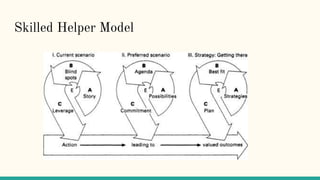
Skilled Helper Model
Stage 1: Reviewing the current scenario
Help clients identify, explore and clarify their problem situations and unused
opportunities.
Stage 2: Developing the preferred scenario
Help clients identify what they want in terms of goals and objectives that are based
on an understanding of problem situations and opportunities.
Stage 3: Getting there
Help clients develop action strategies for accomplishing goals, for getting what they
want.
Getting things done: A bias towards actions
Helps clients act on what they learn throughout the helping process; help clients
translate strategies into goal-accomplishing actions.
Case Example
Cathy had been married for 14 years to her high school sweetheart. Things started
out good but as their family grew to four children the first five years, their marital
relationship gradually deteriorated. Her husband, a sales manager traveled almost
every week. When he was home, he tended to ignore her and the kids. Cathy would
occupy herself with housework, church duties and helping neighbors and other
relatives. Most people thought Cathy had a good marriage, but inside she felt empty
and trapped. Feelings of frustration and anger would occasionally rise to the
surface, but most of the time she just kept it all inside. When Cathy started therapy,
she had just discovered her husband had an addiction to pornography. She was
surprised, hurt, angry and didn’t know whether she wanted to stay in the marriage
or leave. She was concerned about the kids.
Stage 1: Reviewing problem situations and unused
opportunities
Step I-A: Telling and clarifying the story
Help clients tell their stories as clearly as possible
Verbal and Voluntary VS Involuntary and Mute
Step I-B: Identifying and challenging Blind Spots
Help clients discover and deal with the kinds of blind spots that keep them from
seeing properblems and blind spots clearly and moving ahead
Step I-C: Searching for Leverage
Help clients identify and work on problems, issues, concerns or opportunities that
will make a difference in their lives.
Client action: The Heart of the Helping Process
Help clients act both within and outside counselling sessions.
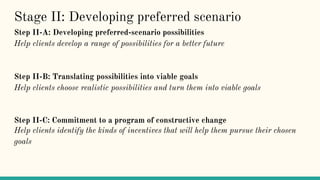
Stage II: Developing preferred scenario
Step II-A: Developing preferred-scenario possibilities
Help clients develop a range of possibilities for a better future
Step II-B: Translating possibilities into viable goals
Help clients choose realistic possibilities and turn them into viable goals
Step II-C: Commitment to a program of constructive change
Help clients identify the kinds of incentives that will help them pursue their chosen
goals
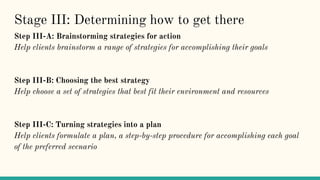
Stage III: Determining how to get there
Step III-A: Brainstorming strategies for action
Help clients brainstorm a range of strategies for accomplishing their goals
Step III-B: Choosing the best strategy
Help choose a set of strategies that best fit their environment and resources
Step III-C: Turning strategies into a plan
Help clients formulate a plan, a step-by-step procedure for accomplishing each goal
of the preferred scenario
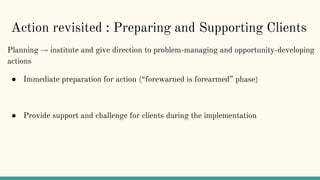
Action revisited : Preparing and Supporting Clients
Planning → institute and give direction to problem-managing and opportunity-developing
actions
● Immediate preparation for action (“forewarned is forearmed” phase)
● Provide support and challenge for clients during the implementation
Flexibility in the use of the model
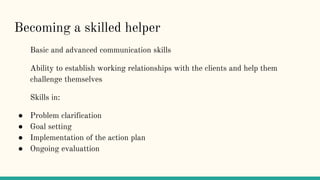
Becoming a skilled helper
Basic and advanced communication skills
Ability to establish working relationships with the clients and help them
challenge themselves
Skills in:
● Problem clarification
● Goal setting
● Implementation of the action plan
● Ongoing evaluattion
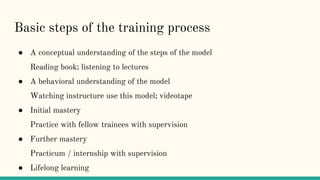
Basic steps of the training process
● A conceptual understanding of the steps of the model
Reading book; listening to lectures
● A behavioral understanding of the model
Watching instructure use this model; videotape
● Initial mastery
Practice with fellow trainees with supervision
● Further mastery
Practicum / internship with supervision
● Lifelong learning
Case Management
Content Problem & Process Problem
Evaluation of The Skilled Helper Model
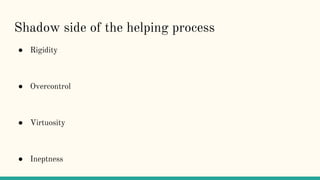
Shadow side of the helping process
● Rigidity
● Overcontrol
● Virtuosity
● Ineptness
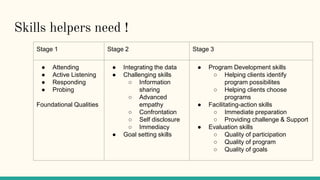
Skills helpers need !
Stage 1 Stage 2 Stage 3
● Attending
● Active Listening
● Responding
● Probing
Foundational Qualities
● Integrating the data
● Challenging skills
○ Information
sharing
○ Advanced
empathy
○ Confrontation
○ Self disclosure
○ Immediacy
● Goal setting skills
● Program Development skills
○ Helping clients identify
program possibilites
○ Helping clients choose
programs
● Facilitating-action skills
○ Immediate preparation
○ Providing challenge & Support
● Evaluation skills
○ Quality of participation
○ Quality of program
○ Quality of goals

Skilled Helper Model - Overview.pptx

  • 1.
    Counselling Skills andTechniques Unit 3
  • 2.
  • 3.
    Stage 1: Reviewingthe current scenario Help clients identify, explore and clarify their problem situations and unused opportunities. Stage 2: Developing the preferred scenario Help clients identify what they want in terms of goals and objectives that are based on an understanding of problem situations and opportunities. Stage 3: Getting there Help clients develop action strategies for accomplishing goals, for getting what they want.
  • 4.
    Getting things done:A bias towards actions Helps clients act on what they learn throughout the helping process; help clients translate strategies into goal-accomplishing actions.
  • 5.
    Case Example Cathy hadbeen married for 14 years to her high school sweetheart. Things started out good but as their family grew to four children the first five years, their marital relationship gradually deteriorated. Her husband, a sales manager traveled almost every week. When he was home, he tended to ignore her and the kids. Cathy would occupy herself with housework, church duties and helping neighbors and other relatives. Most people thought Cathy had a good marriage, but inside she felt empty and trapped. Feelings of frustration and anger would occasionally rise to the surface, but most of the time she just kept it all inside. When Cathy started therapy, she had just discovered her husband had an addiction to pornography. She was surprised, hurt, angry and didn’t know whether she wanted to stay in the marriage or leave. She was concerned about the kids.
  • 6.
    Stage 1: Reviewingproblem situations and unused opportunities Step I-A: Telling and clarifying the story Help clients tell their stories as clearly as possible Verbal and Voluntary VS Involuntary and Mute Step I-B: Identifying and challenging Blind Spots Help clients discover and deal with the kinds of blind spots that keep them from seeing properblems and blind spots clearly and moving ahead
  • 7.
    Step I-C: Searchingfor Leverage Help clients identify and work on problems, issues, concerns or opportunities that will make a difference in their lives. Client action: The Heart of the Helping Process Help clients act both within and outside counselling sessions.
  • 8.
    Stage II: Developingpreferred scenario Step II-A: Developing preferred-scenario possibilities Help clients develop a range of possibilities for a better future Step II-B: Translating possibilities into viable goals Help clients choose realistic possibilities and turn them into viable goals Step II-C: Commitment to a program of constructive change Help clients identify the kinds of incentives that will help them pursue their chosen goals
  • 9.
    Stage III: Determininghow to get there Step III-A: Brainstorming strategies for action Help clients brainstorm a range of strategies for accomplishing their goals Step III-B: Choosing the best strategy Help choose a set of strategies that best fit their environment and resources Step III-C: Turning strategies into a plan Help clients formulate a plan, a step-by-step procedure for accomplishing each goal of the preferred scenario
  • 10.
    Action revisited :Preparing and Supporting Clients Planning → institute and give direction to problem-managing and opportunity-developing actions ● Immediate preparation for action (“forewarned is forearmed” phase) ● Provide support and challenge for clients during the implementation
  • 11.
    Flexibility in theuse of the model
  • 12.
    Becoming a skilledhelper Basic and advanced communication skills Ability to establish working relationships with the clients and help them challenge themselves Skills in: ● Problem clarification ● Goal setting ● Implementation of the action plan ● Ongoing evaluattion
  • 13.
    Basic steps ofthe training process ● A conceptual understanding of the steps of the model Reading book; listening to lectures ● A behavioral understanding of the model Watching instructure use this model; videotape ● Initial mastery Practice with fellow trainees with supervision ● Further mastery Practicum / internship with supervision ● Lifelong learning
  • 14.
  • 15.
    Evaluation of TheSkilled Helper Model
  • 16.
    Shadow side ofthe helping process ● Rigidity ● Overcontrol ● Virtuosity ● Ineptness
  • 17.
    Skills helpers need! Stage 1 Stage 2 Stage 3 ● Attending ● Active Listening ● Responding ● Probing Foundational Qualities ● Integrating the data ● Challenging skills ○ Information sharing ○ Advanced empathy ○ Confrontation ○ Self disclosure ○ Immediacy ● Goal setting skills ● Program Development skills ○ Helping clients identify program possibilites ○ Helping clients choose programs ● Facilitating-action skills ○ Immediate preparation ○ Providing challenge & Support ● Evaluation skills ○ Quality of participation ○ Quality of program ○ Quality of goals