Reported By:
Daisog, Leony G
Bombane, Christine R.

III- H BSE SOC.STUD
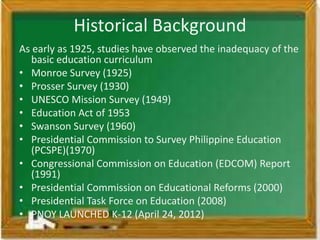
Historical Background
As early as 1925, studies have observed the inadequacy of the
   basic education curriculum
• Monroe Survey (1925)
• Prosser Survey (1930)
• UNESCO Mission Survey (1949)
• Education Act of 1953
• Swanson Survey (1960)
• Presidential Commission to Survey Philippine Education
   (PCSPE)(1970)
• Congressional Commission on Education (EDCOM) Report
   (1991)
• Presidential Commission on Educational Reforms (2000)
• Presidential Task Force on Education (2008)
• PNOY LAUNCHED K-12 (April 24, 2012)
K-12 Framework
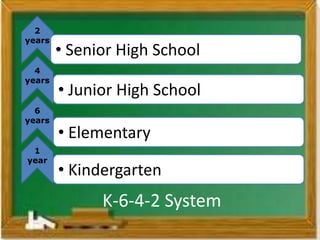
2
years
        • Senior High School
  4
years
        • Junior High School
  6
years
        • Elementary
 1
year
        • Kindergarten
              K-6-4-2 System
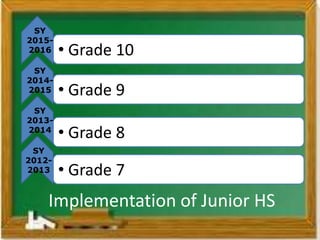
SY
2015-
2016    • Grade 10
 SY
2014-
2015    • Grade 9
 SY
2013-
2014
        • Grade 8
 SY
2012-
2013    • Grade 7
    Implementation of Junior HS
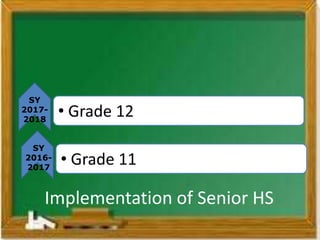
SY
2017-
2018
        • Grade 12
 SY
2016-
2017
        • Grade 11

    Implementation of Senior HS
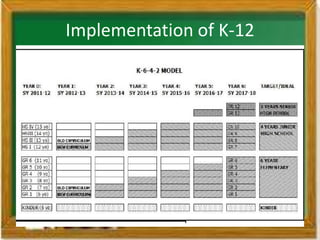
Implementation of K-12
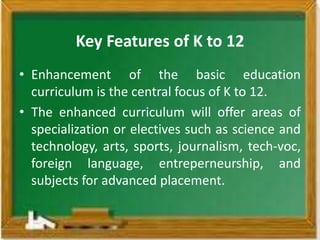
Key Features of K to 12
• Enhancement of the basic education
  curriculum is the central focus of K to 12.
• The enhanced curriculum will offer areas of
  specialization or electives such as science and
  technology, arts, sports, journalism, tech-voc,
  foreign language, entreperneurship, and
  subjects for advanced placement.
New Features of the K-12 Basic
      Education Curriculum

• Mother Tongue as a learning area and
  medium of instruction.
• MAPEH (Music, Arts, Physical Education, and
  Health) begins in Grade 1
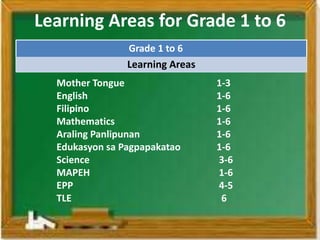
Learning Areas for Grade 1 to 6
                Grade 1 to 6
                Learning Areas
  Mother Tongue                  1-3
  English                        1-6
  Filipino                       1-6
  Mathematics                    1-6
  Araling Panlipunan             1-6
  Edukasyon sa Pagpapakatao      1-6
  Science                        3-6
  MAPEH                          1-6
  EPP                            4-5
  TLE                             6
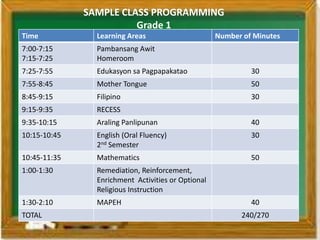
SAMPLE CLASS PROGRAMMING
                        Grade 1
Time            Learning Areas                      Number of Minutes
7:00-7:15       Pambansang Awit
7:15-7:25       Homeroom
7:25-7:55       Edukasyon sa Pagpapakatao                    30
7:55-8:45       Mother Tongue                                50
8:45-9:15       Filipino                                     30
9:15-9:35       RECESS
9:35-10:15      Araling Panlipunan                           40
10:15-10:45     English (Oral Fluency)                       30
                2nd Semester
10:45-11:35     Mathematics                                  50
1:00-1:30       Remediation, Reinforcement,
                Enrichment Activities or Optional
                Religious Instruction
1:30-2:10       MAPEH                                        40
TOTAL                                                     240/270
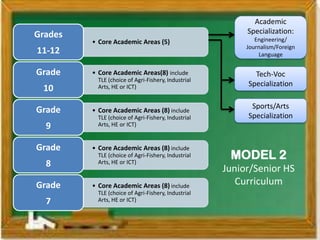
Academic
Grades                                                    Specialization:
         • Core Academic Areas (5)                           Engineering/
                                                          Journalism/Foreign
11-12                                                         Language

Grade    • Core Academic Areas(8) include                   Tech-Voc
           TLE (choice of Agri-Fishery, Industrial
                                                          Specialization
 10        Arts, HE or ICT)


                                                           Sports/Arts
Grade    • Core Academic Areas (8) include
           TLE (choice of Agri-Fishery, Industrial        Specialization
  9        Arts, HE or ICT)


Grade    • Core Academic Areas (8) include
           TLE (choice of Agri-Fishery, Industrial    MODEL 2
  8        Arts, HE or ICT)
                                                     Junior/Senior HS
Grade    • Core Academic Areas (8) include              Curriculum
           TLE (choice of Agri-Fishery, Industrial
  7        Arts, HE or ICT)
Why or
Why Not to K-12?
Pros
Pros
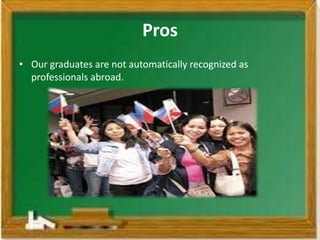
• Our graduates are not automatically recognized as
  professionals abroad.
Pros
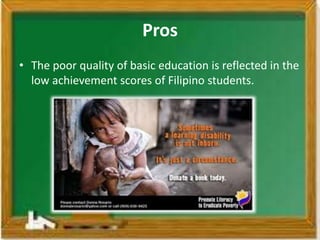
• The poor quality of basic education is reflected in the
  low achievement scores of Filipino students.
Pros
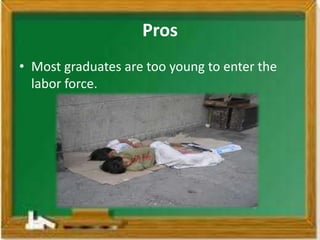
• Most graduates are too young to enter the
  labor force.
Pros
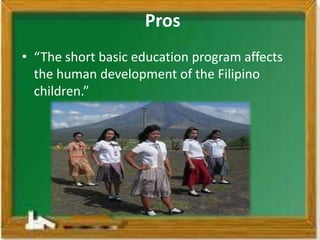
• “The short basic education program affects
  the human development of the Filipino
  children.”
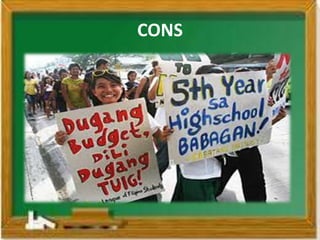
CONS
Cons
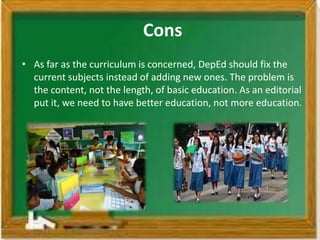
• As far as the curriculum is concerned, DepEd should fix the
  current subjects instead of adding new ones. The problem is
  the content, not the length, of basic education. As an editorial
  put it, we need to have better education, not more education.
Cons
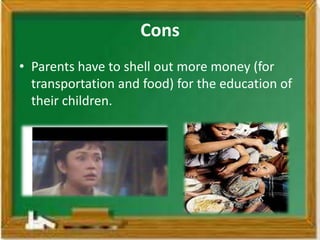
• Parents have to shell out more money (for
  transportation and food) for the education of
  their children.
Cons
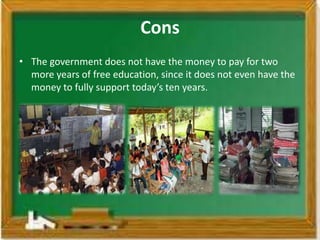
• The government does not have the money to pay for two
  more years of free education, since it does not even have the
  money to fully support today’s ten years.
Cons
• A high school diploma will not get anybody
  anywhere, because business firms will not hire
  fresh high school graduates.
Cons
• Every family dreams of having a child graduate
  from college.
Cons
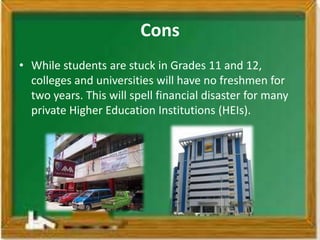
• While students are stuck in Grades 11 and 12,
  colleges and universities will have no freshmen for
  two years. This will spell financial disaster for many
  private Higher Education Institutions (HEIs).
Cons
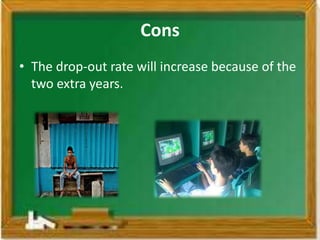
• The drop-out rate will increase because of the
  two extra years.
How will we teach Araling Panlipunan
     under K-12 Curriculum?

    The Conceptual
  Framework of Araling
      Panlipunan
     (Grade 1 - 7)
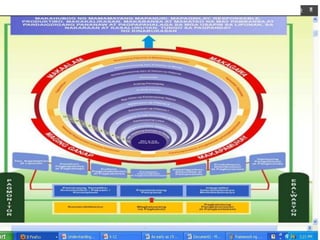
• Naipamamalas ang pagunawa sa mga konsepto at pagaaral ng mga
    tao at grupo, komunidad at lipunan kung paano sila namuhay at
       namumuhay, ang kanilang ugnayan at interaksyon sa kapaligiran
    at sa isa’t isa, at ang kanilang mga paniniwala at kultura upang makabuo
ng pagkakakilanlan bilang Pilipino, tao at miyembro ng bansa at mundo;
      maunawaan ang sariling lipunan gamit ang mga kasanayan sa
 pananaliksik, pagsisiyasat, mapanuring pagiisip, matalinong pagpapasya,
pagkamalikhain, pakikipagkapwa, likas kayang paggamit ng pinagkukunang-
     yaman at pakikipagtalastasan tungo sa isang mapanuri, mapagmuni,
             responsable, produktibo, makakalikasan, makatao at
 makabansa na may pambansa at pandaigdigang pananaw at pagpapahalaga
        sa mga usapin sa lipunan sa nakaraan at kasalukuyan tungo sa
                            pagpanday ng kinabukasan.
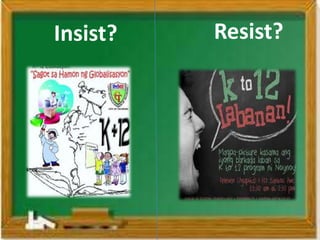
Insist?   Resist?
Wait for the final paper: )))
References:
•   http://www.google.com.ph/#hl=fil&sclient=psy-ab&q=deped+framewok+for+k-
    12&oq=deped+framewok+for+k-
    12&gs_l=hp.3...134056.143566.5.144263.22.20.2.0.0.0.243.3106.0j17j3.20.0...0.0...
•   http://www.slideshare.net/search/slideshow?searchfrom=header&q=k-12+
•   http://www.gov.ph/downloads/2012/01jan/AP-Grade-1-and-7-Revised-TWG-Feb-18.pdf
•   http://www.gov.ph/k-12/
•   http://www.scribd.com/doc/55520272/Proposed-K-12-Basic-Education-System-in-The-
    Philippines

K 12 Curriculum

  • 1.
    Reported By: Daisog, LeonyG Bombane, Christine R. III- H BSE SOC.STUD
  • 2.
    Historical Background As earlyas 1925, studies have observed the inadequacy of the basic education curriculum • Monroe Survey (1925) • Prosser Survey (1930) • UNESCO Mission Survey (1949) • Education Act of 1953 • Swanson Survey (1960) • Presidential Commission to Survey Philippine Education (PCSPE)(1970) • Congressional Commission on Education (EDCOM) Report (1991) • Presidential Commission on Educational Reforms (2000) • Presidential Task Force on Education (2008) • PNOY LAUNCHED K-12 (April 24, 2012)
  • 3.
  • 4.
    2 years • Senior High School 4 years • Junior High School 6 years • Elementary 1 year • Kindergarten K-6-4-2 System
  • 5.
    SY 2015- 2016 • Grade 10 SY 2014- 2015 • Grade 9 SY 2013- 2014 • Grade 8 SY 2012- 2013 • Grade 7 Implementation of Junior HS
  • 6.
    SY 2017- 2018 • Grade 12 SY 2016- 2017 • Grade 11 Implementation of Senior HS
  • 7.
  • 8.
    Key Features ofK to 12 • Enhancement of the basic education curriculum is the central focus of K to 12. • The enhanced curriculum will offer areas of specialization or electives such as science and technology, arts, sports, journalism, tech-voc, foreign language, entreperneurship, and subjects for advanced placement.
  • 9.
    New Features ofthe K-12 Basic Education Curriculum • Mother Tongue as a learning area and medium of instruction. • MAPEH (Music, Arts, Physical Education, and Health) begins in Grade 1
  • 10.
    Learning Areas forGrade 1 to 6 Grade 1 to 6 Learning Areas Mother Tongue 1-3 English 1-6 Filipino 1-6 Mathematics 1-6 Araling Panlipunan 1-6 Edukasyon sa Pagpapakatao 1-6 Science 3-6 MAPEH 1-6 EPP 4-5 TLE 6
  • 11.
    SAMPLE CLASS PROGRAMMING Grade 1 Time Learning Areas Number of Minutes 7:00-7:15 Pambansang Awit 7:15-7:25 Homeroom 7:25-7:55 Edukasyon sa Pagpapakatao 30 7:55-8:45 Mother Tongue 50 8:45-9:15 Filipino 30 9:15-9:35 RECESS 9:35-10:15 Araling Panlipunan 40 10:15-10:45 English (Oral Fluency) 30 2nd Semester 10:45-11:35 Mathematics 50 1:00-1:30 Remediation, Reinforcement, Enrichment Activities or Optional Religious Instruction 1:30-2:10 MAPEH 40 TOTAL 240/270
  • 12.
    Academic Grades Specialization: • Core Academic Areas (5) Engineering/ Journalism/Foreign 11-12 Language Grade • Core Academic Areas(8) include Tech-Voc TLE (choice of Agri-Fishery, Industrial Specialization 10 Arts, HE or ICT) Sports/Arts Grade • Core Academic Areas (8) include TLE (choice of Agri-Fishery, Industrial Specialization 9 Arts, HE or ICT) Grade • Core Academic Areas (8) include TLE (choice of Agri-Fishery, Industrial MODEL 2 8 Arts, HE or ICT) Junior/Senior HS Grade • Core Academic Areas (8) include Curriculum TLE (choice of Agri-Fishery, Industrial 7 Arts, HE or ICT)
  • 13.
  • 14.
  • 15.
    Pros • Our graduatesare not automatically recognized as professionals abroad.
  • 16.
    Pros • The poorquality of basic education is reflected in the low achievement scores of Filipino students.
  • 17.
    Pros • Most graduatesare too young to enter the labor force.
  • 18.
    Pros • “The shortbasic education program affects the human development of the Filipino children.”
  • 19.
  • 20.
    Cons • As faras the curriculum is concerned, DepEd should fix the current subjects instead of adding new ones. The problem is the content, not the length, of basic education. As an editorial put it, we need to have better education, not more education.
  • 21.
    Cons • Parents haveto shell out more money (for transportation and food) for the education of their children.
  • 22.
    Cons • The governmentdoes not have the money to pay for two more years of free education, since it does not even have the money to fully support today’s ten years.
  • 23.
    Cons • A highschool diploma will not get anybody anywhere, because business firms will not hire fresh high school graduates.
  • 24.
    Cons • Every familydreams of having a child graduate from college.
  • 25.
    Cons • While studentsare stuck in Grades 11 and 12, colleges and universities will have no freshmen for two years. This will spell financial disaster for many private Higher Education Institutions (HEIs).
  • 26.
    Cons • The drop-outrate will increase because of the two extra years.
  • 27.
    How will weteach Araling Panlipunan under K-12 Curriculum? The Conceptual Framework of Araling Panlipunan (Grade 1 - 7)
  • 29.
    • Naipamamalas angpagunawa sa mga konsepto at pagaaral ng mga tao at grupo, komunidad at lipunan kung paano sila namuhay at namumuhay, ang kanilang ugnayan at interaksyon sa kapaligiran at sa isa’t isa, at ang kanilang mga paniniwala at kultura upang makabuo ng pagkakakilanlan bilang Pilipino, tao at miyembro ng bansa at mundo; maunawaan ang sariling lipunan gamit ang mga kasanayan sa pananaliksik, pagsisiyasat, mapanuring pagiisip, matalinong pagpapasya, pagkamalikhain, pakikipagkapwa, likas kayang paggamit ng pinagkukunang- yaman at pakikipagtalastasan tungo sa isang mapanuri, mapagmuni, responsable, produktibo, makakalikasan, makatao at makabansa na may pambansa at pandaigdigang pananaw at pagpapahalaga sa mga usapin sa lipunan sa nakaraan at kasalukuyan tungo sa pagpanday ng kinabukasan.
  • 30.
    Insist? Resist?
  • 31.
    Wait for thefinal paper: )))
  • 32.
    References: • http://www.google.com.ph/#hl=fil&sclient=psy-ab&q=deped+framewok+for+k- 12&oq=deped+framewok+for+k- 12&gs_l=hp.3...134056.143566.5.144263.22.20.2.0.0.0.243.3106.0j17j3.20.0...0.0... • http://www.slideshare.net/search/slideshow?searchfrom=header&q=k-12+ • http://www.gov.ph/downloads/2012/01jan/AP-Grade-1-and-7-Revised-TWG-Feb-18.pdf • http://www.gov.ph/k-12/ • http://www.scribd.com/doc/55520272/Proposed-K-12-Basic-Education-System-in-The- Philippines