WH&S

Workplace Health & Safety
   Occupational Health & Safety Act 2000 (NSW)
   Occupational Health & Safety Regulations
    2001 (NSW)

Replaced 1 January 2012

Model Work Health & Safety Act 2010
 Work Health & Safety Act 2011 (NSW)

 Work Health & Safety Regulations 2011 (NSW)
Objectives of Harmonisation
The objects of harmonising work health & safety laws
through a model framework are:


                                                       WHS Act
      • to protect the health and safety of
        workers
      • to improve safety outcomes in
        workplaces
      • to reduce compliance costs for
        business
      • to improve efficiency for regulator
        agencies
                                                           3
What will be different
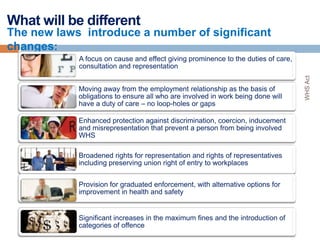
The new laws introduce a number of significant
changes:
            A focus on cause and effect giving prominence to the duties of care,
            consultation and representation


                                                                                   WHS Act
            Moving away from the employment relationship as the basis of
            obligations to ensure all who are involved in work being done will
            have a duty of care – no loop-holes or gaps

            Enhanced protection against discrimination, coercion, inducement
            and misrepresentation that prevent a person from being involved
            WHS

            Broadened rights for representation and rights of representatives
            including preserving union right of entry to workplaces


            Provision for graduated enforcement, with alternative options for
            improvement in health and safety


            Significant increases in the maximum fines and the introduction of
            categories of offence
                                                                                       4
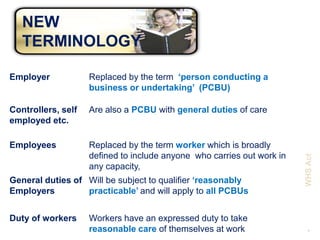
NEW
   TERMINOLOGY

Employer            Replaced by the term ‘person conducting a
                    business or undertaking’ (PCBU)

Controllers, self   Are also a PCBU with general duties of care
employed etc.

Employees           Replaced by the term worker which is broadly
                    defined to include anyone who carries out work in


                                                                        WHS Act
                    any capacity,
General duties of Will be subject to qualifier ‘reasonably
Employers         practicable’ and will apply to all PCBUs


Duty of workers     Workers have an expressed duty to take
                    reasonable care of themselves at work                 5
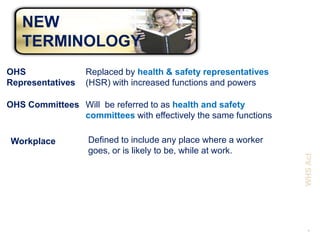
NEW
   TERMINOLOGY
OHS               Replaced by health & safety representatives
Representatives   (HSR) with increased functions and powers

OHS Committees Will be referred to as health and safety
               committees with effectively the same functions

Workplace         Defined to include any place where a worker
                  goes, or is likely to be, while at work.


                                                                WHS Act
                                                                  6
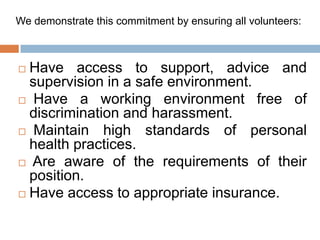
We demonstrate this commitment by ensuring all volunteers:


 Have access to support, advice and
  supervision in a safe environment.
 Have a working environment free of
  discrimination and harassment.
 Maintain    high standards of personal
  health practices.
 Are aware of the requirements of their
  position.
 Have access to appropriate insurance.
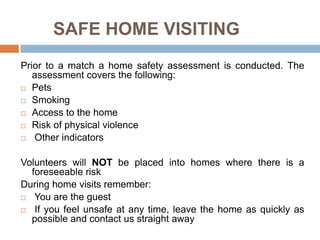
SAFE HOME VISITING
Prior to a match a home safety assessment is conducted. The
   assessment covers the following:
 Pets

 Smoking

 Access to the home

 Risk of physical violence

 Other indicators


Volunteers will NOT be placed into homes where there is a
  foreseeable risk
During home visits remember:
 You are the guest

 If you feel unsafe at any time, leave the home as quickly as
  possible and contact us straight away
MANUAL HANDLING

Any activity requiring the use of force
 exerted by a person to lift, lower, push,
 pull, carry or otherwise move, hold or
 restrain any object or person,


   http://www.youtube.com/watch?v=qWlktm2tAyA
CROSS INFECTION
   Take common precautions and use common
    sense.
   Visits will not take place if families or
    volunteers have contracted any infectious
    disease or illness.
   If you commence a visit and discover someone
    in the family has an infectious disease or
    illness, end the visit as soon as possible.
   Talk to us.
DOMESTIC VIOLENCE
   Our programs do not work with families where
    there is current domestic violence issues.
   If any information is disclosed to you during
    visits please contact us immediately.
   If confronted with a domestic violence situation:
     Keep yourself safe, leave as soon as possible.
     Do not become involved in the situation.

     Contact us straight away.

     Never enter a house if you hear an argument.
INSURANCE
   All Volunteers are covered by Voluntary
    Workers Insurance.

   In the event of injury to yourself:
     Notify us as soon as possible.
     Document the accident/incident in as much detail
      as possible.
     Ensure all receipts and documentation is
      retained.
INSURANCE
   Volunteers are strongly encouraged to have
    comprehensive motor vehicle insurance.
   Volunteers are liable to damage to their
    vehicle, others property damage and personal
    injury to third parties. Barnardos is not insuring
    you against such damage or personal injury
    and will not be liable for such costs.

Work Health & Safety

  • 1.
  • 2.
    Occupational Health & Safety Act 2000 (NSW)  Occupational Health & Safety Regulations 2001 (NSW) Replaced 1 January 2012 Model Work Health & Safety Act 2010  Work Health & Safety Act 2011 (NSW)  Work Health & Safety Regulations 2011 (NSW)
  • 3.
    Objectives of Harmonisation Theobjects of harmonising work health & safety laws through a model framework are: WHS Act • to protect the health and safety of workers • to improve safety outcomes in workplaces • to reduce compliance costs for business • to improve efficiency for regulator agencies 3
  • 4.
    What will bedifferent The new laws introduce a number of significant changes: A focus on cause and effect giving prominence to the duties of care, consultation and representation WHS Act Moving away from the employment relationship as the basis of obligations to ensure all who are involved in work being done will have a duty of care – no loop-holes or gaps Enhanced protection against discrimination, coercion, inducement and misrepresentation that prevent a person from being involved WHS Broadened rights for representation and rights of representatives including preserving union right of entry to workplaces Provision for graduated enforcement, with alternative options for improvement in health and safety Significant increases in the maximum fines and the introduction of categories of offence 4
  • 5.
    NEW TERMINOLOGY Employer Replaced by the term ‘person conducting a business or undertaking’ (PCBU) Controllers, self Are also a PCBU with general duties of care employed etc. Employees Replaced by the term worker which is broadly defined to include anyone who carries out work in WHS Act any capacity, General duties of Will be subject to qualifier ‘reasonably Employers practicable’ and will apply to all PCBUs Duty of workers Workers have an expressed duty to take reasonable care of themselves at work 5
  • 6.
    NEW TERMINOLOGY OHS Replaced by health & safety representatives Representatives (HSR) with increased functions and powers OHS Committees Will be referred to as health and safety committees with effectively the same functions Workplace Defined to include any place where a worker goes, or is likely to be, while at work. WHS Act 6
  • 7.
    We demonstrate thiscommitment by ensuring all volunteers:  Have access to support, advice and supervision in a safe environment.  Have a working environment free of discrimination and harassment.  Maintain high standards of personal health practices.  Are aware of the requirements of their position.  Have access to appropriate insurance.
  • 8.
    SAFE HOME VISITING Priorto a match a home safety assessment is conducted. The assessment covers the following:  Pets  Smoking  Access to the home  Risk of physical violence  Other indicators Volunteers will NOT be placed into homes where there is a foreseeable risk During home visits remember:  You are the guest  If you feel unsafe at any time, leave the home as quickly as possible and contact us straight away
  • 9.
    MANUAL HANDLING Any activityrequiring the use of force exerted by a person to lift, lower, push, pull, carry or otherwise move, hold or restrain any object or person,  http://www.youtube.com/watch?v=qWlktm2tAyA
  • 10.
    CROSS INFECTION  Take common precautions and use common sense.  Visits will not take place if families or volunteers have contracted any infectious disease or illness.  If you commence a visit and discover someone in the family has an infectious disease or illness, end the visit as soon as possible.  Talk to us.
  • 11.
    DOMESTIC VIOLENCE  Our programs do not work with families where there is current domestic violence issues.  If any information is disclosed to you during visits please contact us immediately.  If confronted with a domestic violence situation:  Keep yourself safe, leave as soon as possible.  Do not become involved in the situation.  Contact us straight away.  Never enter a house if you hear an argument.
  • 12.
    INSURANCE  All Volunteers are covered by Voluntary Workers Insurance.  In the event of injury to yourself:  Notify us as soon as possible.  Document the accident/incident in as much detail as possible.  Ensure all receipts and documentation is retained.
  • 13.
    INSURANCE  Volunteers are strongly encouraged to have comprehensive motor vehicle insurance.  Volunteers are liable to damage to their vehicle, others property damage and personal injury to third parties. Barnardos is not insuring you against such damage or personal injury and will not be liable for such costs.

Editor's Notes

  • #4 Trainers Notes: OverviewExplainThe reason for seeking to harmonise work health and safety laws across the county goes beyond simply wanting to achieve uniformity. The ultimate purpose is to reduce the incidence of work related death, injury and illness and to achieve the same rights and protection for workers regardless of where they work and the production of significant financial benefits for industry. The objectives set by the Council of Australian Governments for harmonising work health and safety laws through a model framework are summarised as follows:to protect the health and safety of workersto improve safety outcomes in workplacesto reduce compliance costs for businessto improve efficiency for regulator agencies
  • #5 Trainers Notes: OverviewExplain The new laws introduce a number of significant changes, in these include:A focus on cause and effect giving prominence to the duties of care, consultation and representation Moving away from the employment relationship as the basis of obligations to ensure all who are involved in work being done will have a duty of care – no loop-holes or gapsEnhanced protection against discrimination, coercion, inducement and misrepresentation that prevent a person from being involved WHSBroadened rights for representation and rights of representatives including preserving union right of entry to workplaces Provision for graduated enforcement, with alternative options for improvement in health and safetySignificant increases in the maximum fines and the introduction of categories of offenceLets have a look in more detail where these changes will occur: