Kubernetes
the Very Hard Way
Laurent Bernaille
Staff Engineer, Infrastructure
@lbernail
lbernail
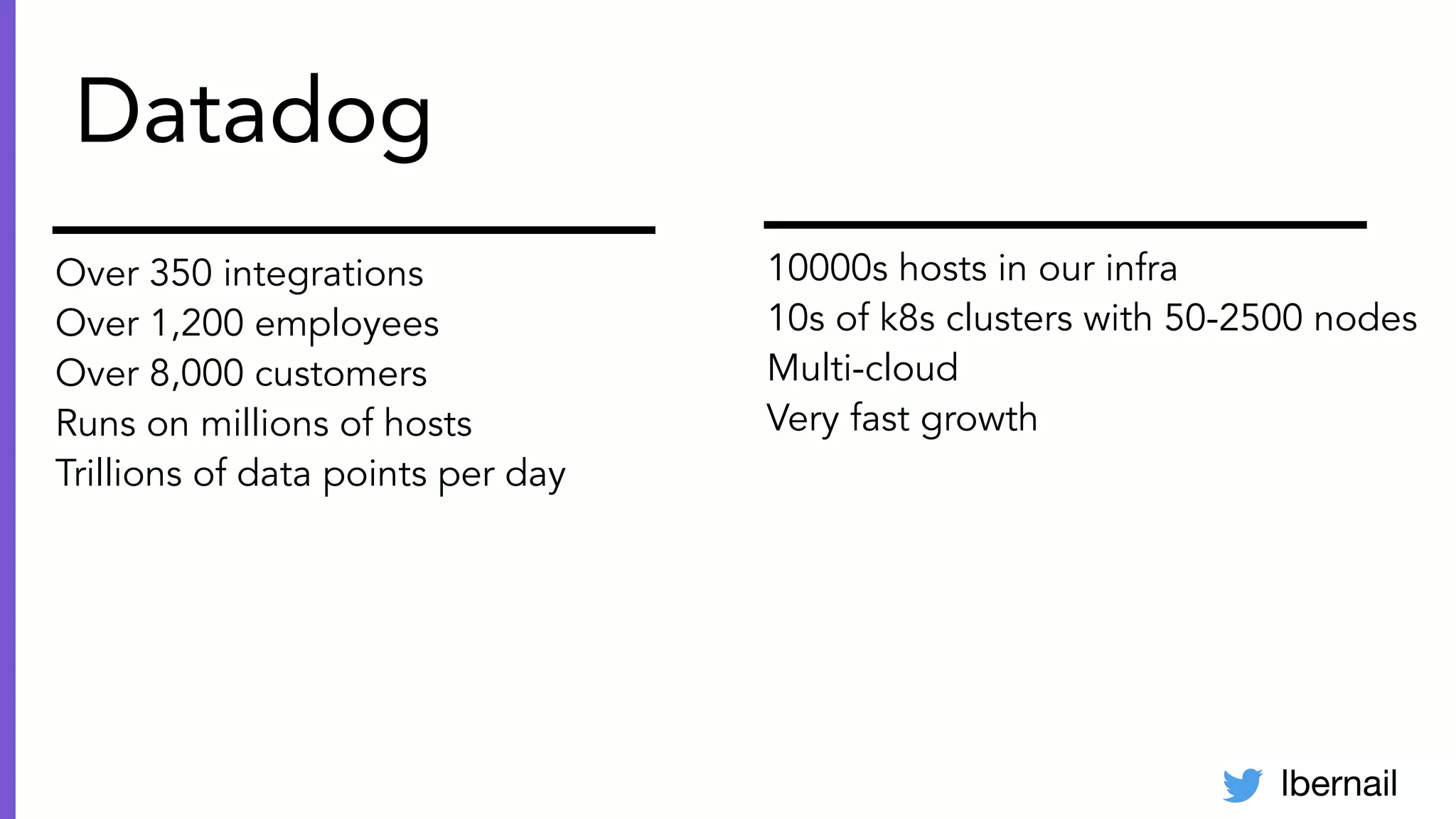
Datadog
Over 350 integrations
Over 1,200 employees
Over 8,000 customers
Runs on millions of hosts
Trillions of data points per day
10000s hosts in our infra
10s of k8s clusters with 50-2500 nodes
Multi-cloud
Very fast growth
lbernail
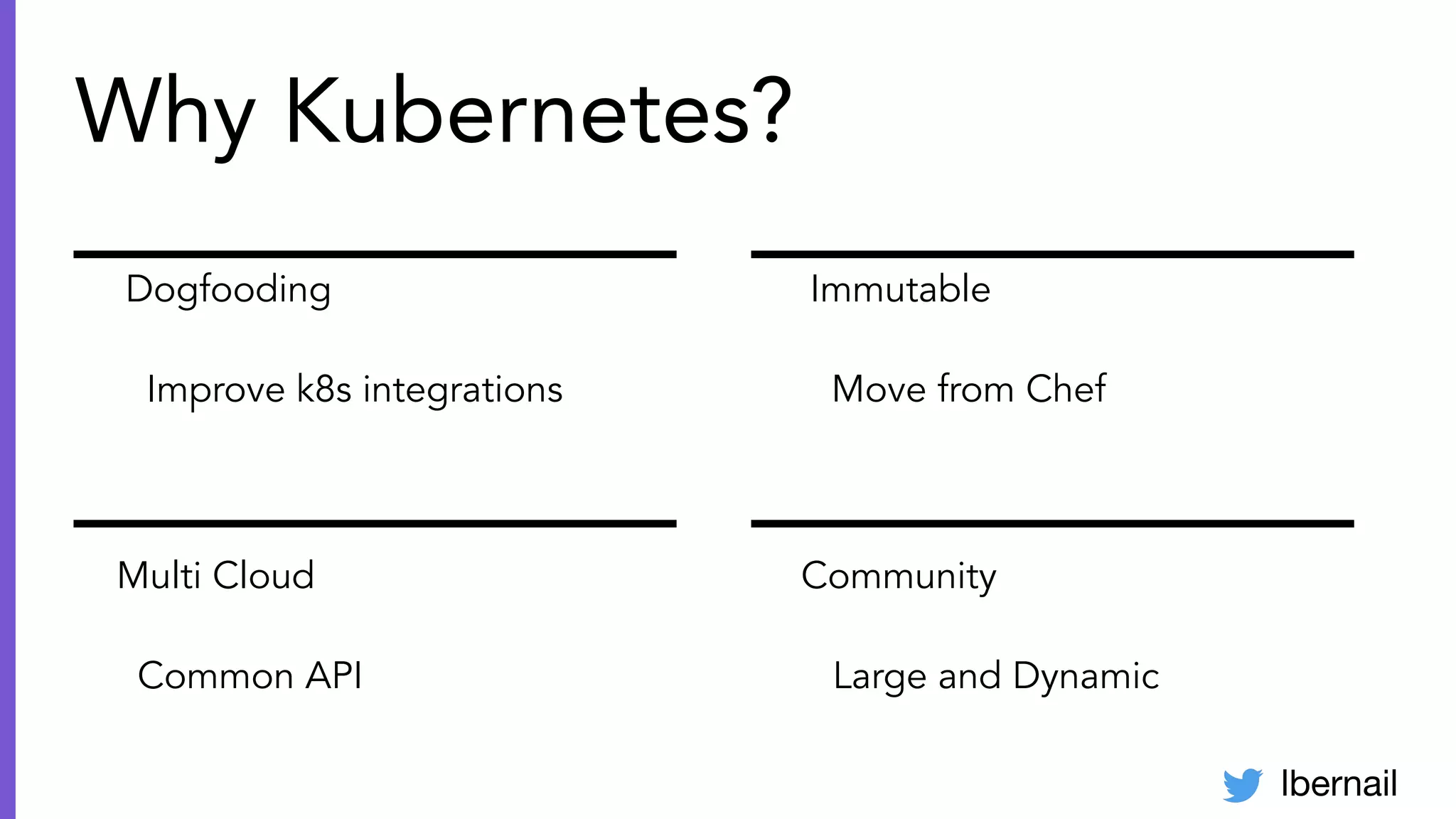
Why Kubernetes?
Dogfooding
Improve k8s integrations
Immutable
Move from Chef
Multi Cloud
Common API
Community
Large and Dynamic
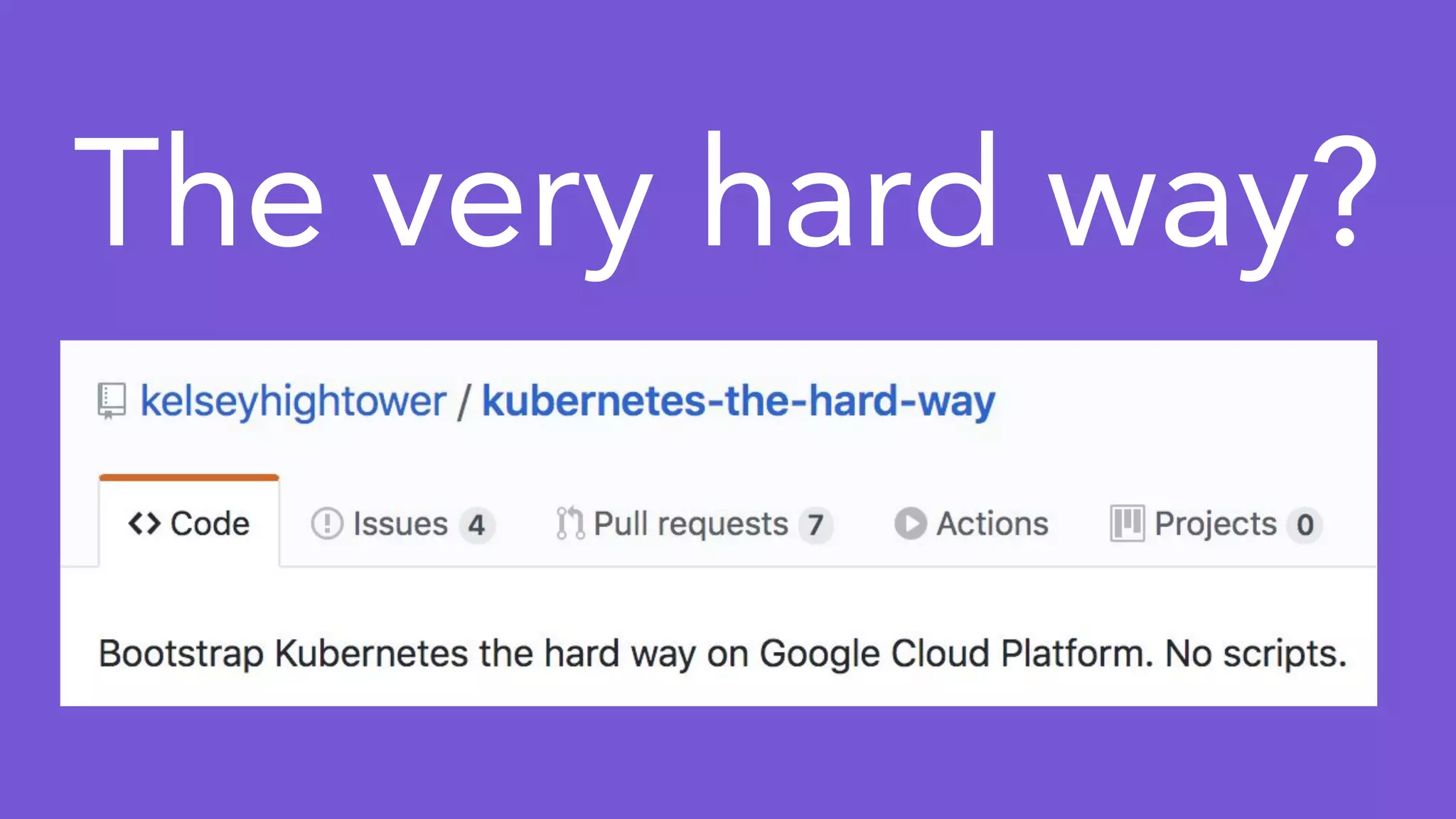
The very hard way?
It was much harder
lbernail
This talk is about the fine prints
“Of course, you will need a HA master setup”
“Oh, and yes, you will have to manage your certificates”
“By the way, networking is slightly more complicated, look
into CNI / ingress controllers”
lbernail
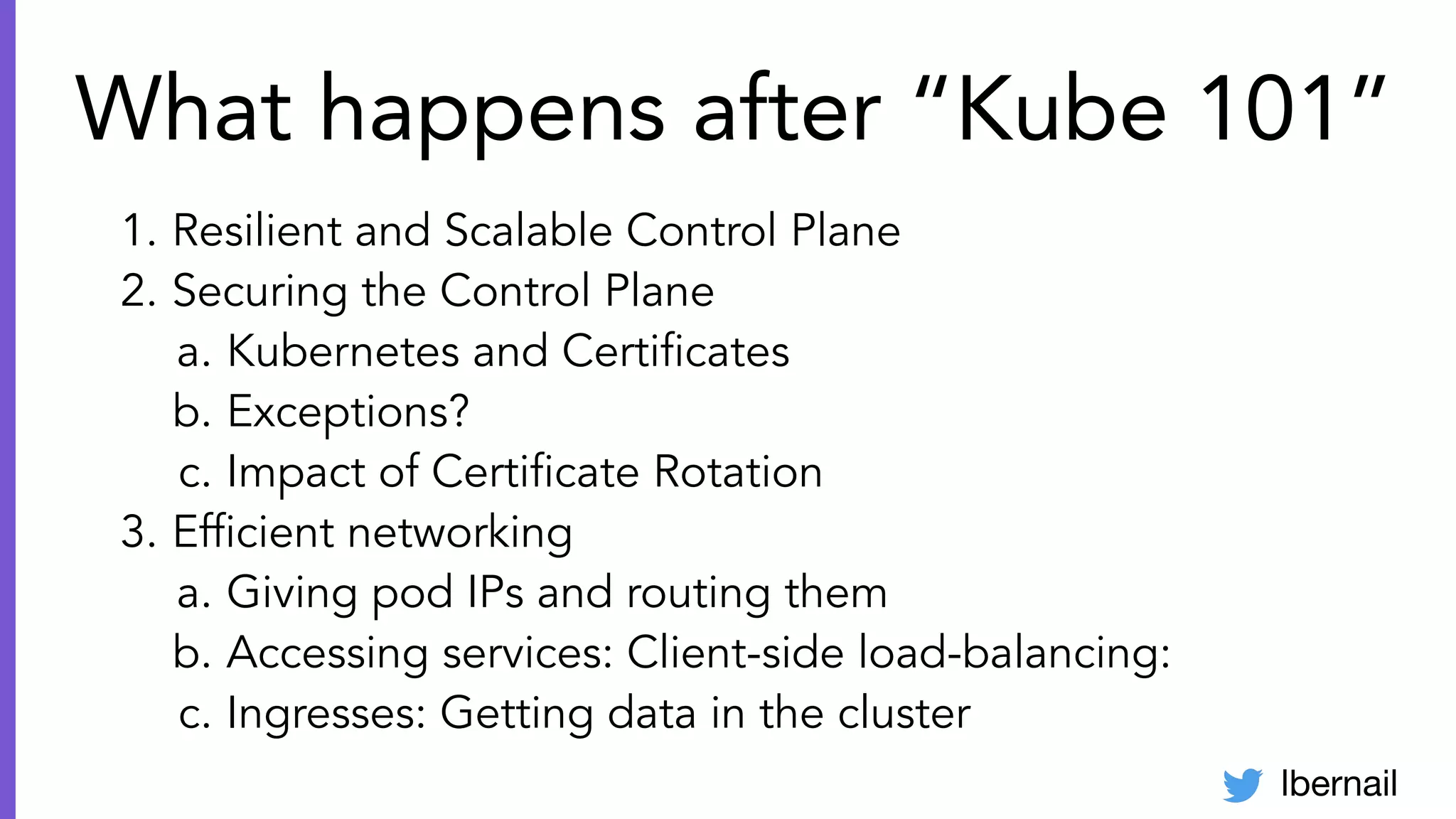
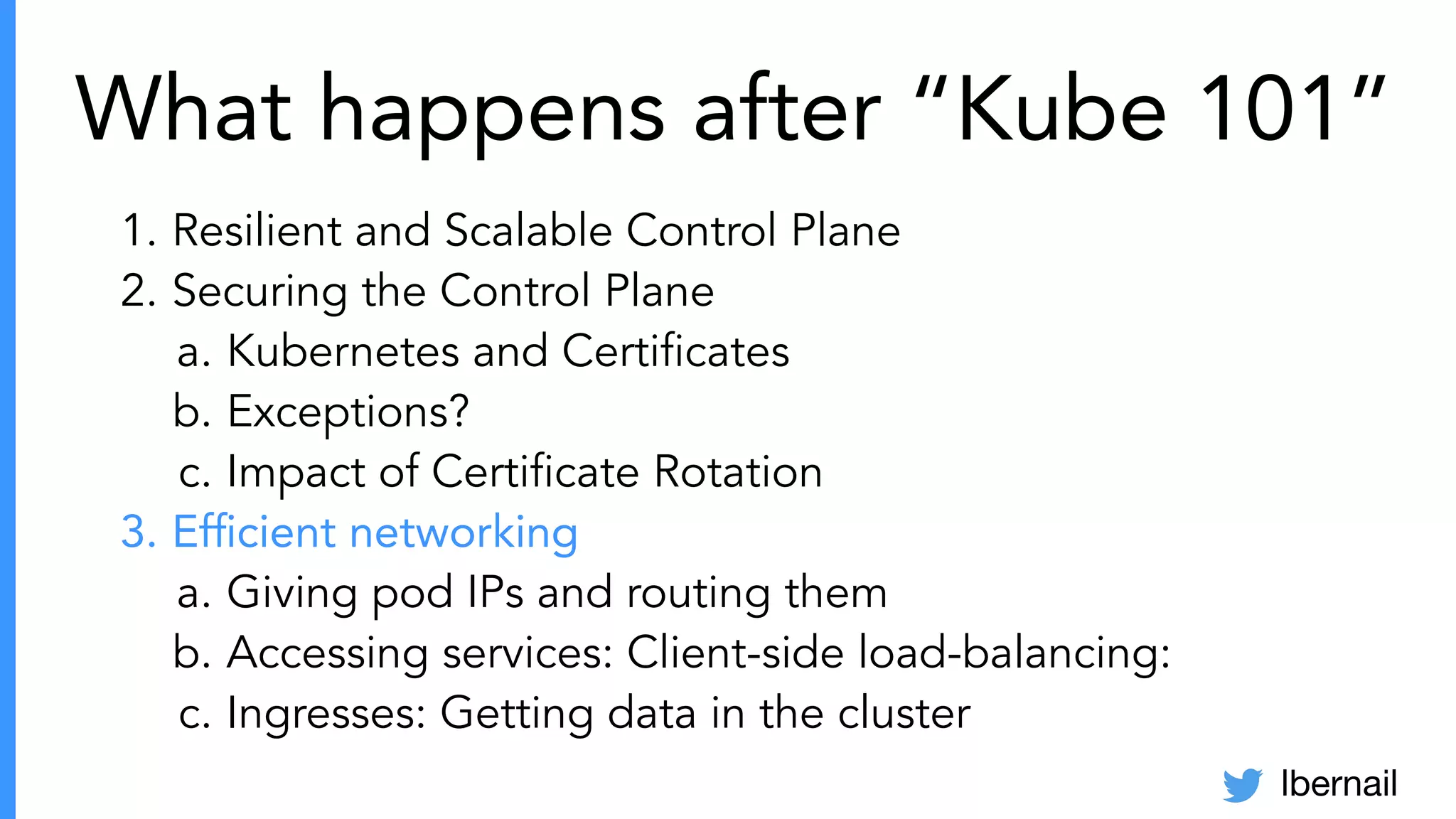
What happens after “Kube 101”
1. Resilient and Scalable Control Plane
2. Securing the Control Plane
a. Kubernetes and Certificates
b. Exceptions?
c. Impact of Certificate Rotation
3. Efficient networking
a. Giving pod IPs and routing them
b. Accessing services: Client-side load-balancing:
c. Ingresses: Getting data in the cluster
lbernail
What happens after “Kube 101”
1. Resilient and Scalable Control Plane
2. Securing the Control Plane
a. Kubernetes and Certificates
b. Exceptions?
c. Impact of Certificate Rotation
3. Efficient networking
a. Giving pod IPs and routing them
b. Accessing services: Client-side load-balancing:
c. Ingresses: Getting data in the cluster
Resilient and Scalable
Control Plane
lbernail
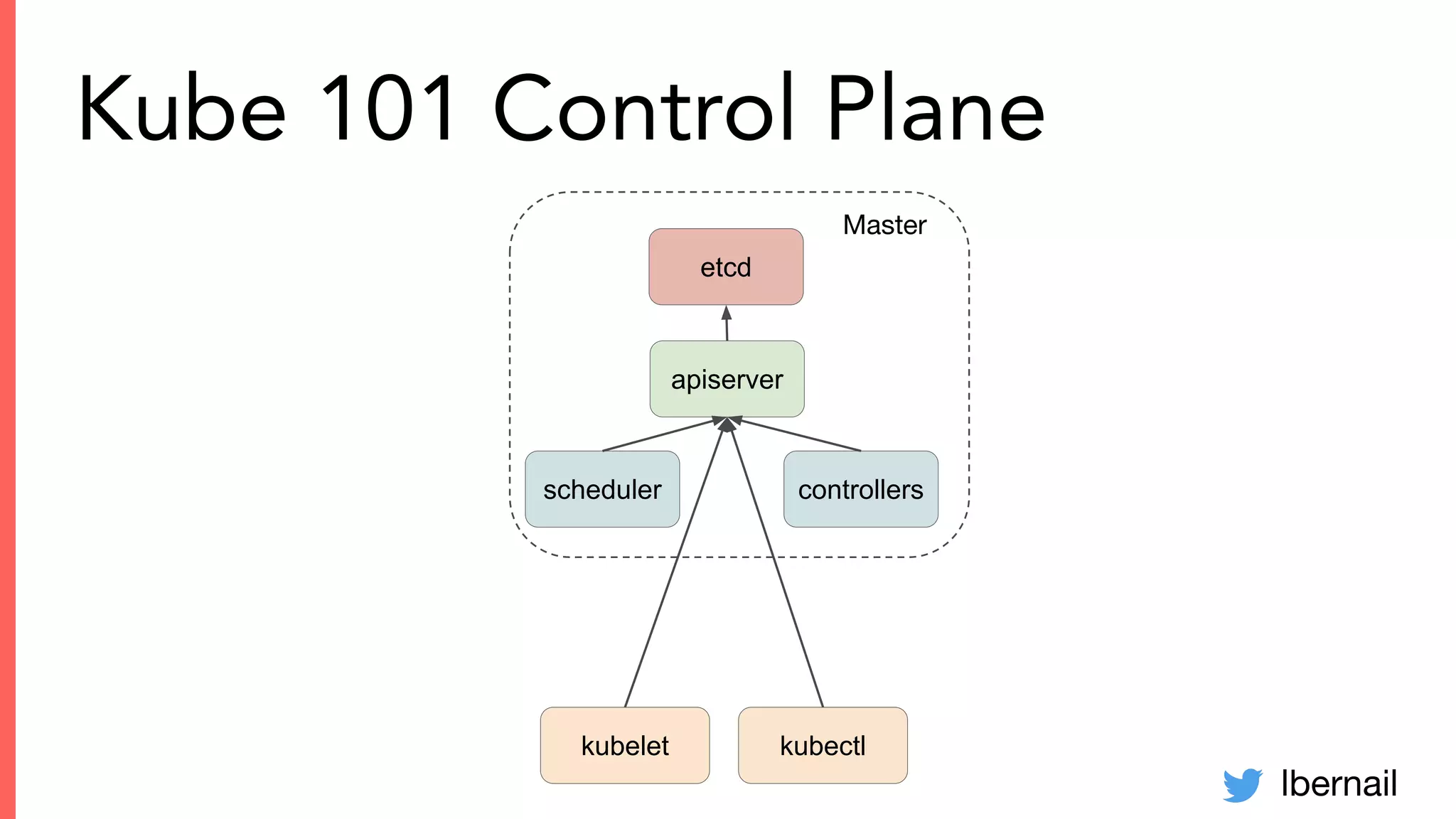
Kube 101 Control Plane
kubelet kubectl
etcd
apiserver
controllersscheduler
Master
lbernail
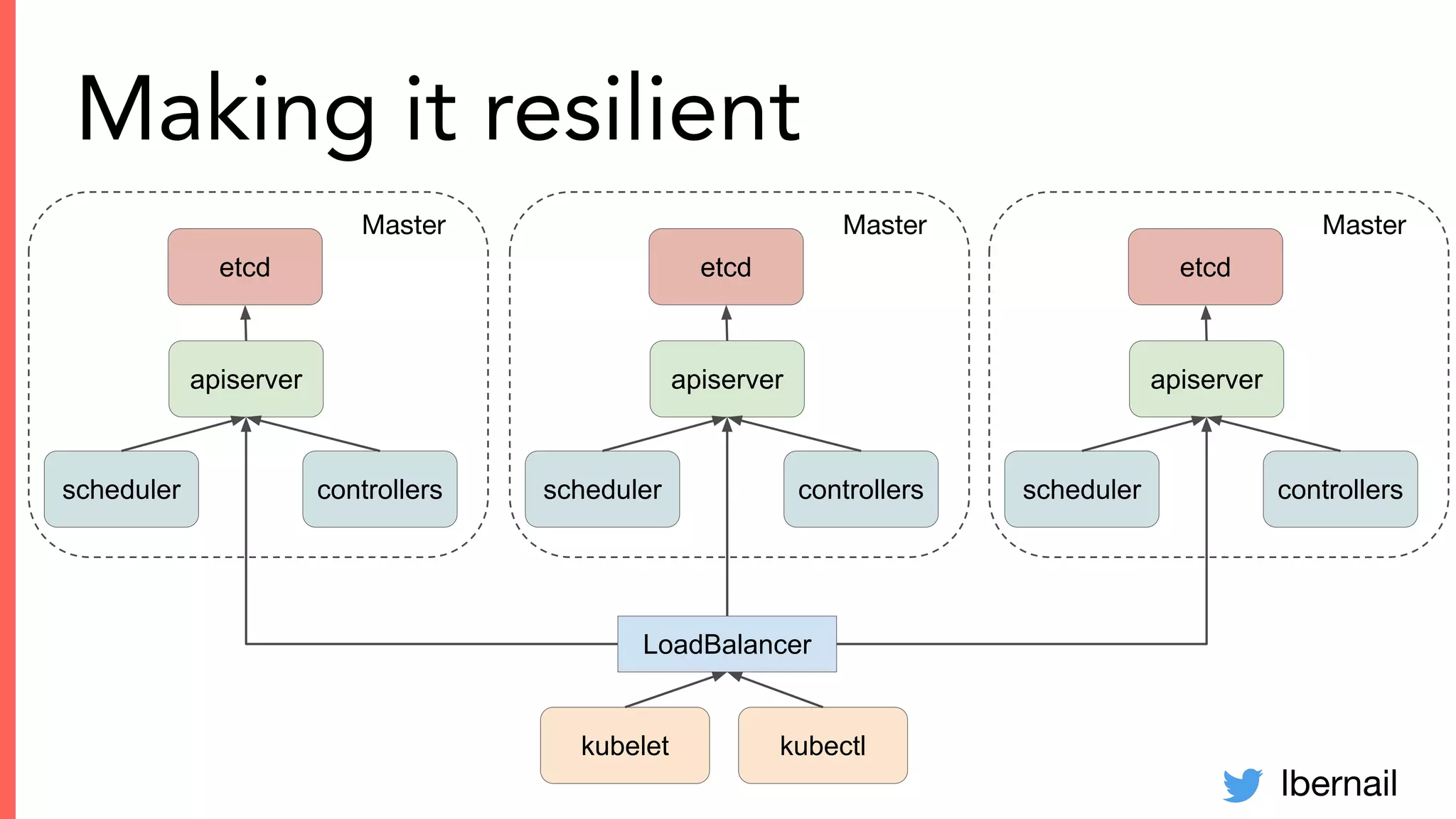
Making it resilient
etcd
apiserver
controllersscheduler
kubelet kubectl
Master
etcd
apiserver
controllersscheduler
Master
etcd
apiserver
controllersscheduler
Master
LoadBalancer
lbernail
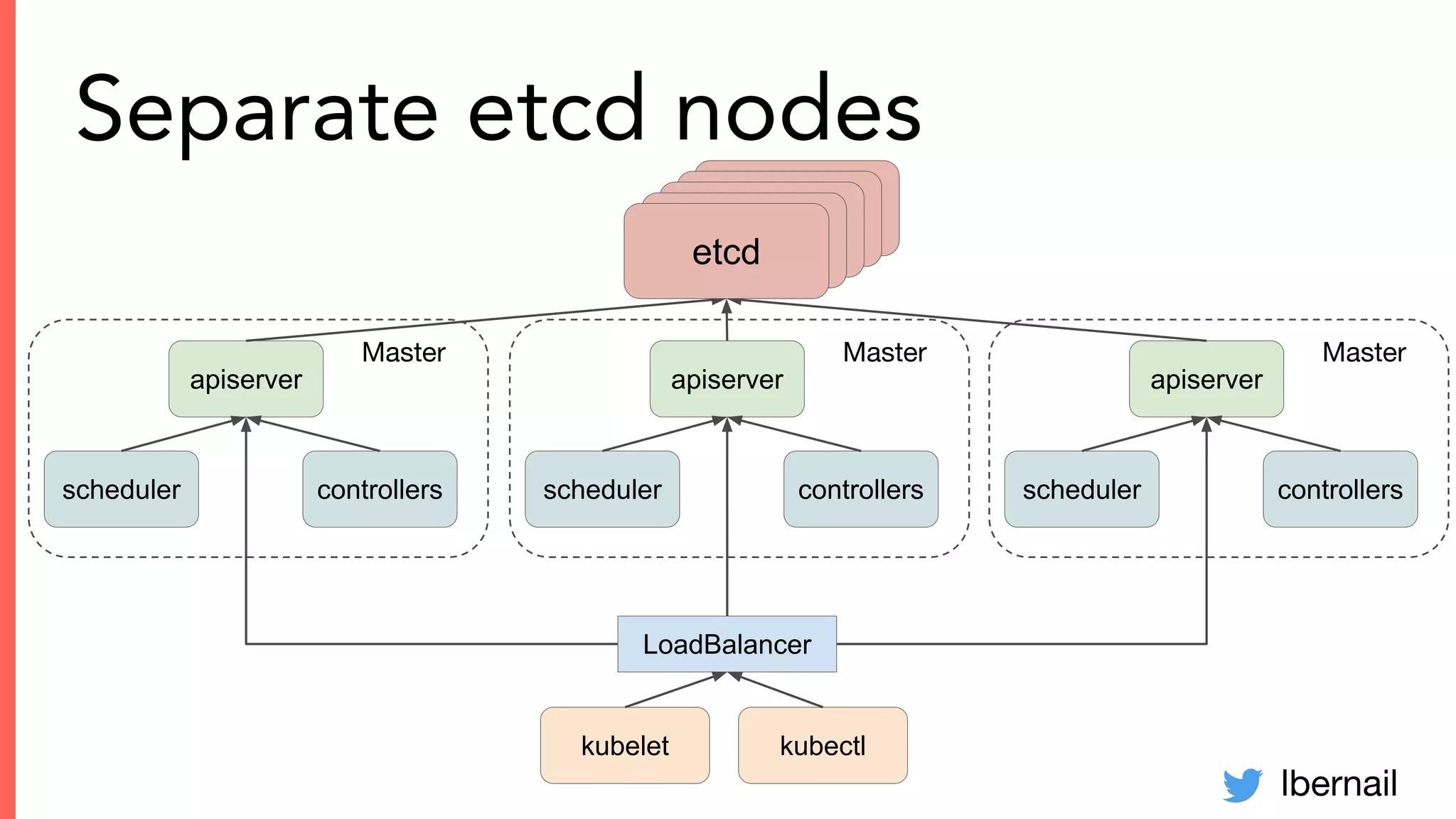
Separate etcd nodes
apiserver
controllersscheduler
kubelet kubectl
Master
apiserver
controllersscheduler
Master
apiserver
controllersscheduler
Master
LoadBalancer
etcdetcdetcdetcdetcd
lbernail
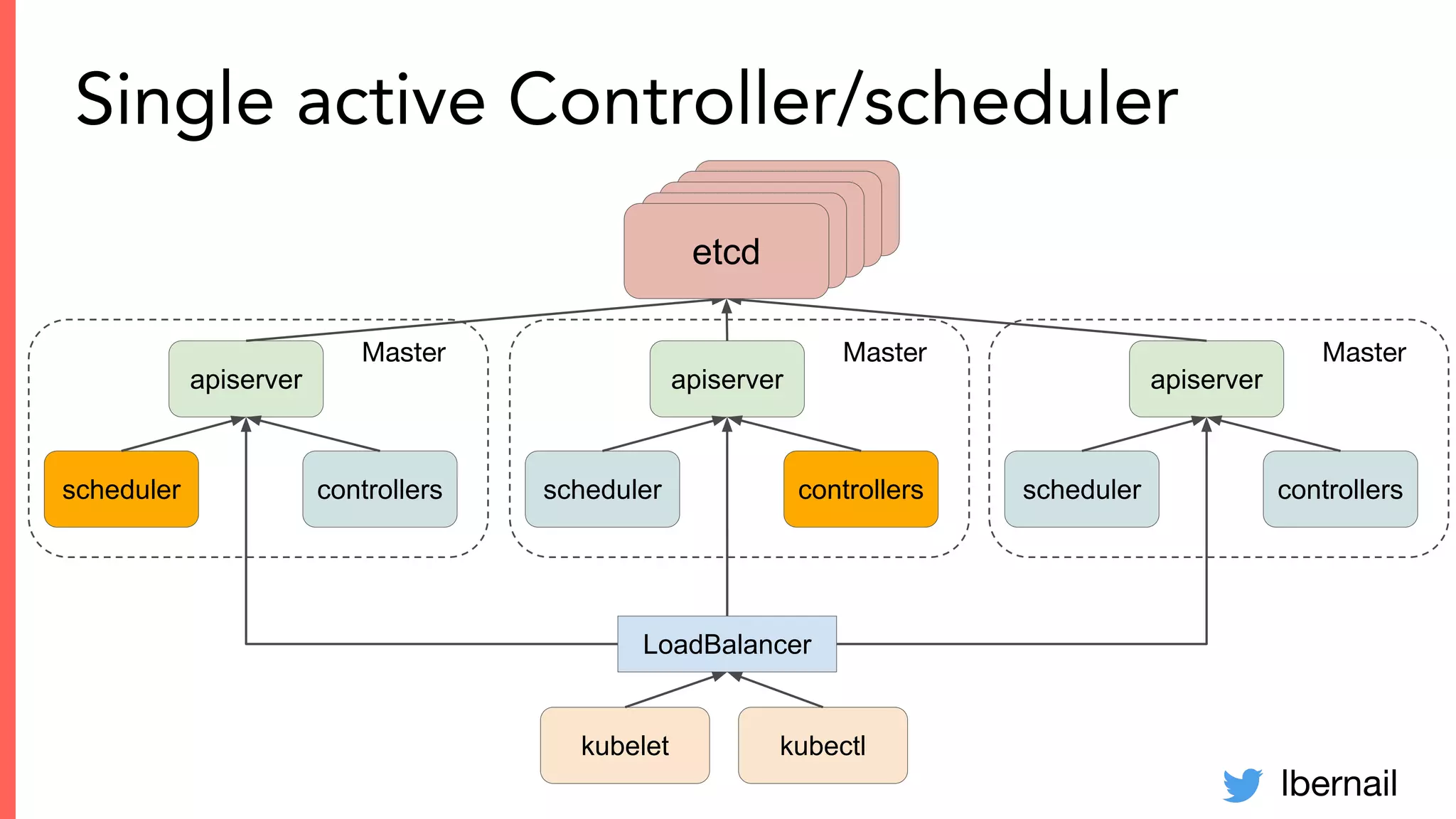
Single active Controller/scheduler
apiserver
controllersscheduler
kubelet kubectl
Master
apiserver
controllersscheduler
Master
apiserver
controllersscheduler
Master
LoadBalancer
etcdetcdetcdetcdetcd
lbernail
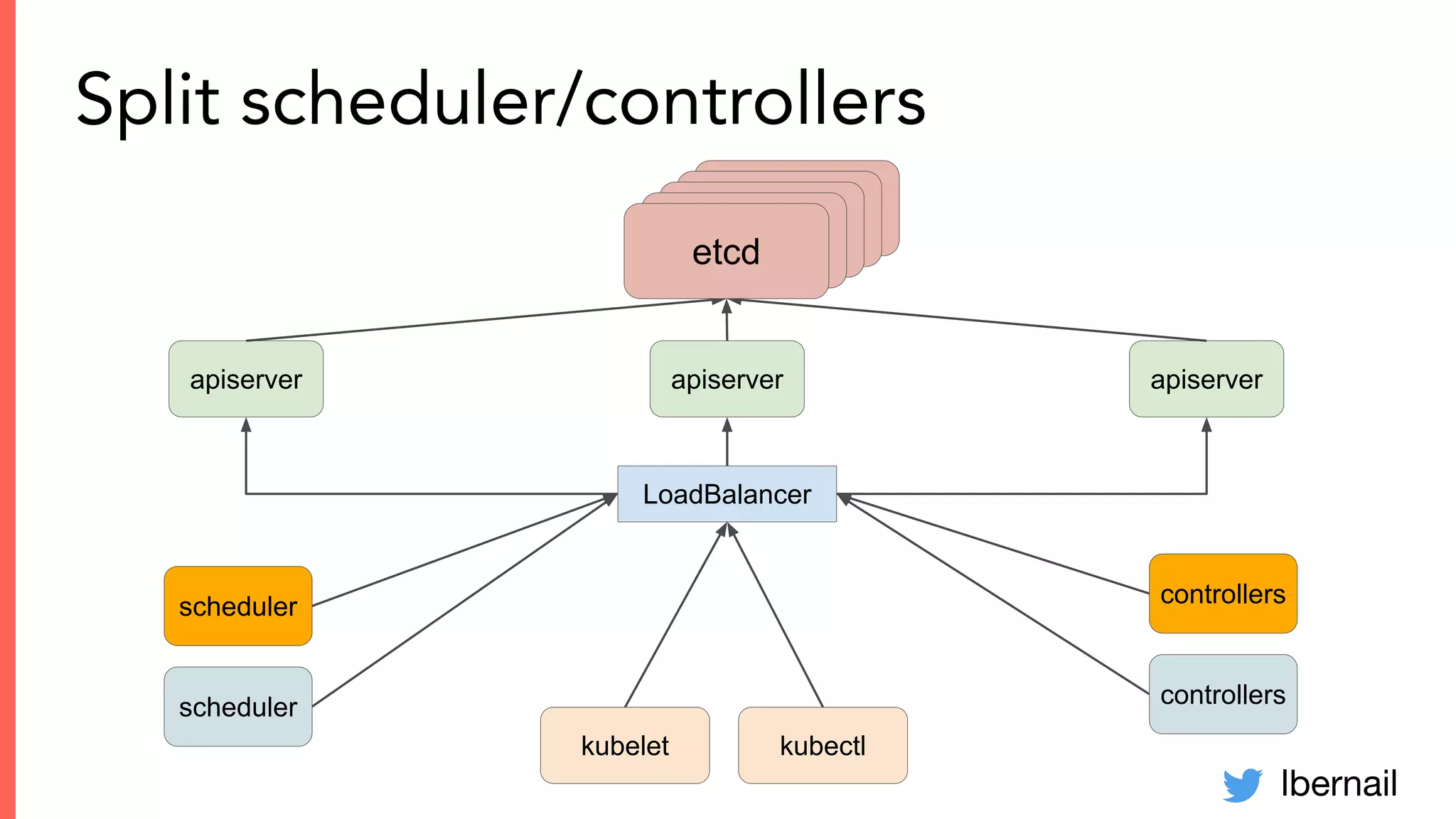
Split scheduler/controllers
apiserver
kubelet kubectl
apiserver apiserver
LoadBalancer
etcdetcdetcdetcdetcd
scheduler
scheduler
controllers
controllers
lbernail
1. Resilient and Scalable Control Plane
2. Securing the Control Plane
a. Kubernetes and Certificates
b. Exceptions?
c. Impact of Certificate Rotation
3. Efficient networking
a. Giving pod IPs and routing them
b. Accessing services: Client-side load-balancing:
c. Ingresses: Getting data in the cluster
What happens after “Kube 101”
Kubernetes and
Certificates
lbernail
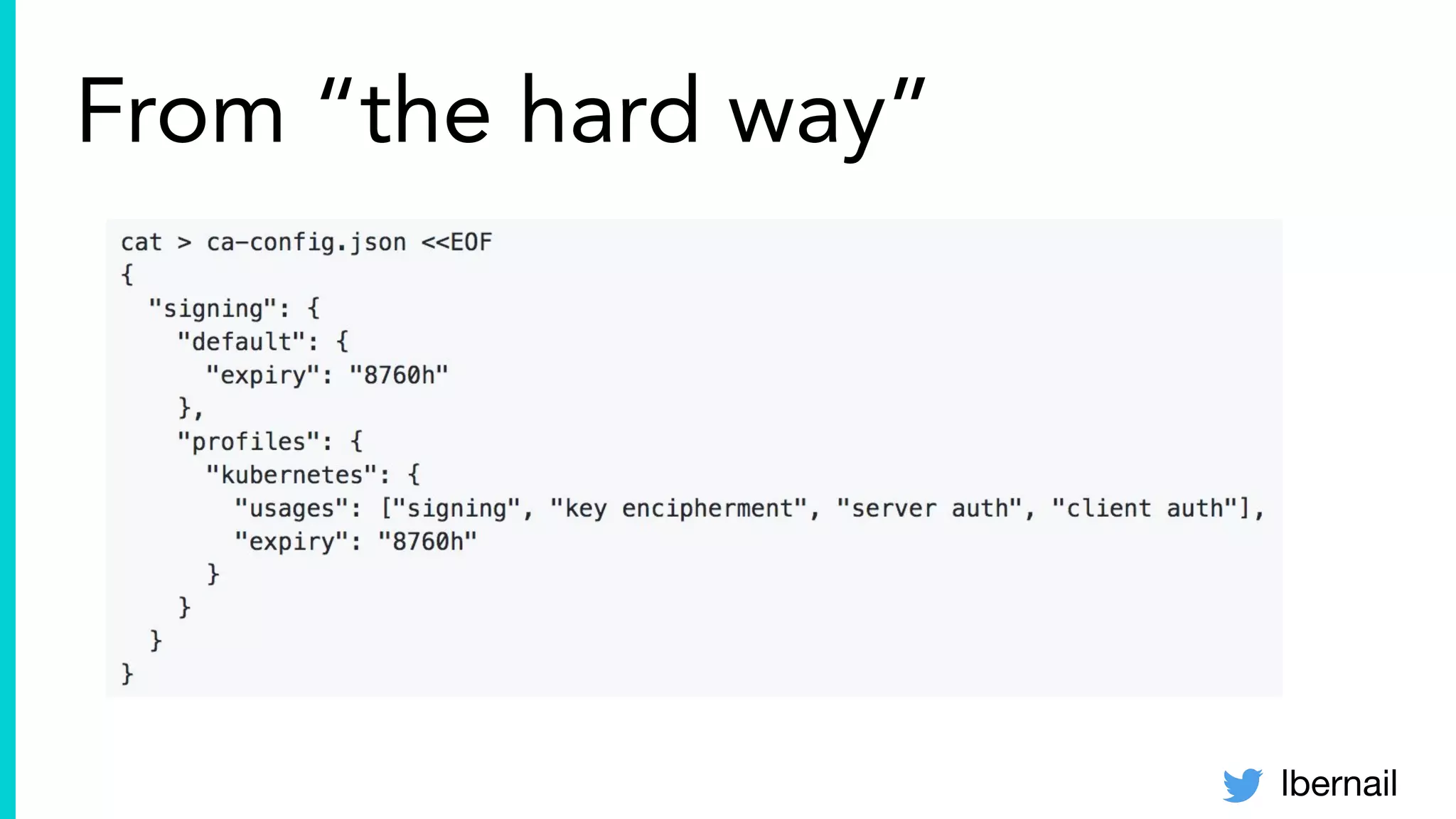
From “the hard way”
lbernail
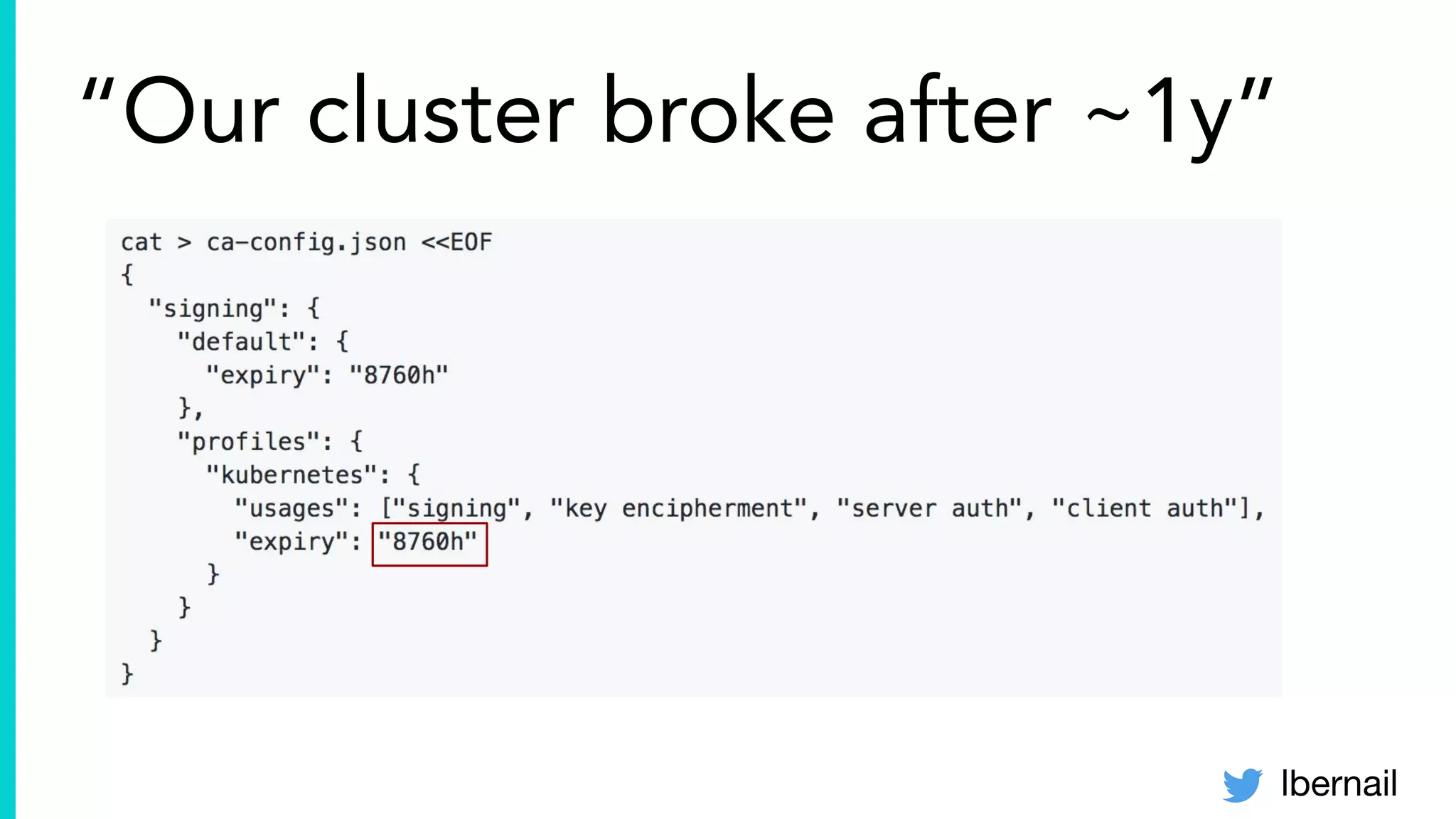
“Our cluster broke after ~1y”
lbernail
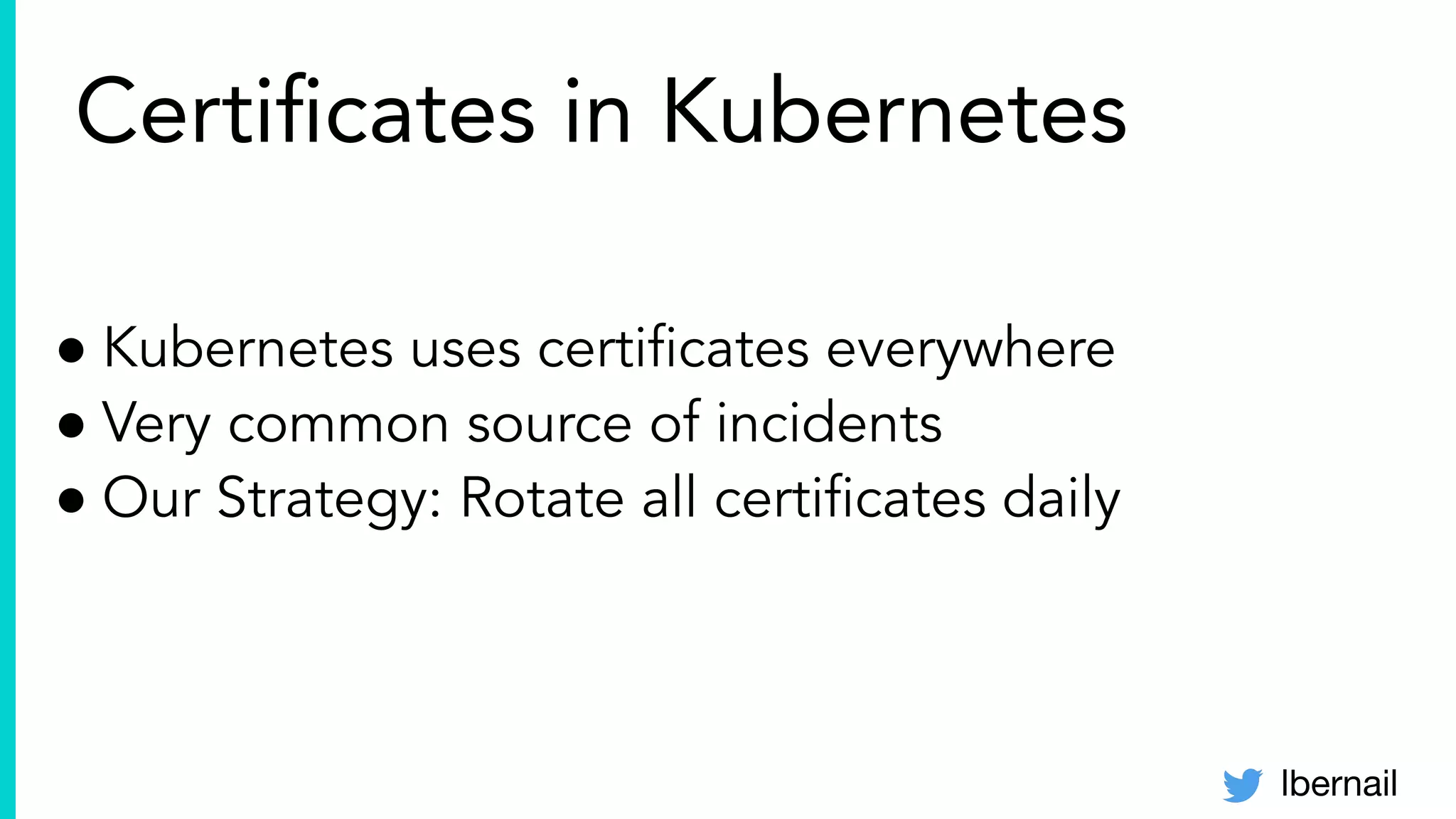
Certificates in Kubernetes
● Kubernetes uses certificates everywhere
● Very common source of incidents
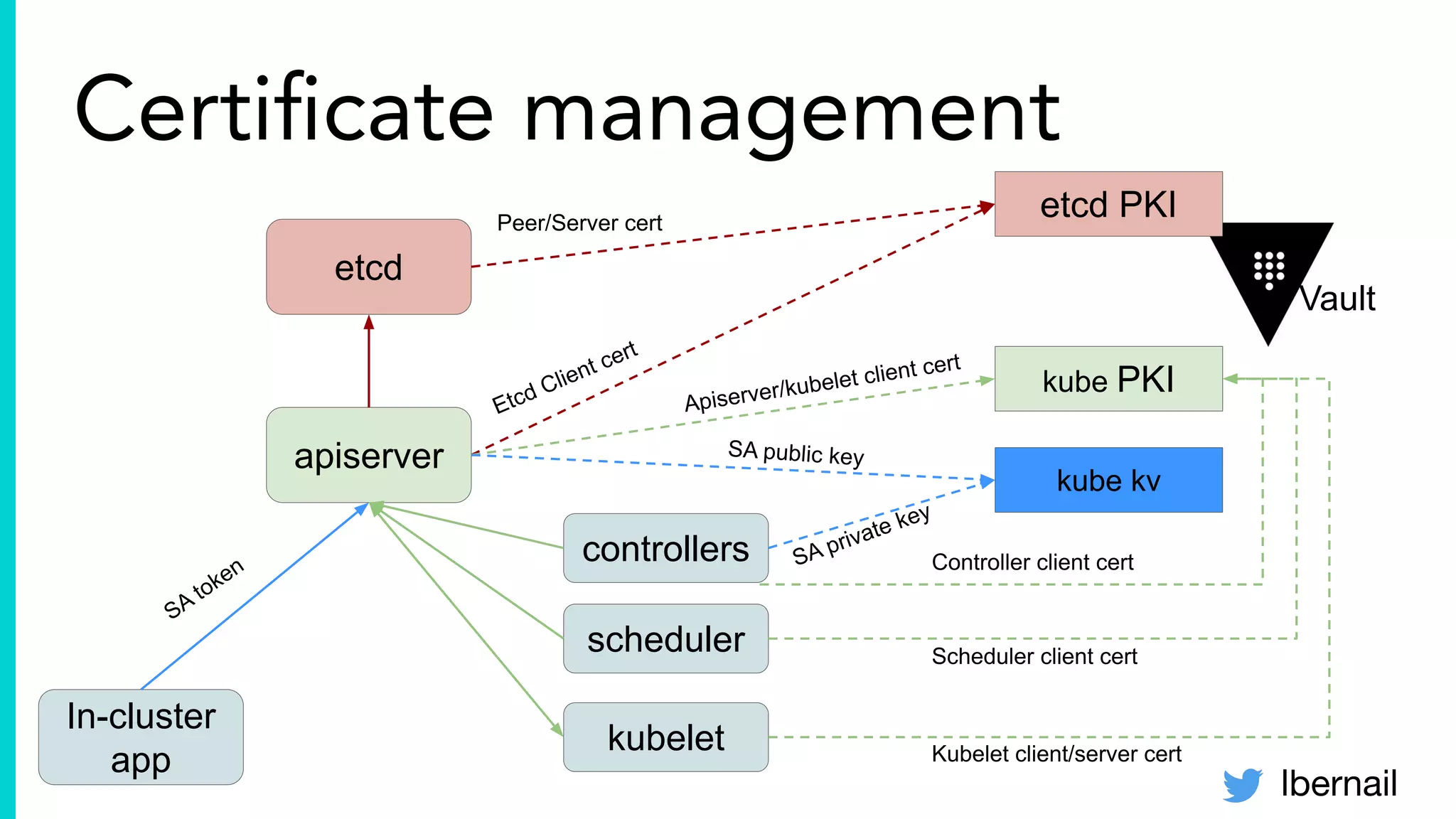
● Our Strategy: Rotate all certificates daily
lbernail
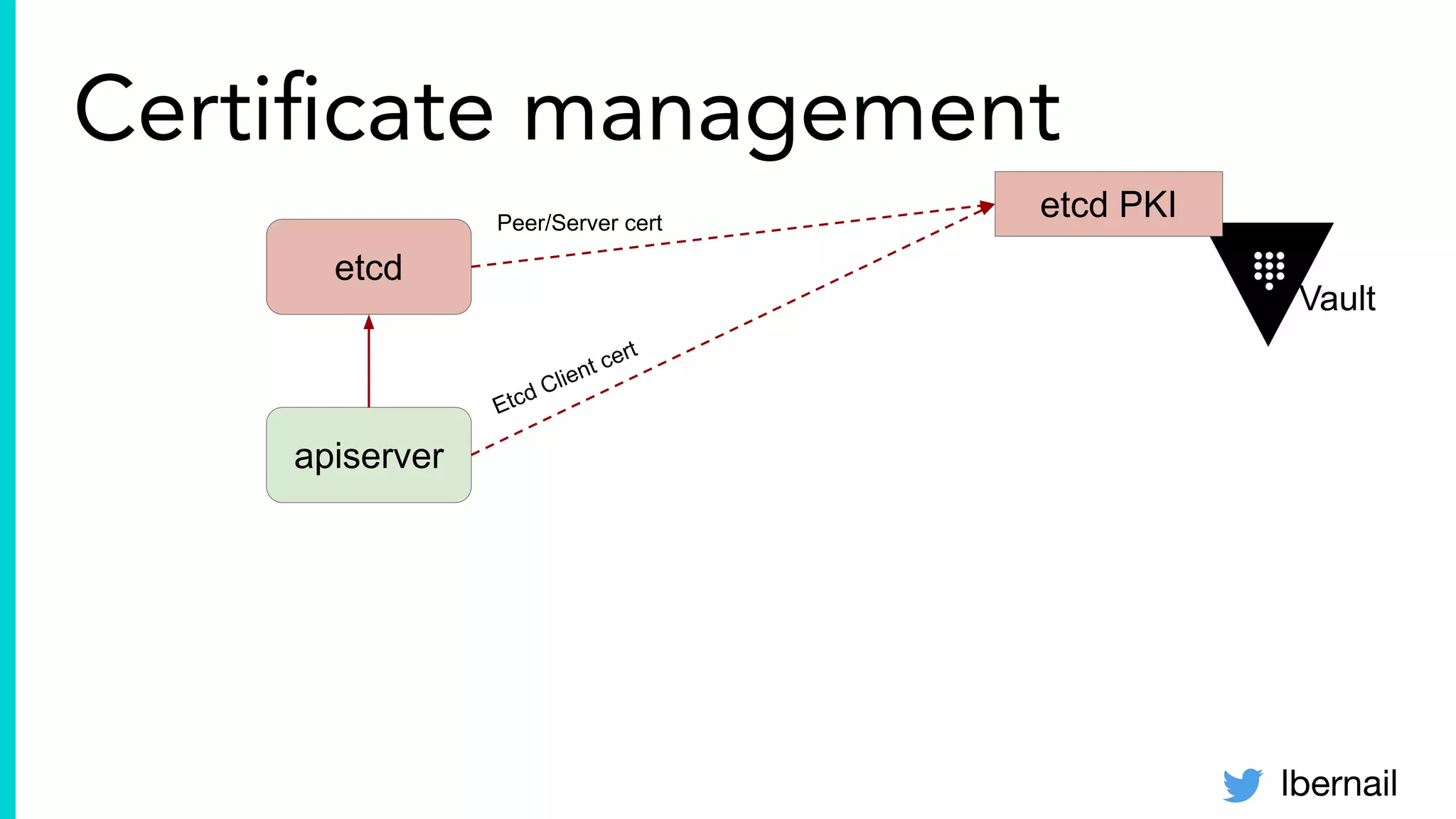
Certificate management
etcd
apiserver
Vault
etcd PKIPeer/Server cert
Etcd Client cert
lbernail
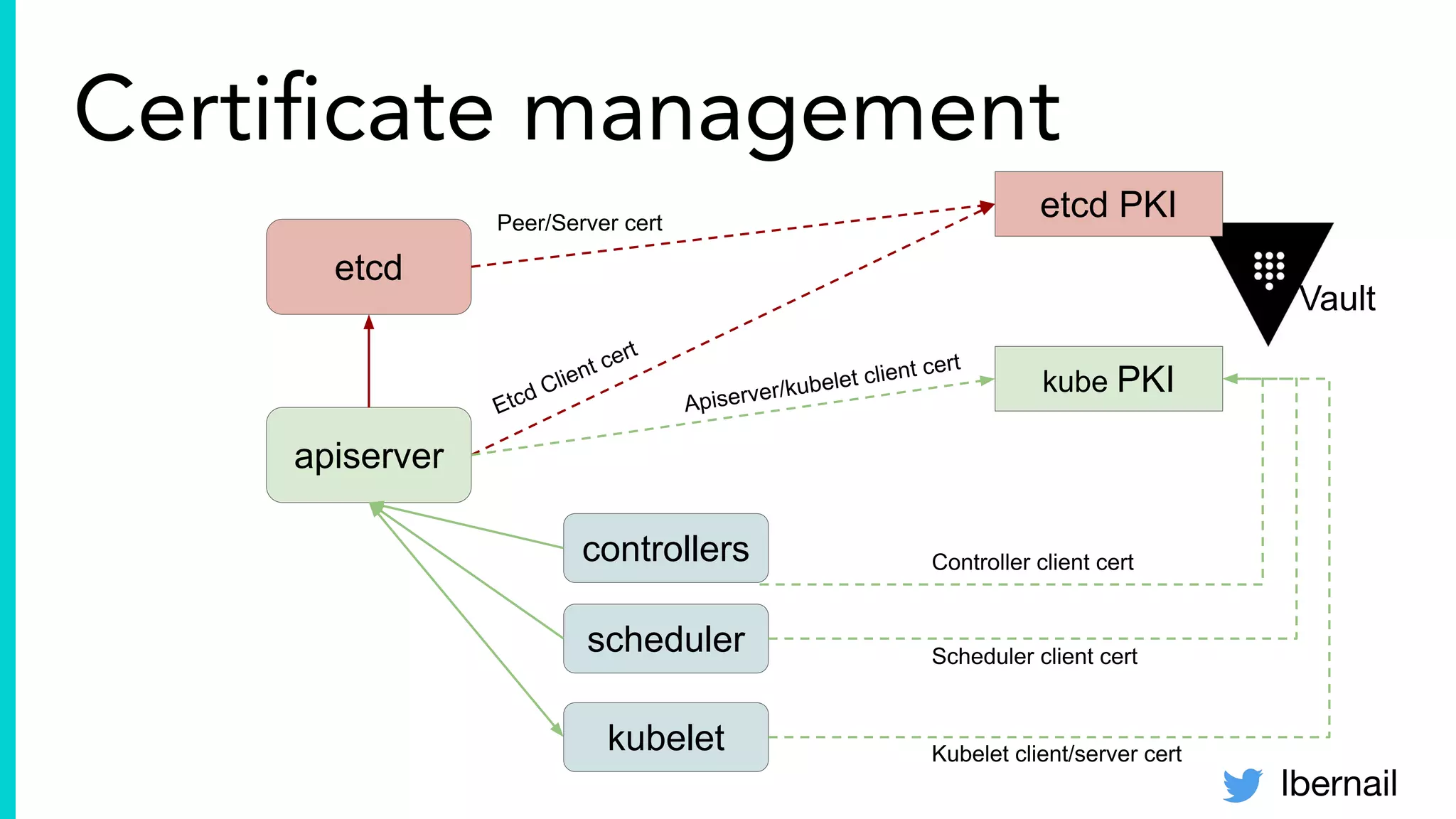
Certificate management
etcd
apiserver
controllers
scheduler
Vault
etcd PKIPeer/Server cert
Etcd Client cert
kube PKI
Apiserver/kubelet client cert
Controller client cert
Scheduler client cert
kubelet Kubelet client/server cert
lbernail
Certificate management
etcd
apiserver
controllers
scheduler
Vault
etcd PKIPeer/Server cert
Etcd Client cert
kube PKI
Apiserver/kubelet client cert
kube kv
SA public key
SA private key
Controller client cert
Scheduler client cert
In-cluster
app
SA
token
kubelet Kubelet client/server cert
lbernail
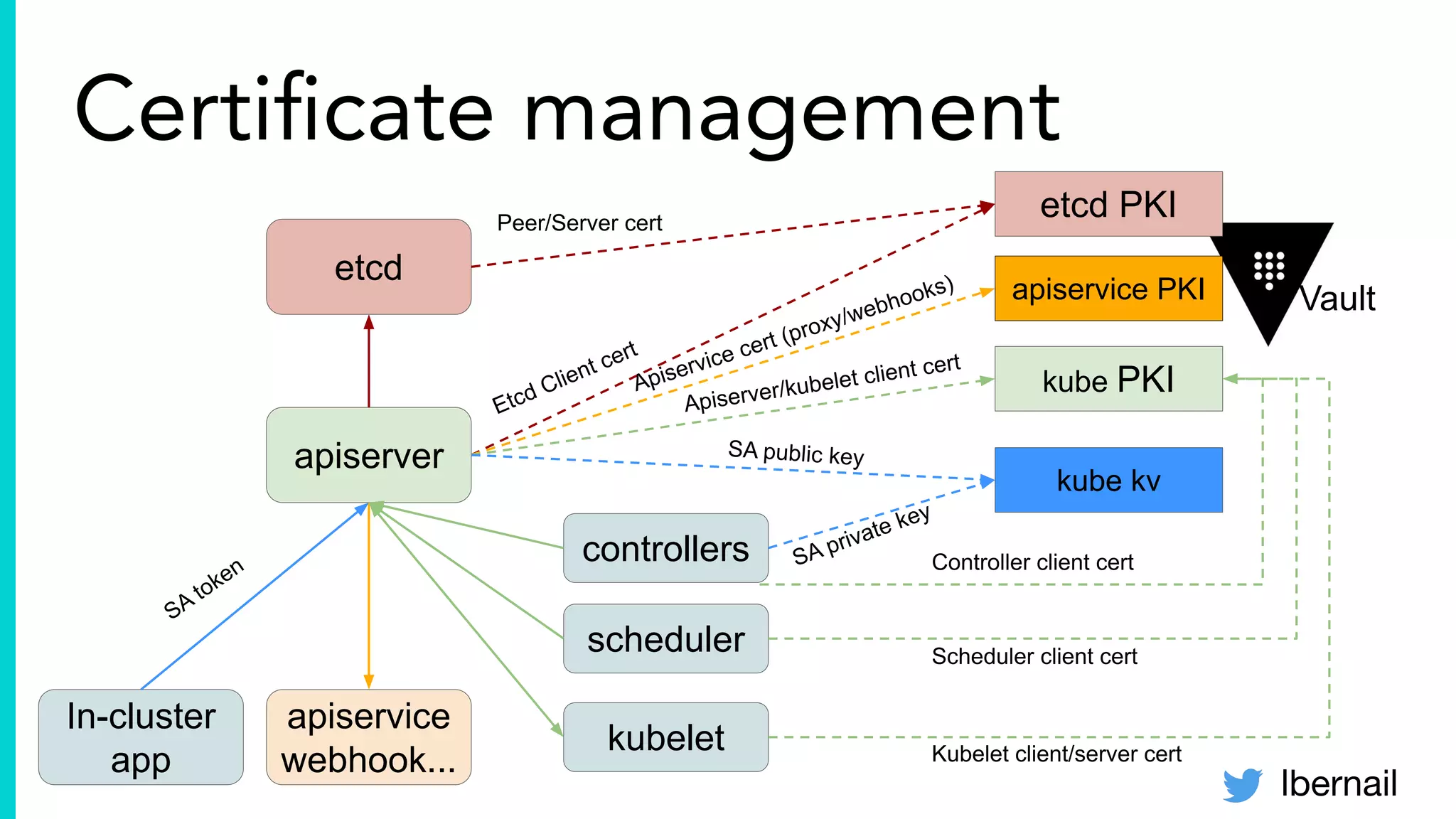
Certificate management
etcd
apiserver
controllers
scheduler
apiservice
webhook...
Vault
etcd PKIPeer/Server cert
Etcd Client cert
apiservice PKI
Apiservice cert (proxy/webhooks)
kube PKI
Apiserver/kubelet client cert
kube kv
SA public key
SA private key
Controller client cert
Scheduler client cert
In-cluster
app
SA
token
kubelet Kubelet client/server cert
lbernail
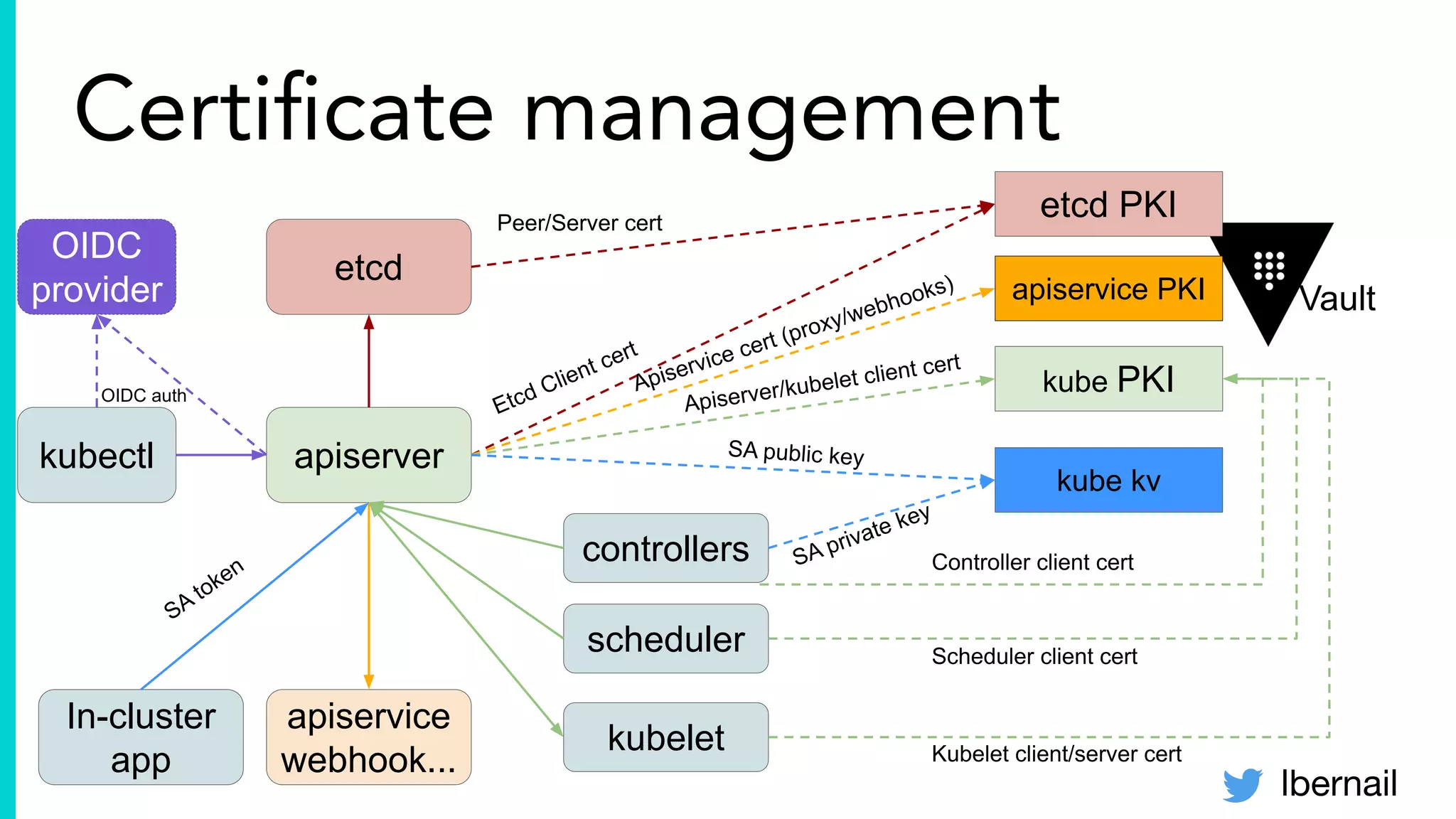
Certificate management
etcd
apiserver
controllers
scheduler
apiservice
webhook...
Vault
etcd PKIPeer/Server cert
Etcd Client cert
apiservice PKI
Apiservice cert (proxy/webhooks)
kube PKI
Apiserver/kubelet client cert
kube kv
SA public key
SA private key
Controller client cert
Scheduler client cert
OIDC
provider
kubectl
OIDC auth
In-cluster
app
SA
token
kubelet Kubelet client/server cert
Exception ?
Incident...
lbernail
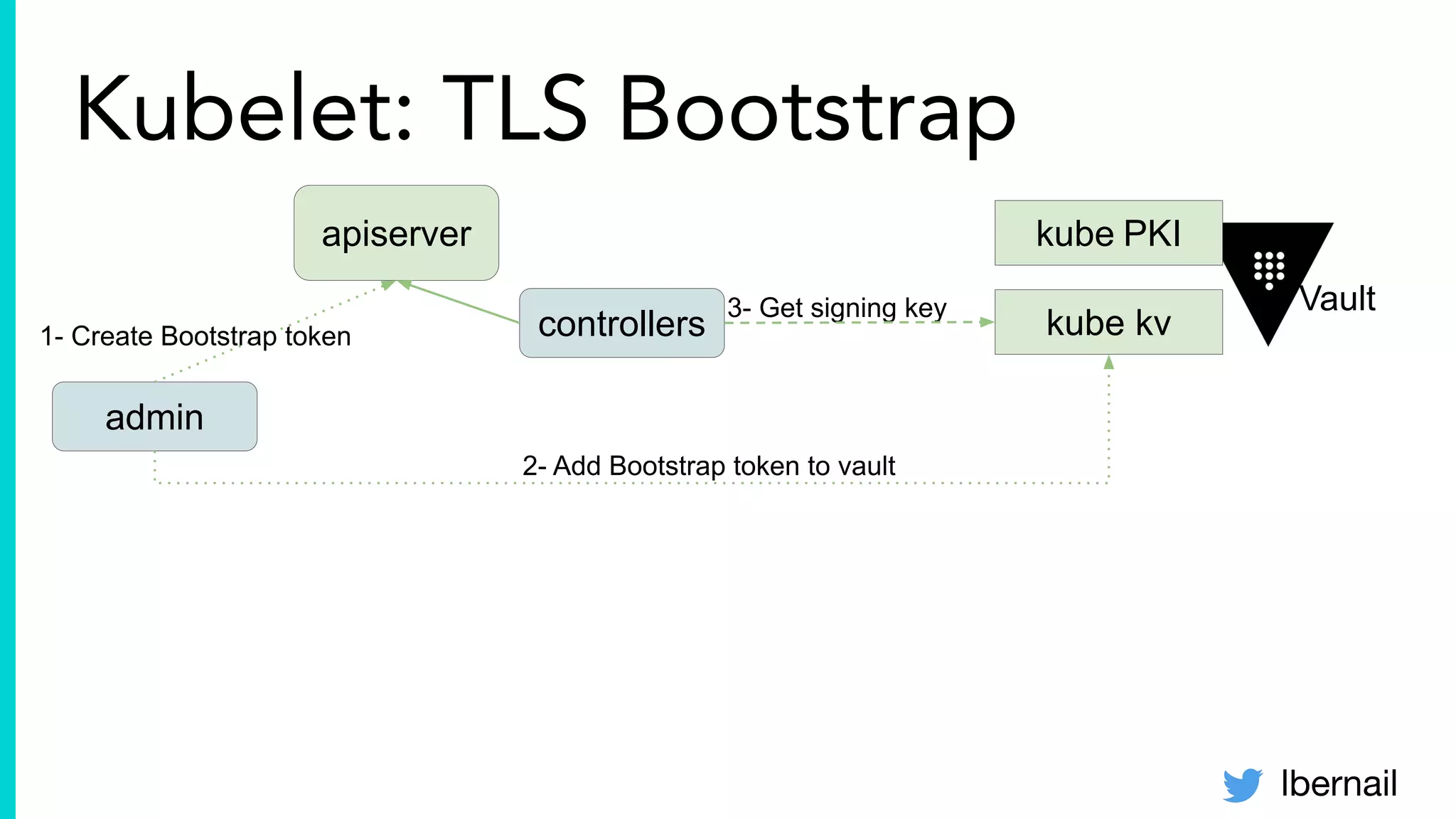
Kubelet: TLS Bootstrap
apiserver
controllers
Vault
kube PKI
kube kv3- Get signing key
admin
1- Create Bootstrap token
2- Add Bootstrap token to vault
lbernail
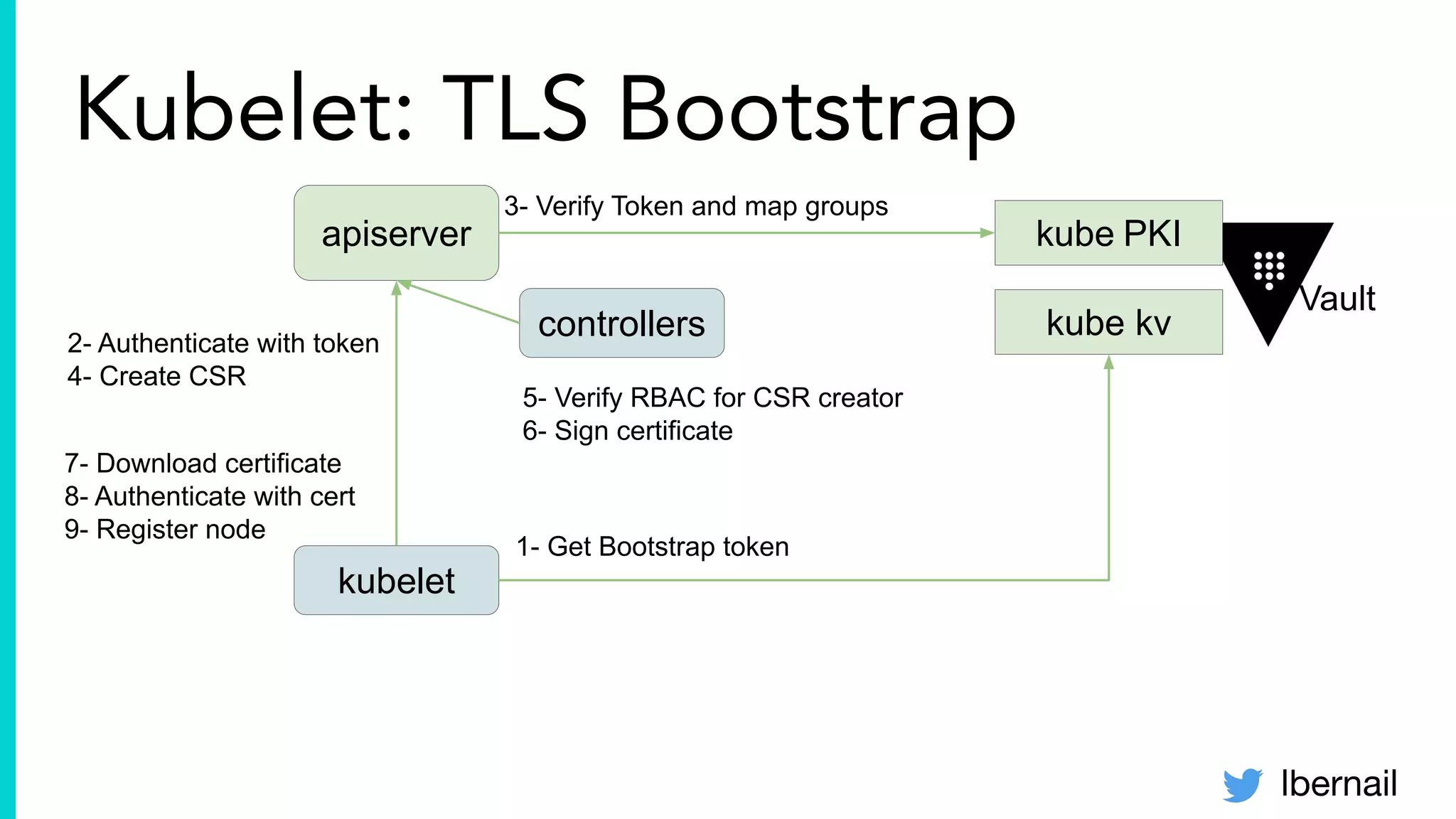
Kubelet: TLS Bootstrap
apiserver
controllers
Vault
kube PKI
kube kv
kubelet
5- Verify RBAC for CSR creator
6- Sign certificate
1- Get Bootstrap token
2- Authenticate with token
4- Create CSR
7- Download certificate
8- Authenticate with cert
9- Register node
3- Verify Token and map groups
lbernail
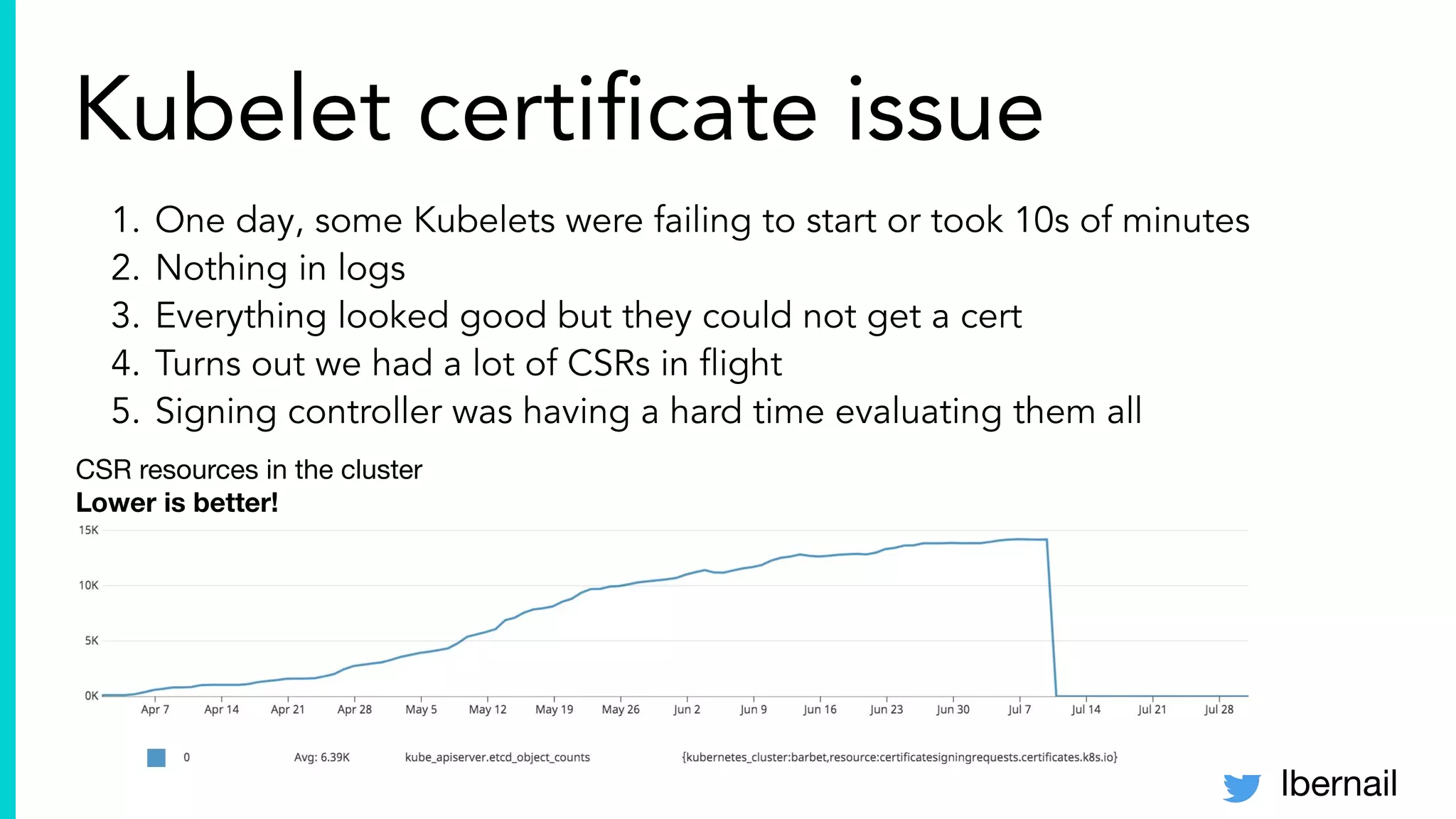
Kubelet certificate issue
1. One day, some Kubelets were failing to start or took 10s of minutes
2. Nothing in logs
3. Everything looked good but they could not get a cert
4. Turns out we had a lot of CSRs in flight
5. Signing controller was having a hard time evaluating them all
CSR resources in the cluster
Lower is better!
lbernail
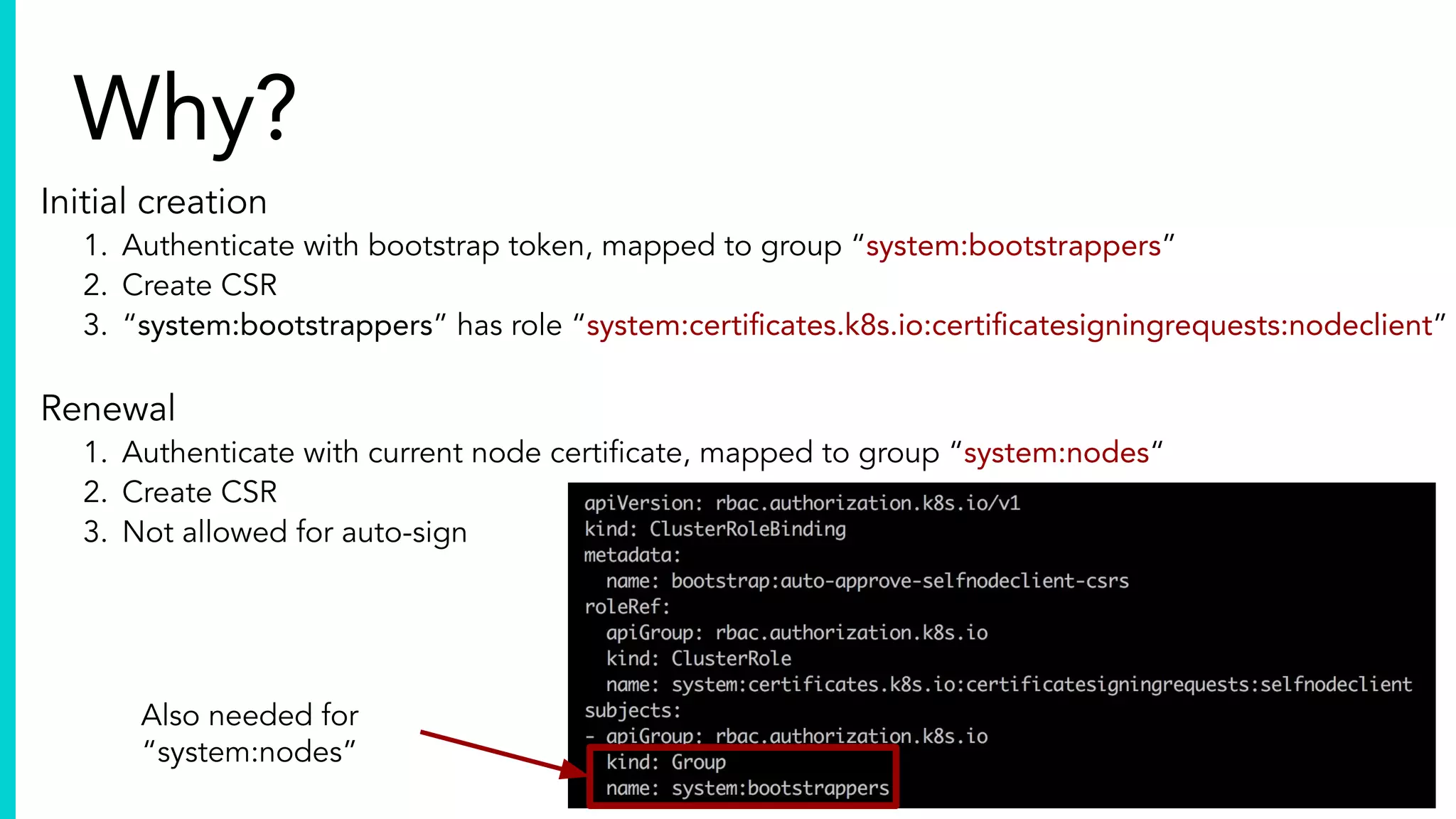
Why?
Initial creation
1. Authenticate with bootstrap token, mapped to group “system:bootstrappers”
2. Create CSR
3. “system:bootstrappers” has role “system:certificates.k8s.io:certificatesigningrequests:nodeclient”
Renewal
1. Authenticate with current node certificate, mapped to group “system:nodes“
2. Create CSR
3. Not allowed for auto-sign
Also needed for
“system:nodes”
Exception 2?
Incident 2...
lbernail
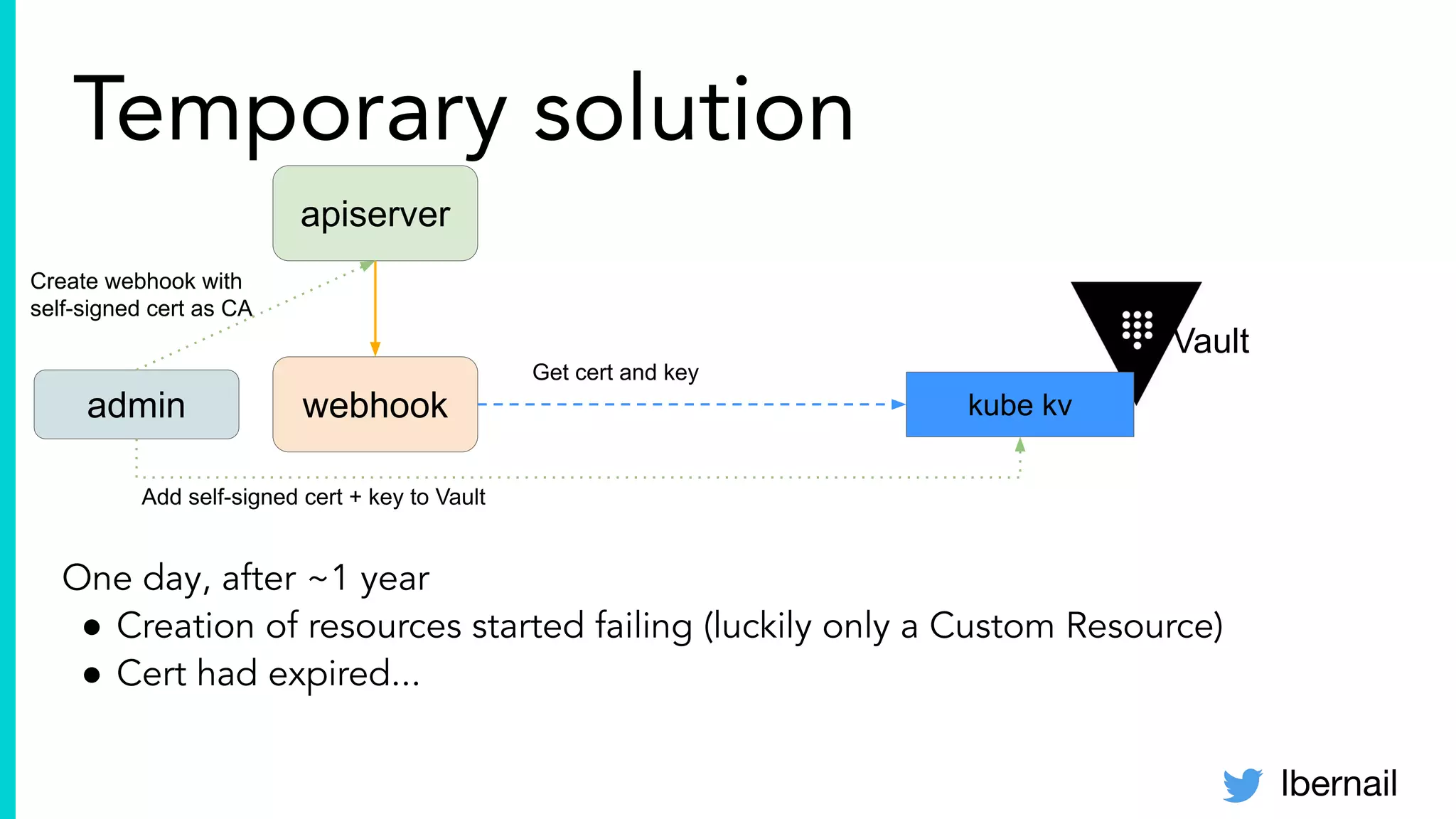
Temporary solution
apiserver
webhook
Vault
kube kv
Get cert and key
admin
Create webhook with
self-signed cert as CA
Add self-signed cert + key to Vault
One day, after ~1 year
● Creation of resources started failing (luckily only a Custom Resource)
● Cert had expired...
lbernail
Take-away
● Rotate server/client certificates
● Not easy
But, “If it’s hard, do it often”
> no expiration issues anymore
Impact of
Certificate rotation
lbernail
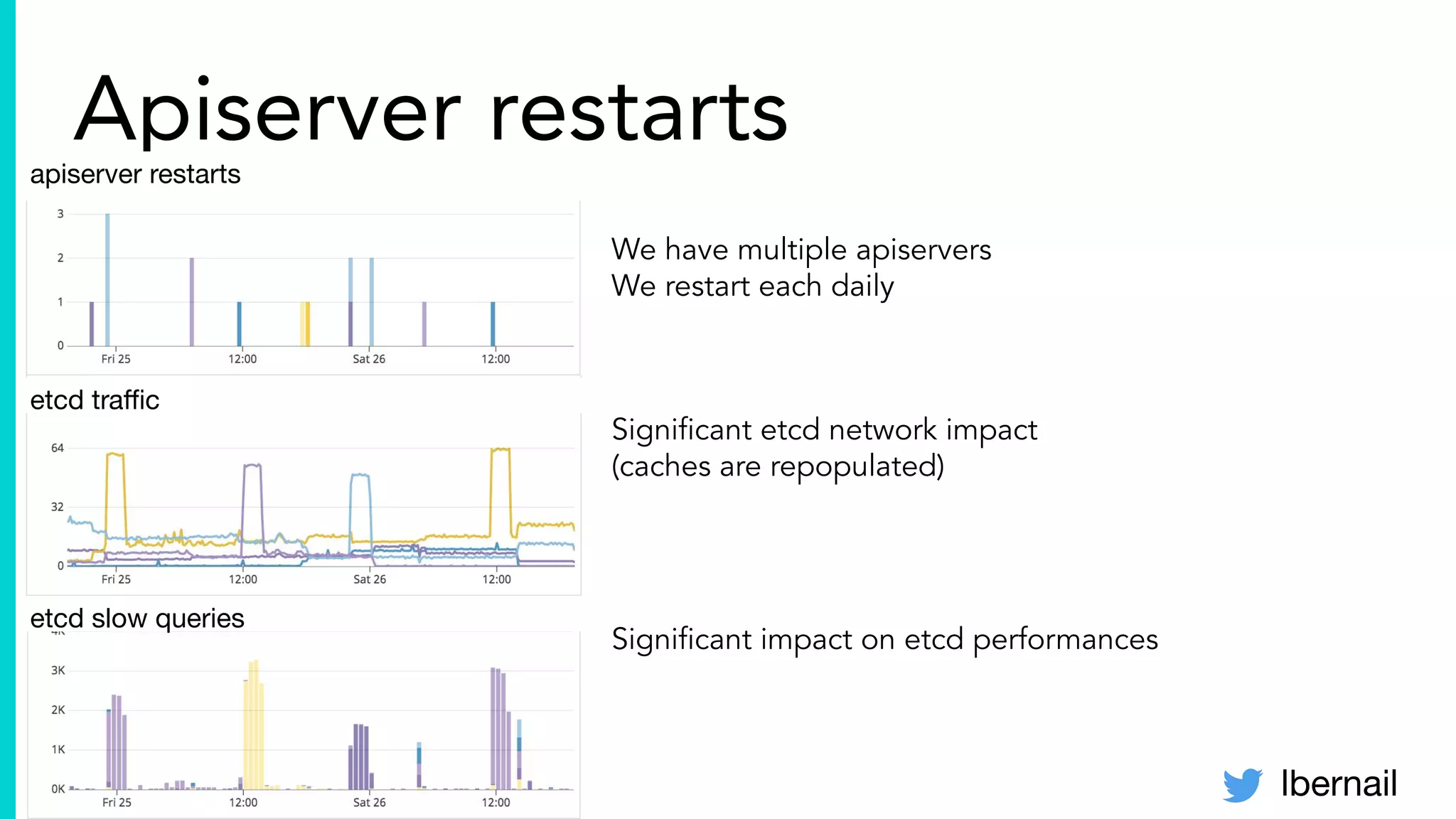
Apiserver restartsapiserver restarts
etcd slow queries
etcd traffic
We have multiple apiservers
We restart each daily
Significant etcd network impact
(caches are repopulated)
Significant impact on etcd performances
lbernail
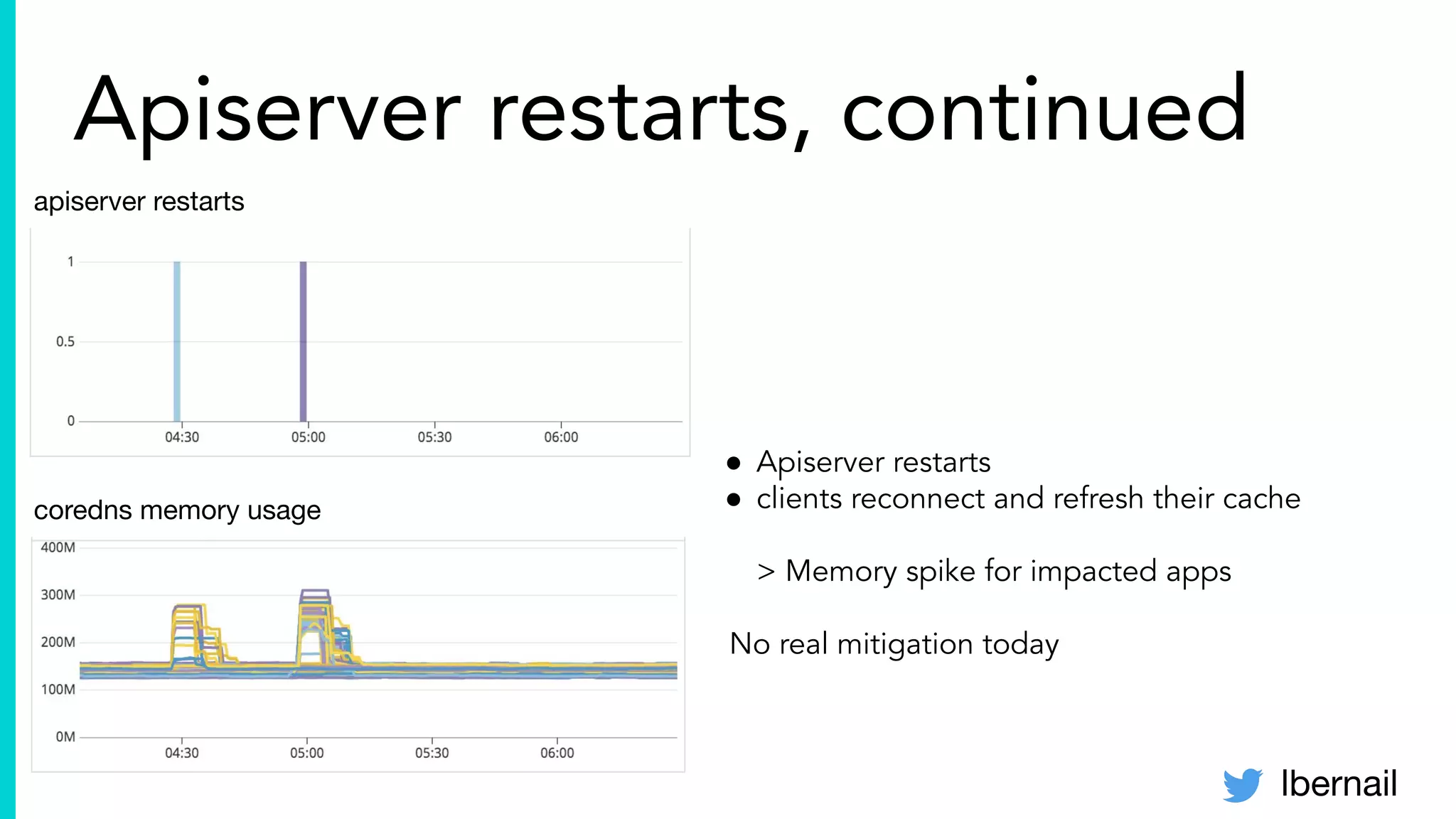
Apiserver restarts, continued
apiserver restarts
coredns memory usage
● Apiserver restarts
● clients reconnect and refresh their cache
> Memory spike for impacted apps
No real mitigation today
lbernail
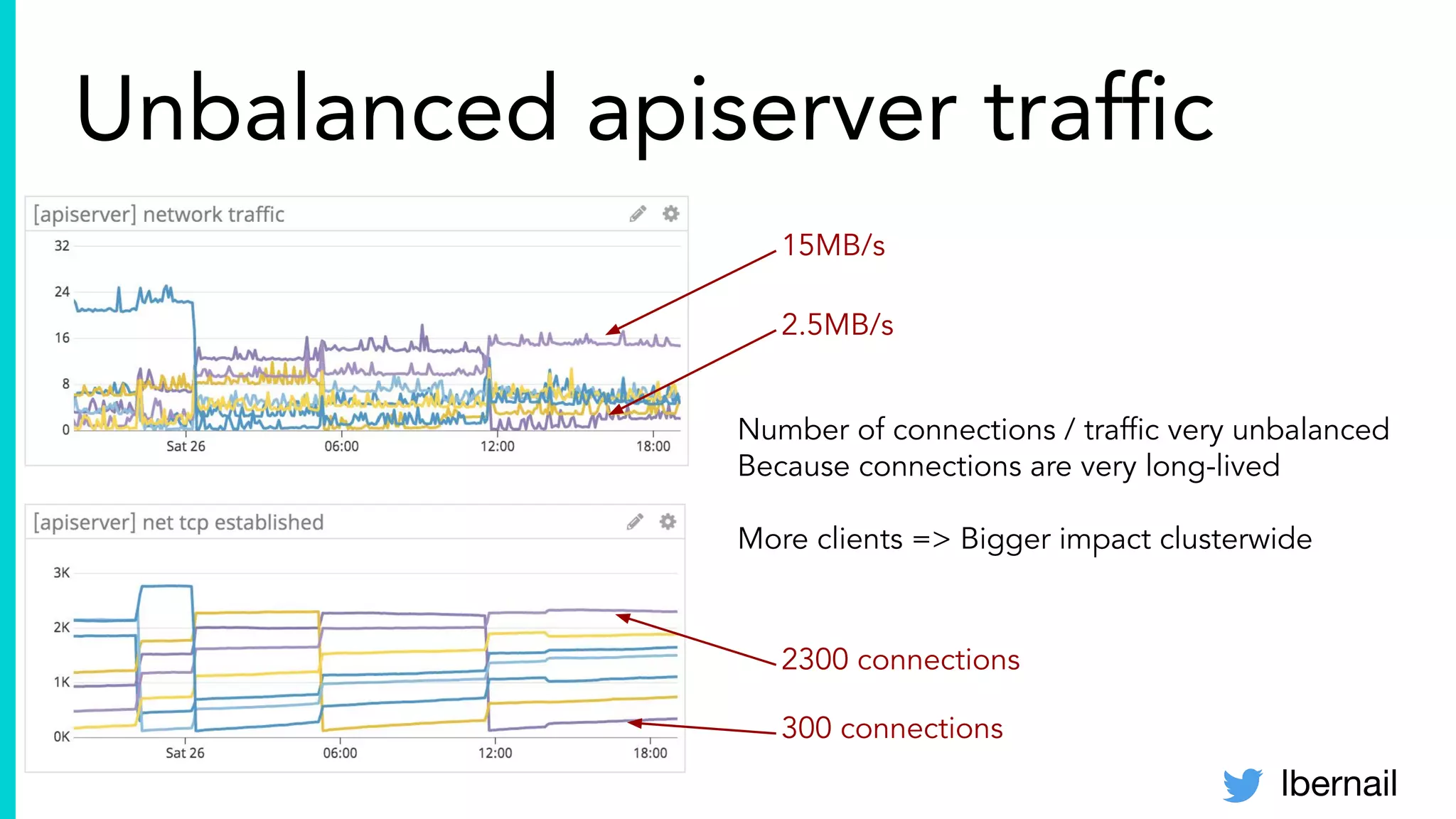
Unbalanced apiserver traffic
Number of connections / traffic very unbalanced
Because connections are very long-lived
More clients => Bigger impact clusterwide
15MB/s
2.5MB/s
2300 connections
300 connections
lbernail
Take-away
Restarting components is not transparent
○ Not limited to apiservers, some issues with the Kubelet too
It would be great if
○ Components could transparently reload certs (server & client)
○ Clients could wait 0-Xs to reconnect to avoid thundering herd
○ Reconnections did not trigger memory spikes
○ Connections were rebalanced (kill them after a while?)
lbernail
What happens after “Kube 101”
1. Resilient and Scalable Control Plane
2. Securing the Control Plane
a. Kubernetes and Certificates
b. Exceptions?
c. Impact of Certificate Rotation
3. Efficient networking
a. Giving pod IPs and routing them
b. Accessing services: Client-side load-balancing:
c. Ingresses: Getting data in the cluster
Efficient
networking
lbernail
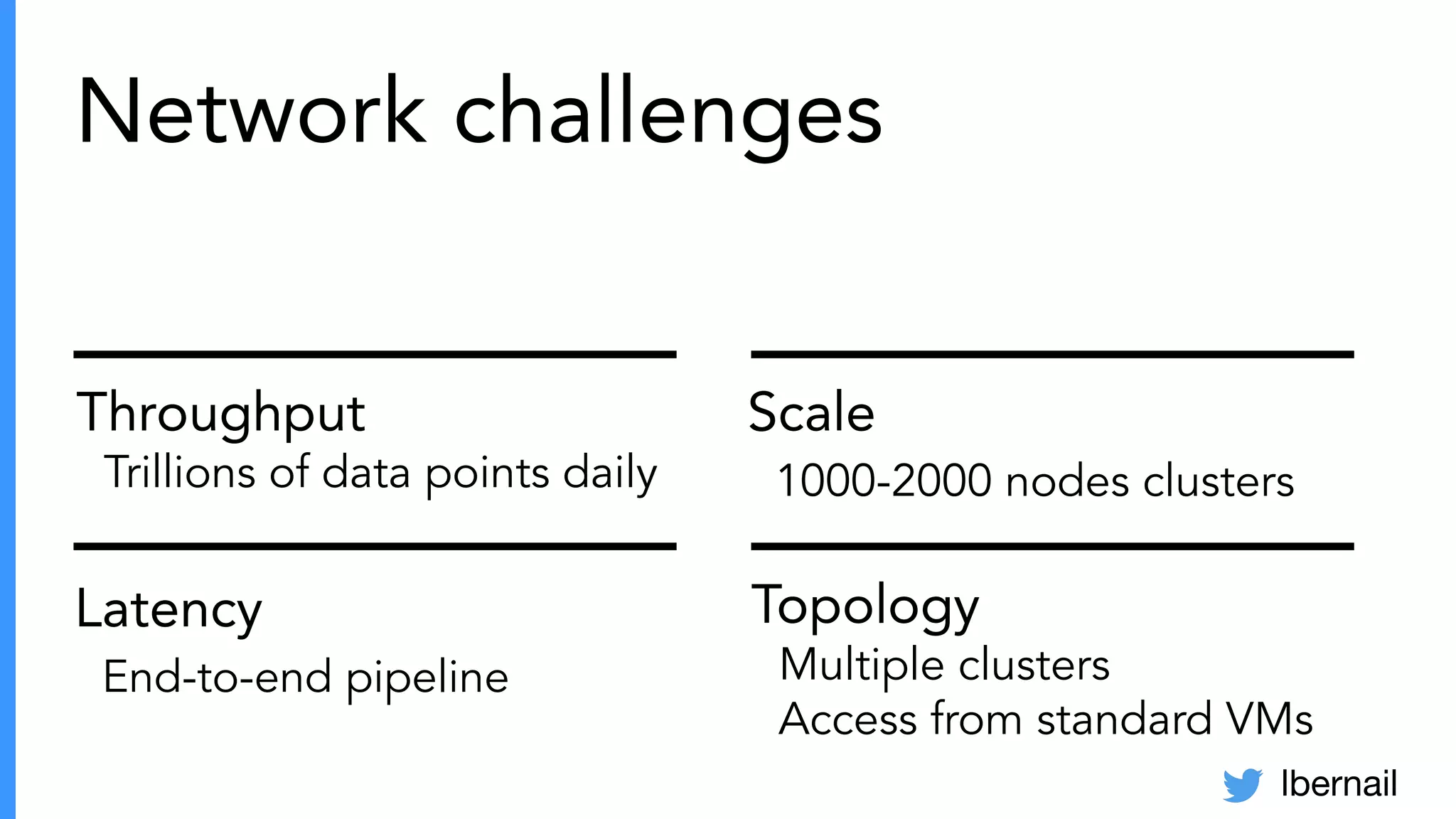
Throughput
Trillions of data points daily
Scale
1000-2000 nodes clusters
Network challenges
Latency
End-to-end pipeline
Topology
Multiple clusters
Access from standard VMs
Giving pods IPs &
Routing them
lbernail
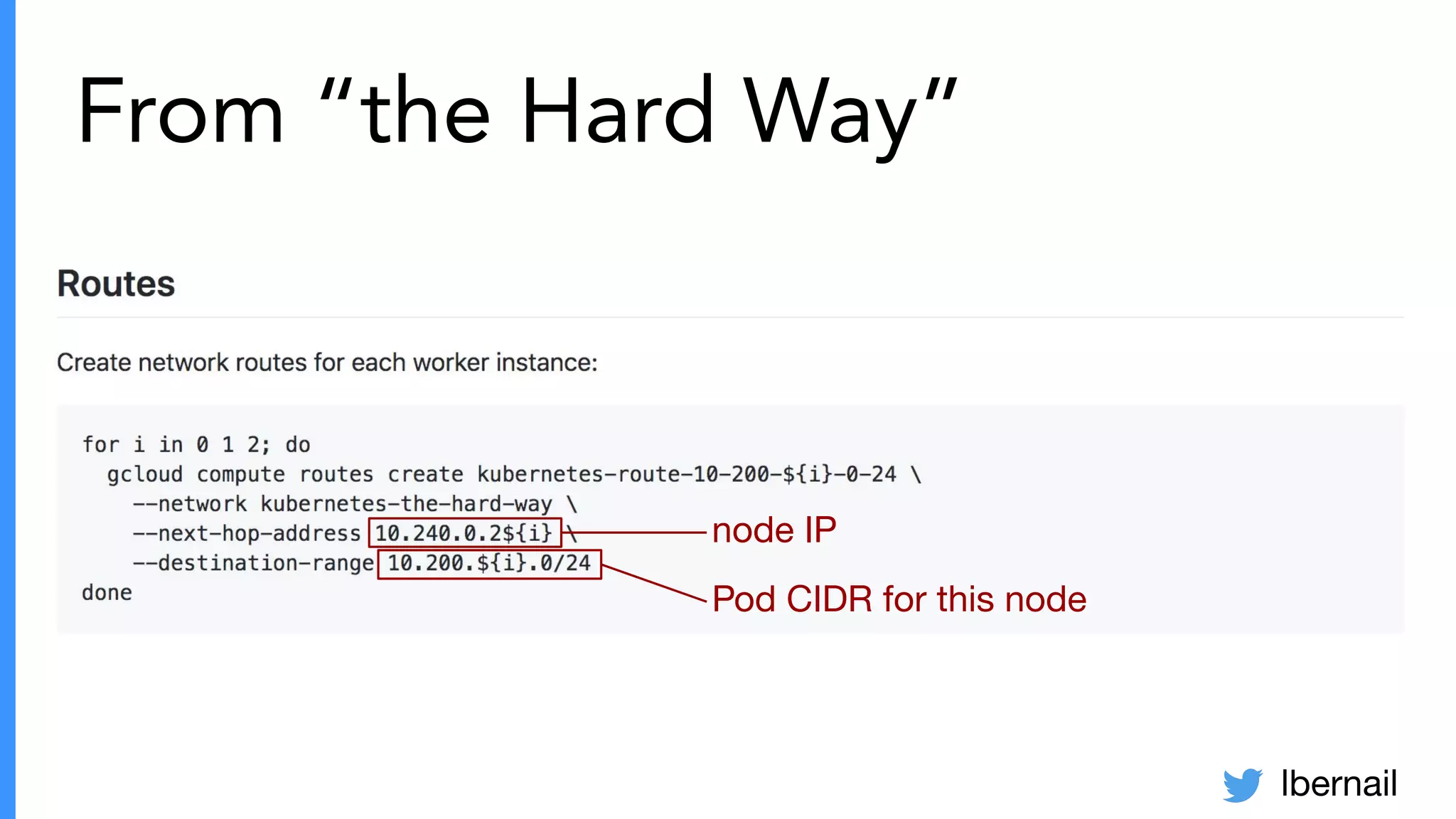
From “the Hard Way”
node IP
Pod CIDR for this node
lbernail
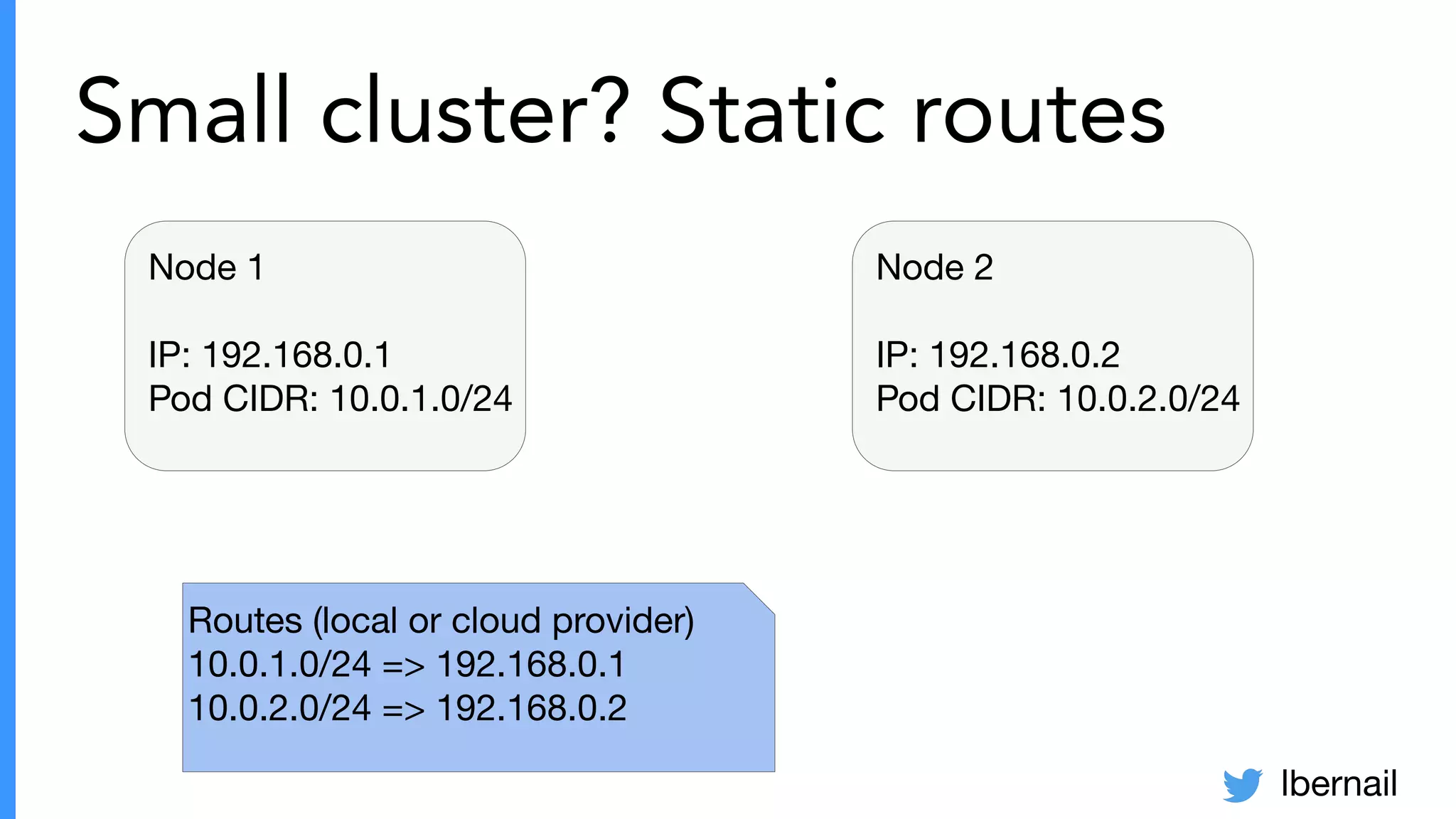
Small cluster? Static routes
Node 1
IP: 192.168.0.1
Pod CIDR: 10.0.1.0/24
Routes (local or cloud provider)
10.0.1.0/24 => 192.168.0.1
10.0.2.0/24 => 192.168.0.2
Node 2
IP: 192.168.0.2
Pod CIDR: 10.0.2.0/24
lbernail
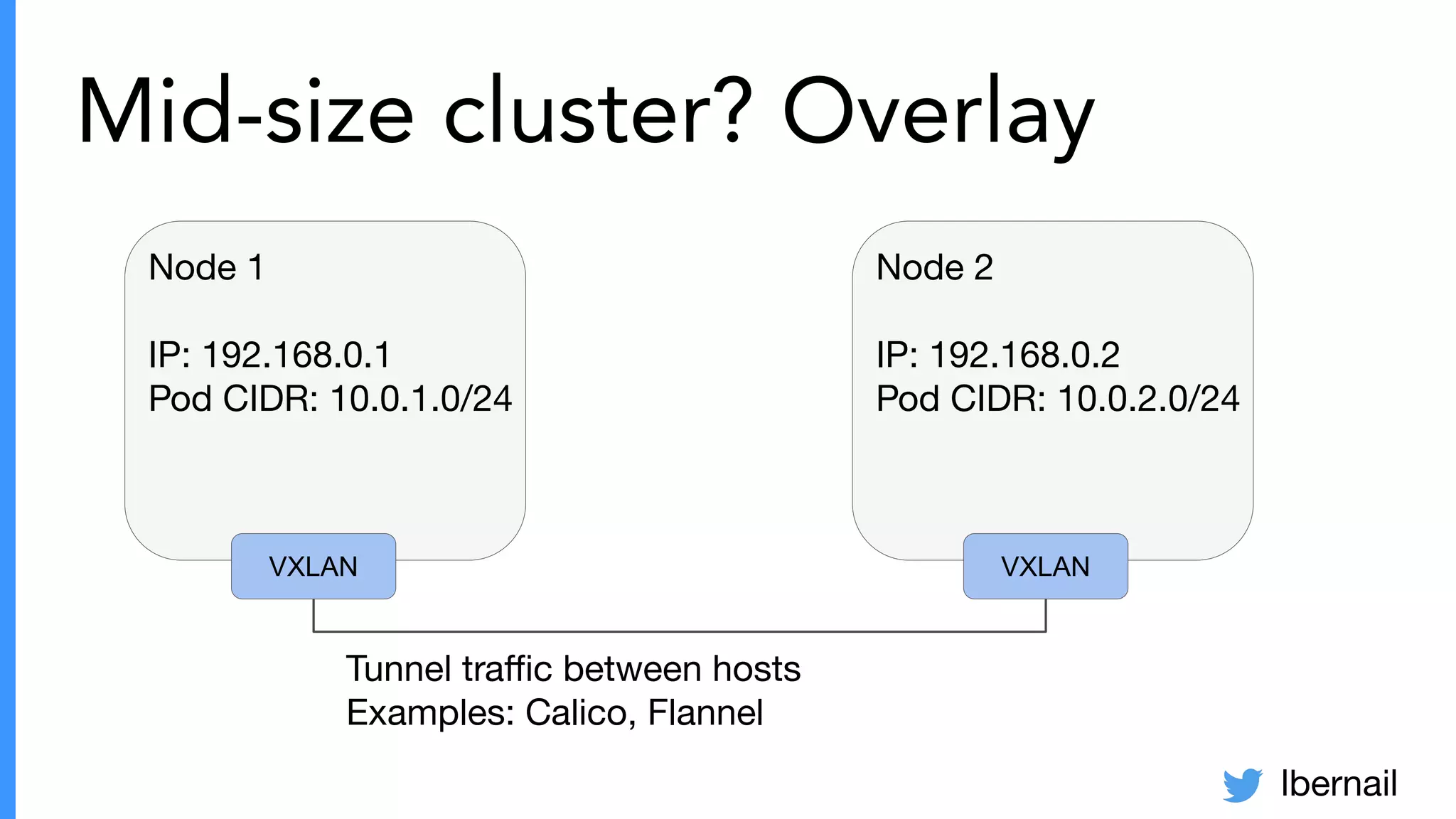
Mid-size cluster? Overlay
Node 1
IP: 192.168.0.1
Pod CIDR: 10.0.1.0/24
Node 2
IP: 192.168.0.2
Pod CIDR: 10.0.2.0/24
VXLAN VXLAN
Tunnel traffic between hosts
Examples: Calico, Flannel
lbernail
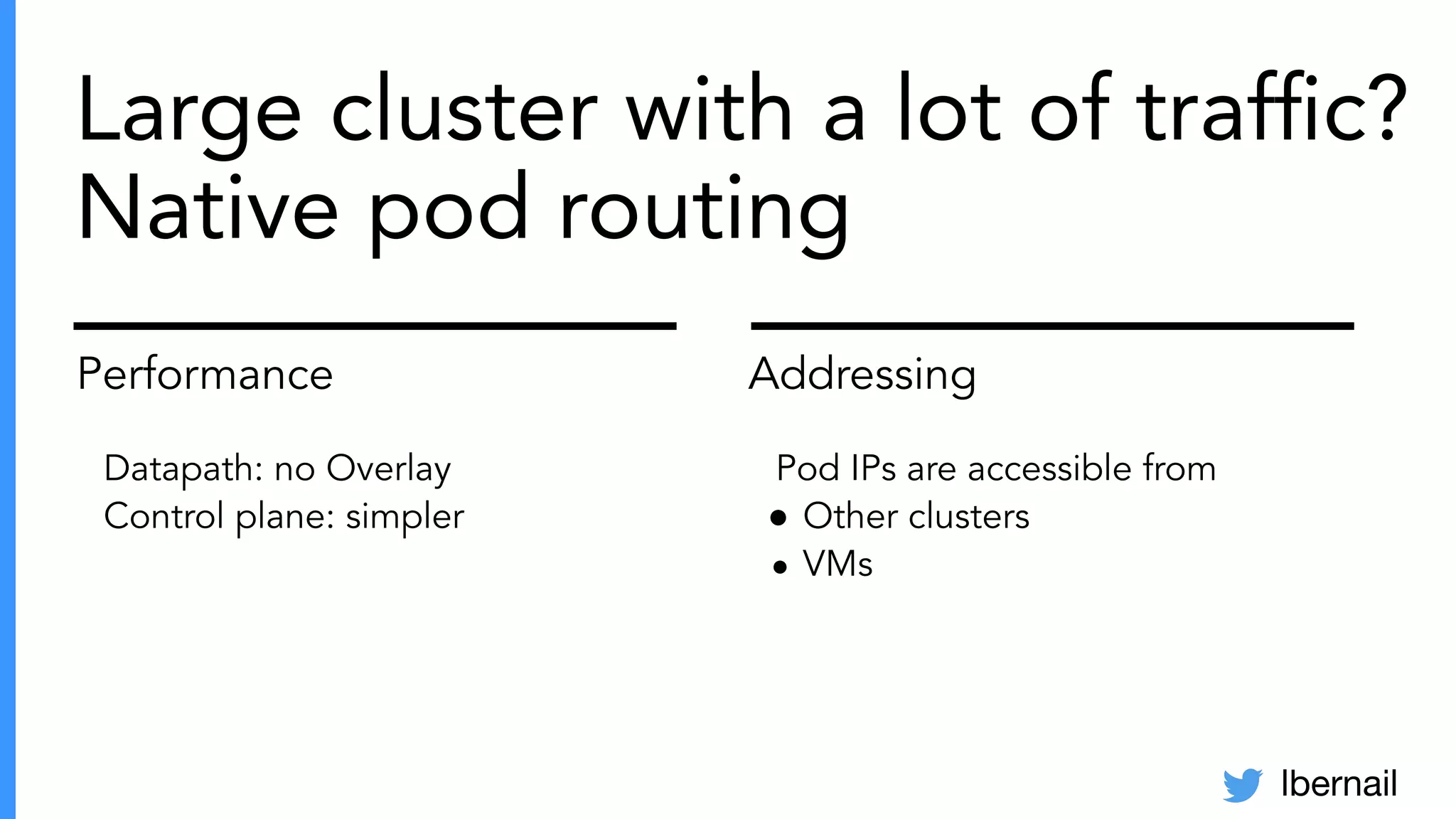
Large cluster with a lot of traffic?
Native pod routing
Performance
Datapath: no Overlay
Control plane: simpler
Addressing
Pod IPs are accessible from
● Other clusters
● VMs
lbernail
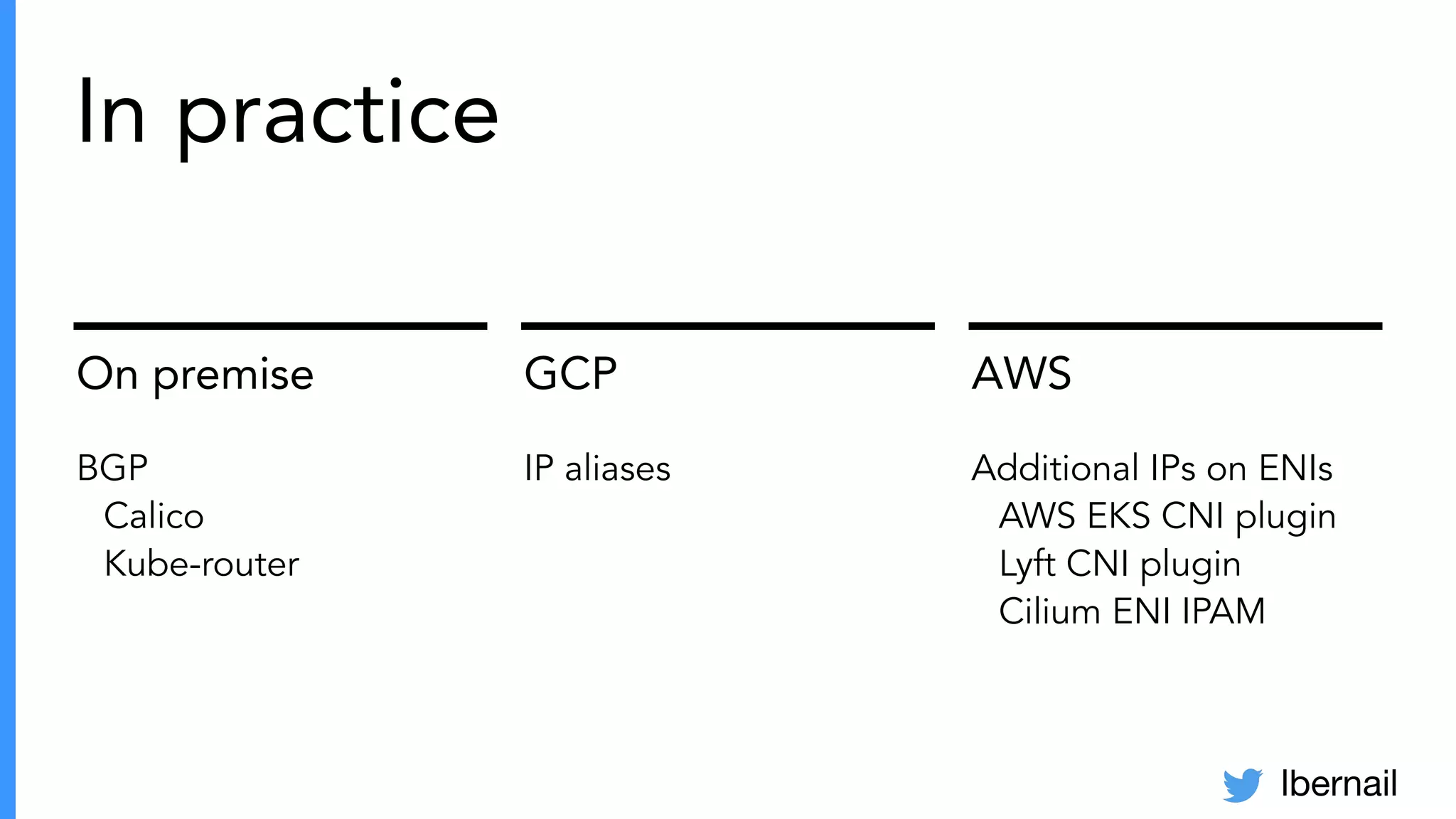
In practice
On premise
BGP
Calico
Kube-router
AWS
Additional IPs on ENIs
AWS EKS CNI plugin
Lyft CNI plugin
Cilium ENI IPAM
GCP
IP aliases
lbernail
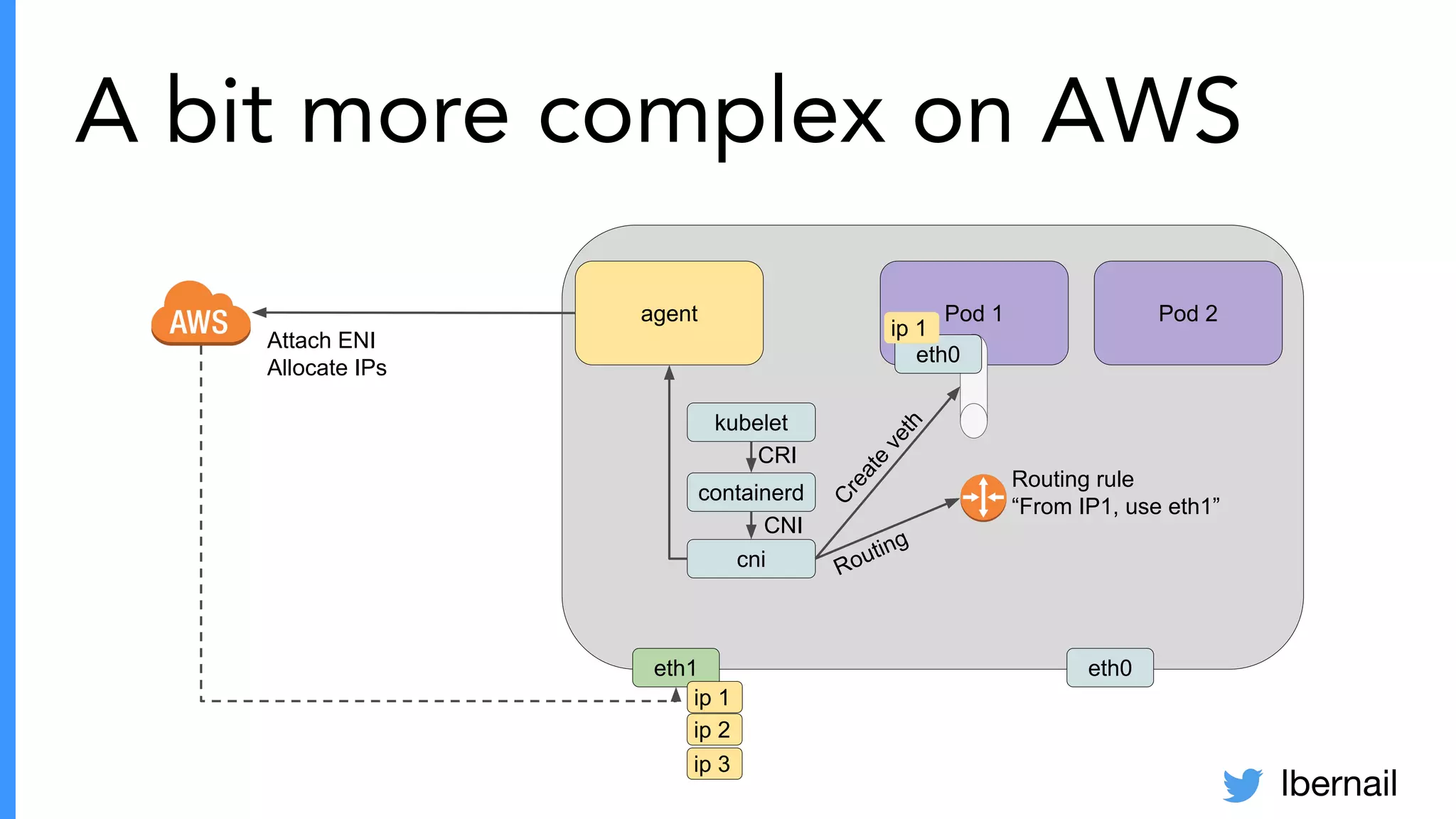
A bit more complex on AWS
eth1
agent Pod 1 Pod 2
kubelet
cni
containerd
CRI
CNI
eth0
Attach ENI
Allocate IPs
Create
veth
ip 1
ip 2
ip 3
Routing rule
“From IP1, use eth1”
Routing
eth0
ip 1
lbernail
Take-away
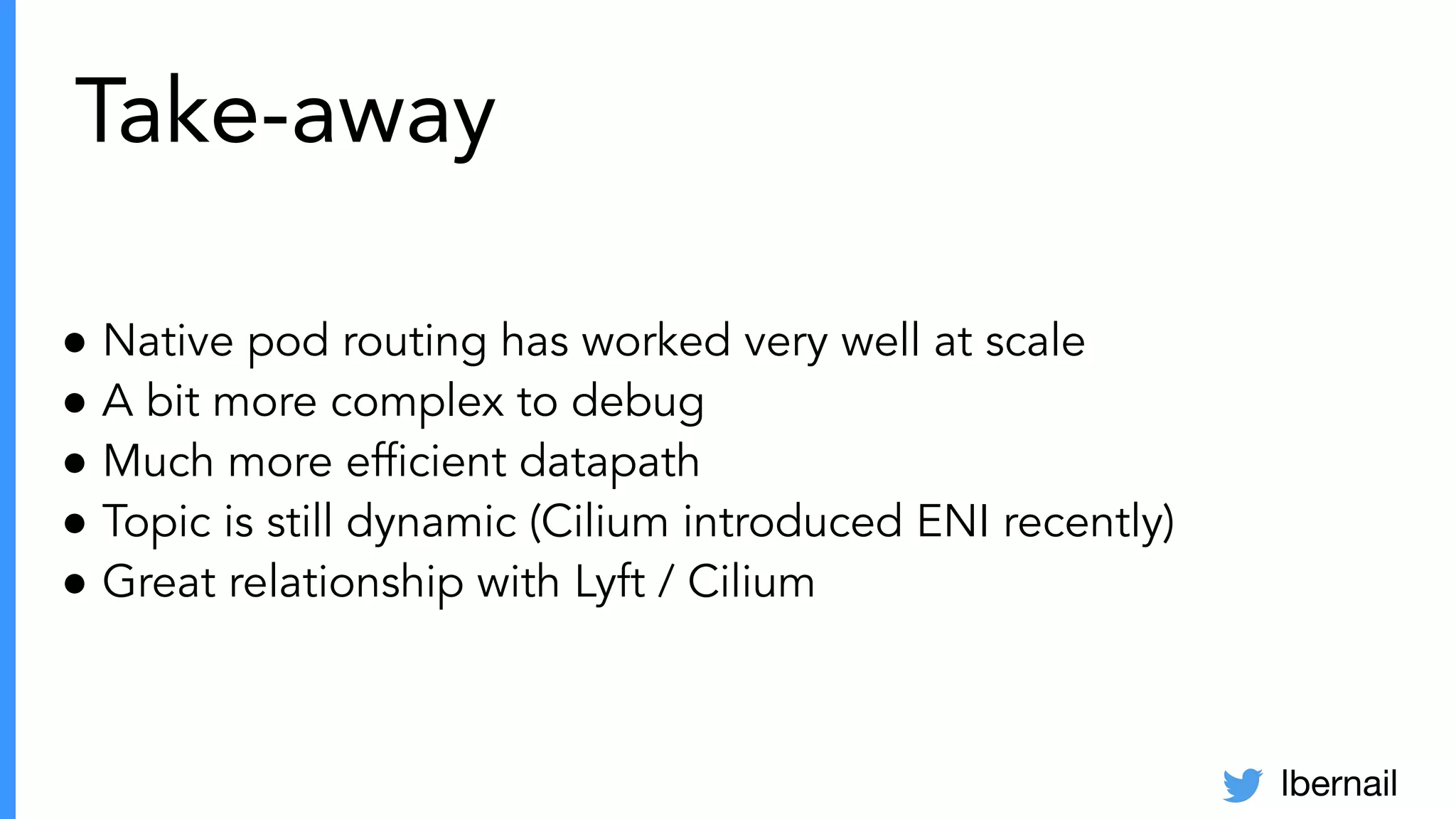
● Native pod routing has worked very well at scale
● A bit more complex to debug
● Much more efficient datapath
● Topic is still dynamic (Cilium introduced ENI recently)
● Great relationship with Lyft / Cilium
Accessing Services
lbernail
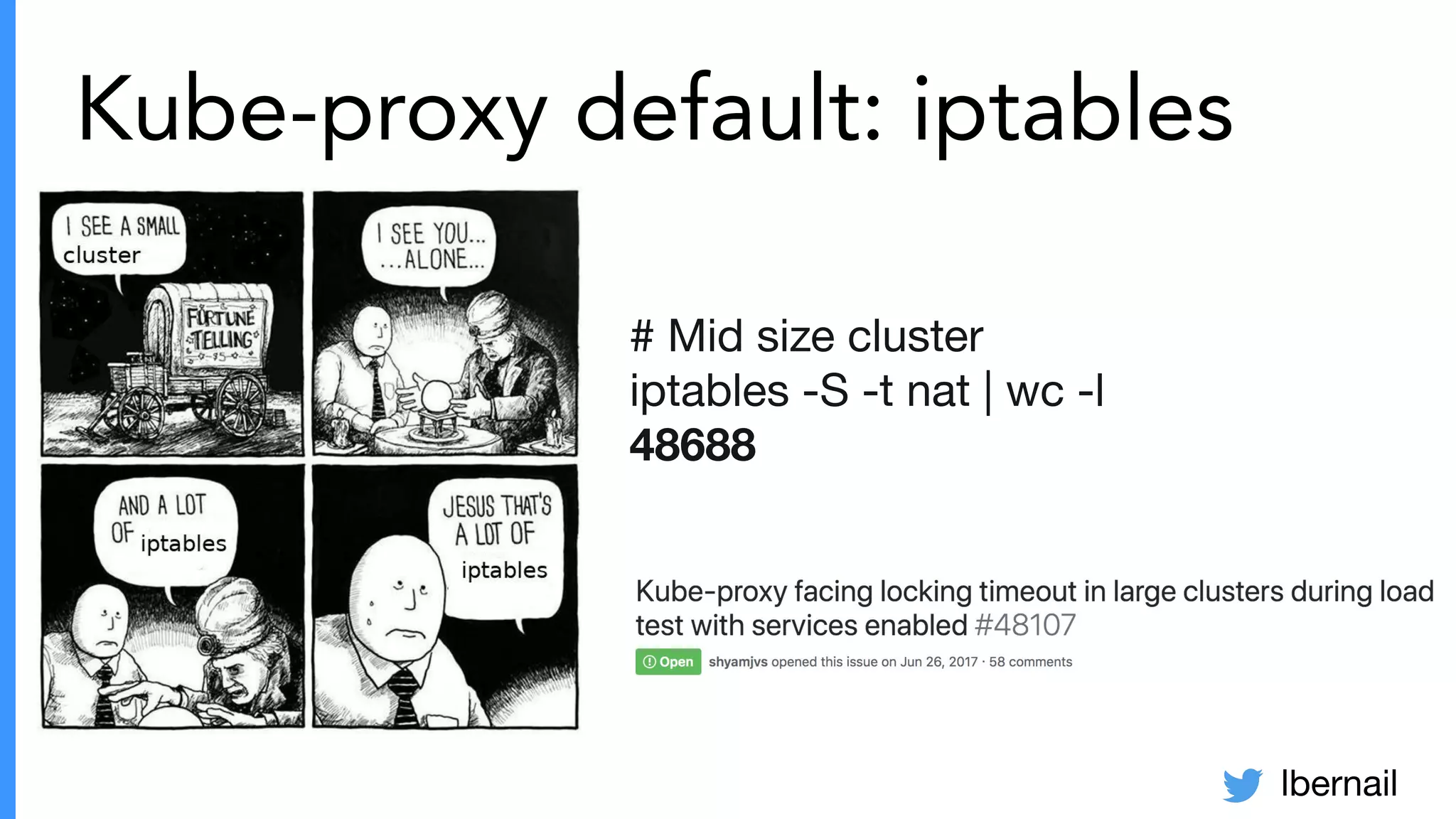
Kube-proxy default: iptables
# Mid size cluster
iptables -S -t nat | wc -l
48688
lbernail
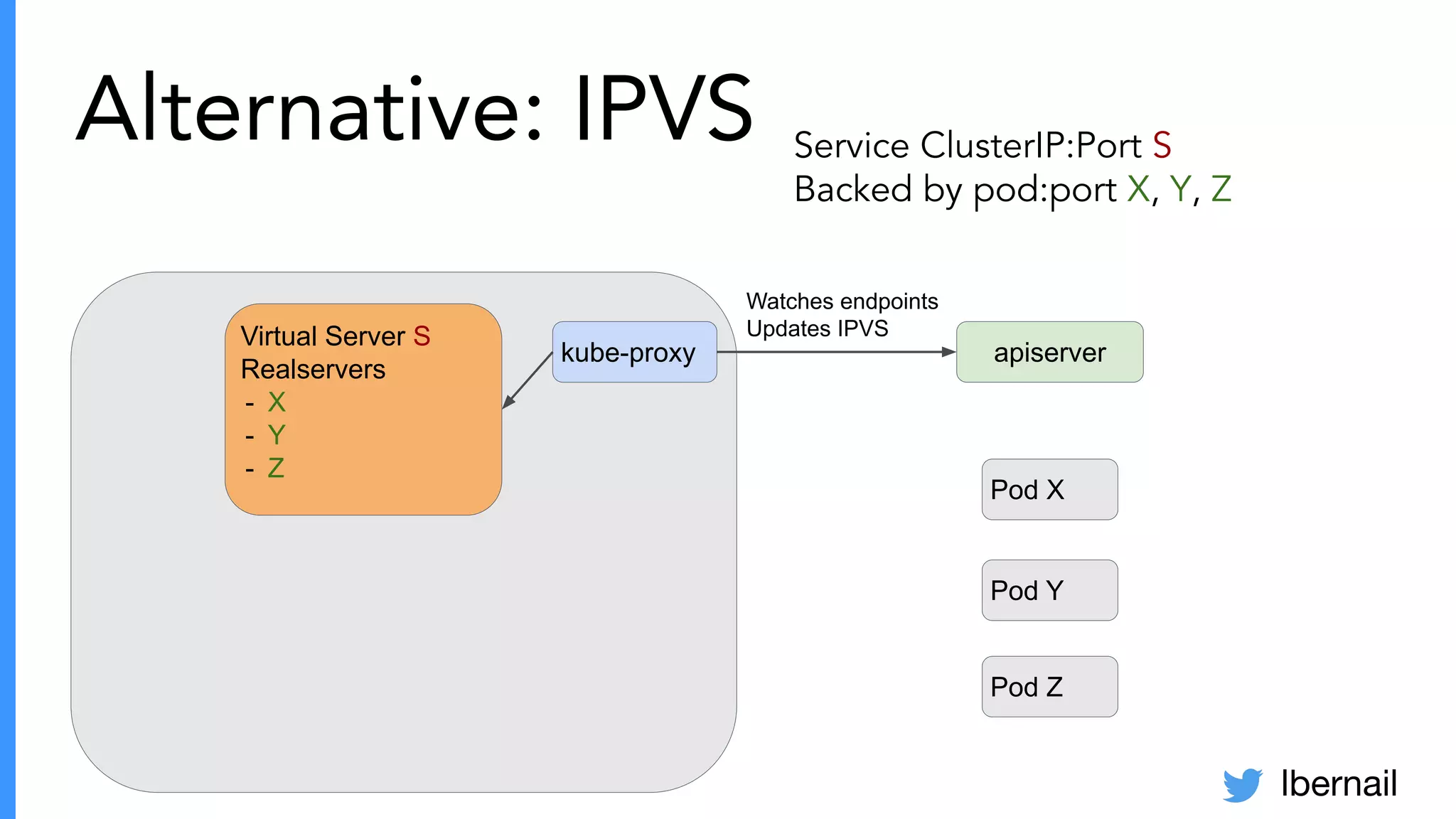
Alternative: IPVS
Pod X
Pod Y
Pod Z
Service ClusterIP:Port S
Backed by pod:port X, Y, Z
Virtual Server S
Realservers
- X
- Y
- Z
kube-proxy apiserver
Watches endpoints
Updates IPVS
lbernail
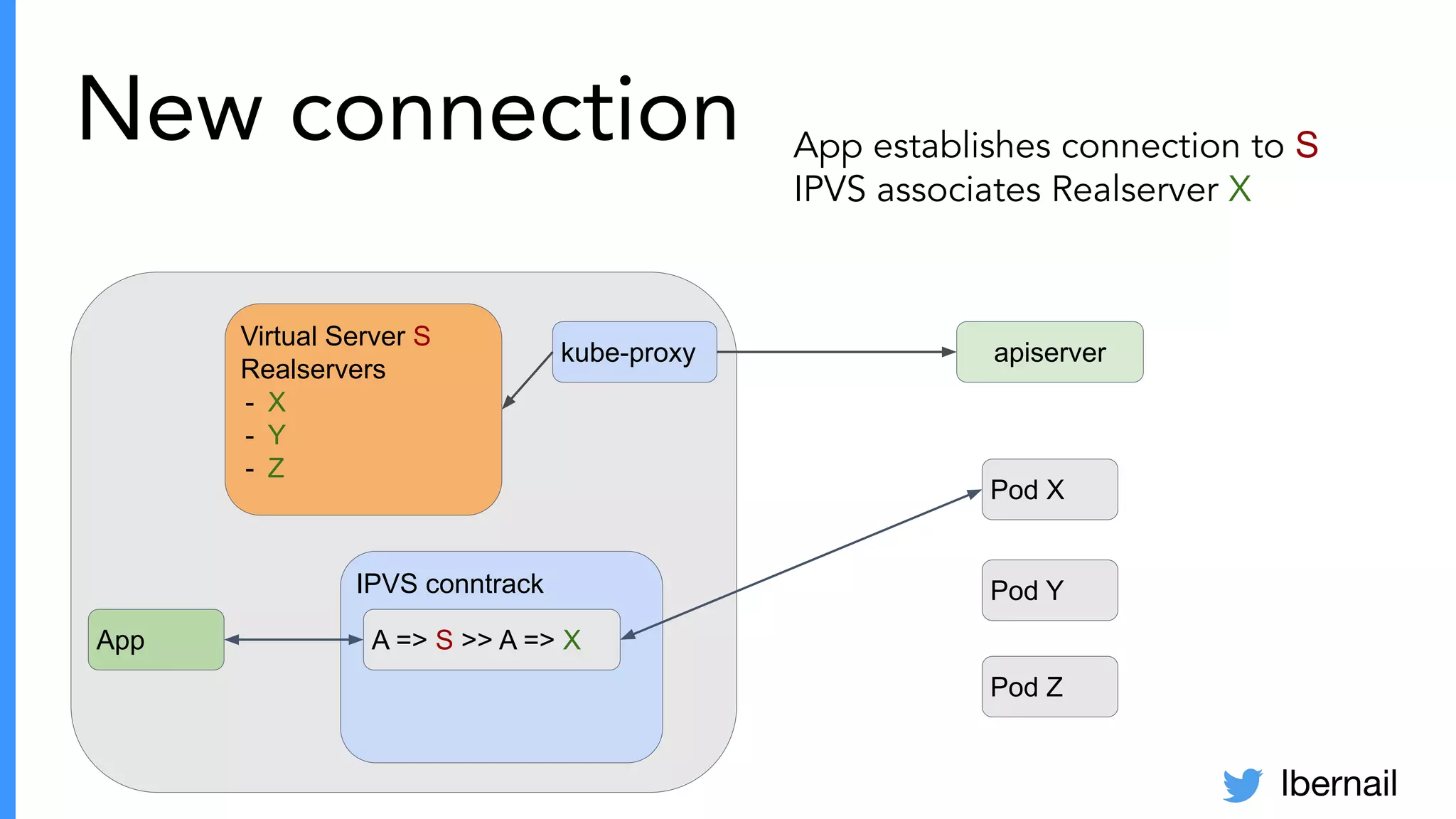
New connection
Pod X
Pod Y
Pod Z
Virtual Server S
Realservers
- X
- Y
- Z
kube-proxy apiserver
IPVS conntrack
App A => S >> A => X
App establishes connection to S
IPVS associates Realserver X
lbernail
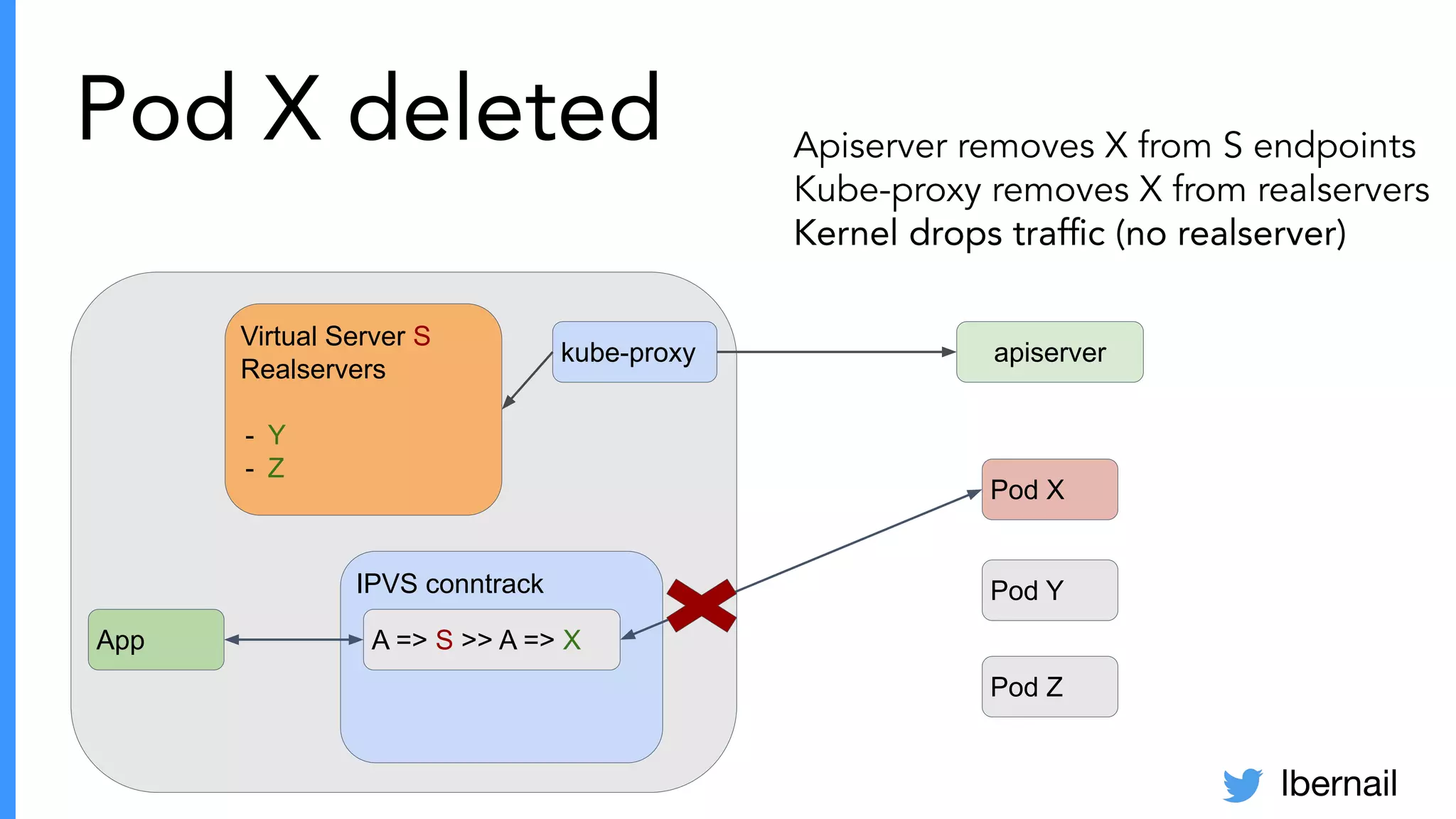
Pod X deleted
Pod X
Pod Y
Pod Z
Virtual Server S
Realservers
- Y
- Z
kube-proxy apiserver
IPVS conntrack
App A => S >> A => X
Apiserver removes X from S endpoints
Kube-proxy removes X from realservers
Kernel drops traffic (no realserver)
lbernail
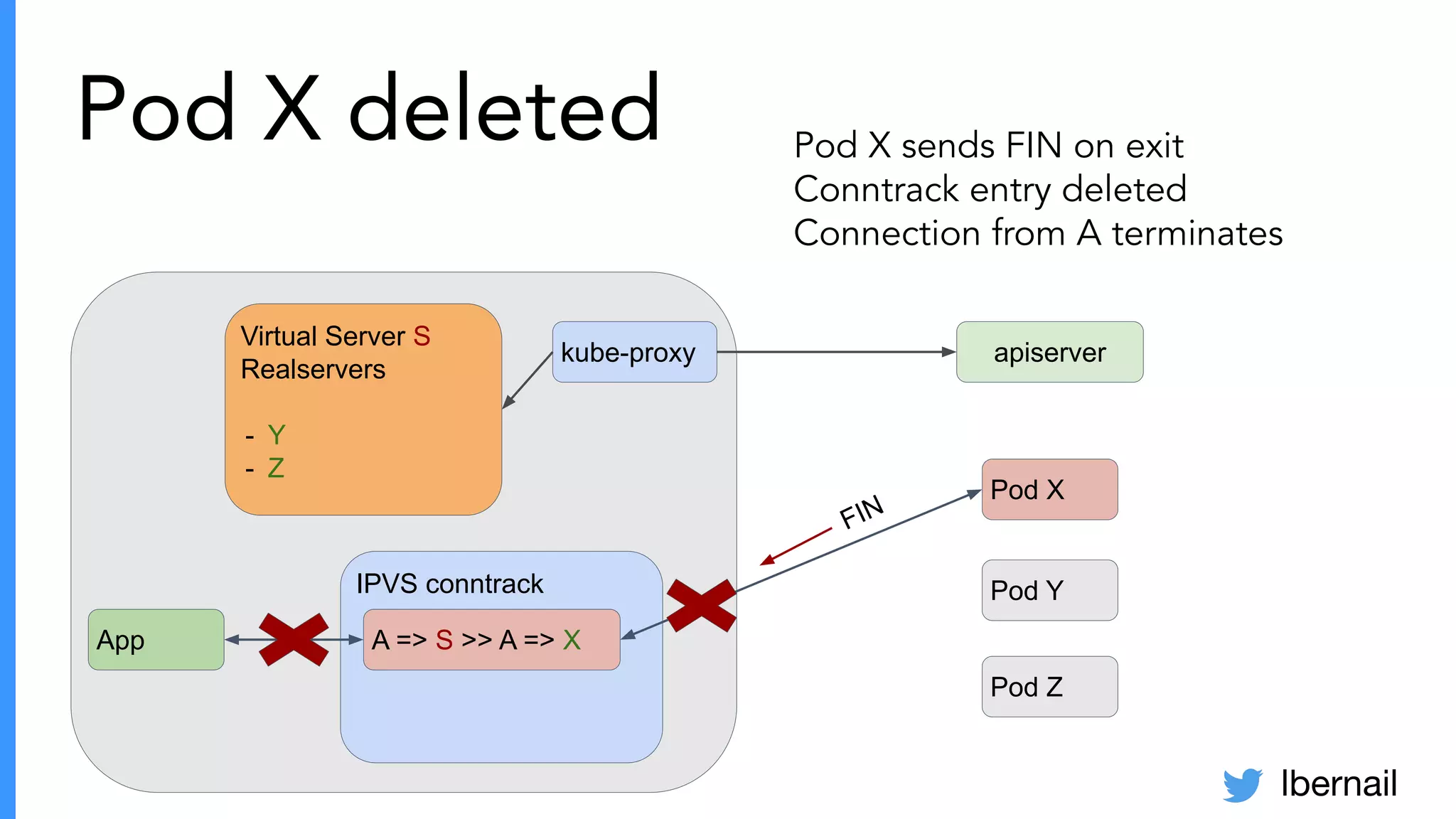
Pod X deleted
Pod X
Pod Y
Pod Z
Virtual Server S
Realservers
- Y
- Z
kube-proxy apiserver
IPVS conntrack
App A => S >> A => X
Pod X sends FIN on exit
Conntrack entry deleted
Connection from A terminates
FIN
lbernail
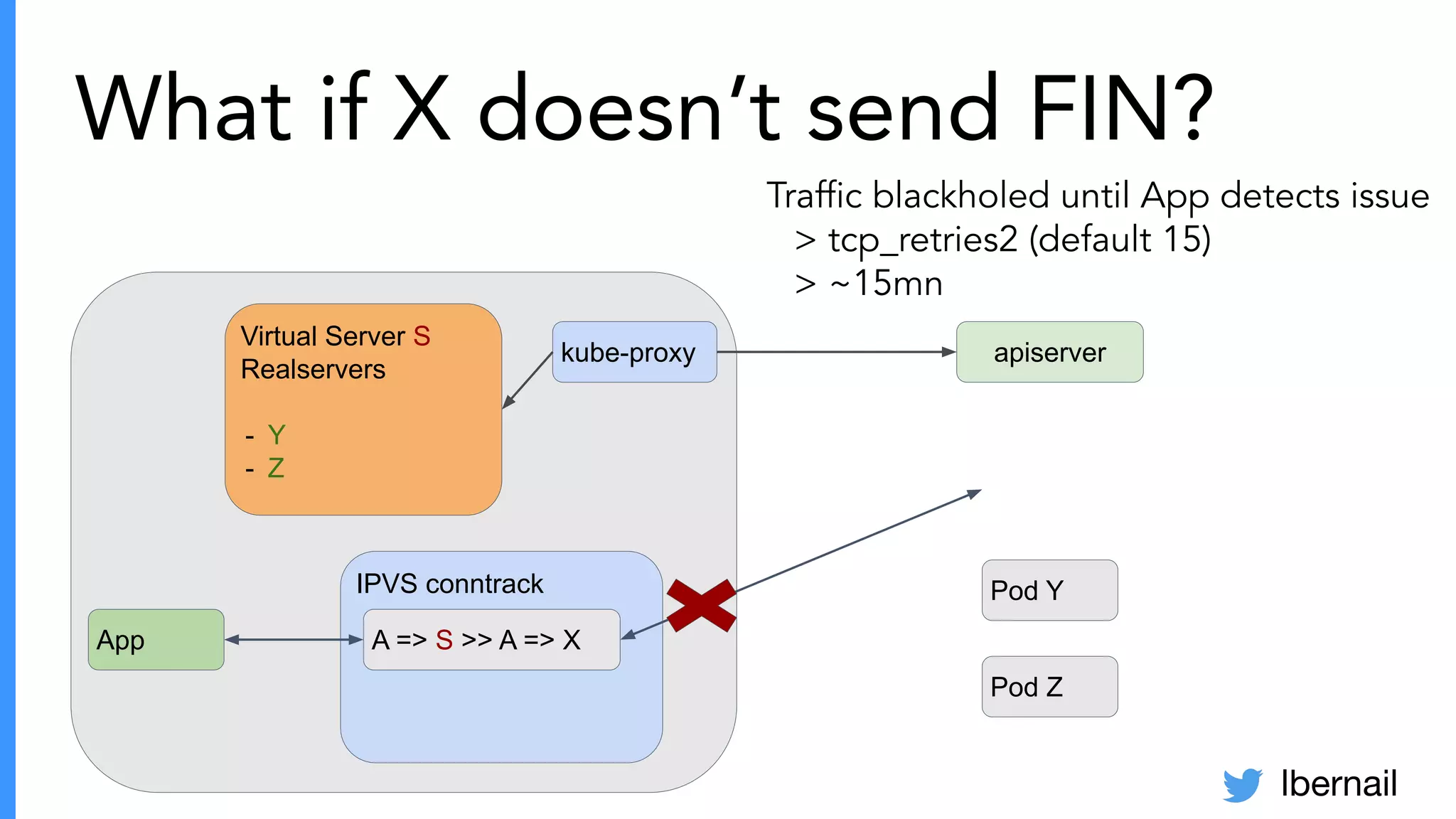
What if X doesn’t send FIN?
Pod Y
Pod Z
Virtual Server S
Realservers
- Y
- Z
kube-proxy apiserver
IPVS conntrack
App A => S >> A => X
Traffic blackholed until App detects issue
> tcp_retries2 (default 15)
> ~15mn
lbernail
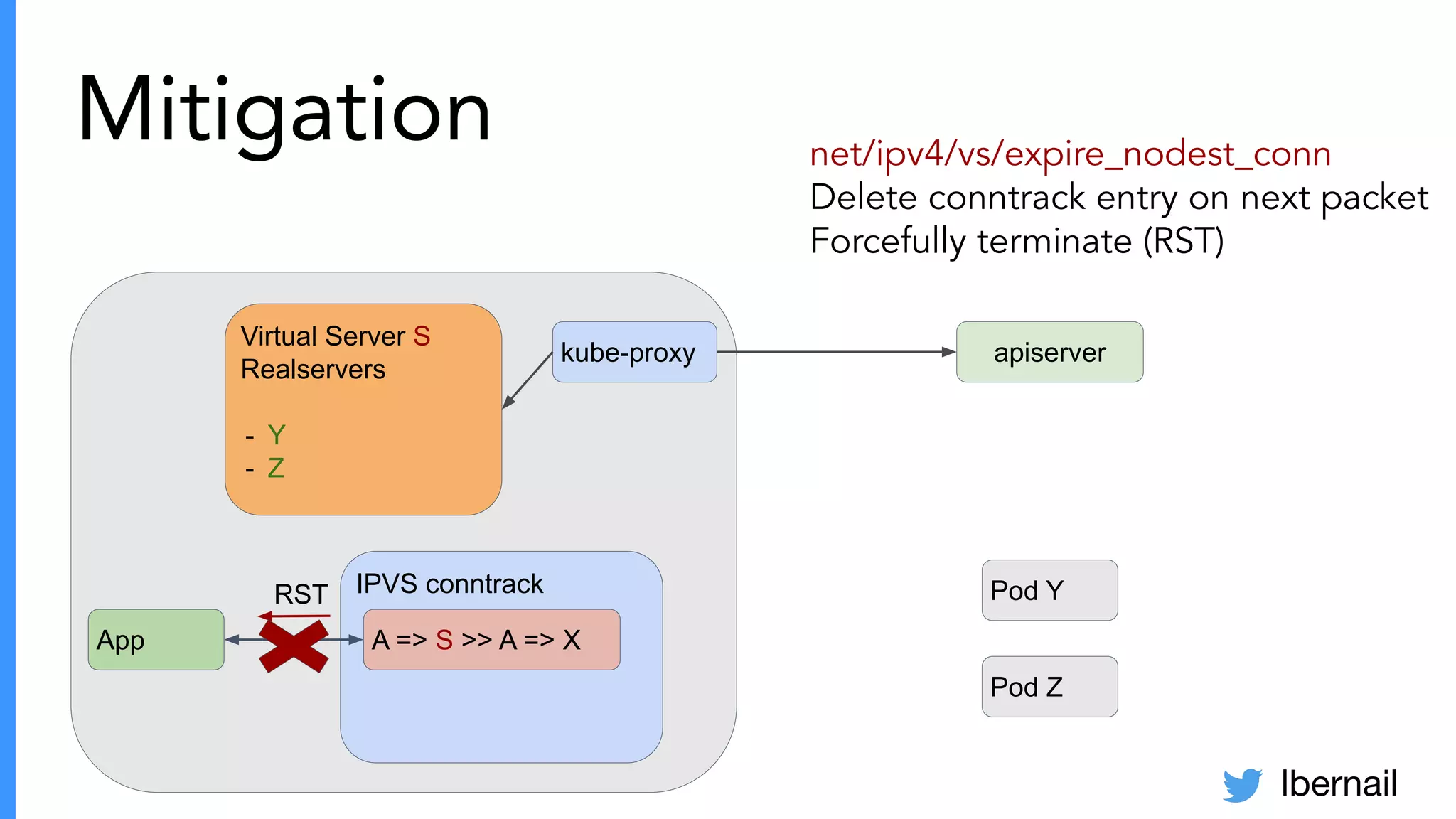
Mitigation
Pod Y
Pod Z
Virtual Server S
Realservers
- Y
- Z
kube-proxy apiserver
IPVS conntrack
App A => S >> A => X
net/ipv4/vs/expire_nodest_conn
Delete conntrack entry on next packet
Forcefully terminate (RST)
RST
lbernail
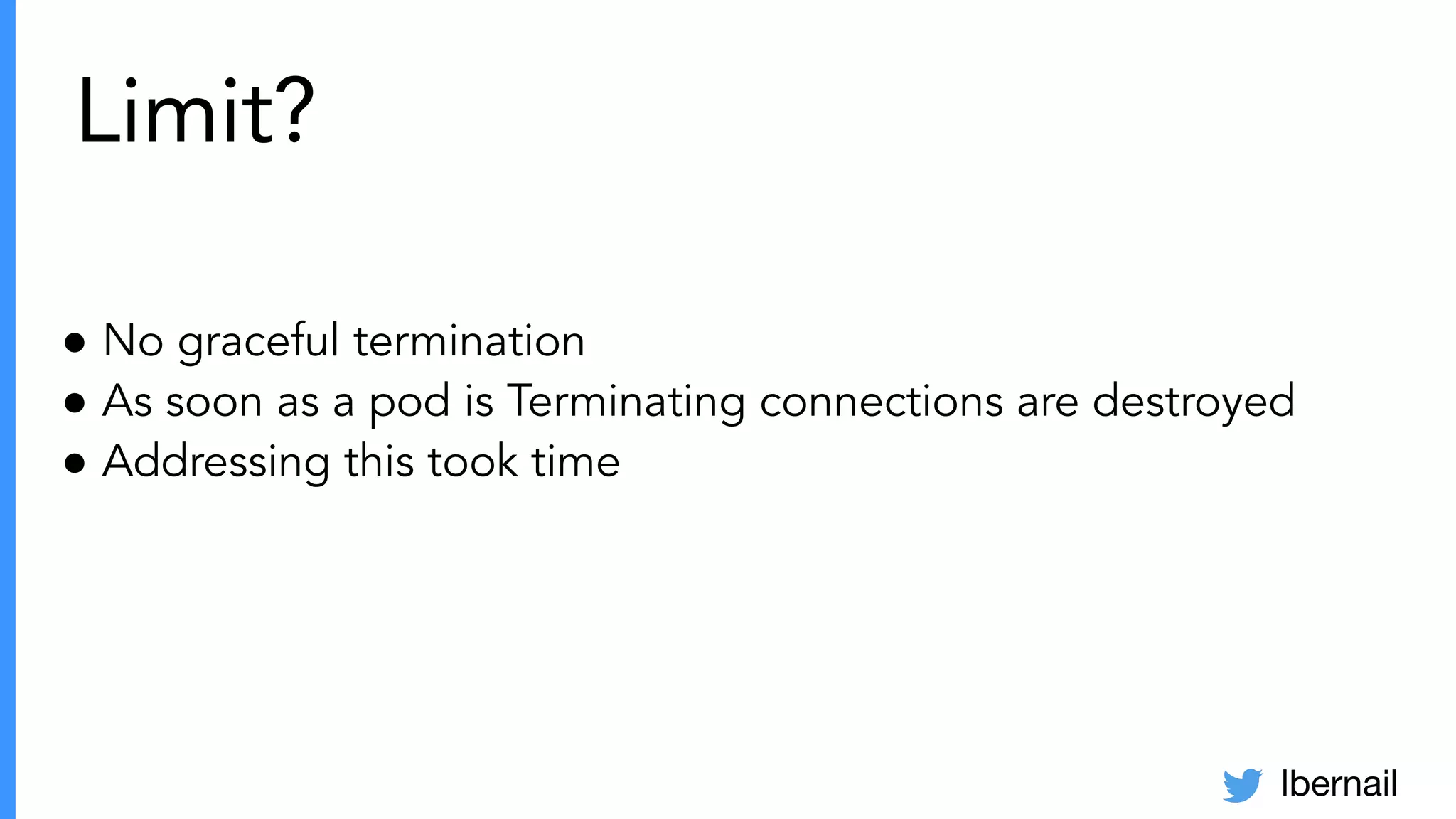
Limit?
● No graceful termination
● As soon as a pod is Terminating connections are destroyed
● Addressing this took time
lbernail
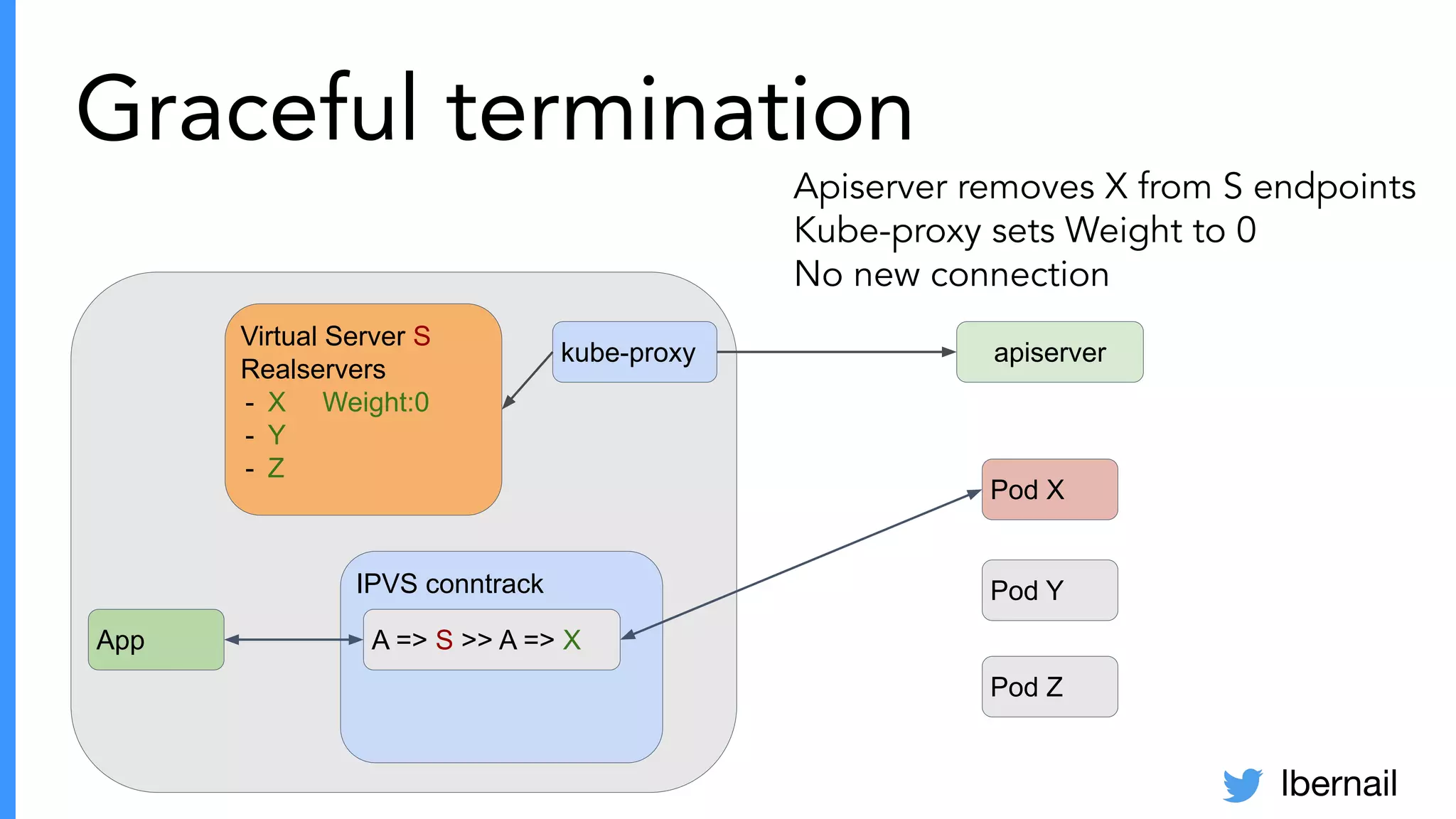
Graceful termination
Pod X
Pod Y
Pod Z
Virtual Server S
Realservers
- X Weight:0
- Y
- Z
kube-proxy apiserver
IPVS conntrack
App A => S >> A => X
Apiserver removes X from S endpoints
Kube-proxy sets Weight to 0
No new connection
lbernail
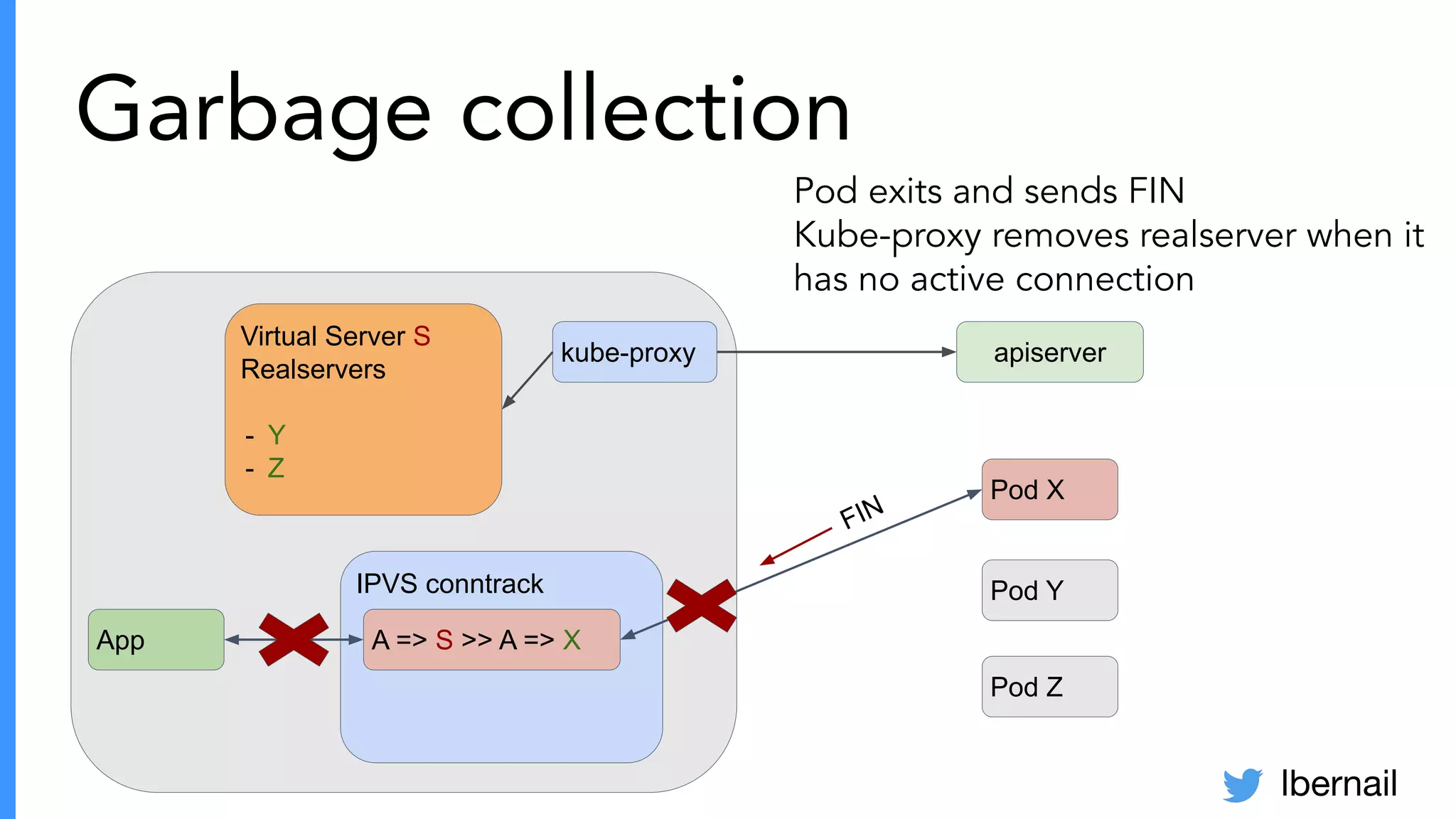
Garbage collection
Pod X
Pod Y
Pod Z
Virtual Server S
Realservers
- Y
- Z
kube-proxy apiserver
IPVS conntrack
App A => S >> A => X
Pod exits and sends FIN
Kube-proxy removes realserver when it
has no active connection
FIN
lbernail
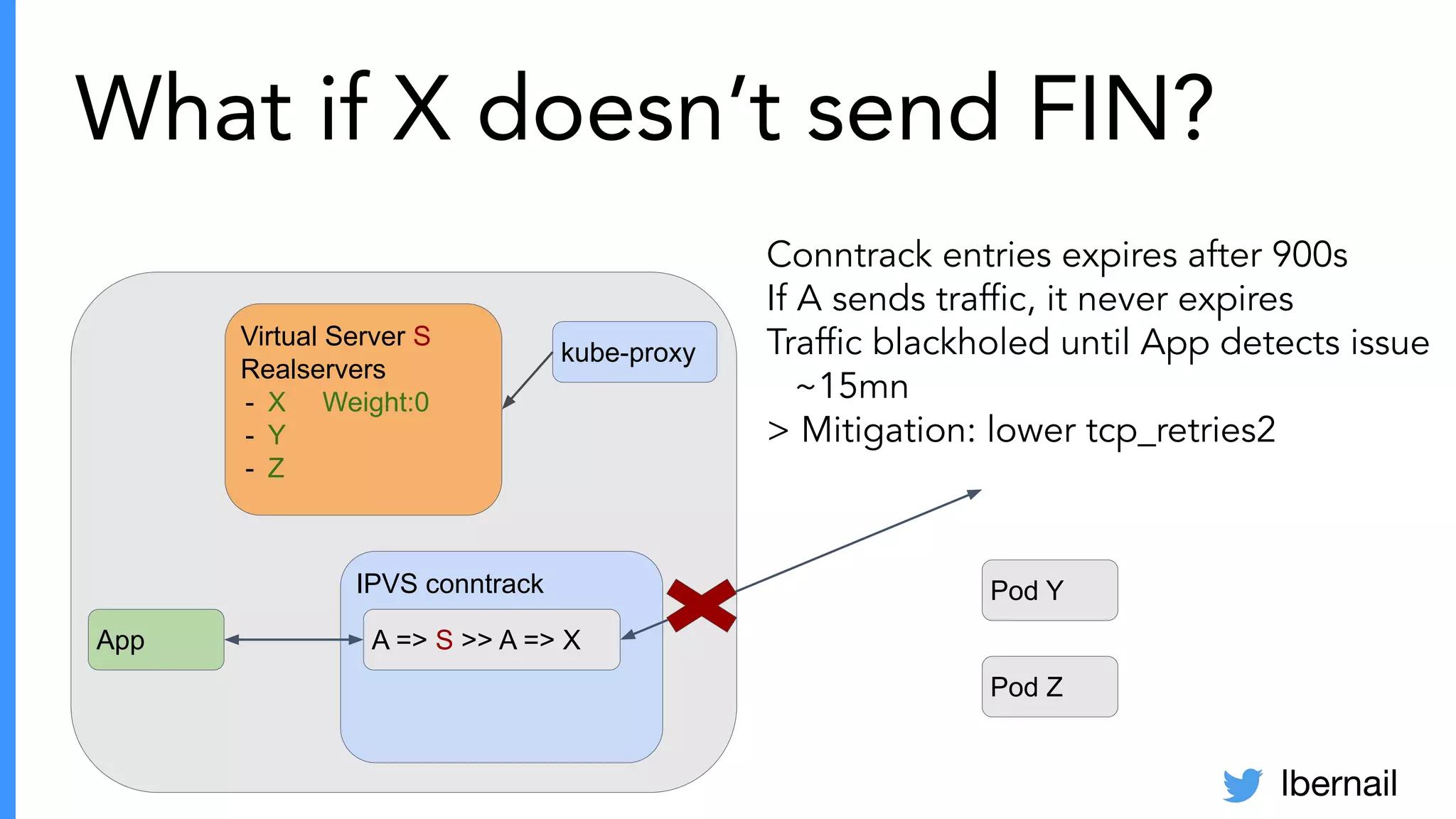
What if X doesn’t send FIN?
Pod Y
Pod Z
Virtual Server S
Realservers
- X Weight:0
- Y
- Z
kube-proxy
IPVS conntrack
App A => S >> A => X
Conntrack entries expires after 900s
If A sends traffic, it never expires
Traffic blackholed until App detects issue
~15mn
> Mitigation: lower tcp_retries2
lbernail
Take-away
● IPVS has been great for us
● IPVS is in a good state now
● Several improvements in the works
● But harder than we expected
● I ended up reviewer/approver for kube-proxy/IPVS
Ingresses
lbernail
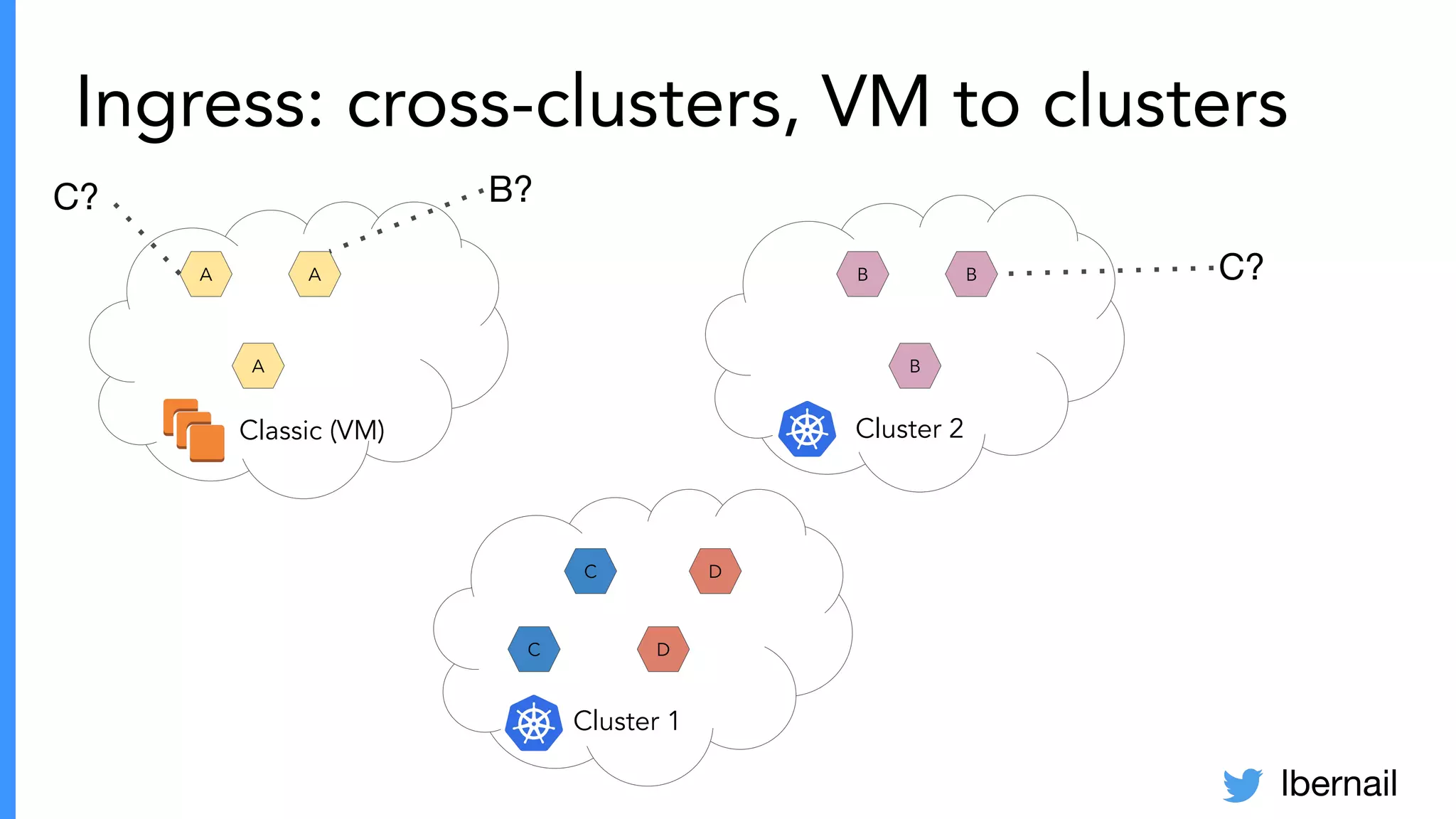
Ingress: cross-clusters, VM to clusters
A A
A
B B
B
C
C
D
D
Cluster 1
Cluster 2Classic (VM)
C?
C? B?
lbernail
Master
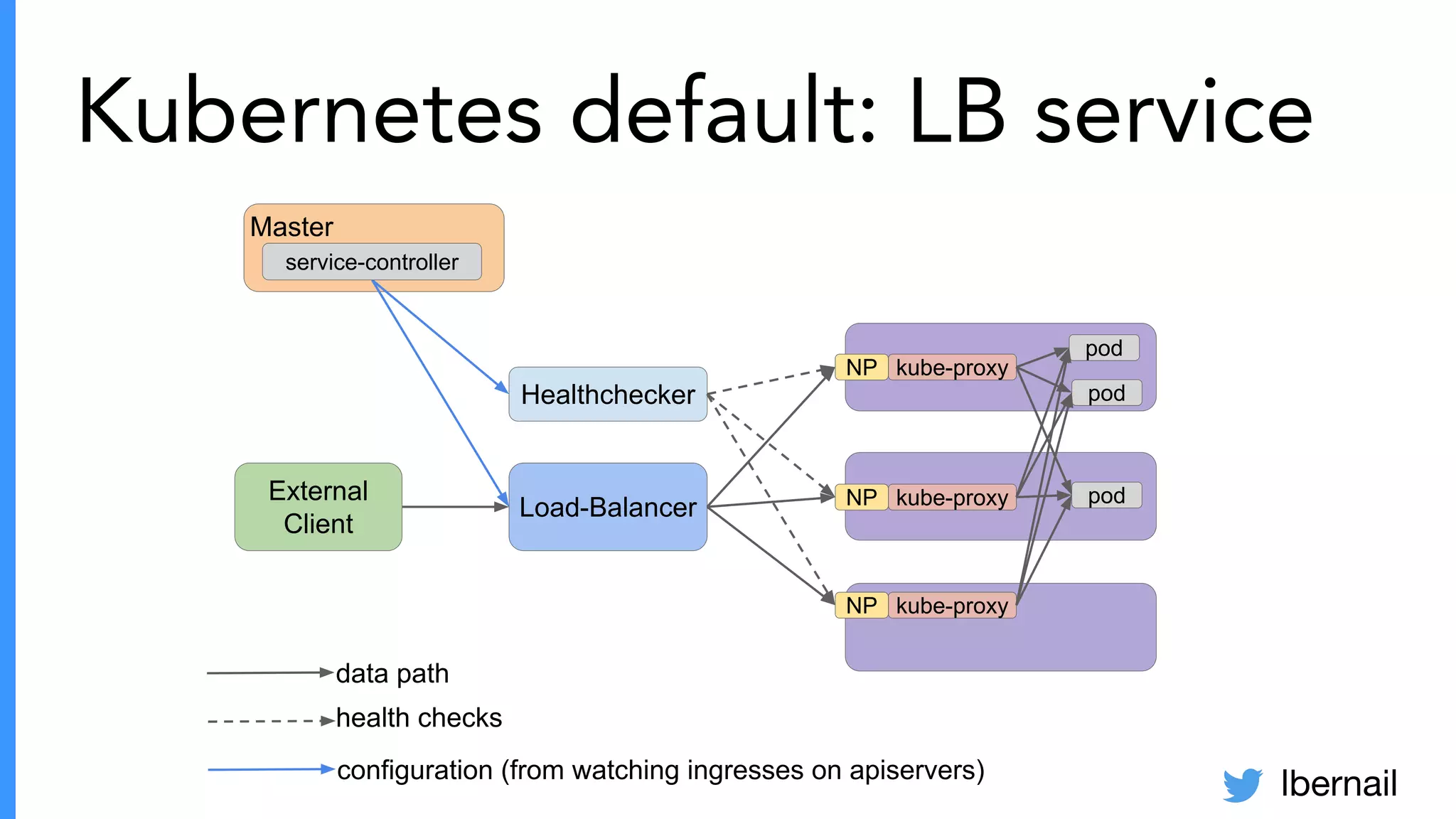
Kubernetes default: LB service
External
Client
Load-Balancer
pod
pod
pod
kube-proxy
kube-proxy
kube-proxy
NP
NP
NP
Healthchecker
data path
health checks
configuration (from watching ingresses on apiservers)
service-controller
lbernail
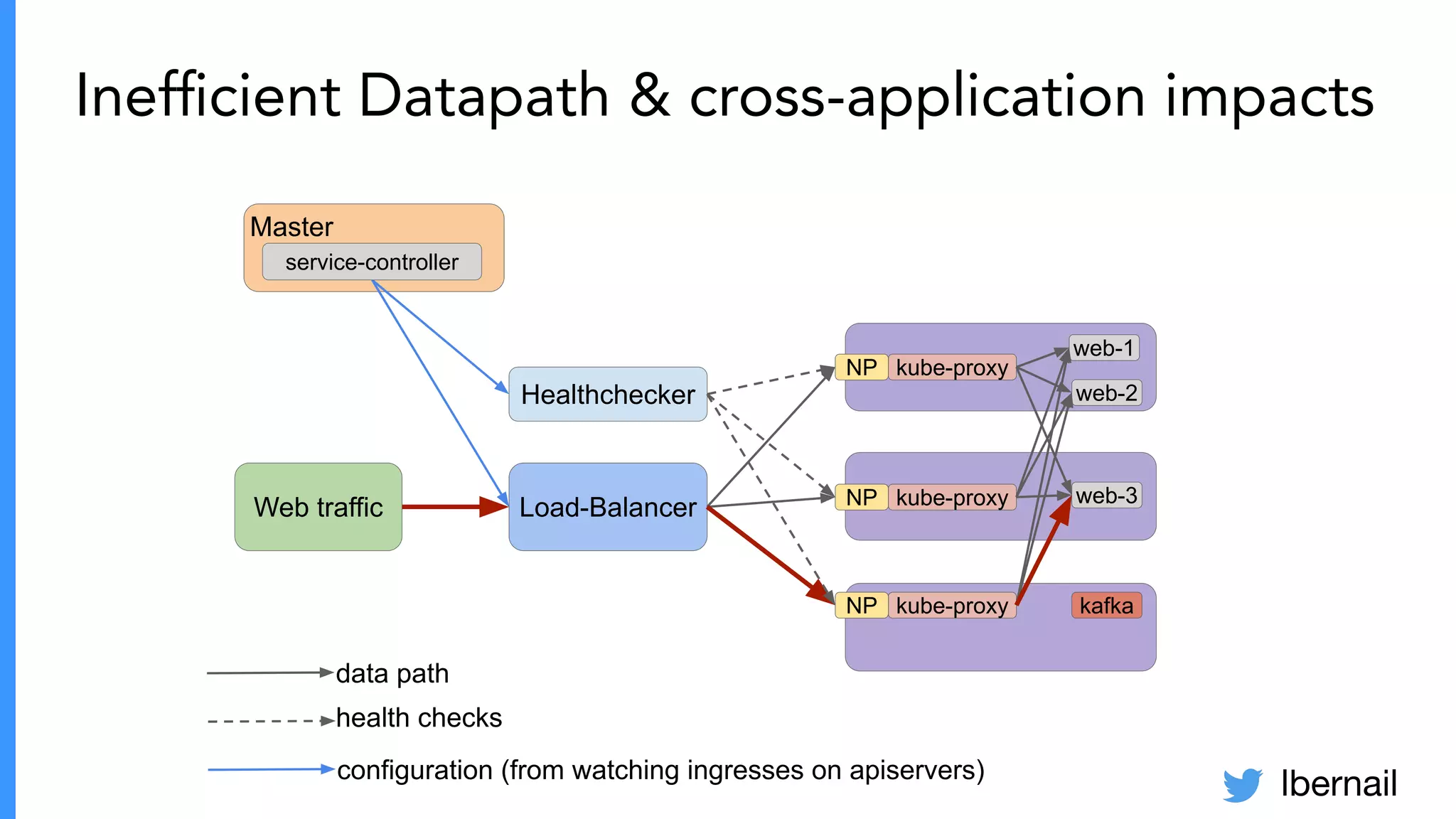
Master
Inefficient Datapath & cross-application impacts
Web traffic Load-Balancer
web-1
web-2
web-3
kube-proxy
kube-proxy
kube-proxy
NP
NP
NP
Healthchecker
data path
health checks
configuration (from watching ingresses on apiservers)
service-controller
kafka
lbernail
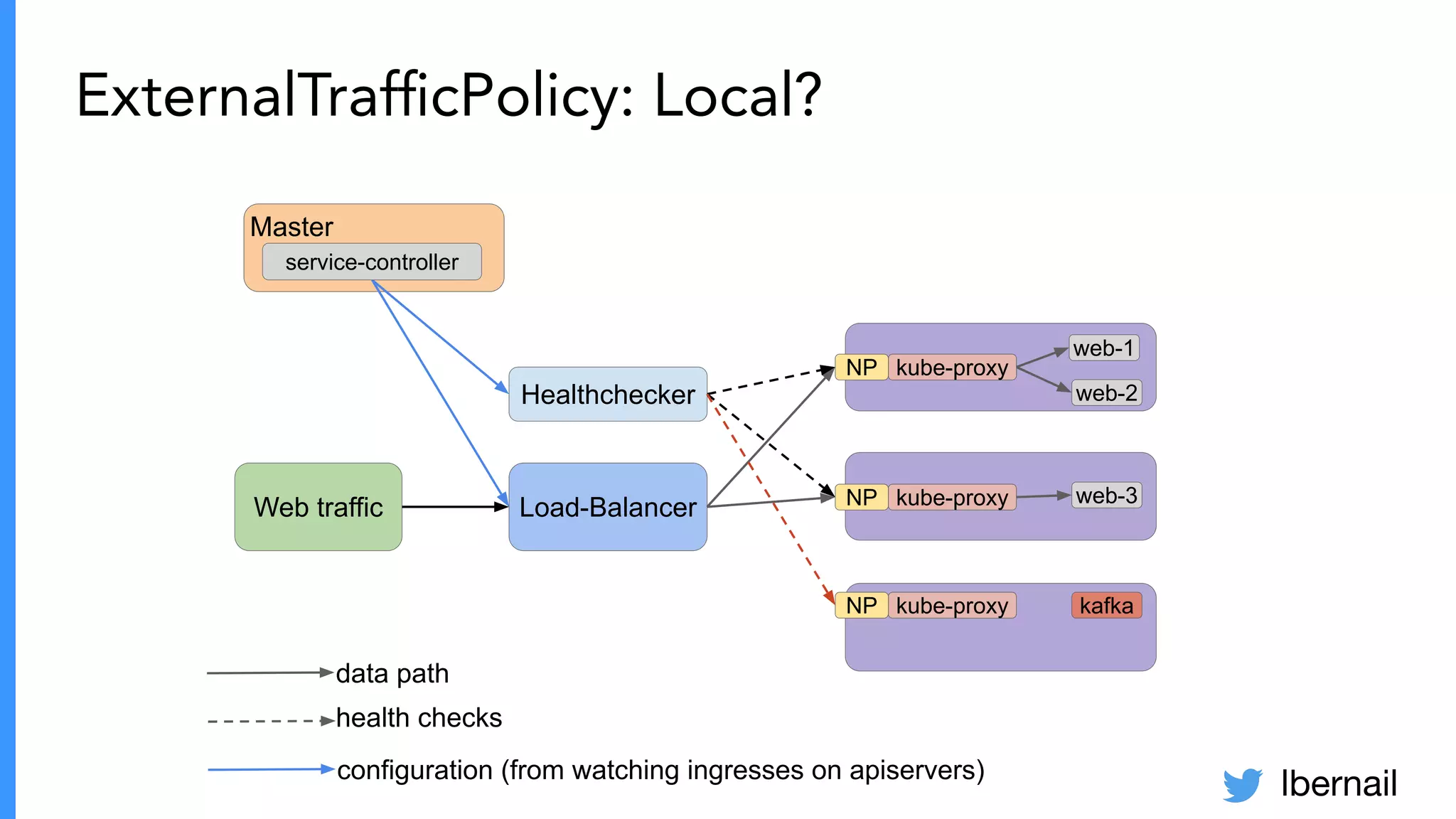
Master
ExternalTrafficPolicy: Local?
Web traffic Load-Balancer
web-1
web-2
web-3
kube-proxy
kube-proxy
kube-proxy
NP
NP
NP
Healthchecker
data path
health checks
configuration (from watching ingresses on apiservers)
service-controller
kafka
lbernail
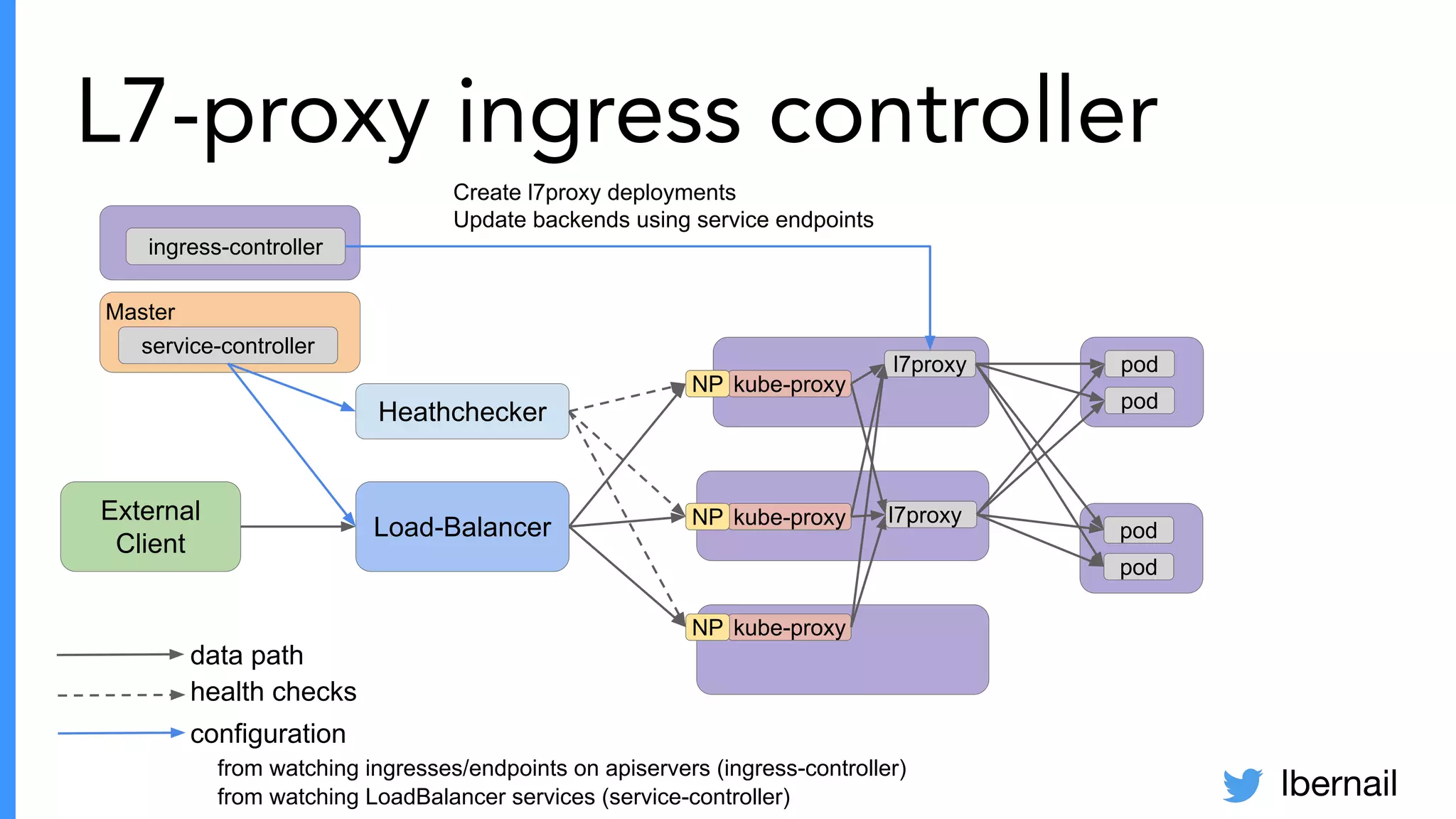
L7-proxy ingress controller
data path
health checks
configuration
from watching ingresses/endpoints on apiservers (ingress-controller)
from watching LoadBalancer services (service-controller)
External
Client
Load-Balancer
l7proxy
l7proxy
kube-proxy
kube-proxy
kube-proxy
NP
NP
NP
Heathchecker
ingress-controller
pod
pod
pod
pod
Create l7proxy deployments
Update backends using service endpoints
Master
service-controller
lbernail
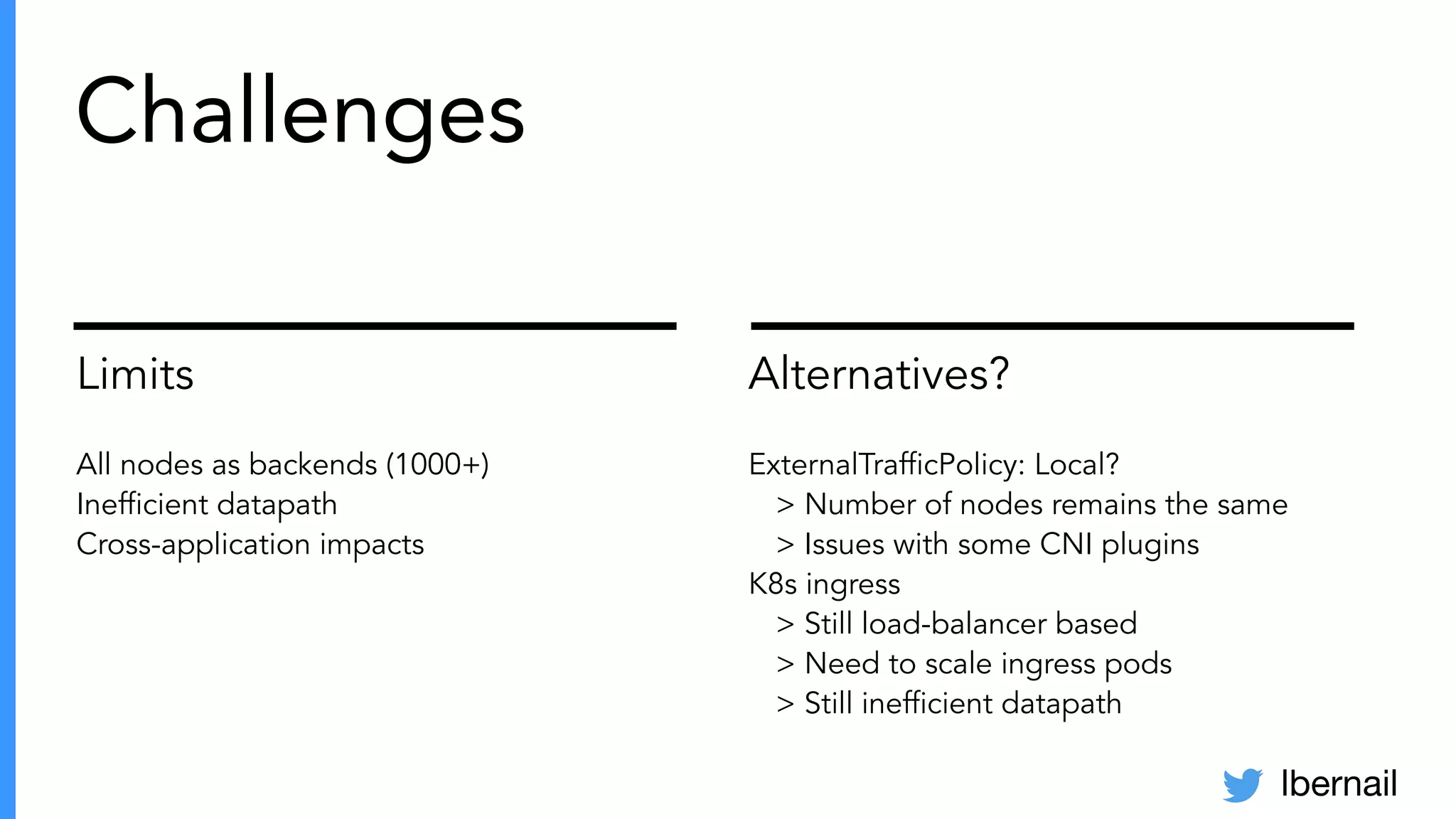
Limits
All nodes as backends (1000+)
Inefficient datapath
Cross-application impacts
Alternatives?
ExternalTrafficPolicy: Local?
> Number of nodes remains the same
> Issues with some CNI plugins
K8s ingress
> Still load-balancer based
> Need to scale ingress pods
> Still inefficient datapath
Challenges
lbernail
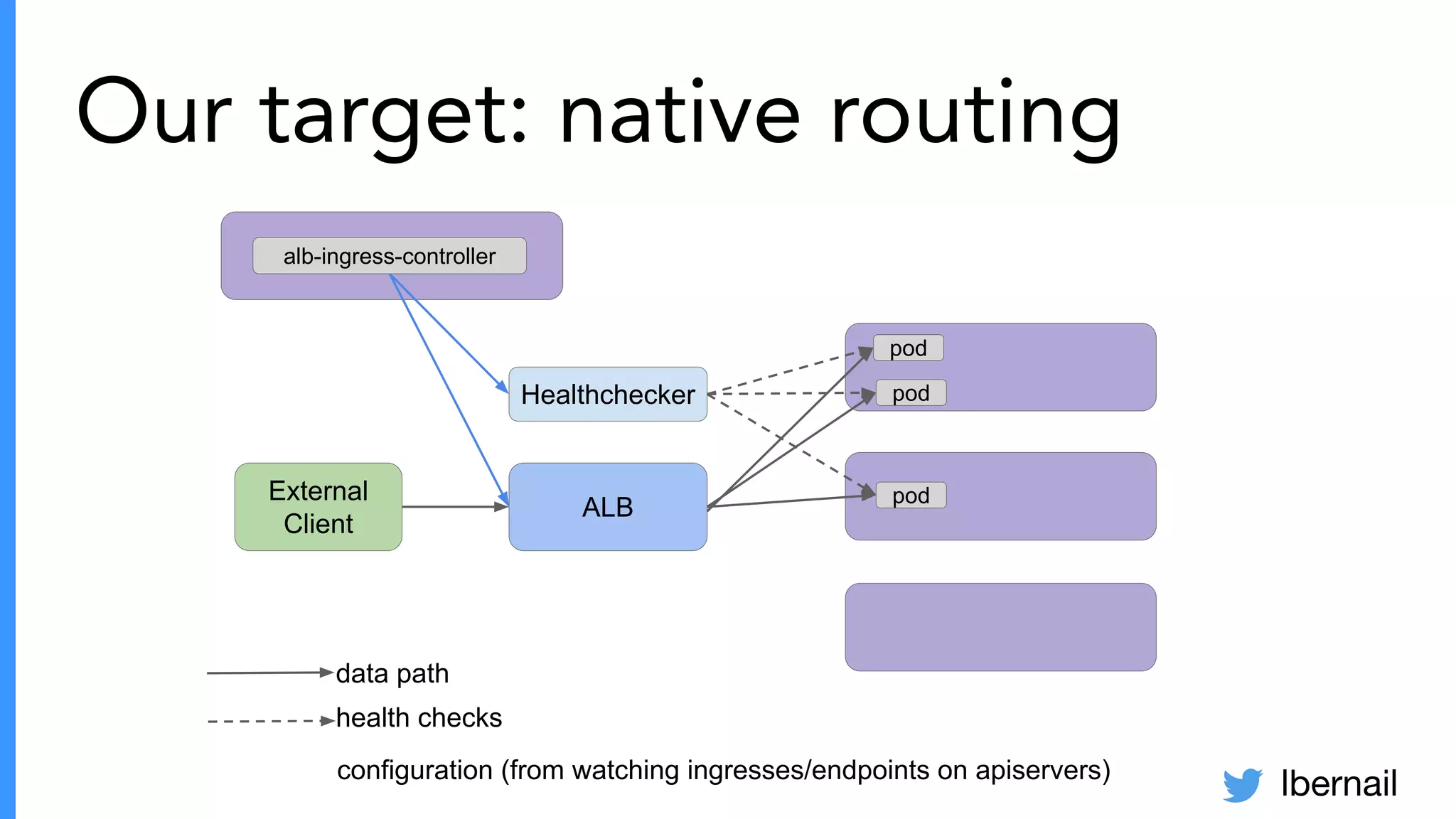
Our target: native routing
External
Client
ALB
pod
pod
pod
Healthchecker
data path
health checks
alb-ingress-controller
configuration (from watching ingresses/endpoints on apiservers)
lbernail
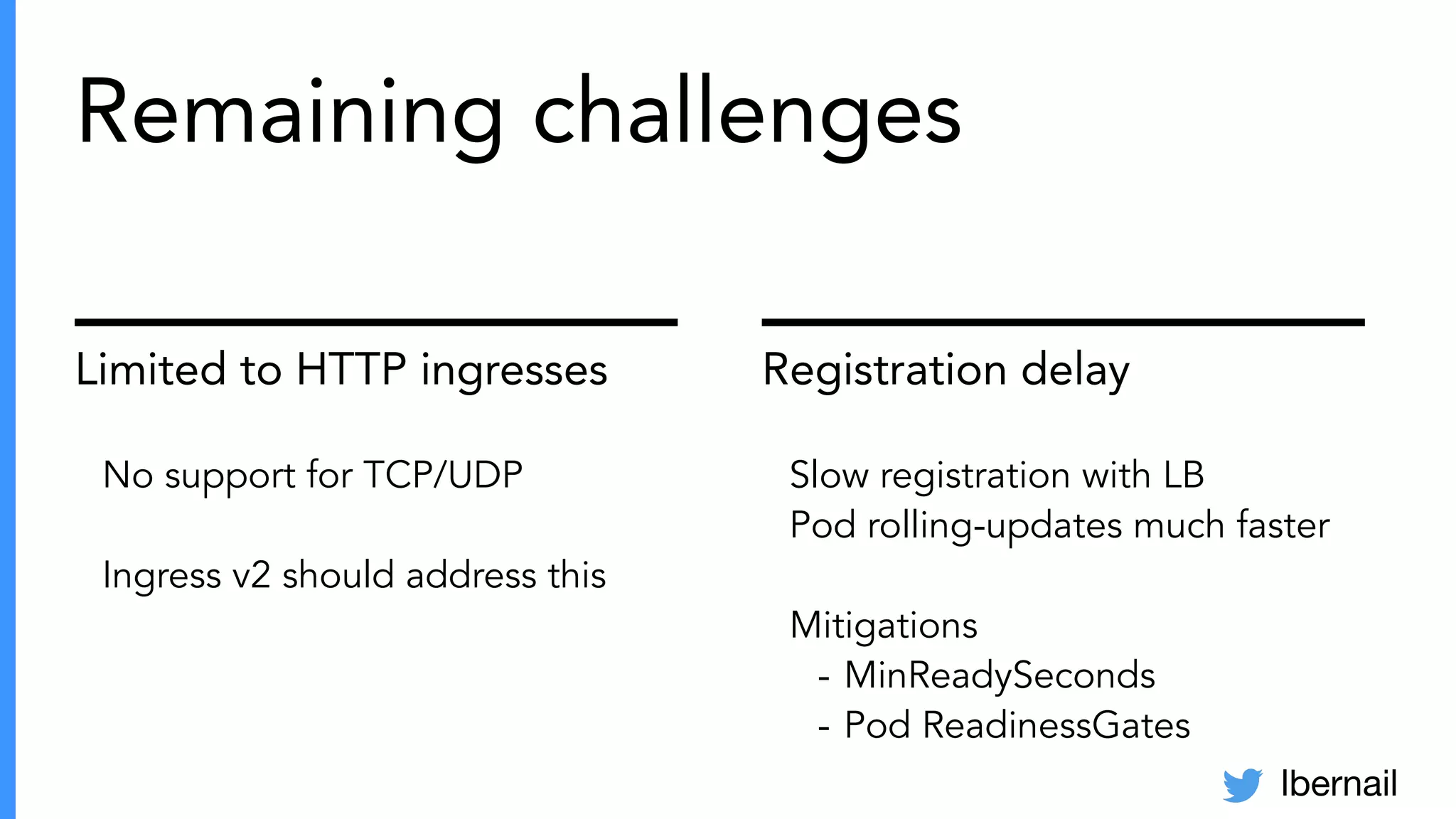
Limited to HTTP ingresses
No support for TCP/UDP
Ingress v2 should address this
Remaining challenges
Registration delay
Slow registration with LB
Pod rolling-updates much faster
Mitigations
- MinReadySeconds
- Pod ReadinessGates
lbernail
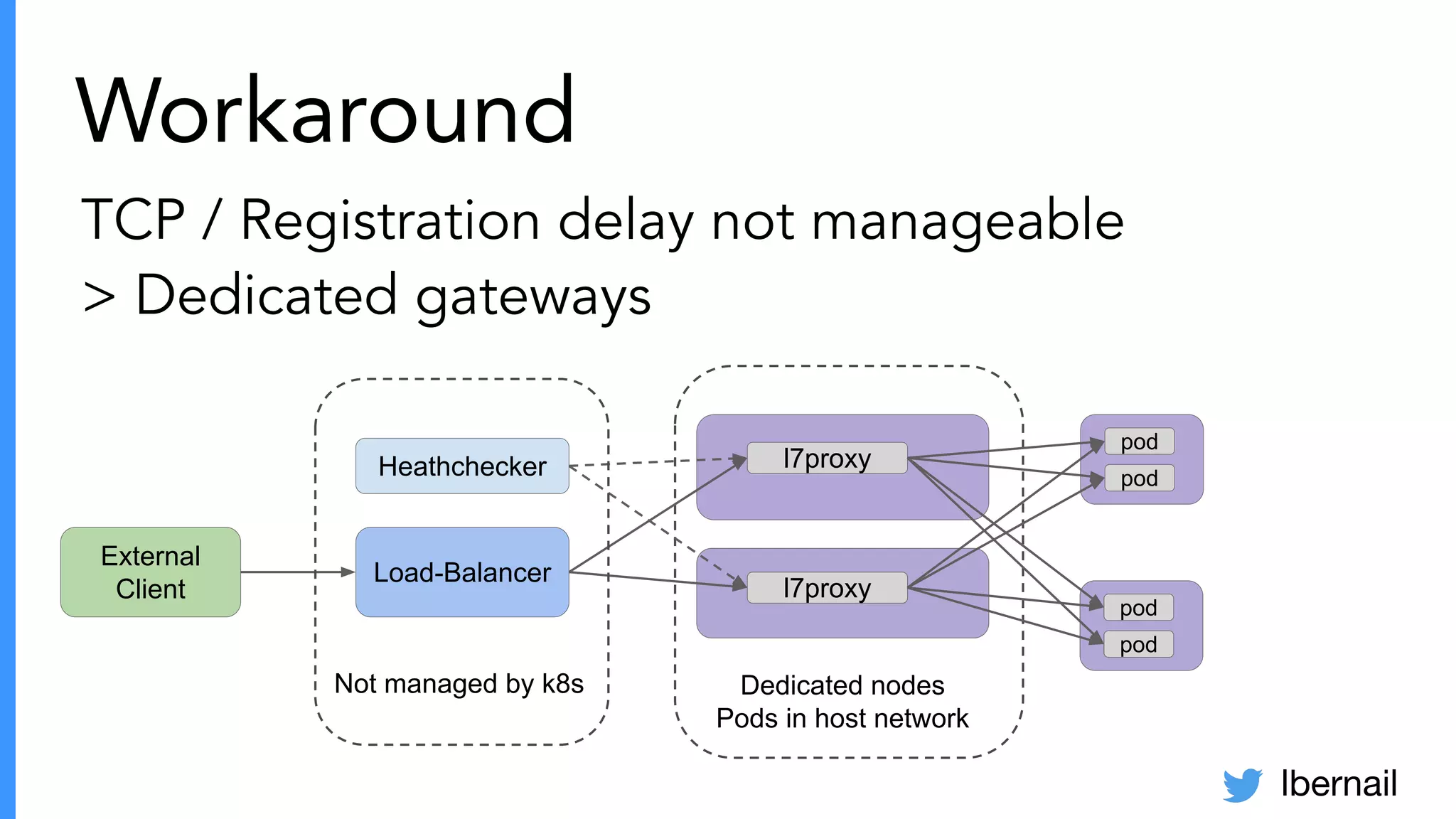
Workaround
External
Client
Load-Balancer
l7proxy
l7proxy
Heathchecker
pod
pod
pod
pod
Not managed by k8s Dedicated nodes
Pods in host network
TCP / Registration delay not manageable
> Dedicated gateways
lbernail
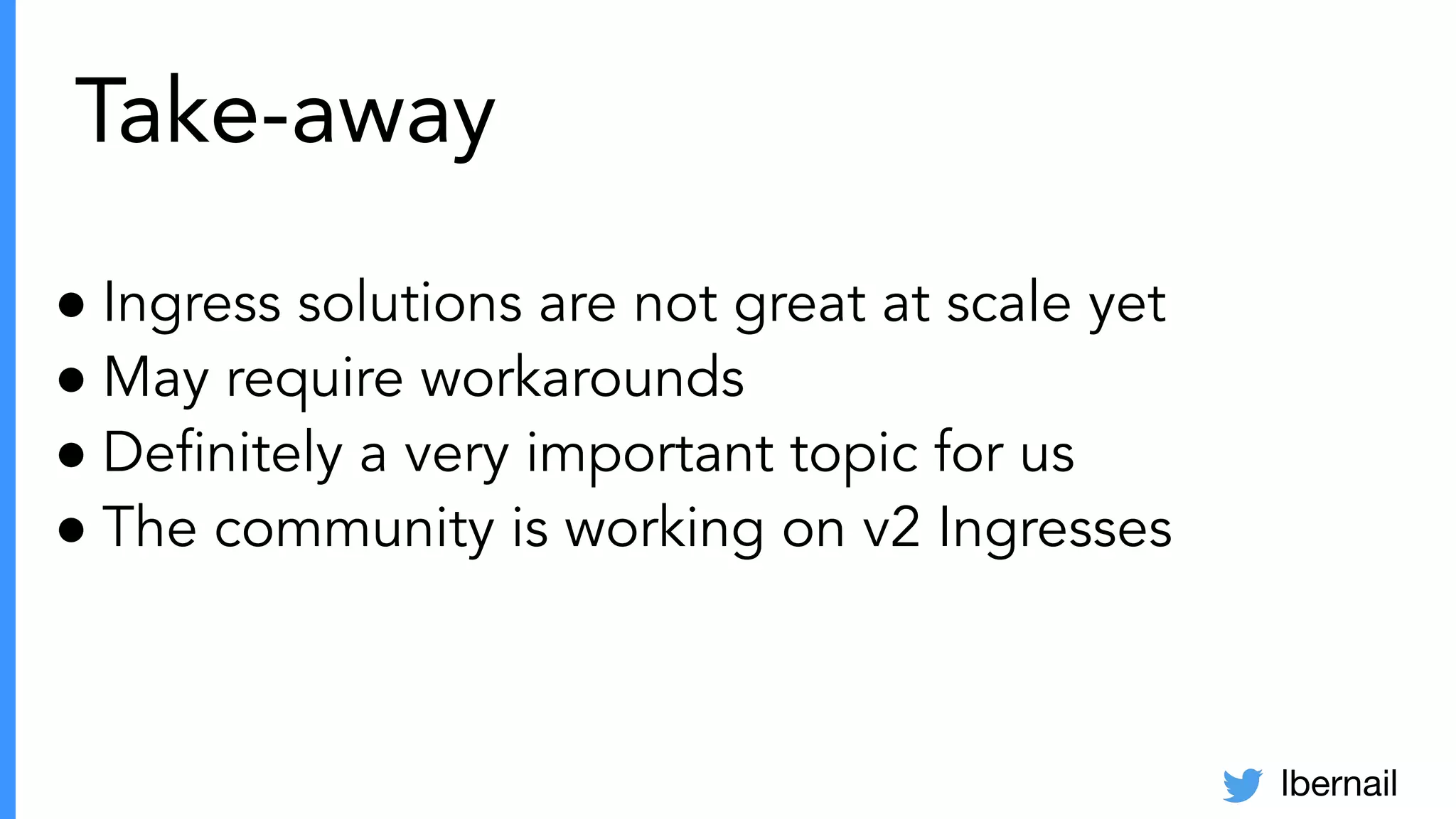
Take-away
● Ingress solutions are not great at scale yet
● May require workarounds
● Definitely a very important topic for us
● The community is working on v2 Ingresses
Conclusion
lbernail
A lot of other topics
● DNS (it’s always DNS!)
● Challenges with Stateful applications
● How to DDOS <insert ~anything> with Daemonsets
● Node Lifecycle
● Cluster Lifecycle
● Deploying applications
● ...
lbernail
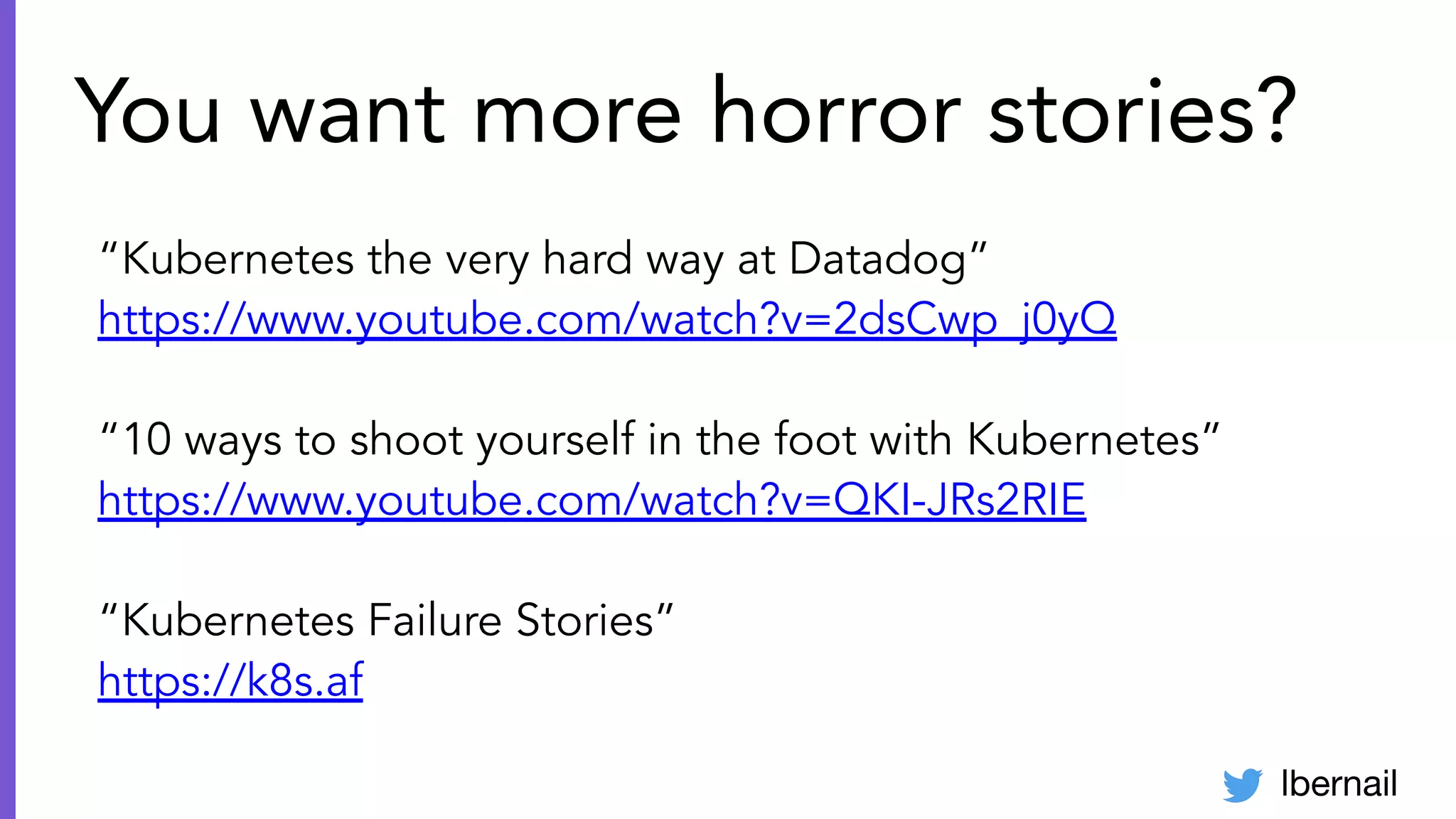
You want more horror stories?
“Kubernetes the very hard way at Datadog”
https://www.youtube.com/watch?v=2dsCwp_j0yQ
“10 ways to shoot yourself in the foot with Kubernetes”
https://www.youtube.com/watch?v=QKI-JRs2RIE
“Kubernetes Failure Stories”
https://k8s.af
lbernail
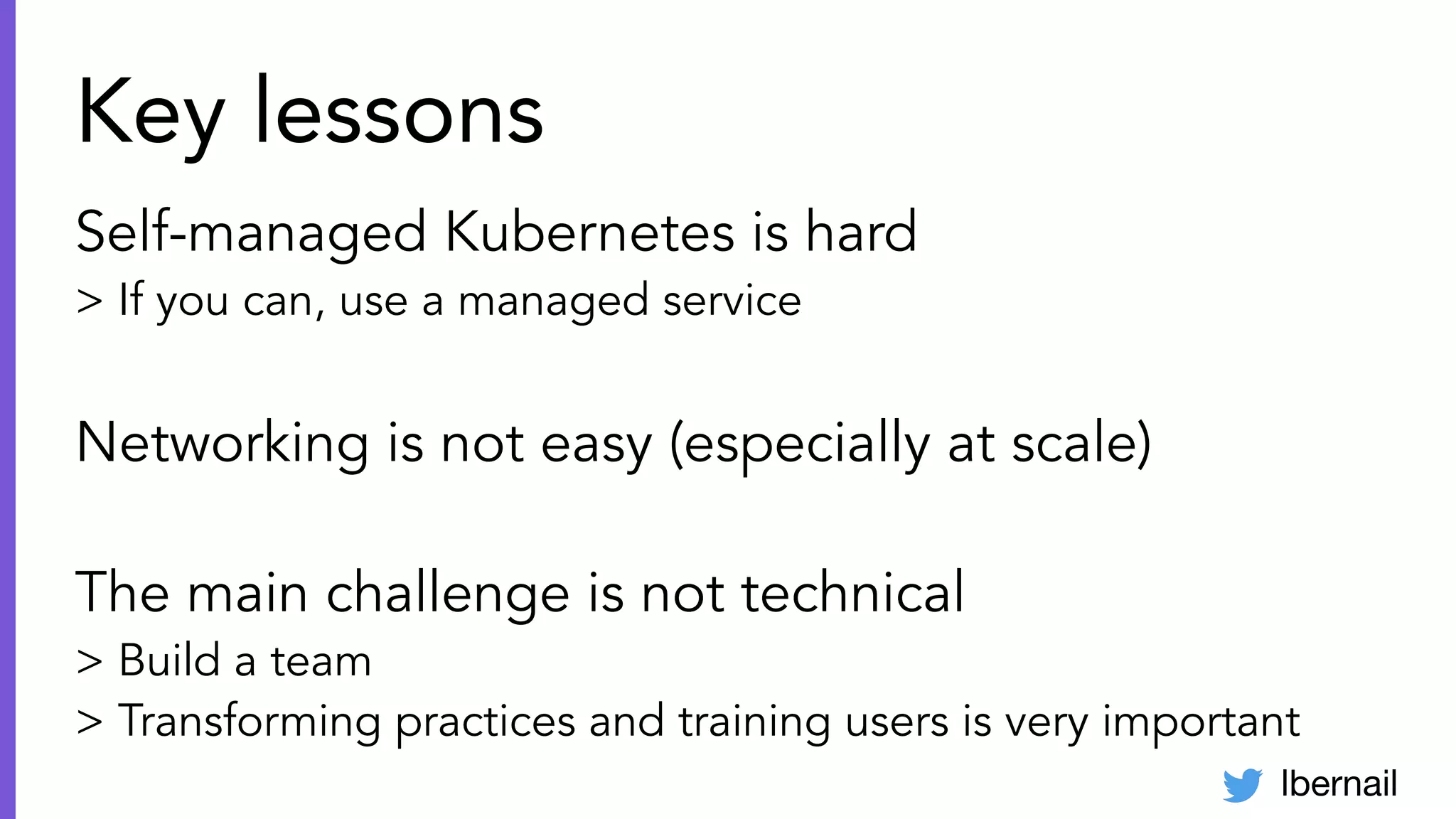
Key lessons
Self-managed Kubernetes is hard
> If you can, use a managed service
Networking is not easy (especially at scale)
The main challenge is not technical
> Build a team
> Transforming practices and training users is very important
Thank you
We’re hiring!
https://www.datadoghq.com/careers/
laurent@datadoghq.com
@lbernail

Kubernetes the Very Hard Way. Lisa Portland 2019