PREDICTING FUTURE OF
EDTECH 2030
Dr. Jari Laru, University Lecturer. Research Unit for Educational Technology, Faculty of Education.
Global Edtech Think That. Learntech Accelerator Horizon project. BETTSHOW2019. London,
25.1.2019
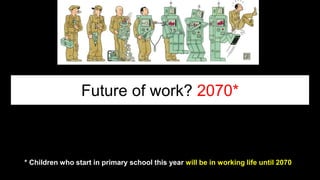
Future of work? 2070*
* Children who start in primary school this year will be in working life until 2070
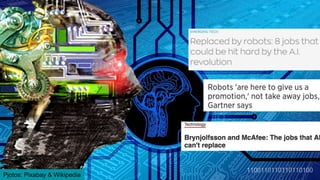
Pjotos: Pixabay & Wikipedia
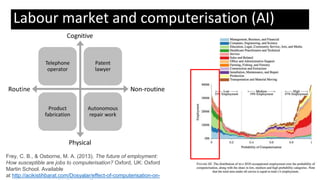
Frey, C. B., & Osborne, M. A. (2013). The future of employment:
How susceptible are jobs to computerisation? Oxford, UK: Oxford
Martin School. Available
at http://acikistihbarat.com/Dosyalar/effect-of-computerisation-on-
Labour market and computerisation (AI)
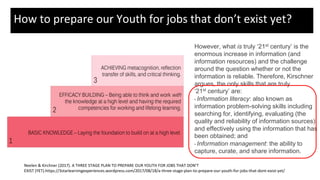
Neelen & Kirchner (2017). A THREE STAGE PLAN TO PREPARE OUR YOUTH FOR JOBS THAT DON’T
EXIST (YET).https://3starlearningexperiences.wordpress.com/2017/08/18/a-three-stage-plan-to-prepare-our-youth-for-jobs-that-dont-exist-yet/
However, what is truly ‘21st century’ is the
enormous increase in information (and
information resources) and the challenge
around the question whether or not the
information is reliable. Therefore, Kirschner
argues, the only skills that are truly
‘21st century’ are:
• Information literacy: also known as
information problem-solving skills including
searching for, identifying, evaluating (the
quality and reliability of information sources),
and effectively using the information that has
been obtained; and
• Information management: the ability to
capture, curate, and share information.
How to prepare our Youth for jobs that don’t exist yet?
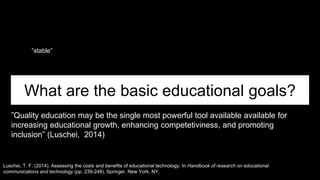
What are the basic educational goals?
”Quality education may be the single most powerful tool available available for
increasing educational growth, enhancing competetiviness, and promoting
inclusion” (Luschei, 2014)
Luschei, T. F. (2014). Assessing the costs and benefits of educational technology. In Handbook of research on educational
communications and technology (pp. 239-248). Springer, New York, NY.
”stable”
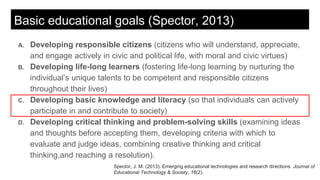
Basic educational goals (Spector, 2013)
A. Developing responsible citizens (citizens who will understand, appreciate,
and engage actively in civic and political life, with moral and civic virtues)
B. Developing life-long learners (fostering life-long learning by nurturing the
individual’s unique talents to be competent and responsible citizens
throughout their lives)
C. Developing basic knowledge and literacy (so that individuals can actively
participate in and contribute to society)
D. Developing critical thinking and problem-solving skills (examining ideas
and thoughts before accepting them, developing criteria with which to
evaluate and judge ideas, combining creative thinking and critical
thinking,and reaching a resolution).
Spector, J. M. (2013). Emerging educational technologies and research directions. Journal of
Educational Technology & Society, 16(2).
”..these (basic) goals [last slide] and
associated educational mission can be
found in one form or another in most
developed and developing countries
around world..” (pp.84 ,Navidad, Mayes,
Choi & Spector, 2015)
Natividad, G., Mayes, R., & Spector, J. M. (2015). Balancing stable educational
goals with changing educational technologies: challenges and opportunities. e-
mentor, 1, 83-94.
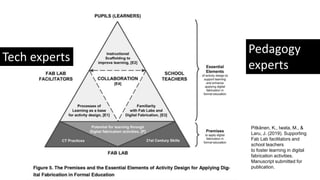
Tech experts
Pedagogy
experts
Pitkänen, K., Iwata, M., &
Laru, J. (2019). Supporting
Fab Lab facilitators and
school teachers
to foster learning in digital
fabrication activities.
Manuscript submitted for
publication.
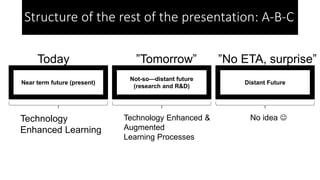
Near term future (present)
Not-so—distant future
(research and R&D)
Distant Future
Technology
Enhanced Learning
Technology Enhanced &
Augmented
Learning Processes
No idea 
Today ”Tomorrow” ”No ETA, surprise”
Structure of the rest of the presentation: A-B-C
A. NEAR-TERM FUTURE
(”Present”)
Already available, but not taken into use yet
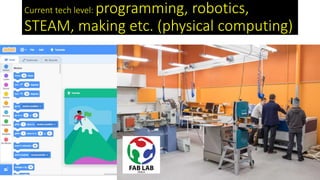
Current tech level: programming, robotics,
STEAM, making etc. (physical computing)
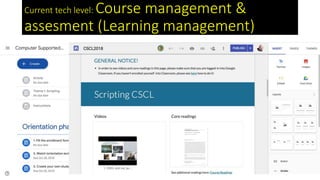
Current tech level: Course management &
assesment (Learning management)
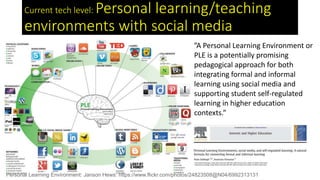
Current tech level: Personal learning/teaching
environments with social media
Personal Learning Environment: Janson Hews: https://www.flickr.com/photos/24823508@N04/6992313131
”A Personal Learning Environment or
PLE is a potentially promising
pedagogical approach for both
integrating formal and informal
learning using social media and
supporting student self-regulated
learning in higher education
contexts.”
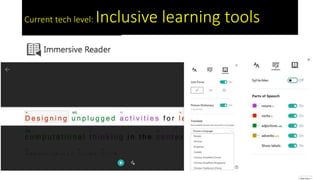
Current tech level: Inclusive learning tools
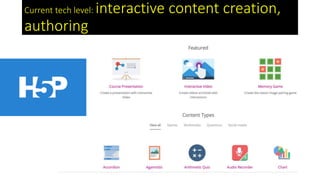
Current tech level: interactive content creation,
authoring
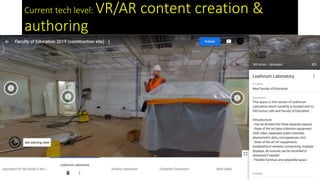
Current tech level: VR/AR content creation &
authoring
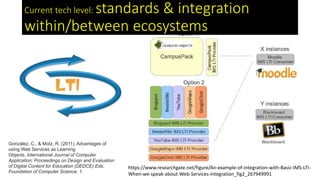
https://www.researchgate.net/figure/An-example-of-integration-with-Basic-IMS-LTI-
When-we-speak-about-Web-Services-integration_fig2_267949991
González, C., & Motz, R. (2011). Advantages of
using Web Services as Learning
Objects. International Journal of Computer
Application: Proceedings on Design and Evaluation
of Digital Content for Education (DEDCE) Eds.
Foundation of Computer Science, 1.
Current tech level: standards & integration
within/between ecosystems
B. NOT-SO-DISTANT FUTURE
(”tomorrow)
Prototypes available, researchers have visions, ideas, projects etc.
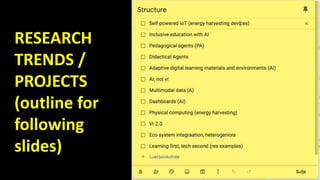
RESEARCH
TRENDS /
PROJECTS
(outline for
following
slides)
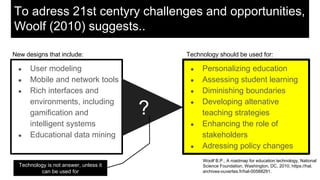
To adress 21st centyry challenges and opportunities,
Woolf (2010) suggests..
● User modeling
● Mobile and network tools
● Rich interfaces and
environments, including
gamification and
intelligent systems
● Educational data mining
● Personalizing education
● Assessing student learning
● Diminishing boundaries
● Developing altenative
teaching strategies
● Enhancing the role of
stakeholders
● Adressing policy changes
Technology should be used for:New designs that include:
Woolf B.P., A roadmap for education technology, National
Science Foundation, Washington, DC, 2010, https://hal.
archives-ouvertes.fr/hal-00588291.
Technology is not answer, unless it
can be used for
?
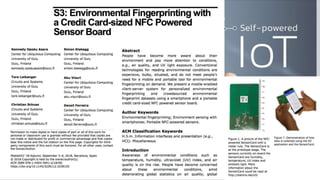
PHYSICAL COMPUTING 2.0 ?
Energy harvesting, self powered devices which integrate to various learning
contexts
ADAPTIVE LEARNING MATERIALS
& Environments
Smart Learning Environment [metatutor]
Adaptive learning materials: early steps
Chew, S. W., Cheng, I. L., & Chen, N. S. (2018). Exploring challenges faced by different
stakeholders while implementing educational technology in classrooms through expert
interviews. Journal of Computers in Education, 5(2), 175-197.
Metatutor Environment (left side:) Azevedo, R., Harley, J., Trevors, G., Duffy, M., Feyzi-
Behnagh, R., Bouchet, F., & Landis, R. (2013). Using trace data to examine the complex roles of
cognitive, metacognitive, and emotional self-regulatory processes during learning with multi-agent
systems. In International handbook of metacognition and learning technologies, Springer New
York, p. 431
..towards developing ”smart learning environment”
• That monitors learners’ learning process and
their progress,
• adapting to their learning patterns and needs,
• suggesting and feeding learners with relevant
information what they need in different forms
that suits each learner’s learning preference
and style
Future: Automated real-time adaptive learning
environment?
Smart Learning Environment [GSTUDY]
Future perspectives
See also: Malmberg, J., Järvenoja, H., & Järvelä, S. (2010). Tracing
elementary school students’ study tactic use in gStudy by examining a
strategic and self-regulated learning. Computers in Human Behavior, 26(5),
1034-1042.
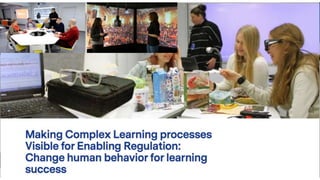
MULTIMODAL DATA & NEW
METHODS
Where is learning on learning analytics? Methdological challenge at the moment,
not in tomorrow
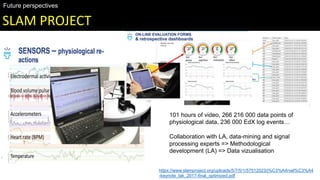
https://www.slamproject.org/uploads/5/7/5/1/57512023/j%C3%A4rvel%C3%A4
-keynote_lak_2017-final_optimized.pdf
101 hours of video, 266 216 000 data points of
physiological data, 236 000 EdX log events…
Collaboration with LA, data-mining and signal
processing experts => Methodological
development (LA) => Data vizualisation
SLAM PROJECT
Future perspectives
PEDAGOGICAL AND DIDACTICAL
AGENTS (or robots)
Azevedo, R., & Taub, M. (in preparation). The challenge
of measuring processes and outcomes during learning
from multiple representations with advanced learning
technologies. In P. Kendeou, P. Van Meter, A. List, & D.
Lombardi (Eds.), Handbook of learning from multiple
representations and perspectives. Cambridge, MA:
Cambridge University Press.
Azevedo, R., Bouchet, F., Harley, J. M., Feyzi-
Behnagh, R., Trevors, G., Duffy, M., ... & Mudrick, N.
(2011). MetaTutor: An Intelligent Multi-Agent
Tutoring System Designed to Detect, Track, Model
Foster Self-Regulated Learning. In Proceedings of
the Fourth Workshop on Self-Regulated Learning in
Educational Technologies.
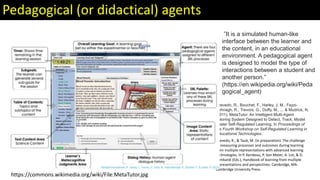
Pedagogical (or didactical) agents
”It is a simulated human-like
interface between the learner and
the content, in an educational
environment. A pedagogical agent
is designed to model the type of
interactions between a student and
another person.”
(https://en.wikipedia.org/wiki/Peda
gogical_agent)
https://commons.wikimedia.org/wiki/File:MetaTutor.jpg
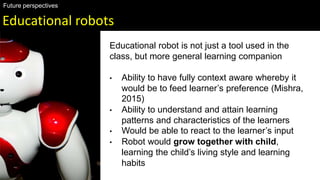
Educational robots
Future perspectives
Educational robot is not just a tool used in the
class, but more general learning companion
• Ability to have fully context aware whereby it
would be to feed learner’s preference (Mishra,
2015)
• Ability to understand and attain learning
patterns and characteristics of the learners
• Would be able to react to the learner’s input
• Robot would grow together with child,
learning the child’s living style and learning
habits
B. DISTANT FUTURE (No ETA,
surprise)
We have no idea about it.
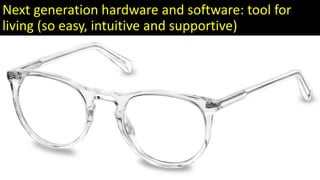
Next generation hardware and software: tool for
living (so easy, intuitive and supportive)
NOW:
Technology enhanced learning
SOON: (future)
Technology enhanced/augmented
learning processes
www.oulu.fi/let
https://twitter.com/LET_Oulu
https://www.linkedin.com/in/jarilaru
https://www.researchgate.net/profile/Jari_Laru
https://twitter.com/larux
Thank You!

PREDICTING FUTURE OF EDTECH 2030 v2

  • 1.
    PREDICTING FUTURE OF EDTECH2030 Dr. Jari Laru, University Lecturer. Research Unit for Educational Technology, Faculty of Education. Global Edtech Think That. Learntech Accelerator Horizon project. BETTSHOW2019. London, 25.1.2019
  • 2.
    Future of work?2070* * Children who start in primary school this year will be in working life until 2070
  • 3.
  • 4.
    Frey, C. B.,& Osborne, M. A. (2013). The future of employment: How susceptible are jobs to computerisation? Oxford, UK: Oxford Martin School. Available at http://acikistihbarat.com/Dosyalar/effect-of-computerisation-on- Labour market and computerisation (AI)
  • 5.
    Neelen & Kirchner(2017). A THREE STAGE PLAN TO PREPARE OUR YOUTH FOR JOBS THAT DON’T EXIST (YET).https://3starlearningexperiences.wordpress.com/2017/08/18/a-three-stage-plan-to-prepare-our-youth-for-jobs-that-dont-exist-yet/ However, what is truly ‘21st century’ is the enormous increase in information (and information resources) and the challenge around the question whether or not the information is reliable. Therefore, Kirschner argues, the only skills that are truly ‘21st century’ are: • Information literacy: also known as information problem-solving skills including searching for, identifying, evaluating (the quality and reliability of information sources), and effectively using the information that has been obtained; and • Information management: the ability to capture, curate, and share information. How to prepare our Youth for jobs that don’t exist yet?
  • 6.
    What are thebasic educational goals? ”Quality education may be the single most powerful tool available available for increasing educational growth, enhancing competetiviness, and promoting inclusion” (Luschei, 2014) Luschei, T. F. (2014). Assessing the costs and benefits of educational technology. In Handbook of research on educational communications and technology (pp. 239-248). Springer, New York, NY. ”stable”
  • 7.
    Basic educational goals(Spector, 2013) A. Developing responsible citizens (citizens who will understand, appreciate, and engage actively in civic and political life, with moral and civic virtues) B. Developing life-long learners (fostering life-long learning by nurturing the individual’s unique talents to be competent and responsible citizens throughout their lives) C. Developing basic knowledge and literacy (so that individuals can actively participate in and contribute to society) D. Developing critical thinking and problem-solving skills (examining ideas and thoughts before accepting them, developing criteria with which to evaluate and judge ideas, combining creative thinking and critical thinking,and reaching a resolution). Spector, J. M. (2013). Emerging educational technologies and research directions. Journal of Educational Technology & Society, 16(2).
  • 8.
    ”..these (basic) goals[last slide] and associated educational mission can be found in one form or another in most developed and developing countries around world..” (pp.84 ,Navidad, Mayes, Choi & Spector, 2015) Natividad, G., Mayes, R., & Spector, J. M. (2015). Balancing stable educational goals with changing educational technologies: challenges and opportunities. e- mentor, 1, 83-94.
  • 9.
    Tech experts Pedagogy experts Pitkänen, K.,Iwata, M., & Laru, J. (2019). Supporting Fab Lab facilitators and school teachers to foster learning in digital fabrication activities. Manuscript submitted for publication.
  • 10.
    Near term future(present) Not-so—distant future (research and R&D) Distant Future Technology Enhanced Learning Technology Enhanced & Augmented Learning Processes No idea  Today ”Tomorrow” ”No ETA, surprise” Structure of the rest of the presentation: A-B-C
  • 11.
    A. NEAR-TERM FUTURE (”Present”) Alreadyavailable, but not taken into use yet
  • 12.
    Current tech level:programming, robotics, STEAM, making etc. (physical computing)
  • 13.
    Current tech level:Course management & assesment (Learning management)
  • 14.
    Current tech level:Personal learning/teaching environments with social media Personal Learning Environment: Janson Hews: https://www.flickr.com/photos/24823508@N04/6992313131 ”A Personal Learning Environment or PLE is a potentially promising pedagogical approach for both integrating formal and informal learning using social media and supporting student self-regulated learning in higher education contexts.”
  • 15.
    Current tech level:Inclusive learning tools
  • 16.
    Current tech level:interactive content creation, authoring
  • 17.
    Current tech level:VR/AR content creation & authoring
  • 18.
    https://www.researchgate.net/figure/An-example-of-integration-with-Basic-IMS-LTI- When-we-speak-about-Web-Services-integration_fig2_267949991 González, C., &Motz, R. (2011). Advantages of using Web Services as Learning Objects. International Journal of Computer Application: Proceedings on Design and Evaluation of Digital Content for Education (DEDCE) Eds. Foundation of Computer Science, 1. Current tech level: standards & integration within/between ecosystems
  • 19.
    B. NOT-SO-DISTANT FUTURE (”tomorrow) Prototypesavailable, researchers have visions, ideas, projects etc.
  • 20.
  • 22.
    To adress 21stcentyry challenges and opportunities, Woolf (2010) suggests.. ● User modeling ● Mobile and network tools ● Rich interfaces and environments, including gamification and intelligent systems ● Educational data mining ● Personalizing education ● Assessing student learning ● Diminishing boundaries ● Developing altenative teaching strategies ● Enhancing the role of stakeholders ● Adressing policy changes Technology should be used for:New designs that include: Woolf B.P., A roadmap for education technology, National Science Foundation, Washington, DC, 2010, https://hal. archives-ouvertes.fr/hal-00588291. Technology is not answer, unless it can be used for ?
  • 23.
    PHYSICAL COMPUTING 2.0? Energy harvesting, self powered devices which integrate to various learning contexts
  • 25.
  • 26.
    Smart Learning Environment[metatutor] Adaptive learning materials: early steps Chew, S. W., Cheng, I. L., & Chen, N. S. (2018). Exploring challenges faced by different stakeholders while implementing educational technology in classrooms through expert interviews. Journal of Computers in Education, 5(2), 175-197. Metatutor Environment (left side:) Azevedo, R., Harley, J., Trevors, G., Duffy, M., Feyzi- Behnagh, R., Bouchet, F., & Landis, R. (2013). Using trace data to examine the complex roles of cognitive, metacognitive, and emotional self-regulatory processes during learning with multi-agent systems. In International handbook of metacognition and learning technologies, Springer New York, p. 431 ..towards developing ”smart learning environment” • That monitors learners’ learning process and their progress, • adapting to their learning patterns and needs, • suggesting and feeding learners with relevant information what they need in different forms that suits each learner’s learning preference and style Future: Automated real-time adaptive learning environment?
  • 27.
    Smart Learning Environment[GSTUDY] Future perspectives See also: Malmberg, J., Järvenoja, H., & Järvelä, S. (2010). Tracing elementary school students’ study tactic use in gStudy by examining a strategic and self-regulated learning. Computers in Human Behavior, 26(5), 1034-1042.
  • 28.
    MULTIMODAL DATA &NEW METHODS Where is learning on learning analytics? Methdological challenge at the moment, not in tomorrow
  • 30.
    https://www.slamproject.org/uploads/5/7/5/1/57512023/j%C3%A4rvel%C3%A4 -keynote_lak_2017-final_optimized.pdf 101 hours ofvideo, 266 216 000 data points of physiological data, 236 000 EdX log events… Collaboration with LA, data-mining and signal processing experts => Methodological development (LA) => Data vizualisation SLAM PROJECT Future perspectives
  • 32.
  • 33.
    Azevedo, R., &Taub, M. (in preparation). The challenge of measuring processes and outcomes during learning from multiple representations with advanced learning technologies. In P. Kendeou, P. Van Meter, A. List, & D. Lombardi (Eds.), Handbook of learning from multiple representations and perspectives. Cambridge, MA: Cambridge University Press. Azevedo, R., Bouchet, F., Harley, J. M., Feyzi- Behnagh, R., Trevors, G., Duffy, M., ... & Mudrick, N. (2011). MetaTutor: An Intelligent Multi-Agent Tutoring System Designed to Detect, Track, Model Foster Self-Regulated Learning. In Proceedings of the Fourth Workshop on Self-Regulated Learning in Educational Technologies. Pedagogical (or didactical) agents ”It is a simulated human-like interface between the learner and the content, in an educational environment. A pedagogical agent is designed to model the type of interactions between a student and another person.” (https://en.wikipedia.org/wiki/Peda gogical_agent) https://commons.wikimedia.org/wiki/File:MetaTutor.jpg
  • 34.
    Educational robots Future perspectives Educationalrobot is not just a tool used in the class, but more general learning companion • Ability to have fully context aware whereby it would be to feed learner’s preference (Mishra, 2015) • Ability to understand and attain learning patterns and characteristics of the learners • Would be able to react to the learner’s input • Robot would grow together with child, learning the child’s living style and learning habits
  • 35.
    B. DISTANT FUTURE(No ETA, surprise) We have no idea about it.
  • 36.
    Next generation hardwareand software: tool for living (so easy, intuitive and supportive)
  • 37.
    NOW: Technology enhanced learning SOON:(future) Technology enhanced/augmented learning processes www.oulu.fi/let https://twitter.com/LET_Oulu
  • 38.