ISOTONICSOLUTIONS
ISOTONIC SOLUTIONS
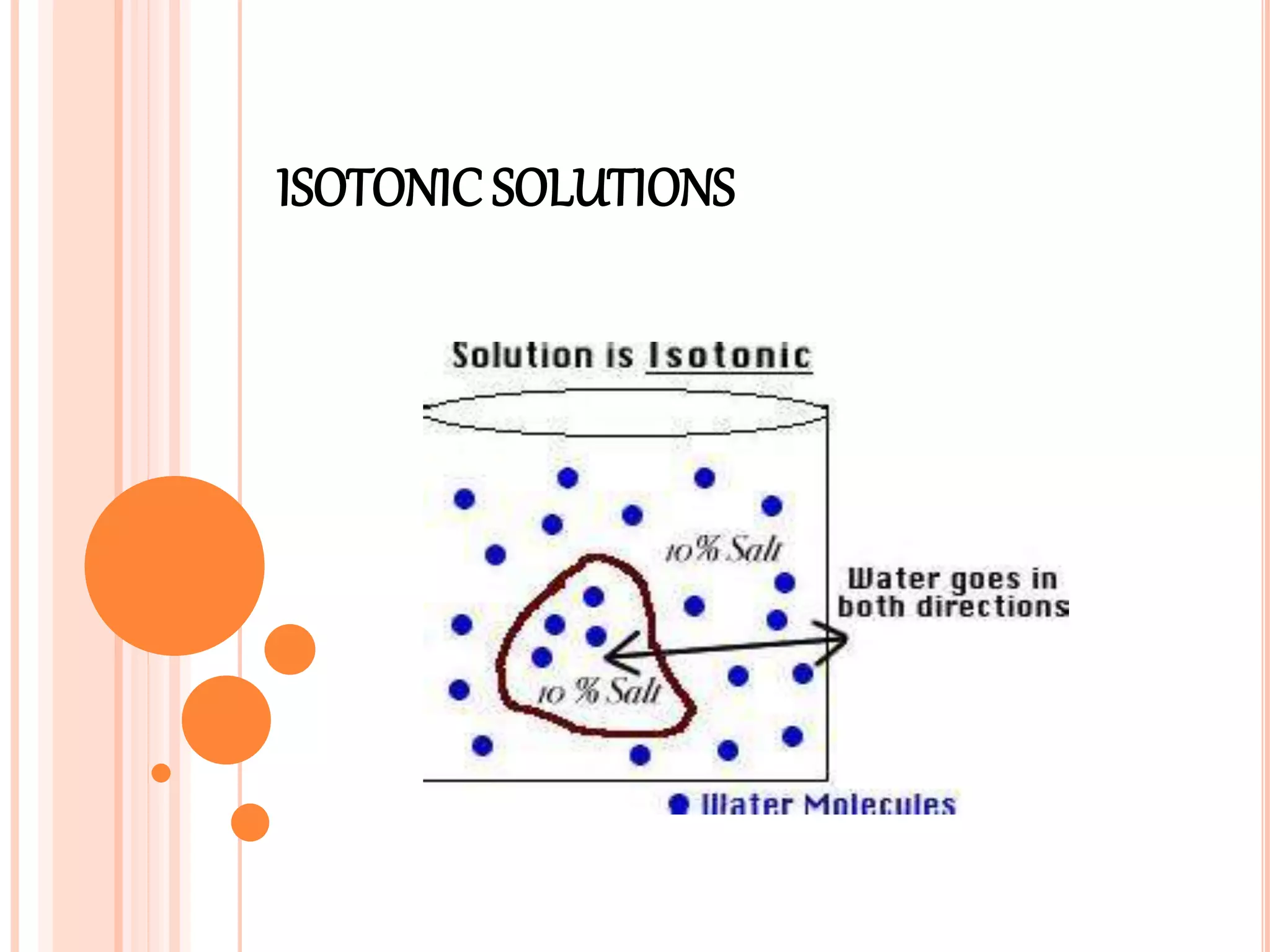
 A solution containing 0.9% of sodium chloride is
practically isotonic with blood plasma and is
regarded as standard.
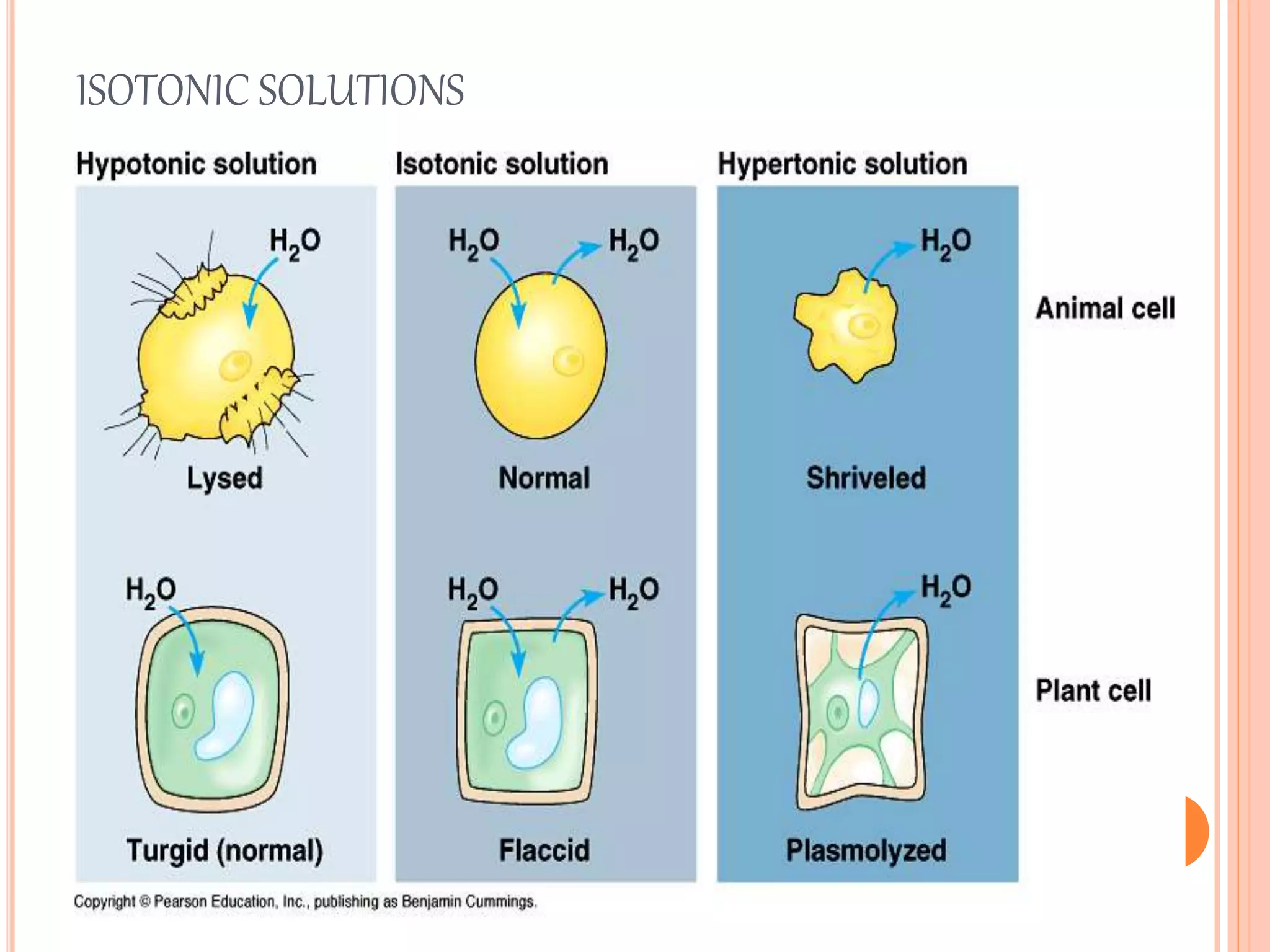
 A solution containing more than 0.9% sodium
chloride is called ‘hypertonic’.
 A solution containing less than 0.9% sodium chloride
is called ‘hypotonic’.
ISOTONIC SOLUTIONS
 Osmosis : the diffusion of solvent molecules from a region
of lower solute concentration to a region of higher solute
concentration through a semi- permeable membrane.
 Semi- permeable membrane: membranes which allow
solvent molecules to pass through but resist the passage of
dissolved substances.
 Excess of solvent molecules passing in one direction
creates a pressure called ‘Osmotic pressure’
ISOTONIC SOLUTIONS
ISOTONIC SOLUTIONS
ISOTONIC SOLUTIONS
 Iso- osmotic solutions: solutions having same
osmotic pressure.
(all Iso osmotic solutions are not necessarily
isotonic)
 Paratonic solutions: solutions with different
osmotic pressure.
GENERAL PRINCIPLES FOR ADJUSTMENT OF ISOTONICITY
1. Parenteral preparations should be isotonic with blood
plasma (depending on the route of administration).
i. intravenous injection- isotonicity is always desirable.
ii. Subcutaneous injection- not essential.
iii. Intramuscular- hypertonic.
iv. Intrathecal injection- isotonic
2. Nasal drops- should be isotonic.
3. Ophthalmic preparations- should be isotonic.
CALCULATIONS FOR SOLUTIONS ISOTONIC WITH BLOOD AND
TEARS.
1. Method based on freezing point data.
2. Method based on molecular concentration.
3. Graphic method based on vapour pressure and
freezing- point depression.
4. Method based on sodium chloride equivalent.
1. METHOD BASED ON FREEZING POINT DATA
 Physical properties of solutions- colligative
properties.
a) Osmotic pressure
b) Depression of freezing point- simpler.
 Temperature at which blood plasma and
tears freeze is -0.520C.
 Any solutions which freezes at –0.520C is
isotonic with blood plasma and tears.
GENERAL FORMULA FOR CALCULATION FOR SOLUTIONS TO
BE MADE ISO- OSMOTIC WITH BLOOD SERUM IS AS
FOLLOWS:
 Percentage w/v of adjusting
substance needed =
0.52- a
b
Where a = Freezing point of the unadjusted solution
b= Freezing point of a 1% w/v solution of the
adjusting substance.
2. METHOD BASED ON MOLECULAR CONCENTRATION
 Molecular concentration: number of units i.e.
molecules or ions or both present in a solution.
 A solution containing 1 g molecule of a non- ionising
solute in 22.4 litres at normal temperature and
pressure (NTP) has an atmospheric pressure of one
atmosphere.
 Therefore a solution containing one gram molecule
in 1 litre (a mole solution) will have osmotic
pressure of 22.4 atmosphere.
 Osmotic pressure of blood plasma and lachrymal
secretion is approximately 6.7 atmosphere.
 Molarity of these fluids = 6.7/22.4 = 0.3 M
(approx.)
 Conc. of un- ionised medicaments needed
to produce iso- osmotic solutions, W= 0.3 M
where W= concentration required in g per litre.
M= molecular weight of the solute.
 In case of ionised medicaments,
W= 0.3 M/ N
N= no. of ions
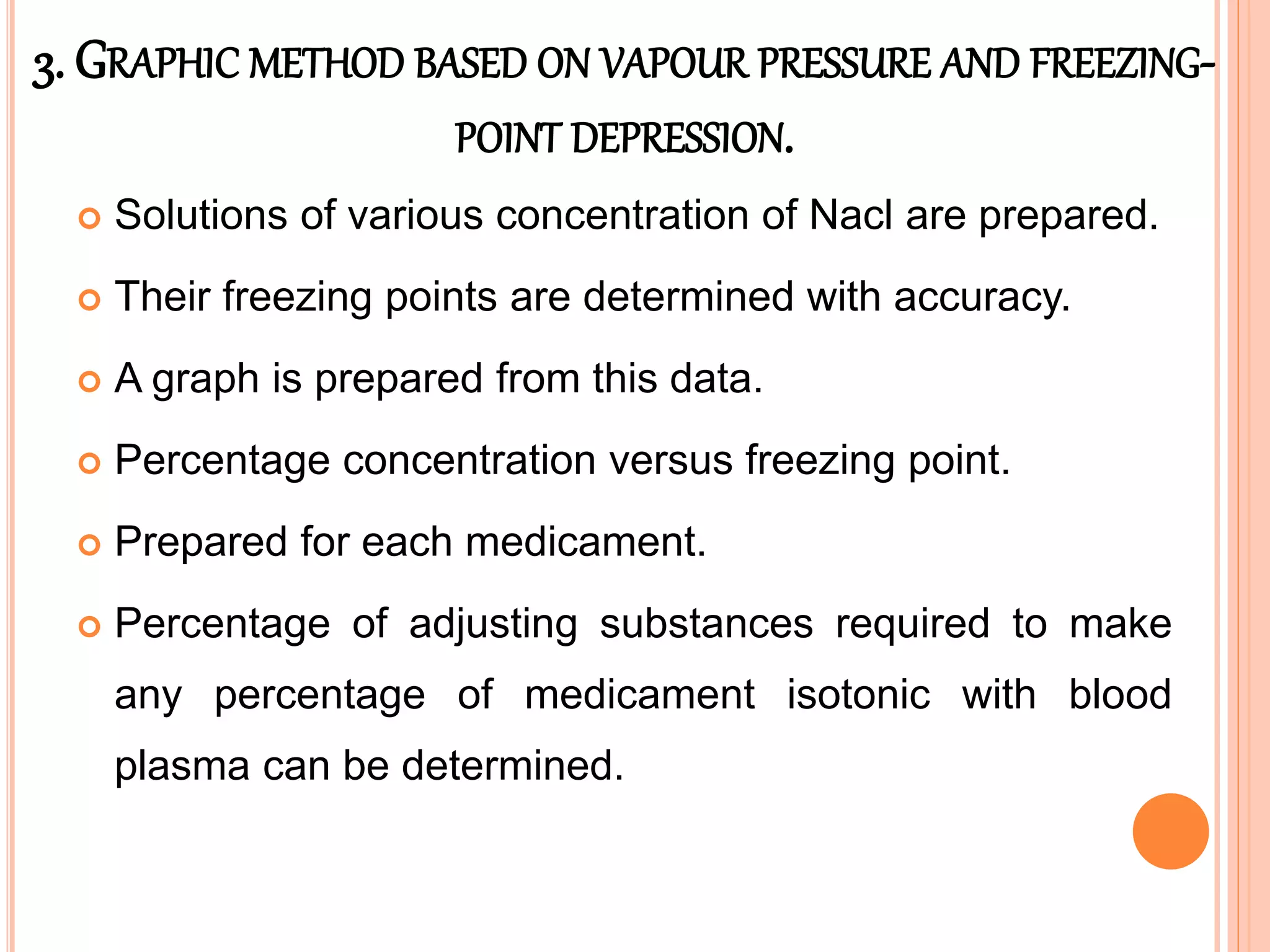
3. GRAPHIC METHOD BASED ON VAPOUR PRESSURE AND FREEZING-
POINT DEPRESSION.
 Solutions of various concentration of Nacl are prepared.
 Their freezing points are determined with accuracy.
 A graph is prepared from this data.
 Percentage concentration versus freezing point.
 Prepared for each medicament.
 Percentage of adjusting substances required to make
any percentage of medicament isotonic with blood
plasma can be determined.
4. METHOD BASED ON SODIUM CHLORIDE EQUIVALENT:
 Factor called ‘sodium chloride equivalent’ which can be
used to convert a specified concentration of medicament
to the concentrate of sodium chloride which will produce
same osmotic effect.
 Sodium chloride Freezing point depression produced
equivalent of a = by a soln of a medicament
medicament Freezing point depression produced
by a Nacl soln of the same strength.
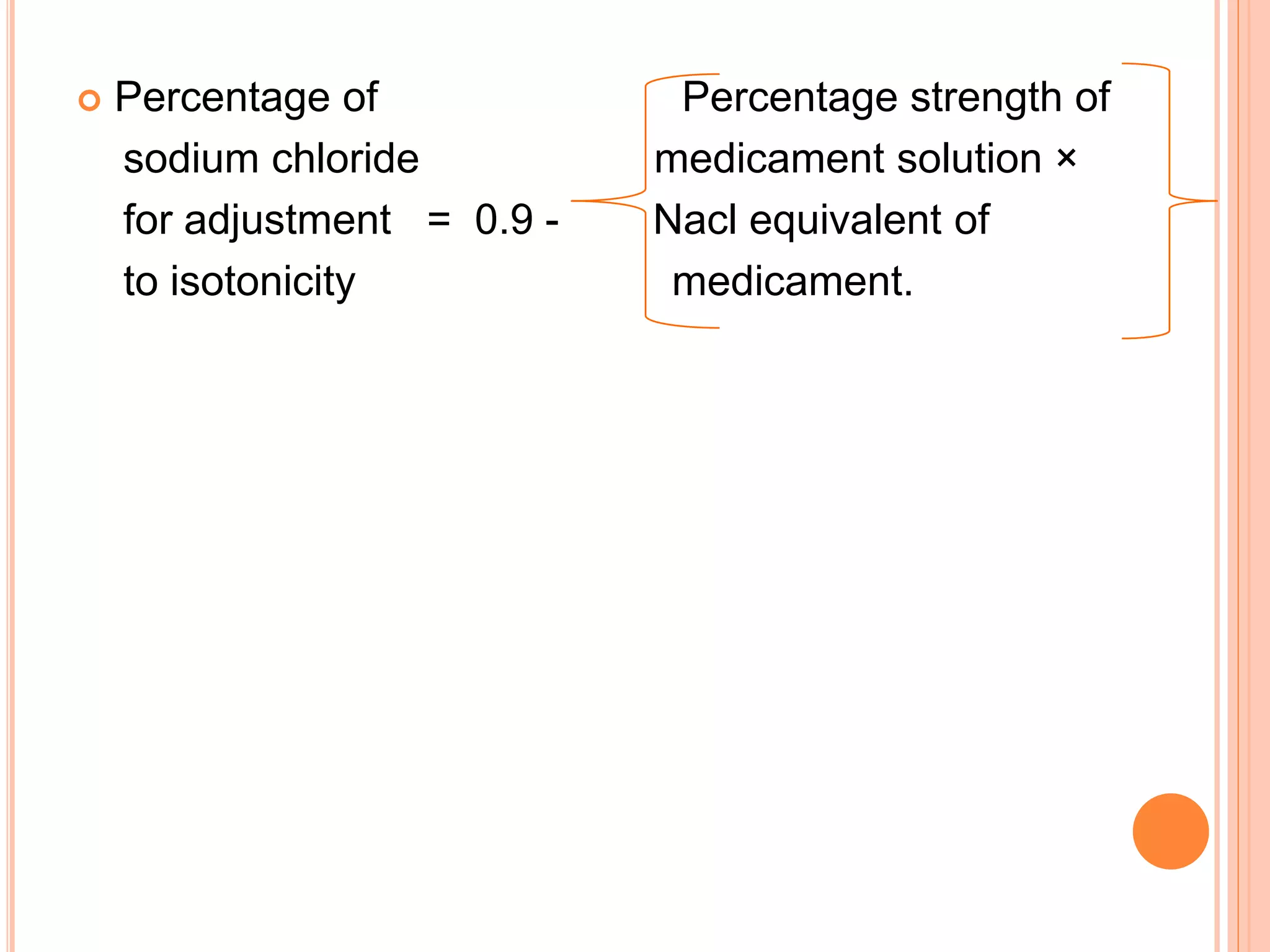
 Percentage of Percentage strength of
sodium chloride medicament solution ×
for adjustment = 0.9 - Nacl equivalent of
to isotonicity medicament.
PERCENTAGE CALCULATIONS
1. Per cent w/w
2. Per cent w/v
3. Per cent v/v
4. Per cent v/w
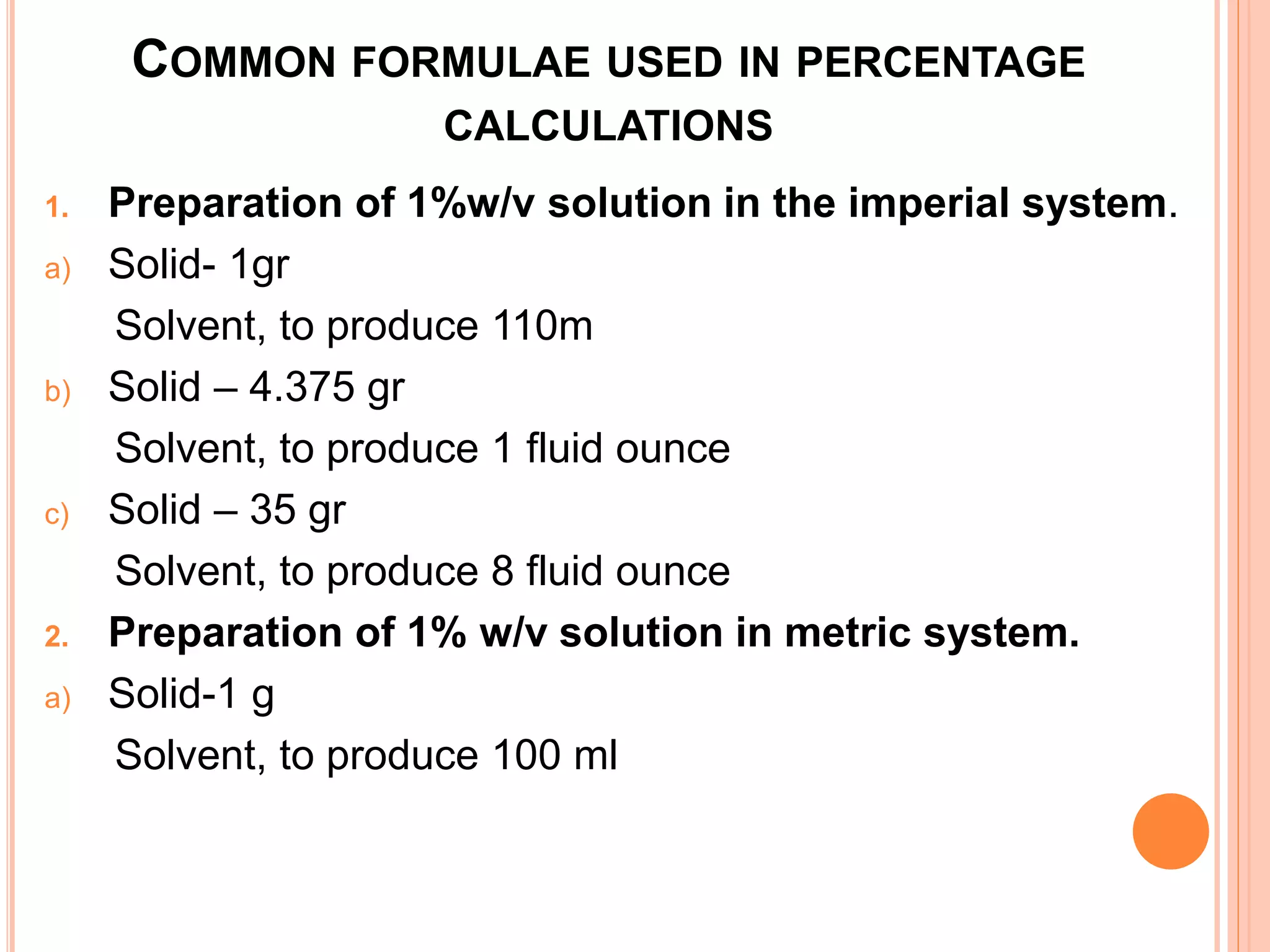
COMMON FORMULAE USED IN PERCENTAGE
CALCULATIONS
1. Preparation of 1%w/v solution in the imperial system.
a) Solid- 1gr
Solvent, to produce 110m
b) Solid – 4.375 gr
Solvent, to produce 1 fluid ounce
c) Solid – 35 gr
Solvent, to produce 8 fluid ounce
2. Preparation of 1% w/v solution in metric system.
a) Solid-1 g
Solvent, to produce 100 ml
COMMON FORMULAE USED IN PERCENTAGE
CALCULATIONS
3. Preparation of percentage solution by diluting the
concentrated solution.
Strength of dilute Strength of concentrate
solution = Degree of dilution
Volume of Volume required × Percentage required
stronger alcohol =
to be used Percentage used
Weight of Weight required × Percentage required
stronger acid =
to be used Percentage used
PERCENTAGE CALCULATIONS
1 in 100 100/100 per cent 1 %
1 in 400 100/ 400 per cent 0.25 %
1 in 1000 100/ 1,000 per cent 0.1 %
3 in 1000 3 × 100/ 1000 per cent 0.3 %
4 in 5000 4 × 100/ 5000 per cent 0.08 %
2 in 10,000 2 × 100/ 10, 1000 per cent 0.02 %

Isotonic solutions

  • 1.
  • 2.
    ISOTONIC SOLUTIONS  Asolution containing 0.9% of sodium chloride is practically isotonic with blood plasma and is regarded as standard.  A solution containing more than 0.9% sodium chloride is called ‘hypertonic’.  A solution containing less than 0.9% sodium chloride is called ‘hypotonic’.
  • 3.
    ISOTONIC SOLUTIONS  Osmosis: the diffusion of solvent molecules from a region of lower solute concentration to a region of higher solute concentration through a semi- permeable membrane.  Semi- permeable membrane: membranes which allow solvent molecules to pass through but resist the passage of dissolved substances.  Excess of solvent molecules passing in one direction creates a pressure called ‘Osmotic pressure’
  • 5.
  • 6.
  • 7.
    ISOTONIC SOLUTIONS  Iso-osmotic solutions: solutions having same osmotic pressure. (all Iso osmotic solutions are not necessarily isotonic)  Paratonic solutions: solutions with different osmotic pressure.
  • 8.
    GENERAL PRINCIPLES FORADJUSTMENT OF ISOTONICITY 1. Parenteral preparations should be isotonic with blood plasma (depending on the route of administration). i. intravenous injection- isotonicity is always desirable. ii. Subcutaneous injection- not essential. iii. Intramuscular- hypertonic. iv. Intrathecal injection- isotonic 2. Nasal drops- should be isotonic. 3. Ophthalmic preparations- should be isotonic.
  • 9.
    CALCULATIONS FOR SOLUTIONSISOTONIC WITH BLOOD AND TEARS. 1. Method based on freezing point data. 2. Method based on molecular concentration. 3. Graphic method based on vapour pressure and freezing- point depression. 4. Method based on sodium chloride equivalent.
  • 10.
    1. METHOD BASEDON FREEZING POINT DATA  Physical properties of solutions- colligative properties. a) Osmotic pressure b) Depression of freezing point- simpler.  Temperature at which blood plasma and tears freeze is -0.520C.  Any solutions which freezes at –0.520C is isotonic with blood plasma and tears.
  • 11.
    GENERAL FORMULA FORCALCULATION FOR SOLUTIONS TO BE MADE ISO- OSMOTIC WITH BLOOD SERUM IS AS FOLLOWS:  Percentage w/v of adjusting substance needed = 0.52- a b Where a = Freezing point of the unadjusted solution b= Freezing point of a 1% w/v solution of the adjusting substance.
  • 12.
    2. METHOD BASEDON MOLECULAR CONCENTRATION  Molecular concentration: number of units i.e. molecules or ions or both present in a solution.  A solution containing 1 g molecule of a non- ionising solute in 22.4 litres at normal temperature and pressure (NTP) has an atmospheric pressure of one atmosphere.  Therefore a solution containing one gram molecule in 1 litre (a mole solution) will have osmotic pressure of 22.4 atmosphere.
  • 13.
     Osmotic pressureof blood plasma and lachrymal secretion is approximately 6.7 atmosphere.  Molarity of these fluids = 6.7/22.4 = 0.3 M (approx.)  Conc. of un- ionised medicaments needed to produce iso- osmotic solutions, W= 0.3 M where W= concentration required in g per litre. M= molecular weight of the solute.  In case of ionised medicaments, W= 0.3 M/ N N= no. of ions
  • 14.
    3. GRAPHIC METHODBASED ON VAPOUR PRESSURE AND FREEZING- POINT DEPRESSION.  Solutions of various concentration of Nacl are prepared.  Their freezing points are determined with accuracy.  A graph is prepared from this data.  Percentage concentration versus freezing point.  Prepared for each medicament.  Percentage of adjusting substances required to make any percentage of medicament isotonic with blood plasma can be determined.
  • 15.
    4. METHOD BASEDON SODIUM CHLORIDE EQUIVALENT:  Factor called ‘sodium chloride equivalent’ which can be used to convert a specified concentration of medicament to the concentrate of sodium chloride which will produce same osmotic effect.  Sodium chloride Freezing point depression produced equivalent of a = by a soln of a medicament medicament Freezing point depression produced by a Nacl soln of the same strength.
  • 16.
     Percentage ofPercentage strength of sodium chloride medicament solution × for adjustment = 0.9 - Nacl equivalent of to isotonicity medicament.
  • 17.
    PERCENTAGE CALCULATIONS 1. Percent w/w 2. Per cent w/v 3. Per cent v/v 4. Per cent v/w
  • 18.
    COMMON FORMULAE USEDIN PERCENTAGE CALCULATIONS 1. Preparation of 1%w/v solution in the imperial system. a) Solid- 1gr Solvent, to produce 110m b) Solid – 4.375 gr Solvent, to produce 1 fluid ounce c) Solid – 35 gr Solvent, to produce 8 fluid ounce 2. Preparation of 1% w/v solution in metric system. a) Solid-1 g Solvent, to produce 100 ml
  • 19.
    COMMON FORMULAE USEDIN PERCENTAGE CALCULATIONS 3. Preparation of percentage solution by diluting the concentrated solution. Strength of dilute Strength of concentrate solution = Degree of dilution Volume of Volume required × Percentage required stronger alcohol = to be used Percentage used Weight of Weight required × Percentage required stronger acid = to be used Percentage used
  • 20.
    PERCENTAGE CALCULATIONS 1 in100 100/100 per cent 1 % 1 in 400 100/ 400 per cent 0.25 % 1 in 1000 100/ 1,000 per cent 0.1 % 3 in 1000 3 × 100/ 1000 per cent 0.3 % 4 in 5000 4 × 100/ 5000 per cent 0.08 % 2 in 10,000 2 × 100/ 10, 1000 per cent 0.02 %