Technocrats Group of Institutions
Technocrats Group Campus, BHEL, Bhopal - 462021 MP, India
Phone : +91-755-2751679
e-mail: info@titbhopal.net | website: www.technocratsgroup.edu.in
Anatomy and physiology
Respiratory system
Session - 2
DMLT
1st year
Mr. Kuldeep Dahayat
www.technocratsgroup.edu.in 2
RESPIRATORY SYSTEM
*Respiration is the process by which oxygen is taken in and
carbon dioxide is given out.
*The first breath takes place only after birth.
*Fetal lungs are non-functional.
*So, during intrauterine life the exchange of gases between
fetal blood and mother’s blood occurs through placenta.
*The permanent stoppage of respiration occurs only at death.
www.technocratsgroup.edu.in 5
Types of respiration
Respiration is often classified into two types:
1. External respiration: it involves exchange
of respiratory gases, i.e. oxygen and
carbon dioxide between lungs and blood
2. Internal respiration: it involves exchange
of gases between blood and tissues.
www.technocratsgroup.edu.in 6
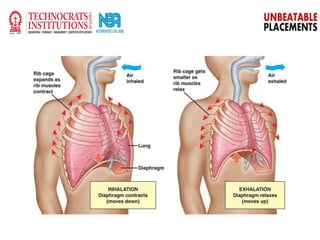
Phases of respiration
Inspiration: during which the air enters the
lungs from atmosphere.
Expiration: during which the air leaves the
lungs.
Note - During normal breathing, inspiration
is an active process and expiration is a
passive process.
www.technocratsgroup.edu.in 7
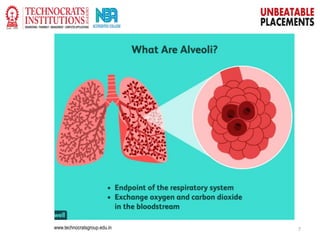
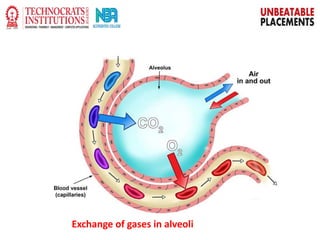
Exchange of gases in alveoli
www.technocratsgroup.edu.in 9
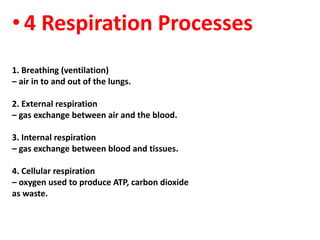
• 4 Respiration Processes
1. Breathing (ventilation)
– air in to and out of the lungs.
2. External respiration
– gas exchange between air and the blood.
3. Internal respiration
– gas exchange between blood and tissues.
4. Cellular respiration
– oxygen used to produce ATP, carbon dioxide
as waste.
www.technocratsgroup.edu.in 11
www.technocratsgroup.edu.in 16
Breathing vs. Respiration
Breathing = Inspiration + Expiration
– intake of air/inhale to bring fresh
supply of oxygen.
– breathing out of air/exhale to get rid of
CO2
Respiration – process of gas exchange
between various body compartments
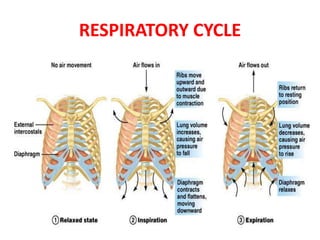
Process of Breathing: Pressure Gradient
• Inspiration/Expiration: air in/air out
• Cycle:
1. Relaxed State – diaphragm and intercostal muscles
relaxed.
2.Inspiration – diaphragm contracts, pulling muscle down,
intercostal muscles contract elevating chest wall and
expanding volume of chest lowering pressure in lungs,
pulling in air
3.Expiration – muscles relax, diaphragm resumes dome
shape, intercostal muscles allow chest to lower resulting in
increase of pressure in chest and expulsion of air.
RESPIRATORY CYCLE
Boyle’s law
• Boyle’s law states that the pressure(p) of a
given quantity of a gas varies inversely
proportional with its volume(v) at constant
temperature.
It means if pressure will
increase the volume will decrease and vice
versa.
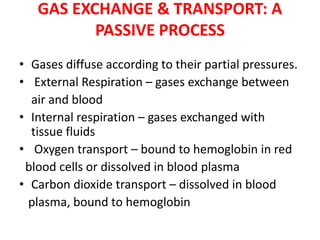
GAS EXCHANGE & TRANSPORT: A
PASSIVE PROCESS
• Gases diffuse according to their partial pressures.
• External Respiration – gases exchange between
air and blood
• Internal respiration – gases exchanged with
tissue fluids
• Oxygen transport – bound to hemoglobin in red
blood cells or dissolved in blood plasma
• Carbon dioxide transport – dissolved in blood
plasma, bound to hemoglobin
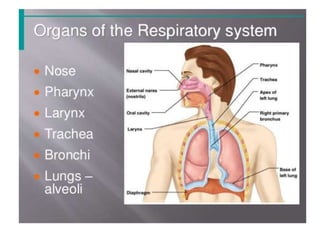
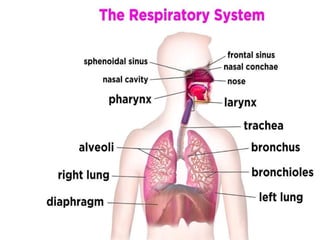
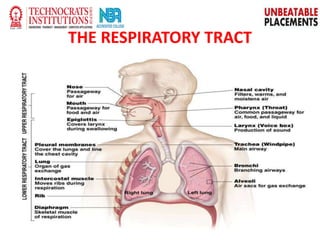
THE RESPIRATORY TRACT
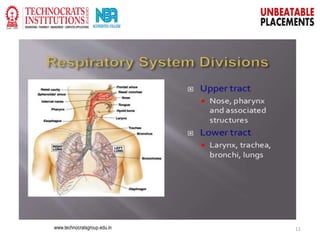
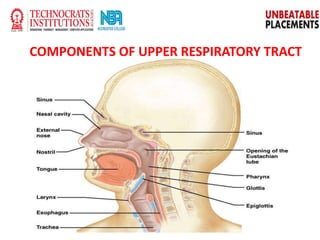
COMPONENTS OF UPPER RESPIRATORY TRACT
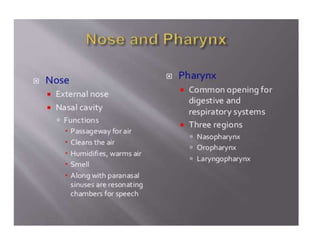
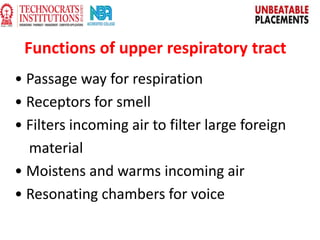
Functions of upper respiratory tract
• Passage way for respiration
• Receptors for smell
• Filters incoming air to filter large foreign
material
• Moistens and warms incoming air
• Resonating chambers for voice
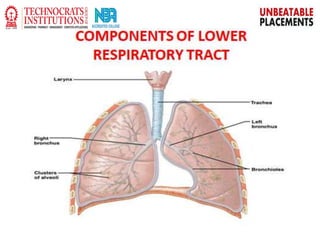
FUNCTIONS OF LOWER RESPIRATORY
TRACT
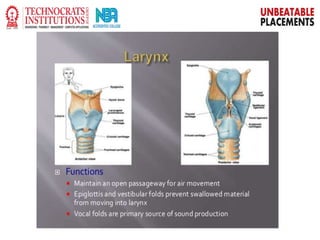
• Larynx – maintains an open airway, routes
food and air appropriately, assists in sound
production
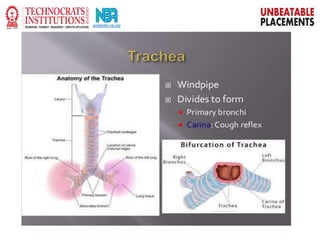
• Trachea – transports air to and from lungs
• Bronchi – branch into lungs
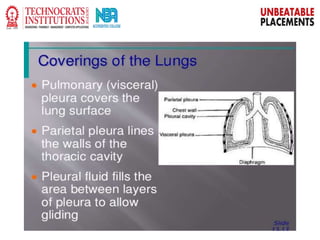
• Lungs – transport air to alveoli for gas
exchange
PULMONARY FUNCTION TESTS
• Pulmonary function test are useful in
assessing the functional status of respiratory
system both in physiological and pathological
condition. pulmonary function tests are
carried out mostly by using spirometer.
• The air in lungs is classified into two divisions
1. lung volumes
2.lung capacities
Applied physiology of respiratory
system
1. Asthma – It is due to allergic reaction to foreign
particles that affect the respiratory system.
2. Emphysema – It is the inflation or abnormal
distension of the bronchioles or alveolar sacs of
lungs.
3. Pneumonia – It is acute infection or
inflammation of the alveoli of the lungs due to
bacterium streptococcus pneumone.
4. Apnea – temporary arrest of breathing
5. Tachypnea – increase in rate of respiration
6. Bradypnea – the decrease in the rate of
respiration.
7. Dyspnea – Difficulty in breathing
Respiratory system

Respiratory system

  • 1.
    Technocrats Group ofInstitutions Technocrats Group Campus, BHEL, Bhopal - 462021 MP, India Phone : +91-755-2751679 e-mail: info@titbhopal.net | website: www.technocratsgroup.edu.in Anatomy and physiology Respiratory system Session - 2 DMLT 1st year Mr. Kuldeep Dahayat
  • 2.
    www.technocratsgroup.edu.in 2 RESPIRATORY SYSTEM *Respirationis the process by which oxygen is taken in and carbon dioxide is given out. *The first breath takes place only after birth. *Fetal lungs are non-functional. *So, during intrauterine life the exchange of gases between fetal blood and mother’s blood occurs through placenta. *The permanent stoppage of respiration occurs only at death.
  • 5.
    www.technocratsgroup.edu.in 5 Types ofrespiration Respiration is often classified into two types: 1. External respiration: it involves exchange of respiratory gases, i.e. oxygen and carbon dioxide between lungs and blood 2. Internal respiration: it involves exchange of gases between blood and tissues.
  • 6.
    www.technocratsgroup.edu.in 6 Phases ofrespiration Inspiration: during which the air enters the lungs from atmosphere. Expiration: during which the air leaves the lungs. Note - During normal breathing, inspiration is an active process and expiration is a passive process.
  • 7.
  • 8.
  • 9.
  • 10.
    • 4 RespirationProcesses 1. Breathing (ventilation) – air in to and out of the lungs. 2. External respiration – gas exchange between air and the blood. 3. Internal respiration – gas exchange between blood and tissues. 4. Cellular respiration – oxygen used to produce ATP, carbon dioxide as waste.
  • 11.
  • 16.
    www.technocratsgroup.edu.in 16 Breathing vs.Respiration Breathing = Inspiration + Expiration – intake of air/inhale to bring fresh supply of oxygen. – breathing out of air/exhale to get rid of CO2 Respiration – process of gas exchange between various body compartments
  • 17.
    Process of Breathing:Pressure Gradient • Inspiration/Expiration: air in/air out • Cycle: 1. Relaxed State – diaphragm and intercostal muscles relaxed. 2.Inspiration – diaphragm contracts, pulling muscle down, intercostal muscles contract elevating chest wall and expanding volume of chest lowering pressure in lungs, pulling in air 3.Expiration – muscles relax, diaphragm resumes dome shape, intercostal muscles allow chest to lower resulting in increase of pressure in chest and expulsion of air.
  • 18.
  • 19.
    Boyle’s law • Boyle’slaw states that the pressure(p) of a given quantity of a gas varies inversely proportional with its volume(v) at constant temperature. It means if pressure will increase the volume will decrease and vice versa.
  • 21.
    GAS EXCHANGE &TRANSPORT: A PASSIVE PROCESS • Gases diffuse according to their partial pressures. • External Respiration – gases exchange between air and blood • Internal respiration – gases exchanged with tissue fluids • Oxygen transport – bound to hemoglobin in red blood cells or dissolved in blood plasma • Carbon dioxide transport – dissolved in blood plasma, bound to hemoglobin
  • 22.
  • 23.
    COMPONENTS OF UPPERRESPIRATORY TRACT
  • 24.
    Functions of upperrespiratory tract • Passage way for respiration • Receptors for smell • Filters incoming air to filter large foreign material • Moistens and warms incoming air • Resonating chambers for voice
  • 26.
    FUNCTIONS OF LOWERRESPIRATORY TRACT • Larynx – maintains an open airway, routes food and air appropriately, assists in sound production • Trachea – transports air to and from lungs • Bronchi – branch into lungs • Lungs – transport air to alveoli for gas exchange
  • 27.
    PULMONARY FUNCTION TESTS •Pulmonary function test are useful in assessing the functional status of respiratory system both in physiological and pathological condition. pulmonary function tests are carried out mostly by using spirometer. • The air in lungs is classified into two divisions 1. lung volumes 2.lung capacities
  • 28.
    Applied physiology ofrespiratory system 1. Asthma – It is due to allergic reaction to foreign particles that affect the respiratory system. 2. Emphysema – It is the inflation or abnormal distension of the bronchioles or alveolar sacs of lungs. 3. Pneumonia – It is acute infection or inflammation of the alveoli of the lungs due to bacterium streptococcus pneumone. 4. Apnea – temporary arrest of breathing
  • 29.
    5. Tachypnea –increase in rate of respiration 6. Bradypnea – the decrease in the rate of respiration. 7. Dyspnea – Difficulty in breathing