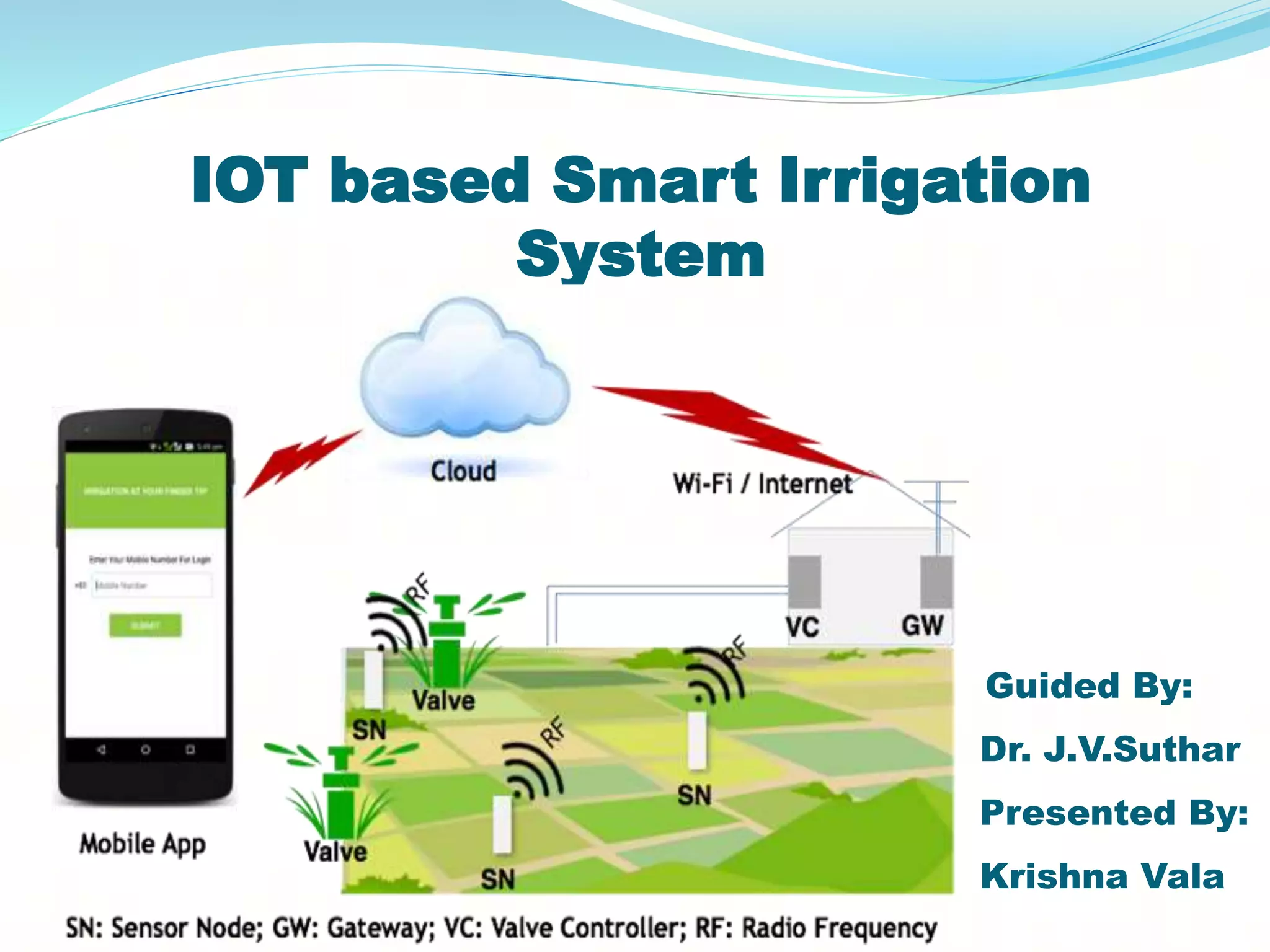
IOT based Smart Irrigation
System
Guided By:
Dr. J.V.Suthar
Presented By:
Krishna Vala
Introduction
 India's population crossing 1.3 billion in 2016
 So balance between the optimum population growth and a healthy of
nation is far to be achieved.
 The rising population need for increased agricultural production
 Irrigated agriculture has been important source increased agricultural
production
 “IOT based smart irrigation system” is for to create an IOT base automated
irrigation mechanism which turns the pumping motor ON and OFF pass
command through IOT platform.
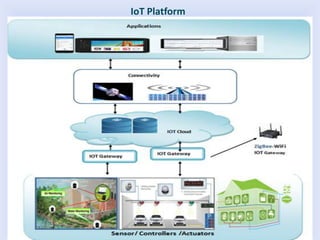
IoT (Internet of Things):
 The Internet of Things (IoT) is the inter-networking of
“physical devices” also referred to as "connected devices"
and "smart devices”.
 Sometimes referred to as the Internet of Everything (IoE) and
Machine to Machine (M2M) communicating.
 IOT is expected to offer advanced connectivity of devices,
systems, and services that covers a variety of protocols,
domains, and applications
IoT Platform
System Component: Hardware and Software
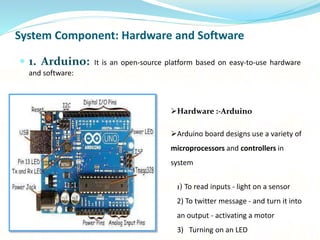
 1. Arduino: It is an open-source platform based on easy-to-use hardware
and software:
Hardware :-Arduino
Arduino board designs use a variety of
microprocessors and controllers in
system
1) To read inputs - light on a sensor
2) To twitter message - and turn it into
an output - activating a motor
3) Turning on an LED
Software :-Arduino (IDE= Integrated Development Environment)
 Use: Check Conditions:
 Writing Sketches: Programs written using
Arduino Software (IDE) are called sketches
 Upload: Compiles your code and
uploads it to the configured board
 New: Creates a new sketch
 Save: Saves your sketch
 Serial Monitor: File, Edit, Sketch, Tools,
Help
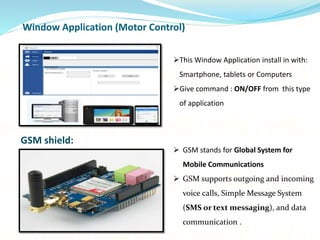
Window Application (Motor Control)
This Window Application install in with:
Smartphone, tablets or Computers
Give command : ON/OFF from this type
of application
 GSM stands for Global System for
Mobile Communications
 GSM supports outgoing and incoming
voice calls, Simple Message System
(SMS or text messaging), and data
communication .
GSM shield:
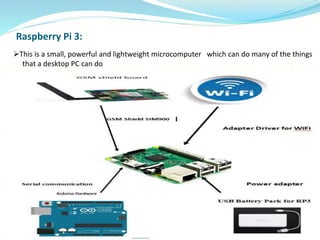
Raspberry Pi 3:
This is a small, powerful and lightweight microcomputer which can do many of the things
that a desktop PC can do
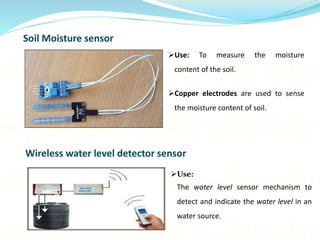
Soil Moisture sensor
Use: To measure the moisture
content of the soil.
Copper electrodes are used to sense
the moisture content of soil.
Wireless water level detector sensor
Use:
The water level sensor mechanism to
detect and indicate the water level in an
water source.
.
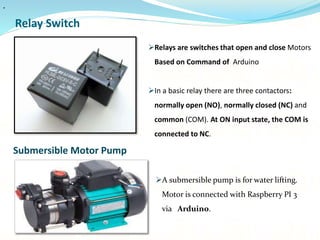
Relays are switches that open and close Motors
Based on Command of Arduino
In a basic relay there are three contactors:
normally open (NO), normally closed (NC) and
common (COM). At ON input state, the COM is
connected to NC.
Submersible Motor Pump
A submersible pump is for water lifting.
Motor is connected with Raspberry PI 3
via Arduino.
Relay Switch
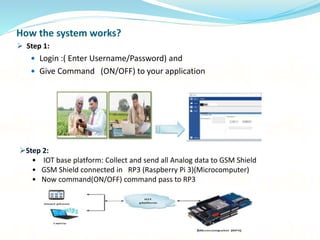
How the system works?
 Step 1:
 Login :( Enter Username/Password) and
 Give Command (ON/OFF) to your application
Step 2:
• IOT base platform: Collect and send all Analog data to GSM Shield
• GSM Shield connected in RP3 (Raspberry Pi 3)(Microcomputer)
• Now command(ON/OFF) command pass to RP3
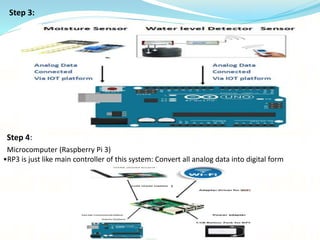
Step 3:
Step 4:
Microcomputer (Raspberry Pi 3)
•RP3 is just like main controller of this system: Convert all analog data into digital form
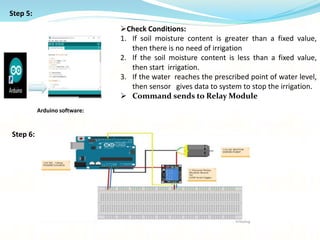
Step 5:
Arduino software:
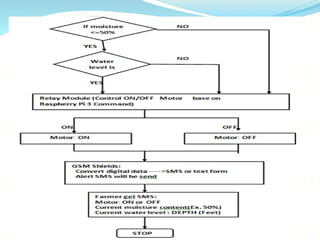
Check Conditions:
1. If soil moisture content is greater than a fixed value,
then there is no need of irrigation
2. If the soil moisture content is less than a fixed value,
then start irrigation.
3. If the water reaches the prescribed point of water level,
then sensor gives data to system to stop the irrigation.
 Command sends to Relay Module
Step 6:
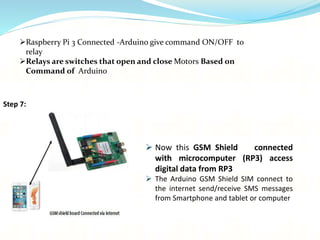
Step 7:
Raspberry Pi 3 Connected -Arduino give command ON/OFF to
relay
Relays are switches that open and close Motors Based on
Command of Arduino
 Now this GSM Shield connected
with microcomputer (RP3) access
digital data from RP3
 The Arduino GSM Shield SIM connect to
the internet send/receive SMS messages
from Smartphone and tablet or computer
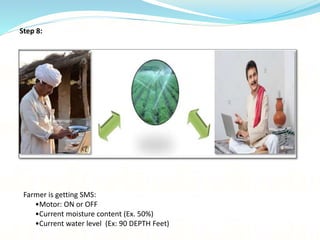
Step 8:
Farmer is getting SMS:
•Motor: ON or OFF
•Current moisture content (Ex. 50%)
•Current water level (Ex: 90 DEPTH Feet)
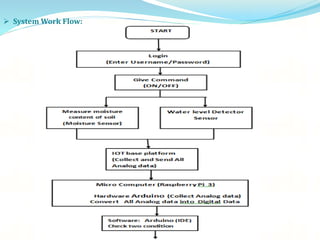
 System Work Flow:
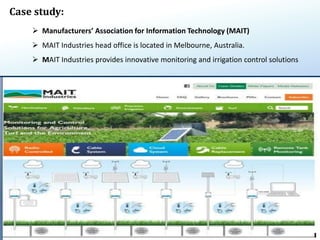
Case study:
 Manufacturers’ Association for Information Technology (MAIT)
 MAIT Industries head office is located in Melbourne, Australia.
 MAIT Industries provides innovative monitoring and irrigation control solutions
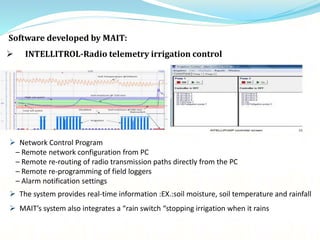
Software developed by MAIT:
 INTELLITROL-Radio telemetry irrigation control
 Network Control Program
– Remote network configuration from PC
– Remote re-routing of radio transmission paths directly from the PC
– Remote re-programming of field loggers
– Alarm notification settings
 The system provides real-time information :EX.:soil moisture, soil temperature and rainfall
 MAIT’s system also integrates a “rain switch “stopping irrigation when it rains
Advantages
 Water Conservation
 Real-Time Data give
 Lowered Operation Costs
 Efficient and Saves Time
 Increase in productivity
 Reduce soil erosion and nutrient leaching
Challenges
 Complexity : The IOT is a diverse and complex network
 Privacy/Security:
 Lesser Employment of Manual Staff or unskilled workers:
 Equipment is costlier.
 Awareness of Indian farmer for this technology
Conclusion
 I conclude that this system is easy to implement and time, money and
manpower saving solution for irrigating fields.
 A farmer should visualize his agricultural land’s moisture content from time
to time and water level of source is sufficient or not. IOT based smart
irrigation system displays the values of the sensors continuously in smart
phone or on computer’s web page and farmer can operate them anytime
from and anywhere.
Iot based smart irrigation system

Iot based smart irrigation system

  • 1.
    IOT based SmartIrrigation System Guided By: Dr. J.V.Suthar Presented By: Krishna Vala
  • 2.
    Introduction  India's populationcrossing 1.3 billion in 2016  So balance between the optimum population growth and a healthy of nation is far to be achieved.  The rising population need for increased agricultural production  Irrigated agriculture has been important source increased agricultural production  “IOT based smart irrigation system” is for to create an IOT base automated irrigation mechanism which turns the pumping motor ON and OFF pass command through IOT platform.
  • 3.
    IoT (Internet ofThings):  The Internet of Things (IoT) is the inter-networking of “physical devices” also referred to as "connected devices" and "smart devices”.  Sometimes referred to as the Internet of Everything (IoE) and Machine to Machine (M2M) communicating.  IOT is expected to offer advanced connectivity of devices, systems, and services that covers a variety of protocols, domains, and applications
  • 4.
  • 5.
    System Component: Hardwareand Software  1. Arduino: It is an open-source platform based on easy-to-use hardware and software: Hardware :-Arduino Arduino board designs use a variety of microprocessors and controllers in system 1) To read inputs - light on a sensor 2) To twitter message - and turn it into an output - activating a motor 3) Turning on an LED
  • 6.
    Software :-Arduino (IDE=Integrated Development Environment)  Use: Check Conditions:  Writing Sketches: Programs written using Arduino Software (IDE) are called sketches  Upload: Compiles your code and uploads it to the configured board  New: Creates a new sketch  Save: Saves your sketch  Serial Monitor: File, Edit, Sketch, Tools, Help
  • 7.
    Window Application (MotorControl) This Window Application install in with: Smartphone, tablets or Computers Give command : ON/OFF from this type of application  GSM stands for Global System for Mobile Communications  GSM supports outgoing and incoming voice calls, Simple Message System (SMS or text messaging), and data communication . GSM shield:
  • 8.
    Raspberry Pi 3: Thisis a small, powerful and lightweight microcomputer which can do many of the things that a desktop PC can do
  • 9.
    Soil Moisture sensor Use:To measure the moisture content of the soil. Copper electrodes are used to sense the moisture content of soil. Wireless water level detector sensor Use: The water level sensor mechanism to detect and indicate the water level in an water source.
  • 10.
    . Relays are switchesthat open and close Motors Based on Command of Arduino In a basic relay there are three contactors: normally open (NO), normally closed (NC) and common (COM). At ON input state, the COM is connected to NC. Submersible Motor Pump A submersible pump is for water lifting. Motor is connected with Raspberry PI 3 via Arduino. Relay Switch
  • 11.
    How the systemworks?  Step 1:  Login :( Enter Username/Password) and  Give Command (ON/OFF) to your application Step 2: • IOT base platform: Collect and send all Analog data to GSM Shield • GSM Shield connected in RP3 (Raspberry Pi 3)(Microcomputer) • Now command(ON/OFF) command pass to RP3
  • 12.
    Step 3: Step 4: Microcomputer(Raspberry Pi 3) •RP3 is just like main controller of this system: Convert all analog data into digital form
  • 13.
    Step 5: Arduino software: CheckConditions: 1. If soil moisture content is greater than a fixed value, then there is no need of irrigation 2. If the soil moisture content is less than a fixed value, then start irrigation. 3. If the water reaches the prescribed point of water level, then sensor gives data to system to stop the irrigation.  Command sends to Relay Module Step 6:
  • 14.
    Step 7: Raspberry Pi3 Connected -Arduino give command ON/OFF to relay Relays are switches that open and close Motors Based on Command of Arduino  Now this GSM Shield connected with microcomputer (RP3) access digital data from RP3  The Arduino GSM Shield SIM connect to the internet send/receive SMS messages from Smartphone and tablet or computer
  • 15.
    Step 8: Farmer isgetting SMS: •Motor: ON or OFF •Current moisture content (Ex. 50%) •Current water level (Ex: 90 DEPTH Feet)
  • 16.
  • 18.
    Case study:  Manufacturers’Association for Information Technology (MAIT)  MAIT Industries head office is located in Melbourne, Australia.  MAIT Industries provides innovative monitoring and irrigation control solutions
  • 19.
    Software developed byMAIT:  INTELLITROL-Radio telemetry irrigation control  Network Control Program – Remote network configuration from PC – Remote re-routing of radio transmission paths directly from the PC – Remote re-programming of field loggers – Alarm notification settings  The system provides real-time information :EX.:soil moisture, soil temperature and rainfall  MAIT’s system also integrates a “rain switch “stopping irrigation when it rains
  • 20.
    Advantages  Water Conservation Real-Time Data give  Lowered Operation Costs  Efficient and Saves Time  Increase in productivity  Reduce soil erosion and nutrient leaching
  • 21.
    Challenges  Complexity :The IOT is a diverse and complex network  Privacy/Security:  Lesser Employment of Manual Staff or unskilled workers:  Equipment is costlier.  Awareness of Indian farmer for this technology
  • 22.
    Conclusion  I concludethat this system is easy to implement and time, money and manpower saving solution for irrigating fields.  A farmer should visualize his agricultural land’s moisture content from time to time and water level of source is sufficient or not. IOT based smart irrigation system displays the values of the sensors continuously in smart phone or on computer’s web page and farmer can operate them anytime from and anywhere.