Essentials of Fire Fighting
6th Edition
Firefighter I
Chapter 8 — Ropes, Webbing,
and Knots
Compare and contrast the
characteristics of life safety rope and
utility rope.
Learning Objective 1
8–2
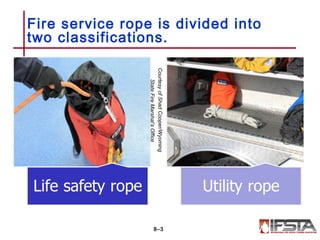
Fire service rope is divided into
two classifications.
8–3
CourtesyofShadCooper/Wyoming
StateFireMarshal’sOffice
NFPA®
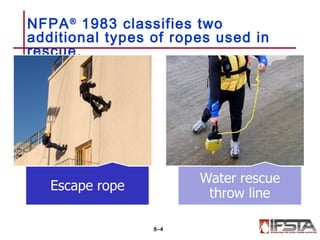
1983 classifies two
additional types of ropes used in
rescue.
8–4
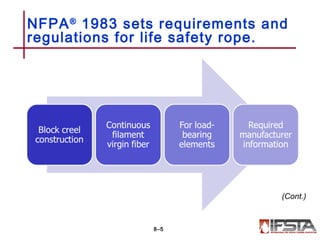
NFPA®
1983 sets requirements and
regulations for life safety rope.
8–5
(Cont.)
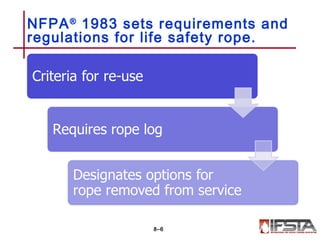
NFPA®
1983 sets requirements and
regulations for life safety rope.
8–6
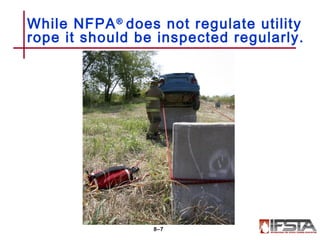
While NFPA®
does not regulate utility
rope it should be inspected regularly.
8–7
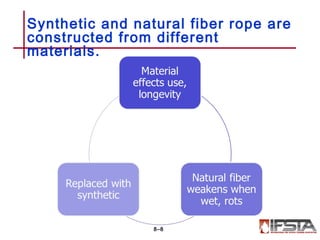
Synthetic and natural fiber rope are
constructed from different
materials.
8–8
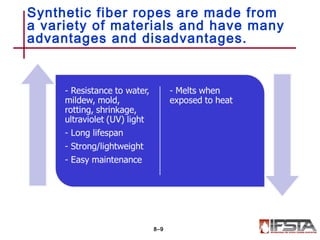
Synthetic fiber ropes are made from
a variety of materials and have many
advantages and disadvantages.
8–9
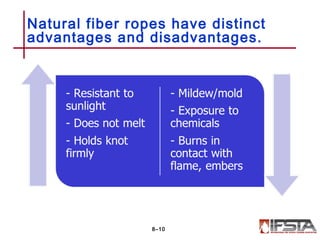
Natural fiber ropes have distinct
advantages and disadvantages.
8–10
REVIEW QUESTION
What are the differences in the
characteristics of life safety and utility
rope?
8–11
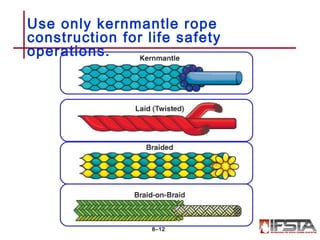
Use only kernmantle rope
construction for life safety
operations.
8–12
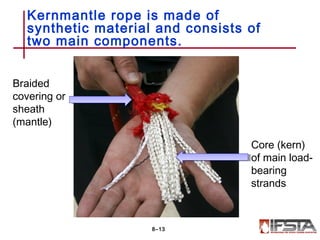
Kernmantle rope is made of
synthetic material and consists of
two main components.
8–13
Braided
covering or
sheath
(mantle)
Core (kern)
of main load-
bearing
strands
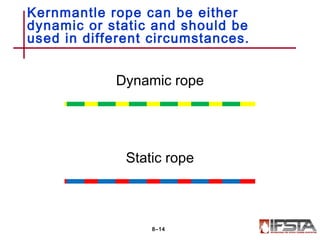
Kernmantle rope can be either
dynamic or static and should be
used in different circumstances.
8–14
Dynamic rope
Static rope
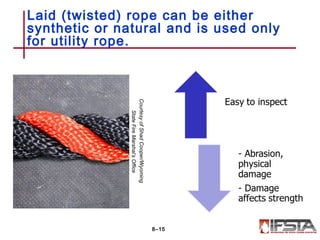
Laid (twisted) rope can be either
synthetic or natural and is used only
for utility rope.
8–15
CourtesyofShadCooper/Wyoming
StateFireMarshal’sOffice
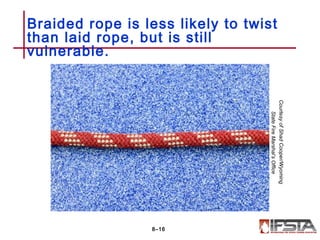
Braided rope is less likely to twist
than laid rope, but is still
vulnerable.
8–16
CourtesyofShadCooper/Wyoming
StateFireMarshal’sOffice
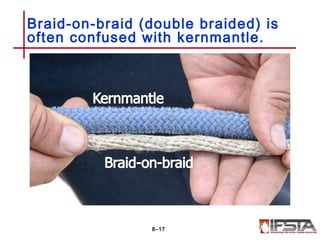
Braid-on-braid (double braided) is
often confused with kernmantle.
8–17
Summarize basic guidelines for rope
maintenance.
Learning Objective 2
8–18
Explain reasons for placing rope out
of service.
Learning Objective 3
8–19
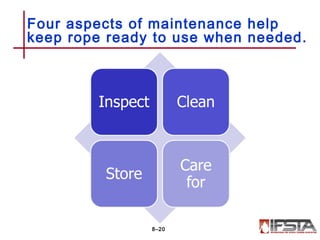
Four aspects of maintenance help
keep rope ready to use when needed.
8–20
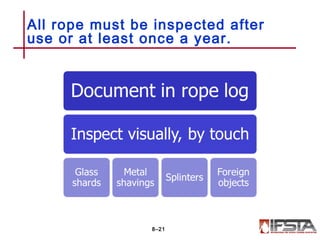
All rope must be inspected after
use or at least once a year.
8–21
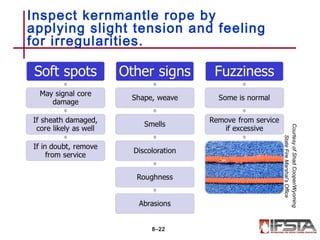
Inspect kernmantle rope by
applying slight tension and feeling
for irregularities.
8–22
CourtesyofShadCooper/Wyoming
StateFireMarshal’sOffice
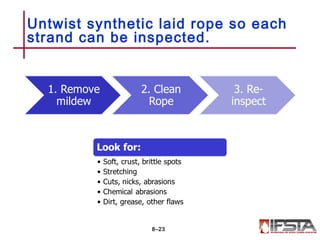
Untwist synthetic laid rope so each
strand can be inspected.
8–23
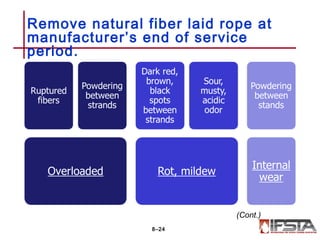
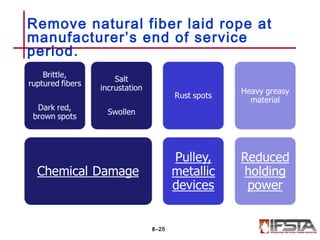
Remove natural fiber laid rope at
manufacturer’s end of service
period.
8–24
(Cont.)
Remove natural fiber laid rope at
manufacturer’s end of service
period.
8–25
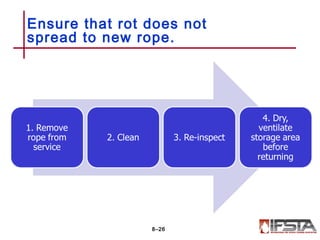
Ensure that rot does not
spread to new rope.
8–26
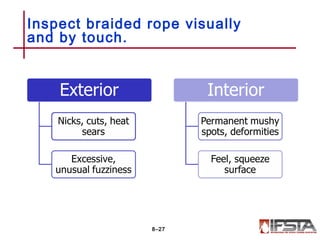
Inspect braided rope visually
and by touch.
8–27
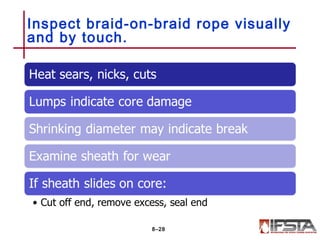
Inspect braid-on-braid rope visually
and by touch.
8–28
REVIEW QUESTION
What are the basic guidelines for
rope maintenance?
8–29
Avoid abrasion and unnecessary
wear while using any type of rope.
8–30
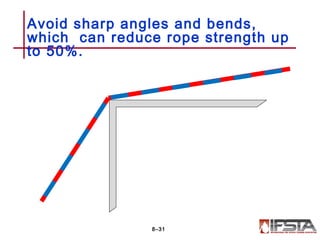
Avoid sharp angles and bends,
which can reduce rope strength up
to 50%.
8–31
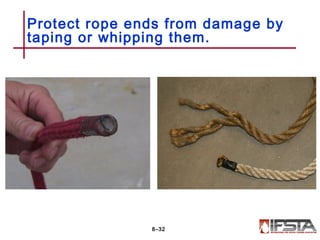
Protect rope ends from damage by
taping or whipping them.
8–32
Avoid exposing rope to sustained
loads.
8–33
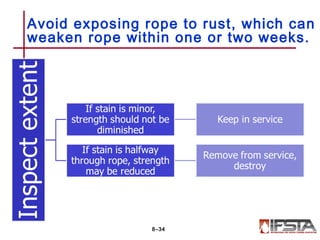
Avoid exposing rope to rust, which can
weaken rope within one or two weeks.
8–34
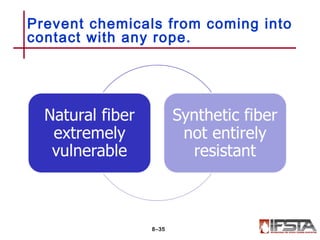
Prevent chemicals from coming into
contact with any rope.
8–35
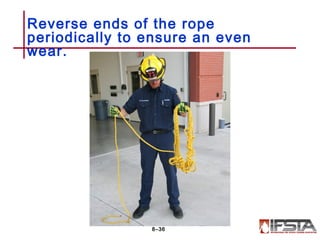
Reverse ends of the rope
periodically to ensure an even
wear.
8–36
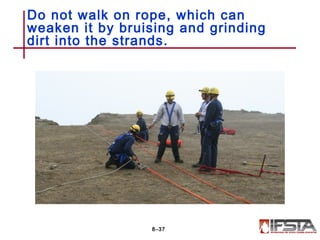
Do not walk on rope, which can
weaken it by bruising and grinding
dirt into the strands.
8–37
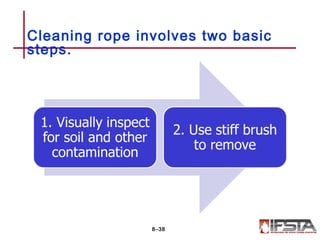
Cleaning rope involves two basic
steps.
8–38
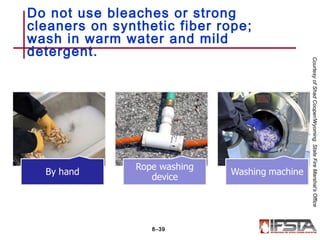
Do not use bleaches or strong
cleaners on synthetic fiber rope;
wash in warm water and mild
detergent.
8–39
CourtesyofShadCooper/WyomingStateFireMarshal’sOffice
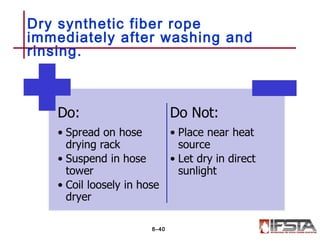
Dry synthetic fiber rope
immediately after washing and
rinsing.
8–40
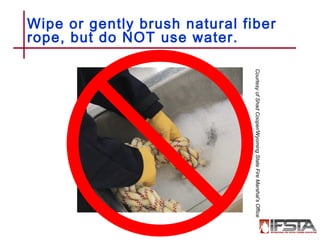
Wipe or gently brush natural fiber
rope, but do NOT use water.
8–41
CourtesyofShadCooper/WyomingStateFireMarshal’sOffice
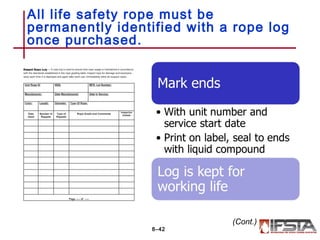
All life safety rope must be
permanently identified with a rope log
once purchased.
8–42
(Cont.)
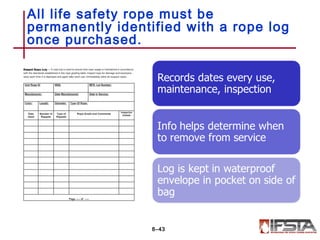
All life safety rope must be
permanently identified with a rope log
once purchased.
8–43
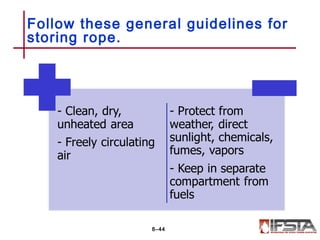
Follow these general guidelines for
storing rope.
8–44
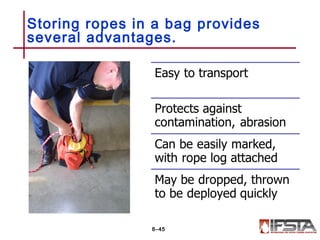
Storing ropes in a bag provides
several advantages.
8–45
REVIEW QUESTION
Why would a rope need to be placed
out of service?
8–46
Describe webbing and webbing
construction.
Learning Objective 4
8–47
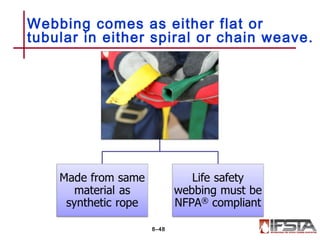
Webbing comes as either flat or
tubular in either spiral or chain weave.
8–48
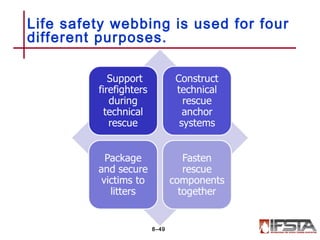
Life safety webbing is used for four
different purposes.
8–49
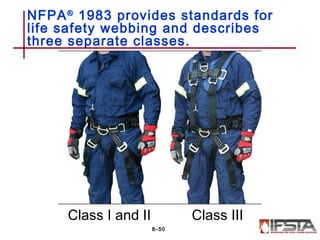
NFPA®
1983 provides standards for
life safety webbing and describes
three separate classes.
8–50
Class I and II Class III
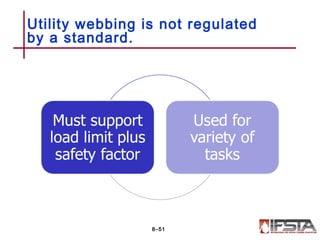
Utility webbing is not regulated
by a standard.
8–51
REVIEW QUESTION
What are the two main uses for
webbing?
8–52
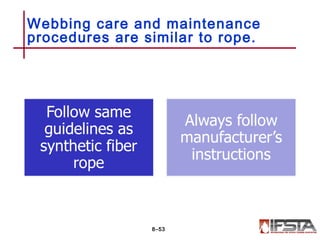
Webbing care and maintenance
procedures are similar to rope.
8–53
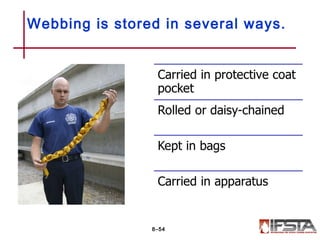
Webbing is stored in several ways.
8–54
Describe parts of a rope and
considerations in tying a knot.
Learning Objective 5
8–55
Describe knot characteristics and
knot elements.
Learning Objective 6
8–56
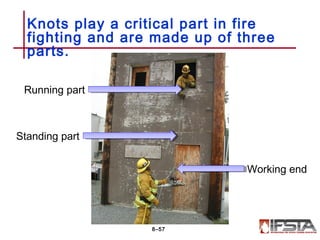
Knots play a critical part in fire
fighting and are made up of three
parts.
8–57
Working end
Standing part
Running part
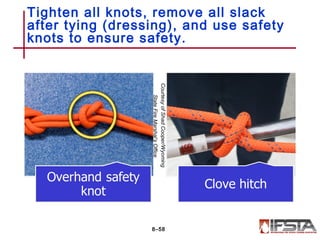
Tighten all knots, remove all slack
after tying (dressing), and use safety
knots to ensure safety.
8–58
CourtesyofShadCooper/Wyoming
StateFireMarshal’sOffice
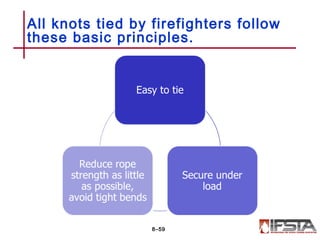
All knots tied by firefighters follow
these basic principles.
8–59
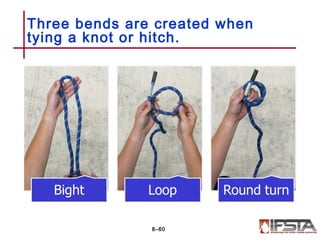
Three bends are created when
tying a knot or hitch.
8–60
REVIEW QUESTION
What are the three parts of a knot?
8–61
Describe characteristics of knots
commonly used in the fire service.
Learning Objective 7
8–62
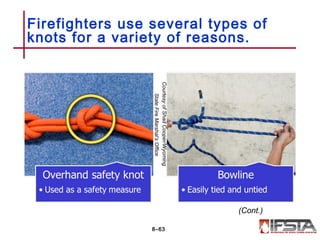
Firefighters use several types of
knots for a variety of reasons.
8–63
(Cont.)
CourtesyofShadCooper/Wyoming
StateFireMarshal’sOffice
Firefighters use several types of
knots for a variety of reasons.
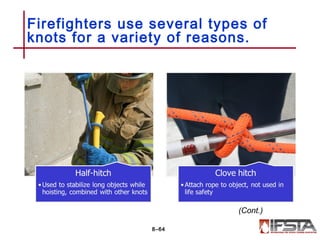
8–64
(Cont.)
Firefighters use several types of
knots for a variety of reasons.
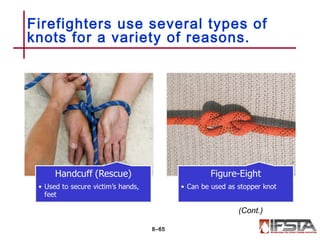
8–65
(Cont.)
Firefighters use several types of
knots for a variety of reasons.
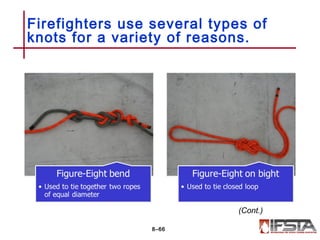
8–66
(Cont.)
Firefighters use several types of
knots for a variety of reasons.
8–67
(Cont.)
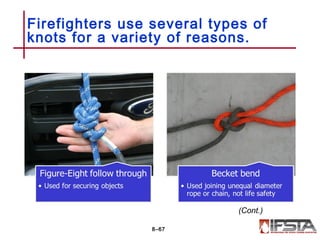
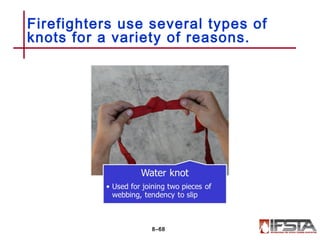
Firefighters use several types of
knots for a variety of reasons.
8–68
REVIEW QUESTION
What are the three main elements of
a knot that can be combined to
create knots and hitches?
8–69
Select commonly used rope
hardware for specific applications.
Learning Objective 8
8–70
Summarize hoisting safety
considerations.
Learning Objective 9
8–71
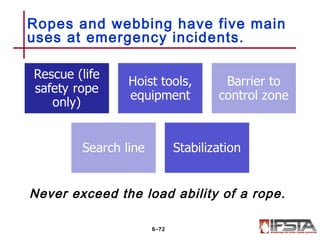
Ropes and webbing have five main
uses at emergency incidents.
8–72
Never exceed the load ability of a rope.
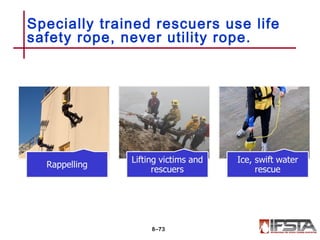
Specially trained rescuers use life
safety rope, never utility rope.
8–73
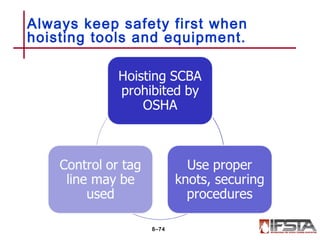
Always keep safety first when
hoisting tools and equipment.
8–74
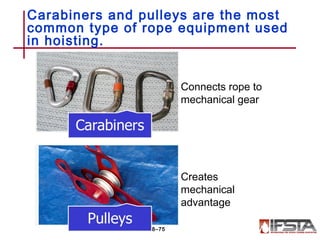
Carabiners and pulleys are the most
common type of rope equipment used
in hoisting.
8–75
Connects rope to
mechanical gear
Creates
mechanical
advantage
REVIEW QUESTION
What kinds of rope hardware may
be encountered when hoisting using
rope?
8–76
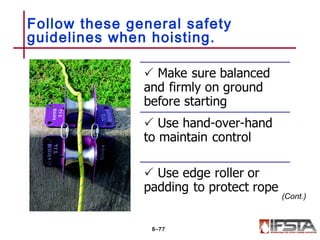
Follow these general safety
guidelines when hoisting.
8–77
(Cont.)
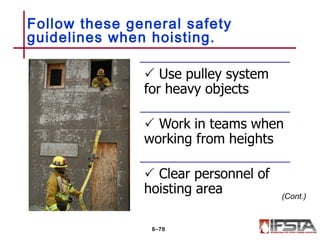
Follow these general safety
guidelines when hoisting.
8–78
(Cont.)
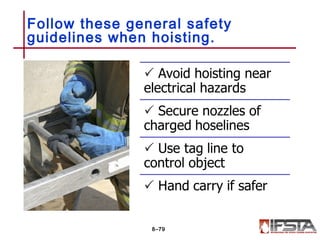
Follow these general safety
guidelines when hoisting.
8–79
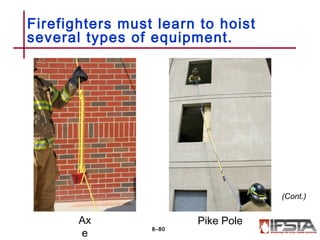
Firefighters must learn to hoist
several types of equipment.
8–80
(Cont.)
Ax
e
Pike Pole
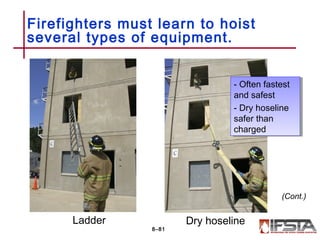
Firefighters must learn to hoist
several types of equipment.
8–81
(Cont.)
- Often fastest
and safest
- Dry hoseline
safer than
charged
- Often fastest
and safest
- Dry hoseline
safer than
charged
Ladder Dry hoseline
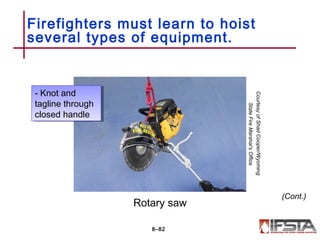
Firefighters must learn to hoist
several types of equipment.
8–82
(Cont.)
- Knot and
tagline through
closed handle
- Knot and
tagline through
closed handle
CourtesyofShadCooper/Wyoming
StateFireMarshal’sOffice
Rotary saw
REVIEW QUESTION
What are three safety guidelines
that must be used when hoisting tools
or equipment?
8–83
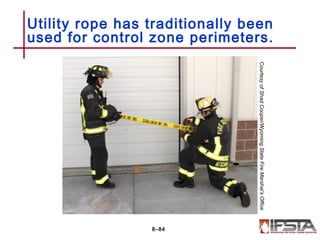
Utility rope has traditionally been
used for control zone perimeters.
8–84
CourtesyofShadCooper/WyomingStateFireMarshal’sOffice
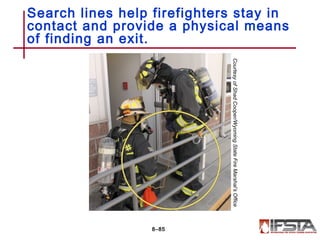
Search lines help firefighters stay in
contact and provide a physical means
of finding an exit.
8–85 CourtesyofShadCooper/WyomingStateFireMarshal’sOffice
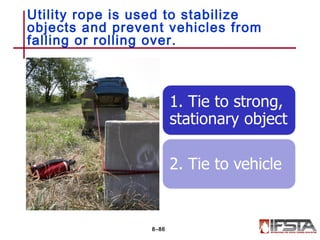
Utility rope is used to stabilize
objects and prevent vehicles from
falling or rolling over.
8–86
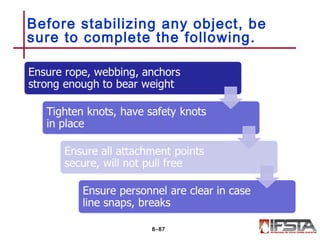
Before stabilizing any object, be
sure to complete the following.
8–87
• Firefighters use rope and webbing to
hoist tools and equipment, stabilize
objects, designate control zones,
perform rescues, and escape from life-
threatening situations.
Summary
8–88
• To use them safely and effectively, you
must know the various types of ropes,
their applications, and how to tie a
variety of knots quickly and correctly.
• Finally, you must know how to inspect,
clean, maintain, and store ropes and
webbing so that they are ready for use
when needed.
Summary
8–89
Inspect, clean, and store a rope.
This objective is measured in Skill
Sheet 8-I-1.
Learning Objective 10
8–90
Tie an overhand knot.
This objective is measured in Skill
Sheet 8-I-2.
Learning Objective 11
8–91
Tie a bowline knot.
This objective is measured in Skill
Sheet 8-I-3.
Learning Objective 12
8–92
Tie a clove hitch.
This objective is measured in Skill
Sheet 8-I-4.
Learning Objective 13
8–93
Tie a clove hitch around an object.
This objective is measured in Skill
Sheet 8-I-5.
Learning Objective 14
8–94
Tie a handcuff (rescue) knot.
This objective is measured in Skill
Sheet 8-I-6.
Learning Objective 15
8–95
Tie a figure-eight knot.
This objective is measured in Skill
Sheet 8-I-7.
Learning Objective 16
8–96
Tie a figure-eight bend.
This objective is measured in Skill
Sheet 8-I-8.
Learning Objective 17
8–97
Tie a figure-eight on a bight.
This objective is measured in Skill
Sheet 8-I-9.
Learning Objective 18
8–98
Tie a figure-eight follow through.
This objective is measured in Skill
Sheet 8-I-10.
Learning Objective 19
8–99
Tie a Becket bend.
This objective is measured in Skill
Sheet 8-I-11.
Learning Objective 20
8–100
Tie a water knot.
This objective is measured in Skill
Sheet 8-I-12.
Learning Objective 21
8–101
Hoist an axe.
This objective is measured in Skill
Sheet 8-I-13.
Learning Objective 22
8–102
Hoist a pike pole.
This objective is measured in Skill
Sheet 8-I-14.
Learning Objective 23
8–103
Hoist a roof ladder.
This objective is measured in Skill
Sheet 8-I-15.
Learning Objective 24
8–104
Hoist a dry hoseline.
This objective is measured in Skill
Sheet 8-I-16.
Learning Objective 25
8–105
Hoist a charged hoseline.
This objective is measured in Skill
Sheet 8-I-17.
Learning Objective 26
8–106
Hoist a power saw.
This objective is measured in Skill
Sheet 8-I-18.
Learning Objective 27
8–107

Chapter 8 ffi

  • 1.
    Essentials of FireFighting 6th Edition Firefighter I Chapter 8 — Ropes, Webbing, and Knots
  • 2.
    Compare and contrastthe characteristics of life safety rope and utility rope. Learning Objective 1 8–2
  • 3.
    Fire service ropeis divided into two classifications. 8–3 CourtesyofShadCooper/Wyoming StateFireMarshal’sOffice
  • 4.
    NFPA® 1983 classifies two additionaltypes of ropes used in rescue. 8–4
  • 5.
    NFPA® 1983 sets requirementsand regulations for life safety rope. 8–5 (Cont.)
  • 6.
    NFPA® 1983 sets requirementsand regulations for life safety rope. 8–6
  • 7.
    While NFPA® does notregulate utility rope it should be inspected regularly. 8–7
  • 8.
    Synthetic and naturalfiber rope are constructed from different materials. 8–8
  • 9.
    Synthetic fiber ropesare made from a variety of materials and have many advantages and disadvantages. 8–9
  • 10.
    Natural fiber ropeshave distinct advantages and disadvantages. 8–10
  • 11.
    REVIEW QUESTION What arethe differences in the characteristics of life safety and utility rope? 8–11
  • 12.
    Use only kernmantlerope construction for life safety operations. 8–12
  • 13.
    Kernmantle rope ismade of synthetic material and consists of two main components. 8–13 Braided covering or sheath (mantle) Core (kern) of main load- bearing strands
  • 14.
    Kernmantle rope canbe either dynamic or static and should be used in different circumstances. 8–14 Dynamic rope Static rope
  • 15.
    Laid (twisted) ropecan be either synthetic or natural and is used only for utility rope. 8–15 CourtesyofShadCooper/Wyoming StateFireMarshal’sOffice
  • 16.
    Braided rope isless likely to twist than laid rope, but is still vulnerable. 8–16 CourtesyofShadCooper/Wyoming StateFireMarshal’sOffice
  • 17.
    Braid-on-braid (double braided)is often confused with kernmantle. 8–17
  • 18.
    Summarize basic guidelinesfor rope maintenance. Learning Objective 2 8–18
  • 19.
    Explain reasons forplacing rope out of service. Learning Objective 3 8–19
  • 20.
    Four aspects ofmaintenance help keep rope ready to use when needed. 8–20
  • 21.
    All rope mustbe inspected after use or at least once a year. 8–21
  • 22.
    Inspect kernmantle ropeby applying slight tension and feeling for irregularities. 8–22 CourtesyofShadCooper/Wyoming StateFireMarshal’sOffice
  • 23.
    Untwist synthetic laidrope so each strand can be inspected. 8–23
  • 24.
    Remove natural fiberlaid rope at manufacturer’s end of service period. 8–24 (Cont.)
  • 25.
    Remove natural fiberlaid rope at manufacturer’s end of service period. 8–25
  • 26.
    Ensure that rotdoes not spread to new rope. 8–26
  • 27.
    Inspect braided ropevisually and by touch. 8–27
  • 28.
    Inspect braid-on-braid ropevisually and by touch. 8–28
  • 29.
    REVIEW QUESTION What arethe basic guidelines for rope maintenance? 8–29
  • 30.
    Avoid abrasion andunnecessary wear while using any type of rope. 8–30
  • 31.
    Avoid sharp anglesand bends, which can reduce rope strength up to 50%. 8–31
  • 32.
    Protect rope endsfrom damage by taping or whipping them. 8–32
  • 33.
    Avoid exposing ropeto sustained loads. 8–33
  • 34.
    Avoid exposing ropeto rust, which can weaken rope within one or two weeks. 8–34
  • 35.
    Prevent chemicals fromcoming into contact with any rope. 8–35
  • 36.
    Reverse ends ofthe rope periodically to ensure an even wear. 8–36
  • 37.
    Do not walkon rope, which can weaken it by bruising and grinding dirt into the strands. 8–37
  • 38.
    Cleaning rope involvestwo basic steps. 8–38
  • 39.
    Do not usebleaches or strong cleaners on synthetic fiber rope; wash in warm water and mild detergent. 8–39 CourtesyofShadCooper/WyomingStateFireMarshal’sOffice
  • 40.
    Dry synthetic fiberrope immediately after washing and rinsing. 8–40
  • 41.
    Wipe or gentlybrush natural fiber rope, but do NOT use water. 8–41 CourtesyofShadCooper/WyomingStateFireMarshal’sOffice
  • 42.
    All life safetyrope must be permanently identified with a rope log once purchased. 8–42 (Cont.)
  • 43.
    All life safetyrope must be permanently identified with a rope log once purchased. 8–43
  • 44.
    Follow these generalguidelines for storing rope. 8–44
  • 45.
    Storing ropes ina bag provides several advantages. 8–45
  • 46.
    REVIEW QUESTION Why woulda rope need to be placed out of service? 8–46
  • 47.
    Describe webbing andwebbing construction. Learning Objective 4 8–47
  • 48.
    Webbing comes aseither flat or tubular in either spiral or chain weave. 8–48
  • 49.
    Life safety webbingis used for four different purposes. 8–49
  • 50.
    NFPA® 1983 provides standardsfor life safety webbing and describes three separate classes. 8–50 Class I and II Class III
  • 51.
    Utility webbing isnot regulated by a standard. 8–51
  • 52.
    REVIEW QUESTION What arethe two main uses for webbing? 8–52
  • 53.
    Webbing care andmaintenance procedures are similar to rope. 8–53
  • 54.
    Webbing is storedin several ways. 8–54
  • 55.
    Describe parts ofa rope and considerations in tying a knot. Learning Objective 5 8–55
  • 56.
    Describe knot characteristicsand knot elements. Learning Objective 6 8–56
  • 57.
    Knots play acritical part in fire fighting and are made up of three parts. 8–57 Working end Standing part Running part
  • 58.
    Tighten all knots,remove all slack after tying (dressing), and use safety knots to ensure safety. 8–58 CourtesyofShadCooper/Wyoming StateFireMarshal’sOffice
  • 59.
    All knots tiedby firefighters follow these basic principles. 8–59
  • 60.
    Three bends arecreated when tying a knot or hitch. 8–60
  • 61.
    REVIEW QUESTION What arethe three parts of a knot? 8–61
  • 62.
    Describe characteristics ofknots commonly used in the fire service. Learning Objective 7 8–62
  • 63.
    Firefighters use severaltypes of knots for a variety of reasons. 8–63 (Cont.) CourtesyofShadCooper/Wyoming StateFireMarshal’sOffice
  • 64.
    Firefighters use severaltypes of knots for a variety of reasons. 8–64 (Cont.)
  • 65.
    Firefighters use severaltypes of knots for a variety of reasons. 8–65 (Cont.)
  • 66.
    Firefighters use severaltypes of knots for a variety of reasons. 8–66 (Cont.)
  • 67.
    Firefighters use severaltypes of knots for a variety of reasons. 8–67 (Cont.)
  • 68.
    Firefighters use severaltypes of knots for a variety of reasons. 8–68
  • 69.
    REVIEW QUESTION What arethe three main elements of a knot that can be combined to create knots and hitches? 8–69
  • 70.
    Select commonly usedrope hardware for specific applications. Learning Objective 8 8–70
  • 71.
  • 72.
    Ropes and webbinghave five main uses at emergency incidents. 8–72 Never exceed the load ability of a rope.
  • 73.
    Specially trained rescuersuse life safety rope, never utility rope. 8–73
  • 74.
    Always keep safetyfirst when hoisting tools and equipment. 8–74
  • 75.
    Carabiners and pulleysare the most common type of rope equipment used in hoisting. 8–75 Connects rope to mechanical gear Creates mechanical advantage
  • 76.
    REVIEW QUESTION What kindsof rope hardware may be encountered when hoisting using rope? 8–76
  • 77.
    Follow these generalsafety guidelines when hoisting. 8–77 (Cont.)
  • 78.
    Follow these generalsafety guidelines when hoisting. 8–78 (Cont.)
  • 79.
    Follow these generalsafety guidelines when hoisting. 8–79
  • 80.
    Firefighters must learnto hoist several types of equipment. 8–80 (Cont.) Ax e Pike Pole
  • 81.
    Firefighters must learnto hoist several types of equipment. 8–81 (Cont.) - Often fastest and safest - Dry hoseline safer than charged - Often fastest and safest - Dry hoseline safer than charged Ladder Dry hoseline
  • 82.
    Firefighters must learnto hoist several types of equipment. 8–82 (Cont.) - Knot and tagline through closed handle - Knot and tagline through closed handle CourtesyofShadCooper/Wyoming StateFireMarshal’sOffice Rotary saw
  • 83.
    REVIEW QUESTION What arethree safety guidelines that must be used when hoisting tools or equipment? 8–83
  • 84.
    Utility rope hastraditionally been used for control zone perimeters. 8–84 CourtesyofShadCooper/WyomingStateFireMarshal’sOffice
  • 85.
    Search lines helpfirefighters stay in contact and provide a physical means of finding an exit. 8–85 CourtesyofShadCooper/WyomingStateFireMarshal’sOffice
  • 86.
    Utility rope isused to stabilize objects and prevent vehicles from falling or rolling over. 8–86
  • 87.
    Before stabilizing anyobject, be sure to complete the following. 8–87
  • 88.
    • Firefighters userope and webbing to hoist tools and equipment, stabilize objects, designate control zones, perform rescues, and escape from life- threatening situations. Summary 8–88
  • 89.
    • To usethem safely and effectively, you must know the various types of ropes, their applications, and how to tie a variety of knots quickly and correctly. • Finally, you must know how to inspect, clean, maintain, and store ropes and webbing so that they are ready for use when needed. Summary 8–89
  • 90.
    Inspect, clean, andstore a rope. This objective is measured in Skill Sheet 8-I-1. Learning Objective 10 8–90
  • 91.
    Tie an overhandknot. This objective is measured in Skill Sheet 8-I-2. Learning Objective 11 8–91
  • 92.
    Tie a bowlineknot. This objective is measured in Skill Sheet 8-I-3. Learning Objective 12 8–92
  • 93.
    Tie a clovehitch. This objective is measured in Skill Sheet 8-I-4. Learning Objective 13 8–93
  • 94.
    Tie a clovehitch around an object. This objective is measured in Skill Sheet 8-I-5. Learning Objective 14 8–94
  • 95.
    Tie a handcuff(rescue) knot. This objective is measured in Skill Sheet 8-I-6. Learning Objective 15 8–95
  • 96.
    Tie a figure-eightknot. This objective is measured in Skill Sheet 8-I-7. Learning Objective 16 8–96
  • 97.
    Tie a figure-eightbend. This objective is measured in Skill Sheet 8-I-8. Learning Objective 17 8–97
  • 98.
    Tie a figure-eighton a bight. This objective is measured in Skill Sheet 8-I-9. Learning Objective 18 8–98
  • 99.
    Tie a figure-eightfollow through. This objective is measured in Skill Sheet 8-I-10. Learning Objective 19 8–99
  • 100.
    Tie a Becketbend. This objective is measured in Skill Sheet 8-I-11. Learning Objective 20 8–100
  • 101.
    Tie a waterknot. This objective is measured in Skill Sheet 8-I-12. Learning Objective 21 8–101
  • 102.
    Hoist an axe. Thisobjective is measured in Skill Sheet 8-I-13. Learning Objective 22 8–102
  • 103.
    Hoist a pikepole. This objective is measured in Skill Sheet 8-I-14. Learning Objective 23 8–103
  • 104.
    Hoist a roofladder. This objective is measured in Skill Sheet 8-I-15. Learning Objective 24 8–104
  • 105.
    Hoist a dryhoseline. This objective is measured in Skill Sheet 8-I-16. Learning Objective 25 8–105
  • 106.
    Hoist a chargedhoseline. This objective is measured in Skill Sheet 8-I-17. Learning Objective 26 8–106
  • 107.
    Hoist a powersaw. This objective is measured in Skill Sheet 8-I-18. Learning Objective 27 8–107