ESSENTIAL ELEMENTS OF A
MANAGED FALL PROTECTION
               PROGRAM
  TRACEY RIEPENHOFF, P.E., C.S.P., P.M.P. - PRINCIPAL
        TRiepenhoff@LJBInc.com; Phone: (419) 225-5995
                                         MARCH 2012
INTRODUCTION

Tracey Riepenhoff, P.E., C.S.P., P.M.P.
 > Principal in LJB Safety division
 > 20 years experience in fall protection industry
 > Past member: ANSI Z359 Committee
 > ASSE Top 100 Women in Safety
 > Frequent speaker at regional and national
   conferences


                                                          2
BOTTOM LINE UPFRONT

The difference between an effective and an ineffective program
can be the difference between life and death.


                                                                 3
LEARNING OBJECTIVES

Discuss the core elements of a fall protection program
Apply the Hierarchy of Control when evaluating and controlling
fall hazards
List common uses and limitations of PPE
Identify action steps to improve an existing fall protection
program


                                                                 4
CALL TO ACTION


1. Evaluate your current practice for fall hazard identification
    •   Existing hazards
    •   Future hazards
2. Determine how abatement solutions are selected
3. Identify who needs competent person training


                                                                   5
PROGRAM CORE ELEMENTS

Management leadership and employee participation
Hazard identification and evaluation
Hazard abatement
Training
Program evaluation


                                                   6
PROGRAM CORE ELEMENTS

Management leadership and employee participation
Hazard identification and evaluation
Hazard abatement
Training
Program evaluation


                                                   7
WHAT DO YOU LOOK FOR?


Fall hazard categories
> Means of access
> Locations
> Tasks
> Improper use of PPE


                                      8
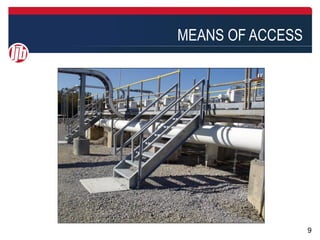
MEANS OF ACCESS


                  9
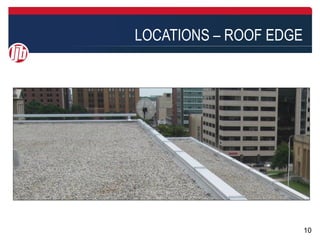
LOCATIONS – ROOF EDGE


                        10
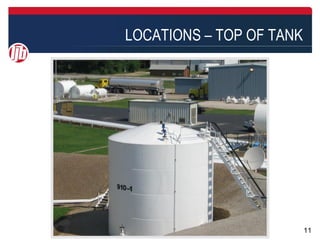
LOCATIONS – TOP OF TANK


                          11
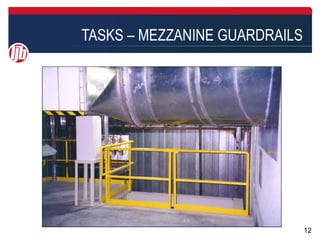
TASKS – MEZZANINE GUARDRAILS


                               12
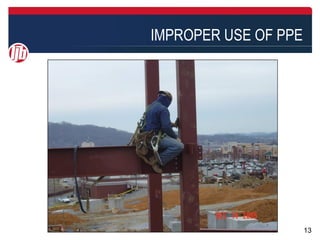
IMPROPER USE OF PPE


                      13
14
15
16
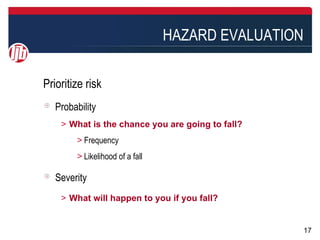
HAZARD EVALUATION

Prioritize risk
   Probability
    > What is the chance you are going to fall?
        >Frequency
        >Likelihood of a fall

   Severity
    > What will happen to you if you fall?


                                                    17
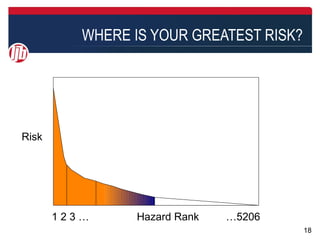
WHERE IS YOUR GREATEST RISK?


Risk


       123…     Hazard Rank   …5206
                                         18
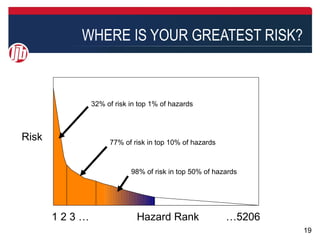
WHERE IS YOUR GREATEST RISK?


              32% of risk in top 1% of hazards


Risk               77% of risk in top 10% of hazards


                          98% of risk in top 50% of hazards


       123…                 Hazard Rank                …5206
                                                               19
PROGRAM CORE ELEMENTS

Management leadership and employee participation
Hazard identification and evaluation
Hazard abatement
Training
Program evaluation


                                                   20
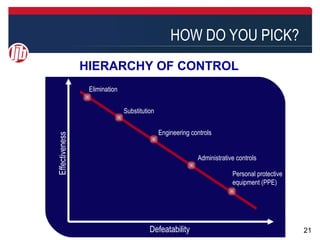
HOW DO YOU PICK?
                HIERARCHY OF CONTROL
                 Elimination


                               Substitution


                                              Engineering controls
Effectiveness


                                                            Administrative controls

                                                                         Personal protective
                                                                         equipment (PPE)


                                         Defeatability                                         21
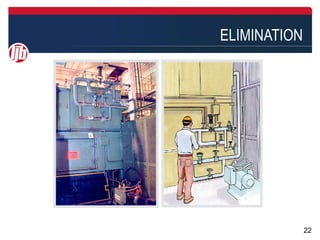
ELIMINATION


BEFORE   AFTER

                           22
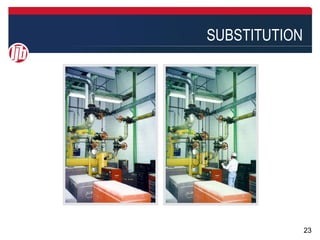
SUBSTITUTION


BEFORE   AFTER

                        23
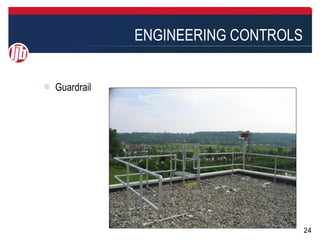
ENGINEERING CONTROLS


Guardrail


                                   24
ABCs (& R) WHEN USING PPE


A     = Anchorage

B     = Body support

C     = Connecting means

R     = Rescue


                                25
ABCs (& R)

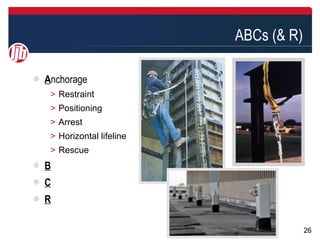
Anchorage
> Restraint
> Positioning
> Arrest
> Horizontal lifeline
> Rescue
B
C
R

                                     26
ABCs (& R)

Anchorage
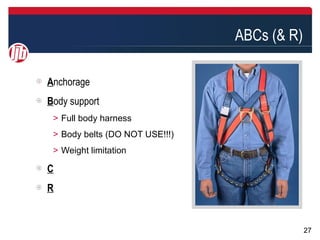
Body support
> Full body harness
> Body belts (DO NOT USE!!!)
> Weight limitation

C
R


                                            27
ABCs (& R)

Anchorage
Body support
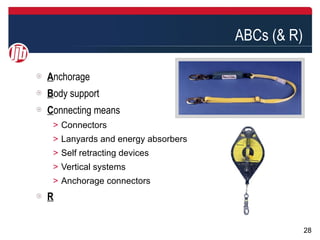
Connecting means
> Connectors
> Lanyards and energy absorbers
> Self retracting devices
> Vertical systems
> Anchorage connectors
R


                                               28
NEW EQUIPMENT STANDARDS

1.   ANSI Z359.12-2009: connectors
2.   ANSI Z359.13-2009: energy absorbers and lanyards
3.   ANSI Z359.14-2012: self-retracting devices
4.   ANSI Z359.17-20XX: horizontal lifelines
5.   ANSI Z359.11-20XX: harnesses
6.   At least three others in coming years.


Available from www.asse.org
                                                        29
ABCs (& R)

Anchorage
Body support
Connecting means
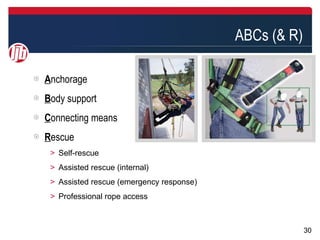
Rescue
> Self-rescue
> Assisted rescue (internal)
> Assisted rescue (emergency response)
> Professional rope access


                                                      30
PROMPT RESCUE

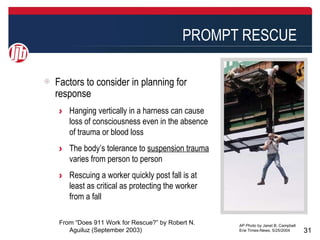
Factors to consider in planning for
response
 > Hanging vertically in a harness can cause
   loss of consciousness even in the absence
   of trauma or blood loss
 > The body’s tolerance to suspension trauma
   varies from person to person
 > Rescuing a worker quickly post fall is at
   least as critical as protecting the worker
   from a fall

 From “Does 911 Work for Rescue?” by Robert N.   AP Photo by Janet B. Campbell
    Aguiluz (September 2003)                     Erie Times-News, 5/25/2004      31
FALL ARREST: RESIDUAL RISK

Inappropriate anchorage
Fall distance
Swing fall
Equipment malfunction / failure
Maximum arrest force
Post-fall suspension time
Rescue

                                             32
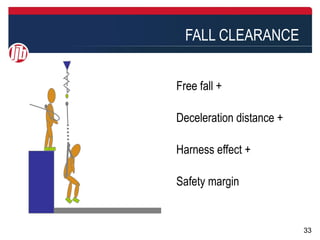
FALL CLEARANCE


Free fall +

Deceleration distance +

Harness effect +

Safety margin


                          33
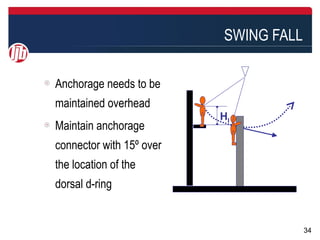
SWING FALL

Anchorage needs to be
maintained overhead
                          HI
Maintain anchorage
connector with 15º over
the location of the
dorsal d-ring


                                       34
EQUIPMENT INSPECTION

Types
1.   Pre-use: daily when used
2.   Formal: every 6 to 12 months
3.   Incident: as part of incident investigation


                                                   35
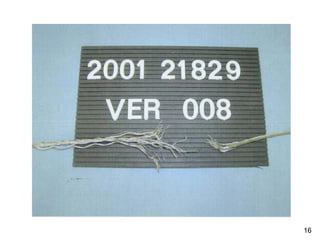
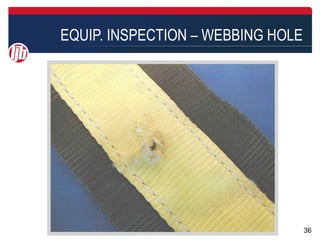
EQUIP. INSPECTION – WEBBING HOLE


                                   36
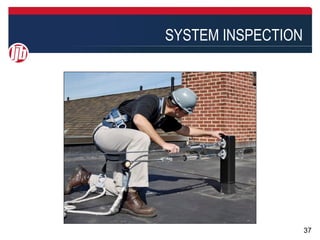
SYSTEM INSPECTION


                    37
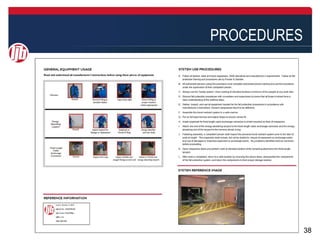
PROCEDURES


             38
PROGRAM CORE ELEMENTS


Management leadership and employee participation
Hazard identification and evaluation
Hazard abatement
Training
Program evaluation


                                                   39
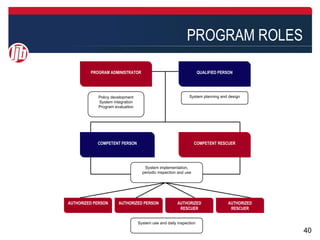
PROGRAM ROLES

         PROGRAM ADMINISTRATOR                                     QUALIFIED PERSON


            Policy development                               System planning and design
            System integration
            Program evaluation


            COMPETENT PERSON                                     COMPETENT RESCUER


                                    System implementation,
                                   periodic inspection and use


AUTHORIZED PERSON     AUTHORIZED PERSON               AUTHORIZED                AUTHORIZED
                                                       RESCUER                   RESCUER


                                 System use and daily inspection

                                                                                             40
DO YOU HAVE THESE?

Training programs
  Awareness
  Authorized person
   > System-specific

  Competent person
  Qualified person
  Rescue


                                            41
PROGRAM CORE ELEMENTS

Management leadership and employee participation
Hazard identification and evaluation
Hazard abatement
Training
Program evaluation


                                                   42
CALL TO ACTION


1. Evaluate your current practice for fall hazard identification
    •   Existing hazards
    •   Future hazards
2. Determine how abatement solutions are selected
3. Identify who needs competent person training


                                                                   43
THANK YOU FOR JOINING US


Blog
 > LJBfallprotectionblog.com

Past webinars
 > Slideshare.net/kmesser

Twitter
 > @LJBInc

YouTube channel
 > Youtube.com/LJBinc


                                                44

Essential Elements of a Managed Fall Protection Program

  • 1.
    ESSENTIAL ELEMENTS OFA MANAGED FALL PROTECTION PROGRAM TRACEY RIEPENHOFF, P.E., C.S.P., P.M.P. - PRINCIPAL TRiepenhoff@LJBInc.com; Phone: (419) 225-5995 MARCH 2012
  • 2.
    INTRODUCTION Tracey Riepenhoff, P.E.,C.S.P., P.M.P. > Principal in LJB Safety division > 20 years experience in fall protection industry > Past member: ANSI Z359 Committee > ASSE Top 100 Women in Safety > Frequent speaker at regional and national conferences 2
  • 3.
    BOTTOM LINE UPFRONT Thedifference between an effective and an ineffective program can be the difference between life and death. 3
  • 4.
    LEARNING OBJECTIVES Discuss thecore elements of a fall protection program Apply the Hierarchy of Control when evaluating and controlling fall hazards List common uses and limitations of PPE Identify action steps to improve an existing fall protection program 4
  • 5.
    CALL TO ACTION 1.Evaluate your current practice for fall hazard identification • Existing hazards • Future hazards 2. Determine how abatement solutions are selected 3. Identify who needs competent person training 5
  • 6.
    PROGRAM CORE ELEMENTS Managementleadership and employee participation Hazard identification and evaluation Hazard abatement Training Program evaluation 6
  • 7.
    PROGRAM CORE ELEMENTS Managementleadership and employee participation Hazard identification and evaluation Hazard abatement Training Program evaluation 7
  • 8.
    WHAT DO YOULOOK FOR? Fall hazard categories > Means of access > Locations > Tasks > Improper use of PPE 8
  • 9.
  • 10.
  • 11.
  • 12.
    TASKS – MEZZANINEGUARDRAILS 12
  • 13.
  • 14.
  • 15.
  • 16.
  • 17.
    HAZARD EVALUATION Prioritize risk Probability > What is the chance you are going to fall? >Frequency >Likelihood of a fall Severity > What will happen to you if you fall? 17
  • 18.
    WHERE IS YOURGREATEST RISK? Risk 123… Hazard Rank …5206 18
  • 19.
    WHERE IS YOURGREATEST RISK? 32% of risk in top 1% of hazards Risk 77% of risk in top 10% of hazards 98% of risk in top 50% of hazards 123… Hazard Rank …5206 19
  • 20.
    PROGRAM CORE ELEMENTS Managementleadership and employee participation Hazard identification and evaluation Hazard abatement Training Program evaluation 20
  • 21.
    HOW DO YOUPICK? HIERARCHY OF CONTROL Elimination Substitution Engineering controls Effectiveness Administrative controls Personal protective equipment (PPE) Defeatability 21
  • 22.
  • 23.
  • 24.
  • 25.
    ABCs (& R)WHEN USING PPE A = Anchorage B = Body support C = Connecting means R = Rescue 25
  • 26.
    ABCs (& R) Anchorage >Restraint > Positioning > Arrest > Horizontal lifeline > Rescue B C R 26
  • 27.
    ABCs (& R) Anchorage Bodysupport > Full body harness > Body belts (DO NOT USE!!!) > Weight limitation C R 27
  • 28.
    ABCs (& R) Anchorage Bodysupport Connecting means > Connectors > Lanyards and energy absorbers > Self retracting devices > Vertical systems > Anchorage connectors R 28
  • 29.
    NEW EQUIPMENT STANDARDS 1. ANSI Z359.12-2009: connectors 2. ANSI Z359.13-2009: energy absorbers and lanyards 3. ANSI Z359.14-2012: self-retracting devices 4. ANSI Z359.17-20XX: horizontal lifelines 5. ANSI Z359.11-20XX: harnesses 6. At least three others in coming years. Available from www.asse.org 29
  • 30.
    ABCs (& R) Anchorage Bodysupport Connecting means Rescue > Self-rescue > Assisted rescue (internal) > Assisted rescue (emergency response) > Professional rope access 30
  • 31.
    PROMPT RESCUE Factors toconsider in planning for response > Hanging vertically in a harness can cause loss of consciousness even in the absence of trauma or blood loss > The body’s tolerance to suspension trauma varies from person to person > Rescuing a worker quickly post fall is at least as critical as protecting the worker from a fall From “Does 911 Work for Rescue?” by Robert N. AP Photo by Janet B. Campbell Aguiluz (September 2003) Erie Times-News, 5/25/2004 31
  • 32.
    FALL ARREST: RESIDUALRISK Inappropriate anchorage Fall distance Swing fall Equipment malfunction / failure Maximum arrest force Post-fall suspension time Rescue 32
  • 33.
    FALL CLEARANCE Free fall+ Deceleration distance + Harness effect + Safety margin 33
  • 34.
    SWING FALL Anchorage needsto be maintained overhead HI Maintain anchorage connector with 15º over the location of the dorsal d-ring 34
  • 35.
    EQUIPMENT INSPECTION Types 1. Pre-use: daily when used 2. Formal: every 6 to 12 months 3. Incident: as part of incident investigation 35
  • 36.
    EQUIP. INSPECTION –WEBBING HOLE 36
  • 37.
  • 38.
  • 39.
    PROGRAM CORE ELEMENTS Managementleadership and employee participation Hazard identification and evaluation Hazard abatement Training Program evaluation 39
  • 40.
    PROGRAM ROLES PROGRAM ADMINISTRATOR QUALIFIED PERSON Policy development System planning and design System integration Program evaluation COMPETENT PERSON COMPETENT RESCUER System implementation, periodic inspection and use AUTHORIZED PERSON AUTHORIZED PERSON AUTHORIZED AUTHORIZED RESCUER RESCUER System use and daily inspection 40
  • 41.
    DO YOU HAVETHESE? Training programs Awareness Authorized person > System-specific Competent person Qualified person Rescue 41
  • 42.
    PROGRAM CORE ELEMENTS Managementleadership and employee participation Hazard identification and evaluation Hazard abatement Training Program evaluation 42
  • 43.
    CALL TO ACTION 1.Evaluate your current practice for fall hazard identification • Existing hazards • Future hazards 2. Determine how abatement solutions are selected 3. Identify who needs competent person training 43
  • 44.
    THANK YOU FORJOINING US Blog > LJBfallprotectionblog.com Past webinars > Slideshare.net/kmesser Twitter > @LJBInc YouTube channel > Youtube.com/LJBinc 44

Editor's Notes

  • #3 Discuss how I love fall protection. While it is something that is just a part of your job, I, as well as many other at LJB, have dedicated our career to this topic. That is the reasons you see that I am registered as a PE and CSP. In fp, you never have a project that is completely safety or completely engineering. No matter what the solution, there are always aspects of both that need to be considered. For example for a personal fall arrest system, there are obvious structural aspects like the design of the rail or horizontal lifeline to which you attach, the connection to thee building structure, the building structure itself. On the other hand, making sure that a fall arrest system should even be used, is a safety related item. Same as specifying the correct equipment, procedures and training.
  • #7 First put on harnesses – awkward 2 rescues PPE rescue from fall Get to medical attention 2 pts. rescue (pre-plan) anchorage
  • #8 First put on harnesses – awkward 2 rescues PPE rescue from fall Get to medical attention 2 pts. rescue (pre-plan) anchorage
  • #9 Most of these items are taken from OSHA’s description of typical hazards encountered.
  • #10 Employees generally do a good job of not climbing ladders with materials in their hands, although when they get to the top of the ladder, they reach over the edge to haul up the material. Also, if there is a group of people accessing the roof, they tend to gather at the ladder whether they are ascending or descending the ladder.
  • #18 Question to class: How far away from a fall hazard is considered safe? 6’? 10’? Actually, OSHA does not give a distance and considers any WWS without fall protection a hazard. Discuss 6’ and 10’ distances and exposure to hazard based on discussions with OSHA.
  • #21 First put on harnesses – awkward 2 rescues PPE rescue from fall Get to medical attention 2 pts. rescue (pre-plan) anchorage
  • #30 Agenda for this module
  • #35 Agenda for this module
  • #36 Agenda for this module
  • #37 Ask “which part of strap is load bearing, which is for abrasion protection?” “If there was just a hole in just the abrasion webbing, would you pass it?” Possibly not.
  • #40 First put on harnesses – awkward 2 rescues PPE rescue from fall Get to medical attention 2 pts. rescue (pre-plan) anchorage
  • #43 First put on harnesses – awkward 2 rescues PPE rescue from fall Get to medical attention 2 pts. rescue (pre-plan) anchorage
  • #45 I edited this slide to make it easier to process/remember.